And God said, Let the waters bring forth abundantly the moving creature that hath life, and fowl that may fly above the earth in the open firmament of heaven. (Genesis 1:20 KJV)
Words: Charles Coffin, Paris Breviary, 1736 (Iisdem creati fluctibus); translated from Latin to English by John Chandler and the compilers of Hymns Ancient and Modern.
Music:St. Flavian, Day’s Psalter, 1563
The Fish in Wave, The Bird on Wing
The fish in wave, the bird on wing,
God bade the waters bear;
Each for our mortal body’s food
His gracious hands prepare.
But other food, of richer cost,
The immortal spirit needs;
By faith it lives on every word
That from His mouth proceeds.
Faith springing from the blood of Christ,
Has flowed o’er every land;
And sinners through the vanquished world
Bow down to its command.
Its light the joy of Heav’n reveals
To hearts made pure within;
And bids them seek by worthy deeds
Eternal crowns to win.
By faith the saints of old were strong
The lion’s wrath to tame;
By faith they spurned the tyrant’s threats,
And scorned the raging flame.
Lord, grant that we the path may tread
Whereon its light doth shine;
And gather, as we onward go,
The fruits of love divine.
O praise the Father; praise the Son,
On Whose most precious blood
Rests all our faith; and praise to Him
Who with Them both is God.
The Pompadour Cotinga – Concealed incubators… ~ by a j mithra
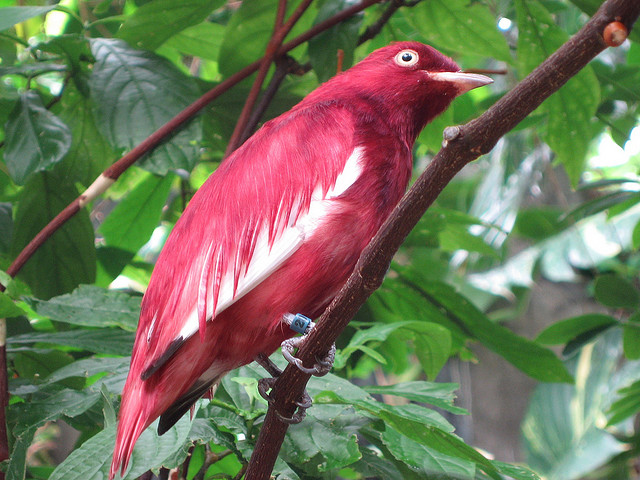
The Pompadour Cotingas are South American birds from the Cotingidae family. They are found in Brazil, Columbia, French Guiana, Guyana, Peru, Suriname, and Venezuela.
They reside in elevations to 1300 m which occur throughout Amazonia. The primary range extends from Columbia eastward to French Guiana and south to north-west Brazil. It is found in the canopy of humid forest and seems to be more numerous in areas of sandy soil forest.
Sand is used most often as a symbol of countless multitudes; especially of the children of Israel and of God’s thoughts on us and also of the wisdom and understanding that God gave King Solomon..
Is that the reason why these beautiful birds are more numerous in areas of sandy soil forest?
They know that Their creator is so mindful of them…
How precious also are thy thoughts unto me, O God! how great is the sum of them! If I should count them, they are more in number than the sand: when I awake, I am still with thee. (Psalm 139:17, 18)
During breeding season males gather to perform a ritualized flight display to attract a female. Two or three males will chase each other around a group of tree tops, keeping above the trees so that their white wings flashing against the dark foliage are visible for a great distance. The males are relatively easy to see even at a distance with their white wings flashing as they fly from tree to tree. Females sometimes join mixed canopy flocks but males appear to be more solitary…
Pompadour Cotinga (Xipholena punicea) female by AGrosset
It is not uncommon for the clutch to contain a single egg. The eggs are a greenish gray with drab spotting. Frail open nests of curly wood tendrils completely conceal the female while she incubates. Little is known about their breeding habits because it occurs high up in the forest canopy.
God closed the door of the Ark and concealed Noah his family and the wildlife as well..
God’s plan in our lives are planned high above in the heavens where no one can see..
His ways are not our ways and our ways are not His..
Please read through Isaiah 39 and you will learn how King Hezekiah brought curse over his family when he showed off all his treasure to the envoys of Babylon so as to win favour from them..
Do not show off God’s blessings over your life to the others to win favour but just conceal yourself like these birds..
God has concealed us in His palm so wait until He shows us off to the world..
Humble yourselves therefore under the mighty hand of God, that he may exalt you in due time: (I Peter 5:6)
The bride, the Church, needs to completely conceal itself while it incubates God’s will…
But you, when you pray, enter into your closet, and when you have shut your door, pray to your Father which is in secret; and your Father which sees in secret shall reward you openly. (Mathew 6:6)
A considerable number of these birds are remarkable for the extraordinarily abnormal form of some of their wing-quills, and occasionally of their wing-coverts – a feature in the former case observable also among the Pipridae, and, where existing, generally confined to the male bird.
Many of them also are brilliantly coloured, and at least one, today known as the Pompadour Cotinga (Xipholena punicea) but known as the Pompadour Chatterer in the 19th Century (and had a latin name of Xipholena pompadora at that time) was given its 19th Century name by Edwards (Gleanings, ii. p. 275, pl. 341) after the celebrated Madame de Pompadour, to whom these birds and other birds were sent, when the ship that bore them from Cayenne fell a prize to a British cruiser.
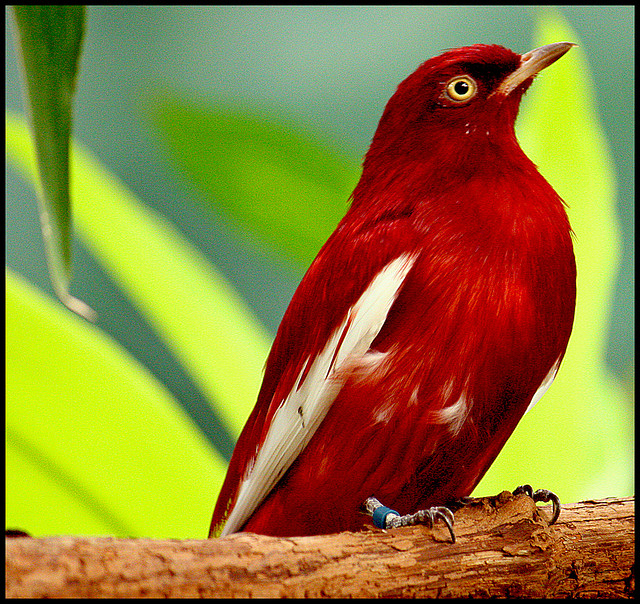
The Pompadour Cotinga is of a hue scarcely to be seen in any other bird. The coloration of the Cotingas is from true pigmentation, not the more common prismatic feather structure. The males are a glistening wine red color with white flight feathers narrowly tipped in black. The elongated and stiff greater wing coverts are wine red with white shafts partly covering the flight feathers. The females are mainly gray and paler below. The throat and belly are grayish white, with the wings and tail dusky. Greater wing coverts and inner flight feathers are broadly edged in white. The juveniles are like the female but with dark eyes.
With glistening wine red color with white flight feathers, reminds us of the wine soaked garment of our Lord isn’t it?
My beloved is white and ruddy, the chiefest among ten thousand. (Song of Solomon 5:10)
About 2000 years back He came to redeem us and was battered and bruised made it look like His garment was soaked in wine…
This time around He is going to come again to turn His garment into red..
Not with His blood though…
Who is this that cometh from Edom, with dyed garments from Bozrah? this that is glorious in his apparel, travelling in the greatness of his strength? I that speak in righteousness, mighty to save.
Wherefore art thou red in thine apparel, and thy garments like him that treadeth in the winefat?
I have trodden the winepress alone; and of the people there was none with me: for I will tread them in mine anger, and trample them in my fury; and their blood shall be sprinkled upon my garments, and I will stain all my raiment
For the day of vengeance is in mine heart, and the year of my redeemed is come. (Isaiah 63:1-4)
Ian’s Bird of the Week – Superb Fruit-Dove ~ by Ian Montgomery
Newsletter ~ 02-20-11
One of the tragedies of severe tropical cyclones is the damage to vegetation, particularly fruiting trees, and the resulting avian refugees, many battered and exhausted, fleeing far and wide in search of food. Since cyclone Yasi, many Superb and Wompoo Fruit-Doves and some Brown Cuckoo-doves have been moving through areas such as Bluewater and Townsville. This happened after cyclone Larry in 2006 when many of these refugees stayed around for months, but they are even more numerous this time round.
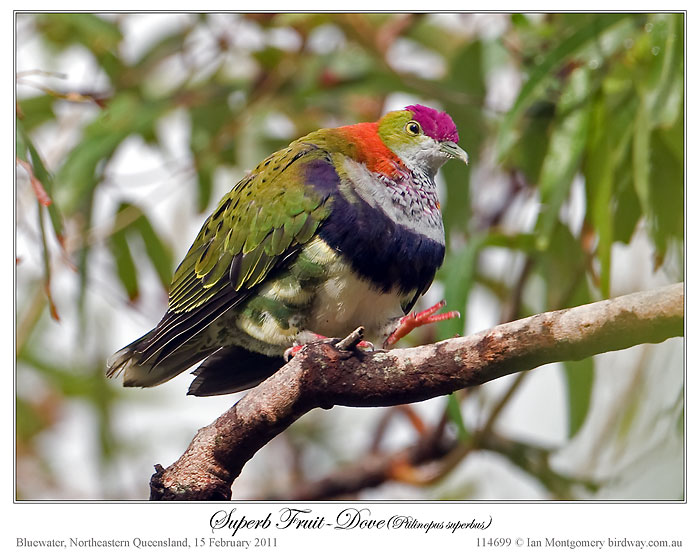
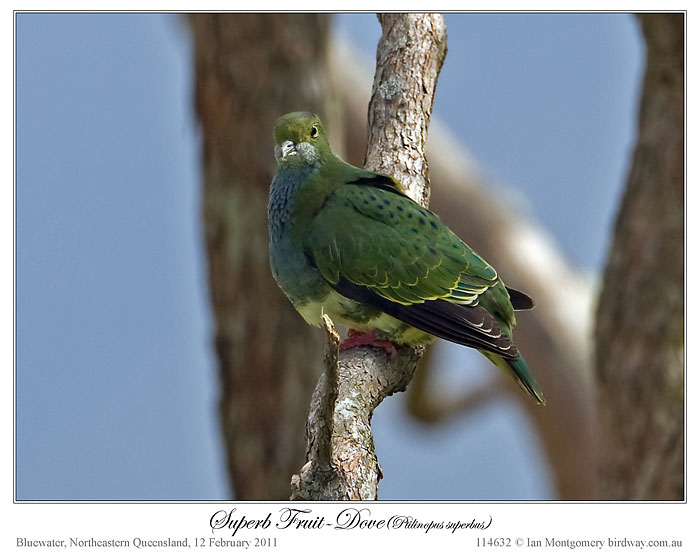
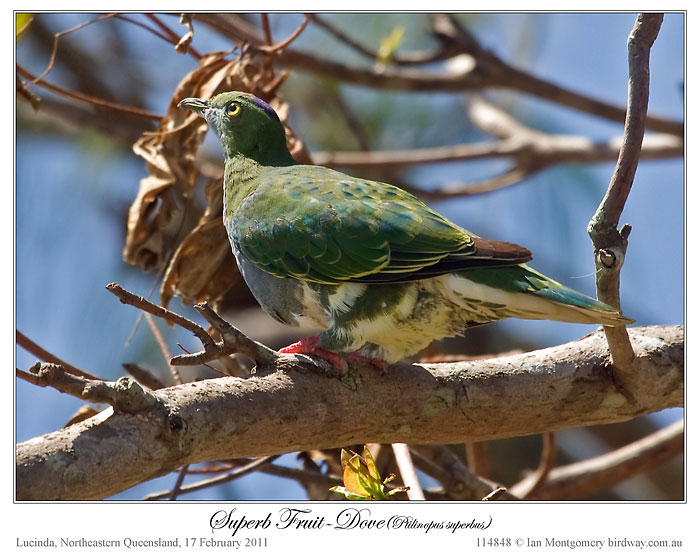
Superb Fruit-Doves are among the most spectacularly beautiful of rainforest birds in eastern Australia, but despite their bright colours are usually heard rather than seen. Their distinctive, repeated ‘whoop, whoop’ calls – with a rising inflection delivered at a regular rhythm and easily distinguished from the similar but accelerating ‘whp-whoo’ of the related and equally gorgeous Rose-crowned Fruit-Dove – are a very characteristic sound of northeastern rainforests. Hearing is no guarantee of seeing, however, and these shy birds usually remain invisible in the thick foliage of rainforest trees. So, it is strange to see these wonderful little doves (length of both species to 24cm/9.5in) sitting in full-view on trees in open tropical savanna left leafless by the cyclone, too tired to fly away when approached.
Superb Fruit Dove (Ptilinopus superbus) by Ian
The first photo shows a male, the second the less-spectacular but still beautiful female photographed from the verandah of my house a week to ten days after the cyclone when this species was most numerous around here. The females have an indigo skull cap that, being on the back of the head, is often not visible but you can see it clearly in the bird in the third photo, taken in a battered but still fruiting tree at Dungeness where we lunched last Thursday, in a normally but no longer shady park near Lucinda on the coast east of Ingham, after doing the monthly wader survey. That area took quite a battering and the sand spit along which we used to walk to do the survey has largely been flattened and the sand dumped in the mud flat to its west.
The range of the Superb Fruit-Dove in Australia is the east coast from the tip of Cape York to south of Sydney. Its main breeding range is in tropical Queensland north of Prosperine on the Whitsunday Coast and it is relatively rare in New South Wales. It also occurs in New Guinea and eastern Indonesia and many Australian birds migrate to New Guinea in winter. Fruit-eating doves normally range widely in search of food, given the seasonal nature of its availability, so it is to be hoped that this ability serves them well in times such as this.
I’ve resumed work on the website still using the borrowed mobile modem and have at last finished updating all the next/previous family pointers of the Australian bird family thumbnail pages. This means that you can now view the website in a global context or an Australian one, depending on your focus. The global context – and the New World and Old World subsets – follows the taxonomic organization and sequence of Birdlife International both between and within families while the Australian one follows the organization and sequence of Christidis and Boles, 2008, the generally accepted authorities in Australia.
There are quite a few differences in the recognized families, the sequence of families and the order within families between the 2 schema, so I suggest that you stick to one or the other (at any one time) to avoid confusion. The Australian context is distinguished by green backgrounds for both arrows (to Australian thumbnails and to previous and next families) and for the pages of family thumbnails. I’ve documented differences in family structure on the family pages; have a look at this for a simple example: http://www.birdway.com.au/cacatuinae/index_aus.htm and this for a particularly divergent example: http://www.birdway.com.au/sylviidae/index_aus.htm .
And I said, Oh that I had wings like a dove! for then would I fly away, and be at rest. (Psalms 55:6 KJV)
Superb Fruit Dove (Ptilinopus superbus) by xeno-canto-David Farrow
Rose-crowned Fruit Dove (Ptilinopus regina) by xeno-canto – Vicki Powys
Though ye have lien among the pots, yet shall ye be as the wings of a dove covered with silver, and her feathers with yellow gold. (Psalms 68:13 KJV)
This beautiful Superb Fruit-Dove or Fruit Dove, depending on whose list used, is in the Columbidae Family of the Columbiformes Order. There are 321 members of the family including the Doves, Fruit Doves, Collared Doves, Cuckoo-Doves, Wood Doves, Bronsewings, Ground and Quail Doves, Bleeding Hearts, plus all the different kinds of Pigeons.
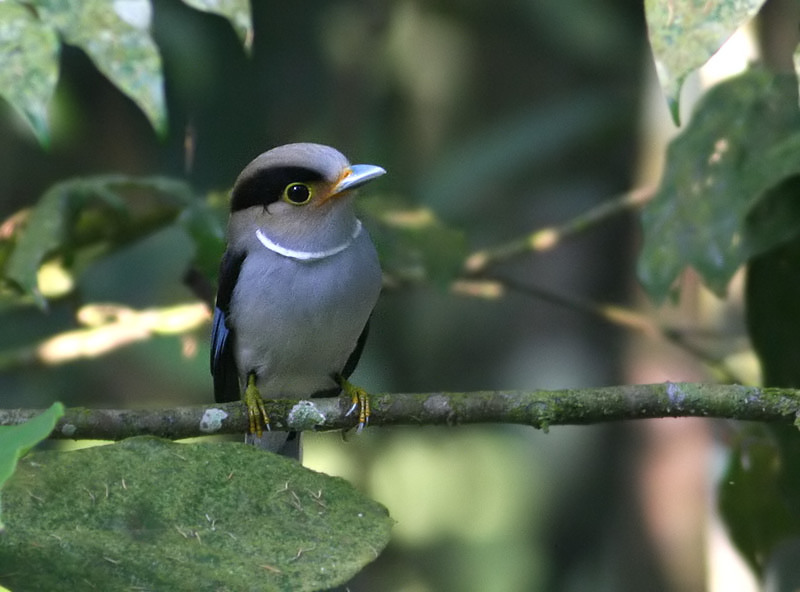
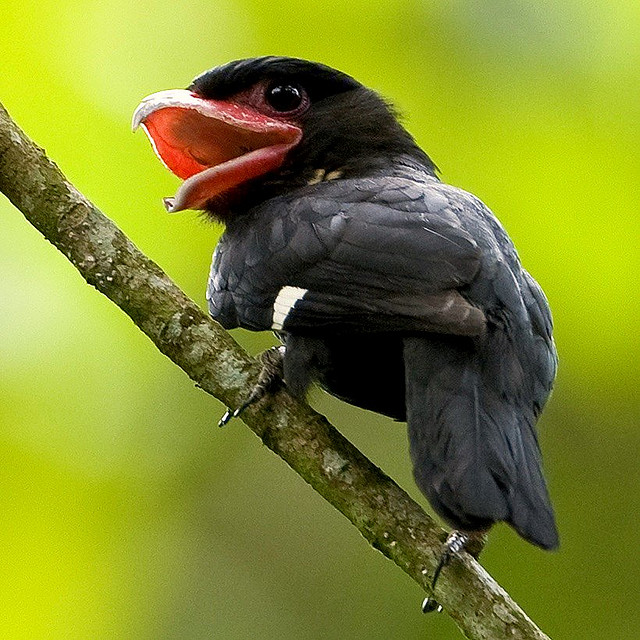
Silver-breasted Broadbill (Serilophus lunatus) by Peter Ericsson
“What are some of God’s favorite object lessons? Certainly His creation is one. A God who can call something into existence which didn’t exist before can do anything. “Lift up your eyes on high, and behold who hath created these things” (Isaiah 40:26).” (Quote from Days of Praise-2-18-2011)
The Broadbills are another of those creations of the Lord. These pretty little birds caught my eye while doing an article. I trust you will find them as interesting as I do. Formed by Him they cannot be anything but amazing. What a great Creator God we have.
The broadbills are a family of small passerine birds, Eurylaimidae. The Smithornis and Pseudocalyptomena species occur in sub-Saharan Africa; the rest extend from the eastern Himalayas to Sumatra and Borneo. The family possibly also includes the Sapayoa from the Neotropics and the asities from Madagascar.
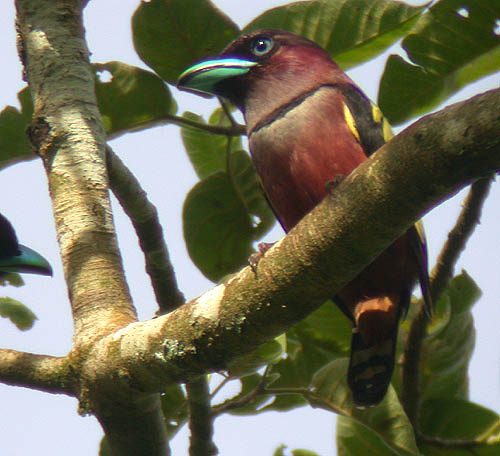
Banded Broadbill (Eurylaimus javanicus) by Peter Ericsson
Many of the broadbills are brightly colored birds. They range from 4.5 to 11.25 inches (13 to 28 centimeters) in length, and live in the dense canopies of wet forests, allowing them to hide despite their brightly coloured plumage. The plumage of the three African broadbills in the genus Smithornis is in contrast dull and streaked. The bills, which give the family their common name, are broad, flat and hooked and relatively large eyes. Even though many are brightly colored, the Lord has designed them to blend in with their surroundings beautifully.
The broadbills are for the most part insectivorous and carnivorous. Prey taken include insects, spiders, centipedes and millipedes, as well as lizards and tree frogs. Prey is obtained by sallying from a perch to snatch it in flight, and gleaning the prey off leaves and branches while flying. Some species may take some fruit (figs being their favorite), but only the green broadbills of the genus Calyptomena and the African Green Broadbill are primarily frugivores (which also take some insects as well).
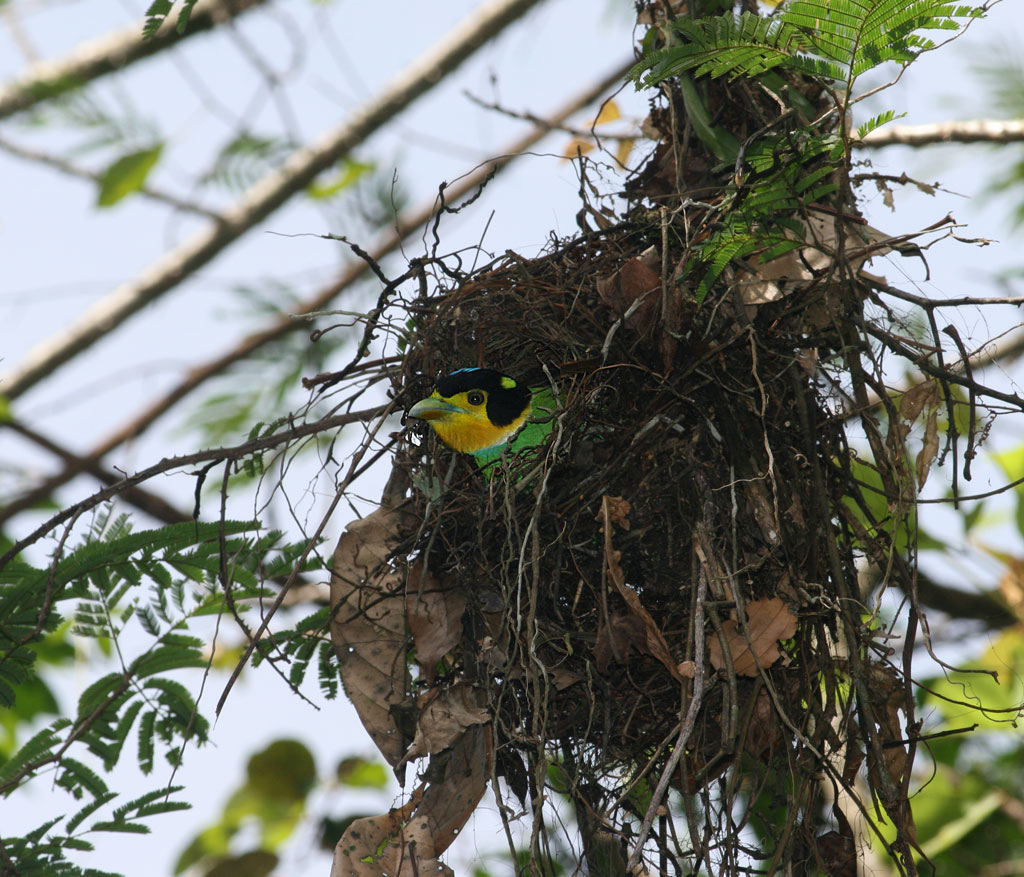
They are generally gregarious, with many species moving about in flocks of about 20 individuals. Broadbills attach their purse-shaped nests to suspended vines, and leave a tail of fibres hanging below it. This gives the nest the appearance of being random debris caught in the tree, an effect further enhanced by the birds covering the nest with lichen and spider webs.
Long-tailed Broadbill (Psarisomus dalhousiae) in nest by Peter Ericsson
Most Broadbills are monogamous, some have quite a courtship dispay and typically she lays two to three eggs. Both participate in nest building and in some species they have “helpers” with the young. Here are some of those verses:
Mostly active early and late in the day, otherwise they are sedentary and perched with their neck pulled in, disguised in the foliage.
Maybe the Lord would like us to look at the broad bills of the Broadbill and be reminded of Scripture. Broad or broader is mentioned over 30 times throughout the Bible.
David repeated in Psalm 18:19 what had been written in 2 Samuel:
He also brought me out into a broad place; He delivered me because He delighted in me. (Psalms 18:19 NKJV)
He also brought me out into a broad place; He delivered me because He delighted in me. “The LORD rewarded me according to my righteousness; According to the cleanness of my hands He has recompensed me. For I have kept the ways of the LORD, And have not wickedly departed from my God. For all His judgments were before me; And as for His statutes, I did not depart from them. (2 Samuel 22:20-23 NKJV)
Let those who fear the LORD now say, “His mercy endures forever.” I called on the LORD in distress; The LORD answered me and set me in a broad place. The LORD is on my side; I will not fear. What can man do to me? (Psalms 118:4-6 NKJV)
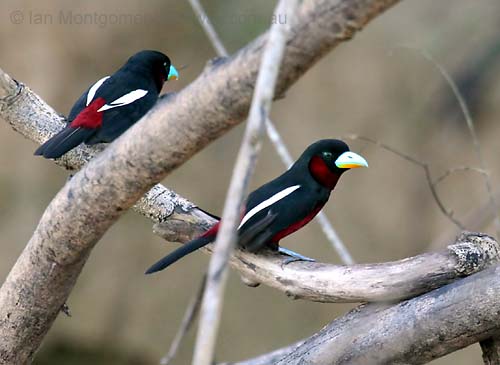
Black-and-red Broadbill (Cymbirhynchus macrorhynchos) by Ian
The wicked wait for me to destroy me, But I will consider Your testimonies. I have seen the consummation of all perfection, But Your commandment is exceedingly broad. Oh, how I love Your law! It is my meditation all the day. (Psalms 119:95-97 NKJV)
But there the glorious LORD will be unto us a place of broad rivers and streams; wherein shall go no galley with oars, neither shall gallant ship pass thereby. (Isaiah 33:21 KJV)
Enter by the narrow gate; for wide is the gate and broad is the way that leads to destruction, and there are many who go in by it. Because narrow is the gate and difficult is the way which leads to life, and there are few who find it. (Matthew 7:13-14 NKJV)
Can you search out the deep things of God? Can you find out the limits of the Almighty? They are higher than heaven– what can you do? Deeper than Sheol– what can you know? Their measure is longer than the earth And broader than the sea. (Job 11:7-9 NKJV)
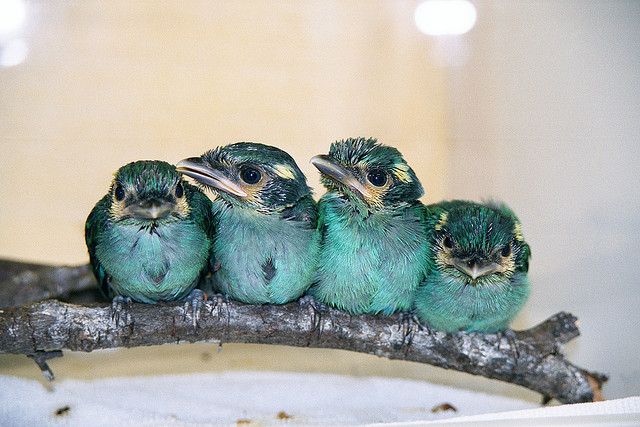
Green Broadbill (Calyptomena viridis) by Peter Ericsson
The Broadbills are in the Eurylaimidae Family and has 20 members at present. The Eurylaimidae-Broadbills are in the Passeriformes or Perching Bird Order.
Ian’s Bird of the Week – Olive-backed/Yellow-bellied Sunbird ~ by Ian Montgomery
Newletter: 02-17-11
Well, my apologies for a very belated bird of the week. Life in and around Townsville has largely returned to normal post-Yasi, except for for my broadband connection so I’ve borrowed a mobile modem from my neighbour.
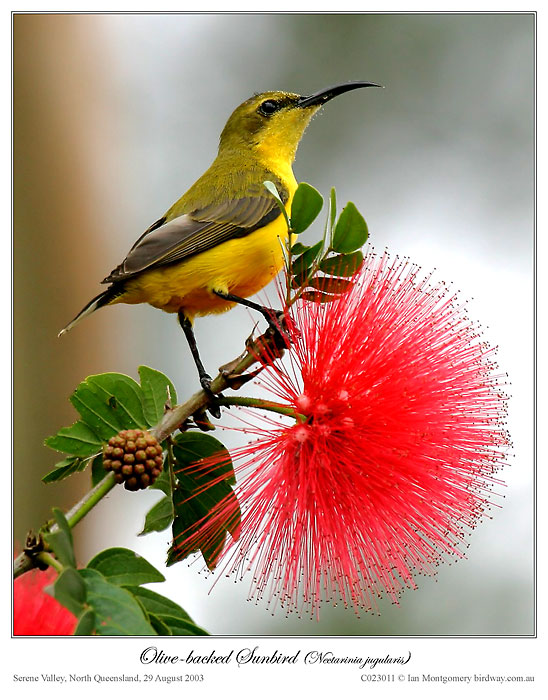
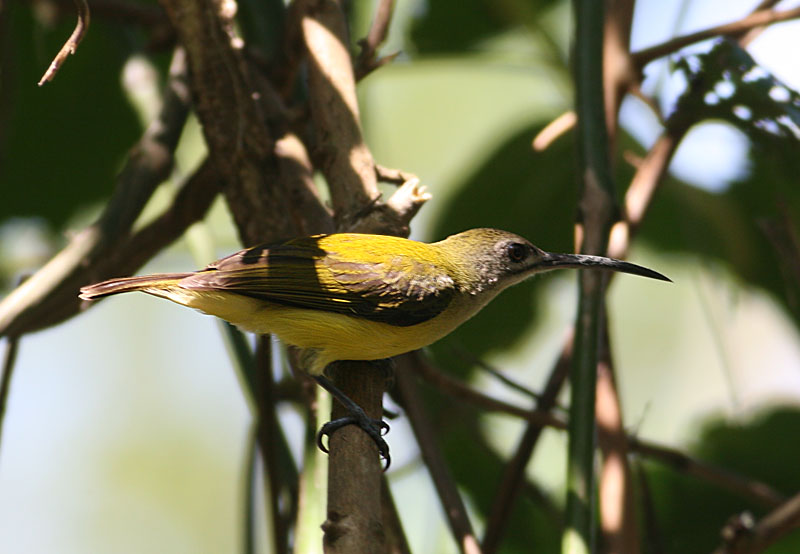
Olive-backed Sunbird (Cinnyris jugularis) by Ian
This week’s choice is the award for small bird cyclone survivor, jointly shared by around here by Red-backed Fairywren, Dusky Honeyeater and Olive-backed or Yellow-bellied Sunbird. The fairywren has been bird of the week before (July 2005), so I was going to choose the Dusky Honeyeater until I discovered that I have no record of the Sunbird being bird of the week before. That’s a potentially serious omission, so please forgive me if I’m mistaken: just nod sagely and put it down to old age and post-cyclone shock.
I suppose one shouldn’t be surprised at the Sunbird surviving cyclones as its range in Australia is restricted almost entirely to coastal tropical Queensland, extending just south of the Tropic of Capricorn to around Bundaberg. It also occurs in Torres Strait, New Guinea and southeast Asia but is regarded here as an iconic species and is immensely popular being very common around gardens, tame and often building its elegant hanging nest on verandahs. They feed mainly on the nectar of blossoms but will also take spiders.
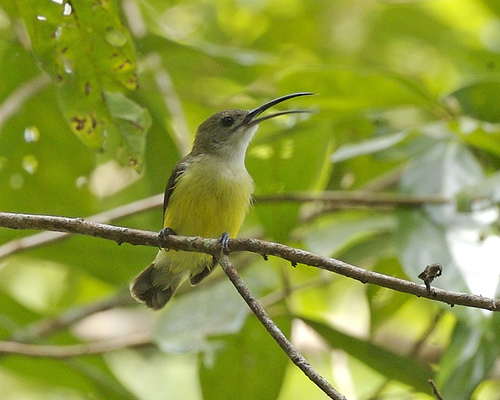
The first two photos show the blue-chested male and yellow-breasted female respectively on Calliandra (Powder Puff) and were taken at the house that I rented when I first moved to Townsville. The third photo shows one of the local males perched in a Poinsiana tree near my current house.
Olive-backed Sunbird (Cinnyris jugularis) by Ian
This species is the only Sunbird found in Australia but it belongs to a large family with more than 100 species of Sunbird in Asia and Africa and leading a lifestyle similar to that of the exclusively American and unrelated Hummingbirds. The Sunbirds are closely related to the Flowerpeckers – which include the Mistletoebird – and there is disagreement as to whether they constitute one or two families.
Other cyclone related news is that the Peaceful Dove that I rescued had an injured rather than broken wing, has recovered well in the company of the budgies next door and is ready to be returned to the wild. Food is now the main issue for survivors and many of you have naturally expressed concern for the Southern Cassowaries, just recovering from cyclone Larry. You can find out what the Queensland Government is doing . Sue and Phil Gregory tell me that the Cassowaries at Cassowary House in Kuranda near Cairns have survived well, so keep that in mind if you are visiting North Queensland and want somewhere lovely to stay: http://www.cassowary-house.com.au/ .
Like cyclone Larry, Bluewater has been visited by some unusual avian visitors post-Yasi. I’ll say more about them in the next email and some photos of a special one for bird of the week #400 which will go out shortly as a catch-up.
Best wishes and thank you again for your kindness and support.
Ian
—
Ian Montgomery, Birdway Pty Ltd,
454 Forestry Road, Bluewater, Qld 4818
Phone: +61-7 4751 3115
Preferred Email: ian@birdway.com.au
Website: http://birdway.com.au
Lee’s Addition:
What a neat looking bird and your photography skills show through as usual, Ian. Not sure about the readers, but I enjoy seeing each of your Bird of the Week offerings.
The Sunbirds reside in the Nectariniidae Family of the Passeriformes Order. There are 136 of these beautiful Sunbirds which also include Double-collared Sunbirds and Spiderhunters.
Then I saw an angel standing in the sun; and he cried with a loud voice, saying to all the birds that fly in the midst of heaven, “Come and gather together for the supper of the great God, (Revelation 19:17 NKJV)
“The sunbirds and spiderhunters are a family, Nectariniidae, of very small passerine birds. The family is distributed throughout Africa, southern Asia and just reaches northern Australia. Most sunbirds feed largely on nectar, although they will also take insects, especially when feeding young. Fruit is also part of the diet of some species. Their flight is fast and direct on their short wings.
The sunbirds have counterparts in two very distantly related groups: the hummingbirds of the Americas and the honeyeaters of Australia. The resemblances are due to the similar nectar-feeding lifestyle. Some sunbird species can take nectar by hovering like a hummingbird, but usually perch to feed.
The family ranges in size from the 5-gram Black-bellied Sunbird to the Spectacled Spiderhunter, at about 45 grams. Like the hummingbirds, sunbirds are strongly sexually dimorphic, with the males usually brilliantly plumaged in metallic colours. In addition to this the tails of many species are longer in the males, and overall the males are larger. Sunbirds have long thin down-curved bills and brush-tipped tubular tongues, both adaptations to their nectar feeding. The spiderhunters, of the genus Arachnothera, are distinct in appearance from the other members of the family. They are typically larger than the other sunbirds, with drab brown plumage that is the same for both sexes and long down-curved beaks.
Species of sunbirds that live in high altitudes will enter torpor while roosting at night, lowering their body temperature and entering a state of low activity and responsiveness.” (Wikipedia)
For the LORD God is a sun and shield; The LORD will give grace and glory; No good thing will He withhold From those who walk uprightly. (Psalms 84:11 NKJV)
What a busy couple of weeks. Between health, doctors, funerals, ladies retreats, church, birdwatching, nutty weather, etc., we finally got a chance to get over to the Lowry Park Zoo again yesterday. On the way to Tampa we spotted Ospreys, Boat-tailed Grackles, House Sparrows, Great Egret, 24 Pigeons (Common Pigeons) and Turkey Vultures. On the way home we added two Bald Eagles, a Snowy Egret and some Black Vultures.
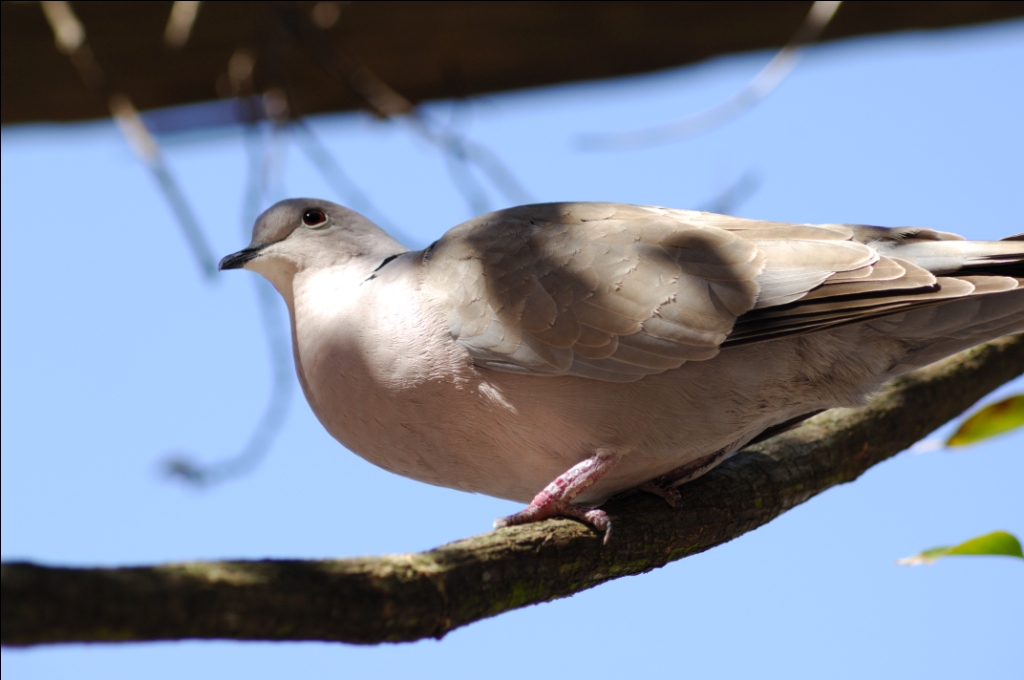
Eurasian Collared Dove (Streptopelia decaocto) by Dan
Loose birds hanging around the Zoo were American White Ibises, Great Egret, Eurasian Collared Dove, 10 Fish Crows, Mockingbird and some more Sparrows. Gulls and Vultures flying around also.
Because my legs were acting up again, we only did the Aviary just inside the gate. That is all I needed anyway, because when I left almost 2 hours later and having walked very little, I had had a ball. The birds were calm and didn’t mind us photographing them. Watched two Southern Bald Ibises mate twice. Maybe spring is on the way.
Buff-banded Rail (Gallirallus philippensis) by Dan
As you enter the Aviary, there are a few birds behind a wire and in very dim light. I keep trying to get a decent photo, but the obstacle makes it very difficult. They had the Silver-beaked Tanager, Blue-grey Tanager and Metallic Starling in that enclosure today.
For by him were all things created, that are in heaven, and that are in earth, visible and invisible, whether they be thrones, or dominions, or principalities, or powers: all things were created by him, and for him: And he is before all things, and by him all things consist. (Colossians 1:16-17 KJV)
Here is a list of the birds seen in the Aviary: (35)
American White Ibis (Eudocimus albus)
Snowy Egret (Egretta thula)
Western Great Egret (Ardea alba)
Turkey Vulture (Cathartes aura)
Black Vulture (Coragyps atratus)
Western Osprey (Pandion haliaetus)
Bald Eagle (Haliaeetus leucocephalus)
Common Pigeon (Columba livia)
Eurasian Collared Dove (Streptopelia decaocto)
Fish Crow (Corvus ossifragus)
Northern Mockingbird (Mimus polyglottos)
House Sparrow (Passer domesticus)
Boat-tailed Grackle (Quiscalus major)
Southern Carmine Bee-eater (Merops nubicoides) by Africaddict
We have written several articles about the Bee-eaters, but they are so pretty and colorful, that they are being presented again. When the Lord created them, He did not spare on the “color pallet.” Nor did He fail to provide them with the ability to know how to remove the stinger and poison of the bees and other insects before eating them.
For by him were all things created, that are in heaven, and that are in earth, visible and invisible, whether they be thrones, or dominions, or principalities, or powers: all things were created by him, and for him: And he is before all things, and by him all things consist. (Colossians 1:16-17 KJV)
This video tells about how the Bee-eater cooperate together in communities. Trust you will enjoy watching it.
“The bee-eaters are a group of near-passerine birds in the family Meropidae. Most species are found in Africa and Asia but others occur in southern Europe, Australia, and New Guinea. They are characterised by richly coloured plumage, slender bodies, and usually elongated central tail feathers. All have long downturned bills and pointed wings, which give them a swallow-like appearance when seen from afar. There are 26 different species of bee-eaters.
As the name suggests, bee-eaters predominantly eat flying insects, especially bees and wasps, which are caught in the air by sallies from an open perch.[1] While they pursue any type of flying insect, honey bees predominate in their diet. Hymenoptera (ants, bees and wasps) comprise from 20% to 96% of all insects eaten, with honey bees comprising approximately one-third of the Hymenoptera.
Carmine BeeEater (Merops nubicus or nubicoides) by Marc at Africaddict
Before eating its meal, a bee-eater removes the sting by repeatedly hitting and rubbing the insect on a hard surface. During this process, pressure is applied to the insect thereby extracting most of the venom.[1] Notably, the birds only catch prey that are on the wing and ignore flying insects once they land.
Bee-eaters are gregarious. They form colonies by nesting in burrows tunnelled into the side of sandy banks, such as those that have collapsed on the edges of rivers. Their eggs are white and they generally produce 2-9 eggs per clutch (depending on species). As they live in colonies, large numbers of these holes are often seen together, white streaks from their accumulated droppings accentuating the entrances to the nests. Most of the species in the family are monogamous, and both parents care for the young, sometimes with the assistance of other birds in the colony.” (From Wikipedia)
Some of the articles we have done that mention the Bee-eaters are:
The Bee-eaters are in the Coraciiformes Order which included the Roller, Kingfisher, Todie, Motmot Families. The Meropidae Family is the one that contains the 26 Bee-eater species.
Chestnut-headed Bee-eater (Merops leschenaulti) by Nikhil Devasar
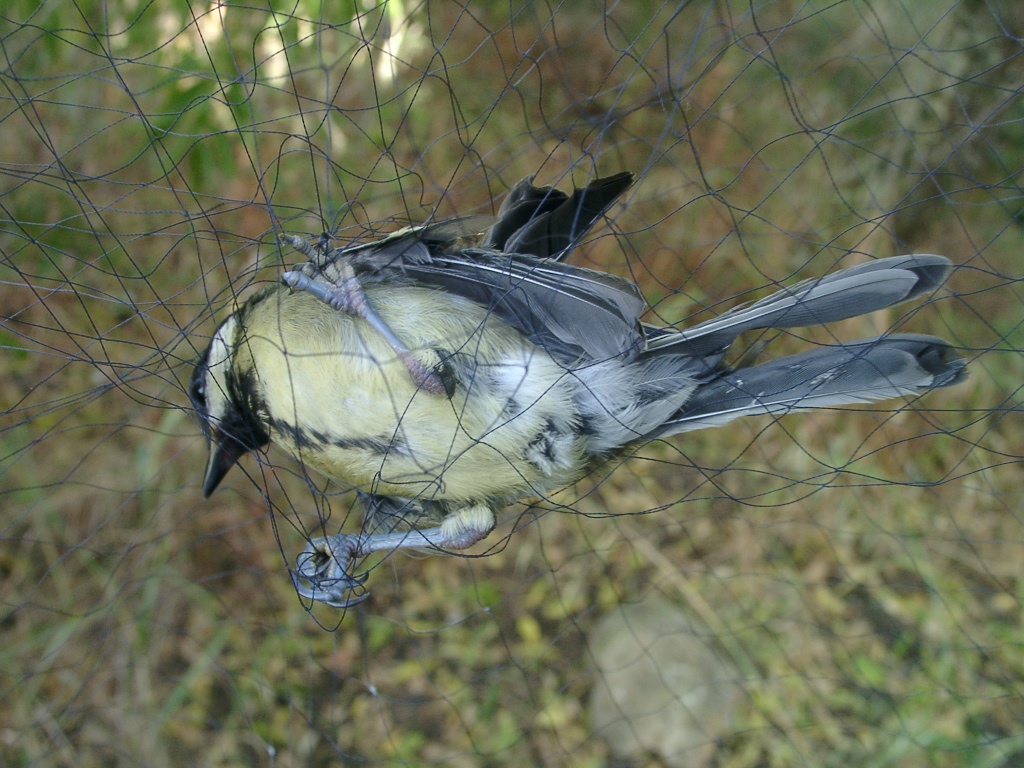
“foul´ẽr (יקשׁ, yōḳēsh): A professional birdcatcher. In the days previous to firearms, birds were captured with nets spread on the ground, in traps and snares. There was a method of taking young birds from a nest, raising them by hand, and when they had become very tame, they were confined in hidden cages so that their voices would call others of their kind to the spot and they could be killed by arrows of concealed bowmen or the use of the throw-stick (Ecclesiasticus 11:30) This was a stick 1 1/2 feet in length and 1/2 inches in diameter, hurled with a rotary motion at the legs of the birds and was very effective when thrown into flocks of ground birds, such as partridge or quail, especially if the birds were running up hill. There was also a practice of sewing a captured bird’s eyelids together and confining it so that its cries would call large numbers of birds through curiosity and they could then be taken in the several ways mentioned. The fowlers supplied the demand for doves and other birds used for caged pets, and furnished the market with wild pigeons and doves for sacrifice and such small birds as were used for food.
For he will deliver thee from the snare of the fowler. And from the deadly pestilence. (Psalms:91:3)
This is David’s promise that the Almighty will deliver us from the evil plans laid to ruin us, as a bird sometimes in its struggles slips the hair and escapes from the “snare” (which see) set for it.
(Here is a video of a modern day “fowler” by patriotledger.)
Our soul is escaped as a bird out of the snare of the fowlers: The snare is broken, and we are escaped. (Psalms 124:7)
Here is the fulfillment of the former promise in a cry of rejoicing. Sometimes the snare held fast, sometimes it broke; then the joy in the heart of a freed man was like the wild exultation in the heart of the escaping bird.
Deliver thyself as a roe from the hands. of the hunter. And as a bird from the hand of the fowler. (Proverbs 6:5)
With methods so primitive as these for taking birds, it must have occurred frequently that a stunned, wounded or entrapped bird slipped even from the hand that held it and made good its escape.
For among my people are found wicked men: they watch, as fowlers lie in wait; they set a trap, they catch men. (Jeremiah 5:26)
Here is the plain comparison strongly drawn between wicked men entrapping their fellows and fowlers taking unsuspecting birds.
The last reference is in Hosea 9:8:
Ephraim was a watchman with my God: as for the prophet, a fowler’s snare is in all his ways, and enmity in the house of his God.
Wherever he goes, the prophet is in danger of being trapped.”
* * *
This article was quoted from:
The International Standard Bible Encyclopedia (1915) is a public domain Biblical encyclopedia. This encyclopedia was published by Wm. B. Eerdmans Publishing Co. It contains articles by nearly 200 scholars about archaeological discoveries, the language and literature of Bible lands, customs, family life, occupations, and the historical and religious environments of Bible people.
In addition there is a newer version which should not be confused with the public domain 1915 edition that can be found freely available at various sites.
Little Spiderhunter (Arachnothera longirostra) by Peter Ericsson
The Little Spiderhunter – The Praising Pollinator ~ by a j mithra
The Little Spiderhunter (Arachnothera longirostra) is a species of long-billed nectar feeding bird in the Nectariniidae family found in the moist forests of South and Southeast Asia.
Unlike typical Sunbirds, males and females are very similar in plumage.
They are usually seen in ones or twos and frequently make a “tzeck” call and are most often found near flowering plants where they obtain nectar. They are found close to their favorite nectar bearing trees, often species of wild Musaceae or flowers in gardens.
We too have Jesus, the Rose of Sharon and the Lilly of the valley, who is sweeter than honey..
But, where is our dwelling place? Is it near Jesus?
Though these birds are called spider eaters, a lesson can be learned from them who dwell among the flowers to obtain nectar…
Though we are sinners, the WORD, which is sweeter than honey, is able to make us holy when we prefer to dwell among The Rose of Sharon…
These birds have to go in search of their favorite flowers..
But, we have the most amazing privilege of bringing the Rose of Sharon, the Lilly of the Valley, among us through our praise…
But thou art holy, O thou that inhabitest the praises of Israel. (Psalm 22:3)
The distinctive long beak sets it apart from other Sunbirds. The sexes are alike except for a paler base to lower mandible in the female. The male has an all black beak.
They have a buzzy “zick-zick” call that is made regularly when disturbed or when foraging. The song is series of rapid chipping notes and these can go on for long periods… While dwelling near its favorite nectar bearing trees, these birds sing for long period of time particularly when they are disturbed…
King Jehoshaphat disturbed God with praise when he was disturbed by his enemies..
Peter and Silas, disturbed God with their praise when they were disturbed by the soldiers…
Jonah disturbed God with his praise when he was disturbed inside the whale’s belly..
King Nebuchadnezzar disturbed God with his praise when his pride disturbed him..
The best way to disturb God when we are disturbed is to praise Him…
Do we murmur or sing praise to the Lord when we are disturbed?
Praise ye the LORD. Sing unto the LORD a new song, and his praise in the congregation of saints.
Let Israel rejoice in him that made him: let the children of Zion be joyful in their King.
Let them praise his name in the dance: let them sing praises unto him with the timbrel and harp.
For the LORD taketh pleasure in his people: he will beautify the meek with salvation.
Let the saints be joyful in glory: let them sing aloud upon their beds.
Let the high praises of God be in their mouth, and a two edged sword in their hand;
To execute vengeance upon the heathen, and punishments upon the people;
To bind their kings with chains, and their nobles with fetters of iron;
To execute upon them the judgment written: this honour have all his saints. Praise ye the LORD. (Psalm 149)
The genus name Arachnothera means “spider hunter” and the species epithet refers to the long beak. About thirteen geographic races are recognized. The nominate race longirostra (Latham, 1790) is found in southwestern India, central and northeastern India, foothills of the Himalayas and into Thailand and Yunnan. Race sordida La Touche, 1921 is found in southern China and northeastern Thailand. Race pallida Delacour, 1932 is found in southeastern Thailand and C & S Indochina. The species is found in Bangladesh, Bhutan, Brunei, Cambodia, China, India, Indonesia, Laos, Malaysia, Myanmar, Nepal, the Philippines, Thailand, and Vietnam.
Within India, there are disjunct populations in the Eastern Ghats from Lamasinghi, Vishakapatnam and parts of Orissa and the Western Ghats apart from the main distribution in north-east India that extends into Southeast Asia. A record from the Nicobar Islands is considered doubtful.
Its natural habitats are subtropical or tropical moist lowland forests, subtropical or tropical mangrove forests, and subtropical or tropical moist montanes. It is usually found below the canopy.
They have been noted as good pollinators of wild banana species and several species of the ginger family and often visit Indian silk cotton tree and Indian coral tree for nectar.
These birds are good pollinators…
The extension of kingdom of God depends upon pollinators of His word…
Are we good pollinators of the Rose of Sharon and the Lilly of the valley?
Or are we just honey suckers?
It is time for us to think and rethink of our status in the kingdom of God…
Now then we are ambassadors for Christ … (II Corinthians 5:20)
They are often seen in plantations in forest areas. Although they are more often seen in secondary forests or in clearings and appear to be tolerant of human activities, they have become extinct in some forest fragments. In Singapore they have gone locally extinct within the botanical garden.
The breeding season in northeastern India is March to September but mainly May to August and in southern India it breeds from December to August.
The nest is a compact cup attached under a banana or similar broad leaved plant suspended by cobwebs and vegetable fibre. Two eggs are the usual clutch.
In Sarawak, the Kayan, Kenyah and Punan people consider it a bird of good omen and when they are out collecting camphor, the men would wait until they heard the “sit” call of one of these spiderhunters.
As we call His name, He sure will deliver the undelivered…
God is waiting for our call before He separates the husk from the grains…
There are millions out there who have not even head the name Jesus..
What are we going to do to reach them before the King returns?
Call unto me, and I will answer thee, and show thee great and mighty things, which thou knowest not. (Jeremiah 33:3)
YouTube from “Hymns – Timeless”. American Songbird Showcase
Blessed Assurance written by Fanny Crosby and sung by Ron Tolson.
Thought you might enjoy this video with all the birds showcased. No birds mentioned in the song, but it still is a “Birds in Hymn” candidate. Our Savior created all these beautiful birds.
Happy is he that hath the God of Jacob for his help, whose hope is in the LORD his God: Which made heaven, and earth, the sea, and all that therein is: which keepeth truth for ever: (Psalms 146:5-6 KJV)
Words by Henry Burton, 1905. (1840-1930)
Music – Santa Trinita by E. V. Pieraccini (1828-1902)
O Maker of the Sea and Sky
* * *
O Maker of the sea and sky,
Whose word the stormy winds fulfill,
On the wide ocean Thou art nigh,
Bidding these hearts of ours be still.
What if Thy footsteps are not known?
We know Thy way is in the sea;
We trace the shadow of Thy throne,
Constant amid inconstancy.
Shy Albatross (Thalassarche cauta) by Ian
Thou bidd’st the north or south wind blow; The lonely sea bird is Thy care;
And in the clouds which come and go,
We see Thy chariots everywhere.
The sun that lights the homeland dear
Spreads the new morning o’er the deep;
And in the dark Thy stars appear,
Keeping their watches while we sleep.
And so, secure from all alarms,
Thy seas beneath, Thy skies above,
Clasped in the everlasting arms,
We rest in Thine unslumbering love.
My help cometh from the LORD, which made heaven and earth. He will not suffer thy foot to be moved: he that keepeth thee will not slumber. (Psalms 121:2-3 KJV)
Here is a video that I shot out at the Circle B Bar Reserve in Lakeland, FL on January 18th. We went out to watch some of the 4,000 American White Pelicans land at the marsh. We got there about 4:30 pm and stayed until almost 6 pm.
I left the sound on so that you can catch the amazement in my voice. My english is terrible and my words nutty, but I was thoroughly enjoying my “birdwatching adventure.” This is what it is really like to go birdwatching with me. I get so amazed at watching God’s created critters.
Thou wilt shew me the path of life: in thy presence is fulness of joy; at thy right hand there are pleasures for evermore. (Psalms 16:11 KJV)
I have more of these and pictures, but will save them for another time. Slower connections speeds will have enough problems loading just one video.
On the video I said about 100 feet over my head, it was more like 20-30 feet over our heads. The pelicans were landing right behind us.










 Lee's Birdwatching Adventures Plus
