Ian’s Bird of the Week: Clark’s Nutcracker

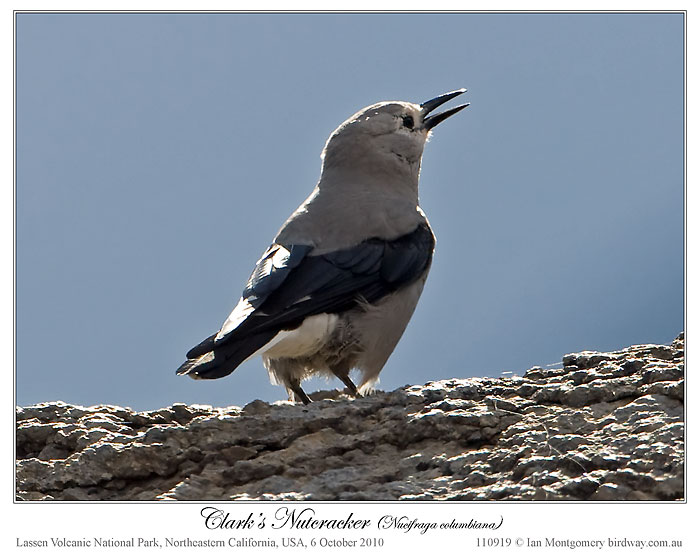
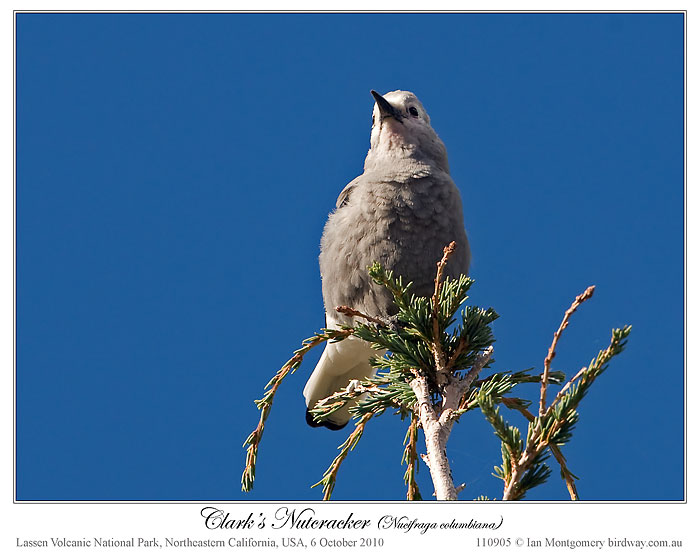
Clark's Nutcracker (Nucifraga columbiana) by Ian

Clark's Nutcracker (Nucifraga columbiana) by Ian

Ian’s Bird of the Week: Clark’s Nutcracker ~ by Ian Montgomery

Newsletter – 10-14-10

My apologies for the very late bird of the week. My last week in California was very full, so the flight to Costa Rica last Sunday was the first opportunity to prepare the photos and, owing to internet problems at my first two hotels, I haven’t been able to send this email until now (Thursday) although I wrote it on Monday morning.

Craggy Trail-Lassen Volcanic National Park

Craggy Trail-Lassen Volcanic National Park

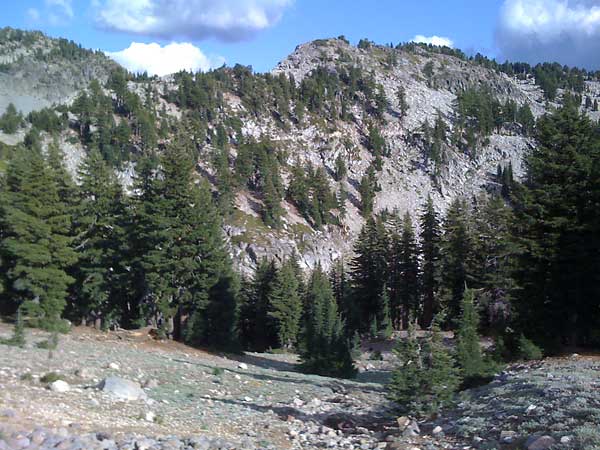
This is one of the birds of the week that gets chosen because there’s a good story to go with it. Clark’s Nutcracker is a mountain species, found near the tree-line in coniferous forest or rocky areas, that I’d only seen once before, in Colorado in September 1970 and and last week’s visit to Lassen Volcanic National Park in NE California was my third since 2008 to look for it. The first photo shows the craggy trail recommended by a ranger to Bumpass Hell (I kid you not) my sister, Gillian, and I took to look for it.

Clark's Nutcracker (Nucifraga columbiana) by Ian

Clark's Nutcracker (Nucifraga columbiana) by Ian

Clark's Nutcracker (Nucifraga columbiana) by Ian

Clark's Nutcracker (Nucifraga columbiana) by Ian

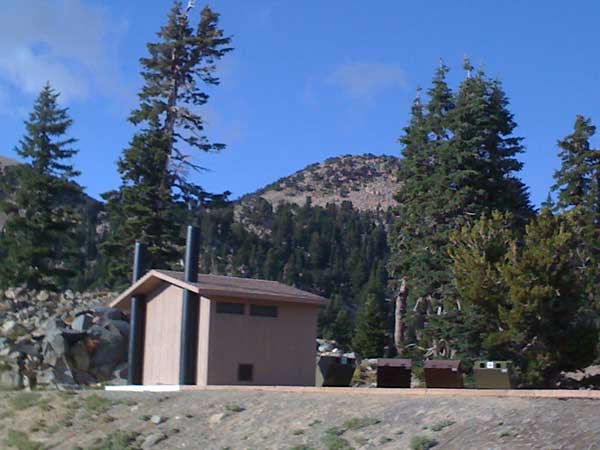
Eventually, we returned to the car park empty-handed and went to the rest-rooms shown in the second photo. After I’d emerged, I heard the call we had been listening for, and turned round the find Gillian looking for the source – a Clark’s Nutcracker calling mockingly at us perched the very top of the small pine tree right behind the building, third photo.

Restroom area-Lassen Volcanic National Park

Restroom area-Lassen Volcanic National Park

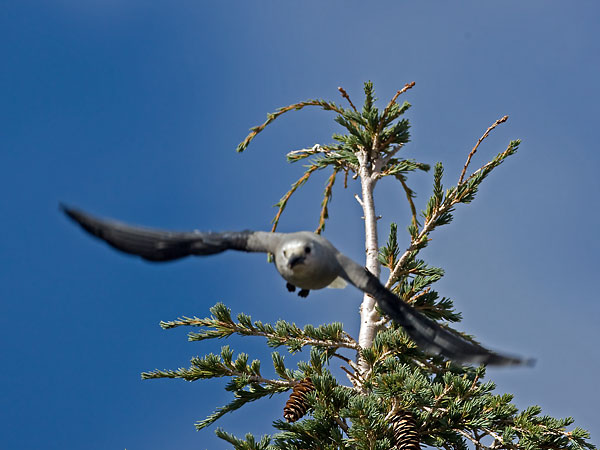
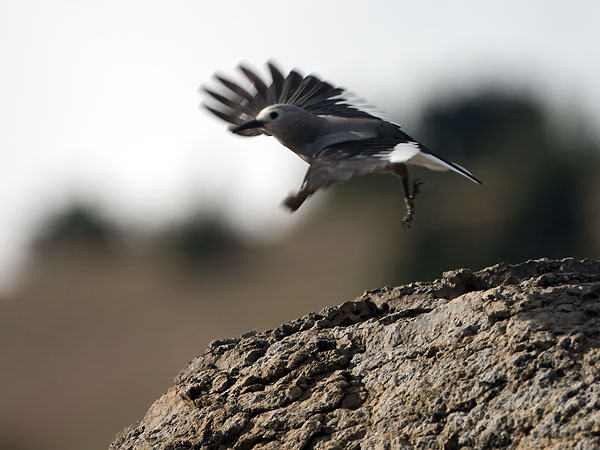
After a few seconds, it then flight right over my head and almost into the camera, fourth photo, to perch on a rock beside the car park, directly in front of the sun, thank you very much, fifth photo. I dodges the inevitable questions from a couple of tourists about the size of my 500mm lens to get in a better position before the bird flew, sixth photo, with its mate down into the very steep valley, never to be seen again.

Clark's Nutcracker (Nucifraga columbiana) by Ian

Clark's Nutcracker (Nucifraga columbiana) by Ian

Many birders will be familiar with the car park list, the ones you find waiting for you when you get back after a long and arduous hike and the rest-room list is a variation on this. And familiar with the advice to take your camera everywhere. EVERYWHERE! And with the settings ready to take photos of the unexpected.

My main target here is the elusive Resplendent Quetzal, so a collective world-wide prayer that I can serve it up to you as the next bird of the week would be greatly appreciated!

Best wishes,
Ian,

Ian Montgomery, Birdway Pty Ltd,
454 Forestry Road, Bluewater, Qld 4818
Phone: +61-7 4751 3115
Preferred Email: ian@birdway.com.au
Website: http://birdway.com.au


Lee’s Addition:
I couldn’t help but chuckle about his being ready at all times episode. It reminded me of a verse in Daniel that says,

Now if ye be ready that at what time ye hear the sound of the cornet, flute, harp, sackbut, psaltery, and dulcimer, and all kinds of musick, … (Daniel 3:15 KJV)

I didn’t read where it mentioned the “Clark’s Nutcracker calling mockingly.”

As usual, Ian had another interesting birdwatching experience.

The Clark’s Nutcracker (Nucifraga columbiana) are in the Corvidae – Crows, Jays family of the Passeriformes order.

See also:

a j mithra’s – Clark’s Nutcracker

Today’s Birds of the Bible

Updated at 8:10 pm

They are all finished. Hope you enjoy reading them.

********

Today, instead of doing my regular Birds of the Bible article, I am going to try to finish the Scripture Alphabet of Animals series. I have all the birds finished and am working hard to finish the rest of the animals today. All throughout the day, new articles will be posted as they are completed. I will be updating the index to the article (below) as I finish each one.

I trust you have enjoyed reading them as much as I have as the articles are being “modernized.” Harriet N Cook was a very good writer and trust she would have approved of the way that they are being handled here.

Lee

Learning from the Birds – Overwhelmed

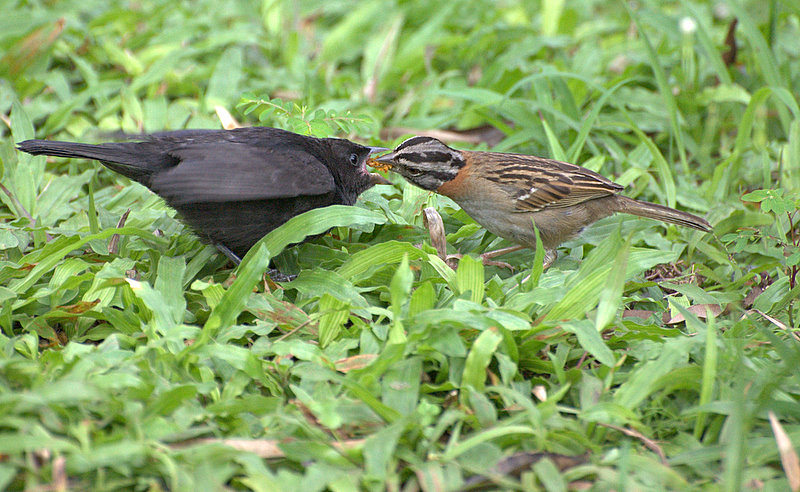
A Shiny Cowbird (Molothrus bonariensis) chick being fed by a Rufous-collared Sparrow (Zonotrichia Capensis)

A Shiny Cowbird (Molothrus bonariensis) chick being fed by a Rufous-collared Sparrow (Zonotrichia Capensis)

But now ask the beasts, and they will teach you; And the birds of the air, and they will tell you; (Job 12:7 NKJV)

Brood parasites are organisms that use the strategy of brood parasitism, found among birds, fish or insects, involving the manipulation and use of host individuals either of the same or different species to raise the young of the brood-parasite. This relieves the parasitic parent from the investment of rearing young or building nests, enabling them to spend more time foraging, producing offspring etc. Additionally, the risk of egg loss to raiders such as raccoons is mitigated, by having distributed the eggs amongst a number of different nests. As this behavior is damaging to the host, it will often result conflict between parasite and host.

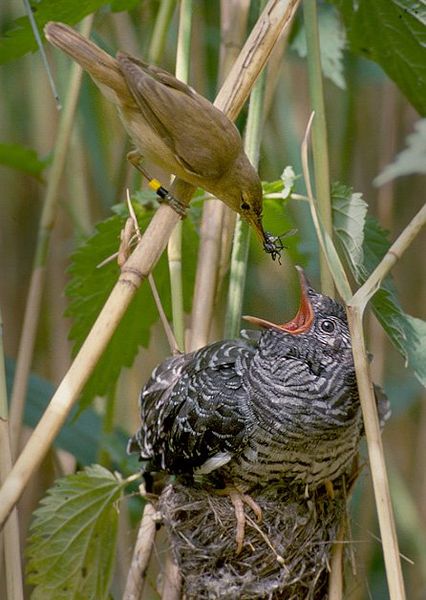
Common Cuckoo (Cuculus canorus) being raised by a Reed Warbler©WikiC

Common Cuckoo (Cuculus canorus) being raised by a Reed Warbler©WikiC

Interspecific brood-parasites include the Old World Cuckoos in Eurasia and Australia, Cowbirds and Black-headed Ducks in the Americas, and Indigobirds, Whydahs, and the Honeyguides in Africa.

Among specialist avian brood parasites, mimetic eggs are a nearly universal adaptation. There is even some evidence that the generalist Brown-headed Cowbird may have developed an egg coloration mimicking a number of their hosts.

Most avian brood parasites will remove a host egg when they lay one of their own in a nest. Depending upon the species, this can happen either in the same visit to the host nest or in a separate visit before or after the parasitism. This both prevents the host species from realizing their nest has been parasitized and reduces competition for the parasitic nestling once it hatches.

Most avian brood parasites have very short egg incubation periods and rapid nestling growth. This gives the parasitic nestling a head start on growth over its nestmates, allowing it to outcompete them. In cases where the host nestlings are significantly smaller than the parasite nestling, the host nestlings will often starve to death. Some brood parasites will eliminate all their nestmates shortly after hatching, either by ejecting them from the nest or killing them with sharp mandible hooks which fall off after a few days.

Whoa! This is NOT NICE! What is so amazing is that if not detected in time, many times the birds do find the intruding egg and toss it out, but most times, the unsuspecting parents raise this young bird as if it were it’s own.

What can we, as observers of this behavior, learn from the birds? I want to consider the host birds who have quite a challenge to face. They either fix the problem or they could be very “overwhelmed” with situation at hand.

My first thoughts were from a physical need. When faced with a health problem, we pray and visit the doctors and try to remedy the situation. Sometimes the ailment is not cured and we may be faced with an “overwhelming” need. Do we accept whatever the outcome and:

Not that I speak in regard to need, for I have learned in whatever state I am, to be content: (Philippians 4:11 NKJV)

Another lesson that could by learned by observing this “overwhelming” task might be in sharing the load. Often in churches, the ones who are willing to serve the Lord become very involved because of others not volunteering or helping. They keep taking on more responsibilities, not complaining, but in time they could become “overwhelmed.” We should find a way to:

Bear one another’s burdens, and so fulfill the law of Christ. (Galatians 6:2 NKJV)

Though one may be overpowered by another, two can withstand him. And a threefold cord is not quickly broken. (Ecclesiastes 4:12 NKJV)

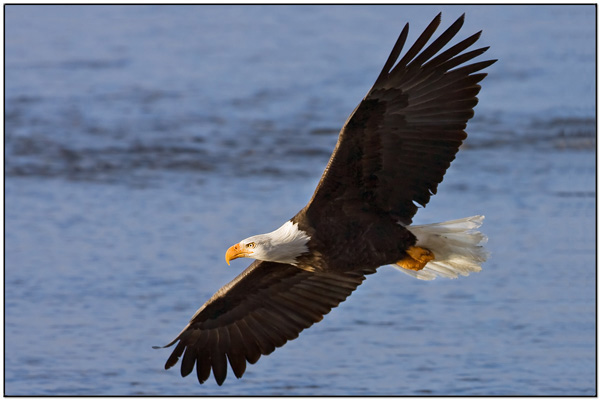
Bald Eagle flying by Dave's BirdingPix

Bald Eagle flying by Dave's BirdingPix

The host birds accept the situation and do the best they can to raise the young bird. How do they do that? One worm at a time! When we become “overwhelmed,” that is just what we need do. No! Not by catching worms, but by taking one step at a time and harkening to the following promises:

But ye, brethren, be not weary in well doing. (2 Thessalonians 3:13 KJV)

And let us not be weary in well doing: for in due season we shall reap, if we faint not. (Galatians 6:9 KJV)

I can do all things through Christ which strengtheneth me.
(Philippians 4:13 KJV)

But they that wait upon the LORD shall renew their strength; they shall mount up with wings as eagles; they shall run, and not be weary; and they shall walk, and not faint. (Isaiah 40:31 KJV)

(Some information from Wikipedia)
*

Bobolink – Extraordinary Migrant…

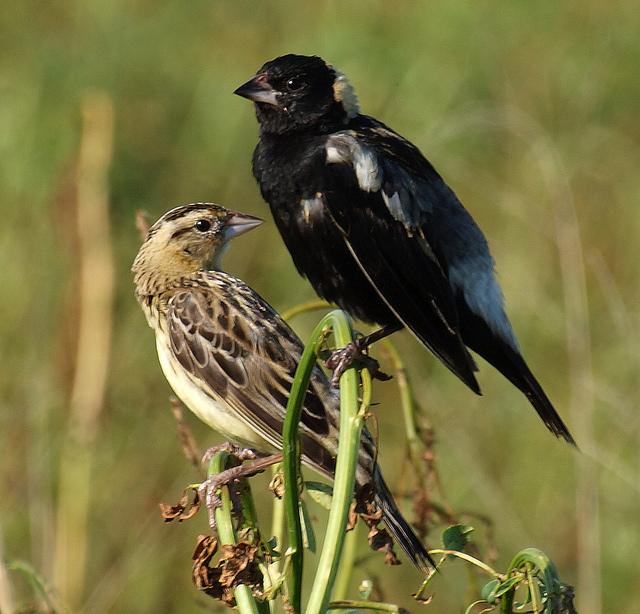
Bobolink (Dolichonyx oryzivorus) Pair ©©ramendan

Bobolink (Dolichonyx oryzivorus) Pair ©©ramendan

Bobolink – Extraordinary Migrant… ~ by a j mithra

Rice bird, meadow-wink, skunk blackbird, reed bird, butter bird—these various names for the member of the blackbird family most commonly known as the Bobolink reflect the diversity of ways in which humans have looked upon this gregarious songbird.

Nesting in the prairies and cultivated land of south Canada and the northern United States and wintering in the grasslands and marshes of Argentina, the Bobolink migrates at least 5,000 miles each way.

Bobolink Migration Route©WikiC

Bobolink Migration Route©WikiC

The Bobolink is an extraordinary migrant, traveling to south of the equator each autumn and making a round-trip of approximately 20,000 kilometers (12,500 mi). One female, known to be at least 9 years old, presumably made this trip annually, a total distance equal to traveling 4.5 times around the earth at the equator! These birds migrate to Argentina, Bolivia and Paraguay. One bird was tracked flying 12,000 miles (19,000 km) over the course of the year, and up to 1,100 miles (1,800 km) in one day. The vast distance is more impressive in relation to the Bobolink’s diminutive size, averaging 7 inches in length, 11.5 inches in wingspan, and 1.5 ounces. in weight.

  • Feeling small?
  • Get ready to do greater things for God…
  • You know, God does not use boulders to stop the waves of the sea from entering the land..
  • But, He uses tiny grains of sand to do it..

God has designed this bird to travel long distances to encourage us that we too can do great and mighty things for God..

A little one shall become a thousand, and a small one a strong nation: I the LORD will hasten it in his time. (Isaiah 6:21)

God seems to have a liking to use small things to fulfill great missions..

  • He chose the small Miriam to find a way to take care of Moses..
  • He chose a small slave girl to bring healing to a Commander of an army..
  • He chose a little shepherd boy David to bring down a mighty giant..
  • He chose a small boy to feed the multitudes…

Here again, this small bird He uses to inspire us to do great things for God..

If this small bird can travel 4.5 times around the world at the equator in its life time, how much more God will expect from us? Most of rely on our strength that is the reason we find it so difficult to travel next door to share the gospel isn’t it?

What sense does it make to say, I can do all things through Christ who strengthens me when we find it so difficult to stand for God?

But be ye doers of the word, and not hearers only, deceiving your own selves. For if any be a hearer of the word, and not a doer, he is like unto a man beholding his natural face in a glass: For he beholdeth himself, and goeth his way, and straightway forgetteth what manner of man he was. But whoso looketh into the perfect law of liberty, and continueth therein, he being not a forgetful hearer, but a doer of the work, this man shall be blessed in his deed. (James 1:22-25)

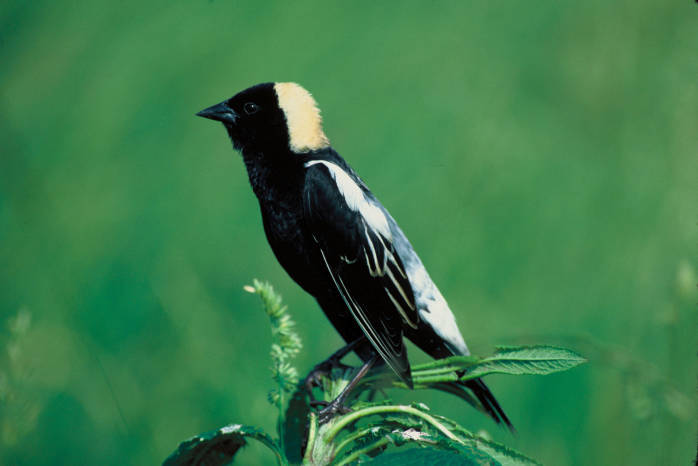
Bobolink (Dolichonyx oryzivorus) ©USFWS

Bobolink (Dolichonyx oryzivorus) ©USFWS

Bobolinks begin their journey northward in South America in early March, reaching Colombia and Venezuela in late April. From there, most take a route over the Caribbean Sea to the Florida peninsula, although some will cross the Gulf of Mexico from the Yucatan Peninsula to Louisiana and Texas. From there they fan northward and westward, arriving on the breeding grounds in May. These Birds breed in open grasslands and hay fields.

Bobolinks migrate at night. The distinctive “clink” notes of these nocturnal travelers can be heard as they pass overhead in large flocks, apparently using the earth’s magnetic field as a compass and the locations of the stars as a map.

  • Human race boasts about technology, innovation and inventions…
  • We feel great pride in finding unknown routes with the help of satellites and compass…

But, these birds use the earth’s magnetic field as compass and locations of the stars as a map…

  • How difficult it is for us to tread on unknown path?
  • When we worship in church we feel so good to call Jesus as the Brightest Morning Star…
  • Do we really turn towards this Morning Star to seek direction in life?
  • Who is our inspiration in life?

If God be with us who can be against us? But the million dollar question is, are we with God?

Great in counsel, and mighty in work: for thine eyes are open upon all the ways of the sons of men: to give every one according to his ways, and according to the fruit of his doings: (Jeremiah 32:19)

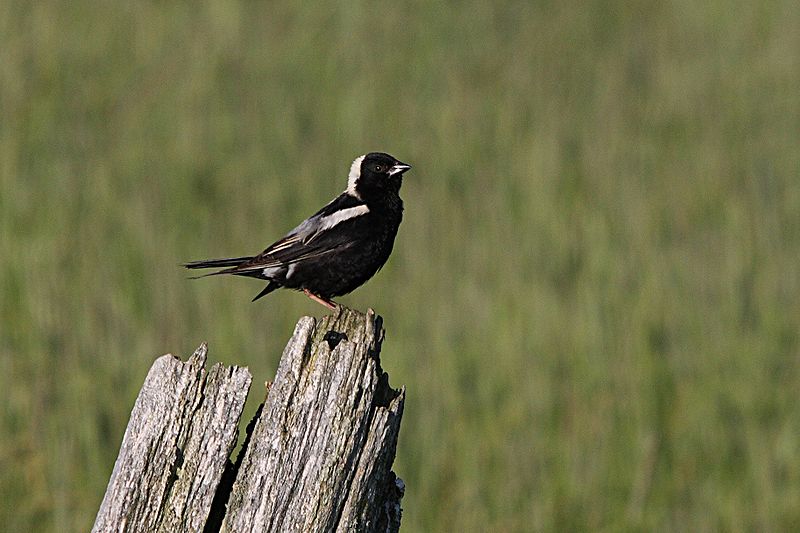
Bobolink (Dolichonyx oryzivorus) ©WikiC

Bobolink (Dolichonyx oryzivorus) ©WikiC

In summer, Bobolinks feed primarily on insects switching to grain crops as they migrate south. In migration and in winter uses freshwater marshes, grasslands, rice and sorghum fields.

Although the Bobolink typically feeds during the day, in migration, while building fat reserves for its long over water flight, it has been observed feeding in rice fields after dark on bright nights.

We all know that we are on the verge of migrating once and for all to heaven..

  • Have we stored reserves to migrate that long?
  • His words has the power to heal the broken and strengthen the weak…
  • His words shall never return empty…

My son, forget not my law; but let thine heart keep my commandments: For length of days, and long life, and peace, shall they add to thee. Let not mercy and truth forsake thee: bind them about thy neck; write them upon the table of thine heart: So shalt thou find favour and good understanding in the sight of God and man.

Trust in the LORD with all thine heart; and lean not unto thine own understanding. In all thy ways acknowledge him, and he shall direct thy paths. Be not wise in thine own eyes: fear the LORD, and depart from evil. It shall be health to thy navel, and marrow to thy bones. (Proverbs 3:1-8)

Bobolink (Dolichonyx oryzivorus) by J Fenton

Bobolink (Dolichonyx oryzivorus) by J Fenton

How many times do we read His words in a day? Maybe we should learn from these birds to eat His words even during our dark hours.

Thy word is a lamp unto my feet, and a light unto my path. (Psalm 119:105)

Judging by sight or sound, the Bobolink is a bird of distinction. Their song has been vividly described as

  • “a bubbling delirium of ecstatic music that flows from the gifted throat of the bird like sparkling champagne,”
  • “a mad, reckless song-fantasia, and outbreak of pent-up, irrepressible glee,” and as
  • “a tinkle of fairy music, like the strains of an old Greek harp.”

We may not be a good singer, yet, God loves to hear us sing. The reason for creating us is to sing, glorify and thank Him.  But, we seem to do every other thing except thanking Him…  Many of our prayers are unanswered, because, we have failed to thank when we pray..

Be careful for nothing; but in every thing by prayer and supplication with thanksgiving let your requests be made known unto God. (Philippians 4:6)

Have a blessed day!

Your’s in YESHUA,
a j mithra

Please visit us at: Crosstree


The Bobolink is in the Icteridae Family of the Passeriformes Order

*

Birdwatching – South Lake Howard Nature Park – 10/2/10

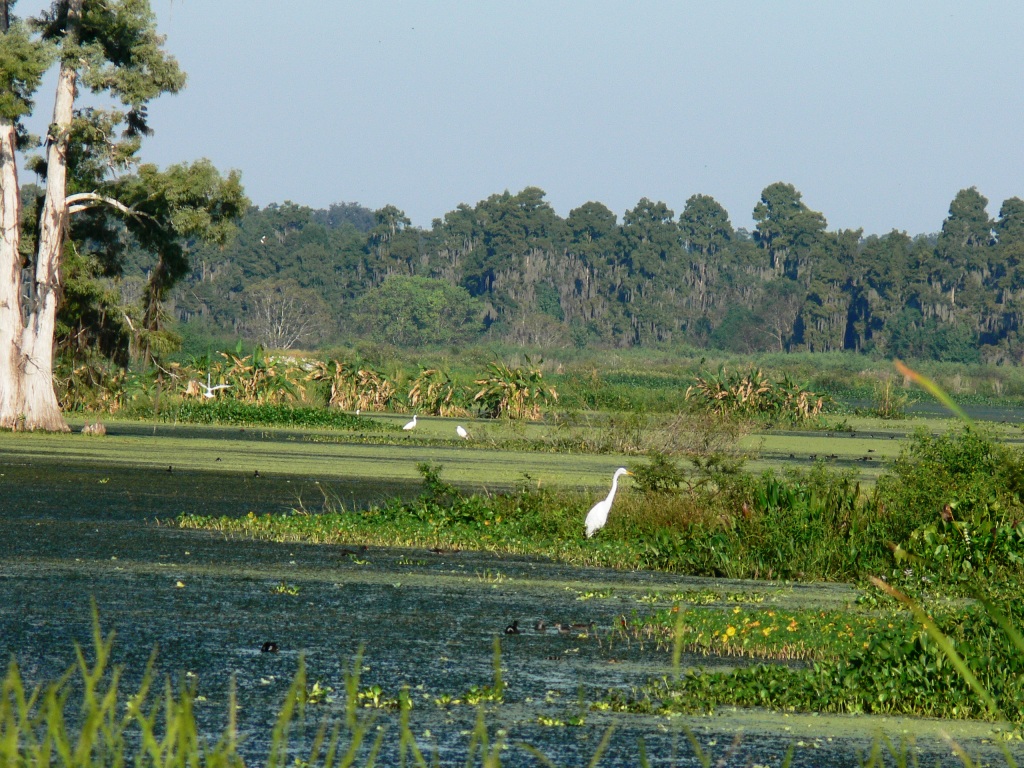
South Lake Howard Nature Park, Winter Haven, FL

South Lake Howard Nature Park, Winter Haven, FL

Saturday, Dan and I were back out birdwatching and enjoying God’s creation. This time we stopped by the South Lake Howard Nature Park in Winter Haven. It was another beautiful “cooler” day like Friday at Circle B.

He put another story before them, saying, The kingdom of heaven is like a grain of mustard seed which a man took and put in his field: Which is smaller than all seeds; but when it has come up it is greater than the plants, and becomes a tree, so that the birds of heaven come and make their resting-places in its branches. (Matthew 13:31-32 BBE)

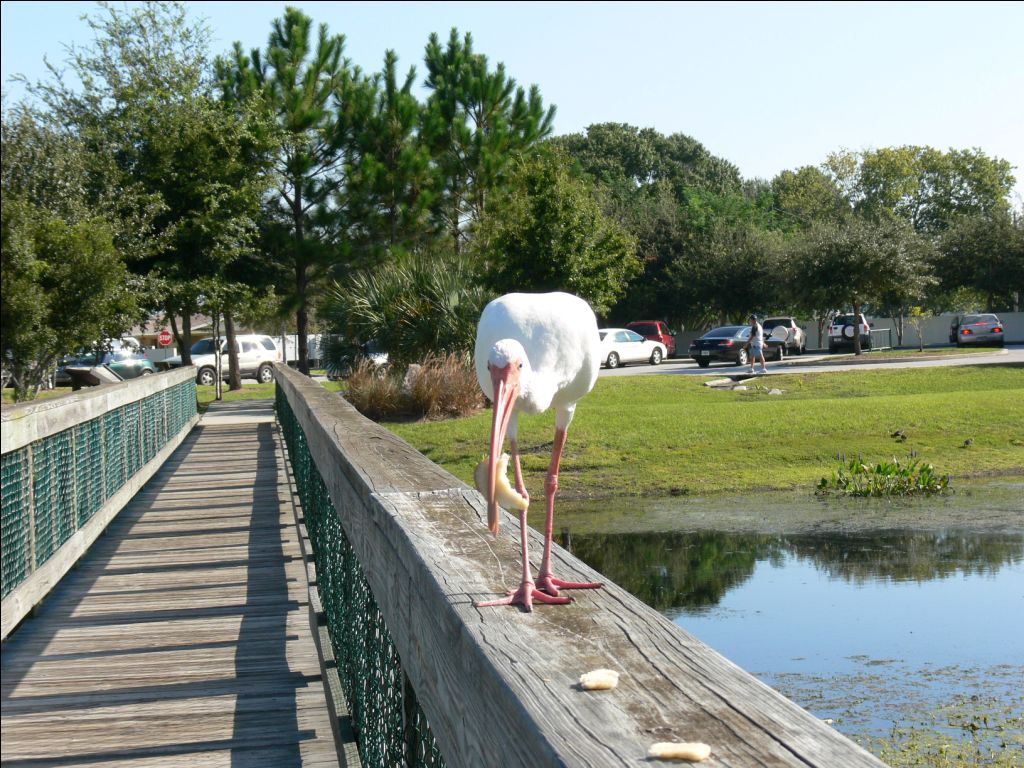
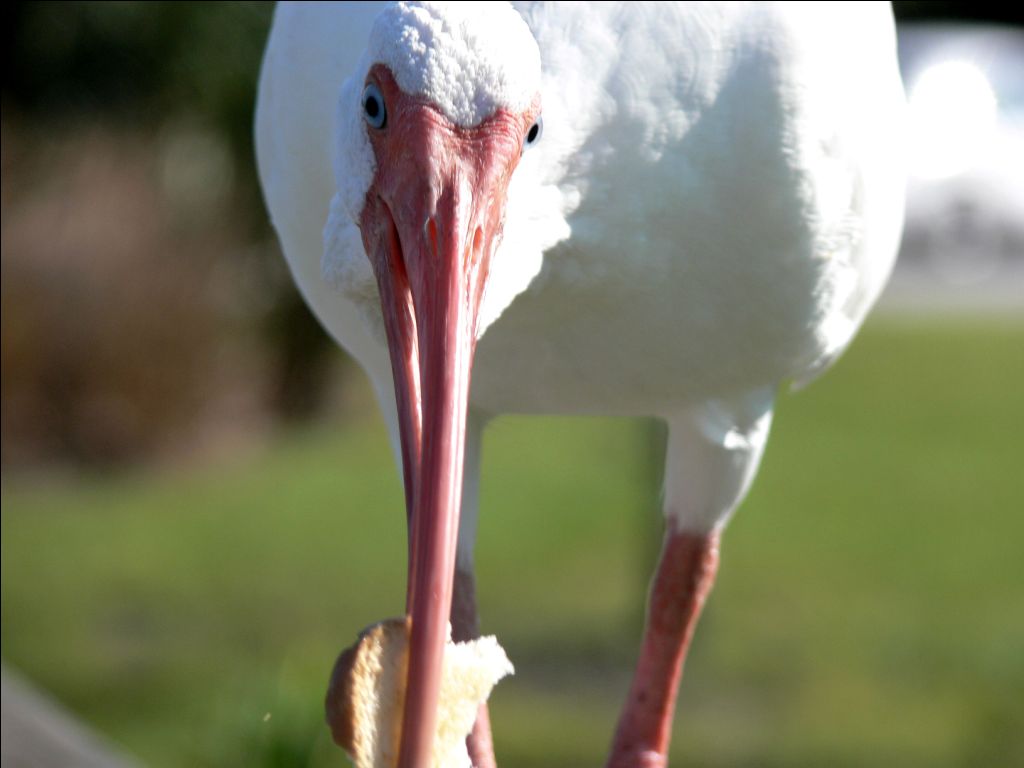
Testing Camera on a White Ibis

Testing Camera on a White Ibis

We were only testing out my camera this time. After missing so many great photos at the Circle B and other outings, we stopped by Marshall’s Camera Shop in Auburndale that afternoon to discuss my camera’s problem. It had been acting up for some time and it wouldn’t auto-focus right. After some adjustments and an attempt to sell me a new Canon, I was satisfied to try some more with my faithful Panasonic Lumix point-and-shoot, always on “program” mode or “video” mode camera. (I’ll leave all those f-stops and ISO’s for the photographers who know what there doing, like Dan, Ian, and my great photographers.) I shoot “proof-shots” (I saw it) and “ID shots” (What was that bird?).

White Ibis on Rail at S. Lake Howard

White Ibis on Rail at S. Lake Howard

White Ibis on Rail up close

White Ibis on Rail up close

With the camera in hand, we checked out the park and managed to see 18 different species and the camera was behaving much better. The birds we observed were small in number again, like Friday. Not sure why the birds haven’t gotten back down here yet. Hope that big storm that went up the East Coast lately didn’t mess up their migration trips down here.

Tricolored Heron at South Lake Howard

Tricolored Heron

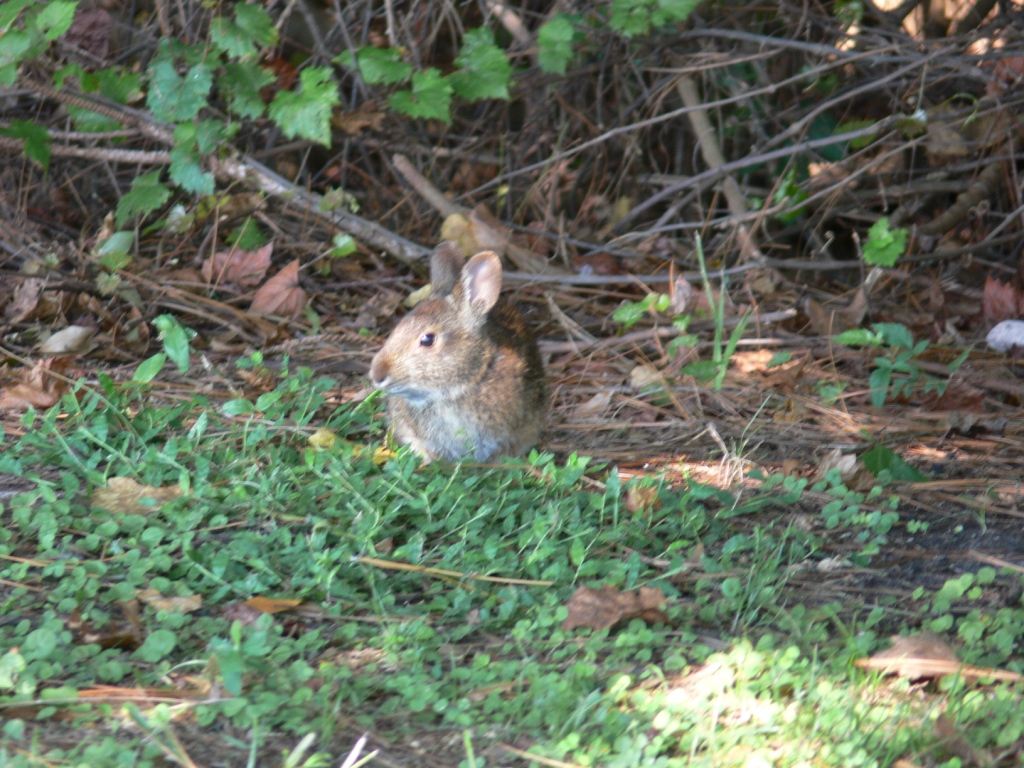
South Lake Howard - Bunny

Bunny at South Lake Howard

Here is a list of what we saw and reported to e-Bird. I didn’t report the bunny rabbit to them.

Number of species:     18
Anhinga     1
Great Blue Heron     2
Great Egret     1
Little Blue Heron     1
Tricolored Heron     2
White Ibis     10
Wood Stork     2
Osprey     2
Purple Gallinule     3
Common Moorhen     9
Mourning Dove     1
Monk Parakeet     5
Belted Kingfisher     1
Blue Jay     3
Blue-gray Gnatcatcher     1
Northern Mockingbird     2
Red-winged Blackbird     2
Boat-tailed Grackle     3

For more visits to South Lake Howard Nature Park.

*

Birdwatching at Circle B – 10/01/2010

Circle B Bar Reserve View

Circle B Bar Reserve View on 10-1-10

Now that the weather is improving and the humidity is becoming bearable, it’s time to go birdwatching again. Actually we have been out several times in the last few week. We made a trip a few weeks ago to Fort Desoto in Pinellas County. I am still trying to figure out which birds we saw at the beach. I’ll save those birds for another blog. It was a delightful day to be out birdwatching.

This is the day the LORD has made; We will rejoice and be glad in it. … God is the LORD, And He has given us light; (Psalms 118:24, 27a NKJV)

Yesterday, 10-1-10 we went to the Circle B Bar Reserve to take a look around. We only went about a mile round trip. The same birds were there, but few in number. Apparently the migrants that spend the winter haven’t arrive yet. They are just trickling in slowly. Talking to one of the volunteers out there, he agrees that the birds are behind their normal arrival.

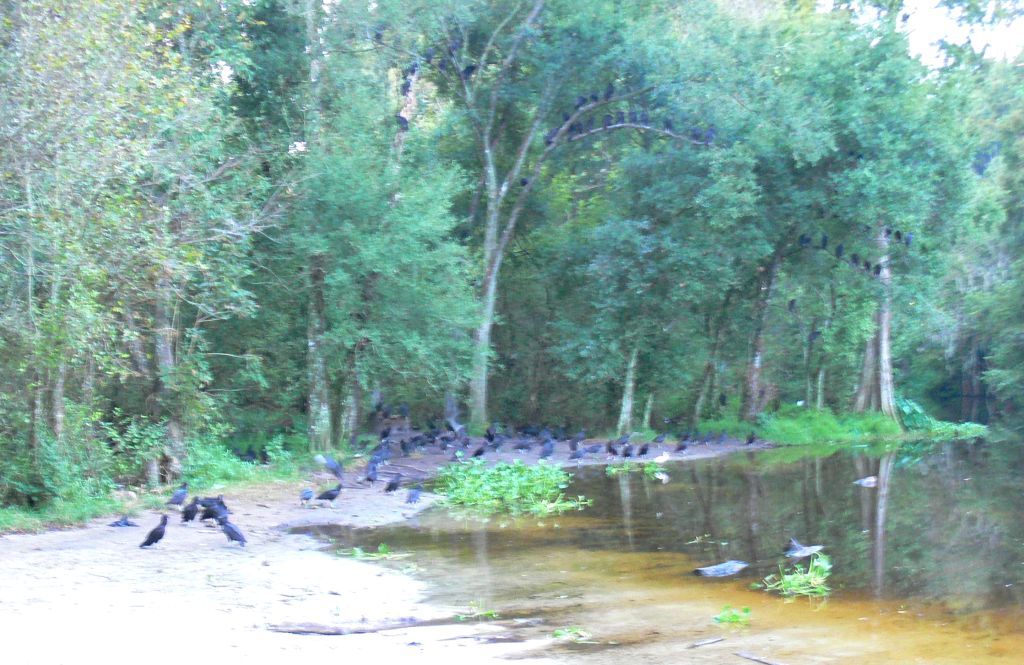
Black Vultures Lining the tree limbs-bad shot by you get the idea

Black Vultures Lining the tree limbs-bad shot by you get the idea

We stopped by “Buzzard Beach” which is on the perimeter of the Reserve, but part of it. There were well over 100 Black Vultures lining the trees and on the ground. Unfortunately, my camera was acting up and my shots were bad.

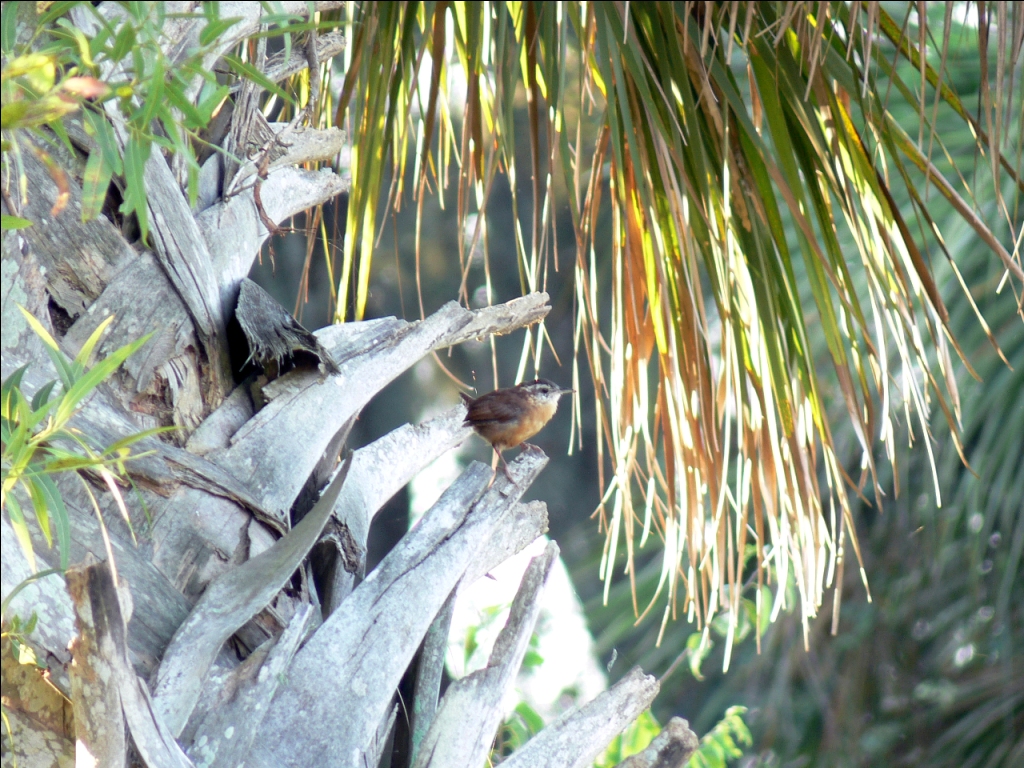
Carolina Wren (Thryothorus ludovicianus) by Lee at Circle B Bar Reserve 10-1-10

Carolina Wren (Thryothorus ludovicianus) by Lee at Circle B Bar Reserve 10-1-10

We started around 7:45 and birded for about 2 hours altogether. My prize of the day was the Carolina Wren. I have been hearing them on previous visits, but could not get one in my camera. Yesterday, I finally got a photo. There were two of them and with help from a friend, we both got them in view.

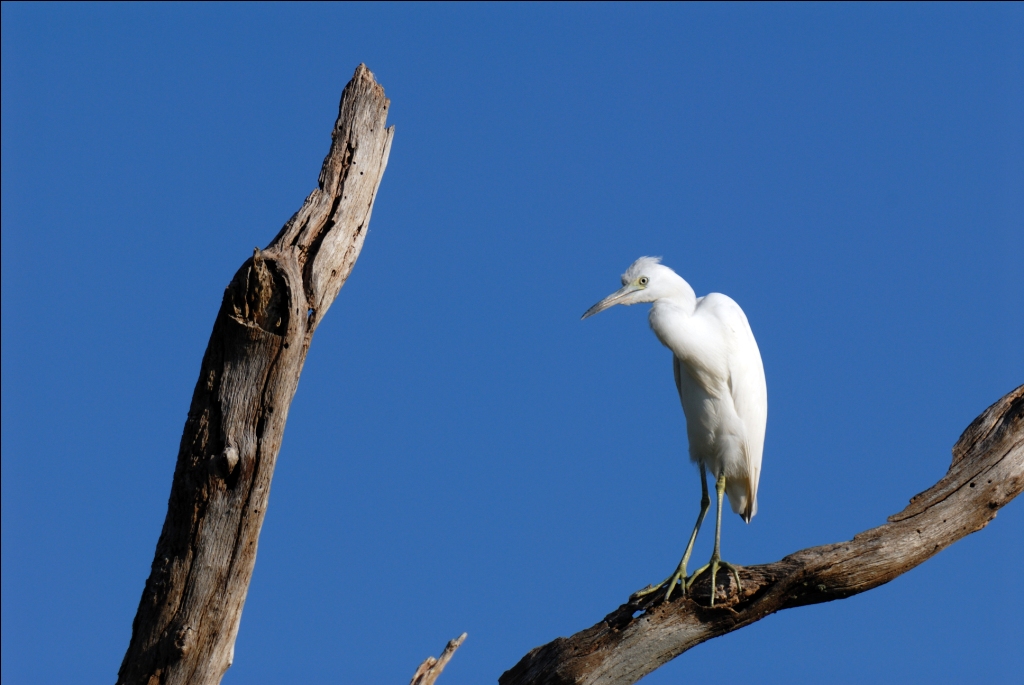
Little Blue Heron immature in a Tree by Dan at Circle B

Little Blue Heron immature in a Tree by Dan at Circle B

Another nice find was a Little Blue Heron that was immature and still in it’s White form. The rest of the birds we pretty much what we get most times out at the Circle B this time of the year.

At any rate, here is the list of birds I reported to eBird at http://ebird.org/content/ebird

Black-bellied Whistling-Duck
Blue-winged Teal
Pied-billed Grebe
Double-crested Cormorant
Anhinga
Great Blue Heron
Great Egret
Snowy Egret
Little Blue Heron
Tricolored Heron
Green Heron
White Ibis
Wood Stork
Black Vulture -100
Osprey
Cooper’s Hawk
Purple Gallinule
Common Moorhen
Sandhill Crane
Mourning Dove
Belted Kingfisher
Red-bellied Woodpecker
Pileated Woodpecker
Blue Jay
Fish Crow
Carolina Wren
Northern Mockingbird
Common Yellowthroat
Northern Cardinal
Red-winged Blackbird
Boat-tailed Grackle

Number of species:     31

For other birdwatching trips to the Circle B Bar Reserve

*

Birds of the Bible – Tamed

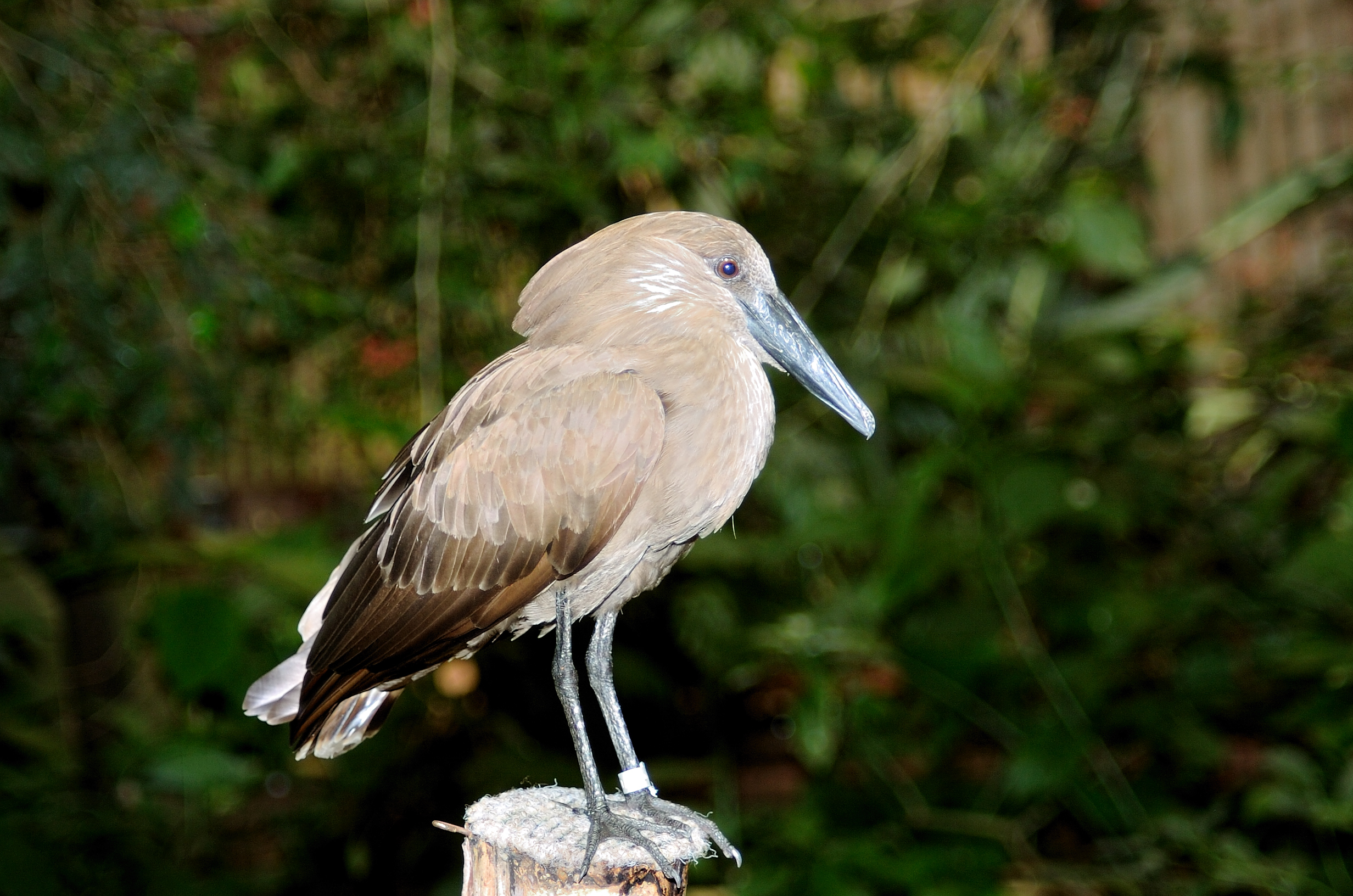
Hamerkop (Scopus umbretta) at NA by Dan

Hamerkop (Scopus umbretta) at National Aviary by Dan

Last week while Dan and I were visiting the Lowry Park Zoo in Tampa, FL, the idea for this article began. We were watching the Birds of Prey show that they have daily. We had also watched the Bird shows at the National Aviary in Pittsburgh, PA back in August.

Both places present some very interesting birds and they are not on leashes. The birds have the freedom to move around on their own, yet they do not run or fly away. They may  have been spooked at times, in Pittsburgh, and they may have to go get them, but they eventually get them back. Both places had birds flying over the heads of the spectators and doing stunts, yet they were  being controlled by the trainers. In other words, they were “tamed.”

Listening to the trainers, they tell how the birds are trained by “positive reinforcement.” The birds are encouraged  to perform for a “reward” for doing it right, but are never “punished” for not doing it right. They are just not given a “treat.” So none of the birds are mistreated.

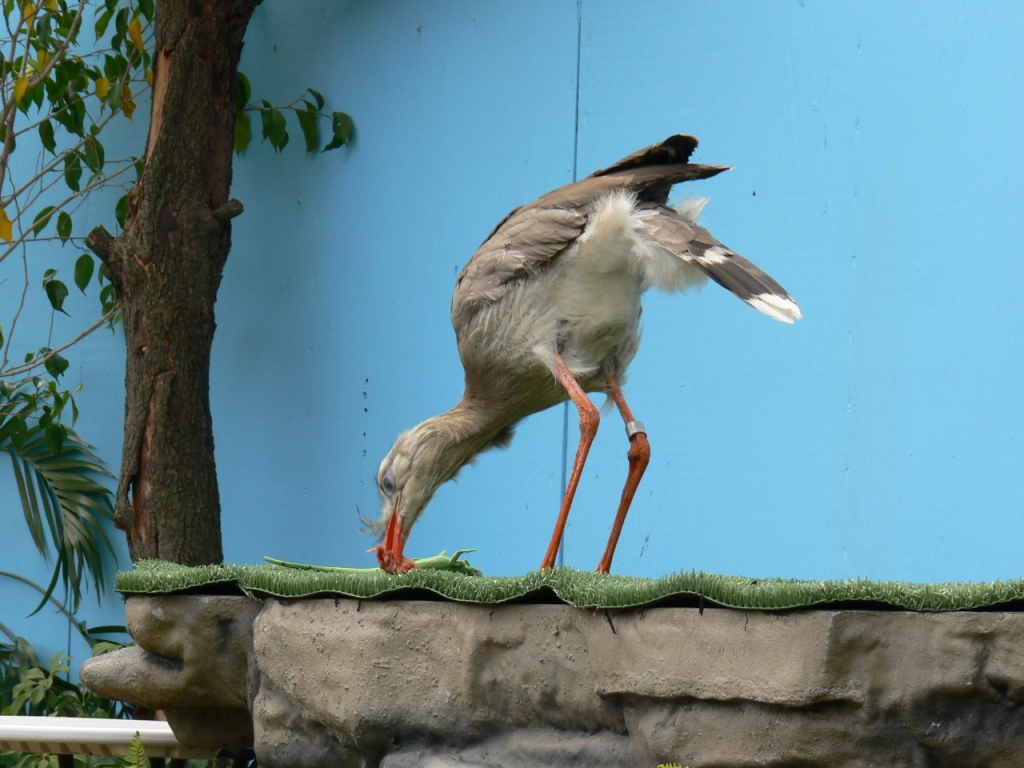
20100921 Lowry Pk Zoo Red-legged Seriema

Lowry Pk Zoo Red-legged Seriema with plastic lizard

Red-legged Seriema (Cariama cristata) by Lee at National Aviary

Red-legged Seriema (Cariama cristata) by Lee at National Aviary

What they do is encourage the bird to perform something that is already one of its behaviors. For instance, both places brought out the Red-legged Seriema, which is a bird of prey, and gave it a plastic lizard. Both birds picked it up and slung it to the floor several times. This is the normal way they kill their prey. So this was an easy task for the birds, yet the trainers had to “train or tame” the bird to where it would do its behavior on command.

The Serierma was just one of many birds doing “behaviors on command” at the Zoo and the Aviary. I felt the breezes of hawks, owls, and an eagle flying just over my head. Below is a Slide show of some of the “tamed” birds at both places.

The Bible only mentions “tame” or “tamed” in two different places. The first is mentioned in Mark 5:3-4 when a man with an unclean spirit, who dwelt in the tombs, “and no one could bind him, not even with chains, because he had often been bound with shackles and chains. And the chains had been pulled apart by him, and the shackles broken in pieces; neither could anyone tame him.” Jesus healed him.

For He said to him,  “Come out of the man, unclean spirit! (Mark 5:8 NKJV)

In James, we find the verses that tell about the birds being tamed. When we look around, we all can see many incidences of tamed critters and birds. Have you ever seen a critter tame a person? Man was given dominion over the critters in Genesis. Dominion did not mean what some think of today as subjugation, but it was more of use of, care of, learning from, and protecting them. Yet, God made man in His image, therefore man and woman are higher than the critters (all of them), not equal with them as some teach. Man has a “soul” which is accountable to God, the critters do not have a “soul.”

For every kind of beast and bird, of reptile and creature of the sea, is tamed and has been tamed by mankind. (James 3:7 NKJV)

The one thing that has a problem is the “tongue.” James goes on to say,

But no man can tame the tongue. It is an unruly evil, full of deadly poison. With it we bless our God and Father, and with it we curse men, who have been made in the similitude of God. Out of the same mouth proceed blessing and cursing. My brethren, these things ought not to be so. (James 3:8-10 NKJV)

These are some of the birds used in the shows or out and about with their trainers.

*

This slideshow requires JavaScript.

*

Ian’s Bird of the Week – Sora

Sora (Porzana carolina) by Ian

Sora (Porzana carolina) by Ian

Ian’s Bird of the Week – Sora (#382) ~ By Ian Montgomery

Newsletter (#382)  – 09-29-10

Any birds that are a challenge to see exert a particular fascination. This includes all the night birds – owls, nightjars, etc – and all the skulkers and lurkers. We had a classic skulker, the American Bittern, a couple of weeks ago, and the crakes and rails belong in the same category and the same habitat. In Australia, I’ve never seen a Lewin’s Rail and I’ve never photographed a Spotless Crake. Here in the US, the Clapper Rails at the Baylands Park at Palo Alto are giving me a hard time too, but the Sora, a crake, and the Virginia Rail have been more obliging.

The Sora (Porzana carolina) is very close related to the Australian Spotted Crake (Porzana fluminea) and looks very similar, but lacks the Moorhen-like red spot on the bill. They both live in reedbeds but will sometimes come out into the open to feed, particularly in the evening and when water levels are low, as they are here now in California at the end of a dry summer.

Sora (Porzana carolina) by Ian

Sora (Porzana carolina) by Ian

I’ve recently visited a park in the hills above San Jose three times looking without success for Golden Eagles, but each time I’ve seen a Sora and twice a Virginia Rail as well. In fact, the bird in the first photo came out into the sunshine to feed on the edge of the reed when we – my sister is here now – were watching for a less cooperative Virginia Rail, that was making a lot of noise. All the crakes and rails have very distinctive, loud calls, so presumably they, like the bittern, have trouble seeing each other too.

Both species are widespread throughout the United Sates and southern Canada, so there’s probably a cautionary tale here about naming species after places, such as Virginia or carolina, though I’m presuming that they weren’t named after people. Both migrate, so crakes and rails will fly quite long distances if they have to – usually at night – and turn up in odd places. Some, like the Buff-banded Rail, widespread in Australia also occurs on coral islands on the Barrier Reef and in the South Pacific, where, with nowhere to hide, it can become quite tame. Others like the Lord Howe Island Woodhen, have gone to the skulking extreme and lost the ability to fly.

Links:

Sora
Australian Spotted Crake
Virginia Rail
Buff-banded Rail

Best wishes,
Ian

Ian Montgomery, Birdway Pty Ltd,
454 Forestry Road, Bluewater, Qld 4818
Phone: +61-7 4751 3115
Preferred Email: ian@birdway.com.au
Website: http://birdway.com.au


Lee’s Addition:

Well, Ian does it again! I saw a Sora once years ago and still haven’t been able to spot one again here in Central Florida. Ours hide a little more than the one he found. :)

I am glad that he is being successful out there in California. If I was envious, I would be upset, but I am not. I’ll just keep looking.

At any rate, the Sora is part of the Rallidae Family of Rails, Crakes & Coots. There are 131 species in the family. The Rallidaes keep company with the Flufftails, Finfoots, Trumpeters, Cranes and Limpkins who are also in the Gruiformes Order.

The Sora’s breeding habitat is marshes throughout much of North America. They nest in a well-concealed location in dense vegetation. The female usually lays 10 to 12 eggs, sometimes as many as 18, in a cup built from marsh vegetation. The eggs do not all hatch together. Both parents incubate and feed the young, who leave the nest soon after they hatch and are able to fly within a month. (Wikipedia)

Can the papyrus grow up without a marsh? Can the reeds flourish without water? While it is yet green and not cut down, It withers before any other plant. So are the paths of all who forget God; … (Job 8:11-13a NKJV)

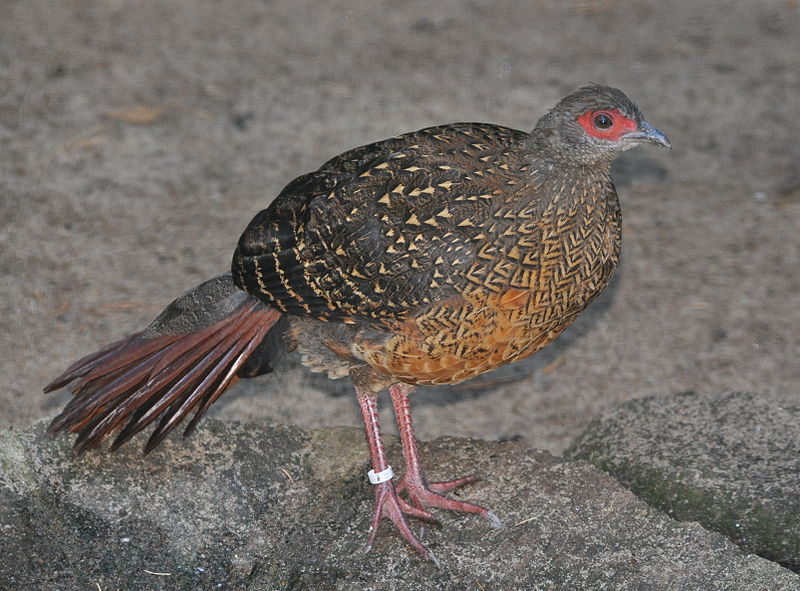
Swinhoe’s Pheasant – The Secret Agents..

Swinhoe's Pheasant (Lophura swinhoii) Male ©WikiC

Swinhoe's Pheasant (Lophura swinhoii) Male ©WikiC

Swinhoe’s Pheasant – The Secret Agents.. ~ by a j mithra

The Swinhoe’s Pheasant, discovered in 1862 by Robert Swinhoe, is a bird endemic to the undisturbed broadleaf forests of Taiwan below 2,500 meters of elevation. Since then, its numbers have fallen due to destruction of natural habitat, and was listed as endangered in 1966.

The habitat of the Swinhoe’s Pheasant has been recorded as dense forest. However, they can also be seen feeding out in the open along forest trails or on forest edges. The range of the Swinhoe’s Pheasant is from sea level up to 2,500 meters of the Central Mountain Range.

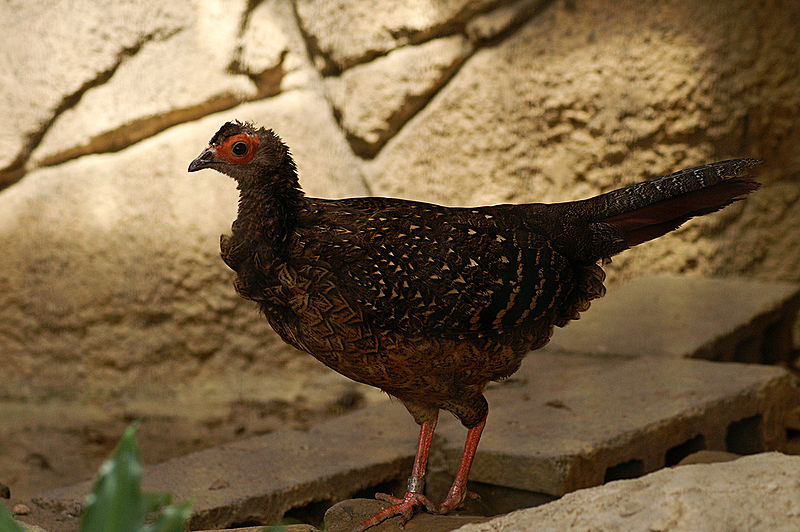
Swinhoe's Pheasant (Lophura swinhoii) Female ©WikiC

Swinhoe's Pheasant (Lophura swinhoii) Female ©WikiC

They live on the floor of a forest with a dense canopy and sparse undergrowth. Occasionally, they may also be found in more mature secondary growth forest, bamboo forest, and mixed forests. Because most of Taiwan’s broadleaf forest has been cleared in the lower elevations, Swinhoe’s Pheasants are mainly found in forests above 1,000 meters elevation. Fragmentation of forests occurring in the upper elevations is a growing threat to populations of the Swinhoe’s Pheasant. Though these birds prefer a higher elevation for a habitat, they still prefer to live on the floor of the forest..

  • Zacchaeus was a tax collector and must have been a rich man,,,
  • We all know that he climbed up into a sycamore tree to see Jesus…
  • And how Jesus went to his house only after he obeyed and came down from the tree..

Where are we right now?

Jesus will step into our lives and homes, but, not until we humble ourselves, Our feet planted firmly on the ground…

A man’s pride shall bring him low: but honour shall uphold the humble in spirit. (Proverbs 29:23)

Swinhoe's Pheasant (Lophura swinhoii) ©WikiC

Swinhoe's Pheasant (Lophura swinhoii) ©WikiC

The Swinhoe’s Pheasant follow the same feeding route in the forest each day. Along forest trails, there are often visible paths through the vegetation where the pheasants walk in and out every day. These paths are not permanent, however, and the same bird might have several entrances in an area.

  • When satan closes one door our God opens several entrances for us…
  • But, most of us just keep staring and grumbling at the closed road instead of looking at the other doors which God had opened for us…
  • One night, Peter’s door was closed and he returned with an empty boat..
  • But, Jesus had different plans after Peter willingly gave his boat to Him…
  • He opened the door so wide that, Peter’s boat overflowed into his friend’s boat too.
  • Instead of staring and grumbling at the closed door, give your life to Jesus and He shall open doors for you and yours too…
  • Well, satan may come through one way but he surely has to flee through seven ways.

This means if he enters your life, he has to open seven doors for you as he flees, because, your life is God’s own domain…

The LORD shall cause thine enemies that rise up against thee to be smitten before thy face: they shall come out against thee one way, and flee before thee seven ways. (Deuteronomy 28:7)

Swinhoe's Pheasant (Lophura swinhoii) Female ©WikiC

Swinhoe's Pheasant (Lophura swinhoii) Female ©WikiC

These pheasants feed by digging and their natural diet consists of seeds, plant material, acorns, berries,  flower buds, leaves, and occasionally insects such as earthworms, millipedes, termites. They tend to feed in the early morning and late afternoon hours, along trail edges in herbaceous ground cover. The pheasants are most active early dawn and late afternoon, especially in the fog when visibility is low. During the night, pheasants roost in trees, discovered through radio-tracking by researchers.

  • If not for His grace and mercy, neither I wouldn’t have written this article nor you would be reading this..
  • All of us would like to see more of His grace and mercy in our lives, but, we fail to comprehend that His grace is not for everyone..
  • We know that His mercy is like morning dew, but how many of us seek Him at dawn?
  • His grace is for the humble, but are we humble?

Surely he scorneth the scorners: but he giveth grace unto the lowly. (Proverbs 3:34)

The nests of Swinhoe’s Pheasants are so well concealed that it is almost impossible to come across unless followed through radio-tracking. The nests are built in highly secretive locations under a large shelter such as logs or rocks where it is safe from rain and predators. Sometimes the nest is built on a tree, where it is well hidden by vegetation.

  • When Jesus becomes the head of our house, satan will never be able to see us…
  • Remember how God smote the Syrian horses and chariots with blindness and led them to a wrong place?
  • He is the same yesterday, today and tomorrow…
  • He is not only the God of Elijah but ours too..
  • If He can do it for Elijah, He can do it for us too, provided we are as faithful as Prophet Elijah….

For thou hast possessed my reins: thou hast covered me in my mother’s womb. (Psalm 139:13)

  • His protection is there for us since we entered our mother’s womb..
  • But, are we still worthy to have this fool-proof protection?
  • If not, it is time for us to regain lost ground by completely submitting our lives..

If my people, which are called by my name, shall humble themselves, and pray, and seek my face, and turn from their wicked ways; then will I hear from heaven, and will forgive their sin, and will heal their land. (2Chronicles 7:14)

Have a blessed day!

Your’s in YESHUA,
a j mithra

Please visit us at:  Crosstree


The Swinhoe’s Pheasant is part of the Phasianidae Family of the Galliformes Order.

*

Birds in Songs – On Eagle’s Wings

Bald Eagle flying by Dave's BirdingPix

Bald Eagle flying by Dave's BirdingPix

I love eagles and I love this song. The song was written by Michael Joncas, in 1979 Unfortunately the words are copyrighted, so I can’t put them here on the blog, but this video has them.

Hope you enjoy the video by mhcaillesrn.

*

Secretary Bird – The Walker

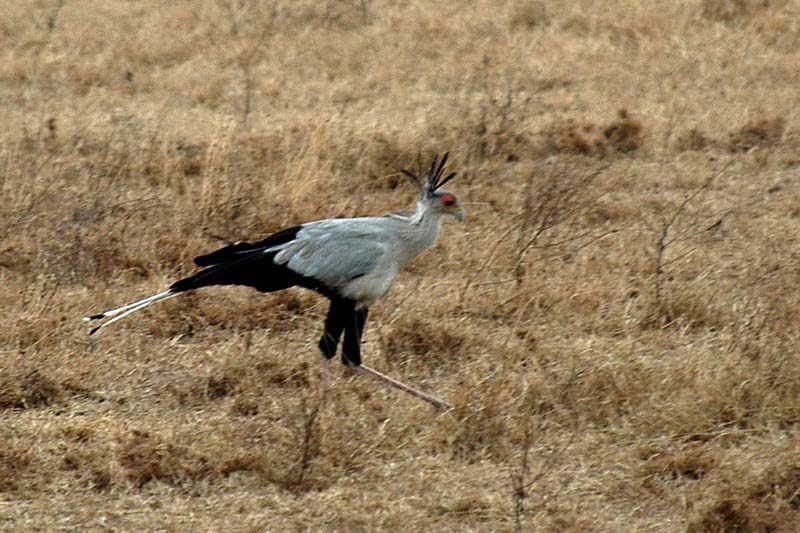
Secretarybird (Sagittarius serpentarius) by Bob-Nan

Secretarybird (Sagittarius serpentarius) by Bob-Nan

Secretary Bird – The Walker ~ by a j mithra

The Secretary bird is a bird of prey, but unlike other raptors it has long legs, wings and a tail.

The single species of its family, the bird gets its name from its crest of long feathers that look like the quill pens 19th century office workers used to tuck behind their ears.

A more recent hypothesis is that “secretary” is borrowed from a French corruption of the Arabic saqr-et-tair or “hunter-bird.” The generic name “Sagittarius” is Latin for “archer,” perhaps likening the Secretary Bird’s “quills” to a quiver of arrows, and the specific epithet “serpentarius” recalls the bird’s skill as a hunter of reptiles This is the only member of the family Sagittariidae.
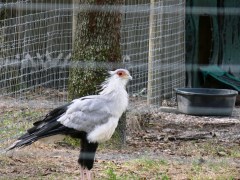
Secretarybird (Sagittarius serpentarius) at Lowry Pk Zoo by Lee

Secretarybird (Sagittarius serpentarius) at Lowry Pk Zoo by Lee

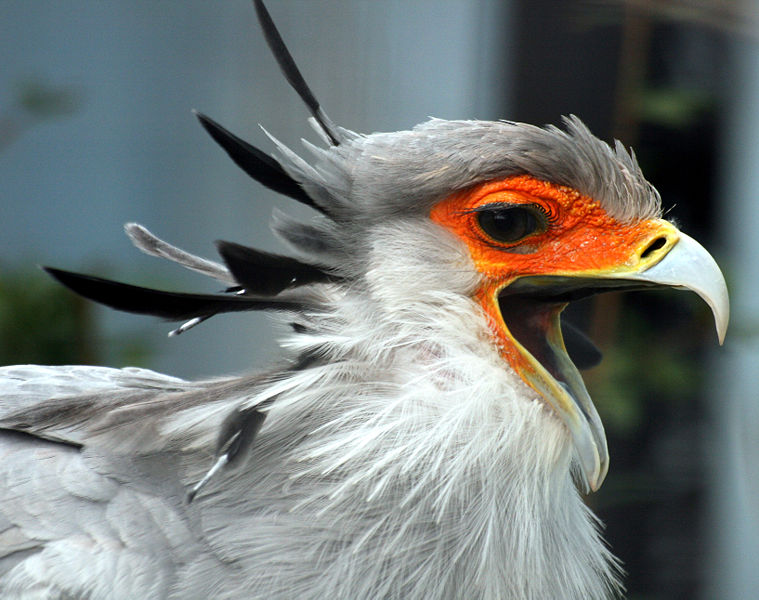
The bird is basically dove-grey in color, with black on the wings, thighs and elongated central tail feathers. The short, down-curved bill is backed by an area of bare, red and yellow skin. The Secretary bird stands three feet high.

The Secretary bird is widespread throughout Africa south of the Sahara. It is found in open areas of plains and savanna country, and often congregates at areas that have been recently burnt, where mammals are deprived of cover and often injured. These birds are basically terrestrial, taking to flight only when hard-pressed. Usually only single birds are found, with members of a pair some distance apart.

The Secretary bird walks well on extremely long legs, and a bird may plod up to twenty miles in a day. When pursued, it relies on its speed to escape.

  • If these birds can walk twenty miles a day, how far do we walk for the Lord?

The Bible says,

And whosoever shall compel thee to go a mile, go with him twain. (Mathew 5:41)

  • Jesus has never compelled us to walk with Him, did He?
  • Unless we walk in THE WAY, to fly high like an eagle can never be possible..
  • His rod and His staff, they comfort those who walk through the valley of the shadow of death..
  • He is the light to those who walk in the darkness..
  • He is the shield to those who walk through the fire..
  • He is the spring of joy to those who walk through the valley of tears…

Blessed is the man that walketh not in the counsel of the ungodly, nor standeth in the way of sinners, nor sitteth in the seat of the scornful. (Psalm 1:1)
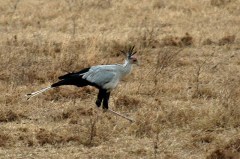
Secretarybird (Sagittarius serpentarius) by Bob-Nan

Secretarybird (Sagittarius serpentarius) by Bob-Nan

In addition to finding food with its beak, the Secretary bird will also stamp on grass tussocks with its feet to scare up lizards, grasshoppers, and small mammals or birds.It is a large bird of open country, savannah and steppe, which can be seen stalking across the plains in search of rodents, reptiles, large insects and, famously, snakes…

It has a surprisingly powerful kick which it uses to stamp on larger prey.

Do you remember where God has called us to stamp and walk?

Thou shalt tread upon the lion and adder: the young lion and the dragon shalt thou trample under feet. (Psalm 91:13)

This privilege is not for everyone, because, God has kept a price tag for every blessing..

The price tag for the above privilege is tied to the first verse and the ninth of the same chapter..

He that dwelleth in the secret place of the most High shall abide under the shadow of the Almighty. (Psalm 91:1)

Because thou hast made the LORD, which is my refuge, even the most High, thy habitation; (Psalm 91:9)

  • Where is your secret place, your refuge and your habitation?
  • When you make Jesus your habitation, you know what will happen?

Even the youths shall faint and be weary, and the young men shall utterly fall: But they that wait upon the LORD shall renew their strength; they shall mount up with wings as eagles; they shall run, and not be weary; and they shall walk, and not faint. (Isaiah 40:30-31)

In addition to its normal “raptor” type diet it is also attracted to bush and grass fires, where it feeds on the small animals which fail to escape the blaze. It finds most of its food on the ground and has a partiality for snakes. It grabs the snake with its strong toes and beats it to death on the ground, while protecting itself from bites with its large wings. Finally, it seizes its prey and hurls it into the air several times to stun it. In South Africa, these birds are kept in captivity to destroy snakes and rats.

Satan thought that he can put an end to Jesus, the Creator, but, Jesus claimed victory on the cross, so that we may live under the protection of His wings forever and ever..

He that believeth and is baptized shall be saved; but he that believeth not shall be damned. And these signs shall follow them that believe; In my name shall they cast out devils; they shall speak with new tongues; They shall take up serpents; and if they drink any deadly thing, it shall not hurt them; they shall lay hands on the sick, and they shall recover. (Mark 16:18)

Although it is usually seen walking it does have very large, broad wings and is an accomplished flyer, using thermals to gain height and soar across distances. Secretary Birds are territorial, normally occupying areas of around 45-50 square kilometers, Interestingly in Kenya they occupy smaller territories.
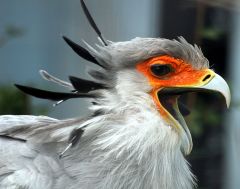
Secretarybird (Sagittarius serpentarius) with open beak©WikiC

Secretarybird (Sagittarius serpentarius) with open beak©WikiC

Secretary Birds associate in monogamous pairs. During mating season there is heavy competition between males, with birds doing acrobatic flights, climbing high into the sky, then suddenly dropping down..

During courtship, they exhibit a nuptial display by soaring high with undulating flight patterns and calling with guttural croaking. Males and females can also perform a grounded display by chasing each other with their wings up and back, much like the way they chase prey. Once paired up they are devoted and remain together for life…  They usually mate on the ground, although some do so in Acacia trees.

  • Jesus gave His life so that we may remain devoted, loyal and remain together for life…
  • He knew that we would walk away from Him from time to time..
  • Is that the reason why He said,

But he that shall endure unto the end, the same shall be saved. (Mathew 24:13)

If we cannot walk with Him on earth all through our life of may be about eighty years, do you think it is possible for us to live with Him in heaven forever and ever?

So as Secretary birds pair for life, they are remarkably faithful to their nest site too. The nest is generally placed low in the fork of a tree, usually an acacia. The huge bundle of sticks grows year by year in the manner of an eagle’s eyrie. Nests are built at a height of 5–7 m (15–20 feet) on Acacia trees. Both the male and female visit the nest site for almost half a year before egg laying takes place. The nest is around 2.5 m (eight feet) wide and 30 cm (one foot) deep, and is constructed as a relatively flat basin of sticks.

  • God is remarkable faithful to finish the good work which He has started in you..
  • But, how faithful are we to Him?

These birds visit their nest site for almost half the year..

  • You know, Jesus is preparing a kingdom for us since the foundation of the world..
  • What a loving God we have!!!!

Then shall the King say unto them on his right hand, Come, ye blessed of my Father, inherit the kingdom prepared for you from the foundation of the world: (Mathew 25:34)

Secretary Birds occupy an ecological niche similar to that occupied by Peafowl in South and South east Asia, Roadrunners in North and Central America and Seriemas in Soth America.

The Secretary Bird is the National Emblem as well as a prominent feature on the Coat of Arms of Sudan. In Sudan, it is featured in the middle white strip of the Presidential Flag; it is the main object on the Presidential Seal, and features heavily in Sudanese military insignia. The Secretary Bird on the Presidential Flag and Seal has its head turned to the right, with its distinctive crest clearly visible and its wings spread out with a white banner between its outstretched wings reading “Victory is Ours”.

We are the crown of the King of kings and the Lord of lords..

Thou shalt also be a crown of glory in the hand of the LORD, and a royal diadem in the hand of thy God. (Isaiah 62:3)

We shall be victorious because we have a God who said

And all this assembly shall know that the LORD saveth not with sword and spear: for the battle is the Lord’s, and he will give you into our hands. (1 Samuel 17:47)

Yahweh Nissi- The Lord is our banner..

Have a blessed day!

Your’s in YESHUA,
a j mithra

Please visit us at:  Crosstree


Accipitriformes Order of the Sagittariidae Family

*
Birds of the Bible – The Lord Provides For Them

Silver-eared Leiothrix (Leiothrix argentauris) by Ian

Silver-eared Leiothrix (Leiothrix argentauris) brightly colored-by Ian

O LORD, how many are Your works! In wisdom You have made them all; The earth is full of Your possessions. There is the sea, great and broad, In which are swarms without number, Animals both small and great. There the ships move along, And Leviathan, which You have formed to sport in it. They all wait for You To give them their food in due season. You give to them, they gather it up; You open Your hand, they are satisfied with good. (Psalms 104:24-28 NASB)

When you look at all that is around you, do you stand amazed at the Lord God’s Creative Hand or do you just think given enough time, this all came about? For me, I see an awesome Creator God that has wisdom and understanding that is way beyond my finite mind to comprehend. As I was praying and asking the Lord to help me do this article, I thought, “Lord you knew I was going to make this prayer this morning.” “You know what I’ll pray about tomorrow, and the next, and next year.” Whoa! I had to finish up my prayer and not get carried away. But, now, I had my idea for this blog today.

In Genesis 1 we learn that when the critters, birds, man and woman were created, they were vegetarians.

And God said, “See, I have given you every herb that yields seed which is on the face of all the earth, and every tree whose fruit yields seed; to you it shall be for food. Also, to every beast of the earth, to every bird of the air, and to everything that creeps on the earth, in which there is life, I have given every green herb for food”; and it was so. Then God saw everything that He had made, and indeed it was very good. So the evening and the morning were the sixth day. (Genesis 1:29-31 NKJV)

God knew that man was going to sin and that the he (man and woman) and all the critters, birds, fish, and the earth were going to be cursed. God knows the end from the beginning. “Before the mountains were brought forth, Or ever You had formed the earth and the world, Even from everlasting to everlasting, You are God.” (Psalms 90:2 NKJV) Just as He provide for man, that Jesus Christ would come to pay the price for our sins; He provided for the animals and birds so they could defend themselves from the cursed nature of other critters and birds.

Silver-eared Leiothrix (Leiothrix argentauris) by Ian

Silver-eared Leiothrix blended in tree-by Ian

Watching birds, one of my favorite things to do, you can see God’s Protective Hand at work. The colors alone, give a clue. The male birds seem to be the most brightly colored, which helps the get a mate. Their mating helps preserve their species and the female, whose color is usually subtle, is protected as she sits on the nest. The bright colors of many birds, which I love to see, seem to blend right in with their surrounding. Again protecting them from predators.

God gave the birds a command to reproduce.  “And God blessed them, saying, “Be fruitful and multiply, and fill the waters in the seas, and let birds multiply on the earth.” (Genesis 1:22 NKJV) When they came off the Ark, He said to Noah, “Bring out with you every living thing of all flesh that is with you: birds and cattle and every creeping thing that creeps on the earth, so that they may abound on the earth, and be fruitful and multiply on the earth.” (Genesis 8:17 NKJV)

Steller's Sea Eagle (Haliaeetus pelagicus) by Lee at NA

Steller’s Sea Eagle (Haliaeetus pelagicus) by Lee at NA

The predators!  Many of the plants before the Flood were large and thick. The beaks and claws were used to help them eat plants, now, those same beaks and claws help them catch prey. They were still provided for by God’s forethought even though that was not what the Creator wanted them to do. He knew the end from the beginning.

I could name trait after trait, where the Creator’s love, omniscience (all-knowing), omnipotence (all-powerful), and care is shown to critters and birds. Look and observe the birds and you will see that they had a Awesome Creator that knew the end from the beginning and has well provided for them.

He sends forth springs in the valleys; They flow between the mountains; They give drink to every beast of the field; The wild donkeys quench their thirst. Beside them the birds of the heavens dwell; They lift up their voices among the branches. He waters the mountains from His upper chambers; The earth is satisfied with the fruit of His works. He causes the grass to grow for the cattle, And vegetation for the labor of man, So that he may bring forth food from the earth, (Psalms 104:10-14 NASB)

What about us? Do we observe and realize the love, care, omniscience, and omnipotence in our (man’s) creation? How about your body, eyes, skin, internal organ, heart, mind? They were all fantastically created by a loving God. Yes, they are falling apart. Yes, they become corrupt. Yes, we die. That is because of the curse and the fall of man into sin.
But!

But God commendeth his love toward us, in that, while we were yet sinners, Christ died for us. (Romans 5:8 KJV)

Let me leave you with encouragement and thoughts that the Lord gave his disciples:

Therefore I say to you, do not worry about your life, what you will eat; nor about the body, what you will put on. Life is more than food, and the body is more than clothing. Consider the ravens, for they neither sow nor reap, which have neither storehouse nor barn; and God feeds them. Of how much more value are you than the birds? And which of you by worrying can add one cubit to his stature? If you then are not able to do the least, why are you anxious for the rest? Consider the lilies, how they grow: they neither toil nor spin; and yet I say to you, even Solomon in all his glory was not arrayed like one of these. If then God so clothes the grass, which today is in the field and tomorrow is thrown into the oven, how much more will He clothe you, O you of little faith? “And do not seek what you should eat or what you should drink, nor have an anxious mind. For all these things the nations of the world seek after, and your Father knows that you need these things. But seek the kingdom of God, and all these things shall be added to you. (Luke 12:22-31 NKJV)

The Wordless Birds
*