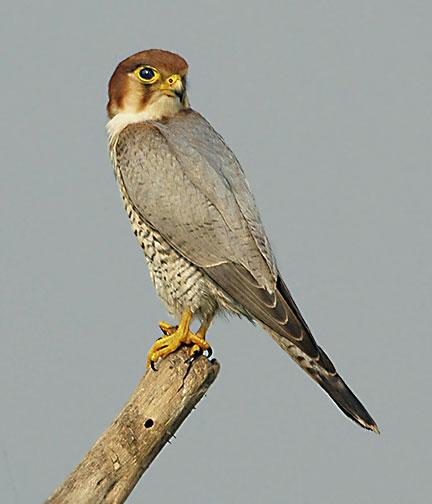
Birds of the Bible – Swift

“Even the stork in the heavens Knows her appointed times; And the turtledove, the swift, and the swallow Observe the time of their coming. But My people do not know the judgment of the LORD. (Jeremiah 8:7 NKJV)

While working on an “Interesting Things – Chimney Swifts” blog, I discovered that I had not done the “Birds of the Bible” about the Swallow or the Swift (translated in the NKJV and the NASB as “swift”). So, here is the first one on the Swift and the Swallow will follow soon. The Chimney Swift is now part of this one. I originally thought I had been through all the “Birds of the Bible” at least once. Fortunately, even though I may have forgotten them, the Lord never forgets his created critters.

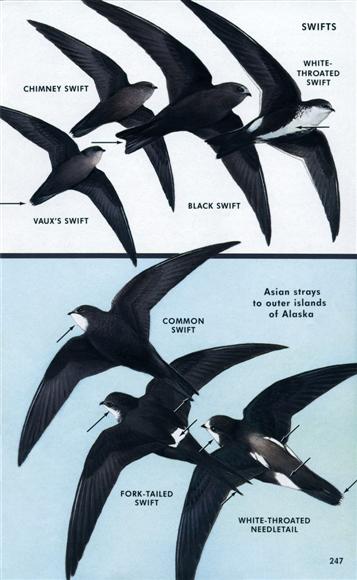
Swifts from PPeterson Field Guide to Western Birds

Swifts from Peterson Field Guide to Western Birds

During the Birding Festival last week, the Chimney Swift was mentioned as a bird that is always flying. That peaked my interest and started investigating it. Creation Moments did an article about it called “A Bird Always in Flight.

The swifts are small aerial birds, spending the majority of their lives flying. These birds have very short legs and never settle voluntarily on the ground, perching instead only on vertical surfaces. Many swifts have long swept-back wings that resemble a crescent or a boomerang. They are often described as a “flying cigar.” They belong to the Order – Apodiformes – Family Apodidae.  Many think that Swifts and Swallows are in the same family, but the Swift is related closer to the Hummingbird. “Swift” comes from the Greek apous which means “without feet.”  They all have feet, but prefer to land on a vertical surface like a chimney, clift, or bank.  Most of the Swifts travel in groups eating insects, flying most of the time – landing only to roost at night or for nesting. Their call is described as a chatter, twitter, or similar sound.”A group of swifts are collectively known as a “box”, “flock”, “screaming frenzy”, and “swoop” of swifts.” (from WhatBird.com, as are the following links)

Our North American Swifts are:
Chimney Swift is 5-6″ long with a wingspan of 11-12″ (When in a chimney they use their tail which has spines to help them stay put and they attach their nest using a saliva glue.)
Black Swift is 7-7.5″ with a wingspan of 15″
Common Swift is 6-7″ with a 16-19′ wingspan
Vaux’s Swift is 4′ with a wingspan of 11″ (the smallest North American Swift)
White-collard Swift is 8.75″ with a wingspan of 19-21
White-throated Swift is 6-7″, wingspan of 13-14″ (with a white throat)
White-throated Needletail (formerly Spine-tailed Swift) is 7.5-9″ with a 20″ wingspan


Articles and Sound from Cornell:

White-collared Swift from Wikipedia

White-collared Swift from Wikipedia

Chimney Swifts
Vaux’s Swift
White-throated Swift

Some Interesting Links:
For the Birds – Chimney Swifts
I Saw The Swifts

*

Interesting Things – Why Birds Don’t Wear Socks

SmileyCentral.com

One of my favorite articles from Creation Moments has been about why birds don’t wear socks. Now they have produced a YouTube about it and it is copied here. I was just getting ready to do some more research on it when I found this. Let’s see what can be found out.

There is an interest Pod Cast about Why Birds Stand on One Leg from BirdNote.org

Apparently the “Wonder Net” is actually called the “rete mirabile” which is Latin for “wonderful net.” It is a complex of arteries and veins that are close to each other. It uses a “countercurrent blood flow within the net (blood flowing in opposite directions.) It exchanges heat, ions, or gases between vessel walls so that the two bloodstreams within the rete maintain a gradient with respect to temperature, or concentration of gases or solutes.” (“Rete mirabile”, from Wikipedia)

In birds with webbed feet, a rete mirabile in the legs and feet transfers heat from the outgoing (hot) blood in the arteries to the incoming (cold) blood in the veins, with the net effect that the internal temperature of the feet is much closer to the ambient temperature, thus reducing heat loss. In this example the rete mirabile functions as a biological heat exchanger. A similar structure is seen in other vertebrate extremities, including the neck of the dog, in order to protect the brain when the body overheats; fishes such as tuna, whose core temperature is higher than that of the cold deep waters they inhabit; and penguins who have them in the feet, flippers and nasal passages, to limit body heat lost to the cold environments in which they live. In giraffes, a rete mirabile in the neck equalizes blood pressure when the animal bends down to drink.

“You are worthy, O Lord, To receive glory and honor and power; For You created all things, And by Your will they exist and were created.” (Revelation 4:11 NKJV)
For by Him all things were created that are in heaven and that are on earth, visible and invisible, whether thrones or dominions or principalities or powers. All things were created through Him and for Him. And He is before all things, and in Him all things consist. (Colossians 1:16-17 NKJV)

See Also: The Amazing Giraffe

Day Five at the Space Coast Birding Festival

We had another great day at the Space Coast Birding Festival which ends tomorrow, Jan 26th. We are home now, but they continue on without us.

Dawn, Jeff and Me

Dawn, Jeff and Me

Met up with Dawn and Jeff several times again today. She does Dawn’s Bloggy Blog. Then off to some more workshops. First off was Reinier Munguia’s, “Bird ID for Kids” to help with some upcoming lessons with kids. Reinier was still not up to normal, so he let his daughter do the presentation. She is a 9th grader and did a  fantastic job. She has been in the field with her dad since she was 3 months old, straped on her father’s back.

In the afternoon it was “Taking the Fear Out of Identifying Gulls” by Alvaro Jaramillo of Field Guides, Inc. He did another great presentation and again I picked up some great information.

By the time that ended, I was in “information overload.” With all the workshops and seminars, birding, plus walking around the exhibits and chatting for the past few days, I was ready for “home.” So was Dan. When we did get home, a 90 mile drive, we found that the cold weather we have been having did “a number” on a few of the plants in the yard. Checked the outdoor temperature and it had gotten down to 26 degrees. We weren’t here to cover the plants. The ones in pots were okay because we had set them in the carport before leaving. Would I go again, You Bet!!!

Day Four at the Space Coast Birding Festival

Today was another interesting day at the Birding Festival. I started the day off with Reinier Munguia’s (of Wildstock Photos) seminar on the “Life of Birds.” He did a very good job even though he still isn’t feeling all that well yet. He made it entertaining as well as informative.

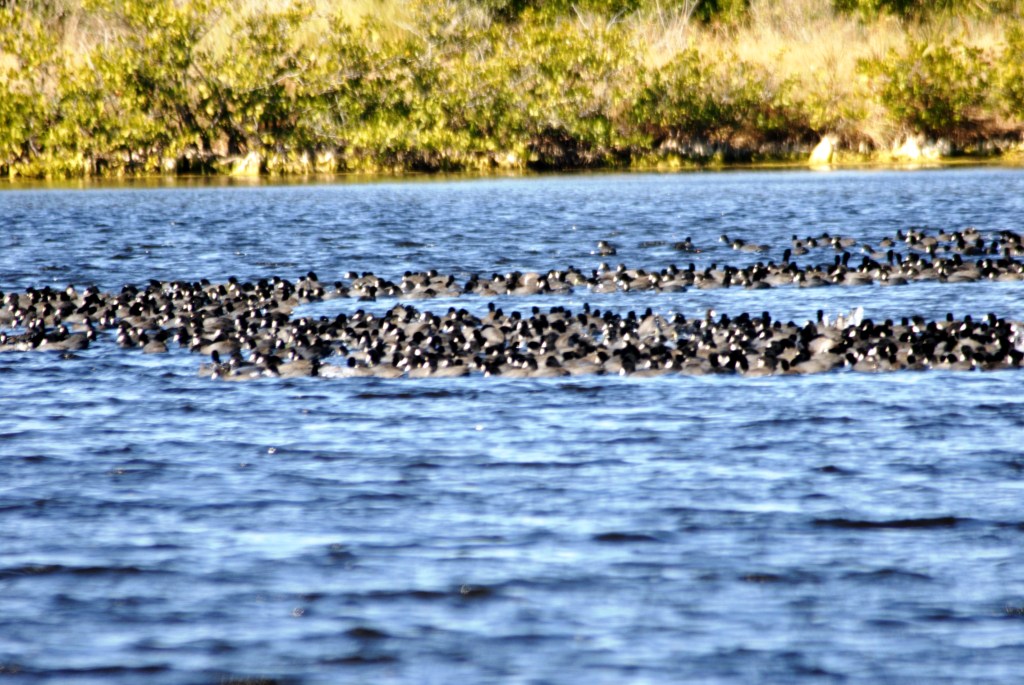
Hundreds of Coots at Merritt Is NWR

Hundreds of Coots at Merritt Is NWR

Then, I attended the two seminars by Sharon Stiteler of the BirdChick Blog. She did one on “City Bird, Country Bird Housing and Feeding,” which helped clear up some questions I had about using meal worms and some other feeding questions. Her other seminar was, “BirdChick Blog: The New Nature Journal.” She did an excellent presentation and I learned many things that will help me with this blog. She is a very enthusiastic person. Thanks, Sharon. It was nice meeting you.

I finished up the day with the “Great Florida Birding Trail“, by Mark Kiser.  He showed many of the great places around the state to bird and what birds to expect there. He also introduced their new birding trip planning website which will be a great help. Poor Dan, he is going to have to take us on some more birding trips. He has been learning all those photography tips, so I doubt he won’t mind too much.

A new thing is in the mail for me to use, but that information will just have to wait to be told later. Needless to say, this Birding Festival has been very well run and it has been right enjoyable. I have seen some mighty great pictures and learned more facinating facts about the great birds the Lord has created. His creative Hand is so evident.

Birds of the Bible – Pigeon

In Genesis 15, Abram was told in a vision:

(1)  After these things the word of the LORD came to Abram in a vision, saying, “Do not be afraid, Abram. I am your shield, your exceedingly great reward.”…
(5)  Then He brought him outside and said, “Look now toward heaven, and count the stars if you are able to number them.” And He said to him, “So shall your descendants be.”  (6)  And he believed in the LORD, and He accounted it to him for righteousness.  (7)  Then He said to him, “I am the LORD, who brought you out of Ur of the Chaldeans, to give you this land to inherit it.”
(8)  And he said, “Lord GOD, how shall I know that I will inherit it?”
(9)  So He said to him, “Bring Me a three-year-old heifer, a three-year-old female goat, a three-year-old ram, a turtledove, and a young pigeon.”  (10)  Then he brought all these to Him and cut them in two, down the middle, and placed each piece opposite the other; but he did not cut the birds in two….
(12)  Now when the sun was going down, a deep sleep fell upon Abram; and behold, horror and great darkness fell upon him….  (17)  And it came to pass, when the sun went down and it was dark, that behold, there appeared a smoking oven and a burning torch that passed between those pieces.
(18)  On the same day the LORD made a covenant with Abram, saying: “To your descendants I have given this land, from the river of Egypt to the great river, the River Euphrates  (19)  the Kenites, the Kenezzites, the Kadmonites,  (20)  the Hittites, the Perizzites, the Rephaim,  (21)  the Amorites, the Canaanites, the Girgashites, and the Jebusites.”

The next time a pigeon is mentioned is after the birth of a child, a woman was to bring a sin offering.

‘When the days of her purification are fulfilled, whether for a son or a daughter, she shall bring to the priest a lamb of the first year as a burnt offering, and a young pigeon or a turtledove as a sin offering, to the door of the tabernacle of meeting. (Leviticus 12:6 NKJV)

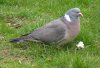
In North America we have four pigeons that are in the Order Columbifomes, which contains 300 plus species. This includes pigeons, doves, and turtle-doves plus others. The size of the bird helps distinguish between “doves” and “pigeons”, with the “pigeon” being the largest. Our Pigeons are the:

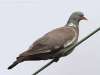
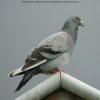
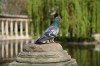
The Rock Pigeon (previously the Rock Dove), “Male, 12.2–13.4 in (31–34 cm), 6.3–12.5 oz (180–355 g). Plumage generally bluish gray with relatively short tail and long, strong wings.” “The rock pigeon has a rather fast and long step. It is a skillful flyer. Flight velocities of 115 mph (185 kph) have been recorded.”  “Carrier pigeons deserve special mention. Pigeons have been used to send communications since earliest times. In ancient Egypt, Pharaoh Djoser (2600–2550 B.C.) released house pigeons at the borders of his empire to mail the news that enemies were attacking the frontiers. Today’s carrier pigeon was created about 1850 in Belgium by breeding various races. Carrier pigeons can cover up to 621 mi (1,000 km) in a single day, and were trained to live with two lofts 12.4 mi (20 km) apart.” (About.com)

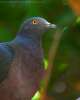
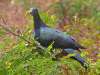
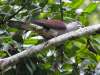
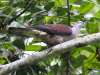
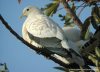
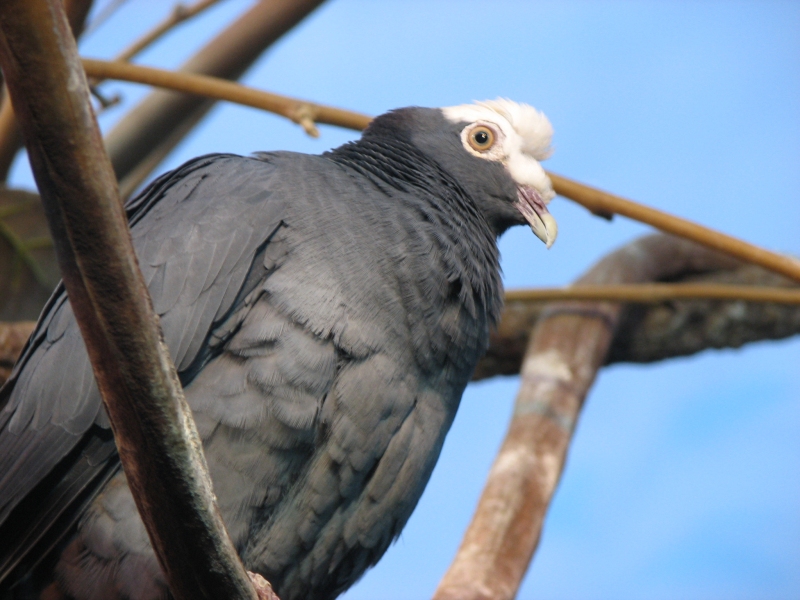
White-crowned Pigeon

White-crowned Pigeon

White-crowned Pigeon, is 13 in long, has a wingspan of 23 in and weighs about 8 oz. “The adult is dark grey, with green and white bars on the nape, a brilliant white crown to the head, a white iris, and a pale-tipped red bill.” “The ground speed of the White-crowned Pigeon in flight has not been formally documented, but is said to easily outpace a fast motorboat.” (All About Birds)

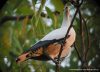
Band-tailed Pigeon, is 13-16 in and weighs 12.5 oz. and has a yellow bill and feet. “The plumage is gray, somewhat darker above. The head and underparts have a faint pink cast, especially in the adult male; the belly is nearly white.” (Western Field Guide)

Red-billed Pigeon – is 14 in and a large pigeon, that is gray and deep maroon, with a red bill with a pale tip.

“Pigeons and doves are distributed everywhere on Earth, except for the driest areas of the Sahara Desert, Antarctica and its surrounding islands and the high Arctic. They have colonised most of the world’s oceanic islands (with the notable exception of Hawaii), reaching eastern Polynesia and the Chatham Islands in the Pacific, Mauritius, the Seychelles and Reunion in the Indian Ocean, and the Azores in the Atlantic Ocean.

The Band-tailed Pigeon is the largest in North America. The Passenger Pigeon, which has become extinct, at one time had over 4 billion in number. One report mentioned that on a fly-over the pigeons were in a flock, “a mile wide and up to 300 miles long, were so dense that they darkened the sky for hours and days as the flock passed overhead.” (Chipper Wood Bird Observatory)

The family has adapted to most of the habitats available on the planet. The largest number of species are found in tropical forests and woodlands, where they may be arboreal, terrestrial or semi-terrestrial. Various species also inhabit savannas, grasslands, deserts, temperate woodlands and forests, mangrove forests, and even the barren sands and gravels of atolls.” From Wikipedia

“The Common Bronzewing (Phaps chalcoptera) is a species of medium-sized, heavily built pigeon. Native to Australia and one of the country’s most common pigeons, the Common Bronzewing is able to live in almost any habitat, with the possible exception of very barren areas and dense rainforests.” From Wikipedia

Pigeons in a group are called a “loft,” “band,” “dropping”, “passel” or a “school” of pigeons.

Links from WhatBird.com
Red-billed Pigeon
Band-tailed Pigeon or Band-tailed from All About Birds
Rock Pigeon or Rock from All About Birds
White-crowned Pigeon or White-tailed from All About Birds
Here are some of the Pigeons Worldwide:

Day Three at the Space Coast Birding and Wildlife Festival

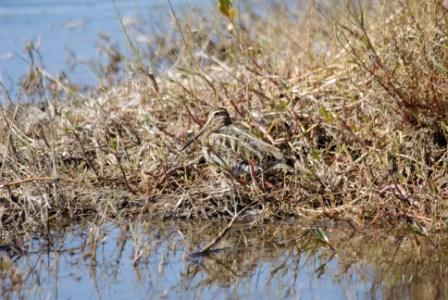
Wilson's Snipe - Merritt Is. NWR by Dan

Wilson's Snipe - Merritt Is. NWR by Dan

Off we went again to the festival in 28 degree weather. Sure be glad when this cold front departs. Today’s seminars and workshops were very good. First, Dan and I attended “Bird Photography” by Joel Rosenthal, who gave a very good presentation on some ins and outs of photographing birds. Later, it was “Wading Birds” by Dr. Eric Stolen from Kennedy Space Center who studies the environment for the Wading Birds there on the Center.
Then I attended Alvaro Jaramillo’s “Field Marks We Haven’t Met Yet – Birding Outside the Box.” His idea of learning to ID birds is to observe and study them to where you just “know them”, like you would “just know” a person’s face. It was a very interesting lecture.
Then one of the highlights of the day was when I met up with Dawn, from Dawn’s Bloggy Blog. We enjoyed meeting each other and I hope to spend some more time chatting with her and Jeff. We were also concerned about Reinier Munguia, who was very sick yesterday and today. He does photography workshops here and is our friend who’s photos I use on the blog. He was a little better this afternoon.

So far, the Festival has been going very well, minus a small power outage this afternoon.

Doves and Pigeons Page Updated

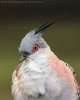
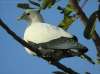
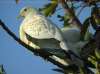
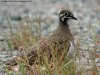
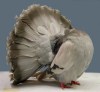
Crested Pigeon

Crested Pigeon

I recently updated my Dove and Pigeons page in preparation for an article on Birds of the Bible – Pigeons coming out on Friday this week. That is, if I get it done with all the Space Coast Birding Festival activities. (See next post) I hope you enjoy the photos of the pigeons and doves. I recently got permission from Ian Montgomery, an excellent photographer in Australia, to use his photos in these blogs. Thanks, Ian. There is a new link (Birdway by Ian Montgomery) on the sidebar for his website in the Photography links.
Check out the Doves and Pigeon page!

Day Two at the Space Coast Birding and Wildlife Festival

We are enjoying our time here at the Space Coast Birding and Wildlife Festival in Titusville, Florida. We left home yesterday (48 degrees) and drove the 90 miles and saw 23 species of birds on the way over including: 11 Wild Turkeys, American Kestrel, and 5 Robins. After arriving we spent 2 1/2 hours driving through the Black Point drive at Merritt Island National Wildlife Refuge. We were chilled to the bones with it still being only 48 degrees with 20-25 mph winds. But, it was worth it. Among the 36 species spotted were 5 new “life birds.”

Clappper Rail at Merritt Is. NWR

Clappper Rail at Merritt Is. NWR

Here is what we saw: 50 American Wigeons (Life), 40 Mottled Ducks, 50 Blue-winged Teal, 50 Northern Shoveler, 50 Northern Pintail, 15 Pied-billed Grebe, 5 Brown Pelican, 25 Double-crested Cormorants, 5 Anhinga, 7 Great Blue Heron, 8 Great Egret, 15 Little Blue Heron, 10 Tricolored Heron, 1 Green Heron, 30 White Ibis, 10 Glossy Ibis, 16 Roseate Spoonbill, 3 Wood Stork, 15 Black Vulture, 15 Turkey Vulture, 5 Osprey, 1 Bald Eagle, 1 Clapper Rail (Life), 5 Common Moorhen, 1000 American Coot (never seen so many), 2 Sandhill Crane, 1 Killdeer, 50 Avocet (Life), 1 Spotted Sandpiper (Life), 20 Greater Yellowlegs, 25 Lesser Yellowlegs, 10 Short-billed Dowitcher (Life), 3 Wilson’s Snipe, 5 Ring-billed Gull, and 2 Belted Kingfisher.

Snowy Egret at Merritt Is. NWR

Snowy Egret at Merritt Is. NWR

We were fortunate to keep running into Peter, from Massachusetts, who was a big help with some of the IDs. He is here for the Birding Festival also. He had his telescope which was a big help.
Today, they really started the seminars, workshops, trips, and other activities. The festival runs until Sunday. This morning I attended an informative “Beginning Photography” seminar, by Milton Heiberg Photography, and then this afternoon, I went to a great workshop about “Kingfishers” by Jeffrey A. Gordon from Leica. Today I had the privilege of having conversations with Bill Thompson III (Bird Watcher’s Digest, editor) and Pete Dunn at Cape May Bird Observatory who has written many bird books and both are well known in the “birding world.”

Bird Watcher Passes Goal – from The Ledger

The following is an article in today’s The Ledger, our local newspaper: (the bold type is mine)

THE NATURE OF THINGS
Bird Watcher Hits Goal, Finding 216 Species in Polk

By Tom Palmer, Published: Monday, January 12, 2009 at 9:50 p.m.

Roy Morris‘ quest to see how many species of birds a person could find in Polk County in a year is over.
The total was 216 species, one species more than the minimum of 215 species he said was his goal a year ago.
His total would have been a little higher if he hadn’t been out of town when a couple of species showed up at Saddle Creek Park one fall weekend.
Nevertheless, his list includes some surprises.
This is the first time I know of that anyone has set out intentionally to see how many species they could check off in a year in Polk County. In bird-watching parlance, this is what is known as a “Big Year.”
Morris said the way he looks at it, he has now set a benchmark for others to try to top.
He said his quest revealed a few things about bird-watching opportunities in Polk County. For one, there’s no one place where there are mass gatherings of waterfowl or shorebirds that compare with some of the coastal areas of Florida.
Some local birdwatchers have broached the idea of building “scrapes” in section of wetlands areas of local parks. These are areas that are open, wet and sparsely vegetated, which would attract more shorebirds.
The advantage to something like that is that uncommon species sometimes join the masses of common species in this kind of area.
Although other sites looked promising, Saddle Creek Park near Lakeland remained the best and most dependable place to see songbirds during the fall migration.
Circle B Bar Reserve, one of the better local bird-watching parks, was closed during most of 2008 because of construction.
During the spring migration, songbirds are more commonly seen in coastal parks.
Morris said his quest reinforced the idea that Polk County is a good place to see Florida specialties, such as snail kites, caracaras and burrowing owls.
Morris said he had fun tackling the project and it did get him out of his normal bird-watching haunts to explore new areas of Polk County. He had hoped to reach 220 species or so and that could have been possible if he had found birds that he knows were present in the county because other people saw them.
So what did Morris see?
The list is long and varied. His first bird of the year was a pied-bill grebe, which he saw on Jan. 1, along with 91 other species.
The last bird of the year was an American woodcock he found on Dec. 2.
The most unexpected bird he saw was a magnificent frigatebird, which he spotted among a large group of vultures soaring over Saddle Creek Park on Oct. 25.
Frigatebirds are seabirds. I’ve seen several in Polk, but only after they were pushed inland by a hurricane or tropical storm. This bird’s appearance didn’t appear to be weather-related, which makes the sighting particularly notable.
Some other notable finds included a peregrine falcon, a black-throated green warbler, Canada warbler, red-cockaded woodpecker, dunlin (a kind of shorebird), lark sparrow and scissor-tailed flycatcher.
In case you’re wondering, the official Polk County bird list contains 306 species, but many of them were one-time wonders that showed up years ago, never to be seen again locally.
There is a Web site on Polk County birds that’s maintained by local birdwatcher Chuck Geanangel.
To learn more go to www.polkcountybirds.com.


Birds of the Bible – Osprey II

Osprey by Anthony

Osprey by Anthony

The Osprey or Ospray (depending on which version of Bible) listed in Leviticus 11:13 or Deuteronomy 14:12, gives an interesting challenge. According to my e-Sword Bible Program, an Osprey or ospray is listed in the ASV, BBE, Bishops, CEV, Geneva, JPS, KJV,  MKJV, RV, WEB, Webster, and YLT versions. Yet, the Darby calls it a sea-eagle. The ESV, GW, LITV, MSG, NASB, and the NKJV versions call it a type of Vulture. I am not sure why the different versions do that, but most of them call it the Osprey or sea-eagle which is another name used for it. The WhatBird article had this to say about it, “The Osprey, Pandion haliaetus–whose species name is derived from the Greek ‘hals’ (salt or sea) and ‘aetos,’ or eagle–is the only bird of prey that feeds exclusively on live fish.”
Smith’s Bible Dictionary says, “Osprey. The Hebrew word occurs in, Lev_11:13 and Deu_14:12, as the name of some unclean bird. It’s probably either the osprey, (Pandion haliaetus), or the white-tailed eagle, (Haliaetus albicella).”
Faussett Bible Dictionary says, “Ospray

Osprey with Fish by Jim Fenton

Osprey with Fish by Jim Fenton

ozniah (Lev_11:13; Deu_14:12). The sea eagle or fish hawk, Pandion haliaetus, the Septuagint. Or the short-toed eagle that feeds upon reptiles. The ossifrage (peres, means “the bone-breaker,” the lamergeyer, Gypaetus (eagle and vulture combined) barbatus, “the bearded vulture.” “Ospray” is a corruption of “ossifrage.” It flies in easy curving lines, and then pounces perpendicularly with unerring aim on a fish.”
International Standard BibleEncyclopedia says, “Ospray
os´prā́ (עזניּה, ‛oznīyāh; ἁλιάετος, haliáetos; Latin Pandion haliaetus): A large hawk preferring a diet of fish. The word is found in the list of abominations only. See Lev_11:13; Deu_14:12. The osprey was quite similar in appearance to some of the smaller eagles, and by some it is thought that the short-toed eagle is intended. But the eagle and the gier-eagle had been specified, and on account of the osprey plunging into water for food and having feet bare to the lower leg-joint and plumage of brighter and more distinctive marking, it seems very probable that it was recognized as a distinctive species, and so named separately. Moreover, the osprey was not numerous as were other hawks and eagles. It was a bird that lived almost wholly on fish, and these were not plentiful in the waters of Palestine. This would tend to make it a marked bird, so no doubt the translation is correct as it stands, as any hawk that lived on fish would have been barred as an article of diet (see Tristram, Natural History of the Bible, 182; also Studers, Birds of North America, p. 16).”
Webster says, Ospray
“OS’PRAY, n. [L. ossifraga; as, a bone, and frango, to break; the bone-breaker.]
The sea-eagle, a fowl of the genus Falco or hawk, of the size of a peacock. This is our fish hawk. It feeds on fish which it takes by suddenly darting upon them, when near the surface of the water.”

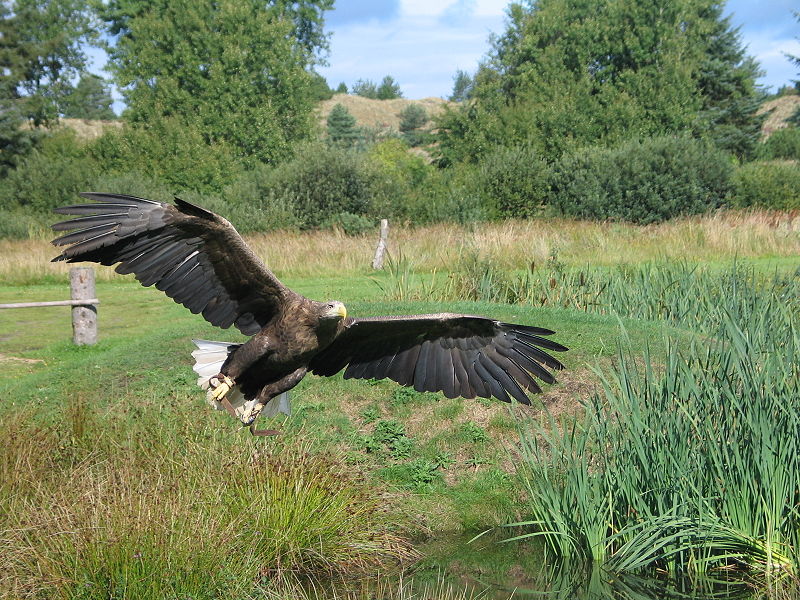
White-tailed Eagle in Flight - Wikipedia

White-tailed Eagle in Flight – Wikipedia

One thing most of them seem to be in agreement about, is that the bird is a fish eater. The Osprey’s diet consists almost exclusively of fish and God has created them with specialized feet and behaviors to assist them in their search for food. One of their biggest problems is the thievery of their catch by Bald Eagles. Dan and I have had the privilege twice to witness this event. Once years ago in Punta Gorda, Florida and just last month here in Winter Haven. Needless to say, the Osprey gets very upset, but both times, they lost. Do you think the Eagle knows the truth of Ephesians 4:28? (Replace hands with feet). Let’s make sure we don’t copy this improper behavior of the Eagle.

Let him who stole steal no longer, but rather let him labor, working with his hands what is good, that he may have something to give him who has need. (Eph 4:28 NKJV)

Original blog about the Osprey was Birds of the Bible – Osprey

See the Osprey Page for more information on the Osprey including Photos and Videos.

For more sources of information about Ospreys see:
Osprey – WhatBird.com
Osprey – Wikipedia
Osprey – BirdLife Species Factsheet
USGS – Osprey
Osprey Videos from the Internet Bird Connection

First Bird and Birding Trip of 2009

Here we are in 2009 and it’s time to start listing the birds we see this year. I hope last year was very

1st photo of 2009 - Female Ring-necked Duck 1st photo of 2009

1st photo of 2009 - Female Ring-necked Duck

productive in the bird listing area. I am still checking my counts, due to a software glitch that knocked some of the lists out. With the year only three days old, I trust you have been spotting birds already. On “BRDBRAIN”, a listing service here in Florida, they have all been listing the first bird they saw this year.

The first birds all saw when I looked out at my feeders on New Year’s Day were two Mourning Doves. What was the first bird you saw? Post a comment to this blog and let’s find out what everyone saw.

Today, we took our first Birding Trip for the year and went to Lakes Morton and Hollingsworth in Lakeland, FL. That is about a 20 minute ride from our home. We were not disappointed. On the way we counted a Blue Jay, Boat-tailed Grackles, a Wood Stork flying by, 11 Cattle Egrets, Great Egret, 15 Fish Crows, Mourning Doves and Eurasian-collared Dove, Mallards and a Great Blue Heron.

When we got to Lake Morton we were overwhelmed by the number of Ring-necked Ducks (150+) that are down for their winter vacation. There was also 27 Ruddy Ducks, Ring-billed Gulls (lots), 15 White Pelicans with Double-crested Cormorants swimming right along with them, Mallards, 2 Great Blue Herons, Great Egret, White Swans and Black Swans, Geese, Pied-bill Grebe, Muscovy Ducks, Coots (lots), and 2 Rock Doves, and an Anhinga or two.

Then off to Lake Hollingsworth, but this time we were on the north side of the lake at a walkway they have at a small wetlands. Here is what we saw there: 50+ Fish Crows, 7 Double-crested Cormorants, Mallards, White Ibises, Anhinga, Yellow-rumped Warbler, Palm Warbler, 2 Limpkins, Great Blue Heron, 2 Coots, Boat-tailed Grackles, Common Grackles, 2 Common Moorhens, White Pelican, Ospreys, 2 Red-bellied Woodpecker, Eastern Phoebe and some unknowns that we are trying to ID from photos.

All in all, it was a gorgeous day and the Lord provided lots to look at and enjoy. I trust your year will be loaded with much viewing of the beautiful birds and critters that have been created for ours and the Lords pleasure. Don’t forget to leave a comment as to what was the first bird you saw this year and where.

The photos have not really been touch up yet. Just wanted to get some posted to show what we saw today.

*

This slideshow requires JavaScript.

*

Birds of the Bible – Falcons II

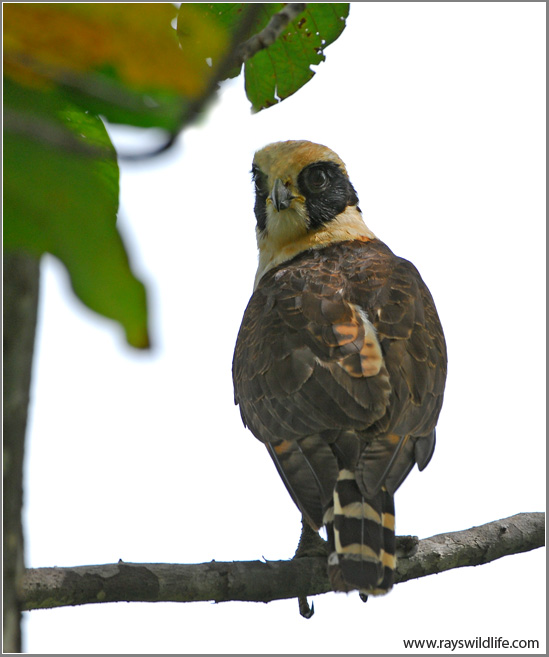
Laughing Falcon in Palo Verde National Park, Costa Rica by Ray

Laughing Falcon in Palo Verde National Park, Costa Rica by Ray

I have noticed that many come to my blog looking for information and photos of Falcons. The Birds of the Bible – Falcons introduced the Falcons. This week we will give some more on the Falcons around the world. The Falcon is on the “unclean list” of birds and was not to be eaten. Deuteronomy 14:13 and Leviticus 11:14 provides their name in that list.

the red kite, the falcon, and the kite after their kinds; (Deu 14:13 NKJV)
the kite, and the falcon after its kind; (Lev 11:14 NKJV)

The other reference in Scripture is found in Job 28:7 which refers to it’s eye.

That path no bird knows, Nor has the falcon’s eye seen it.

The Lord has created the Falcon with another fantastic ability which helps it catch its prey. Notice as you watch these videos, no matter what else they are doing, their eye’s are constantly watching for prey. A quote from Steiner Birding about the Peregrine Falcon says, “Sight is developed to a marvelous degree:
They are equipped with full-color vision and with eyes specially adapted to permit rapid adjustment of focus while moving at speed, and from four to eight times the resolving power of the human eye. Hovering may be compared to looking into a field from a car moving at twenty miles an hour or from one which comes to a standstill every few yards. It would be possible for a human being to see an individual rabbit or large game bird at a range of 600-700-yards; a bird of prey, with about four times the resolving power of the human eye, should therefore be able to see it at a range of nearly two miles.”

Here is a list of the Falcon’s listed at Internet Bird Collection (IBC) (a total of 34) The ones with the * were mentioned in the first blog:

Laughing Falcon – Videos of a Laughing Falcon on a tree and a Laughing Falcon calling continuously
Barred Forest-Falcon
Plumbeous Forest-Falcon
Lined Forest-Falcon
Slaty-backed Forest-Falcon
Collared Forest-Falcon

Red-necked Falcon

Red-necked Falcon from Wikipedia

Buckley’s Forest-Falcon
Spot-winged Falconet  – Video
African Pygmy Falcon – Video
White-rumped Pygmy-Falcon P
Collared Falconet – Video
Black-thighed Falconet
White-fronted Falconet
Philippine Falconet – Video
Pied Falconet – Video
Red-necked Falcon
Red-footed Falcon – Video
Amur Falcon – Video
Eleonora’s Falcon – Video
Sooty Falcon
Aplomado Falcon – Video
Bat Falcon – Video
Orange-breasted Falcon
New Zealand Falcon
Brown Falcon – Video
Grey Falcon
Black Falcon
Lanner Falcon – Video
Laggar Falcon
Saker Falcon – Video
Gyrfalcon
Prairie Falcon – Video
Taita Falcon – Video
Peregrine Falcon – Video

See also:

Falcon Pages
Falconidae – Caracaras, Falcons – Family
Peregrine Falcon – Peterson Field Guide

*