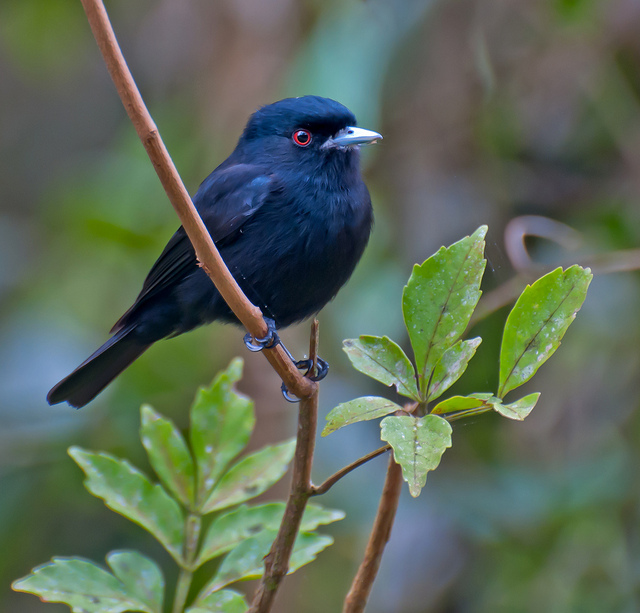
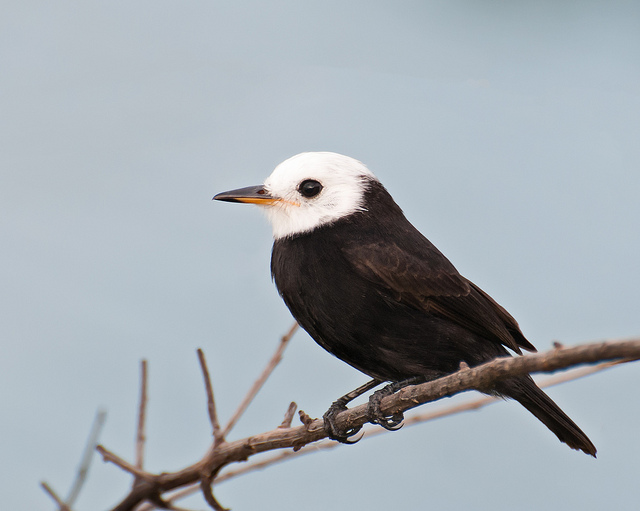
Blue-billed Black Tyrant (Knipolegus cyanirostris) by Dario Sanches
But the fruit of the Spirit is love, joy, peace, longsuffering, kindness, goodness, faithfulness, gentleness, self-control. Against such there is no law. (Galatians 5:22-23 NKJV)
I cannot help but post this video. Made aware of it several years ago. The “music was made for a school project. A Pixar video with audio created by David Redinha”
The verses that come to my mind have to do with being kind and not making fun of someone. This video of shows what might happen when both not being kind and making fun of someone appear at the same time. Enjoy!
Let all bitterness, and wrath, and anger, and clamour, and evil speaking, be put away from you, with all malice: And be ye kind one to another, tenderhearted, forgiving one another, even as God for Christ’s sake hath forgiven you. (Ephesians 4:31-32 KJV)
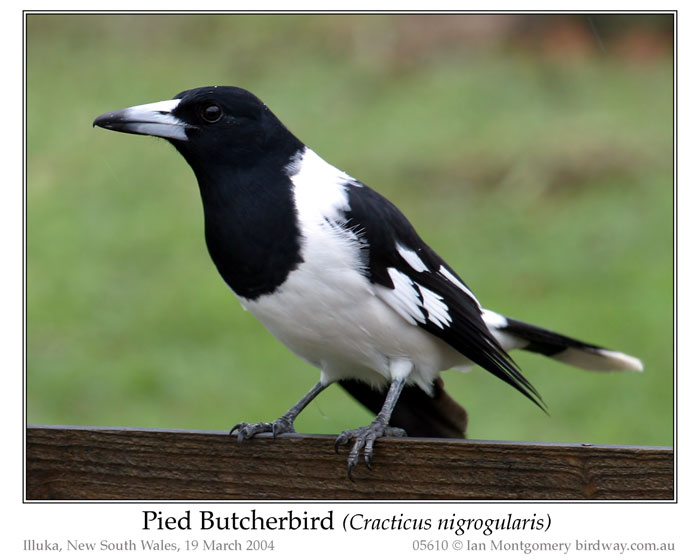
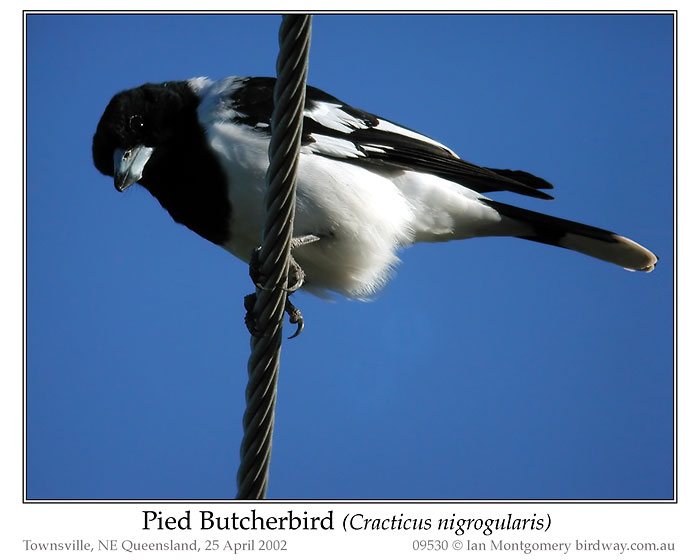
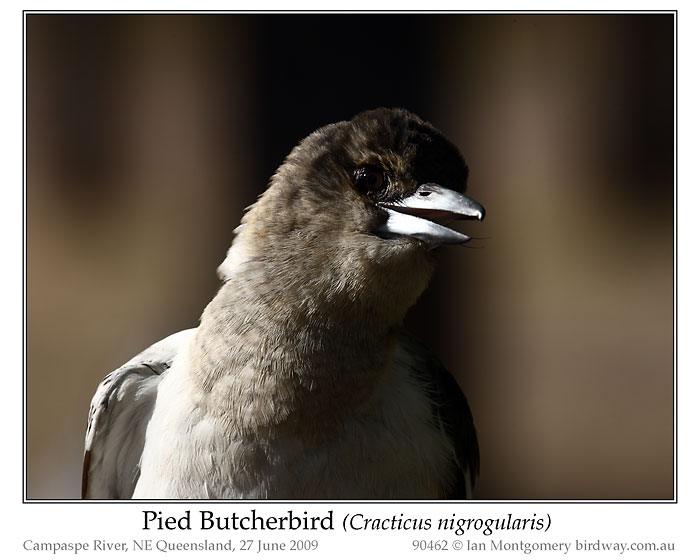
Ian’s Bird of the Week – Pied Butcherbird ~ by Ian Montgomery
Newsletter ~ 2/22/14
Birds of the week are usually chosen on the basis of appearance, photo quality or species interest, but here for a change is one whose real claim to fame is auditory. Not that Pied Butcherbirds don’t look quite dapper, even if the hooked bill suggests a predatory existence and the black hood has the connotation of the executioner, at least for the Spanish : Verdugo Gorjinegro, where verdugo means executioner or hangman, and gorjinegro you can guess. However, their real claim to fame is their beautiful singing which has a clarity and sense of purpose that I think is unequalled. When I first heard a Pied Butcherbird singing in Australia in western New South Wales in 1971, I was fascinated. To me it seemed like it was practising the theme from an oboe concerto, as it would keep carefully repeating the phrases, each time slightly differently.
The first edition of Graham Pizzey’s Field Guide to the Birds of Australia (1980-2000) has wonderful descriptions – I bought it after reading his description of Musk Duck, which starts “A decidedly strange duck.” – so I’ll quote him on the Pied Butcherbird: “Superb: slow flute-like piping, of clear high-pitched and low mellow notes, throughout day and moonlit nights, best in early morning; often given by two or more birds alternatively, higher-pitched notes of one contrasting with more mellow notes of others. … Also accomplished mimicry, as part of quieter sub-song.”
I can’t just leave you hanging after a description like that. Here is a YouTube link to a lovely video of a duet
and here is another to a Pied Butcherbird mimicking a variety of species
Listen to these and I’m sure you’ll agree that this is one of the most beautiful song birds in the world.
On the subject of mimicry, I had an email from Rose Bay in Sydney recounting a conversation that took place between a Grey Butcherbird and the correspondent, thank you Jeremy, who whistled in response, over several months. The bird remained hidden and unidentified in foliage until a couple of weeks ago when, during such a talk, he spotted the bird and the mystery was solved. I’ve accompanied a Pied Butcherbird here in Bluewater on the treble recorder. I checked their vocal range using a pitch analyser on sound recordings and found that the mellow notes were close to middle C (C4), while the top notes were around D6, two octaves above middle C; an impressive range.
And, yes, they do prey on small birds, mammals, reptiles and invertebrates and will even hunt in unison with Australian Hobbies. They get their name from their habit of wedging larger prey items in a fork in a tree (or clothes line) so that they can dismember it. If you think that sounds macabre, go and listen to Berlioz’s Symphonie Fantastique again, imagining the idée fixé played by a Pied Butcherbird, particular the rendering of it in the third movement on the oboe and by the clarinet in the fourth Marche au supplice. The latter appears briefly before the fall of the guillotine. I tried playing the first of the YouTube videos simulaneously with the third movement a short while ago and the result is, well, fantastic.
Anyway, back to family matters. Pied Butcherbirds have group territories similar to those of their cousins the Australian Magpies with usually one breeding pair. The female does all the hard work of building the nest and incubating the eggs while, the male, presumably, sings. The other members of the group, usually offspring from earlier broods, do help to feed the young.
I should, I suppose, mention the photos. The first three are of adult birds, the last two of brownish immature birds. At 32-36cm/12.5-14in in length the Pied Butcherbird is intermediate between the smaller Grey and Black-backed Butcherbirds and the larger Black Butcherbird. The Pied Butcherbird occurs through most of mainland Australia, but is absent from very arid regions, most of South Australia and Victoria, and southeastern New South Wales. Here in the northeast Queensland, they show a preference for watercourses.
The bird of the week has been going out regularly, if not weekly, since late 2002. I have copies of almost all of them and I’ve decided to publish them as an electronic book under the umbrella “A Bird Photographer’s Diary”. At the moment, I’m progressing steadily through the second quarter of 2006, and I’m having great fun reliving all the experiences and places involved. The intention is to add photos of the various locations and habitats. I’ll keep you posted.
The flowers appear on the earth; the time of the singing [of birds] has come, and the voice of the turtledove is heard in our land. (Song of Solomon 2:12 AMP)
Wow! What an amazing article about these birds and the videos only enhance it more. I especially like the them singing duet. Ian finds us the most interesting birds to see and hear. Thanks, Ian.
Check out Ian’s Butcherbirds in his Artamidae Family
Where the birds build their nests, And the stork, whose home is the fir trees. (Psalms 104:17 NASB)
Last week we saw some of the Tyrant Flycatcher family. This time, with over 400 species, just this family of birds will be featured.
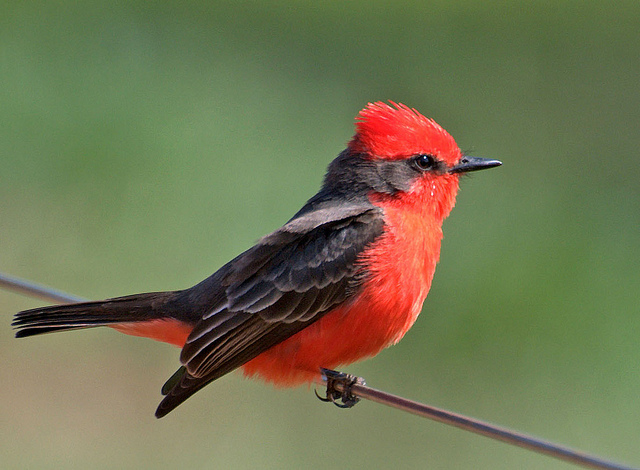
The tyrant flycatchers are birds which occur throughout North and South America. They are considered the largest family of birds, with more than 400 species. They are the most diverse avian family in every country in the Americas, except for the United States and Canada. As could be expected from a family this large, the members vary greatly in shape, patterns, size and colors. Most, but not all, species are rather plain, with various hues of brown, gray and white commonplace. Obvious exceptions include the bright red vermilion flycatcher, blue, black, white and yellow many-colored rush-tyrant and some species of tody-flycatchers or tyrants, which are often yellow, black, white and/or rufous.
Vermilion Flycatcher (Pyrocephalus rubinus) by Dario Sanches
The smallest family members are the closely related short-tailed pygmy tyrant and black-capped pygmy tyrant. These species reach a total length of 6.5–7 cm (2.5–2.8 in) and a weight of 4–5 grams. By length, they are the smallest passerines on earth, although some species of Old World warblers apparently rival them in their minuscule mean body masses if not in total length. The minuscule size and very short tail of the Myiornis pygmy tyrants often lend them a resemblance to a tiny ball or insect. The largest tyrant flycatcher is the great shrike-tyrant at 29 cm (11.5 in) and 99.2 grams (3.5 oz).
Please enjoy watching a slideshow of some more of the Lord’s neatly created birds as you listen our orchestra and then the choir sing.
This slideshow requires JavaScript.
*
Click to listen:
“Amazing Grace” – Orchestra and “I Love You, Written in Red” – Choir (Faith Baptist Church)
He will yet fill your mouth with laughing, And your lips with rejoicing. (Job 8:21 NKJV)
This is a video of funny bird antics that was made in 2012. This should Tickle you. It tickled me. I especially couldn’t believe that Gull eating what he does. It is amazing what the Lord’s created birds can do.
“A time to weep, And a time to laugh; A time to mourn, And a time to dance;” (Ecclesiastes 3:4 NKJV)
Had to change video on this one because the original one is no longer available.
Before the mountains were brought forth, or ever thou hadst formed the earth and the world, even from everlasting to everlasting, thou art God. (Psalms 90:2 KJV)
Hast thou not known? hast thou not heard, that the everlasting God, the LORD, the Creator of the ends of the earth, fainteth not, neither is weary? there is no searching of his understanding. (Isaiah 40:28 KJV)
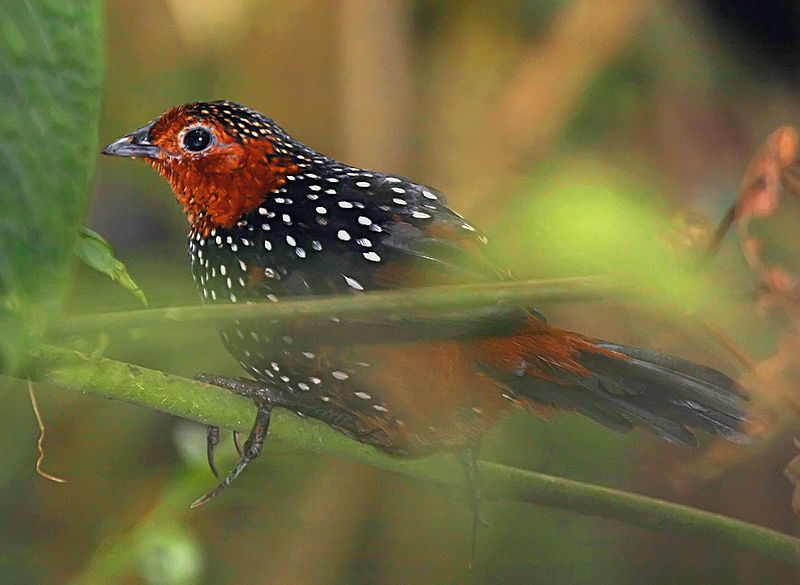
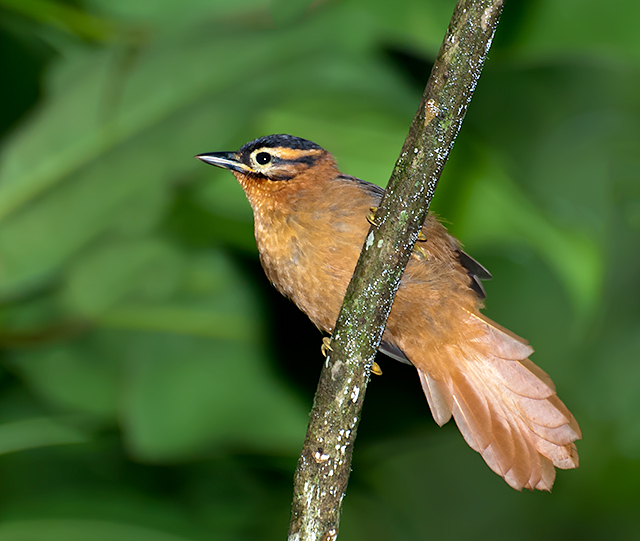
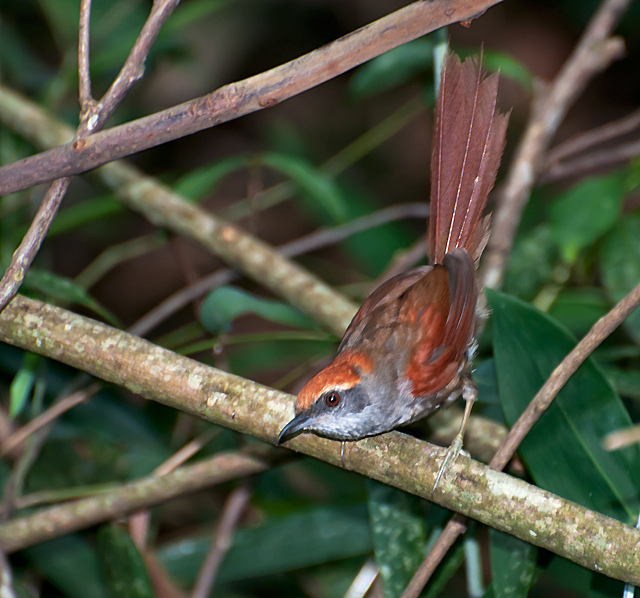
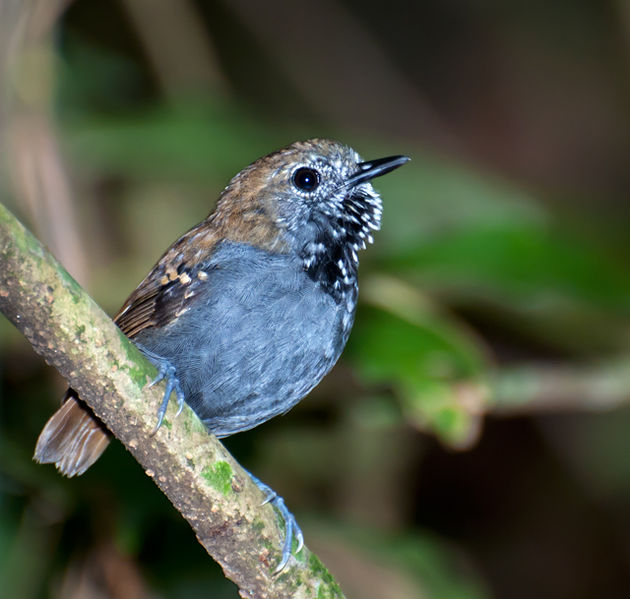
Since I have been going down the list of Passerines, might as well keep going. Today’s birds are from Gnateaters (Conopophagidae), Tapaculos (Rhinocryptidae), Crescentchests (Melanopareiidae) and part of the Tyrant Flycatchers (Tyrannidae). There are over 400 members in the last family, so will add more later.
As you can see, most of these are fairly small birds and rather non-descript. Their Creator has given them a nice look, but has them protected by letting them blend in with their surroundings. Another show of love for His creation.
The gnateaters are a bird family, consisting of ten small passerine species in two genera, which occur in South and Central America. The members of this family are very closely related to the antbirds and less closely to the antpittas and tapaculos. Due to their remote and dim habitat, gnateaters are a little-studied and poorly known family of birds. They are round, short-tailed, and long-legged birds, about 12–19 cm (5–7½ inches) in length. They are quite upright when standing. Most Conopophaga species have a white tuft behind the eye.
The tapaculos (pronounced ta-pa-COO-lo) are found mainly in South America and with the highest diversity in the Andean regions. Three species (Chocó, Tacarcuna, and the silvery-fronted) are found in southern Central America. Tapaculos are small to medium-sized birds, with a total length ranging from 10–24 cm (4–9½ in). These are terrestrial species that fly only poorly on their short wings. They have strong legs, well-suited to their habitat of grassland or forest undergrowth. The tail is cocked and pointed towards the head, and the name tapaculo possibly derives from Spanish for “cover your behind”.
The crescentchests are birds from South America. The crescentchests range in length from 14 to 16 cm (5.5–6.3 in), in weight from 16 to 23 g (0.56–0.81 oz) and have relatively long tails compared to the tapaculos. The plumage is striking with a distinctive band across the chest that gives the group their name.
Scale-crested Pygmy Tyrant (Lophotriccus pileatus) by Michael Woodruff
The tyrant flycatchers are birds which occur throughout North and South America. They are considered the largest family of birds, with more than 400 species. They are the most diverse avian family in every country in the Americas, except for the United States and Canada. As could be expected from a family this large, the members vary greatly in shape, patterns, size and colors. Most, but not all, species are rather plain, with various hues of brown, gray and white commonplace. Obvious exceptions include the bright red vermilion flycatcher, blue, black, white and yellow many-colored rush-tyrant and some species of tody-flycatchers or tyrants, which are often yellow, black, white and/or rufous.
The smallest family members are the closely related short-tailed pygmy tyrant and black-capped pygmy tyrant. These species reach a total length of 6.5–7 cm (2.5–2.8 in) and a weight of 4–5 grams. By length, they are the smallest passerines on earth, although some species of Old World warblers apparently rival them in their minuscule mean body masses if not in total length. The minuscule size and very short tail of the Myiornis pygmy tyrants often lend them a resemblance to a tiny ball or insect. The largest tyrant flycatcher is the great shrike-tyrant at 29 cm (11.5 in) and 99.2 grams (3.5 oz).
This slideshow requires JavaScript.
Now to him that is of power to stablish you according to my gospel, and the preaching of Jesus Christ, according to the revelation of the mystery, which was kept secret since the world began, But now is made manifest, and by the scriptures of the prophets, according to the commandment of the everlasting God, made known to all nations for the obedience of faith: To God only wise, be glory through Jesus Christ for ever. Amen. Written to the Romans from Corinthus, and sent by Phebe servant of the church at Cenchrea. (Romans 16:25-27 KJV)
Once there was a little boy who had short brown hair and was kind of short for his age. Every week, his parents would take him to a small park by a big lake.
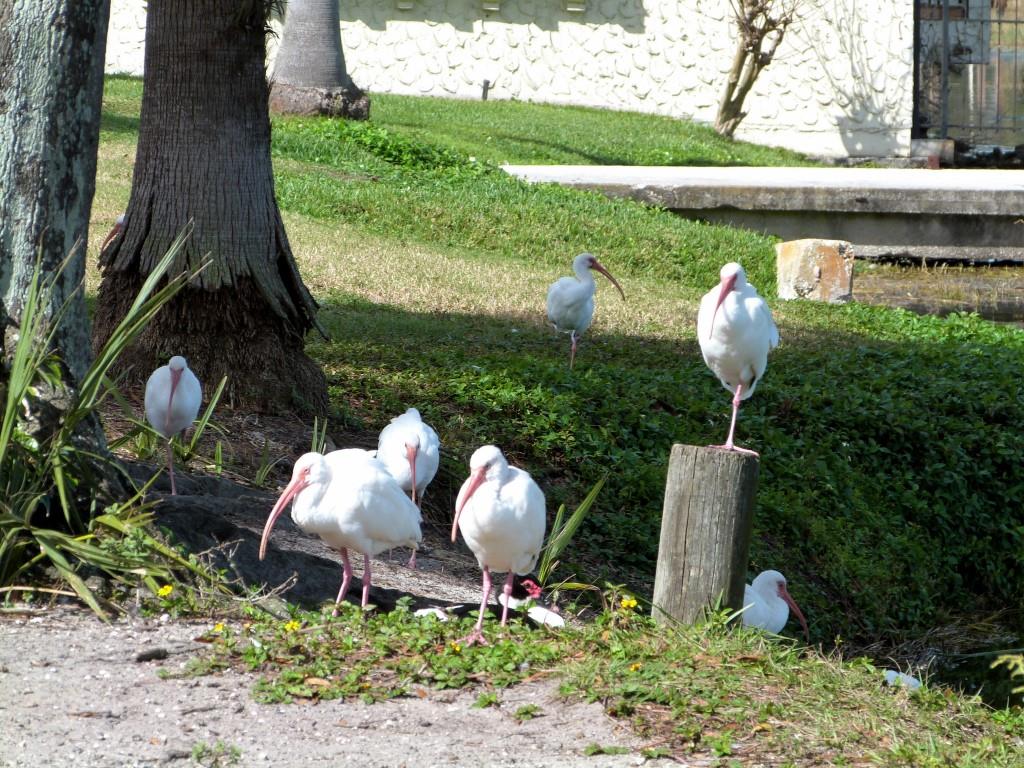
When they arrived, the little boy fed the ibises bread and talked to them about how he was about to start school. The ibises ate as much bread as they could hold and decided they liked hearing the little boy talk.
Several years passed and the little boy became a teenager. He started having problems with his grades. After failing another math test, the boy drove down to the park with some bread. Watching the ibises fly over and eat the bread made the boy feel a lot better and the ibises listened patiently as he told them all about how he could not get his grades to improve.
Eventually the teenage boy became a man and got married. The ibises started to multiply. A few years later, the man brought his children to the park. The ibises did the same. The man and his wife watched as their kids fed the ibises and as the ibises showed their children how to eat the bread with them. The man also taught his children how to talk to them.
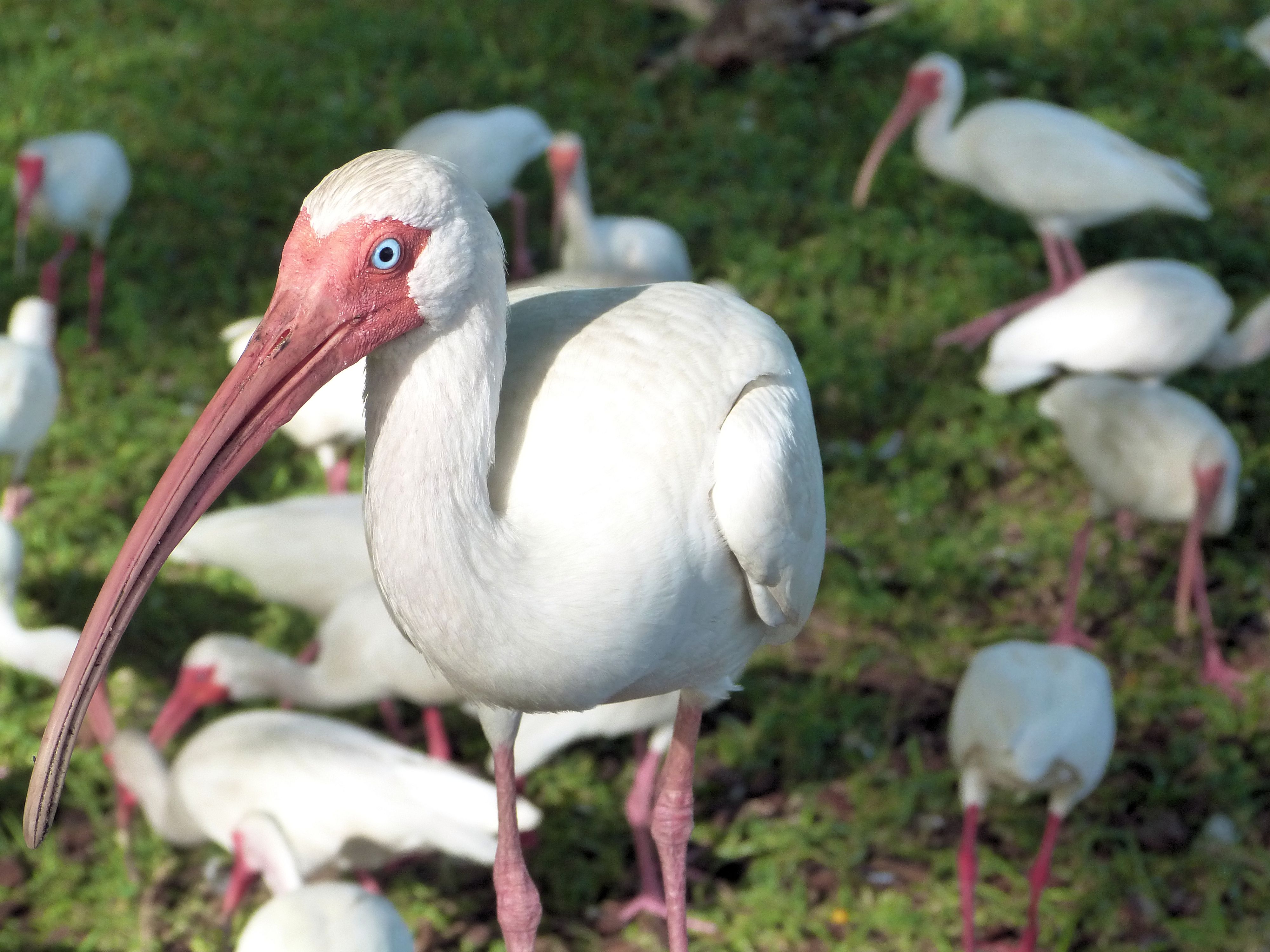
White Ibis on Table Listening by Lee
Many years passed and all the man’s children grew up and moved away. The man grew old, but he still drove to the park every week to feed the ibises.
Finally, one day, the old man grew too old to drive. He took one last drive to the park however. The ibises came as usual. The old man told the ibises that he wouldn’t be able to come and see them anymore because he couldn’t drive much longer. The ibises were very sad when they heard this statement. As the old man drove home, the ibises decided to fly after his car and follow him home. Soon there was a great flock of birds following the old man’s car.
The next day the old man opened his front door to get the mail and found the flock of ibises. The old man was very happy about the ibises coming to his house every day. From that day on, the ibises flew to the old man’s’ house so he could feed them bread.
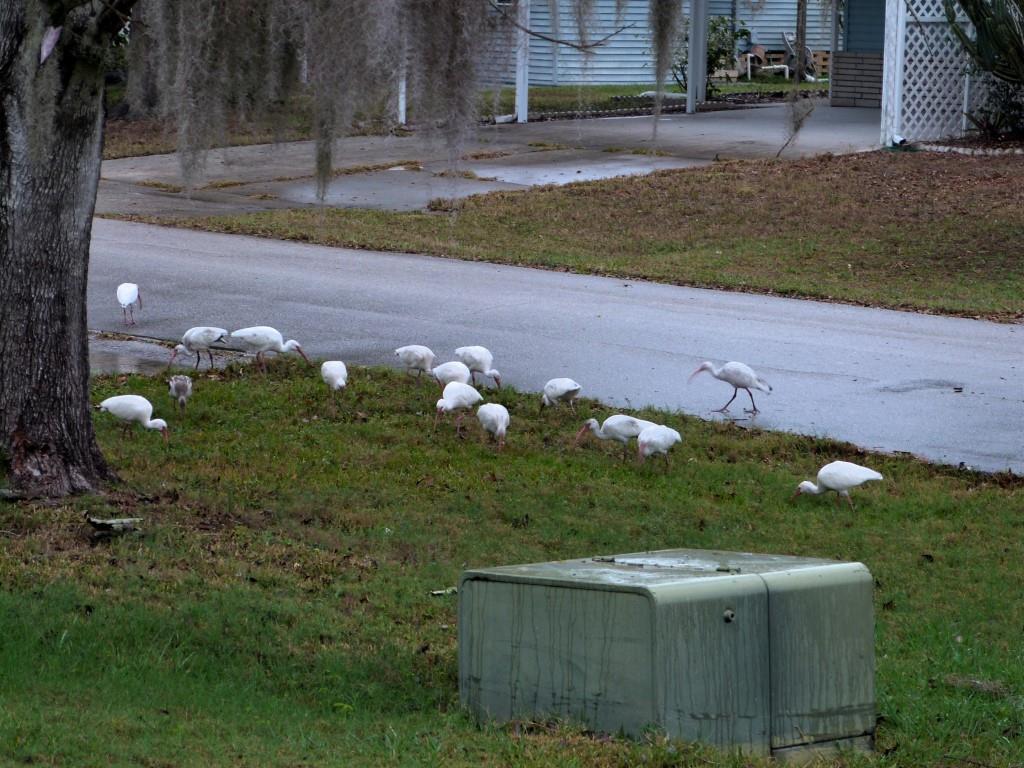
American White Ibis (Eudocimus albus) coming to the yard by Lee
The End
Lee’s Addition:
Put on therefore, as the elect of God, holy and beloved, bowels of mercies, kindness, humbleness of mind, meekness, longsuffering; (Colossians 3:12 KJV)
Emma has written another fine Bird Tale for us. It is enjoyable to watch as she is developing her writing skills. Each tale is better than the one before. This one is very heart touching. (Maybe it meant a lot because I wonder if the birds will come “people-watching” here when I can no longer go watch them.)
A man that hath friends must shew himself friendly: and there is a friend that sticketh closer than a brother. (Proverbs 18:24 KJV)
To shew forth thy lovingkindness in the morning, and thy faithfulness every night, (Psalms 92:2 KJV)
There is much friendliness and kindness shown in this story.
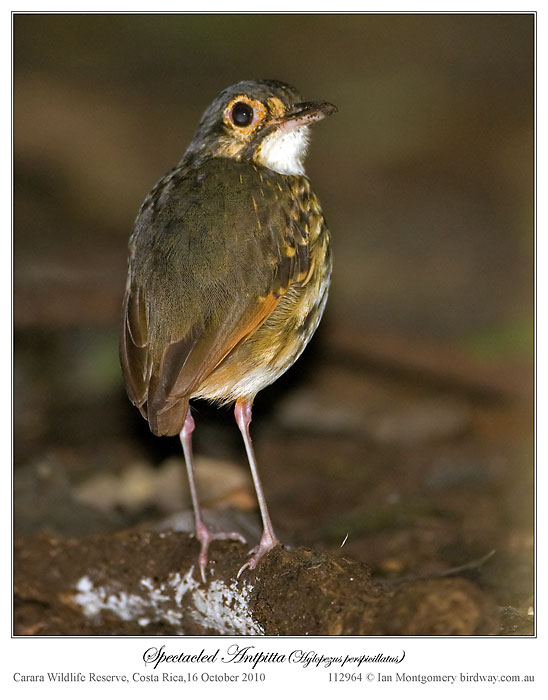
Streak-chested (Spectacled) Antpitta (Hylopezus perspicillatus) by Ian
The ants are a people not strong, yet they prepare their meat in the summer; (Proverbs 30:25 KJV)
Go to the ant, thou sluggard; consider her ways, and be wise: Which having no guide, overseer, or ruler, Provideth her meat in the summer, and gathereth her food in the harvest. (Proverbs 6:6-8 KJV)
Last week’s Sunday Inspiration featured the “first four bird families, taxonomically, in the Passeriformes Order (Songbirds)” This week we will continue with the next three families. They all have “ant” birds in them; Antshrikes, Antwrens, Antbirds, Antthrushes and Antpittas.. The Thamnophilidae – Antbirds family does have a few Bare-eyes.
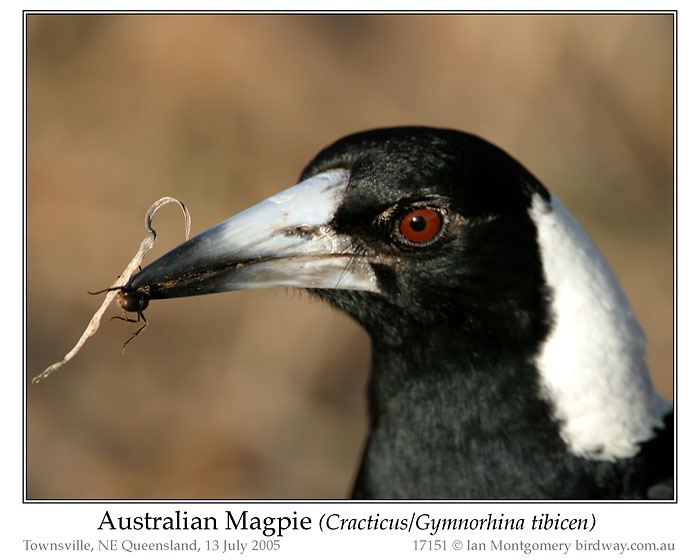
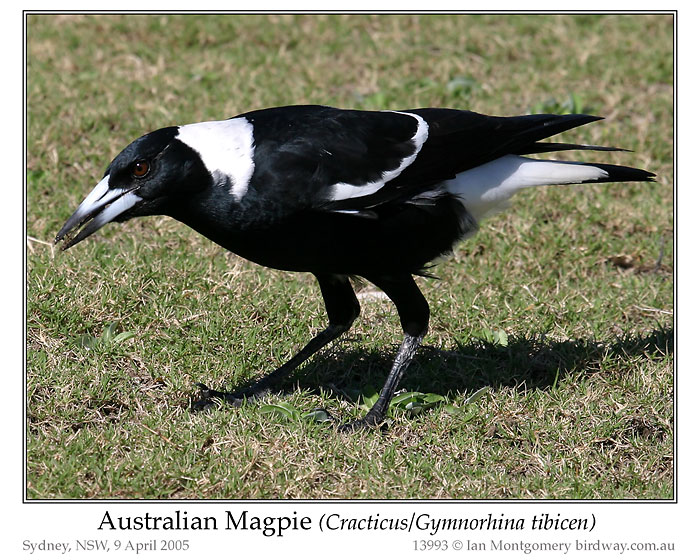
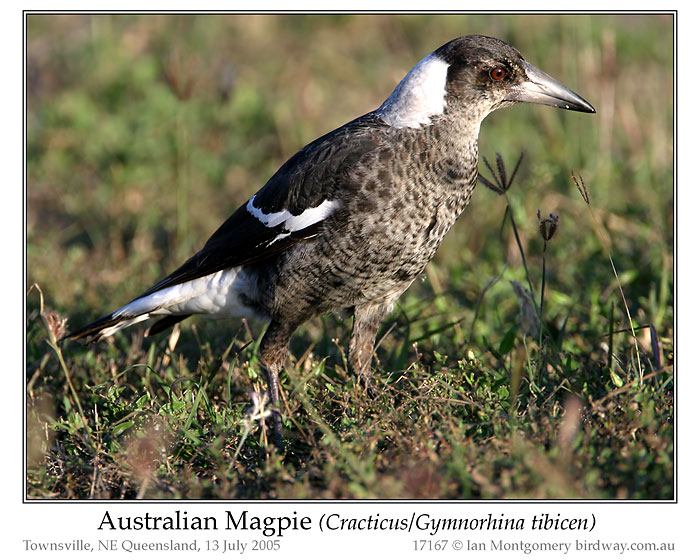
National days are occasions in which icons play a big, maybe dominant or even overpowering role, and Australia’s, January 26th, is no exception. So here is the Australian Magpie. It’s not strictly a Magpie in the Northern Hemisphere sense and it’s not strictly Australian, as it also occurs naturally in southern Papua New Guinea and has been introduced to both the main islands of New Zealand.
It is, however, certainly iconic, and not just in the sense of something that is typical of Australia. It was incorporated in various South Australian insignia just after Federation, and features “displayed proper” against the risen sun of federation. All six state coat of arms were incorporated into the Australian coat of arms in 1912, so the magpie, along with the Black Swan of Western Australia, made it to the national coat of arms. The bird referred to in the original South Australian design documents is called the “Piping Shrike” but the Australian Magpie has had various names including “Piping Crow-shrike” (Charles Sturt, explorer, 1840).
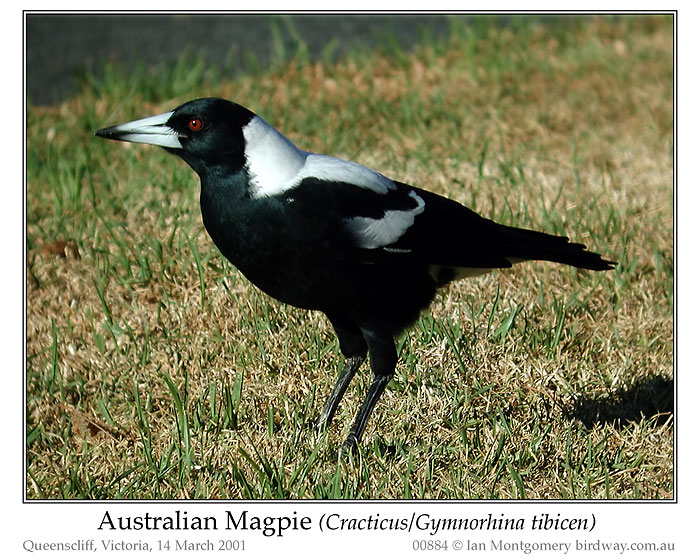
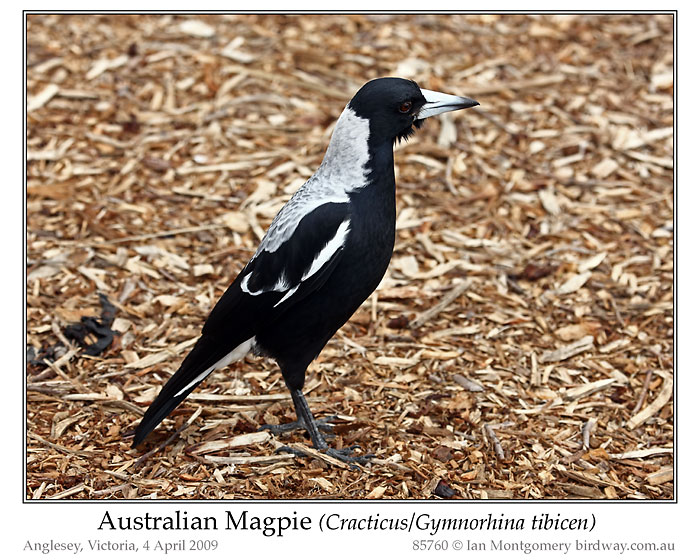
There are several races of the Magpie and I thought it would be easy to describe and illustrate them as part of this bird of the week. In fact, the descriptions, delineations and ranges of the various races are both messy and vague so I’ve settled for three easily recognised categories based on the colouration of their backs between the universally white (or pale grey) nape and rump: Black-backed, White-backed and Western.
The Black-backed group, first and second photos, is the most widespread occurring everywhere except in SW Western Australia and SE Australia and Tasmania. The nominate race ‘tibicen’ of eastern Australia is Black-backed and the name is derived from the Latin for ‘trumpeter’: tubicen. Male and female Black-backed have similar patterning except that the females have greyish tinge to the white and the black is less intense.
The familiar Magpie of Victoria, Tasmania and South Australia is the White-backed. The bird in the third photo is a male, while the one in the fourth photo is a female. The grey tinge and scalloping on her nape and back is quite obvious.
The male of the Western Magpie in SW Western Australia is like the male White-backed. The female, however, has very dark scalloping on the back to the point where it is almost black, fifth photo.
Australian Magpies have group territories with the group varying in size from a pair of adults to several adults and juveniles of varying ages. Usually only one pair in the group actually nests with the female doing the nest-building and most of the incubation. The young are fed by the female, often with help from her male partner and sometimes from other group members. Magpies can be aggressive towards people near the nest, and many Australians can recount stories of being attacked when cycling to or from school. Juveniles have greyish rather than black plumage, like the juvenile Black-backed in the sixth photo.
Australian Magpies, and their close relatives the Butcherbirds, are candidates for being the finest song birds in Australia. The Magpie has a varied and complex repertoire and is well-known for its flute-like choruses by a pair or group. It is usually started by the senior male or female in the group with other members, including juveniles, joining in. Less intense warbling songs are done by individuals, often for long periods, contain elements of the choral singing and mimicry. The New Zealand Poet, Denis Glover, in his best known poem, The Magpies, rendered the song as ‘and Quardle oodle ardle wardle doodle/The magpies said’.
The flute-like quality of the voice features in various European names for the Australian Magpie: Cassican flûteur (F), Flötenvogel (G) and Verdugo Flautista (Sp). I think the Germans have got it right with their Fluting-bird – much better than naming it after some unrelated Northern Hemisphere bird that it vaguely resembles. Maybe we should launch a new name for it next Australia Day. Now that would be a fitting Australia Day honour.
Greetings
Ian
**************************************************
Ian Montgomery, Birdway Pty Ltd,
454 Forestry Road, Bluewater, Qld 4818
Tel 0411 602 737 ian@birdway.com.au
Bird Photos http://www.birdway.com.au/
Where to Find Birds in Northern Queensland: iTunes; Google Play Kobo Books
Recorder Society http://www.nqrs.org.au
Lee’s Addition:
He (Solomon) spoke of trees, from the cedar that is in Lebanon even to the hyssop that grows on the wall; he spoke also of animals and birds and creeping things and fish. (1 Kings 4:33 NASB)
Ian, thanks again for sharing your Magpies from Australia. Seeing that he travels all around, he gets to see these different Magpies as he goes off on his birdwatching adventures. Their expressions give a look of intelligence to them.
Rufous-capped Spinetail (Synallaxis ruficapilla) by Dario Sanches
For he that is mighty hath done to me great things; and holy is his name. (Luke 1:49 KJV)
Our Creator has given us so many birds to enjoy, that it is hard to pick them. So, today as you listen to another arrangement from Pastor Jerry’s special night a few weeks ago, you can view another slideshow of mixed avian friends. These are from the first four bird families, taxonomically, in the Passeriformes Order (Songbirds).
Ah Lord GOD! behold, thou hast made the heaven and the earth by thy great power and stretched out arm, and there is nothing too hard for thee: Thou shewest lovingkindness unto thousands, and recompensest the iniquity of the fathers into the bosom of their children after them: the Great, the Mighty God, the LORD of hosts, is his name, Great in counsel, and mighty in work: for thine eyes are open upon all the ways of the sons of men: to give every one according to his ways, and according to the fruit of his doings: (Jeremiah 32:17-19 KJV)
This slideshow requires JavaScript.
Click to listen:
“Jesus What A Might Name” – Pastor Jerry Smith w/Choir and Orchestra
For unto us a Child is born, Unto us a Son is given; And the government will be upon His shoulder. And His name will be called Wonderful, Counselor, Mighty God, Everlasting Father, Prince of Peace. (Isaiah 9:6 NKJV)
Today’s Sunday Inspiration is spotlighting the “Star” birds while Pastor Jerry and Reagan Osborne sing “Day Star.” This was sung when Pastor Jerry retired from the Music Ministry.
The “star” birds have “star” in their names. This includes Hillstars, Redstarts, Starlings, Starfrontlets, and a Whitestart.
We have also a more sure word of prophecy; whereunto ye do well that ye take heed, as unto a light that shineth in a dark place, until the day dawn, and the day star arise in your hearts: (2 Peter 1:19 KJV)
Believer’s Bible Commentary: “…The rising of the morning star (day star) pictures Christ’s coming for His saints. Thus the sense of the passage is that we should always keep the prophetic word before us, treasuring it in our hearts, for it will serve as a light in this dark world until the age is ended and Christ appears in the clouds to take His waiting people home to heaven.”
This slideshow requires JavaScript.
Click to Listen
“Day Star” ~ Pastor Jerry Smith and Reagan Osborne at Faith Baptist Church
Ian’s Bird of the Week – European Goldfinch ~ by Ian Montgomery
Newsletter – 1/21/15
Last week I mentioned that the Zebra Finch was an Estrildid or Grass Finch (family Estrildidae) without exploring the significance of this, so here is a taxonomically quite different finch, the European Goldfinch (family Fringillidae), to continue the subject. Choosing it was prompted by an email from some English friends of mine currently in New Zealand who expressed disappointment that most of the birds seemed to be ones introduced from the British Isles, naming in particular the Goldfinch. So here is a photo of one that I took in its native habitat, when staying with these friends in 2001 on Alderney one of the smaller inhabited Channel Islands off the coast of France.
It was introduced to Australia as well in the 1860s and is quite widespread in the southeastern mainland and on Tasmania. It’s an attractive bird with a canary-like song and like the Zebra Finch a popular cage bird. So it’s not surprising that homesick settlers introduced it. It does well in farmland, parks and gardens but not in native vegetation.
The sex of adult Goldfinches can be told from their plumage, even though they are very similar and most field guides don’t make the distinction. It’s a bit like those Spot the Difference puzzles, so here, second photo, is an Irish male to compare with the female in the first. The pale cheeks on the female are buff, those on the male white. The red bib on the female is rounded, on the male more rectangular. The female usually has a complete buff breast band; the male just has buff breast patches separate by white. The male is also whiter underneath. There are other subtle differences not apparent in these photos such as the amount of white on the tail.
You can tell from their stout conical bills that they are seed-eaters, and any such vaguely sparrow-like bird is likely to be called a ‘finch’. In temperate zones seeds are available mainly in spring and autumn, so dietary versatility is needed. The male is chomping its way through the buds and flowers of Hawthorn and Goldfinches will also feed on invertebrates. Their favourite food is the seeds of thistles and their, by finch standards, relatively pointed bills are adapted to picking out seeds from among thorns, like the juvenile bird in the third photo in autumn. Its plumage, apart from the black and yellow wings, is mainly brown and streaked with no red or black on the head, and almost pipit-like.
The juveniles acquire the adult plumage during the first autumn moult, and the rather scruffy individual in the fourth photo is in mid-transition. This photo shows the very pointed bill, even if the owner is looking a bit doubtful about the even scruffier thistle head.
Getting around to the taxonomy at last, the various groups of finch-like birds have caused and still cause avian taxonomists many headaches, and I don’t want to trigger any more here. It is sufficient to say that the approximately 700 global species of finch-like birds belong to several separate lineages, currently separated at the level of family.
The Fringillidae to which the Goldfinch belongs, sometimes called the ‘true’ finches (by the Europeans of course) have an almost global distribution but are completely absent, naturally, from Australasia. The Estrildidae, which include all the native Australian grass finches, occur only in Africa, southern and southeast Asia and Australasia (but not New Zealand).
The African members belong to a group called Waxbills, the Asian ones are mainly Munias or Mannikins and the grass finches are predominantly Australian. The Estrildids occur mainly in tropical or sub-tropical regions, and only in Australia have some Firetails ventured into cooler areas: notably the Red-eared Firetail in SW Western Australia and the Beautiful Firetail in the SE mainland and Tasmania.
**************************************************
Ian Montgomery, Birdway Pty Ltd,
454 Forestry Road, Bluewater, Qld 4818
Tel 0411 602 737 ian@birdway.com.au
Bird Photos http://www.birdway.com.au/
Where to Find Birds in Northern Queensland: iTunes; Google Play Kobo Books
Recorder Society http://www.nqrs.org.au
Lee’s Addition:
they and every beast after its kind, all cattle after their kind, every creeping thing that creeps on the earth after its kind, and every bird after its kind, every bird of every sort. And they went into the ark to Noah, two by two, of all flesh in which is the breath of life. (Genesis 7:14-15 NKJV)
More beautiful birds to check out from Ian. Thanks, Ian. If you check out his links, you will find some very nice photos.









 Lee's Birdwatching Adventures Plus