Oh, the depth of the riches both of the wisdom and knowledge of God! How unsearchable are His judgments and unfathomable His ways! (Romans 11:33 NASB)
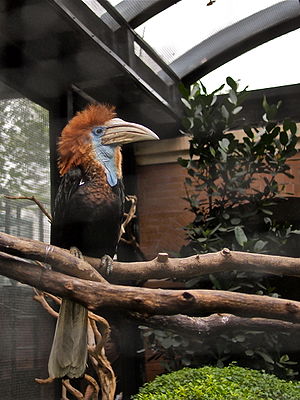
Hornbills that Understand Monkey
The Yellow-casqued Hornbill (Ceratogymna elata) is found in the primeval rain forest of coastal regions of West Africa, for example in Côte d’Ivoire.
Yellow-casqued Hornbills are one of the largest birds of the forest, with adults weighing up to 2 kg. They live mainly in the forest canopy, feeding on the ground only rarely. They live in small family groups containing at least one adult male and female, with one or two immature birds, though they sometimes gather in larger flocks to exploit a major food supply such as an ant or termite nest.
“The birds are occasionally preyed upon by Crowned Eagles, and they respond to the presence of an eagle (sometimes indicated by its characteristic shriek) by mobbing, i.e. approaching it and emitting calls. Since the eagles depend on surprise to make a catch, this frequently causes them to leave the area.” (Wikipedia edited)
“With the exception of basic messages such as aggression, communication between two entirely different species has seldom been observed among animals in the wild. We know that many animals among the same species give each other specific warnings about an impending danger.” One example is “researchers have found that a downy woodpecker responds to alarm calls from chickadees.” “However, scientists have never noted one species recognizing the specific warning given by a second species.
Diana monkeys on the Ivory Coast of Africa face two primary threats, leopards and crowned eagles. When one of these threats appears, the spotter gives a very specific bark-like call depending on the type of threat. Of course, the monkeys need to respond differently to each threat whether it comes from the leopard below or the eagle above. So it helps them to know what they are facing. On the other hand, a bird named the yellow hornbill is threatened only by the crowned eagles. Researchers noted that these birds ignored the monkeys’ warning about the leopards. But when the monkeys signaled danger from the eagle, the bird took defensive measures. Researchers confirmed their observations using tape recorded monkey calls. The researchers were amazed that these birds understood the monkey warnings in an intelligent manner.”
Such intelligence comes from the Creator, Who has given the gift of such intelligence to His creatures in a way that provides for their survival. This shows His loving care for His creation.
Cedar Waxwing (Bombycilla cedrorum) by Daves BirdingPix
Do Migratory Birds Practice Preventative Medicine?
by Brian Thomas, M.S. *
“Before a long migration, certain birds shift from an insect diet to eating fruits such as berries. Researchers once thought that this added carbohydrate reserves as fuel for the journey. But a new study out of the University of Rhode Island suggests that the birds are interested in the fruits’ antioxidants, not their sugars.
Antioxidants are chemicals that are packed within richly colored fruit skins and are known to stabilize cellular processes. Based on research presented at the March 24th American Chemical Society meeting in San Francisco, it appears that the birds fill up on berry antioxidants for the medicinal benefits they provide to tissues that will undergo stress during the upcoming flight.
But this implies that birds use preventative medicine by instinct,….”
To read the rest of the article – CLICK HERE
And wild animals shall meet with hyenas; the wild goat shall cry to his fellow; indeed, there the night bird settles and finds for herself a resting place. (Isaiah 34:14 ESV)
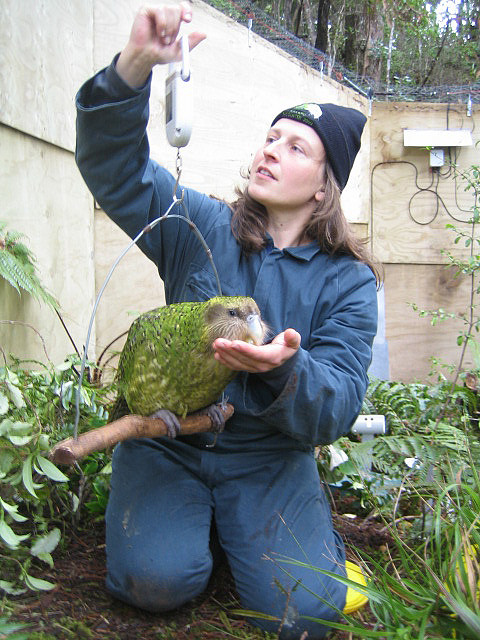
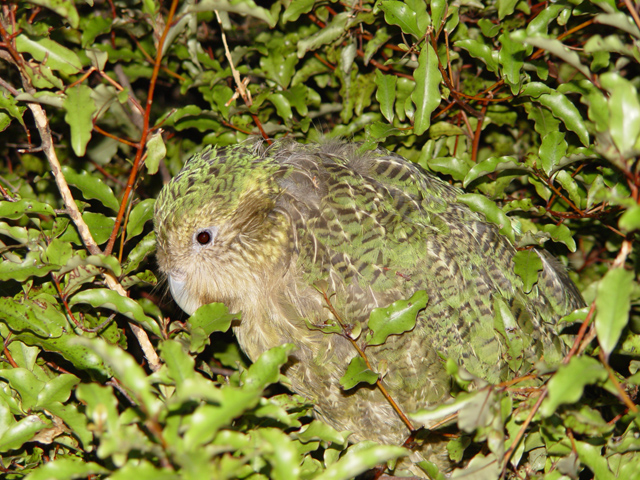
The Kakapo (Strigops habroptila) is another unique bird Formed by the Creator. The following articles will introduce you to a New Zealand bird that is extremely endangered with only about 90-120 left in the world (depending on sources). They belong to the Strigopidae Family, of which it is the only bird in the Strigops genus and keeps company with the Kea and New Zealand Kaka of the Nestor genus. The three are classified as New Zealand Parrots and belong to the Psittaciformes Order of Parrots and Cockatoos.
From Creation Moments: A Truly Strange Bird
Many, O LORD my God, are thy wonderful works which thou hast done, and thy thoughts which are to us-ward: they cannot be reckoned up in order unto thee: if I would declare and speak of them, they are more than can be numbered. (Psalms 40:5 KJV)
Though God created the entire living kingdom in only a few days, the variety and creativity of what He made seems nearly unlimited by our standards. One of the more unusual creatures He made was thought extinct until it was rediscovered in 1958.
The kakapo parrot lives in New Zealand. The most unusual parrot on Earth, it is one of only a few known parrots that prefers to sleep during the day and becomes active at night. Weighing in at five pounds, it is also the world’s heaviest parrot. It is, perhaps not surprisingly, the world’s only non-flying parrot.
The Creator’s unusual expression of inventive creativity in designing the kakapo did not end here. The mating habits of the kakapo are especially peculiar for birds. In mating season, the males gather in locations that are used year after year for mate selection. Female parrots come to these places to inspect the males to select a mate. However, in most un-bird-like fashion, the males provide absolutely no help building the nest or rearing the young.
This is what Wikipedia (with editing) has to say about the Kakapo:
“The Kakapo (Māori: kākāpō, meaning night parrot), Strigops habroptila, also called owl parrot, is a species of large (60 cm, 24 in), flightless nocturnal parrot endemic to New Zealand. It has finely blotched yellow-green plumage, a distinct facial disc of sensory, vibrissa-like feathers, a large grey beak, short legs, large feet, and wings and a tail of relatively short length. A certain combination of traits makes it unique among its kind—it is the world’s only flightless parrot, the heaviest parrot (2-4 kg, 4.5-9 lb), nocturnal, herbivorous, visibly sexually dimorphic in body size, has a low basal metabolic rate, no male parental care, and is the only parrot to have a polygynous lek breeding system. It is also possibly one of the world’s longest-living birds. Its anatomy typifies the tendency of bird evolution on oceanic islands, with few predators and abundant food: a generally robust physique, with accretion of thermodynamic efficiency at the expense of flight abilities, reduced wing muscles, and a diminished keel on the sternum.
The Kakapo is critically endangered; as of February 2010, only 120 living individuals are known, most of which have been given names.
The Kakapo has a well-developed sense of smell, which complements its nocturnal lifestyle. It can discriminate among odours while foraging; a behaviour reported for only one other parrot species. One of the most striking characteristics of the Kakapo is its pleasant and powerful odour, which has been described as musty. Given the Kakapo’s well-developed sense of smell, this scent may be a social chemosignal.”
Facts about the Kakapo from New Zealand’s Dept of Conservation:
* It is the heaviest parrot in the world. Males can weigh over two kilograms. Unique among land birds, it can store large amounts of energy as body fat.
* It is the only parrot to have a ‘lek’ mating system: males compete for ‘calling posts’ specially dug-out bowls in the earth and call (“boom”) each night in summer months for a female. The male’s low-frequency mating boom travels over several kilometres. It is the only parrot to have an inflatable thoracic air sac.
* Kākāpō breed every three to four years.
* A bird can range several kilometres in one night.
* Although it cannot fly, it is good at climbing trees.
* The birds are herbivores and eat variety of foods such as roots, leaves and fruit
* Kākāpō once ranged from near sea level to high in the mountains.
* Possibly as defence against its ancient predator – the giant eagle – the kākāpō became nocturnal and learned to remain still (‘freeze’) at times of danger.
Incline your ear, and come unto me: hear, and your soul shall live; and I will make an everlasting covenant with you, even the sure mercies of David. (Isaiah 55:3 KJV)
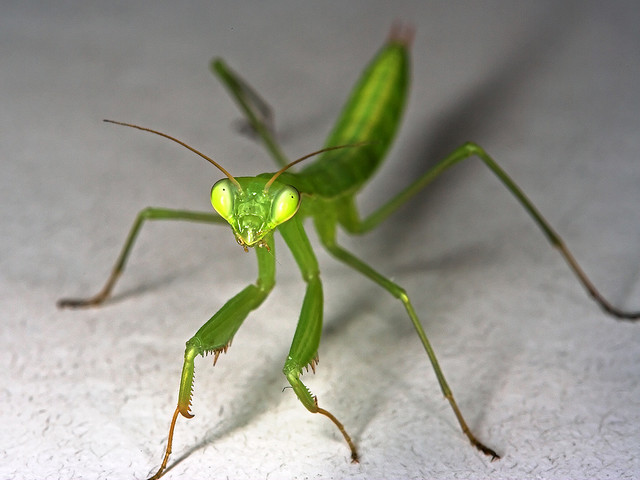
All insects that hear, except one, have two ears. Some insects have ears on their legs, thorax or abdomen. However, they all follow the same principle. Their ears are separated so that they can locate the source of the sound – except in one insect.
Scientists always thought the praying mantis was deaf. The 1,700 species of mantises have no structure that looks like an ear. Only after a long process of detailed study and testing did scientists finally discover that the mantis can hear. Further investigation finally led to the discovery of one of the most bizarre methods of hearing anywhere in the animal kingdom.
The mantis’s hearing organ is difficult to call an ear. Unlike any other insect, the mantis has only one hearing organ, located in a groove underneath its thorax. The teardrop shaped groove has a thinner cuticle than other parts of the body. Beneath the cuticle there is a relatively large air sac on each side of the groove. These sacs are connected to the insect’s respiratory system. Near the top of the sac are the nerves that carry the sensation of sound to the nervous system. Scientists say that this hearing organ senses ultrasonic frequencies. When researchers played a bat like sound to a mantis in flight, it immediately took an evasive flight path to escape the bat it thought it heard.
There is no limit to God’s creativity or His ability to make whatever He can imagine. We should keep this in mind, especially when some human authority tells us the Bible has made a mistake.
Prayer:
I marvel and praise You, dear Lord, as I consider the creation around me. Even as some would use the creation to deny Your existence, help me to more clearly see the excellence of all that You do, both materially and spiritually. Amen.
Notes:
Miller, Julie Ann. 1986. “Sensory surprises in platypus, mantis.” Science News, v. 129. p. 104.
The I.O.C. has updated to Version 2.7, but they are also getting ready to release a whole new format in Version 3.0. They placed the Ver. 2.7 in a draft which includes the Subspecies. After experimenting with several different ways to present the list, I have made my choice. This means that I have been busy behind the scene working on this website. (Lee’s Birdwatching Adventures Plus)
The I.O.C. is now the I.O.U. “Our goal on behalf of the International Ornithologist’s Union, formerly International Ornithological Congress (IOC), is to facilitate worldwide communication in ornithology and conservation through the consistent use of English names linked to current species taxonomy. The English names follow explicit guidelines for spelling and construction that increase clarity of application. To this end we provide a complete list of the extant bird species of the world.”
IOC World Bird List – Subspecies (Draft 1)
Supplementing the release of version 2.7 of the IOC World Bird List is a preview of our draft listing of the subspecies of the world’s birds along with the authors and dates attributed to their nomenclature. This working draft will provide the taxonomic foundation for version 3.0.
The above quotes are from the IOC World Bird List website. Since they are making a major revision, I decided to get started on updating to match their way of listing birds. I have been using the IOC lists of World Birds since starting the Birds of the World section.
There are 233 Families of birds, which means I have 233 pages of data to update. So, I have 5 down and 228 to go. For now the indexes to the families will not change, but a few birds may not be correct until I finish. Try not to be too upset about the dust flying around as the changes are being made. Trust the 3.0 Version is close to what I am doing.
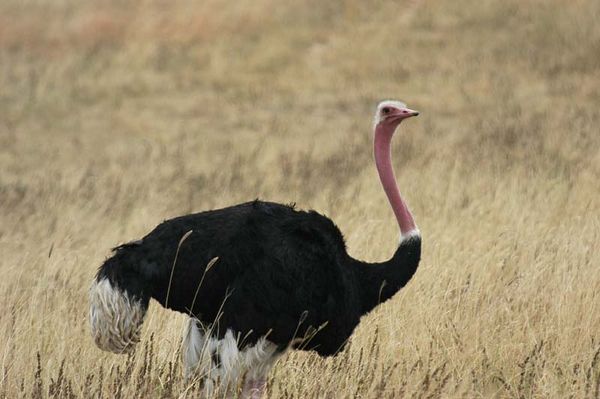
The main difference is that before only the bird was named, such as: (All photos by Bob-Nan)
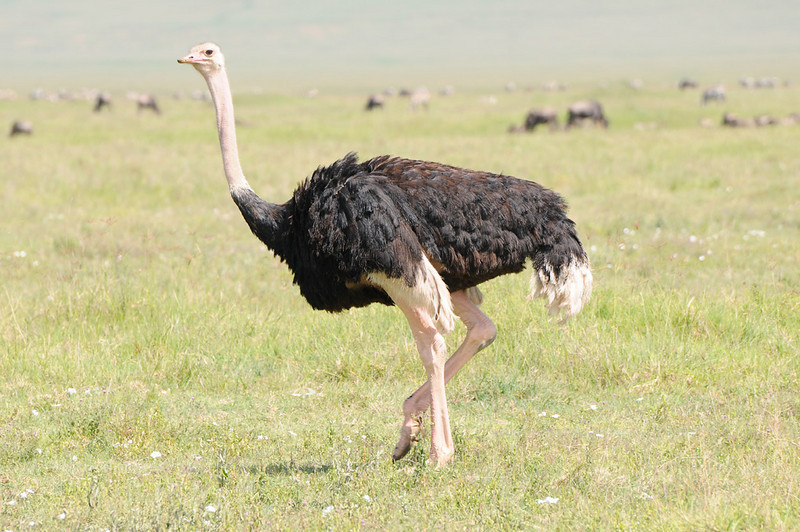
Common Ostrich (Struthio camelus massaicus) by Bob-Nan
I trust this helps explain the new layout for the list of world birds. It’s time for me to start kicking up some more dust as I continue with the changes. I am going straight down the list of families –Family Index. Keep checking back to see how far I have gotten. Updating all the links to the pictures and videos is the most time consuming.
And out of the ground the LORD God formed every beast of the field, and every fowl of the air; and brought them unto Adam to see what he would call them: and whatsoever Adam called every living creature, that was the name thereof. (Genesis 2:19 KJV)
Remember his marvellous works that he hath done; his wonders, and the judgments of his mouth; (Psalms 105:5 KJV)
That they may see, and know, and consider, and understand together, that the hand of the LORD hath done this, and the Holy One of Israel hath created it. (Isaiah 41:20 KJV)
Let them praise the name of the LORD: for he commanded, and they were created. (Psalms 148:5 KJV)
And God said, Let the waters bring forth abundantly the moving creature that hath life, and fowl that may fly above the earth in the open firmament of heaven. (Genesis 1:20 KJV)
Words: Charles Coffin, Paris Breviary, 1736 (Iisdem creati fluctibus); translated from Latin to English by John Chandler and the compilers of Hymns Ancient and Modern.
Music:St. Flavian, Day’s Psalter, 1563
The Fish in Wave, The Bird on Wing
The fish in wave, the bird on wing,
God bade the waters bear;
Each for our mortal body’s food
His gracious hands prepare.
But other food, of richer cost,
The immortal spirit needs;
By faith it lives on every word
That from His mouth proceeds.
Faith springing from the blood of Christ,
Has flowed o’er every land;
And sinners through the vanquished world
Bow down to its command.
Its light the joy of Heav’n reveals
To hearts made pure within;
And bids them seek by worthy deeds
Eternal crowns to win.
By faith the saints of old were strong
The lion’s wrath to tame;
By faith they spurned the tyrant’s threats,
And scorned the raging flame.
Lord, grant that we the path may tread
Whereon its light doth shine;
And gather, as we onward go,
The fruits of love divine.
O praise the Father; praise the Son,
On Whose most precious blood
Rests all our faith; and praise to Him
Who with Them both is God.
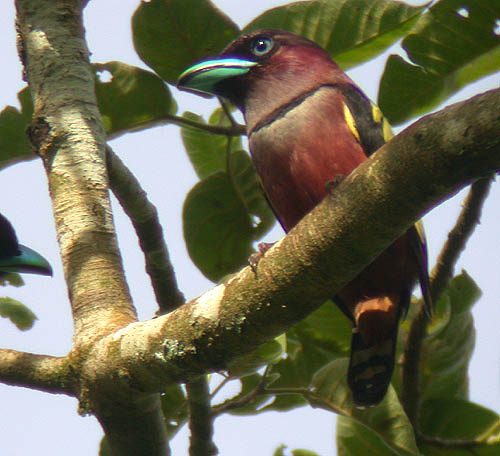
Silver-breasted Broadbill (Serilophus lunatus) by Peter Ericsson
“What are some of God’s favorite object lessons? Certainly His creation is one. A God who can call something into existence which didn’t exist before can do anything. “Lift up your eyes on high, and behold who hath created these things” (Isaiah 40:26).” (Quote from Days of Praise-2-18-2011)
The Broadbills are another of those creations of the Lord. These pretty little birds caught my eye while doing an article. I trust you will find them as interesting as I do. Formed by Him they cannot be anything but amazing. What a great Creator God we have.
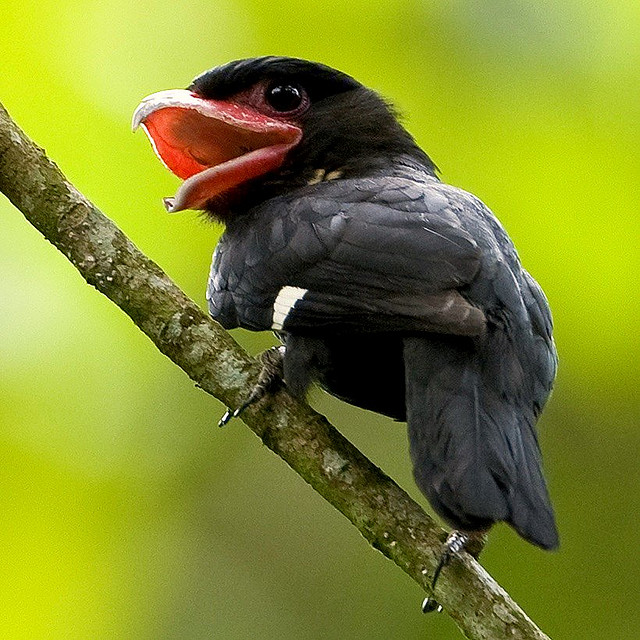
The broadbills are a family of small passerine birds, Eurylaimidae. The Smithornis and Pseudocalyptomena species occur in sub-Saharan Africa; the rest extend from the eastern Himalayas to Sumatra and Borneo. The family possibly also includes the Sapayoa from the Neotropics and the asities from Madagascar.
Banded Broadbill (Eurylaimus javanicus) by Peter Ericsson
Many of the broadbills are brightly colored birds. They range from 4.5 to 11.25 inches (13 to 28 centimeters) in length, and live in the dense canopies of wet forests, allowing them to hide despite their brightly coloured plumage. The plumage of the three African broadbills in the genus Smithornis is in contrast dull and streaked. The bills, which give the family their common name, are broad, flat and hooked and relatively large eyes. Even though many are brightly colored, the Lord has designed them to blend in with their surroundings beautifully.
The broadbills are for the most part insectivorous and carnivorous. Prey taken include insects, spiders, centipedes and millipedes, as well as lizards and tree frogs. Prey is obtained by sallying from a perch to snatch it in flight, and gleaning the prey off leaves and branches while flying. Some species may take some fruit (figs being their favorite), but only the green broadbills of the genus Calyptomena and the African Green Broadbill are primarily frugivores (which also take some insects as well).
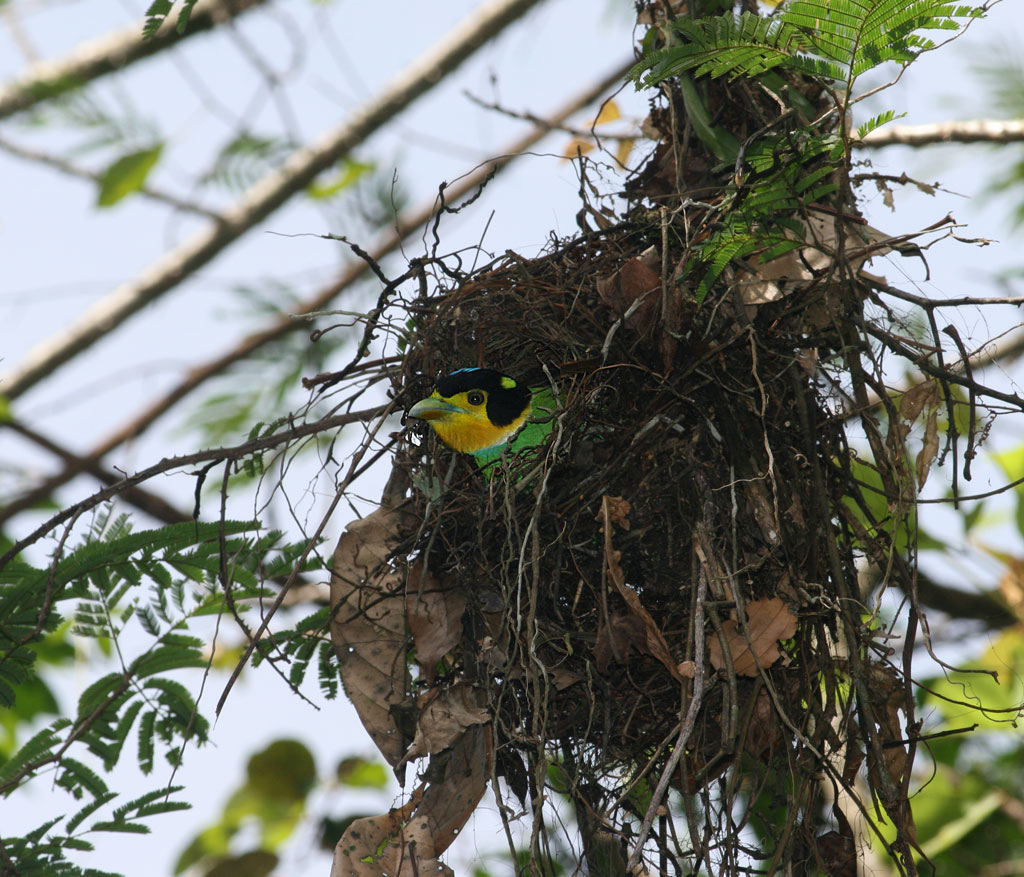
They are generally gregarious, with many species moving about in flocks of about 20 individuals. Broadbills attach their purse-shaped nests to suspended vines, and leave a tail of fibres hanging below it. This gives the nest the appearance of being random debris caught in the tree, an effect further enhanced by the birds covering the nest with lichen and spider webs.
Long-tailed Broadbill (Psarisomus dalhousiae) in nest by Peter Ericsson
Most Broadbills are monogamous, some have quite a courtship dispay and typically she lays two to three eggs. Both participate in nest building and in some species they have “helpers” with the young. Here are some of those verses:
Mostly active early and late in the day, otherwise they are sedentary and perched with their neck pulled in, disguised in the foliage.
Maybe the Lord would like us to look at the broad bills of the Broadbill and be reminded of Scripture. Broad or broader is mentioned over 30 times throughout the Bible.
David repeated in Psalm 18:19 what had been written in 2 Samuel:
He also brought me out into a broad place; He delivered me because He delighted in me. (Psalms 18:19 NKJV)
He also brought me out into a broad place; He delivered me because He delighted in me. “The LORD rewarded me according to my righteousness; According to the cleanness of my hands He has recompensed me. For I have kept the ways of the LORD, And have not wickedly departed from my God. For all His judgments were before me; And as for His statutes, I did not depart from them. (2 Samuel 22:20-23 NKJV)
Let those who fear the LORD now say, “His mercy endures forever.” I called on the LORD in distress; The LORD answered me and set me in a broad place. The LORD is on my side; I will not fear. What can man do to me? (Psalms 118:4-6 NKJV)
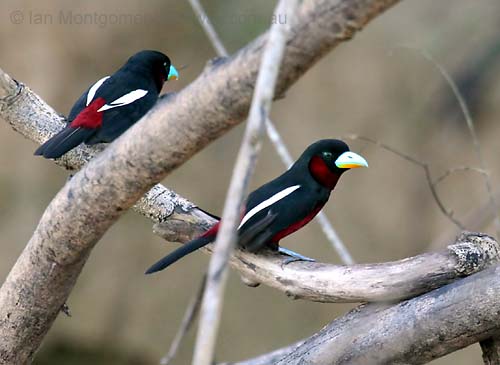
Black-and-red Broadbill (Cymbirhynchus macrorhynchos) by Ian
The wicked wait for me to destroy me, But I will consider Your testimonies. I have seen the consummation of all perfection, But Your commandment is exceedingly broad. Oh, how I love Your law! It is my meditation all the day. (Psalms 119:95-97 NKJV)
But there the glorious LORD will be unto us a place of broad rivers and streams; wherein shall go no galley with oars, neither shall gallant ship pass thereby. (Isaiah 33:21 KJV)
Enter by the narrow gate; for wide is the gate and broad is the way that leads to destruction, and there are many who go in by it. Because narrow is the gate and difficult is the way which leads to life, and there are few who find it. (Matthew 7:13-14 NKJV)
Can you search out the deep things of God? Can you find out the limits of the Almighty? They are higher than heaven– what can you do? Deeper than Sheol– what can you know? Their measure is longer than the earth And broader than the sea. (Job 11:7-9 NKJV)
Green Broadbill (Calyptomena viridis) by Peter Ericsson
The Broadbills are in the Eurylaimidae Family and has 20 members at present. The Eurylaimidae-Broadbills are in the Passeriformes or Perching Bird Order.
Southern Carmine Bee-eater (Merops nubicoides) by Africaddict
We have written several articles about the Bee-eaters, but they are so pretty and colorful, that they are being presented again. When the Lord created them, He did not spare on the “color pallet.” Nor did He fail to provide them with the ability to know how to remove the stinger and poison of the bees and other insects before eating them.
For by him were all things created, that are in heaven, and that are in earth, visible and invisible, whether they be thrones, or dominions, or principalities, or powers: all things were created by him, and for him: And he is before all things, and by him all things consist. (Colossians 1:16-17 KJV)
This video tells about how the Bee-eater cooperate together in communities. Trust you will enjoy watching it.
“The bee-eaters are a group of near-passerine birds in the family Meropidae. Most species are found in Africa and Asia but others occur in southern Europe, Australia, and New Guinea. They are characterised by richly coloured plumage, slender bodies, and usually elongated central tail feathers. All have long downturned bills and pointed wings, which give them a swallow-like appearance when seen from afar. There are 26 different species of bee-eaters.
As the name suggests, bee-eaters predominantly eat flying insects, especially bees and wasps, which are caught in the air by sallies from an open perch.[1] While they pursue any type of flying insect, honey bees predominate in their diet. Hymenoptera (ants, bees and wasps) comprise from 20% to 96% of all insects eaten, with honey bees comprising approximately one-third of the Hymenoptera.
Carmine BeeEater (Merops nubicus or nubicoides) by Marc at Africaddict
Before eating its meal, a bee-eater removes the sting by repeatedly hitting and rubbing the insect on a hard surface. During this process, pressure is applied to the insect thereby extracting most of the venom.[1] Notably, the birds only catch prey that are on the wing and ignore flying insects once they land.
Bee-eaters are gregarious. They form colonies by nesting in burrows tunnelled into the side of sandy banks, such as those that have collapsed on the edges of rivers. Their eggs are white and they generally produce 2-9 eggs per clutch (depending on species). As they live in colonies, large numbers of these holes are often seen together, white streaks from their accumulated droppings accentuating the entrances to the nests. Most of the species in the family are monogamous, and both parents care for the young, sometimes with the assistance of other birds in the colony.” (From Wikipedia)
Some of the articles we have done that mention the Bee-eaters are:
The Bee-eaters are in the Coraciiformes Order which included the Roller, Kingfisher, Todie, Motmot Families. The Meropidae Family is the one that contains the 26 Bee-eater species.
Chestnut-headed Bee-eater (Merops leschenaulti) by Nikhil Devasar
Here is a video that I shot out at the Circle B Bar Reserve in Lakeland, FL on January 18th. We went out to watch some of the 4,000 American White Pelicans land at the marsh. We got there about 4:30 pm and stayed until almost 6 pm.
I left the sound on so that you can catch the amazement in my voice. My english is terrible and my words nutty, but I was thoroughly enjoying my “birdwatching adventure.” This is what it is really like to go birdwatching with me. I get so amazed at watching God’s created critters.
Thou wilt shew me the path of life: in thy presence is fulness of joy; at thy right hand there are pleasures for evermore. (Psalms 16:11 KJV)
I have more of these and pictures, but will save them for another time. Slower connections speeds will have enough problems loading just one video.
On the video I said about 100 feet over my head, it was more like 20-30 feet over our heads. The pelicans were landing right behind us.
An interesting article by Donna L. O’Daniel provided the background for this blog. You can see her complete article at: Water, Water Everywhere . . . And Not A Drop To Drink. See the article for some of the more technical aspects of this.
Birds that are at sea for months and even years must have a way to quench their thirst. How can they do that? If we drink seawater, which is loaded with salt, we would be in deep trouble. Most regular birds would also suffer harm if they were to drink the salty water all the time. Birds like the Albatrosses, Petrels, Tubenoses and Shearwaters do, in fact, drink saltwater.
Laysan Albatross (Phoebastria immutabilis) by Daves BirdingPix
You would know that the Lord God, the Creator God, would have already prepared these birds for this situation. And so He did.
For My thoughts are not your thoughts, Nor are your ways My ways,” says the LORD. “For as the heavens are higher than the earth, So are My ways higher than your ways, And My thoughts than your thoughts. (Isaiah 55:8-9 NKJV)
Have you not known? Have you not heard? The everlasting God, the LORD, The Creator of the ends of the earth, Neither faints nor is weary. His understanding is unsearchable. (Isaiah 40:28 NKJV)
Northern Giant Petrel (Macronectes halli) by Dave’s BirdingPix
“Sea birds like the albatross drink freely from sea water but never seem to suffer any ill effects. They manage this because their physiology has become adapted to the sea environment. They have special glands just behind their eyes that actively pump salt out of their blood and into narrow tubes that lead into the bird’s nostril. The excess salt drips harmlessly out of the body, restoring the blood salt level back to normal.” “Seabirds can drink seawater and have salt glands inside the head that eliminate excess salt out of the nostrils.” (Internet)
Wikipedia has this to say about the Albatrosses: “Albatrosses, along with all Procellariiformes have a need to lower their salt content due to their drinking of ocean water. All birds have an enlarged nasal gland at the base of the bill, above their eyes. This gland is inactive in species that don’t require it; however the Procellariiformes do require its use. Scientists are uncertain as to its exact processes, but do know in general terms that it removes salt that forms a 5% saline solution that drips out of their nose or is forcibly ejected in some birds.“
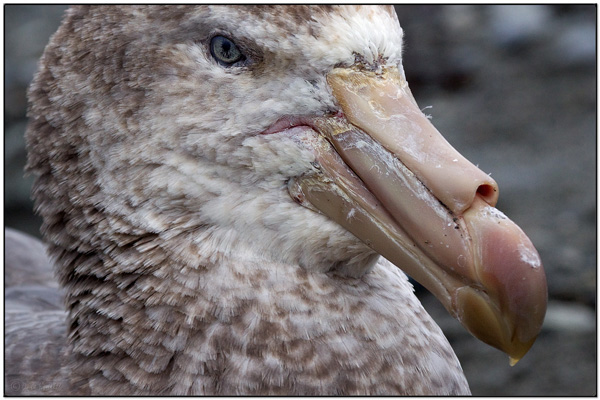
Northern Giant Petrel head close-up by Daves BirdingPix
About the Tubenoses and Shearwaters: “They also have a uniquely structured bill, with seven to nine distinct horny plates.. Finally, they have a salt gland that is located above their nasal passages and helps desalinate their body, as they drink seawater. They excrete the salty waste out their nose. As members of Procellariiformes, they share certain characteristics. First they have tubular nostrils called nariorns. This feature gives them their common name, Tubenoses. The opening to the nostril is located differently in some birds. These birds have the opening on top of the upper bill.”
For since the creation of the world His invisible attributes are clearly seen, being understood by the things that are made, even His eternal power and Godhead, so that they are without excuse, because, although they knew God, they did not glorify Him as God, nor were thankful, but became futile in their thoughts, and their foolish hearts were darkened. (Romans 1:20-21 NKJV)
Wandering Albatross (Diomedea exulans) by Ian
“The creation model for the origin of avian salt glands states that an intelligent Creator created this class of vertebrates complete with all of the complex systems within their bodies to survive in and adapt to their given environments, including salt glands to rid their bodies of excess salt. Perhaps the strongest argument in favor of the creation model for the origin of avian salt glands, aside from the lack of transitional forms in the fossil record, is one consisting of purpose and interdependence of purposeful parts.
Given the complexity of the functioning of avian salt glands, their existence by design can hardly be denied. The evidence for design that is obvious in the avian salt gland suggests a Designer who not only created the gland, but the entire animal, the earth, and the entire universe.” From Donna’s Article (see above)
And He said to me, “It is done! I am the Alpha and the Omega, the Beginning and the End. I will give of the fountain of the water of life freely to him who thirsts. (Revelation 21:6 NKJV)
And the Spirit and the bride say, “Come!” And let him who hears say, “Come!” And let him who thirsts come. Whoever desires, let him take the water of life freely. (Revelation 22:17 NKJV)
The Bible says,” But ask now the beasts, and they shall teach thee; And the birds of the heavens, and they shall tell thee” Job 12:6
Birds are the most beautiful of all creations… Aren’t they? Of course they are.. If we have the heart to learn, there is indeed so much that we can learn from them; from living an organized lifestyle with what little they have and the way they take themselves and their homes and kids in times of adversities… Above all, we can learn a lot about music, about music and the most important part played by music in its life….
Birds have never been to a university. But the fact is that, most of the universities around the world are behind birds, learning new things everyday about them.
Out of all that we can learn from birds, the most amazing habit is their singing, what the birders call as bird calls of bird songs. Singing is their habit and way of living, but for us, singing is a hobby and we try to earn a living out of it… Remember God had created us to worship..
Birds are the only creations which start their day with singing and end their day with singing… You know why birds sing at dawn? It is just that they want to advertise to this world that they are still alive..
We call ourselves as Christians.. But do we really have Christ in us? How many mornings did we advertise to this world that JESUS – THE LIFE dwells in us? If we don’t sing praises in the morning, we should definitely scan our heart and soul to see if we are dead or alive. For the Bible says,
The dead praise not the LORD, neither any that go down into silence. (Psalms 115:17)
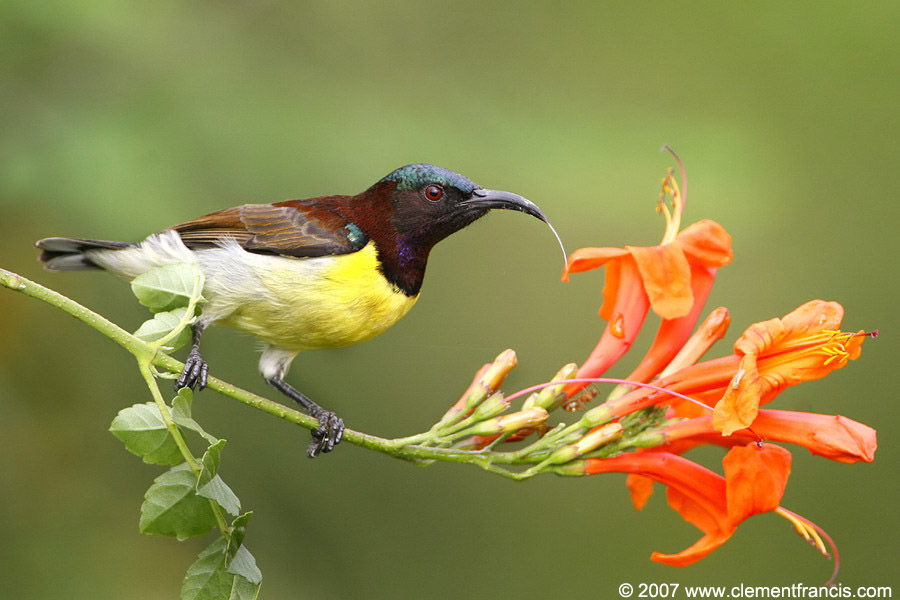
Oh! What joy they should have in their life to do so? A small Sun bird’s call can be heard as far as 300 to 400 meters. If a bird is as big as a human and if it sings,
Purple-rumped Sunbird (Leptocoma zeylonica) by Clement Francis
(PURPLE-RUMPED SUNBIRD)
its song can be heard as far as 3 to 4 kilometers… Well, that is what Ornithologists say… To sing that powerful, birds need lots of energy. Hence, they need to eat very often, because birds burn lot of calories on singing…
How loud do we sing in Church? Or do we sing at all in our personal prayer? Or do we act as if we are worshiping the Lord will all our heart in Church? Bible says, “Make a joyful noise,” it did not say voice, it says NOISE. Joshua and his men made NOISE and the fort of Jericho crumbled. Let us do it the Joshua way.
Maybe their early morning singing is the reason that they are able to fly hundreds of miles every day in search of food and water and yet returns home with so much of energy to end their day with another open-air concert … There is a saying which goes like this “Laughter is the best medicine.” Birds can’t laugh… Is that why they sing to show their joy? Where there is joy, there is strength… Prophet Nehemiah knew that secret that is why he says,
….: for the joy of the Lord is your strength (Nehemiah 8:10)
Is that the reason why the birds are so strong that they can fly and we can’t? Birds never go to a doctor because they know that their music can heal them… Music has the power to heal you know?
Kind David’s music healed King Saul isn’t it? Your worship can heal people’s body, mind and soul. After all, GOD has kept life and death in our tongue. Let us use it for HIS glory..
Well, how many of us start or dare to start our day with singing? Where there is singing there is joy and where there is joy there is strength… It sounds so simple isn’t it? And it’s not just simple but, it’s powerful too… Birds know this secret and that’s why they bring so much joy through their singing…
No matter what the situation is, it is time for us to start our day with singing, for the KING is returning very soon. If we do not have the practice of singing here, we would never be able to sing in heaven along with the angels.
Birds sing in perfect pitch and perfect rhythm… Musicians use a software called “NEUNDO” for recording and the default set for the Tempo is 120 BPM (beats per minute)… The rhythm of the song of most birds is set to the tempo of 120 BPM… It sounds as if they had invented NEUNDO…Isn’t it quite astonishing or amazing or whatever you may call it? The syncopation of bird songs has intricate patterns and most of them are new to men… They sing very short phrases compared to human singing, but, their syncopation has complicated but complete rhythmic patterns…
Once as I was birding, I saw a Chestnut-headed Bee-eater
Chestnut-headed Bee-eater (Merops leschenaulti) by Nikhil Devasar
(CHESTNUT-HEADED BEE-EATER)
perched on a dry tree. Suddenly the bird flew as far as about 50 meters and flew back to the same place where it was perched with a dragon-fly stuffed into its beak.. The dragon-fly was still alive. So, the little bird whacked its beak. Tak, tak, tak, tak, tak, five times on either side on the branch where it was perched to kill the dragon-fly all in one motion… Was just wondering, why it whacked five times… Then I found that, in music a rhythmic phrase always ends on the first beat of the next bar… Don’t we sing in a funeral? That’s what the Bee-eater did? Hm
they spontaneously sing complicated rhythmic patterns like a seasoned jazz player… Most composers avoid composing on 5/8 rhythm because of its limitation and the complications involved in the execution of a song in this rhythm…
from the Macaulay’s Library of Cornell’s lab of ornithology, sing in 5/8 rhythmic pattern… I felt so small in front of this small little bird when I heard that song… How it is possible for this little bird to sing in this one of the most complicated rhythmic pattern so spontaneously?
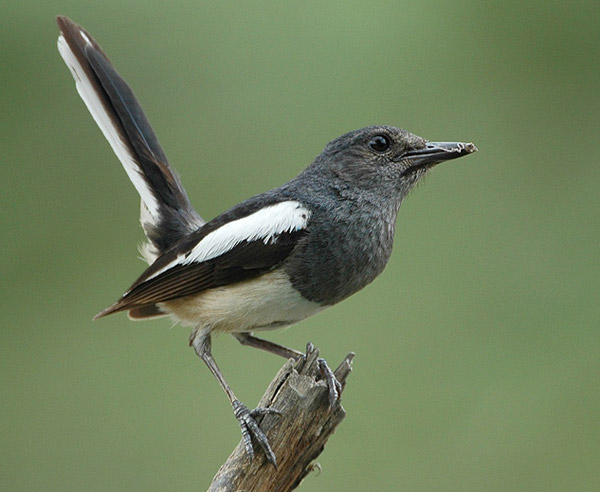
Each individual of Oriental Magpie Robin
Oriental Magpie-Robin (Copsychus saularis) by Nikhil Devasar
(ORIENTAL MAGPIE ROBIN)
can sing more than fifteen songs per individual and each one is different… Just imagine how much competition would be there to impress upon the females?
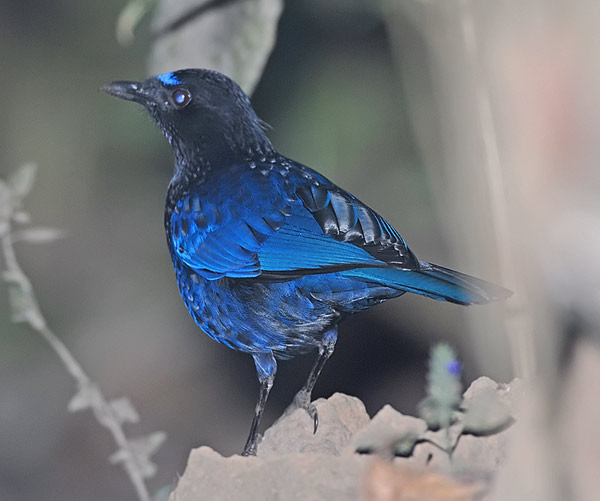
There are birds like the Malabar Whistling Thrush,
Malabar Whistling Thrush (Myophonus horsfieldii) by Nikhil Devasar
(MALABAR WHISTLING THRUSH)
which is considered as one of the best singers of the bird community… Bird call specialists say that you would mistake its singing for a human whistling a song… But, I personally feel that, that statement shows human ego… If I sound arrogant, please forgive me for that, because, I personally feel that the song of the Malabar Whistling Thrush or any other bird on planet earth is ORIGINAL… NO COMPARISONS PLEASE… Each bird’s songs are special and they know that too.. That is why birds never get jealous of each other’s singing… Do they?
Researchers say that, if a bird doesn’t learn to sing early, the percentage of survival is minimized… This means Birds sings for survival… The mother bird feeds the chick which shouts the most first… So, the louder you sing the more you eat…
God said,
I am the LORD thy God, which brought thee out of the land of Egypt: open thy mouth wide, and I will fill it. (Psalms 81:10)
Imagine if the same rule applies for mankind, how many of us would still be alive? Most would’ve starved to death and Churches would be empty isn’t it? How long are we going to zip our mouth in the presence of the Lord? Let us open our mouth and He shall open the windows of heaven and fill us and we shall over flow..
Birds sing to attract their mate… A bird which sings the best gets the most attractive mate… If again, the same rule applies to us, scores of us would still be bachelors isn’t it? If again, we don’t sing, our eternal bridegroom would never come near us. Because, our GOD dwells among our praises..
But thou art holy, O thou that inhabitest the praises of Israel. (Psalms 22:3)
Remember, most of us prefer to sing in the bathroom rather than in the church! We sing for applause, name, fame and money. If we start applauding, each time a bird sings, I wonder if any bird could live near us, for they will fly away and never venture to sing before a man again… But, Birds sing for the sheer joy of singing… When would we learn to live like them?
has a sound which resembles the wood block, a percussion instrument, which originated from Africa… Maybe the Africans were inspired by the bird’s call… There are tales after tales that say how man was inspired by nightingales and sparrows and cuckoos for their inspiring songs…
Birds never keep singing the same old songs all through their lives… To impress upon their mates they try to outwit their male subordinates by improvising their songs time and again… After all, female birds feel that, the males which sing the most complicated songs are the ones which are capable of taking care of their families better… Is that why, great teachers like Socrates and Pythagoras taught music first before they taught mathematics and astronomy?
King David knew God’s heart that is why he says,
I will sing a new song unto thee, O God: upon a psaltery and an instrument of ten strings will I sing praises unto thee. (Psalms 144:9)
We stop teaching our kids with rhymes than music; and that too only till the kindergarten level… If only we had been singing all through our lives, this world would’ve been rid of jealousy, ego, hatred, terrorism and the list may go on and on… If Osama Bin Laden had practiced music, he would’ve been a carrying a 4-stringed Oudh – an Arabian stringed instrument plucked with the Quill of an Eagle’s feather, instead of an AK47…
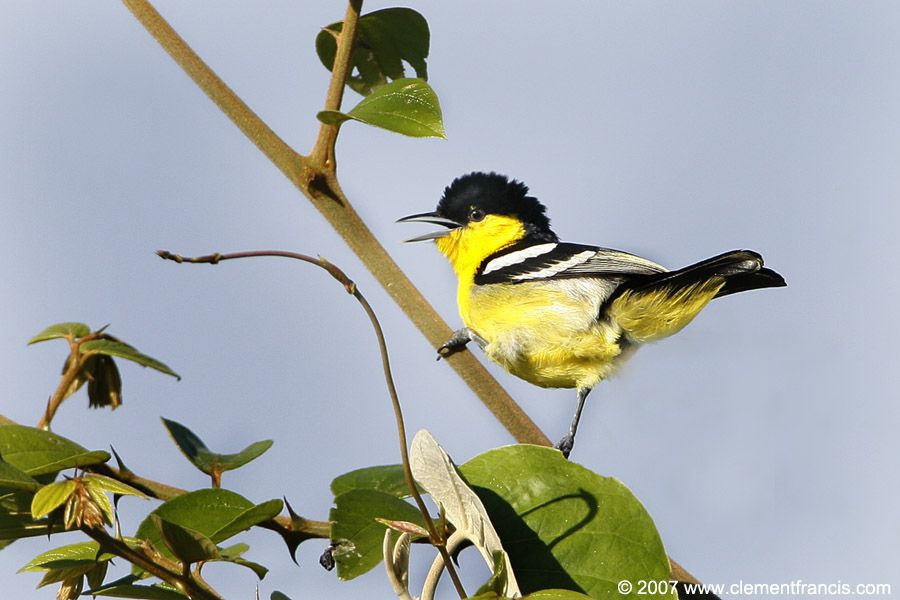
Birds live in perfect harmony not only among themselves but also with the flow of nature… Once I heard a territorial call of an Indian bird called Common Iora.
Common Iora (Aegithina tiphia) by Clement Francis
(COMMON IORA)
Each one was answering one another’s territorial calls. They both were singing similar phrase. Slowly, the calls turned a bit aggressive I thought; because, one was answering before the other could finish singing its phrase. At one particular point when one overlapped the other’s call, like what we call singing cannon in music, it turned into a harmony. As a musician, I know it was perfect harmony. But, I don’t know if it was intentional or accident. All that I heard was perfect harmony. They are in harmony with time and season. Rain or shine, no matter what happens around them the birds are able to sing.
Do we find harmony at home, in school, in our office, in our church? If only we knew the power of harmony, we Christians will not have thousands of denominations. If we knew the effect of harmony, by this time every soul would have accepted Christ as their savior… If we had learned to live in harmony, this world would be a better place to live.
A home or a street or a town or a city or a state or a country which encourages and practices music will live in PERFECT HARMONY… After all music is all about harmony and perfection of body, mind and soul… Most Christian families do not have family prayer and worship.. We think that Sunday worship in Church is suffice. Unless we live in perfect harmony at home, would it be possible to have harmony in the places where we go. Well, ministry starts at home.
It is because of us trying to move against the flow of nature that the world is facing severe biological catastrophe. If only we could learn to live in harmony with nature? This world would be the same as it was in the beginning. It may be too late and too hard to live in harmony with nature right now. But, we can surely postpone the inevitable to a certain extent. This can happen only when we unite together in harmony and save earth so that they Birds can sing and sing and sing forever and ever… Come on, rain or shine, let us all learn to sing like birds at all times and live in PERFECT HARMONY with GOD and HIS creations..…
(a j mithra wrote the article and Lee supplied some photos, videos and the sounds-not all recordings match his descriptions)
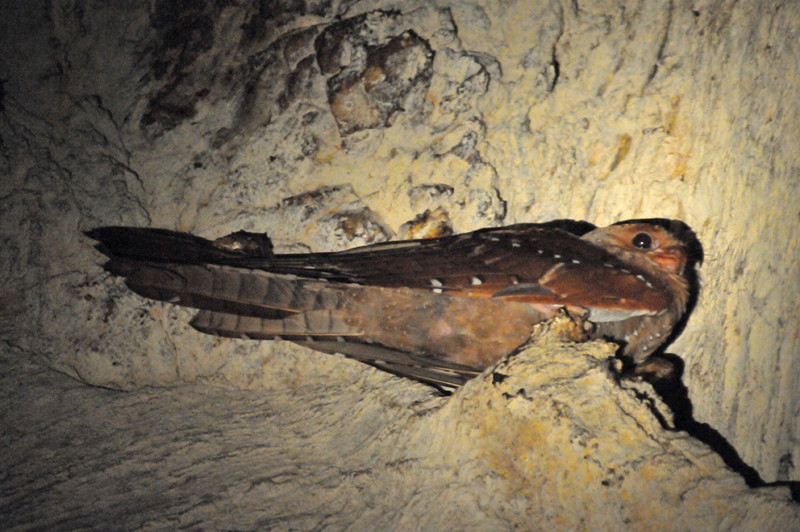
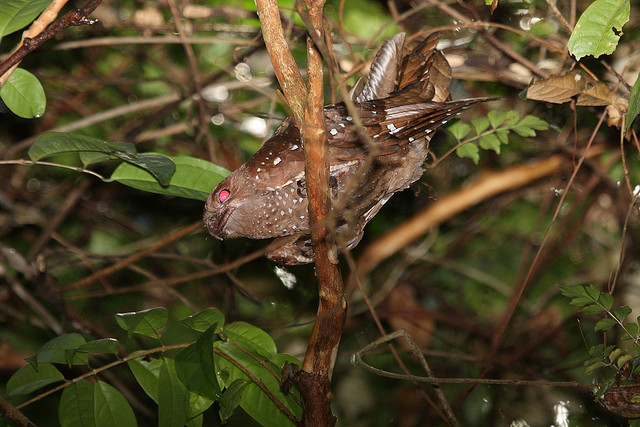
Oilbird or Guacharo lives in northern South America from Guyana to Peru. The Oilbird ranges locally across much northern South America and down the Andes all the way to Bolivia.
Their plumage is cinnamon brown, with small, white spots. The Oilbird presents a somewhat “hen-ish” or owlish appearance, observant and hesitant when trolling branches; puffy and somnolent when asleep. It is mainly reddish-brown with white spots on the nape and wings. Lower Oilbird parts are brownish color to neutral white. The stiff tail feathers are a rich chestnut brown spotted with white on either side.
This is a large bird at sixteen to nineteen inches with a wing span of three feet. The Oilbird’s flattened hooked bill is surrounded by dark brown bristles up to two inches long.
Oilbird (Steatornis caripensis) by Ian
It is a bird of tropical and subtropical primary forests. Colonies leave the caves at night to fly to fruiting trees. Figs are often consumed but the Trinidad population has been documented eating over 36 different kinds of fruit. The seeds of these fruit are spread widely after passing through the bird’s system, and the Oilbird is thus an important component of the tropical ecosystems. The forest depends on these fruit eaters — and other animals with similar behavior such as fruit bats — to continue in existence.
The existence of Church depends on how far and wide we sow the word of God…
God has asked us to spread the gospel over all the earth…
But, the question is have we touched lives which dwell next door or at least to the person who sits next to our table in office ? First of all, we don’t even know the person who sits next to us in church, isn’t it? We’ve been hearing a lot about brotherly love and love your neighbor as thy selves..
But, have we ever asked ourselves if we truly love our self?
Most so called believers are going through self inflicted injuries and self pity…
Maybe that is the reason we are not able to lead a fruitful life..
Our fruits are not the fruits which God expects from us…
Unless we are fruitful and our lives testify God’s work in us, we may not be able to sow seeds of faith among our fellow beings…
A good tree cannot bring forth evil fruit, neither can a corrupt tree bring forth good fruit. Every tree that bringeth not forth good fruit is hewn down, and cast into the fire. Wherefore by their fruits ye shall know them (Mathew 7:18-20)
It is a seasonal migrant, moving from breeding caves to fertile wild land fruit trees. Oilbirds plump up possibly half their body weight again before the breeding migration, an intelligent habit as caves will provide little nutrition and parents will not want to leave the nest.
Oilbird (Steatornis caripensis) by Judd Patterson
Seasonally, the oilbird lives in forests to gather nutrition and store up for breeding. Then the oilbird will migrate from the forest and woodland to within breeding areas within caves. Both parents share the task of incubating the clutch of two to four eggs for about 33 days, and the nestlings stay put for up to four months.
Oilbirds feed their young exclusively on fruit pulp. This is very unusual because an all-fruit diet would not normally provide adequate nutrition or baby birds. The young nestlings grow fat (even half as heavy again as their parents)—causing the literal downfall of many!
These birds seem to know the importance of storing nutrition for migration and breeding that’s why they provide adequate nutrition for their babies…
We as Christian parents, do we take care to nourish our children with spiritual food?
We tell them stories about the five who went to buy oil at the last minute..
But are we insisting upon our kids to get ready to meet the King?
These young oilbirds are heavier than their parents, how healthy are our children in spirituality?
I have no greater joy than to hear that my children walk in truth. (III John : 1)
The wings of the oilbird control aerial maneuvers. The Oilbird’s small feet are somewhat useless, other than for positioning and alignment to vertical surfaces. The oilbird’s hovering, twisting flight allows the bird to navigate the route and “hallways” of the caves. Oilbirds echo-locate (like bats) inside caves but use their huge eyes once they leave the communal roosts.
They apparently have excellent night vision. Rows of bristles protect the eyes both above and below. They fly with fast with primary tips widely spaced (like New World vultures) but have the ability to fly slowly or even hover. They can range quite a distance in search of fruit. Radio telemetry studies have shown their normal range per night is 40 kms (25 mi) but they have traveled as far as 150 km (93 mi) in a single night. They may find fruit by smell. These birds travel so long in a single night in search of fruits..
This reminds of how Jesus had come from heaven to earth in search of fruits from us isn’t it?
He expects us to give fruits at all seasons…
Do we have fruits to offer 24 x 7 or just seasonal?
And now also the ax is laid unto the root of the trees: therefore every tree which bringeth not forth good fruit is hewn down, and cast into the fire. (Matthew 3:10)
Studies have shown that all the fruit they eat is spicy or aromatic when ripe. Oilbirds nest in large colonies on high, rocky ledges, often a good distance into the cave. They build their cone-shape nests from a mixture of regurgitated fruit pulp, their droppings and undigested seeds. Oilbird nestlings retain food in their intestines for longer than normal, enabling them to extract all the nutrients which they need in order to thrive on fruit. For instance, they are able to extract 80% of the lipids (fats) from their diet.
We eat lots of the THE FIRST, which is the WORD OF GOD…
But, do we extract all the nutrients of THE WORD by meditating on what we read?
Do we eat THE WORD in haste? Or is it a ritual that we need to practice every day?
The Word of God has the power to heal, to cleanse, and to encourage and so on…
How do we handle it?
For the word of God is quick, and powerful, and sharper than any twoedged sword, piercing even to the dividing asunder of soul and spirit, and of the joints and marrow, and is a discerner of the thoughts and intents of the heart. (Hebrews 4: 12)
Just like bats (and many sea mammals), Oilbirds emit clicking calls in rapid succession and listen to the returning echoes. This means that, in the pitch blackness of their cave home, they can fly around without bumping into the cave walls or each other.
Oilbird (Steatornis caripensis) by Bob-Nan
At dusk, they leave the cave to find food and their echolocation system works together with their keen smell and super-sensitive vision, helping them to snatch nuts and small fruits in mid-flight without needing to land. In fact it is thought that they never perch during foraging trips, using instead their ability to hover while feeding.
The eyes of oilbirds are highly specialized for their unique lifestyle. While not apparently designed for distinguishing colour, it has recently been discovered that they are extraordinarily sensitive to light—a great advantage to a bird that ‘breaks all the rules’ by being nocturnal. This incredible light-sensitivity is achieved by each of the oilbird’s eyes having a large pupil, enabling them to gather the maximum amount of light and millions of densely packed rods, the photoreceptor cells.
God had created these birds with excellent night vision for them to travel long distance in search of food..
But, we are so privileged that we have God Himself as our light to show us the way during our dark times..
Then spake Jesus again unto them, saying, I am the light of the world: he that followeth me shall not walk in darkness, but shall have the light of life. (John 8:12)
These unique Oilbirds dwell in caves, has dolphin-like sonar, navigates like a bat, has eyes like a deep-sea fish, can hover like a kingfisher, finds its food by smell and can be boiled up to make oil…
The eyes of these birds are extremely sensitive to light and that is the reason that they are able to break all rules by being a nocturnal…
This world will see us also as very special when we are sensitive to THE LIGHT..
The light of the body is the eye: therefore when thine eye is single, thy whole body also is full of light; but when thine eye is evil, thy body also is full of darkness If thy whole body therefore be full of light, having no part dark, the whole shall be full of light, as when the bright shining of a candle doth give thee light. Take heed therefore that the light which is in thee be not darkness. (Luke 11:34-36)
What a neat bird, a j. I am also going to add this to the “Formed By Him” series. The Creator has really designed this very unique and useful bird for His Glory.