“Evolutionists trumpet the several Galapagos finch “species” as arising by adaptation from one species. Creationists agree, but this did not happen through evolution. Normally the finch types segregate by lifestyle according to their beak shape, but in times of stress they interbreed and combine. No evolution here. The flightless cormorants are recognizably related to other species of cormorant on other continents, but these have lost the use of their wings. …”
(See Cormorant Family from Bird Families of the World to see the similarities)
Lee’s Birds of the World, is based on the I.O.C., 2.1 version of 2009. It lists 39 Orders, 224 Families, and 10,340 individual Species. This is new and still being developed. All the ORDERs and the Families are listed. More indexes, photos, links, and Scriptures are still being added. These pages are under the Birds-World Tab above. Please enjoy looking around at the references to the numerous birds that the Lord has created. It appears by the numbers of the birds that they have done as the verses below declare.
So God created great sea creatures and every living thing that moves, with which the waters abounded, according to their kind, and every winged bird according to its kind. And God saw that it was good. And God blessed them, saying, “Be fruitful and multiply, and fill the waters in the seas, and let birds multiply on the earth. (Genesis 1:21-22 NKJV)
All photographs have been used with the permission of the photographers listed or are in the public domain. Please honor their copyrights.
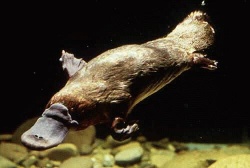
“Some animals, such as the duckbilled platypus, have organs that completely confound evolutionary explanation. The platypus has a mixture of features from animals completely unrelated to its supposed ancestry. For instance:
The warm-blooded platypus feeds its babies milk like other mammals.
It lays leathery eggs, has a single ventral opening (for eliminating its waste, mating, and birth), and has claws and a shoulder girdle like most reptiles.
It can detect electrical currents like some fish.
It has webbed feet like an otter, a flat tail like a beaver, and the male can inject poison into its predator like a snake.
It has a bill like a duck.
Platypus From Creation Wiki
It would seem that animals such as the platypus are God’s reminder of His unfathomable creativity. These animals combine features from many unrelated creatures and have no logical place on the evolutionary tree.” There is no direct evidence that any major group of animals (or plants) arose from any other group. Completely different types of animals are only observed going out of existence (extinctions), never coming into existence.”
In the Beginning, 7th Ed., p.7
Great is the LORD, and greatly to be praised; And His greatness is unsearchable. One generation shall praise Your works to another, And shall declare Your mighty acts. I will meditate on the glorious splendor of Your majesty, And on Your wondrous works. Men shall speak of the might of Your awesome acts, And I will declare Your greatness. (Psalms 145:3-6 NKJV)
From A Closer Look at the Evidence, Richard and Tina Kleiss, Aug 3
While working on the Orders of the Birds and finding so many species of birds worldwide, I went looking for more information about them. I came across this interesting article at the ICR.org website. The bolding is mine. I trust you will find it worth the reading.
Cormorant Tree by Dan
Do ‘New Species’ Demonstrate Darwinism?
by Various Authors
Frank Sherwin, M.A., and Brian Thomas, M.S.*
“That species undergo change in this grand system called earth is apparent, but those changes do not occur the way Charles Darwin envisioned. Living things do shift behaviors and physiologies in response to environmental (and other) pressures, but can these minor changes completely rework a creature’s essential form (a concept referred to as “macroevolution”)? Decades of research emphatically say no.
Often, small changes within a kind are referred to as “microevolution,” which has been defined as “evolution resulting from a succession of relatively small genetic variations that often cause the formation of new subspecies.”1 Creation scientists agree that small variations occur, both because they can be observed, and because it is reasonable that a wise Creator would equip His creatures with survival-enhancing capabilities. But these variations do not lead to large-scale changes between kinds. Indeed, “there is no agreement [among evolutionists] as to whether macroevolution results from the accumulation of small changes due to microevolution, or whether macroevolution is uncoupled from microevolution.”2
The confusing array of definitions for the word “species” can obscure deficiencies in Darwinian evolution. As leading scientists have admitted, “The very term ‘species’ is deeply ambiguous.”3 Harvard’s Steven Palumbi said in 1994 that “the formation of species has long represented one of the most central, yet also one of the most elusive, subjects in evolutionary biology.”4
If different species are described as essentially those forms which cannot interbreed, then new species do arise, a process called “speciation.” They do so, however, because of a loss of information–the opposite direction to what Darwinian evolution requires. “…..
“One of the fascinating and unique creatures of all creation is the common hummingbird. What is the probability that all of the unique characteristics of the Ruby-throated Hummingbird, each of which are needed for its survival, developed by some step-by-step process? A few of the hummingbird’s incredible abilities are listed below:
The unique ability to fly forward, backward, upside-down, and straight up like a helicopter as no other bird can.
The use of a special fringed tongue to sweep insects out from the inside of flowers. It cannot survive on nectar alone, but also needs the protein from eating insects. Without its special tongue it could never catch the insects.
The ability to fly 500 miles nonstop over the gulf waters to Mexico. The hummingbird can conserve its strength for long flights by taking a prolonged rest just prior to the flight and making every motion count in flight.
The ability to go into a “torpid” condition at night by almost shutting down its metabolism. Because of its incredibly high energy activity, gram for gram the hummingbird has the greatest energy output of any warm-blooded animal. Yet at night it uses only about one fifth of its normal energy.
Ruby-throated Hummingbird by Ray’s Wildlife
The hummingbird is truly a marvel of God’s creativity.
Character Sketches, Vol.II, p.42-48″
Seek the LORD and his strength; seek his presence continually! Remember the wondrous works that he has done, his miracles, and the judgments he uttered, (Psalms 105:4-5 ESV)
A Closer Look at the Evidence, July 13, by Richard and Tina Kleiss
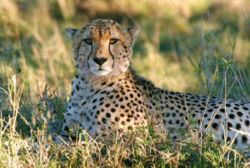
The cheetah is truly a remarkable creature. It is the world’s fastest land animal, capable of accelerating from 0 to 40 miles per hour in 2 seconds. The cheetah can reach a speed of 70 miles per hour. How does the cheetah reach these phenomenal speeds? It is designed with a high-performance body containing a uniquely powerful heart, strong large-diameter arteries, and extra-large nostrils for breathing large volumes of air. The cheeta also has hip and shoulder girdles that swivel on its spine. As it runs, the cheetah’s spine curves up and down as its legs contract and extend. When moving at high speeds, the cheetah may only touch the ground once every 23 feet.
Cheetah
Evolutionist would claim that some unknown pre-cheetah creature turned into the cheetah by chance mutations of its heart, liver, arteries, nostrils, hips, shoulders, spinal column, and muscles. Yet the oldest known cheetah fossils reveal an animal that is essentially identical to the cheetahs alive today. Once again, the actual physical evidence supports creation, rather than evolution. The cheetah’s unique characteristics are a result of design. All of the information necessary for the cheetah’s speed was programmed into the first large “cat-type” creature. No series of random modifications could have produced this fast, sleek animal.
The LORD is righteous in all His ways, Gracious in all His works. (Psalms 145:17 NKJV)
“Evidence From Biology”, July 27, from A Closer Look at the Evidence, Richard and Tina Kleiss – Taken from Letting God Create Your Day, Vol.4, p.19
From Creation Wiki:
“The word Cheetah actually originates from a Hindi word, which means “spotted one.” Cheetahs are carnivorous cats that are best know for their spots and their speed. They are found mainly in Southern Africa. They rely on speed for hunting, and not stealth, unlike most cats. Females tend to be solitary, while the males spend their whole lives together. They have smaller teeth than most cats, which helps improve the cat’s respiratory system. A cheetah’s life span in the wild is about 12 years. Ancient Egyptians sometimes kept cheetahs as pets, and used them for hunting.”
Cheethah have small teeth which help it get air in while running at those high speeds mentioned above. They weigh between 80-140 lbs. and are about 32 tall and 48-56 inches long. “Almost every part of a cheetah’s body is built, in some way, to help it run faster. They have semi-retractable claws, as well as special paw pads on their feet to give the cat good traction. As mentioned before, large nostril and a clear intake help get air in and out quickly and smoothly. The cheetah’s spine acts as a spring for its back legs. Their tail is much like a rudder, it gives the cat added agility, enabling it to turn quickly. The cheetah’s top speed is an amazing 71 miles per hour. This speed can only be held out for about 200-300 yards. The cheetah can accelerate from 0-60 mph in 3.5 seconds, faster than many sports cars.”
Interesting Things – Dragonfly gave a lot of detail about the Dragonflies. Now the researchers have produced some very interesting details about their migration. According to the “Mail Online”, they have longest migration by insects. They “fly 11,000 mile round-trip over ocean.” and the “BCC-Earth News” also has an article about their incredible journey.
From the BBC Earth News: “Every year, millions of dragonflies fly thousands of kilometres (11,000 miles) across the sea from southern India to Africa.
So says a biologist in the Maldives, who claims to have discovered the longest migration of any insect.
If confirmed, the mass exodus would be the first known insect migration across open ocean water.”
They go on to mention the Monarch Butterfly’s migration is much less lengthy, only traveling around 8,600 miles round-trip.
Round-trip of Dragonfly from Mail Online
What an amazing feat these dragonflies perform. Below are the links to the articles, but what a fantastic Creator we have. As you read the articles, you cannot but be amazed by the way they were programmed to sense the weather patterns, knowing when the rains would be there, etc. There is no way this just happened without a designer.
O LORD, how many are Your works! In wisdom You have made them all; The earth is full of Your possessions. (Psalms 104:24 NASB)
The Birds of the Bible usually cover the birds specifically mentioned by name in the Bible, but because of variation within the “kinds”, I decided to start covering some of their “Relatives.” The latest DNA-DNA and other testing have put the Hoatzin in the Cuckoo (Cuculiformes-cuckoos and relatives) family, but that data is being questioned at at present, they aren’t sure where to place it. For now, I stuck it with the Cuckoos. See Birds of the Bible – Cuckoo. (In IOC status it is in the Opisthocomidae Family)
The South American Hoatzin (pronunced hoh-AT-sin), is another of the Lord’s birds that keep evolutionist confused. Most birds eat berries or insects, but the Hoatzin, eats like a cow!
Is anything too hard for the LORD? (Gen 18:14 NKJV)
“The Hoatzin has one more odd characteristic that scientists find the most puzzling of all. Ninety five percent of its diet is leaves. It’s the only bird known to digest its food the same way cows and other ruminants do. Just like ruminants, the Hoatzin uses bacteria to break down the plant material it eats in a special chamber above its stomach.
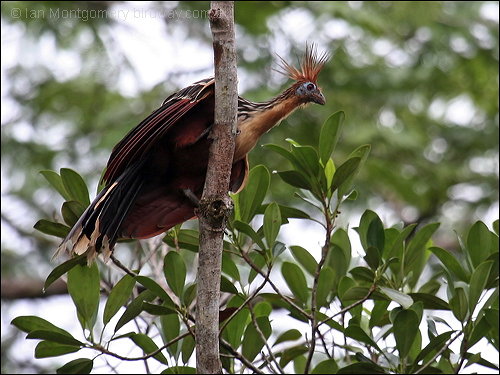
Hoatzin by Birdway’s Ian Montgomery
How do evolutionists explain this oddity? As one evolutionary scientist who has studied the Hoatzin for decades said, “Hoatzins don’t seem to follow the rules of evolution.” While he admitted to being creative in being able to come up with evolutionary explanations for creatures, he said that he was never able to arrive
at an evolutionary explanation for the Hoatzin’s digestive arrangement.
This leads us to glorify God for one more aspect of His creative work. In creating the Hoatzin, He was able to design a creature that defies any explanation humans might try to invent to deny that He is the Creator. Truly the creation declares His handiwork! (from Creation Moments, World’s Strangest Bird)
“The Hoatzin live in the backwater swamps of the Amazon and Orinco basins in South America.” They eat flowers, fruits, leaves of many marshland plants. The vegetable matter is fermented in their foregut like a cow, sheep, kangaroos and deer, while they sit around digesting their food.
“The Hoatzin chick features a rare anatomical feature — two claws on each budding wing which help it grip branches and clamber about awkwardly. This feature has been compared to Archaeopteryx, the fossil proto-bird, and lend a antediluvian background to what is already a really weird bird. Hoatzins live in family groups and small aggregations (up to 40 birds) and are social throughout the year.
During breeding birds occupy densely packed exclusive territories, sometimes up to 28 nests in one tree. They are noisy and often vocalize in unison with a collection of hoarse cries, grunts, growls and hisses. ” (from Hoatzin, Bird families of the World, see below)
Hoatzin by Ian
The birds are pheasant-sized at about 25 inches with a long neck and small head. It’s face is unfeathered with maroon eyes, and its head is topped by a spiky, rufous crest. The bird is also called “stickbird” because of the bird’s manure-like odor, caused by the digestive system.
Though conspicuous, even attractive, at close range due to its bizarre shape and striking colors, unwary and a poor flier, it is not considered endangered. In fact, its survival seems to be more assured than that of many other endemics of its range. In Brazil, tribal people sometimes collect the eggs for food, and the adults are occasionally hunted, but in general this is rare, as it is reputed to have a bad taste. While its preferred habitats, mangrove and riverine forest, are disappearing fast in some regions, it is less threatened than terra firme forest, which is the primary target for deforestation in the Amazon. The Hoatzin therefore remains fairly common in a large part of its range.
There are only two possible explanations for life:
Evolution-which states that life has evolved from simple forms of plants and animals into the more complex forms we find today.
Creation-Which states that God created the entire universe and all of the creatures on Earth fully formed and completely functional.
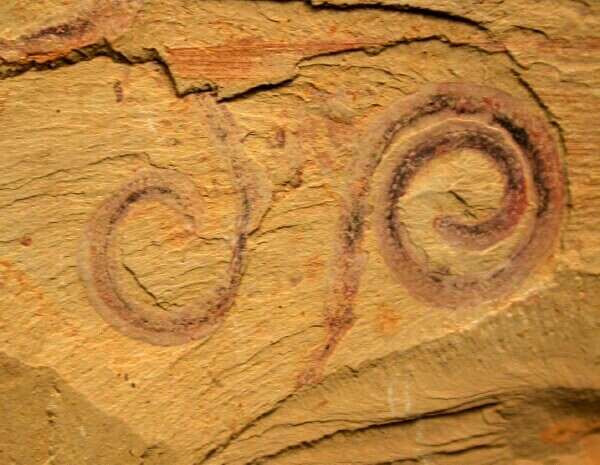
Paleontologists have found a greater variety of creatures in the fossil record than now exists, including soft-bodied creatures such as worms and jellyfish. However, even in the lowest rock layers, these worms and jellyfish are fully formed and easily categorized into the same kinds of animals alive today.
Maotianshania cylindrica found in China
If evolution is the correct explanation, then there should be thousands of intermediate forms as one type of creature slowly turned into another type. If creation is true, then the classifications of distinctly different types of animals, both living and in the fossil record, should remain essentially the same.
The fossil evidence clearly supports creation. True science progresses when all the evidence is presented.
Letting God Create Your Day, Vol.3, P.247
Casting down imaginations, and every high thing that exalteth itself against the knowledge of God, and bringing into captivity every thought to the obedience of Christ; (2Co 10:5 KJV)
“Evidence From The Fossil Record”, July 5, from A Closer Look at the Evidence, Richard and Tina Kleiss
It’s very rare to find the soft parts of the body preserved, Briggs said. “It has to be buried quickly,” he told LiveScience. “You have to get minerals forming and preserving the outline before the animal decays completely.”
That is exactly what a global flood would do.
Living Fossil, from Creation Wiki, has a great list of “Examples of Living Fossils.”
A recent “Creation Moments” article is worth reading.
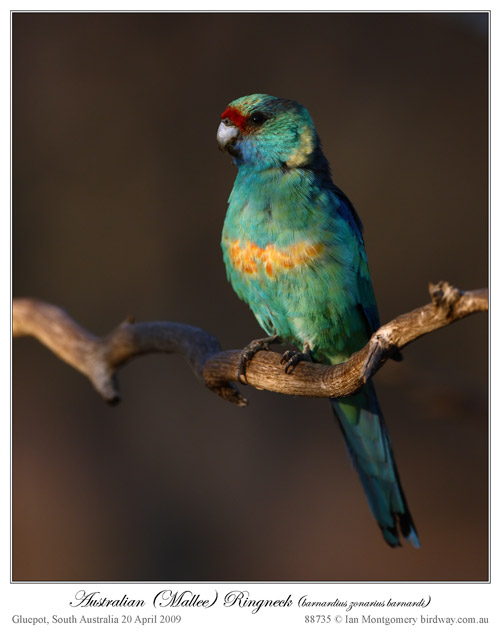
Australian Ringneck by Birdway
“Anyone who has seen the film Jurassic Park knows that evolutionists have been telling us that modern-day birds are descended from dinosaurs. Well, it looks like the scientists have recently changed their mind.
According to an article on the ScienceDaily website dated June 9, researchers at Oregon State University have made a fundamental new discovery about how birds breathe and have a lung capacity that allows for flight – and the finding means it’s unlikely that birds descended from any known theropod dinosaurs.
The article goes on to report that the conclusions add to other evolving evidence that may finally force many paleontologists to reconsider their long-held belief that modern birds are the direct descendants of ancient, meat-eating dinosaurs, OSU researchers say.
‘For one thing, birds are found earlier in the fossil record than the dinosaurs they are supposed to have descended from,” said OSU professor of zoology John Ruben. “That’s a pretty serious problem, and there are other inconsistencies with the bird-from-dinosaur theories.’…”
Here are some more quotes from the “Discovery Raises New Doubts About Dinosaur-bird Links:
“It’s been known for decades that the femur, or thigh bone in birds is largely fixed and makes birds into “knee runners,” unlike virtually all other land animals, the OSU experts say. What was just discovered, however, is that it’s this fixed position of bird bones and musculature that keeps their air-sac lung from collapsing when the bird inhales.”
“This is fundamental to bird physiology,” said Devon Quick, an OSU instructor of zoology who completed this work as part of her doctoral studies. “It’s really strange that no one realized this before. The position of the thigh bone and muscles in birds is critical to their lung function, which in turn is what gives them enough lung capacity for flight.”
“However, every other animal that has walked on land, the scientists said, has a moveable thigh bone that is involved in their motion – including humans, elephants, dogs, lizards and – in the ancient past – dinosaurs.”
“The implication, the researchers said, is that birds almost certainly did not descend from theropod dinosaurs, such as tyrannosaurus or allosaurus. The findings add to a growing body of evidence in the past two decades that challenge some of the most widely-held beliefs about animal evolution.”
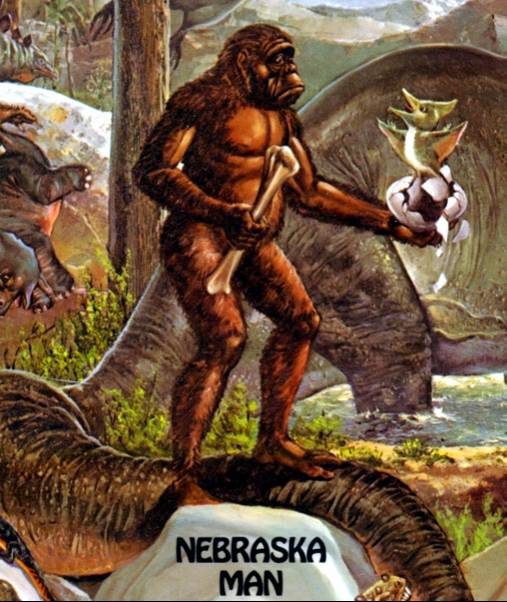
Although claims of ape-to-man links frequently make headlines, rarely is it even mentioned, as these claims invariably are proven false. One of many examples of the poor quality of evidence used to support evolution is the single tooth commonly known as Nebraska Man. This tooth was publicized a genuine “missing link” and was used as evidence during the famous 1925 Scopes “Monkey Trial” in Dayton, Tennessee. A vivid reconstruction was commissioned, based on the only evidence-a single tooth found in Nebraska and a few supposed tools. This was one of the main pieces of hard evidence used to swing public opinion in favor of evolution and riducule the biblical account of creation. Later excavations uncovered the rest of the remains and found that it was not the tooth of a man, an ape, or an ape-man. The new discovery did not receive the publicity it had received when it was presented as a missing link, leaving most people with the impression that an ape-to-man link had been found.
Nebraska Man
The single tooth, used mightily to shake the public’s confidence in the Word of God, actually turned out to be the tooth of an extinct wild pig.
Interestingly, every ape-to-man link used to support evolution during the Scopes Monkey Trial has since been debunked or withdrawn. Despite this lack of evidence, the dogma of evolution continues to be taught as if it were a fact of science.
The Illustrated Origins, Answer Book, P.36
O Timothy! Guard what was committed to your trust, avoiding the profane and idle babblings and contradictions of what is falsely called knowledge– (1Ti 6:20 NKJV)
“Evidence From Anthropology”, July 3, from A Closer Look at the Evidence, Richard and Tina Kleiss
Then He said to them, “Come away, all of you, to a quiet place, and rest awhile.” For there were many coming and going, so that they had no time even for meals. (Mar 6:31 WNT)
Duck Lake - Robbins AFB, GA
Dan and I have been on vacation, and are back now. Guess I will have to get busy and write some more articles. Between traveling and having computer problems that knocked me off the Internet, I haven’t been able to do much. Thanks to other’s articles and what few I could get up, we have kept things sort of running.
Zonkey at Creation Museum
We went to Indiana to visit family, the Creation Museum in Kentucky, then Ohio to visit a friend, and friends in Georgia. We were suppose to be “birdwatching” our way home, but the heat indexes were in the 100+ degree range. The birds were hiding and so were we. So, we came home four days early.
I “birdwatched” from the car as Dan drove us up and back. I did keep a list. On the way up, several birds that hit my fancy (because we don’t get to see them often) were: Swallow-tailed Kites, American Crows, Cardinals, Robins, Purple Martins, and a Red-tailed Hawk. On the way home – a Kestrel, lots of Eastern Meadowlarks, a Hairy and Downy Woodpeckers and Bluebirds at a park (Blue Lick Battlefield SRP in Kentucky)
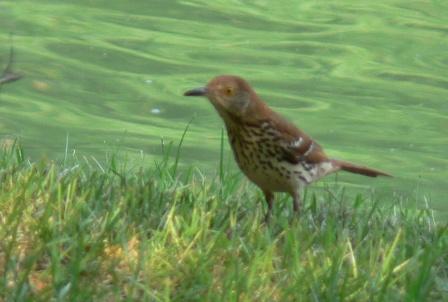
Brown Thrasher - Robbins AFB, GA
The best “birdwatching” we got to do was at Robbins AFB in Georgia. They have a Duck Lake where we were able to see the most birds. Here is what we saw or heard there on the 27th of June: Eastern Pewee, Hairy and a Downy Woodpecker, Mockingbirds, Cardinals, Carolina Wren, Blue Jays, White Breasted Nuthatch, Mourning Doves, Red-bellied Woodpecker, Tufted Titmouse, House Sparrows, Great Egret, Brown Thrasher, Brown Headed Cowbird, Red-headed Woodpecker, Little Blue Heron, Rock Pigeons, Brown Thrush, Cattle Egrets and several I am trying to ID. It is very wooded around the lake and made for great birding.