Welcome to the Updated Child’s Book of Water Birds, by Anonymous. It was written in 1855 and this is 2013. That is 158 years ago.
*
*
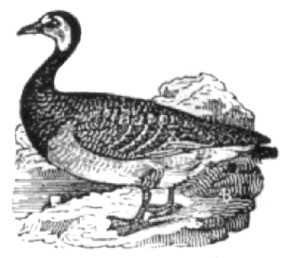
THE GOOSE.
The Goose is a very common bird. In Lincolnshire, England, enormous flocks are bred, containing from two to ten thousand each. They are subjected to the plucking of their wing-feathers periodically, in order to supply the demand for quills.
Today we use ballpoint pens and the Geese do not need to have their feathers plucked for quill pens. There are many Geese here in America and around the world. They belong to the Ducks, Geese & Swan Family. Many local parks have geese of various kinds. They are larger than Ducks, but smaller than Swans,
The female is called a “goose” and the male is the “gander.” Some of the kinds of geese are: Barnacle, Cackling, Canada, Emperor, Nene, Ross’s and the Snow Goose.
Many geese, like the Snow Goose, have their chicks in summer in the northern parts of America and then fly south in the winter. They gather in huge flocks.
*
Even the stork in the heavens knows her times, and the turtledove, swallow, and crane keep the time of their coming, but my people know not the rules of the LORD. (Jer 8:7 ESV)
Welcome to the Updated Child’s Book of Water Birds, by Anonymous. It was written in 1855 and this is 2013. That is 158 years ago.
*
*
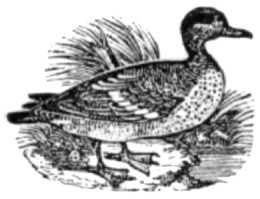
THE TEAL.
The Teal is the smallest of the ducks. The Green-winged Teal is the American. It feeds on fresh-water insects, seeds, and aquatic plants. When fat it is considered a great luxury. It is almost always seen on well furnished tables. It generally feeds at night. It flies very swiftly, and utters a whistling cry.
***
*
Male Green-winged Teal at Lowry Park Zoo, Tampa, FL
*
Update:
Thisdabbling duck (the Green-winged Teal) flies south in the winter and will form large flocks.
This is the smallest North American dabbling duck. The male has grey flanks and back, with a yellow rear end and a white-edged green feathers. It has a chestnut head with a green eye patch. a vertical white stripe on side of breast. The females are light brown.
Welcome to the Updated Child’s Book of Water Birds, by Anonymous. It was written in 1855 and this is 2013. That is 158 years ago.
*
*
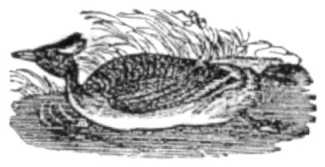
THE DABCHICK.
The Dabchick is a very timid bird, and when alarmed instantly dives, after which it is useless to look after the bird. It is easily domesticated, and is often seen placed as an ornament to ponds, where it swims about very merrily, and seems to enjoy a game of hide and seek with any one who is attempting to watch its movements.
*
Little Grebe (Tachybaptus ruficollis) by Nikhil Devasar
Update:
The Little Grebe (Tachybaptus ruficollis), also known as Dabchick, is a member of the Grebe family of water birds. At 9 to 11.4 in (23 to 29 cm) in length it is the smallest European member of its family. It is commonly found in open bodies of water across most of its range. Also, there is a New Zealand Grebe (Dabchick).
It is a small water bird with a pointed bill. In summer, the adult is dark above with its rich, rufous colour neck, cheeks and flanks (sides), and bright yellow gape (mouth). Non-breeding and juvenile birds are a dirty brownish grey.
It is an excellent swimmer and diver and chases its fish and aquatic prey underwater. It uses the vegetation skilfully as a hiding place. it nests at the water’s edge, since its legs are set very far back and it cannot walk well. The young leave the nest and can swim soon after hatching, and chicks are often carried on the backs of the swimming adults.
If a bird’s nest should chance to be before you in the way, in any tree or on the ground, with young ones or eggs, and the mother bird is sitting on the young or on the eggs, you shall not take the mother bird with the young. (Deu 22:6 AMP)
The Little Grebe’s breeding call, given singly or in duet, is a trilled repeated weet-weet-weet or wee-wee-wee which sounds like a horse whinnying.
Welcome to the Updated Child’s Book of Water Birds, by Anonymous. It was written in 1855 and this is 2013. That is 158 years ago.
*
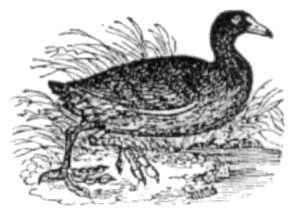
THE COOT.
The Coot is generally found in large sheets of water, particularly if shaded by trees. The nest is a mass of flags, reeds, and grass, usually at the water’s edge, but sometimes actually in the water. The Coot’s eggs are generally seven in number. They are of a greenish-white, spotted.
*
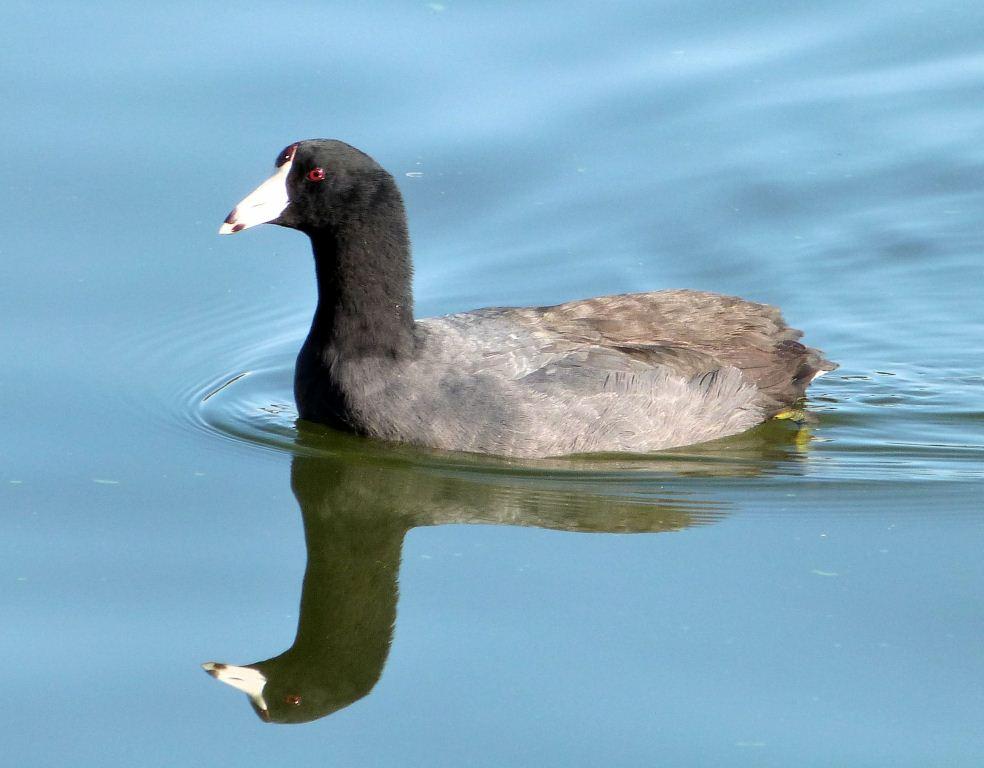
American Coot (Fulica americana) by Lee at Lk Morton
Update:
Coots are medium-sized birds that belong to the Raillidae – Rail Family. There are twelve (12) different Coots around the world.
They have mostly black feathers and can be seen swimming in open water. Coots have prominent frontal shields or other decoration on the forehead, with red to dark red eyes and coloured bills. Many, but not all, have white on the under tail.
Coots eat plants, eggs and some small animals. The defend their nest when they have babies. A group of Coots are called a “covert” or “cover.”
Like other rails, they have long, lobed toes that are well adapted to soft, uneven surfaces. Coots have strong legs and can walk and run fast. This video shows their feet.
Welcome to the Updated Child’s Book of Water Birds, by Anonymous. It was written in 1855 and this is 2013. That is 158 years ago.
*
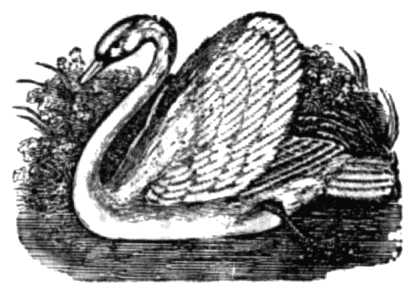
THE SWAN.
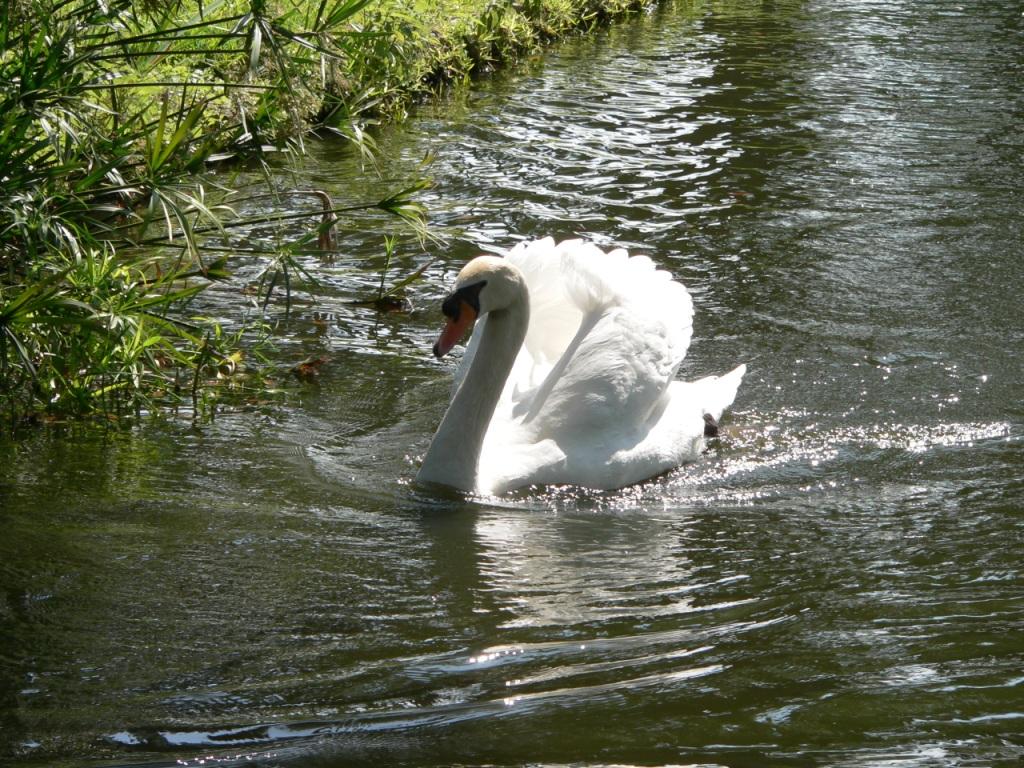
The Swan is a very beautiful bird. It is generally white, though a black swan has been discovered in Australia. It is not very often seen in this country. It was brought from Asia and Eastern Europe into England—from whence, most probably, a few specimens have been introduced into this country. The Swan is very graceful in the water, but on land it is an awkward waddler.
*
Swan at Bok Tower
Update:
Swans are the largest member of the Water Birds family Swans. They are also among the largest flying birds. Some Swans have a wingspan almost 10 ft (3 m).
A group of swans is called a bevy or a wedge in flight. Swans feed in the water and on land.
The nest is on the ground near water. Average egg size (for the mute swan) is 4.4 X 2.9 in (113×74 mm), weighing 11 oz (340 g), in a clutch size of 4 to 7. Swans are very protective of their nest.
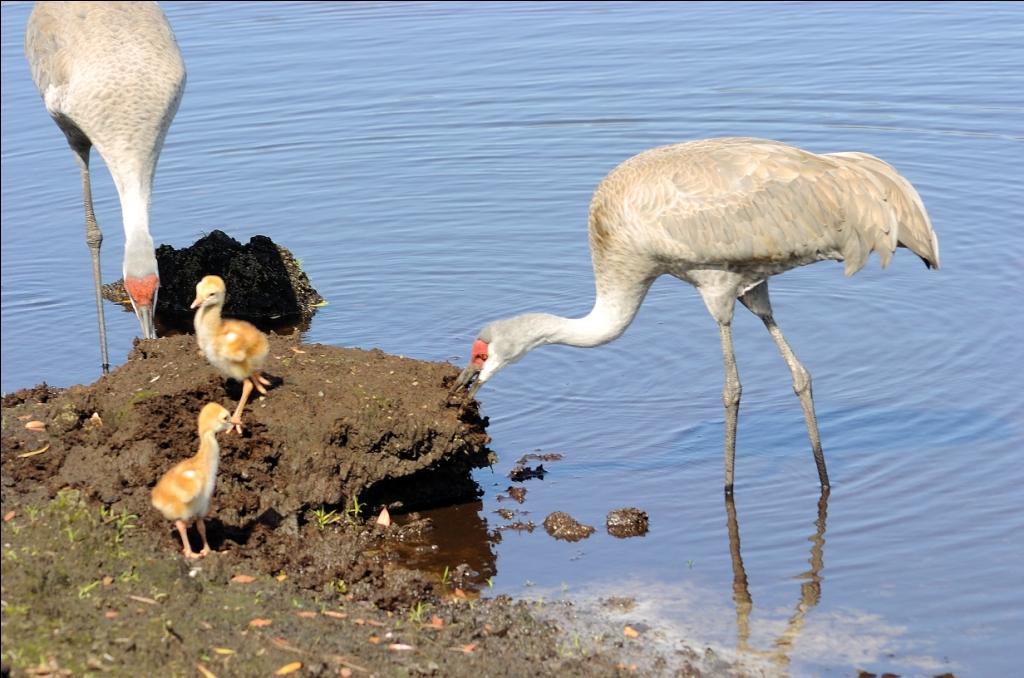
“Ah, Soul, God does listen to the chattering of cranes! I know He does, for I have read in His Word what is tantamount to that in the text [Isaiah 38:14],
Like a crane or a swallow, so did I chatter: I did mourn as a dove: mine eyes fail with looking upward: O LORD, I am oppressed; undertake for me. (Isaiah 38:14 KJV)
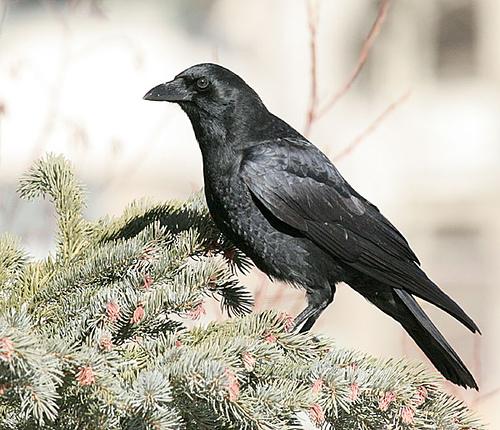
Northern Raven (Corvus corax) by Kent Nickell
“He hears the young ravens when they cry.”
And surely if He hears a raven’s cry and if not a sparrow falls to the ground without our Father, your prayer, though it may be very indistinct and the language, itself, may be very unworthy of the Divine ear, yet it shall command an audience and will bring down a blessing from above!”
Above is a quote from C. H. Spurgeon’s Notable Quotes: —Volume 61, Sermon #3468
Give ear to my words, O LORD, consider my meditation. Hearken unto the voice of my cry, my King, and my God: for unto thee will I pray. My voice shalt thou hear in the morning, O LORD; in the morning will I direct my prayer unto thee, and will look up. (Psalms 5:1-3 KJV)
This bird is found mostly in the southern states. Here he is known by the more common name of Turkey Buzzard.
He looks like a noble bird but he isn’t. While he is well fitted for flying, and might, if he tried, catch his prey, he prefers to eat dead animals.
The people down south never think of burying a dead horse or cow. They just drag it out away from their homes and leave it to the Vultures who are sure to dispose of it.
It is very seldom that they attack a live animal.
They will even visit the streets of the cities in search of dead animals for food, and do not show much fear of man. Oftentimes they are found among the chickens and ducks in the barn-yard, but have never been known to kill any.
One gentleman who has studied the habits of the Vulture says that it has been known to suck the eggs of Herons. This is not common, though. As I said they prefer dead animals for their food and even eat their own dead.
The Vulture is very graceful while on the wing. He sails along and you can hardly see his wings move as he circles about looking for food on the ground below.
Many people think the Vulture looks much like our tame turkey.
If you know of a turkey near by, just compare this picture with it and you won’t think so.
See how chalk-white his bill is. No feathers on his head, but a bright red skin.
What do you think of the young chick? It doesn’t seem as though he could ever be the large, heavy bird his parent seems to be.
Now turn back to the first page of July “Birds” and see how he differs from the Eagle.
THE TURKEY VULTURE
From col. F. M. Woodruff.
THE TURKEY VULTURE.
URKEY BUZZARD is the familiar name applied to this bird, on account of his remarkable resemblance to our common Turkey. This is the only respect however, in which they are alike. It inhabits the United States and British Provinces from the Atlantic to the Pacific, south through Central and most of South America. Every farmer knows it to be an industrious scavenger, devouring at all times the putrid or decomposing flesh of carcasses. They are found in flocks, not only flying and feeding in company, but resorting to the same spot to roost; nesting also in communities; depositing their eggs on the ground, on rocks, or in hollow logs and stumps, usually in thick woods or in a sycamore grove, in the bend or fork of a stream. The nest is frequently built in a tree, or in the cavity of a sycamore stump, though a favorite place for depositing the eggs is a little depression under a small bush or overhanging rock on a steep hillside.
Renowned naturalists have long argued that the Vulture does not have an extraordinary power of smell, but, according to Mr. Davie, an excellent authority, it has been proven by the most satisfactory experiments that the Turkey Buzzard does possess a keen sense of smell by which it can distinguish the odor of flesh at a great distance.
The flight of the Turkey Vulture is truly beautiful, and no landscape with its patches of green woods and grassy fields, is perfect without its dignified figure high in the air, moving round in circles, steady, graceful and easy, and apparently without effort. “It sails,” says Dr. Brewer, “with a steady, even motion, with wings just above the horizontal position, with their tips slightly raised, rises from the ground with a single bound, gives a few flaps of the wings, and then proceeds with its peculiar soaring flight, rising very high in the air.”
The Vulture pictured in the accompanying plate was obtained between the Brazos river and Matagorda bay. With it was found the Black Vulture, both nesting upon the ground. As the nearest trees were thirty or forty miles distant these Vultures were always found in this situation. The birds selected an open spot beneath a heavy growth of bushes, placing the eggs upon the bare ground. The old bird when approached would not attempt to leave the nest, and in the case of the young bird in the plate, the female to protect it from harm, promptly disgorged the putrid contents of her stomach, which was so offensive that the intruder had to close his nostrils with one hand while he reached for the young bird with the other.
The Turkey Vulture is a very silent bird, only uttering a hiss of defiance or warning to its neighbors when feeding, or a low gutteral croak of alarm when flying low overhead.
The services of the Vultures as scavengers in removing offal render them valuable, and almost a necessity in southern cities. If an animal is killed and left exposed to view, the bird is sure to find out the spot in a very short time, and to make its appearance as if called by some magic spell from the empty air.
“Never stoops the soaring Vulture
On his quarry in the desert,
On the sick or wounded bison,
But another Vulture, watching,
From his high aerial lookout,
Sees the downward plunge and follows;
And a third pursues the second,
Coming from the invisible ether,
First a speck, and then a Vulture,
Till the air is dark with pinions.”
Summary:
TURKEY VULTURE.—Catharista Atrata.
Range—Temperate America, from New Jersey southward to Patagonia.
Nest—In hollow stump or log, or on ground beneath bushes or palmettos.
Eggs—One to three; dull white, spotted and blotched with chocolate marking.
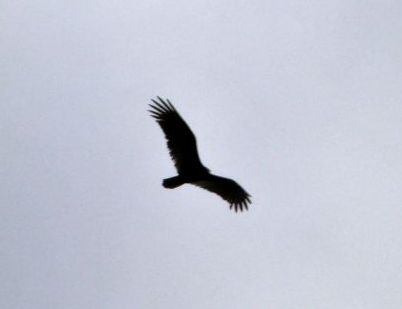
Turkey Vulture flying by – LPP
Lee’s Addition:
There is a path which no fowl knoweth, and which the vulture’s eye hath not seen: (Job 28:7 KJV)
We see Turkey and Black Vulture quite frequently here. I only disagree with one part of the article. “The Vulture is very graceful while on the wing. He sails along and you can hardly see his wings move as he circles about looking for food on the ground below.”
The way I distinguish the Turkey and Black Vultures apart is that the Black (BV) is steady on the wing, but the Turkey TV) is wobbly on the wing. They have a rocking motion, even when it is not windy. Another way to tell the two apart is the V of the Turkey and the flatter wings of the Black, who also has white on the tips of their wings.
The above article is the first article in the monthly serial that was started in January 1897 “designed to promote Knowledge of Bird-Live.” These include Color Photography, as they call them, today they are drawings. There are at least three Volumes that have been digitized by Project Gutenberg.
The Evening Grosbeak by Birds Illustrated by Bird Photography, 1897
THE EVENING GROSBEAK.
ANDSOMER birds there may be, but in the opinion of many this visitant to various portions of western North America is in shape, color, and markings one of the most exquisite of the feather-wearers. It has for its habitation the region extending from the plains to the Pacific ocean and from Mexico into British America. Toward the North it ranges further to the east; so that, while it appears to be not uncommon about Lake Superior, it has been reported as occuring in Ohio, New York, and Canada. In Illinois it was observed at Freeport during the winter of 1870 and 1871, and at Waukegan during January, 1873. It is a common resident of the forests of the State of Washington, and also of Oregon. In the latter region Dr. Merrill observed the birds carrying building material to a huge fir tree, but was unable to locate the nest, and the tree was practically inaccessable. Mr. Walter E. Bryant was the first to record an authentic nest and eggs of the Evening Grosbeak. In a paper read before the California Academy of Sciences he describes a nest of this species containing four eggs, found in Yolo county, California. The nest was built in a small live oak, at a height of ten feet, and was composed of small twigs supporting a thin layer of fibrous bark and a lining of horse hair. The eggs are of a clear greenish-ground color, blotched with pale brown. According to Mr. Davie, one of the leading authorities on North American birds, little if any more information has been obtained regarding the nests and eggs of the Evening Grosbeak.
As to its habits, Mr. O. P. Day says, that about the year 1872, while hunting during fine autumn weather in the woods about Eureka, Illinois, he fell in with a number of these Grosbeaks. They were feeding in the tree tops on the seeds of the sugar maple, just then ripening, and were excessively fat. They were very unsuspicious, and for a long time suffered him to observe them. They also ate the buds of the cottonwood tree in company with the Rose-Breasted Grosbeak.
The song of the Grosbeak is singularly like that of the Robin, and to one not thoroughly familiar with the notes of the latter a difference would not at first be detected. There is a very decided difference, however, and by repeatedly listening to both species in full voice it will be discovered more and more clearly. The sweet and gentle strains of music harmonize delightfully, and the concert they make is well worth the careful attention of the discriminating student. The value of such study will be admitted by all who know how little is known of the songsters. A gentleman recently said to us that one day in November the greater part of the football field at the south end of Lincoln Park was covered with Snow Birds. There were also on the field more than one hundred grammar and high school boys waiting the arrival of the football team. There was only one person present who paid any attention to the birds which were picking up the food, twittering, hopping, and flying about, and occasionally indulging in fights, and all utterly oblivious of the fact that there were scores of shouting school boys around and about them. The gentleman called the attention of one after another of ten of the high school boys to the snow birds and asked what they were. They one and all declared they were English Sparrows, and seemed astounded that any one could be so ignorant as not to know what an English Sparrow was. So much for the city-bred boy’s observation of birds.
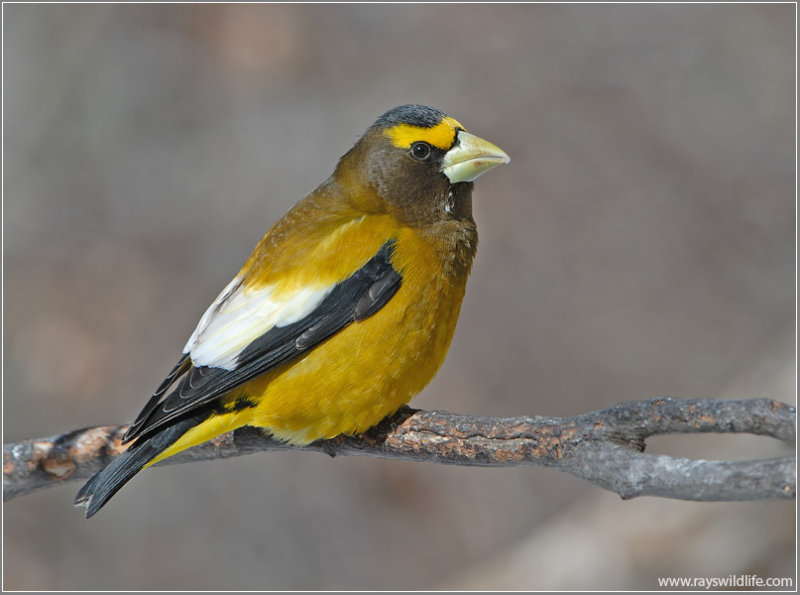
Evening Grosbeak (Hesperiphona vespertina) male by Raymond Barlow
THE EVENING GROSBEAK.
In the far Northwest we find this beautiful bird the year around. During the winter he often comes farther south in company with his cousin, the Rose-Breasted Grosbeak.
What a beautiful sight it must be to see a flock of these birds—Evening Grosbeaks and Rose-Breasted in their pretty plumage.
Grosbeaks belong to a family called Finches. The Sparrows, Buntings, and Crossbills belong to the same family. It is the largest family among birds.
You will notice that they all have stout bills. Their food is mostly grains and their bills are well formed to crush the seeds.
Look at your back numbers of “Birds” and notice the pictures of the other Finches I have named. Don’t you think Dame Nature is very generous with her colors sometimes?
Only a few days ago while strolling through the woods with my field glass, I saw a pretty sight. On one tree I saw a Redheaded Woodpecker, a Flicker, an Indigo Bunting, and a Rose-Breasted Grosbeak. I thought then, if we could only have the Evening Grosbeak our group of colors would be complete.
Have you ever wondered at some birds being so prettily dressed while others have such dull colors?
Some people say that the birds who do not sing must have bright feathers to make them attractive. We cannot believe this. Some of our bright colored birds are sweet singers, and surely many of our dull colored birds cannot sing very well.
Next month you will see the pictures of several home birds. See if dull colors have anything to do with sweet song.
Lee’s Addition:
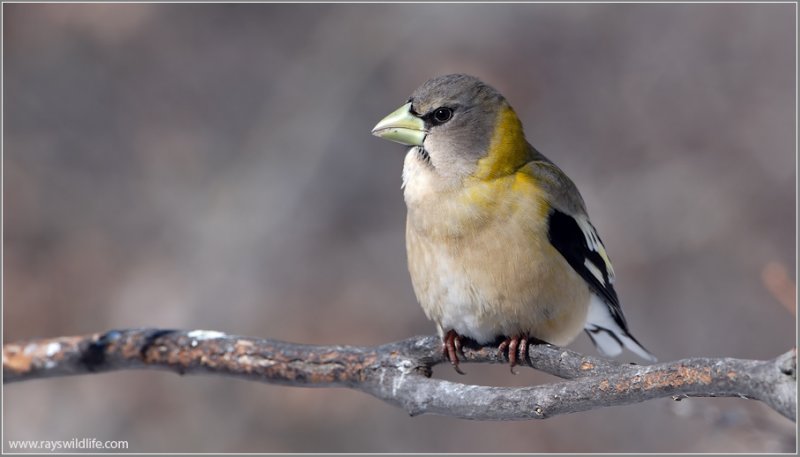
Evening Grosbeak (Hesperiphona vespertina) female by Raymond Barlow
By awesome deeds you answer us with righteousness, O God of our salvation, the hope of all the ends of the earth and of the farthest seas; the one who by his strength established the mountains, being girded with might; who stills the roaring of the seas, the roaring of their waves, the tumult of the peoples, so that those who dwell at the ends of the earth are in awe at your signs. You make the going out of the morning and the evening to shout for joy. (Psalms 65:5-8 ESV)
What a beautiful bird the Lord created in the Evening Grosbeak. The Grosbeaks are in the Cardinalidae – Grosbeaks, Saltators & Allies Family. There are 17 Grosbeaks in the family and are found in 9 genera. The Evening Grosbeak is in the
The Evening Grosbeak (Coccothraustes vespertinus) is a large finch. In the past, it was treated in a genus of its own as Hesperiphona vespertina, but is now usually placed in the same genus as the Hawfinch of Eurasia.
The breeding habitat is coniferous and mixed forest across Canada and the western mountainous areas of the United States and Mexico. It is an extremely rare vagrant to the British Isles, with just two records so far. The nest is built on a horizontal branch or in a fork of a tree.
The migration of this bird is variable; in some winters, it may wander as far south as the southern U.S.
The Evening Grosbeak is similar in appearance to the Eurasian Hawfinch, both being bulky, heavily built finches with large bills and short tails. The Evening Grosbeak ranges in length from 6.3 to 8.7 in (16 to 22 cm) in length and spans 12 to 14 in (30 to 36 cm) across the wings. In a large sampling of grosbeaks in Pennsylvania during winter, males weighed from 1.37 to 3.04 oz (38.7 to 86.1 g), with an average of 2.1 oz (60 g), while females weighed from 1.52 to 2.59 oz (43.2 to 73.5 g), with an average of 2.07 oz (58.7 g). The adult has a short black tail, black wings and a large pale bill. The adult male has a bright yellow forehead and body; its head is brown and there is a large white patch in the wing. The adult female is mainly olive-brown, greyer on the underparts and with white patches in the wings.
These birds forage in trees and bushes, sometimes on the ground. They mainly eat seeds, berries and insects. Outside of the nesting season they often feed in flocks. Sometimes, they will swallow fine gravel.
The range of this bird has expanded far to the east in historical times, possibly due to plantings of Manitoba maples and other maples and shrubs around farms and the availability of bird feeders in winter.
“Calls from a large flock visiting a feeder” – from xeno-canto
The above article is the first article in the monthly serial that was started in January 1897 “designed to promote Knowledge of Bird-Live.” These include Color Photography, as they call them, today they are drawings. There are at least three Volumes that have been digitized by Project Gutenberg.
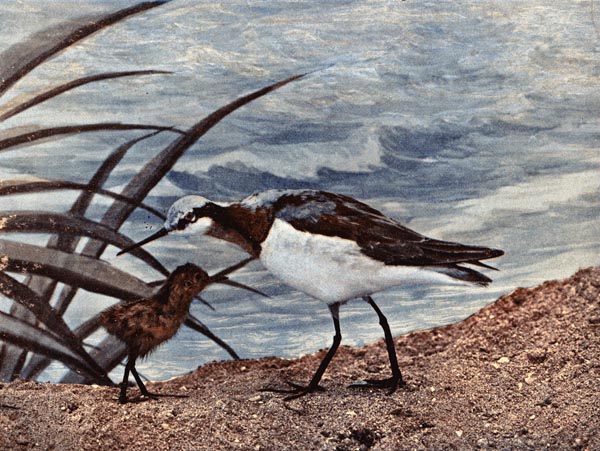
Wilson’s Phalarope for Birds Illustrated by Color Photography
WILSON’S PHALAROPE.
ERHAPS the most interesting, as it is certainly the most uncommon, characteristic of this species of birds is that the male relieves his mate from all domestic duties except the laying of the eggs. He usually chooses a thin tuft of grass on a level spot, but often in an open place concealed by only a few straggling blades. He scratches a shallow depression in the soft earth, lines it with a thin layer of fragments of old grass blades, upon which the eggs, three or four, are laid about the last of May or first of June. Owing to the low situation in which the nest is placed, the first set of eggs are often destroyed by a heavy fall of rain causing the water to rise so as to submerge the nest. The instinct of self preservation in these birds, as in many others, seems lacking in this respect. A second set, numbering two or three, is often deposited in a depression scratched in the ground, as at first, but with no sign of any lining.
Wilson’s Phalarope is exclusively an American bird, more common in the interior than along the sea coast. The older ornithologists knew little of it. It is now known to breed in northern Illinois, Iowa, Wisconsin, Minnesota, the Dakotas, Utah, and Oregon. It is recorded as a summer resident in northern Indiana and in western Kansas. Mr. E. W. Nelson states that it is the most common species in northern Illinois, frequenting grassy marshes and low prairies, and is not exceeded in numbers even by the ever-present Spotted Sandpiper. While it was one of our most common birds in the Calumet region it is now becoming scarce.
The adult female of this beautiful species is by far the handsomest of the small waders. The breeding plumage is much brighter and richer than that of the male, another peculiar characteristic, and the male alone possesses the naked abdomen. The female always remains near the nest while he is sitting, and shows great solicitude upon the approach of an intruder. The adults assume the winter plumage during July.
Wilson’s Phalarope (Phalaropus tricolor) by J Fenton
Lee’s Addition:
Out of the ground the LORD God formed every beast of the field and every bird of the air, and brought them to Adam to see what he would call them. And whatever Adam called each living creature, that was its name. So Adam gave names to all cattle, to the birds of the air, and to every beast of the field. But for Adam there was not found a helper comparable to him. (Genesis 2:19-20 NKJV)
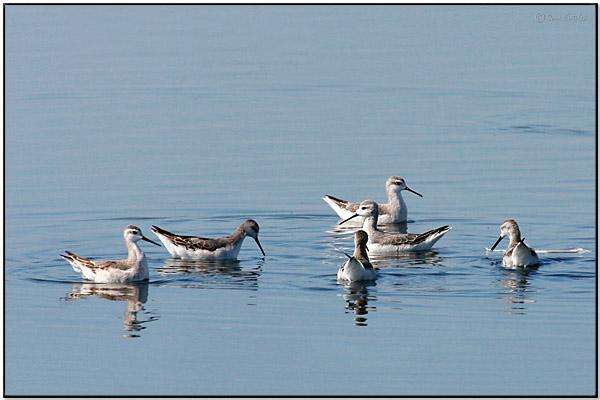
What another fantastically created bird. The Phalaropes belong to the Scolopacidae – Sandpipers, Snipes family. There are 96 species in the family, with 3 of those in the Phalaropus genus; the Wilson’s, Red-necked and Red Phalaropes. Phalarope are sometimes called “wadepipers.” They are especially notable for two things: their unusual nesting behavior (see above), and their unique feeding technique. When feeding, a phalarope will often swim in a small, rapid circle, forming a small whirlpool. This behavior is thought to aid feeding by raising food from the bottom of shallow water. The bird will reach into the center of the vortex with its bill, plucking small insects or crustaceans caught up therein.
The Wilson’s Phalarope, Phalaropus tricolor, is a small wader. This bird, the largest of the phalaropes, breeds in the prairies of North America in western Canada and the western United States. It is migratory, wintering around the central Andes in South America. They are passage migrants through Central America around March/April and again during September/October. The species is a rare vagrant to western Europe.
This species is often very tame and approachable. Its common name commemorates the American ornithologist Alexander Wilson. Sometimes, it is placed in a monotypic genus Steganopus.
Wilson’s Phalarope (Phalaropus tricolor) by Daves BirdingPix
Wilson’s Phalarope is slightly larger than the Red Phalarope at about 9.1 in (23 cm) in length. As are all 3 phalaropes, it is a unique, dainty shorebird with lobed toes and a straight fine black bill. The breeding female is predominantly gray and brown above, with white underparts, a reddish neck and reddish flank patches. The breeding male is a duller version of the female, with a brown back, and the reddish patches reduced or absent. In a study of breeding phalaropes in Saskatchewan Providence in Canada, females were found to average around 10% larger in standard measurements and to weigh around 30% more than the males. Females weighed from 68 to 79 g (2.4 to 2.8 oz), whereas the males average 1.83 oz (51.8 g).
Young birds are grey and brown above, with whitish underparts and a dark patch through the eye. In winter, the plumage is essentially grey above and white below, but the dark eyepatch is always present.
The above article is the first article in the monthly serial that was started in January 1897 “designed to promote Knowledge of Bird-Live.” These include Color Photography, as they call them, today they are drawings. There are at least three Volumes that have been digitized by Project Gutenberg.
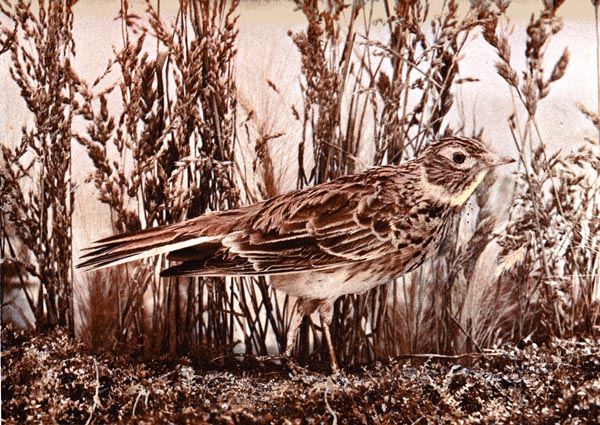
The Skylark – Birds Illustrated by Color Photography
From col. F. M. Woodruff.
THE SKYLARK.
This is not an American bird. I have allowed his picture to be taken and placed here because so many of our English friends desired it.
The skylark is probably the most noted of birds in Europe. He is found in all of the countries of Europe, but England seems to claim it. Here it stays during the summer, and goes south in the winter.
Like our own Meadow Lark, he likes best to stay in the fields. Here you will find it when not on the wing.
Early in the spring the Skylark begins his song, and he may be heard for most of the year.
Sometimes he sings while on the ground, but usually it is while he is soaring far above us.
Skylarks do not often seek the company of persons. There are some birds, you know, that seem happy only when they are near people. Of course, they are somewhat shy, but as a rule they prefer to be near people. While the Skylark does not seek to be near persons, yet it is not afraid of them.
A gentleman, while riding through the country, was surprised to see a Skylark perch on his saddle. When he tried to touch it, the Lark moved along on the horse’s back, and finally dropped under the horse’s feet. Here it seemed to hide. The rider, looking up, saw a hawk flying about. This explained the cause of the skylark’s strange actions.
A pair of these Larks had built their nest in a meadow. When the time came for mowing the grass, the little ones were not large enough to leave the nest. The mother bird laid herself flat on the ground, with her wings spread out. The father bird took one of the little ones from the nest and placed it on the mother’s back. She flew away, took the baby bird to a safe place, and came back for another.
This time the father took his turn. In this way they carried the little ones to a safe place before the mowers came.
Like our Meadow Lark, the Skylark builds her nest on the ground—never in bushes or trees. Usually it is built in a hole below the surface of the ground. It is for this reason that it is hard to find.
Then, too, the color of the nest is much like that of the ground.
Four or five eggs are usually laid, and in two weeks the little larks crack the shells, and come into the world crying for worms and bugs.
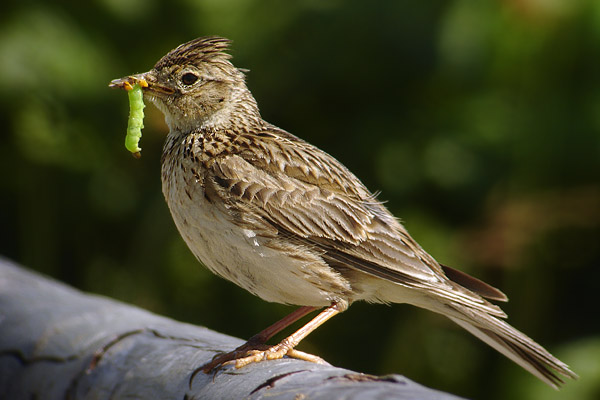
Eurasian Skylark (Alauda arvensis) by Ian
THE SKYLARK.
HE English Skylark has been more celebrated in poetry than any other song-bird. Shelley’s famous poem is too long to quote and too symmetrical to present in fragmentary form. It is almost as musical as the sweet singer itself.
“By the first streak of dawn,” says one familiar with the Skylark, “he bounds from the dripping herbage, and on fluttering wings mounts the air for a few feet ere giving forth his cheery notes. Then upward, apparently without effort he sails, sometimes drifting far away as he ascends, borne as it were by the ascending vapors, so easily he mounts the air. His notes are so pure and sweet, and yet so loud and varied withal, that when they first disturb the air of early morning all the other little feathered tenants of the fields and hedgerows seem irresistibly compelled to join him in filling the air with melody. Upwards, ever upwards, he mounts, until like a speck in the highest ether he appears motionless; yet still his notes are heard, lovely in their faintness, now gradually growing louder and louder as he descends, until within a few yards of the earth they cease, and he drops like a fragment hurled from above into the herbage, or flits about it for a short distance ere alighting.” The Lark sings just as richly on the ground as when on quivering wing. When in song he is said to be a good guide to the weather, for whenever we see him rise into the air, despite the gloomy looks of an overcast sky, fine weather is invariably at hand.
The nest is most frequently in the grass fields, sometimes amongst the young corn, or in places little frequented. It is made of dry grass and moss, and lined with fibrous roots and a little horse hair. The eggs, usually four or five in number, are dull white, spotted, clouded, and blotched over the entire surface with brownish green. The female Lark, says Dixon, like all ground birds, is a very close sitter, remaining faithful to her charge. She regains her nest by dropping to the ground a hundred yards or more from its concealment.
The food of the Lark is varied,—in spring and summer, insects and their larvae, and worms and slugs, in autumn and winter, seeds.
Olive Thorne Miller tells this pretty anecdote of a Skylark which she emancipated from a bird store: “I bought the skylark, though I did not want him. I spared no pains to make the stranger happy. I procured a beautiful sod of uncut fresh grass, of which he at once took possession, crouching or sitting low among the stems, and looking most bewitching. He seemed contented, and uttered no more that appealing cry, but he did not show much intelligence. His cage had a broad base behind which he delighted to hide, and for hours as I sat in the room I could see nothing of him, although I would hear him stirring about. If I rose from my seat he was instantly on the alert, and stretched his head up to look over at me. I tried to get a better view of him by hanging a small mirror at an angle over his cage, but he was so much frightened by it that I removed it.”
“This bird,” Mrs. Miller says “never seemed to know enough to go home. Even when very hungry he would stand before his wide open door, where one step would take him into his beloved grass thicket, and yet that one step he would not take. When his hunger became intolerable he ran around the room, circled about his cage, looking in, recognizing his food dishes, and trying eagerly to get between the wires to reach them; and yet when he came before the open door he would stand and gaze, but never go in. After five months’ trial, during which he displayed no particular intelligence, and never learned to enter his cage, he passed out of the bird room, but not into a store.”
Don’t be afraid, land; rejoice and be glad, for the LORD has done great things. Don’t be afraid, wild animals, for the wilderness pastures have turned green, the trees bear their fruit, and the fig tree and grapevine yield their riches. (Joel 2:21-22 HCSB)
The Eurasian Skylark (Alauda arvensis) is a small passerine bird species. This lark breeds across most of Europe and Asia and in the mountains of north Africa. It is mainly resident in the west of its range, but eastern populations are more migratory, moving further south in winter. Even in the milder west of its range, many birds move to lowlands and the coast in winter. Asian birds appear as vagrants in Alaska; this bird has also been introduced in Hawaii, western North America, eastern Australia and New Zealand.
The Eurasian Skylark is 16 to 18 centimetres long. It is a bird of open farmland and heath, known throughout its range for the song of the male, which is delivered in hovering flight from heights of 50 to 100 m, when the singing bird may appear as just a dot in the sky from the ground. The song generally lasts two to three minutes, but it tends to last longer later in the mating season. The male has broader wings than the female. This adaptation for more efficient hovering flight may have evolved because of female Eurasian Skylarks’ preference for males that sing and hover for longer periods and so demonstrate that they are likely to have good overall fitness.
Like most other larks, the Eurasian Skylark is a rather dull-looking species on the ground, being mainly brown above and paler below. It has a short blunt crest on the head, which can be raised and lowered. In flight it shows a short tail and short broad wings. The tail and the rear edge of the wings are edged with white, which are visible when the bird is flying away, but not if it is heading towards the observer. The Eurasian Skylark has sturdy legs and spends much time on the ground foraging for seeds, supplemented with insects in the breeding season.
The Eurasian Skylark makes a grass nest on the ground, hidden amongst vegetation. It is sometimes found nesting in bracken, using it for cover. Generally the nests are very difficult to find. Three to six eggs are laid in June. A second or third brood may be started later in the year. The eggs are yellow/white with brownish/purple spots mainly at the large end. (Wikipedia)
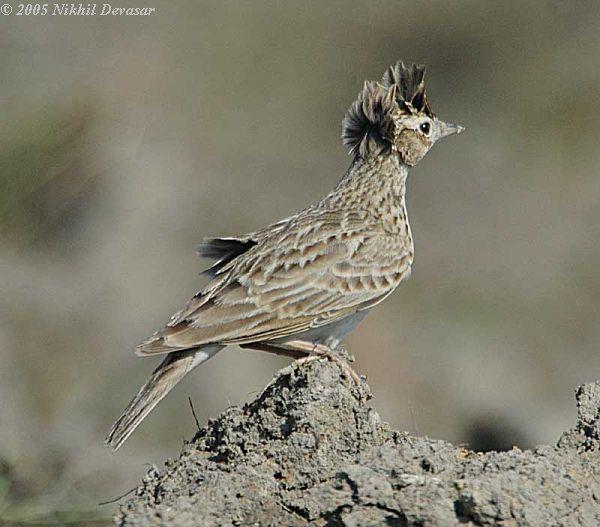
Oriental Skylark (Alauda gulgula) by Nikhil Devasar
There is also the Oriental Skylark (Alauda gulgula), also known as the Oriental Lark or Small Skylark, is a species of skylark found in the Indian Subcontinent and Southeast Asia. Like other skylarks, it is found in open grassland – often near waterbodies – where it feeds on seeds and insects.
These skylarks frequently rocket up into the sky, fluttering and singing before descending down to earth. Male Oriental Skylarks may also hover in the air and sing, in order to attract a mate.
Oriental Skylarks are about 16 cm long. They have streaked, yellow-brown upper plumage, with white outer tail feathers and a short crest. Both sexes are similar. (Wikipedia)
The above article is the first article in the monthly serial that was started in January 1897 “designed to promote Knowledge of Bird-Live.” These include Color Photography, as they call them, today they are drawings. There are at least three Volumes that have been digitized by Project Gutenberg.
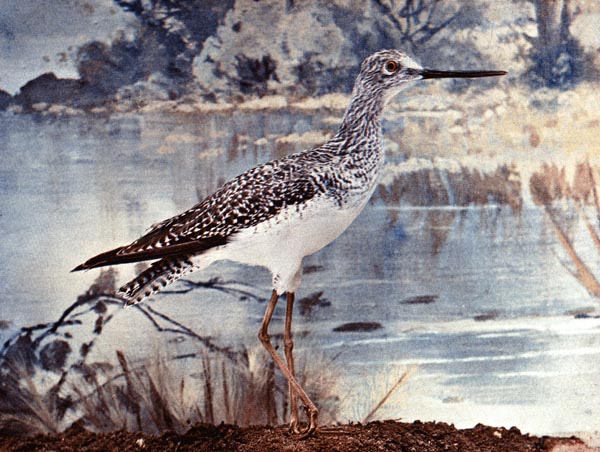
Lesser Yellow Legs for Birds Illustrated by Color Photography – From col. F. M. Woodruff.
THE YELLOW LEGS.
ELLOW LEGS, or Lesser Tell tale sometimes called Yellow-leg Snipe, and Little Cucu, inhabits the whole of North America, nesting in the cold temperate and subarctic districts of the northern continent, migrating south in winter to Argentine and Chili. It is much rarer in the western than eastern province of North America, and is only accidental in Europe. It is one of the wading birds, its food consisting of larvae of insects, small shell fish and the like.
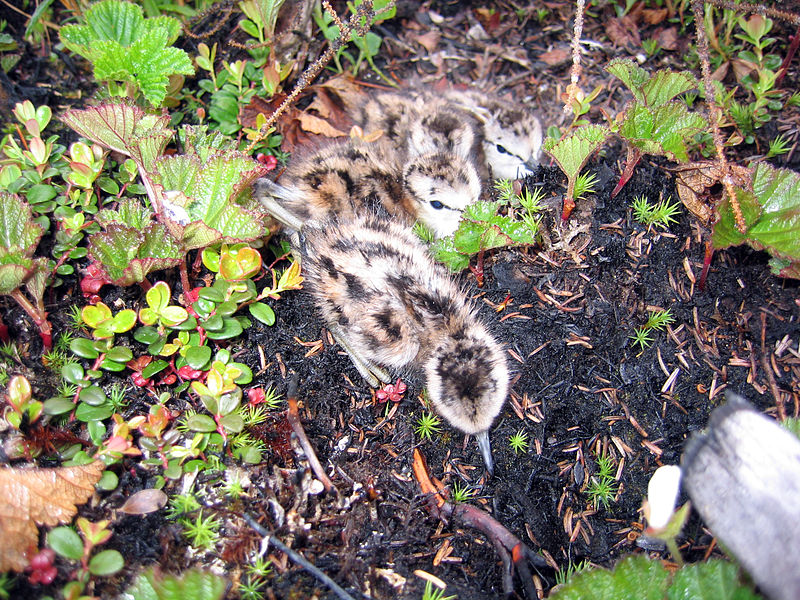
The nest of the Lesser Yellow Shanks, which it is sometimes called, is a mere depression in the ground, without any lining. Sometimes, however, it is placed at the foot of a bush, with a scanty lining of withered leaves. Four eggs of light drab, buffy or cream color, sometimes of light brown, are laid, and the breast of the female is found to be bare of feathers when engaged in rearing the young. The Lesser Yellow legs breeds in central Ohio and Illinois, where it is a regular summer resident, arriving about the middle of April, the larger portion of flocks passing north early in May and returning about the first of September to remain until the last of October.
A nest of this species of Snipe was found situated in a slight depression at the base of a small hillock near the border of a prairie slough near Evanston, Illinois, and was made of grass stems and blades. The color of the eggs in this instance was a deep grayish white, three of which were marked with spots of dark brown, and the fourth egg with spots and well defined blotches of a considerably lighter shade of the same.
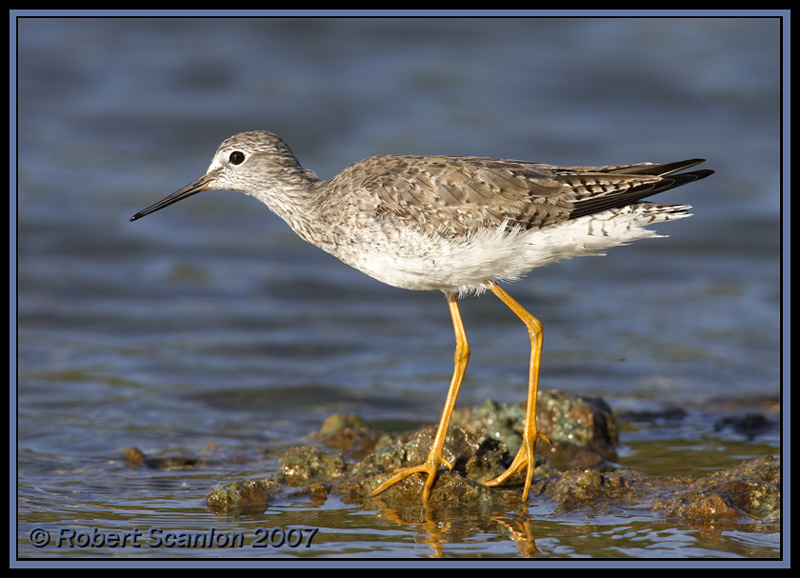
Lesser Yellowlegs (Tringa flavipes) by Robert Scanlon
Lee’s Addition:
If you come across a bird’s nest in any tree or on the ground, with young ones or eggs and the mother sitting on the young or on the eggs, you shall not take the mother with the young. (Deuteronomy 22:6 ESV)
The Yellowlegs belong to the Scolopacidae – Sandpipers, Snipes Family. There are 96 species in the family. The Tringa genus that they are placed in also has Redshanks, Greenshanks, Sandpipers, Tattlers, and the Willet.
The Lesser Yellowlegs (Tringa flavipes) is a medium-sized shorebird similar in appearance to the larger Greater Yellowlegs. It is not closely related to this bird, however, but instead to the much larger and quite dissimilar Willet: merely the fine, clear and dense pattern of the neck shown in breeding plumage indicates these species’ actual relationships.
Their breeding habitat is clearings near ponds in the boreal forest region from Alaska to Quebec. They nest on the ground, usually in open dry locations.
They migrate to the Gulf coast of the United States and south to South America.
This species is a regular vagrant to western Europe, and the odd bird has wintered in Great Britain.
These birds forage in shallow water, sometimes using their bill to stir up the water. They mainly eat insects, small fish and crustaceans.
The call of this bird is softer than that of the Greater Yellowlegs.
The above article is the first article in the monthly serial that was started in January 1897 “designed to promote Knowledge of Bird-Live.” These include Color Photography, as they call them, today they are drawings. There are at least three Volumes that have been digitized by Project Gutenberg.














 Lee's Birdwatching Adventures Plus