This is a repost of Heaven’s New Jerusalem and Birds – Sapphire. This series originally appeared in 2019. (With a little dusting and updating they will all be reposted in the coming days. Stay tuned.)
“And the foundations of the wall of the city were garnished with all manner of precious stones. The first foundation was jasper; the second, sapphire; the third, a chalcedony; the fourth, an emerald;” (Revelation 21:19 KJV)
For now, the first stone – “Jasper,” is being skipped. I am still researching what is the color or colors of the Jasper stone. Some have it all over the color spectrum. Also, there is no bird with the name “Jasper” in it. (Heaven’s New Jerusalem and Birds – Jasper II)
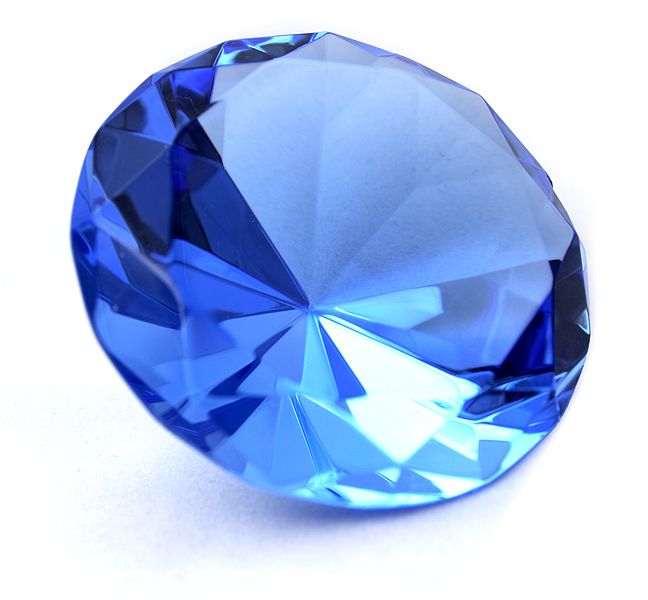
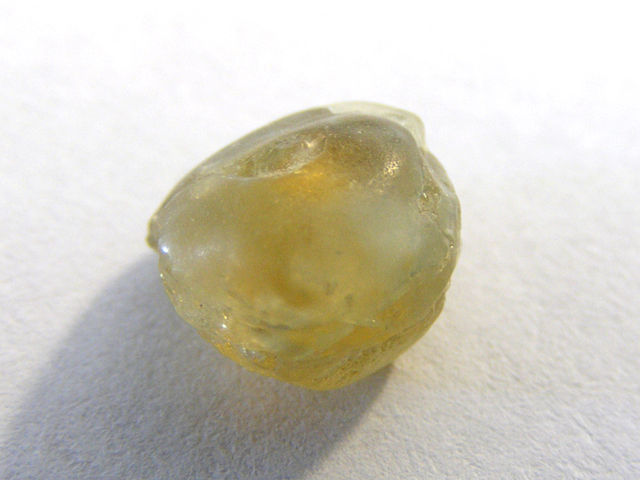
The Sapphire is beautiful and is typically blue but varies. Sapphire is also the stone used to represent those born in September. Yeah, my birth month. “Sapphire is the birthstone for September and the gem of the 45th anniversary. A sapphire jubilee occurs after 65 years.” [Wikipedia]
A rare variety of natural sapphire, known as color-change sapphire, exhibits different colors in different light. Color change sapphires are blue in outdoor light and purple under incandescent indoor light, or green to gray-green in daylight and pink to reddish-violet in incandescent light. Color change sapphires come from a variety of locations, including Thailand and Tanzania. The color-change effect is caused by the interaction of the sapphire, which absorbs specific wavelengths of light, and the light-source, whose spectral output varies depending upon the illuminant. Transition-metal impurities in the sapphire, such as chromium and vanadium, are responsible for the color change. [Wikipedia]
The sapphire is mentioned in nine verses in the King James version of the Bible.
“And they saw the God of Israel: and there was under his feet as it were a paved work of a sapphire stone, and as it were the body of heaven in his clearness.” (Exodus 24:10 KJV)
“And the second row shall be an emerald, a sapphire, and a diamond.” [The breastplate of judgment] (Exodus 28:18 and 39:11 KJV)
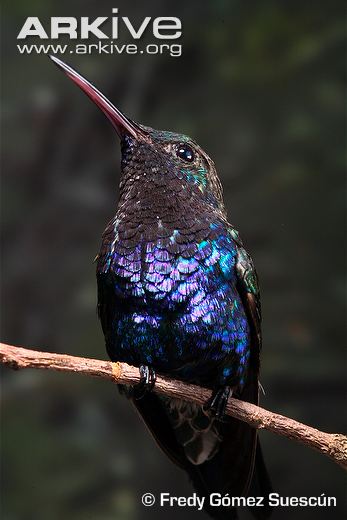
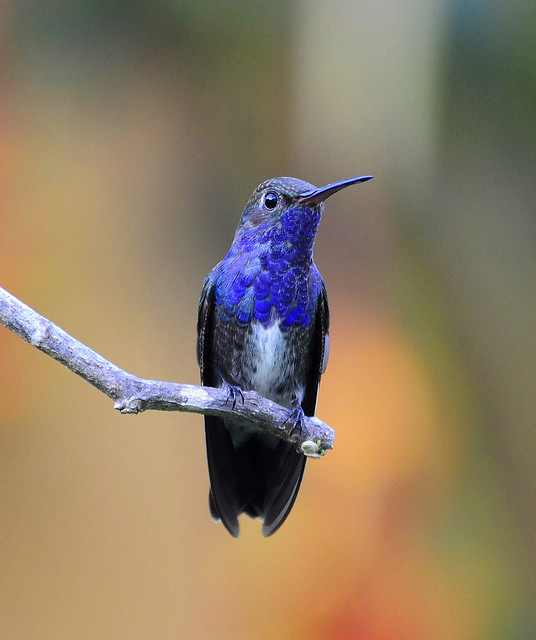
White-chinned Sapphire (Hylocharis cyanus) by Dario Sanches
“But where shall wisdom be found? and where is the place of understanding? Man knoweth not the price thereof; neither is it found in the land of the living. The depth saith, It is not in me: and the sea saith, It is not with me. It cannot be gotten for gold, neither shall silver be weighed for the price thereof. It cannot be valued with the gold of Ophir, with the precious onyx, or the sapphire.” (Job 28:12-16 KJV)
Unchanged:
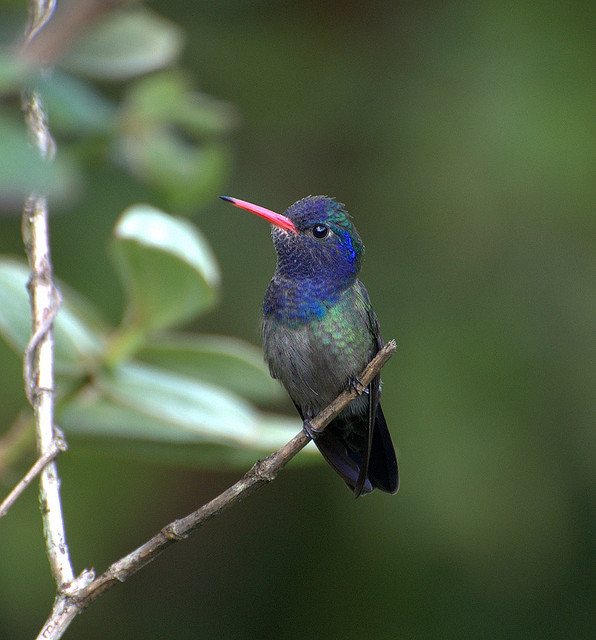
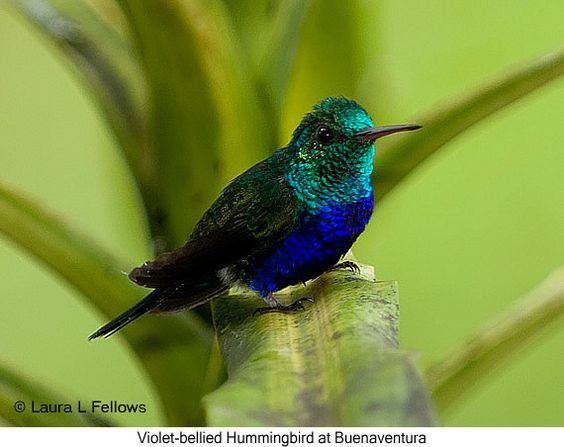
Sapphire-spangled Emerald (Amazilia lactea) by Dario Sanches
“And above the firmament that was over their heads was the likeness of a throne, as the appearance of a sapphire stone: and upon the likeness of the throne was the likeness as the appearance of a man above upon it.” (Ezekiel 1:26 KJV)
“Then I looked, and, behold, in the firmament that was above the head of the cherubims there appeared over them as it were a sapphire stone, as the appearance of the likeness of a throne.” (Ezekiel 10:1 KJV)
“Thou hast been in Eden the garden of God; every precious stone was thy covering, the sardius, topaz, and the diamond, the beryl, the onyx, and the jasper, the sapphire, the emerald, and the carbuncle, and gold: the workmanship of thy tabrets and of thy pipes was prepared in thee in the day that thou wast created.” (Ezekiel 28:13 KJV)
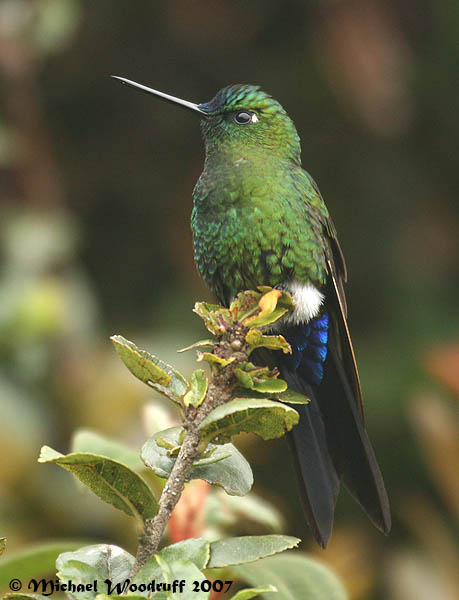
Sapphire-vented Puffleg (Eriocnemis luciani) by Michael Woodruff
I trust you enjoyed seeing some of the birds with Sapphire in their name as the various verses about sapphires were given.
Previous Blogs that used Verses with Sapphires in them:
This is a repost of Heaven’s New Jerusalem and Birds – Jasper. This series originally appeared in 2019. (With a little dusting and updating they will all be reposted in the coming days. Stay tuned.)
“And the foundations of the wall of the city were garnished with all manner of precious stones. The first foundation was jasper; the second, sapphire; the third, a chalcedony; the fourth, an emerald;” (KJV)
Hit a problem already. No Jasper named birds; first or last name. Now what? Most all the translations of Revelation 21:19 say that the first foundation was jasper or similar.
Here are a few exceptions from Bible Gateway’s list of versions:
the first foundation stone was diamond – CJB (Complete Jewish Bible)
“The first foundation was gray quartz” – GW, NOG (God’s Word & Names of God)
“The first stone was red jasper” – WE (Worldwide English)
Looking at the Dictionaries, these clues from them:
Thayer gives G2393 this:
ἴασπις
iaspis
Thayer Definition:
1) jasper, a precious stone of various colours (for some are purple, others blue, others green, and others the colour of brass)
Part of Speech: noun feminine
NASEC [New American Exhaustive Commentary]
G2393
ἴασπις
iaspis; of Semitic or.; jasper (a translucent stone): – jasper (4).
Strong LXX
G2393
ἴασπις
iaspis
ee’-as-pis
Probably of foreign origin (see [H3471]); “jasper”, a gem: – jasper.
H3471
ישׁפה
yâshphêh
yaw-shef-ay’
From an unused root meaning to polish; a gem supposed to be jasper (from the resemblance in name): – jasper.
The best clues from all of these seems to be from Thayer and NASEC. “It appears to be: a translucent stone”, and “a precious stone of various colours (for some are purple, others blue, others green, and others the colour of brass).” That could describe thousands of birds.
“Having the glory of God: and her light was like unto a stone most precious, even like a jasper stone, clear as crystal;” (Revelation 21:11 KJV)
Which birds do I show? See the Dilemma? Could use just about any multicolored bird.
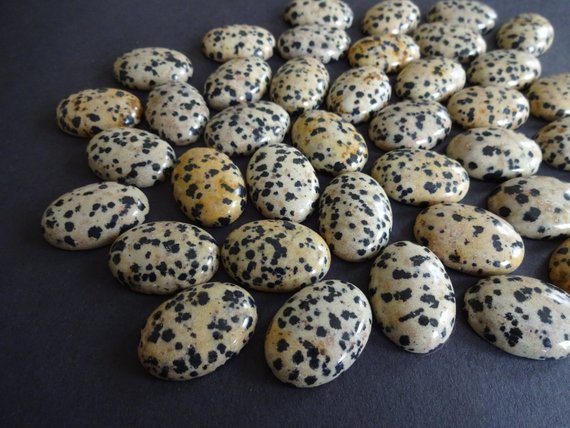
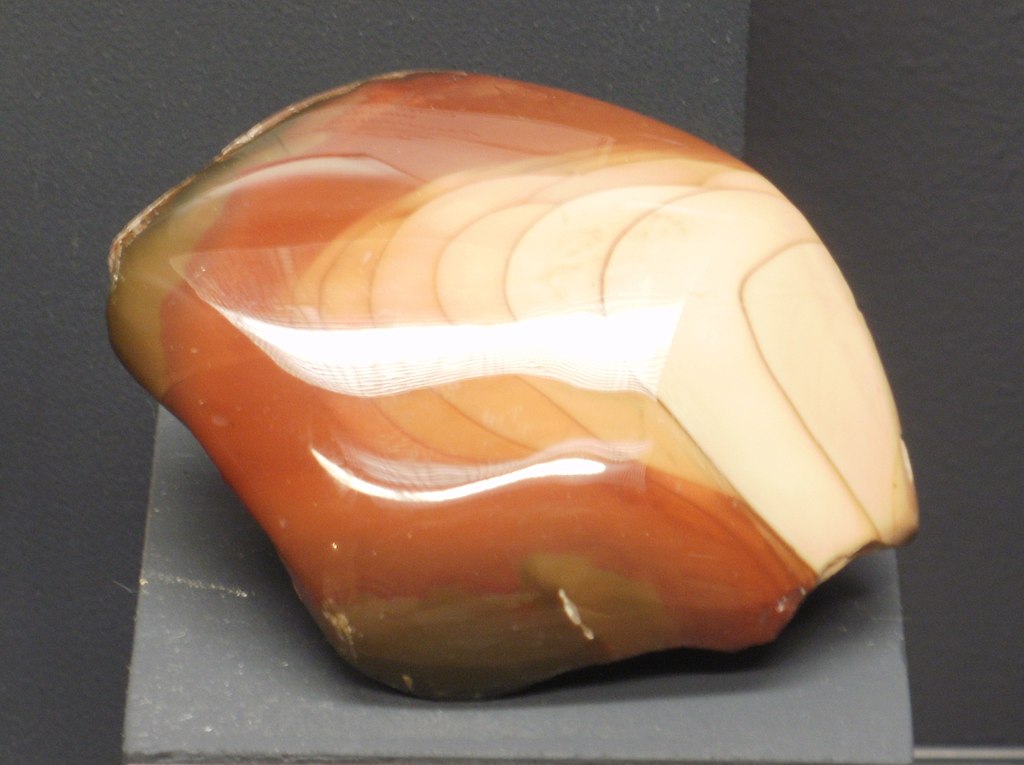
Looking on the internet, I found this: “THE GEMSTONE JASPER – Jasper is an opaque variety of Chalcedony, and is usually associated with brown, yellow, or reddish colors, but may be used to describe other opaque colors of Chalcedony such as dark or mottled green, orange, and black. Jasper is almost always multicolored, with unique color patterns and habits.
The appeal of Jasper is its interesting color patterns and formations. Though it can be a solid color, it is most often mottled, spotted, ringed, or striped. Each Jasper has a unique color or pattern, lending this gemstone much variety. Jasper is an ancient gemstone, and is mentioned in the bible and other classical sources. Though fairly common and affordable today, Jasper in antiquity was regarded as a valuable stone. “[Minerals Net]
That quote makes one think of how we are to the Lord. We are often “mottled, spotted, ringed, or striped.” We are in need of the Savior because we are sinners, but each of us are valuable to the Lord. He gave His life for us on the cross. “For God so loved the world, that he gave his only begotten Son, that whosoever believeth in him should not perish, but have everlasting life. For God sent not his Son into the world to condemn the world; but that the world through him might be saved. He that believeth on him is not condemned: but he that believeth not is condemned already, because he hath not believed in the name of the only begotten Son of God. And this is the condemnation, that light is come into the world, and men loved darkness rather than light, because their deeds were evil.” (John 3:16-19 KJV)
This is a repost of Introduction to the Heaven’s New Jerusalem and Birds. This series originally appeared in 2019. (With a little dusting and updating they will all be reposted in the coming days. Stay tuned.)
I am currently attending a ladies Bible study class on Heaven. It is very interesting, and of course, when the mention of the various precious stones, with their beautiful colors came up, birds fluttered to mind. I have been accused of having a “bird brain.” [Always thinking about things in relation to birds.]
A huge question came to mind. Wonder if I could find birds whose names or colors closely reflected the names of those stones? Sounds like a simple premise. Right? Not so fast, as I am finding out.
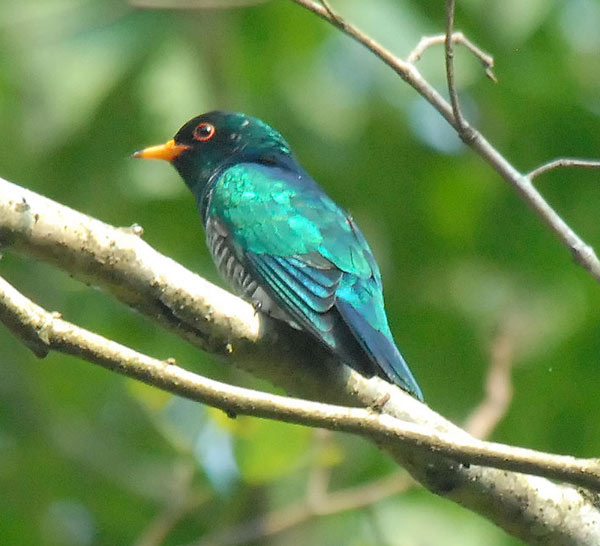
Asian Emerald Cuckoo (Chrysococcyx maculatus) by Nikhil Devasar
First some of the verses that we were reading from Revelation Chapter 21:
“10 And he carried me away in the spirit to a great and high mountain, and shewed me that great city, the holy Jerusalem, descending out of heaven from God, 18 And the building of the wall of it was of jasper: and the city was pure gold, like unto clear glass. 19 And the foundations of the wall of the city were garnished with all manner of precious stones. The first foundation was jasper; the second, sapphire; the third, a chalcedony; the fourth, an emerald; 20 The fifth, sardonyx; the sixth, sardius; the seventh, chrysolyte; the eighth, beryl; the ninth, a topaz; the tenth, a chrysoprasus; the eleventh, a jacinth; the twelfth, an amethyst.
21 And the twelve gates were twelve pearls: every several gate was of one pearl: and the street of the city was pure gold, as it were transparent glass. (KJV) [Yes, pearls are not stones]
Things go well with Gold, Jasper, Sapphire, Emerald, Topaz, Jacinth?, and Amethyst. What about chalcedony, sardonyx, sardius, chrysolyte, beryl [maybe], and chrysoprasus?
King James Study Bible 21:9–21. These verses describe the beauty and glory of the holy Jerusalem. It is called Christ’s bride (cf. v. 2), a reference perhaps to the church as the city’s principal inhabitant. It is an expression of the glory of God. The wall shows its security and protection. Its gates show accessibility. Saved Israel is also present. It has dimensions of approximately 1,500 miles cubed. The gold and precious stones may be earthly materials glorified (cf. 1 Cor. 15:50–54). They depict the glory, beauty, and eternal quality of the city. Jasper is green, sapphire is blue, chalcedonyis green, emerald is green, sardonyx is red and white, sardius is bloodred, chrysolyte is yellow or gold, beryl is green, topaz is greenish gold or yellow, chrysoprasus is green, jacinth is bluish purple, and amethyst is purple quartz. The effect is a magnificent city of brilliant gold adorned with gems of every color. There appears to be only one street (cf. 22:2), also made of pure, radiant gold.
Stones, Precious
“Precious stones are frequently alluded to in Scriptures; they were known and very highly valued in the earliest times. The Tyrians traded in precious stones supplied by Syria. Eze_27:16. The merchants of Sheba and Raamah in south Arabia, and , doubtless, India and Ceylon, supplied the markets of Tyre with various precious stones. The art of engraving on precious stones was known from the very earliest times. Gen_38:18.
The twelve stones of the breastplate were engraved, each one, with the name of one of the tribes. Exo_28:17-21. It is an undecided question whether the diamond was known to the early nations of antiquity. The Authorized Version gives it as the rendering of the Hebrew word, yahalom, but it is probable that the jasper is intended.
Precious stones are used in Scripture, in a figurative sense, to signify value, beauty durability, etc., in those objects with which they are compared. See Son_5:14; Isa_54:11-12; Lam_4:7; Rev_4:3; Rev_21:10; Rev_21:21. [Smith’s Bible Dictionary]
The Bible Knowledge Commentary says this of Revelation 21:19-21″
“The decorations of the foundations (with the apostles’ names inscribed on them) include 12 stones involving different colors. The color of the jasper is not indicated. The sapphire was probably blue; the chalcedony comes from Chalcedon, Turkey and is basically blue with stripes of other colors. The emerald is a bright green; the sardonyx is red and white; and the carnelian, called a “sardius” in the NASB, is usually ruby-red in color, though it sometimes has an amber or honey color. In Rev_4:3 the carnelian stone is coupled with the jasper to reflect the glory of God. The chrysolyte is a golden color, probably different from the modern chrysolyte stone which is pale green. The beryl is a sea green; the topaz is a transparent yellow-green; the chrysoprase is also green; the jacinth is violet in color; and the amethyst is purple. The stones together provide a brilliant array of beautiful colors. The gates resemble huge, single pearls, and the street of the city was of pure gold, like transparent glass (cf. Rev_21:18).
While the beauty of the city may have symbolic meaning, no clue is given as to the precise interpretation. Since it is reasonable to assume that the saints will dwell in the city, it is best to take the city as a literal future dwelling place of the saints and angels.”
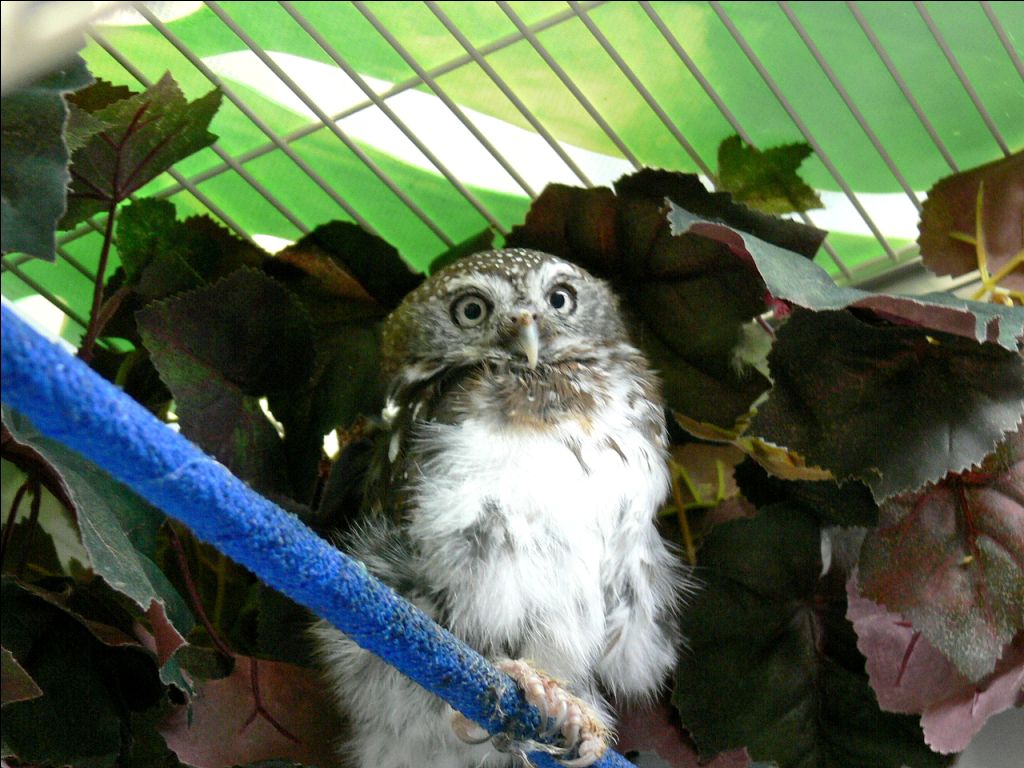
Pearl-spotted Owlet (Glaucidium perlatum) Breeding Room by Lee
As you can see, it is going to take a while to figure out some of these colors to find possible matching bird colors and names. A friend mentioned that the colors were maybe the same as the ones in the rainbow. Sounds reasonable. When the Lord created the birds, He knew about the rainbow that was going to be given as a promise after the flood. He also knew the colors of the foundations of the New Jerusalem. So, why would he not use those colors in birds when He created them?
“In the beginning was the Word, and the Word was with God, and the Word was God. The same was in the beginning with God. All things were made by him; and without him was not any thing made that was made.” (John 1:1-3 KJV)
This is a repost of the original that appeared on (February 22, 2019)
Precious Stone
“O LORD, our Lord, How majestic is Your name in all the earth!” (Psalms 8:9 NASB)
Before matching the bird’s colors to the Foundation Stones, here are some facts and photos to help us understand the colors of the twelve foundations, if that is possible with our human minds. If the stones are this beautiful now, what will they be like in heaven?
Very interesting article about The 12 Foundation Stones in New Jerusalem gives fact about these gems. “In the past century, it has been discovered that gems can be classified as either anisotropic or isotropic, and only recently have scientists discovered cross polarized light, which can be used to identify whether a gem is anisotropic or isotropic. When viewed in crossed-polarised light (similar to “pure” light), anisotropic stones produce a colourful array- reflecting all the colours of the rainbow, whereas isotropic stones lose all of their colour and appear black.”
There are some words in there that are new to me, like, anisotropic or isotropic, cross polarized light. Yet the next paragraph, is really informative:
“It’s interesting that, in Revelation chapter 21, there are 12 gems mentioned to be inlaid for decoration of the New Jerusalem, and ALL of these 12 gems are anisotropic gems, i.e., gems that can show colourful patterns under pure light…
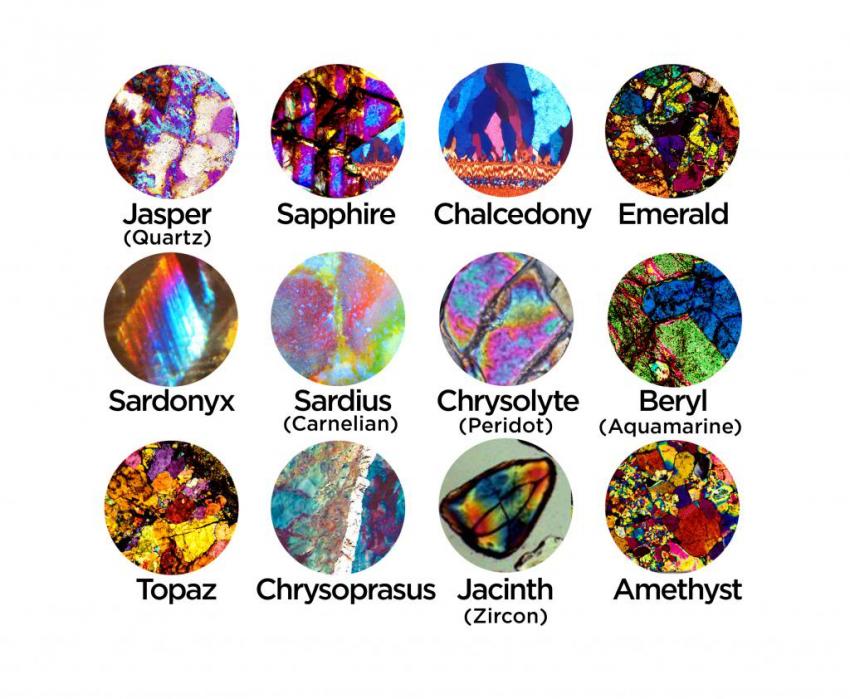
Twelve Stones of Revelation 21 from Christian Evidence
We normally think of the colors of these stones as:
Here is a video showing the colors of these stones. [music can be muted]
“And the building of the wall of it was of jasper: and the city was pure gold, like unto clear glass. And the foundations of the wall of the city were garnished with all manner of precious stones. The first foundation was jasper; the second, sapphire; the third, a chalcedony; the fourth, an emerald; The fifth, sardonyx; the sixth, sardius; the seventh, chrysolite; the eighth, beryl; the ninth, a topaz; the tenth, a chrysoprasus; the eleventh, a jacinth; the twelfth, an amethyst.” (Revelation 21:18-20 KJV)
I am aware that the seven colors of the rainbow are not necessarily the order of the foundation, but this article is also worth reading:
” O LORD, our Lord, How excellent is Your name in all the earth, Who have set Your glory above the heavens! Out of the mouth of babes and nursing infants You have ordained strength, Because of Your enemies, That You may silence the enemy and the avenger. When I consider Your heavens, the work of Your fingers, The moon and the stars, which You have ordained, What is man that You are mindful of him, And the son of man that You visit him? (5) For You have made him a little lower than the angels, And You have crowned him with glory and honor. (6) You have made him to have dominion over the works of Your hands; You have put all things under his feet, All sheep and oxen—Even the beasts of the field, The birds of the air, And the fish of the sea That pass through the paths of the seas. O LORD, our Lord, How excellent is Your name in all the earth!
When I was asked to do some articles about birds, way back in 2008, I never imagined that today, Lee’s Birdwatching Adventures (now with WordPress) would have:
2,513,166 visits as of today
3,857 articles posted
The Lord has truly blessed these efforts. But now? After prayer and much thought, A decision has been made!!
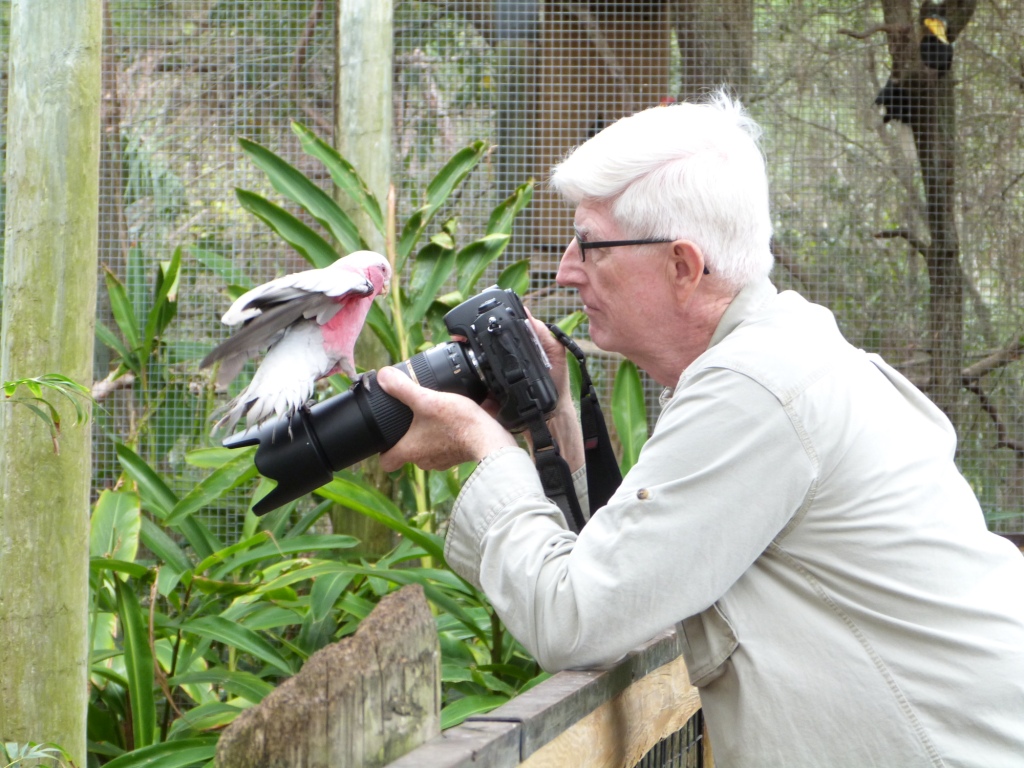
Galah (Eolophus roseicapilla) Hopping on Dan’s camera
LET’S CONTINE ON!!!!
I’ve paid the fees to continue. The Lord is about to allow me to turn 81 in a little over a week. Thank You Lord. We already have several great writers and photographer that can still add new articles here. The wealth of articles makes great resources for those seeking information about birds, especially home school students and others.
Golden Eagle and Dr Jim – Circle B by Lee
Dr. James J.S. Johnson from Institute for Creation Research,
William Wise a great photographer and writer, and
Golden Eagle, a.k.a. Dr. Baron Brown, are still birding.
ME?? I am planning to review and repost many of the great series of previous posts. I’ll check for broken link and missing photos.
In fact, tomorrow, the Heaven’s New Jerusalem and Birds – Foundation Stones series will begin. It’s one of my favorites.
Thank you for all the visits over the years and trust you’ll continue checking out these “oldies but goodies.” At my age, I forget things. :)
Praise the Lord for all these blessings that He has allowed us the share.
What were the names of first bird species listed in the Bible? (Genesis 8:7, 8)
If you checked these verses, you know that they were the Raven and the Dove. The Raven was released from the Ark first. It flew back and forth until the waters were abated or dried up. It does not say that Noah brought it back into the Ark. My imagination is that it landed on the ark but stayed outside.
While looking through several of the books I showed you in the first post, some interesting facts come to light:
The Raven’s feeding habits:
They are resourceful
They like plants and seeds
They eat carrion
If you imagine the total destruction that the worldwide flood caused, there would still be some things floating on the surface of the water. As the waters receded, the Raven would eventually not need to return to Noah or the Ark.
From All About Birds:
“Common Ravens will eat almost anything they can get hold of. They eat carrion; small animals from the size of mice and baby tortoises up to adult Rock Pigeons and nestling Great Blue Herons; eggs; grasshoppers, beetles, scorpions, and other arthropods; fish; wolf and sled-dog dung; grains, buds, and berries; pet food; and many types of human food including unattended picnic items and garbage.”
There are many links to the articles, facts, and photos about the Raven from previous post. Also, by typing in the Search,,, box on the right side of the page, you will find many more posts about Ravens.
The Birds of the Bible are why Lee’s Birdwatching Adventures Plus was started. Now, 16 years later, do you or I remember what was posted?
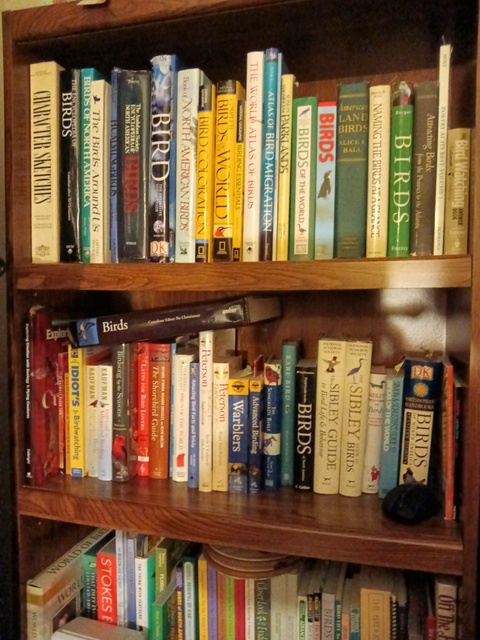
When we started this, we may have had one or two birdwatching books. Today, my bookshelves, at least three of them. have these books waiting on me to find new and interesting bird facts. I wonder what amazing information could be gleaned about God’s Creative Handiwork at work on the birds? Huh??
Bird Books in Library
We now have additional writers that would also be willing to contribute more articles. (I will invite them to join in this.)
When was the first bird created? (Genesis 1:20)
What day was that? (Genesis 1:23)
Who named the first birds? (Genesis 2:19)
What were the names of first bird species listed in the Bible? (Genesis 8:7, 8)
Did birds come from dinosaurs?
Do you know? Want to find out more? Leave me a comment. Stay tuned!
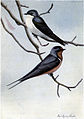
The Bank Swallow, the Kingfisher and the Sparrow Hawk.
The Burgess Bird Book For Children
Chapter 22
*
CHAPTER XXII. Some Feathered Diggers.
Peter Rabbit scampered along down one bank of the Laughing Brook,
eagerly watching for a high, gravelly bank such as Grandfather Frog had
said that Rattles the Kingfisher likes to make his home in. If Peter had
stopped to do a little thinking, he would have known that he was simply
wasting time. You see, the Laughing Brook was flowing through the Green
Meadows, so of course there would be no high, gravelly bank, because the
Green Meadows are low. But Peter Rabbit, in his usual heedless way, did
no thinking. He had seen Rattles fly down the Laughing Brook, and so he
had just taken it for granted that the home of Rattles must be somewhere
down there.
At last Peter reached the place where the Laughing Brook entered the
Big River. Of course, he hadn’t found the home of Rattles. But now he did
find something that for the time being made him quite forget Rattles and
his home. Just before it reached the Big River the Laughing Brook wound
through a swamp in which were many tall trees and a great number of
young trees. A great many big ferns grew there and were splendid to hide
under. Peter always did like that swamp.
Great Blue Herons. American Expedition
He had stopped to rest in a clump of ferns when he was startled by
seeing a great bird alight in a tree just a little way from him. His
first thought was that it was a Hawk, so you can imagine how surprised
and pleased he was to discover that it was Mrs. Longlegs. Somehow
Peter had always thought of Longlegs the Blue Heron as never alighting
anywhere except on the ground. But here was Mrs. Longlegs in a tree.
Having nothing to fear, Peter crept out from his hiding place that he
might see better.
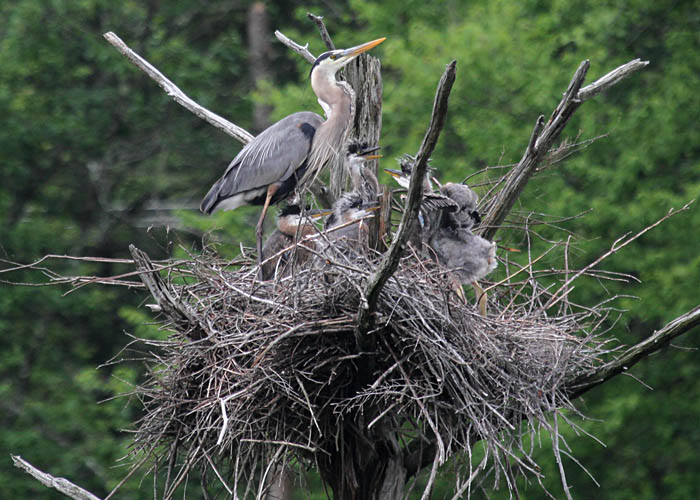
In the tree in which Mrs. Longlegs was perched and just below her he
saw a little platform of sticks. He didn’t suspect that it was a nest,
because it looked too rough and loosely put together to be a nest.
Probably he wouldn’t have thought about it at all had not Mrs. Longlegs
settled herself on it right while Peter was watching. It didn’t seem big
enough or strong enough to hold her, but it did.
Great Blue Heron-nest. Naturally-Curious Mary Holland
“As I live,” thought Peter, “I’ve found the nest of Longlegs! He and
Mrs. Longlegs may be good fishermen, but they certainly are mighty poor
nest-builders. I don’t see how under the sun Mrs. Longlegs ever gets on
and off that nest without kicking the eggs out.”
Peter sat around for a while, but as he didn’t care to let his presence
be known, and as there was no one to talk to, he presently made up his
mind that being so near the Big River he would go over there to see if
Plunger the Osprey was fishing again on this day.
When he reached the Big River, Plunger was not in sight. Peter was
disappointed. He had just about made up his mind to return the way he
had come, when from beyond the swamp, farther up the Big River, he heard
the harsh, rattling cry of Rattles the Kingfisher. It reminded him of
what he had come for, and he at once began to hurry in that direction.
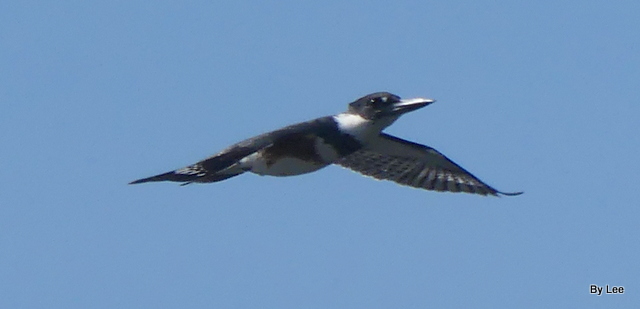
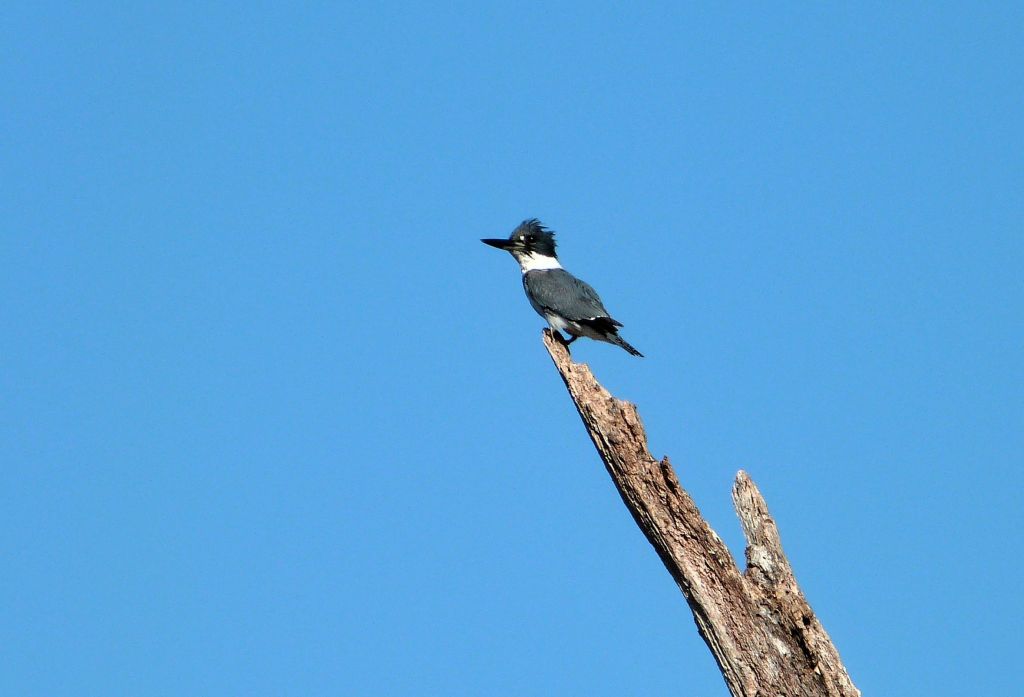
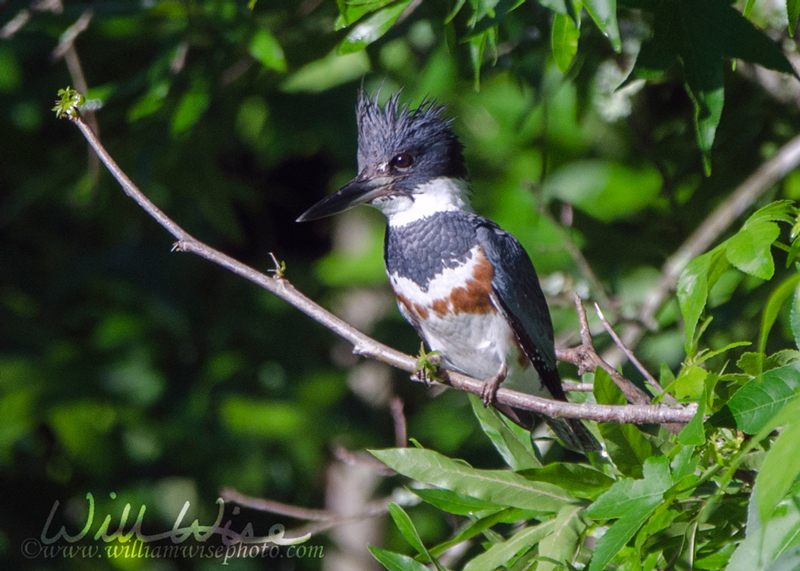
Belted Kingfisher at 11:24 am on 11/25/20 by Lee
Peter came out of the swamp on a little sandy beach. There he squatted
for a moment, blinking his eyes, for out there the sun was very bright.
Then a little way beyond him he discovered something that in his eager
curiosity made him quite forget that he was out in the open where it was
anything but safe for a Rabbit to be. What he saw was a high sandy bank.
With a hasty glance this way and that way to make sure that no enemy was
in sight, Peter scampered along the edge of the water till he was right
at the foot of that sandy bank. Then he squatted down and looked eagerly
for a hole such as he imagined Rattles the Kingfisher might make.
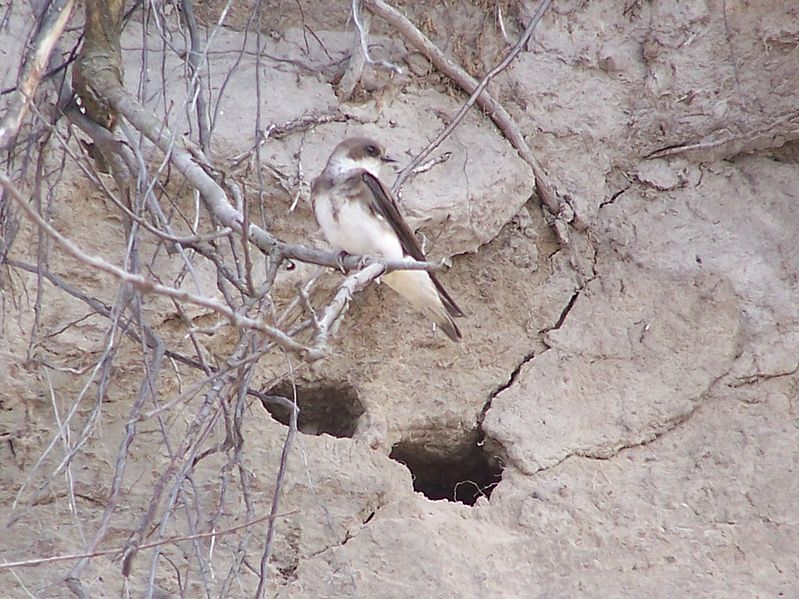
Instead of one hole he saw a lot of holes, but they were very small
holes. He knew right away that Rattles couldn’t possibly get in or out
of a single one of those holes. In fact, those holes in the bank were
no bigger than the holes Downy the Woodpecker makes in trees. Peter
couldn’t imagine who or what had made them.
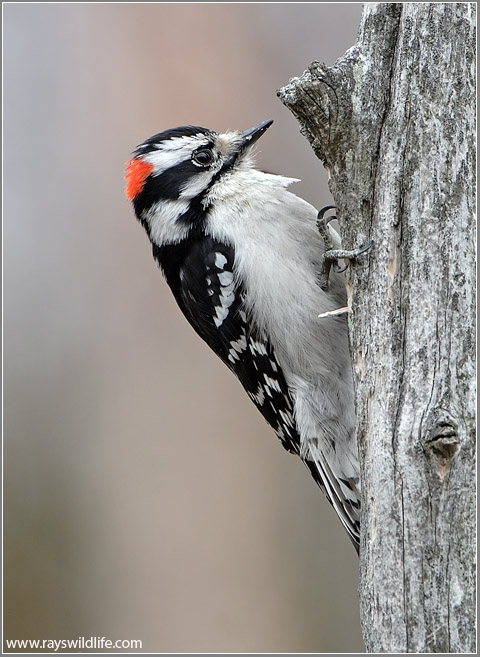
Downy Woodpecker (Picoides pubescens) by Raymond Barlow
As Peter sat there staring and wondering a trim little head appeared
at the entrance to one of those holes. It was a trim little head with a
very small bill and a snowy white throat. At first glance Peter thought
it was his old friend, Skimmer the Tree Swallow, and he was just on the
point of asking what under the sun Skimmer was doing in such a place as
that, when with a lively twitter of greeting the owner of that little
hole in the bank flew out and circled over Peter’s head. It wasn’t
Skimmer at all. It was Banker the Bank Swallow, own cousin to Skimmer
the Tree Swallow. Peter recognized him the instant he got a full view of
him.
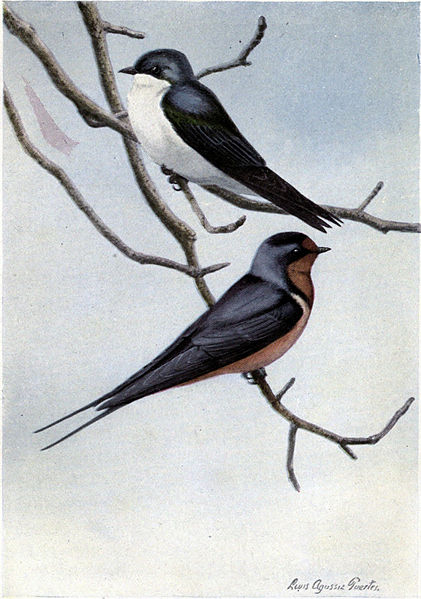
In the first place Banker was a little smaller than Skimmer. Then too,
he was not nearly so handsome. His back, instead of being that
beautiful rich steel-blue which makes Skimmer so handsome, was a sober
grayish-brown. He was a little darker on his wings and tail. His breast,
instead of being all snowy white, was crossed with a brownish band. His
tail was more nearly square across the end than is the case with other
members of the Swallow family.
“Wha–wha–what were you doing there?” stuttered Peter, his eyes popping
right out with curiosity and excitement.
“Why, that’s my home,” twittered Banker.
“Do–do–do you mean to say that you live in a hole in the ground?”
cried Peter.
“Certainly; why not?” twittered Banker as he snapped up a fly just over
Peter’s head.
“I don’t know any reason why you shouldn’t,” confessed Peter. “But
somehow it is hard for me to think of birds as living in holes in the
ground. I’ve only just found out that Rattles the Kingfisher does. But
I didn’t suppose there were any others. Did you make that hole yourself,
Banker?”
“Of course,” replied Banker. “That is, I helped make it. Mrs. Banker did
her share. ‘Way in at the end of it we’ve got the nicest little nest of
straw and feathers. What is more, we’ve got four white eggs in there,
and Mrs. Banker is sitting on them now.”
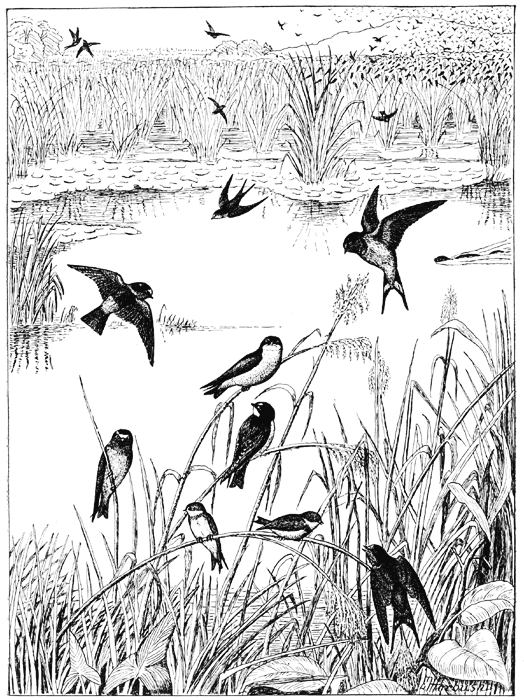
Swallow Friends – Burgess Book (Can be colored)
By this time the air seemed to be full of Banker’s friends, skimming and
circling this way and that, and going in and out of the little holes in
the bank.
“I am like my big cousin, Twitter the Purple Martin, fond of society,”
explained Banker. “We Bank Swallows like our homes close together. You
said that you had just learned that Rattles the Kingfisher has his home
in a bank. Do you know where it is?”
“No,” replied Peter. “I was looking for it when I discovered your home.
Can you tell me where it is?”
“I’ll do better than that;” replied Banker. “I’ll show you where it is.”
He darted some distance up along the bank and hovered for an instant
close to the top. Peter scampered over there and looked up. There, just
a few inches below the top, was another hole, a very much larger hole
than those he had just left. As he was staring up at it a head with a
long sharp bill and a crest which looked as if all the feathers on the
top of his head had been brushed the wrong way, was thrust out. It was
Rattles himself. He didn’t seem at all glad to see Peter. In fact, he
came out and darted at Peter angrily. Peter didn’t wait to feel that
sharp dagger-like bill. He took to his heels. He had seen what he
started out to find and he was quite content to go home.
Peter took a short cut across the Green Meadows. It took him past a
certain tall, dead tree. A sharp cry of “Kill-ee, kill-ee, kill-ee!”
caused Peter to look up just in time to see a trim, handsome bird whose
body was about the size of Sammy Jay’s but whose longer wings and longer
tail made him look bigger. One glance was enough to tell Peter that
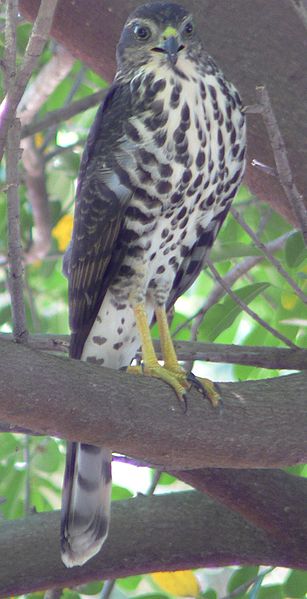
this was a member of the Hawk family, the smallest of the family. It was
Killy the Sparrow Hawk. He is too small for Peter to fear him, so now
Peter was possessed of nothing more than a very lively curiosity, and
sat up to watch.
Out over the meadow grass Killy sailed. Suddenly, with beating wings,
he kept himself in one place in the air and then dropped down into the
grass. He was up again in an instant, and Peter could see that he had a
fat grasshopper in his claws. Back to the top of the tall, dead tree
he flew and there ate the grasshopper. When it was finished, he sat up
straight and still, so still that he seemed a part of the tree itself.
With those wonderful eyes of his he was watching for another grasshopper
or for a careless Meadow Mouse.
Very trim and handsome was Killy. His back was reddish-brown crossed by
bars of black. His tail was reddish-brown with a band of black near
its end and a white tip. His wings were slaty-blue with little bars
of black, the longest feathers leaving white bars. Underneath he was a
beautiful buff, spotted with black. His head was bluish with a reddish
patch right on top. Before and behind each ear was a black mark. His
rather short bill, like the bills of all the rest of his family, was
hooked.
As Peter sat there admiring Killy, for he was handsome enough for any
one to admire, he noticed for the first time a hole high up in the trunk
of the tree, such a hole as Yellow Wing the Flicker might have made and
probably did make. Right away Peter remembered what Jenny Wren had
told him about Killy’s making his nest in just such a hole. “I wonder,”
thought Peter, “if that is Killy’s home.”
Just then Killy flew over and dropped in the grass just in front of
Peter, where he caught another fat grasshopper. “Is that your home up
there?” asked Peter hastily.
“It certainly is, Peter,” replied Killy. “This is the third summer Mrs.
Killy and I have had our home there.”
“You seem to be very fond of grasshoppers,” Peter ventured.
“I am,” replied Killy. “They are very fine eating when one can get
enough of them.”
“Are they the only kind of food you eat?” ventured Peter.
Killy laughed. It was a shrill laugh. “I should say not,” said he. “I
eat spiders and worms and all sorts of insects big enough to give a
fellow a decent bite. But for real good eating give me a fat Meadow
Mouse. I don’t object to a Sparrow or some other small bird now and
then, especially when I have a family of hungry youngsters to feed. But
take it the season through, I live mostly on grasshoppers and insects
and Meadow Mice. I do a lot of good in this world, I’d have you know.”
Peter said that he supposed that this was so, but all the time he
kept thinking what a pity it was that Killy ever killed his feathered
neighbors. As soon as he conveniently could he politely bade Killy
good-by and hurried home to the dear Old Briar-patch, there to think
over how queer it seemed that a member of the hawk family should nest
in a hollow tree and a member of the Swallow family should dig a hole in
the ground.
*** Bold points for questions at the bottom or for Christian traits.
A man who has friends must himself be friendly, But there is a friend who sticks closer than a brother.
(Proverbs 18:24 NKJV)
So God created great sea creatures and every living thing that moves, with which the waters abounded, according to their kind, and every winged bird according to its kind. And God saw that it was good.
(Genesis 1:21 NKJV)
“And every living substance was destroyed which was upon the face of the ground, both man, and cattle, and the creeping things, and the fowl of the heaven;.” Genesis 7:23a
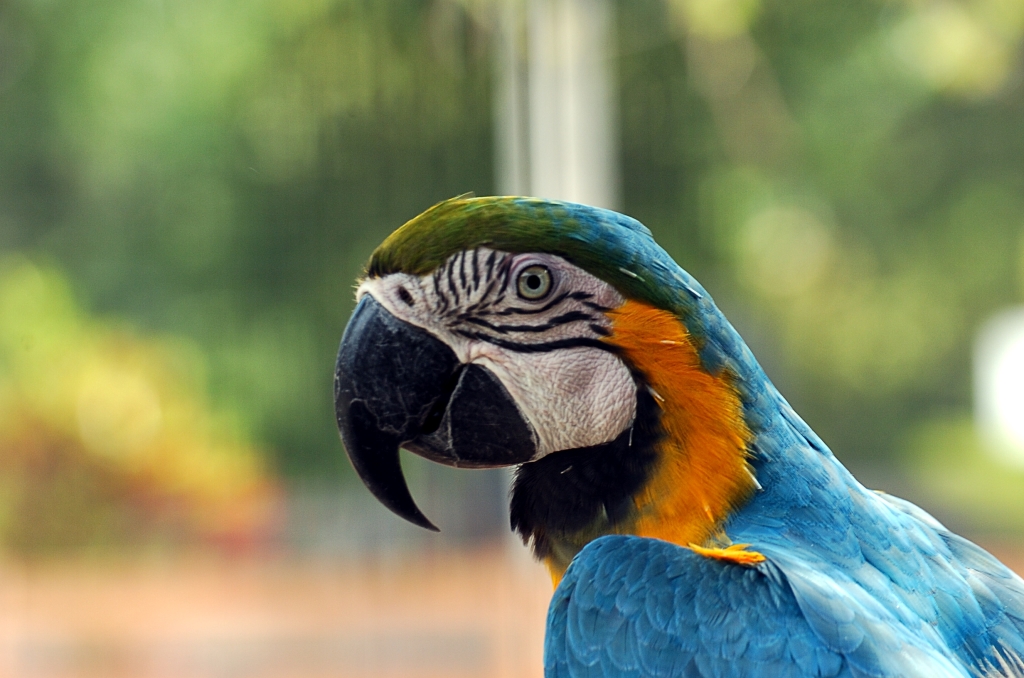
According to evolution theory, birds should not have been around at the time of the dinosaurs. This is especially true of the parrot, which is supposed, by those who believe in evolution, to be a more highly-evolved bird.
A fossilized parrot’s beak was dug up 40 years ago, but ignored. It was recently rediscovered at the University of California, Berkeley, by a graduate student. The problem, for evolutionists, is that they date the rock in which the beak was found as coming from the Cretaceous period when the dinosaurs lived and birds had not yet evolved. X‑ray study of the fossilized beak shows that the beak has the same blood vessel and nerve channels as a modern parrot. But it is not just one parrot’s beak that has been found in rocks from the age of dinosaurs. Loons, frigate‑birds and other shore bird fossils have also been found in rock that was supposedly laid down during the time of the dinosaurs!
Fossils are remains of living things rapidly buried, we believe, at the time of the Genesis Flood. However, it is perhaps not too surprising that bird fossils and dinosaur fossils are generally not found together; indeed, bird fossils in any part of the earth’s strata are extremely rare. This is because while dinosaur bones are very robust, bird bones and beaks are extremely fragile and would not have survived the turmoil of the Genesis Flood. The very few that have been fossilized tell us of very rapid and deep burial that would be expected during the Biblical Flood.
Prayer: I thank You, Lord, for making Your Word trustworthy in everything. Amen.
Belted Kingfisher (Megaceryle alcyon) by Lee Circle B
A Fishing Party
The Great Blue Heron and the Kingfisher.
The Burgess Bird Book For Children
Chapter 21
Listen to the story read.
A Fishing Party.
Peter Rabbit sat on the edge of the Old Briar-patch trying to make up
his mind whether to stay at home, which was the wise and proper thing
to do, or to go call on some of the friends he had not yet visited. A
sharp, harsh rattle caused him to look up to see a bird about a third
larger than Welcome Robin, and with a head out of all proportion to
the size of his body. He was flying straight towards the Smiling Pool,
rattling harshly as he flew. The mere sound of his voice settled the
matter for Peter. “It’s Rattles the Kingfisher,” he cried. “I think I’ll
run over to the Smiling Pool and pay him my respects.”
Belted Kingfisher on 11/25/20 by Lee
So Peter started for the Smiling Pool as fast as his long legs could
take him, lipperty-lipperty-lip. He had lost sight of Rattles the
Kingfisher, and when he reached the back of the Smiling Pool he was in
doubt which way to turn. It was very early in the morning and there was
not so much as a ripple on the surface of the Smiling Pool. As Peter sat
there trying to make up his mind which way to go, he saw coming from the
direction of the Big River a great, broad-winged bird, flying slowly. He
seemed to have no neck at all, but carried straight out behind him were
two long legs.
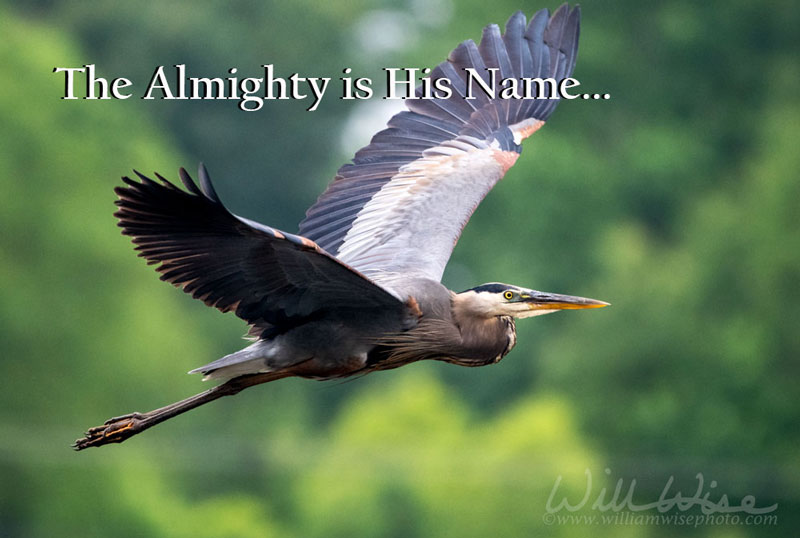
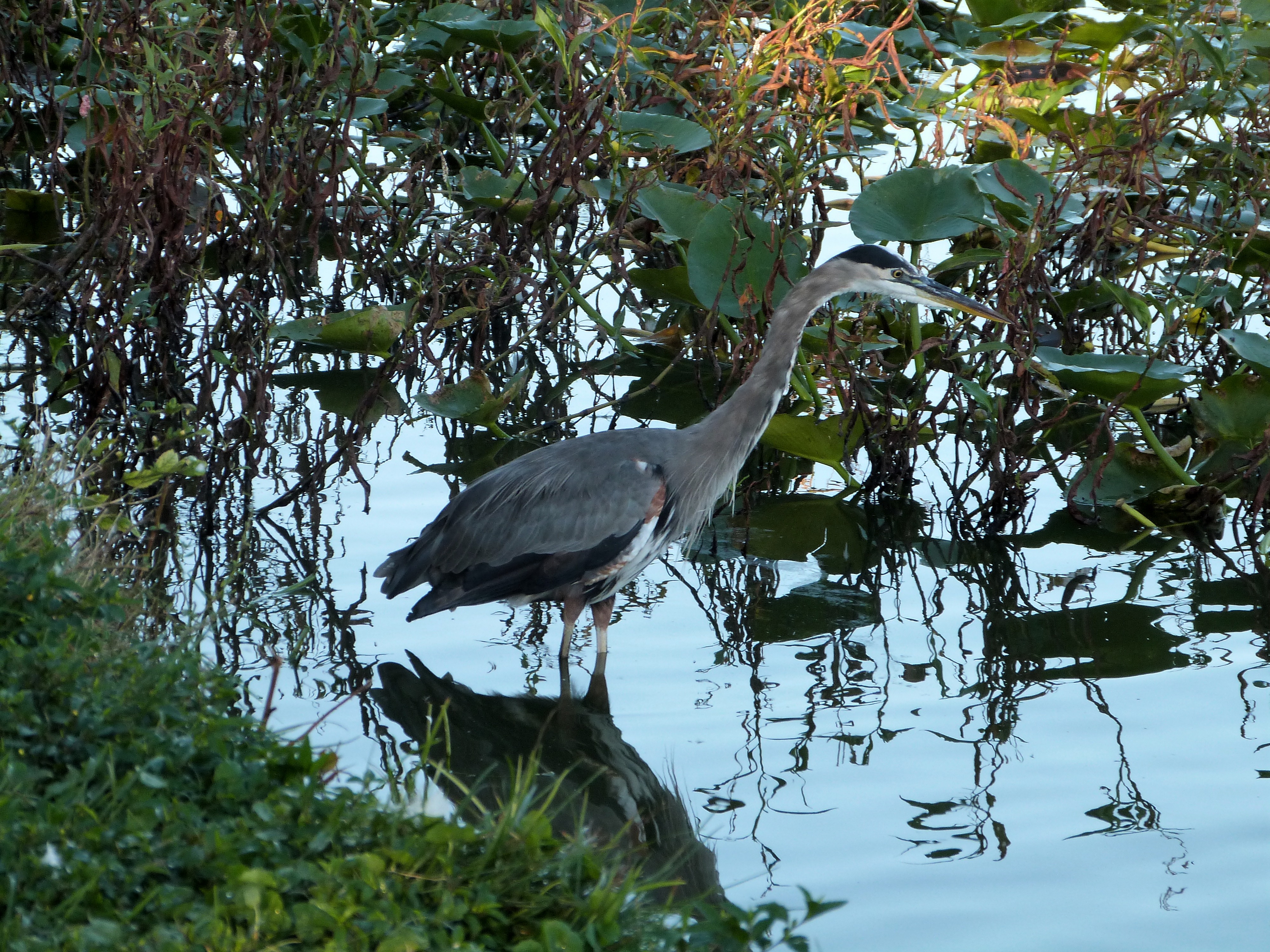
Great Blue Heron; Walton County, Georgia birding photogaphy blog by williamwisephoto.com
“Longlegs the Great Blue Heron! I wonder if he is coming here,”
exclaimed Peter. “I do hope so.”
Peter stayed right where he was and waited. Nearer and nearer came
Longlegs. When he was right opposite Peter he suddenly dropped his long
legs, folded his great wings, and alighted right on the edge of the
Smiling Pool across from where Peter was sitting. If he seemed to have
no neck at all when he was flying, now he seemed to be all neck as he
stretched it to its full length. The fact is, his neck was so long that
when he was flying he carried it folded back on his shoulders. Never
before had Peter had such an opportunity to see Longlegs.
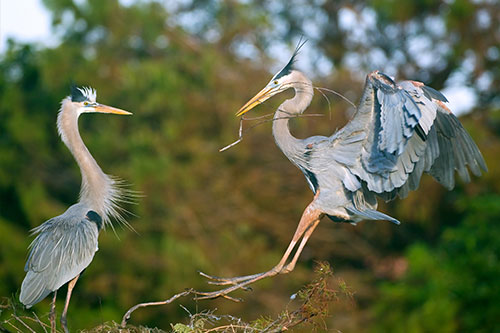
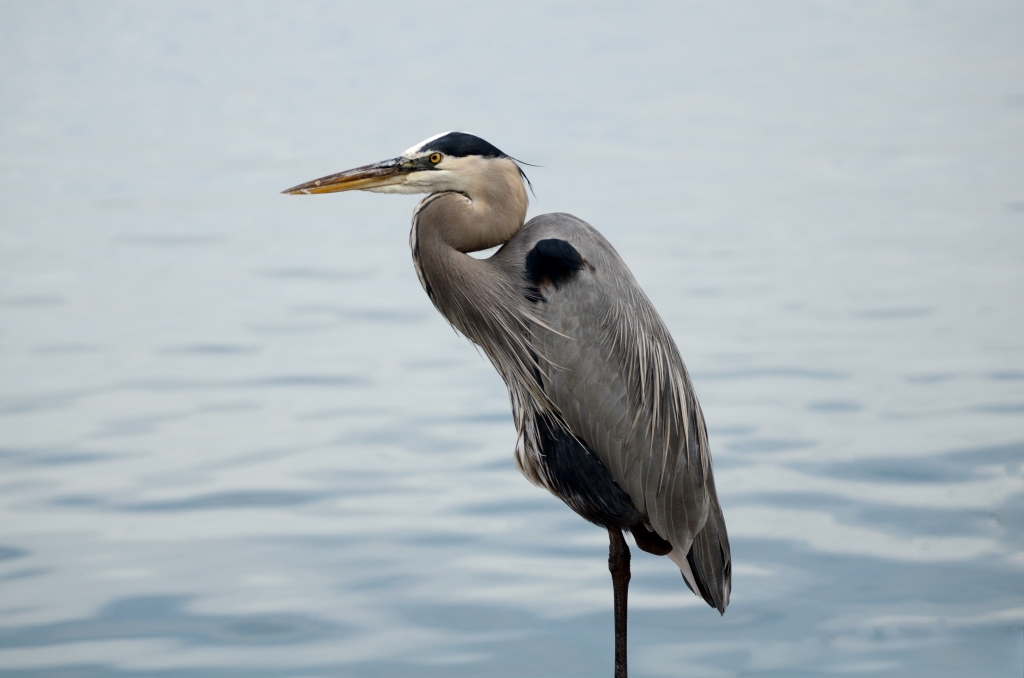
He stood quite four feet high. The top of his head and throat were
white. From the base of his great bill and over his eye was a black
stripe which ended in two long, slender, black feathers hanging from
the back of his head. His bill was longer than his head, stout and
sharp like a spear and yellow in color. His long neck was a light
brownish-gray. His back and wings were of a bluish color. The bend of
each wing and the feathered parts of his legs were a rusty-red. The
remainder of his legs and his feet were black. Hanging down over his
breast were beautiful long pearly-gray feathers quite unlike any Peter
had seen on any of his other feathered friends. In spite of the
length of his legs and the length of his neck he was both graceful and
handsome.
Great Blue Heron Lake Morton by Dan
“I wonder what has brought him over to the Smiling Pool,” thought Peter.
He didn’t have to wait long to find out. After standing perfectly still
with his neck stretched to its full height until he was sure that no
danger was near, Longlegs waded into the water a few steps, folded his
neck back on his shoulders until his long bill seemed to rest on his
breast, and then remained as motionless as if there were no life in him.
Peter also sat perfectly still. By and by he began to wonder if Longlegs
had gone to sleep. His own patience was reaching an end and he was just
about to go on in search of Rattles the Kingfisher when like a flash the
dagger-like bill of Longlegs shot out and down into the water. When he
withdrew it Peter saw that Longlegs had caught a little fish which he at
once proceeded to swallow head-first. Peter almost laughed right out as
he watched the funny efforts of Longlegs to gulp that fish down his long
throat. Then Longlegs resumed his old position as motionless as before.
Great Blue Heron (Ardea herodias) from Jim JS Johnson
It was no trouble now for Peter to sit still, for he was too interested
in watching this lone fisherman to think of leaving. It wasn’t long
before Longlegs made another catch and this time it was a fat Pollywog.
Peter thought of how he had watched Plunger the Osprey fishing in the
Big River and the difference in the ways of the two fishermen.
“Plunger hunts for his fish while Longlegs waits for his fish to come to him,” thought Peter. “I wonder if Longlegs never goes hunting.”
As if in answer to Peter’s thought Longlegs seemed to conclude that
no more fish were coming his way. He stretched himself up to his full
height, looked sharply this way and that way to make sure that all was
safe, then began to walk along the edge of the Smiling Pool. He put each
foot down slowly and carefully so as to make no noise. He had gone but
a few steps when that great bill darted down like a flash, and Peter
saw that he had caught a careless young Frog. A few steps farther on he
caught another Pollywog. Then coming to a spot that suited him, he once
more waded in and began to watch for fish.
Great Blue Heron at Lake Morton watching for fish, by Lee
Peter was suddenly reminded of Rattles the Kingfisher, whom he had quite
forgotten. From the Big Hickory-tree on the bank, Rattles flew out over
the Smiling Pool, hovered for an instant, then plunged down head-first.
There was a splash, and a second later Rattles was in the air again,
shaking the water from him in a silver spray. In his long, stout, black
bill was a little fish. He flew back to a branch of the Big Hickory-tree
that hung out over the water and thumped the fish against the branch
until it was dead. Then he turned it about so he could swallow it
head-first. It was a big fish for the size of the fisherman and he had a
dreadful time getting it down. But at last it was down, and Rattles set
himself to watch for another. The sun shone full on him, and Peter gave
a little gasp of surprise.
“I never knew before how handsome Rattles is,” thought Peter. He was
about the size of Yellow Wing the Flicker, but his head made him look
bigger than he really was. You see, the feathers on top of his head
stood up in a crest, as if they had been brushed the wrong way. His
head, back, wings and tail were a bluish-gray. His throat was white and
he wore a white collar. In front of each eye was a little white spot.
Across his breast was a belt of bluish-gray, and underneath he was
white. There were tiny spots of white on his wings, and his tail was
spotted with white. His bill was black and, like that of Longlegs, was
long, and stout, and sharp. It looked almost too big for his size.
Belted Kingfisher; Walton County Georgia
Presently Rattles flew out and plunged into the Smiling Pool again, this
time, very near to where Longlegs was patiently waiting. He caught a
fish, for it is not often that Rattles misses. It was smaller than the
first one Peter had seen him catch, and this time as soon as he got back
to the Big Hickory-tree, he swallowed it without thumping it against the
branch. As for Longlegs, he looked thoroughly put out. For a moment or
two he stood glaring angrily up at Rattles. You see, when Rattles had
plunged so close to Longlegs he had frightened all the fish. Finally
Longlegs seemed to make up his mind that there was room for but one
fisherman at a time at the Smiling Pool. Spreading his great wings,
folding his long neck back on his shoulders, and dragging his long legs
out behind him, he flew heavily away in the direction of the Big River.
Rattles remained long enough to catch another little fish, and then
with a harsh rattle flew off down the Laughing Brook. “I would know him
anywhere by that rattle,” thought Peter. “There isn’t any one who can
make a noise anything like it. I wonder where he has gone to now. He
must have a nest, but I haven’t the least idea what kind of a nest he
builds. Hello! There’s Grandfather Frog over on his green lily pad.
Perhaps he can tell me.”
So Peter hopped along until he was near enough to talk to Grandfather
Frog. “What kind of a nest does Rattles the Kingfisher build?” repeated
Grandfather Frog. “Chug-arum, Peter Rabbit! I thought everybody knew
that Rattles doesn’t build a nest. At least I wouldn’t call it a nest.
He lives in a hole in the ground.”
“What!” cried Peter, and looked as if he couldn’t believe his own ears.
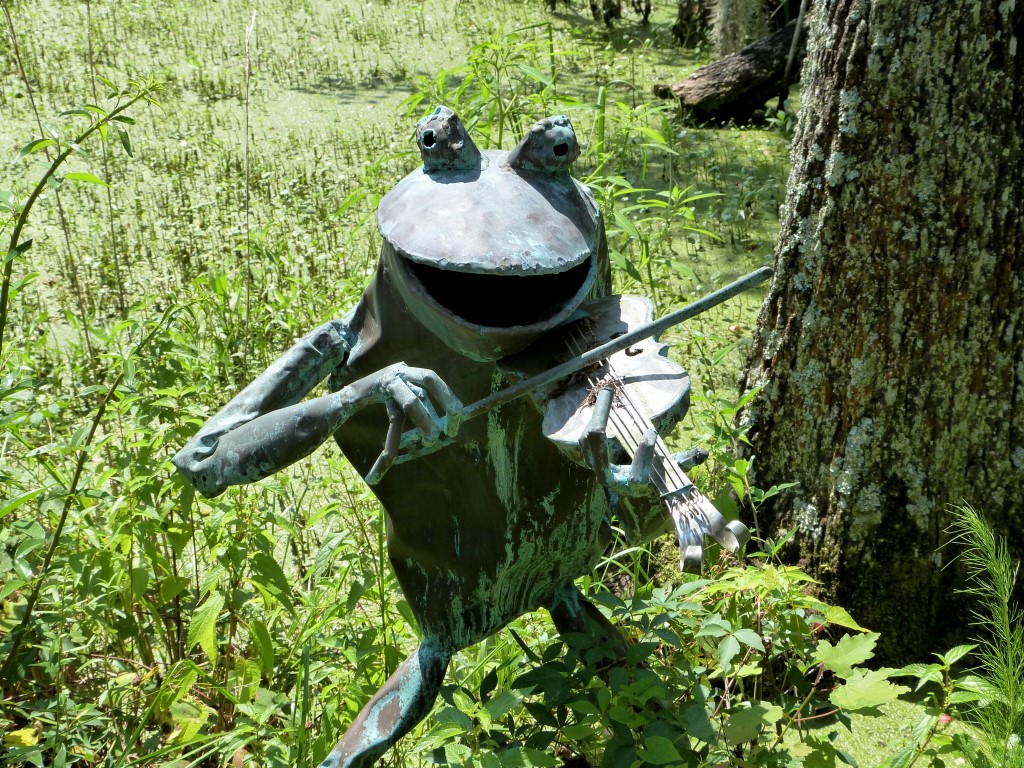
No Breath, but cute -Frog Playing Violin at Swamp Magnolia Plantation by Lee
Grandfather Frog grinned and his goggly eyes twinkled. “Yes,” said he,
“Rattles lives in a hole in the ground.”
“But–but–but what kind of a hole?” stammered Peter.
“Just plain hole,” retorted Grandfather Frog, grinning more broadly than
ever. Then seeing how perplexed and puzzled Peter looked, he went on to
explain. “He usually picks out a high gravelly bank close to the water
and digs a hole straight in just a little way from the top. He makes
it just big enough for himself and Mrs. Rattles to go in and out of
comfortably, and he digs it straight in for several feet. I’m told that
at the end of it he makes a sort of bedroom, because he usually has a
good-sized family.”
“Do you mean to say that he digs it himself?” asked Peter.
Grandfather Frog nodded. “If he doesn’t, Mrs. Kingfisher does,” he
replied. “Those big bills of theirs are picks as well as fish spears.
They loosen the sand with those and scoop it out with their feet. I’ve
never seen the inside of their home myself, but I’m told that their
bedroom is lined with fish bones. Perhaps you may call that a nest, but
I don’t.”
“I’m going straight down the Laughing Brook to look for that hole,”
declared Peter, and left in such a hurry that he forgot to be polite
enough to say thank you to Grandfather Frog.
***
What kind of birds is Longlegs?
How does Longlegs fish?
How does Longlegs swallow his fish?
What kind of bird is Rattles?
Do Longlegs and Rattles fish the same way?
How does Rattles fish?
Both Longlegs and Rattles fish differently. The Lord created them differently, but they both like fish.
Do we make fun of someone, or tease them if they do something a little differently than we do?
“And be kind to one another, tenderhearted, forgiving one another, even as God in Christ forgave you.” (Ephesians 4:32 NKJV)
Just out of curiosity, and because he possesses what is called the
wandering foot, which means that he delights to roam about, Peter Rabbit
had run over to the bank of the Big River. There were plenty of bushes,
clumps of tall grass, weeds and tangles of vines along the bank of the
Big River, so that Peter felt quite safe there. He liked to sit gazing
out over the water and wonder where it all came from and where it was
going and what, kept it moving.
He was doing this very thing on this particular morning when he happened
to glance up in the blue, blue sky. There he saw a broad-winged bird
sailing in wide, graceful circles. Instantly Peter crouched a little
lower in his hiding-place, for he knew this for a member of the Hawk
family and Peter has learned by experience that the only way to keep
perfectly safe when one of these hook-clawed, hook-billed birds is about
is to keep out of sight.
So now he crouched very close to the ground and kept his eyes fixed on
the big bird sailing so gracefully high up in the blue, blue sky over
the Big River. Suddenly the stranger paused in his flight and for a
moment appeared to remain in one place, his great wings heating rapidly
to hold him there. Then those wings were closed and with a rush he shot
down straight for the water, disappearing with a great splash. Instantly
Peter sat up to his full height that he might see better.
“It’s Plunger the Osprey fishing, and I’ve nothing to fear from him,” he
cried happily.
Out of the water, his great wings flapping, rose Plunger. Peter looked
eagerly to see if he had caught a fish, but there was nothing in
Plunger’s great, curved claws. Either that fish had been too deep or
had seen Plunger and darted away just in the nick of time. Peter had a
splendid view of Plunger. He was just a little bigger than Redtail the
Hawk. Above he was dark brown, his head and neck marked with white. His
tail was grayish, crossed by several narrow dark bands and tipped with
white. His under parts were white with some light brown spots on his
breast. Peter could see clearly the great, curved claws which are
Plunger’s fishhooks.
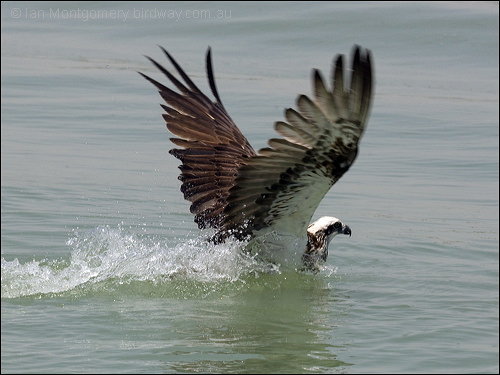
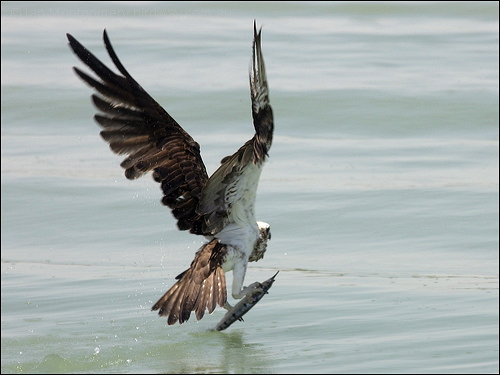
Eastern Osprey trying to catch fish by Ian
Up, up, up he rose, going round and round in a spiral. When he was well
up in the blue, blue sky, he began to sail again in wide circles as when
Peter had first seen him. It wasn’t long before he again paused and
then shot down towards the water. This time he abruptly spread his great
wings just before reaching the water so that he no more than wet his
feet. Once more a fish had escaped him. But Plunger seemed not in the
least discouraged. He is a true fisherman and every true fisherman
possesses patience. Up again he spiraled until he was so high that Peter
wondered how he could possibly see a fish so far below. You see, Peter
didn’t know that it is easier to see down into the water from high above
it than from close to it. Then, too, there are no more wonderful eyes
than those possessed by the members of the Hawk family. And Plunger the
Osprey is a Hawk, usually called Fish Hawk.
Osprey Catching Fish by Ian
A third time Plunger shot down and this time, as in his first attempt,
he struck the water with a great splash and disappeared. In an instant
he reappeared, shaking the water from him in a silver spray and flapping
heavily. This time Fetes could gee a great shining fish in his claws.
It was heavy, as Peter could tell by the way in which Plunger flew. He
headed towards a tall tree on the other bank of the Big River, there to
enjoy his breakfast. He was not more than halfway there when Peter was
startled by a harsh scream.
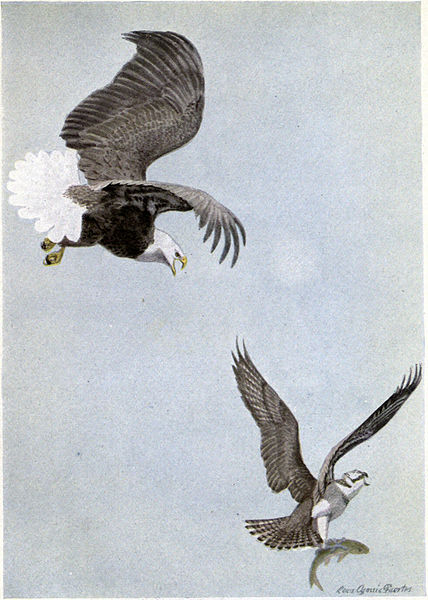
He looked up to see a great bird, with wonderful broad wings, swinging
in short circles about Plunger. His body and wings were dark brown, and
his head was snowy white, as was his tail. His great hooked beak was
yellow and his legs were yellow. Peter knew in an instant who it was.
There could be no mistake. It was King Eagle, commonly known as Bald
Head, though his head isn’t bald at all.
Peter’s eyes looked as if they would pop out of his head, for it was
quite plain to him that King Eagle was after Plunger, and Peter didn’t
understand this at all. You see, he didn’t understand what King Eagle
was screaming. But Plunger did. King Eagle was screaming, “Drop that
fish! Drop that fish!”
Plunger didn’t intend to drop that fish if he could help himself. It was
his fish. Hadn’t he caught it himself? He didn’t intend to give it up to
any robber of the air, even though that robber was King Eagle himself,
unless he was actually forced to. So Plunger began to dodge and twist
and turn in the air, all the time mounting higher and higher, and all
the time screaming harshly, “Robber! Thief! I won’t drop this fish! It’s
mine! It’s mine!”
Now the fish was heavy, so of course Plunger couldn’t fly as easily and
swiftly as if he were carrying nothing. Up, up he went, but all the time
King Eagle went up with him, circling round him, screaming harshly, and
threatening to strike him with those great cruel, curved claws. Peter
watched them, so excited that he fairly danced. “O, I do hope Plunger
will get away from that big robber,” cried Peter. “He may be king of the
air, but he is a robber just the same.”
Plunger and King Eagle were now high in the air above the Big River.
Suddenly King Eagle swung above Plunger and for an instant seemed to
hold himself still there, just as Plunger had done before he had shot
down into the water after that fish. There was a still harsher note in
King Eagle’s scream. If Peter had been near enough he would have seen
a look of anger and determination in King Eagle’s fierce, yellow eyes.
Plunger saw it and knew what it meant. He knew that King Eagle would
stand for no more fooling. With a cry of bitter disappointment and anger
he let go of the big fish.
Bald Eagle – San Diego Zoo
Down, down, dropped the fish, shining in the sun like a bar of silver.
King Eagle’s wings half closed and he shot down like a thunderbolt. Just
before the fish reached the water King Eagle struck it with his great
claws, checked himself by spreading his broad wings and tail, and then
in triumph flew over to the very tree towards which Plunger had started
when he had caught the fish. There he leisurely made his breakfast,
apparently enjoying it as much as if he had come by it honestly.
As for poor Plunger, he shook himself, screamed angrily once or twice,
then appeared to think that it was wisest to make the best of a bad
matter and that there were more fish where that one had come from, for
he once more began to sail in circles over the Big River, searching
for a fish near the surface. Peter watched him until he saw him catch
another fish and fly away with it in triumph. King Eagle watched him,
too, but having had a good breakfast he was quite willing to let Plunger
enjoy his catch in peace.
Late that afternoon Peter visited the Old Orchard, for he just had to
tell Jenny Wren all about what he had seen that morning.
“King Eagle is king simply because he is so big and fierce and strong,”
sputtered Jenny. “He isn’t kingly in his habits, not the least bit. He
never hesitates to rob those smaller than himself, just as you saw him
rob Plunger. He is very fond of fish, and once in a while he catches one
for himself when Plunger isn’t around to be robbed, but he isn’t a very
good fisherman, and he isn’t the least bit fussy about his fish. Plunger
eats only fresh fish which he catches himself, but King Eagle will eat
dead fish which he finds on the shore. He doesn’t seem to care how long
they have been dead either.”
“Doesn’t he eat anything but fish?” asked Peter innocently.
“Well,” retorted Jenny Wren, her eyes twinkling, “I wouldn’t advise you
to run across the Green Meadows in sight of King Eagle. I am told he is
very fond of Rabbit. In fact he is very fond of fresh meat of any kind.
He even catches the babies of Lightfoot the Deer when he gets a chance.
He is so swift of wing that even the members of the Duck family fear
him, for he is especially fond of fat Duck. Even Honker the Goose is not
safe from him. King he may he, but he rules only through fear. He is
a white-headed old robber. The best thing I can say of him is that he
takes a mate for life and is loyal and true to her as long as she lives,
and that is a great many years. By the way, Peter, did you know that
she is bigger than he is, and that the young during the first year after
leaving their nest, are bigger than their parents and do not have white
heads? By the time they get white heads they are the same size as their
parents.”
“That’s odd and its hard to believe,” said Peter.
“It is odd, but it is true just the same, whether you believe it or
not,” retorted Jenny Wren, and whisked out of sight into her home.
***
What kind of bird is Plunger?
Who was watching Plunger trying to catch a fish?
How many tries did it take to catch a fish?
Do you give up after the first try, or do you keep trying to accomplish (finish) a goal?
What happened to the fish?
Did both birds have a meal?
Is it right to steal?
“You shall not steal, nor deal falsely, nor lie to one another.” (Leviticus 19:11 NKJV)
One of our readers asked if I might continue this Burgess Bird Book for Children Series in the Bird Tales section. [She is reading them to her children.] Since I already have the stories, photos, and recordings on my computer, I agreed. Here is Chapter 19, and there are 45 chapters all total. So, STAY TUNED!
Chapter 19. A Maker of Thunder and a Friend in Black.
Listen to the story read.
Peter Rabbit’s intentions were of the best. Once safely away from that lonesome part of the Green Forest where was the home of Redtail the Hawk, he intended to go straight back to the dear Old Briar-patch. But he was not halfway there when from another direction in the Green Forest there came a sound that caused him to stop short and quite forget all about home. It was a sound very like distant thunder. It began slowly at first and then went faster and faster. Boom–Boom–Boom–Boom-Boom-Boom Boo-Boo-B-B-B-B-b-b-b-b-boom! It was like the long roll on a bass drum.
Peter laughed right out. “That’s Strutter the Stuffed Grouse!” he cried joyously. “I had forgotten all about him. I certainly must go over and pay him a call and find out where Mrs. Grouse is. My, how Strutter can drum!”
Peter promptly headed towards that distant thunder. As he drew nearer to it, it sounded louder and louder. Presently Peter stopped to try to locate exactly the place where that sound, which now was more than ever like thunder, was coming from. Suddenly Peter remembered something. “I know just where he is,” said he to himself. “There’s a big, mossy, hollow log over yonder, and I remember that Mrs. Grouse once told me that that is Strutter’s thunder log.”
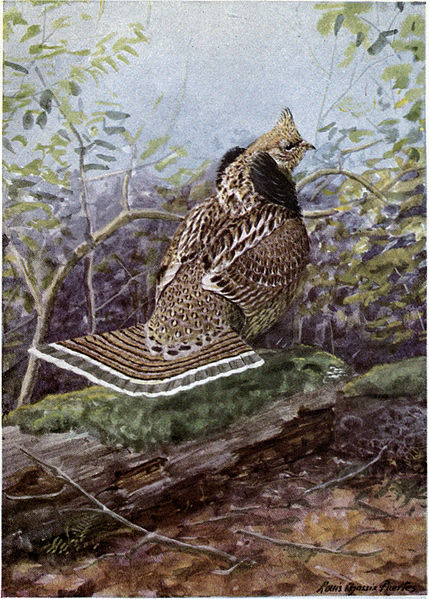
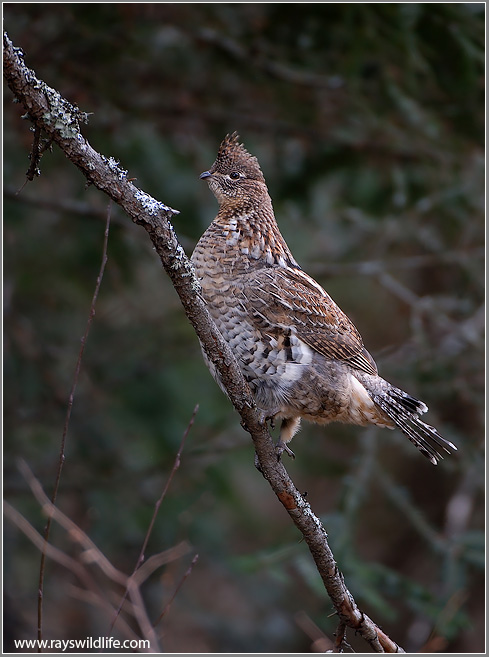
Very, very carefully Peter stole forward, making no sound at all. At last he reached a place where he could peep out and see that big, mossy, hollow log. Sure enough, there was Strutter the Ruffed Grouse. When Peter first saw him he was crouched on one end of the log, a fluffy ball of reddish-brown, black and gray feathers. He was resting. Suddenly he straightened up to his full height, raised his tail and spread it until it was like an open fan above his back. The outer edge was gray, then came a broad band of black, followed by bands of gray, brown and black. Around his neck was a wonderful ruff of black. His reddish-brown wings were dropped until the tips nearly touched the log. His full breast rounded out and was buff color with black markings. He was of about the size of the little Bantam hens Peter had seen in Farmer Brown’s henyard.
Ruffed Grouse (Bonasa umbellus) by Raymond Barlow
In the most stately way you can imagine Strutter walked the length of that mossy log. He was a perfect picture of pride as he strutted very much like Tom Gobbler the big Turkey cock. When he reached the end of the log he suddenly dropped his tail, stretched himself to his full height and his wings began to beat, first slowly then faster and faster, until they were just a blur. They seemed to touch above his back but when they came down they didn’t quite strike his sides. It was those fast moving wings that made the thunder. It was so loud that Peter almost wanted to stop his ears. When it ended Strutter settled down to rest and once more appeared like a ball of fluffy feathers. His ruff was laid flat.
Peter watched him thunder several times and then ventured to show himself. “Strutter, you are wonderful! simply wonderful!” cried Peter, and he meant just what he said.
Strutter threw out his chest proudly. “That is just what Mrs. Grouse says,” he replied. “I don’t know of any better thunderer if I do say it myself.”
“Speaking of Mrs. Grouse, where is she?” asked Peter eagerly.
“Attending to her household affairs, as a good housewife should,” retorted Strutter promptly.
“Do you mean she has a nest and eggs?” asked Peter.
Strutter nodded. “She has twelve eggs,” he added proudly.
“I suppose,” said Peter artfully, “her nest is somewhere near here on the ground.”
“It’s on the ground, Peter, but as to where it is I am not saying a word. It may or it may not be near here. Do you want to hear me thunder again?”
Of course Peter said he did, and that was sufficient excuse for Strutter to show off. Peter stayed a while longer to gossip, but finding Strutter more interested in thundering than in talking, he once more started for home.
“I really would like to know where that nest is,” said he to himself as he scampered along. “I suppose Mrs. Grouse has hidden it so cleverly that it is quite useless to look for it.”
On his way he passed a certain big tree. All around the ground was carpeted with brown, dead leaves. There were no bushes or young trees there. Peter never once thought of looking for a nest. It was the last place in the world he would expect to find one. When he was well past the big tree there was a soft chuckle and from among the brown leaves right at the foot of that big tree a head with a pair of the brightest eyes was raised a little. Those eyes twinkled as they watched Peter out of sight.
“He didn’t see me at all,” chuckled Mrs. Grouse, as she settled down once more. “That is what comes of having a cloak so like the color of these nice brown leaves. He isn’t the first one who has passed me without seeing me at all. It is better than trying to hide a nest, and I certainly am thankful to Old Mother Nature for the cloak she gave me. I wonder if every one of these twelve eggs will hatch. If they do, I certainly will have a family to be proud of.”
Meanwhile Peter hurried on in his usual happy-go-lucky fashion until he came to the edge of the Green Forest. Out on the Green Meadows just beyond he caught sight of a black form walking about in a stately way and now and then picking up something. It reminded him of Blacky the Crow, but he knew right away that it wasn’t Blacky, because it was so much smaller, being not more than half as big.
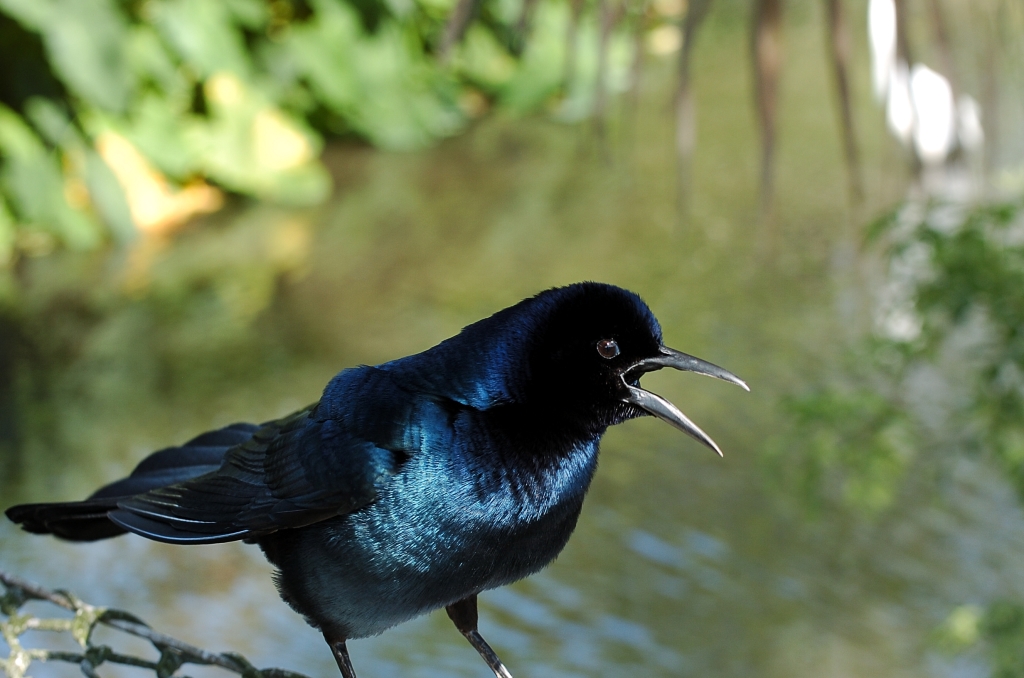
Grackle by Dan
“It’s Creaker the Grackle. He was one of the first to arrive this spring and I’m ashamed of myself for not having called on him,” thought Peter, as he hopped out and started across the Green Meadows towards Creaker. “What a splendid long tail he has. I believe Jenny Wren told me that he belongs to the Blackbird family. He looks so much like Blacky the Crow that I suppose this is why they call him Crow Blackbird.”
Just then Creaker turned in such a way that the sun fell full on his head and back. “Why! Why-ee!” exclaimed Peter, rubbing his eyes with astonishment. “He isn’t just black! He’s beautiful, simply beautiful, and I’ve always supposed he was just plain, homely black.”
It was true. Creaker the Grackle with the sun shining on him was truly beautiful. His head and neck, his throat and upper breast, were a shining blue-black, while his back was a rich, shining brassy-green. His wings and tail were much like his head and neck. As Peter watched it seemed as if the colors were constantly changing. This changing of colors is called iridescence. One other thing Peter noticed and this was that Creaker’s eyes were yellow. Just at the moment Peter couldn’t remember any other bird with yellow eyes.
“Creaker,” cried Peter, “I wonder if you know how handsome you are!”
“I’m glad you think so,” replied Creaker. “I’m not at all vain, but there are mighty few birds I would change coats with.”
“Is–is–Mrs. Creaker dressed as handsomely as you are?” asked Peter rather timidly.
Creaker shook his head. “Not quite,” said he. “She likes plain black better. Some of the feathers on her back shine like mine, but she says that she has no time to show off in the sun and to take care of fine feathers.”
“Where is she now?” asked Peter.
“Over home,” replied Creaker, pulling a white grub out of the roots of the grass. “We’ve got a nest over there in one of those pine-trees on the edge of the Green Forest and I expect any day now we will have four hungry babies to feed. I shall have to get busy then. You know I am one of those who believe that every father should do his full share in taking care of his family.”
“I’m glad to hear you say it,” declared Peter, nodding his head with approval quite as if he was himself the best of fathers, which he isn’t at all.
“May I ask you a very personal question, Creaker?”
“Ask as many questions as you like. I don’t have to answer them unless I want to,” retorted Creaker.
“Is it true that you steal the eggs of other birds?” Peter blurted the question out rather hurriedly.
Creaker’s yellow eyes began to twinkle. “That is a very personal question,” said he. “I won’t go so far as to say I steal eggs, but I’ve found that eggs are very good for my constitution and if I find a nest with nobody around I sometimes help myself to the eggs. You see the owner might not come back and then those eggs would spoil, and that would be a pity.”
“That’s no excuse at all,” declared Peter. “I believe you’re no better than Sammy Jay and Blacky the Crow.”
Creaker chuckled, but he did not seem to be at all offended. Just then he heard Mrs. Creaker calling him and with a hasty farewell he spread his wings and headed for the Green Forest. Once in the air he seemed just plain black. Peter watched him out of sight and then once more headed for the dear Old Briar-patch.
“There are three things which are stately in their march, Even four which are stately when they walk: The lion which is mighty among beasts And does not retreat before any, The strutting rooster, the male goat also, And a king when his army is with him. If you have been foolish in exalting yourself Or if you have plotted evil, put your hand on your mouth.” (Proverbs 30:29-32 NASB)
*
Who did Peter hear first in the forest?
What did that bird sound like? What kind of instrument?














 Lee's Birdwatching Adventures Plus