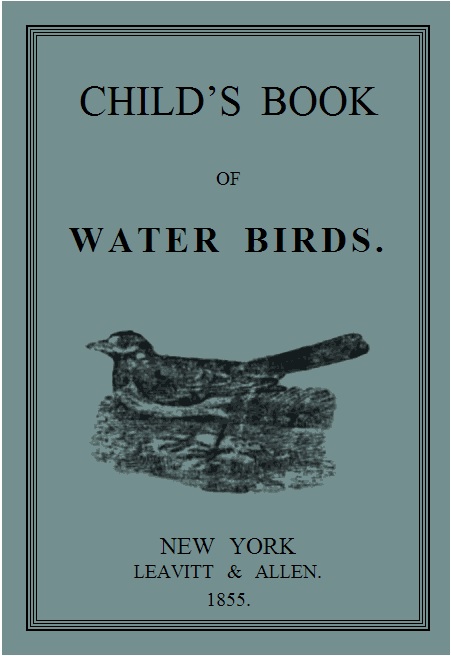
The above article is an article in the monthly serial for October 1897 “designed to promote Knowledge of Bird-Live.” These include Color Photography, as they call them, today they are drawings. There are at least three Volumes that have been digitized by Project Gutenberg.
Thou hast enlarged my steps under me, that my feet did not slip. (Psalms 18:36 KJV)
In the Coot article they said: “Like other rails, they have long, lobed toes that are well adapted to soft, uneven surfaces. Coots have strong legs and can walk and run fast.”
Answers gives this definition: “Feet that have toes with stiff scale-covered flaps that extend to provide a surface analogous to webbing on a duck as an aid in swimming.”
The Lord designed these “lobed feet” to help the birds walk over uneven ground, in and out of water. He cares about all His creatures.
American Coot – from Color Key To North American Birds
This Drawing from Color Key To North American Birds helps you to see their feet better.
It is neat to watch them walk around and see those “big feet.”
Welcome to the Updated Child’s Book of Water Birds, by Anonymous. It was written in 1855 and this is 2013. That is 158 years ago.
*
*
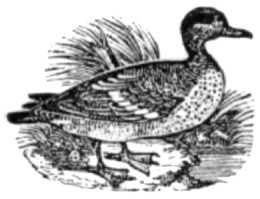
THE TEAL.
The Teal is the smallest of the ducks. The Green-winged Teal is the American. It feeds on fresh-water insects, seeds, and aquatic plants. When fat it is considered a great luxury. It is almost always seen on well furnished tables. It generally feeds at night. It flies very swiftly, and utters a whistling cry.
***
*
Male Green-winged Teal at Lowry Park Zoo, Tampa, FL
*
Update:
Thisdabbling duck (the Green-winged Teal) flies south in the winter and will form large flocks.
This is the smallest North American dabbling duck. The male has grey flanks and back, with a yellow rear end and a white-edged green feathers. It has a chestnut head with a green eye patch. a vertical white stripe on side of breast. The females are light brown.
What does it mean when a duck “dabbles” or is a “dabbling duck”?
This group of ducks has been so named because its members feed mainly on vegetable matter by upending on the water surface, or grazing, and only rarely dive. These are mostly gregarious ducks of freshwater or estuaries. These birds are strong fliers and northern species are highly migratory. Compared to other types of duck, their legs are placed more towards the centre of their bodies. They walk well on land, and some species feed on land.
Puddle ducks generally feed on the surface of the water or feed on very shallow bottoms. They are not equipped to dive down several feet like their diving counterparts. The most predominant difference between puddle ducks and divers are the size of the feet. A puddle duck’s feet are generally smaller because they do not need the extra propulsion to dive for their forage.
Another distinguishing characteristic of puddle ducks when compared to diving ducks is the way in which they take flight when spooked or are on the move.
Puddle ducks spring straight up from the water, and diving ducks need to gain momentum to take off, so they must run across the water a short distance to gain flight.
What does it mean when a duck “dabbles” or is a “dabbling duck”?
They are called that because these ducks feed mainly on vegetable matter (plants) by upending on the water surface (They put their head in the water to eat and their tail section is all that is seen above the water.) or grazing, and only rarely dive.
When they take flight, they spring straight up from the water. The Diving ducks have to sort of run to take-off.
(Wikipedia with editing)
Look at the birds of the air; they neither sow nor reap nor gather into barns, and yet your heavenly Father keeps feeding them. Are you not worth much more than they? (Mat 6:26 AMP)
Welcome to the Updated Child’s Book of Water Birds, by Anonymous. It was written in 1855 and this is 2013. That is 158 years ago.
*
*
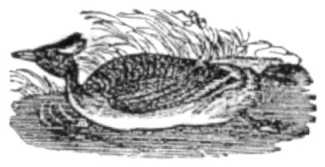
THE DABCHICK.
The Dabchick is a very timid bird, and when alarmed instantly dives, after which it is useless to look after the bird. It is easily domesticated, and is often seen placed as an ornament to ponds, where it swims about very merrily, and seems to enjoy a game of hide and seek with any one who is attempting to watch its movements.
*
Little Grebe (Tachybaptus ruficollis) by Nikhil Devasar
Update:
The Little Grebe (Tachybaptus ruficollis), also known as Dabchick, is a member of the Grebe family of water birds. At 9 to 11.4 in (23 to 29 cm) in length it is the smallest European member of its family. It is commonly found in open bodies of water across most of its range. Also, there is a New Zealand Grebe (Dabchick).
It is a small water bird with a pointed bill. In summer, the adult is dark above with its rich, rufous colour neck, cheeks and flanks (sides), and bright yellow gape (mouth). Non-breeding and juvenile birds are a dirty brownish grey.
It is an excellent swimmer and diver and chases its fish and aquatic prey underwater. It uses the vegetation skilfully as a hiding place. it nests at the water’s edge, since its legs are set very far back and it cannot walk well. The young leave the nest and can swim soon after hatching, and chicks are often carried on the backs of the swimming adults.
If a bird’s nest should chance to be before you in the way, in any tree or on the ground, with young ones or eggs, and the mother bird is sitting on the young or on the eggs, you shall not take the mother bird with the young. (Deu 22:6 AMP)
The Little Grebe’s breeding call, given singly or in duet, is a trilled repeated weet-weet-weet or wee-wee-wee which sounds like a horse whinnying.
Welcome to the Updated Child’s Book of Water Birds, by Anonymous. It was written in 1855 and this is 2013. That is 158 years ago.
*
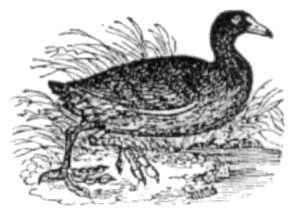
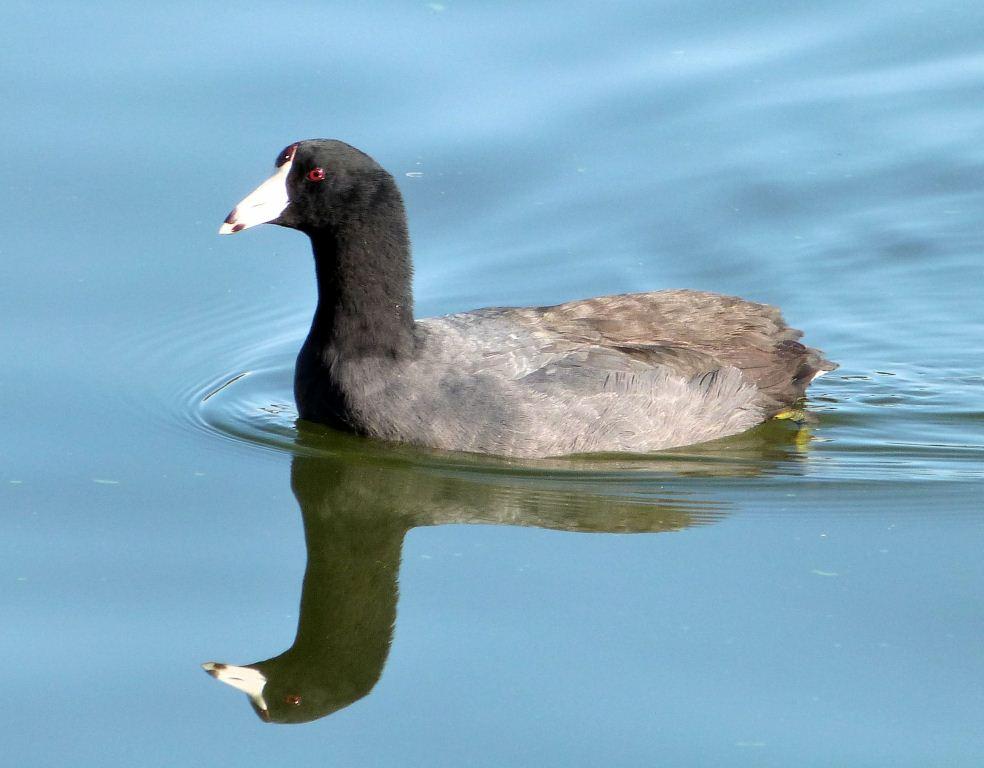
THE COOT.
The Coot is generally found in large sheets of water, particularly if shaded by trees. The nest is a mass of flags, reeds, and grass, usually at the water’s edge, but sometimes actually in the water. The Coot’s eggs are generally seven in number. They are of a greenish-white, spotted.
*
American Coot (Fulica americana) by Lee at Lk Morton
Update:
Coots are medium-sized birds that belong to the Raillidae – Rail Family. There are twelve (12) different Coots around the world.
They have mostly black feathers and can be seen swimming in open water. Coots have prominent frontal shields or other decoration on the forehead, with red to dark red eyes and coloured bills. Many, but not all, have white on the under tail.
Coots eat plants, eggs and some small animals. The defend their nest when they have babies. A group of Coots are called a “covert” or “cover.”
Like other rails, they have long, lobed toes that are well adapted to soft, uneven surfaces. Coots have strong legs and can walk and run fast. This video shows their feet.
Welcome to the Updated Child’s Book of Water Birds, by Anonymous. It was written in 1855 and this is 2013. That is 158 years ago.
*
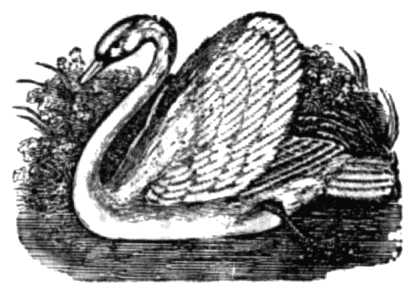
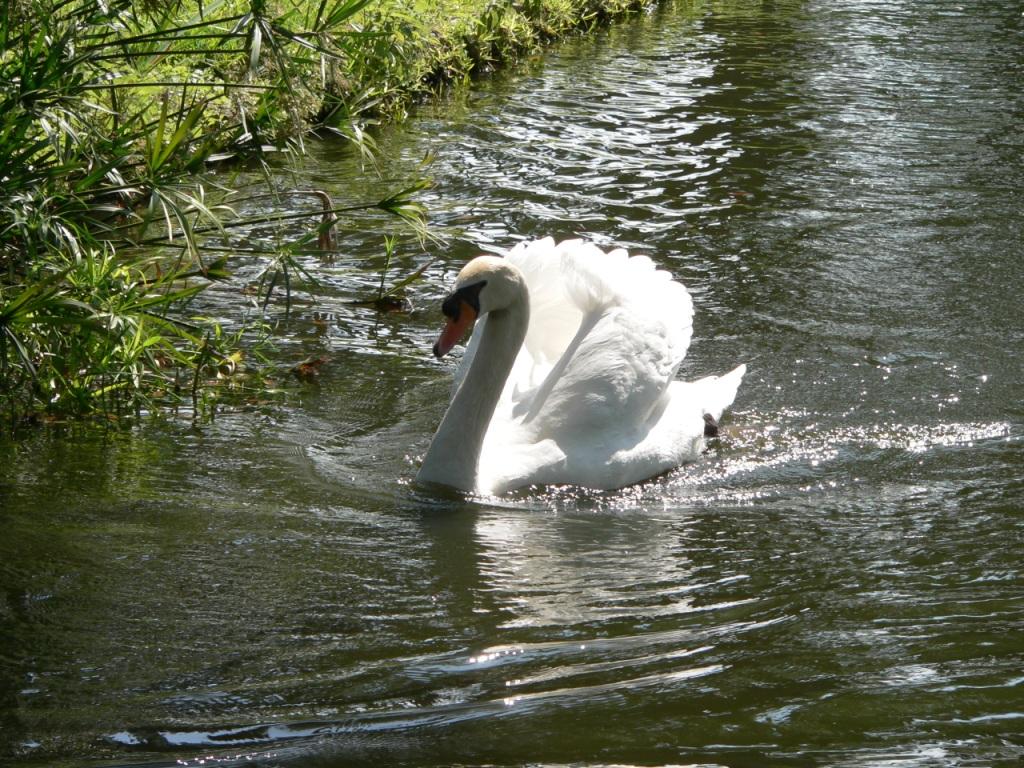
THE SWAN.
The Swan is a very beautiful bird. It is generally white, though a black swan has been discovered in Australia. It is not very often seen in this country. It was brought from Asia and Eastern Europe into England—from whence, most probably, a few specimens have been introduced into this country. The Swan is very graceful in the water, but on land it is an awkward waddler.
*
Swan at Bok Tower
Update:
Swans are the largest member of the Water Birds family Swans. They are also among the largest flying birds. Some Swans have a wingspan almost 10 ft (3 m).
A group of swans is called a bevy or a wedge in flight. Swans feed in the water and on land.
The nest is on the ground near water. Average egg size (for the mute swan) is 4.4 X 2.9 in (113×74 mm), weighing 11 oz (340 g), in a clutch size of 4 to 7. Swans are very protective of their nest.
Consider the ravens, for they neither sow nor reap, which have neither storehouse nor barn; and God feeds them. Of how much more value are you than the birds? (Luk 12:24 NKJV)
“For animals in the wild, the medicine cabinet seems at first glance to be pretty bare, and you might think they’re just left out in the cold when it comes to finding remedies. But even with the fallen nature of our world, the Creator hasn’t left untamed creatures, like the ravens that neither sow nor reap (Luke 12:24), defenseless against all the things that ail them. In fact, He’s stocked their “closets” with a cornucopia of cures.” (From Jungle Doctors)
One of those cures is the birds “Anting” behaviour.
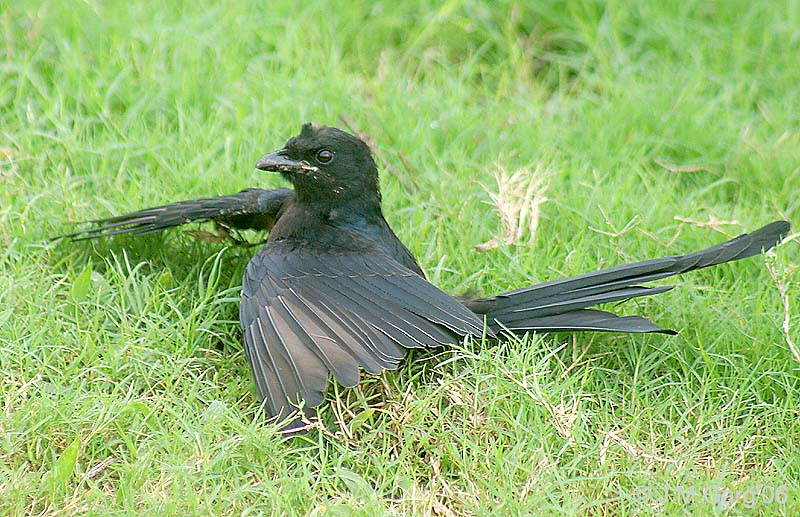
Anting (Excerpts from The Birder’s Handbook, p.487)
“Many different songbird species have been observed picking up single ants or small groups and rubbing them on their feathers. Less commonly, other songbirds “ant” by spreading their wings and lying on an anthill, and squirming or otherwise stimulating the ants to swarm up among their feathers.
Because the seasonal timing of anting and molting (spring and summer) often correspond, some have suggested that anting may soothe the skin during feather replacement. It seems more likely that the seasonal relationship simply reflects the greater activity of ants during those periods.”
In the behavior called anting, birds rub insects on their feathers, usually ants, which secrete liquids containing chemicals such as formic acid, that can act as an insecticide, miticide, fungicide, bactericide, or to make them edible by removing the distasteful acid. It possibly also supplements the bird’s own preen oil. Instead of ants, birds can also use millipedes. Over 250 species of bird have been known to ant. Most of those are Passerines.
Many theories exits as to why the birds “ant.”
It has been suggested that anting acts as way of reducing feather parasites such as mites or in controlling fungi or bacteria, although there has been little convincing support for any of the theories. It is possible that the use of certain kinds of ants indicates the importance of the chemicals they release. Some cases of anting involved the use of millipedes or caterpillars, and these too are known to release powerful defensive chemicals.
Another suggested function, based on observation of Blue Jays, is that the bird makes the insects edible, by discharging the harmful acid onto their feathers. The birds were found to show anting behaviour only if the ants had a full acid sac, and with subjects whose acid sacs had been experimentally removed, the behaviour was absent.
Finally, it has also been suggested that anting is related to feather moulting. However, the correlation may also be attributed to the greater activity of ants in summer.
Dusting with soil from ant-hills has been considered by some as equivalent to anting.
Some birds like Antbirds and Flickers not only ant, but also consume the ants as an important part of their diet. Other opportunist ant-eating birds include Sparrows, Wrens, Grouse and Starlings.
*
*
Anting (Excerpts from Audubon Society Encyclopedia of North American Birds, pps 19-20)
“John James Audubon published the first known reference to this habit in his Ornithological Biography (1831), in which he wrote of watching wild turkeys roll in ants’ nests ‘to clear their growing feathers of loose scales, and prevent ticks and other vermin from attacking them, these insects being unable to bear the odor of the earth in which ants have been.’ ”
Here are some of the birds listed in this section:
The turkeys mentioned, plus “crows; starlings and Indian mynas, magpie lark, gray thrush, Pekin robin, house sparrow, manakin and apostlebird in Australia; a Magpie in Britain; Grackles, Blue Jay, pekin robin, gray catbird, American robin, wood thrush, hermit thrush, veery, cedar waxwing, bobolink, Baltimore oriole, cardinal, rose-breasted grosbeak, black-headed grosbeak, indigo bunting, dark-eyed junco, Harris’ sparrow, white-crowned sparrow, fox sparrow, and song sparrow in America”;
“Others seen in the wild anting are: scarlet tanagers, summer tanagers, towhees…, others.” (Lack off capitalization is from the book)
Lee’s Additon:
But now ask the beasts, and they will teach you; And the birds of the air, and they will tell you; (Job 12:7 NKJV)
It appears that the birds were given instincts or knowledge, by their Creator, to protect themselves from pests and irritation. That would be a possible answer they might give us, if we were to question them. If these birds evolved, then it appears that they had to develop this habit in each country and area where the birds “ant.” Huh? As for me, I opt for a Creator giving them that knowledge rather than a chance behaviour happening in so many places.
(Gen 1:21) So God created great sea creatures and every living thing that moves, with which the waters abounded, according to their kind, and every winged bird according to its kind. And God saw that it was good.
I have just had the privilege of “screening” the “FLIGHT: The Genius of Birds” film. After being contacted by its director, Lad, I accepted the offer to watch this amazing film all about the bird’s intelligently designed ability to fly. It is FANTASTIC!
Illustra Media produced this film and I am including their Trailer and three segments; the Embryonic Development, the Skeletal system, and the Hummingbird tongue.
Enjoy watching these. And this is only a part of a tremendously amazing film!
Out of the ground the LORD God formed every beast of the field and every bird of the air, and brought them to Adam to see what he would call them. And whatever Adam called each living creature, that was its name. (Gen 2:19)
*
*
Skeletal system
*
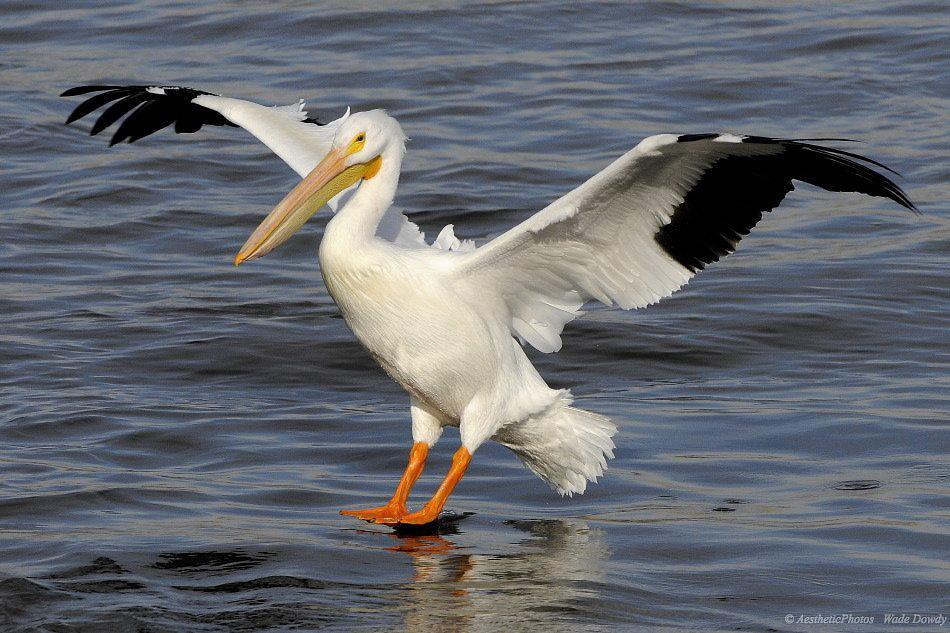
American White Pelican (Pelecanus erythrorhynchos) by AestheticPhotos
Many, O LORD my God, are thy wonderful works which thou hast done, and thy thoughts which are to us-ward: they cannot be reckoned up in order unto thee: if I would declare and speak of them, they are more than can be numbered. (Psa 40:5 KJV)
*
This clip tells about the skeletal makeup of the birds. They do a super job showing with their photography and illustrations. It helped me better understand how the bird’s bones and structure work together to enable birds to fly.
*
*
Hummingbird tongue
*
Rufous-tailed Hummingbird (Amazilia tzacatl) by Judd Patterson
Such knowledge is too wonderful for me; it is high, I cannot attain unto it. (Psa 139:6 KJV)
*
I never imagined this is how they get the nectar. Wow!
*
I do not sell things here on the blog. My goal is to help promote this very informative video about how an Intelligent designer is behind all of the ingenious aspects of birds and their Flight. We know that the Lord Jesus Christ is that “intelligent designer’ and that He deserves all the credit.
In the beginning was the Word, and the Word was with God, and the Word was God. He was in the beginning with God. All things were made through Him, and without Him nothing was made that was made. (Joh 1:1-3)
Taken from YouTube – TO ORDER DVDs: www.illustramedia.com / FLIGHT: THE GENIUS OF BIRDS is the first episode in Illustra Media’s new series THE DESIGN OF LIFE. This remarkable documentary explores the evidence for intelligent design as revealed through the biological systems and mechanisms that make avian flight possible. Photographed in North America, England, Peru, Greenland, and Antarctica FLIGHT celebrates birds and the miracle of life in the skies.
The DVD is available for purchase now – visit www.illustramedia.com for more information.
Is it by your understanding that the hawk soars and spreads his wings toward the south? (Job 39:26 ESV)
Job was being asked by the Lord if he knew how and why the Hawk knows that it needs to go south for the winter. The Lord is smarter than we are and when He created the birds, He gave them instincts (knowledge) to do certain tasks. He put within the Hawks and other birds that migrate (travel to other areas) the knowledge of when and where to go.
Why do they migrate? There are various reasons why they travel, many great distances, for the winter or summer. The weather turns cold in the northern part of the world (northern hemisphere) in the winter and many birds cannot survive in really cold weather. In the summer, those birds go back north, because it gets cold down where they spent the winter. (The seasons are reversed in the northern and southern hemispheres.) So, some birds just keep going north and south each year so they can live in warm weather.
Other birds move around or migrate because their food supply ends and they go to the next area to be able to feed themselves. The Lord promised the birds and animals to provide for them, but He does not “spoon-feed” them. They have to go where He has provided for them.
And to all the animals on the earth and to every bird of the air and to everything that creeps on the ground–to everything in which there is the breath of life–I have given every green plant for food. And it was so. (Genesis 1:30 AMP)
A tree in Daniel has this promise given about it:
Its leaves were fair and its fruit abundant, and in it was food for all. The living creatures of the field found shade under it, and the birds of the sky dwelt in its branches; and all flesh was fed from it. (Daniel 4:12 AMP)
Look at the birds of the air; they neither sow nor reap nor gather into barns, and yet your heavenly Father keeps feeding them. Are you not worth much more than they? (Matthew 6:26 AMP)
Those are very good promises by the Lord, the Creator, that He will provide for them. That last verse also gives you and I the promise that He will also provide for us, because we are worth more. He loves us and has given us much more. See The Wordless Birds.
We will tell more things about the Hawks in other Bible Bird – Hawks articles.
The Birdwatching Page was updated to add this video and links to photos of the birds shown. Here is the video and the photo links are on the Birdwatching Page.
And out of the ground the Lord God formed every [wild] beast and living creature of the field and every bird of the air and brought them to Adam to see what he would call them; and whatever Adam called every living creature, that was its name. (Genesis 2:19 AMP)
Southern Giant Petrel (Macronectes giganteus) by Ian
Ian’s Bird of the Week – Southern Giant-Petrel ~ by Ian Montgomery
Newsletter ~ 8/7/2013
I’ve been neglecting the bird of the week list lately, so here is a big bird and a big posting to make up. My excuse for the neglect is my recent involvement with organising a recorder workshop and the involvement of the North Queensland Recorder Society in Benjamin Britten’s opera Noye’s Fludde – Noah’s Flood – at the Australian Festival of Chamber Music in Townsville. Anyway, the musical dust is settling now and it’s back to the birds.
A Shearwater and a Petrel have featured as bird of the week recently (Providence Petrel, Flesh-footed Shearwater). They’re closely related, belonging to the family Procellariidae, so here’s one to illustrate, perhaps grossly, the difference between them. Shearwaters are slender, more elegant and have finer bills then their dumpier counterparts, the Petrels. The dumpiest of the lot is the Southern Giant-Petrel, comparable in size to the smaller Albatrosses (or Mollymawks) with a length of 85-100cm/33-39in , a wingspan of 150-210cm/59-83in and a weight of 3.8-5.0Kg/8.4-11lbs.
Southern Giant Petrel (Macronectes giganteus) by Ian
They are the vultures of the Southern Ocean, dealing with the unsavoury task of cleaning up offal in bird and marine mammal colonies, a job they tackle with unsubtle enthusiasm. They’re also not above killing young and or weak chicks of penguins, so it’s not surprising that they are often regarded with some distaste. On land, they appear clumsy like other members of the family, but, as the first photo, can be surprisingly agile. this bird is a young adult with a restricted amount of off-white on the face and neck. Juveniles are brownish-black and the adults get progressively paler on the head and neck as they age. The one in the second photo is an older adult.
Southern Giant Petrel (Macronectes giganteus) by Ian
The most important field-mark for distinguishing Southern and Northern Giant-Petrels is the colour of the bulbous tip to the bill: this is greenish in the Southern and pinkish-red in the Northern. This might seem an inconspicuous feature, but the contrast between the otherwise pinkish bill and greenish tip of the Southern species is fairly obvious, even at a distance and the field-mark holds true for juvenile birds as well. The other field-mark is the pale leading edge to the wing of adult Southern Giant-Petrels, visible in the third photo of a bird concentrating very hard on making a gentle landing on the beach at Macquarie Island. This particular bird looked very pleased with itself after landing as you can see by following this link.
Southern Giant Petrel (Macronectes giganteus) by Ian
Both species nest on islands all around the Southern Ocean, and their distributions overlap, though only the Southern breeds on the coast of Antarctica and only the Northern breeds on the Sub-Antartic Islands of New Zealand. Both nest on Macquarie Island, so there seems to be no doubt that they are different species despite their similarities, even though there is a population on Gough Island that is intermediate and may be hybrid (Northern plumage with greenish bill-tip). About 10% of the adult Southern population on Macquarie Island belong to a white morph and have almost complete white plumage with a few dark spots, fourth and fifth photos. With a little imagination, this looks like ermine and makes these birds look almost regal compared with their decidedly grungy relatives. Interestingly, about 1% of the juveniles fledged on Macquarie are albino with completely white plumage and pink bill, legs and feet, but they don’t appear to survive to adulthood. The Northern Giant-Petrel doesn’t have a white morph.
Southern Giant Petrel (Macronectes giganteus) by Ian
Both species occur in mainland Australian waters but usually offshore and usually as juveniles. The juveniles have silky dark plumage and look quite dapper. The sixth photo shows one of each species off the coast of Victoria, and you can see the difference in bill colour.
Southern Giant Petrel (Macronectes giganteus) and Northern Giant Petrel (Macronectes halli) juv by Ian
The seventh photo shows a juvenile in flight south of New Zealand. The pale leading edge to the wing of the Southern species is absent in juveniles, but this photo illustrates the point I made earlier that the bill colour is visible even in birds at a distance.
Southern Giant Petrel (Macronectes giganteus) by Ian
If you’re observant, you may have noticed that I’ve tried changing the font of the species English and scientific names – the seventh photo shows the old font. I chose this originally to copy the style of 19th Century bird artists such as the French-America John James Audubon (below). Recently a member of the list made the point that the scientific name in particular was hard to read in the old font (Edwardian Script). The new one (Apple Chancery) is italic-looking and doesn’t have a separate italic style, so I’ve need to underline the scientific name instead to conform to scientific naming conventions. If you feel strongly about either the old or new fonts, let me know ian@birdway.com.au so I can make a decision whether to make the change permanent.
Audubon’s Shearwater (Puffinus lherminieri) Drawing Ian
The Dusky Shearwater, incidentally, is now known as Audubon’s Shearwater (Puffinus lherminieri) and is part of the Little Shearwater species complex. He encountered it off the coast of Florida: it breeds in the Caribbean and on Cape Verde Is and has been recorded in Australia.
The birds of the air, and the fish of the sea, and whatever passes along the paths of the seas. (Psalms 8:8 AMP)
Here is a hint for the photo that has the two juveniles in it; the bulbous tip of the front one is green and the back one is pink. Thanks, Ian, for introducing us to more interesting birds. Their beaks are quite interesting. See Formed By Him – Sea Birds That Drink Seawater, for an article for an explanation of that beak.
Wikipedia, with editing, also has this to say about this bird: The Southern Giant Petrel (Macronectes giganteus), also known as the Antarctic Giant Petrel, Giant Fulmar, Stinker, and Stinkpot, is a large seabird of the southern oceans. Its distribution overlaps broadly with the similar Northern Giant Petrel, though it overall is centered slightly further south.
It, like all members of the Procellariiformes have certain features that set them apart from other birds. First, they have nasal passages that attach to the upper bill called naricorns. Although the nostrils on the Petrels are on the top of the bill. The bills of all Procellariiformes are also unique in that they are split into between 7 and 9 horny plates. Finally, they produce a stomach oil made up of wax esters and triglycerides that is stored in the proventriculus. This is used against predators as well as an energy rich food source for chicks and for the adults during their long flights. They also have a salt gland that is situated above the nasal passage and helps desalinate their bodies, due to the high amount of ocean water that they imbibe; it excretes a concentrated saline solution from the nostrils.
The Southern Giant Petrel achieves maturity at six or seven years of age; however the average age of first breeding is ten years. Its breeding season begins in October. Its nest is a mound of moss, grass, and stones with a depression in the center and located on bare or grassy ground. They form loose colonies except in the Falkland Islands where the colonies are much larger. One egg is laid and is incubated for 55–66 days. When the white chick is born it is brooded for two to three weeks and it fledges at 104–132 days.