What were the names of first bird species listed in the Bible? (Genesis 8:7, 8)
If you checked these verses, you know that they were the Raven and the Dove. The Raven was released from the Ark first. It flew back and forth until the waters were abated or dried up. It does not say that Noah brought it back into the Ark. My imagination is that it landed on the ark but stayed outside.
While looking through several of the books I showed you in the first post, some interesting facts come to light:
The Raven’s feeding habits:
They are resourceful
They like plants and seeds
They eat carrion
If you imagine the total destruction that the worldwide flood caused, there would still be some things floating on the surface of the water. As the waters receded, the Raven would eventually not need to return to Noah or the Ark.
From All About Birds:
“Common Ravens will eat almost anything they can get hold of. They eat carrion; small animals from the size of mice and baby tortoises up to adult Rock Pigeons and nestling Great Blue Herons; eggs; grasshoppers, beetles, scorpions, and other arthropods; fish; wolf and sled-dog dung; grains, buds, and berries; pet food; and many types of human food including unattended picnic items and garbage.”
There are many links to the articles, facts, and photos about the Raven from previous post. Also, by typing in the Search,,, box on the right side of the page, you will find many more posts about Ravens.
The Birds of the Bible are why Lee’s Birdwatching Adventures Plus was started. Now, 16 years later, do you or I remember what was posted?
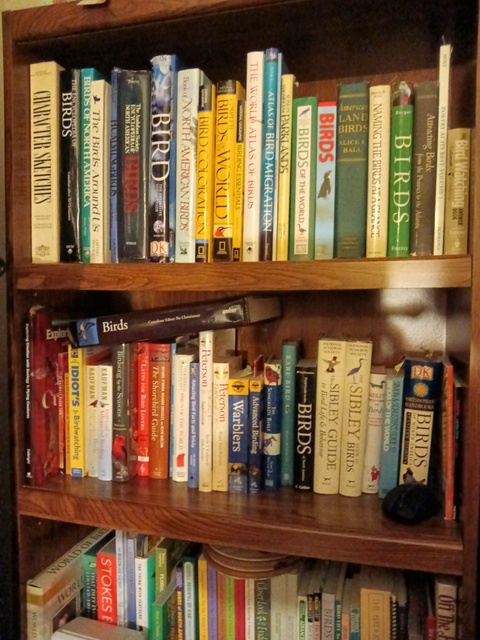
When we started this, we may have had one or two birdwatching books. Today, my bookshelves, at least three of them. have these books waiting on me to find new and interesting bird facts. I wonder what amazing information could be gleaned about God’s Creative Handiwork at work on the birds? Huh??
Bird Books in Library
We now have additional writers that would also be willing to contribute more articles. (I will invite them to join in this.)
When was the first bird created? (Genesis 1:20)
What day was that? (Genesis 1:23)
Who named the first birds? (Genesis 2:19)
What were the names of first bird species listed in the Bible? (Genesis 8:7, 8)
Did birds come from dinosaurs?
Do you know? Want to find out more? Leave me a comment. Stay tuned!
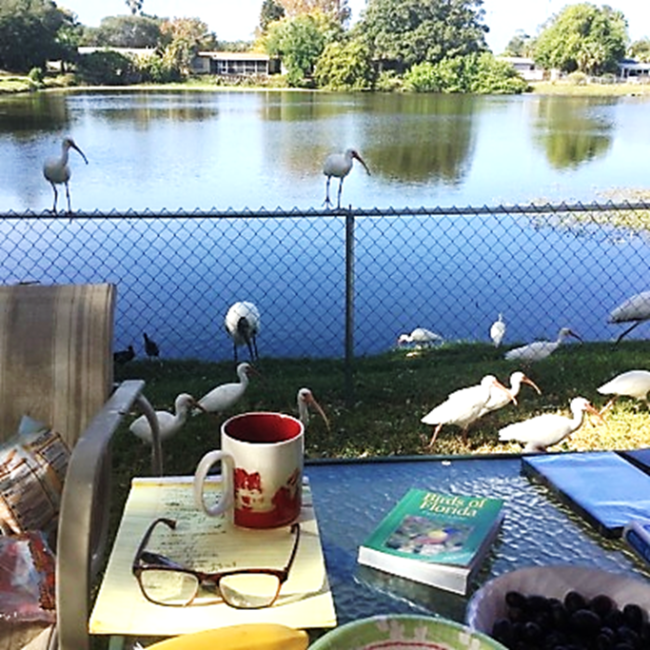
As reported in 2 recent blogposts — ( see https://leesbird.com/2023/01/20/florida-pond-shore-report-part-1/ and https://leesbird.com/2023/01/23/florida-pond-shore-report-part-2/ ) — the pond-shore birds were plentiful (except not ducks, for some odd reasons) in St. Petersburg, Florida, at the home of Chaplain Bob and Marcia Webel, on the morning of Monday, January 16th (A.D.2023, as Chaplain Bob and I sat in lawn chairs in the Webels’ backyard that adjoins the pond-shore (of what Floridians call a “lake”), drinking our coffee (and eating toasted rye bread).
In that prior-reported blogposts I described reported (in Part 1) seeing Bald Eagle, White Ibis, and Common Grackle, as well as seeing (in Part 2) Great Blue Heron, Great White Egret, and Double-crested Cormorant.
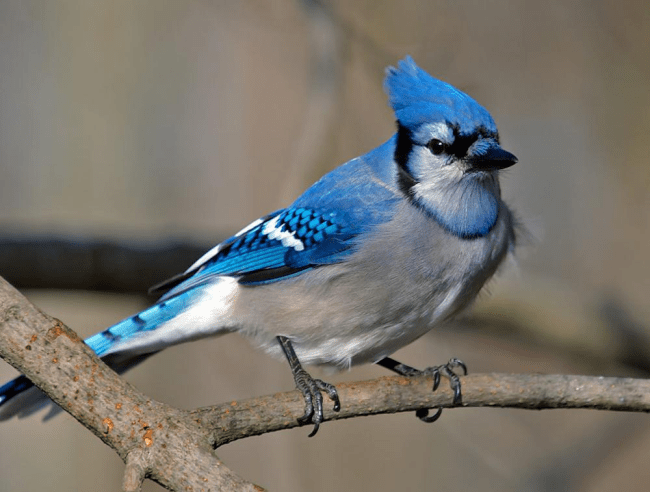
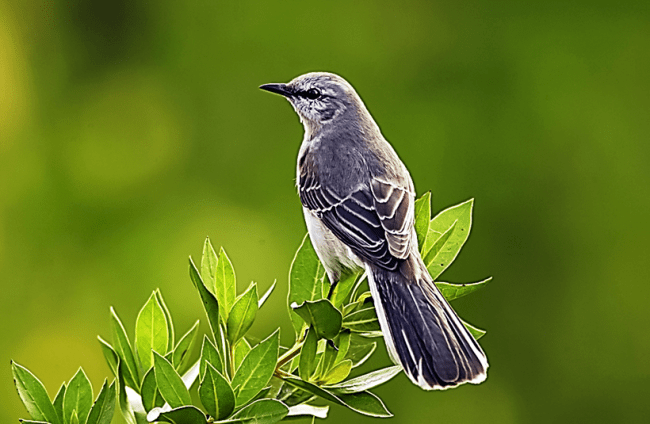
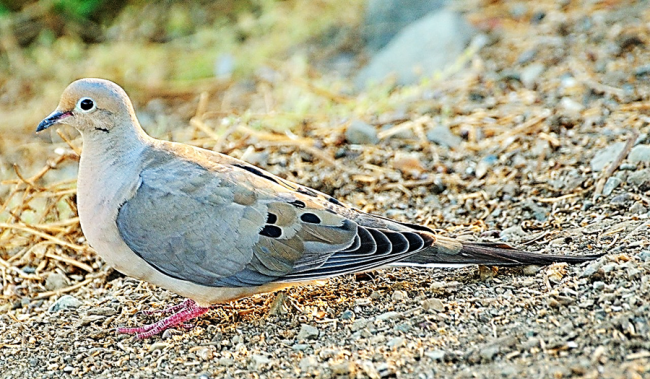
In this report (Part 3) the birds to be featured are Snowy Egret,Mockingbird, Mourning Dove, and Blue Jay.
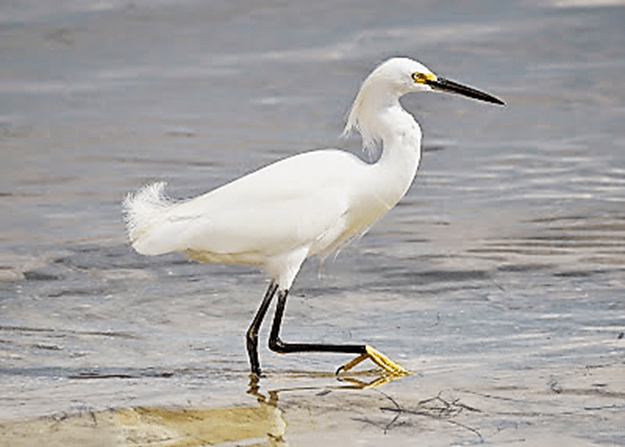
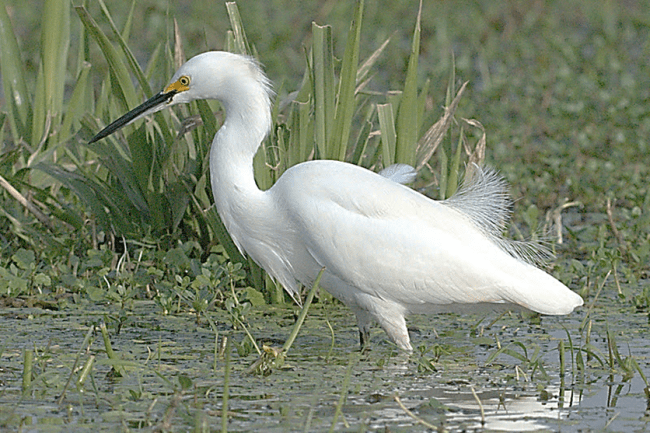
SNOWY EGRET in St. Petersburg (Joan and Dan’s Birding Blog image, q.v.)
SNOWY EGRET. The Snowy Egret has previously been described on this blog by ornithologist Lee Dusing, documenting this splendidly plumed wader (seen in St. Petersburg), in her blogpost “Walking Snowy Egret Showing Off Yellow Feet”, posted at https://leesbird.com/2019/01/04/walking-snowy-egret-showing-off-yellow-feet/ , on January 4th of A.D.2019, — as well as in “’E’ is for Egrets and Emus: ‘E Birds’, Part 2” (posted at https://leesbird.com/2016/11/08/eis-for-egrets-and-emus-e-birds-part-2/ , on November 11th of AD2018). Snowy Egrets (Egretta thula) are reported to hybridize with Little Egret (Egretta garzetta) and Cattle Egret (Bubulcus ibis), according to Eugene M. McCarthy, HANDBOOK OF AVIAN HYBRIDS FO THE WORLD (Oxford, UK: Oxford University Press, 2006), pages 189-191. The Snowy Egret, as a member of the “heron-egret” subfamily Ardeinae, is a distant “cousin” to the Great White Egret that is described in “Egret Feathers, Worth More than Gold!” (posted at https://leesbird.com/2018/08/17/egret-feathers-worth-more-than-gold/ , dated August 17th of AD2018).
NORTHERN MOCKINGBIRD ( U.S. Fish & Wildlife Service image / Wikipedia, q.v.)
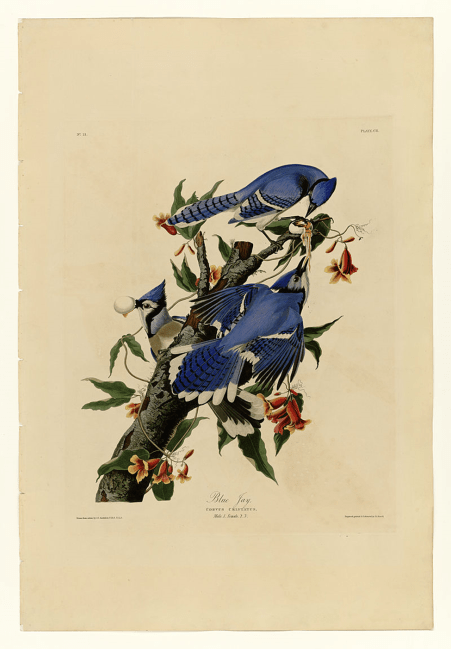
BLUE JAY (John James Audubon painting, ~AD1830s / public domain)
BLUE JAY. The Blue Jay, which can be a neighborhood bully, has been described on this birding blog – see “Bird Brains, Amazing Evidence of God’s Genius”, posted on March 7th of AD2013 (at https://leesbird.com/2013/03/07/48484/ ). When ranges overlap, such as in Rocky Mountain states, Blue Jays sometimes hybridize with Steller’s Jays — see “Jaybirds Mix It Up in Colorado”, posted on November 12th of AD2018 (at https://leesbird.com/2018/11/12/jaybirds-mix-it-up-in-colorado/ ). The behavioral habits of Blue Jays, which include eating sunflower seeds, are noted within the poetic blogpost titled “Here’s Seed for Thought”, posted on July 4th of AD2015 (at https://leesbird.com/2015/07/04/heres-seed-for-thought/ ). Another jaybird adventure that comes to mind is the birdwatching joy (on July 7th of AD2006, with my wife, while approaching a rural restaurant) of seeing a Eurasian Jay in a wooded field outside of Porvoo, Finland – see “Eurasian Jay: ‘Jay of the Oaks’ Admired in Finland”, posted on October 10th of AD2016 (at https://leesbird.com/2016/10/10/eurasian-jay-jay-of-the-oaks-admired-in-finland/ ). Truly amazing!
Meanwhile, the other pond-shore visiting birds — i.e., Florida Gallinule (a/k/a Common Moorhen), Anhinga (a/k/a Snakebird), Tufted Titmouse, Limpkin, Red-bellied Woodpecker, and Muscovy Duck (the last being seen on grass of neighbor’s front-yard) — on the morning of Monday, January 16th of A.D.2023), must wait for another day to be reported here, Deo volente. Thank the Lord for such good memories!
Also, thanks be unto the LORD for His creative and artistic bioengineering as our great Creator, including His Creatorship as exhibited in His making of Snowy Egrets (like the one below shown) and of all of Earth’s other magnificent birds!
><> JJSJ profjjsj@aol.com
SNOWY EGRET (Rich Vial / Clearly Confused Blog photo credit)
And the stork, theheron [הָאֲנָפָ֖ה] after her kind, and the lapwing, and the bat.
Leviticus 11:19
As reported last Friday — ( see https://leesbird.com/2023/01/20/florida-pond-shore-report-part-1/ ) — the pond-shore birds were plentiful (except not ducks, for some odd reasons) in St. Petersburg, Florida, at the home of Chaplain Bob and Marcia Webel, on the morning of Monday, January 16th (A.D.2023, as Chaplain Bob and I sat in lawn chairs in the Webels’ backyard that adjoins the pond-shore (of what Floridians call a “lake”), drinking our coffee (and eating toasted rye bread). In that prior-reported blogpost I described the Bald Eagle, White Ibis, and Common Grackle. This report (“Part 2” in this series) will feature the Great Blue Heron, Great White Egret, andDouble-crested Cormorant.
GREAT BLUE HERON in Florida (Terry Foote image / Wikipedia image, q.v.)
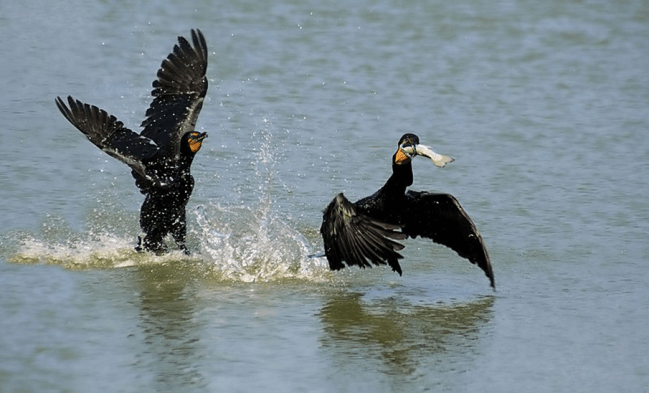
DOUBLE-CRESTED CORMORANT, 1 with a fish (Brocken Inaglory image / Wikipedia, q.v.)
DOUBLE-CRESTED CORMORANT. The Double-crested Cormorant has previously been described on this birdwatching blog – see “Of Cormorants and Anhingas” (posted on June 13th of A.D.2019, at https://leesbird.com/2019/06/13/of-cormorants-and-anhingas/ ). See also Lee Dusing’s interesting report on cormorants, “Birds of the Bible – Cormorant”, posted June 26th of A.D.2008, at https://leesbird.com/2008/06/26/birds-of-the-bible-cormorant/ — which includes video footage of domesticated cormorant fishing in China. Amazing!
Meanwhile, the other pond-shore visiting birds — i.e., Mockingbird, Mourning Dove, Blue Jay, Snowy Egret, Common Moorhen (a/k/a “Florida Gallinule”, Anhinga, Tufted Titmouse, Limpkin, Red-bellied Woodpecker, and Muscovy Duck (the last being seen on grass of neighbor’s front-yard) — on the morning of Monday, January 16th of A.D.2023), must wait for another day to be reported here, Deo volente. Thank the Lord for ssuch good memories!
I would seek unto God, and unto God would I commit my cause, Who doeth great things and unsearchable, marvelous things without number … Who doeth great things past finding out; yea, and wonders without number.
“I will open rivers in high places, and fountains in the midst of the valleys: I will make the wilderness a pond of water, and the dry land springs of water.”
(Isaiah 41:18)
Wow! What a morning birdwatching in St. Petersburg, Florida, at the home of Chaplain Bob and Marcia Webel, good Christian friends (of mine) since the early A.D.1970s (and good friends of my wife, years later). On the morning of Monday, January 16th (A.D.2023) we sat in lawn chairs inside the backyard that borders a near-the-bay pond (i.e., what Floridians call a “lake”), drinking our coffee (and eating toasted rye bread), enjoying the privilege of observing the following birds:
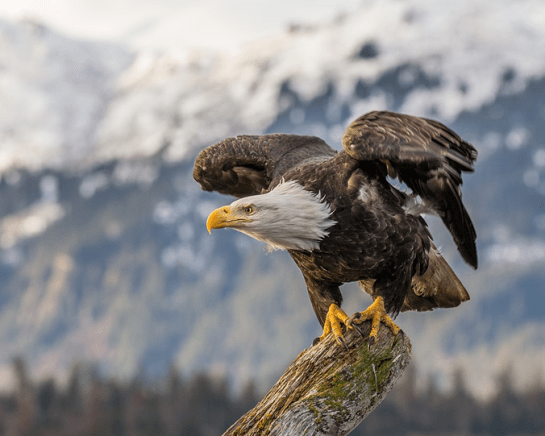
BALD EAGLE (Wikipedia image)
Bald Eagle. When a Bald Eagle fly to the top branches of a pond-shore tree the smaller birds fled, yielding to the eagle’s raptor reputation. All American patriots know the Bald Eagle, our national bird. The heads and necks (of both male adults and female adults) are covered with bright white feathers, giving it the appearance of being “bald” (from a distance). [See John Bull & John Farrand, Jr., NATIONAL AUDUBON SOCIETY FIELD GUIDE TO NORTH AMERICAN BIRDS: EASTERN REGION, revised edition (New York, NY: Alfred A. Knopf, 1994), pages 321-322 & 423-424.] These heavy hawk-like raptors love to eat fish, so it is not surprising to see them at and near seashores, lakeshores, estuarial bays and riverbanks, and similar shorelines where fish are readily available. [See Roger Tory Peterson, PETERSON FIELD GUIDE TO BIRDS OF WESTERN NORTH AMERICA, 5th edition (Boston, MA: HarperCollins, 2020), page 178.]
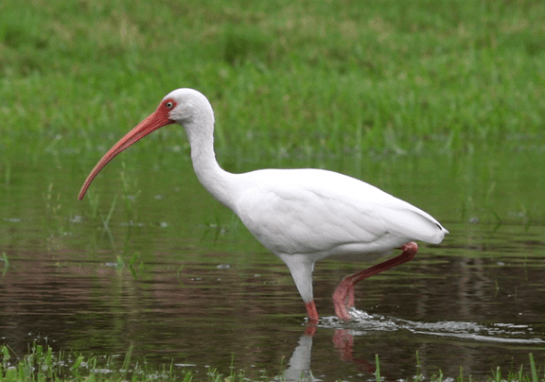
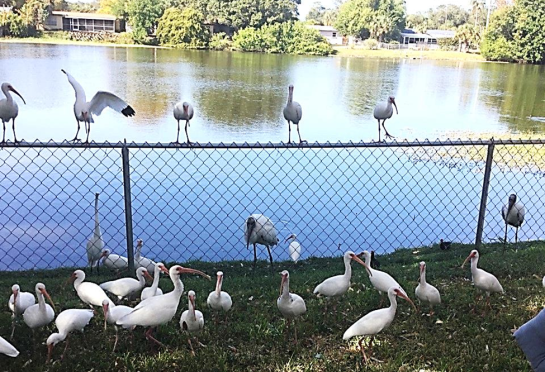
WHITE IBIS (Wikipedia image)
White Ibis. Although wild, these happy-to-eat-bread birds are noticeably bold in their willingness to approach humans who feed them bread crumbs. (In some Florida pond-shore park contexts they will literally eat bread morsels from human hands.) White Ibises are a long-legged chicken-sized waterfowl, almost all white (yet has black under-edging on its wings), with a long decurved (i.e., downward-curved) bill that is reddish (vermillion-orange/coral-red) in color. These wading birds enjoy eating critters that inhabit pond-shore waters, such as crayfish, small fishes, and aquatic insects. [See John Bull & John Farrand, Jr., NATIONAL AUDUBON SOCIETY FIELD GUIDE TO NORTH AMERICAN BIRDS: EASTERN REGION, revised edition (New York, NY: Alfred A. Knopf, 1994), pages 12 & 376.] These white waterfowl are known to hybridize with Scarlet Ibis. [See Eugene M. McCarthy, HANDBOOK OF AVIAN HYBRIDS OF THE WORLD (Oxford, UK: Oxford University Press, 2006), page 192.]
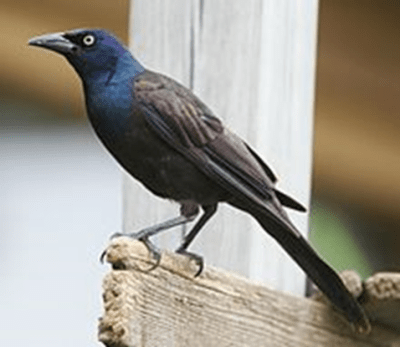
COMMON GRACKLE (Wikipedia image)
Common Grackle. Although I was originally inspired by a Great-tailed Grackle (at a pond-shore in Denton County, Texas) to write “Of Grackles and Gratitude”, in the July AD2012 issue of ACTS & FACTS ( posted at www.icr.org/article/grackles-gratitude ), the grackles that I saw in St. Petersburg, in the backyard by the pond-shore, were Common Grackles (varieties of which include “Purple Grackle” and “Florida Grackle”). Their glossy-black iridescent plumage shimmers in the sunlight, like a kaleidoscope of gleaning flickers of indigo, deep purple, peacock blue, midnight blue, dark bronze-brown, and emerald green. [See John Bull & John Farrand, Jr., NATIONAL AUDUBON SOCIETY FIELD GUIDE TO NORTH AMERICAN BIRDS: EASTERN REGION, revised edition (New York, NY: Alfred A. Knopf, 1994), pages 479 & 735.]
Other birds that we (i.e., Chaplain Bob Webel and I, while our wives chatted inside the Webels’ house) observed that morning, at or near the pond-shore, included Great White Egret, Great Blue Heron, Double-crested Cormorant, Mockingbird, Mourning Dove, Blue Jay, Snowy Egret, Common Moorhen, Anhinga, Tufted Titmouse (on a tree near the pond-shore), Limpkin (foraging near a group of ibises), Red-bellied Woodpecker (on oak branches by the pond-shore), plus later 3 Muscovy Ducks were seen waddling about on the grass of a neighbor’s front-yard. Besides birds, a playful (and very large) River Otter relaxed on the opposite shore of the pond, while several Eastern Grey Squirrels darted here and there on the ground and on the trunk and branches of nearby trees.
But the details of those other shoreline-visiting birds must await future blogposts (D.v.), because this one is almost finished.
Meanwhile, what a privilege it is to observe—close-up—God’s winged wonders, including those seen last Monday.
“Praise the Lord from the earth, … beasts, and all cattle; creeping things, and flying fowl.”
Drop a comment and help decide which to use. For today’s article, I stuck with “Looking Back.”
To begin this series, I found all the post that looked back over the Anniversaries of Lee’s Birdwatching Adventures Plus. If you scan through them, you will discover why it was started and how the Lord has been blessing it over the years. As different writers began adding articles, photographers gave permission to use their photos, and linked their websites, the blog has continued to grow.
To everything there is a season, and a time to every purpose under the heaven. (Ecclesiastes 3:1)
KONICA MINOLTA DIGITAL CAMERA
RED-COCKADED WOODPECKER (Carolina Bird Club photo)
Woodpeckers are famous for eating insects—beetles, caterpillars, “grubs” (insect larvae), spiders, ants, etc.—as well as occasionally eating berries and other fruits. But what about vitamins and minerals, how do woodpeckers get what they need?
Consider this: when you eat eggs—boiled, poached, or as omelets—do you discard the eggshells? Likewise, if you eat trout or turkey, do you recycle your fish or fowl bones?
Some birds and mammals eat broken eggshells or snail shells to get nutritionally valuable calcium.[1] Also, some birds—such as Red-cockaded woodpeckers[2] and Alaskan sandpipers[3]—munch on bones, to get calcium, especially during breeding season.
Getting calcium (usually from calcium carbonate: CaCO3) is needful, of course, but how do birds know they need calcium, especially during the breeding season?
A related question: how do expectant human mothers, who suddenly crave finfish or shellfish (or pickles, or Buffalo hot wings, or whatever) know that they need a nutritional change, while their physiologically transformed womb-factories busily build beautiful babies?
God somehow provides an urge to eat certain foods that we need, when we need those foods—this is something we gained by so-called evolutionary “luck” or random “chance”! In fact, successful reproduction of populations, whether they be human or animal, is something that is unfixable if reproduction is ever broken. (In other words, true extinction is forever—there are no second chances!)
Actually, calcium nutrition-satisfying behavior makes sense, biblically, because it helps Christ’s creatures to reproduce successfully, i.e., to “be fruitful and multiply”, so their kinds can “fill” (populate) Earth’s habitats. Thus, learning how creatures fulfill the Genesis Mandate helps us to “cast down” haughty imaginations (2nd Corinthians 10:4-5), such as the imaginations of Darwinists, who try to replace Christ with animistic “nature-creating-itself” mythology, masquerading falsely as “science” (1st Timothy 6:20)–as if inanimate “nature” could somehow “select” helpful results for promoting life on Earth!
During Creation Week (on Day #5, to be exact), the Lord Jesus Christ (as Creator[4]) commanded birds to reproduce (and “fill” environments); He also equipped them with what they need, to do so. Many of the intricate details we are just now learning.
Further complicating matters, successful reproduction requires a harmony of physical traits (biochemically regulated by genetics/epigenetics) with decision-based behaviors (which rely upon learning, by the non-physical “soul” of a bird). The details of successfully blending physical body systems, with non-physical learned behaviors, is one of the “wonders without number” (Job 9:10) that we can admire God for, as we reverently study how God’s creatures live.[5]
Of course, when creatures purposefully search local habitats for needed nutrients—including vital minerals like calcium—they exhibit continuous environmental tracking (CET), as they hunt and select what they need from their territory. Thus, Christ equipped animals to actively select what they need, from their habitats—it is not true that habitats “select” or “shape” passive animals.[6]
So, what can we learn from our Lord Jesus Christ’s red-cockaded woodpeckers (Picoides borealis), that recycle calcium from collected bone fragments, consuming bone flakes just before and when they are laying eggs?
The females took bone fragments from raptor pellets located on the ground. … Small bone fragments were consumed at the pellets whereas larger pieces were taken to a tree trunk (by flight) where they were pecked and mandibulated. … Pieces of bone were cached by placing them between scales of [tree-trunk] bark and then hammering them with the bill until they were wedged. We confirmed that bones were cached by recovering two pieces of bone from trees and by observing birds recover cached bones, handle them and cache them elsewhere.2
Repasky, Blue, & Doerr article cited in endnote 2 (below)
Selecting and ingesting bone-pecked calcium is targeted and purposeful—not random—because mother woodpeckers seek and extract calcium from bone fragments during breeding seasons (hiding bone fragments for later “snacks”), mostly ignoring those bones when they cease producing eggs2,4,5—amazing!
Darwinian trial-and-error “luck” cannot explain how these wise woodpeckers know to hunt and ingest calcium-rich bone flakes, timed to egg-producing seasons.4,5 However, the Lord Jesus Christ is the Mastermind of purposeful timing for all of His creation (Ecclesiastes 3:1), including female red-cockaded woodpeckers.
RED-COCKADED WOODPECKERS (James Audubon watercolor — public domain)
REFERENCES
[1] E.g., Mary Straus, “Calcium in Homemade Dog Food”, WHOLE DOG JOURNAL (May 28, 2019), at http://www.whole-dog-journal.com/food/calcium-in-homemade-dog-food/ (calcium from eggshells). See also Samuel L. Beasom & Oliver H. Pattee, “Utilization of Snails by Rio Grande Turkey Hens”, JOURNAL OF WILDLIFE MANAGEMENT, 42:916-919 (1978).
[2] Richard R. Repasky, Roberta J. Blue, & Philip D. Doerr, “Laying Red-cockaded Woodpeckers Cache Bone Fragments”, THE CONDOR, 93(2):458-461 (1991). Red-cockaded woodpeckers resemble 4 other American woodpeckers, the Ladder-backed Woodpecker, Downy Woodpecker, Hairy Woodpecker, and Nuttall’s Woodpecker. It appears that Red-cockaded Woodpeckers can hybridize with Hairy Woodpeckers (Picoides villosus), which in turn hybridize with Ladder-backed Woodpeckers (Picoides scalaris), which hybridize with Downy Woodpeckers (Picoides pubescens) and with Nuttall’s Woodpecker (Picoides nuttallii). See Eugene M. McCarty, HANDBOOK OF AVIAN HYBRIDS OF THE WORLD (New York, NY: Oxford University Press, 2006), pages 107-108.
[3] Stephen F. MacLean, Jr., “Lemming Bones as a Source of Calcium for Arctic Sandpipers (Calidris spp.)”, IBIS (INTERNATIONAL JOURNAL OF AVIAN SCIENCE), 116:552-557 (1974).
[4] See John 1:1-10 & Colossians 1:16-17 & Hebrews 1:1-2, etc.
[5] “Although qualitatively distinct from humans—who are made in God’s image (Genesis 1:27)—animals have what Scripture calls a “soul” (Hebrew nephesh). … But the resourcefulness of animals should not surprise us. Proverbs [30:24-28] informs us that God wisely installed wisdom into animals—even small creatures like ants, conies, locusts, and lizards. Literally, these animals are “wise from receiving [God’s] wisdom.”7 Fascinating!” Quoting James J. S. Johnson, “Clever Creatures: ‘Wise from Receiving Wisdom’”, ACTS & FACTS, 46(3):21 (March 2017).
[6] Randy J. Guliuzza, “A New Commitment to Deep Research”, ACTS & FACTS, 50(9):4-5 (September 2021).
RED-COCKADED WOODPECKER (Carolina Bird Club photo)








 Lee's Birdwatching Adventures Plus
Drop a comment and help decide which to use. For today’s article, I stuck with “Looking Back.”
To begin this series, I found all the post that looked back over the Anniversaries of Lee’s Birdwatching Adventures Plus. If you scan through them, you will discover why it was started and how the Lord has been blessing it over the years. As different writers began adding articles, photographers gave permission to use their photos, and linked their websites, the blog has continued to grow.