“And Ruth said, entreat me not to leave thee, or to return from following after thee; for where you go, I will go; and where you lodge, I will lodge: thy people shall be my people, and thy God my God. (Ruth 1:16)
“So God created great sea creatures and every living thing that moves, with which the waters abounded, according to their kind, and every winged bird according to its kind. And God saw that it was good.” (Genesis 1:21 NKJV)
The Procellariidae – Petrels, Shearwaters Family contains more than those two species of birds. You will be introduced to Giant Petrels, Diving Petrels, Petrels, Fulmars, Prions, and Shearwaters. The previous Petrels families shown were Storm Petrels (Oceanitidae and Hydrobatidae), and the Albatross (Diomedeidae) family also was presented. These four families make up the Procellariiformes Order. This Procellariidae group, being the largest, will take several weeks to be able to cover.
From Wikipedia – “The family Procellariidae is a group of seabirds that comprises the fulmarine petrels, the gadfly petrels, the prions, and the shearwaters. This family is part of the bird order Procellariiformes (or tubenoses), which also includes the albatrosses, the storm petrels, and the diving petrels.
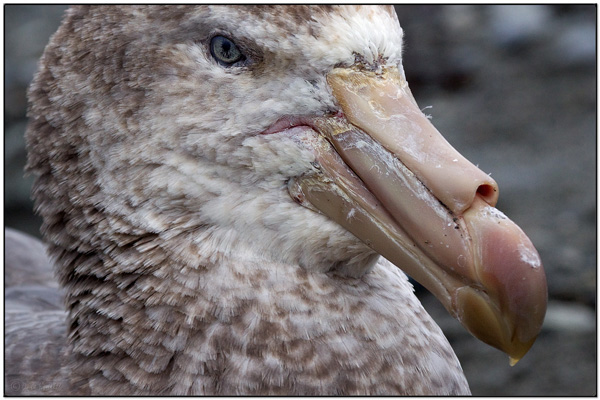
Northern Giant Petrel head close-up by Daves BirdingPix
The procellariids are the most numerous family of tubenoses, and the most diverse. They range in size from the giant petrels, which are almost as large as the albatrosses, to the prions, which are as small as the larger storm petrels. They feed on fish, squid and crustacea, with many also taking fisheries discards and carrion. All species are accomplished long-distance foragers, and many undertake long trans-equatorial migrations. They are colonial breeders, exhibiting long-term mate fidelity and site philopatry. In all species, each pair lays a single egg per breeding season. Their incubation times and chick-rearing periods are exceptionally long compared to other birds.
Many procellariids have breeding populations of over several million pairs; others number fewer than 200 birds. Humans have traditionally exploited several species of fulmar and shearwater (known as muttonbirds) for food, fuel, and bait, a practice that continues in a controlled fashion today. Several species are threatened by introduced species attacking adults and chicks in breeding colonies and by long-line fisheries.” (Wikipedia)
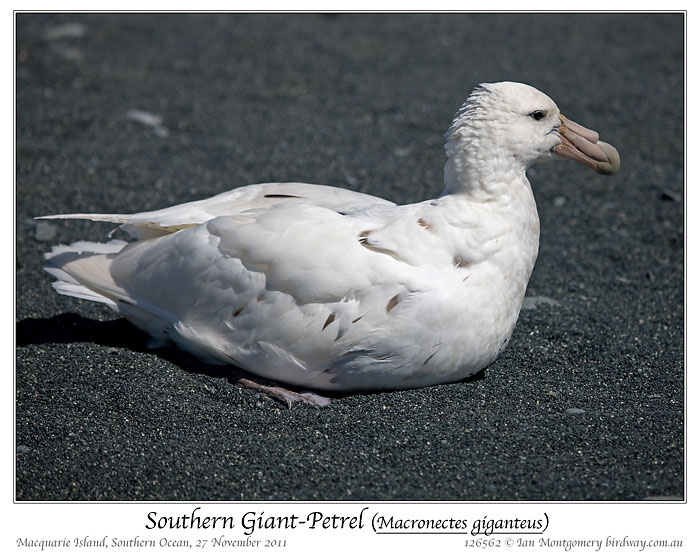
Southern Giant Petrel (Macronectes giganteus) by Ian
“Giant petrels form a genus, Macronectes, from the family Procellariidae, which consists of two species. They are the largest birds of this family. Both species are restricted to the Southern Hemisphere, and though their distributions overlap significantly, with both species breeding on the Prince Edward Islands, Crozet Islands, Kerguelen Islands, Macquarie Island and South Georgia, many southern giant petrels nest further south, with colonies as far south as Antarctica. Giant petrels are aggressive predators and scavengers, inspiring another common name, the stinker. South Sea whalers used to call them gluttons.”
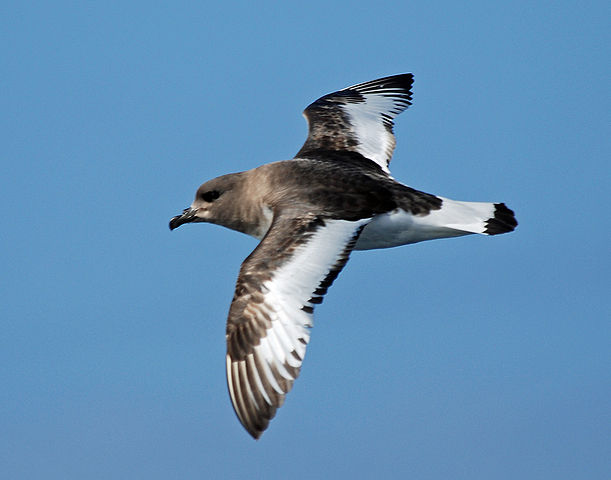
“The Antarctic petrel (Thalassoica antarctica) is a boldly marked dark brown and white petrel, found in Antarctica, most commonly in the Ross and Weddell seas. They eat Antarctic krill, fish, and small squid. They feed while swimming but can dive from both the surface and the air.”
Cape Petrel (Daption capense) by Ian
“The Cape petrel (Daption capense), also called the Cape pigeon, pintado petrel, or Cape fulmar is a common seabird of the Southern Ocean from the family Procellariidae. It is the only member of the genus Daption, and is allied to the fulmarine petrels, and the giant petrels. They are extremely common seabirds with an estimated population of around 2 million.”
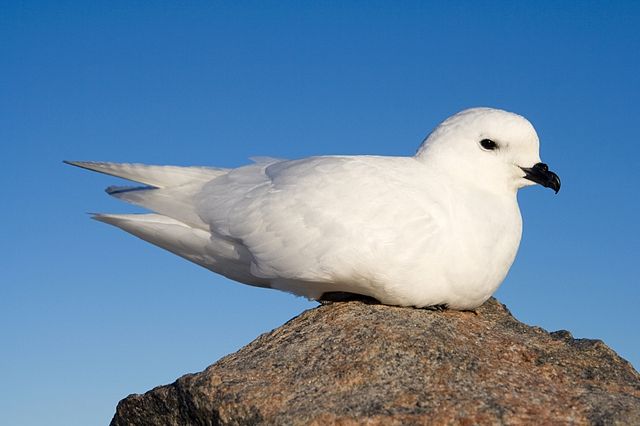
“The snow petrel (Pagodroma nivea) is the only member of the genus Pagodroma. It is one of only three birds that breed exclusively in Antarctica and has been seen at the geographic South Pole. It has the most southerly breeding distribution of any bird.
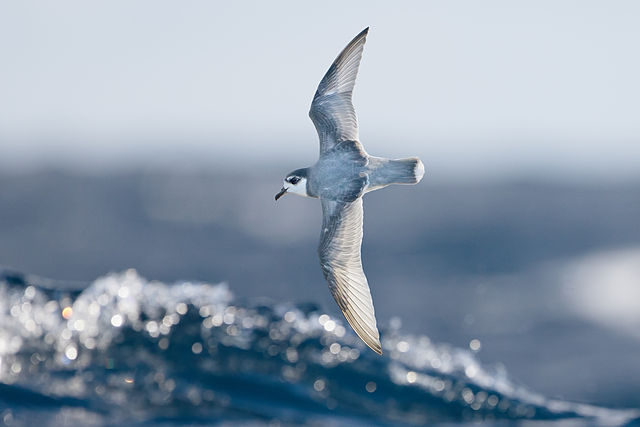
“The blue petrel (Halobaena caerulea) is a small seabird in the shearwater and petrel family Procellariidae. This small petrel is the only member of the genus Halobaena, but is closely allied to the prions.”
“Pachyptila is a genus of seabirds in the family Procellariidae and the order Procellariiformes. The members of this genus and the blue petrel form a sub-group called prions. They range throughout the southern hemisphere, often in the much cooler higher latitudes. Three species, the Broad-billed Prion (Pachyptila vittata), the Antarctic Prion (Pachyptila desolata) and the Fairy Prion (Pachyptila turtur), range into the subtropics.”
“The Kerguelen petrel (Aphrodroma brevirostris) is a small (36 cm long) slate-grey seabird. Kerguelen petrels breed colonially on remote islands; colonies are present on Gough Island in the Atlantic Ocean, and Marion Island, Prince Edward Island, Crozet Islands and Kerguelen Island in the Indian Ocean. The species attends its colonies nocturnally, breeding in burrows in wet soil. The burrows usually face away from the prevailing wind. A single egg is laid per breeding season; the egg is unusually round for the family. The egg is incubated by both parents for 49 days. After hatching the chick fledges after 60 days.”
[Quotes are from Wikipedia, with editing.]
This slideshow requires JavaScript.
*
“He alone spreads out the heavens, And treads on the waves of the sea;” (Job 9:8 NKJV)
“Wherefore she went forth out of the place where she was, and her two daughters in law with her; and they went on the way to return unto the land of Judah.” (Ruth 1:7)
“So they two went until they came to Bethlehem. And it came to pass, when they were come to Bethlehem, that all the city was moved about them, and they said, Is this Naomi? (Ruth 1:19)
Ian’s Bird of the Week/Moment – Red-tailed Black-Cockatoo by Ian Montgomery
The bird of the week has, regrettably, been so irregular over the last year or so, that I can’t pretend anymore that it’s a weekly event, or even a monthly one for that matter. These days we’re supposed to achieve peace of mind by living in the now, I’ve renamed the series Bird of the Moment.
In the last one on Macaws, I finished with this photo of a Scarlet Macaw feeding on an introduced Terminalia tree in Costa Rica and mentioned that the fruit of same species (T. cappata) is equally popular with Red-tailed Black-Cockatoos along The Strand in Townsville. Here is a pair with the male on the right whispering sweet phrases to the female two days before Valentine’s Day: she looks very receptive. You can see the female has spots on the head, barring on the body and a barred panels in the tail against a background of red and yellow. The male has glossy black plumage and scarlet, unbarred panels in the tail.
These Cockatoos are quite common in the Townsville District and for me, it was love and first sight when I arrived here in 2002. They are spectacular birds, very large (to 65cm/25in in length) with a wonderful leisurely ‘rowing’ flight, long tails and a permanent smile. They are often heard before being seen both when perched and in flight, owing to their haunting, far-carrying, trumpeting calls, which are positively melodious compared with the ear-shattering screeches of their ubiquitous white relatives, the Sulphur-crested Cockatoo. They’re remarkably tame too and seem to enjoy being photographed.
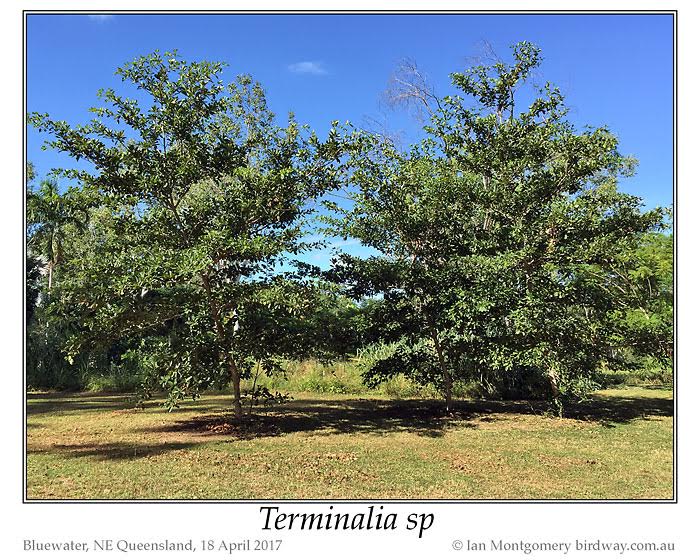
Terminalia grow readily from seedlings, and Jo Wieneke gave me some seedlings when I moved to Bluewater in 2013, which I planted with the sole aim of attracting these Cockatoos, above. These belong to a different species of Terminalia with smaller leaves and fruit. The fruit of T. cappata, the ‘Beach Almond’ are about the size of walnuts; these ones are more like smallish, hard, black olives. The three trees all lean to the left, a legacy of cyclone Yasi in 2011, called the ‘Yasi lean’. Since then the trees have tried to correct this defect by growing vertically at the base and the top – easiest to see in the left-most tree – and growing thicker branches on the right-hand side, presumably as a counter-balance.
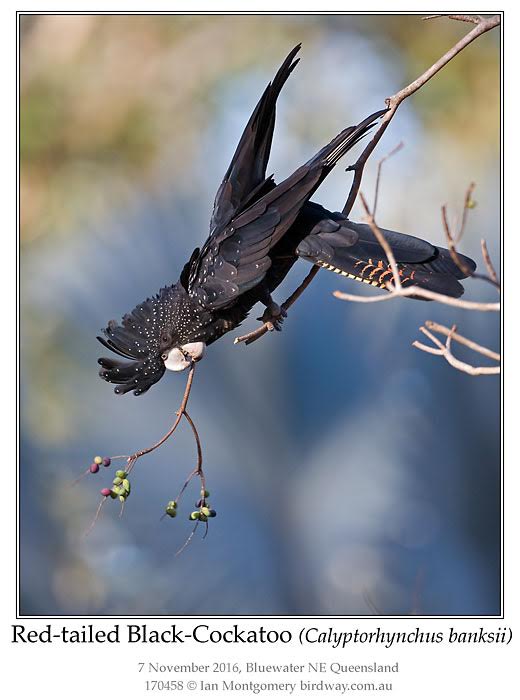
The trees started flowering and fruiting about three years ago, and I was delighted when they had their first visit from a lone Black-Cockatoo. Last November, the trees had an abundant harvest, and a pair of Cockatoos came each evening at about 4:30 pm (and maybe before I surfaced in the morning) and thoroughly until they had completely stripped all fruit. The birds are wonderfully acrobatic (below) and their preferred way of eating is to snip off a twig, hold it in one foot, stand on the other foot, prise open the hard shell to get at the kernel in the middle and discard both the shells and the twigs.
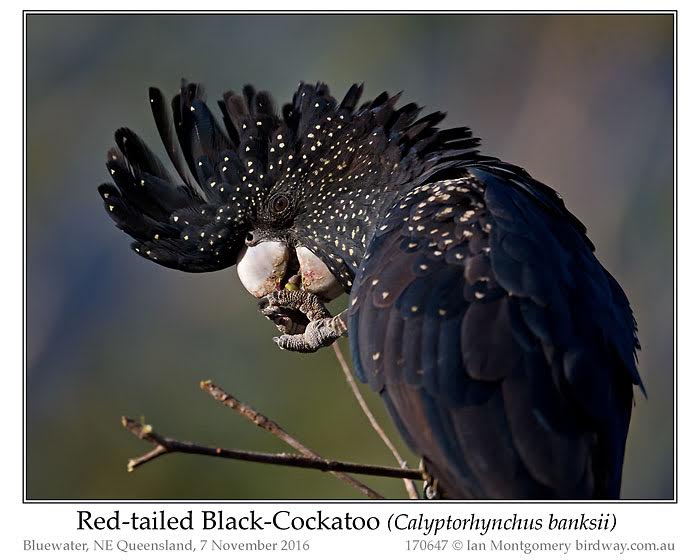
The shells are quite hard and I cut one open to see what was inside and found the kernel is tiny, so it seemed like a lot of effort for a relatively small reward. In the photo below, the male is using the pointed tip of the upper mandible to extract the kernel from the cracked shell. They drop a lot of unopened fruit and several months later a small flock of cockatoos came round to feed on the ground under the trees.
The coloured panels on the tail are not easy to see except when the birds spread the tail feathers, either when taking off, landing or doing a sudden manoeuvre in flight. Presumably, it is an important signal to other members of the flock. Black-Cockatoos seem to form long-term pair-bonds which are maintained even when they flock, so I wonder whether the variability in the colour of the panels of females (the one below has much red and little yellow) help the males identify their mates.
The next photo shows a male just after take-off and showing his red panels to best advantage.
Here is a female on the beach at Horseshoe Bay on Magnetic Island. She looks as if she’s contemplating a swim – you can see the edge of the water in the background – but it is more likely that she is looking for fruits from the casuarinas growing along the foreshore. In the absence of introduced Terminalia trees, the birds feed on the fruit of native trees including those of Eucalyptus and Pandanus.
The Red-tailed Black-Cockatoo is the most widespread of the five species of Black-Cockatoo, all of which are Australian endemic.s (I’m not including the Palm Cockatoo which belongs to a different genus and occurs in Cape York and across New Guinea.) The other four species are the Glossy (eastern Australia); the Yellow-tailed (eastern and southern Australia and Tasmania) and the Long-billed and Short-billed (both have white tails and are restricted to SW Western Australia). The Red-tailed has five subspecies which differ in size and in the colour of the tail panels in females: the largest, nominate race banksii (Queensland and northern NSW); the large-billed macrorhynchus (Northern Territory and NW Western Australia); the smaller samueli in central Australia; also in (SW Western Australia); and graptogyne (western Victoria and SE South Australia).
The three birds in the last photo belong to the large-billed race macrorhynchus, and presumably are a family with the female on the left and the male on the right. The bird in the centre has female-like plumage but a black bill – females have whitish bills – so is probably a juvenile male; juvenile males take about four years to acquire the adult male plumage. Family bonding would appear to be important and you often see these birds in groups of three.
I’ve been slack about the Bird of the Moment; I have however been working on the website. The latest inclusions include a gallery of Dragonflies and one of Butterflies and Moths, and there are various additions to the bird galleries.
Greetings,
Ian
Lee’s Addition:
“Oh that men would praise the LORD for his goodness, and for his wonderful works to the children of men!” (Psalms 107:8 KJV)
Thanks, Ian, for an update. I had begun to think you were not able to provide any more of these great articles for us. You are missed when we fail to hear from you.
It appears that the series of blog posts of Ian’s will be renamed. Starting with his next article, the title will be “Ian’s Bird of the Moment.” It is an appropriate name for the series, as most birdwatchers are watching “birds of the moment.”
Not sure if you readers were aware, but Ian has been dealing with a serious eye problem. That is difficult for such a good photographer to deal with. Glad he is improving so he can keep us informed about God’s amazing flying avian wonders.
“Then she arose with her daughters in law, that she might return from the country of Moab: for she had heard in the country of Moab how that the Lord had visited his people in giving them bread.” (Ruth 1:6)
“So Naomi returned, and Ruth the Moabitess, her daughter in law, with her, which returned out of the country of Moab: and they came to Bethlehem in the beginning of barley harvest.” (Ruth 1:22)
“Simon Peter saith unto them, I go a-fishing. They say unto him, We also go with thee. They went forth, and entered into a ship immediately; and that night they caught nothing. (John 21:3)
Once there was a chicken named Mae who lived on a small farm in the country. Mae lived on this small farm with many other animals who were her friends, but despite living in such a nice place, Mae was not happy. Every day the farmer would come into the henhouse to collect all of the eggs that the chickens laid, but Mae really wanted to have chicks of her own. One day Mae laid two eggs and promptly decided to hide them behind the henhouse. Mae searched for several good places to hide them, and finally decided to hide them inside the coils of a garden hose and cover the hose with a tarp to keep the eggs warm.
Mae checked her eggs every now and then to make sure they were safe. A couple of days later, however, Mae noticed some of the farmers hiding different colored eggs in several different places around the farm. Puzzled, Mae flapped over to one purple egg to see to whom it the egg might belong. After pecking at it, Mae was startled to see the egg pop open to reveal a small piece of candy.
Suddenly a large group of squealing children ran out into the yard. Mae was so frightened she flapped back into the safety of the hen house. She watched as the children began running around, searching for the colored eggs with candy inside them.
Mae eventually realized that each of the children was hunting for the eggs in order to obtain the candy inside each one. Confused at the overall purpose, Mae decided to stay inside the hen house while the children tried to find the rest of the eggs.
Eventually, Mae waddled outside the hen house to check on her eggs, but when she walked behind the hen house she noticed that the tarp had been cast aside and her eggs were gone. Mae began frantically searching for her eggs, but they were nowhere to be found. The only eggs she found were the brightly colored eggs filled with candy. Mae searched all over the farm to find her two eggs, but they had disappeared.
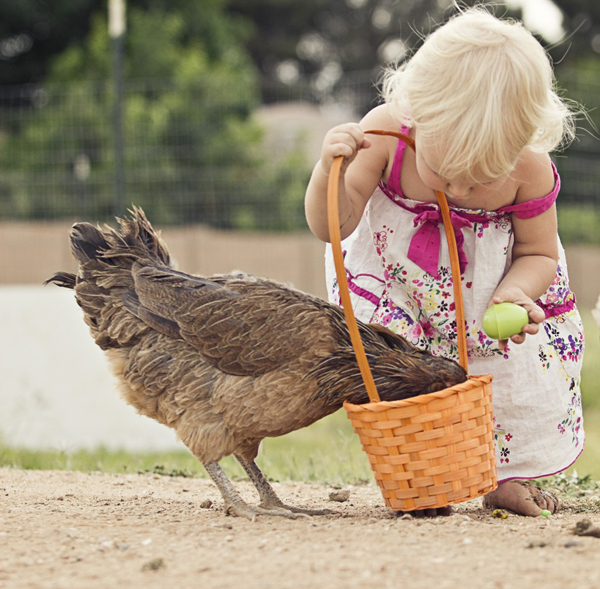
Mae grew very upset because she couldn’t find her eggs, so upset that she barely noticed a group of children gathering around a girl’s Easter basket. Mae started to walk past them, but she heard a small cracking sound, followed by cries from the children. Mae fluttered over to where the children stood and saw her eggs in the basket. One of the eggs was shaking while another was almost completely open. All of a sudden the egg hatched open to reveal a tiny chick. The chick peeped loudly and gazed at its new surroundings. Mae was so happy she started clucking noisily, and the children quickly drew back because they thought she was angry at them for accidentally taking her chicks, thinking they were Easter eggs.
The other chick hatched out of his egg and quickly found its mother like the first chick. Carefully pulling her chicks out of her Easter basket, Mae guided her chicks toward the henhouse, grateful that she had found them and that they were safe. Mae came back from the henhouse, however, after her chicks were safe inside, and showed the children who had watched her chicks hatch where the rest of the Easter eggs were. Mae had done so much searching she was able to find other eggs that the rest of the children hadn’t seen. She decided to show them the eggs as a way of saying thank you, which made the children very happy. From then on Mae looked forward to the Easter egg hunt that came once a year, and every year she told her chicks the story of how they hatched in an Easter basket.
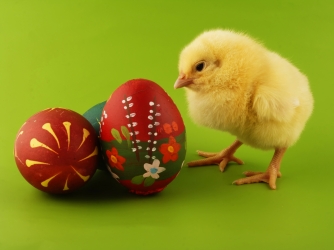
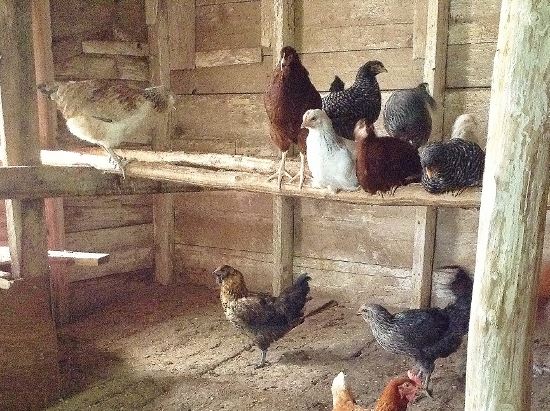
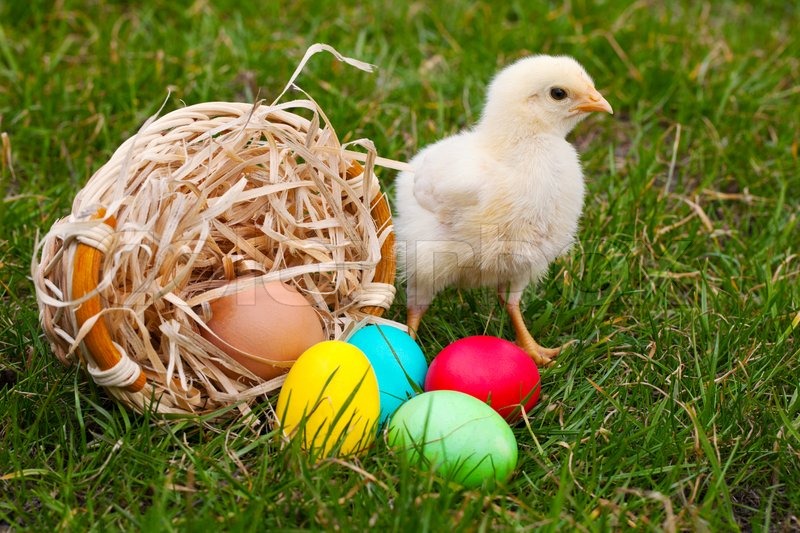
Emma, thank you for another delightful Bird Tale. Mae is quite an adventurous hen. Trust these added photos help illustrate Mae’s surprise of finding her new chicks in an Easter Basket.
Mae also reminds us that we should not be come overly concerned as Christians.
“Take therefore no thought for the morrow: for the morrow shall take thought for the things of itself. Sufficient unto the day is the evil thereof.” (Matthew 6:34 KJV)
“And which of you with taking thought can add to his stature one cubit?” (Luke 12:25 KJV)
“And God saw every thing that he had made, and, behold, it was very good. And the evening and the morning were the sixth day.” (Genesis 1:31 KJV)
These animals show such kindness to other animals. May they remind us to show kindness to those around us; to critters and especially our human acquaintances.
“And to godliness brotherly kindness; and to brotherly kindness charity.” (2 Peter 1:7 KJV)
“For his merciful kindness is great toward us: and the truth of the LORD endureth for ever. Praise ye the LORD.” (Psalms 117:2 KJV)