“A” is for Accipiter and Alcid: “A” Birds, Part 2

“A” is for Accipiter and Alcid:  “A” Birds, Part 2

Dr. James J. S. Johnson

There is a way that seems right to a man, but its end is the way of death. (Proverbs 14:12)

(Patience!  The relevance of this verse will be noted near the end of this article.)

As noted in Part 1 (of the “A” Birds review), “A” is for Avocets, Albatrosses, Accipiters, and Alcids (including Auklets and the Atlantic Puffin), — plus Antbirds and a few other birds omitted here.   This study now continues (after having reviewed Avocets and Albatrosses) with 2 categories of birds that start with the letter “A, Accipiters and Alcids.

SHARP-SHINNED HAWK (Accipiter striatus)

What are some of the accipiters hawks, also called “bird hawks”? 

One example of an accipiter is the Northern Goshawk (Accipiter gentilis), depicted below.

Northern Goshawk - Juvenile (brown) adults (grey)

Northern Goshawk (Accipiter gentilis) ©WikiC

Northern Goshawk (Accipiter gentilis) ©WikiC

[Northern Goshawk: juvenile (brown) & adults (grey)]

Accipiter” is an avian category term used for grouping similar bird-eating  hawks, the so-called “bird hawks” (many of these slim raptors are known as sparrow-hawks or goshawks), such as Northern Goshawk (Accipiter gentilis), Cooper’s Hawk (Accipiter cooperii), and Sharp-shinned Hawk (Accipiter striatus).

Regarding accipiter hawks, the eminent ornithologist Roger Tory Peterson says: “Long-tailed woodland raptors with rounded wings [and long tails, which they use a rudders for steering quick turns], adapted [i.e., designed by God] for hunting among the trees.  Typical flight consists of several quick beats and a glide … [chiefly eating] birds, [plus] some small mammals.” [Quoting Roger Tory Peterson, A Field Guide to Western Birds (Houghton Mifflin, 1990, 3rd edition; maps by Virginia Marie Peterson), page 172.]   Regarding the difference between the slim hawks grouped as “accipiters” and the larger high-soaring hawks called “buteos”, see Lee’s “Birds of the Bible: Hawks .

For specific information about Northern Goshawk (Accipiter gentilis), which appears on the flag of the Azores, see Flag that Bird! (Part 1)”.

Now for a representative of the accipiter hawks, the Cooper’s Hawk.
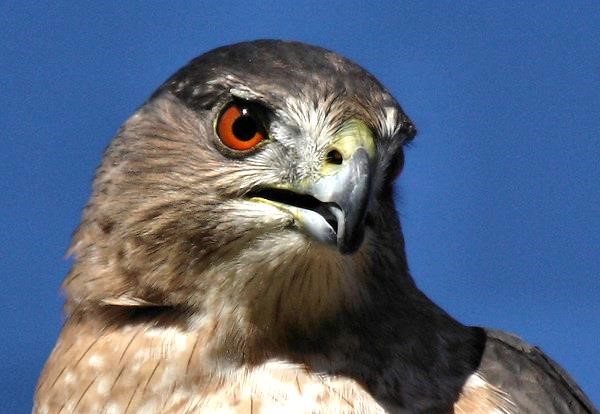
Cooper's Hawk (female) mug shot

[COOPER’S HAWK (female): “mug shot”]

For another “in-your-face” close-up view of a Cooper’s Hawk, showing the detail of its beak (profile view), see “Cooper’s Hawk” .

As shown in a Terry Sohl range map [which was deleted from this blog, at Terry Sohl’s insistence — because, being an atheist, he hated to see his map being used on a blog that honors God as the Creator], the permanent (i.e., year-round) range of the Cooper’s Hawk covers almost all America’s “lower 48” states, except that accipiter only stays for breeding in the northernmost states (Maine, New Hampshire, Vermont, most of New York, much of Michigan, northern Wisconsin,  most of Minnesota, North and South Dakota, Montana, some of northern Wyoming, the Idaho Panhandle, and northern Washington).  [NOTE: the above-referenced Terry Sohl range map is not shown here, because Mr. Sohl, as a self-described “hardcore atheist”, does not want his maps associated with a Christian blogsite.]

Cooper’s Hawks are stereotypical “bird hawks” (formerly called “chicken hawks” in some rural areas).  These aerial raptors rely upon surprise — mostly hunting, ambushing, snatching, and then eating, small and medium-sized birds, such as picids (woodpeckers, flickers, and sapsuckers), smaller corvids (jays), icterids (blackbirds, grackles, and orioles), galliforms (wildfowl such as quail, domestic chickens, grouse, bobwhites, pheasants, and Mexico’s wood partridges), columbids (doves, including pigeons), cuculids (cuckoos, roadrunners, anis), thrushes, (including robins), warblers, starlings, etc.  Supplementing their bird diet, Cooper’s Hawks (especially those in America’s West) are also known to capture and eat small rodents (squirrels, chipmunks, and mice), lagomorphs (rabbits and hares), and even bats.
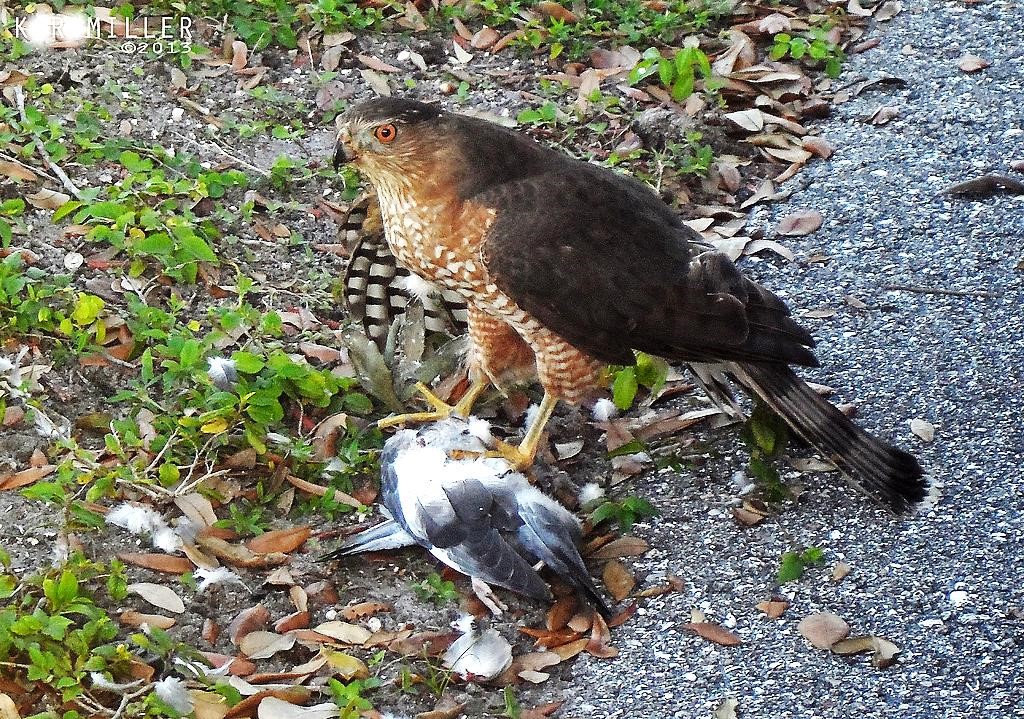
Accipiters and Alcids - Cooper's Hawk with caught bird

The Cooper’s Hawk (Accipiter cooperii) can live as long as 20 years, although its lifestyle usually shortens that lifespan – chest puncture impact/trauma injuries, occurring during a chase, are observed on carcasses of many of these accipiters.

Disappointingly, despite its noble name, is not named for England’s eminent scholar Dr. Bill Cooper.  (Actually, the hawk’s association with the name “Cooper” refers to an American naturalist named William Cooper, who lived in the late AD1700s and early AD1800s – some of his work was used by ornithologists John James Audubon, Charles Lucien Bonaparte, and others).  Regardless, it is worth noting, here, that Dr. Bill Cooper does allude to trained “hawks” as they (and pigeons) were used in festive pageantries during the falconry-adorned Dark Ages, when Great Britain suffered being deprived of Scripture accessibility, prior to the Protestant Reformation dawning under the helpful ministries of Dr. John Wycliffe,  Lollards, and William Tyndale.  [See William R. Cooper’s annotated translation of THE CHRONICLE OF THE EARLY BRITONS: Brut y Bryttaniait, (AD2002), at page 52, posted CLICK HERE 

Ironically, Cooper Hawk female adults are larger than their male counterparts.  Consequently, Cooper Hawk males demonstrate respect (seen in submissive body language) when approaching females.  However, communications are primarily a matter of vocalizations (with the male having a higher-pitched voice!), rather than body language, because the usual habitat of Cooper Hawks is visually crowded by trees and dense vegetation, so body gestures may not be practical for communicating except at short distances.

But now we turn, briefly, to introduce some seabirds called “alcids”.
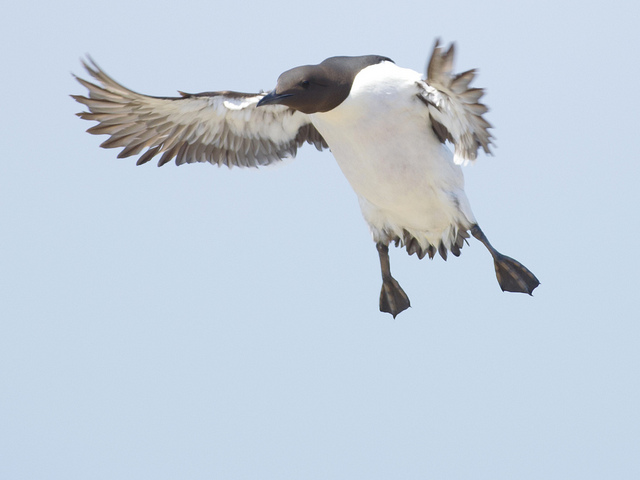
 

Black Guillemot (Cepphus grylle) ©FLickr Ray Morris
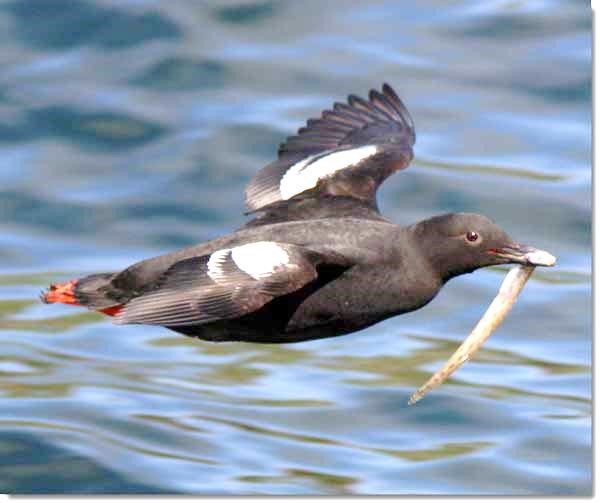
Pigeon Guillemot (Cepphus columba) ©USFWS

Pigeon Guillemot (Cepphus columba)

[guillemots: approaching beach for landing (T); carrying caught fish (B)]

Alcid” is an avian category term (previously called “auks”) used to denote another group of similar birds, i.e., the auk-like bird group that includes puffins (like the Atlantic Puffin, Tufted Puffin, and Horned Puffin); auklets (like Least Auklet and Cassin’s Auklet); murres (like Common Murre and Thick-billed Murre); murrelets (like Xantus’s Murrelet, Ancient Murrelet, Marbled Murrelet, and Guadalupe Murrelet); guillemots (like Common Guillemot and Black Guillemot); the Razorbill auk (2/3 of whom breed in Iceland); the high-arctic-island-dwelling Little Auk (a/k/a Dovekie), and the now-extinct Great Auk.

Alcids spend much time at sea, hunting seafood (usually small fish, though sometimes shrimp or other miniature sea creatures, such as baby squid), but they breed on coastal land (often in the crevices of or atop shoreline cliffs that are  not easily accessed by terrestrial predators) in fairly dense breeding colonies.   [E.g., for movie footage of a Canadian guillemot colony, to see the video posted CLICK HERE.

Atlantic Puffin Colony on Farne Islands, near England's Northumberland Coast

Atlantic Puffin colony on Farne Islands, near England’s Northumberland coast

For a listing of about 2 dozen alcids, with photographs (and some video footage), see Lee’s “Alcidae – Auks”.

Regarding alcids (a/k/a “auks”), the eminent ornithologist Roger Tory Peterson says: “The northern [hemisphere’s] counterparts of the [similarly piscivorous divers, yet much larger] penguins, but auks fly [in the air, as well as underwater], beating their small narrow wings in a whit, often veering.  They have short necks and pointed, stubby, or deep and laterally compressed bills.  Auks swim and dive expertly.  Most [alcid] species nest on sea cliffs in crowded colonies … [habitually eating] fish, crustaceans, [and sometimes a few] mollusks.” [Quoting Roger Tory Peterson, A Field Guide to Western Birds (Houghton Mifflin, 1990, 3rd edition; maps by Virginia Marie Peterson), page 32.]
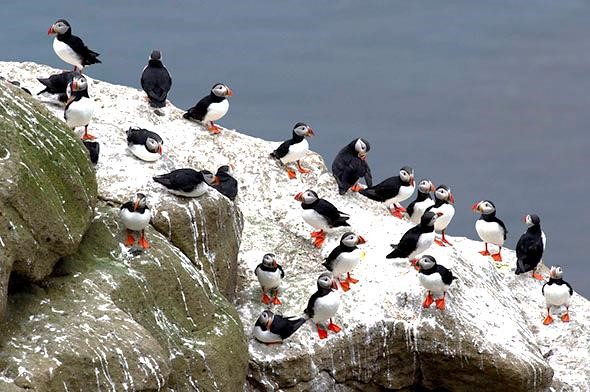
Puffins

Alcids have mostly black-and-white plumage, so they look superficially like miniature penguins.  Alcids have short wings, so their wing-flapping must be quick and intense — in order to succeed is getting and staying aloft.  Yet their flying prowess enables their populations to eat, successfully, as they propel their streamlined bodies down through the air, diving into the seawater (with powerful wingbeats propelling and “paddling” them underwater) toward their prey, which usually is some kind of fish (such as herring, sprats, and capelin).  These seabirds get their needed water by drinking ocean-water; their highly efficient salt glands (located inside their nostrils) facilitate desalination of ocean-water, supplemented by salt-removing kidney excretions.
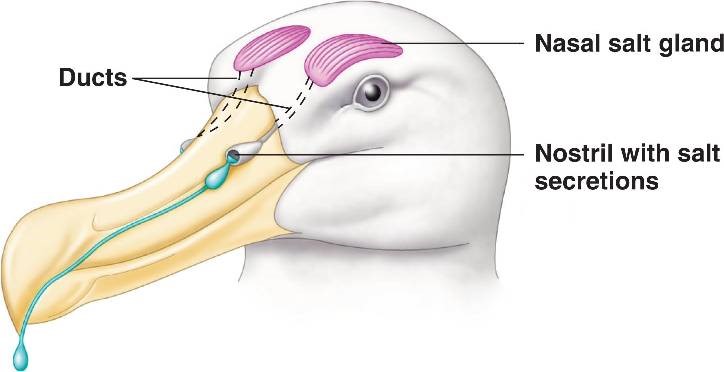
Nasal Salt Gland ©Niceweb

Later, in this article, one alcids will receive special attention, the Atlantic Puffin (Fratercula arctica), who (like other alcids) ranges the North Atlantic’s northern latitudes.  (The Xantus’s Murrelet will be featured later, D.v., because birds with names starting with “X” are few and far between!)

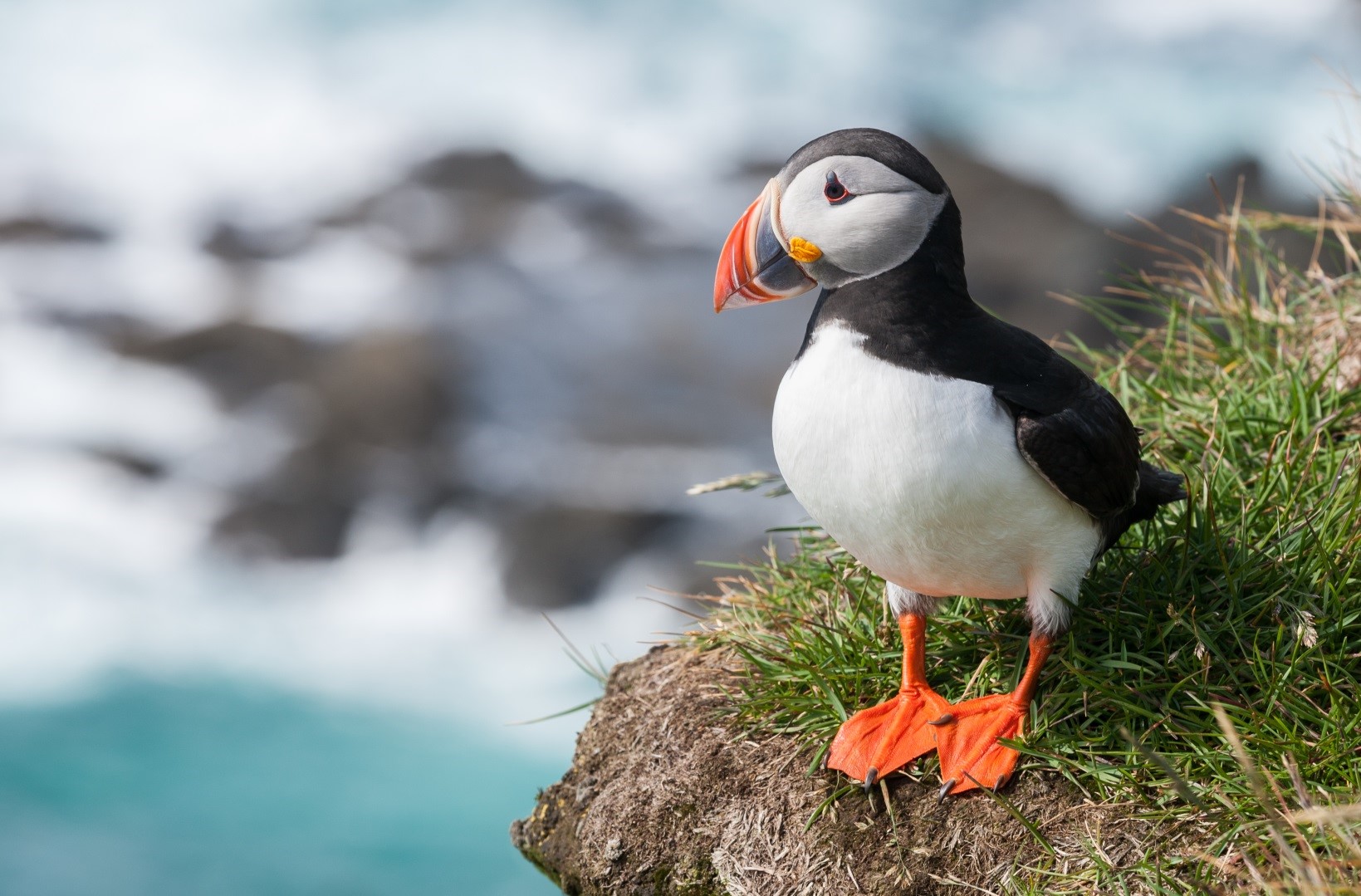
Now for another “A” bird, an alcid of Viking seawaters, Atlantic Puffin.
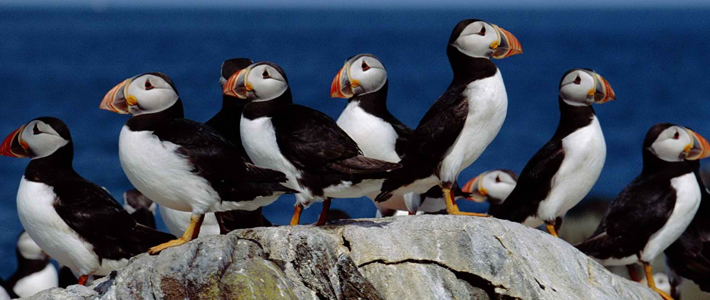
 atlantic-puffin2-710x300

Atlantic Puffins, as “pursuit-divers”, love to eat fish. Puffins thrive on ocean-caught herring, sand-eel, capelin, sprats, and small gadids (such as hake, whiting, and shore rockling), although they actually eat their catch on land.  Puffin chicks are mostly fed sand-eels.  Yet observations of puffin stomach contents, presumably done when puffins were dead ( J ), show that their fish diets are supplemented by small shellfish, mollusks, and marine annelid worms (a/k/a “bristle worms”), especially if the birds were last eating in coastal seawaters.

Atlantic Puffin with fish

The Atlantic Puffin (Fratercula arctica), as noted above, is one of many Northern Hemisphere alcids.  The arctic/subarctic seawaters and coastlands of the northern Pacific Ocean host the Horned Puffin and the Tufted Puffin, but only the Atlantic Puffin is found in the arctic/subarctic waters of the North Atlantic Ocean and its coastlands.  The primary range of the Atlantic Puffin is in the waters between and alongside northeastern North America, southern Greenland, Iceland, all of the British Isles, Scandinavian coasts (excluding Baltic Sea coasts), northwestern Russia, Svalbard, and other islands of the Arctic Ocean.

Specifically, the Atlantic Puffin has an extended range that includes the coastlands once visited by Norse Vikings, focusing mostly on the frigid North’s coastlines, yet (due to migration) stretching farther south than most would expect of this alcid, as geographer Mia Bennett insightfully observes:

The Farne Islands, England lie at 55 degrees N. Off the coast of Northumberland, they’re not too far from Newcastle, England and Edinburgh, Scotland. I took a boat trip out to the islands a few weeks ago and saw thousands of puffins. The black and white birds were diving, bobbing, and flying with fish in their beaks.

Puffins are usually associated with the Arctic, so I was surprised to see them in the country I’ve called home for the past ten months. Even though I wasn’t really that far north – still eleven degrees south of the Arctic Circle – the presence of puffins made me feel closer to the Arctic than I have since I was in Trømsø in January.

Atlantic Puffin Range Map - accompanying Mia Bennett's Article

[Atlantic Puffin range map accompanying Mia Bennett’s article]

A map of the global puffin habitat reveals that the species generally breeds in places we call the Arctic, but also places we wouldn’t, namely the British Isles, Normandy and Brittany, and Canada’s Maritime Provinces. Puffins fly as far south as Morocco, providing a link between ecosystems in Africa and the Arctic.

The map of the puffin habitat bears an odd resemblance to that of the Viking raids:

Viking range map accompanying Mia Bennett’s article

[Viking range map accompanying Mia Bennett’s article]

Visualizing the extent of the puffin habitat and the Viking raids helps us to reconceptualize what the Arctic means and to understand its place in relation to the rest of the world. The region can be defined beyond a strict adherence to lines of latitude like the Arctic Circle. In their own ways, puffins, and the Vikings before them, help link the circumpolar north into more southern-lying lands like Spain and Morocco. The flight of the puffin, which winters south of the Arctic, reminds me of the fish protein commodity chain that begins up in the Lofoten Islands, Norway, where I saw Lithuanian fishermen hanging cod to dry. The protein powder made from ground up fish heads would be sent on to Nigeria – yet another North-South chain, this time to do with goods rather than animals or people.

As for the UK, a lot more connects the country to the Arctic than puffins. Klaus Dodds, a geography professor and Arctic specialist at Royal Holloway, and Duncan Depledge, his doctoral student and a researcher at the Royal United Services Institute for Defence and Security Studies  (RUSI), outline what they see as the country’s priorities in a RUSI report. They write, “The UK has a 400-year-old relationship with the Arctic, created and consolidated by exploration, science, security, resources, commerce and the popular imagination.” The near hero-worship of explorers like Robert F. Scott and television shows like BBC’s Frozen Planet attest to the continuing prominence of the Arctic in British popular culture, even if Westminster isn’t paying the High North (or even the north of England, for that matter) too much heed.

[Quoting Mia M. Bennett, “As the Puffin Flies: The U.K. and the Arctic” (emphasis added)]  Bennett’s allusion to Captain Robert Scott is a good reminder of the quixotic quandaries (and deadly dangers) that can go with idolizing evolutionists and their animistic “natural selection” mythologies.

Explorers Robert Scott and others

How so?  Robert Scott and others learned the hard way – the cold reality – that trying to prove the Bible wrong about origins, while trying to backdate “proof” for Darwin’s speculations, paves a miserable path to self-destruction.

“There is a way that seems right to a man, but its end is the way of death.” (Proverbs 14:12)

(See “Penguin Eggs to Die for”.)  What a quixotic quest that Antarctic expedition was – futilely trying to prove that Darwin’s “natural selection” theory was right, and that the Holy Bible was wrong.  What a tragic folly it was.

Even today there are similar enterprises, albeit less exotic, following fables and materialistic myths (see 1st Timothy 6:20) – rather than embracing the “inconvenient” truth that Genesis reports the facts!

For a recent example, exhibiting editorial resistance to admitting that Darwin’s “natural selection” theory is pseudo-scientific “emperor’s new clothes” sophistry,  —  compare “Mislabeling Crabs and Creationists”, as published ultra vires in Creation Research Society Quarterly, 52(2):50 (fall 2015) (displaying unauthorized censorship, ironically exemplifying my article’s caveat that some professing creationists have compromised with Darwinian concepts/terminology, and are doing so surreptitiously), — with my authorized version, “Charading Crabs and Creationists”, posted at Bibleworld Adventures, posted at http://bibleworldadventures.com/2015/10/23/mislabeling-crabs-and-creationists/  (10-23-AD2015).   Using unfair surprise and the equivalent of editorial forgery, the CRSQ version replaced the critical phrase “natural selection” with “descent-with-modification”, without any advance notice to me, the author (much less getting any pre-publication authorization from me, for that meaning-quashing edit), of CRSQ‘s decision to insert such terminology transmogrification.  In essence, the unauthorized editing, in the CRSQ version (that removed my phrase “natural selection” and replaced it by the inapposite term “descent-with-modification”), showcases the very problem of underhanded/undercover defense of “natural selection” sophistry.  [For more on this topic, see the comments regarding Dr. Randy Guliuzza within “A Bohemian Goose and Saxon Swan”, posted at https://leesbird.com/2014/12/10/a-bohemian-goose-and-a-saxon-swan/  .]

Now, back to the puffins:  why do so many people love to see Atlantic Puffins?

Atlantic Puffin with mouth open

Perhaps because the Atlantic Puffin is one of the most cute and colorful alcids — if not also goofy-looking (in a clownish way) — of the North Atlantic latitudes.

With a face like that, surely the Atlantic Puffin has won many a beauty contest!

Of course, other birds have names that start with “A” – but readers can only read for so long, and this article is already long enough!

Meanwhile, God willing, the next study in this alphabetic series (to be delivered in parts) will be about some “B” birds – such as Bee-eaters, Bittern, Bluebird, Bunting, and Buteos.  So stay tuned!         ><>   JJSJ        profjjsj@verizon.net
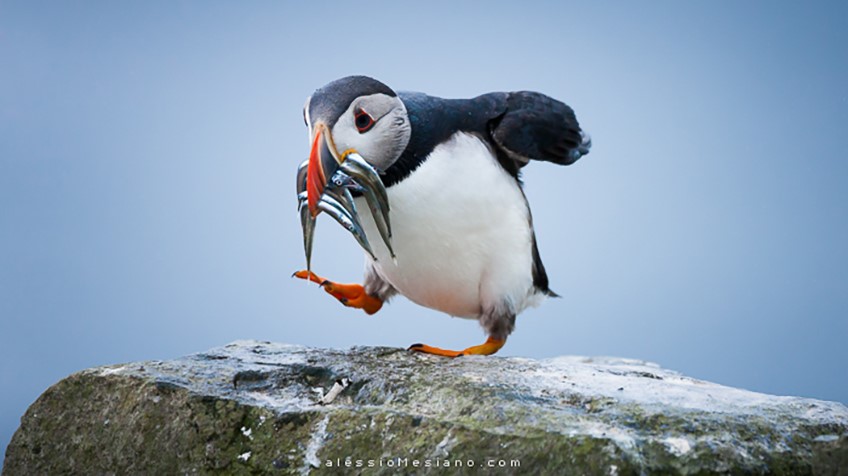
Atlantic Puffin on the march

Atlantic Puffin at the shore

“A” is for Avocet, Albatross: “A” Birds, Part 1

Birds of the Bible: Hawks

Flag that Bird! (Part 1)

Alcidae – Auks

Penguin Eggs to Die for

*

Lee’s Four Word Thursday – 4/7/16

***
DOTH THE HAWK FLY

***


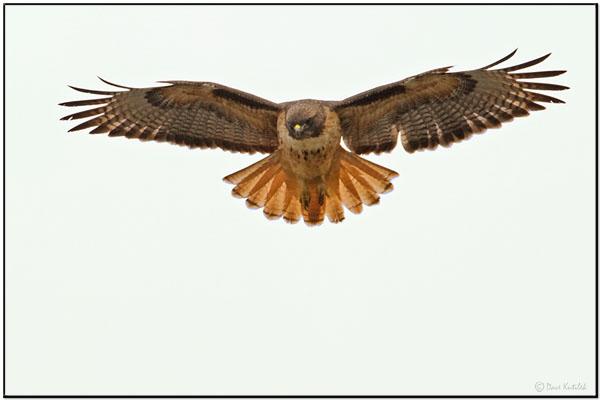
“Doth the hawk fly by thy wisdom, and stretch her wings toward the south?” (Job 39:26 KJV)

Red-tailed Hawk (Buteo jamaicensis) by Daves BirdingPix

*

More Daily Devotionals

*

Lee’s Three Word Wednesday – 4/6/16

***

Inca Tern at Lowry Park Zoo by Lee

PRAY WITHOUT CEASING

***


Pray without ceasing. (1 Thessalonians 5:17 KJV)

Inca Tern at Lowry Park Zoo by Lee

*

More Daily Devotionals

*

Ian’s Bird of the Week – Masked Lapwing

Ian’s Bird of the Week – Masked Lapwing ~ by Ian Montgomery

Newsletter – 4/5/16

This is a seriously overdue bird of the week, so I offer you my apologies. The reason or excuse, and the good news, is that I was working hard to complete the conversion of the birdway website to make it ‘mobile friendly’ and that is now finished. I’ve converted more than 1,600 galleries of birds and other wildlife and all the navigational pages, such as family thumbnails. Naturally I’ve thought up other improvements such as a top-level page of wildlife thumbnails but I’m taking a rest from the website to play catch-up with other effortlessly side-lined tasks such as 2015 tax returns :-).<

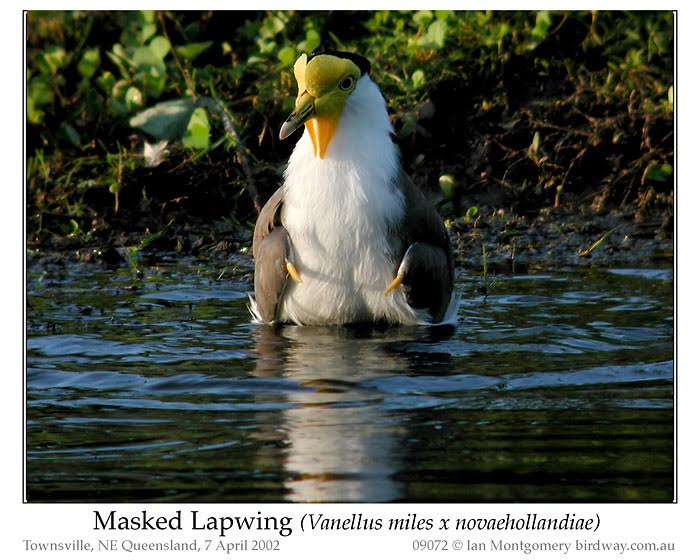
Masked Lapwing (Vanellus miles) by Ian 1

The last bird of the week was the elegant and dignified Northern Lapwing, one of the birds that got me interested in birding more than 50 years ago. This week we have its loud and arrogant Australian cousin, the Masked Lapwing. Just in case you think I’m making an offensive comparison, I hasten to add that the other Australian Lapwing – and the only truly indigenous one – the Banded Lapwing is shy, dignified and attractive, which is probably why I’ve previously chosen it rather than the Masked Lapwing as bird of the week. It is, however, much rarer but I’ll let you draw your own conclusions from that.

Masked Lapwing (Vanellus miles) by Ian 2

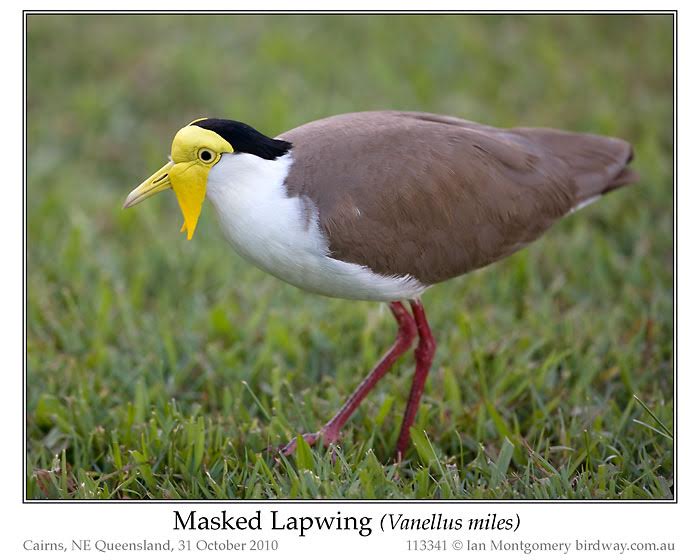
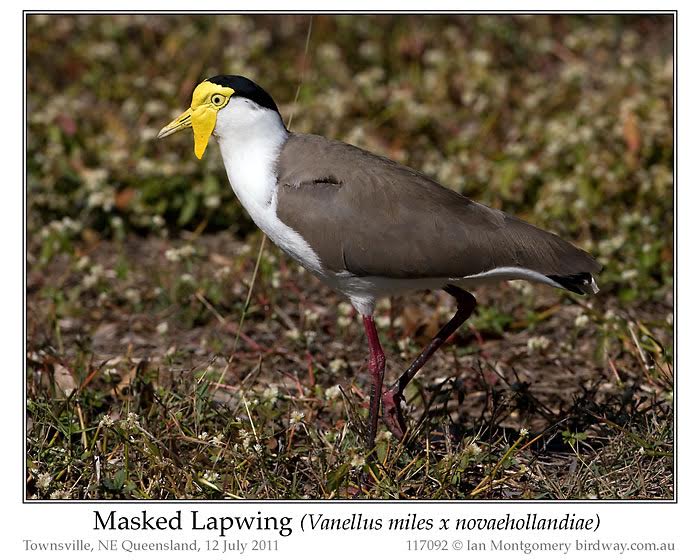
The Masked Lapwing comes in two forms, sufficiently different to cause taxonomists chronic and persisting migraines. The northern variety, the ‘Masked Lapwing/Plover’ in the strict sense, shown in the first photo has a huge yellow wattle and a black cap that tapers to a point on the nape, while the southern ‘Spur-winged Lapwing/Plover’, second photo has a wattle that is much smaller (posteriorly) and shorter (ventrally) and a larger black cap which extends as an incomplete black collar draped over the shoulders. There are other difference: the northern one is paler, smaller and shorter-winged but has a larger bill. Consequently, taxonomists disagree as to whether we’re dealing with one or two species.

Masked Lapwing (Vanellus miles) by Ian 3

The IOC, which I’m following here, treats them as a single species, the northern one being the nominate race Vanellus miles (miles) and the southern being the sub-species V. miles novaehollandiae. The New Holland tag refers to its original entirely mainland Australian range from Central Queensland south to Victoria and east to South Australia, while the nominate race occurs in northern Australia, New Guinea, eastern Indonesia and Christmas Island. BirdLife International treats them as different species, with the southern form being given full specific status Vanellus novaehollandiae. Unfortunately the name Spur-winged Lapwing is already used for an African species V. spinosus, so Birdlife International calls the Australian one the ‘Black-shouldered Lapwing’, a name largely unused in Australia.

The problem with treating them as different species is that the two form hybridise over a broad zone from Far North to Central Queensland – Cairns to Mackay – a particular obstacle to identification in Townsville, more or less in the middle. The bird in the third photo is a typical Townsville one with a somewhat intermediate, largish wattle and black smudges both below the main cap and on the shoulders. It’s fairly like the pure northern variety found in Cairns, but I’m more comfortable treating it as hybrid miles x novaehollandiae and regarding them as a single species.

Masked Lapwing (Vanellus miles) by Ian 4

The fourth photo shows another Townsville bird cooling off in a dam in a paddock. It’s also displaying the impressive carpal spurs on the wings, possessed by both the Masked and Spur-winged varieties. The Spur-winged race has dark tips on both the spurs and the bill. The spurs are used as weapons and the birds are very aggressive when nesting and the spurs are used both on the ground and in flight (below), with the parents dive-bombing intruders in spectacular fashion. The specific name miles mean ‘soldier’ in Latin. They’re noisy birds too, and not just when nesting. Their sharp, grating ‘kekekekeke’ or shrill repeated ‘kek’ calls are a familiar sound throughout their range, day and night.

Masked Lapwing (Vanellus miles) by Ian 5

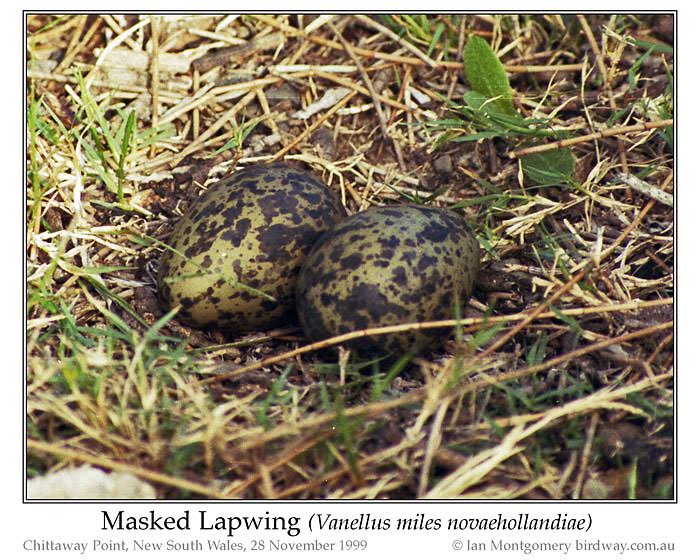
The ‘nest’ is just a scrape in the ground in short grass often near water and often in very vulnerable locations such as roadsides, parks, paddocks, gardens and airfields. They usually lay 3 or 4 large eggs and will re-lay if the clutch is lost to predation, mowing or being stepped on. Typical predators include birds such as Butcherbirds and reptiles such as Goannas (Monitor lizards).

Despite heavy losses, Masked Lapwings would appear to have benefitted from clearing of land following European settlement. In the past two hundred years, their range has expanded in Australia, and the southern race has become well established in Tasmania and colonised New Zealand, Lord Howe Island and, recently, New Caledonia, where it has bred since 1998. This is despite the fact that it relatively sedentary in Australia, although an altitudinal migrant in the Snowy Mountains.

Masked Lapwing (Vanellus miles) eggs by Ian 6

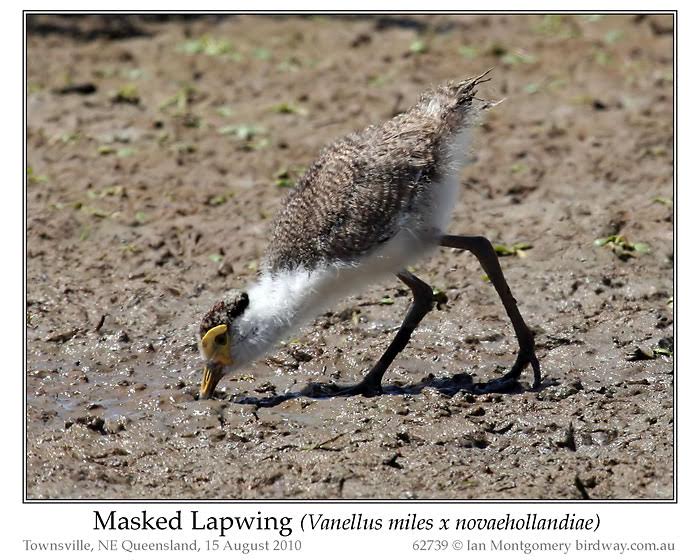
As in all plovers, the eggs are large so the hatchlings are well developed and mobile at a very early age, below, after incubation by both parents for 28-30 days. They can also swim when very young. Until they fledge after 5-7 weeks, they remain very vulnerable to predation, relying on camouflage and their parents for survival.

Masked Lapwing (Vanellus miles) Chicks by Ian 7

Below is an older youngster showing the barred plumage and an already developing wattle. They start feeding themselves from a very early age but remain dependent on the parents for up to six months. The parents maintain the pair bond from one year to another and often return to the same site to nest.

Masked Lapwing (Vanellus miles x novaehollandiae) Immature by Ian 6

So there you have it: noisy, aggressive and successful. Sounds like a very 21st century lifestyle to me.

Incidentally, because all the new web pages use embedded scripts to load common code such as headers, their file names end in ‘.php’ instead of ‘.htm’. If you use bookmarks to access the website, you’ll automatically get redirected to the correct file or, in the case of individual photo pages, to the first photo page in the gallery. You may care to update the bookmarks either by replacing them (easier) or, for the technically inclined, editing them to replace the ‘htm’ with ‘php’. If you do, the pages should load faster.

Greetings

**************************************************

Ian Montgomery, Birdway Pty Ltd,
454 Forestry Road, Bluewater, Qld 4818
Tel 0411 602 737 ian@birdway.com.au
Bird Photos http://www.birdway.com.au/
Recorder Society http://www.nqrs.org.au


Lee’s Addition:

Thou therefore endure hardness, as a good soldier of Jesus Christ. (2 Timothy 2:3 KJV)

Thanks again, Ian. What a coincidence, we were at the Lowry Park Zoo today and guess what a took a picture of? A Masked Lapwing.

Masked Lapwing (Vanellus miles) by Lee at LPZ

Masked Lapwing (Vanellus miles) by Lee at LPZ

It was nice being out birdwatching again after having been home-bound with bronchitis. Thanks for all your prayers for my recovery. Even the back was better today. Praise the Lord.

*

Ian’s Bird of the Week

Ian’s Birdway

Ian’s Banded Lapwing

Wordless Toucan

*


Lee’s Two Word Tuesday – 4/5/16

***

Greater Roadrunner (Geococcyx californianus) ©©Nathan Davis Bing

SO RUN

***


Know ye not that they which run in a race run all, but one receiveth the prize? So run, that ye may obtain. (1 Corinthians 9:24 KJV)

Greater Roadrunner (Geococcyx californianus) ©©Nathan Davis Bing

*

More Daily Devotionals

*

Lee’s One Word Monday – 4/4/16

***

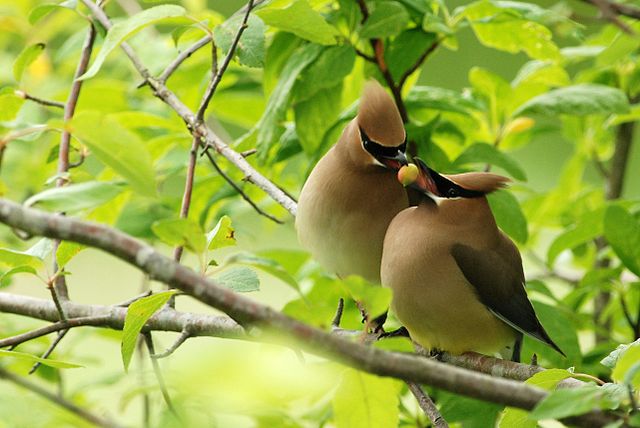
Cedar Waxwing (Bombycilla cedrorum) Passing Berries ©WikiC

LOVE

***


“But the fruit of the Spirit is love, joy, peace, longsuffering, gentleness, goodness, faith, Meekness, temperance: against such there is no law.” (Galatians 5:22-23 KJV)

Cedar Waxwing (Bombycilla cedrorum) Passing Berries ©WikiC

*

More Daily Devotionals

Love

Joy

Peace

Longsuffering

Gentleness

Faith

Meekness

Temperance

*

Creation Moment’s – Great Travelers Have Great Stories To Tell

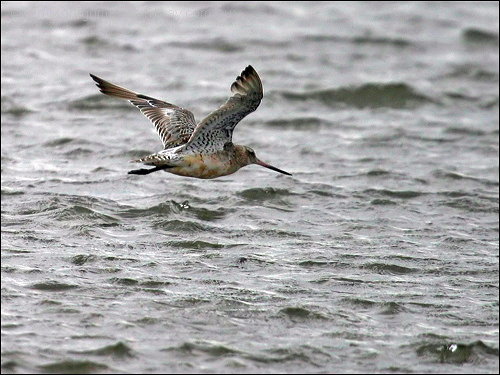
Bar-tailed Godwit (Limosa lapponica) by Nikhil Devasar

Bar-tailed Godwit (Limosa lapponica) by Nikhil Devasar

GREAT TRAVELERS HAVE GREAT STORIES TO TELL

“Now they which were scattered abroad upon the persecution that arose about Stephen traveled as far as Phoenicia, and Cyprus, and Antioch….” (Acts 11:19a)

Those who widely travel usually have interesting experiences to talk about. That is no less true of animals that migrate. A commonly known example is the monarch butterfly. In the fall, monarchs from all over North America head south to the same small patch of jungle trees in Mexico. Even more astonishing is that each generation finds this exact traditional wintering spot but has never been there before.

Bar-tailed Godwit (Limosa lapponica) by Ian

Bar-tailed Godwit (Limosa lapponica) by Ian

Scientists have recently discovered that another migrating creature has an even more interesting story to tell. Bar-tailed Godwits, shorebirds with a wingspan of about 12 to 16 inches, summer in Alaska. But they winter in New Zealand, over 7,000 miles away. As you mentally picture their route, you would be right to notice that there are very few places to stop and rest between Alaska and New Zealand. Researchers outfitted seven female godwits with tracking devices to learn more about their migration. They found that the godwits traveled the distance nonstop, without rest or even food or water. That’s the equivalent of a nonstop flight from London to Los Angeles, plus 1,000 miles more!

Godwits glorify God as Creator with their amazing migratory paths. As the first Christians scattered across the Roman Empire in fear of persecution and martyrdom, they spread the wonder of God’s love for us in the Gospel of salvation.

Prayer:
Father, I thank You for the glory of Your creation, but I rejoice in the wonder of Your love and salvation. Amen.

Notes:
Science News, 11/22/08, p. 14, Laura Sanders, “Nonstop godwit flights.”
©Creation Moments 2016


Lee’s Addition:

What an amazing Creator that gives these Godwits the ability to make that 7,000 mile journey NON STOP! Wow!

Godwits are in the Scolopacidae Family of the Charadriiformes Order

Bar-tailed Godwit’s Self – Control.. by ajmithra

Wordless Birds
*

Lee’s Seven Word Sunday – 4/3/16

***

Black-cheeked Lovebird (Agapornis nigrigenis) ©WikiC

AND LO, I AM WITH YOU ALWAY

***


Go ye therefore, and teach all nations, baptizing them in the name of the Father, and of the Son, and of the Holy Ghost: Teaching them to observe all things whatsoever I have commanded you: and, lo, I am with you alway, even unto the end of the world. Amen. (Matthew 28:19-20 KJV)

Black-cheeked Lovebird (Agapornis nigrigenis) ©WikiC

*

More Daily Devotionals

*

Sunday Inspiration – Finches IV

American Goldfinch (Spinus tristis) on Thistle by Fenton

So God created great sea creatures and every living thing that moves, with which the waters abounded, according to their kind, and every winged bird according to its kind. And God saw that it was good. And God blessed them, saying, “Be fruitful and multiply, and fill the waters in the seas, and let birds multiply on the earth.” So the evening and the morning were the fifth day. (Genesis 1:21-23 NKJV)

Today, we finish up the Finch Family. I trust you have enjoyed getting to see so many of the finches, “after their kind.” Our Lord, their Creator, gave them some mighty nice colors and markings. There are missing ones, not shown, that are available, but we don’t have permission to use them. So, if you check the internet and books, they can be found.

Eurasian Siskin (Spinus spinus) ©WikiC

Eurasian Siskin (Spinus spinus) ©WikiC

Spinus is a genus of passerine birds in the finch family. It contains the North and South American siskins and goldfinches.

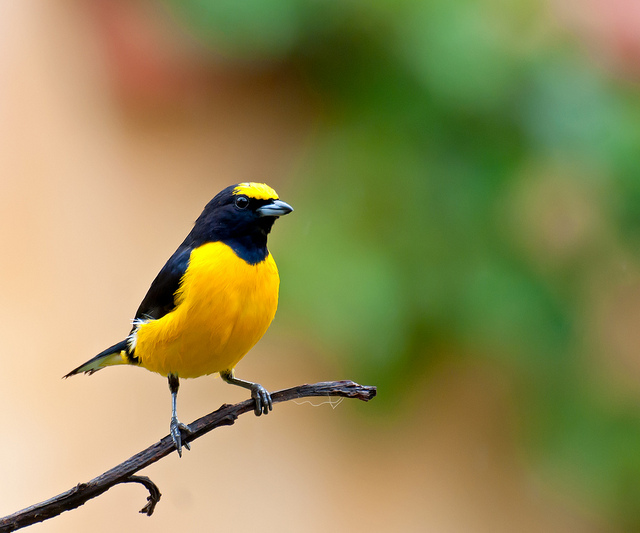
Purple-throated Euphonia (Euphonia chlorotica) by Dario Sanches

Purple-throated Euphonia (Euphonia chlorotica) by Dario Sanches

Most Euphonias are dark metallic blue above and bright yellow below. Many have contrasting pale foreheads and white undertails. Some have light blue patches on the head and/or orangish underparts. They range in overall length from 9 to 11 cm (3.5 to 4.3 in). They eat small fruit and berries particularly mistletoe (Loranthaceae). Some species may also eat some insects.

This slideshow requires JavaScript.

“But the angel answered and said to the women, “Do not be afraid, for I know that you seek Jesus who was crucified. He is not here; for He is risen, as He said. Come, see the place where the Lord lay.” (Matthew 28:5-6 NKJV)

“Once Upon A Tree” ~ by Faith Baptist Church Choir

“Crown Him Lord of All” ~ Faith Baptist Orchestra

Because of Resurrection Sunday – Easter last week, there was no Sunday Inspiration.

*

Sunday Inspiration – Finches I

Sunday Inspiration – Finches II

Sunday Inspiration – Finches III

More Sunday Inspiration

Fringillidae – Finches

Fringillid Finches & Allies – Ian’s Birdway

Finch – Wikipedia

*

Lee’s Six Word Saturday – 4/2/16

***

Raven Feeding ©Flickr Josh More

FOR THEY NEITHER SOW NOR REAP

***


Consider the ravens, for they neither sow nor reap, which have neither storehouse nor barn; and God feeds them. Of how much more value are you than the birds? (Luke 12:24 NKJV)

Raven Feeding ©Flickr Josh More

*

More Daily Devotionals

*

“A” is for Avocet and Albatross: “A” Birds, Part 1

“A” is for Avocet and Albatross: “A” Birds, Part 1

James J. S. Johnson

American Avocet (Recurvirostra americana) by Jim Fenton

American Avocet (Recurvirostra americana) by Jim Fenton

“A” is for Avocets, Albatrosses, Accipiters, and Alcids (including Auklets and the Atlantic Puffin), — plus Antbirds and a few other birds omitted here. This study now bravely begins an alphabet-based series on birds, starting with a quick introduction to 4 types of birds that start with the letter “A”   –    followed by a few observations of alphabetic patterns in Scripture (exhibited initially by Psalm 119:1-8)   –   then followed by specific information on avocets, albatrosses, accipiters, and alcids. Due to the length of this review, the “A” birds (just mentioned) will be considered in two parts: Part 1, Avocets and Albatrosses, — and Part 2 (in the near future, God willing), Accipiter hawks and Alcids.

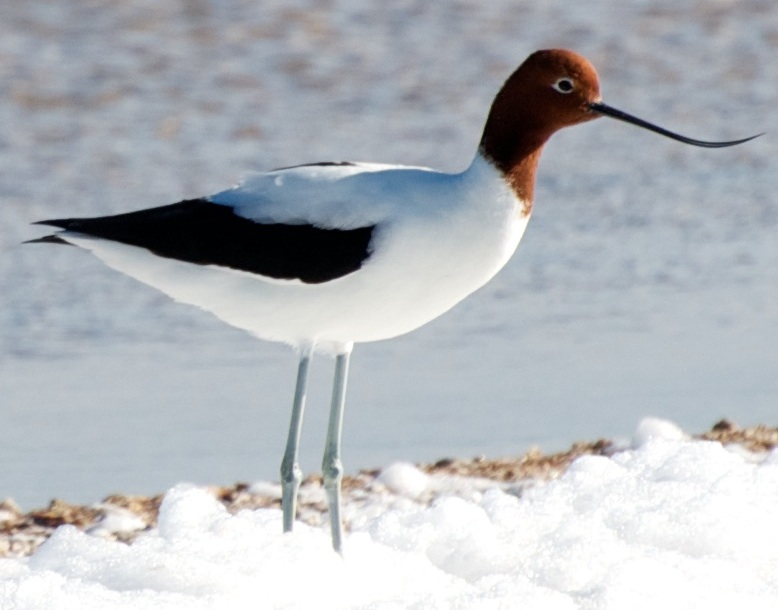
Red-necked Avocets ©WikiC

Red-necked Avocet at shore ©WikiC

Avocets” are shorebirds, known for wading into the salty or brackish tidewaters, on skinny stilt-like legs, picking at food with thin upward-curving (the opposite of “decurved”) bills.  Avocets include American Avocet (Recurvirostra americana), Pied Avocet (Recurvirostra avosetta), Red-necked Avocet (Recurvirostra novaehollandiae), and Andean Avocet (Recurvirostra andina).

Avocets are often grouped with other shorebirds that have similar morphology (shape), who occupy similar eco-niches (similar ecological contexts) and have somewhat similar eating habits – the fancy word for that category of shorebirds is “Recurvirostrids” – a group that includes avocets and stilts.  (For a listing on these shorebirds, with photographs, see Lee’s “Recurvirostridae: Stilts, Avocets

Later, in this article, one avocet will receive special attention, the American Avocet (Recurvirostra americana).

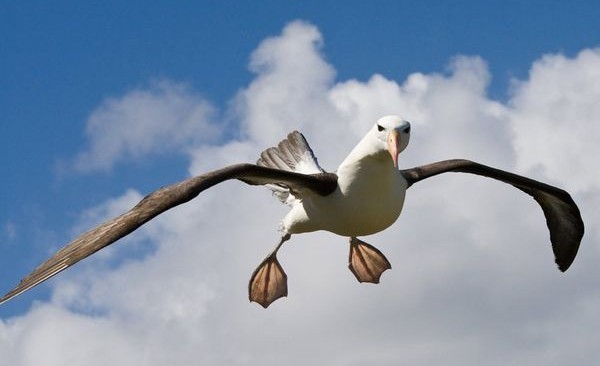
Black-browed Albatross launching into flight from the sea

Black-browed Albatross launching into flight from the sea

[Black-browed Albatross, launching into flight from the sea]

Albatross” is a large tube-nosed seabird type  –  sometimes called “gooney birds” — typically ranging over open-ocean waters, that includes about 20 different species, such as Snowy Albatross (Diomedea exulans, a/k/a Wandering Albatross or White-winged Albatross), Black-footed Albatross (Phoebastria nigripes), Light-mantled Albatross (Phoebetria palpebrata, a/k/a Grey-mantled Albatross), the Atlantic Yellow-nosed Albatross (Thalassarche chlororhynchos), Laysan Albatross (Phoebastria immutabilis), Steller’s Albatross (Phoebastria albatrus, a/k/a Short-tailed Albatross, known for eating juvenile squid), etc.

Regarding albatrosses as a “family” group, with photographs of more than 20 species of albatrosses, see Lee’s “Diomedeidae: Albatrosses.  “Gooney birds” are obviously designed by flying over oceans.  However, on land they can ambulate as they need to, although they may appear “goofy” on shore, as they appear to hobble (or waddle) along, upon their large webbed feet. Yet they live for many decades (e.g., up to 60 years!), unless their natural lives are cut short by a predator.

http://siliconvalley.corriere.it/files/2015/12/black-browed-albatross-flying.jpg

Albatross (Diomedea) ©Unknown from Siliconvalley

*

Albatross Study from Ian Montgomery

Albatross Study from Ian Montgomery

For examples of albatross studies, provided by Australian ornithologist Ian Montgomery, see “Ian’s Bird of the Week: Royal Albatross”,  —  and “Ian’s Stamp of the Week: Antipodean Albatross”,   —  and “Ian’s Bird of the Week: Light-mantled Albatross”,  — and “Ian’s Bird of the Week: Campbell / Black-browed AlbatrossLater, in this article, one albatross will receive special attention, Steller’s Albatross (Phoebastria albatrus).

ALPHABETS CAN BE HELPFUL FOR ACROSTIC-BASED LISTINGS

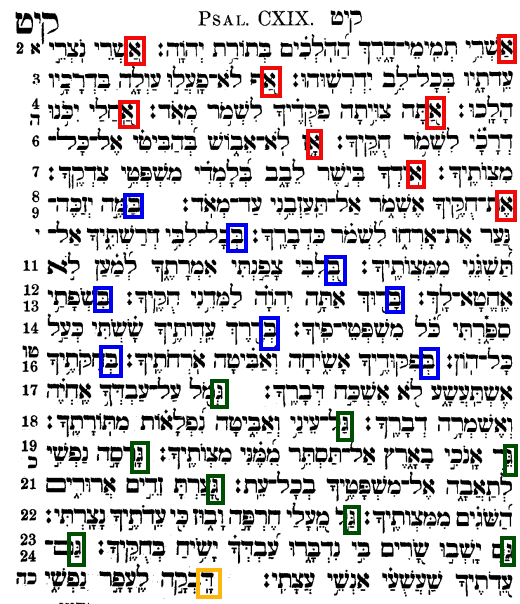
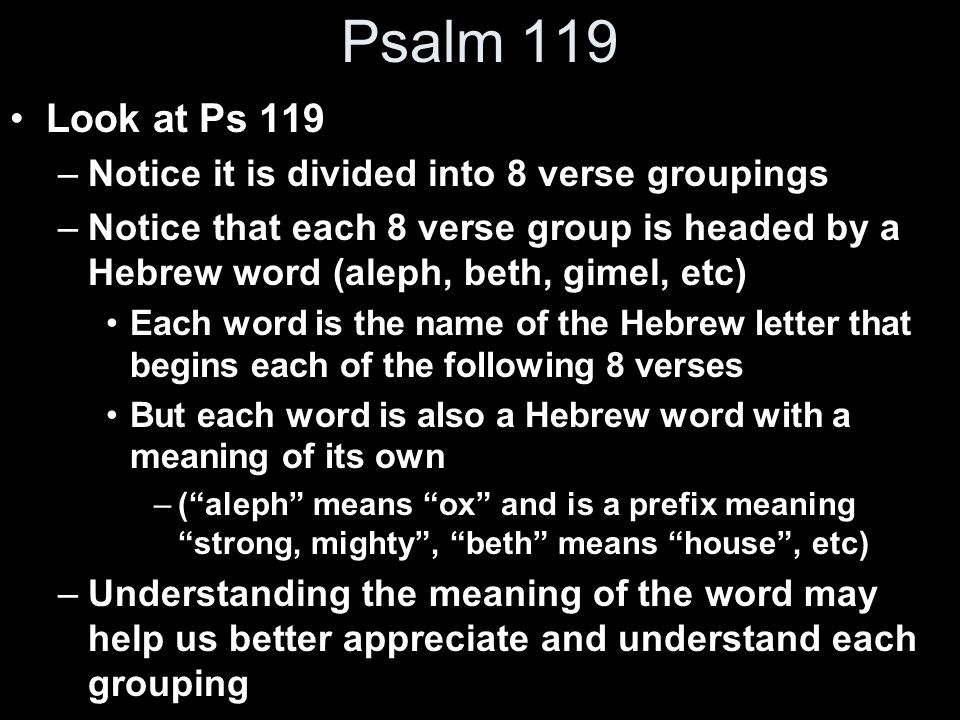
Using an alphabet, to organize a sequence of information, has Biblical precedent.  The perfect example is the “acrostic” pattern of Psalm 119, the longest psalm (having 176 verses!), which has 22 sections (comprised of 8 verses per section), representing the 22 letters of the Hebrew alphabet. (Compare that to English, which has 26 alphabet letters, and Norwegian, which has 29 alphabet letters.)

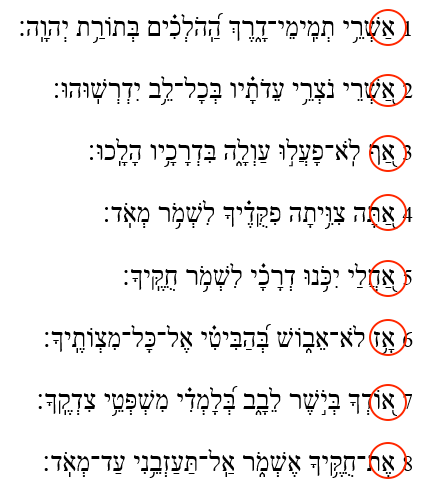
The sentences in each section start with the same Hebrew  letter, so Verses 1-8 start with ALEPH, Verses 9-16 start with BETH, Verse 17-24 start with GIMEL, and so forth.  Here are the first 8 verses in Psalm 119, each sentence of which starts with ALEPH  [an inaudible guttural consonant, usually transliterated into English as an apostrophe that looks like a backwards C = ’ , i.e., like a closed single-quotation mark].  ALEPH is the first letter in the Hebrew alphabet, so each verse literally starts with that letter as the first letter in the first word (although the first Hebrew word may be differently placed in the English translation’s sentence):

Alphabet in Hebrew of Psalm 119

Blessed [’asherê] are the undefiled in the way, who walk in the law of the Lord.

Blessed [’asherê] are they that keep His testimonies, and that seek Him with the whole heart.

Yea [’aph], they also do no iniquity: they walk in His ways.

Thou [’atah] hast commanded us to keep Thy precepts diligently.

O-that [’aḥalai] my ways were directed to keep Thy statutes!

Then [’az] shall I not be ashamed, when I have respect unto all Thy commandments.

I-will-praise-thee [’ôdekâ] with uprightness of heart, when I shall have learned Thy righteous judgments.

Thy-statutes [’et-uqqekâ] I will keep; O forsake me not utterly.

Interestingly, Verses 1-3 are narrated in the third person (referring to God as “He”, “Him”, etc.), but Verses 4-8 are addressed to God (“Thou”, “Thy”, “Thee”) in the second person.  Certainly the psalmist appreciates God’s truth as He has  kindly and authoritatively provided it unto His favorite creature, Adam’s race!

Most English Bibles show how the Hebrew alphabet is used to divide Psalm 119 into those 22 sections, although it requires looking at the Hebrew text to see how this was actually done.  Psalm 119 is not the only acrostic psalm – there are others (see Psalms 9, 10, 25, 34, 37, 111, 112, 145).  In fact, there is a hidden-in-plain-view message in Psalm 145, which deliberately omits the Hebrew letter nûn (that matches our “N”), but that unusual usage of an intentionally incomplete acrostic must wait another day to be explained.

“In the common form of acrostic found in Old Testament Poetry, each line or stanza begins with a letter of the Hebrew alphabet, in order. This literary form may have been intended as an aid to memory, but more likely it was a poetic way of saying that a total coverage of the subject was being offered — as we would say, ‘from A to Z.’ Acrostics occur in Psalms 111 and 112, where each letter begins a line; in Psalms 25, 34, and 145, where each letter begins a half-verse; in Psalm 37, Proverbs 31:10-31, and Lamentations 1, 2, and 4, where each letter begins a whole verse; and in Lamentations 3, where each letter begins three verses. Psalm 119 is the most elaborate demonstration of the acrostic method where, in each section of eight verses, the same opening letter is used, and the twenty-two sections of the psalm move through the Hebrew alphabet, letter after letter.” [Quoting J. Alec Motyer, “Acrostic”, in The New International Dictionary of the Bible (Zondervan, 1987), page 12.]

Hebrew Alphabet Acrostic of Psalm 119 ©Zondervan

Hebrew Alphabet Acrostic of Psalm 119 ©Zondervan

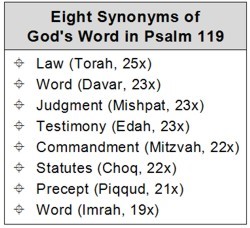
Psalm 119 is all about God’s revelation of truth – especially truth about Himself – to mankind (in a comprehensive “A to Z” panorama).  The most important revelation of truth that God has given to us, and the most authoritative form of truth we have, is the Holy Bible – the Scriptures.  (In fact, it appears that Scripture is referred to 176 times within Psalm 119, since 6 verses twice allude to Scriptures.)  Accordingly, Psalm 119 is dominated by references to the Scriptures – using terms like “the law of the LORD”, “Thy Word”, “Thy commandments”, “Thy testimonies”, “Thy statutes”, “Thy judgments”, etc.

Psalm 119 Study Photo

Psalm 119 Study Photo

Of the 176 verses in Psalm 119 there appear to be only 6 verses (actually, there are only 5 exceptions) that omit a direct reference to the Scriptures:   Verses 3, 37, 90, 91, 122, and 132.  Yet, even so, each (of those “exceptions”) refers to some form of God’s general or special revelation:  “His ways” and “Thy way” (in Verses 3 & 37, yet God’s ways are only known to us by His creation, His Word, His incarnation, and His providences, all of which are forms of God revealing truth to us); “Thy faithfulness” (in Verse 90, yet God’s faithfulness is only known to us by His creation, His Word, His incarnation, and His providences, all of which are forms of God revealing truth to us); “Thy ordinances” (in Verse 91, is not really an exception, because it translates for mishpat, a Hebrew noun repeatedly translated as “judgment(s)”, elsewhere in Psalm 119); “surety” (in Verse 122, is the Hebrew verb ‘arōbh, functioning as a noun, yet the concept of God as our “surety” is comparable to His “faithfulness”, noted in Verse 90); and “Thy name” (shemekâ, in Verse 132, which divine name itself reveals God’s character (in the Old Testament Hebrew name for God) as the eternal Being, YHWH, as is emphasized in Exodus 3:14 and further in John 8:58).

Regarding God’s name, the incarnation has revealed God to us as Emmanuel (“God with us”), the Lord Jesus Christ (Philippians 2:9-11).  Accordingly, by His name as the incarnate God (i.e., Jesus the Christ), God’s name is necessarily implied even by how we count time on Earth, every time we refer to what year it is, — because the years are denominated as “B.C.” (“before Christ”) and “A.D.” (“anno Domini= “year of our Lord [Jesus Christ]”), ubiquitously reminding us that God has revealed Himself, on Earth, via Christ’s incarnation and earthly ministry!).

Eight Synonyms of Gods Word in Psalm 119

Dusty Bible

In short, Psalm 119 teaches that God reveals truth, and we should expect that we learn 97% of it from the Holy Bible!  (Romans chapter 1 emphasizes that we are taught, by the physical creation, about God’s majestic power and glorious wisdom, and that the message of God’s creation is so strong that to ignore it is to do so “without excuse”.)  Also, since the Hebrew letter ALEPH is derived from the Hebrew word for “ox” (which exemplifies might), it is noteworthy that the first 8 verses of Psalm 119 emphasize who powerfully God’s Word strengthens us for holy living (see Hebrews 4:12).

Now back to the “A” birds (Part 1), Avocets and Albatrosses.

American Avocet - Family group visiting lentic shore

American Avocet – Family group visiting lentic shore

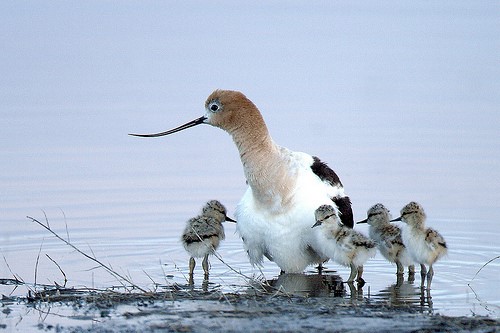
The American Avocet (Recurvirostra americana), like many shorebirds, thrives upon the available edibles on beaches swept back-and-forth by coastal tidewaters.  This dignified shorebird, with its long skinny bill, long skinny legs, and its cinnamon-to-salmon summer plumage (on its head and neck), has already been described by ornithologist Lee Dusing – see “Birds, Volume 2, #1: The American Avocet.

The breeding range of the American Avocet includes most of the states in the western half of America’s “lower 48” states, plus some of western inland Canada (southern Alberta and Saskatchewan, and part of Manitoba), with the breeding range situated mostly in Montana, North and South Dakota, Nebraska, Wyoming, Colorado, southern Idaho, western Oregon, northern Utah, New Mexico, far western Oklahoma, and the Texas Panhandle.  Some breeding avocets have also been sighted in Minnesota.

Avocets migrate south for the winter, either to Florida or to Mexico.  Their migratory passage travels occur in between their wintering and breeding ranges, covering large parts of Texas, Arizona, California, Nevada, Utah, and Idaho.

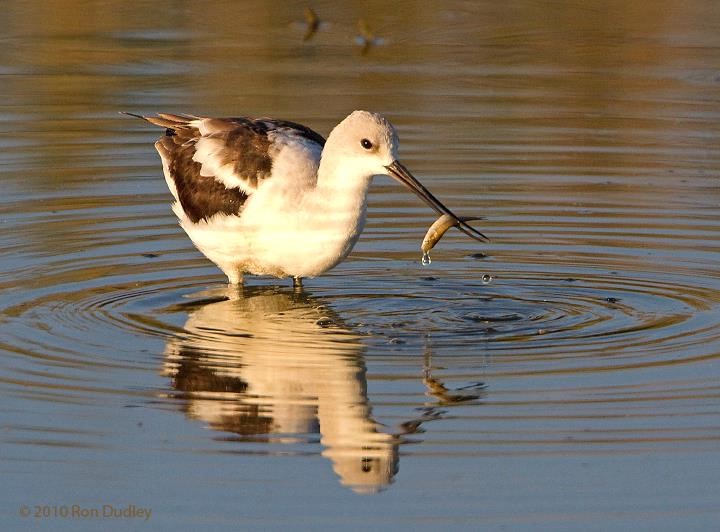
Avocets, being shorebirds, like to eat fish that venture close enough to the shoreline to get caught in the quick bill of an avocet.

Do not think that avocets are merely passive, waiting for food to swim or drift by where they stand, in the shallow water of a pond or lake.

Avocets poke their long stick-like bills into the water, then flex their bills back and forth in the water, stirring the water so that nearby creatures – such as water bugs and crustaceans – are agitated into motion that reveals their presence.   Seeing such creatures reactively move, avocets use their long bills to clamp down on an entrée, such as a small fish!

Avocets also enjoy eating aquatic plants (especially their nutritious seeds) that emerge above the shoreline’s water surface.

American Avocet

American Avocet “Gone fishin” – photo by Ron Dudley

Now for another “A” bird:  the Albatross, specifically Steller’s Albatross, a shorebird that has been listed as “endangered” since AD2000.

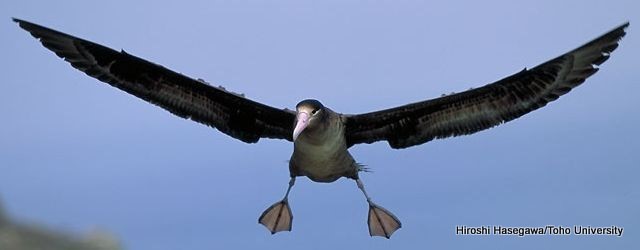
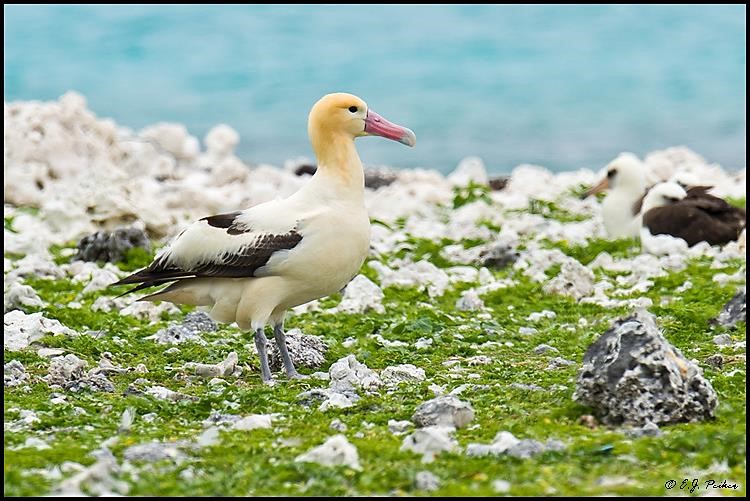
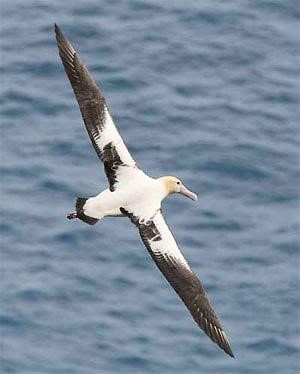
The Steller’s Albatross (Phoebastria albatrus, a/k/a Short-tailed Albatross, formerly known taxonomically as Diomeda albatrus) is an North Pacific Ocean-ranging albatross.  This albatross was originally named for the 18th century (AD) German naturalist Georg Steller, for whom the Steller’s Jay is also named.  Georg Steller is likewise the namesake of Steller’s Eider and Steller’s Sea Eagle (and even of two pinniped marine mammals, the Steller’s Sea Lion and the now-extinct Steller’s Sea Cow).  Regarding Georg Steller’s scientific career and “stellar” accomplishments (pardon the pun), see Steller’s Jay: A Lesson in Choosing What Is Valuable.

Steller’s Albatross ©U.S. Fish & Wildlife Service

The U.S. Fish & Wildlife Service describes the Steller’s Albatross as follows:

“With a wingspan of over 2 meters (over 7 feet), the short-tailed albatross is the largest seabird in the North Pacific. Its long, narrow wings are adapted to soaring low over the ocean. It is best distinguished from other albatrosses by its large, bubblegum-pink bill. Young birds also have the large pink bill, but their feathers are dark chocolate brown, gradually turning white as the bird ages. Adults have an entirely white back, white or light gold head and back of neck, and black and white wings. …

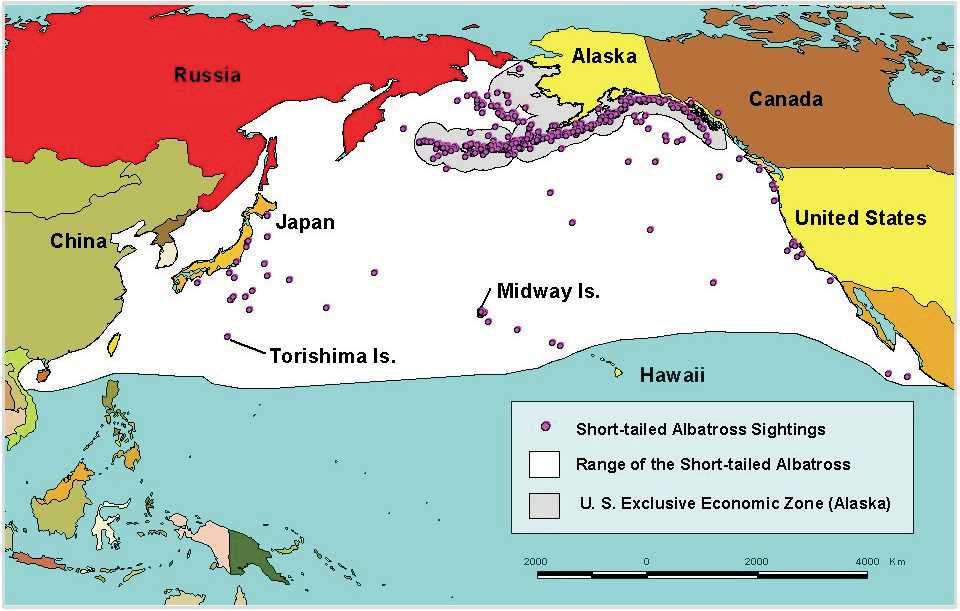
Historically, millions of short-tailed albatrosses bred in the western North Pacific on several islands south of the main islands of Japan. Only two breeding colonies remain active today: Torishima Island and Minami-kojima Island, Japan. In addition, a single nest was recently found on Yomejima Island of the Ogasawara Island group in Japan. Single nests also occasionally occur on Midway Island, HI. Short-tailed albatrosses forage widely across the temperate and subarctic North Pacific, and can be seen in the Gulf of Alaska, along the Aleutian Islands, and in the Bering Sea. The world population is currently estimated to be about 1200 birds and is increasing. …

Like many seabirds, short-tailed albatrosses are slow to reproduce and are long-lived, with some known to be over 40 years old. They begin breeding at about 7 or 8 years, and mate for life. Short-tailed albatrosses nest on sloping grassy terraces on two rugged, isolated, windswept islands in Japan. Pairs lay a single egg each year in October or November. Eggs hatch in late December through early January. Chicks remain near the nest for about 5 months, fledging in June. After breeding, short-tailed albatrosses move to feeding areas in the North Pacific. When feeding, albatrosses alight on the ocean surface and seize their prey, including squid, fish, and shrimp.”

[Quoting USF&W, “Short-tailed Albatross (Phoebastria albatrus)”, February 2001 pamphlet, page 1 of 2.]

Steller’s Albatross 2©U.S. Fish & Wildlife Service
Steller’s Albatross 3©U.S. Fish & Wildlife Service
Short-tailed Albatross Map

The Steller’s Albatross, under the name Short-tailed Albatross, has been officially listed as “endangered” (under the Endangered Species Act of 1973) throughout its North Pacific range, as promulgated in 65 F.R. 46643 (Volume 65 of the Federal Register, page 46643-46654, issued 31 July 2000), in conjunction with implementing aspects of the wildlife protection treaty called “CITES” (Convention on International Trade in Endangered Species of Wild Fauna and Flora).

This means that the Steller’s Albatross, and products of its body parts, may not be freely traded (i.e., apart from an appropriate governmental license), regardless of whether they were “taken” from the wild in America — or “taken” from the wild in any other country that is a ratifying signatory of the CITES treaty (which prohibits the trafficking of endangered species and products produced therefrom).

So, if anyone offers to sell you a fancy hat, adorned with Steller’s Albatross feathers – and claims that the bird was obtained outside the United States, don’t buy it!   (It’s contraband, unpermitted possession of which is a federal crime!)

Ironically, as a result of an earlier “administrative error”, this albatross was officially listed as “endangered” throughout its range “except in the United States”! — Way to go, bureaucrats!

At this point we will break our review of the above-mentioned “A” birds.  In “Part 2” of these “A birds” we will review Accipiter hawks and Alcids, God willing!

<> JJSJ

*

“A” is for Accipiter and Alcid: “A” Bird, Part 2

Diomedeidae: Albatrosses

Ian’s Bird of the Week: Royal Albatross

Ian’s Stamp of the Week: Antipodean Albatross

Ian’s Bird of the Week: Light-mantled Albatross

Ian’s Bird of the Week: Campbell / Black-browed Albatross.

Steller’s Jay: A Lesson in Choosing What Is Valuable

Recurvirostridae: Stilts, Avocets

*

Hummingbirds! – by Brian Thomas, M.S.

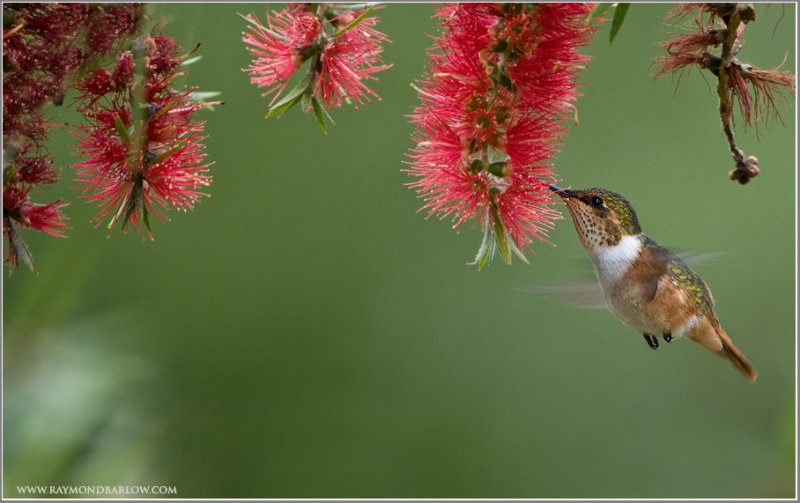
Scintillant Hummingbird (Selasphorus scintilla) in Flight by Raymond Barlow

Scintillant Hummingbird (Selasphorus scintilla) in Flight by Raymond Barlow

That they may see, and know, and consider, and understand together, that the hand of the LORD hath done this, and the Holy One of Israel hath created it. (Isaiah 41:20 KJV)

I wanted to share an article from the latest Acts and Facts. Acts and Facts is a monthly magazine from the Institute for Creation Research. Here are a few quotes from “Hummingbirds!”, by Brian Thomas, M.S.

Magnificent Hummingbird (Eugenes fulgens) by Judd Patterson

Magnificent Hummingbird (Eugenes fulgens) by Judd Patterson

“Who doesn’t pause to marvel when a hummingbird flies by? These tiny, colorful birds perform amazing aerobatic feats, and yet some very smart scientists insist that mere natural forces mimicked a real engineer to construct these fascinating flyers. Authors of a Nature paper on hummingbird flight wrote in 2005 that “the selective pressure on hummingbird ancestors was probably for increased efficiency.”1 They imagine that hummingbirds….”

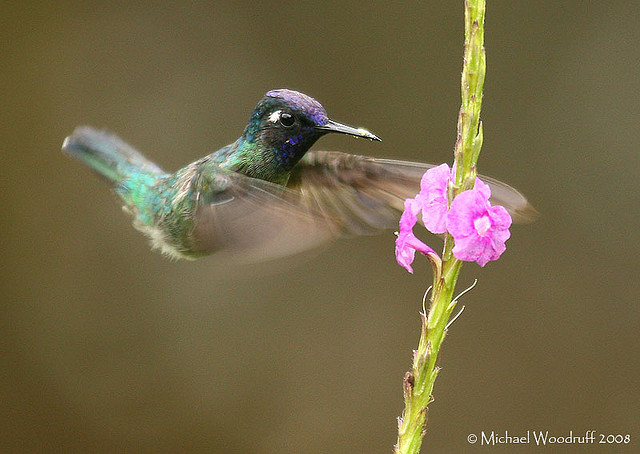
Violet-headed Hummingbird (Klais guimeti) by Michael Woodruff

Violet-headed Hummingbird (Klais guimeti) by Michael Woodruff

“Hummingbird beaks, bones, and feathers differ from those of all other living or extinct bird kinds.3 Their wings don’t fold in the middle. Instead,….”

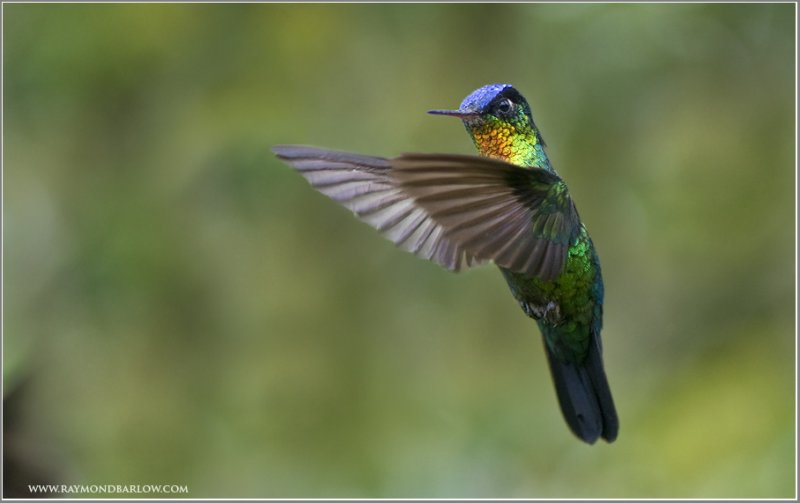
Fiery-throated Hummingbird (Panterpe insignis) by Raymond Barlow

Fiery-throated Hummingbird (Panterpe insignis) by Raymond Barlow

“New hummingbird research has revealed other fascinating features. Birds generate a lot of heat when they fly. Considering their speed, you might expect hummingbirds….”

To read the article  CLICK HERE.

*

Acts and Facts

“Hummingbirds!”, by Brian Thomas

Institute for Creation Research

Trochilidae – Hummingbirds Family

*