Lee’s Four Word Thursday – 4/27/17

***

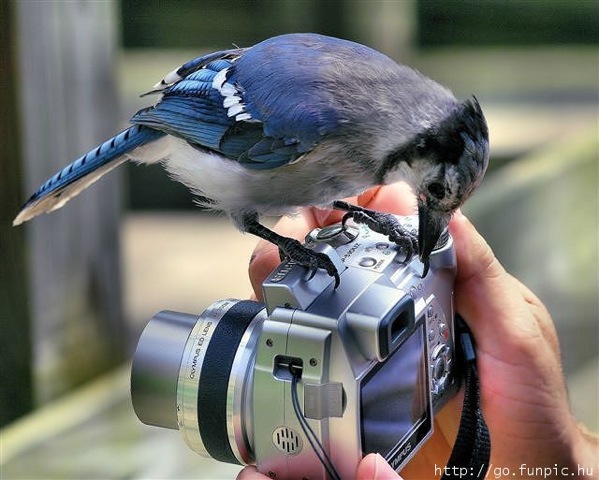
Blue Jay on Camera ©Funpic

GIVEN INTO YOUR HAND

***


“And the fear of you and the dread of you shall be on every beast of the earth, on every bird of the air, on all that move on the earth, and on all the fish of the sea. They are given into your hand.” (Genesis 9:2 NKJV)

Blue Jay on Camera ©Funpic

[This Blue Jay forgot to be afraid.]

*

More Daily Devotionals

Home, Home on the Sage: Nothing to Grouse about!

HOME, HOME ON THE SAGE:  NOTHING TO GROUSE ABOUT!

Dr. James J. S. Johnson

And it came to pass, that at even the quails came up, and covered the camp: and in the morning the dew lay round about the host.   (Exodus 16:13)

Among ground-fowl birds there are some galliforms – called Phasianidae – that resemble one another enough that they are often grouped together, taxonomically, as if they are all super-family “cousins”:  quails, pheasants, partridges, ptarmigans, chickens, peafowl, and grouse-fowl.  One of these Phasianid galliforms, almost the size of a turkey,  will now be considered:  the Greater Sage Grouse.  Since one of the bird’s favorite foods is sagebrush leaves, it is no wonder than the quail-like fowl is often found nesting or foraging in sagebrush-dominated terrain.  Sage grouse eat other leaves as well, if and when accessible, as well as buds, forbs, flowers and bugs.  Insects often eaten by sage grouse include grasshoppers, beetles, and ants.

GreaterSageGrouse.Wikipedia

Greater Sage Grouse   (Centrocercus urophasianus), photo credit: Wikipedia

The GREATER SAGE GROUSE routinely inhabits the Great Basin Desert, thriving in xeric shrublands, a dry steppe-like blend of desert and scrub-grasslands, as well as other sagebrush-dominated lands east of the Great Basin [see Fort Collins Science Center range map, for America’s Sage Grouse].  To appreciate the Greater Sage Grouse’s scrubland habitat, a quick review of the Great Basin Desert is worthwhile.
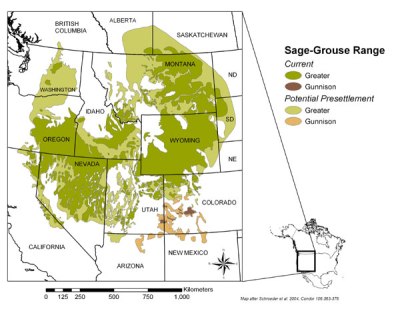
SageGrouse-RangeMap.FortCollinsScienceCenter

The “Great Basin” Desert is not the typical “desert” of hot, hot, dry, dry mostly-barren land, studded with cactus and sagebrush vegetation. Rather the Great Basin Desert is a “cold” scrubland desert, meaning that it is dry most of the year, but its temperatures are not hot year-round – in fact, it usually gets more annual precipitation via snowfall than by rainfall.  In other words, the Great Basin is dry enough to qualify as a “desert” (and thus it is not “covered” by forests or grasslands, and typically hot during summer, yet it get quite cold in the winter, with snow winters as the norm.  In this respect the Great Basin is in a class by itself, in North America, unlike America’s other 3 major deserts (the Sonoran, Chihuahuan, and Mojave deserts) which hare truly “hot deserts”. [See map of the Great Basin Desert, below, compliments of Wikipedia.]
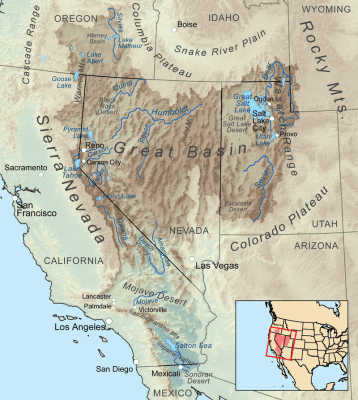
GreatBasinDesert-MAP.Wikipedia.png

Ecologicallly speaking, the Great Basin includes a mix of rocky soils and scrublands, many dominated by sagebrush, greasewood, saltbush and salty-soil areas, mudflats, and sand dunes, as well as pinyon-juniper woodlands in higher elevations. Geographically speaking, the Great Basin covers almost all of Nevada, plus western Utah, a bit of southern Idaho, and part of the south-central part of Oregon.  [See map, below, compliments of the U.S. Geological Survey, a bureau of the U.S. Department of the Interior.]
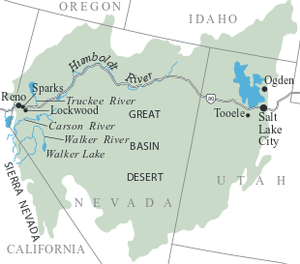
GreatBasinDesert-MAP.USGS

Great Basin Desert, USGS map [public domain]

Since the Great Basin Desert is not hot year-round, but routinely experiences snowy winters, its inhabitants must apply climate-response strategies that successfully resolve temperature extremes, such as how to deal with hot and dry summers, plus cool-to-cold winters. Some Great Basin animals migrate, seasonally, while other hibernate, to avoid the inconveniences of snowfall and frigidity.  But how do Greater Sage Grouse deal with the seasonal “climate change” challenges of the Great Basin?

Sagebrush-terrain.Defenders-of-Wildlife-Blog-ScottSmith.jpg

Sagebrush-dominated terrain (photo credit: Scott Smith / Defenders of Wildlife Blog)

In short, the sage grouse stay put, for the most part, throughout all or most of the year.  [See Roger Tory Peterson, A FIELD GUIDE TO WESTERN BIRDS (Peterson Field Guides / Houghton Mifflin, 1990), pages 158-159 & Map 96.]  If need be, however, they “micro-migrate” to other nearby areas, although usually only for relatively short distances, so they are not true “migrants”, phenologically speaking.  In other words, depending upon the severity of winter weather, sage grouse may undertake short-distance migrations, to find user-friendly winter habitat, going as far as 100 miles if necessary, although less than 20 miles is more typical.

SageGrouse-with-Pronghorn.sagebrush.jpg

Sage Grouse, with Pronghorn, in sagebrush  (photo credit” Defenders of Wildlife Blog)

Consider the following facts, summarized by the U.S. Fish & Wildlife Service, about the Greater Sage Grouse:

Greater sage-grouse (Centrocercus urophasianus) are members of the Phasianidae family. They are one of two species; the other species in the genus is the Gunnison sage-grouse (Centrocercus minimus). The Greater sage-grouse is the largest North American grouse species. Adult male greater sage-grouse range in length from 26 to 30 inches and weigh between 4 and 7 pounds. Adult females are smaller, ranging in length from 19 to 23 inches and weighing between 2 and 4 pounds.  During the spring breeding season, male sage-grouse gather together to perform courtship displays on areas called leks. Areas of bare soil, short-grass steppe, windswept ridges, exposed knolls, or other relatively open sites typically serve as leks, which are often surrounded by denser shrub-steppe cover, which is used for escape, thermal and feeding cover. The proximity, configuration, and abundance of nesting habitat are key factors influencing lek location. Leks can be formed opportunistically at any appropriate site within or adjacent to nesting habitat. Therefore, lek habitat availability is not considered to be a limiting factor for sage-grouse. Leks are indicative of nesting habitat.   Productive nesting areas are typically characterized by sagebrush with an understory of native grasses and forbs, with horizontal and vertical structural diversity that provides an insect prey base, herbaceous forage for pre-laying and nesting hens, and cover for the hen while she is incubating. Shrub canopy and grass cover provide concealment for sage-grouse nests and young, and are critical for reproductive success. The average distance between a female’s nest and the lek on which she was first observed ranged from 2.1 mi to 4.8 mi in five studies examining 301 nest locations, but actual distances can be highly variable. Male sage-grouse do not participate in nesting or rearing of the chicks.   …

During the spring and summer sage-grouse will primarily eat insects and forbs, but they rarely stray from the edge of sagebrush, which provides cover year round. In the fall, sage-grouse shift their diet entirely to sagebrush, depending on the shrub for both food and cover. Sage-grouse obtain their water from the food they eat. However, they will drink water if available. …  Currently, greater sage-grouse occur in 11 States (Washington, Oregon, California, Nevada, Idaho, Montana, Wyoming, Colorado, Utah, South Dakota, and North Dakota), and 2 Canadian provinces (Alberta and Saskatchewan), occupying approximately 56 percent of their historical range. Approximately 2 percent of the total range of the greater sage-grouse occurs in Canada, with the remainder in the United States. Sage-grouse have been extirpated from Nebraska, British Columbia, and possibly Arizona. Current distribution of the greater sage-grouse is estimated at 258,075 mi2. Changes in distribution are the result of sagebrush alteration and degradation [because sage grouse depend heavily upon sagebrush for their habitat needs]. …

[Quoting from USFWS, “Beginner’s Guide to Greater Sage-Grouse”.]

So there you have it, Sage Grouse like to live around — and eat — desert scrub sagebrush, so expect to find them living in the sagebrush-dominated areas of the Great Basin Desert..  Perhaps they also have a “dry” sense of humor!
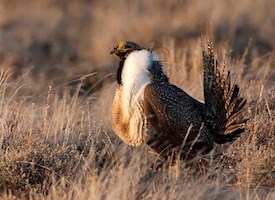

GreaterSageGrouse.Cornell-StephenParsons

Featured image photo credit:  Stephen Parsons / Cornell
Lee’s Three Word Wednesday – 4/26/17

***

Wood Duck (Aix sponsa) Shuting Mouth ©S-Media-Cache

SHUT THEIR MOUTH

***


“So shall he sprinkle many nations; the kings shall shut their mouths at him: for that which had not been told them shall they see; and that which they had not heard shall they consider.”  (Isaiah 52:15)

Wood Duck (Aix sponsa) Shuting Mouth ©S-Media-Cache

*

More Daily Devotionals

Lee’s Two Word Tuesday – 4/25/17

***

Broad-billed Prion (Pachyptila vittata) ©www.TeAra.govt.nz

BROAD IS

***


“Enter ye in at the strait gate: for wide is the gate, and broad is the way, that leadeth to destruction, and many there be which go in thereat: Because strait is the gate, and narrow is the way, which leadeth unto life, and few there be that find it.” (Matthew 7:13-14 KJV)

Broad-billed Prion (Pachyptila vittata) ©www.TeAra.govt.nz

*

More Daily Devotionals

Lee’s One Word Monday – 4/24/17

***

Northern Giant Petrel (Macronectes halli) by Dave's BirdingPix

OPEN

***


“I am the LORD thy God, which brought thee out of the land of Egypt: open thy mouth wide, and I will fill it.” (Psalms 81:10 KJV)

Northern Giant Petrel (Macronectes halli) by Dave’s BirdingPix

*

More Daily Devotionals

Lee’s Seven Word Sunday – 4/23/17

***

Black-cheeked Lovebird (Agapornis nigrigenis) ©ImagesFromAfrica

FOR WHERE YOU GO, I WILL GO

AND WHERE YOU LODGE, I WILL LODGE

***


“And Ruth said, entreat me not to leave thee, or to return from following after thee; for where you go, I will go; and where you lodge, I will lodge: thy people shall be my people, and thy God my God.  (Ruth 1:16)

Name and Credit for Bird Photo

*

More Daily Devotionals

Lee’s Six Word Saturday – 4/22/17

***

Three Geese Heading Out ©Photofeathers

SURELY WE WILL RETURN WITH THEE

***


“And they said unto her, Surely we will return with thee unto thy people.”  (Ruth 1:10)

Three Geese Heading Out ©Photofeathers

*

More Daily Devotionals

*

Lee’s Five Word Friday – 4/21/17 ex

***

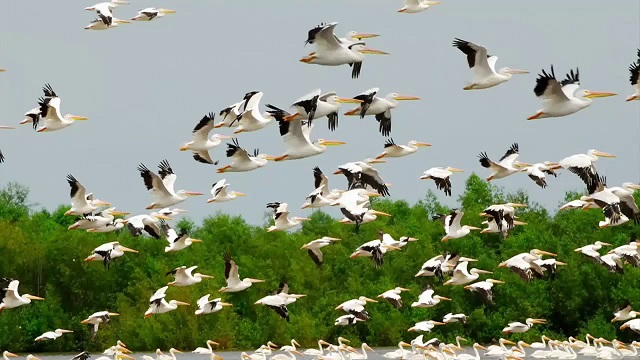
American White Pelican (Pelecanus erythrorhynchos) ©WTTW

ON THE WAY TO RETURN

***


“Wherefore she went forth out of the place where she was, and her two daughters in law with her; and they went on the way to return unto the land of Judah.”  (Ruth 1:7)

American White Pelican (Pelecanus erythrorhynchos) ©WTTW

*

More Daily Devotionals

*

Lee’s Four Word Thursday – 4/20/17

***

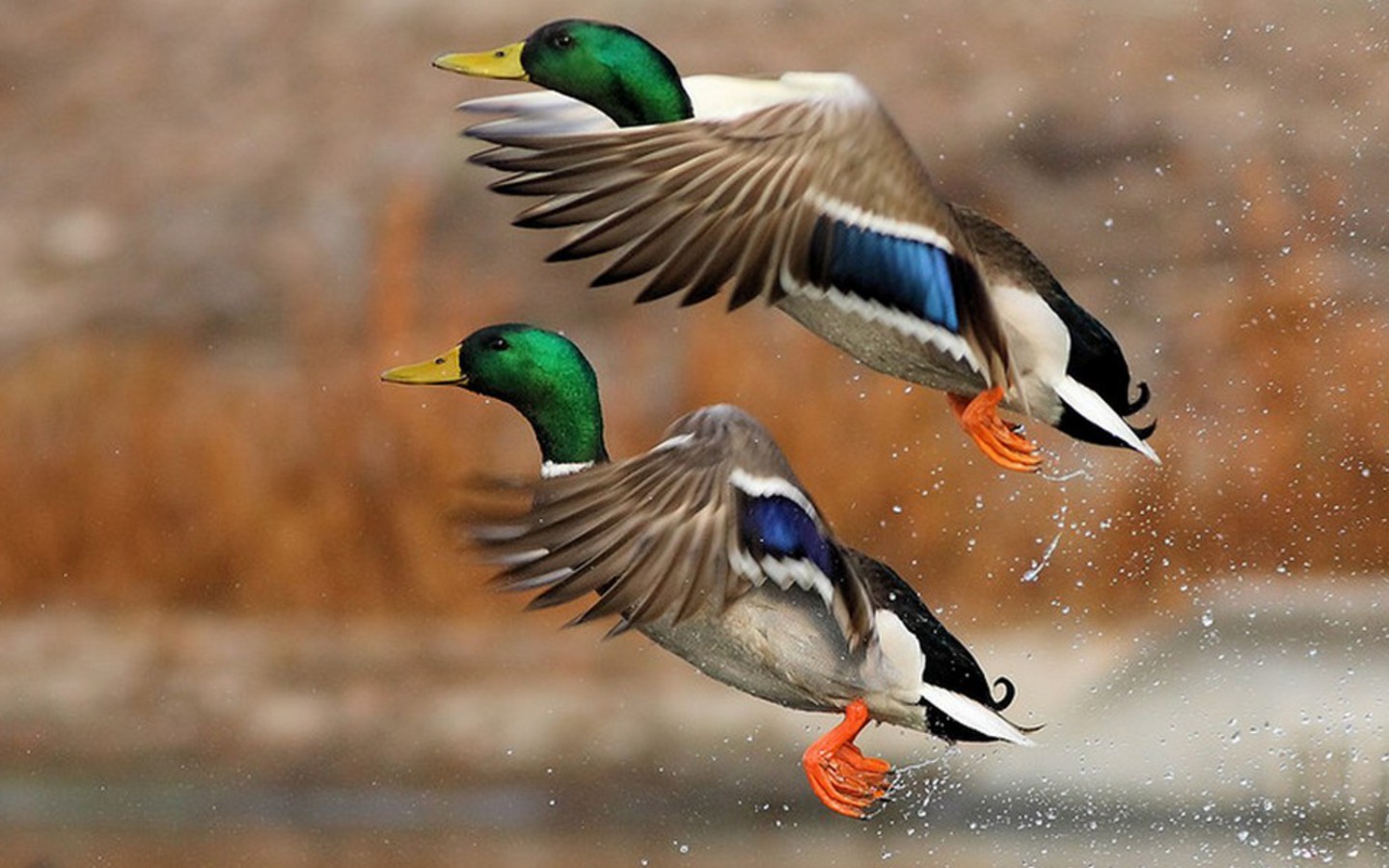
Two Mallards Taking Off ©WallpaperSafari

SO THEY TWO WENT

***


“So they two went until they came to Bethlehem. And it came to pass, when they were come to Bethlehem, that all the city was moved about them, and they said, Is this Naomi?  (Ruth 1:19)

Two Mallards Taking Off ©WallpaperSafari

*

More Daily Devotionals

*

Ian’s Bird of the Week/Moment – Red-tailed Black-Cockatoo

Ian’s Bird of the Week/Moment – Red-tailed Black-Cockatoo by Ian Montgomery

Scarlet Macaw (Ara macao) by Ian

The bird of the week has, regrettably, been so irregular over the last year or so, that I can’t pretend anymore that it’s a weekly event, or even a monthly one for that matter. These days we’re supposed to achieve peace of mind by living in the now, I’ve renamed the series Bird of the Moment.

In the last one on Macaws, I finished with this photo of a Scarlet Macaw feeding on an introduced Terminalia tree in Costa Rica and mentioned that the fruit of same species (T. cappata) is equally popular with Red-tailed Black-Cockatoos along The Strand in Townsville. Here is a pair with the male on the right whispering sweet phrases to the female two days before Valentine’s Day: she looks very receptive. You can see the female has spots on the head, barring on the body and a barred panels in the tail against a background of red and yellow. The male has glossy black plumage and scarlet, unbarred panels in the tail.

Red-tailed Black Cockatoo (Calyptorhynchus banksii) by Ian

These Cockatoos are quite common in the Townsville District and for me, it was love and first sight when I arrived here in 2002. They are spectacular birds, very large (to 65cm/25in in length) with a wonderful leisurely ‘rowing’ flight, long tails and a permanent smile. They are often heard before being seen both when perched and in flight, owing to their haunting, far-carrying, trumpeting calls, which are positively melodious compared with the ear-shattering screeches of their ubiquitous white relatives, the Sulphur-crested Cockatoo. They’re remarkably tame too and seem to enjoy being photographed.

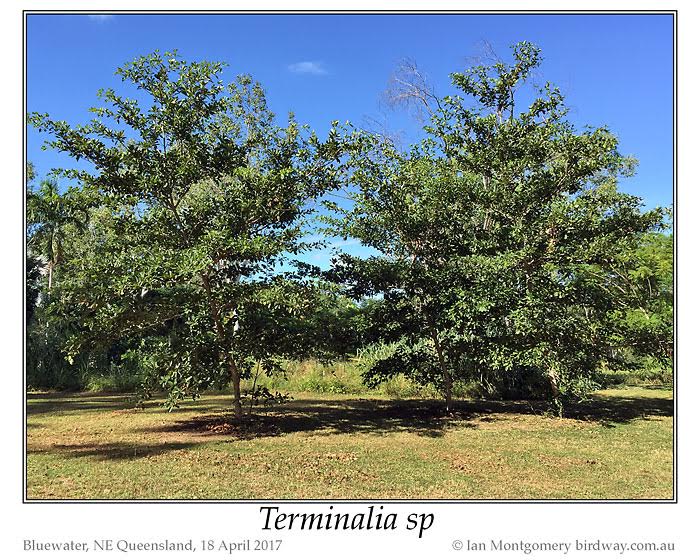
Terminalia sp

Terminalia grow readily from seedlings, and Jo Wieneke gave me some seedlings when I moved to Bluewater in 2013, which I planted with the sole aim of attracting these Cockatoos, above. These belong to a different species of Terminalia with smaller leaves and fruit. The fruit of T. cappata, the ‘Beach Almond’ are about the size of walnuts; these ones are more like smallish, hard, black olives. The three trees all lean to the left, a legacy of cyclone Yasi in 2011, called the ‘Yasi lean’. Since then the trees have tried to correct this defect by growing vertically at the base and the top – easiest to see in the left-most tree – and growing thicker branches on the right-hand side, presumably as a counter-balance.

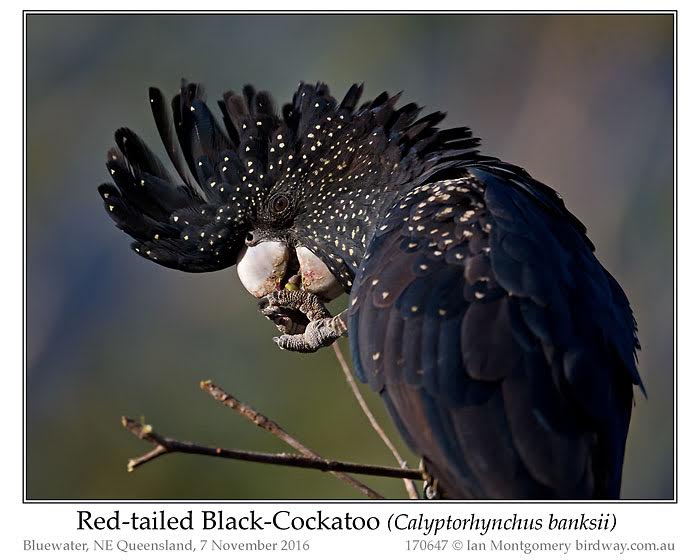
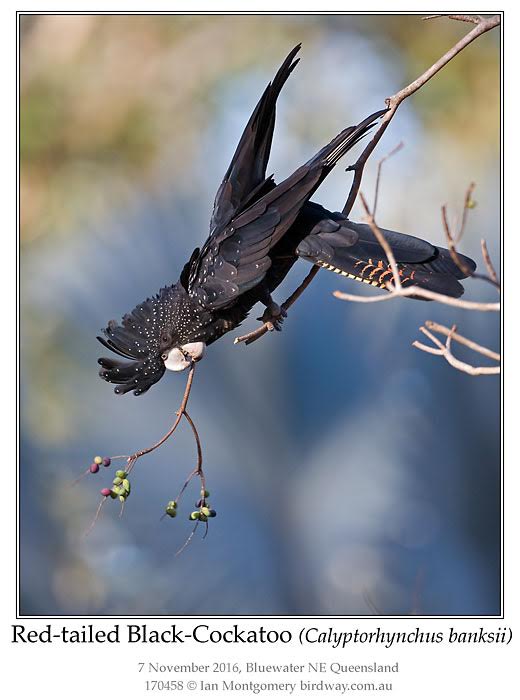
The trees started flowering and fruiting about three years ago, and I was delighted when they had their first visit from a lone Black-Cockatoo. Last November, the trees had an abundant harvest, and a pair of Cockatoos came each evening at about 4:30 pm (and maybe before I surfaced in the morning) and thoroughly until they had completely stripped all fruit. The birds are wonderfully acrobatic (below) and their preferred way of eating is to snip off a twig, hold it in one foot, stand on the other foot, prise open the hard shell to get at the kernel in the middle and discard both the shells and the twigs.

Red-tailed Black Cockatoo (Calyptorhynchus banksii) by Ian

The shells are quite hard and I cut one open to see what was inside and found the kernel is tiny, so it seemed like a lot of effort for a relatively small reward. In the photo below, the male is using the pointed tip of the upper mandible to extract the kernel from the cracked shell. They drop a lot of unopened fruit and several months later a small flock of cockatoos came round to feed on the ground under the trees.

Red-tailed Black Cockatoo (Calyptorhynchus banksii) by Ian

The coloured panels on the tail are not easy to see except when the birds spread the tail feathers, either when taking off, landing or doing a sudden manoeuvre in flight. Presumably, it is an important signal to other members of the flock. Black-Cockatoos seem to form long-term pair-bonds which are maintained even when they flock, so I wonder whether the variability in the colour of the panels of females (the one below has much red and little yellow) help the males identify their mates.

Red-tailed Black Cockatoo (Calyptorhynchus banksii) by Ian

The next photo shows a male just after take-off and showing his red panels to best advantage.

Red-tailed Black Cockatoo (Calyptorhynchus banksii) by Ian

Here is a female on the beach at Horseshoe Bay on Magnetic Island. She looks as if she’s contemplating a swim – you can see the edge of the water in the background – but it is more likely that she is looking for fruits from the casuarinas growing along the foreshore. In the absence of introduced Terminalia trees, the birds feed on the fruit of native trees including those of Eucalyptus and Pandanus.

Red-tailed Black Cockatoo (Calyptorhynchus banksii) by Ian

The Red-tailed Black-Cockatoo is the most widespread of the five species of Black-Cockatoo, all of which are Australian endemic.s (I’m not including the Palm Cockatoo which belongs to a different genus and occurs in Cape York and across New Guinea.) The other four species are the Glossy (eastern Australia); the Yellow-tailed (eastern and southern Australia and Tasmania) and the Long-billed and Short-billed (both have white tails and are restricted to SW Western Australia). The Red-tailed has five subspecies which differ in size and in the colour of the tail panels in females: the largest, nominate race banksii (Queensland and northern NSW); the large-billed macrorhynchus (Northern Territory and NW Western Australia); the smaller samueli in central Australia; also in (SW Western Australia); and graptogyne (western Victoria and SE South Australia).

Red-tailed Black Cockatoo (Calyptorhynchus banksii) by Ian

The three birds in the last photo belong to the large-billed race macrorhynchus, and presumably are a family with the female on the left and the male on the right. The bird in the centre has female-like plumage but a black bill – females have whitish bills – so is probably a juvenile male; juvenile males take about four years to acquire the adult male plumage. Family bonding would appear to be important and you often see these birds in groups of three.

I’ve been slack about the Bird of the Moment; I have however been working on the website. The latest inclusions include a gallery of Dragonflies and one of Butterflies and Moths, and there are various additions to the bird galleries.

Greetings,
Ian


Lee’s Addition:

“Oh that men would praise the LORD for his goodness, and for his wonderful works to the children of men!” (Psalms 107:8 KJV)

Thanks, Ian, for an update. I had begun to think you were not able to provide any more of these great articles for us. You are missed when we fail to hear from you.

It appears that the series of blog posts of Ian’s will be renamed. Starting with his next article, the title will be “Ian’s Bird of the Moment.” It is an appropriate name for the series, as most birdwatchers are watching “birds of the moment.”

Not sure if you readers were aware, but Ian has been dealing with a serious eye problem. That is difficult for such a good photographer to deal with. Glad he is improving so he can keep us informed about God’s amazing flying avian wonders.


Lee’s Three Word Wednesday – 4/19/17

***

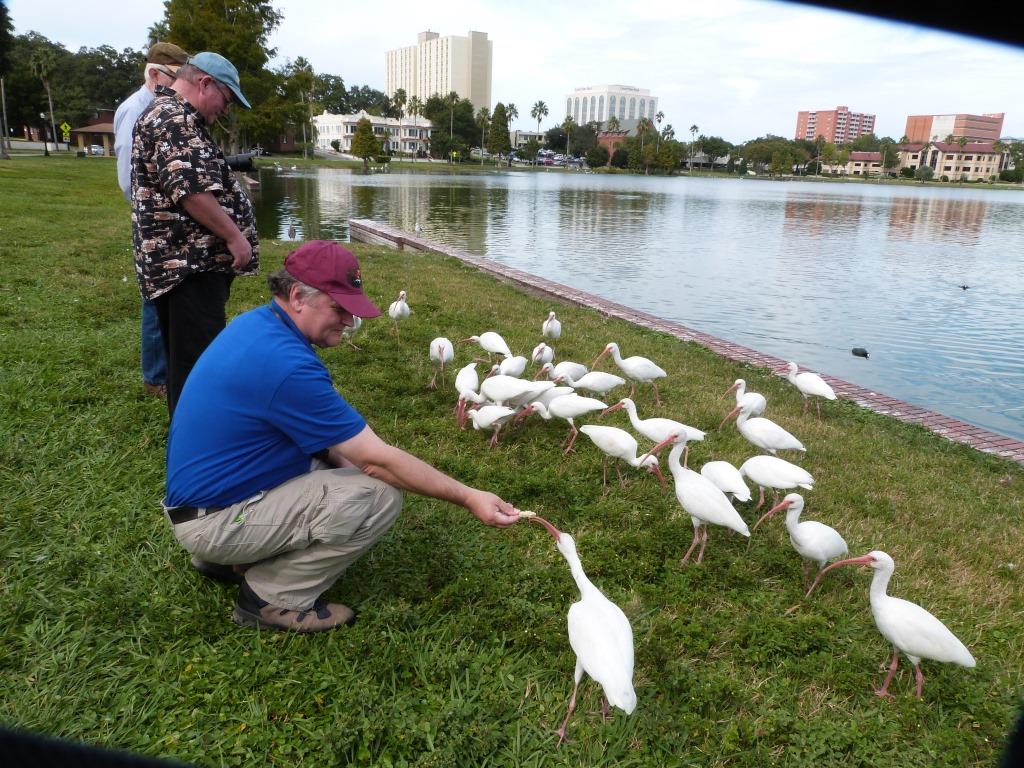
Feeding White Ibises at Lake Morton

GIVING THEM BREAD

***


“Then she arose with her daughters in law, that she might return from the country of Moab: for she had heard in the country of Moab how that the Lord had visited his people in giving them bread.”  (Ruth 1:6)

Feeding White Ibises at Lake Morton

*

More Daily Devotionals

*

Lee’s Two Word Tuesday – 4/18/17

***

Corn Bunting (Emberiza calandra) In the barley harvest ©Vinehousefarm

BARLEY HARVEST

***


“So Naomi returned, and Ruth the Moabitess, her daughter in law, with her, which returned out of the country of Moab: and they came to Bethlehem in the beginning of barley harvest.”  (Ruth 1:22)

Corn Bunting (Emberiza calandra) In the barley harvest ©Vinehousefarm

*

More Daily Devotionals

*