***
DESPISE YOUR YOUTH
***
“Let no one despise your youth, but be an example to the believers in word, in conduct, in love, in spirit, in faith, in purity.” (1 Timothy 4:12 NKJV)
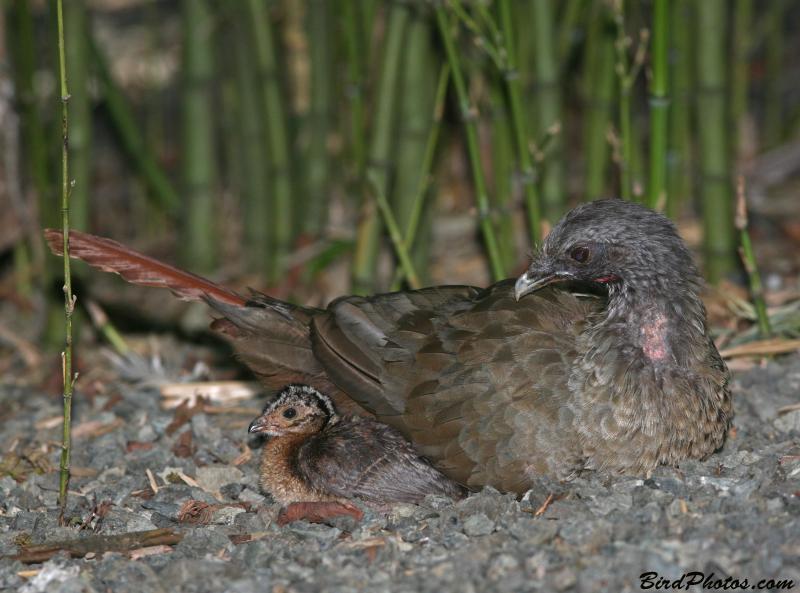
Little Chachalaca (Ortalis motmot) ©BirdPhotos.com
*
*
“Let no one despise your youth, but be an example to the believers in word, in conduct, in love, in spirit, in faith, in purity.” (1 Timothy 4:12 NKJV)
Little Chachalaca (Ortalis motmot) ©BirdPhotos.com
*
*
Duck from Refrigerator
RockDoveBlog published this article yesterday and thought you might enjoy reading about this Cool Duck.
An amazing story of duck survival was reported, years ago, by BBC News:
A duck in the US state of Florida has survived gunshot wounds and a two-day stint in a refrigerator. A hunter shot the duck, wounding it in the wing and leg. Believing the bird was dead, he left it in his fridge at his home in Tallahassee. The hunter’s wife got a fright when she opened the fridge and the duck lifted its head, a local veterinarian said. Staff at the Goose Creek Animal Sanctuary who are treating the bird said it has a 75% chance of survival. CLICK HERE TO READ THE REST OF THE BLOG
Also BBC’s article about this duck.
“Be patient therefore, brethren, unto the coming of the Lord. Behold, the husbandman waiteth for the precious fruit of the earth, and hath long patience for it, until he receive the early and latter rain.” (James 5:7 KJV)

Cajun Cuisine at Willie’s Duck Diner (West Monroe, Louisiana, AD2018)
[Actually his first on of the new year.]
First of all my best wishes for a contented and healthy New Year. There is one important change for birdway customers with the new year. I’m planning to officially deregister the birdway company at the end of the Australian financial year (30 June) so in preparation for that birdway stopped trading on 31 December. I’ve registered as a sole trader, so any future invoices will be made out by me rather in the name of the company and will not include GST.
I’ve also removed the books Diary of a Bird Photographer and Where to Find Birds in Northern Queensland from the Apple Store, Google Play and Kobo Books. If you want to buy them, contact me directly, ian@birdway.com.au or ianbirdway@gmail.com. I’ve put instructions on the website: Diary of a Bird Photographer and Where to Find Birds on Northern Queensland. Having removed the middlemen and GST, I can now offer them at reduced prices of $5 and $15 respectively (Australian dollars or equivalent; foreign currencies preferably through PayPal). I’ll investigate direct purchase through the website, but for the moment I’ll email them to customers in the required format (ePub for Apple, Windows and Android computers, tablets and smart phones; Kindle for Amazon readers).
Back to the New Year: here’s the last photo that I took in 2016, a two day old new moon just after sunset on 31st December.

New Year is often represented symbolically by a chubby baby wearing not much more than a top hat and a banner with the new year number on it. Here, perhaps more appropriately for us, is a new year baby Dollarbird taken from my house last Friday, 3 days after it left the nest. Junior is on the right looking relaxed, while an alert and anxious-looking parent is on the right.
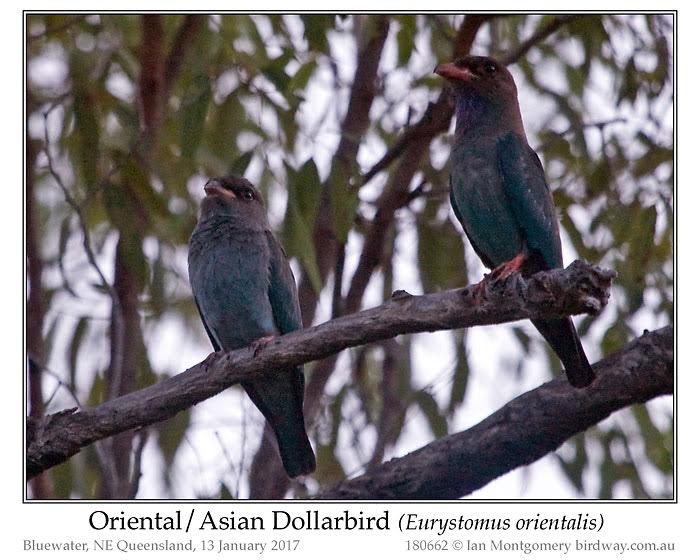 A pair of Dollarbirds nest regularly in a termite-ridden poplar gum near the house, which has plenty of nesting hollows thanks to the termites. The same tree is also the headquarters of the local band of Blue-winged Kookaburras, but the two species seem to co-habit quite peacefully, if not quietly. The dollarbird nest is at a great height, perhaps 25m/80ft, so the first introduction of the young birds to the outside world is a perilous decent to the ground that doesn’t always end well.
This year, the young bird landed in my neighbour’s garden on the 10th January. He has both a dog and a ride-on lawn mower that is his favourite toy and I warned him about the bird. The parents made lots of noise over the next three days, presumably in defence of the newcomer. Consequently, I assumed all was well but I was of course relieved to see it safely up in the tree.

That’s by way of a new year aside. I’ve chosen another hollow-nesting bird as the subject of this posting, the Eurasian Three-toed Woodpecker from the trip to Slovakia last June. Those of you who have been on the list for a while probably know that Woodpeckers are among my favourite birds, even though or perhaps because I’ve most lived in Woodpecker-deprived countries – Ireland and then Australia, though eastern Ireland has recently been colonised successfully by the Great Spotted Woodpecker.
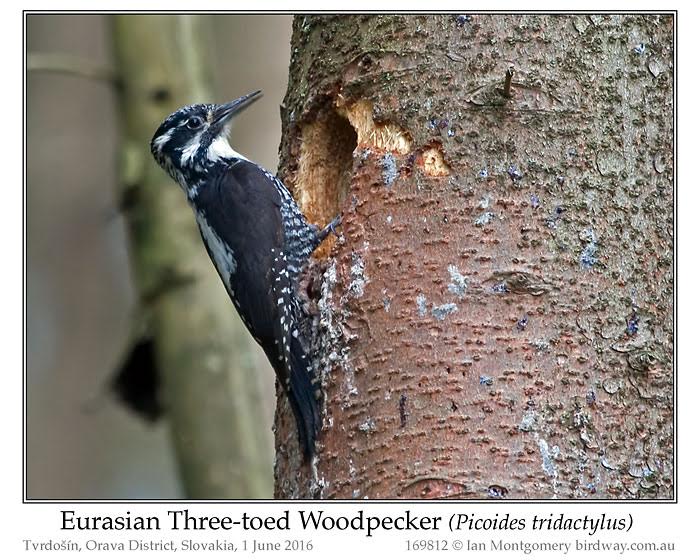
Woodpeckers were among my target birds in Slovakia. Although we saw several species, the only one that I got good photos of was this one. A very closely related three-toed woodpecker also occurs in North America. There is disagreement as to whether they should be treated as the same or separate species, so it’s qualified here with ‘Eurasian’. The nesting hollow was close to the ground so I was able to set up the camera and tripod at a convenient distance (see second last photo) and wait for the adults to visit carrying food.
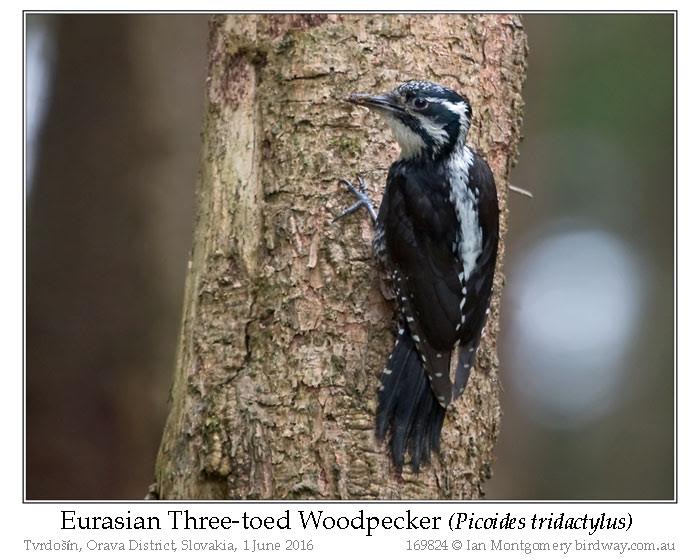
The males are distinguishable by having some yellow streaks on the crown. The yellow varies in intensity and was very pale in this male – first of the Woodpecker photos. He made only one visit during the hour or so I was there, so the female either did most of the work or had more success in finding food. This species is supposedly shy, but this pair didn’t take much notice of me, though the female sometimes perched on a tree closer to the camera and looked in my direction (photo directly above).
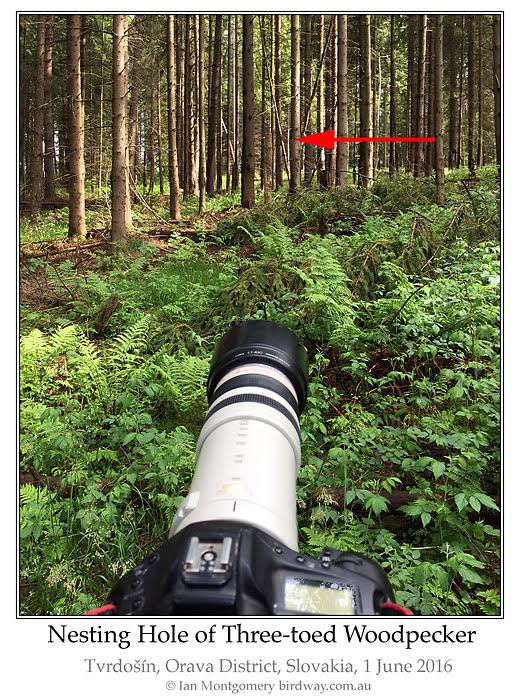
A little later, our guides found an active hollow of a Great Spotted Woodpecker with noisy young nearby. These adults were much shyer and wouldn’t approach the nest while I was in the vicinity, so I left them in peace after a little while. Unlike Dollarbirds, Woodpeckers can’t rely on termites to do all the work of burrowing for them and have to do it themselves. You can see on these photos that there were a few false starts chipping through the bark. Eurasian Three-toed Woodpeckers usually nest in Spruce.
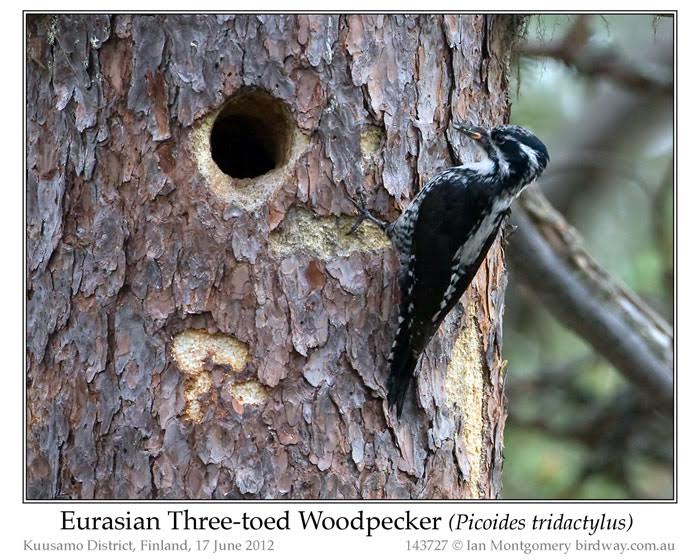
I was pleased with the photos that I got of the Slovakian Three-toed Woodpeckers. It was only later that I found that I had already photographed another nesting site in Finland, four years before (last photo). On this photo you can see that the bird has only three toes. All – I believe – other Woodpeckers have four toes and usually cling onto trees with two toes pointing forwards and two braced backwards. I find it hard to imagine what competitive advantage there would lead to the three-toed losing one of its toes.
Greetings
Ian
Lee’s Addition:
“…that he may set his nest on high, that he may be delivered from the power of evil!” (Habakkuk 2:9b KJV)
What an interesting Woodpecker and what a distance that camera is from the little avian wonder. Wow!
*
More of Ian’s Bird of the Week articles:
*
“…that ye might learn in us not to think of men above that which is written, that no one of you be puffed up for one against another.” (1 Corinthians 4:6b KJV)
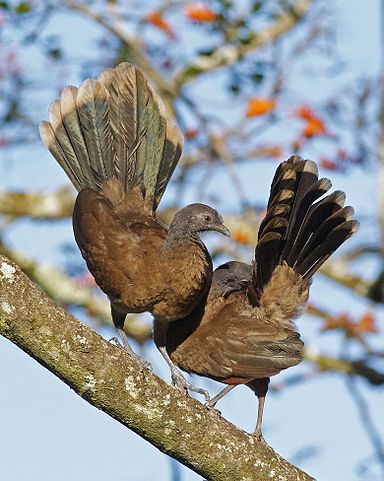
Grey-headed Chachalaca (Ortalis cinereiceps) ©WikiC
*
*
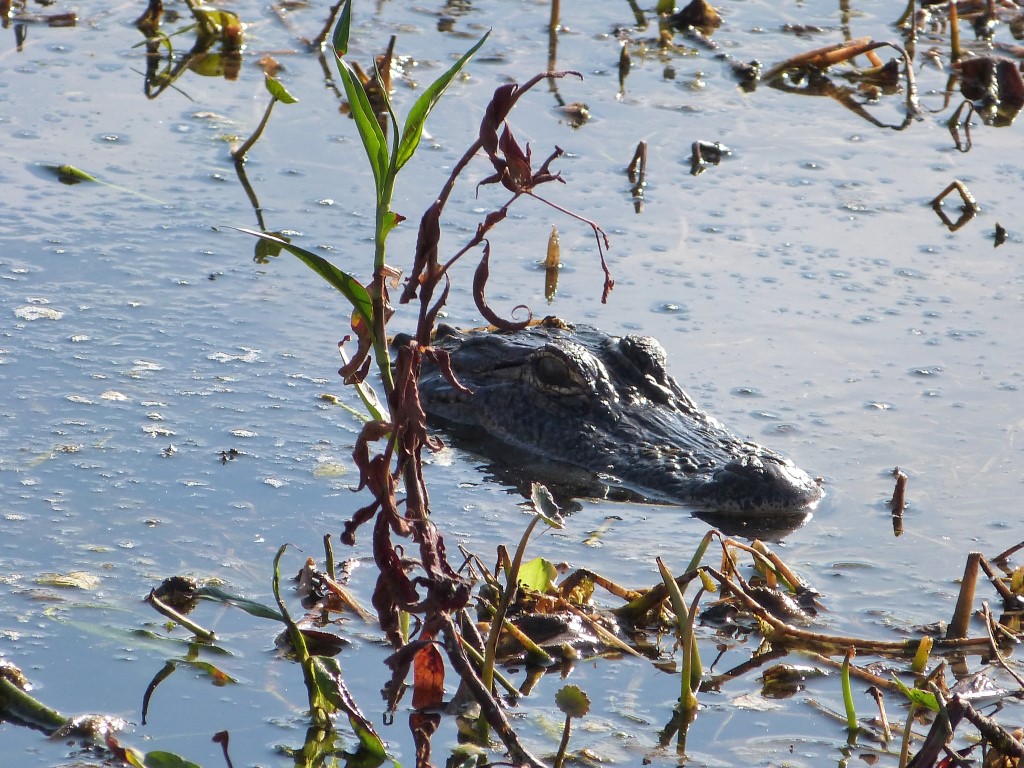
Alligator Circle B Bar Reserve by Lee taken in 2014
“And I will walk at liberty:…” (Psalms 119:45a KJV)
I thought you might enjoy seeing the huge alligator that strolled across the path at our favorite local place we go birdwatching. In fact, this was on the national news this evening. We have seen many gators out there, but glad this this one didn’t surprise us in the past.

Alligator about 8 ft by Lee at Circle B 2013
On the news they thought he was between 12-14 feet long and was just wanting to cross the path. Not bothering anyone.
“Then shalt thou walk in thy way safely, and thy foot shall not stumble.” (Proverbs 3:23 KJV)
No, we were not out there when this happened. [broken computer, back problems and almost bronchitis] No, this fellow had to do this without our watching him. :)
Our previous adventures at Circle B
*
“Watch, stand fast in the faith, be brave, be strong.” (1 Corinthians 16:13 NKJV)
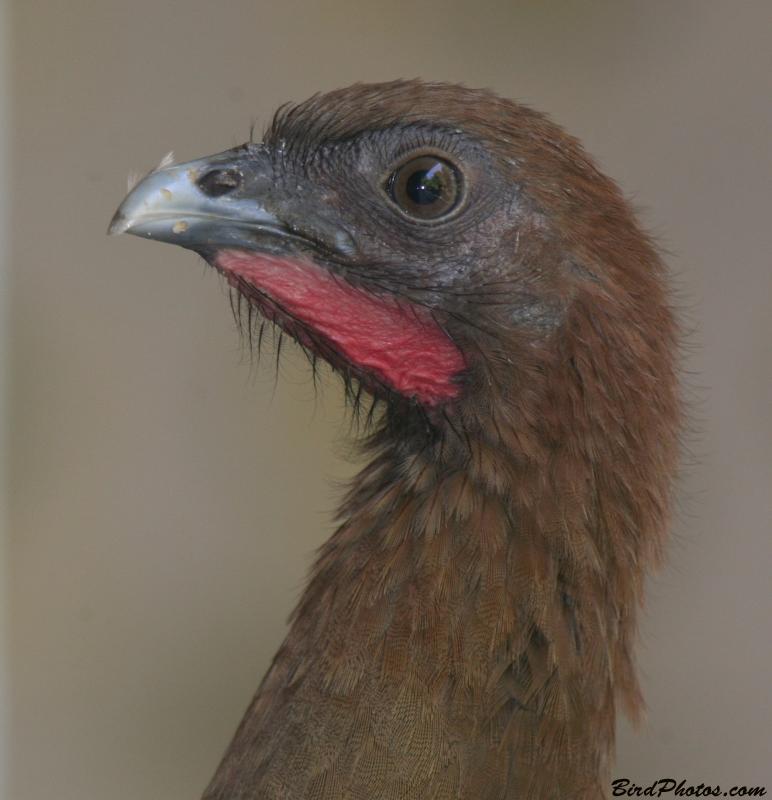
Chestnut-winged Chachalaca (Ortalis garrula) close-up ©BirdPhotos.com
*
*
“And he arose, and came to his father. But when he was yet a great way off, his father saw him, and had compassion, and ran, and fell on his neck, and kissed him.” (Luk 15:20 KJV)
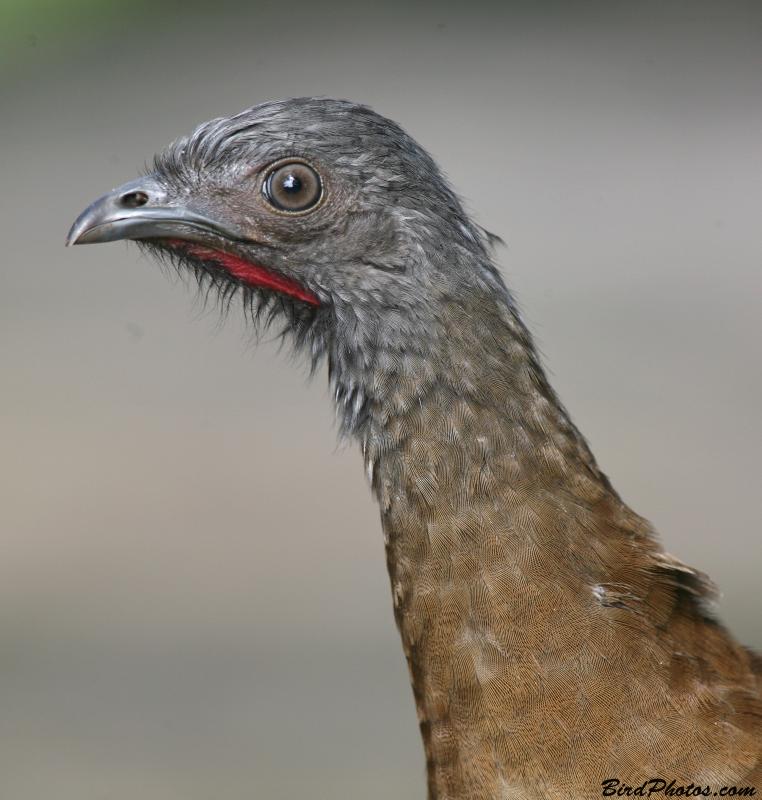
Grey-headed Chachalaca (Ortalis cinereiceps) Close-up ©BirdPhotos.com
*
*
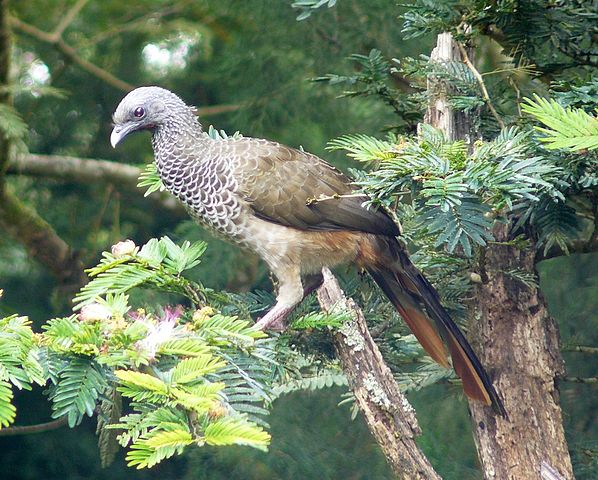
Colombian Chachalaca (Ortalis columbiana) ©WikiC
“I know all the fowls of the mountains: and the wild beasts of the field are mine.” (Psam 50:11 KJV)
Chachalacas are a part of the Cracidae family. There are 55 species in this family and these 16 Chachalacas are in the Ortalis genus. It makes for a good division for this family, plus, I have been having computer problems for over a week. So, we will go with these noisy little avian wonders from the Lord’s hand. You may notice that they are not really “handsome” or “colorful,” yet, they are just as special to their Creator as the more fancy birds.

Rufous-vented Chachalaca (Ortalis ruficauda) by Kent Nickel
Chachalacas are mainly brown galliform birds from the genus Ortalis. These birds are found in wooded habitats in far southern United States (Texas), Mexico, and Central and South America. They are social, can be very noisy and often remain fairly common even near humans, as their relatively small size makes them less desirable to hunters than their larger relatives. They somewhat resemble the guans, and the two have commonly been placed in a subfamily together, though the chachalacas are probably closer to the curassows.
The generic name is derived from the Greek word όρταλις, meaning “pullet” or “domestic hen.” The common name is an onomatopoeia for the four-noted cackle of the plain chachalaca (O. vetula). (Information from Wikipedia)
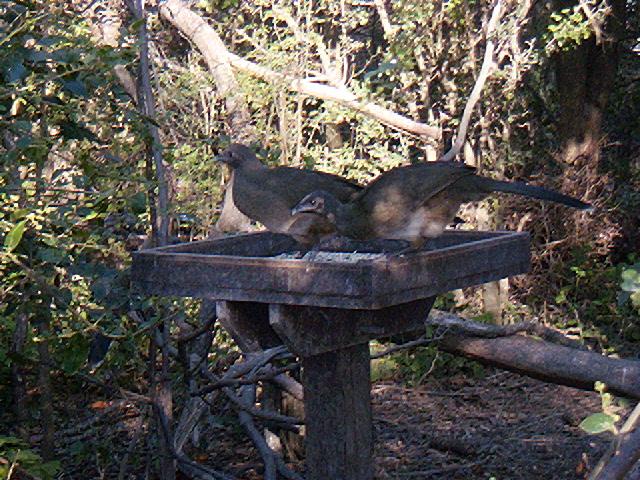
Plain Chachalaca at Santa Ana NWR, 2002 [Old camera]
After that noisy Chachalaca thought you might like a little quieter song.
*And my people shall dwell in a peaceable habitation, and in sure dwellings, and in quiet resting places;” (Isa 32:18 KJV)
“Quiet Rest* and “Sweet Hour of Prayer” ~ by Kathy Lisby – Nell Reese acc”.
*
*
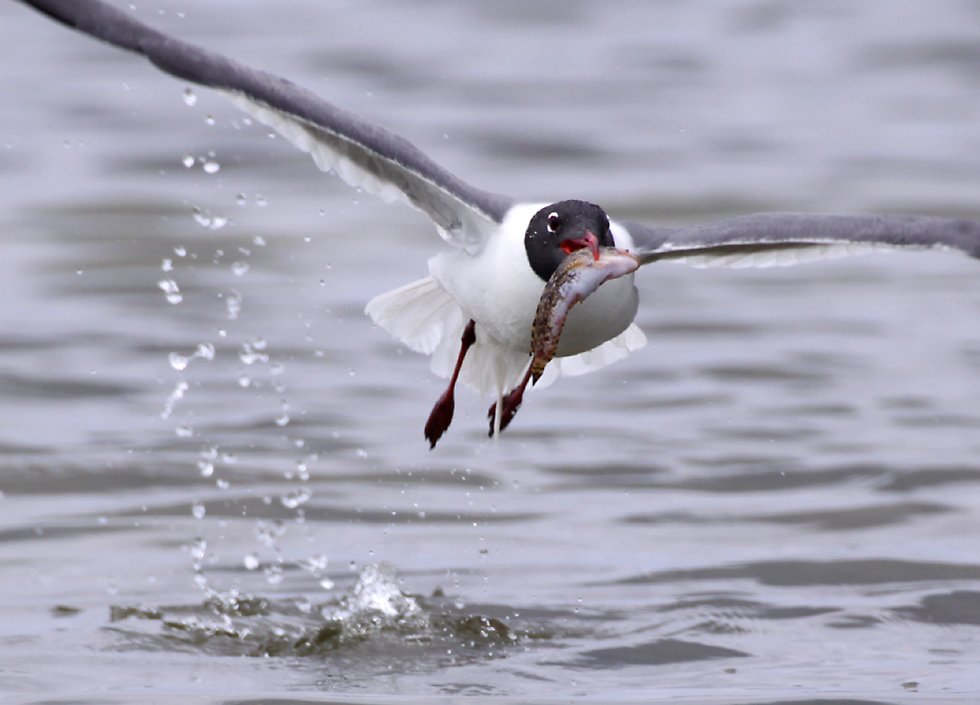
“Jesus saith unto them, Bring of the fish which ye have now caught.” (John 21:10 KJV)
Laughing Gull Caught Fish ©Richard Seaman
*
*
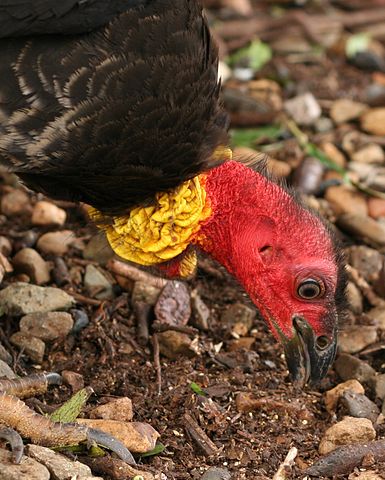
“Let us search and try our ways, and turn again to the LORD.” (Lamentations 3:40 KJV)
Australian Brushturkey (Alectura lathami lathami) ©WikiC
*
*
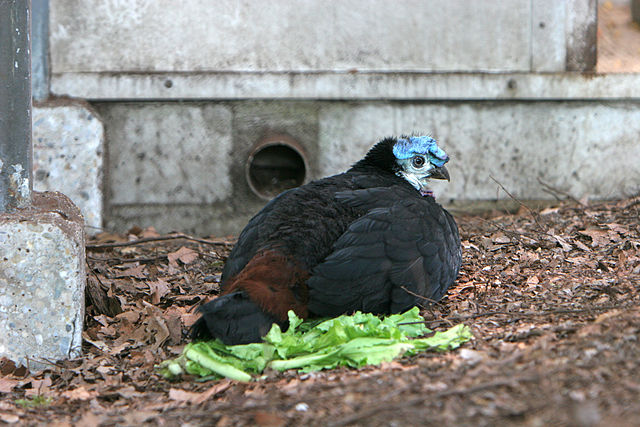
“And my people shall dwell in a peaceable habitation, and in sure dwellings, and in quiet resting places;
(Isaiah 32:18 KJV)
Wattled Brushturkey (Aepypodius arfakianus) Zoo Amsterdam ©WikiC
*
*

“There went in two and two unto Noah into the ark, the male and the female, as God had commanded Noah.” (Genesis 7:9 KJV)
Orange-footed Scrubfowl (Megapodius reinwardt) by Felix©©
*
*
 Lee's Birdwatching Adventures Plus