“I know all the fowls of the mountains: and the wild beasts of the field are mine.” (Psam 50:11 KJV)
Chachalacas are a part of the Cracidae family. There are 55 species in this family and these 16 Chachalacas are in the Ortalis genus. It makes for a good division for this family, plus, I have been having computer problems for over a week. So, we will go with these noisy little avian wonders from the Lord’s hand. You may notice that they are not really “handsome” or “colorful,” yet, they are just as special to their Creator as the more fancy birds.
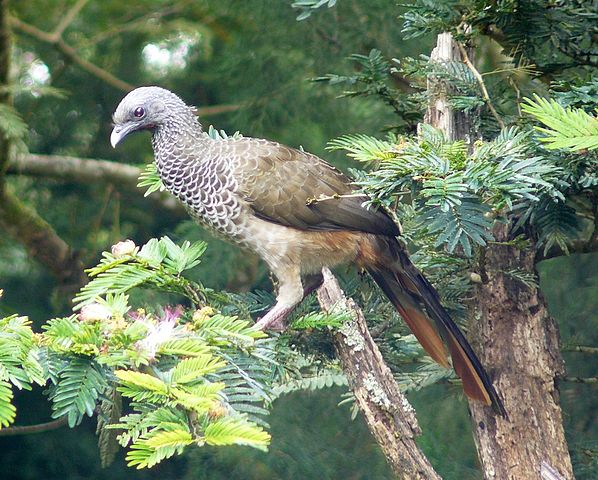
Rufous-vented Chachalaca (Ortalis ruficauda) by Kent Nickel
Chachalacas are mainly brown galliform birds from the genus Ortalis. These birds are found in wooded habitats in far southern United States (Texas), Mexico, and Central and South America. They are social, can be very noisy and often remain fairly common even near humans, as their relatively small size makes them less desirable to hunters than their larger relatives. They somewhat resemble the guans, and the two have commonly been placed in a subfamily together, though the chachalacas are probably closer to the curassows.
The generic name is derived from the Greek word όρταλις, meaning “pullet” or “domestic hen.” The common name is an onomatopoeia for the four-noted cackle of the plain chachalaca (O. vetula). (Information from Wikipedia)
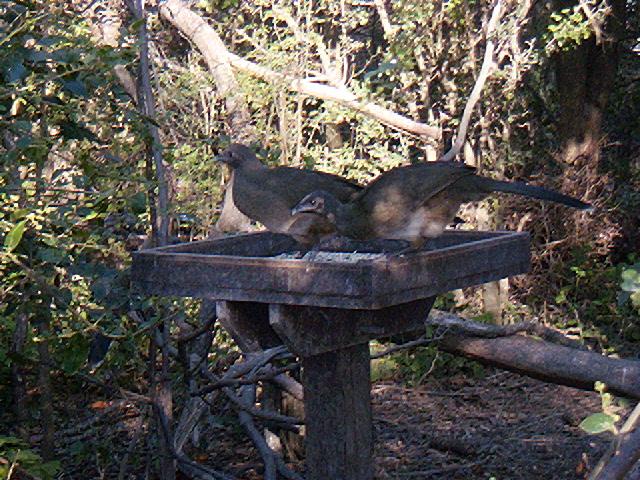
Plain Chachalaca at Santa Ana NWR, 2002 [Old camera]
We were fortunate to see our first Chachalaca at the Santa Ana NWR in South Texas back in 2002. They just barely come over into the U.S.
This slideshow requires JavaScript.
After that noisy Chachalaca thought you might like a little quieter song.
*And my people shall dwell in a peaceable habitation, and in sure dwellings, and in quiet resting places;” (Isa 32:18 KJV)
“Quiet Rest* and “Sweet Hour of Prayer” ~ by Kathy Lisby – Nell Reese acc”.
“Bring forth with thee every living thing that is with thee, of all flesh, both of fowl, and of cattle, and of every creeping thing that creepeth upon the earth; that they may breed abundantly in the earth, and be fruitful, and multiply upon the earth.” (Genesis 8:17 KJV)
This week we start introducing you to the five families in the Megapodiidae Order. The first family in taxonomic listings is the Megapodiidaes. There are 21 species in this family of “medium-sized to large terrestrial birds with large legs and feet with sharp claws. They range from 28 to 70 cm. The largest members of the clade are the species of Alectura and Talegalla. The smallest are the Micronesian scrubfowl (Megapodius laperouse) and the Moluccan scrubfowl (Eulipoa wallacei). They have small heads, short beaks, and rounded and large wings. Their flying abilities vary within the clade. They present the hallux at the same level of the other toes just like the species of the clade Cracidae. The other Galliformes have their halluces raised above the level of the front toes.”
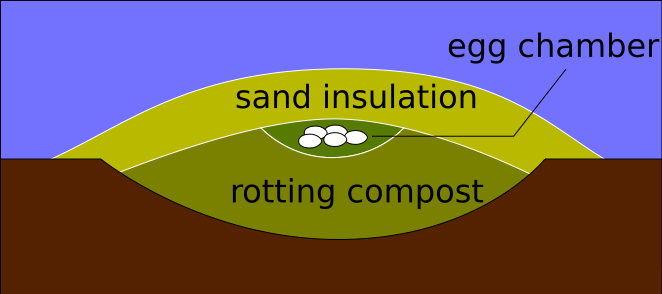
“The megapodes, also known as incubator birds or mound-builders, are stocky, medium-large chicken-like birds with small heads and large feet in the family Megapodiidae. Their name literally means “large foot” (Greek: mega = large, poda = foot), and is a reference to the heavy legs and feet typical of these terrestrial birds. All are browsers, and all but the malleefowl occupy wooded habitats. Most are brown or black colored. Megapodes are superprecocial, hatching from their eggs in the most mature condition of any birds. They hatch with open eyes, bodily coordination and strength, full wing feathers and downy body feathers, and are able to run, pursue prey, and, in some species, fly on the same day they hatch.”
The family consist of 6 Brushturkeys, the Malleefowl, Maleo, 10 Megapodes and 3 Scrubfowls.
*
This slideshow requires JavaScript.
“Saying, We give thee thanks, O Lord God Almighty, which art, and wast, and art to come; because thou hast taken to thee thy great power, and hast reigned.” (Revelation 11:17 KJV)
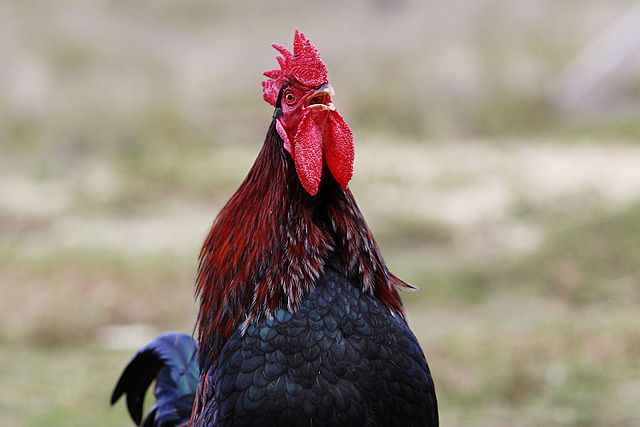
“Jesus said unto him, Verily I say unto thee, That this night, before the cock crow, thou shalt deny me thrice.” (Matthew 26:34 KJV)
Happy New Year!!
“The Galliformes Order is the next order taxonomically. “The Galliformesare an order of heavy-bodied ground-feeding birds that includes turkey, grouse, chicken, New World quail and Old World quail, ptarmigan, partridge, pheasant, junglefowl and the Cracidae. The name derives from “gallus”, Latin for “cock” or “rooster”. Common names are gamefowl or gamebirds, landfowl, gallinaceous birds, or galliforms. “Wildfowl” or just “fowl” are also often used for the Galliformes, but usually these terms also refer to waterfowl (Anseriformes), [which we just finished] and occasionally to other commonly hunted birds. This group has about 299 species, one or more of which are found in essentially every part of the world’s continents (except for the innermost deserts and perpetual ice). They are rarer on islands, and in contrast to the closely related waterfowl, are essentially absent from oceanic islands—unless introduced there by humans. Several species have been domesticated during their long and extensive relationships with humans.”
“As the partridge sitteth on eggs, and hatcheth them not; so he that getteth riches, and not by right, shall leave them in the midst of his days, and at his end shall be a fool.” (Jeremiah 17:11 KJV)
“This order contains five families: Phasianidae (including chicken, quail, partridges, pheasants, turkeys, peafowl and grouse), Odontophoridae (New World quails), Numididae (guineafowl), Cracidae (including chachalacas and curassows), and Megapodiidae (incubator birds like mallee fowl and brush-turkeys). They are important as seed dispersers and predators in the ecosystems they inhabit, and are often reared as game birds by humans for their meat and eggs and for recreational hunting. Many gallinaceous species are skilled runners and escape predators by running rather than flying. Males of most species are more colorful than the females. Males often have elaborate courtship behaviors that include strutting, fluffing of tail or head feathers, and vocal sounds. They are mainly nonmigratory.” (Wikipedia with editing)
Peacock at Magnolia Plantation by Dan
“Gavest thou the goodly wings unto the peacocks? or wings and feathers unto the ostrich?” (Job 39:13)
Here are a few birds from each of the five families:
This slideshow requires JavaScript.
“The people asked, and he brought quails, and satisfied them with the bread of heaven.” (Psalms 105:40 KJV)
Many of these birds are mentioned in the Bible, so they are also listed in our Birds of the Bible articles. Over the following Sunday, these families will be presented in smaller articles with the slideshows as in the previous articles.
“Now when Jesus was born in Bethlehem of Judaea in the days of Herod the king, behold, there came wise men from the east to Jerusalem, Saying, Where is he that is born King of the Jews? for we have seen his star in the east, and are come to worship him.” (Matthew 2:1-2 KJV)
All of us from Lee’s Birdwatching Adventures would like to wish you a very Merry Christmas. Dan and I, James J. S. Johnson [Dr. Jim], Emma Foster, Ian, and all our other guest authors wish you a peaceful and blessed day as you consider all the importance of what this Christmas Day represents.
Unfortunately, this video was removed from the internet. Sorry! [by Lee – 04-25-22]
*
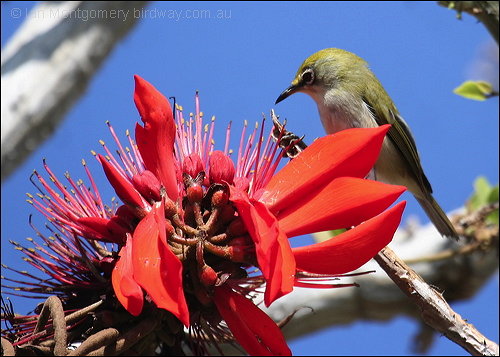
Christmas Island White-eye (Zosterops natalis) by Ian
“Therefore the Lord himself shall give you a sign; Behold, a virgin shall conceive, and bear a son, and shall call his name Immanuel.” (Isaiah 7:14 KJV)
Today is a little different from our normal post. Last Sunday evening we had the Christmas Cantata at our church, Faith Baptist Church in Winter Haven, Florida. It was absolutely fantastic!
Enjoy and may you have a blessed Christmas.
“In the beginning God created the heaven and the earth. And the earth was without form, and void; and darkness was upon the face of the deep. And the Spirit of God moved upon the face of the waters.” And God said, Let us make man in our image, after our likeness: and let them have dominion over the fish of the sea, and over the fowl of the air, and over the cattle, and over all the earth, and over every creeping thing that creepeth upon the earth. So God created man in his own image, in the image of God created he him; male and female created he them. And God blessed them, and God said unto them, Be fruitful, and multiply, and replenish the earth, and subdue it: and have dominion over the fish of the sea, and over the fowl of the air, and over every living thing that moveth upon the earth.” (Genesis 1:1-2, 26-28 KJV)
“And there were in the same country shepherds abiding in the field, keeping watch over their flock by night. And, lo, the angel of the Lord came upon them, and the glory of the Lord shone round about them: and they were sore afraid. And the angel said unto them, Fear not: for, behold, I bring you good tidings of great joy, which shall be to all people. For unto you is born this day in the city of David a Saviour, which is Christ the Lord. And this shall be a sign unto you; Ye shall find the babe wrapped in swaddling clothes, lying in a manger. And suddenly there was with the angel a multitude of the heavenly host praising God, and saying, Glory to God in the highest, and on earth peace, good will toward men. And it came to pass, as the angels were gone away from them into heaven, the shepherds said one to another, Let us now go even unto Bethlehem, and see this thing which is come to pass, which the Lord hath made known unto us. And they came with haste, and found Mary, and Joseph, and the babe lying in a manger.” (Luke 2:8-16 KJV)
“In the beginning was the Word, and the Word was with God, and the Word was God. The same was in the beginning with God. All things were made by him; and without him was not any thing made that was made. In him was life; and the life was the light of men. And the light shineth in darkness; and the darkness comprehended it not. There was a man sent from God, whose name was John. The same came for a witness, to bear witness of the Light, that all men through him might believe. He was not that Light, but was sent to bear witness of that Light. That was the true Light, which lighteth every man that cometh into the world. He was in the world, and the world was made by him, and the world knew him not. He came unto his own, and his own received him not. But as many as received him, to them gave he power to become the sons of God, even to them that believe on his name: Which were born, not of blood, nor of the will of the flesh, nor of the will of man, but of God. And the Word was made flesh, and dwelt among us, (and we beheld his glory, the glory as of the only begotten of the Father,) full of grace and truth.” (John 1:1-14 KJV)
“For by grace are ye saved through faith; and that not of yourselves: it is the gift of God: Not of works, lest any man should boast.” (Ephesians 2:8-9 KJV)
“And she shall bring forth a son, and thou shalt call his name JESUS: for he shall save his people from their sins.” (Matthew 1:21 KJV)
Surprise! We are finally at the last of the Anatidae Family of Ducks, Geese, and Swans. There are 31 left, and today we will reveal the rest of them. There is a total of 173 species in this family. Trust you didn’t mind them being divided into different articles [in taxonomic order]. A list of the whole series of these avian wonders is at the end of the article.
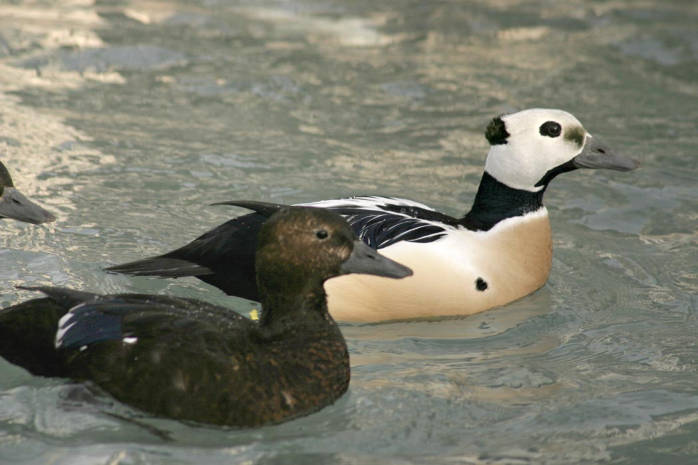
Today, we start off with four Eiders that are in two genera. They are the Steller’s Eider (Polysticta stelleri), Spectacled Eider (Somateria fischeri), and the King Eider (Somateria spectabilis), Common Eider (Somateria mollissima).What are an interesting looking group.
Steller’s Eider (Polysticta stelleri)is the smallest eider at 45 cm (18 in) long. The male is unmistakable with his white head marked by a thick black eye ring and greenish-black tufts of feathers on the forehead and the back of the head. Chin, throat and neck are also black, as are the back, tail, and rump. Wings are dark bluish-purple with white edging. When folded, they give a striped appearance across the back. The speculum is metallic blue bordered with white. The breast and flanks are cinnamon-buff marked with a black spot on each side just above the waterline. Legs, feet and bill are dark bluish-grey. The female is a dark brown bird, smaller with a more typically duck-shaped head and body than other eider species.
The Eider genus, Somateria, are large seaducks. The scientific name is derived from Ancient Greek somatos “body” and erion “wool”, referring to eiderdown. They all breed in the cooler latitudes of the Northern Hemisphere. The down feathers of eider ducks, and some other ducks and geese, are used to fill pillows and quilts—they have given the name to the type of quilt known as an eiderdown.
I think that when the Lord God, the Creator of all these “duck family” critters, He was proving these verses we read in the Bible: “Wherein he hath abounded toward us in all wisdom and prudence; Having made known unto us the mystery of his will, according to his good pleasure which he hath purposed in himself:” (Ephesians 1:8-9 KJV) [emphasis mine]
As you will see as we continue through the rest of these swimming critters, the variety of design, color, shapes, and provisions for them. What a Creator!
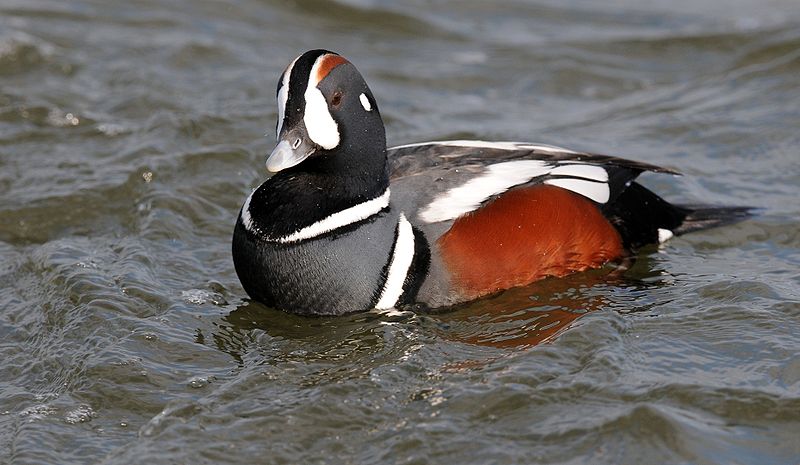
The Harlequin Duck (Histrionicus histrionicus) is a small sea duck. It takes its name from Harlequin (French Arlequin, Italian Arlecchino), a colourfully dressed character in Commedia dell’arte. The species name comes from the Latin word “histrio”, “actor”. In North America it is also known as lords and ladies. Other names include painted duck, totem pole duck, rock duck, glacier duck, mountain duck, white-eyed diver, squeaker and blue streak.
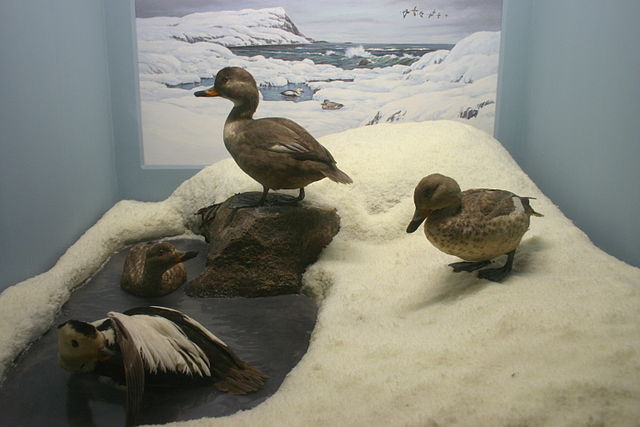
The Labrador Duck (Camptorhynchus labradorius) is an extinct North American bird; it has the dubious distinction of being the first endemic North American bird species to become extinct after the Columbian Exchange. It was already a rare duck before European settlers arrived, and became extinct shortly after. As a result of its rarity, information on the Labrador duck is not abundant, but some, such as its habitat, characteristics, dietary habits, and reasons behind extinction, are known. Specimens of the Labrador duck are preserved in museum collections worldwide.
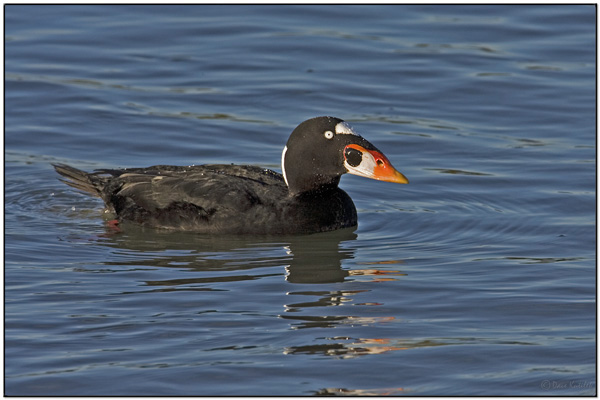
Surf Scoter (Melanitta perspicillata) by Daves BirdingPix
The Scoters of the Melanitta genus come next: The Surf Scoter (Melanitta perspicillata), Velvet Scoter (Melanitta fusca), White-winged Scoter (Melanitta deglandi), Common Scoter (Melanitta nigra), Black Scoter (Melanitta americana)
They are stocky seaducks. The drakes are mostly black and have swollen bills. Females are brown. The genus name is derived from Ancient Greek melas “black” and netta “duck”.
They breed in the far north of Europe, Asia, and North America, and winter farther south in temperate zones of those continents. They form large flocks on suitable coastal waters. These are tightly packed, and the birds tend to take off together. Their lined nests are built on the ground close to the sea, lakes or rivers, in woodland or tundra. These species dive for crustaceans and molluscs.
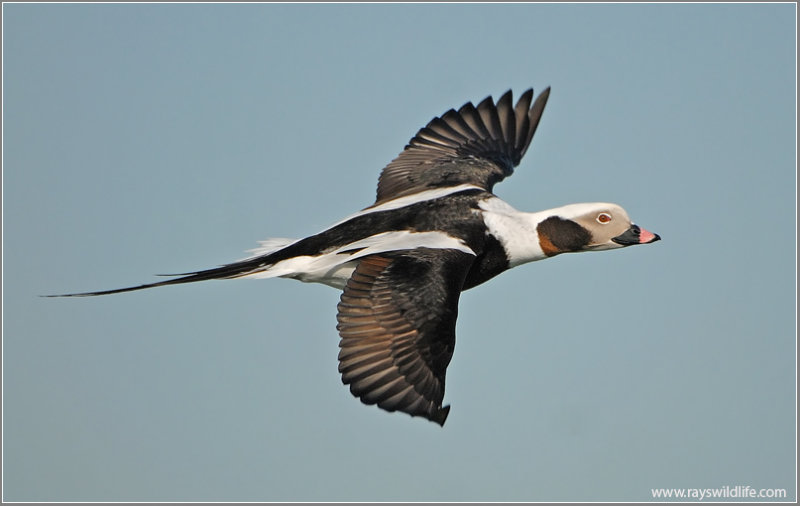
Long-tailed Duck (Clangula hyemalis) by Ray
Long-tailed Duck (Clangula hyemalis), once known as oldsquaw, is a medium-sized sea duck. Their breeding habitat is in tundra pools and marshes, but also along sea coasts and in large mountain lakes in the North Atlantic region, Alaska, northern Canada, northern Europe, and Russia. The nest is located on the ground near water; it is built using vegetation and lined with down. They are migratory and winter along the eastern and western coasts of North America, on the Great Lakes, coastal northern Europe and Asia, with stragglers to the Black Sea. The most important wintering area is the Baltic Sea, where a total of about 4.5 million gather.
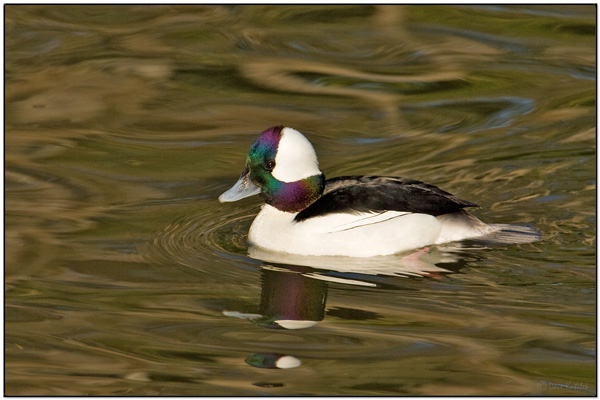
Bufflehead (Bucephala albeola) by Daves BirdingPix
Bucephala is a genus of ducks found in the Northern Hemisphere. The genus name is derived from Ancient Greek boukephalos, “bullheaded”, from bous “bull”, and kephale, “head”, a reference to the crest of the bufflehead making its head look large. They are the Bufflehead (Bucephala albeola), Common Goldeneye (Bucephala clangula), Barrow’s Goldeneye (Bucephala islandica)
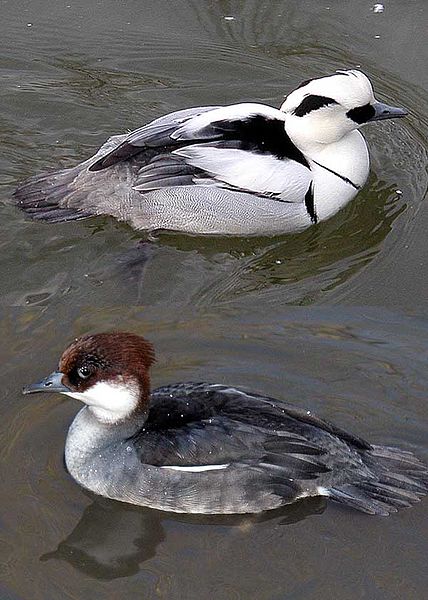
Smew (Mergellus albellus) – The drake smew, with its ‘cracked ice’ and ‘panda’ appearance, is unmistakable, and looks very black-and-white in flight. The females and immature males are grey birds with chestnut foreheads and crowns, and can be confused at a distance with the ruddy duck; they are often known as “redhead” smew. It has oval white wing-patches in flight. The smew’s bill has a hooked tip and serrated edges, which help it catch fish when it dives for them.
Hooded Merganser Viera Wetlands with hood down by Lee
Hooded Merganser (Lophodytes cucullatus) is a species of small duck. It is the only extant species in the genus Lophodytes. The bird is striking in appearance; both sexes have crests that they can raise or lower, and the breeding plumage of the male is handsomely patterned and coloured. The hooded merganser has a sawbill but is not classified as a typical merganser.
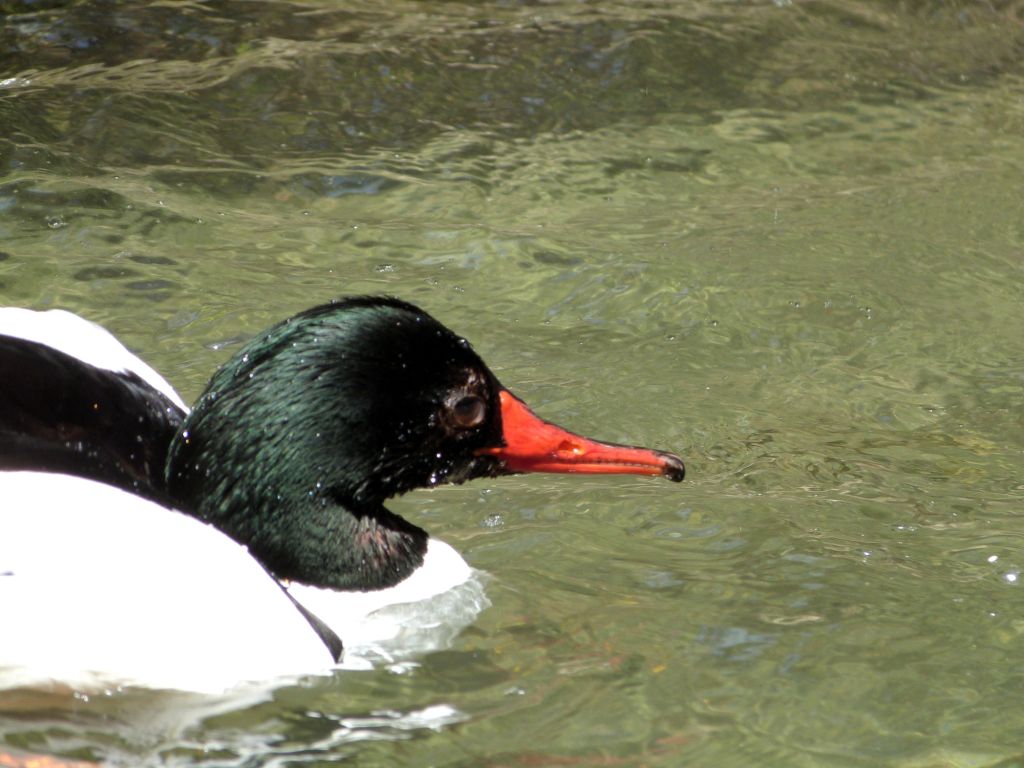
Common Merganser (Mergus merganser) Male Zoo Miami by Lee
The Merus genus of Typical Mergansers: New Zealand Merganser (Mergus australis) Extinct, Brazilian Merganser (Mergus octosetaceus), Common Merganser (Mergus merganser), Red-breasted Merganser (Mergus serrator), Scaly-sided Merganser (Mergus squamatus)
Although they are seaducks, most of the mergansers prefer riverine habitats, with only the red-breasted merganser being common at sea. These large fish-eaters typically have black-and-white, brown and/or green hues in their plumage, and most have somewhat shaggy crests. All have serrated edges to their long and thin bills that help them grip their prey. Along with the Smew and Hooded Merganser, they are therefore often known as “sawbills“.
The Black-headed Duck (Heteronetta atricapilla) is a South American duck allied to the stiff-tailed ducks in the subfamily Oxyurinae of the family Anatidae. It is the only member of the genus Heteronetta.
This is the most basal living member of its subfamily, and it lacks the stiff tail and swollen bill of its relatives.
Masked Duck (Nomonyx dominicus) is a tiny stiff-tailed duck ranging through the tropical Americas. They are found from Mexico to South America and also in the Caribbean. Primarily not migratory, masked ducks are reported as very uncommon vagrants in the southernmost United States, along the Mexican border and in Florida.
These ducks mainly feed on seeds, roots, and leaves of aquatic plants. They also eat aquatic insects and crustaceans. They feed by diving.
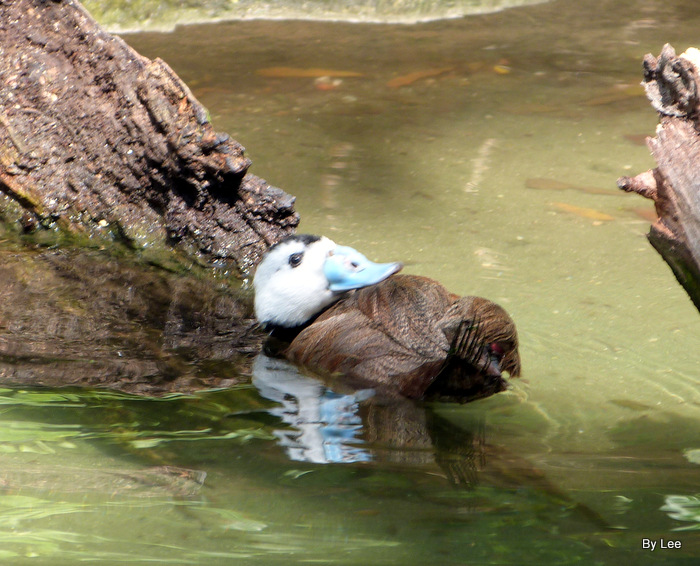
White-headed Duck (Oxyura leucocephala) Zoo Miami by Lee
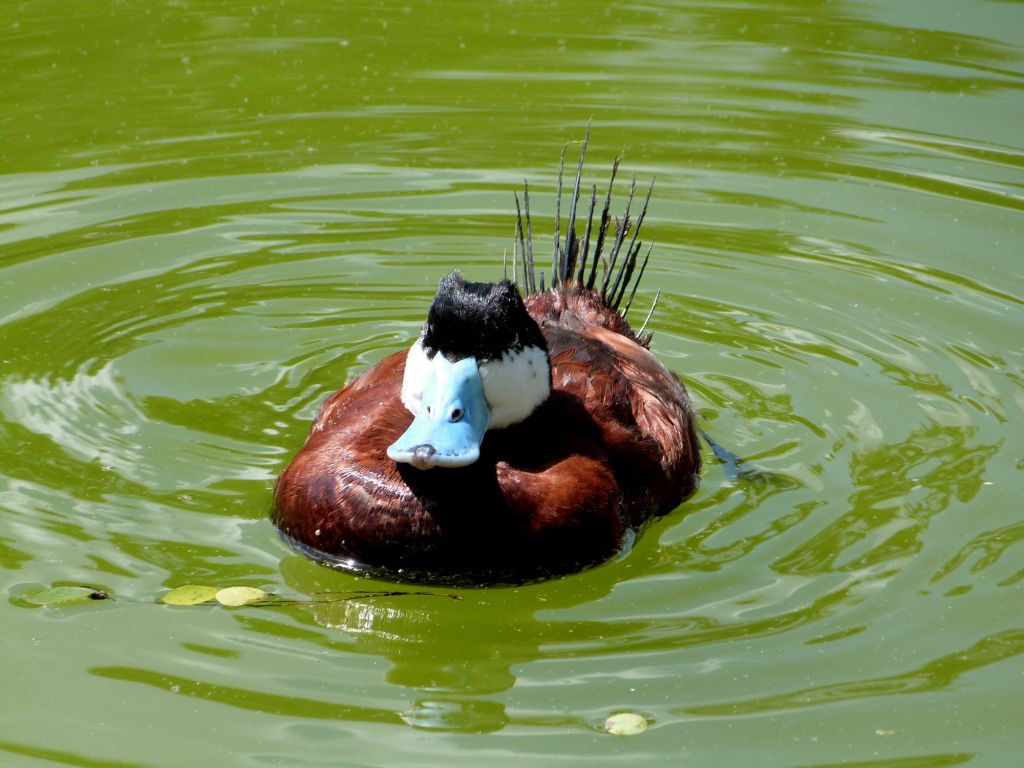
The Oxyura genus has 6 Ducks, the Ruddy Duck (Oxyura jamaicensis), Andean Duck (Oxyura ferruginea), Lake Duck (Oxyura vittata), Blue-billed Duck (Oxyura australis), Maccoa Duck (Oxyura maccoa), and the White-headed Duck (Oxyura leucocephala).
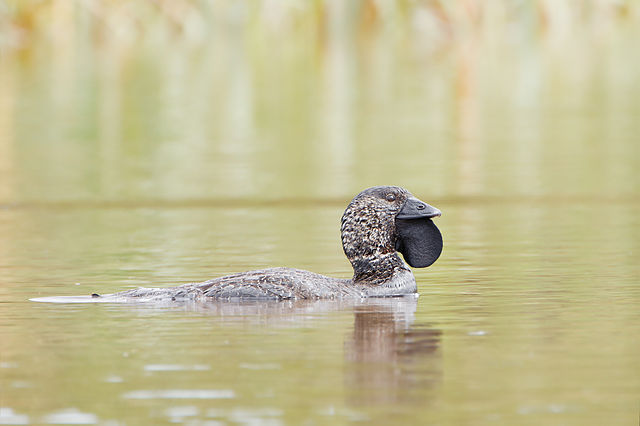
The Musk Duck (Biziura lobate) is a highly aquatic, stiff-tailed duck native to southern Australia. It is the only living member of the genus Biziura. This animal derives its common name from the peculiar musky odour it emanates during the breeding season. Musk ducks are moderately common through the Murray-Darling and Cooper Creek basins, and in the wetter, fertile areas in the south of the continent: the southwest corner of Western Australia, Victoria, and Tasmania.
[Information from Wikipedia with editing]
This slideshow requires JavaScript.
*
Saying, Where is he that is born King of the Jews? for we have seen his star in the east, and are come to worship him.” (Matthew 2:2 KJV)
Marbled Duck (Marmaronetta angustirostris) at Lowry Park Zoo by Lee
“He turns a wilderness into pools of water, And dry land into watersprings. There He makes the hungry dwell,…” (Psalms 107:35-36a NKJV)
Today we will continue through the Anatidae family of Ducks, Geese, Swans and allies. We start off with these neat Marbled Ducks that greet us when we visit the Parakeet Plus Aviary at Lowry Park Zoo in Tampa, FL.
Marbled Duck (Marmaronetta angustirostris) at Lowry Park Zoo by Lee
“The marbled duck, or marbled teal (Marmaronetta angustirostris), is a medium-sized duck. It used to be included among the dabbling ducks, but is now classed as a diving duck. The scientific name, Marmaronetta angustirostris, comes from the Greek marmaros, marbled and netta, a duck, and Latinangustus, narrow or small and rostris billed.The marbled duck is approximately 39–42 cm (15–17 in) long. Adults are a pale sandy-brown colour, diffusely blotched off-white, with a dark eye-patch and shaggy head. Juveniles are similar but with more off-white blotches. In flight, the wings look pale without a marked pattern, and no speculum on the secondaries. These birds feed mainly in shallow water by dabbling or up-ending, occasionally diving. Little is known of their diet.”
“The pink-headed duck (Rhodonessa caryophyllacea) was (or is) a large diving duck that was once found in parts of the Gangetic plains of India, Bangladesh and in the riverine swamps of Myanmar but feared extinct since the 1950s. Numerous searches have failed to provide any proof of continued existence. It has been suggested that it may exist in the inaccessible swamp regions of northern Myanmar and some sight reports from that region have led to its status being declared as “Critically Endangered” rather than extinct. The genus placement has been disputed and while some have suggested that it is close to the red-crested pochard (Netta rufina), others have placed it in a separate genus of its own. It is unique in the pink colouration of the head combined with a dark body. A prominent wing patch and the long slender neck are features shared with the common Indian spot-billed duck. The eggs have also been held as particularly peculiar in being nearly spherical.”
Red-crested Pochard (Netta rufina) by Dan at Zoo Miami
The next genus, Netta, and the Aythyagenus, together make up the: “Subfamily: Aythyinae, diving ducks (Some 15 species of diving ducks, of worldwide distribution, in two to four genera; The 1986 morphological analysis suggested the probably extinct pink-headed duck of India, previously treated separately in Rhodonessa, should be placed in Netta, but this has been questioned. Furthermore, while morphologically close to dabbling ducks, the mtDNA data indicate a treatment as distinct subfamily is indeed correct, with the Tadorninae being actually closer to dabbling ducks than the diving ducks)”
Netta, red-crested pochard and allies (four species, one probably extinct)
“Netta is a genus of diving ducks. The name is derived from Greek Netta “duck”. Unlike other diving ducks, the Netta species are reluctant to dive, and feed more like dabbling ducks. These are gregarious ducks, mainly found on fresh water. They are strong fliers; their broad, blunt-tipped wings require faster wing-beats than those of many ducks and they take off with some difficulty.
They do not walk as well on land as the dabbling ducks because their legs tend to be placed further back on their bodies to help propel them when underwater.”
Ring-necked Duck (Aythya collaris) at Lake Morton by Dan
“Aythya is a genus of diving ducks. It has twelve described species. The name Aythya comes from the Ancient Greek word αυθυια, aithuia, which may have referred to a sea-dwelling duck or an auklet.” The Aythyas are the; Canvasback (A. valisineria), Common pochard (A. ferina), Redhead (A. americana), Ring-necked duck (A. collaris), Hardhead (A. australis), Baer’s pochard (A. baeri), Ferruginous duck (A. nyroca), Madagascar pochard (A. innotata), New Zealand scaup (A. novaeseelandiae), Tufted duck (A. fuligula), Greater scaup (A. marila), Lesser scaup (A. affinis)”
[all quoted material is from Wikipedia]
“Bring forth with thee every living thing that is with thee, of all flesh, both of fowl, and of cattle, and of every creeping thing that creepeth upon the earth; that they may breed abundantly in the earth, and be fruitful, and multiply upon the earth.” (Genesis 8:17 KJV)
This slideshow requires JavaScript.
“And Noah went forth, and his sons, and his wife, and his sons’ wives with him: Every beast, every creeping thing, and every fowl, and whatsoever creepeth upon the earth, after their kinds, went forth out of the ark.” (Genesis 8:18-19 KJV)
“How Can I Keep Singing” ~ The 3+1 Trio (Pastor Jerry, Reagan Osborne, Caleb and Jessie Padgett)”.
“If a bird’s nest chance to be before thee in the way in any tree, or on the ground, whether they be young ones, or eggs, and the dam sitting upon the young, or upon the eggs, thou shalt not take the dam with the young:” (Deuteronomy 22:6 KJV)
Today’s group of members from the “Ducks Plus” family, the Anatidae, are all from one Genus. The Anas according to Wikionary is: ” A taxonomic genus within the family Anatidae – various species of dabbling duck. These are probably the most common group of ducks many of us see. The genus name is the Latin for “duck”. It includes mallards, wigeons, teals, pintails and shovelers in a number of subgenera. “Dabbling” is where the duck upends itself to feed. They feed mainly on water plants, which they obtain by tipping-up in shallows—uncommonly by diving (with opened wings); they often forage near the shore for seeds and insects. The bill is flat and broad, the hindtoe unlobed. Dabbling ducks float high in the water and are swift fliers, leaping upward on noisy wings before attaining level flight, usually in compact flocks.
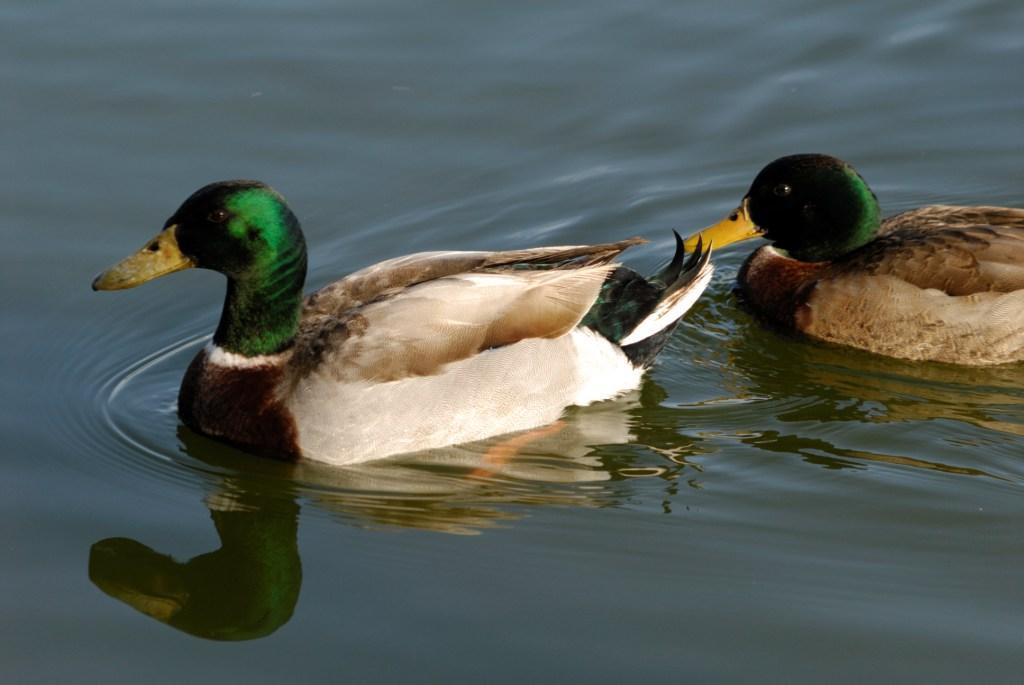
The mallard (/ˈmælɑːrd/ or /ˈmælərd/) or wild duck (Anas platyrhynchos) is a dabbling duck which breeds throughout the temperate and subtropical Americas, Europe, Asia, and North Africa, and has been introduced to New Zealand, Australia, Peru, Brazil, Uruguay, Argentina, Chile, the Falkland Islands and South Africa. This duck belongs to the subfamily Anatinae of the waterfowl family Anatidae.
The male birds (drakes) have a glossy green head and are grey on wings and belly, while the females (hens or ducks) have mainly brown-speckled plumage. Both sexes have an area of white-bordered black speculum feathers which commonly also include iridescent blue feathers especially among males. Mallards live in wetlands, eat water plants and small animals, and are social animals preferring to congregate in groups or flocks of varying sizes. This species is the main ancestor of most breeds of domesticated ducks. I personally think that this duck, the Mallard, was on board the Ark. He seems to have obey the command to:
“Go forth of the ark, thou, and thy wife, and thy sons, and thy sons’ wives with thee. Bring forth with thee every living thing that is with thee, of all flesh, both of fowl, and of cattle, and of every creeping thing that creepeth upon the earth; that they may breed abundantly in the earth, and be fruitful, and multiply upon the earth.” (Genesis 8:16-17 KJV)
The mallard was one of the many bird species originally described by Carl Linnaeus in his 18th-century work Systema Naturae, and still bears its original binomial name. The scientific name is from Latin Anas, “duck” and Ancient Greek platyrhynchus , “broad-billed” ( from platus, “broad” and rhunkhos, ” bill”).
But the Mallard is not the only duck in this genus, Anas. There are 48 others. As mentioned, much interbreeding has taken place, and eventually these were raised to species status. After showing you the Wood Ducks last week, their is another beauty from the Lord in this week’s group.
We have seen this Teal, but not in that breeding outfit.
Baikal Teal (Anas formosa) Zoo Miami by Lee
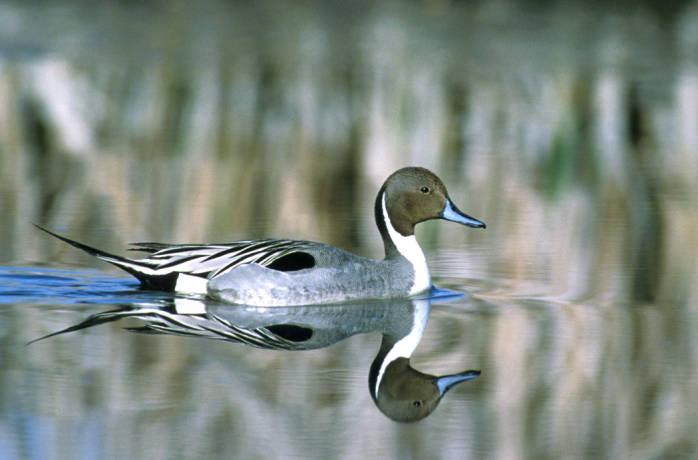
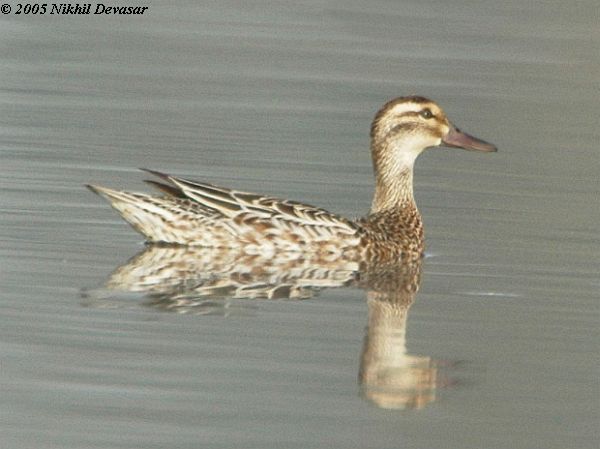
Unfortunately this genus contains “some of the world’s finest game birds: the black duck(Anas rubripes), much sought after by hunters; the mallard; the gadwall(Anas strepera); the garganey (A. querquedula); the pintail (A. acuta), perhaps the world’s most abundant waterfowl; the shoveler (Anas, or Spatula, clypeata), the “spoonbill” of hunters; the teals, races of Anas crecca and other species; the wigeons, Anas, or Mareca, americana and A.,or M., penelope. (Enclopeaedia Britannica) As you all know, I am a birdwatcher/photographer, not a hunter. I realize hunter organizations do much to maintain hunting areas and prevent over-hunting. That is a good thing, but not my “cup of tea.”
Here is a of each by last name:
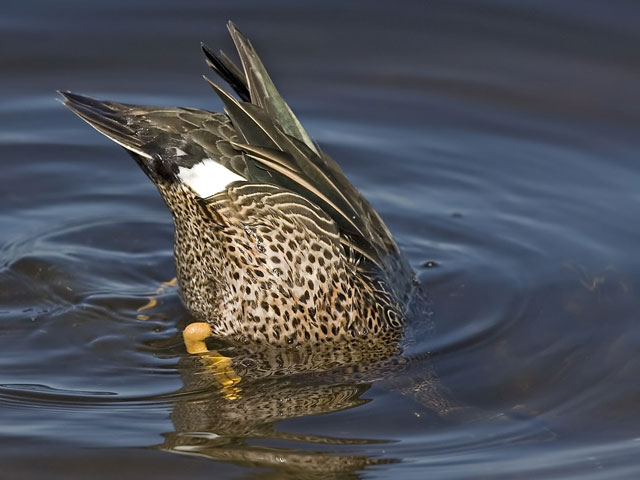
Tealsdo not totally submerge when feeding and are often seen with just their rears showing as the search for food. Because of their feeding method, teals are more buoyant than diving ducks.
The gadwall is a quieter duck, except during its courtship display.
Gadwall (Anas strepera)
*
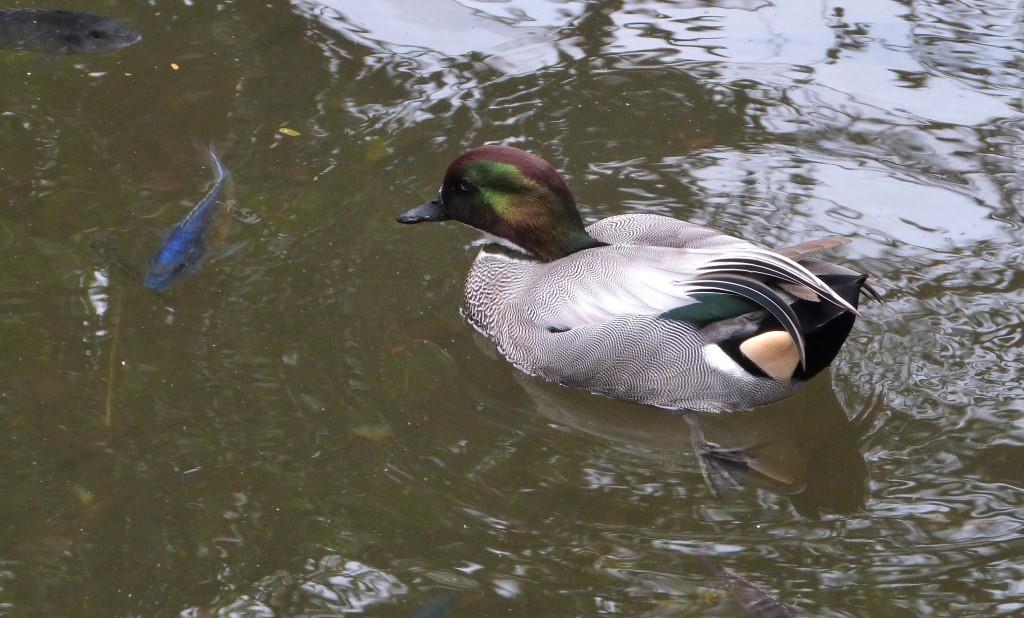
Falcated Duck (Anas falcata) at Wings of Asia by Lee
Ducks are mostly aquatic birds, mostly smaller than the swans and geese, and may be found in both fresh water and sea water.
Falcated Duck (Anas falcata), African Black Duck (Anas sparsa), American Black Duck (Anas rubripes), Mottled Duck (Anas fulvigula), Mexican Duck (Anas diazi), Hawaiian Duck (Anas wyvilliana), Laysan Duck (Anas laysanensis), Philippine Duck (Anas luzonica), Pacific Black Duck (Anas superciliosa), Indian Spot-billed Duck (Anas poecilorhyncha), Eastern Spot-billed Duck (Anas zonorhyncha), Yellow-billed Duck (Anas undulata), Meller’s Duck (Anas melleri)
*
Mallards by Dan
The male mallards (drakes) have a glossy green head and are grey on wings and belly, while the females (hens or ducks) have mainly brown-speckled plumage.
Mallard (Anas platyrhynchos)
*
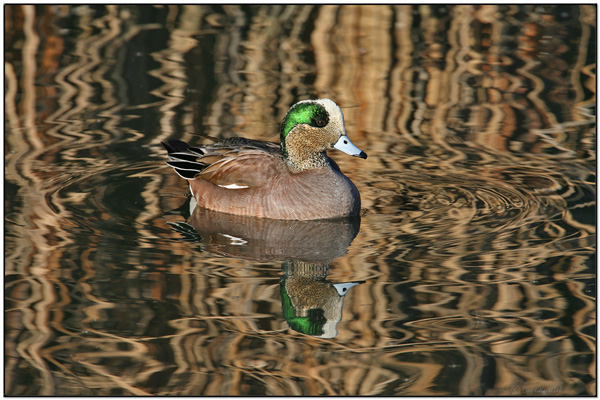
American Wigeon (Anas americana) by Daves BirdingPix
The wigeons are similarly shaped, with a steep forehead and bulbous rear to the head.
*
“And the sea arose by reason of a great wind that blew. So when they had rowed about five and twenty or thirty furlongs, they see Jesus walking on the sea, and drawing nigh unto the ship: and they were afraid. But he saith unto them, It is I; be not afraid.” (John 6:18-20 KJV)
“Ship Ahoy”~ from “Great is Thy Faithfulness” by Dr. Richard Gregory
And God created great whales, and every living creature that moveth, which the waters brought forth abundantly, after their kind, and every winged fowl after his kind: and God saw that it was good. And God blessed them, saying, Be fruitful, and multiply, and fill the waters in the seas, and let fowl multiply in the earth. (Gen 1:21-22 KJV)
Today we only have 22 more Anatidae family members to show you, but it will take 14 different genera to present them. The largest and the first genus, with 7 species, is the Shelducks.
Raja Shelduck (Tadorna radjah) at Wing of Asia by Dan
Shelducks are large birds in the Tadorna genus. Many consider them as intermediate between geese and ducks in size. The sexes are colored slightly differently in most species, and all have a characteristic upperwing coloration in flight: the tertiary remiges form a green speculum, the secondaries and primaries are black, and the coverts (forewing) are white. Their diet consists of small shore animals (winkles, crabs etc.) as well as grasses and other plants.
The genus name comes from the French name Tadorne for the common shelduck. It may originally derive from Celtic roots meaning “pied waterfowl”, essentially the same as the English “shelduck”
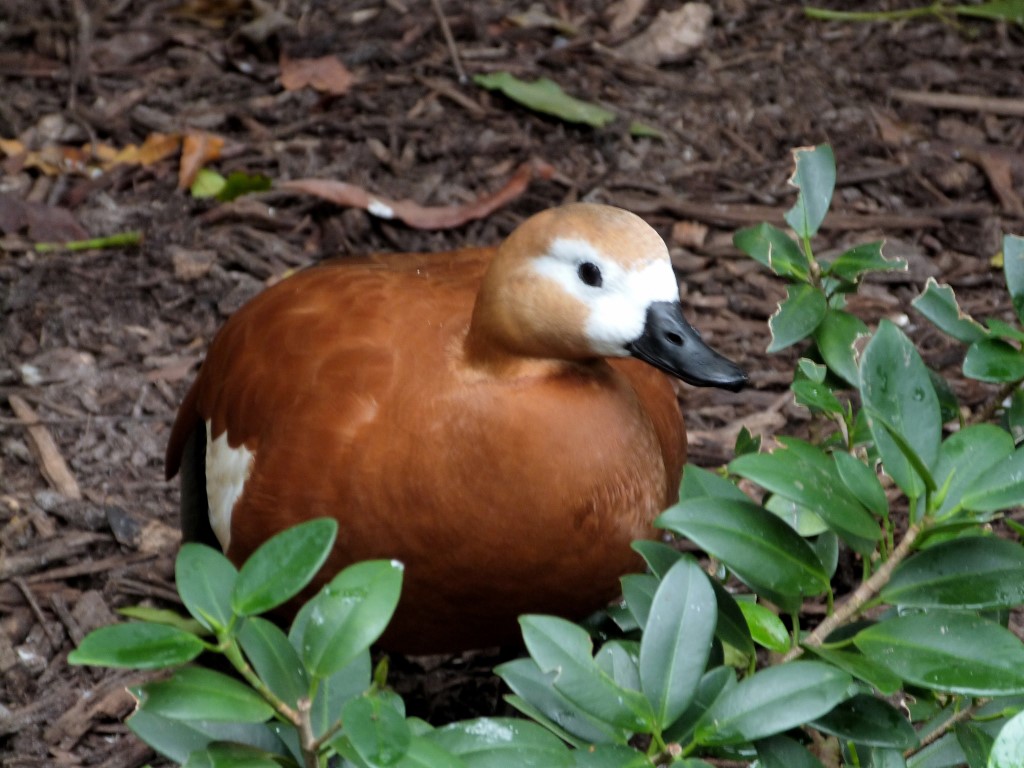
Ruddy Shelduck (Tadorna ferruginea) at Wings of Asia by Lee
Common Shelduck (Tadorna tadorna)
Raja Shelduck (Tadorna radjah)
Ruddy Shelduck (Tadorna ferruginea)
South African Shelduck (Tadorna cana)
Australian Shelduck (Tadorna tadornoides)
Paradise Shelduck (Tadorna variegata)
Paradise Shelducks of New Zealand often have one mating partner for life.
Crested Shelduck (Tadorna cristata)
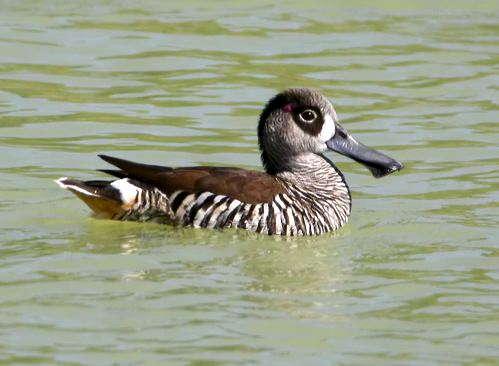
Pink-eared Duck (Malacorhynchus membranaceus) by Ian
Each of the next 5 Ducks and Teals are the only ones in their genus.
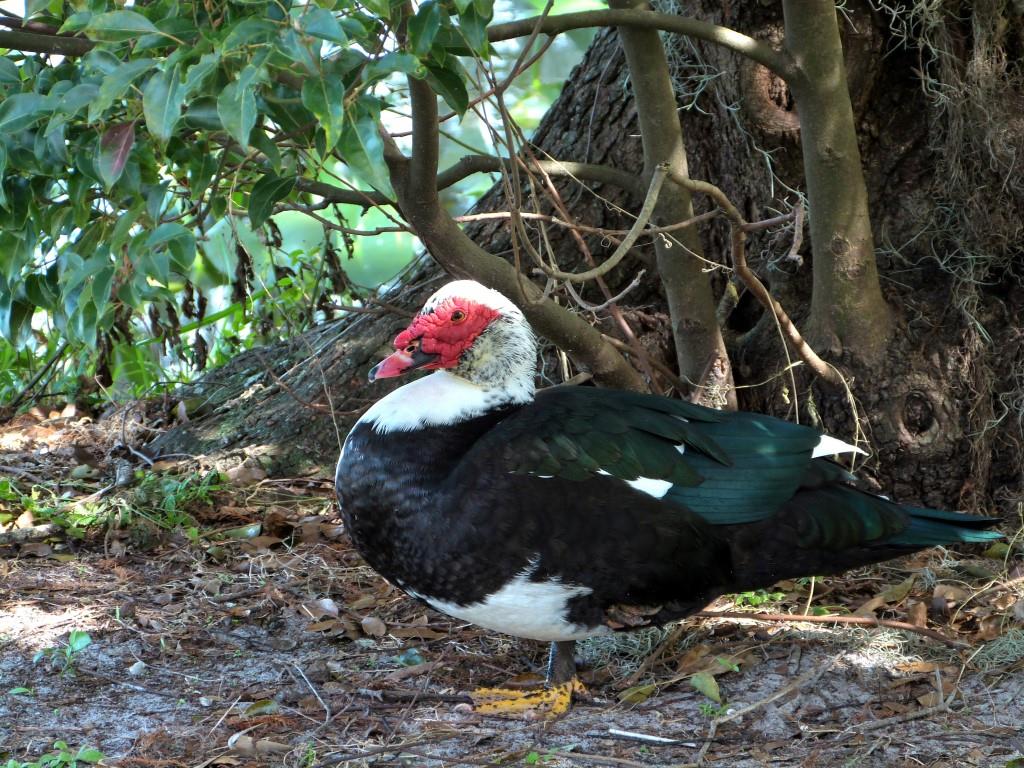
Ducks have been domesticated as pets and farm animals for more than 500 years, and all domestic ducks are descended from either the mallard or the Muscovy duck. Mallards, especially, are easy to crossbreed with other types of ducks, and mallards often hybridize with all types of ducks at local ponds.
White-winged Duck (Asarcornis scutulata) by Nikhil
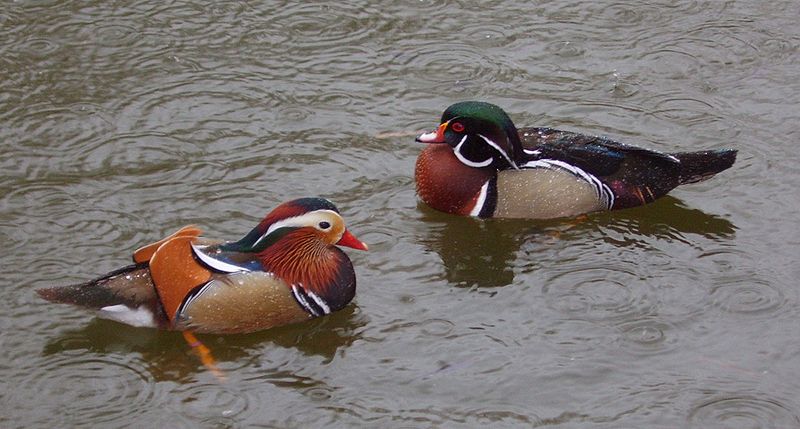
Two of my favorite Ducks, which we get to see often, are the Wood and Mandarin Ducks in the Aix genus. The Wood Ducks are local to us and are a treat to see their evidence of the Master’s Hand. Their cousin, the Mandarin Ducks are in many zoos and Lakeland, FL (right near here) placed some in one of their lakes.
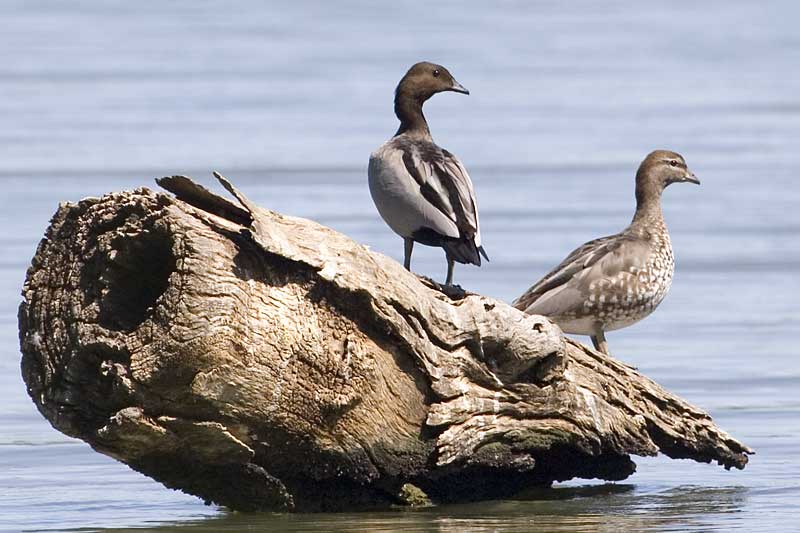
The Maned Duck is again an only species in its genus, the Chenonetta.
Maned Duck (Chenonetta jubata)
Cotton Pygmy Goose (Nettapus coromandelianus) by Lee
The Pygmy Geese are only three, but are in two different genera. The Nerthus and the Nettapus.
African Pygmy Goose (Nerthus auritus)
Cotton Pygmy Goose (Nettapus coromandelianus)
Green Pygmy Goose (Nettapus pulchellus)
The last four for today are in four genera, and include two Teals and two Ducks.
One of the comments made last week mentioned that they didn’t realize how many Ducks and family members there are. Here are a couple of “Duck Facts”:
The duck is a number of species in the Anatidae family of birds. They are related to swans and geese.
Ducks are mostly aquatic birds living in both fresh water and sea water and found on every continent except for Antarctica.
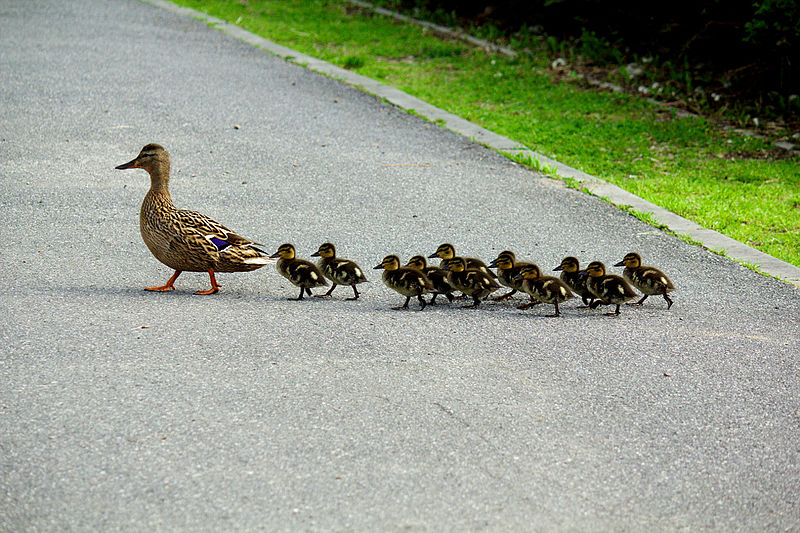
A male duck is called a drake, a female duck a hen, and a baby duck a duckling.
Ducks are omnivores. They feed on aquatic plants, small fish, insects, worms, grubs and more. People often feed domesticated ducks bread.
Diving ducks and sea ducks search for food fairly deep underwater. To be able to stay underwater more easily, diving ducks are quite heavy.
Dabbling ducks feed on the surface of water, on land, or by ducking their head underwater. Along the edge of their beak is a comb-like structure called a pecten, that enables them to hold slippery food and filter nutrients out of the water.
“With him is wisdom and strength, he hath counsel and understanding.” (Job 12:13 KJV)
It’s Sunday and time for some more of the Anatidae Family. We have 18 more great swimmers for you to check out. These are in 10 different genera, with 9 Ducks, 9 Geese and 2 sheldgeese. The Lord created all of these with shapes and colors, but they all love being in or near water.
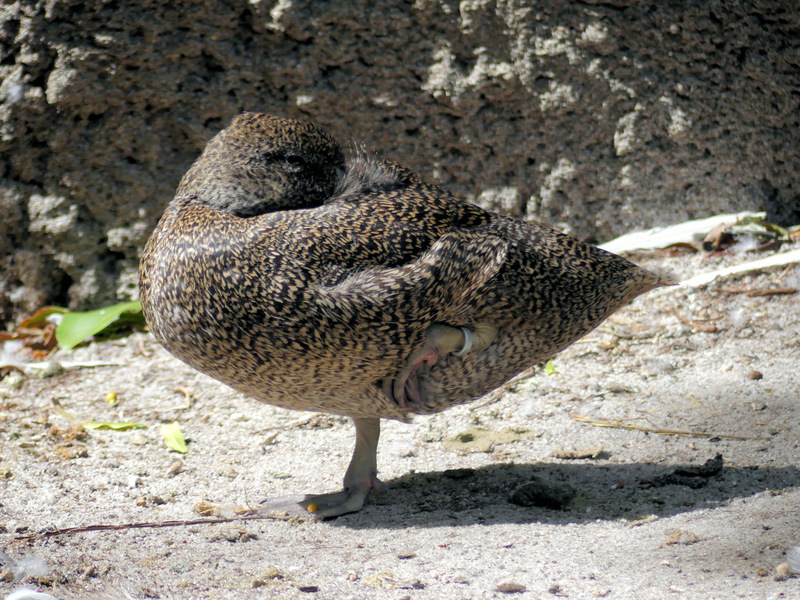
Freckled Duck (Stictonetta naevosa) by Lee at Zoo Miami
Freckled Duck (Stictonetta naevosa) – is a waterfowl species endemic to Australia and is among the rarest waterfowl in the world. The freckled duck has also been referred to as the monkey duck or the oatmeal duck in English, Punktchenente in German, canard mouchete in French and pato manchado in Spanish. These birds are usually present in mainland Australia, but disperse to coastal and subcostal wetlands in the dry period. During such times it is common for the freckled duck population to congregate in flocks in the same area, giving the impression that they are more common than they really are.
The freckled duck has a distinctive appearance. It is characterized, in adults, by dark grey to black plumage covered with small white flecks, which gives the duck the ‘freckled’ look. The feet, legs and bill of both sexes is of a slate grey color. Hatchlings and juveniles are distinguished by a uniform light grey plumage, which they lose around their 32nd week when they undergo a full body molt to assume the adult plumage.
In the past few decades, several institutions have established breeding programs to aid in supplementation of the freckled duck population. and Zoo Miami is one of the ones in this program. We saw these on our latest trip to the zoo.
Blue Duck (Hymenolaimus malacorhynchos) is endemic to New Zealand. (Also known as “Whio”) It is the only member of the genus Hymenolaimus. It is an endemic resident breeder in New Zealand, nesting in hollow logs, small caves and other sheltered spots. It is a rare duck, holding territories on fast flowing mountain rivers. It is a powerful swimmer even in strong currents, but is reluctant to fly. It is difficult to find, but not particularly wary when located.
Captive North Island Whio are held and bred on both main islands of New Zealand, but the progeny are returned to their respective island. South Island whio are held and bred in captivity on the South Island only. All captives are kept by approved and permitted zoological and wildlife facilities as part of the national recovery plan. As part of this current ten-year plan (2009-2019) is the WHIONE program which works with specially trained nose dogs to locate nests. The eggs removed and ducklings hatched and raised in captivity. Later they are conditioned for coordinated release. Sounds like they are continuing the Genesis mandate. (Genesis 1:26-28) * The blue duck is depicted on the reverse side of the New Zealand $10 banknote.
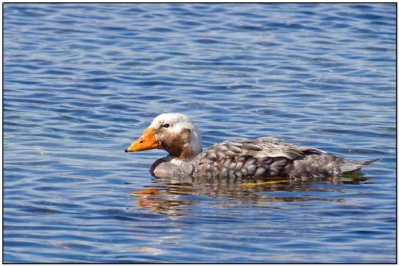
Falkland Steamer Duck (Tachyeres brachypterus) by Dave’s BirdingPix
The Steamer Ducks are a genus (Tachyeres) of ducks in the family Anatidae. All of the four species occur at the southern cone of South America in Chile and Argentina, and all except the Flying Steamer Duck are flightless; even this one species capable of flight rarely takes to the air. The genus name Tachyeres, “having fast oars” or “fast rower”, comes from Ancient Greek ταχυ- “fast” + ἐρέσσω “I row (as with oars)”. The common name “steamer ducks” arose because, when swimming fast, they flap their wings into the water as well as using their feet, creating an effect like a paddle steamer. They can be aggressive and are capable of chasing off predators like petrels.
The Steamer Ducks are the Flying Steamer Duck (Tachyeres patachonicus), Fuegian Steamer Duck (Tachyeres pteneres), Falkland Steamer Duck (Tachyeres brachypterus), and the Chubut Steamer Duck (Tachyeres leucocephalus)
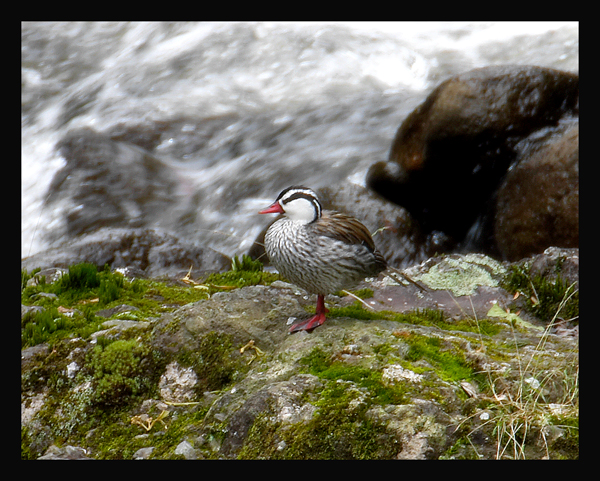
Torrent Duck (Merganetta armata) by Robert Scanlon
Torrent Duck (Merganetta armata) is the only member of the genus Merganetta. Its closest relative may be the blue duck of New Zealand.
This 43–46-centimetre (17–18 in) long species is a resident breeder in the Andes of South America, nesting in small waterside caves and other sheltered spots. Like the blue duck, it holds territories on fast flowing mountain rivers, usually above 1,500 metres (4,900 ft). It is a powerful swimmer and diver even in white water, but is reluctant to fly more than short distances. It is not particularly wary when located.
Male torrent ducks have a striking black and white head and neck pattern and a red bill. In flight they show dark wings with a green speculum. Females of all subspecies are somewhat smaller than the drakes; they have orange underparts and throat, with the head and upperparts grey and a yellower bill. Juveniles are pale grey above and whitish below.
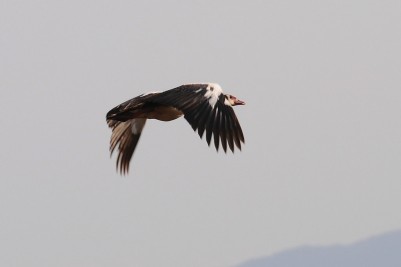
Spur-winged Goose (Plectropterus gambensis) by Bob-Nan
Spur-winged Goose (Plectropterus gambensis) is a large bird in the family Anatidae, related to the geese and the shelducks, but distinct from both of these in a number of anatomical features, and therefore treated in its own subfamily, the Plectropterinae. It occurs in wetlands throughout sub-Saharan Africa. Adults are 75–115 cm (30–45 in) long and weigh on average 4–6.8 kg (8.8–15.0 lb), rarely up to 10 kg (22 lb), with males noticeably larger than the females.The wingspan can range from 150 to 200 cm (59 to 79 in).
This species often occurs in open grasslands with lakes, seasonal pools, rivers, swamps and river deltas. Large inland rivers and lakes are perhaps most commonly inhabited, with saline lakes and upland areas generally being avoided, although the species can occur to an elevation of 3,000 m (9,800 ft) in eastern Africa. It is also absent from arid zones.
Comb Duck (Sarkidiornis sylvicola) by Nikhil Devasar
Comb Duck (Sarkidiornis sylvicola) and Knob-billed Duck (Sarkidiornis melanotos) are an unusual, pan-tropical duck, found in tropical wetlands in sub-Saharan Africa, Madagascar and south Asia from Pakistan to Laos and extreme southern China. It also occurs in continental South America south to the Paraguay River region in eastern Paraguay, southeastern Brazil and the extreme northeast of Argentina, and as a vagrant on Trinidad. These were subspecies that have both been raise to full species status.
These common species are unmistakable. One of the largest species of duck. Length can range from 56 to 76 cm (22 to 30 in), wingspan ranges from 116 to 145 cm (46 to 57 in) and weight from 1.03 to 2.9 kg (2.3 to 6.4 lb). Adults have a white head freckled with dark spots, and a pure white neck and underparts. The upperparts are glossy blue-black upperparts, with bluish and greenish iridescence especially prominent on the secondaries (lower arm feathers). The male is much larger than the female, and has a large black knob on the bill. Young birds are dull buff below and on the face and neck, with dull brown upperparts, top of the head and eyestripe.
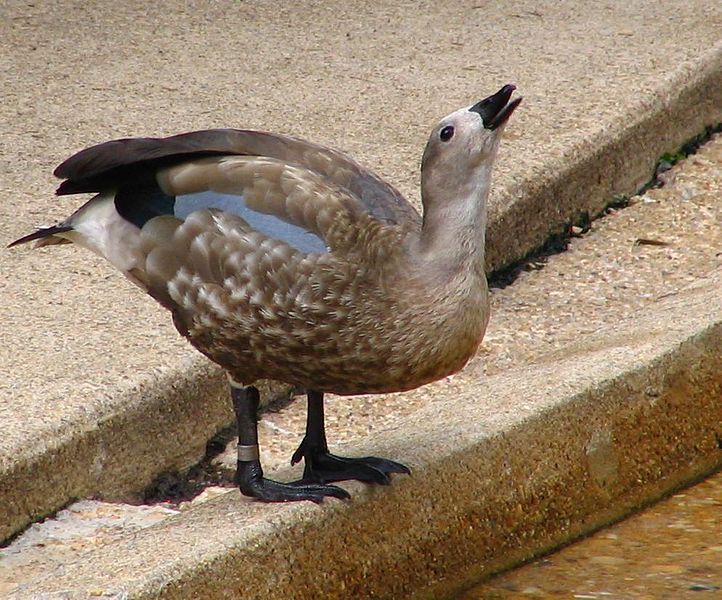
Blue-winged Goose (Cyanochen cyanoptera) is a waterfowl species which is endemic to Ethiopia. It is the only member of the genus Cyanochen. This is a stocky grey-brown bird about 70 centimetres (28 in) long with a slightly paler head and upper neck. It has a small black bill and black legs. In flight, this species shows a pale blue forewing. Sexes are similar, but immature birds are duller. The plumage of these birds is thick and loose, furlike as an adaptation to the cold of the Ethiopian highlands.
It feeds by grazing, and is apparently largely nocturnal, loafing during the day. It can swim and fly well, but this terrestrial bird is reluctant to do either, and is quite approachable. It forms flocks outside the breeding season. It breeds by mountain lakes and streams. This little-known species is believed to build a lined nest amongst grass tussocks, and to lay 6–7 eggs.
Egyptian Goose (Alopochen aegyptiaca) by Daves BirdingPix
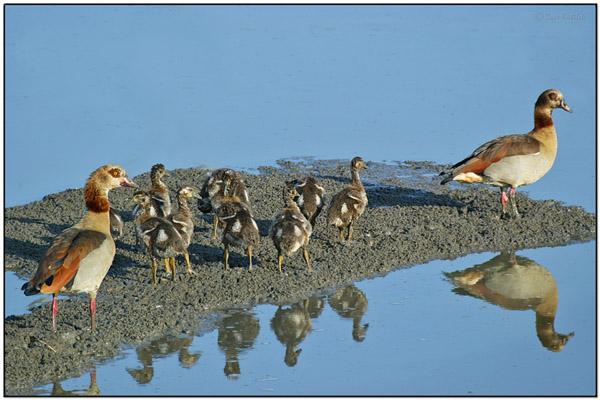
The Egyptian Goose (Alopochen aegyptiacus) is native to Africa south of the Sahara and the Nile Valley. The other two species, Mauritius Sheldgoose (Alopochen mauritiana) became extinct in 1698 and Reunion Sheldgoose (Alopochen kervazoi) was extinct in the 1690’s. Both were over hunted.
Egyptian geese were considered sacred by the Ancient Egyptians, and appeared in much of their artwork. They have been raised for food and extensively bred in parts of Africa since they were domesticated by the ancient Egyptians. Because of their popularity chiefly as ornamental bird, escapes are common and small feral populations have become established in Western Europe.
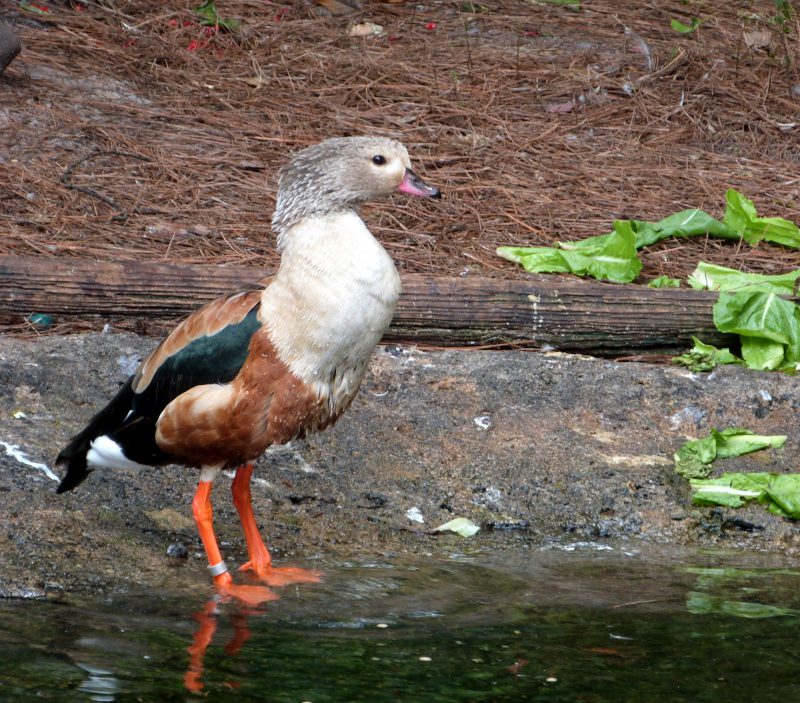
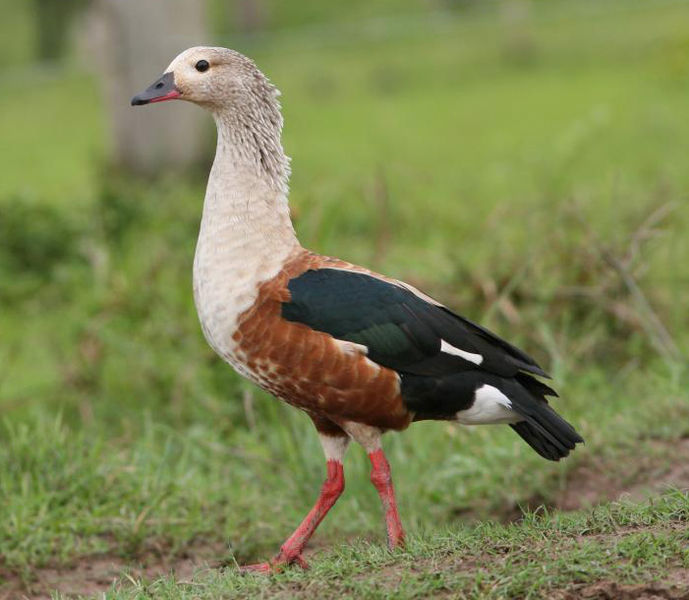
Orinoco Goose (Neochen jubata) are 61 to 76 cm (24 to 30 in) long and are resident breeders in the forests of tropical South America. Its preference is forest lakes or marshes with access to open woodland or savanna. This is a largely terrestrial species, which will also perch readily in trees. It rarely swims or flies unless hard pressed. In flight it looks heavy, more like a goose than a duck, hence the English name.
It has a pale head and neck, chestnut flanks and mantle and blackish wings with a white speculum. The legs are red and the bill is black and pinkish. The sexes of this striking species are identical in plumage, though the males are larger; juveniles have duller plumage than adults.
Upland Goose (Chloephaga picta) by Daves BirdingPix
The Chloephaga genus is made up of these Geese all from South America. The Andean Goose (Chloephaga melanoptera), Upland Goose (Chloephaga picta), Kelp Goose (Chloephaga hybrida), Ashy-headed Goose (Chloephaga poliocephala), and the Ruddy-headed Goose (Chloephaga rubidiceps). They are considered part of the Sheldgeese subfamily.
“Sheldgoose, any of the larger members of the duck tribe Tadornini, family Anatidae (order Anseriformes). The smaller members of the tribe are called shelducks. Sheldgeese inhabit tropical and subtropical regions worldwide. They are small-billed and rather long-legged, with upright stance; some have bony spurs—which function as weapons—at the wing bend. Typically they show white wing patches and are finely black-barred below. They are not true geese, though they resemble them in some anatomic features.” Encyclopaedia Britannica
(Information from Wikipedia with editing)
This slideshow requires JavaScript.
“In a moment, in the twinkling of an eye, at the last trump: for the trumpet shall sound, and the dead shall be raised incorruptible, and we shall be changed.” (1Co 15:52 KJV)
“I Will Rise” ~ Margaret and Sue, accompanied by Amy – cello and Jill – Keyboard
“And the swan, and the pelican, and the gier eagle,” (Leviticus 11:18)
As we continue in the Anatidae Family of Ducks, Geese and Swans, this week we will introduce you to four genera. The Branta, the Anser, and the Coscorba genera are made up of Geese. The Cygnus genus are Swans.
Anserinae is a subfamily of swans and geese (three to seven extant genera with 25–30 living species, mainly cool temperate Northern Hemisphere, but also some Southern Hemisphere species, with the swans in one genus, and the geese in three genera. Some other species are sometimes placed herein, but seem somewhat more distinct.
Chen, white geese (three species, now included in Anser)
Coscorba, unresolved (one species)
Cygnus, true swans (six species, four sometimes separated in Olor)
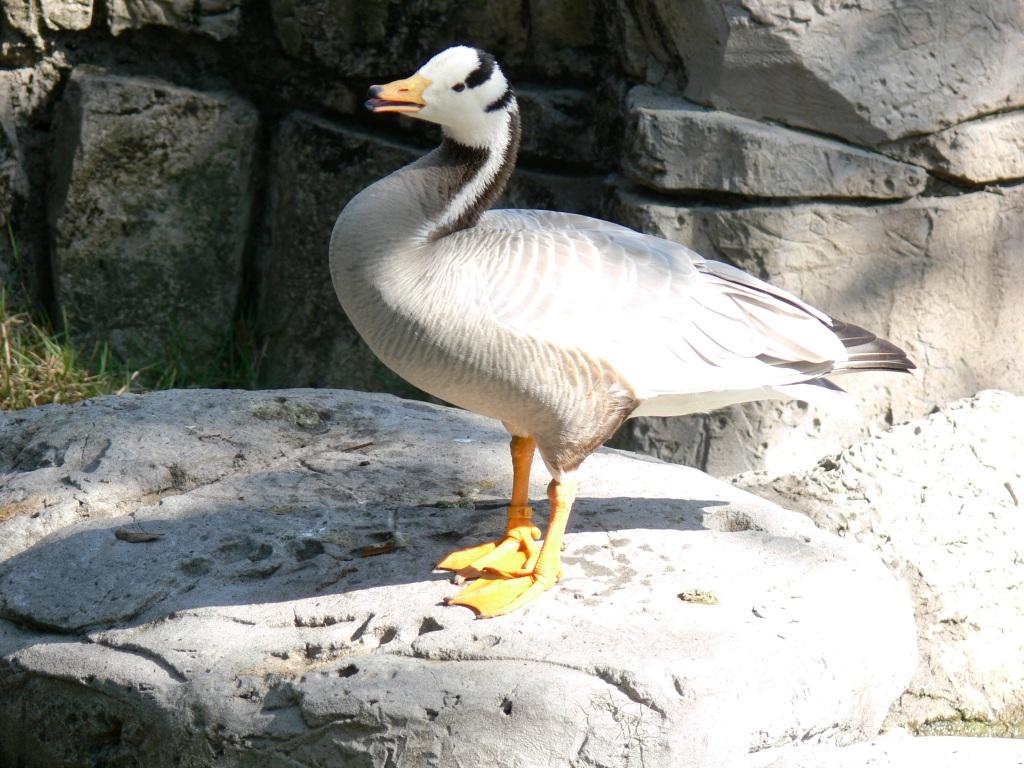
Bar-headed Goose (Anser indicus) Lowry Park Zoo by Lee
This blog follows the I.O.C. list of birds and below are the birds in their listing:
There are also links to articles here written about these different birds.
Bar-headed Goose (Anser indicus) – See Dr. Jim’s Article
Emperor Goose (Anser canagicus – wasChen)
Ross’s Goose (Anser rossii – wasChen)
Snow Goose (Anser caerulescens – wasChen)
Greylag Goose (Anser anser) – See Article
Swan Goose (Anser cygnoides)
Taiga Bean Goose (Anser fabalis)
Pink-footed Goose (Anser brachyrhynchus) – See Article
Tundra Bean Goose (Anser serrirostris)
Greater White-fronted Goose (Anser albifrons) – See Article
Lesser White-fronted Goose (Anser erythropus) – See Article
Coscoroba Swan (Coscoroba coscoroba) – See Lee’s Article
Black Swan (Cygnus atratus) – See Article & Dr. Jim’s Article
Black-necked Swan (Cygnus melancoryphus) – Ian’s Article
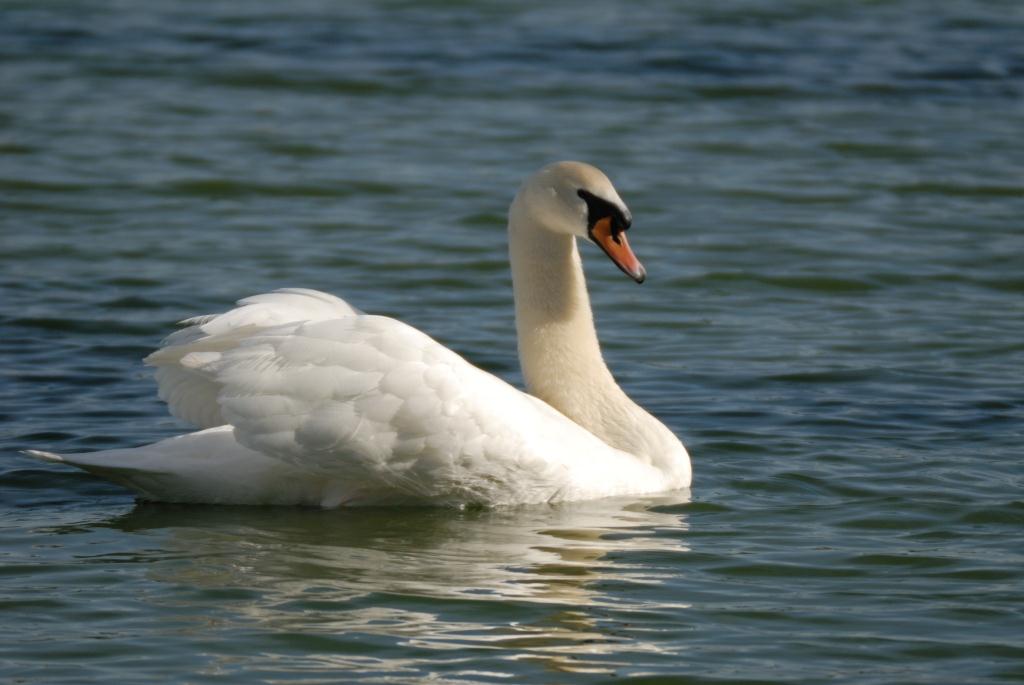
Mute Swan (Cygnus olor) – See Article
Trumpeter Swan (Cygnus buccinator) – See Dr. Jim’s Article
Tundra Swan (Cygnus columbianus) – See Article
Whooper Swan (Cygnus cygnus) – See Article
This slideshow requires JavaScript.
“For which cause we faint not; but though our outward man perish, yet the inward man is renewed day by day. For our light affliction, which is but for a moment, worketh for us a far more exceeding and eternal weight of glory; While we look not at the things which are seen, but at the things which are not seen: for the things which are seen are temporal; but the things which are not seen are eternal.” (2 Corinthians 4:16-18)
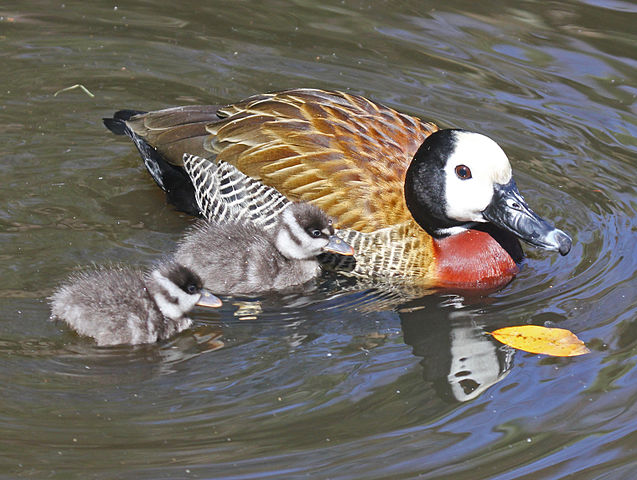
Black-bellied Whistling Duck (Dendrocygna autumnalis) at Palm Beach Zoo by Lee
“And the swan, and the pelican, and the gier-eagle,” (Leviticus 11:18)
I have always enjoyed trying to whistle and today we lead off our latest Family, the Anatidae, in the Answeriformes Order. The Anatidae family has ducks, geese, swans, and a few others that add up to 173 species. The Whistling Ducks do make a whistling sound, which I notice more when they are flying. We have the Black-bellied Whistling Ducks here locally. In fact, some hang out at the pond in our housing area.
Black-bellied Whistling Duck (Dendrocygna autumnalis) by Lee at Palm Beach Zoo
Audio of a Black-bellied Whistling Duck from xeno-canto.
The Anatidae are the biological family of birds that includes ducks, geese, and swans. The family has a cosmopolitan distribution, occurring on all the world’s continents. These birds are adapted for swimming, floating on the water surface, and in some cases diving in at least shallow water. (The magpie goose is no longer considered to be part of the Anatidae, but is placed in its own family
They are generally herbivorous, and are monogamous breeders. A number of species undertake annual migrations. A few species have been domesticated for agriculture, and many others are hunted for food and recreation. Five species have become extinct since 1600, and many more are threatened with extinction.
Whistling ducks are found in the tropics and subtropics. As their name implies, they have distinctive whistling calls. The whistling ducks have long legs and necks, and are very gregarious, flying to and from night-time roosts in large flocks. Both sexes have the same plumage, and all have a hunched appearance and black underwings in flight.
The white-backed duck (Thalassornis leuconotus) is a waterbird of the family Anatidae. It is distinct from all other ducks, but most closely related to the whistling ducks in the subfamily Dendrocygninae, though also showing some similarities to the stiff-tailed ducks in the subfamily Oxyurinae. It is the only member of the genus Thalassornis.
These birds are well adapted for diving. On occasions they have been observed to stay under water for up to half a minute. They search especially for the bulbs of waterlilies. From danger, they also escape preferentially by diving; hence, the namesake white back is hardly visible in life. (Information from Wikipedia)
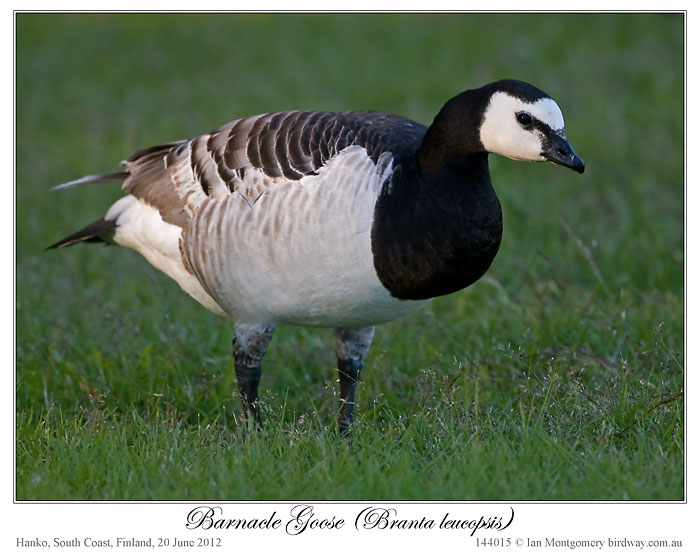
Barnacle Goose (Branta leucopsis) by Ian
The black geese of the genus Branta are waterfowl belonging to the true geese and swans subfamily Anserinae. They occur in the northern coastal regions of the Palearctic and all over North America, migrating to more southernly coasts in winter, and as resident birds in the Hawaiian Islands. Alone in the Southern Hemisphere, a self-sustaining feral population derived from introduced Canada geese is also found in New Zealand.
The scientific name Branta is a Latinised form of Old Norse Brandgás, “burnt (black) goose). The black geese derive their vernacular name for the prominent areas of black coloration found in all species. They can be distinguished from all other true geese by their legs and feet, which are black or very dark grey. Furthermore, they have black bills and large areas of black on the head and neck, with white (ochre in one species) markings that can be used to tell apart most species.[note 1] As with most geese, their undertail and uppertail coverts are white. They are also on average smaller than other geese, though some very large taxa are known, which rival the swan goose and the black-necked swan in size.
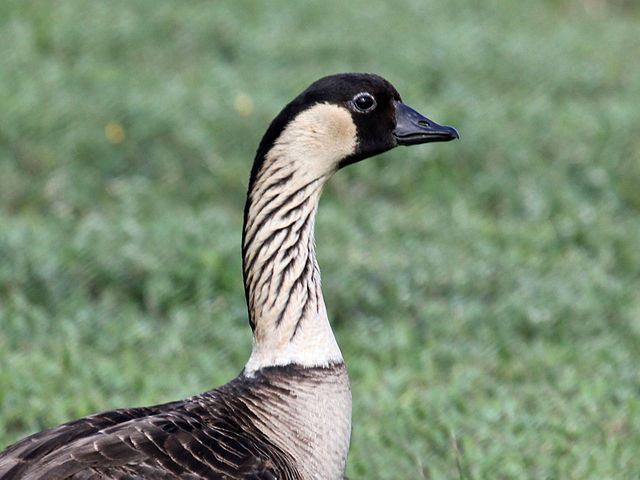
The Nene (Branta sandvicensis), also known as nēnē and Hawaiian goose, is a species of goose endemic to the Hawaiian Islands. The official bird of the state of Hawaiʻi, the nene is exclusively found in the wild on the islands of Oahu, Maui, Kauaʻi, Molokai, and Hawaiʻi. The Hawaiian name nēnē comes from its soft call. The species name sandvicensis refers to the Sandwich Islands, an old name for the Hawaiian Islands. (Above information from Wikipedia)
The first two photos show how the different zoos call the same bird by different names. This is why the scientific name is very important. Also, Dan and I have been fortunate to have seen most of these birds either in the wild or in zoos. It is always a joy to watch the Lord’s Creations in person.
This slideshow requires JavaScript.
I made me pools of water, to water therewith the wood that bringeth forth trees: (Ecclesiastes 2:6)
In those pools of water, most likely you will find one of these.
“I’d Rather Have Jesus” ~ by Faith Baptist Orchestra*



























 Lee's Birdwatching Adventures Plus