Sunday Inspiration – Reed Warblers

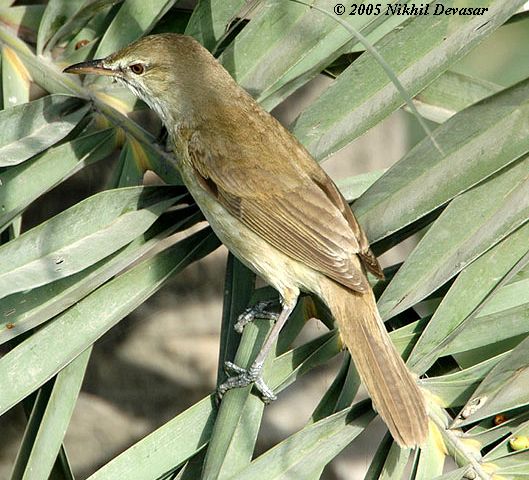
Clamorous Reed Warbler (Acrocephalus stentoreus) by Nikhil

Clamorous Reed Warbler (Acrocephalus stentoreus) by Nikhil

“Can the papyrus grow up without a marsh? Can the reeds flourish without water? (Job 8:11 NKJV)

This week we introduce you to just one family, the Acrocephalidae Family of Reed Warblers, Marsh- and Tree-warblers, and Acrocephalid warblers. The Lord has created this family of birds to blend in rather well with their surroundings. Another act of love and concern from the Creator.

The species in this family are usually rather large “warblers”. Most are rather plain olivaceous brown above with much yellow to beige below. They are usually found in open woodland, reedbeds or tall grass. The family occurs mostly in southern to western Eurasia and surroundings, but also ranging far into Pacific, with some species in Africa.

There are five genus in this family;

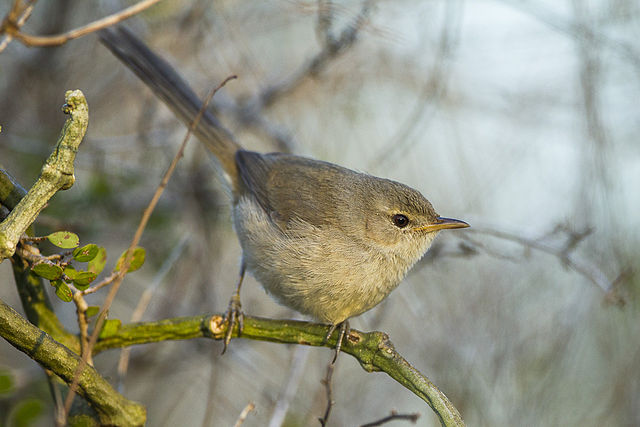
Subdesert Brush Warbler (Nesillas lantzii) ©WikiC

Subdesert Brush Warbler (Nesillas lantzii) ©WikiC

Nesillas – Brush Warblers; found in Comoros and Madagascar. Its natural habitats are subtropical or tropical dry forests, subtropical or tropical moist lowland forests, and subtropical or tropical moist shrubland.

Sedge Warbler (Acrocephalus schoenobaenus) by Robert Scanlon

Sedge Warbler (Acrocephalus schoenobaenus) by Robert Scanlon

Acrocephalus warblers are small, insectivorous passerine birds. Formerly in the Old World warbler assemblage, they are now separated as the namesake of the marsh and tree warbler family Acrocephalidae. They are sometimes called marsh warblers or reed warblers. These are rather drab brownish warblers usually associated with marshes or other wetlands. Some are streaked, others plain. Many species are migratory. Many species have a flat head profile, which gives rise to the group’s scientific name;

African Yellow Warbler (Iduna natalensis) ©WikiC

African Yellow Warbler (Iduna natalensis) ©WikiC

Iduna is a genus of tree warbler in the Acrocephalidae family. It is sometimes lumped together in the genus Hippolais.

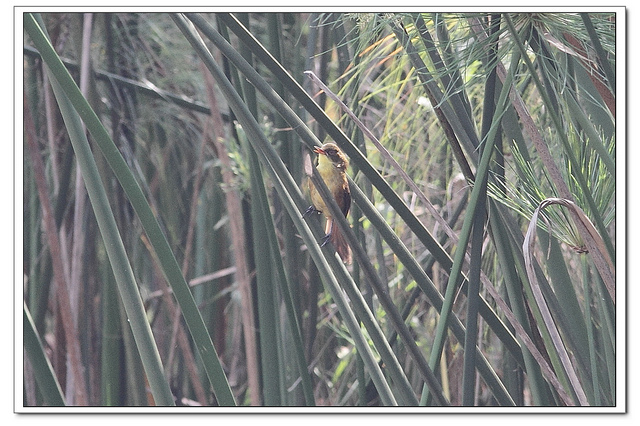
Papyrus Yellow Warbler (Calamonastides gracilirostris) ©©Flickr Ross Tsal

Papyrus Yellow Warbler (Calamonastides gracilirostris) ©©Flickr Ross Tsal

(Calamonastides gracilirostris) Papyrus Yellow Warbler is a species of tree warbler; formerly placed in the “Old World warblers”. It is monotypic in its genus. It is found in Burundi, Democratic Republic of the Congo, Kenya, Rwanda, Tanzania, Uganda, and Zambia. Its natural habitat is swamps. It is threatened by habitat loss. Compared with the dull browns and greys typical of swamp-dwelling warblers, this warbler is brightly coloured. It shows an underbelly of rich yellow and olive-brown upper parts. Its song consists of melodious liquid warbling:

Icterine Warbler (Hippolais icterina) ©WikiC

Icterine Warbler (Hippolais icterina) ©WikiC

Hippolais is a genus of tree warbler in the Acrocephalidae family. It is sometimes lumped together with the genus Iduna.

(Info from Wikipedia with editing)

Acrocephalidae – Reed Warblers and allies:

This slideshow requires JavaScript.

As they departed, Jesus began to say to the multitudes concerning John: “What did you go out into the wilderness to see? A reed shaken by the wind? (Matthew 11:7 NKJV)

“When I Survey The Wondrous Cross” ~ by Miss Anna Pletcher (12 years old at Faith Baptist) on piano

I love the last verse of this hymn:

Were the whole realm of nature mine,
That were a present far too small;
Love so amazing, so divine,
Demands my soul, my life, my all.

 *

Sunday Inspiration

Acrocephalidae Family of Reed Warblers and Allies

Reed Warblers and Allies – Montereybay

Acrocephalidae Family – Wikipedia

Gideon

*

Sad Clowns of the Sea

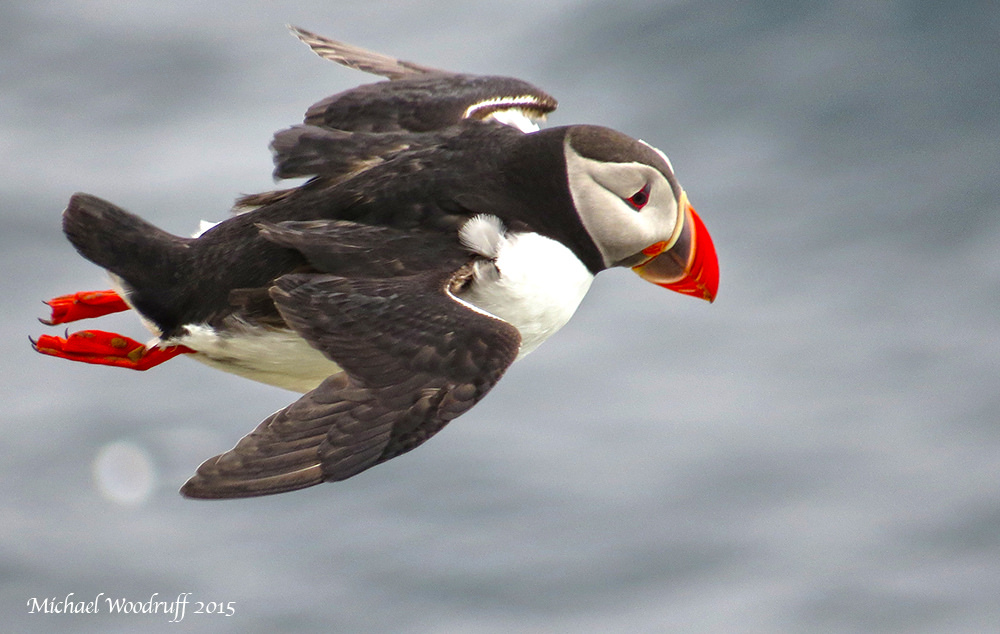
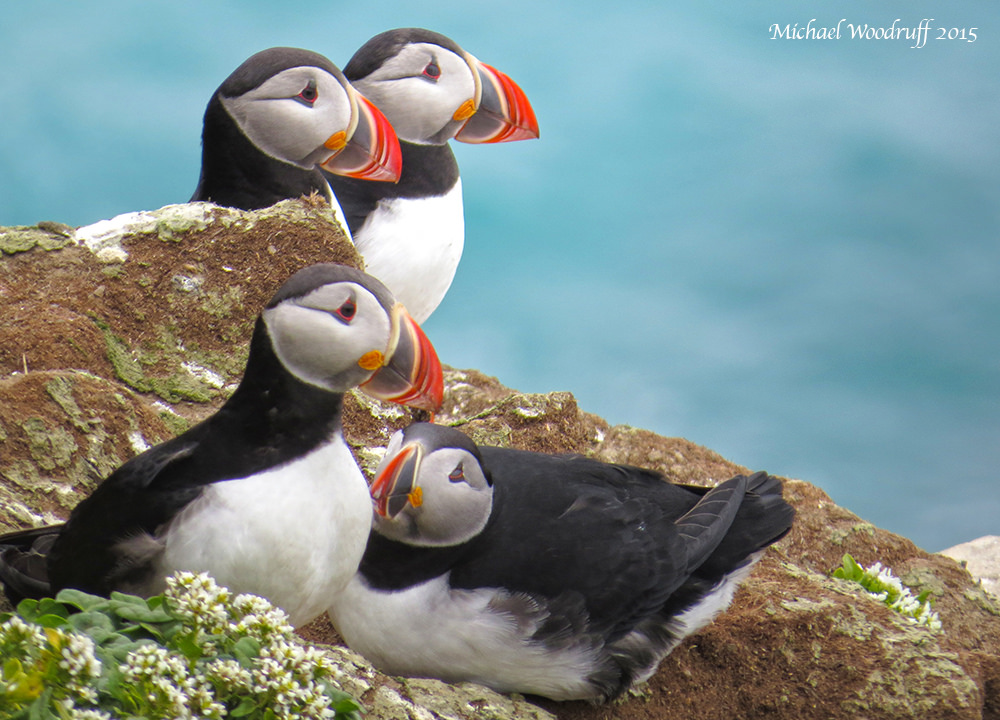
Atlantic Puffin (Fratercula arctica) by Michael Woodruff

Atlantic Puffin (Fratercula arctica) by Michael Woodruff

Why am I discouraged? Why am I restless? I trust you! And I will praise you again because you help me, and you are my God. (Psalms 43:5 CEV)

Recently I decided to check back through the photographers who have given me permission to use their photos. There are links to them down the right menu in the Photography section.

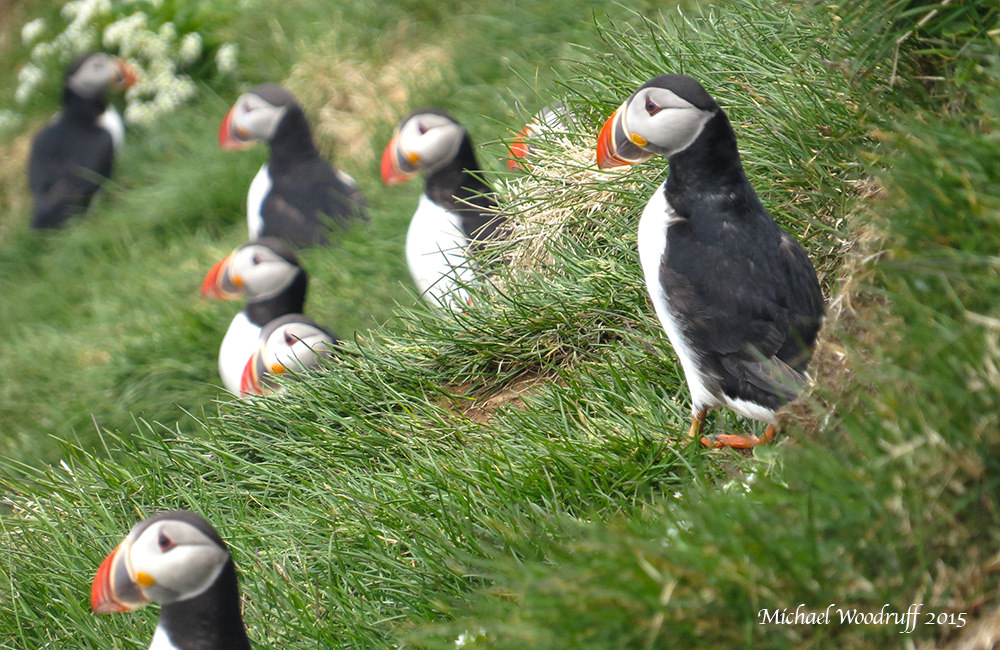
Atlantic Puffin (Fratercula arctica) by Michael Woodruff

Atlantic Puffin (Fratercula arctica) by Michael Woodruff

While looking through Michael Woodruff’s Flickr photos, I spotted these recent Puffins. Michael is one of the first photographers to allow me to use his beautiful photos on this blog and Michael is also a Christian. Apparently he made a trip to Grimsey Island, Iceland on 29 June 2015.  So these are some of his latest photos.

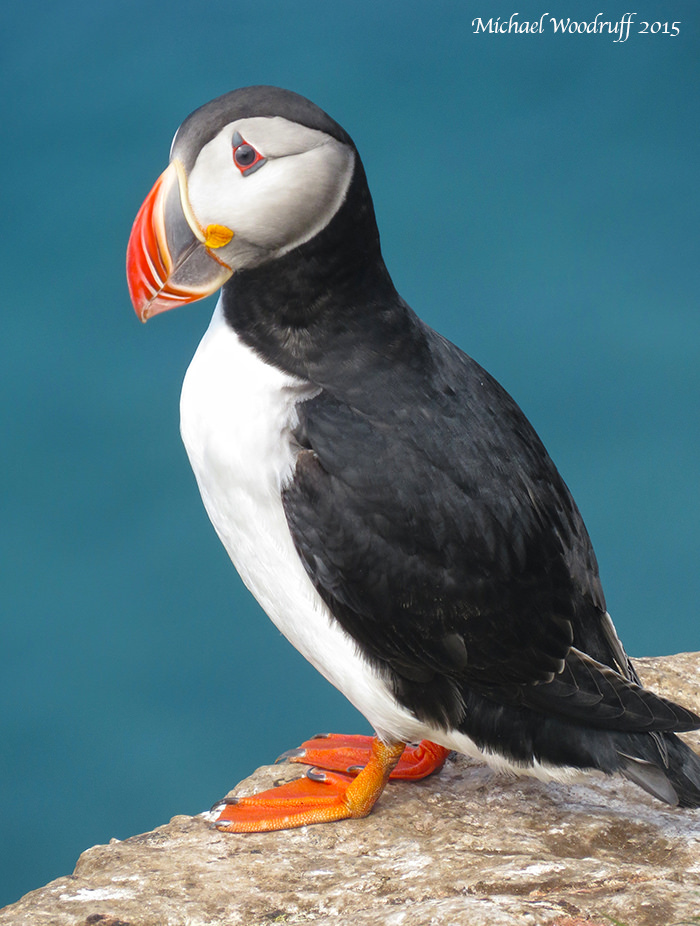
Atlantic Puffin (Fratercula arctica) by Michael Woodruff

Atlantic Puffin (Fratercula arctica) by Michael Woodruff

The Atlantic Puffins have been called the “Clowns of the Sea” because of their colorful marking that the Lord their Creator gave them. They are also sometimes called “Sea Parrots.” However you think of them, they are beautiful birds and I was surprised they are so small. On land it stands about 20 cm (8 in) high. The Atlantic puffin is sturdily built with a thick-set neck and short wings and tail. It is 28 to 30 centimetres (11 to 12 in) in length from the tip of its stout bill to its blunt-ended tail. Its wingspan is 47 to 63 centimetres (19 to 25 in). Males are slightly larger than the female, but both are marked the same. They mate for life.

Atlantic Puffin (Fratercula arctica) by Michael Woodruff

Atlantic Puffin (Fratercula arctica) by Michael Woodruff

Sorrow is better than laughter: for by the sadness of the countenance the heart is made better. (Ecclesiastes 7:3 KJV)

The beak is very distinctive. From the side the beak is broad and triangular but viewed from above it is narrow. The half nearest the tip is orange-red and the half nearest to the head is slate grey. There is a yellow chevron-shaped ridge separating the two parts and a yellow, fleshy strip at the base of the bill. At the joint of the two mandibles there is a yellow, wrinkled rosette. The exact proportions of the beak vary with the age of the bird. In an immature individual, the beak has reached its full length but it is not as broad as that of an adult. With time the bill deepens, the upper edge curves and a kink develops at its base. As the bird ages, one or more grooves may form on the red portion. The bird has a powerful bite.

Atlantic Puffin (Fratercula arctica) by Michael Woodruff

Atlantic Puffin (Fratercula arctica) by Michael Woodruff

Share the happiness of those who are happy, the sorrow of those who are sad. (Romans 12:15 Phillips)

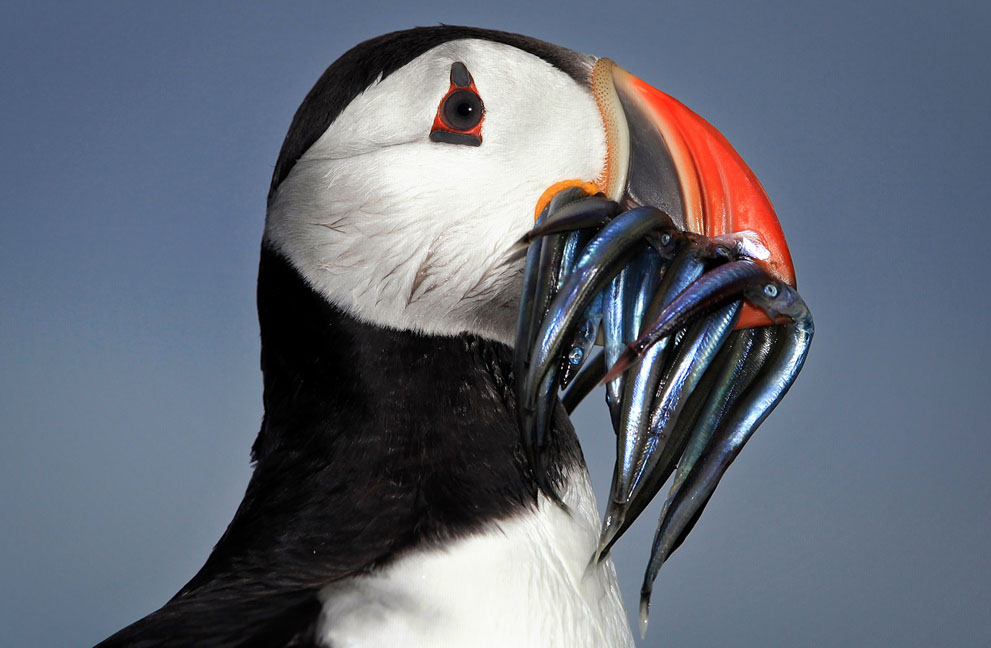
They are known for collecting multiple fish in that beautiful beak. It was designed very distinctly. It fishes by sight and can swallow small fish while submerged, but larger specimens are brought to the surface. It can catch several small fish in one dive, holding the first ones in place in its beak with its muscular, grooved tongue while it catches others. The two mandibles are hinged in such a way that they can be held parallel to hold a row of fish in place and these are also retained by inward-facing serrations on the edges of the beak. It copes with the excess salt that it swallows partly through its kidneys and partly by excretion through specialized salt glands in its nostrils. Now that is wisdom from the Creator.

Puffin with Sand Eels

Puffin with Sand Eels ©WikiC (not Michael’s, but shows the mouth full of eels)

You can read more about the Puffins from the links below, but I just wanted to share some of these photos from Michael.

Atlantic Puffin (Fratercula arctica) by Michael Woodruff

Atlantic Puffin (Fratercula arctica) by Michael Woodruff

Photos by Michael Woodruff. Atlantic Puffins by God.

*

*

EGGS-ELLENT EXAMPLES OF DESIGN

“And thou shalt be secure, because there is hope; yea, thou shalt dig about thee, and thou shalt take thy rest in safety.” (Job 11:18)

Over the years, Creation Moments has brought you countless examples of plants and animals that appear to have been designed because they really were designed! Nowhere is this easier to see than in the design of bird eggs.

African jacana chickAs we mentioned on an earlier program, the shape and coloring of bird eggs are no accident. God designed them that way for a specific purpose. Today we’re going to mention two other design features seen in some bird eggs.

SmileyCentral.com

Interesting Things from Smiley Central
The first are the eggs of the African jacana. These long-legged shorebirds build a flimsy nest that floats on water. When the male jacana lands in the nest to incubate the eggs, the whole nest sinks into the water. It’s a good thing, then, that God created the eggs to be waterproof. This is a design feature the eggs must have had from the very beginning.

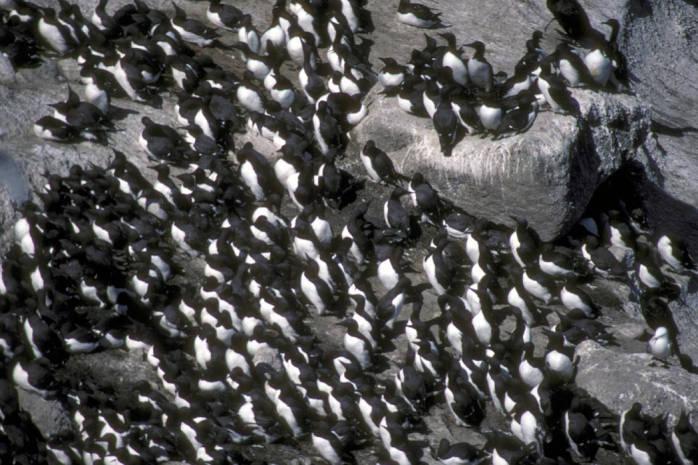
Common Murre (Uria aalge) colony ©USFWS

Common Murre (Uria aalge) colony ©USFWS

Or take the eggs of the common murre. According to BBC Earth, “The eggshells have cone-like structures that make the eggs ‘self-cleaning’.” This is useful, they say, because murre colonies are tightly packed and the eggs get showered in bird droppings. “When water lands on an egg, its water-repelling shell causes the water to gather into spherical drops” which then roll off the egg and clean it.

We could mention many other design features of bird eggs, and we will share these with you in the future. But we close today’s program with praise to the God of creation who cares for all of His creatures – especially you and me!

Prayer:

Lord Jesus, my heart overflows with praise when I look at Your creation and think about what You accomplished in just six days! You are awesome in every way! Amen.

Notes:”The 13 birds with the most amazing eggs,” BBC Earth. http://www.bbc.com/earth/story/20150319-the-birds-with-super-powered-eggs. Photo: African jacana chick. Courtesy of Magnus Manske. (CCA 2.0 Generic)

Used with permission of Creation Moments ©2015

*

African Jacana (Actophilornis africanus) by Lee

African Jacana (Actophilornis africanus) by Lee

*

Birdwatching on Danish Zealand: Remembering a Sandwich Tern, at Hamlet’s Castle

Birdwatching on Danish Zealand:

Remembering a Sandwich Tern, at Hamlet’s Castle

 ~By James J. S. Johnson

Photo taken from http://mw2.google.com/mw-panoramio/photos/medium/14567172.jpg
(Photo taken from http://mw2.google.com/mw-panoramio/photos/medium/14567172.jpg )

This will be written for the generation to come, that a people yet to be created may praise the LORD. (Psalm 102:18)

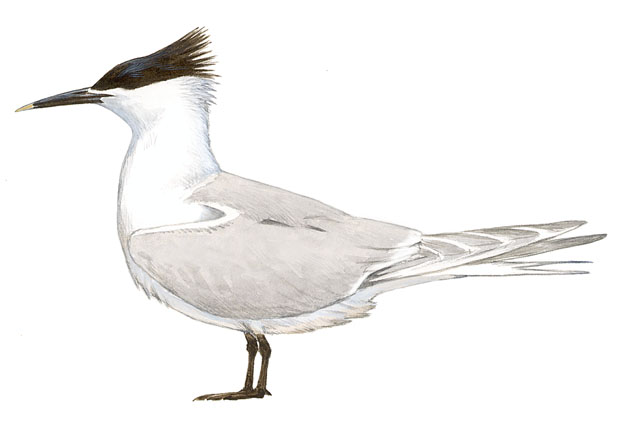
Sandwich Tern

(picture taken from http://blog.fuertecharter.com/wp-content/uploads/2015/04/F295_Dibujo_01.jpg)

The SANDWICH TERN (Thalasseus sanvicensis) is, as its name suggests, a member of the “tern” [Sternidae] family of seagulls.  (The term “Sandwich” refers to Sandwich, in Kent, western England, where this tern was formally identified in AD1787 by ornithologist-physician John Latham, MD.)

The Sandwich Tern is medium-to-large in size (for a tern), with a fairly large head (for a tern), a long thin bill, and a relatively short tail.   It may grow to 16 inches in length and 36 inches in wingspan (!), so it is obviously designed for aerodynamic flight – well-fitted for flying above its oceanic and coastland habitats.  Its thin bill is black, with a “butter-yellow” tip.  The Sandwich Tern is mostly white, appearing whiter (especially from a distance) than the Common Tern and Arctic Tern; it has greyish-white wings and (top) tail feathers.  The newer feathers, produced according to the tern’s molting cycle, are more greyish in color. The top and back of its flat-crowned head is black.  It has short black legs.

Sandwich Tern (Thalasseus sandvicensis) ©Rafy Rodriguez

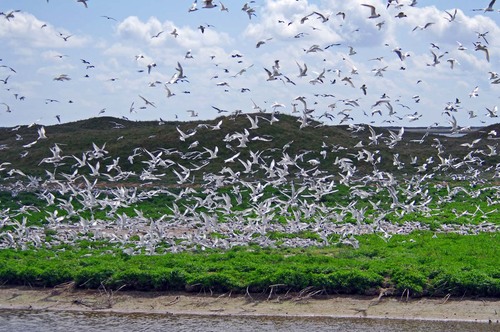
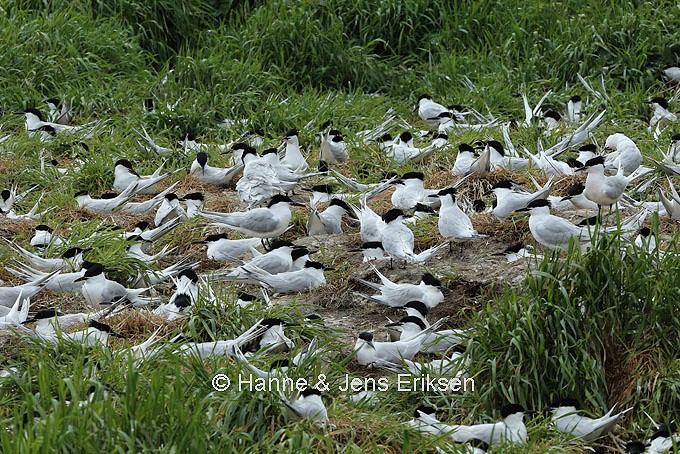
Sandwich Terns are sociable, nesting in densely packed colonies, sometimes mixed with other terns and small seagulls. [See Chris Kightley, Steve Madge, & Dave Nurney, POCKET GUIDE TO THE BIRDS OF BRITAIN AND NORTH-WEST EUROPE (New Haven: Yale University Press, 1998), page 150.]

Some consider the Cabot’s Tern of North America, which winters in and near the Caribbean (including Florida), as a close cousin of the Sandwich Tern.

SandwichTerns

Photo taken from http://www.birdsoman.com/Birds/061-Gulls/SandwichTern/SandwichTern-19098.jpg

The Sandwich Tern’s summer range is predominantly coastal – not surprising for a tern, with its most populous summer range includes various coastal shores of the British Isles (England, Scotland, Orkney, Hebrides, Ireland — but not Wales), Holland (where it is called Grote stern), and Denmark (where it is called Splitterne), especially from late March through early October.  (Sandwich Terns are known to winter in various coastal areas of North Africa.)

Besides those coastlands, the Sandwich Tern is also known as a summer visitor in parts of France (where it is called Sterne caugek), Estonia, Belgium, and Germany (where it is called Brandseeschwalbe).  Its migratory travels allow it to be observed in other countries as well, such as Poland (breeding), Sweden (where it is called Kentsk tärna – often seen where Sweden almost touches Denmark), Norway (as a “vagrant”), Spain’s Mediterranean coast, and even northeastern Italy.  [See Roger Tory Peterson, Guy Mountfort, & P. A. D. Hollom, A FIELD GUIDE TO BIRDS OF BRITAIN AND EUROPE, 5th edition (Boston: Houghton Mifflin, 1993), page 134 & Range Map 174.]

SandwichTern - Cemlyn Lagoon Anglesy

SandwichTern – Cemlyn Lagoon Anglesy

[ photo taken from https://ateambirding.files.wordpress.com/2013/07/0611-sandwich-tern-cemlyn-lagoon-anglesy-29th-june-2013-img_6143.jpg ]

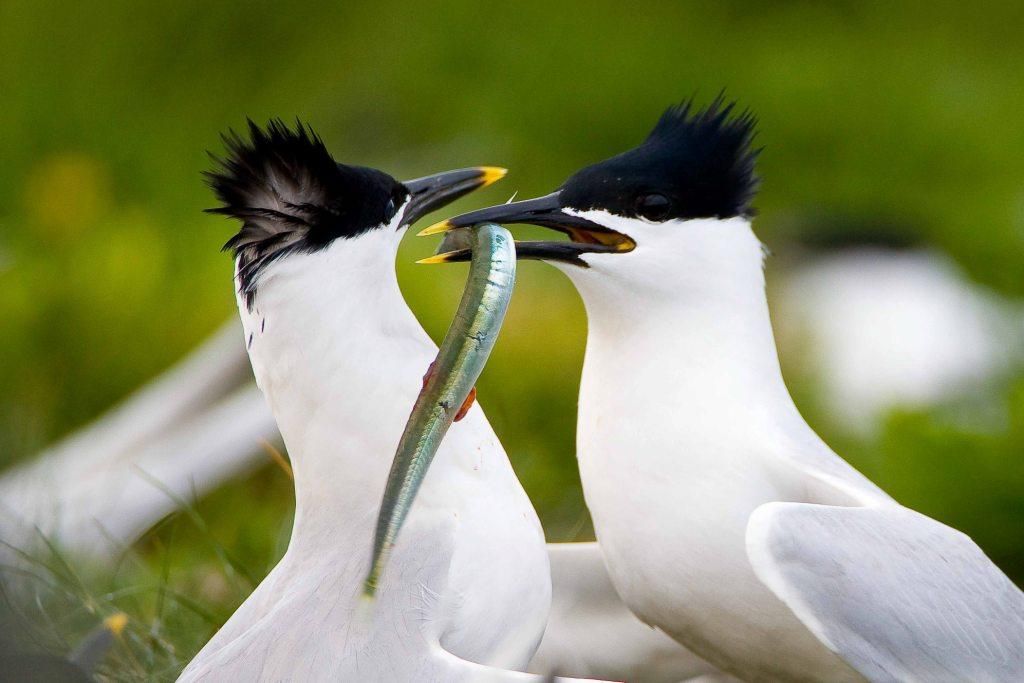
Like other terns (and gulls and fulmars, etc.), Sandwich Terns enjoy eating fish! Sandwich Terns catch their piscatorial repast by plunge-diving into the ocean.  (Occasionally they frequent lakes and ponds near coastlines, so lacustrine fish are also vulnerable to terns who elect to “go fishing” there.)

Sandwich Tern ©Jürgen Reich

Sandwich Tern ©Jürgen Reich

[Photo taken from http://www.helcom.fi/PublishingImages/baltic-sea-trends/environment-fact-sheets/latest-fact-sheets/population-development-of-sandwich-tern/Brandseeschwalben%20J%C3%BCrgen%20Reich_1.jpg ]

In addition to the shorelands of the British Isles, some parts of the Baltic Sea’s western coastline also host Sandwich Terns in the summer – including the shores at and near “Hamlet’s Castle” in Helsingør, in eastern Denmark.  In fact, it was at “Hamlet’s Castle” where I saw a Sandwich Tern on the 4th of July in AD2006.

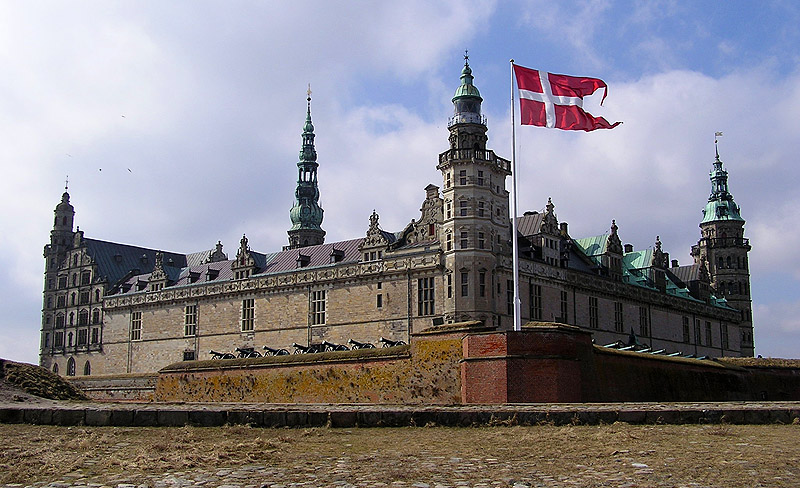
Medieval castle at Helsingør (on the island of Zealand)

Medieval castle at Helsingør (on the island of Zealand)

Photo from  https://en.wikipedia.org/wiki/Kronborg#/media/File:Helsingoer_Kronborg_Castle.jpg

Why is the medieval castle at Helsingør (on the island of Zealand, at the narrowest part of the strait of Øresund, which strait separated Denmark and Sweden), built back in the AD1420s (by the Kalmar Union triple-crown king, Eirik, “king of Denmark, Sweden, and Norway, king of the Wends and the Goths, and Duke of Pomerania”), called “Hamlet’s Castle”?

“Shakespeare brought Kronborg Slot [i.e., Kronborg Castle] world renown as the [fictional] backdrop of his ‘HAMLET’.  Most of the magnificent Renaissance castle, which has had its present appearance since 1585, is accessible to the public.”  [Quoting Reinhard Ilg, JOURNEY THROUGH DENMARK (Stürtz, 2002; translation by Faith Gibson Tegethoff; photos by Tina Herzig & Horst Herzig), page 46.]

Kronborg Castle

Kronborg Castle

[ photo taken from  http://i1.trekearth.com/photos/2765/tdanny_denmark_kronborg_1.jpg ]

In Shakespeare’s famous play, HAMLET, the fundamental question of life is asked, “To be, or not to be?”  This is a fundamental question for every human being, yet it was beforehand a fundamental question that was considered and decided by God Himself, when He chose to give each one of us the lives we call our own.  Why?  While Shakespeare’s character Hamlet considered the grave question of whether to end his earthly existence with the famous words “to be, or not to be”, the choice even more basic than that was God’s sovereign decision to create us “to be” in the first place! [See, regarding this great question of life, considered with Psalm 102:18, http://www.icr.org/article/people-yet-be-created/ .

Just as the Lord chose to imagine and invent the maritime birds that we call Sandwich Terns, of His own beneficent and sovereign volition, He chose to imagine and invent us, as the specific (and unique) humans who each one of us is.  What a choice God made, when He did so!

And, knowing that we needed redemption, as human sinners descended from Adam, God also foresaw the need for the Lord Jesus Christ to be our Redeemer – so He planned for Christ’s Messiahship – long before we ever were created as the individuals we are  (John 17:24;  Ephesians 1:4;  1st Peter 1:20)all wonderful Bible verses, that Bob Webel taught me as a teenager!).

It is God’s providential grace and kindness that He chose to make us.  It is even more grace and kindness that He provided redemption in Christ to save us!   How should we then live, to appreciate Him for Who He isthat is the question, that (by God’s grace) our lives must daily answer!

This will be written for the generation to come, that a people yet to be created may praise the LORD. (Psalm 102:18)

*

Orni-Theology

James J. S. Johnson

People Yet To Be Created

Sandwich Terns – All About Birds

Sandwich Tern – Wikipedia

*

White-faced Owl – Transformer

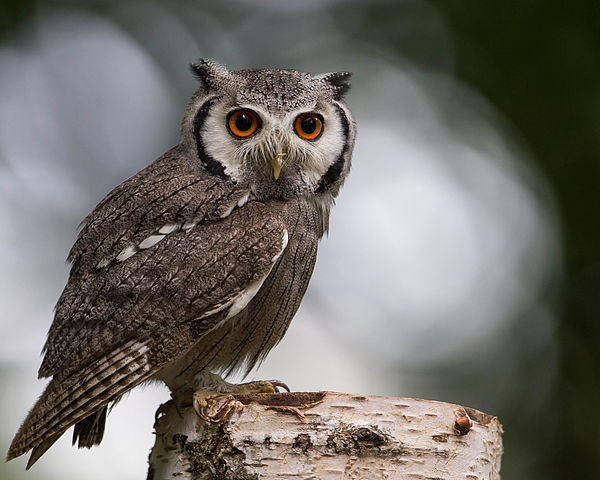
Southern White-faced Owl (Ptilopsis granti) ©PD

Southern White-faced Owl (Ptilopsis granti) ©PD

And be not conformed to this world: but be ye transformed by the renewing of your mind, that ye may prove what is that good, and acceptable, and perfect, will of God. (Romans 12:2 KJV)

Our contributing writer, James J. S. Johnson, sent me a really neat YouTube Video. It is called the Owl Transformer. After you watch this video, I will share the information I found about this cool owl.

There are two White-faced Owls. There is a Southern White-face Owl and a Northern White-faced Owl, but the one in the video is the Northern White-faced Owl. What a fantastic creation from the Creator.

Northern White-faced Owl (Ptilopsis leucotis) ©PD

Northern White-faced Owl (Ptilopsis leucotis) ©PD

These owls, both north and south, are from Africa. This northern one is from a band across Africa between the Sahara and the Equator. The southern owl appears in the southern part of Africa.

It is its “Fight-or-Flight” response that causes this defense mechanism. “When faced with another owl slightly larger than it, the bird flares its wings to appear larger. When faced with something much larger than itself, it pulls its feathers inwards, elongates its body, and narrows its eyes to thin slits. It is thought that it uses this ability to camouflage itself, and it shares the ability with relatives like the African scops owl.

In fact, many different types of owls have some ability to adopt a “concealing posture”, also known by the German word Tarnstellung, in which they squeeze and thin their body to look like a broken tree branch, and some types may also narrow their eyes to slits and fold a wing sideways across their chest in a Dracula-like manner to hide the lighter-colored feathers on their underparts. Such behavior has also been documented in eastern screech owls in a natural setting reacting to threats. (Wikipedia)

The Lord Jesus Christ gives these birds the ability to “transform” for their protection, just as he wants us to “transform” into His Image.

But we all, with open face beholding as in a glass the glory of the Lord, are changed into the same image from glory to glory, even as by the Spirit of the Lord. (2 Corinthians 3:18 KJV)

Here is another video found on YouTube:

*
Northern white-faced owl – Wikipedia

Southern white-faced owl – Wikipedia

Strigidae – Owls

Sharing The Gospel
*

The Newest I.O.C. World Bird List – Ver. 5.3 Finished Finally

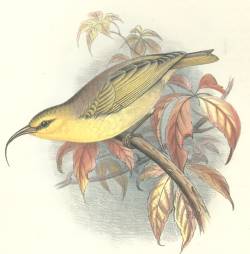
Hawaii Creeper (Loxops mana) ©WikiC

Hawaii Creeper (Loxops mana) ©WikiC – This bird is in the Loxops genus which now has add the Hawaii Akepa, Oahu Akepa and the Maui Akepa.

Be glad in the LORD, and rejoice, ye righteous: and shout for joy, all ye that are upright in heart. (Psalms 32:11 KJV)

I started working on the newest version of the I.O.C. World Bird List in mid August after I realized the 5.3 Version had been released. I was able to get the new Parrot Family updated and put these two blogs up.

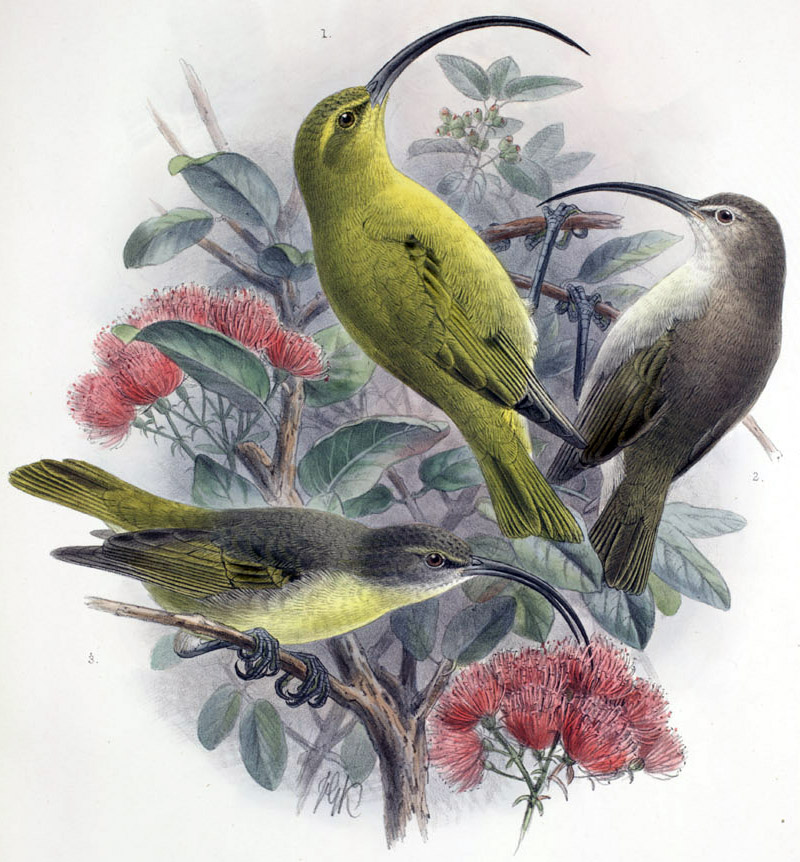
Nukupuu (Hemignathus lucidus) ©Drawing WikiC

Nukupuu (Hemignathus lucidus) ©Drawing WikiC – This is now the Oahu Nukupuu. The genus now has two new species Kauai Nukupuu (Hemignathus hanapepe) and Maui Nukupuu (Hemignathus affinis)

Well, it is now the third of September and I finally have the update finished. Since them I am older (birthday yesterday) and hope I am a little wiser. Between health, rainstorms, internet issues and just plain hard work fixing the update, IT IS FINISHED!

When Jesus therefore had received the vinegar, he said, It is finished: and he bowed his head, and gave up the ghost. (John 19:30 KJV)

The Lord said that when He had paid the debt for our sins on the cross, but this update no way compares to that greatest act of Love and Sacrifice for our salvation.

The “wiser” part came because as I had to update each Bird Family Page (241 pages), I changed the 5.2 Version to “The Latest I.O.C. Version.” Now I will only need to change the Family pages as needed. “Duhh” Why didn’t I think of that sooner. Since the pages were in edit mode, a Slideshow was added to each page. That is where a lot of time was spent.

Oahu Akialoa (Hemignathus procerus) Male Juvenile and Female ©WikiC Drawing

Oahu Akialoa (Hemignathus procerus) Male Juvenile and Female ©WikiC Drawing This was the Akialoa. There is now a Kauai Akialoa and a Maui-nui Akialoa (All are Extinct.)

That accomplished, it was time to get the indexes up to date. As they make changes to the Versions, new birds are added or deleted, name changes or misspellings corrected, and some genus are changed as they do the DNA studies.

That is when my hair started falling out as I pulled on it when The Next Problem showed up. While TRYING to edit the alphabetical pages, you know, A-Z on first names and last names (another 26 pages each), what is usually a “piece of cake” became a real challenge.

When I would select a Bird’s First Name – A, other “A” pages opened. Like Torrey’s Tropical  – “A” page or the Nave’s Topical “A” page or the Bird’s Last Name – “A” page.

So I owe all of you who have clicked around on this blog a BIG APOLOGY!!!!!  You have been going to all kinds of wrong pages. That took hours to find out why and then fix the pages. It appears, for those of us who blog, we should not to have more than one “A” page even if they are in different categories. For now I have pulled the Nave’s and Torrey’s indexes off-line until they can be corrected.

The IOC World Bird List 5.3 contains 10,580 extant species (and 152 extinct species)  classified in 40 Orders,  239 Families (plus 2 Incertae Sedis) and 2281 Genera.  The list also includes 20782 subspecies, their ranges and  authors.

Changes include:

SPECIES ADDED:                 19 (3 extinct)

SPECIES DELETED:               3

ENGLISH NAMES:                  13

TAXONOMY:                           18  including revised classification of world parrots

Now, maybe I can get back to writing some blog and visiting your websites again. Stay Tuned!

He that hath an ear, let him hear what the Spirit saith unto the churches; To him that overcometh will I give to eat of the hidden manna, and will give him a white stone, and in the stone a new name written, which no man knoweth saving he that receiveth it. (Revelation 2:17 KJV)

*

*

Ian’s Bird of the Week – Ouvéa Parakeet

Ian’s Bird of the Week – Ouvéa Parakeet ~ by Ian Montgomery

Newsletter ~ 9/2/15

I was half-way through preparing this bird of the week this afternoon when my 2008 iMac died, or at least got terribly ill, so I’ve delivered it to the Mac Doctors and am now working on my laptop. Thank goodness for automatic backups, as I lost only the email itself and the map below that I was in the middle of preparing. I want to get the email out today so that i can delivery 4 birds of the week this month – my level of enthusiasm for doing the bird of the week has risen considerably since I started preparing the first volume of the Diary of a Bird Photographer.

Anyway, back to the Loyalty Islands off the west coast of the main island of New Caledonia. After spending the morning in Lifou, we flew to the neighbouring island, Ouvéa, home to the endemic Ouvéa Parakeet. Ouvéa is a long thin island, thinnest in the middle in a way that reminded me of both Bribie Island in Tasmania and Lord Howe Island. Like Lord Howe, it has a coral lagoon on one side and an ocean beach on the other but the resemblance largely ends there, as Ouvéa is a coral atoll and very flat, while Lord Howe is volcanic in origin and spectacularly mountainous.

Map of where Ouvéa Parakeet Found, by Ian

Map of where Ouvéa Parakeet Found, by Ian

The parakeet occurs mainly on the northern end of the island so its geographical range is tiny – see the scale on the map above, courtesy of Google Earth. The airport is on the southern end and we decided not to emulate some energetic birders who wrote a trip report and travelled from the airport to the north end of the island by bicycle. Instead, we had booked a rental car at the airport and booked accommodation in a tribal village called Gossanah in parakeet territory near where our bird guide Benoit lived. I’ll say a bit more about both our guide and accommodation later, but first the parakeet.

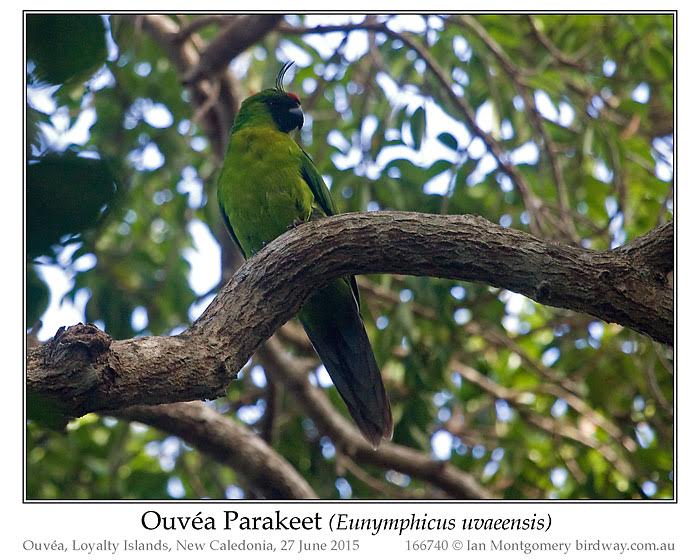
Ouvéa Parakeet (Eunymphicus uvaeensis) by Ian

It was dark by the time we reached Gossanah, so parakeet hunting had to wait until the morning. I was woken up by early-riser Joy with the exciting news that there were parakeets in the grounds of where we were staying. I stumbled out bleary-eyed (remember we had got up at 4:30am the morning before to get our flight to Lihou) camera in hand and sure enough there they were, or there it was, first photo. Later we joined Benoit and he took us around his garden and though an area of adjacent rainforest. There we found some more parakeets, including the one in the second photo.

Ouvéa Parakeet (Eunymphicus uvaeensis) by Ian

They aren’t as brightly coloured as the Horned Parakeet of the main island, Grand Terre, and the crest is different, containing more than two feathers and lacking red tips. The Ouvéa Parakeet used to be treated as a race of the Horned, but has now been given full species status.

Ouvéa Parakeet (Eunymphicus uvaeensis) Nesting Hollow by Ian

Benoit showed us an active nesting hollow, third photo. We saw a parakeet flying into it and waited for it to reappear, but it had either settled down for the morning or had more patience than we had. The parakeets are very partial to the seeds of Papaya. They don’t wait for the fruit to ripen before they chew their way into the centre to get at the seeds.

Papaya

Papaya

The parakeets are protected and the population has increased in recent years. We got the impression that the islanders are rather ambivalent about the birds. They are proud to have such an unusual endemic bird – its iconic status is actively promoted by the authorities – but are concerned about its effect on their largely subsistent way of life.

Ouvéa Parakeet (Eunymphicus uvaeensis) by Ian

Ouvéa Parakeet (Eunymphicus uvaeensis) by Ian

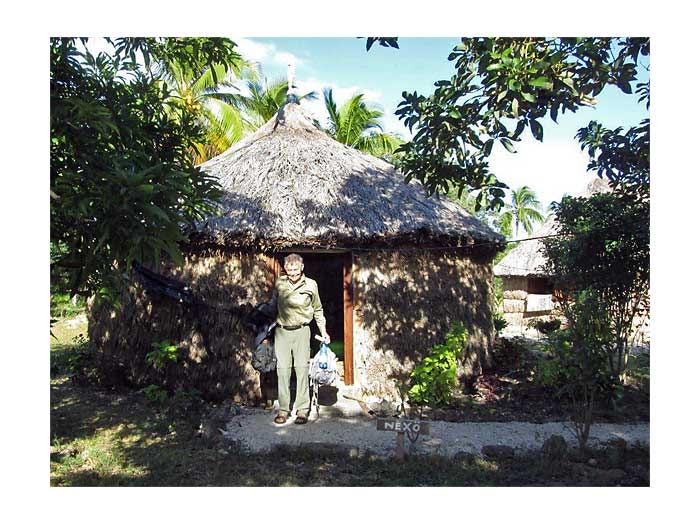
We stayed at a tribal home stay called Beauvoisin – ‘good neighbour’ run by Marc and his wife (see http://www.iles-loyaute.com/en/Prestataire/Fiche/1374/beauvoisin). They provided dinner in the evening, accommodation in a circular hut and breakfast – Joy took the photo above of me emerging from the hut in the morning. We enjoyed it very much and Marc and his family were delightful and looked after us very well. They spoke some English and have a Facebook page. Benoit Tangopi our guide was great too and we saw a variety of other interesting birds on the walk through the rainforest. We contacted him by phone +687 800549, but you might need to brush up your French as he doesn’t speak much English.

Greetings
Ian

**************************************************
Ian Montgomery, Birdway Pty Ltd,
454 Forestry Road, Bluewater, Qld 4818
Tel 0411 602 737 ian@birdway.com.au
Check the latest website updates:
http://www.birdway.com.au/#updates


Lee’s Addition:


If a bird’s nest should chance to be before you in the way, in any tree or on the ground, with young ones or eggs, and the mother bird is sitting on the young or on the eggs, you shall not take the mother bird with the young. You shall surely let the mother bird go, and take only the young, that it may be well with you and that you may prolong your days. (Deuteronomy 22:6-7 AMP)

Thanks, Ian, for taking us along on another birdwatching adventure. I don’t speak French, so we are glad you did the talking and photographing. Another neat creation you have found for us to enjoy.

*

Ian’s Bird of the Week Newsletters

Ian’s Ouvéa Parakeet Photos

Psittaculidae – Old World Parrots

Wordless Birds

*

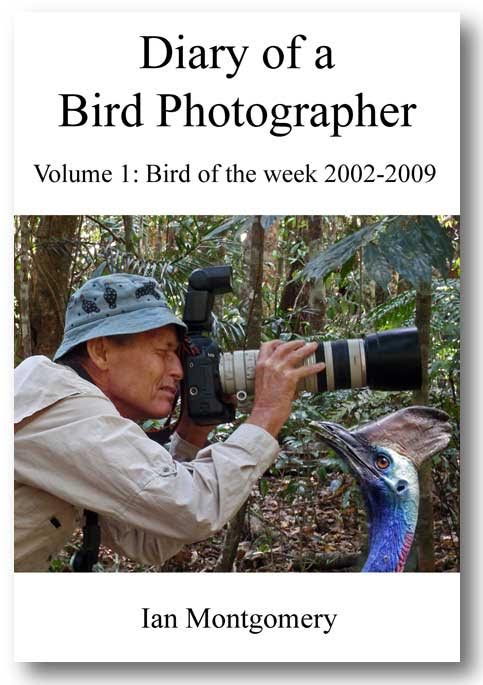
Diary of a Bird Photographer!

y electronic book Diary of a Bird Photographer has been released worldwide today, 31 August, on Apple iTunes BooksGoogle Books and Kobo Books! Find out more about it including availability, pricing, compatible devices and screenshots on the BIrdway website: http://www.birdway.com.au/birdphotographersdiary01.htm.

Ian's Book

Ian’s Book

With the increasing abundance of excellent bird photos on the internet, I am finding it more difficult to sell photos so moving into publishing is important for the future of my Birdway website and the Bird of the Week newsletter. Diary of a Bird Photographer contains the first 341 Bird of the Week postings spanning the period 2002-2009, contains more than 500 photos and 80,000 words – the length of an average novel. Depending on sales, l plan to publish 2010-2014 as another book.

With a recommended retail price of 8.00AUD, 7USD, 6EUR or the equivalent in your local currency it represents great value. By buying it for yourself and/or your friends or family and recommending it to others, you’ll earn my gratitude and show your appreciation for the bird of the week! Maybe you could forward this email to anyone who you think might be interested: that would be wonderful.

Greetings
Ian

PS Next bird of the week, a special parrot and the random bird of the week, should be out later today.

**************************************************
Ian Montgomery, Birdway Pty Ltd,
454 Forestry Road, Bluewater, Qld 4818
Tel 0411 602 737 ian@birdway.com.au
Bird Photos http://www.birdway.com.au/
Recorder Society http://www.nqrs.org.au


Lee’s Addition:

Seem’s as though Ian has written a book. Here is his newsletter telling about his “Diary of a Bird Photographer!”

His regular weekly newsletter – Ian’s Bird of the Week – will be published tomorrow.

Sunday Inspiration – Cupwings, Crombecs and Bush Warblers

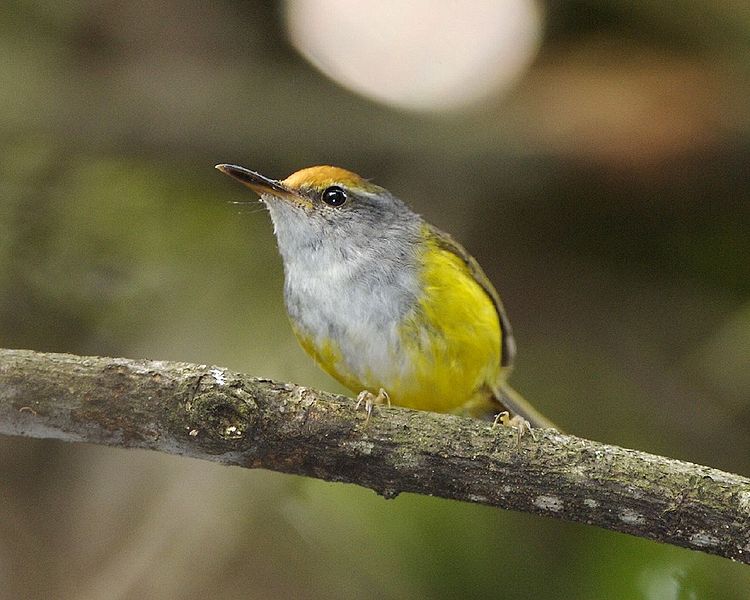
Mountain Tailorbird (Phyllergates cucullatus) by© Wiki

Mountain Tailorbird (Phyllergates cucullatus) by© Wiki

For by Him all things were created that are in heaven and that are on earth, visible and invisible, whether thrones or dominions or principalities or powers. All things were created through Him and for Him. (Colossians 1:16 NKJV)

I trust you are enjoying this Sunday Inspiration series of the Lord’s Creation of the PASSERIFORMES – Passerines (Songbirds) Order. This week’s collection of little Passerines are from three families. Of the 130 families in the Order, we have arrived at numbers 76, 77, and 78. By now, you have see over half the Songbird species in the world. Of the 40 Orders of Birds, the Passerines are the largest.

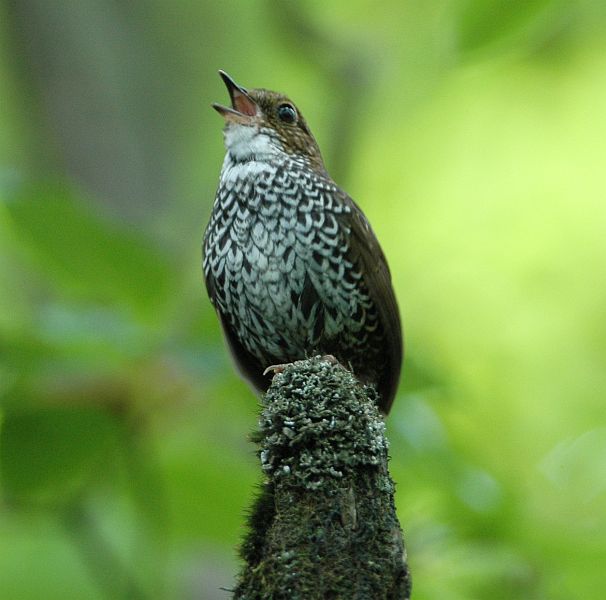
Scaly-breasted Wren-babbler (Pnoepyga albiventer) ©©

Scaly-breasted Cupwing (Pnoepyga albiventer) ©©

Immediately there fell from his eyes something like scales, and he received his sight at once; and he arose and was baptized. (Acts 9:18 NKJV)

Pnoepygidae – Cupwing [8.2 Version just changed these to Cupwings] has only five species and are endemic to southern and south eastern Asia. The genus contains four species. The genus has long been placed in the babbler family Timaliidae. A 2009 study of the DNA of the families Timaliidae and the Old World warblers (Sylviidae) found no support for the placement of the genus in either family, prompting the authors to erect a new monogeneric family, the Pnoepygidae.

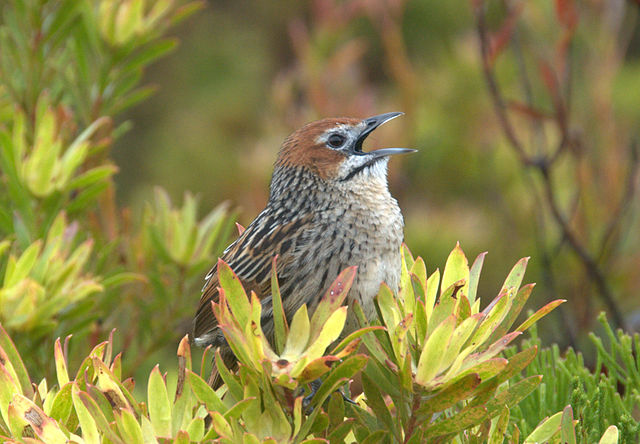
Cape Grassbird (Sphenoeacus afer) ©WikiC

Cape Grassbird (Sphenoeacus afer) ©WikiC

Sing unto him, sing psalms unto him, talk ye of all his wondrous works. (1 Chronicles 16:9 KJV)

Macrosphenidae – Crombecs, African Warblers family has eighteen (18) members in its family. The African warblers are a newly erected family, Macrosphenidae, of songbirds. Most of the species were formerly placed in the Old World warbler family Sylviidae, although one species, the Rockrunner, was placed in the babbler family Timaliidae. A series of molecular studies of the Old World warblers and other bird families in the superfamily Sylvioidea (which includes the larks, swallows and tits) found that the African warblers were not part of the family Sylviidae but were instead an early offshoot (basal) to the entire Sylvioidea clade.

Chestnut-crowned Bush Warbler (Cettia major) ©WikiC

Chestnut-crowned Bush Warbler (Cettia major) ©WikiC

The simple inherit folly: but the prudent are crowned with knowledge. (Proverbs 14:18 KJV)

Cettiidae – Cettia Bush Warblers and Allies total up 32 species.

Cettiidae is a newly validated family of small insectivorous songbirds (“warblers”) It contains the typical bush warblers (Cettia) and their relatives. As common name, cettiid warblers is usually used.

Its members occur mainly in Asia and Africa, ranging into Wallacea and Europe. The monarch warblers (Erythrocercus), Tit Hylia Pholidornis and Green Hylia (Hylia) are exclusively found in the forests of Africa. The pseudo-tailorbirds, tesias and stubtails, as well as Tickellia and Abroscopus warblers are mostly found in the forests of south and southeastern Asia, with one species reaching as far north as Japan and Siberia. The genus Cettia has the widest distribution of the family, reaching from Western Europe across Asia to the Pacific islands of Fiji and Palau. Most of the species in the genus are sedentary, but the Asian Stubtail is wholly migratory and the Japanese Bush Warbler and Cetti’s Warbler are partly migratory over much of their range. A few species, such as the Pale-footed Bush Warbler, are altitudinal migrants.

The species are small, stubby birds. Most have moderately long to long tails, while the stubtails and tesias have tiny tails that do not even emerge past their tail retrices. The group is typically clad in dull plumage, often with a line above the eye. Some, like the monarch-warblers (Erythrocercus), are much different in appearance, having areas of bright yellow plumage. (Wikipedia)

This slideshow requires JavaScript.

Listen as you watch the birds:

“Bow The Knee” ~ Sheila Vegter and Jacob (her son who is playing the piano and singing)

*

Sunday Inspirations

PASSERIFORMES – Passerines (Songbirds)

Pnoepygidae – Cupwings

Macrosphenidae – Crombecs, African Warblers

Cettiidae – Cettia Bush Warblers and Allies

Good News

*

Pileated Woodpeckers With a Chipmunk, One Singing, and One Eating

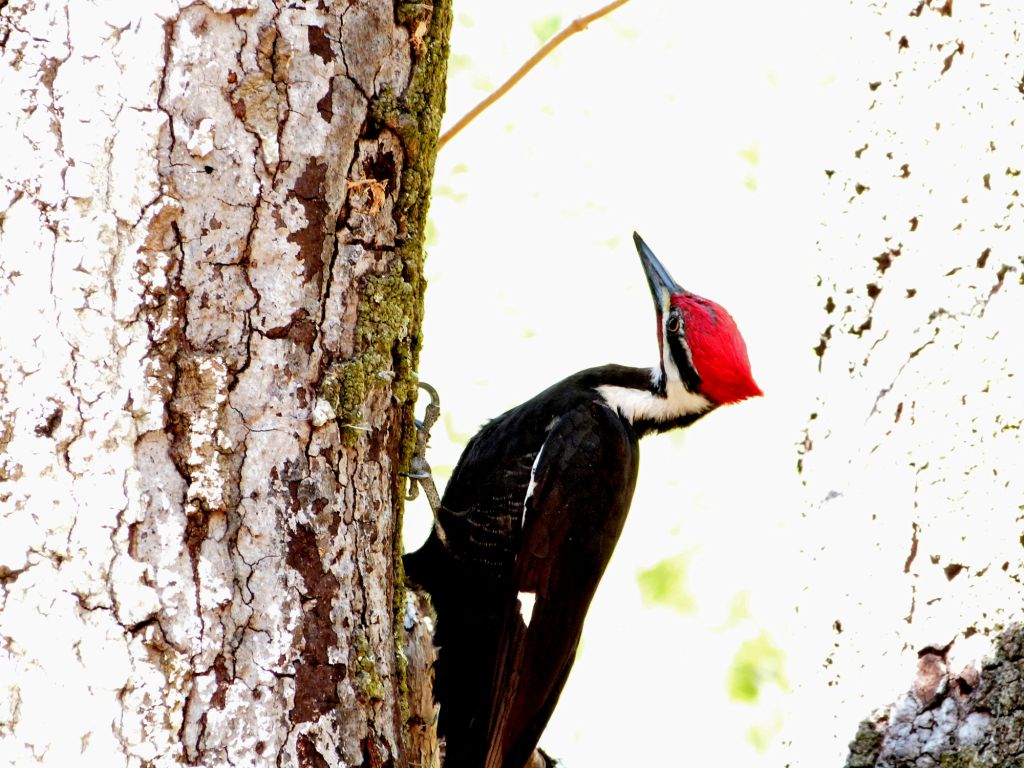
Pileated Woodpecker by Lee

Pileated Woodpecker by Lee

‘Ah, Lord GOD! Behold, You have made the heavens and the earth by Your great power and outstretched arm. There is nothing too hard for You. (Jeremiah 32:17 NKJV)

I always enjoy seeing Pileated Woodpeckers like this one at Circle B Bar Reserve here in the area. This was taken several years ago.

I found these videos on YouTube and they show the Pileated in a different way than we have observed them. Enjoy!

The first one is a YouTube by Dan & Joe. He discovers a chipmunk:

He has made the earth by His power; He has established the world by His wisdom, And stretched out the heaven by His understanding. (Jeremiah 51:15 NKJV)

Here’s another video of a Pileated Woodpecker Singing by Pureimaginationvideo:

This last one has a very good close-up of a Pileated digging for Grubs by Martyn Stewart:

But the LORD is the true God; He is the living God and the everlasting King. At His wrath the earth will tremble, And the nations will not be able to endure His indignation. Thus you shall say to them: “The gods that have not made the heavens and the earth shall perish from the earth and from under these heavens.” He has made the earth by His power, He has established the world by His wisdom, And has stretched out the heavens at His discretion. (Jeremiah 10:10-12 NKJV)

I have been reading through Jeremiah and these verse caught my attention.

*

Birds of the World

Picidae – Woodpeckers Family

Who Paints the Leaves?

*

“Flag That Bird!” (Part 5)

Black Swan ©WikiC
“Flag That Bird!”  (Part 5)

by James J. S. Johnson

Better is the end of a thing than the beginning thereof: and the patient in spirit is better than the proud in spirit.  (Ecclesiastes 7:8)

This is the fifth and last article in this “Flag that bird!” series, on various birds that appear on national flags.  (In other words, this is this mini-series’ “swan song”.)

All of us know enthusiasm-fueled folks who proudly launch into a new project – yet they soon falter, when the initial excitement fizzles, and they somehow fail to employ the prolonged patience to follow a long-term project through to completion.  (But, as we all know, “a job half-done is a job undone”.)  Thankfully, this blogsite mini-series, on “flag birds”, has now reached its proper closure!  Of course, there are other flags (such as state and provincial flags) that depict birds, but this set of articles has predominantly focused on birds portrayed on national flags.  Accordingly, as promised before, this final sequel features two huge birds, a swan and a crane, plus another bird whose identity is less than fully certain.

For a quick review, these vexillology-related birds were previously featured, as follows:

Part 1, posted at Flag That Bird – Part 1  — Belgium’s Wallonian Chicken (Gallus gallus domesticus); Portugal’s Northern Goshawk (Accipiter gentilis); Burma’s Green Peafowl (Pavo muticus); and Dominica’s Sisserou Parrot (Amazona imperialis);

Part 2, posted at Flag That Bird – Part 2  — the British Antarctic Territory’s Emperor Penguin (Aptenodytes forsteri), and the Saint Helena Plover, a/k/a Saint Helena’s skinny-legged “Wirebird” (Charadrius sanctaehelenae);

Part 3, posted at Flag That Bird – Part 3  — Kiribati’s Great Frigatebird Emperor Penguin (Fregata minor); and

Part 4, posted at Flag That Bird – Part 4  — Papua New Guinea’s Raggiana Bird-of-Paradise (Paradisaea raggiana, f/k/a Gerrus paradisaea), and the ubiquitous Dove, best illustrated by the common pigeon, a/k/a Rock Dove (Columbia livia).

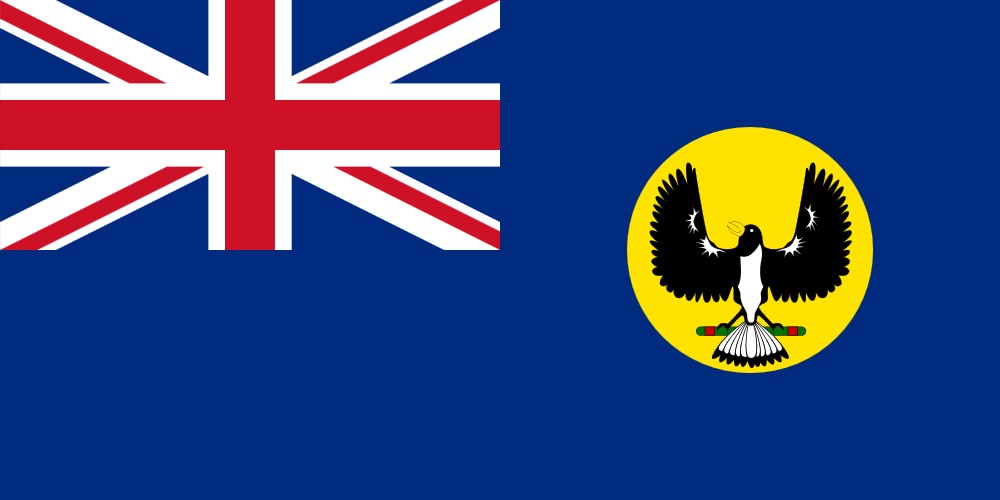
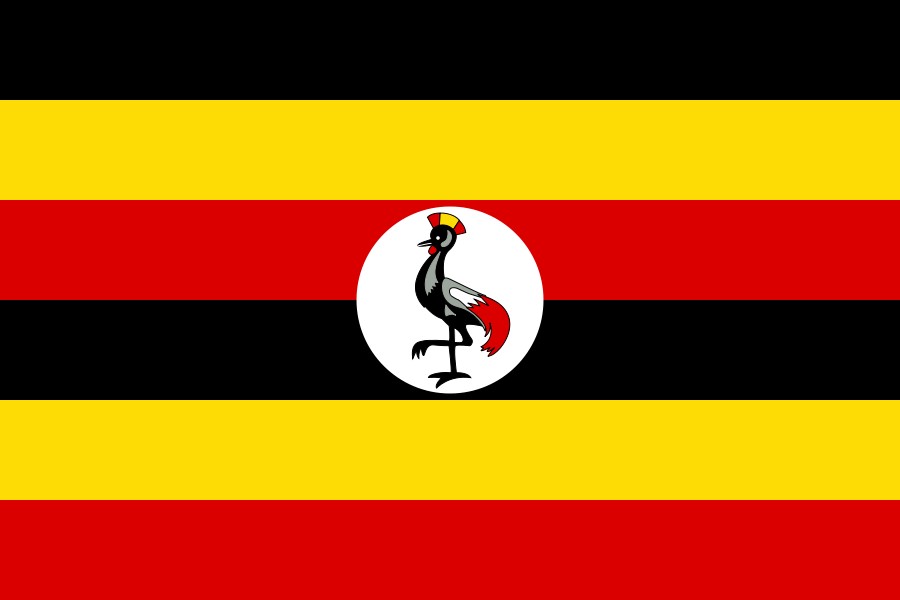
In this article, three remaining birds will be introduced:  (1) the black swan of Western Australia (Cygnus atratus); (2) the black and white “piping shrike” of South Australia, the exact identity of which is questionable, although this article will assume it is the same bird as the Australian magpie, perhaps more particularly the subspecies known as Cracticus tibicen telonocua, f/k/a Gymnorhina tibicen leuconota (e.g., by explorer Charles Sturt); and (3) Uganda’s crested crane (Balearica regulorum gibbericeps).

Black  Swan (Cygnus atratus).
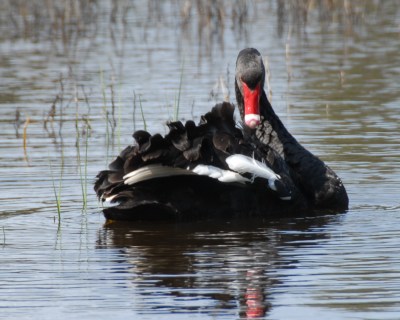
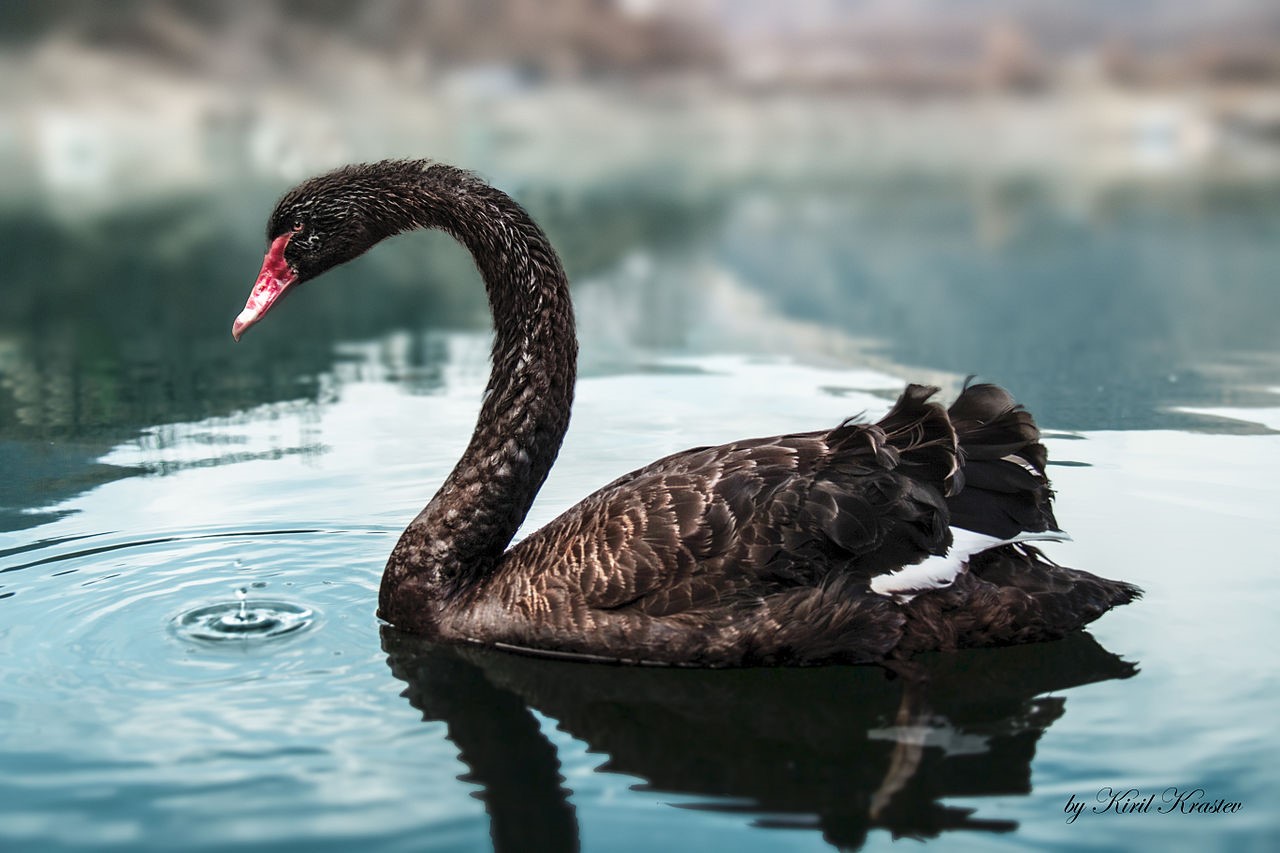
Black Swan (Cygnus atratus) Ruffled ©WikiC

Black Swan (Cygnus atratus) Ruffled ©WikiC

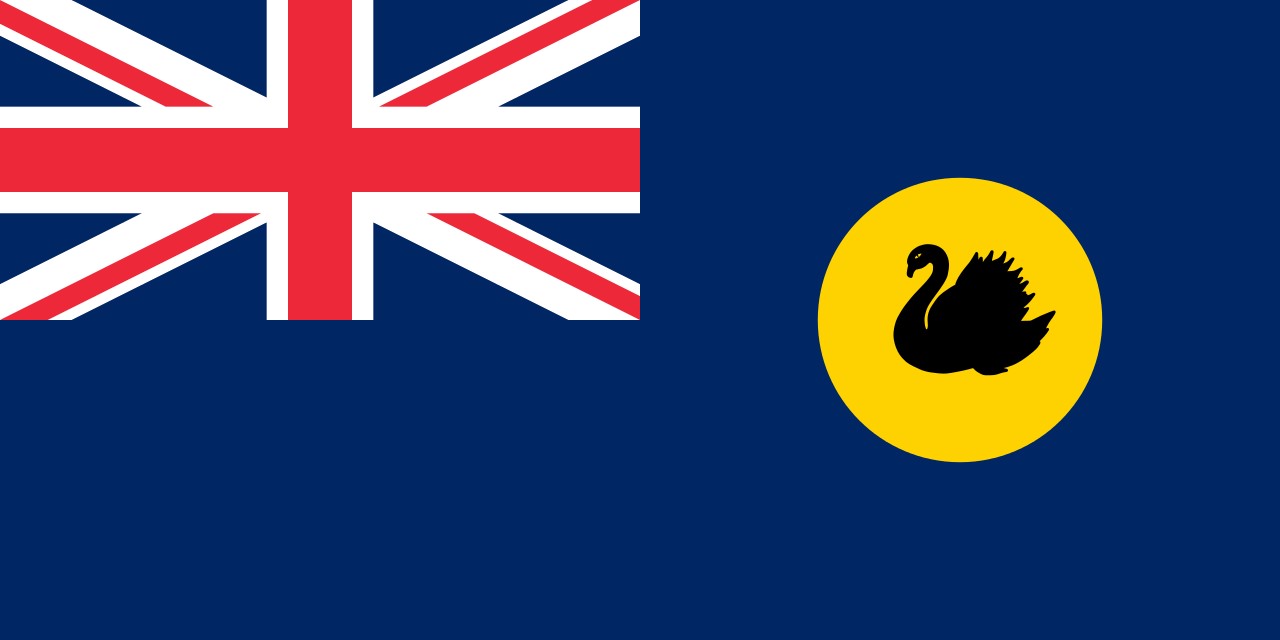
Western Australia’s Black Swan (Cygnus atratus) appears on the official state flag of Western Australia (sometimes contracted as “Westralia”), which occupies the western third (i.e., almost a million square miles) of that island-continent country.  The Black Swan also presents prominently on Western Australia’s official coat-of-arms, flanked by two kangaroos.
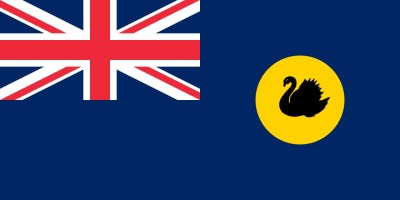
Flag that bird - Flag of Western Australia

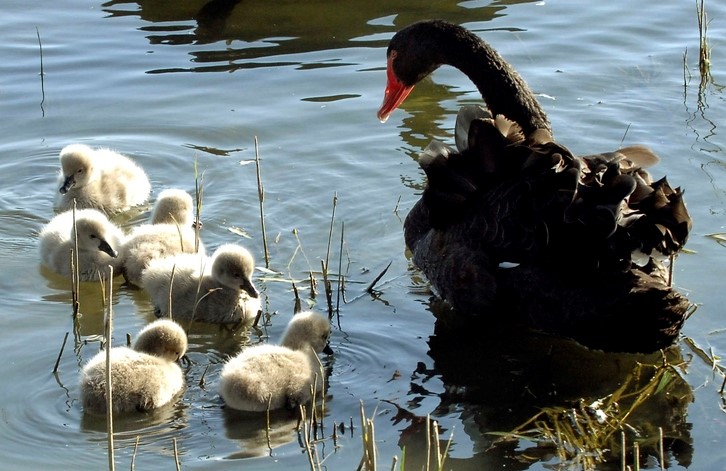
The Black Swan is well-named – their feathers are black (or black-grey, depending on how the sun shines on them), with a few white flight feathers.  Their bills are mostly bright scarlet, with a whitish bar near the tip.  And they are huge birds – adults can weigh between 8 to almost 20 pounds!  The wingspan breadth is between 5 to 6½ feet, like the length of a human lying down!  Their babies (called “cygnets”), however, are fuzzy white chicks, with dark bills, cute as they can be.

Black Swan (Cygnus atratus) with Cygnets ©WashPost

Black Swan (Cygnus atratus) with Cygnets ©WashPost

The first time that I ever saw Black Swans, excluding the confined context of a zoo’s aviary, was at The Broadmoor hotel complex in Colorado (located at the edge of Colorado Springs and Manitou Springs, within view of Pike’s Peak – an area perfect for viewing magpies).  But the Black Swan is not native to North America – it is an Aussie native.

Black Swan (Cygnus atratus) with Cygnets ©Broadmoor

Black Swan (Cygnus atratus) with Cygnets ©Broadmoor

Like other swans (e.g., the Trumpeter Swan, described at Trumpeting A Wildlife Conservation Comeback, its neck is S-curved and very long – in fact, the Black Swan has the longest neck of any swan.

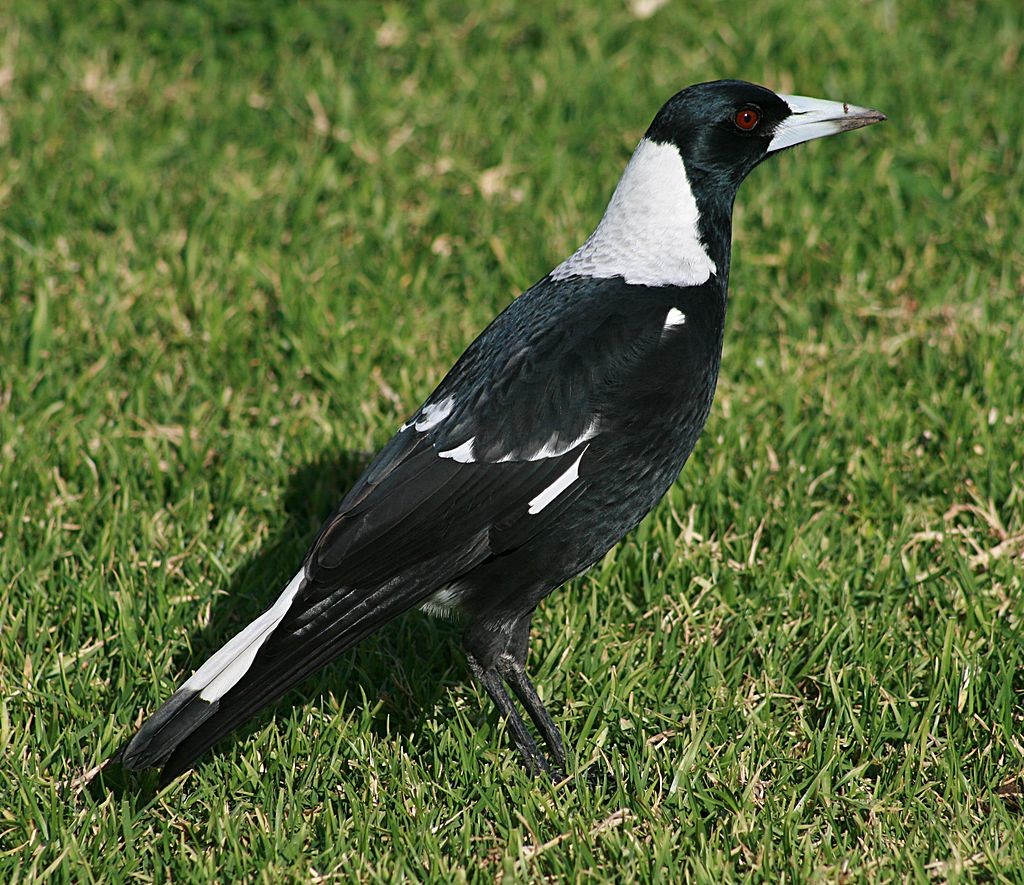
Australian Magpie (Cracticus tibicen, a/k/a Gymnorhina tibicen).

The official state flag of South Australia features a bird called a “piping shrike”, but what bird is that?  Many have analytically identified it as the species now called the Australian Magpie, (Cracticus tibicen), perhaps more particularly the subspecies once called the “White-backed Crow Shrike”, which his now called the white-backed magpie (Cracticus tibicen telonocua, f/k/a Gymnorhina tibicen leuconota).
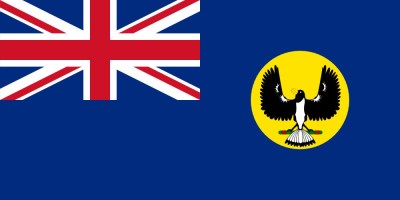
Flag that bird - Flag of Western Australia - Magpie

The Australian Magpie has several subspecies nowadays, nine according to some taxonomists – although ornithologists know that such lump-or-split classifications are vulnerable to slippery subjectivities.  [For an insight into the arbitrary subjectivity of “lumper”-versus-“splitter” taxonomy, see Footnote #2 within http://www.icr.org/article/valuing-gods-variety .]
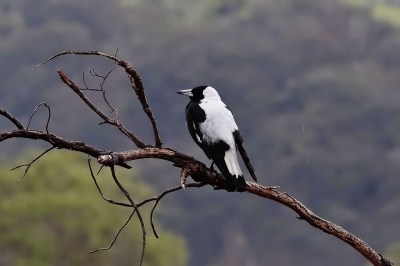
Australia Magpie on Dead Branch ©WikiC

Australia Magpie on Dead Branch ©WikiC

The Australian Magpie is deemed a type of “butcherbird” as opposed to the “corvid” category that includes the “magpies” of Europe and America.  The Australian Magpie is famous for its singing, entertaining (those with ears to hear) with a complex repertoire of vocalizations.  The black-and-white opportunist has habituated to human-dominated habitats, such as the agricultural fields of farms, gardens, and even wooded parklands.

Australia Magpie ©WikiC

Australia Magpie ©WikiC

The Australian Magpie is not a picky eater – its diet includes both plants and animals.  Its preferred diet, however, is dominated by a variety of larval and adult invertebrates, such as insects (like ants, moths, beetles, bees, wasps, cockroaches) and arachnids (like spiders, scorpions), as well as earthworms, millipedes.  The Australian Magpie is also known to eat some small vertebrates, such as rodents (like mice), lizards (like skinks), and/or amphibians (like frogs and toads).

Some compare the problem-solving resourcefulness and the brash cockiness – of this bird – to the national “reputation” displayed by many Aussie ex-patriots.  (Maybe Ken Ham should set the record straight on that topic!)  The Australian Magpie is quite a clever problem-solver  — it has been observed breaking off the stingers of bees and wasps, before swallowing such otherwise-dangerous bugs!  The Australian Magpie is not timid – it will defend its territory against raptors trespassing therein, such as Brown Goshawks.

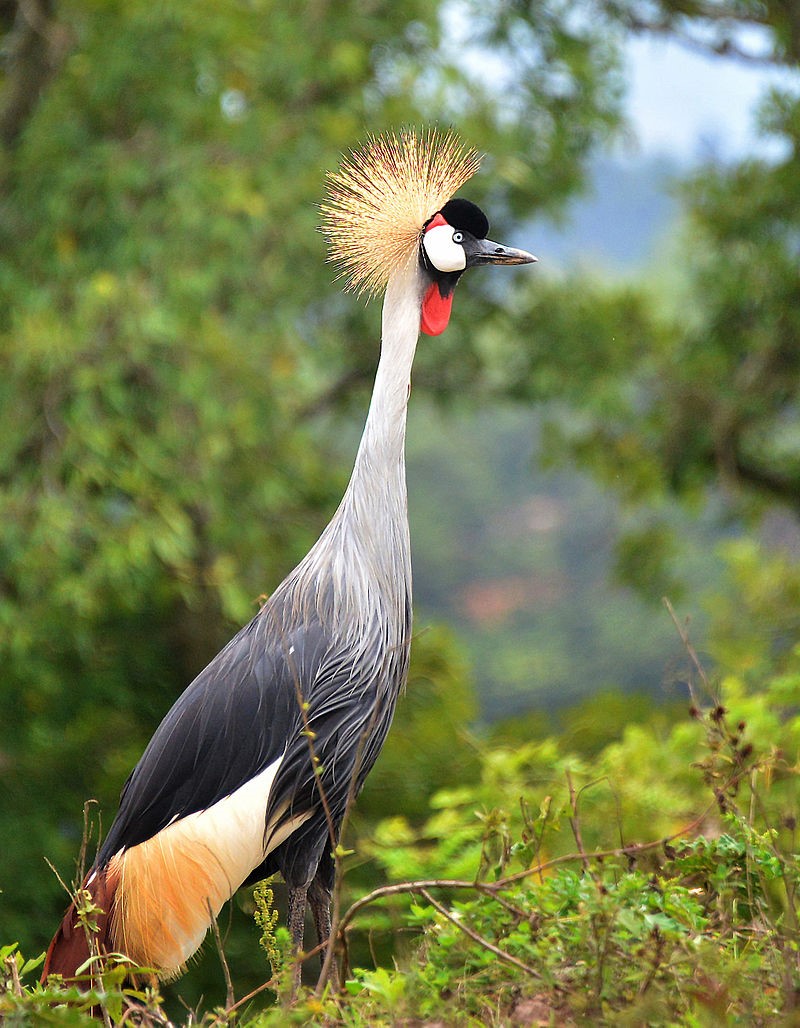
Crested Crane (Balearica regulorum gibbericeps).

The official flag of Uganda sports a stylized depiction of a Crested Crane, a/k/a “East African Crowned Crane” (Balearica regulorum gibbericeps), which is a subspecies of the Grey Crowned Crane (Balearica regulorum).  The same crane appears on the Ugandan coat-of-arms.

The Ugandan coat-of-arms provides a more realistic picture of a Crested Crane.

Ugandan coat-of-arms Crested Crane

The East African Crowned Crane (a/k/a Crested Crane) is a tall bird, standing up to 4 feet tall!  It can weigh 6 to 8 pounds, while sporting a wingspan breadth of 6½ feet.  The plumage is dominated by slate-grey feathers, with wing feathers of white and chestnut orange.  The Crested Crane’s black head is adorned by white cheeks (accented with red) and a showy 3D “fan” crest, of golden top feathers, somewhat resembling fireworks.
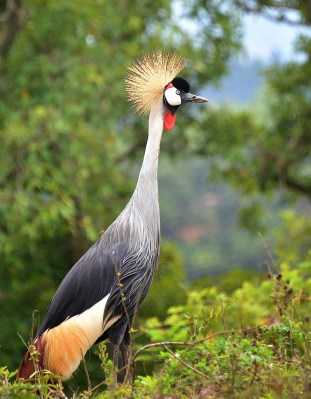
Grey Crowned Crane ©WikiC

Grey Crowned Crane ©WikiC

Cranes – of various species – are famous for their long necks and long thin legs. Unlike herons (which fly with their necks “pulled back”), the Crested Crane (like other cranes) flies with its neck straightened and outstretched.  Like other cranes, the Crested Crane is gregarious – their aggregate nesting territories may host a flock of up to 200 residents.  These cranes are typically monogamous and territorial.  These socially stable birds are known to live as long as 20 to even 40 years of age.

In the wild, the Created Crane eats a mix of seeds (such as grains), other plant materials, insects, and worms.  Other foods eaten include eggs and fish, and even small lizards and frogs.  This diet is similar to the diet of other cranes (e.g., Sandhill Crane, Whooping Crane, Common Crane, etc.) around the world.  Cranes routinely eat whatever is available and convenient, so cranes are classified as “opportunist” feeders – consuming small mammals (like rodents), fish, snails, amphibians (like frogs), worms, insects, seeds (like grains, nuts, acorns), berries, root vegetables, and other plant materials (such as leaves.  As a matter of biome ecology, most cranes prefer wetlands, such as mudflats and other shorelands, or in wide open fields, such as prairies.
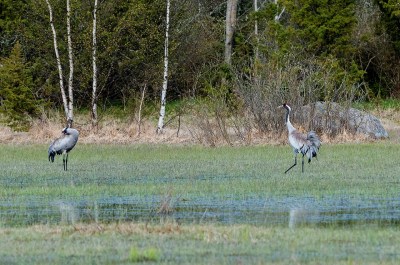
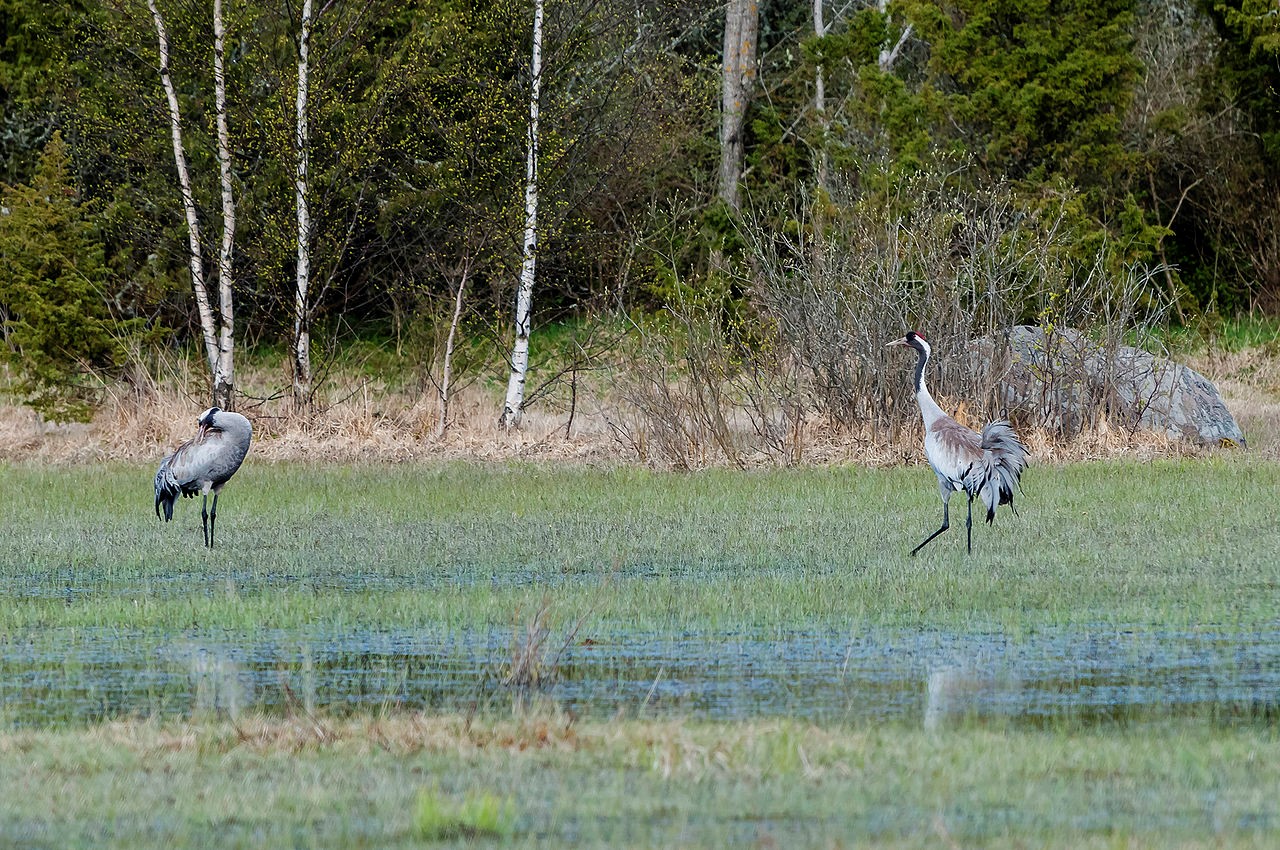
Common Crane in Estonia ©WikiC

Common Crane in Estonia Wetland ©WikiC

The “Common Crane” (Grus grus) is a cousin the these African cranes.  The Common Crane has a summer range, typically boreal forests (called taiga in Russia) that covered most of the top half of Eurasia, with blotches of winter ranges in Europe (Spain), Asia (e.g., China), and parts of Africa.

The zoologist George Cansdale [see his ALL THE ANIMALS OF THE BIBLE LANDS, pages 158-159] – after analyzing the mix of Biblical, ornithological, and biogeographical evidence – concludes that the Hebrew noun ‘agûr (e.g., in Jeremiah 8:7 & Isaiah 38:14) refers to the noisy Common Crane (Grus grus), an identification that the learned Hebrew scholar John Joseph Owens concurs with [see his ANALYTICAL KEY TO THE OLD TESTAMENT, volume 4, pages 116 & 242].  Matching the ‘agûr of Isaiah 38:14, the Common Crane is clamorously noisy, especially when agitated.  Cranes are also phenological migrants, a trait that accords with Jeremiah 8:7.

A review of our introductory verse provides another insight, the contrast between patience and pride:

Better is the end of a thing than the beginning thereof: and the patient in spirit is better than the proud in spirit.  (Ecclesiastes 7:8)

In Ecclesiastes 7:8 the Hebrew adjective translated “patient” is ’erek – it denotes someone or something that is prolonged, drawn out, slow, longsuffering.  Accordingly, to be “patient in spirit” is to be willing to wait one’s turn, according to God’s providential line-up (and timing).  A humble person doesn’t butt in line; he or she patiently waits in the queue, for his or her turn.

In Ecclesiastes 7:8 the Hebrew adjective translated “proud” is gabah  — it denotes someone or something that is high, haughty, or high-minded, in some contexts what we sometimes call “uppity”.  Accordingly, to be “proud in spirit” is to regard one’s self as higher that one should, which is the opposite of what God (through Paul) commands us to be:

Let nothing be done through strife or vainglory; but in lowliness of mind let each [i.e., all of us] esteem others better than themselves.  Look not every man on his own things, but every man also on the things of others.  (Philippians 2:3-4)

Interestingly, humility and patience go well together, because accomplishing a long-term project often requires interacting successfully with other people, and getting other people to coöperate with you (so that your goals can be furthered) routinely requires you to serve their needs and goals.  This is called mutual symbiosis when we see it in birds; we call it “win-win” coöperation when humans do it.  In win-win situations the coöperating parties both further their respective goals, so their interactive relationship is not one-sided. (Contrast this with “parasite”-like people, who habitually take, but won’t give).

Unsurprisingly those who are haughty-minded, being selfish, are slow to appreciate this life principle, because “uppity” people cannot understand or accept the law of Acts 20:35, that “it is more blessed to give than to receive” (quoting the Lord Jesus Christ Himself).  Consequently, many who could help them, with their project checklists, may shy away  –  why host a parasite?   And so it is that many who are haughty are proud to assertively start – yet don’t finish – complex projects that require prolonged patience.   Why?  Part of the cost of succeeding was the cost of benefiting others who contribute to the project.  The end is predictable:  failure and shame.

For which of you, intending to build a tower, sitteth not down first, and counteth the cost, whether he have sufficient to finish it?  (Luke 14:28)

A sober lesson for long-term projects (including long-term relationships)!  Yet, this is a lesson much needed in America, nowadays, where impatient and high-minded “get-rich-quick” tactics all-too-often end in disappointment and discord.  (This author has seen many illustrations of this in business bankruptcy cases and in employment law contexts.)

In sum, thankfully, this “flags” the end of this mini-series on national vexillology-related birds.

*

“Flag That Bird!”(Part 1)(Part 2)(Part 3)(Part 4) 

Orni-Theology

James J. S. Johnson’s Articles

*

Sunday Inspiration – Swallows and Martins

Barn Swallow (Hirundo rustica) baby by Neal Addy Gallery

Barn Swallow (Hirundo rustica) baby by Neal Addy Gallery

Even the sparrow has found a home, And the swallow a nest for herself, Where she may lay her young— Even Your altars, O LORD of hosts, My King and my God. (Psalms 84:3 NKJV)

This week’s 88 avian flyers are from the Hirundinidae Family of Swallows and Martins. The species in this group are River Martins, Saw-wings, Swallows, and Martins of various genus, Many here in America are familiar with the Barn Swallow.
Also, the Swallows are Birds of the Bible, being mentioned in at least four verses; Psalms 84:3, Proverbs 26:2, Isaiah 38:14, and Jeremiah 8:7,

Swallows are in the Hirundinidae – Swallows Family which includes Martins. “Within the Hirundiniae, the name ‘martin’ tends to be used for the squarer-tailed species, and the name “swallow” for the more fork-tailed species; however, there is no scientific distinction between these two groups. The family contains around 88 species in 19 genera.” The subfamilies are: Saw-wings (including Square-tailed, Mountain, White-headed, Black and Fanti), Swallows (many including Barn, Bank, Cave Mangrove, Golden, etc), Martins (Purple, Cuban, Sinaloa, Brown-chested, etc.), Sand Martins (including Brown-throated, Congo, Pale, Banded).

The swallows are found on all continents except Antarctica, with the largest diversity of species in Africa. They are found on many islands, as there are quite a few that migrate long distances. God has designed them with short bills, but with a wide mouth that has a strong jaw. This is useful in their hunt for insects which they catch on the wing. With their streamlined body and wings that are pointed, they are very maneuverable at great speeds. Their forked long tail, that has 12 feathers, helps them steer. They can range from 3.9-9.4 inches and weight between 0.4-2.1 ounces.

This family of birds, to me, are one of the hardest to photograph. They zip about often, but land very seldom to catch their picture. Thankfully the Lord gave these birds a tastebud for insects that have a tastebud for us.

This slideshow requires JavaScript.

Like a flitting sparrow, like a flying swallow, So a curse without cause shall not alight. (Proverbs 26:2 NKJV)

“If I Don’t Have Love” ~ by Jessie Padgett – Special at Faith Baptist

*

More Sunday Inspirations

Birds of the Bible – Swallows

Hirundinidae Family of Swallows and Martins

Swallow – (Wikipedia)

Sharing The Gospel

*