Bufflehead Ducks’ Dependable Migration Timing

BUFFLEHEAD DUCKS’ DEPENDABLE MIGRATION TIMING

Dr. James J. S. Johnson

Seest thou a man diligent in his business? he shall stand before kings; he shall not stand before mean men.  (Proverbs 22:29)
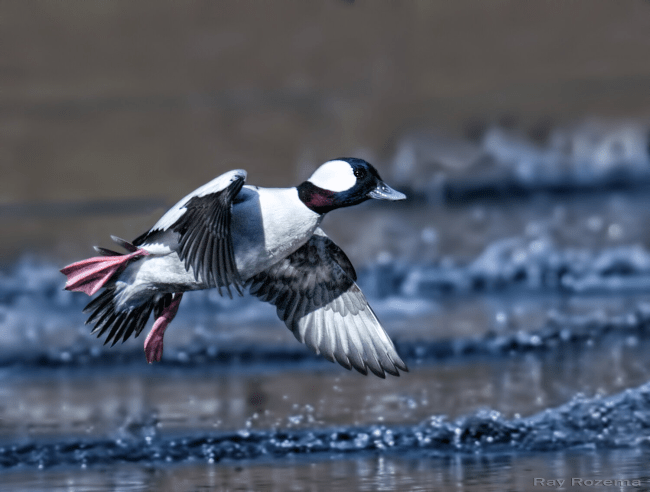
BUFFLEHEAD IN FLIGHT
Sacramento Audubon Society / Ray Rozema photo credit

When I think of Bufflehead ducks (Bucephala albeola), I am reminded of the authoritative advice (“words of the wise”) of Proverbs 22:29, regarding reputations for dependable “diligence”.  Why?
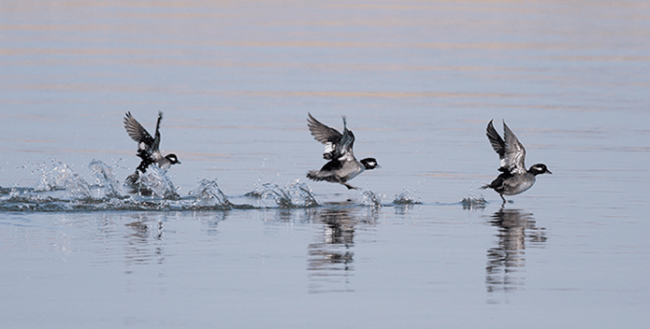
BUFFLEHEADS in migration
Jonathan Maher Kresge / Chesapeake bay Foundation photo credit

The first time that this author observed a Bufflehead, in the wild, was on March 11th of A.D.1996, while visiting the Texas Gulf Coast’s Aransas Bay (which is protected as Aransas Bay National Wildlife Refuge), as part of ornithological research (eventually) leading to a doctoral degree in creation science (applied to wildlife ecology). [See “Bufflehead Duck, One of Diverse Divers at Aransas Bay” (posted at https://leesbird.com/2018/01/26/bufflehead-duck-one-of-diverse-divers-at-aransas-bay/ .]
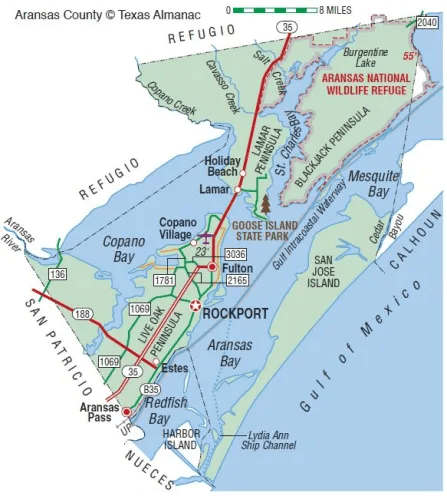
ARANSAS BAY MAP
Aransas County in TEXAS ALMANAC image credit

What conspicuously beautiful ducks those Buffleheads were (and are)!
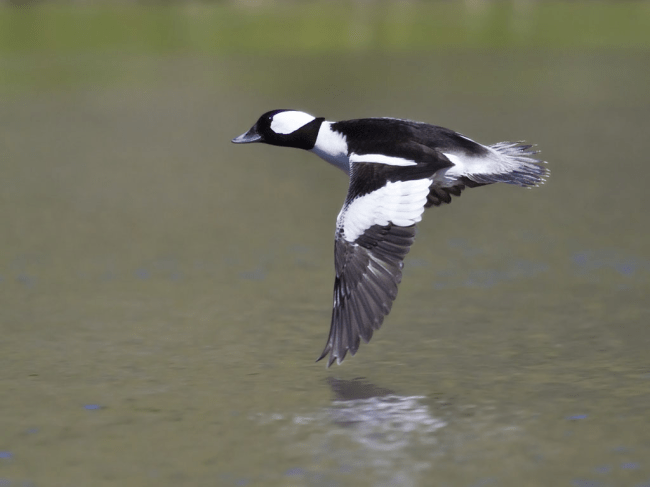
BUFFLEHEAD DUCK in flight
Bill Bouton photo credit

Consider the reputation that the Bufflehead duck has, for dependability punctuality, as was recently observed by Alonso Abugattas, the Chesapeake Bay area’s “Capital Naturalist”:

The bufflehead is nothing if not punctual.  Few other ducks are known to arrive in our neighborhood every winter within a few delays of the date they arrived the previous year.  The smallest of North America’s diving ducks, the bufflehead … [can] nest in the tree cavities of woodpeckers, most commonly northern flickers, according to Canadian zoologist Gilles Gauthier. . . . .

After forming their pair bonds over the winter, the birds head back to their breeding grounds in early April and early May, migrating at night. They’re among the last ducks to leave their winter territory.  The greatest concentration of breeding grounds, according to abundance maps maintained by the Cornell Lab of Ornithology, are in northwestern Canada, in a wide swath crossing through Saskatchewan, Alberta and Northwest Territory… petering out in Alaska. . . .

Buffleheads start leaving [their breeding grounds] for the wintering grounds in October, settling mostly across [the U.S.A.’s Lower 48] but sometimes going as far [south] as Central America.

[Quoting CHESAPEAKE BAY JOURNAL, 34(8): 39 (November 2024).]
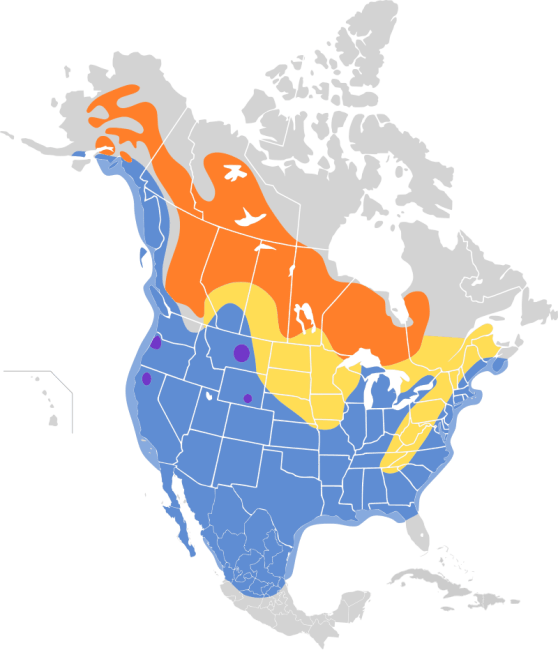
BUFFLEHEAD RANGE MAP
(Cephas / BirdLife Internat’l / Wikipedia image credit)

So much for the Bufflehead’s predictable-because-dependable migration movements. 

Yet is there a lesson for us humans, as we consider the Bufflehead’s phenological reliability?  Yes, there is – especially if we look at the details of Proverbs 22:29.
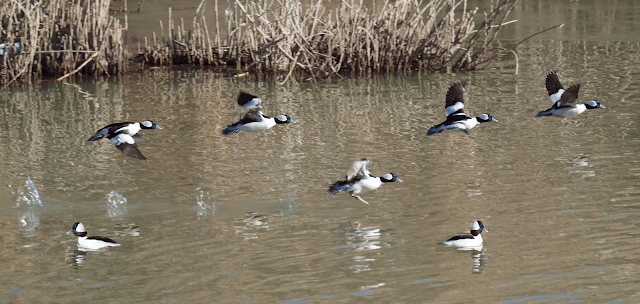
BUFFLEHEADS in wetland habitat
Robert Mortensen / BirdingIsFun.com composite photo credit

Of course, it is good to earn a reputation for dependable punctuality. In fact, that is similar to having a reputation for quickly fulfilling one’s responsibility — as opposed to having a reputation for dilatory procrastination.  Some folks can be expected to do sloppy work – who needs that kind of “help”?

Yet other folks are famous for delivering extremely careful (almost perfectionist) work, but only in an all-too-often impractically slow response time, so slow that the perfectionist work is of diminished practical value (because the need for timely results was compromised and disappointed).

How is all that relevant to understanding Proverbs 22:29?  That proverb is translated into English as follows:

Seest thou a man diligent in his business? he shall stand before kings; he shall not stand before mean men.  (Proverbs 22:29)

In that sentence the phrase “man diligent” is a translation of ’îš mâhîr, with ’îš being a generic word for “man”—but what does the Hebrew word mâhîr (translated as “diligent” in the KJV) mean?

Consider that the masculine singular adjective mâhîr is translated by several English words in our English Bible.  For example, mâhîr is translated “ready” in Ezra 7:6 and also in Psalm 45:1 (which is Psalm 45:2 in Hebrew verse numbering]). Also, mâhîr is translated “hasting” in Isaiah 16:5.  But there is more to consider, because Hebrew adjectives are routinely related in meaning to similarly spelled nouns, verbs, and/or adverbs. 

Therefore, to better understand what the Hebrew adjective mâhîr means, in Proverbs 22:29, consider also the following (non-exhaustive) listing of illustrative (etymologically related) verbs and adverbs:

ROOT VERB mâhar

“hasten”, “haste”, “make haste”, etc. (Genesis 18:6-7 & 19:22 & 24:18,20,46 & 41:32 & 43:30 & 45:9,13; Exodus 34:8; Joshua 4:10 & 8:14,19; Judges 9:48 & 13:10; 1st Samuel 9:12 & 17:48 & 23:27 & 25:18,23,34,42 & 28:24; 1st Kings 20:41 & 22:9;  2nd Kings 9:13; 2nd Chronicles 24:5; Esther 5:5 & 6:10; Psalm 16:4; Proverbs 1:16 & 7:23; Isaiah 49:17 & 51:14 & 59:7)

“make ready quickly” (Genesis 18:6)

“make speed” (2nd Samuel 15:14)

“fetch quickly” (2nd Chronicles 18:8)

RELATED MASCULINE ADVERB mahêr

“quickly” (Exodus 32:8; Deuteronomy 9:3,12[twice],16 & 26:20; Joshua 2:5; Judges 2:17,23)

“speedily” (Psalm 69:17 [69:81 in Hebrew verse numbering] & 79:8 & 102:2 [102:3 in Hebrew verse numbering]; 143:7)

“hastily” (Judges 2:23; Proverbs 25:8)

“suddenly” (Deuteronomy 7:4)

RELATED FEMININE ADVERB mehêrâh

“quickly” (Numbers 16:46 [17:11 in Hebrew verse numbering]; Deuteronomy 11:17; Joshua 8:19 & 10:6 & 23:16; 2nd Samuel 17:16,18,21; 2nd Kings 1:11; Ecclesiastes 4:12)

“hastily” (Judges 9:54)

“speedily” (Psalm 31:2 [31:3 in Hebrew verse numbering]; Ecclesiastes 8:11; Isaiah 58:8)

“swiftly” (Psalm 147:15)

[See generally George V. Wigram’s ENGLISHMAN’S HEBREW CONCORDANCE OF THE OLD TESTAMENT (Hendrickson’s 2001 reprint of the 1874 London-published 3rd edition), page 669.]

The listing above is incomplete—but the pattern is already clear—the adjective mâhîr denotes the trait of being speedy, swift, quick!  

RAPIDLY RUNNING A RACE!
Scottish Gov’t / Parent Club photo credit

In other words, a person who consistently and dependably does his or her work fastly is appreciated—and (eventually) will “stand before kings” (i.e., not be limited to serving before low-ranking individuals).

So, just as the phenological punctuality of the returning-from-winter Bufflehead duck is dependably predictable (as is also the migratory return of Israel’s faithful stork—see www.icr.org/article/lesson-from-stork — which is noted in Jeremiah 8:7), a truly diligent human will be prompt (i.e., give quick turnaround) in his or her work responsibilities. 

Careful work is appreciated, yes, but only if it is contextually timely. Promptness is really appreciated! 

><> JJSJ  profjjsj@aol.com  😊
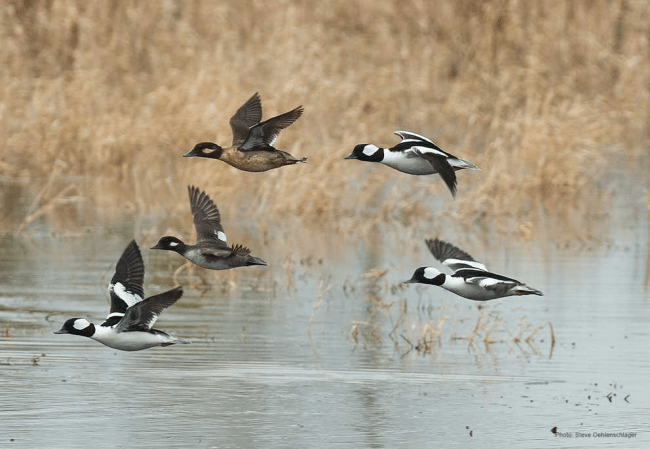
BUFFLEHEADS in flight
Ducks Unlimited photo credit

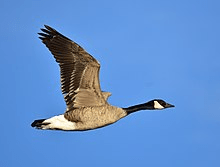
MIGRATORY STOPOVER FOR CANADA GEESE

Dr. James J. S. Johnson

Yea, the stork in the heaven knows her appointed times; and the turtledove and the crane and the swallow observe the time of their return; but My people know not the judgment of the LORD. (Jeremiah 8:7)

The Bible mentions migratory birds – for examples, storks, turtledoves, cranes, and swallows are mentioned as faithfully migratory birds in Jeremiah 8:7.  (See JJSJ’s “A Lesson from the Stork”, at http://www.icr.org/article/lesson-from-stork .)

CANADA GOOSE in flight (Wikipedia photo credit)

Avian migrations are truly a wonderful recurrence in God’s phenological providences. 

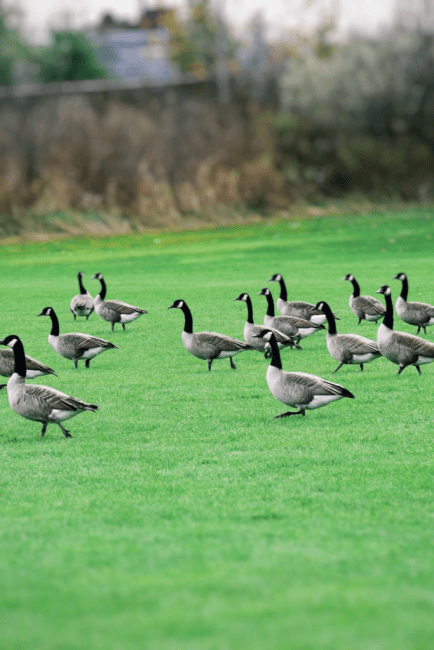
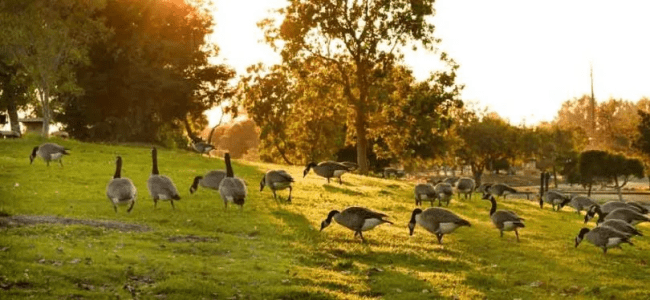
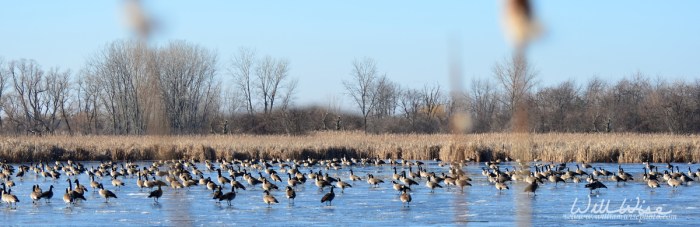
With that in mind, I observed a flock of Canada geese (Branta canadensis) in my neighborhood, not far from my mailbox—they were grazing among the grasses by my rain-runoff drainage ditch. 

CANADA GEESE IN GRASS
(HumaneActionPittsburgh.org photo credit)

But not long afterwards they were off again, in the air, southbound, toward wherever they go for winter.  Today’s limerick follows.

OBSERVING 18 CANADA GEESE: MIGRATORY STOPOVER VISITORS

A migrant flock came by today

The flock intact, none gone astray;

Slowly grazing geese,

Dawdling and obese;

Then they returned to their flyway.

(JJSJ, November 4th A.D.2024, near Flower Mound, Texas.)

CANADA GEESE IN YARD
(TriangleGardener.com photo credit)

BOBOLINKS: GRAIN-LOVING GRASSLANDERS

SEED-LOVING BOBOLINKS, GROUND-NESTING IN GRASSLANDS

Dr. James J. S. Johnson

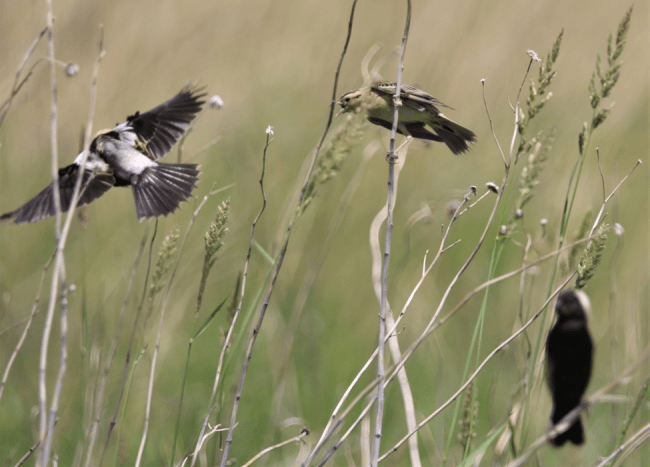
BOBOLINKS in grassland habitat, Minnesota 
(photo credit: Bryce Gaudian)

If a bird’s nest chance to be before thee in the way in any tree, or on the ground, whether they be young ones, or eggs, and the mother sitting upon the young, or upon the eggs, thou shalt not take the mother with the young. 

(Deuteronomy 22:6)

Moses noted that some wild birds build their nests upon the ground; Bobolinks do just that.

Years ago, I reported on the Black-capped Chickadee, noting that I first saw one at Gilsland Farm Sanctuary, while attending a wetland ecologists’ meeting: “Decades ago, I saw Black-capped Chickadees, for the first time, in Falmouth (near Portland), Maine – at the Gilsland Farm Sanctuary (now called “Gilsland Farm Audubon Center”), on May 31st of AD1995, while attending the annual national meeting of the Society of Wetlands Scientists.” [Quoting from “Tiny Yet Tough: Chickadees Hunker Down for Winter”, posted at https://leesbird.com/2016/11/18/tiny-yet-tough-chickadees-hunker-down-for-winter/ .]

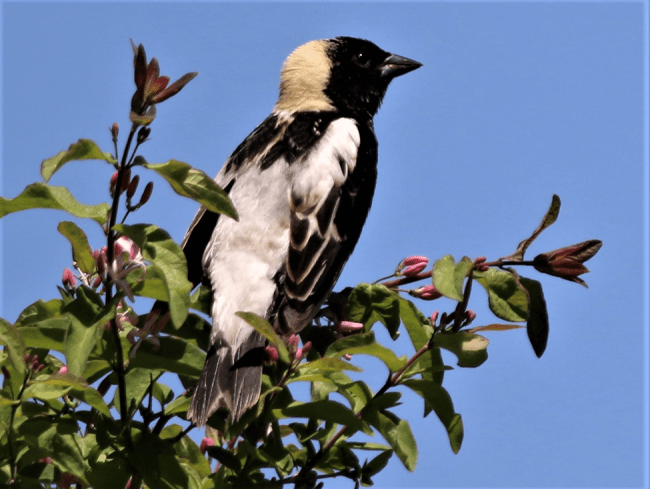
Another “lifer” that I then observed that day, at Gilsland Farm Sanctuary, was the BOBOLINK.  And what a striking plumage the male Bobolink has, during breeding season! 

BOBOLINK MALE in breeding plumage, Minnesota 
(photo credit: Bryce Gaudian)

Bobolinks (Dolichonyx oryzivorus) are icterids (blackbirds of the Western Hemisphere), dwelling in America’s prairie and pasture grasslands and marshy wetlands during the warm months of the year.  Bobolinks were nicknamed “rice birds” (which matches their species name, oryzivorus, meaning “rice-eating”), due to their dining habits, especially during autumn migrations.  

The Bobolink genus name, Dolichonyx, means “long claw”, matching its prehensile perching “fingers”.

BOBOLINK MALE, perching with “long claws”, Minnesota 
(photo credit: Bryce Gaudian)

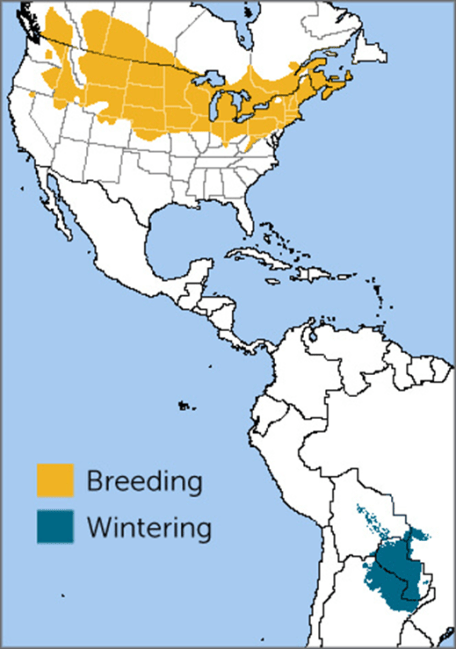
During such migrations Bobolinks frequently feed in farmed fields of rice and other grains (such as oats, sorghum, maize corn, and hayseed), at energy-packing refueling stopovers (e.g., in South Carolina and the Gulf states), on their aerial journeys southward, via Caribbean islands, en route to South American over-wintering range destinations.

Bobolinks feed on (or near) the ground, eating various seeds, insects, spiders, and even snails—especially during breeding seasons.  Both larvae and adults of insects (especially armyworm moths) are protein-rich, much needed for growing Bobolink juveniles.

Also, during breeding seasons, Bobolinks depend upon available hay for nest-building, on the ground, in vegetated areas. 

Bobolinks are quite specific in their breeding habitat needs.  Open hay fields are a must, and so as farming is some regions of the country diminishes, so do populations of bobolinks.  Where colonies of bobolinks have traditionally bred, it is important to preserve their habitat with regular mowing practices.  Unfortunately, the right time to mow a field for hay is often just when the young are fledging[!].  Careful observation of the behavior of a [bobolink] colony and delaying of mowing until one or two weeks after fledging, a time when the young can fly fairly well, will keep a colony producing and ensure its [multi-generational] survival. 

[Quoting Donald W. Stokes & Lillian Q. Stokes, A GUIDE TO BIRD BEHAVIOR, Volume III (Boston: Little, Brown & Company/Stokes Nature Guides, 1989), pages 351-352.]
BOBOLINK MALE in grassland habitat, Minnesota 
(photo credit: Bryce Gaudian)

Consequently, Bobolinks are easier to find in habitats where their needs for food and nesting are plentiful.

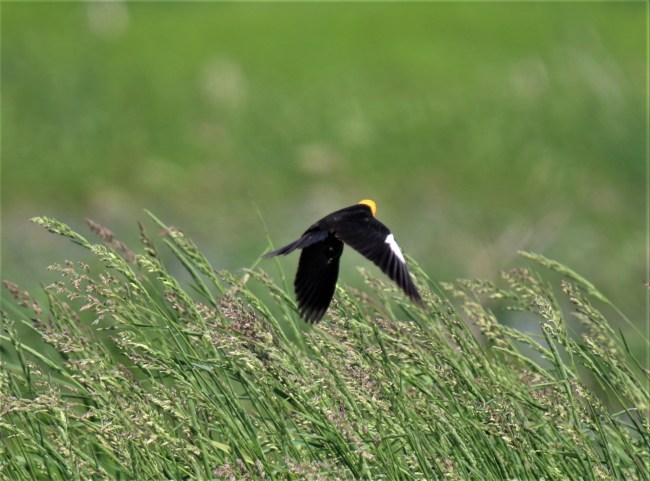
BOBOLINK male in flight, prairie habitat, Minnesota
(photo credit: Bryce Gaudian)

The males have easily seen plumages—like reverse tuxedos (white upon black) in spring and summer, during breeding months.

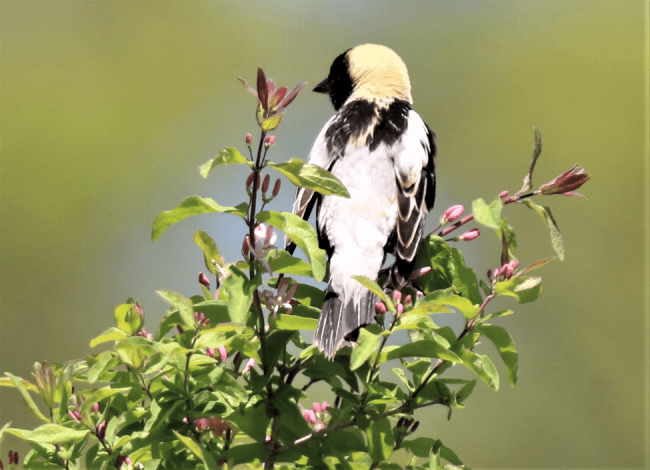
BOBOLINK male, displaying yellow nape-hood, Minnesota
(photo credit: Bryce Gaudian)

Male and female bobolinks are easily distinguished during the breeding season.  Males have a black head, belly, and wings, with a buff-gold nape and white patches on the back.  The female is buff [and brown] colored all over with dark streaks on her back, wings, and sides.

[Quoting Donald W. Stokes & Lillian Q. Stokes, A GUIDE TO BIRD BEHAVIOR, Volume III (Boston: Little, Brown & Company/Stokes Nature Guides, 1989), pages 364.]

During non-breeding months, however, Bobolink males shift to duller hues of dark and light browns, similar to the year-round plumage of Bobolink females and juveniles.

BOBOLINK female perching near prairie flower
(Mircea Costina / Shutterstock / ABCbirds.org photo credit)

Of course, these tweety-chirpy icterids breed elsewhere in spring – in most of the upper half of America’s Lower 48, from the Northeast’s coastlines almost as far wet as the coasts of Washington and Oregon. Accordingly, the Bobolink migrates about 6,000 miles southward or northward, so it accrues about 12,000 miles per year, in air miles.

American Bird Conservancy range map

It was a privilege to see Bobolinks, back in AD1995, at the Gilsland Farm Sanctuary, as part of my time attending the Society of Wetlands Scientists’ meeting.

Likewise, it’s a privilege, now, to be permitted to share some of the wonderful Bobolink photographs taken in Minnesota, by Christian/creationist photographer BRYCE GAUDIAN — thanks, Bryce!

And now, it’s time for a limerick, about Bobolinks.

In Appreciation of the Bobolink, a/k/a Rice Bird

There’s an icterid feathered quite nice,

Whose fast-food oft includes rice;

It makes a chirp-sound,

As it nests on the ground,

And it’s photo’d quite well, by Bryce!


Fly-thru “Althing” of Migratory Cedar Waxwings

Dr. James J. S. Johnson

“Praise the LORD from the earth … fruitful trees and all cedars … and flying fowl.” (from Psalm 148:7-10)

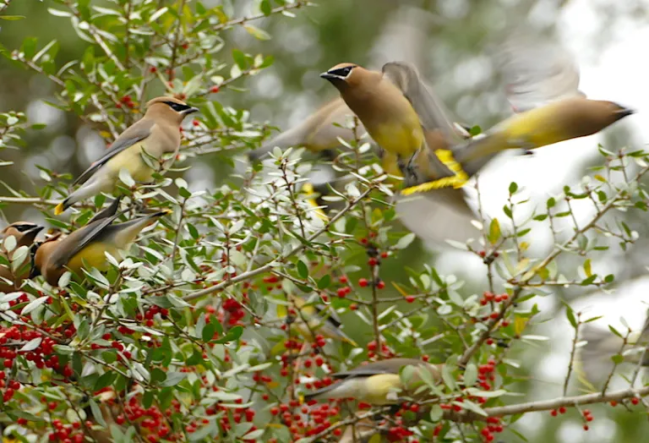
CEDAR WAXWINGS EATING BERRIES [photo credit: Wild Birds Unlimited]

Each spring gregarious flocks of Cedar Waxwings pass through my part of Texas, as they migrate northward toward their breeding grounds. No “lone rangers” here! Cedar Waxwings travel in flocks of many dozens–sometimes even hundreds–synchronizing their fast-food stopovers along the way, to refuel for the next aerial leg of their migratory trek. And trees or bushes with red berries are a particular favorite of Cedar Waxwings. Although the nutritional details are a bit technical — as noted below* — waxwings need to balance their sour berry intake with protein-rich pollen, both of which are available during mid-April in my part of Texas, as the flocks of Cedar Waxwings pass through in their flights northward.

So, when these large flocks of colorful waxwings make a “pit stop” for fast-food they often fill the branches of trees as they hastily consume red berries (and other edible nutrients), just before resuming their northbound flights to their spring-through-summer breeding ranges.

On April 7th A.D.2023, a Friday morning, as I observed this hastily convened arboreal assembly of avian migrants, I thought of the traditional assemblies (“things”) of the Vikings — such as those Nordic congregants convened annually in Iceland (Thingvellir’s “Althing”) and on the Isle of Man (at the Manx “Tynwald”), to conduct the serious business of life. Could it be that these Cedar Waxwings were having their own version of an Althing assembly, as they refueled (and rested briefly) during their stopover in the branches of my trees and bushes? Since I cannot understand the language of Cedar Waxwings I cannot know what they conversed about — but I knew that they would vacate northward soon enough, so I would not see them again until the next seasonal migratory pass-through, as they live out the providential phenology of their migratory lifestyle.

What a privilege it was to see God’s Cedar Waxwings–scores of them (perhaps more than a hundred!) as a flock in transit–quickly visiting the trees and bushes on the south side of my home. Surely God’s birds will remind us of His care for us, if we take the time to think about it–and have eyes to see (Matthew 6:26; Luke 12:24).

In fact, that faith lesson (which is was taught, in ancient times, to the patriarch Job, by God Himself (in Job 38:41), as is noted in the first of the 3 apologetics lectures (shown below) that I gave recently, to a Swedish theology school (Skandinavisk Teologisk Högskola):

God’s Creation Sermon in Job 39: Learning from God’s Animals: https://youtu.be/_ydP8vCTBAY

Viking Skeletons Embarrass Carbon 14 Radiometric Dating: https://youtu.be/Bx40cjdodRM

Why Study Grass and Flowers? Learning from God’s Plants: https://youtu.be/-4SMgqq2waU

CEDAR WAXWINGS [photo credit: Museum of Life & Science, Durham, N.C.]

So, now for a limerick, that memorializes my observations of the flock of Cedar Waxwings that briefly visited my frontyard earlier this month:

FAST-FOOD/FLY-THRU ALTHING OF MIGRATORY CEDAR WAXWINGS

A flock-full of birds, in my trees,

Gulped down every berry they’d seize;

This arboreal Althing

of the Cedar Waxwing

Soon adjourned—dispersed with the breeze!

CEDAR WAXWINGS photo credit: Mary Anne Borge / The Natural Web

[*For technical information, befitting Cornell University, about the diet of Cedar Waxwings, see Mark C. Witmer’s “Nutritional Interactions and Fruit Removal: Cedar Waxwing Consumption of Viburnum opulus Fruits in Spring”, ECOLOGY, 82(11):3120-3130 (November 2001).]

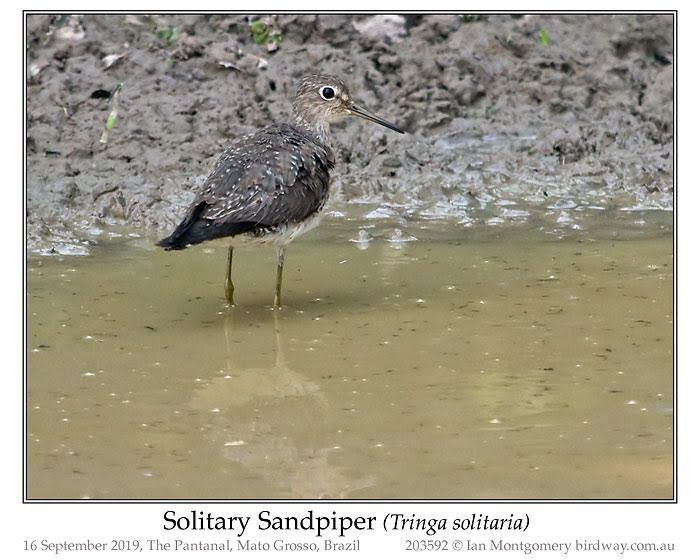
Ian’s Irregular Bird – Solitary Sandpiper

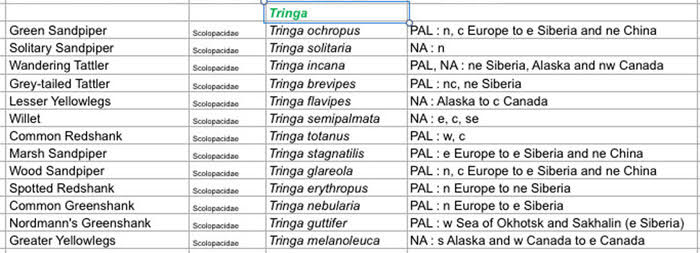
You may remember from the last Irregular Bird (Green Sandpiper) that the plan is to work through all the waders in the genus Tringa, the Shanks and relatives, in the order used by the IOC, below.  This is the next one the Solitary Sandpiper.

It’s fairly similar to the Green Sandpiper and they were originally treated as a single species. In fact, they are easy to distinguish in flight as the Green Sandpiper has a white rump and a tail with side to side barring, while the central feathers of the rump and tail of the Solitary Sandpiper are brown creating a longitudinal stripe. These features are visible under the flight feathers in the first photo and shown in a drawing later.
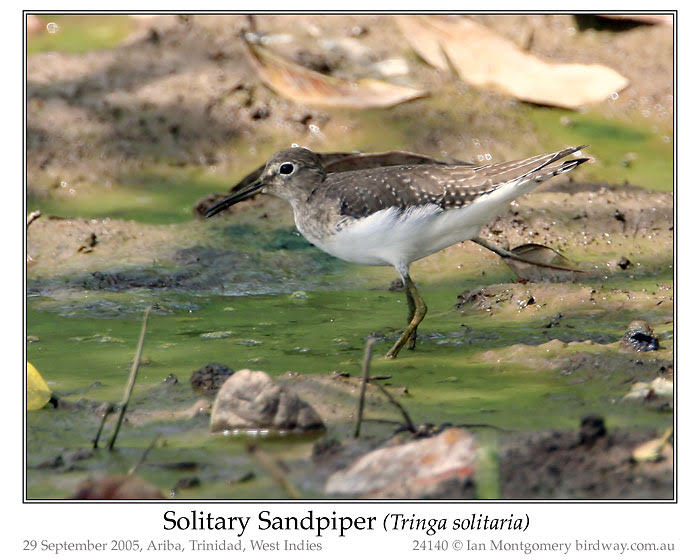
Solitary Sandpiper by Ian
In practice you can also use their ranges as the Green Sandpiper occurs in Eurasia and Africa, while the Solitary Sandpiper is an American species. It nesting range is almost entirely in Canada and Alaska.  It migrates through the United States and winters in Mexico, Central America, and in northern, central and eastern South America as far south as Peru in the west and northern Argentina in the east.
I haven’t got photos of either species in flight so here is a crude drawing to illustrate the difference in flight pattern. Don’t take too much notice of anything except the different rumps, tail and length of the legs. The latter are longer and protrude farther beyond the tail in the Solitary Sandpiper. So, if you’re a dedicated twitcher, as I am now, keep a beady eye out for something special if you are in a place where either or both of these birds don’t usually occur. There are a few records of Green Sandpipers in northern Australia and a few records of Solitary Sandpiper in Siberia and Western Europe.
Solitary Sandpiper by Ian
There isn’t much difference among the plumages of breeding adults, non-breeding adults, and juveniles though there is less streaking in juveniles and the spots on breeding adults are whiter, rather than buff and more conspicuous. I think the bird in the second photo in Trinidad is a juvenile, the one in the third photo in Brazil is an adult but I don’t know about the one in the first photo. If you’re an expert on the plumages of Solitary Sandpipers, I’d be happy to get your opinion: ianbirdway@gmail.com.
Solitary Sandpiper by Ian
Actually, I misidentified the two in Trinidad as Spotted Sandpipers in non-breeding plumage but maybe I had Spotted Sandpiper on the brain as I’d seen the one in the third photo in Tobago eleven days earlier. Non-breeding Spotted Sandpipers don’t have spots (go figure, as they say), just a little barring on the wings but they have conspicuous long white eyebrow stripes and shorter, much yellower legs, so I lack a reasonable excuse for the confusion.
Spotted Sandpiper by Ian
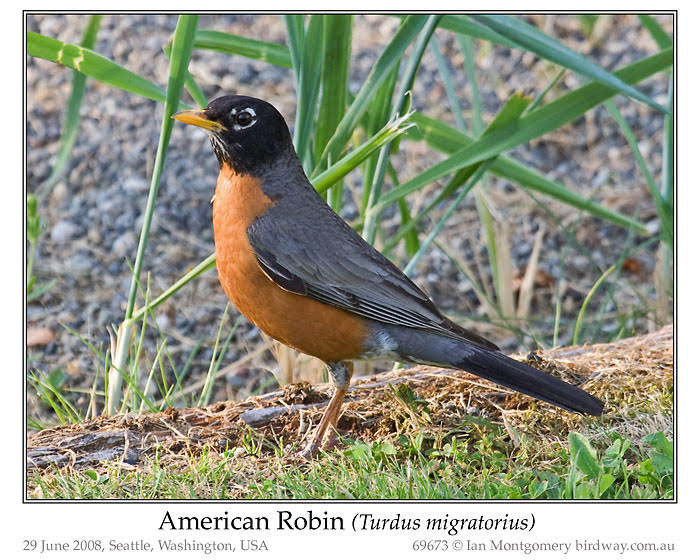
Like their Eurasian cousins, Solitary Sandpipers breed in trees and shrubs using the old nests of thrushes. It so happens that the range of perhaps the commonest thrush in North America, the American Robin, overlaps the range of the Solitary Sandpiper in Canada and Alaska. The Robin, despite its name which is based on colour not taxonomy, is a Thrush and a close relative of the Eurasian Blackbird and is the most likely candidate as a provider of nests, though not much is known about the breeding behaviour of the Sandpiper.
American Robin by Ian
So how does the Solitary Sandpiper get its name? Amazingly, unlike most waders which believe in safety in numbers, it migrates either alone or in small groups and often appear at stopovers or at the destination in ones or twos. It migrates mostly at night. I don’t know whether juvenile birds instinctively know where to go or whether the adults teach them. The mind boggles at what we don’t know about bird migration.
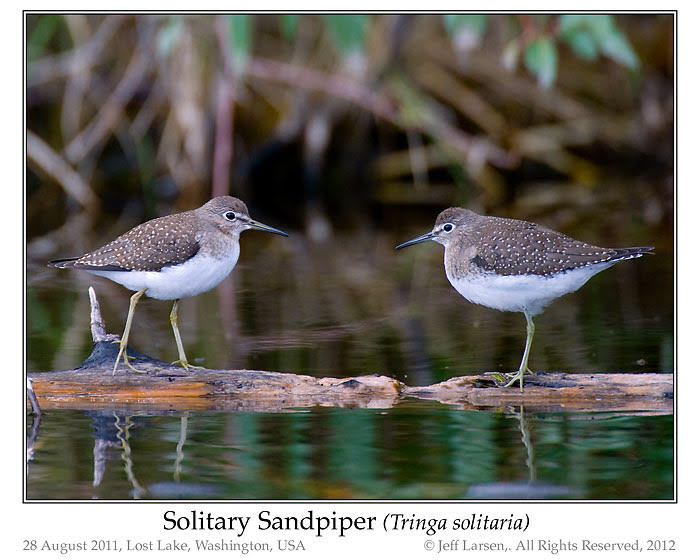
Jeff Larsen sent me this lovely photo of two birds together in Washington state, so they’re clearly not completely antisocial. He calls them Solitary Chickens, which appeals to me and he gave me permission to share this photo with you.
Solitary Sandpiper by Ian
Solitary Sandpipers are birds of freshwater and are usually found on small ponds or in marshy areas, even in winter. We spotted the one in Brazil in a roadside pond in the Pantanal.
Next time we’ll talk about the Tattlers, two rather similar species that are next on the IOC list.
Greetings
Ian


Google Groups “Birdway” group.
Write to him at ian@birdway.com.au, or visit this group at http://groups.google.com/group/Birdway


Lee’s Addition:

Here is the next Sandpiper in Ian’s “Tringa” series. He has promised more. Stay tuned.
He mentions the sameness of these birds:
“But thou art the same, and thy years shall have no end.” (Psalms 102:27 KJV)
See:

Ian’s Bird of the Week

Good News

Christ’s Providence Is Clearly Seen in Bird Migrations

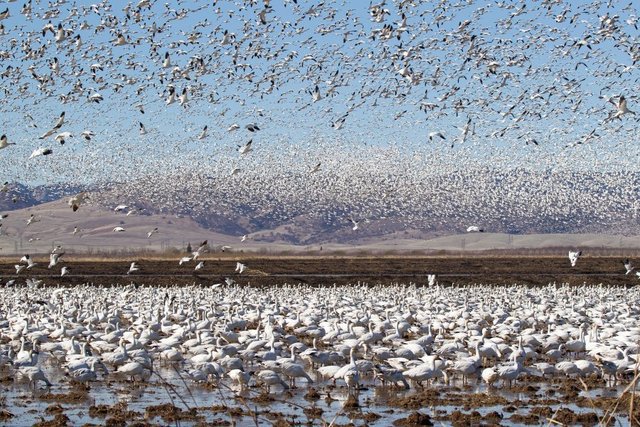
Snow Geese Migrating

Click to watch – Intro Video

Christ’s Providence Is Clearly Seen in Bird Migrations

Just as monkeys can’t accidently type Shakespeare texts, birds can’t migrate by evolutionary luck, despite imagined eons of time for “lucky” accidents.1 Why? Because the challenging mix of birds’ metabolic needs for long-distance travel, synchronized to seasonal and diurnal weather conditions, are exacerbated by unyielding entropy. This all-or-nothing complexity prohibits “lucky” bird migrations. In short, to seasonally migrate, birds need the Lord Jesus Christ’s providential bioengineering care.2,3

Flight failures are tragic when malfunctioning airplanes or spacecraft fall out of the sky.3 Likewise, if bird traits malfunctioned while trying to evolve migratory flight features, there would be no second chances.1 So, either birds are aptly fitted by their Creator with migration traits or they can’t migrate.4,5

Consider the air speeds that birds need to maintain over long distances before their flying fuel (i.e., metabolic assets dedicated to long-distance flight needs) is depleted.

The birds’ flight speed in relation to the air varies in general between approximately 30 km per hour, for the smallest birds, and 80 km per hour, for larger birds.…When the bird’s mass increases 100 times, then 200 times as much flight power is required.4

Yet, powering heavier-than-air flight requires adequate bird muscle strength and endurance.

The muscle power cannot, however, increase much more than the weight. Provided that the proportions are the same, the wing area is only 20 times as great in a bird that weighs 100 times more than another. The limited muscle power and wing area of heavy birds, in combination with the very high flight power that is required [for long-distance migrations], sets a size limit above which flying is no longer possible. This limit is estimated to be around 15 kg. This corresponds well with the weight of the largest animals in the world that can actively fly—swans, bustards, albatrosses and condors.4

Thus, interplay between flight speed and muscle power balances the complicated physics required for non-fixed-wing flying against long-distance migration.2-5

Moreover, the unforgiving biochemistry and physiology of each migratory bird’s metabolism (food acquisition, fuel utilization, respiration, etc.) must aptly fit the ongoing needs of seasonal migrations or else avian biochemical logistics fail.4,5 Thankfully, for all migratory birds—and all birdwatchers—the phenological phenomena of bird migrations is not dependent upon “luck,” as imagined by evolutionists.3,5 Rather, none less than the Lord Jesus Christ deserves all credit and acclaim for these winged wonders of biogeographic beauty.
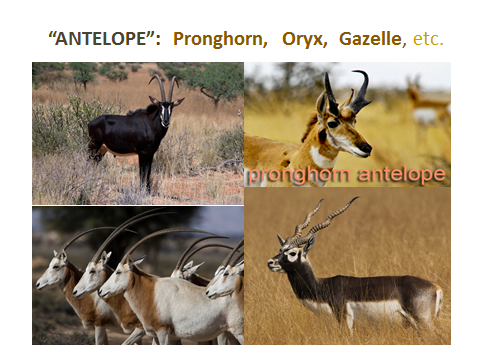
“But now ask…the birds of the air, and they will tell [literally “explain to,” or “clarify to”] you…that the hand of the LORD has done this, in Whose hand is the life of every living thing.” (Job 12:7-10)

References

  1. “Thus, eons of time guarantee that the simian keypunchers can never type out Hamlet—the imagined luck is ‘not to be.’ Time plus entropy prevents the spontaneous generation of life and any hope of evolution.” Johnson, J. J. S. 2018. Infinite Time Won’t Rescue EvolutionActs & Facts. 47 (6): 21. Complex bird anatomies cannot spontaneously self-assemble, apart from Christ’s bioengineering providence, because ubiquitous entropy (i.e., the 2nd Law of Thermodynamics) absolutely prevents any mix of biochemicals from magically combining into purpose-working “all-or-nothing-unity” systems, regardless of how much time is allowed, because infinite time guarantees that (our fallen universe’s) entropy bars any such luck.
  2. Egevang, C. et al. 2010. Tracking of Arctic terns Sterna paradisaea reveals longest animal migrationProceedings of the National Academy of Sciences. 107 (5): 2078-2081, quoted in Johnson, J. J. S. 2010. Survival of the Fittest: God’s Providential ProgrammingActs & Facts. 39 (10): 17-18. See also, regarding phenological migrations, Johnson, J. J. S. 2013. God Fitted Habitats for BiodiversityActs & Facts. 42 (3): 10-12.
  3. Guliuzza, R. J. 2011. Darwin’s Sacred Imposter: The Illusion That Natural Selection Operates on OrganismsActs & Facts. 40 (9): 12-15; Guliuzza, R. J. 2017. Engineered Adaptability: Engineering Causality Studies Unmask Evolutionary ExternalismActs & Facts. 46 (11): 17-19. See also Sherwin, F. A ‘One-Hundred-Million-Year-Old Bird’ Is Still a BirdCreation Science Update. Posted on ICR.org June 20, 2006, accessed October 1, 2021.
  4. “The rule of thumb is that the speed roughly doubles when the mass of the bird increases 100 times. If a 10-g Willow Warbler flies at 30 km per hour, then a Raven of 1 kg [1,000 grams] flies, in round figures, at 60 km per hour. …The capacity of the flight muscles sets a ‘ceiling’ to how much flight power a bird can cope with—a lower ceiling for continuous power outtake and a somewhat higher ceiling for temporary all-out bursts. After this sort of brief ‘muscle spurt’ the muscles have to wind down while the lactic acid which is formed in the muscle tissue when energy is produced without sufficient oxygen supply is carried away.” Alerstam, T. 1993. Bird Migration. New York: Cambridge University Press, 252.
  5. Johnson, J. J. S. 2016. High-Altitude Flying Is for the BirdsActs & Facts. 45 (3): 20-21.

* Dr. Johnson is Associate Professor of Apologetics and Chief Academic Officer at the Institute for Creation Research.

Cite this article: James J. S. Johnson, J.D., Th.D. 2021. Christ’s Providence Is Clearly Seen in Bird MigrationsActs & Facts. 50 (12).

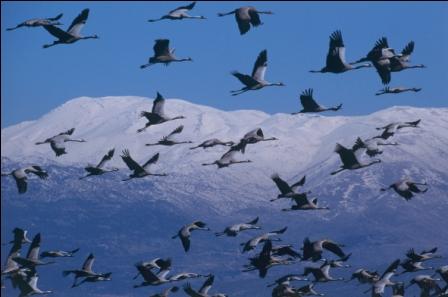
Crane Migration over Israel

Crane Migration over Israel

(Dr. Jim asked me to post this for him. Trust you will enjoy this. Copied directly from the website with his permission.)

Just Passing Through

“We are here for only a moment, visitors and strangers in the land as our ancestors were before us. Our days on earth are like a passing shadow, gone so soon without a trace.” 1 Chronicles 29:15

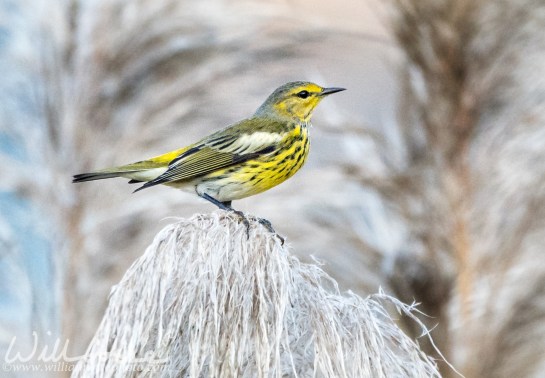
Migrating Cape May Warbler photographed October 12, 2020 in Clarke County, Georgia. ©www.williamwisephoto.com

Like a golden beam of sunshine that briefly pierces an autumn cloud cover, a Cape May Warbler made a brief but dazzling appearance in my backyard this month. Just as quickly as I was able to fire off three shots, she was off, not to be seen again. She didn’t stop to feed. She didn’t gather any nesting material. She didn’t have a bath or a drink. She was just passing through.

Just as these migrating birds only briefly stop during their long travels to and from their breeding grounds, I am reminded of the Christian’s journey here in this world. Although we may be busy putting down roots and making ourselves comfortable, the Bible describes the Christian as a pilgrim, as a sojourner just passing through. We are not permanent residents of this world, but headed for another.

Our destination is not a seasonal wintering ground in South America, but a permanent, eternal home in heaven. Like the warblers that quickly pass through our yards each spring and fall, the Christian is to have a mind of temporary residency as we pass through this life oriented towards eternity. Let us enjoy the wonders of this world, but also keep a mind on eternity!

Colossians 3:1-3  “If ye then be risen with Christ, seek those things which are above, where Christ sitteth on the right hand of God. Set your affection on things above, not on things on the earth.”


Hi, I’m wildlife photographer and nature writer William Wise. I was saved under a campus ministry while studying wildlife biology at the University of Georgia. My love of the outdoors quickly turned into a love for the Creator and His works. I’m currently an animal shelter director and live in Athens, Georgia with my wife and two teenage daughters, who are all also actively involved in ministry. Creation Speaks is my teaching ministry that glorifies our Creator and teaches the truth of creation.  — “What a wildly wonderful world, God! You made it all, with Wisdom at Your side, made earth overflow with your wonderful creations.” Psalms 104, The Message.
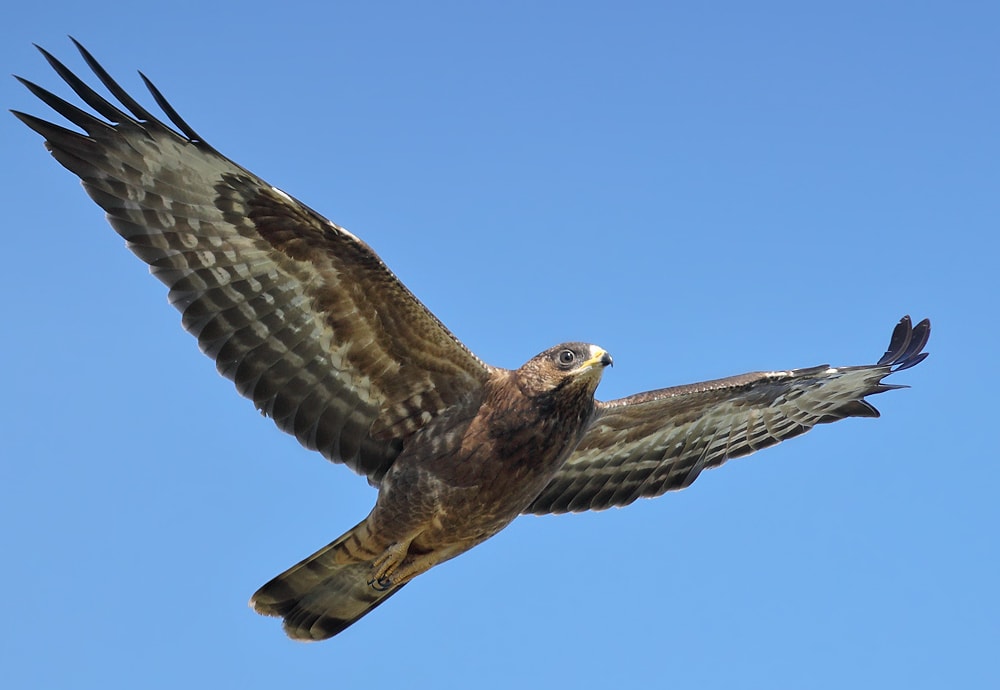
Spectacular Journey to Africa by Honey Buzzard

What an amazing story!! This is from the BirdGuides.Com

…..

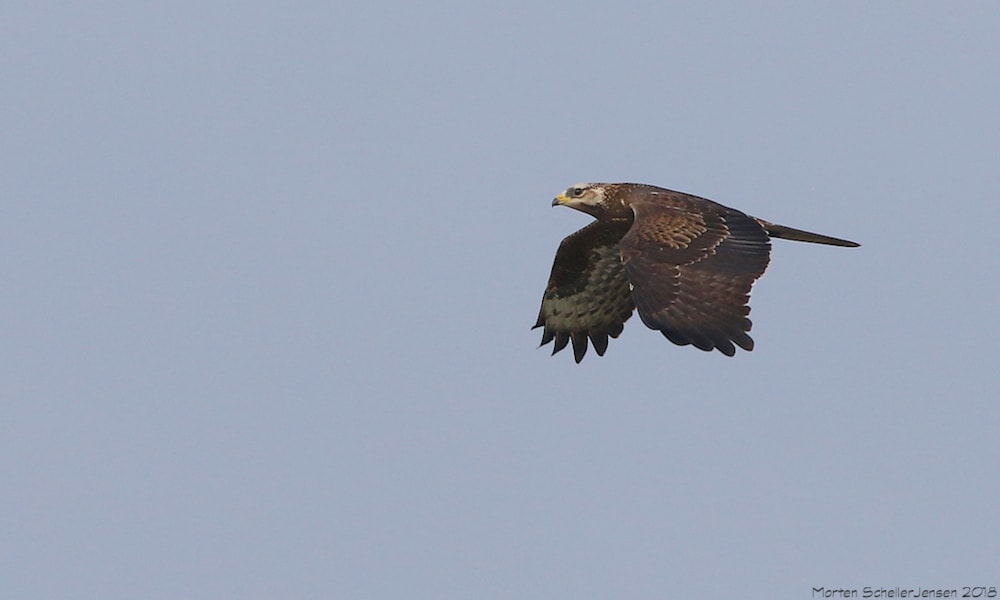
A young European Honey Buzzard, satellite tagged by the Roy Dennis Foundation at a nest near Forres, Scotland, in mid-August, has already reached the African continent – albeit via a remarkably risky route that included two long sea crossings.

The bird, ‘620’, was tagged on 11 August and remained in the vicinity of her natal woodland until early September. Her first significant flight came on 11 September, when she moved 50 km to the east, aided by a stiff breeze.

“Doth the hawk (or buzzard) fly by thy wisdom, and stretch her wings toward the south?” (Job 39:26 KJV)

Young European Honey Buzzards, such as this one, often end up taking more convoluted migrations south in their first autumn than the more experienced adults (Per Schans Christensen).

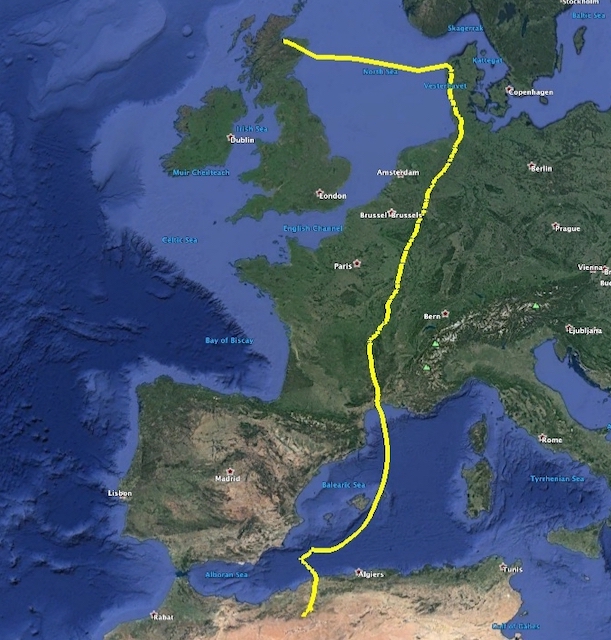
However, this could have given no clues for the extraordinary events that took place on 12-13 September. Clear skies and a brisk westerly wind on the morning of 12th encouraged the young honey buzzard to continue her eastward journey, although the Aberdeenshire coast seemingly provided no deterrant – she continued out to sea just north of Aberdeen at around 11.20 am, with the next GPS position logging her at an altitude of 477 m some 57 km out to sea, south-east of the Scottish city.

She continued on an easterly trajectory and, as darkness fell, she was only half-way across the North Sea. Flying through the night, the next tag fix at 2.34 am placed her a further 282 km east of the previous evening’s reading. By 6.30 am, she reached the Danish coast safely, having made a 640-km sea crossing in a non-stop 19-hour flight, largely during the hours of darkness – hugely impressive given it was the bird’s first long-distance movement since fledging the nest.

After a couple of days’ recuperation, her southward journey recommenced as she gradually made her way through Denmark, reaching Germany by the evening of 17th. She continued on a south-westerly route, skirting the western border of Germany and entering south-east Belgium on 20th, roosting in the country that evening. The south-westerly trajectory continued over the following five days, and ‘620’ had reached Clermont-Ferrand, France, by the evening of 25th.


Juvenile European Honey Buzzard photographed on migration in Denmark – a route used by many youngsters of this species, including ‘620’ (Morten Scheller Jensen).

At this point, it seemed as if the south-westerly route would continue, taking the bird into Iberia and, most likely, across the Strait of Gibraltar, which is a well-practised spring and autumn migration route for adult European Honey Buzzards. However, ‘620’ had other ideas.

After two days near Clermont-Ferrand, she flew due south to a wood near Montpellier on the afternoon of 27th. Her migration recommenced the next morning and by 8.40 am she was at the coast. But, instead of following this south-west into Spain, strong north-westerly winds encouraged her to fly directly out to sea.

As she moved south over the Mediterranean Sea the wind veered to a north-easterly and, with a brisk tailwind, her flying speed reached 87 km/h as she flew at altitudes of up to 750 m. By 1 pm she had reached Menorca – but did not land there, instead continuing southwards. By 8.30 pm, the wind had dropped and she was flying due west, having travelled almost 750 km over open sea in 12 hours of continuous flight.

Satellite data suggests she rested on a boat for a couple of hours in the middle of the night, before recommencing her journey south. Finally, by 12.50 pm the following day, she reached the Algerian coast, completing a 1,000-km migration over open sea in just over 28 hours – an astonishing feat for such a young bird tackling its first migration. Not done there though, the young honey buzzard continued inland for a further 160 km, roosting in mountains on the northern edge of the Sahara. It then made a further 60-km movement south and roosted in one of the last patches of woodland on the north side of the Sahara on the evening of 29th.


The movements of young European Honey Buzzard ‘620’ between 11 and 29 September, from Scotland to Algeria via Denmark, Germany and France (Roy Dennis Foundation).

This amazing journey shows just how treacherous life can be for migrant birds, especially youngsters in their first autumn, yet also exhibits the impressive feats that they are capable of. But the journey isn’t done there, with the world’s largest desert still left to negotiate. As the Roy Dennis Foundation wrote on its blog on 30 September: “After two very long sea crossings, the young honey buzzard now faces another daunting challenge – her first flight across the Sahara.”

Following 620’s exploits at www.roydennis.org/category/honey-buzzard-620.

“Was it through your know how that the hawk learned to fly, soaring effortlessly on thermal updrafts? Did you command the eagle’s flight, and teach her to build her nest in the heights,” (Job 39:26-27 MSG) [I don’t use this version normally, but I liked these verses, in respect to this story.]

What A Creator!!

Birds of the Bible – Buzzard

Wordless Birds

Back On Course

James 1:16-18 The Message “So, my very dear friends, don’t get thrown off course.”

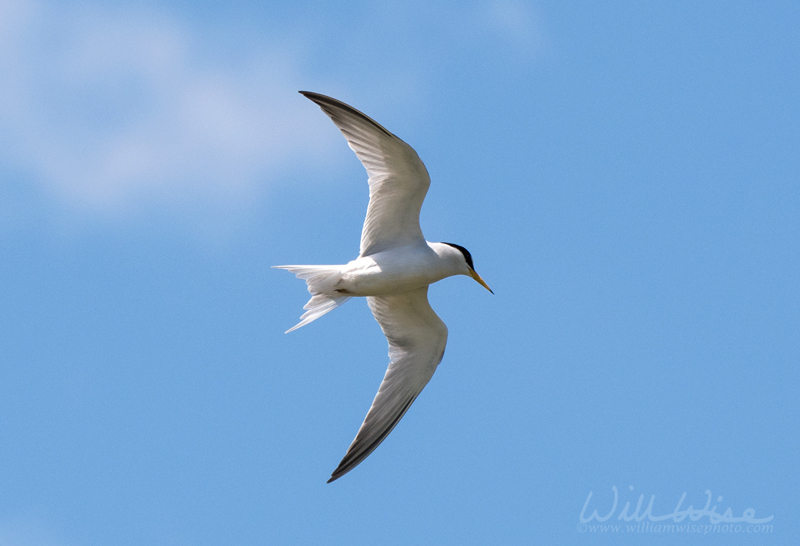
Normally along the coast, this Least Tern (Sternula antillarum) was a bit off course when spotted in Walton County, Georgia. June 11, 2020. Photo by William Wise.

As the fall migrations progress, there are often birds that go off course and show up in odd areas where they are not normally observed. Even  though they may be a common bird elsewhere, birders often delight in seeing these vagrants and will travel miles and miles to add them to their checklists. These birds may have drifted off course from storms or strong weather patterns, or by following the wrong flock (“abmigration”).

Earlier this summer I was delighted when I found a Least Tern flapping in graceful circles over the retention pond behind my office in Walton County, Georgia…  about 260 miles from the coast! What a delight to have the first and only eBird sighting for my county! Yes, I could have simply driven four hours east and seen as many Least Terns as I wanted. But this drifter was a delight to be seen so far off course.

In our Christian walk, we too can become spiritual “vagrants”. We might neglect Bible reading or prayer, or prolonged absence from in-person church attendance might leave us a tad off course. But when a Christian strays, there is no joy… except with Satan! He’s just waiting to add another drifting Christian to his list.

Hebrews 3:12-14  The Message  So watch your step, friends. Make sure there’s no evil unbelief lying around that will trip you up and throw you off course, diverting you from the living God.

But thank God we have a Divine Navigator that can direct our feet and put us back on course. His Word casts a beam of light and makes it simple to find the correct course. The Holy Spirit’s guidance is a gift that keeps us from becoming a checkmark on the devil’s eBird list!

John 12:46 I have come as a Light to shine in this dark world, so that all who put their trust in me will no longer wander in the darkness.


Hi, I’m wildlife photographer and nature writer William Wise. I was saved under a campus ministry while studying wildlife biology at the University of Georgia. My love of the outdoors quickly turned into a love for the Creator and His works. I’m currently an animal shelter director and live in Athens, Georgia with my wife and two teenage daughters, who are all also actively involved in ministry. Creation Speaks is my teaching ministry that glorifies our Creator and teaches the truth of creation.  — “What a wildly wonderful world, God! You made it all, with Wisdom at Your side, made earth overflow with your wonderful creations.” Psalms 104, The Message.

Not Deer or Bovine, So It Must Be An ‘Antelope’

Bibleworld Adventures has chosen to close down his website, due to a very busy schedule with work and his church ministries. We have decided to move his articles here. Baron has written articles here as Golden Eagle. This will preserve his and Dr. Johnson’s articles for us to enjoy. They are not about birds, but are all very interesting. Most are about a variety of our Creator’s amazing animals. [Will have a link to these pages in the sidebar as Bible World Adventures.]

Originally posted 2017/12/19

NOT DEER OR BOVINE, SO IT MUST BE AN ‘ANTELOPE’

Dr. James J. S. Johnson

The hart, and the roebuck, and the fallow deer, and the wild goat, and the pygarg [dîshōn], and the wild ox, and the chamois.   (Deuteronomy 14:5)

Addax-Morocco.Haytem93-photo

ADDAX male [photo credit: Haytem93]

Most likely the “Pygarg” [dîshōn] is what today is called an ADDAX.  An ADDAX is a desert-dwelling member of the ANTELOPE family.  [See George Cansdale, ALL THE ANIMALS OF THE BIBLE LANDS (Zondervan, 1976), page 85, saying “Among several quaint animal names found only in the AV [i.e., KJV] is the Pygarg, from Heb. dishon; this is merely a transliteration of the [LXX] Gr. Word meaning ‘white-rumped’, by which [Greeks] had long ago described an antelope. … [The reference in Deuteronomy 14:5] between two animals that are probably desert species, coupled with a long-standing tradition, suggests that this is the Addax, Addax nasomaculatus, a desert antelope classified between the oryx and hartebeests”.]antelope-family.jjsj-PPTslide

But, what is an antelope?

Antelope, and antelope-like animals, live in many different parts of the world—except not in Australia or Antarctica. For examples, pronghorns live mostly in America’s Western prairie states. The oryx live in Israel and many of the Arabian deserts.  The Dorcas gazelle lives in the top half of Africa.  Impalas live in eastern and southern Africa.

Serengeti-migraton-wildebeest-zebra.ZambesiSafari-photo

Wildebeests and Zebras migrate through Serengeti  /  Zambesi Safari photo

The blue wildebeest (also called “gnu”) are famous for their huge migratory herds, that often mix with zebras, that seasonally travel through Tanzania’s Serengeti.  Tibetan antelope, of course, live in Tibet, as well as in neighboring parts of Asia.  The Indian antelope (also called “blackbuck”) lives in India, Pakistan, and Nepal.

GreatMigration-Serengeti.Pinterest

Great Migration (Serengeti & Masai Mara)  image credit: Pinterest

These plant-eating mammals (animals that give mother’s milk to their babies) are different from other four-legged mammals – such as deer, cattle, horses, camels, sheep, goats, pigs, cats, and dogs.

In many ways antelope (and antelope-like animals, like the pronghorns of America’s prairies) are like deer. But unlike deer, which have antlers (that grow and shed each year, then regrow the next year, and are later shed, etc.), antelopes have horns (like cattle, bison, sheep, and goats), which continue to slowly grow out from their heads, anchored to bony roots.

Impala-w-oxpecker.jjsj-PPTslide

Antelopes often live in flat grasslands (such as the grassy prairies of America’s West), where their plant-food is plentiful. However, in grasslands there are usually very few trees, so antelopes cannot hide in forests from other animals (such as mountain lions or wolves), so it is good that God made them to have great speed for running across flat land.  And that is what antelopes (and pronghorns, which are antelope-like animals) often do–with great speed!–when they run away from predators at high speeds—sometimes as fast as 55 miles/hour for a mile, or 42 miles/hour for 2 miles, or 35 miles/hour for 3 miles.Gazelle-foraging.jjsj-PPTslide

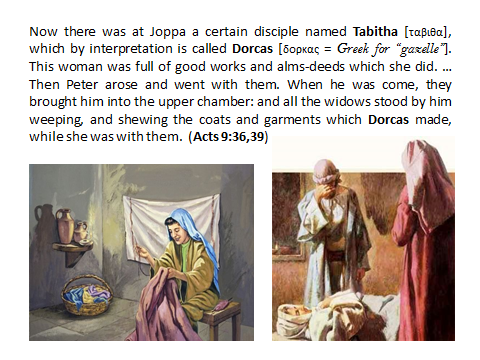
Dorcas is the Greek word for a gazelle, which is a member of the antelope family. Because gazelles are graceful and beautiful animals it is unsurprising that girl babies have been named Dorcas, including one who is mentioned in Scripture, in Acts chapter 9.Dorcas-philology.jjsj-PPTslide

Dorcas-Acts-chapter9.jjsj-PPTslide

In North America the primary antelope-like mammal is the PRONGHORN. To learn about this beautiful, graceful, and extremely speedy animals, see “Geography Matters, Illustrated by Pronghorns, Mountain Goats, and Old Testament Warfare”, posted at https://bibleworldadventures.com/2016/08/17/geography-matters-illustrated-by-pronghorns-mountain-goats-and-old-testament-warfare/ .

pronghorn-coming-fast.closeup-turning

When we see beauty, grace, strength, and speed — displayed in antelope (and antelope-like pronghorns) — we are reminded, by these living exhibits of God’s making, that God Himself is amazingly beautiful, graceful, strong, and quick, beyond our comprehension.

Here am I, Where are You?

Always Honking

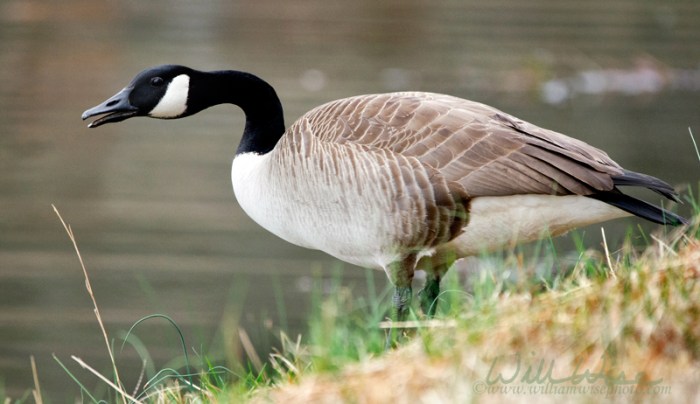
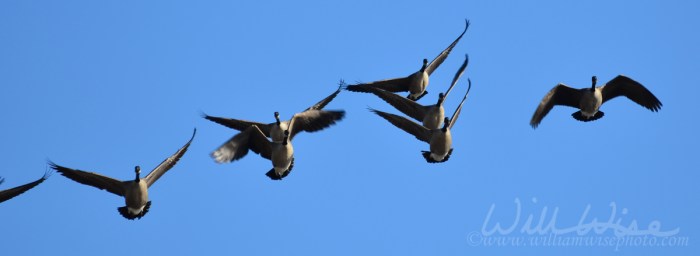
Honk…honk…honk!” Before you ever see the birds’ characteristic black heads and white cheek patches, you identify Canada Geese coming as they honk across the sky in their typical V-shaped pattern. It seems Canada Geese are always vocal; on the ground, in the air, while feeding, when waking up, just before they sleep… they are always honking.

So that begs the question: what are they honking about? What are they saying? Biologists tell us they honk to keep family groups together; they honk to communicate rest or feeding areas; they honk to alert others of danger or predators; or, especially the younger birds, they just “go off with a jag of honking that seems to serve no other purpose than sheer exuberance – the expression of joy and excitement over the ability to fly with their friends and family.” 

Keeping it Together

Birds face many hazards during migration. Facing often severe weather and high winds, some may get blown off course or get caught in a storm. Inexperienced birds may chart a wrong course and fatally collide with tall buildings, windows, and other structures, or risk being shot by hunters. It is during the hardships of migration that honking becomes so important to Canada Geese. The blinding snow and rain, or thick fog, may make it impossible to see one another. So, as they toil through the sky, they honk to keep their flock together.

The geese are talking to one another. Each is saying to its companions, ‘Here am I… where are you? Here am I… where are you?’ Aloft in storm and cloud, the voices hold the flock together. They speak out loudly against wind and distance so that others of their kind, strayed or lost, may know the way. Under fair sky the calls continue for reassurance and to reassure. ‘Come along, do not tire. We are on the right course and will soon stop for rest.’ It is no fable, but a truth of nature; experienced elders lead the way.

Magnificent Voyagers, Waterfowl of North America

The experienced elder goose is leading the way with his honking, while the others follow honking encouragement to the others to keep to the course and not quit the flight. The grounded geese that left the flock because of weariness or injury can hear the incessant calling, “Here am I… where are you?” and rejoin their migrating families. It is the duty of those still in flight and on course to call out to their lost and weary relations to come back and return to the path.

Calling Out to Others

In life, many people around us may fly the wrong course or succumb to the hazards of life: failure and defeat, drugs and alcohol, apathy or crime. We have a duty to our fellow man to fly the right course and to lead them in a safe direction. We are to be leaders in our schools, on our jobs, in our families. We have a duty to not leave behind the weak and weary, and to help others to the safe places of rest and success that have been shown to us.

As Christians, we all have a duty to “honk” as the Canada Goose: “Here am I…where are you?” There are many – family members, friends, coworkers, schoolmates – that are lost and on the wrong course. They will never find the right course and follow Jesus if we, the ones that know the right path, don’t call out to them to follow. 

The New Living Translation of Romans 10:14 states, “But how can they call on him to save them unless they believe in him? And how can they believe in him if they have never heard about him? And how can they hear about him unless someone tells them?” If we remain silent, they will never find the way. Our constant, clear call of “Here am I…where are you? Here Am I…where are You?” makes it ever known to them to where they can return when they tire of the life of sin. ​

Where are You?

Before you can lead others and call “Here am I…”, do you know where you are heading? Are you on the narrow path that leads to life? If not, follow the voice of the Savior who “calls you out of darkness into His wonderful life” (I Peter 2:9). And if you do know the course, never quit your duty of calling out to those who are lost or weary. Like the geese that seem to never quit honking, so should you never cease making the call: “Here am I…where are you?  Here am I…where are you?


Hi, I’m wildlife photographer and nature writer William Wise. I was saved under a campus ministry while studying wildlife biology at the University of Georgia. My love of the outdoors quickly turned into a love for the Creator and His works. I’m currently an animal shelter director and live in Athens, Georgia with my wife and two teenage daughters, who are all also actively involved in ministry. Creation Speaks is my teaching ministry that glorifies our Creator and teaches the truth of creation. I am also a guest author at Lee’s Birdwatching Adventures and The Creation Club. — “What a wildly wonderful world, God! You made it all, with Wisdom at Your side, made earth overflow with your wonderful creations.” Psalms 104, The Message.

Why Use The Ark?

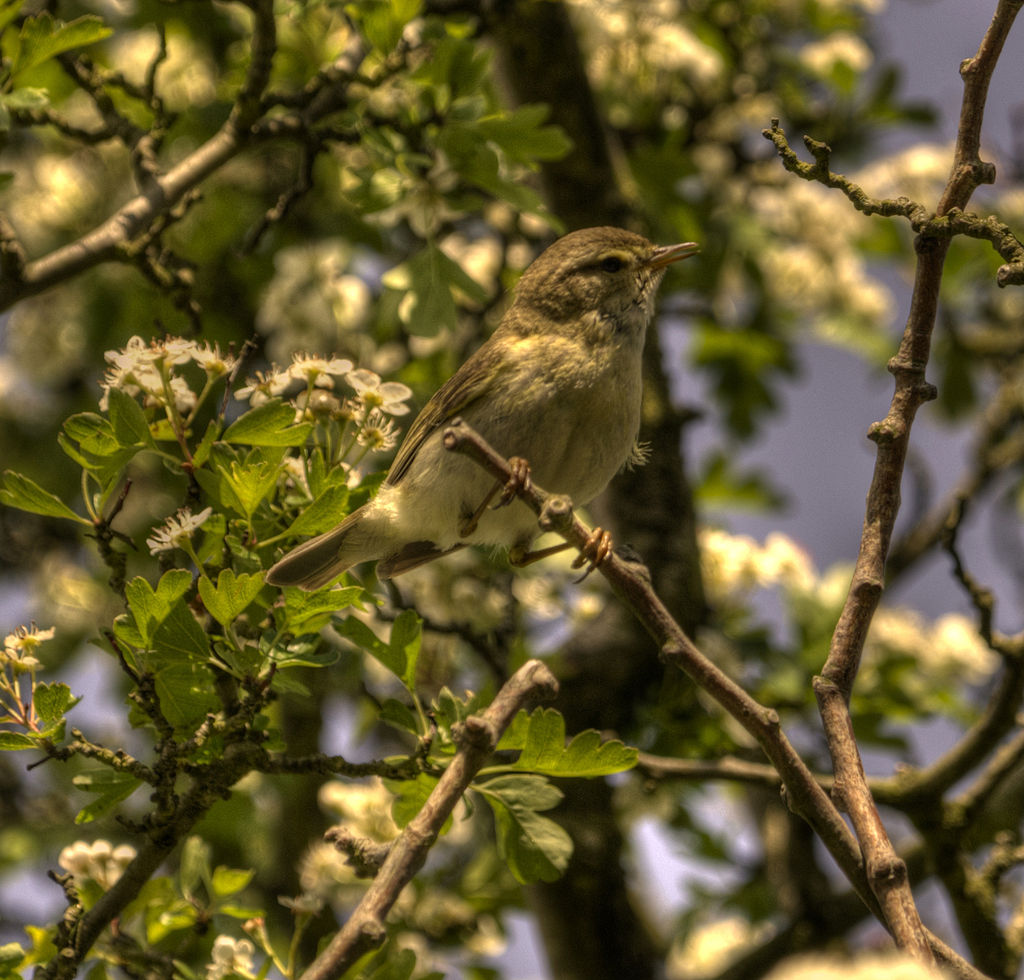
Willow Warbler (Phylloscopus trochilus) ©WikiC

An article in the latest issue of Answers in Genesis Magazine, “As The Bird Flies,”, p.20, tells about the Willow Warbler. This little bird weighs only “0.4 ounce (10 g) … and migrate more than 8,000 miles (13,000 km) from eastern Siberia to Kenya and Tanzania in Africa.”

The article goes on to tell how much research has been done with this bird and its migratory habits. The internet has many articles about this fantastic avian wonder from the Lord. Another article, Study: Siberian Willow Warblers Migrate Incredible 8,000 Miles One Way.

“All populations are highly migratory, with the subspecies P. t. yakutensis migrating up to 12,000 km from eastern Siberia to southern Africa along the Asian – East African Flyway, one of the longest migrations of any for a bird of its size. Approximate timings are:

October to March: wintering in sub Saharan Africa.
Mid March to mid May: migrates and arrives in the breeding range.
Late April to August: breeding season, usually only one brood but rarely two.
August to October: migrates back to Africa.” [Wikipedia – Willow Warbler]

Answers article continues with this remark: “Their surprisingly complex navigational abilities showcase the Creator’s ingenious design”

They then challenge those who sort of believe in creation, but the flood gives them problems. Many only believe in a “Local Flood.” My take on this and theirs is: Why Get In The Ark When You Can Fly? “Why couldn’t the animals just leave the area instead of getting on a ship, especially if a bird that weights less than a few paper clips can trave more than 8,000 miles?”

“In the selfsame day entered Noah, and Shem, and Ham, and Japheth, the sons of Noah, and Noah’s wife, and the three wives of his sons with them, into the ark; They, and every beast after his kind, and all the cattle after their kind, and every creeping thing that creepeth upon the earth after his kind, and every fowl after his kind, every bird of every sort.” (Genesis 7:13-14 KJV)

“And the waters prevailed exceedingly upon the earth; and all the high hills, that were under the whole heaven, were covered. Fifteen cubits upward did the waters prevail; and the mountains were covered. And all flesh died that moved upon the earth, both of fowl, and of cattle, and of beast, and of every creeping thing that creepeth upon the earth, and every man: All in whose nostrils was the breath of life, of all that was in the dry land, died. And every living substance was destroyed which was upon the face of the ground, both man, and cattle, and the creeping things, and the fowl of the heaven; and they were destroyed from the earth: and Noah only remained alive, and they that were with him in the ark.” (Genesis 7:19-23 KJV)

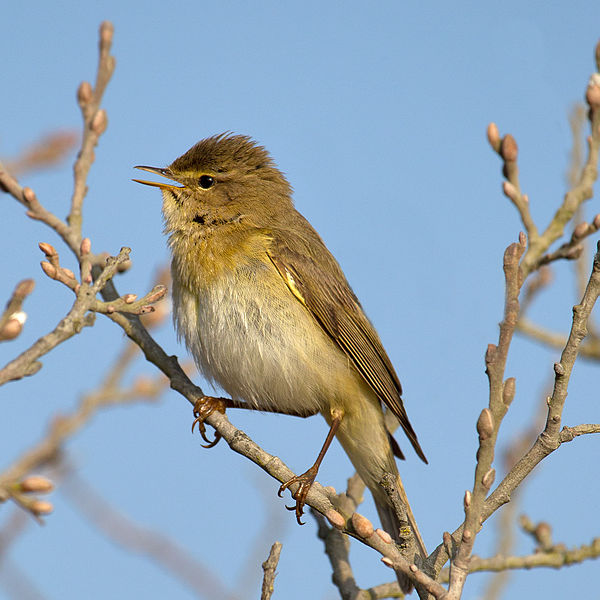
Willow Warbler (Phylloscopus trochilus) ©WikiC

Sharing The Gospel