To the end that my glory may sing praise to thee, and not be silent. O LORD my God, I will give thanks unto thee for ever. (Psalms 30:12 KJV)
As we continue through the Passerine Families, today we arrive at Cotingidae – Cotingas Family which has 66 members and the Pipridae – Manakins Family has 52 species.
As you watch the birds you can listen to Mark Quijano sing “Give Thanks.” Mark is a newer follower of this blog and I am following his, now that we have been made aware of the each other’s blog. Our mutual draw is Our Lord Jesus Christ. I find the Lord’s Family enjoyable, wherever they may be. Mark lives in Saga City, Japan. Please check out his site “Travel Diary.”
If you have a large screen, you can do both at the same time, else, watch the birds as you listen to Mark. Or you can watch Mark sing and then start it again and listen as you watch the birds. Oh, the options I have given you today to enjoy Our Lord’s Creation and “Give Thanks” through music and birds.
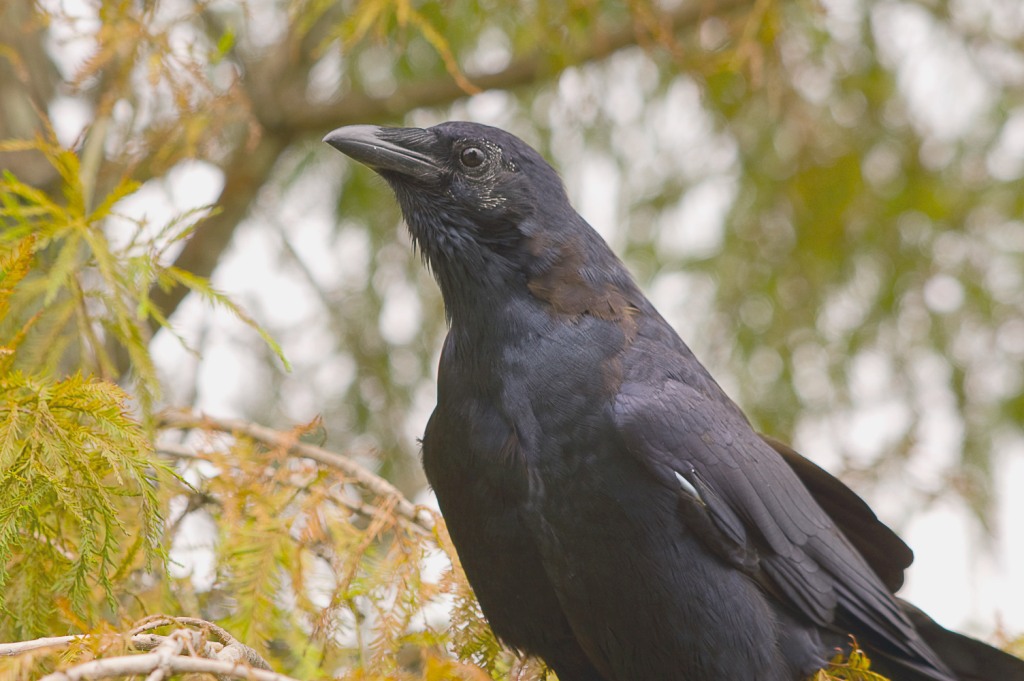
Fish Crow (Corvus ossifragus) at Lake Morton By Dan’sPix
Birds of the Bible articles have been written about Raven’s before. James J S Johnson sent a link to a news story in the BBC News Magazine about Crows that is similar to the Ravens in the Bible.
First the story. A young girl, Gabi Mann, feeds Crows and they bring her “gifts.” (nutshell version). See The girl who gets gifts from birds.
It started when she got out of the car and dropped food from her lap. The Crows grabbed it and each time she came home, they watched for her. It went from that to Gabi and her mother feeding them on a regular basis. Then, the crows started leaving various items, that could fit in their mouths, as “gifts.” Here are some of those items.
Things brought by the crows
*
Things brought by the crows
Does the story bring to mind a similar situation, but with Ravens bringing something to someone?
In I Kings 17, we read about the prophet Elijah who was told by the LORD to get away and hide by the Brook Cherith.
And it will be that you shall drink from the brook, and I have commanded the ravens to feed you there.” So he went and did according to the word of the LORD, for he went and stayed by the Brook Cherith, which flows into the Jordan. The ravens brought him bread and meat in the morning, and bread and meat in the evening; and he drank from the brook. (1 Kings 17:4-6 NKJV)
Ravens and Crows are both in the same family, Corvidae – Crows, Jays, Ravens, which has 130 species presently. “They are considered the most intelligent of the birds, and among the most intelligent of all animals” (Corvidae-Wikipedia).
In the Bible, our passage in I Kings says that the ravens brought him food. Checking the different translations, all the translations, except two, call them Ravens. Those two call them Crows. The ABP+ uses G2876, which Strong says:
G2876
κόραξ korax kor’-ax
Perhaps from G2880; a crow (from its voracity): – raven.
Total KJV occurrences: 1
The other, ISV, says, “Crows would bring him bread and meat both in the morning and in the evening, and he would drink from the brook.”
Either way, the point is, the LORD used birds from a very intelligent avian family, that He Created, to feed his prophet. Critics like to find everything they can to disprove the Bible. Yet, the Lord gives us all kinds of reasons to believe his Word, if we just open our eyes.
Those birds could have brought bits of food as well as “trinkets.”
Because that which may be known of God is manifest in them; for God hath shewed it unto them. For the invisible things of him from the creation of the world are clearly seen, being understood by the things that are made, even his eternal power and Godhead; so that they are without excuse: (Romans 1:19-20 KJV)
Take therefore no thought for the morrow: for the morrow shall take thought for the things of itself. Sufficient unto the day is the evil thereof. (Matthew 6:34)
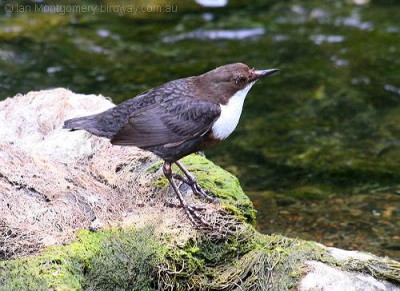
EUROPEAN DIPPER
Orni-Theology
The official bird of Norway is the White-throated Dipper (a/k/a European Dipper: Cinclus cinclus). Unlike the American Dipper (which is dark-black all over), it has a mix of colors: brown head, white throat/bib, chestnut belly, and blackish back and tail.
As the range map shows, this little bird is known to range over all of Norway, as a year-round resident. This bird needs running freshwater, because that is where its primary source of food resides. And Norway has lots of fast-running freshwater, especially as mountain snow melts and flows downhill, in crevices, waterfalls, streams, and other drainage pathways that lead westward to the sea.
White-throated Dipper aka European Dipper
This passerine (i.e., perching songbird) bird is thus deemed an “aquatic” bird, due to its familiar habit of dipping into freshwater for food – and “walking” across the streambed as it fishes (underwater) for insect larvae and other edible morsels found in streambeds.
Specifically, this dipper has too behavioral movements that fit its name: (1) as it perches near quick-flowing stream-waters, it often (and suddenly – some say “spasmodically”) bobs, with its tail propped up (somewhat like a wren), near the splashing water; and (2) it dives into such lotic waters, sometimes after wading into the water’s edge: then submerges itself by quickly plunging in (or diving in), with a small splash. While underwater it seems to swim, though its wings actually “fly” underwater, or (at times when the current is stronger) the submerged bird vigorously “rows” its sturdy wings, like oars, to resist the under-current, in order to steady its underwater position.
Dipper under water by Getty Images
The Dipper can also use its strong prehensile toes (i.e., it can grip with its feet, almost like a human hand) to grab onto projecting substrates on the bottom of a stream, while simultaneously straining its muscles (and keeping its head bent down so that it can see what is on the streambed) to prevent it from rising to the water’s surface – thus giving the appearance that it is “walking on the bottom” of the stream!
While underwater the dipper collects its food (which is often “epibenthic”, i.e., located on top of the stream-bottom sediments), such as caddisfly larvae (and other insect larvae), as well as small freshwater mollusks, fish, and amphibians – and a favorite freshwater crustacean, the thin amphipod shrimp (of the genus Gammarus, a genus containing marine “scud”, estuarial, and freshwater shrimps known for their detritivorous / scavenging habits).
What a strange bird! Yet it is determined to use its anatomy and strength to get food for the day, even appearing to defy gravity while it does. It may not be a huge buffet banquet table, by our standards, but it is enough – so the bird eats what it needs, one day at a time.
Just face one day of challenges at a time – what a concept!
Take therefore no thought for the morrow: for the morrow shall take thought for the things of itself. Sufficient unto the day is the evil thereof. (Matthew 6:34)
Happy is the man that findeth wisdom, and the man that getteth understanding. (Proverbs 3:13 KJV)
There are only two rules for this challenge:
1. On 5 consecutive days, create a post using either a past or recent photo in B&W.
2. Each day invite another blog friend to join in the fun.
My fifth nomination is Talainsphotography, because he has a variety of photos, most of them from nature. He “likes birds, bees, trees and flowers with sunsets, rainbows, and with rocky towers thrown in. But don’t be surprised if I throw in something else that is not nature oriented occasionally. If it catches my eye, I’ll put it in and try to give you some background on the photo’s subject matter!”
This is the fifth and final one in the 5-day challenge. I trust you have enjoyed them and checking out the sites of the ones nominated. There are many more of you that I could have nominated, but I could only choose five. Maybe another challenge will come along that interests me and I will pick you.
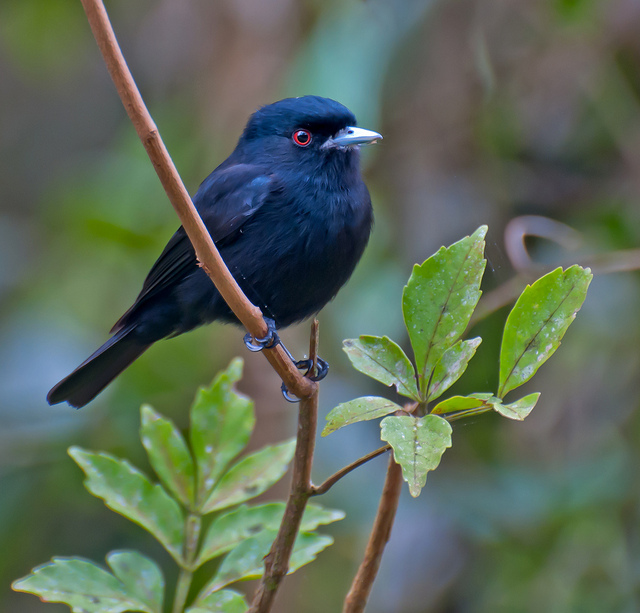
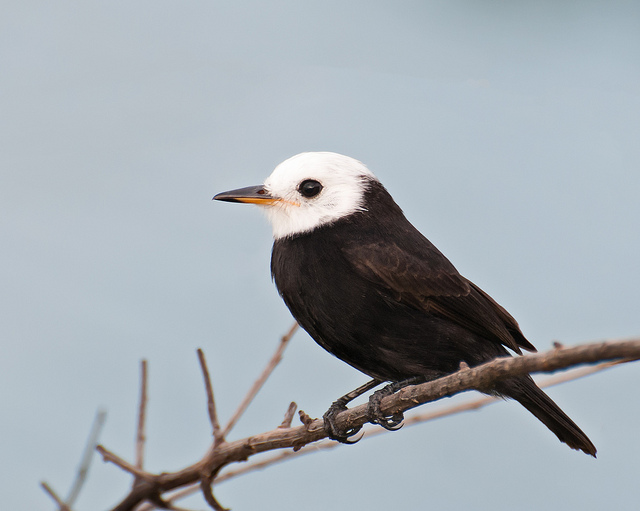
Blue-billed Black Tyrant (Knipolegus cyanirostris) by Dario Sanches
But the fruit of the Spirit is love, joy, peace, longsuffering, kindness, goodness, faithfulness, gentleness, self-control. Against such there is no law. (Galatians 5:22-23 NKJV)
I cannot help but post this video. Made aware of it several years ago. The “music was made for a school project. A Pixar video with audio created by David Redinha”
The verses that come to my mind have to do with being kind and not making fun of someone. This video of shows what might happen when both not being kind and making fun of someone appear at the same time. Enjoy!
Let all bitterness, and wrath, and anger, and clamour, and evil speaking, be put away from you, with all malice: And be ye kind one to another, tenderhearted, forgiving one another, even as God for Christ’s sake hath forgiven you. (Ephesians 4:31-32 KJV)
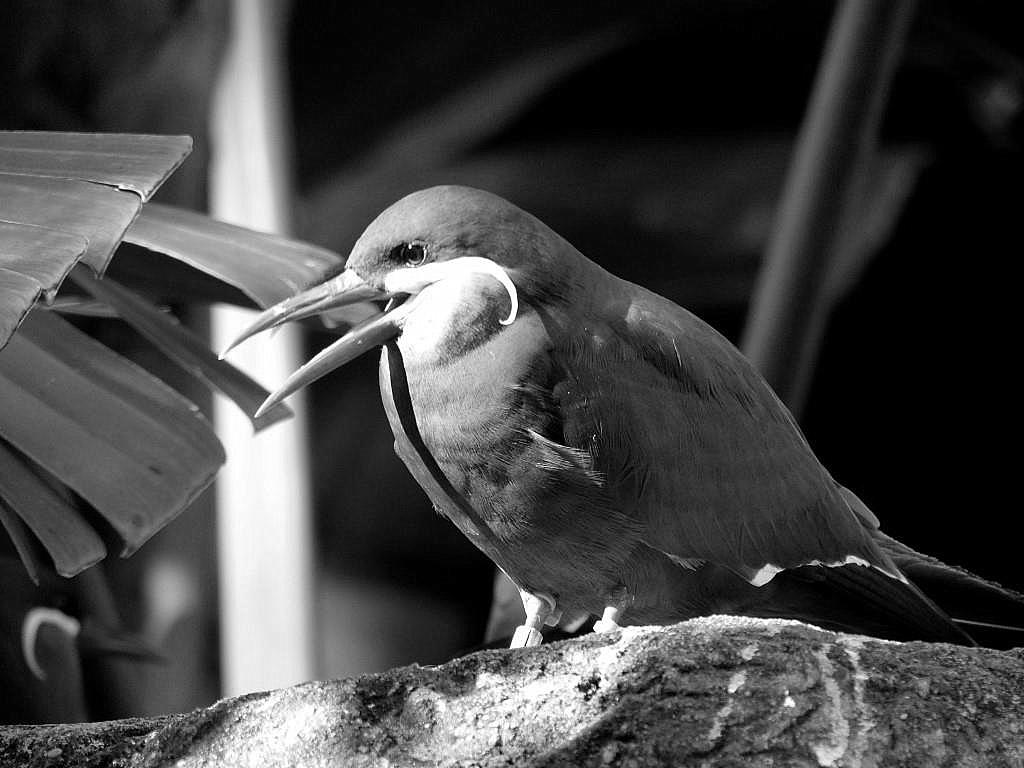
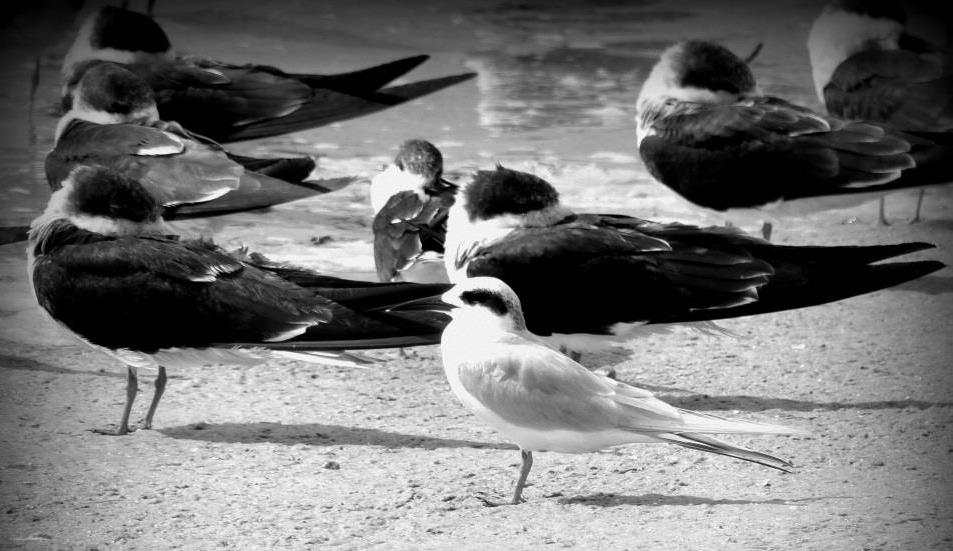
Tern with Skimmer Friends at MacDill AFB Shore 2015 by Lee
And great multitudes were gathered together unto him, so that he went into a ship, and sat; and the whole multitude stood on the shore. (Matthew 13:2 KJV)
But when the morning was now come, Jesus stood on the shore: but the disciples knew not that it was Jesus. (John 21:4 KJV)
There are only two rules for this challenge:
1. On 5 consecutive days, create a post using either a past or recent photo in B&W.
2. Each day invite another blog friend to join in the fun.
My fourth nomination is B is for Blessed, “Receive God’s Grace Every Day,” because Lilkah is a Christian who likes to encourage others with her photos, verses and enjoyable stories.
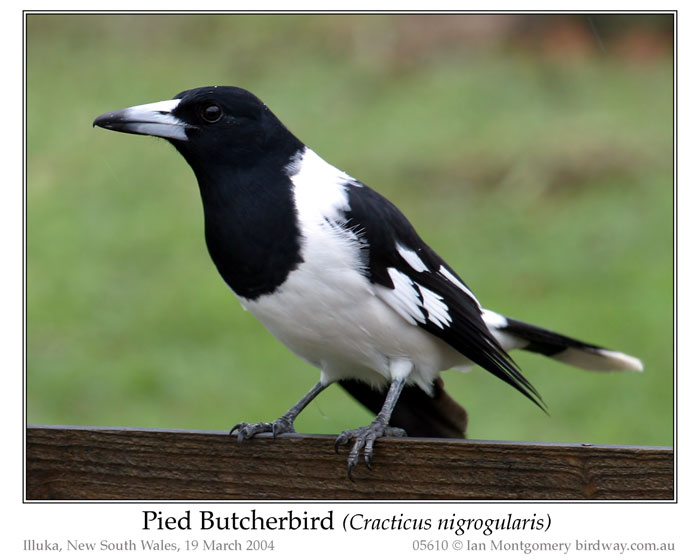
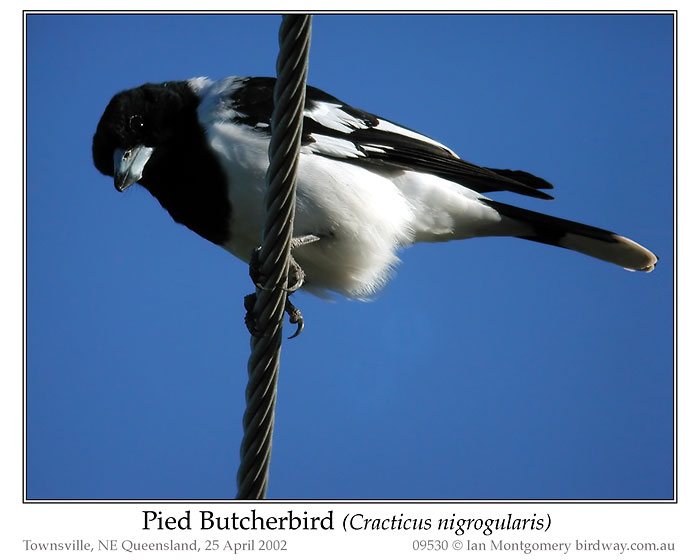
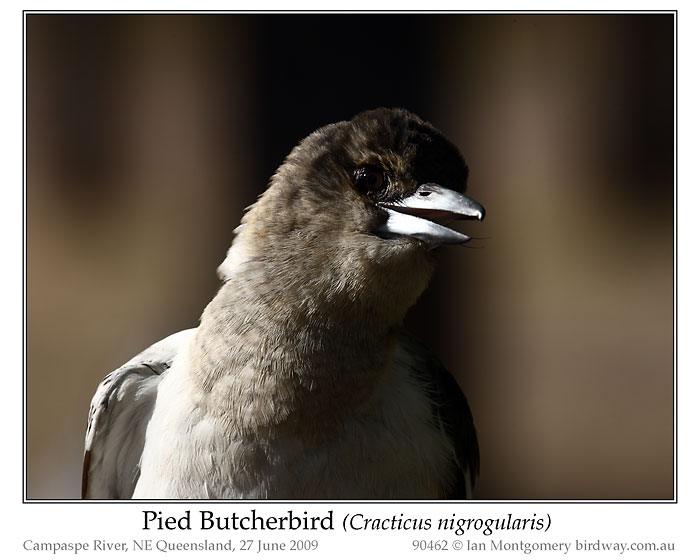
Ian’s Bird of the Week – Pied Butcherbird ~ by Ian Montgomery
Newsletter ~ 2/22/14
Birds of the week are usually chosen on the basis of appearance, photo quality or species interest, but here for a change is one whose real claim to fame is auditory. Not that Pied Butcherbirds don’t look quite dapper, even if the hooked bill suggests a predatory existence and the black hood has the connotation of the executioner, at least for the Spanish : Verdugo Gorjinegro, where verdugo means executioner or hangman, and gorjinegro you can guess. However, their real claim to fame is their beautiful singing which has a clarity and sense of purpose that I think is unequalled. When I first heard a Pied Butcherbird singing in Australia in western New South Wales in 1971, I was fascinated. To me it seemed like it was practising the theme from an oboe concerto, as it would keep carefully repeating the phrases, each time slightly differently.
The first edition of Graham Pizzey’s Field Guide to the Birds of Australia (1980-2000) has wonderful descriptions – I bought it after reading his description of Musk Duck, which starts “A decidedly strange duck.” – so I’ll quote him on the Pied Butcherbird: “Superb: slow flute-like piping, of clear high-pitched and low mellow notes, throughout day and moonlit nights, best in early morning; often given by two or more birds alternatively, higher-pitched notes of one contrasting with more mellow notes of others. … Also accomplished mimicry, as part of quieter sub-song.”
I can’t just leave you hanging after a description like that. Here is a YouTube link to a lovely video of a duet
and here is another to a Pied Butcherbird mimicking a variety of species
Listen to these and I’m sure you’ll agree that this is one of the most beautiful song birds in the world.
On the subject of mimicry, I had an email from Rose Bay in Sydney recounting a conversation that took place between a Grey Butcherbird and the correspondent, thank you Jeremy, who whistled in response, over several months. The bird remained hidden and unidentified in foliage until a couple of weeks ago when, during such a talk, he spotted the bird and the mystery was solved. I’ve accompanied a Pied Butcherbird here in Bluewater on the treble recorder. I checked their vocal range using a pitch analyser on sound recordings and found that the mellow notes were close to middle C (C4), while the top notes were around D6, two octaves above middle C; an impressive range.
And, yes, they do prey on small birds, mammals, reptiles and invertebrates and will even hunt in unison with Australian Hobbies. They get their name from their habit of wedging larger prey items in a fork in a tree (or clothes line) so that they can dismember it. If you think that sounds macabre, go and listen to Berlioz’s Symphonie Fantastique again, imagining the idée fixé played by a Pied Butcherbird, particular the rendering of it in the third movement on the oboe and by the clarinet in the fourth Marche au supplice. The latter appears briefly before the fall of the guillotine. I tried playing the first of the YouTube videos simulaneously with the third movement a short while ago and the result is, well, fantastic.
Anyway, back to family matters. Pied Butcherbirds have group territories similar to those of their cousins the Australian Magpies with usually one breeding pair. The female does all the hard work of building the nest and incubating the eggs while, the male, presumably, sings. The other members of the group, usually offspring from earlier broods, do help to feed the young.
I should, I suppose, mention the photos. The first three are of adult birds, the last two of brownish immature birds. At 32-36cm/12.5-14in in length the Pied Butcherbird is intermediate between the smaller Grey and Black-backed Butcherbirds and the larger Black Butcherbird. The Pied Butcherbird occurs through most of mainland Australia, but is absent from very arid regions, most of South Australia and Victoria, and southeastern New South Wales. Here in the northeast Queensland, they show a preference for watercourses.
The bird of the week has been going out regularly, if not weekly, since late 2002. I have copies of almost all of them and I’ve decided to publish them as an electronic book under the umbrella “A Bird Photographer’s Diary”. At the moment, I’m progressing steadily through the second quarter of 2006, and I’m having great fun reliving all the experiences and places involved. The intention is to add photos of the various locations and habitats. I’ll keep you posted.
The flowers appear on the earth; the time of the singing [of birds] has come, and the voice of the turtledove is heard in our land. (Song of Solomon 2:12 AMP)
Wow! What an amazing article about these birds and the videos only enhance it more. I especially like the them singing duet. Ian finds us the most interesting birds to see and hear. Thanks, Ian.
Check out Ian’s Butcherbirds in his Artamidae Family
Galah (Eolophus roseicapilla) and Dan at Brevard Zoo BW
Beloved, do not be surprised at the fiery ordeal among you, which comes upon you for your testing, as though some strange thing were happening to you; (1 Peter 4:12 NASB)
There are only two rules for this challenge:
1. On 5 consecutive days, create a post using either a past or recent photo in B&W.
2. Each day invite another blog friend to join in the fun.
My third nomination is Through Open Lens, because he is a great photographer and has some stunning photos. The articles are short, but informative. An all around variety of nature.
Where the birds build their nests, And the stork, whose home is the fir trees. (Psalms 104:17 NASB)
Last week we saw some of the Tyrant Flycatcher family. This time, with over 400 species, just this family of birds will be featured.
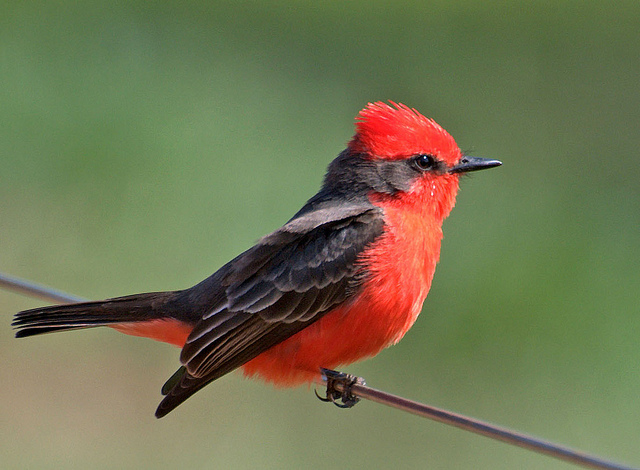
The tyrant flycatchers are birds which occur throughout North and South America. They are considered the largest family of birds, with more than 400 species. They are the most diverse avian family in every country in the Americas, except for the United States and Canada. As could be expected from a family this large, the members vary greatly in shape, patterns, size and colors. Most, but not all, species are rather plain, with various hues of brown, gray and white commonplace. Obvious exceptions include the bright red vermilion flycatcher, blue, black, white and yellow many-colored rush-tyrant and some species of tody-flycatchers or tyrants, which are often yellow, black, white and/or rufous.
Vermilion Flycatcher (Pyrocephalus rubinus) by Dario Sanches
The smallest family members are the closely related short-tailed pygmy tyrant and black-capped pygmy tyrant. These species reach a total length of 6.5–7 cm (2.5–2.8 in) and a weight of 4–5 grams. By length, they are the smallest passerines on earth, although some species of Old World warblers apparently rival them in their minuscule mean body masses if not in total length. The minuscule size and very short tail of the Myiornis pygmy tyrants often lend them a resemblance to a tiny ball or insect. The largest tyrant flycatcher is the great shrike-tyrant at 29 cm (11.5 in) and 99.2 grams (3.5 oz).
Please enjoy watching a slideshow of some more of the Lord’s neatly created birds as you listen our orchestra and then the choir sing.
This slideshow requires JavaScript.
*
Click to listen:
“Amazing Grace” – Orchestra and “I Love You, Written in Red” – Choir (Faith Baptist Church)
Neither shalt thou swear by thy head, because thou canst not make one hair white or black. (Matthew 5:36 KJV)
There are only two rules for this challenge:
1. On 5 consecutive days, create a post using either a past or recent photo in B&W.
2. Each day invite another blog friend to join in the fun.
My second nomination is Sukanya Ramanujan, because she accepted the challenge and she has great photos. She is from Chennai, India (Same town a j mithra was from) She is a “multi-lingual professional with varied interests such as reading, travelling, music and photography.” Also check out her photos.
Anhinga (Anhinga anhinga) Female at Vierra Wetlands By Dan’sPix B-W
There are only two rules for this challenge:
1. On 5 consecutive days, create a post using either a past or recent photo in B&W.
2. Each day invite another blog friend to join in the fun.
My first nomination is AussieBirder, because their purpose is for “the appreciation of Australian birds and the love of birdwatching, sharing bird sightings, photographs, personal experiences and helpful information.” That pretty well sums up their purpose and feel they are up to the challenge.
I am thankful to Our Rumbling Ocean for nominating me. They live on the East Coast of South Africa and have lots of nature photos, plus an adorable son, Boeta. I enjoy following their adventures.
Like the heat of summer in a dry land, the angry shouts of those foreigners brought us to our knees. But like a thick cloud that blocks the summer heat, you answered their challenge. (Isaiah 25:5 ERV)
He gives snow like wool; He scatters the frost like ashes; (Psalms 147:16 NKJV)
Let them praise the name of the LORD, For He commanded and they were created. He also established them forever and ever; He made a decree which shall not pass away. Praise the LORD from the earth, You great sea creatures and all the depths; Fire and hail, snow and clouds; Stormy wind, fulfilling His word; (Psalms 148:5-8 NKJV)
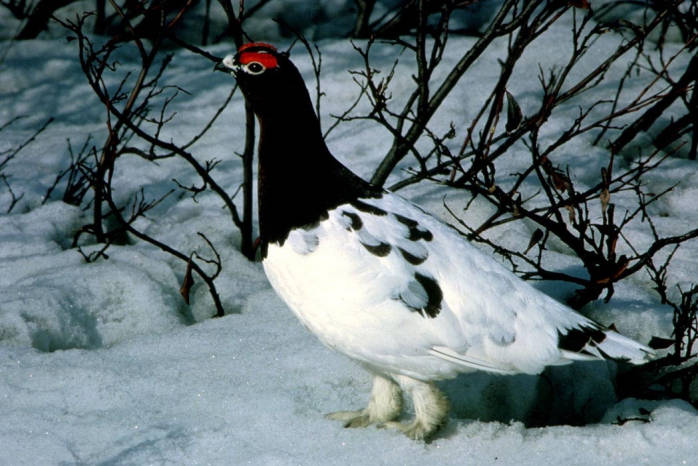
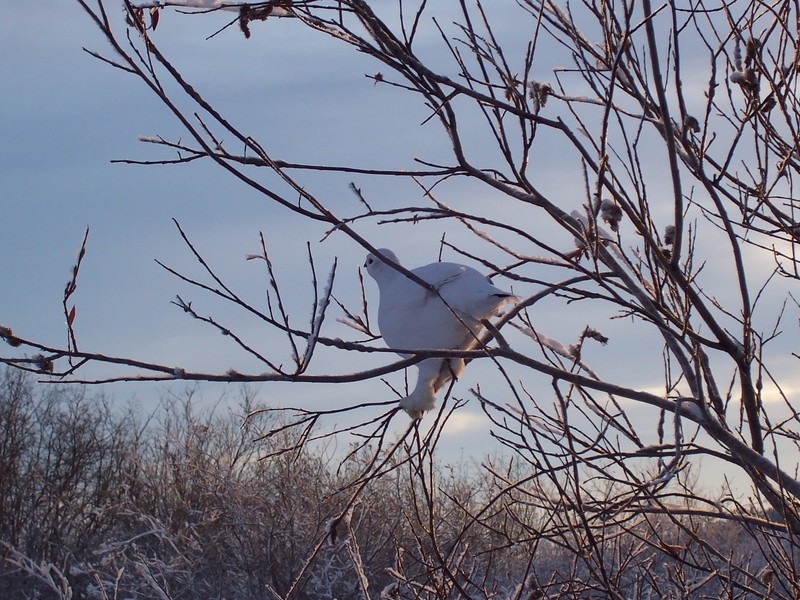
Since so much of North America is having such a cold and snowy winter, thought that you might like watching a Willow Ptarmigan in its winter outfit.
Lesley the Bird Nerd produced this YouTube and thought you might enjoy watching how the Lord has prepared this bird to survive in winter.
We are going to drop down to freezing the for a few nights here in Central Florida, but nothing like what many of you are experiencing. Stay warm and enjoy the Lord’s Creations.
God thunders marvelously with His voice; He does great things which we cannot comprehend. For He says to the snow, ‘Fall on the earth’; Likewise to the gentle rain and the heavy rain of His strength. He seals the hand of every man, That all men may know His work. (Job 37:5-7 NKJV)
The willow ptarmigan (Lagopus lagopus) is a bird in the grouse subfamily Tetraoninae of the pheasant family Phasianidae. It is also known as the willow grouse and in the British Isles, where it was previously believed to be a separate species, as the red grouse. It is a sedentary species, breeding in birch and other forests and moorlands in northern Europe, the tundra of Scandinavia, Siberia, Alaska and northern Canada, in particular in the provinces of Newfoundland and Labrador. It is the state bird of Alaska. In the summer the birds are largely brown, with dappled plumage, but in the winter they are white with some black feathers in their tails (British populations do not adopt a winter plumage). Nesting takes place in the spring when clutches of four to ten eggs are laid in a scrape on the ground. The chicks are precocial and soon leave the nest and while they are young, both parents play a part in caring for them. The chicks eat insects and young plant growth while the adults are completely herbivorous, eating leaves, flowers, buds, seeds and berries during the summer and largely subsisting on the buds and twigs of willow and other dwarf shrubs and trees during the winter. (Wikipedia)










 Lee's Birdwatching Adventures Plus