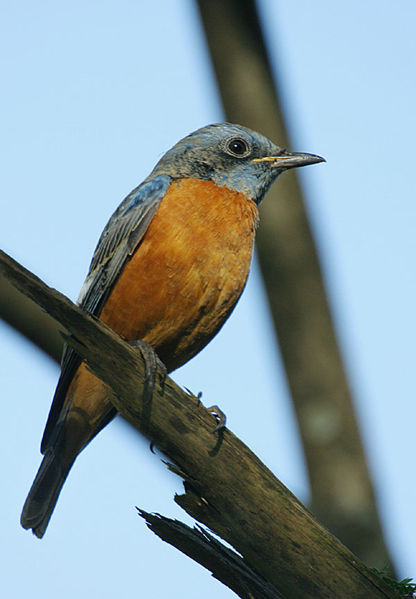
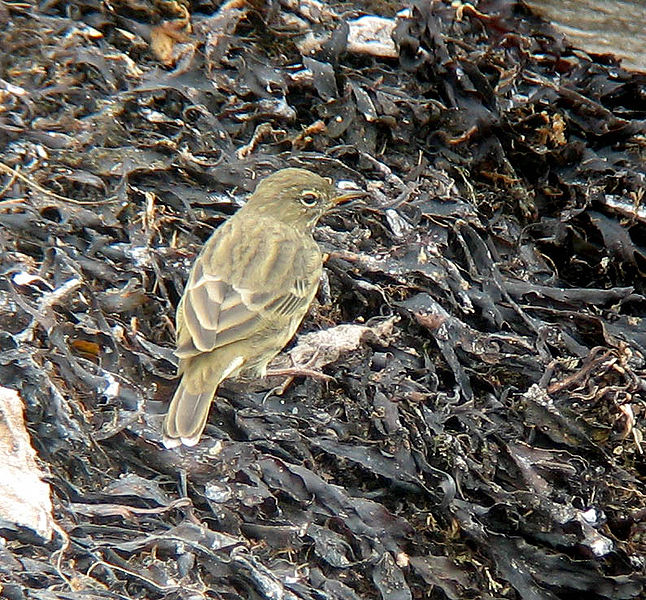
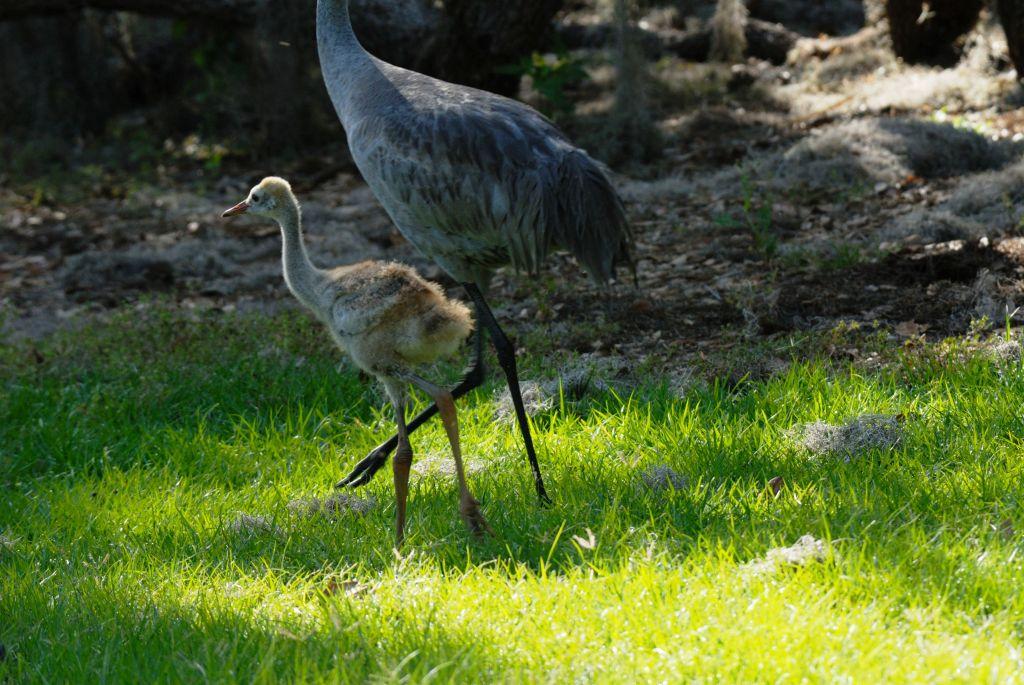
Sandhill Crane (Grus canadensis) and young by Dan’s Pix
Yea, the stork in the heaven knoweth her appointed times; and the turtle and the crane and the swallow observe the time of their coming; but my people know not the judgment of the LORD. (Jeremiah 8:7 KJV)
We were finally able to find a little bit of time to go birdwatching the other day. Our adventure took us back out to the Circle B Bar Reserve in Lakeland, FL. It was a cloudless morning, around 64 degrees, when we arrived. Dan had his camera along, but I only used my binoculars. One thing nice about the Circle B is its closeness to home. With fuel prices rising, birdwatching nearer to your local areas may become more necessary.
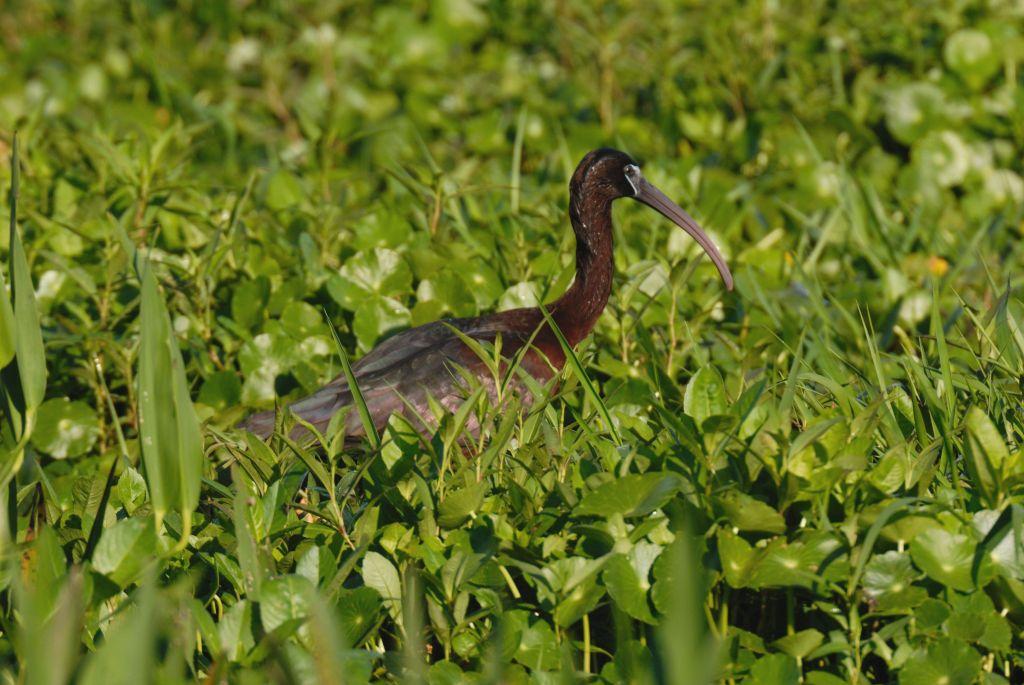
Glossy Ibis (Plegadis falcinellus) by Dan’s Pix
We are fortunate, because Circle B is becoming a premier birding spot here in Florida. With 1,267 acres to roam, there is plenty to see. Unfortunately, many of our “winter visiting birds” have packed their bags and gone back North. Fortunately, we still have our “residents” that keep any trip out there interesting.
Anhinga (Anhinga anhinga) by Dan’s Pix
One of my surprises was the lack of Wood Storks this trip. Usually there are plenty of them hanging out in the trees early in the morning. Never spotted a one, yet two days later in town we spotted one flying over. They are here, but just wanted to make themselves scarce that Friday.
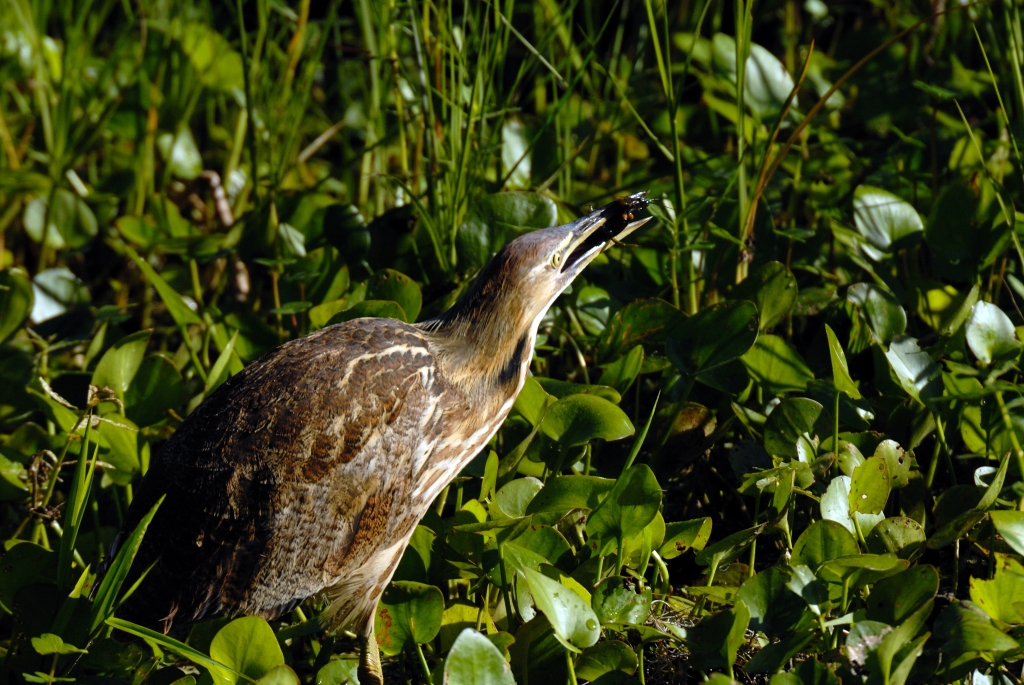
American Bittern (Botaurus lentiginosus) by Dans Pix
Another surprise was finding the American Bittern. We knew there were some out there, but kept missing them. This time I spotted one, whipped out my phone, and called Dan to bring his camera to my location while I kept the Bittern in view. He got one shot just as it had caught something.
Little Blue Heron (Egretta caerulea) imm by Dan’s Pix
One of my favorite birds was an immature Little Blue Heron. When they are young, they are white instead of blue. As they mature, the become “blotchy” as the blue starts to come in. This one was right along the walk path and we were able to view it very well.
Black-bellied Whistling Duck (Dendrocygna autumnalis) with young
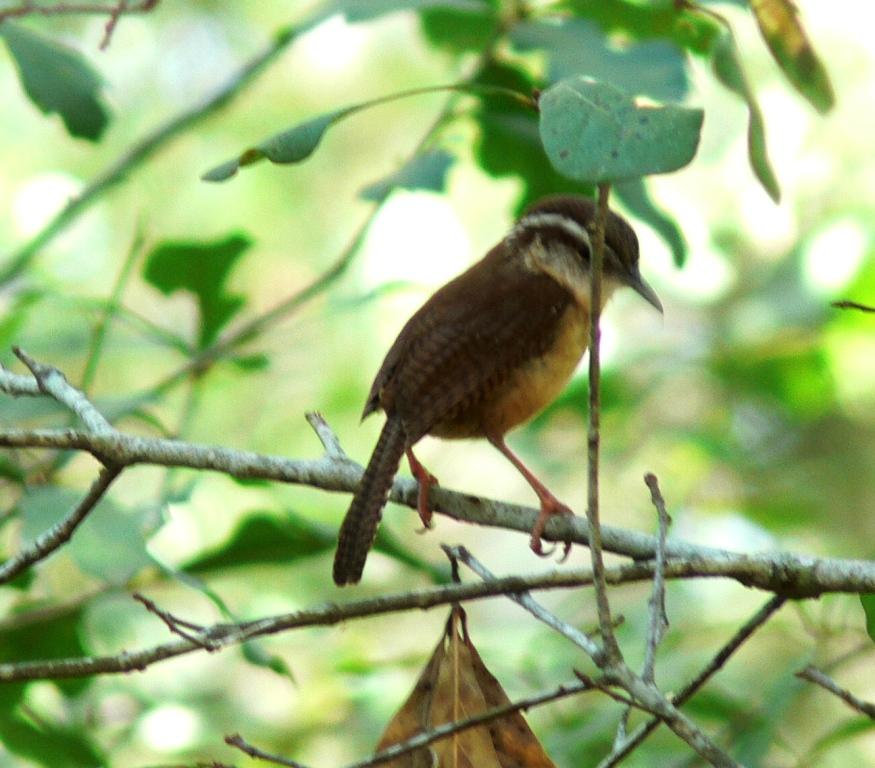
We also found some Glossy and White Ibises, Tricolored Herons, Great Blue Heron, more Little Blue Herons, Great Egrets, a Snowy Egret, Cattle Egrets, the American Bittern, Green Heron, Limpkins, Mourning Doves, Cardinals, Tufted Titmouce, Carolina Wren and maybe a House Wren, Red-bellied, Pileated and Downy Woodpeckers, Common Gallinules, American Coots, Black-bellied Whistlers with young ones, 3 sets of Sandhill Cranes with young, Red-shouldered Hawk (light phase), Anhingas and Double-crested Cormorants, Redwing Blackbirds and Boat-tailed Grackles.
All in all it was a great morning to be out enjoying God’s Creation of birds and other critters. We also observed 4 young alligators about 2-3 feet long and a Black Racer about 4 feet long stretched out along some bushes.
See our other birdwatching trips to Circle B – Click Here
Ian’s Bird of the Week – Turquoise Parrot ~ by Ian Montgomery
Maybe I was tempting fate when last week I publicly declared my target species of the Pilliga trip to be the Turquoise Parrot, but fate was kind to me when I did the same thing with the Resplendent Quetzal on the eve of my visit to Costa Rica last year.
In truth I felt I needed a bit of help as I’ve been wanting to get reasonable photographs of these gorgeous birds since taking a very poor one of a female in the Warrumbungles in New South Wales in pre-digital days almost exactly eleven years ago. To that end I’d visited both the Warrumbungles and the Capertee Valley west of Sydney several times over the years, detoured via Warwick in Southern Queensland and camped the night in Chiltern in Northern Victoria, all places where this species has been reported.
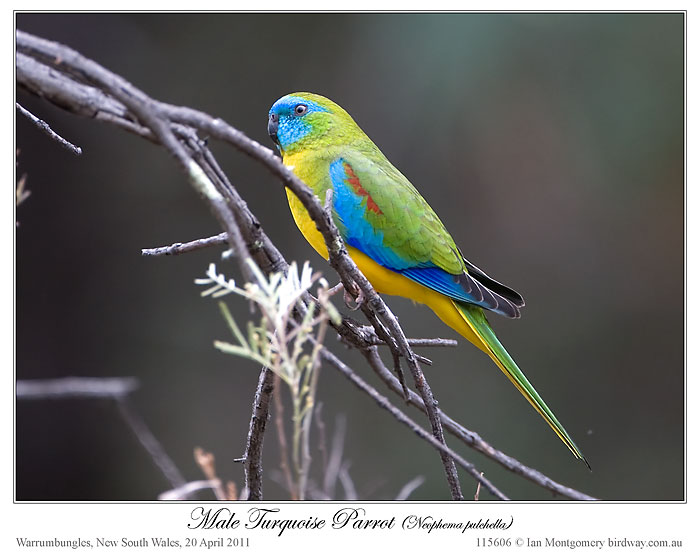
Turquoise Parrot (Neophema pulchella) by Ian
We went to the Warrumbungles last Wednesday and we were just about to leave the second site – the Woolshed – recommended by a helpful but not optimistic ranger (‘they haven’t been seen for a month or two’) when Ivor, one of my two sharp-eyed companions, spotted a female on exactly the same powerlines as eleven years ago, but this time she flew off towards the creek without waiting to have her photo taken. A careful search of the creek revealed nothing even vaguely turquoise but eventually we found about 20 birds feeding on the grassy track on the far side.
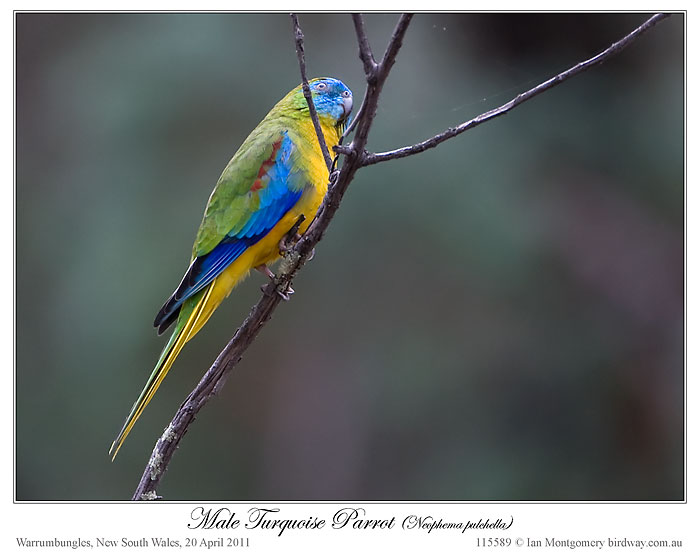
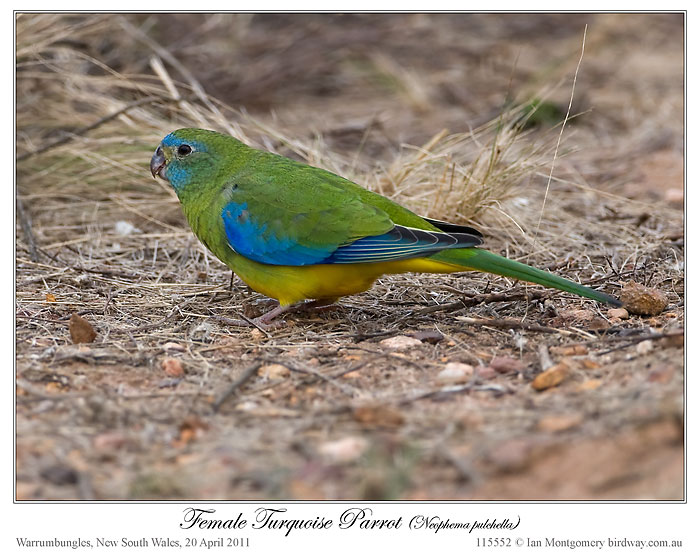
I spent about 20 minutes sidling up to these birds as gradually as possible. The first two photos are of adult male birds, distinguishable by the reddish shouldered patches, which flew up into a shrub as I approached. The second male seems to be eyeing me quizzically as if wondering what I’m up to. The third photo is of a female feeding on the path.
Turquoise Parrot (Neophema pulchella) by Ian
Misión completa, as they said in Costa Rica, and thank you, fate.
Ask, and it shall be given you; seek, and ye shall find; knock, and it shall be opened unto you: (Matthew 7:7 KJV)
I know last week when Ian said he was off on an adventure to find that Turquoise Parrot, I prayed and asked that he find one. I was being a little selfish because I had never seen one and was trusting that his group would spot one. Whichever, fate or prayer, it is a choice we all make. I prefer the later.
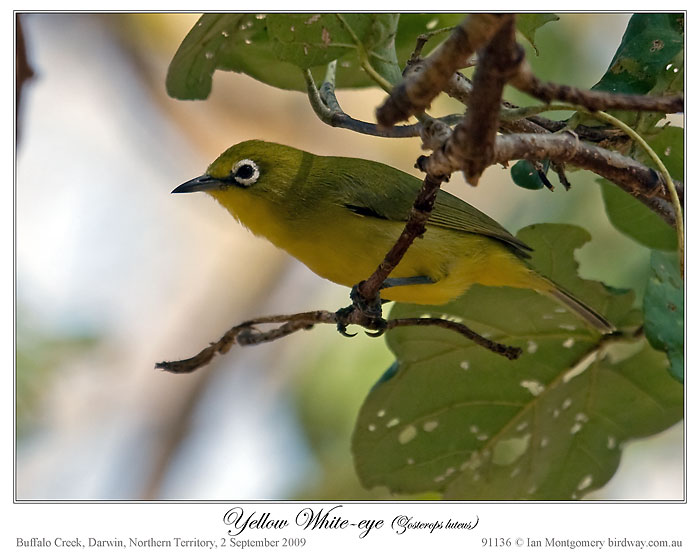
Canary (yellow) White-eye (Zosterops luteus) by Ian
Ian’s Bird of the Week – Yellow White-eye ~ by Ian Montgomery
Newsletter – 4/15/11
This week’s bird, the Yellow White-eye is a mangrove-dwelling relative of the widespread and familiar Silvereye. While the Silvereye is well-known in gardens and orchards of all the more densely populated areas of mainland Australia and Tasmania, the Yellow White-eye is confined to coastal areas of northern Western Australia, the Northern Territory and northwestern Queensland with one very isolated population near Ayr south of Townsville. So you have to go out of your way to find it, but it is quite common in suitable habitat within its range.
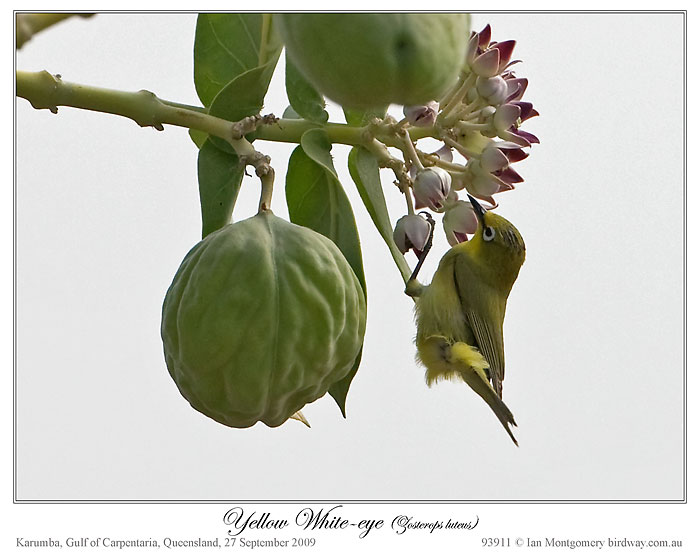
Canary (yellow) White-eye (Zosterops luteus luteus) by Ian
The first photo was taken at Buffalo Creek near Darwin and the second near Karumba on the southern end of the Gulf of Carpentaria. Incidentally, I’d be interested to hear from anyone who can identify the pink-flowered shrub with the White-eye-sized fruit (Yellow White-eyes are 11-12cm/4.3-4.7in). Birds from these regions are yellower than the Western Australian birds and some taxonomists split the species into two sub-species. These yellower northern and eastern birds belong to the nominate race luteus while the greener birds in Western Australia belong to the race balstoni.
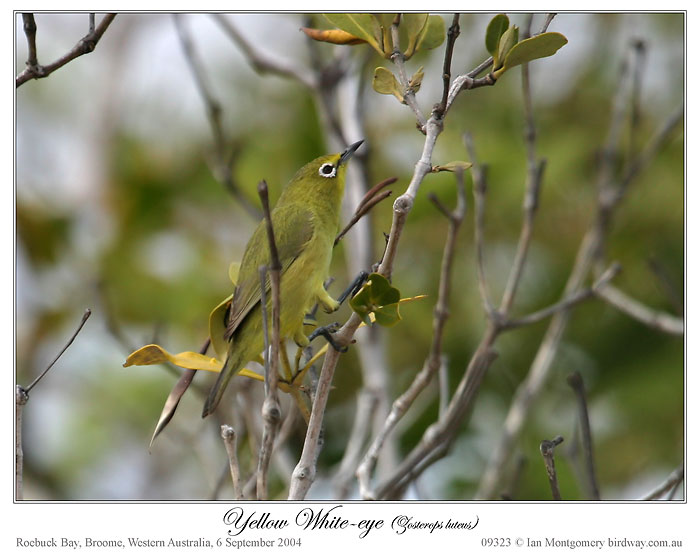
The third photo was taken at Roebuck Bay near the Broome Bird Observatory and belongs to this greener race. The difference is subtle and I imagine you would need to compare birds directly to see the distinction. More striking is how well the plumage matches the colour of the leaves of the mangroves. Like Silvereyes, Yellow White-eyes are very lively and vocal so if they are around, they are not hard to find.
Canary (yellow) White-eye (Zosterops luteus balstoni) by Ian
The apparently endless wet season has finally ended in North Queensland and this week we have all been enjoying lovely sunny days and moonlit nights. I’m making preparations to travel with friends to the Easter campout being organised by the Northern NSW group of Birds Australia in Baradine in the Pilliga Scrub/Forest between Coonabarabran and Narrabri. There are some interesting birds there (I have my sights set on Turquoise Parrot) and I hope I’ll be able to share some of them with you.
Best wishes,
Ian
—
Ian Montgomery, Birdway Pty Ltd,
454 Forestry Road, Bluewater, Qld 4818
Phone: 0411 602 737 +61-411 602 737
Preferred Email: ian@birdway.com.au
Website: http://birdway.com.au
Thanks for introducing us to another interesting bird. The I.O.C. World Bird List has this bird as the Canary White-eye. This is another example of why the Scientific names are important. No matter what the bird is called, the scientific name assures that the same bird is being described.
I am trusting Ian will be able to capture through his lens that Turquoise Parrot. That sounds like another neat bird.
Keep me as the apple of the eye, hide me under the shadow of thy wings, (Psalms 17:8 KJV)
Beside them the birds of the heavens dwell; they sing among the branches…. O LORD, how manifold are your works! In wisdom have you made them all; the earth is full of your creatures. (Psalms 104:12, 24 ESV)
It has been hard to find the time lately to go out on a birdwatching trip, but we have been seeing quite a few birds. Do you ever have times like that? Unfortunately, those are the times when you see some interesting bird, but you are not prepared to take a photo or have a notepad at hand. That has been the case with us recently. Though a true bird watcher is always on the lookout for avian friends to view.
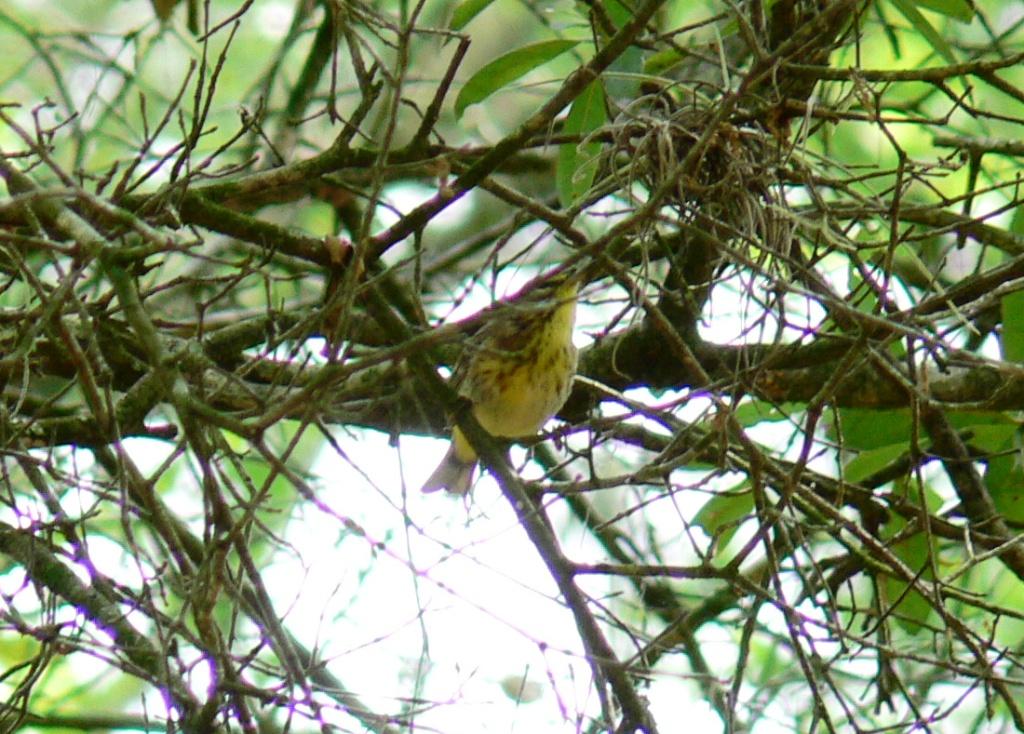
Unknown Warbler by Lee
We’ve had company, my sister and her husband, a short family reunion out of town, and a trip to South Carolina, and on and on. By the time we get a chance to go out with cameras in hand, all of our birds will have flown back north for the summer. Oh, well! Those of you who live north of us will be glad to see their feathered friends arrive and start their nesting season. Take good care of them and send them back to us in the fall.
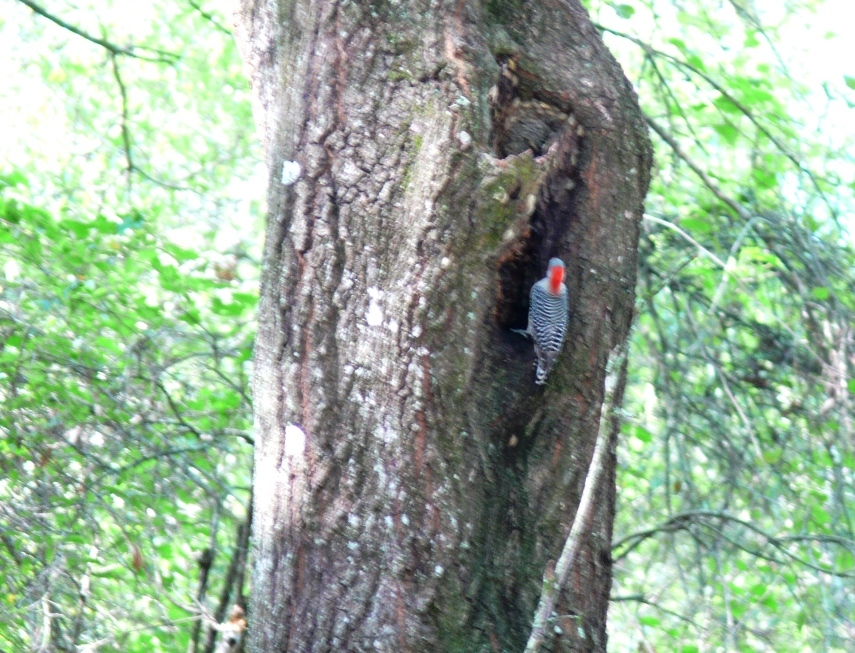
We have seen some birds we don’t normally see here near the house. At my brothers, near Webster, FL, we either heard or saw Pileated Woodpeckers and Red-bellied Woodpeckers, Blue Jays, Carolina Wren, Tufted Titmice, Mourning Dove, American Crow, and an unknown to me warbler. We watched the Red-bellied coming in an out of a nest. Did have a camera, but not the normal one. Not the best photo. At my feeder, I spotted a House Finch that was an orange variant. In our neighborhood recently I spotted a Pileated Woodpecker, Lesser Yellowlegs, and a baby Sandhill Crane with its parents.
Red-bellied Woodpecker (Melanerpes carolinus) by Lee
Being at my brother’s house, which is in a very wooded area, helped me realize that I need more practice hearing and identifying birds by their sounds. It was hard to spot most of them, but they were there singing and calling, but my lack of practice, made it hard to put names on them. There are many good programs and websites that can help teach the sounds.
All of this was said to encourage you to stay alert to what is around you. Planned or unplanned, birdwatching is always interesting and many times surprises comes in to view or a sound comes into your ear.
The I.O.C Version 2.8 of the World Bird List is out and the Birds of the World is being updated.
P.S. If you know what that bird is, please leave a comment.
Ian’s Bird of the Week – Little Egret ~ by Ian Montgomery
Newsletter ~ 4/6/11
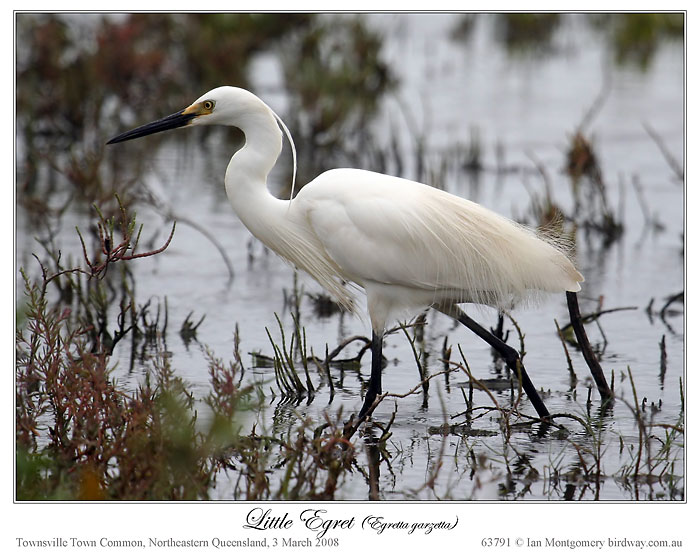
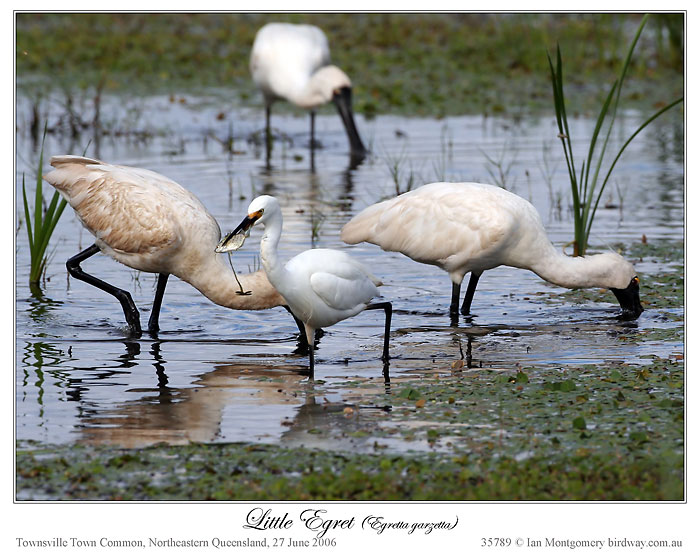
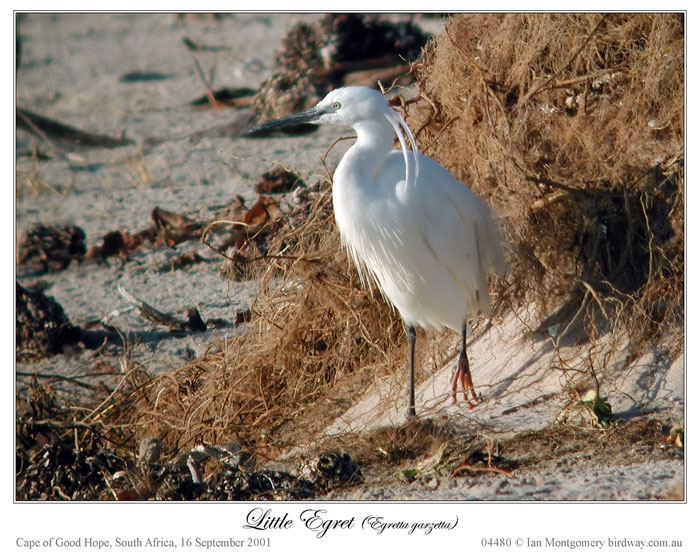
I’ve recently been updating the Heron and Egret galleries (Ardeidae) on the website and I noticed that the elegant Little Egret hadn’t yet featured as bird of the week. Its one of five species of egret resident in Australia and in breeding plumage it is easily distinguished by the only one to have a pair of head plumes – as in the first photo – in addition to breast and back plumes. The only other egrets globally with these head plumes are the closely related Snowy Egret of the Americas and the possibly conspecific Western Reef Egret, neither of which has been recorded in mainland Australia (there are records of the Western Reef Egret in the Cocos Islands).
Little Egret (Egretta garzetta) by Ian
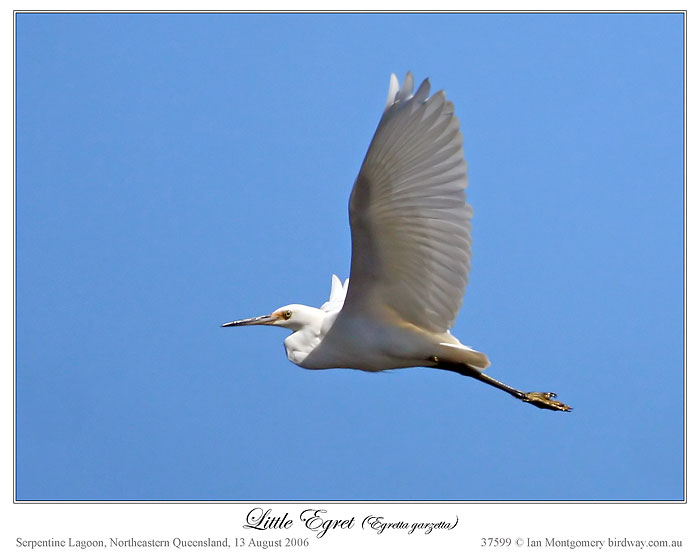
In non-breeding plumage, it lacks plumes and is most easily separated from the similarly-sized Intermediate Egret by having a dark bill rather than a yellow or orange one. It’s best and worst field mark is the yellowish feet – best because this feature is shared only with Snowy and Western Reef Egrets and worst because you usually can’t see the colour of the feet in their normal habitat – wetlands – though visible in flight as in the second photo.
In Australia, the Little Egret is commonest in northern Australia, but also occurs in smaller numbers in eastern and southeastern Australia, in Tasmania in winter and in central and western Australia when conditions are suitable. It also extends widely through Eurasia and Africa. The Australian race has yellow lores between the bill and the eye, but that of the nominate Eurasian race normally has blue-grey lores as in the fourth photo of one on a beach at the Cape of Good Hope. Globally, Little Egrets are quite variable and their taxonomy is still poorly understood.
Like other egrets, the global population of Little Egrets suffered severely in the late 19th century because of the fashion trade in plumes. It was this trade in plumes that lead to the establishment of the RSPB in 1889, a silver lining if there was one, and populations have recovered since.
the stork, the heron after its kind, and the hoopoe and the bat. (Deuteronomy 14:18 NKJV)
The Egrets keep company with Heron and Bitterns in the Ardeidea Family of the large Pelecaniformes Order which includes the Pelicans, Ibises, Spoonbills, Hamerkop and Shoebill.
The Heron is one of the birds mentioned in the Bible, so is found in our Birds of the Bible – Heron page.
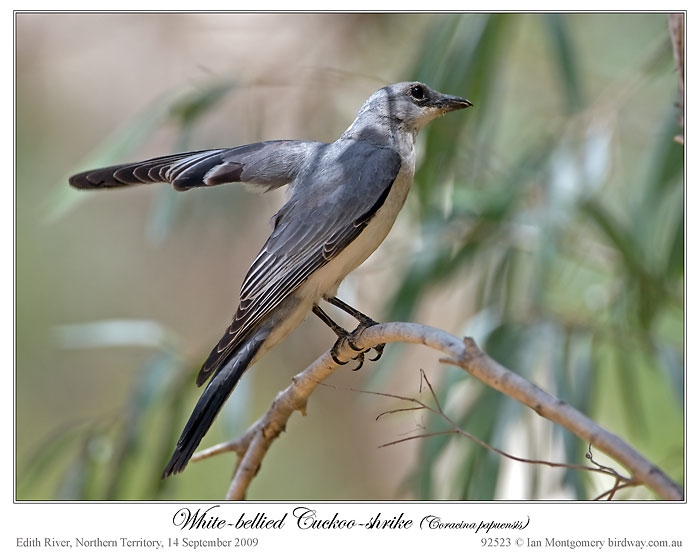
White-bellied Cuckooshrike (Coracina papuensis robusta) by Ian
Ian’s Bird Of The Week – White-bellied Cuckooshrike ~ by Ian Montgomery
Newsletter – 3/27/11
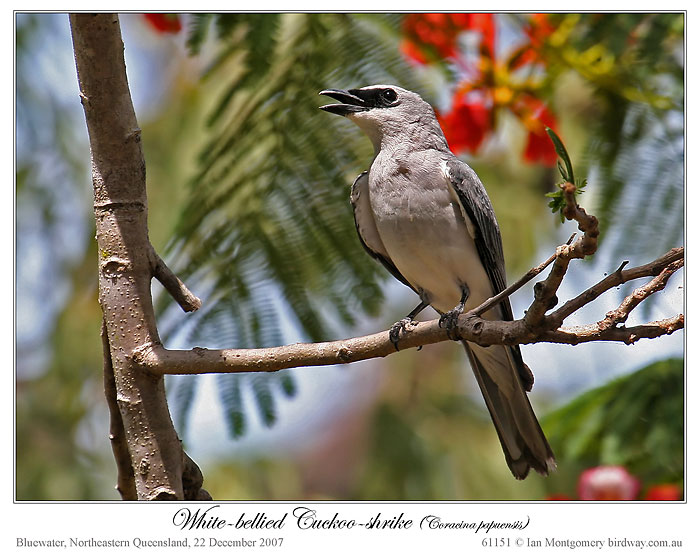
Not only colourful birds are beautiful. Take, for example, the monochrome Cuckooshrikes, such as the White-bellied. ‘Dapper’ comes to mind, though my dictionary defines it as meaning ‘up-to-date in dress and manners, and there is something timeless about the beauty of birds. I find the soft greys of Cuckooshrikes quite lovely and the contrasting white and black touches make them completely ready for the most formal occasion.
White-bellied Cuckooshrike (Coracina papuensis robusta) by Ian
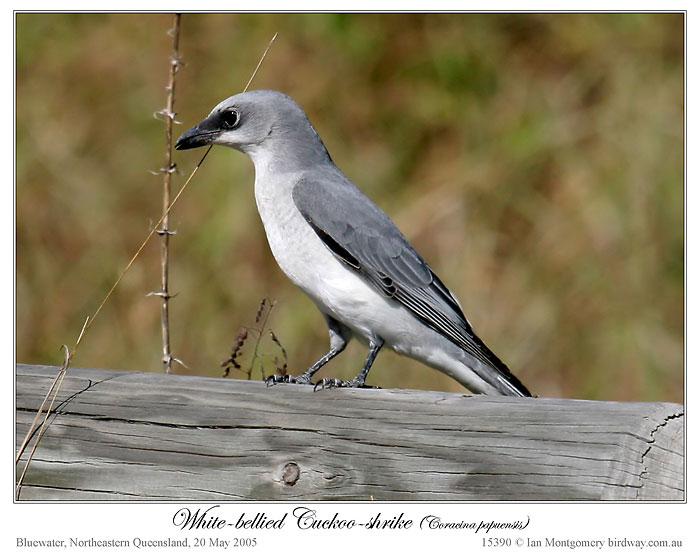
The best known Cuckooshrike in Australia is the very widespread Black-faced, but in North Queensland the smaller White-bellied is usually much commoner, though the migrant Black-faced can be numerous in the (winter) dry season. The first photo shows an adult of the eastern Australian race robusta perched in a red-flowering Poinsiana near my house. The second photo is of a juvenile bird, also in my garden, with the characteristic faintly barred breast and dark smudge behind the eye.
White-bellied Cuckooshrike (Coracina papuensis hypoleuca) by Ian
The third photo shows the paler, white-breasted, northern race hypoleuca, found in the Northern Territory and northern Western Australia. It merely looks like it’s got a broken wing: it’s actually in the middle of the wing shuffle performed both by this species and the Black-faced after landing and, apparently, during display. The shuffle is done very deliberately and the birds look as if they are having trouble folding their wings comfortably. The Black-faced is sometimes called the ‘Shufflewing’, arguably a much better name than ‘cuckooshrike’ as they are not related to either cuckoos or shrikes and shrikes are meaninglessly unknown in Australia, except as rare vagrants.
White-bellied Cuckooshrike (Coracina papuensis robusta)dark morph by Ian
Interestingly, the White-bellied seems to have some black-faced genes lurking in its genome, as there is an uncommon dark morph of the race robusta, fourth photo, which could easily be confused with the larger Black-faced Cuckooshrike, though the dark morph of the White-bellied has black scallops between the breast and the belly. The species are distinguishable by call. Both are quite vocal, with the Black-faced having a musical ‘chereer’ while the White-bellied is a peevish ‘kissik’: if it sounds as if it’s complaining, it’s a White-bellied.
Thanks, Ian, for introducing us to another interesting bird. The Cuckoo is a Bird of the Bible, but I am not sure if the Cuckooshrike comes under that “kind” or not. The KJV spells it, “cuckow” and the MKJV “cuckoo.”
and the owl, and the night hawk, and the cuckoo, and the hawk after its kind, (Deuteronomy 14:15 MKJV)
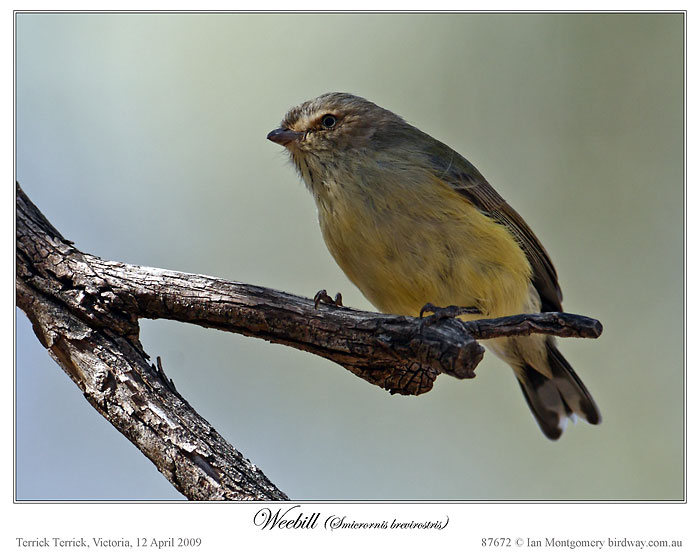
Weebill (Smicrornis brevirostris) by Ian Montgomery
Ian’s Bird of the Week – Weebill ~ by Ian Montgomery
I’ve recently been reformatting the photo galleries of the Thornbills and Allies (Acanthizidae) on the website. This is a family of small, mostly insectivorous birds and here, with a length of 8-9cm/3.2-3.5in, is the diminutive Weebill. It is widespread in drier woodlands, including Mallee, across mainland Australia, but absent from Tasmania and is not found in wetter forests. It has a characteristic stubby horn-coloured bill, pale eyebrow and pale iris, as in the first photo, which distinguishes it from the rather similar Yellow Thornbill. This photo, taken in Victoria, shows the browner nominate race found Victoria, New South Wales, southern Queensland and eastern South Australia.
Weebill (Smicrornis brevirostris) by Ian Montgomery
The northern race (flavescens), second photo, taken on Southern Cape York Peninsula, ranges across the most of the rest of northern and central Australia is much yellower in colour and slightly smaller, making it the smallest bird in Australia. They are often to be found in very harsh, dry habitats and I am frequently impressed that such small birds are so tough and such great survivors.
Weebill (Smicrornis brevirostris) by Ian Montgomery
The third photo, taken in Northwestern Queensland, is also of this race but is, I think, an immature bird, less brightly coloured and a greyish rather than white iris. In southwestern Western Australia, the northern race grades into another race (occidentalis) with a greyish face with a rufous tinge, but I haven’t photographed it.
Weebills are lively, vocal little birds with a remarkably strong voice so you often hear them before you spot them busily feeding in the foliage of trees. The call is rendered something like ‘wee-willey-weet weet’ but I was told to remember ‘I’m a little Weebill’ and that works for me.
P. S. There was an error in last week’s Yellow-spotted Honeyeater. I said that the Yellow-spotted and the Graceful where North Queensland endemics when I should have said that in Australia, they occur only in North Queensland. They also occur in New Guinea.
Lee’s Addition:
What a cute little bird. After you check out Ian’s links to the Acanthizidae he has photographed, see the Acanthizidae Family of the Passeriformes Order in our Birds of the World section.
And to every beast of the earth and to every bird of the heavens and to everything that creeps on the earth, everything that has the breath of life, I have given every green plant for food.” And it was so. (Genesis 1:30 ESV)
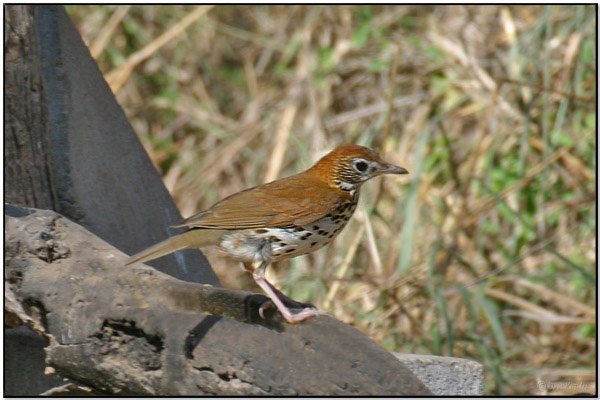
Wood Thrush (Hylocichla mustelina) by Daves BirdingPix
Storks, doves, swallows, and thrushes all know when it’s time to fly away for the winter and when to come back. But you, my people, don’t know what I demand. (Jeremiah 8:7 CEV)
I recently added the Birds of the Bible – Thrushes page. It now appears in the Sidebar and in the Birds of the Bible List. While comparing the Scripture on Jeremiah 8:7, I decided that the Thrushes deserved to be a Bird of the Bible on this blog. As you know, all birds are “Birds of the Bible,” because the Lord created them all. Mainly the ones named in particular have been given their own page. Since Jeremiah 8:7 is translated “thrush” in six Bible versions, it now has its own page.
So God created great sea creatures and every living thing that moves, with which the waters abounded, according to their kind, and every winged bird according to its kind. And God saw that it was good. (Genesis 1:21 NKJV)
Not all versions of the Bible list the Thrush in this verse, but because so many versions do, the Thrush is being added to the Birds of the Bible. The following versions and the verse are listed below:
(CEV) Storks, doves, swallows, and thrushes all know when it’s time to fly away for the winter and when to come back. But you, my people, don’t know what I demand.
(ERV) Even the birds in the sky know the right time to do things. The storks, doves, swifts, and thrushes know when it is time to fly to a new home. But my people don’t know what the LORD wants them to do.
(GNB) Even storks know when it is time to return; doves, swallows, and thrushes know when it is time to migrate. But, my people, you do not know the laws by which I rule you.
(LITV) Also the stork in the heavens knows her seasons, and the turtledove and the swallow and the thrush observe the time of their coming. But My people do not know the judgment of Jehovah.
(NAS77) “Even the stork in the sky Knows her seasons; And the turtledove and the swift and the thrush Observe the time of their migration; But My people do not know The ordinance of the LORD.
(NASB) “Even the stork in the sky Knows her seasons; And the turtledove and the swift and the thrush Observe the time of their migration; But My people do not know The ordinance of the LORD.
Yellow-spotted Honeyeater (Meliphaga notata) by Ian
Ian’s Bird Of The Week – Yellow-spotted Honeyeater ~ by Ian Montgomery
Newsletter – 03-13-11
I’ve been working on the Honeyeater galleries on the website recently and a Yellow-spotted Honeyeater showed up outside my house a few days ago, pushing this species into the foreground when I was contemplating the choice of this week’s bird. Bluewater is at the southern end of its range, so it turns up only occasionally and this one is presumably a cyclone Yasi refugee.
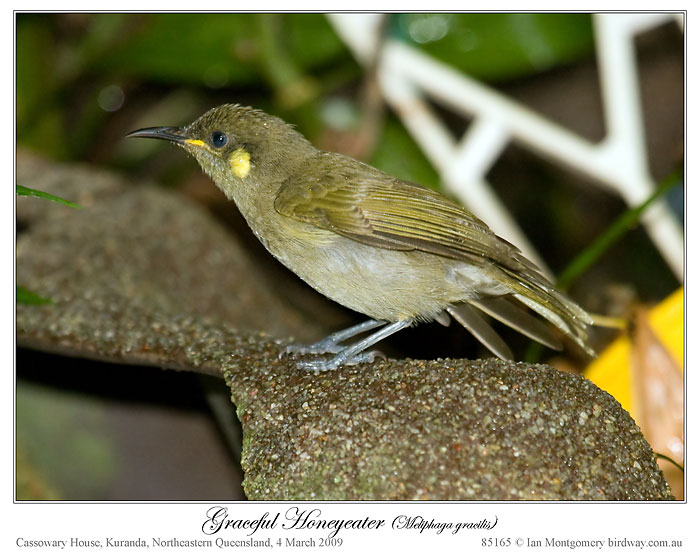
It’s very similar to the Graceful Honeyeater, which has an almost identical range from just north of Bluewater (Rollingstone) to Cape York, so they are both North Queensland endemics and, in turn, similar to Lewin’s Honeyeater, which occurs right along the east coast of Australia as far south as Melbourne. Both the Yellow-spotted and the Graceful are common in forest habitats in North Queensland and I had trouble separating them when I first moved up here until I learnt their calls – the easiest way to distinguish them – so a comparison of the three species might be of interest and I’ve selected photos taken under similar condition using flash in poor light, typical of forests.
Lewin's Honeyeater (Meliphaga lewinii) by Ian
The Yellow-spotted – first photo – is intermediate in size (17-19cm/6.7-7.5in) between the larger Lewin’s – second photo – (19-22cm/7.5-8.7) and the smaller Graceful – third photo – (14-17cm/5.5-6.7in), so perhaps the key is to separate it from the other two species. Lewin’s has a dark-grey face (in front of the ear-patch), a large half-moon-shaped ear patch and a heavier bill. Both have longish pale-yellow, almost whitish, gapes. The typical call of the Lewin’s is the familiar loud and regular ‘machine-gun’ rattle of the forest of eastern Australia; that of the Yellow-spotted is clearly related but different: slower and descending. Both also have harsh chattering calls, differing in tone and intensity in a similar way to the machine-gun calls – that of the Lewin’s is louder and harsher in a bigger-bird sort of way.
Both the Yellow-spotted and the Graceful have greenish faces and smallish ear-patches which look similar to me (though some field guides make distinctions such as ’rounded triangle, yellow’ versus ’rounded, cream’: huh?). The gapes, however, are quite different, that of the Yellow-spotted being long and pale like that Lewin’s while that of the Graceful is shorter and very yellow (chrome). The Graceful has a longer bill with a decurved lower edge (that of both Lewin’s and Yellow-spotted is almost straight), though I’ve found that a tricky field mark unless you get a good, exactly lateral view. Happily, the call of the Graceful is very different, a sharp ‘tuck’ or ‘pik’ repeated at intervals and very distinctive.
Graceful Honeyeater (Meliphaga gracilis) by Ian
All three species are quite vocal and in the forest you normally hear them before you see them, so I find it best to use the visual field marks to confirm an auditory identification, particularly if you find the Graceful and the Yellow-spotted together, which happens sometimes. In the north, the Lewin’s is more of a highland species, though it does move down in winter, and it’s unusual to find it in the company of the other two.
At home the good news is that my lone cyclone-surviving male Blue-winged Kookaburra seems to have attracted a mate, and there were plenty of Dollarbirds around yesterday.
Best wishes,
Ian
—
Ian Montgomery, Birdway Pty Ltd,
454 Forestry Road, Bluewater, Qld 4818
Phone: +61-7 4751 3115
Preferred Email: ian@birdway.com.au
Website: http://birdway.com.au
Water Splashing on Rocks – Point Lobos State Reserve by Daves BP
Therefore whosoever heareth these sayings of mine, and doeth them, I will liken him unto a wise man, which built his house upon a rock: (Matthew 7:24 KJV)
When the Lord created the world and all that is therein, He created the rocks and hills and the birds that He created were well adapted to live in those places. Birdwatchers through the years have observed them in this habitat of rocks, stones, cliffs, and other high rocky places. Just as Adam named the first birds, ornithologists (bird people) are still naming birds.
Searching through the latest IOC 2.7 List of Birds, I found 50 birds with “Rock” in their names. Searching the Bible for the word “Rock”, I found around 130 verses referring to a “rock” or “The Rock.” Here is a blend of the birds and some of the Scriptures verses that show the mighty Hand of God at work and the neat “Rock Birds” Formed by Him.
Here is the list of the last 25 birds with “Rock” in their name in taxonomic order with a few words about them :
O come, let us sing unto the LORD: let us make a joyful noise to the rock of our salvation. (Psalms 95:1 KJV)
Rockrunner (Achaetops pycnopygius) – The Rockrunner is a monogamous bird which means that the bird finds and breeds with one partner for the rest of its life. The bird lays between 2 to 3 eggs and they are coloured red.
The nest is built high up in the tree canopy and is protected from predators by branches and the dense green foliage.
Rock-loving Cisticola (Cisticola emini) – It is usually associated with rocky wooded terrain with interspersed patchy grass tussocks. Forages in rocks or rank vegetation for insects. Split from the Lazy Cisticola.
Rock Wren (Salpinctes obsoletus) – Their breeding habitat is dry rocky locations, including canyons, from southwestern Canada south to Costa Rica. This bird builds a cup nest in a crevice or cavity, usually among rocks.
These birds are permanent residents in the south of their range, but northern populations migrate to warmer areas from the central United States and southwest Canada southwards. They are occasional vagrants in the eastern United States.
These birds actively hunt on the ground, around and under objects, probing with their bill as their extraction tool. They mainly eat insects and spiders. Neat Video This bird’s song is a trill, becoming more varied during the nesting season.
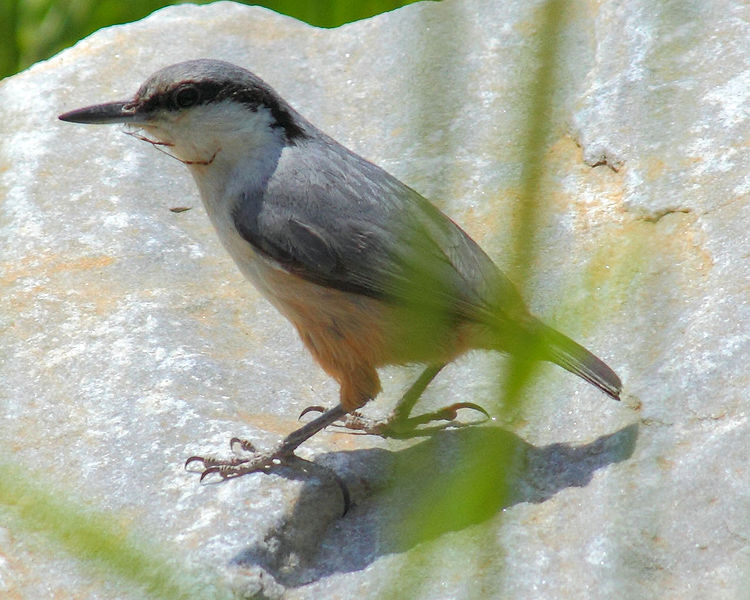
Western Rock Nuthatch (Sitta neumayer) – Video – The Western Rock Nuthatch is a bird associated with habitats with bare rocks, especially in mountainous areas. Those at the highest altitudes may move lower down in winter.
It feeds on insects and spiders in summer, supplemented with seeds and snails in winter. It feeds on the ground, and will wedge larger items in rock crevies while it hammers them open with its strong bill. It will also flycatch.
This territorial species builds a flask-shaped nest from mud, dung and hair or feathers in a rock crevice, cave, or under an overhang on a rock face. Decorative items may be pushed into crevices and cracks near the entrance to the nest. The nest is lined with softer materials and the entrance is sealed with mud. 4-10 eggs are laid, and are white speckled with yellow.
In God is my salvation and my glory: the rock of my strength, and my refuge, is in God. (Psalms 62:7 KJV)
Brown Rock Chat (Cercomela fusca) – Video – Habitat: Rocky hills, ravines, ruins of ancient tombs and forts, and in suburban compounds, occasionally visiting inhabited homes or nesting in rafters.
Brown-tailed Rock Chat (Cercomela scotocerca) – Photo – A seriously undistinguished little bird that only a birder or ornithologist would bother looking for! It’s main distinguishing feature is its brown-ness and it’s distinguished from the similar Red-tailed Chat by the fact that it’s well, browner. It’s fairly uncommon and prefers rocky bush country. It’s range extends down as far as Samburu, but the best place we’ve found to see it is near Lake Baringo where it can usually be found at the base of the basalt cliffs just West of the lake. Even there it can be difficult to spot since it blends in well against the rocks and dust, especially in the dry season when evrything looks (wait for it) brown. (Kenya Birds)
Cape Rock Thrush (Monticola rupestris) – The rock-thrushes, Monticola, are a genus of chats, medium-sized mostly insectivorous or omnivorous songbirds. All are Old World birds associated with mountainous regions.
Sentinel Rock Thrush (Monticola explorator) – Same as above – Video by Keith Short-toed Rock Thrush(Monticola brevipes) – Same as above – It is found in Angola, Botswana, Namibia, and South Africa. Its natural habitat is subtropical or tropical dry shrubland.
He brought me up also out of an horrible pit, out of the miry clay, and set my feet upon a rock, and established my goings. (Psalms 40:2 KJV)
Miombo Rock Thrush (Monticola angolensis) – Same as above Rufous-tailed Rock Thrush (Monticola saxatilis) (Common) – Same as above Little Rock Thrush (Monticola rufocinereus) – Same as above – It is found in rocky areas with some trees, and sometimes near settlements.[2][3] At 15 to 16 centimetres (5.9 to 6.3 in) this is the smallest of the rock thrushes.
Blue Rock Thrush (Monticola solitarius) – Same as above – Blue Rock Thrush breeds in open mountainous areas, usually higher than the breeding zone of the related Rufous-tailed Rock Thrush. It nests in rock cavities and walls, and usually lays 3-5 eggs. An omnivore, the Blue Rock Thrush eats a wide variety of insects and small reptiles in addition to berries and seeds.
This is a starling-sized bird, 21–23 cm in length with a long slim bill. The summer male is unmistakable, with all blue-grey plumage apart from its darker wings. Females and immatures are much less striking, with dark brown upperparts, and paler brown scaly underparts. Both sexes lack the reddish outer tail feathers of Rock Thrush. The male Blue Rock Thrush sings a clear, melodious call that is similar to, but louder than the call of the Rock Thrush.
The Blue Rock Thrush is Malta’s national bird and is shown on the Lm 1 coins that was part of the previous currency of the country.
Chestnut-bellied Rock Thrush (Monticola rufiventris) – Same as above – It is found in Bangladesh, Bhutan, China, India, Laos, Myanmar, Nepal, Pakistan, Thailand, and Vietnam. Its natural habitat is temperate forests. Blue-capped Rock Thrush (Monticola cinclorhynchus) – Same as above Video – This thrush-like Old World flycatcher breeds in the foothills of the Himalayas and winters in the hill forests of southern India.
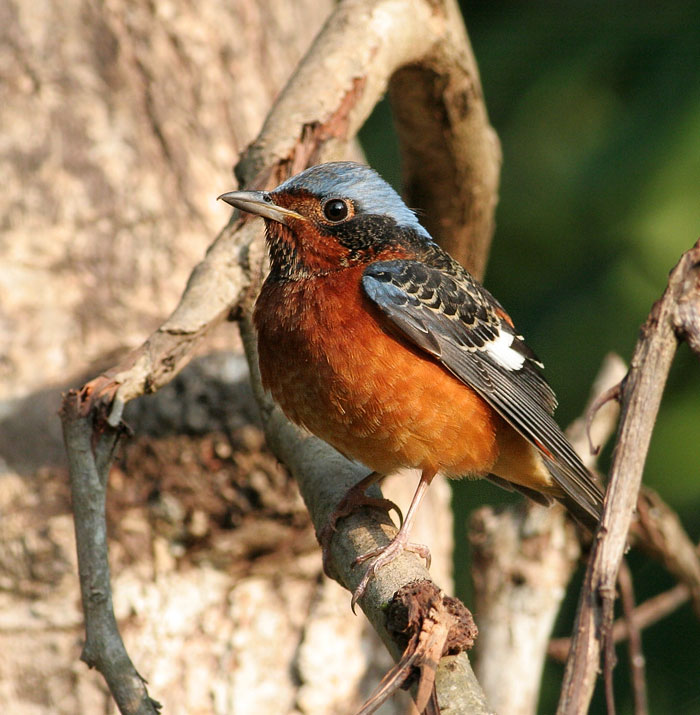
White-throated Rock Thrush by Peter Ericsson
White-throated Rock Thrush (Monticola gularis) – Same as above – It is found in Cambodia, China, Hong Kong, Japan, North Korea, South Korea, Laos, Malaysia, Myanmar, Russia, Singapore, Thailand, and Vietnam. Its natural habitat is temperate forests. Littoral Rock Thrush (Monticola imerina) – Same as above – Its natural habitats are dry savanna and subtropical or tropical dry shrubland. Forest Rock Thrush (Monticola sharpei) – Same as above – It is endemic to Madagascar.
And they remembered that God was their rock, and the high God their redeemer. (Psalms 78:35 KJV)
Rockefeller’s Sunbird (Cinnyris rockefelleri) – It is found in Democratic Republic of the Congo, possibly Burundi, and possibly Rwanda. Its natural habitats are subtropical or tropical moist montanes and subtropical or tropical high-altitude shrubland. It is threatened by habitat loss. Pale Rockfinch (Carpospiza brachydactyla) – Photo – Rock Sparrow (Petronia petronia) – This sparrow breeds on barren rocky hills from the Iberian peninsula and western north Africa across southern Europe and through central Asia. It is largely resident in the west of its range, but Asian birds migrate to more southerly areas, or move down the mountains.
As it is written, Behold, I lay in Sion a stumblingstone and rock of offence: and whosoever believeth on him shall not be ashamed. (Romans 9:33 KJV)
Rock Firefinch (Lagonosticta sanguinodorsalis) – Photo – It is commonly found in bushy and rocky outcrops on the Jos Plateau, Nigeria and inselbergs to the north and east. It probably feeds on grass seeds. Eurasian Rock Pipit (Anthus petrosus) – a small passerine bird species which breeds on rocky coasts of western Europe northwards from Brittany. Rock Pipits tend to be found along rocky coasts, whereas Water Pipits favour damp grassland.
African Rock Pipit (Anthus crenatus) – The Yellow-tufted Pipit, also known as the African Rock Pipit, is a species of bird in the Motacillidae family. It is found in Lesotho and South Africa. Its natural habitat is subtropical or tropical high-altitude grassland.
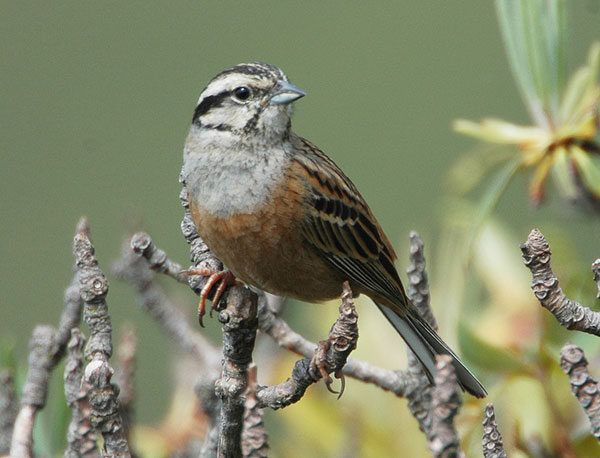
Rock Bunting (Emberiza cia) – Photo – Rock Bunting breeds in open dry rocky mountainous areas. It lays 3-5 greyish eggs in a lined nest on the ground or occasionally in a low bush. Its natural food consists of insects when feeding young, and otherwise seeds.
Doth the eagle mount up at thy command, and make her nest on high? She dwelleth and abideth on the rock, upon the crag of the rock, and the strong place. (Job 39:27-28 KJV)
For thou art my rock and my fortress; therefore for thy name’s sake lead me, and guide me. (Psalms 31:3 KJV)
There are many more verses that mention “The Rock” and there are also many more birds that live and eat in rocky places. They may not have “rock” in their name, but they were all created by The Rock, Jesus Christ.
And to make all men see what is the fellowship of the mystery, which from the beginning of the world hath been hid in God, who created all things by Jesus Christ: (Ephesians 3:9 KJV)
And did all drink the same spiritual drink: for they drank of that spiritual Rock that followed them: and that Rock was Christ. (1 Corinthians 10:4 KJV)
Information mostly from Wikipedia, but other internet sources quoted also. Names according to the IOC 2.7 version.
Ian’s Bird of the Week – Lesser Frigatebird ~ by Ian Montgomery
Newsletter – 3/2/11
This is the third of the post-cyclone Yasi birds of the week. The first dealt with survival of small birds; the second with birds like fruit-doves that move after the cyclone in search of food. Another category of birds greatly affected by cyclones are seabirds, particularly those that spend much time on the wing and these often appear in places where they are not usually seen or get blown inland, sometimes over great distances.
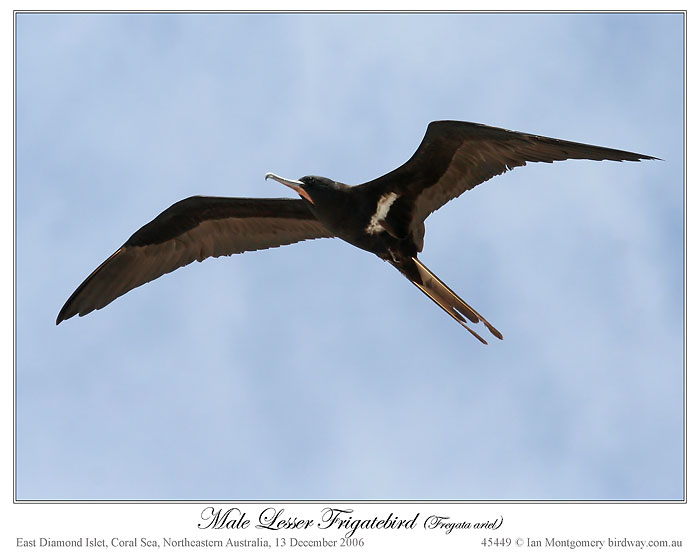
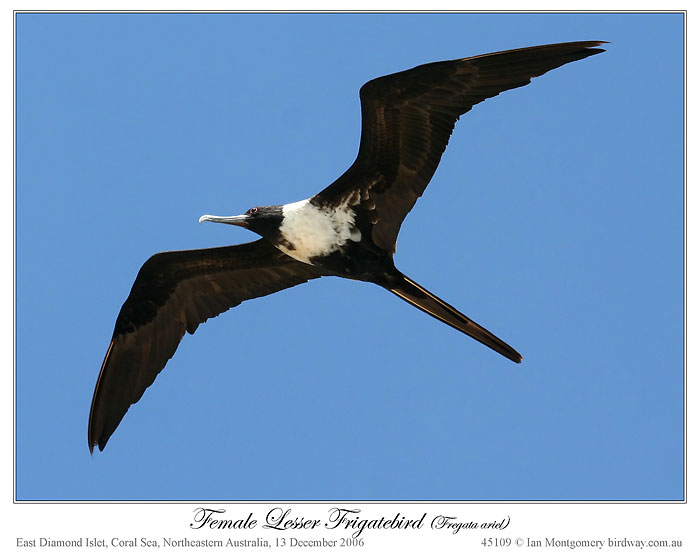
The Lesser Frigatebird is common in oceanic waters of northern Australia and breeds in colonies both on the northern mainland and on cays and islands. Adult birds are normally sedentary, remaining in the vicinity of the colonies, though immature birds may travel widely over the oceans. Frigatebirds not normally seen in places like Townsville, distant from breeding colonies, except after cyclones and cyclone Yasi was no exception with both Great and Lesser Frigatebirds being recorded along the coast. I was surprised to see a pair of Lesser Frigatebirds near my place at Bluewater, 11km from the coast and the birds looked quite out of place soaring over the hills south of the house.
Lesser Frigatebird (Fregata ariel) female by Ian
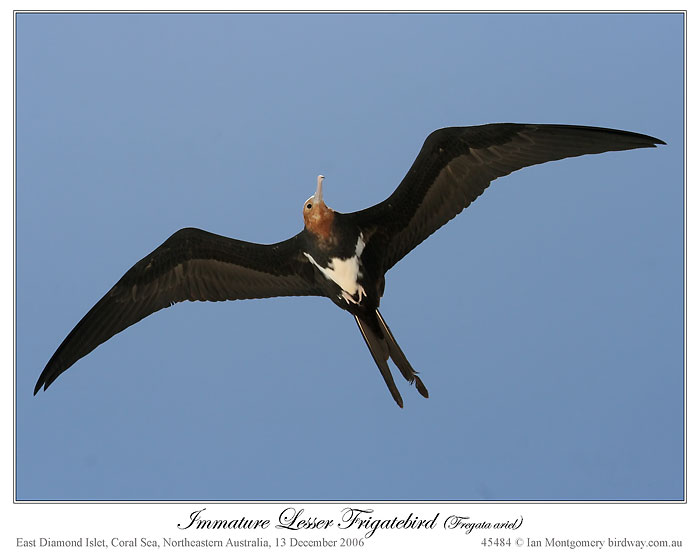
Lesser Frigatebirds are easily distinguished in all plumages from Great Frigatebirds by having white ‘armpits’ or spurs. The first photo shows a male bird, black except for these spurs and male Great Frigatebirds are entirely black. Male Frigatebirds have inflatable red throat pouches used to spectacular effect in displays (for example this male Magnificent Frigatebird in Ecuador: http://www.birdway.com.au/fregatidae/magnificent_frigatebird/source/magnif_frigatebird_27662.htm ). The second photo shows a female Lesser Frigatebird and the third an immature one.
Frigatebirds are huge. Even the Lesser, the smallest of the 5 global species, is 70-80cm/28-32in. in length with a wingspan of 1.8-1.9m/5.9-6.2 feet. They are very light for their size, having very light bones, and are adapted to soaring effortlessly in the trade winds where they are usually found. They are famous as pirates, forcing other seabirds, particularly boobies, to disgorge their prey ( http://www.birdway.com.au/fregatidae/greater_frigatebird/source/greater_frigatebird_39356.htm ), but they are also adept fishers in their own right, snatching flying fish in flight and other fish and cuttlefish from the surface of the water. They have tiny feet, useful only for perching in trees when nesting or roosting and quickly become water-logged if forced to land on water which they normally avoid. They will bathe and drink fresh water in flight ( http://www.birdway.com.au/fregatidae/greater_frigatebird/source/greater_frigatebird_40675.htm ).
Lesser Frigatebird (Fregata ariel) imm. by Ian
11km from the coast is nothing to a frigatebird and it is likely that cyclone-distributed frigatebirds can find their way home (like swifts, they often take advantage of storm fronts). Less fortunate perhaps was the Petrel recorded post-Yasi on the Atherton Tableland by Alan Gillanders, though the record for Yasi goes to a Bridled Tern rescued ‘in bad shape’ in Alice Springs by Chris Watson, probably as far away from the ocean as you can get in Australia.
The latest addition to the website is a taxonomic index of Australian birds ( http://www.birdway.com.au/aus_taxonomic.htm ), showing Orders and Families and with links to the 97 of 103 families of Australian birds represented on the website. The 6 unrepresented families are also shown but lack links. Some of these missing families are merely rare vagrants such as Northern Storm-Petrels and Leaf Warblers (the Arctic Warbler) or introductions like the Ostrich but others such as Penguins (there are only photos of African Penguins) are to be regretted and I hope to rectify this before the year is out. The other two – Scrub-birds and Sheathbills – are in the very hard baskets, and I can’t make any promises. If classification is your thing, this page is for you and you can find it under the grey navigation button ‘Indices to Australian Birds’ formerly singular. There are also instructions on the home page: http://www.birdway.com.au/index.htm#news .
The birds of the air, And the fish of the sea That pass through the paths of the seas. O LORD, our Lord, How excellent is Your name in all the earth! (Psalms 8:8-9 NKJV)
The frigatebirds are a family, Fregatidae, of seabirds. There are five species in the single genus Fregata. They are also sometimes called Man of War birds or Pirate birds. Since they are related to the pelicans, the term “frigate pelican” is also a name applied to them. They have long wings, tails and bills and the males have a red gular pouch that is inflated during the breeding season to attract a mate. They are part of the Suliformes Order.
Frigatebirds are pelagic piscivores which obtain most of their food on the wing. A small amount of their diet is obtained by robbing other seabirds, a behavior that has given the family its name, and by snatching seabird chicks. Frigatebirds are seasonally monogamous, and nest colonially. A rough nest is constructed in low trees or on the ground on remote islands. A single egg[citation needed] is laid each breeding season. The duration of parental care in frigatebirds is the longest of any bird.
Frigatebirds are found over tropical oceans and ride warm updrafts. Therefore, they can often be spotted riding weather fronts and can signal changing weather patterns.
These birds do not swim and cannot walk well, and cannot take off from a flat surface. Having the largest wingspan to body weight ratio of any bird, they are essentially aerial, able to stay aloft for more than a week, landing only to roost or breed on trees or cliffs. (Wikipedia)
Dan and I had the privilege of see a Magnificent Frigatebird flying over Ding Darling NWR.
Ian’s Bird of the Week – Superb Fruit-Dove ~ by Ian Montgomery
Newsletter ~ 02-20-11
One of the tragedies of severe tropical cyclones is the damage to vegetation, particularly fruiting trees, and the resulting avian refugees, many battered and exhausted, fleeing far and wide in search of food. Since cyclone Yasi, many Superb and Wompoo Fruit-Doves and some Brown Cuckoo-doves have been moving through areas such as Bluewater and Townsville. This happened after cyclone Larry in 2006 when many of these refugees stayed around for months, but they are even more numerous this time round.
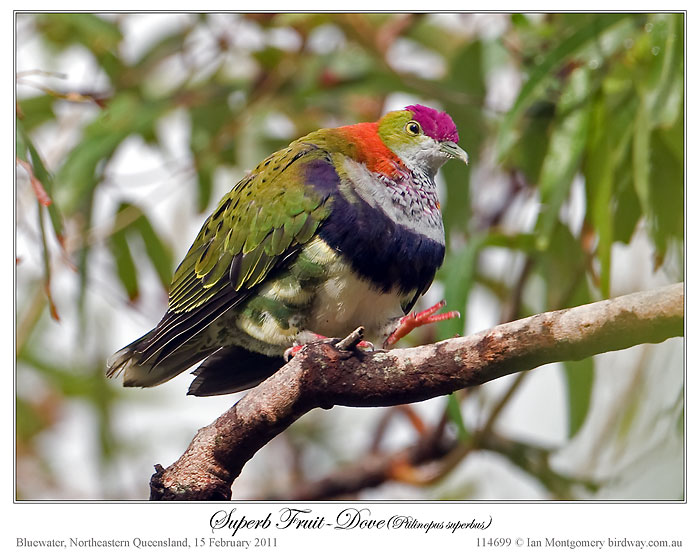
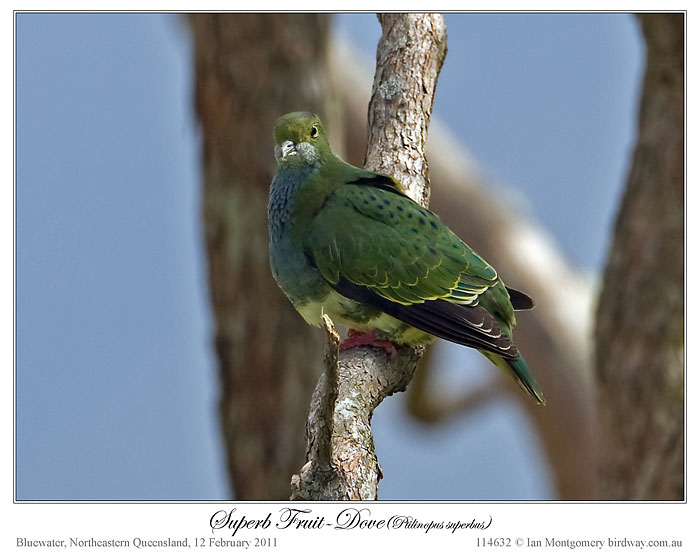
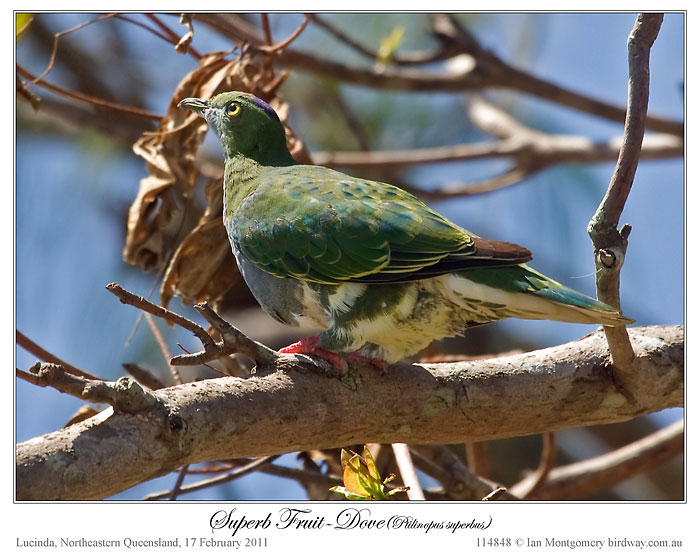
Superb Fruit-Doves are among the most spectacularly beautiful of rainforest birds in eastern Australia, but despite their bright colours are usually heard rather than seen. Their distinctive, repeated ‘whoop, whoop’ calls – with a rising inflection delivered at a regular rhythm and easily distinguished from the similar but accelerating ‘whp-whoo’ of the related and equally gorgeous Rose-crowned Fruit-Dove – are a very characteristic sound of northeastern rainforests. Hearing is no guarantee of seeing, however, and these shy birds usually remain invisible in the thick foliage of rainforest trees. So, it is strange to see these wonderful little doves (length of both species to 24cm/9.5in) sitting in full-view on trees in open tropical savanna left leafless by the cyclone, too tired to fly away when approached.
Superb Fruit Dove (Ptilinopus superbus) by Ian
The first photo shows a male, the second the less-spectacular but still beautiful female photographed from the verandah of my house a week to ten days after the cyclone when this species was most numerous around here. The females have an indigo skull cap that, being on the back of the head, is often not visible but you can see it clearly in the bird in the third photo, taken in a battered but still fruiting tree at Dungeness where we lunched last Thursday, in a normally but no longer shady park near Lucinda on the coast east of Ingham, after doing the monthly wader survey. That area took quite a battering and the sand spit along which we used to walk to do the survey has largely been flattened and the sand dumped in the mud flat to its west.
The range of the Superb Fruit-Dove in Australia is the east coast from the tip of Cape York to south of Sydney. Its main breeding range is in tropical Queensland north of Prosperine on the Whitsunday Coast and it is relatively rare in New South Wales. It also occurs in New Guinea and eastern Indonesia and many Australian birds migrate to New Guinea in winter. Fruit-eating doves normally range widely in search of food, given the seasonal nature of its availability, so it is to be hoped that this ability serves them well in times such as this.
I’ve resumed work on the website still using the borrowed mobile modem and have at last finished updating all the next/previous family pointers of the Australian bird family thumbnail pages. This means that you can now view the website in a global context or an Australian one, depending on your focus. The global context – and the New World and Old World subsets – follows the taxonomic organization and sequence of Birdlife International both between and within families while the Australian one follows the organization and sequence of Christidis and Boles, 2008, the generally accepted authorities in Australia.
There are quite a few differences in the recognized families, the sequence of families and the order within families between the 2 schema, so I suggest that you stick to one or the other (at any one time) to avoid confusion. The Australian context is distinguished by green backgrounds for both arrows (to Australian thumbnails and to previous and next families) and for the pages of family thumbnails. I’ve documented differences in family structure on the family pages; have a look at this for a simple example: http://www.birdway.com.au/cacatuinae/index_aus.htm and this for a particularly divergent example: http://www.birdway.com.au/sylviidae/index_aus.htm .
And I said, Oh that I had wings like a dove! for then would I fly away, and be at rest. (Psalms 55:6 KJV)
Superb Fruit Dove (Ptilinopus superbus) by xeno-canto-David Farrow
Rose-crowned Fruit Dove (Ptilinopus regina) by xeno-canto – Vicki Powys
Though ye have lien among the pots, yet shall ye be as the wings of a dove covered with silver, and her feathers with yellow gold. (Psalms 68:13 KJV)
This beautiful Superb Fruit-Dove or Fruit Dove, depending on whose list used, is in the Columbidae Family of the Columbiformes Order. There are 321 members of the family including the Doves, Fruit Doves, Collared Doves, Cuckoo-Doves, Wood Doves, Bronsewings, Ground and Quail Doves, Bleeding Hearts, plus all the different kinds of Pigeons.













 Lee's Birdwatching Adventures Plus