Sunday Inspiration – Worthy The Lamb

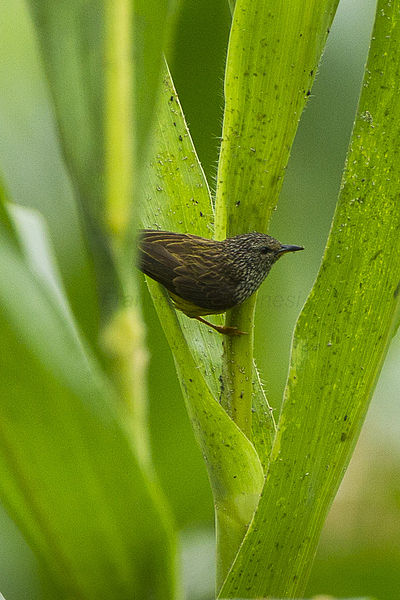
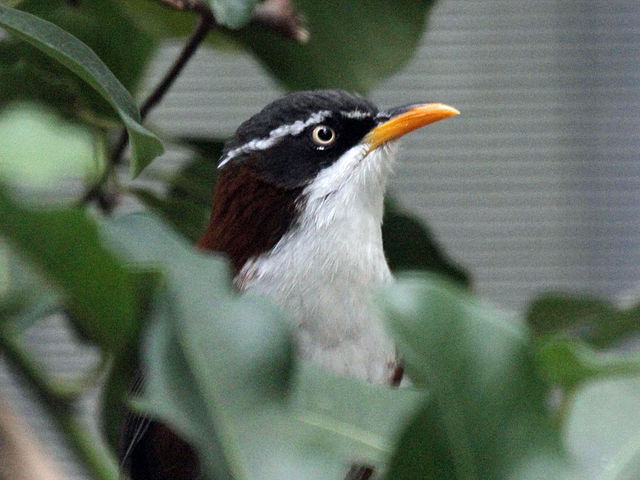
Chestnut-backed Scimitar Babbler (Pomatorhinus montanus) ©WikiC

Chestnut-backed Scimitar Babbler (Pomatorhinus montanus) ©WikiC

Wherefore, holy brethren, partakers of the heavenly calling, consider the Apostle and High Priest of our profession, Christ Jesus; Who was faithful to him that appointed him, as also Moses was faithful in all his house. For this man was counted worthy of more glory than Moses, inasmuch as he who hath builded the house hath more honour than the house. For every house is builded by some man; but he that built all things is God. (Hebrews 3:1-4 KJV)

Looks like this week you’ll be introduced to three families of avian wonders. I am skipping over the Cisticolidae – Cisticolas and allies until next week, because it is quite large. This week the Black-capped Donacobius (Donacobiidae), only bird in family; the Malagasy Warblers (Bernienidae) with 11 species; and the Babblers, Scimitar Barbler’s of the Timaliidae Family of 55 should give us enough birds for a slideshow.

Black-capped Donacobius (Donacobius atricapilla) ©©

Black-capped Donacobius (Donacobius atricapilla) ©©

The Black-capped Donacobius (Donacobius atricapilla) is a conspicuous, vocal South American bird. It is found in tropical swamps and wetlands in Argentina, Bolivia, Brazil, Colombia, Ecuador, French Guiana, Guyana, Paraguay, Peru, Suriname, and Venezuela; also Panama of Central America. They are common in a wide range of Amazonian wetlands, including oxbow lakes, riparian zones, and other areas with tall dense aquatic or semi-aquatic vegetation.

Mating for life, pairs of Black-capped Donacobiuses can be seen frequently and throughout the day atop thickets of dense lakeside or streamside vegetation. They often will engage in antiphonic dueting. Adult offspring will remain with their parents and help raise siblings from subsequent nesting periods in a system of cooperative breeding. (Wikipedia)
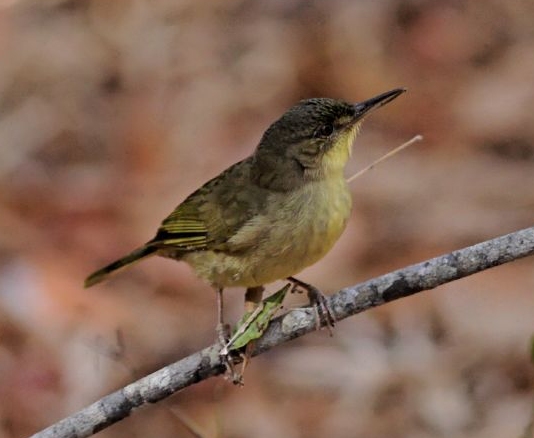
Long-billed Bernieria (Bernieria madagascariensis) WikiC

Long-billed Bernieria (Bernieria madagascariensis) WikiC

The Malagasy warblers are a newly validated clade of songbirds. They were formally named Bernieridae in 2010. The family consists of 11 species of small forest birds and is endemic to Madagascar. (Wikipedia)
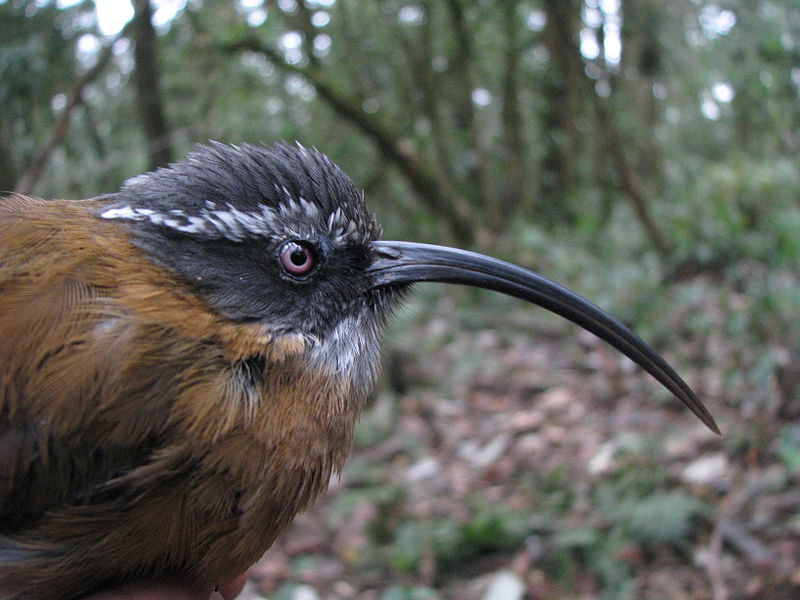
Slender-billed Scimitar Babbler (Pomatorhinus superciliaris) ©WikiC

Slender-billed Scimitar Babbler (Pomatorhinus superciliaris) ©WikiC

Our last family has Scimitar Babblers and some of the various Babblers.

The genus Pomatorhinus of scimitar babblers are jungle birds with long downcurved bills. These are birds of tropical Asia, with the greatest number of species occurring in hills of the Himalayas. They are medium-sized, floppy-tailed landbirds with soft plumage. They are typically long-tailed, dark brown above, and white or orange-brown below. Many have striking head patterns, with a broad black band through the eye, bordered with white above and below.

Spelaeorni genus the typical wren-babblers, is a bird genus in the family Timaliidae. Among this group, the typical wren-babblers are quite closely related to the type species, the chestnut-capped babbler (Timalia pileata). Typical babblers live in communities of around a dozen birds, jointly defending a territory. Many even breed communally, with a dominant pair building a nest, and the remainder helping to defend and rear their young. Young males remain with the group, while females move away to find a new group, and thus avoid inbreeding. They make nests from twigs, and hide them in dense vegetation. (Info from Wikipedia)

This slideshow requires JavaScript.

Saying with a loud voice, Worthy is the Lamb that was slain to receive power, and riches, and wisdom, and strength, and honour, and glory, and blessing. (Revelation 5:12 KJV)

“Worthy The Lamb” ~ Choir at Faith Baptist Church

*

More Sunday Inspirations

Donacobiidae – Black-capped Donacobius

Bernieridae – Malagasy Warblers

Timaliidae – Babblers, Scimitar Babblers

Gospel Presentation

*

“SUPERB,” “SPLENDID” AND “LOVELY” – Re-post Plus

“SUPERB,” “SPLENDID” AND “LOVELY”

“I know all the fowls of the mountains: and the wild beasts of the field are mine.” Psalm 50:11

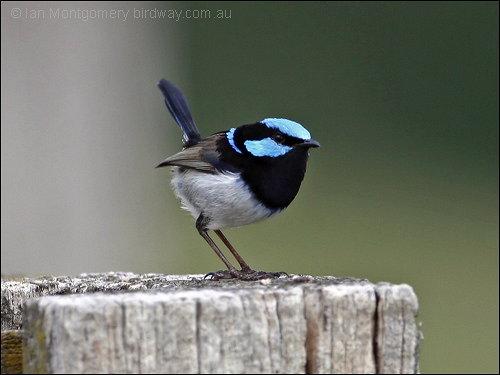
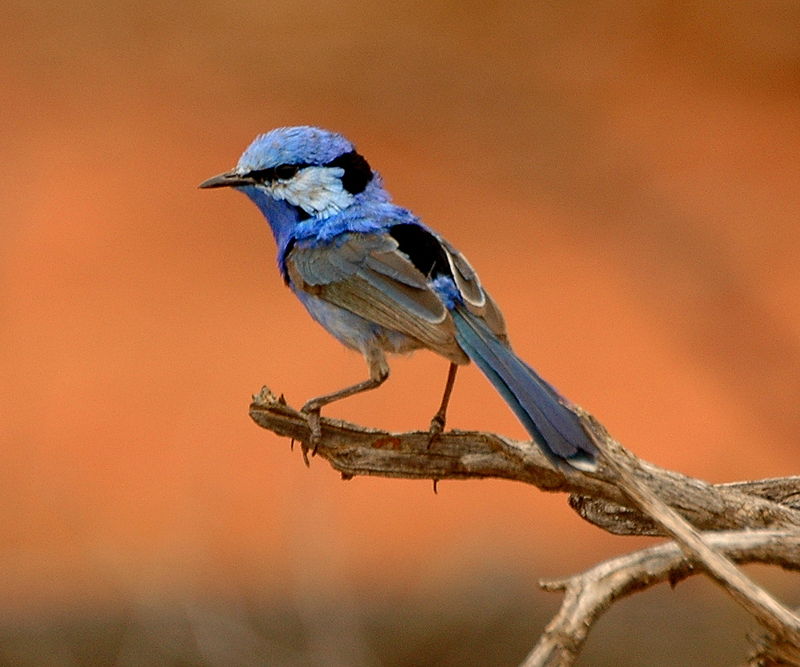
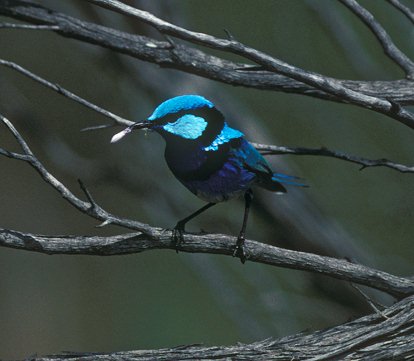
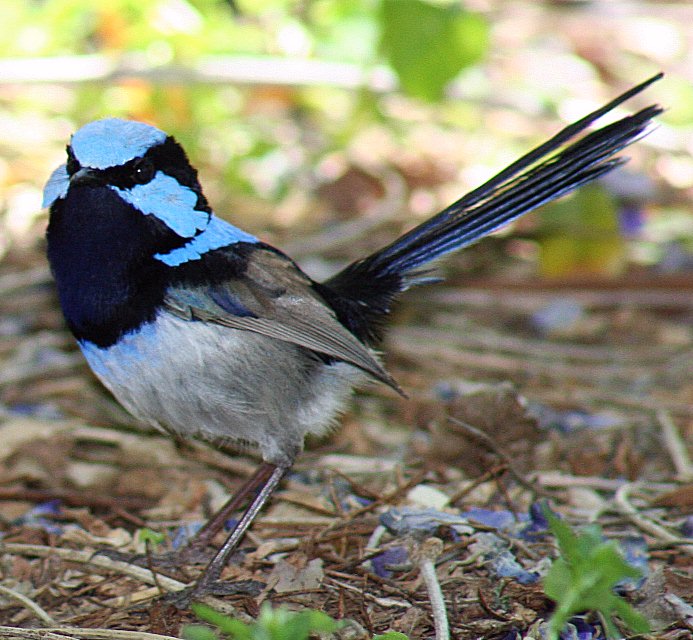
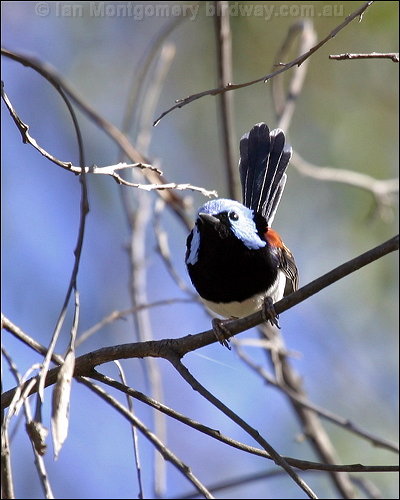
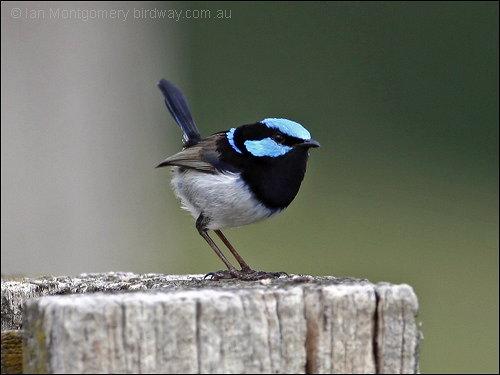
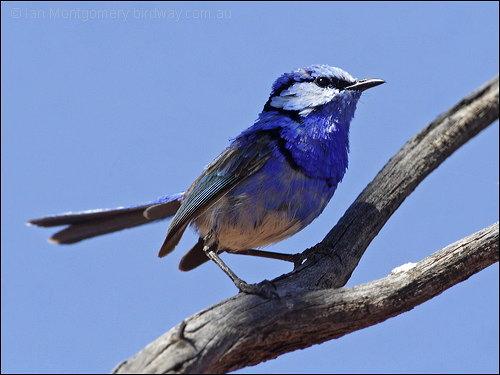
There are 13 species of a brightly plumed little songbird known as the fairy wren. The birds are found in Australia and New Guinea. So colorful are their feathers that the various species go by names like “superb,” “splendid” and “lovely.” However, even more noteworthy is the birds’ unusual behavior.

Superb Fairy-wren (Malurus cyaneus) by Ian

Superb Fairywren (Malurus cyaneus) by Ian

A male courting a female will bring her a flower petal. The petal usually matches his color or is a deeply contrasting color. Normally a perky little bird with an upright tail, when courting he lowers his tail and creeps around close to the ground. As he twists his body back and forth, he puffs out his cheek feathers. If the female accepts his courting, she builds their nest alone, lining it with bright parrot feathers. While they mate for life, they are not known for fidelity to their mates.

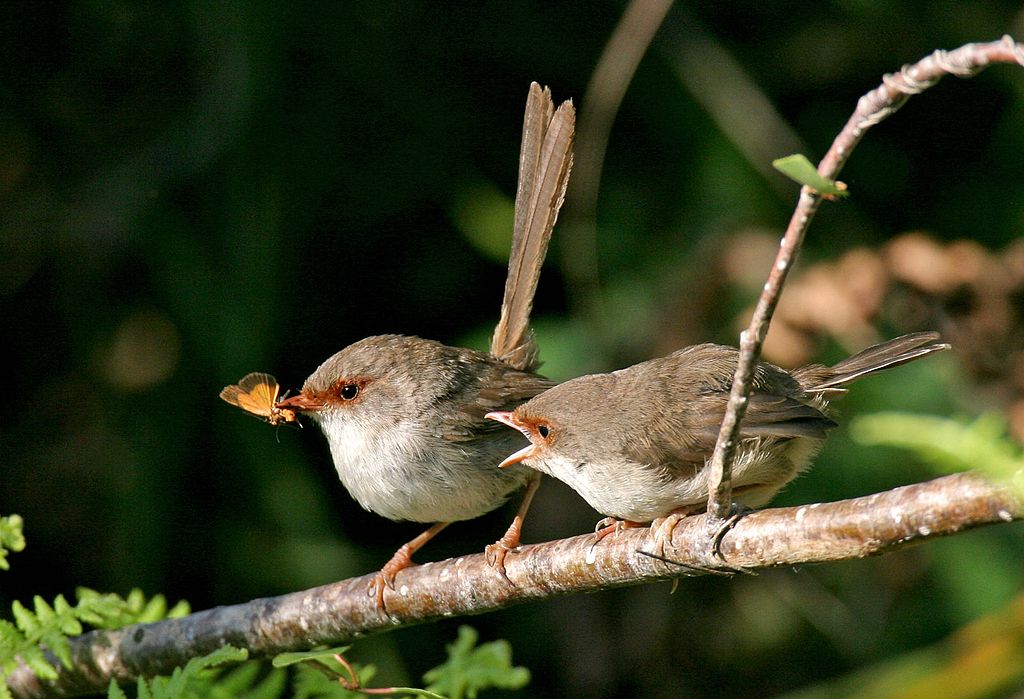
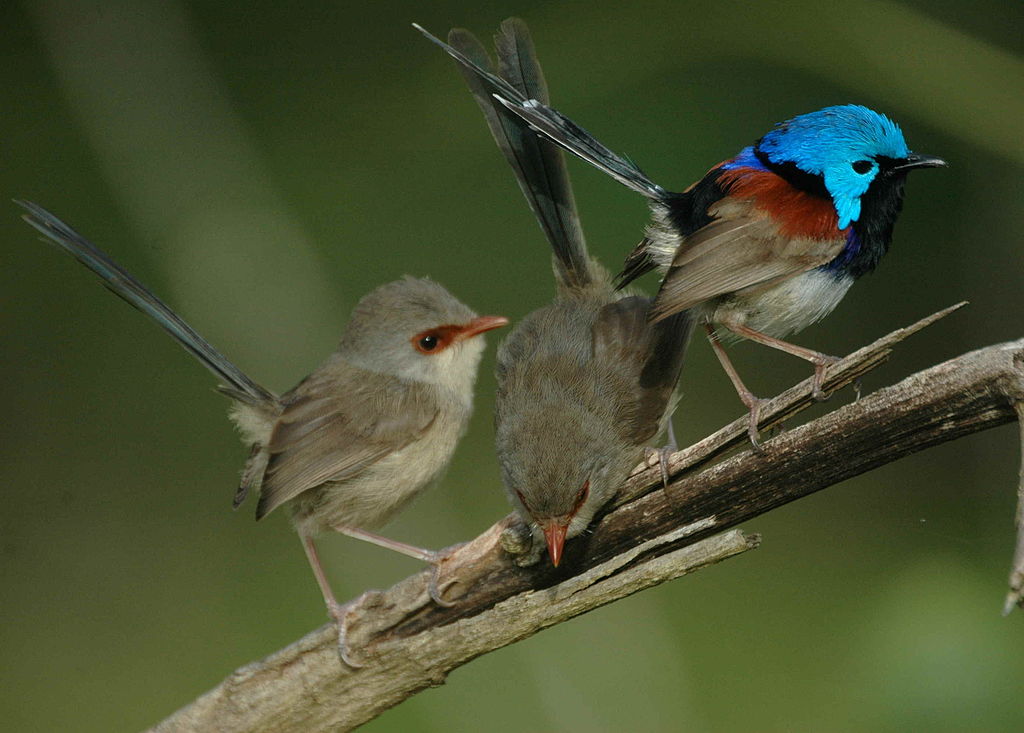
Superb Fairy-wren (Malurus cyaneus) Juvenile and Female ©WikiC

Superb Fairywren (Malurus cyaneus) Juvenile and Female ©WikiC

When mature, females will go off on their own, but males may stay with their parents for a year or more. Their main duty is to guard the family nest. If danger approaches the nest, the guard will puff up his wings, lower his tail and scuttle through dry grass, pretending to be a mouse. The idea is to lure the predator away from the nest.

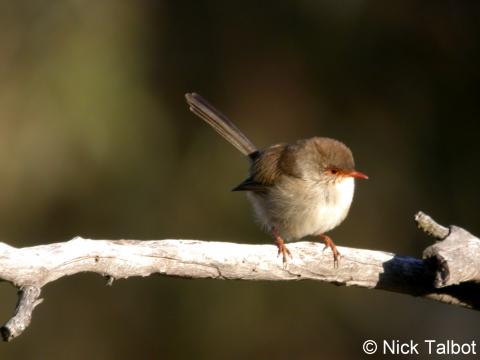
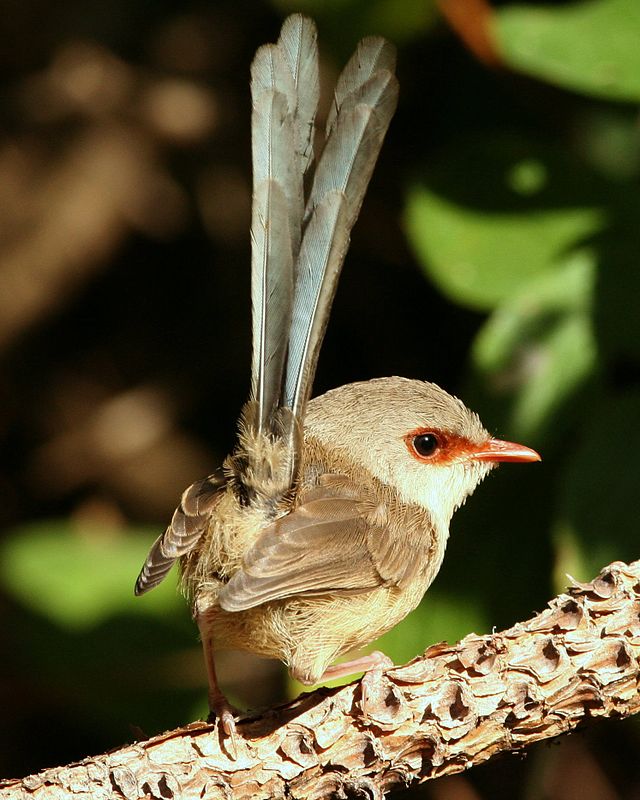
Superb Fairy-wren (Malurus cyaneus) Female by Nick Talbot

Superb Fairywren (Malurus cyaneus) Female by Nick Talbot

The beauty and unusual behavior of these little birds testifies to more than God’s creativity and love for beauty. They remind us of the beauty that was lost to God’s creation when it was tainted by man’s sin. Thankfully, some of that beauty that was lost can return to our lives through the forgiveness of sins that is found in Jesus Christ.

Prayer:
Dear Father, I thank You for the beauty of Your creation and for giving me the forgiveness of sins in Jesus Christ. Amen.

Notes:
Natural History, 11/94, pp. 56 62, “Faithful Philanderers.” Photo: Superb blue fairy-wren. Courtesy of Benjamint444. (CC-BY-SA 3.0)
©Creation Moments 2015 used with Permission


Lee’s Addition:
Here are some more photos of the Fairywrens from their Creator:


*
Creation Moments
“Superb, Splendid and Lovely”
Interesting Things
Fairywren Family
Wordless Birds
*

Ian’s Bird of the Week – Silvereye

Ian’s Bird of the Week – Silvereye ~ by Ian Montgomery

Newsletter – 9/18/15

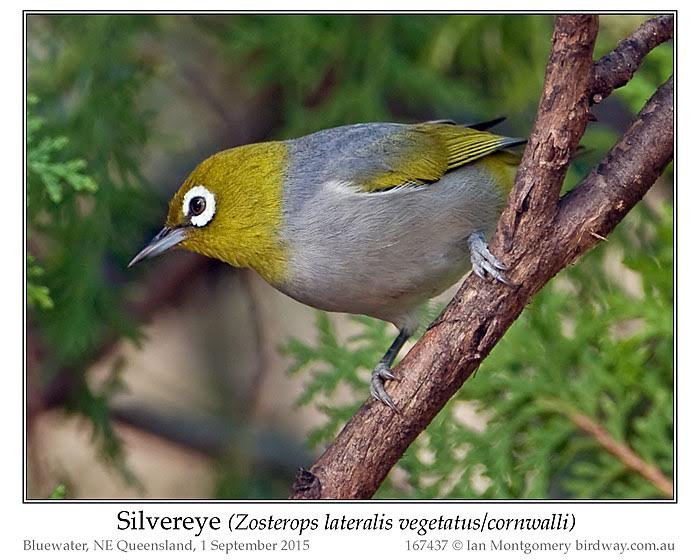
Two weeks ago we had the obscure Small Lifou White-eye as bird of the week. This week we have what is probably its best known relative – at least in Australasia – the Silvereye. I mentioned that the members of the White-eye family are expert colonisers of small islands in the Indian and western Pacific Oceans. The Silvereye is no exception and provides a particularly interesting case-study in bio-geography that is unusual in that some of its range expansion is both historically recent and well documented.

Silvereye (Zosterops lateralis) by Ian

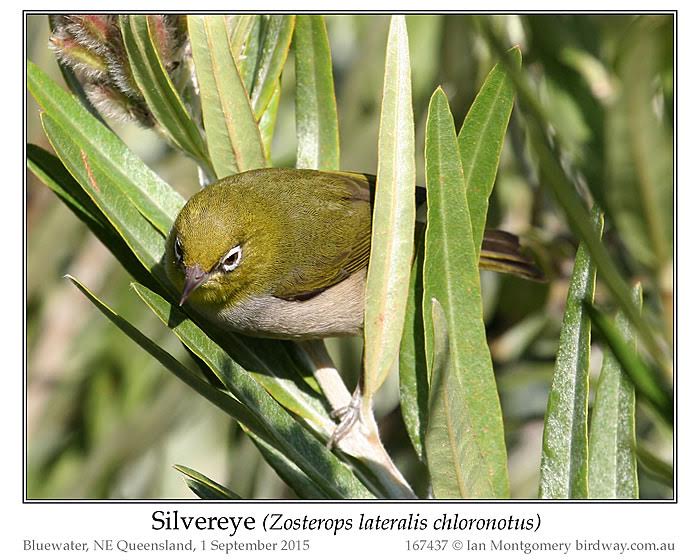
I’ll return to that later after looking at its range and variation in Australia. Here it occurs in coastal and sub-coastal regions from the tip of Cape York clockwise around Australia to Shark Bay in Western Australia, including Tasmania. Between Shark Bay and western Cape York it is replaced by the Australian Yellow White-eye. Currently, about nine races are recognised. The nominate race, lateralis, is Tasmanian and visually the most distinctive having cinnamon-coloured flanks, which is presumably what John Latham was referring to when he described the species in 1801 only 13 years after European settlement.

Silvereye (Zosterops lateralis) by Ian

There are five mainland races ranging northeastern Queensland to Western Australia. The differences between these are subtle and the race grade into one another. Townsville, second photo, is in the zone of intergradation between the Cape York race (vegetus) and the eastern Australian one (cornwalli). Note the lack of the cinnamon flanks and the clear demarcation between the yellowish-green head and the grey back and compare that with the Western Australian race ,third photo, which has a green back and to which its sub-specific name chloronotus refers. (I’m using the words race and subspecies interchangeably here).

Silvereye (Zosterops lateralis) by Ian

There are three island races in addition to the Tasmanian one and they occur on King Island in Bass Strait; the islands of the Barrier Reef notably Heron Island; and on Lord Howe Island. The Lord Howe one, aptly name robusta, is larger and stronger than the nominate race and survived the introduction of mice and rats. That’s an interesting little story in its own right as it became very rare, was thought to have become extinct like other Lord Howe Island species and the nominate race was deliberately introduced to replace it. To everyone’s surprise the indigenous race survived, adapted to the presence of the rodents, recovered and the introduction of the nominate race was unsuccessful.

Silvereye (Zosterops lateralis) by Ian

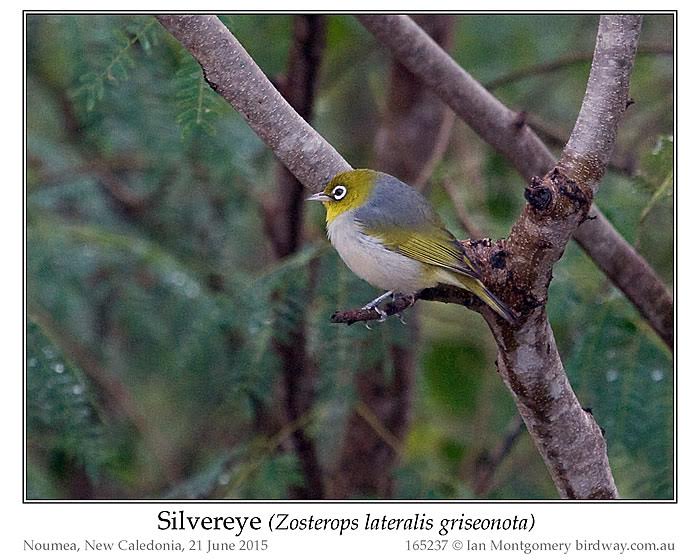
If you go farther afield to Norfolk Island expecting to find a distinctive looking local Silvereye, you’d be in for a surprise, fourth photo, as the locals, complete with cinnamon flanks, are indistinguishable from the nominate race, which it in fact is. If you went to New Zealand, the same thing would happen and you would find the nominate race on both main islands, Stewart Island, Chatham Island and the sub-Antarctic islands such as Snares, the Aucklands and Chatham. What happens if you head north and end up in New Caledonia? On the main island, you’d find this race, fifth photo, called griseonota, meaning, of course, ‘grey-backed’. Apart from the black smudge on the face, it looks to me very like the Cape York race.

Silvereye (Zosterops lateralis) by Ian

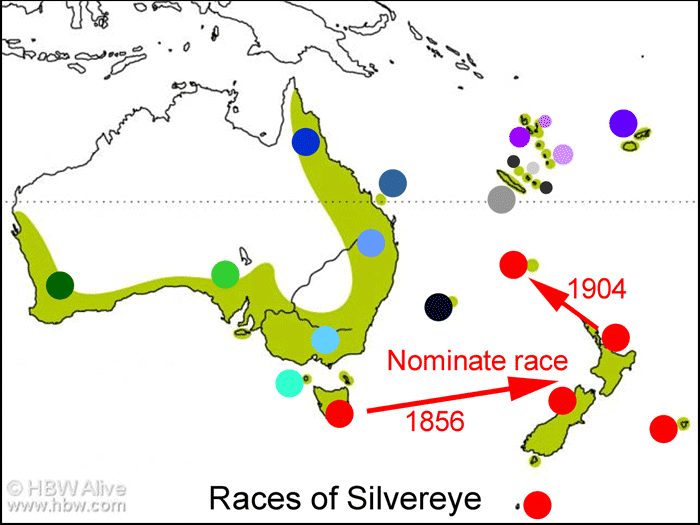
So what, you may ask, is happening? The proliferation of race suggests a sedentary species with little genetic mixing between neighbouring populations but this is contradicted by the widespread range of the Tasmanian race which suggests genetic flow between Tasmanian, Norfolk Island and New Zealand. In fact both are true to some extent, and this is where history comes to the rescue. Here is a map that I’ve drawn up showing the different races of the Silvereye using the basic range map from Handbook of Birds of the World (HBW) as a template. The different colours represent races. The red one is the nominate race; the other Australian races are shown in varying shades of blue and green and black; the New Caledonian races (three) in grey, the Vanuatu races (three) in purple and the Fiji race in indigo.

Silvereye (Zosterops lateralis) by Ian Map

The Tasmanian race isn’t completely sedentary. At least part of the population, probably mainly young birds, disperse in autumn and move Victoria and New South Wales for the winter. The Victorian ornithologist Alfred North noticed the change in plumage and ascribed it to winter and summer plumages. It was only later that it was realised that the change in appearance didn’t coincide with moulting in the mainland birds and the truth emerged. Incidentally, Latham’s original specimen came from ‘Port Jackson’ (Sydney) and must have been a Tasmanian bird.

As any blue-water sailor will tell you, the weather in Bass Strait between Tasmania and Victoria is notorious and a pleasant sail, or flight, in calm conditions can suddenly become a nightmare when a low pressure system and its associated cold front can arrive from the southwest. Powerful weather systems move continuously in an easterly direction between Tasmania and New Zealand. Have a look at the current four-day weather chart: http://www.bom.gov.au/australia/charts/4day_col.shtml. Another clue comes from the Maori name for the Silvereye: ‘tauhou’ meaning ‘stranger’. Silvereyes were rare vagrants to New Zealand until 1856 when large numbers appeared in the Welllington district, became established and spread to other parts of New Zealand. Similarly, Silvereyes first appeared in Norfolk Island in 1904 and it as assumed that these came from New Zealand rather than Tasmania. Silvereyes have benefitted from European settlement in Australia and it may be that is also a factor in their recent colonisation of New Zealand and Norfolk Island.

I wonder how the Silvereyes got to New Caledonia, Vanuatu and Fiji? These all look more like the Cape York race than the nominate one. Tropical cyclones in the Coral Sea are famously erratic and often head from Queensland to New Caledonia, so it looks as if the weather could play the main role here.

I’m going to stop here. I was going to talk about names and languages as well, but you can work that out for yourselves. We’ve already had cloronotus and griseonota for Australian races. Combine that with the French for Silvereye ‘Lunette a dos gris’ and the New Caledonian endemic Green-backed White-eye: ‘Lunette a dos vert’. Globally, there are almost 100 species of White-eye, not to mention races, and they nearly all look much the same, so pity any unfortunate taxonomists trying to be original.

And here’s a paper that I found interesting: http://aviculturalsocietynsw.org/_PDFs/Silvereye.pdf. You can check out photos of various White-eyes here: http://www.birdway.com.au/zosteropidae/index.htm.

Greetings

**************************************************
Ian Montgomery, Birdway Pty Ltd,
454 Forestry Road, Bluewater, Qld 4818
Tel 0411 602 737 ian@birdway.com.au
Bird Photos http://www.birdway.com.au/

And God blessed them, saying, “Be fruitful and multiply and fill the waters in the seas, and let birds multiply on the earth.” And there was evening and there was morning, the fifth day. (Genesis 1:22-23 ESV)

Lee’s Addition:

Well, Ian really got informative on these Silvereyes. Very interesting, at least to me. When the Lord commanded the birds to cover the earth and reproduce, these little avian wonders with beautiful silver eye rings seem to have obeyed.

*

Ian’s Bird of the Week

Ian’s Zosteropidae Family

Wordless Hummers

*
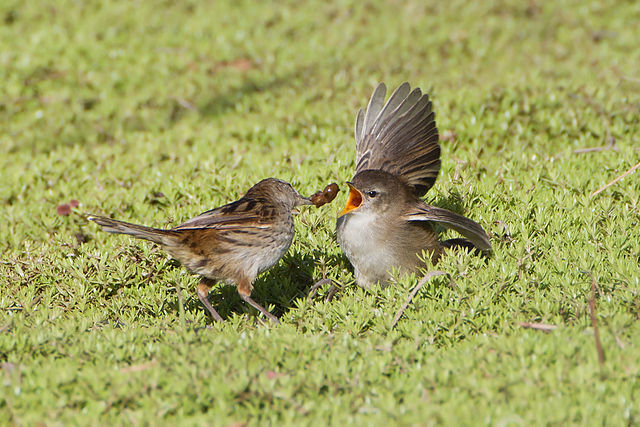
Tattered Survivor Bandaged

Michael Powell loves to take photographs of Dragonflies and other neat things – up close. This one caught my attention because it reminds me of a great promise from the Lord.

“Come, let us return to the LORD. For He has torn us, but He will heal us; He has wounded us, but He will bandage us.” (Hosea 6:1 NASB)

Thanks, Michael for great photos.

Visit – Source: Tattered survivor

Michael Q. Powell for more of his articles.

Sunday Inspiration – Grassbirds And Allies

Little Grassbird (Megalurus gramineus) Adult Feeding Juvenile©WikiC

Little Grassbird (Megalurus gramineus) Adult Feeding Juvenile ©WikiC

The grass withers, the flower fades, but the word of our God will stand forever. (Isaiah 40:8 ESV)

The Lord Jesus Christ created another neat group (family) of birds that includes Grassbirds, Bush Warblers, Thicketbirds and other various warbler sized birds. There is even an Emutail.

Grey Emutail (Amphilais seebohmi) ©WikiC

Grey Emutail (Amphilais seebohmi) ©WikiC

Locustellidae is a newly recognized family of small insectivorous songbirds (“warblers”), formerly placed in the Old World warbler “wastebin” family. It contains the grass warblers, grassbirds, and the Bradypterus “bush warblers”. These birds occur mainly in Eurasia, Africa, and the Australian region. The family name is sometimes given as Megaluridae, but Locustellidae has priority.

Striated Grassbird (Megalurus palustris) ©WikiC

Striated Grassbird (Megalurus palustris) ©WikiC

The species are smallish birds with tails that are usually long and pointed; the scientific name of the genus Megalurus in fact means “the large-tailed one” in plain English. They are less wren-like than the typical shrub-warblers (Cettia) but like these drab brownish or buffy all over. They tend to be larger and slimmer than Cettia though, and many have bold dark streaks on wings and/or underside. Most live in scrubland and frequently hunt food by clambering through thick tangled growth or pursuing it on the ground; they are perhaps the most terrestrial of the “warblers”. Very unusual for Passeriformes, some are becoming flightless in some taxa.

Among the “warbler and babbler” superfamily Sylvioidea, the Locustellidae are closest to the Malagasy warblers, another newly recognized (and hitherto unnamed) family; the black-capped donacobius (Donacobius atricapillus) is an American relative derived from the same ancestral stock and not a wren as was long believed. (Wikipedia with editing)

Then God said, “Let the earth bring forth grass, the herb that yields seed, and the fruit tree that yields fruit according to its kind, whose seed is in itself, on the earth”; and it was so. And the earth brought forth grass, the herb that yields seed according to its kind, and the tree that yields fruit, whose seed is in itself according to its kind. And God saw that it was good. (Genesis 1:11-12 NKJV)

You can see most of the Family as you listen to the music below the slideshow.

This slideshow requires JavaScript.

“The Church’s One Foundation” ~ Megan Fee, Cody Hancock & Dakota Hancock ~ at Faith Baptist

For we are labourers together with God: ye are God’s husbandry, ye are God’s building. According to the grace of God which is given unto me, as a wise masterbuilder, I have laid the foundation, and another buildeth thereon. But let every man take heed how he buildeth thereupon. For other foundation can no man lay than that is laid, which is Jesus Christ. (1 Corinthians 3:9-11 KJV)

*

Locustellidae – Grassbirds and Allies Family

Locustellidae – Wikipedia

Gospel Message

*

Sunday Inspiration – Reed Warblers

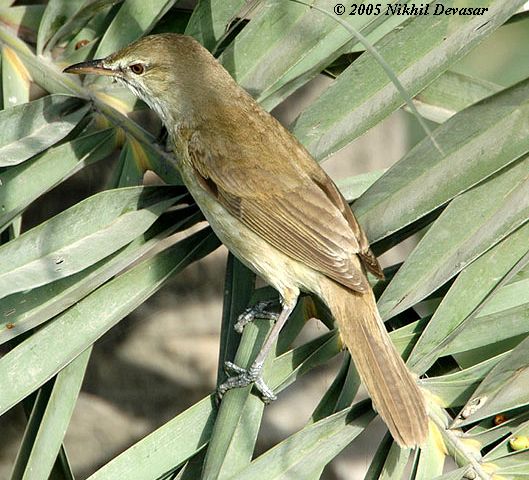
Clamorous Reed Warbler (Acrocephalus stentoreus) by Nikhil

Clamorous Reed Warbler (Acrocephalus stentoreus) by Nikhil

“Can the papyrus grow up without a marsh? Can the reeds flourish without water? (Job 8:11 NKJV)

This week we introduce you to just one family, the Acrocephalidae Family of Reed Warblers, Marsh- and Tree-warblers, and Acrocephalid warblers. The Lord has created this family of birds to blend in rather well with their surroundings. Another act of love and concern from the Creator.

The species in this family are usually rather large “warblers”. Most are rather plain olivaceous brown above with much yellow to beige below. They are usually found in open woodland, reedbeds or tall grass. The family occurs mostly in southern to western Eurasia and surroundings, but also ranging far into Pacific, with some species in Africa.

There are five genus in this family;

Subdesert Brush Warbler (Nesillas lantzii) ©WikiC

Subdesert Brush Warbler (Nesillas lantzii) ©WikiC

Nesillas – Brush Warblers; found in Comoros and Madagascar. Its natural habitats are subtropical or tropical dry forests, subtropical or tropical moist lowland forests, and subtropical or tropical moist shrubland.

Sedge Warbler (Acrocephalus schoenobaenus) by Robert Scanlon

Sedge Warbler (Acrocephalus schoenobaenus) by Robert Scanlon

Acrocephalus warblers are small, insectivorous passerine birds. Formerly in the Old World warbler assemblage, they are now separated as the namesake of the marsh and tree warbler family Acrocephalidae. They are sometimes called marsh warblers or reed warblers. These are rather drab brownish warblers usually associated with marshes or other wetlands. Some are streaked, others plain. Many species are migratory. Many species have a flat head profile, which gives rise to the group’s scientific name;

African Yellow Warbler (Iduna natalensis) ©WikiC

African Yellow Warbler (Iduna natalensis) ©WikiC

Iduna is a genus of tree warbler in the Acrocephalidae family. It is sometimes lumped together in the genus Hippolais.

Papyrus Yellow Warbler (Calamonastides gracilirostris) ©©Flickr Ross Tsal

Papyrus Yellow Warbler (Calamonastides gracilirostris) ©©Flickr Ross Tsal

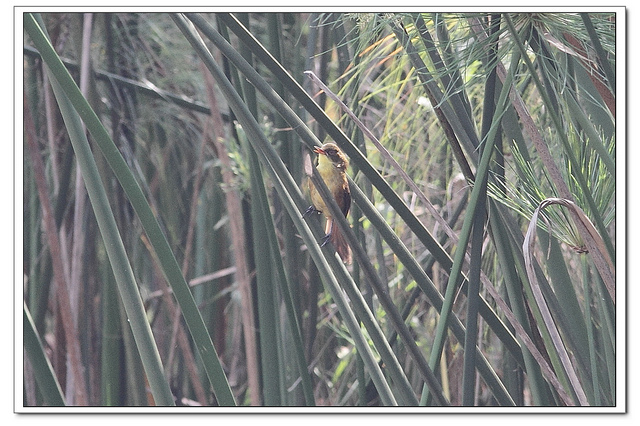
(Calamonastides gracilirostris) Papyrus Yellow Warbler is a species of tree warbler; formerly placed in the “Old World warblers”. It is monotypic in its genus. It is found in Burundi, Democratic Republic of the Congo, Kenya, Rwanda, Tanzania, Uganda, and Zambia. Its natural habitat is swamps. It is threatened by habitat loss. Compared with the dull browns and greys typical of swamp-dwelling warblers, this warbler is brightly coloured. It shows an underbelly of rich yellow and olive-brown upper parts. Its song consists of melodious liquid warbling:

Icterine Warbler (Hippolais icterina) ©WikiC

Icterine Warbler (Hippolais icterina) ©WikiC

Hippolais is a genus of tree warbler in the Acrocephalidae family. It is sometimes lumped together with the genus Iduna.

(Info from Wikipedia with editing)

Acrocephalidae – Reed Warblers and allies:

This slideshow requires JavaScript.

As they departed, Jesus began to say to the multitudes concerning John: “What did you go out into the wilderness to see? A reed shaken by the wind? (Matthew 11:7 NKJV)

“When I Survey The Wondrous Cross” ~ by Miss Anna Pletcher (12 years old at Faith Baptist) on piano

I love the last verse of this hymn:

Were the whole realm of nature mine,
That were a present far too small;
Love so amazing, so divine,
Demands my soul, my life, my all.

 *

Sunday Inspiration

Acrocephalidae Family of Reed Warblers and Allies

Reed Warblers and Allies – Montereybay

Acrocephalidae Family – Wikipedia

Gideon

*

Sad Clowns of the Sea

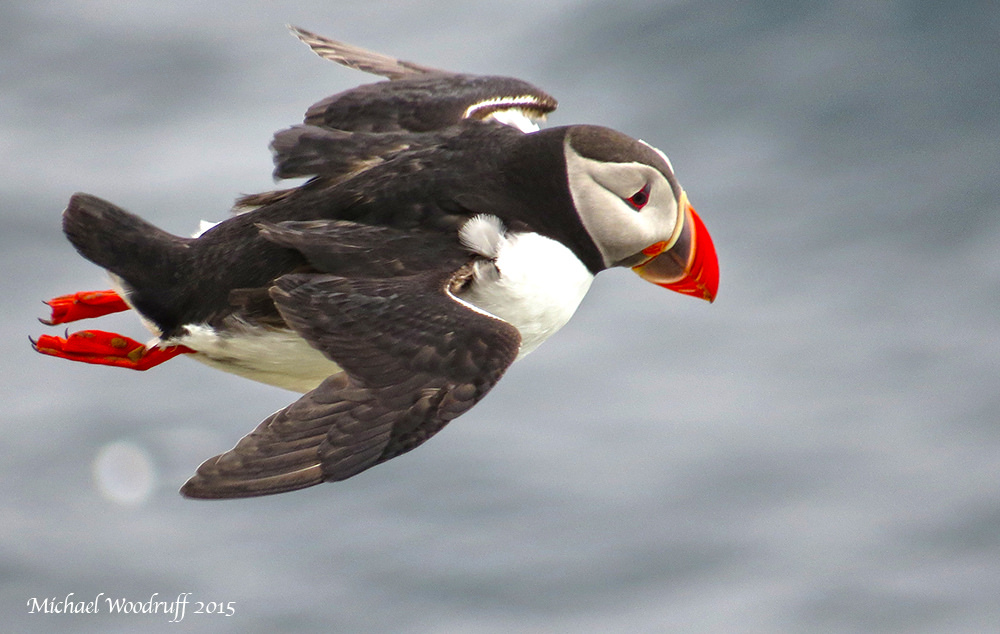
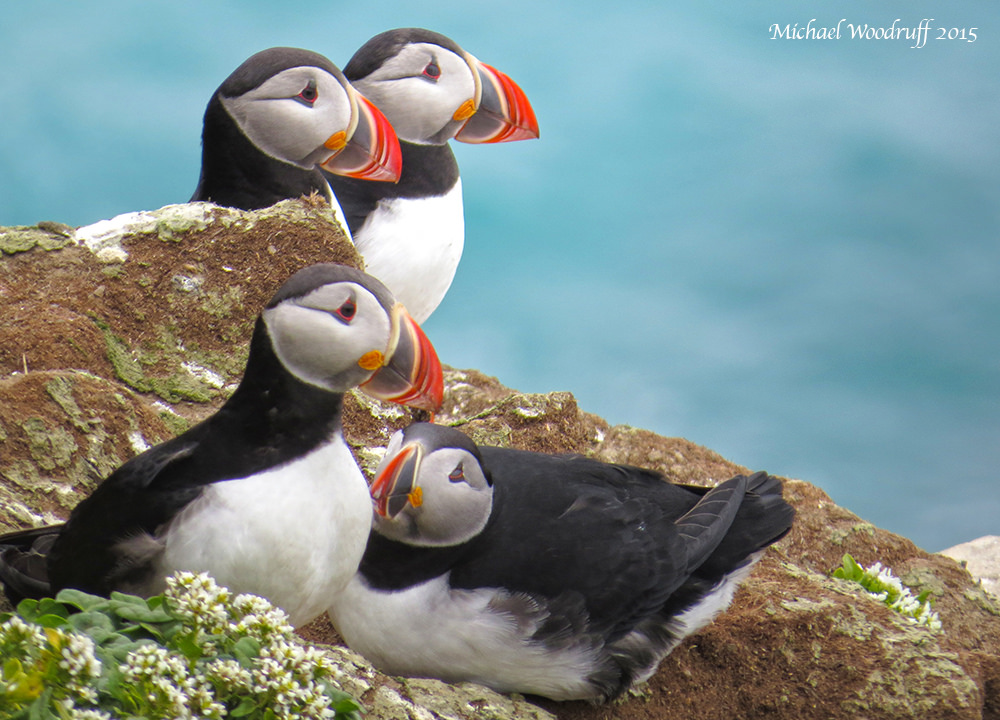
Atlantic Puffin (Fratercula arctica) by Michael Woodruff

Atlantic Puffin (Fratercula arctica) by Michael Woodruff

Why am I discouraged? Why am I restless? I trust you! And I will praise you again because you help me, and you are my God. (Psalms 43:5 CEV)

Recently I decided to check back through the photographers who have given me permission to use their photos. There are links to them down the right menu in the Photography section.

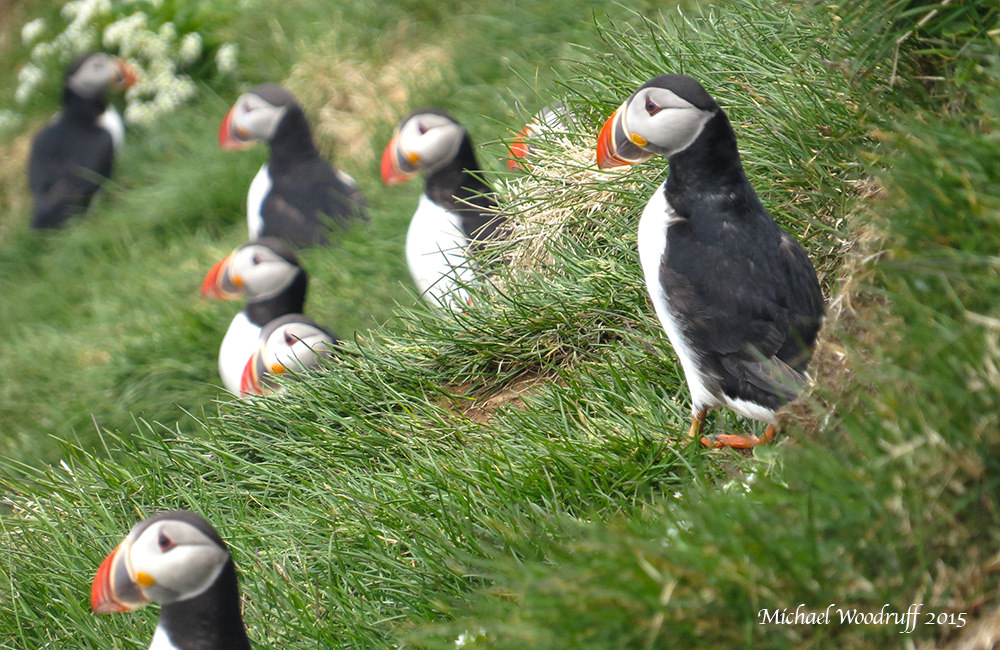
Atlantic Puffin (Fratercula arctica) by Michael Woodruff

Atlantic Puffin (Fratercula arctica) by Michael Woodruff

While looking through Michael Woodruff’s Flickr photos, I spotted these recent Puffins. Michael is one of the first photographers to allow me to use his beautiful photos on this blog and Michael is also a Christian. Apparently he made a trip to Grimsey Island, Iceland on 29 June 2015.  So these are some of his latest photos.

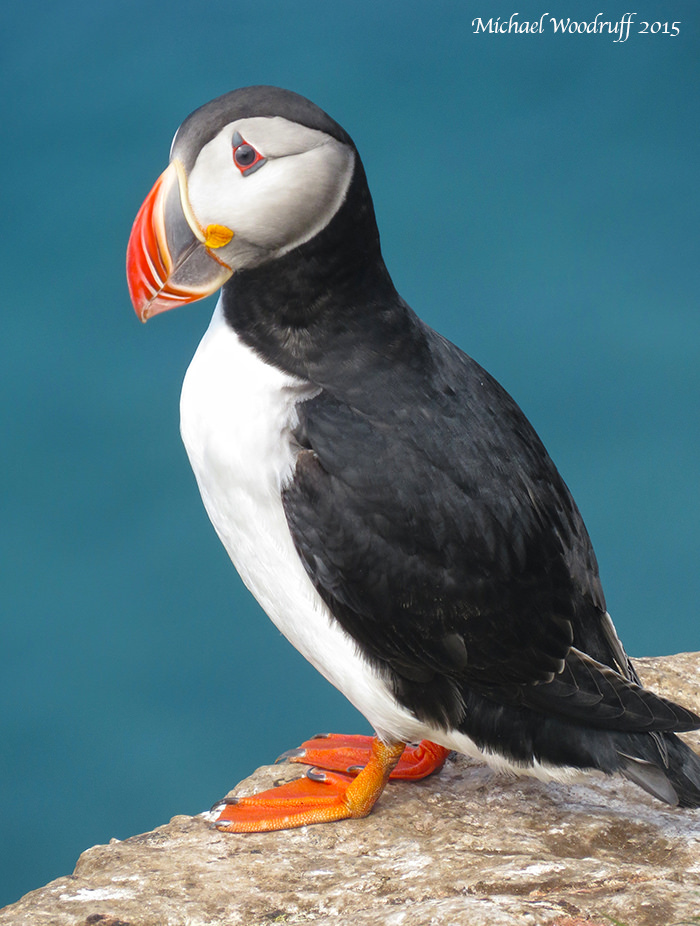
Atlantic Puffin (Fratercula arctica) by Michael Woodruff

Atlantic Puffin (Fratercula arctica) by Michael Woodruff

The Atlantic Puffins have been called the “Clowns of the Sea” because of their colorful marking that the Lord their Creator gave them. They are also sometimes called “Sea Parrots.” However you think of them, they are beautiful birds and I was surprised they are so small. On land it stands about 20 cm (8 in) high. The Atlantic puffin is sturdily built with a thick-set neck and short wings and tail. It is 28 to 30 centimetres (11 to 12 in) in length from the tip of its stout bill to its blunt-ended tail. Its wingspan is 47 to 63 centimetres (19 to 25 in). Males are slightly larger than the female, but both are marked the same. They mate for life.

Atlantic Puffin (Fratercula arctica) by Michael Woodruff

Atlantic Puffin (Fratercula arctica) by Michael Woodruff

Sorrow is better than laughter: for by the sadness of the countenance the heart is made better. (Ecclesiastes 7:3 KJV)

The beak is very distinctive. From the side the beak is broad and triangular but viewed from above it is narrow. The half nearest the tip is orange-red and the half nearest to the head is slate grey. There is a yellow chevron-shaped ridge separating the two parts and a yellow, fleshy strip at the base of the bill. At the joint of the two mandibles there is a yellow, wrinkled rosette. The exact proportions of the beak vary with the age of the bird. In an immature individual, the beak has reached its full length but it is not as broad as that of an adult. With time the bill deepens, the upper edge curves and a kink develops at its base. As the bird ages, one or more grooves may form on the red portion. The bird has a powerful bite.

Atlantic Puffin (Fratercula arctica) by Michael Woodruff

Atlantic Puffin (Fratercula arctica) by Michael Woodruff

Share the happiness of those who are happy, the sorrow of those who are sad. (Romans 12:15 Phillips)

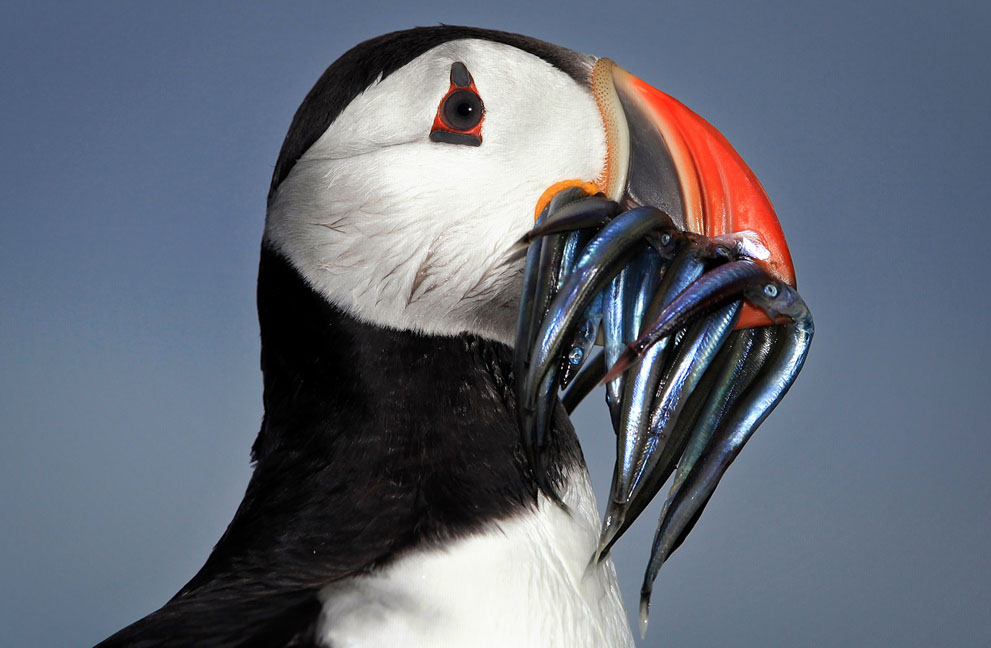
They are known for collecting multiple fish in that beautiful beak. It was designed very distinctly. It fishes by sight and can swallow small fish while submerged, but larger specimens are brought to the surface. It can catch several small fish in one dive, holding the first ones in place in its beak with its muscular, grooved tongue while it catches others. The two mandibles are hinged in such a way that they can be held parallel to hold a row of fish in place and these are also retained by inward-facing serrations on the edges of the beak. It copes with the excess salt that it swallows partly through its kidneys and partly by excretion through specialized salt glands in its nostrils. Now that is wisdom from the Creator.

Puffin with Sand Eels

Puffin with Sand Eels ©WikiC (not Michael’s, but shows the mouth full of eels)

You can read more about the Puffins from the links below, but I just wanted to share some of these photos from Michael.

Atlantic Puffin (Fratercula arctica) by Michael Woodruff

Atlantic Puffin (Fratercula arctica) by Michael Woodruff

Photos by Michael Woodruff. Atlantic Puffins by God.

*

*

Ian’s Bird of the Week – Lesser Sooty Owl

Ian’s Bird of the Week – Lesser Sooty Owl ~ by Ian Montgomery

Newsletter – 9/7/15

You may remember that in March of this year Greater Sooty Owl featured as Bird of the Week when I visited East Gippsland east of Melbourne with my Victorian birding pals Barb, Jen and Joy. Last Thursday I met up with the trio again, this time at Kingfisher Park west of Cairns, Far North Queensland. The main target was, naturally, Lesser Sooty Owl , another member of the Barn Owl family and a species as elusive as its larger cousin. I’d seen one at Kingfisher Park in 2002 but hadn’t photographed it and none of the trio had seen it before.

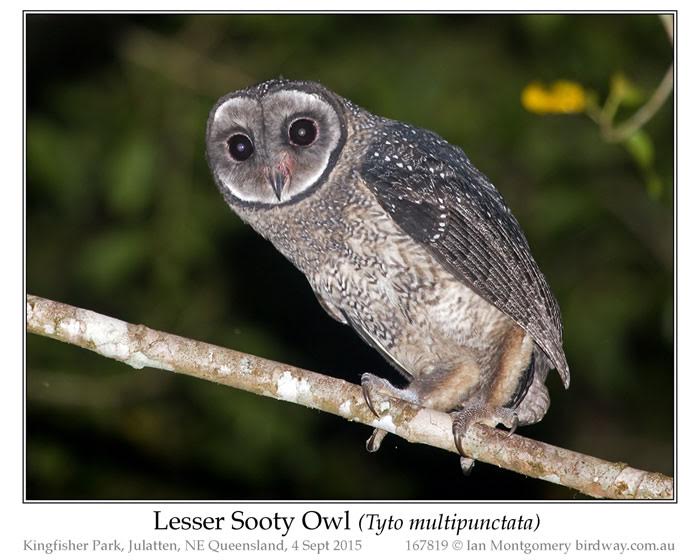
Lesser Sooty Owl (Tyto multipunctata) by Ian

It’s a Wet Tropics endemic ranging from Paluma – and perhaps Bluewater Forest near me – in the south to Cedar Bay in the north, with an estimated population of 2000 pairs. I’ve searched for it many time since without success so I’d agree with the field guides that say: “seldom seen” (Morcombe) and “until field studies in recent decades … among our least-known birds” (Pizzey and Knight). On Wednesday night I’d searched for it along some dreadful tracks in Tumoulin Forest Reserve near Ravenshoe and on Thursday night we spotlighted the 10km length of the Mount Lewis road near Kingfisher Park with the usual result.

Lesser Sooty Owl (Tyto multipunctata) by Ian

It does occur at Kingfisher Park and Andrew Isles told us to listen for it in the evening “after the barn owls” which live in adjacent Geraghty Park. Barn and Sooty Owls make chirruping calls and both species of Sooty Owl have a characteristic descending whistle like a falling bomb. Sure enough at 6:55pm an owl chirruped maybe 50 metres from the trio’s apartment and we raced around the corner to find this bird had come to visit us and was perched in full view in a tree at a photography-friendly height. Later, I agreed with Joy that it was an OMG moment on a par with encountering the Kagu family on a forest track in New Caledonia.

Lesser Sooty Owl (Tyto multipunctata) by Ian

In the past, the Greater and Lesser have been treated as a single species, but the species split is now generally accepted. They are genetically close, but there is a big difference in sizes – Lesser 31-38cm/12-15in , Greater 37-51cm/14.5-20 (females of both are larger than the males) – and differences in appearance, call and behaviour. Their ranges are disjoint with the Greater found from near Melbourne (Strzelecki and Dandenong Ranges) along the east coast to Eungella National Park near Mackay in Central Queensland. There is also a Sooty Owl in New Guinea. It’s still lumped with the Greater, which is biogeographically unlikely, but has been placed with the Lesser and may even be a different species.

Lesser Sooty Owl (Tyto multipunctata) by Ian

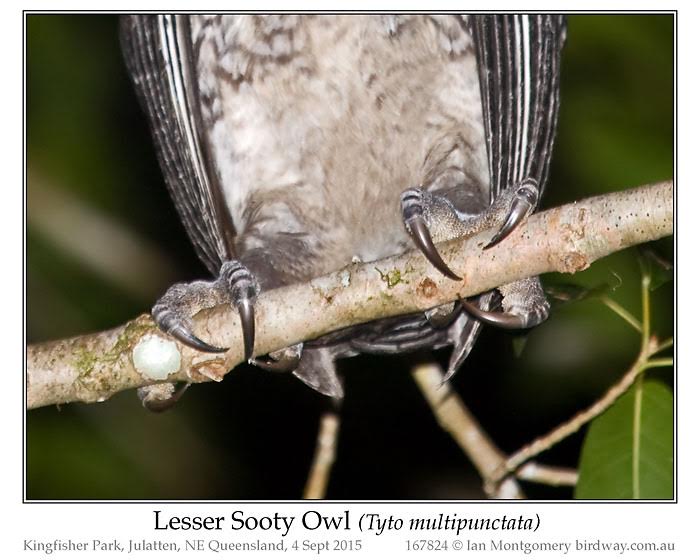
The behaviour of the Lesser differs in that it uses lower perches for hunting, good for photographers, and is known to cling to the side of tree trunks like the Eastern Yellow and Pale-yellow Robins. The last photo shows its impressive talons: these would be able to cling on to anything.

Lesser Sooty Owl (Tyto multipunctata) by Ian

If you’re into benchmarks, last week’s bird, the Ouvea Parakeet, was the 1500th global species on the Birday website (15% of all bird species) but the Australian total was stuck at 699 waiting for something special of course. The Lesser Sooty Owl will be a fitting 700th – I haven’t put it up yet, you get to see if first – that’s 700 out of the 898 ever recorded or 78%.

I’m back home now planning my next project now that the Diary of a Bird Photographer Volume 1 has been published. So far, 27 copies have been purchased and favourable comments are coming in from all over the place including California, UK, Italy and Dubai. The Fat Birder has published a review in which he said:

“I hope anyone who enjoys fine photography and fantastic birds will go to iTunes and download the book… I for one can’t wait for volume 2”

Happily, the remaining 940 members of the bird of the week list don’t have to wait that long for Volume 1!

Greetings
Ian

**************************************************
Ian Montgomery, Birdway Pty Ltd,
454 Forestry Road, Bluewater, Qld 4818
Tel 0411 602 737 ian@birdway.com.au
Check the latest website updates:
http://www.birdway.com.au/#updates


Lee’s Addition:

The beast of the field shall honour me, the dragons and the owls: because I give waters in the wilderness, and rivers in the desert, to give drink to my people, my chosen. (Isaiah 43:20 KJV)

I am impressed with this neat Lesser Sooty Owl from our Creator and also with Ian’s number of Global and Australian birds he has on his birding list.

Now that he is producing these books, I hope he will continue to give permission to reproduce his Bird of the Week Newsletters.

*

Ian’s Bird of the Week 

Ian’s Birdway

Barn Owls – Tytonidae

Wordless Birds

*
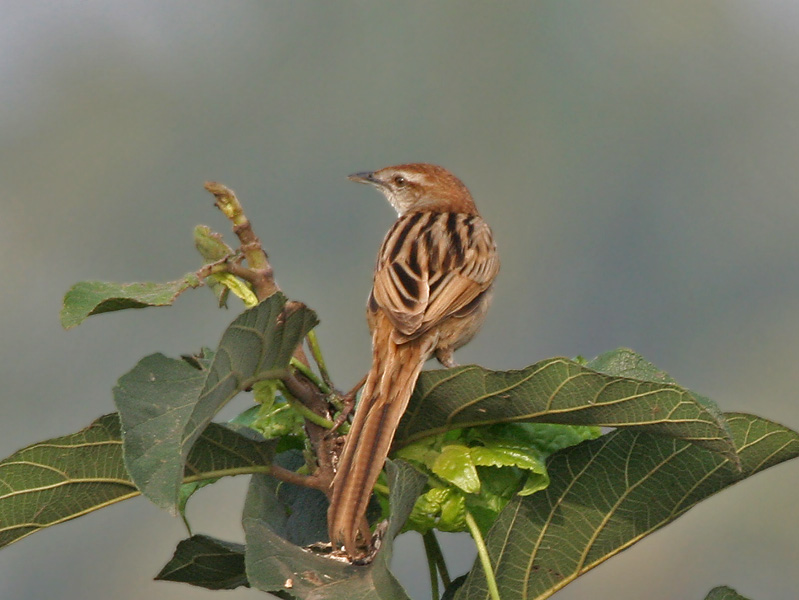
Birdwatching on Danish Zealand: Remembering a Sandwich Tern, at Hamlet’s Castle

Birdwatching on Danish Zealand:

Remembering a Sandwich Tern, at Hamlet’s Castle

 ~By James J. S. Johnson

Photo taken from http://mw2.google.com/mw-panoramio/photos/medium/14567172.jpg
(Photo taken from http://mw2.google.com/mw-panoramio/photos/medium/14567172.jpg )

This will be written for the generation to come, that a people yet to be created may praise the LORD. (Psalm 102:18)

Sandwich Tern

(picture taken from http://blog.fuertecharter.com/wp-content/uploads/2015/04/F295_Dibujo_01.jpg)

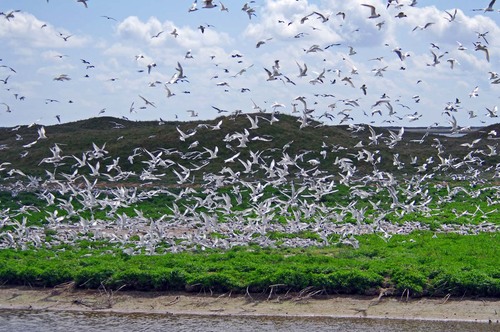
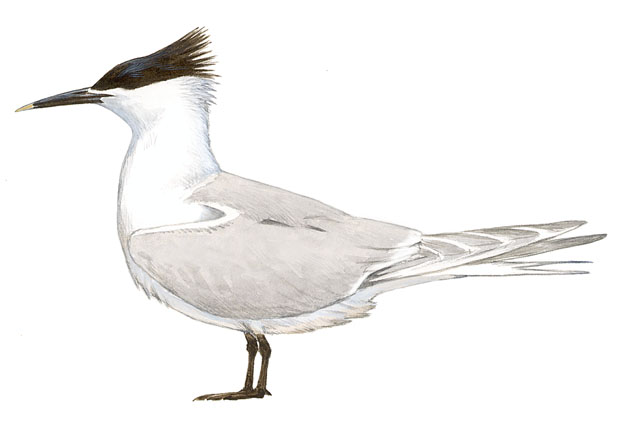
The SANDWICH TERN (Thalasseus sanvicensis) is, as its name suggests, a member of the “tern” [Sternidae] family of seagulls.  (The term “Sandwich” refers to Sandwich, in Kent, western England, where this tern was formally identified in AD1787 by ornithologist-physician John Latham, MD.)

The Sandwich Tern is medium-to-large in size (for a tern), with a fairly large head (for a tern), a long thin bill, and a relatively short tail.   It may grow to 16 inches in length and 36 inches in wingspan (!), so it is obviously designed for aerodynamic flight – well-fitted for flying above its oceanic and coastland habitats.  Its thin bill is black, with a “butter-yellow” tip.  The Sandwich Tern is mostly white, appearing whiter (especially from a distance) than the Common Tern and Arctic Tern; it has greyish-white wings and (top) tail feathers.  The newer feathers, produced according to the tern’s molting cycle, are more greyish in color. The top and back of its flat-crowned head is black.  It has short black legs.

Sandwich Tern (Thalasseus sandvicensis) ©Rafy Rodriguez

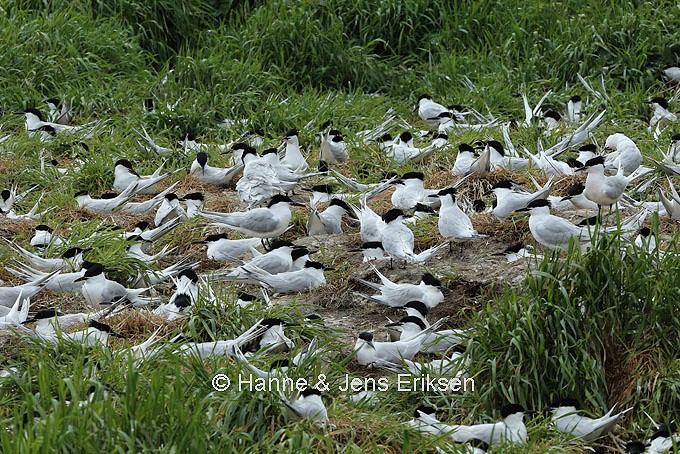
Sandwich Terns are sociable, nesting in densely packed colonies, sometimes mixed with other terns and small seagulls. [See Chris Kightley, Steve Madge, & Dave Nurney, POCKET GUIDE TO THE BIRDS OF BRITAIN AND NORTH-WEST EUROPE (New Haven: Yale University Press, 1998), page 150.]

Some consider the Cabot’s Tern of North America, which winters in and near the Caribbean (including Florida), as a close cousin of the Sandwich Tern.

SandwichTerns

Photo taken from http://www.birdsoman.com/Birds/061-Gulls/SandwichTern/SandwichTern-19098.jpg

The Sandwich Tern’s summer range is predominantly coastal – not surprising for a tern, with its most populous summer range includes various coastal shores of the British Isles (England, Scotland, Orkney, Hebrides, Ireland — but not Wales), Holland (where it is called Grote stern), and Denmark (where it is called Splitterne), especially from late March through early October.  (Sandwich Terns are known to winter in various coastal areas of North Africa.)

Besides those coastlands, the Sandwich Tern is also known as a summer visitor in parts of France (where it is called Sterne caugek), Estonia, Belgium, and Germany (where it is called Brandseeschwalbe).  Its migratory travels allow it to be observed in other countries as well, such as Poland (breeding), Sweden (where it is called Kentsk tärna – often seen where Sweden almost touches Denmark), Norway (as a “vagrant”), Spain’s Mediterranean coast, and even northeastern Italy.  [See Roger Tory Peterson, Guy Mountfort, & P. A. D. Hollom, A FIELD GUIDE TO BIRDS OF BRITAIN AND EUROPE, 5th edition (Boston: Houghton Mifflin, 1993), page 134 & Range Map 174.]

SandwichTern - Cemlyn Lagoon Anglesy

SandwichTern – Cemlyn Lagoon Anglesy

[ photo taken from https://ateambirding.files.wordpress.com/2013/07/0611-sandwich-tern-cemlyn-lagoon-anglesy-29th-june-2013-img_6143.jpg ]

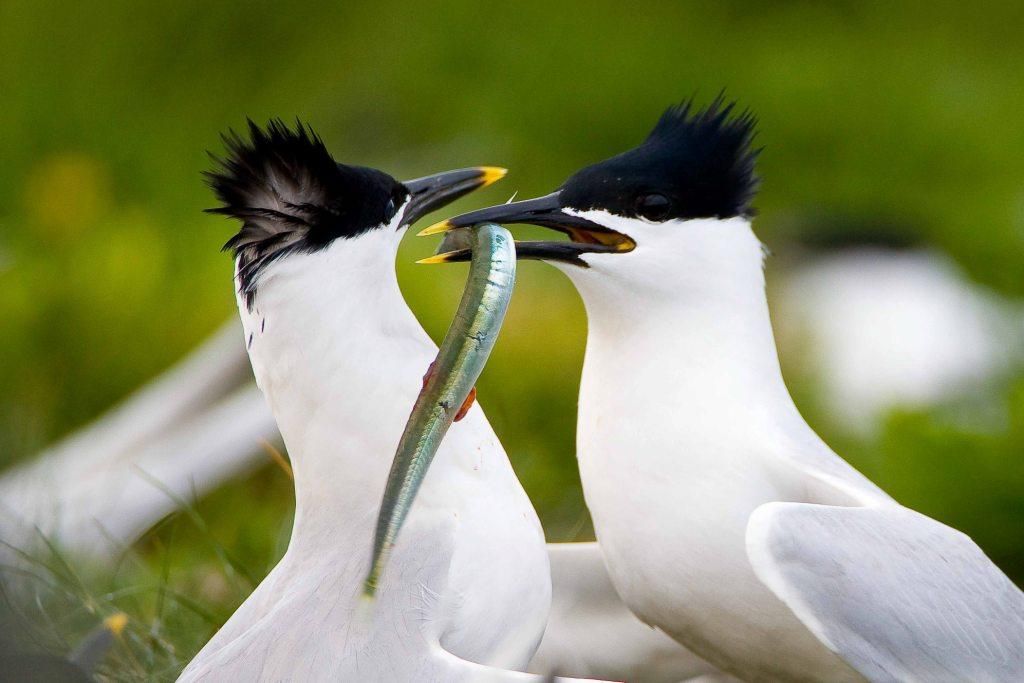
Like other terns (and gulls and fulmars, etc.), Sandwich Terns enjoy eating fish! Sandwich Terns catch their piscatorial repast by plunge-diving into the ocean.  (Occasionally they frequent lakes and ponds near coastlines, so lacustrine fish are also vulnerable to terns who elect to “go fishing” there.)

Sandwich Tern ©Jürgen Reich

Sandwich Tern ©Jürgen Reich

[Photo taken from http://www.helcom.fi/PublishingImages/baltic-sea-trends/environment-fact-sheets/latest-fact-sheets/population-development-of-sandwich-tern/Brandseeschwalben%20J%C3%BCrgen%20Reich_1.jpg ]

In addition to the shorelands of the British Isles, some parts of the Baltic Sea’s western coastline also host Sandwich Terns in the summer – including the shores at and near “Hamlet’s Castle” in Helsingør, in eastern Denmark.  In fact, it was at “Hamlet’s Castle” where I saw a Sandwich Tern on the 4th of July in AD2006.

Medieval castle at Helsingør (on the island of Zealand)

Medieval castle at Helsingør (on the island of Zealand)

Photo from  https://en.wikipedia.org/wiki/Kronborg#/media/File:Helsingoer_Kronborg_Castle.jpg

Why is the medieval castle at Helsingør (on the island of Zealand, at the narrowest part of the strait of Øresund, which strait separated Denmark and Sweden), built back in the AD1420s (by the Kalmar Union triple-crown king, Eirik, “king of Denmark, Sweden, and Norway, king of the Wends and the Goths, and Duke of Pomerania”), called “Hamlet’s Castle”?

“Shakespeare brought Kronborg Slot [i.e., Kronborg Castle] world renown as the [fictional] backdrop of his ‘HAMLET’.  Most of the magnificent Renaissance castle, which has had its present appearance since 1585, is accessible to the public.”  [Quoting Reinhard Ilg, JOURNEY THROUGH DENMARK (Stürtz, 2002; translation by Faith Gibson Tegethoff; photos by Tina Herzig & Horst Herzig), page 46.]

Kronborg Castle

Kronborg Castle

[ photo taken from  http://i1.trekearth.com/photos/2765/tdanny_denmark_kronborg_1.jpg ]

In Shakespeare’s famous play, HAMLET, the fundamental question of life is asked, “To be, or not to be?”  This is a fundamental question for every human being, yet it was beforehand a fundamental question that was considered and decided by God Himself, when He chose to give each one of us the lives we call our own.  Why?  While Shakespeare’s character Hamlet considered the grave question of whether to end his earthly existence with the famous words “to be, or not to be”, the choice even more basic than that was God’s sovereign decision to create us “to be” in the first place! [See, regarding this great question of life, considered with Psalm 102:18, http://www.icr.org/article/people-yet-be-created/ .

Just as the Lord chose to imagine and invent the maritime birds that we call Sandwich Terns, of His own beneficent and sovereign volition, He chose to imagine and invent us, as the specific (and unique) humans who each one of us is.  What a choice God made, when He did so!

And, knowing that we needed redemption, as human sinners descended from Adam, God also foresaw the need for the Lord Jesus Christ to be our Redeemer – so He planned for Christ’s Messiahship – long before we ever were created as the individuals we are  (John 17:24;  Ephesians 1:4;  1st Peter 1:20)all wonderful Bible verses, that Bob Webel taught me as a teenager!).

It is God’s providential grace and kindness that He chose to make us.  It is even more grace and kindness that He provided redemption in Christ to save us!   How should we then live, to appreciate Him for Who He isthat is the question, that (by God’s grace) our lives must daily answer!

This will be written for the generation to come, that a people yet to be created may praise the LORD. (Psalm 102:18)

*
Orni-Theology

James J. S. Johnson

People Yet To Be Created

Sandwich Terns – All About Birds

Sandwich Tern – Wikipedia

*
Sunday Inspiration – Little Beauties From The Lord

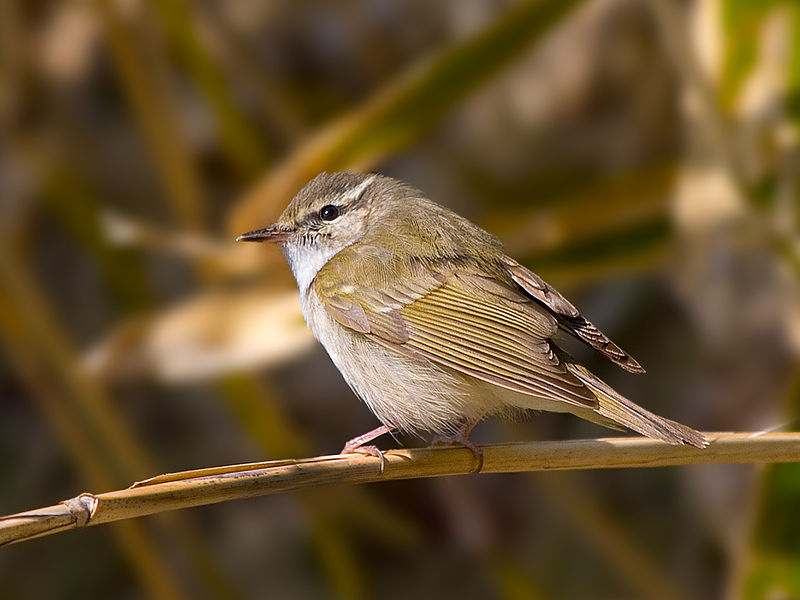
Sakhalin Leaf Warbler (Phylloscopus borealoides) ©WikiC

Sakhalin Leaf Warbler (Phylloscopus borealoides) ©WikiC

And Jesus saith unto him, The foxes have holes, and the birds of the air have nests; but the Son of man hath not where to lay his head. (Matthew 8:20 KJV)

We have another mixture of birds from our Creator found in several families, but most are Leaf Warblers from Phylloscopidae family. There are 77 in that family, but the families before them, taxonomically, have just a few species in them.

Streaked Scrub Warbler (Scotocerca inquieta) ©WikiC

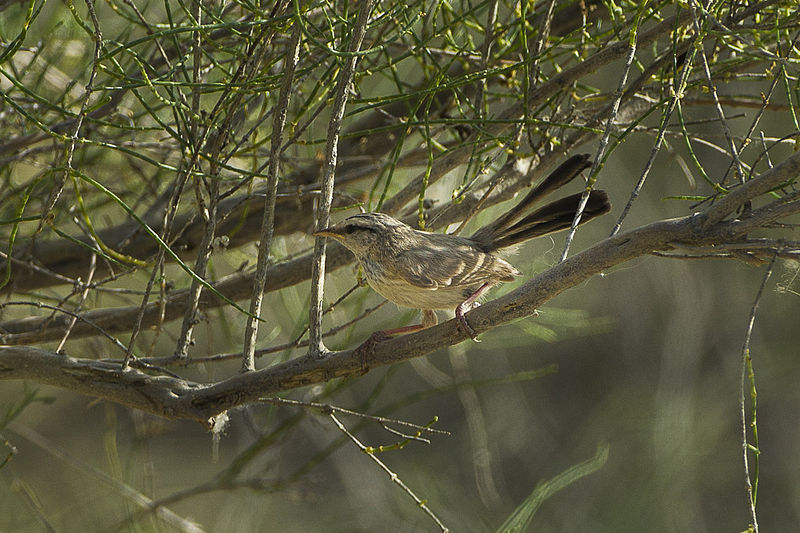
Streaked Scrub Warbler (Scotocerca inquieta) ©WikiC

Streaked Scrub Warbler – Scotocercidae has only one bird – the Streaked Scrub Warbler (Scotocerca inquieta). It is found in Afghanistan, Algeria, Egypt, India, Iran, Israel, Jordan, Kazakhstan, Lebanon, Libya, Mauritania, Morocco, Oman, Pakistan, Palestine, Russia, Saudi Arabia, Syria, Tajikistan, Tunisia, Turkmenistan, United Arab Emirates, Uzbekistan,and Yemen. (Wikipedia)

Chestnut-capped Flycatcher (Erythrocercus mccallii) ©WikiC

Chestnut-capped Flycatcher (Erythrocercus mccallii) ©WikiC

Yellow Flycatchers – Erythrocercidae has 3 members; Little Yellow Flycatcher (Erythrocercus holochlorus), Chestnut-capped Flycatcher (Erythrocercus mccallii) and the Livingstone’s Flycatcher (Erythrocercus livingstonei). All three of these creations are found in Africa.

Tit Hylia (Pholidornis rushiae ussheri) ©WikiC

Tit Hylia (Pholidornis rushiae ussheri) ©WikiC

This next group of birds are assigned to an  Incertae Sedis family. That simply means they don’t which family to assign to them. They are the Grauer’s Warbler (Graueria vittata), Green Hylia (Hylia prasina) and Tit Hylia (Pholidornis rushiae). They get moved in and out of families, but the IOC Version 5.3 has them unassigned. They are all in Africa and are “basically” Old World Warblers.

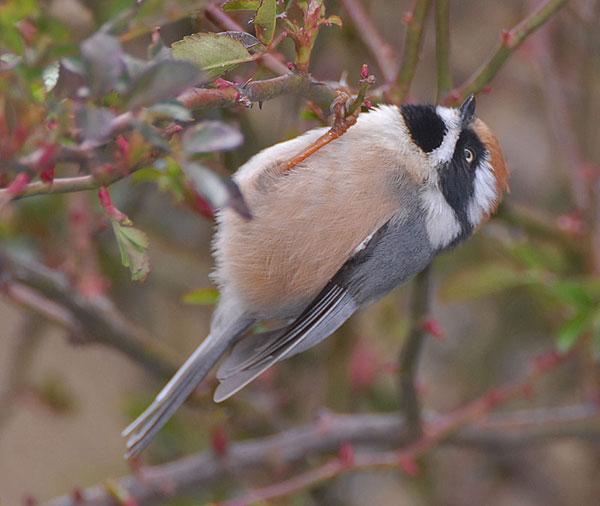
Black-throated Bushtit (Aegithalos concinnus) by Nikhil Devasar

Black-throated Bushtit (Aegithalos concinnus) by Nikhil Devasar

The Aegithalidae – Bushtits family has 13 members and are a family of small, drab passerine birds with moderately long tails. The family contains three genera, all but one of which are found in Eurasia. Bushtits are active birds, moving almost constantly while they forage for insects in shrubs and trees. During non-breeding season, birds live in flocks of up to 50 individuals. Several bushtit species display cooperative breeding behavior, also called helpers at the nest.

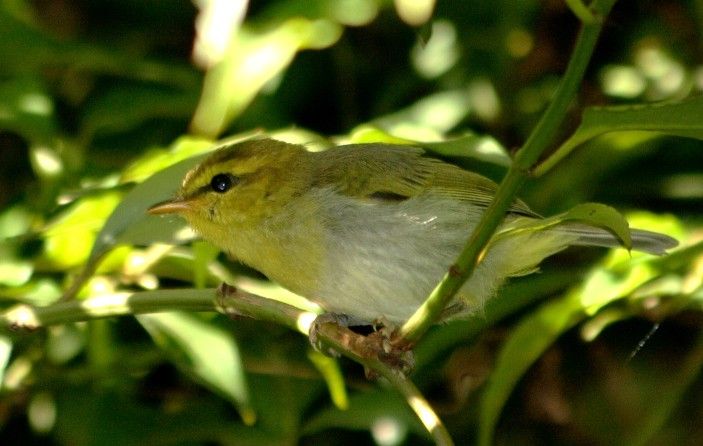
Yellow-throated Woodland Warbler (Phylloscopus ruficapilla) ©WikiC

Yellow-throated Woodland Warbler (Phylloscopus ruficapilla) ©WikiC

And our last family of avian wonders from the Lord is the Phylloscopidae – Leaf warblers and allies Family. This family of 77 species contains various Warblers and Chiffchaff. They were formerly included in the Old World warbler family but are now considered to belong to the Phylloscopidae, a family created in 2006. The genus is closely related to Seicercus and some species have been moved between the two genera in recent classification attempts. Leaf warblers are active, constantly moving, often flicking their wings as they glean the foliage for insects along the branches of trees and bushes. They forage at various levels within forests, from the top canopy to the understorey. Most of the species are markedly territorial both in their summer and winter quarters.

Most are greenish or brownish above and off-white or yellowish below. Compared to some other “warblers”, their songs are very simple.

Well, that’s our group of birds for this week. Trust you will enjoy seeing them as you listen to the music below. You have two options this week. You can listen or you can watch the Kid’s Choir as they sing. Figured little warblers needed young people singing as you view them.

But Jesus said, Suffer little children, and forbid them not, to come unto me: for of such is the kingdom of heaven. (Matthew 19:14 KJV)

*

This slideshow requires JavaScript.

*

Beautiful Savior (Fairest Lord Jesus) ~  by Kid’s Choir Faith Baptist

*

*

More Sunday Inspirations
Scotocercidae – Streaked Scrub Warbler
Erythrocercidae – Yellow Flycatchers
Incertae-Sedis1 – Family Uncertain-Warbler, Hylia
Aegithalidae – Bushtits
Phylloscopidae – Leaf Warblers and allies
Kids, You Are Special

*

White-faced Owl – Transformer

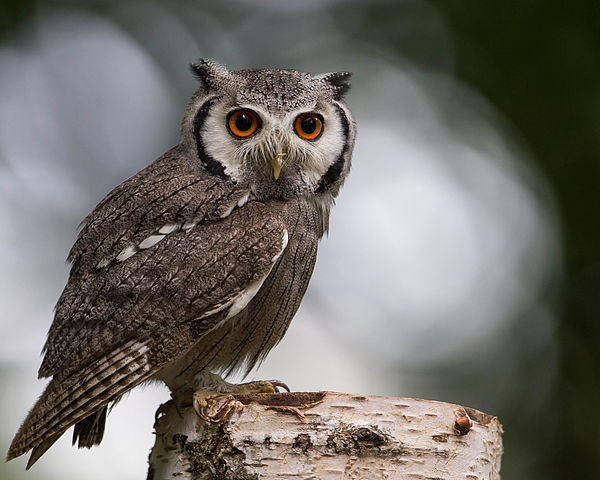
Southern White-faced Owl (Ptilopsis granti) ©PD

Southern White-faced Owl (Ptilopsis granti) ©PD

And be not conformed to this world: but be ye transformed by the renewing of your mind, that ye may prove what is that good, and acceptable, and perfect, will of God. (Romans 12:2 KJV)

Our contributing writer, James J. S. Johnson, sent me a really neat YouTube Video. It is called the Owl Transformer. After you watch this video, I will share the information I found about this cool owl.

There are two White-faced Owls. There is a Southern White-face Owl and a Northern White-faced Owl, but the one in the video is the Northern White-faced Owl. What a fantastic creation from the Creator.

Northern White-faced Owl (Ptilopsis leucotis) ©PD

Northern White-faced Owl (Ptilopsis leucotis) ©PD

These owls, both north and south, are from Africa. This northern one is from a band across Africa between the Sahara and the Equator. The southern owl appears in the southern part of Africa.

It is its “Fight-or-Flight” response that causes this defense mechanism. “When faced with another owl slightly larger than it, the bird flares its wings to appear larger. When faced with something much larger than itself, it pulls its feathers inwards, elongates its body, and narrows its eyes to thin slits. It is thought that it uses this ability to camouflage itself, and it shares the ability with relatives like the African scops owl.

In fact, many different types of owls have some ability to adopt a “concealing posture”, also known by the German word Tarnstellung, in which they squeeze and thin their body to look like a broken tree branch, and some types may also narrow their eyes to slits and fold a wing sideways across their chest in a Dracula-like manner to hide the lighter-colored feathers on their underparts. Such behavior has also been documented in eastern screech owls in a natural setting reacting to threats. (Wikipedia)

The Lord Jesus Christ gives these birds the ability to “transform” for their protection, just as he wants us to “transform” into His Image.

But we all, with open face beholding as in a glass the glory of the Lord, are changed into the same image from glory to glory, even as by the Spirit of the Lord. (2 Corinthians 3:18 KJV)

Here is another video found on YouTube:

*
Northern white-faced owl – Wikipedia

Southern white-faced owl – Wikipedia

Strigidae – Owls

Sharing The Gospel
*

The Newest I.O.C. World Bird List – Ver. 5.3 Finished Finally

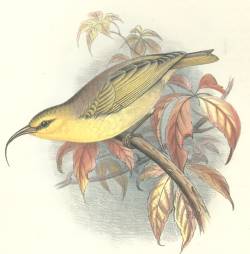
Hawaii Creeper (Loxops mana) ©WikiC

Hawaii Creeper (Loxops mana) ©WikiC – This bird is in the Loxops genus which now has add the Hawaii Akepa, Oahu Akepa and the Maui Akepa.

Be glad in the LORD, and rejoice, ye righteous: and shout for joy, all ye that are upright in heart. (Psalms 32:11 KJV)

I started working on the newest version of the I.O.C. World Bird List in mid August after I realized the 5.3 Version had been released. I was able to get the new Parrot Family updated and put these two blogs up.

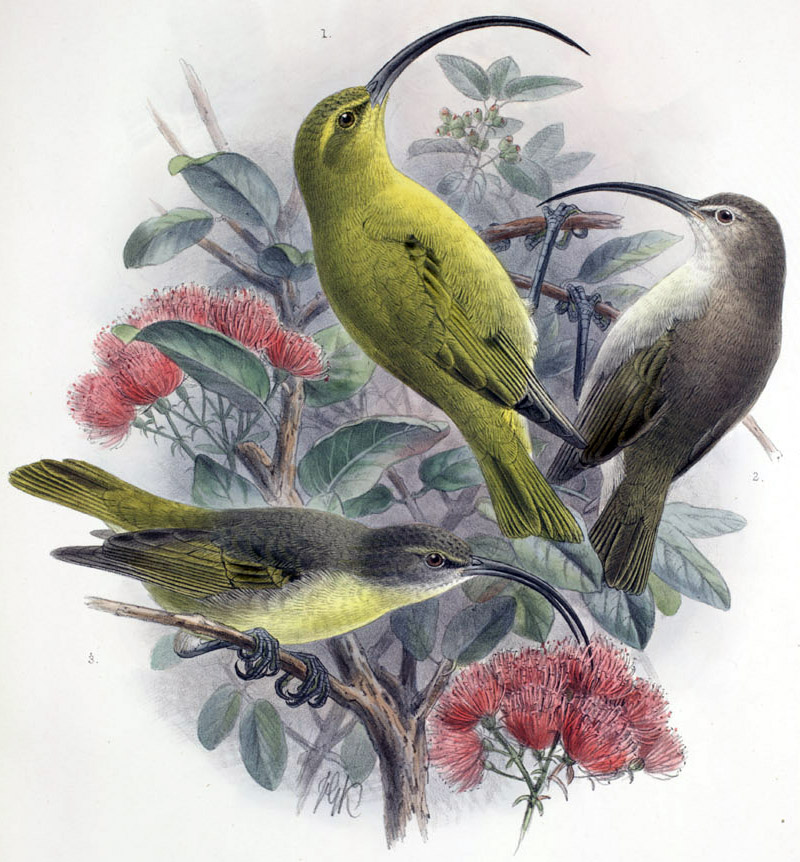
Nukupuu (Hemignathus lucidus) ©Drawing WikiC

Nukupuu (Hemignathus lucidus) ©Drawing WikiC – This is now the Oahu Nukupuu. The genus now has two new species Kauai Nukupuu (Hemignathus hanapepe) and Maui Nukupuu (Hemignathus affinis)

Well, it is now the third of September and I finally have the update finished. Since them I am older (birthday yesterday) and hope I am a little wiser. Between health, rainstorms, internet issues and just plain hard work fixing the update, IT IS FINISHED!

When Jesus therefore had received the vinegar, he said, It is finished: and he bowed his head, and gave up the ghost. (John 19:30 KJV)

The Lord said that when He had paid the debt for our sins on the cross, but this update no way compares to that greatest act of Love and Sacrifice for our salvation.

The “wiser” part came because as I had to update each Bird Family Page (241 pages), I changed the 5.2 Version to “The Latest I.O.C. Version.” Now I will only need to change the Family pages as needed. “Duhh” Why didn’t I think of that sooner. Since the pages were in edit mode, a Slideshow was added to each page. That is where a lot of time was spent.

Oahu Akialoa (Hemignathus procerus) Male Juvenile and Female ©WikiC Drawing

Oahu Akialoa (Hemignathus procerus) Male Juvenile and Female ©WikiC Drawing This was the Akialoa. There is now a Kauai Akialoa and a Maui-nui Akialoa (All are Extinct.)

That accomplished, it was time to get the indexes up to date. As they make changes to the Versions, new birds are added or deleted, name changes or misspellings corrected, and some genus are changed as they do the DNA studies.

That is when my hair started falling out as I pulled on it when The Next Problem showed up. While TRYING to edit the alphabetical pages, you know, A-Z on first names and last names (another 26 pages each), what is usually a “piece of cake” became a real challenge.

When I would select a Bird’s First Name – A, other “A” pages opened. Like Torrey’s Tropical  – “A” page or the Nave’s Topical “A” page or the Bird’s Last Name – “A” page.

So I owe all of you who have clicked around on this blog a BIG APOLOGY!!!!!  You have been going to all kinds of wrong pages. That took hours to find out why and then fix the pages. It appears, for those of us who blog, we should not to have more than one “A” page even if they are in different categories. For now I have pulled the Nave’s and Torrey’s indexes off-line until they can be corrected.

The IOC World Bird List 5.3 contains 10,580 extant species (and 152 extinct species)  classified in 40 Orders,  239 Families (plus 2 Incertae Sedis) and 2281 Genera.  The list also includes 20782 subspecies, their ranges and  authors.

Changes include:

SPECIES ADDED:                 19 (3 extinct)

SPECIES DELETED:               3

ENGLISH NAMES:                  13

TAXONOMY:                           18  including revised classification of world parrots

Now, maybe I can get back to writing some blog and visiting your websites again. Stay Tuned!

He that hath an ear, let him hear what the Spirit saith unto the churches; To him that overcometh will I give to eat of the hidden manna, and will give him a white stone, and in the stone a new name written, which no man knoweth saving he that receiveth it. (Revelation 2:17 KJV)

*

*