
Golden Eagle (Aquila chrysaetos) Flying ©WikiC
The link was sent to many of you as https://leesbird.com/2018/02/15/avian-and-attributes-mount/ which was sent accidentally.
This caused a 404 Error.
The correct link is:
Golden Eagle (Aquila chrysaetos) Flying ©WikiC
The link was sent to many of you as https://leesbird.com/2018/02/15/avian-and-attributes-mount/ which was sent accidentally.
This caused a 404 Error.
The correct link is:

Mount Cameroon Speirops (Zosterops melanocephalus) ©WikiC
And I looked, and, lo, a Lamb stood on the mount Sion, and with him an hundred forty and four thousand, having his Father’s name written in their foreheads. And I heard a voice from heaven, as the voice of many waters, and as the voice of a great thunder: and I heard the voice of harpers harping with their harps:
(Revelation 14:1-2 KJV)And he came out, and went, as he was wont, to the mount of Olives; and his disciples also followed him. And when he was at the place, he said unto them, Pray that ye enter not into temptation. And he was withdrawn from them about a stone’s cast, and kneeled down, and prayed, Saying, Father, if thou be willing, remove this cup from me: nevertheless not my will, but thine, be done.
(Luke 22:39-42 KJV)
Avian and Attributes – Mount
MOUNT, n. [L. mons, literally a heap or an elevation.]
1. A mass of earth, or earth and rock, rising considerably above the common surface of the surrounding land. Mount is used for an eminence or elevation of earth, indefinite in highth or size, and may be a hillock, hill or mountain. It is applied in Scripture to the small hillocks on which sacrifice was offered as well as to Mount Sinai. Jacob offered sacrifice on the mount or heap of stones raised for a witness between him and Laban. Gen 31.
2. A mound; a bulwark for offense or defense.
Hew ye down trees and cast a mount against Jerusalem. Jer 6.
3. Formerly, a bank or fund of money.
MOUNT, v.i.
1. To rise on high; to ascend; with or without up.
Doth the eagle mount up at thy command? Job 39.
The fire of trees and houses mounts on high.
2. To rise; to ascend; to tower; to be built to a great altitude.
Though Babylon should mount up to heaven. Jer 51.
3. To get on horseback.
4. To leap upon any animal.
5. To amount; to rise in value.
Bring then these blessings to a strict account,
Make fair deductions, see to what they mount.
MOUNT, v.t. To raise aloft; to lift on high.
What power is it which mounts my love so high?
1. To ascend; to climb; to get upon an elevated place; as, to mount a throne.
2. To place one’s self on horseback; as, to mount a horse.
3. To furnish with horses; as, to mount a troop. The dragoons were well mounted.
4. To put on or cover with something; to embellish with ornaments; as, to mount a sword.
5. To carry; to be furnished with; as, a ship of the line mounts seventy four guns; a fort mounts a hundred cannon.
6. To raise and place on a carriage; as, to mount a cannon.
To mount guard, to take the station and do the duty of a sentinel.

Bald Eagle (Haliaeetus leucocephalus) by Ray Barlow
There are four “Mount” birds, but surprisingly, only one photo available to use. [shown at top]
Mount Cameroon Francolin (Pternistis camerunensis) is a bird species in the family Phasianidae. It is found only in Cameroon.
Mount Cameroon Speirops (Zosterops melanocephalus) is a species of bird in the disputed family Zosteropidae, which might be included in the Timaliidae. It is endemic to Cameroon. Its natural habitats are subtropical or tropical moist montane forests and subtropical or tropical high-altitude shrubland.
Mount Kupe Bushshrike (Telophorus kupeensis) is a species of bird in the family Malaconotidae. It is endemic to Cameroon, where it is found in the Bakossi Forest Reserve and in particular on Mount Kupe.
Mount Victoria Babax (Babax woodi) is a species of passerine bird of the family Leiothrichidae typical of the mountains of the northeast of the Indian subcontinent . Previously it was considered a subspecies of Chinese babax .
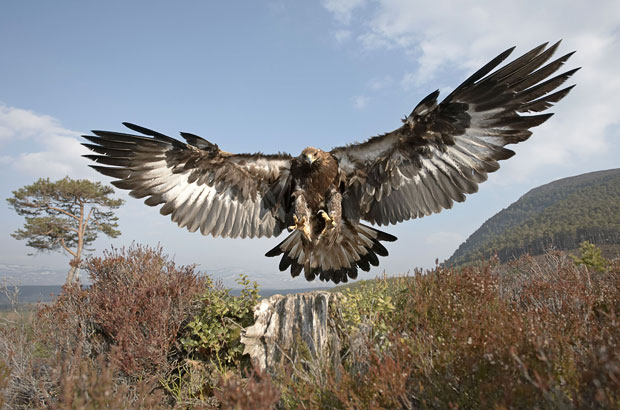
Golden Eagle (Aquila chrysaetos) Swooping Down ©Netns Wildlifezone
“Hast thou not known? hast thou not heard, that the everlasting God, the LORD, the Creator of the ends of the earth, fainteth not, neither is weary? there is no searching of his understanding. He giveth power to the faint; and to them that have no might he increaseth strength. Even the youths shall faint and be weary, and the young men shall utterly fall: But they that wait upon the LORD shall renew their strength; they shall mount up with wings as eagles; they shall run, and not be weary; and they shall walk, and not faint.” (Isaiah 40:28-31 KJV)
“And in the day time he was teaching in the temple; and at night he went out, and abode in the mount that is called the mount of Olives.” (Luke 21:37 KJV)
One of the attributes of Christ, that I think about, is his going up to the Mount to pray. Like us, He became weary in His human body, even though He is 100% God, while on earth, He was also 100% human. Therefore He needed rest and refreshment of body as we do.
Birds whose first name starts with “M”
*
[Definitions from Webster’s Dictionary of American English (1828), unless noted. Bird info from Wikipedia plus.]
In the beginning was the Word, and the Word was with God, and the Word was God. The same was in the beginning with God. All things were made by him; and without him was not any thing made that was made. (John 1:1-3 KJV)
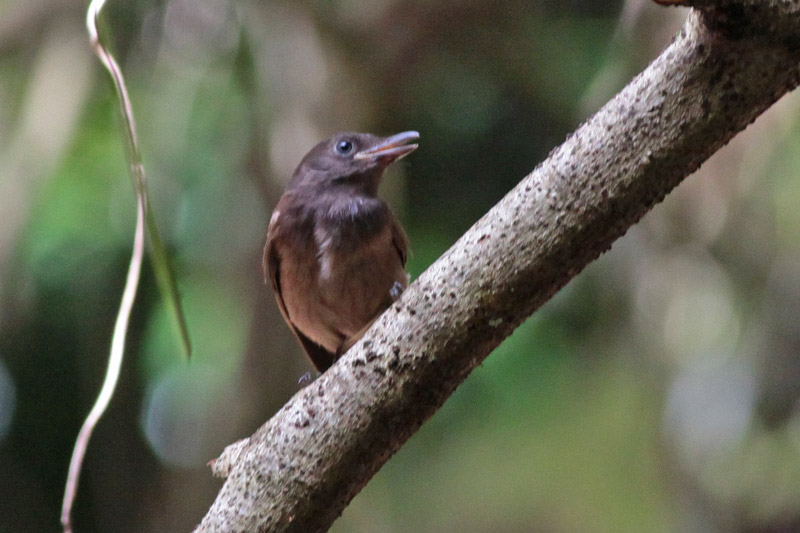
Morningbird (Colluricincla tenebrosa) by Margaret Sloan
“And in the morning, rising up a great while before day, he went out, and departed into a solitary place, and there prayed.” (Mark 1:35 KJV)
“Watch ye therefore: for ye know not when the master of the house cometh, at even, or at midnight, or at the cockcrowing, or in the morning:” (Mark 13:35 KJV)
“And early in the morning he came again into the temple, and all the people came unto him; and he sat down, and taught them.” (John 8:2 KJV)
“I Jesus have sent mine angel to testify unto you these things in the churches. I am the root and the offspring of David, and the bright and morning star.” (Revelation 22:16 KJV)
Avian and Attributes – Morning
MORN’ING, n.
1. The first part of the day, beginning at twelve o’clock at night and extending to twelve at noon. Thus we say, a star rises at one o’clock in the morning. In a more limited sense, morning is the time beginning an hour or two before sunrise, or at break of day, and extending to the hour of breakfast and of beginning the labors of the day. Among men of business in large cities, the morning extends to the hour of dining.
2. The first or early part.
In the morning of life, devote yourself to the service of the Most High.
MORN’ING, a. Pertaining to the first part or early part of the day; being in the early part of the day; as morning dew; morning light; morning service.
She looks as clear
As morning roses newly washed with dew.
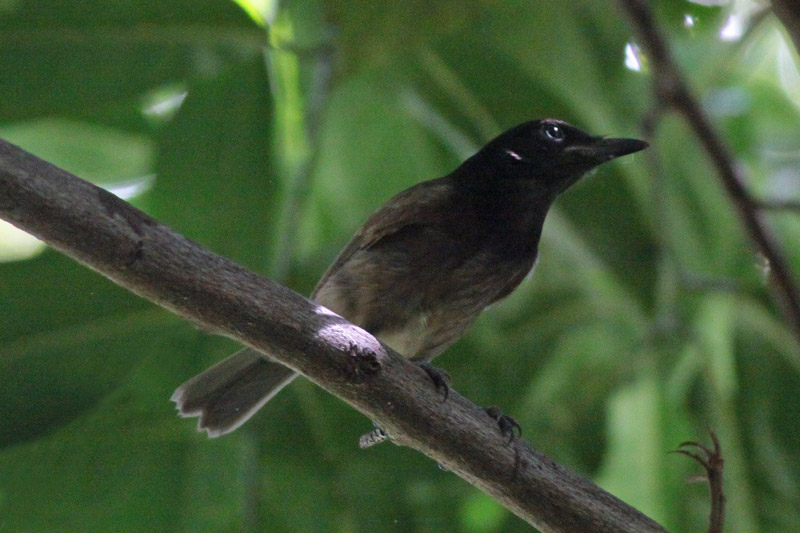
Morningbird (Colluricincla tenebrosa) by Margaret Sloan
Morningbird (Pachycephala tenebrosa)
The Mmorningbird (Pachycephala tenebrosa) is a songbird species in the family Pachycephalidae. It is endemic to the islands of Babelthuap, Koror, Garakayo, Peleliu and Ngabad in Palau. Its natural habitat is deep primary tropical moist lowland forests. The species is non-migratory. It is apparently commoner on the smaller islands in its range.
Morningbirds feed principally on insects, but also take snails, berries, fruit and seeds. They feed on or around the ground.
Birds whose first name starts with “M”
Morningbird – A Voice In The Morning
*
[Definitions from Webster’s Dictionary of American English (1828), unless noted. Bird info from Wikipedia plus.]
“My voice shalt thou hear in the morning, O LORD; in the morning will I direct my prayer unto thee, and will look up.” (Psalms 5:3 KJV)

The dust is thinning out a bit.
Here is the Latest list of pages and articles that have flown over to the Birds of the Bible for Kids site. The ones in blue are the newest arrivals. Wow! I had forgotten about so many of these articles. They are being re-published to current dates.
I trust you will check some of these out. If you have youngsters and/or teenagers, or, grandchildren, you may want to share these with them.
The Bible Bird indexes that are now open are GROWING:
“I will meditate also of all thy work, and talk of thy doings.” (Psalms 77:12 KJV)
Waiting
Here are some of the articles that are active again: (reverse order as they were released)
Birds of the Bible for Kids is Under Construction
Keep Checking
At times I think I may have bitten off more than I can chew. It was easier moving the Birds of the Bible for Kids material over here than it is trying to move it back to the original location. :)
Things are progressing over there, but it is still quite dusty.
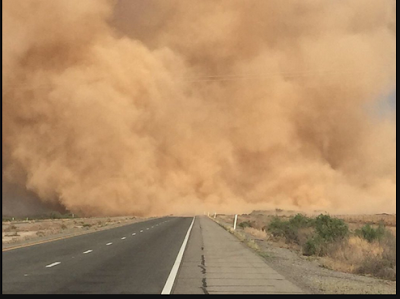
Dust storm over I-10 in Arizona ©AZGeology
In fact, the birds have been taking “Dust Baths”!!

Turkey taking a Dust Bath ©Jim Block
Here’s another one I caught Dust Bathing with some of the dust that is being kicked up:
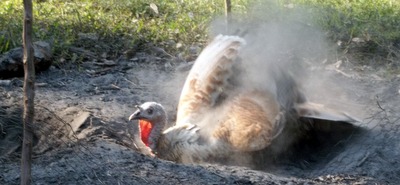
Dust Bathing
There has been some progress though. All of the Scriptural Alphabet of Animals are active.
Here are some of what has been going on over at Birds of the Bible for Kids:
The Bible Bird indexes that are open are:
Here are some of the articles that are active again: (reverse order as they were released)

Mocking Cliff Chat (Thamnolaea cinnamomeiventris) Female ©WikiC
“Likewise also the chief priests mocking him, with the scribes and elders, said, He saved others; himself he cannot save. If he be the King of Israel, let him now come down from the cross, and we will believe him. He trusted in God; let him deliver him now, if he will have him: for he said, I am the Son of God.” (Matthew 27:41-43 KJV) [While the were mocking Christ, He did not say anything.]
Avian and Attributes – Mocking
MOCK’ING, ppr. Imitating in contempt; mimicking; ridiculing by mimicry; treating with sneers and scorn; defeating; deluding.
MOCK’ING, n. Derision; insult.
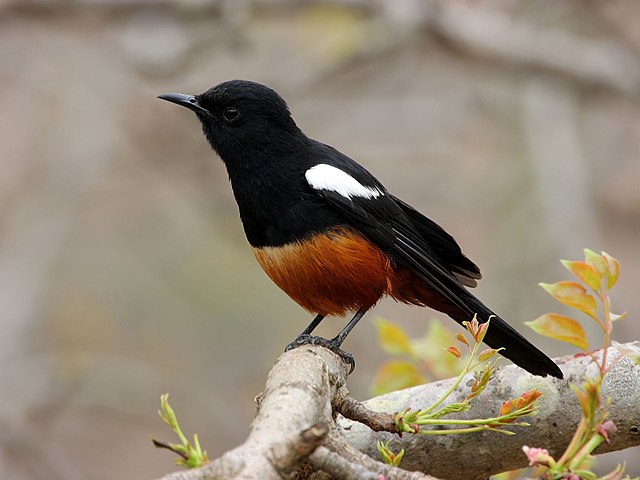
Mocking Cliff Chat (Thamnolaea cinnamomeiventris) Male ©WikiC
The Mocking Cliff Chat, mocking chat or cliff chat, (Thamnolaea cinnamomeiventris) is a species of chat in the family Muscicapidae which occurs in rocky habitats in much of eastern Sub-Saharan Africa.
The mocking cliff chat is a large chat with distinctive colouration. The male has a glossy black with a chestnut belly, vent, and rump and white shoulder patches. The shoulder patches vary in size geographically. The female is dark grey with a chestnut lower breast, belly, and vent. The mocking cliff chat has a length of 19–21 cm and weighs 41–51g.
The mocking cliff chat inhabits rocky and boulder-strewn areas, well-wooded rocky ravines, cliffs, gullies, boulder-strewn hillsides and watercourses in valley bottoms with scattered rocks.
A loud fluty melodious warbling song which often contains many rapid-fire phrases mimicking other species, with some harsher phrases interspersed.
Birds whose first name starts with “M”
*
[Definitions from Webster’s Dictionary of American English (1828), unless noted. Bird info from Wikipedia plus.]
“For the scripture saith, Whosoever believeth on him shall not be ashamed. For there is no difference between the Jew and the Greek: for the same Lord over all is rich unto all that call upon him. For whosoever shall call upon the name of the Lord shall be saved.” (Romans 10:11-13 KJV)
“For by these He has granted to us His precious and magnificent promises, so that by them you may become partakers of the divine nature, having escaped the corruption that is in the world by lust.” (2 Peter 1:4 NASB)
Avian and Attributes – Magnificent
MAGNIF’ICENT, a. Grand in appearance; splendid; pompous.
Man he made, and for him built
Magnificent this world.
1. Exhibiting grandeur.
“Whereby are given unto us exceeding great and precious promises: that by these ye might be partakers of the divine nature, having escaped the corruption that is in the world through lust.” (2 Peter 1:4 KJV)
EXCEE’DING, ppr. Going beyond; surpassing; excelling; outdoing.
1. Great in extent, quantity or duration; very extensive.
2. adv. In a very great degree; unusually; as exceeding rich.
I am thy shield, and thy exceeding great reward. Gen 15.
EXCEE’DING, n. Excess; superfluity.
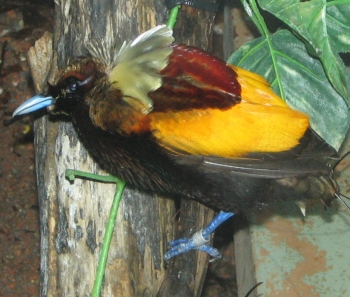
Magnificent Bird-of-paradise (Diphyllodes magnificus) ©WikiC
Magnificent Bird-of-paradise (Diphyllodes magnificus) is distributed amongst the hill and mid-mountain forests of New Guinea and surrounding islands. Their diet consists mainly of fruits. Like most members of the family Paradisaeidae, the male is polygamous and performs an elaborate courtship display.
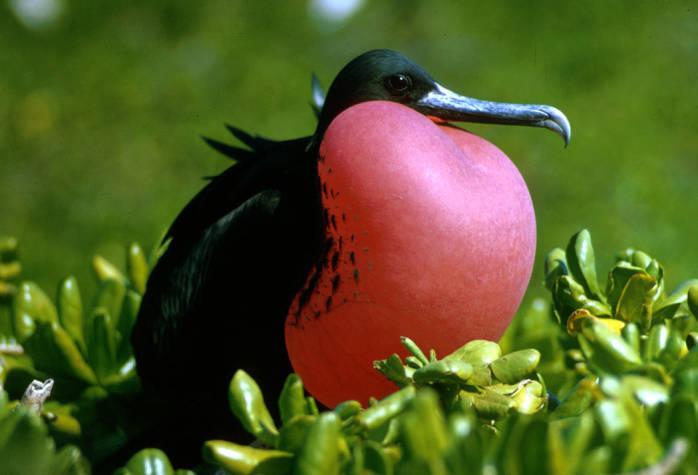
Magnificent Frigatebird (Fregata magnificens) ©USFWS
Magnificent Frigatebird (Fregata magnificens) is a seabird of the frigatebird family Fregatidae. With a length of 89–114 centimetres (35–45 in) it is the largest species of frigatebird. It occurs over tropical and subtropical waters off America, between northern Mexico and Ecuador on the Pacific coast and between Florida and southern Brazil along the Atlantic coast. There are also populations on the Galápagos Islands in the Pacific and the Cape Verde islands in the Atlantic.
The magnificent frigatebird is a large, lightly built seabird with brownish-black plumage, long narrow wings and a deeply forked tail. The male has a striking red gular sac which it inflates to attract a mate. The female is slightly larger than the male and has a white breast and belly. Frigatebirds feed on fish taken in flight from the ocean’s surface (often flying fish), and sometimes indulge in kleptoparasitism, harassing other birds to force them to regurgitate their food.
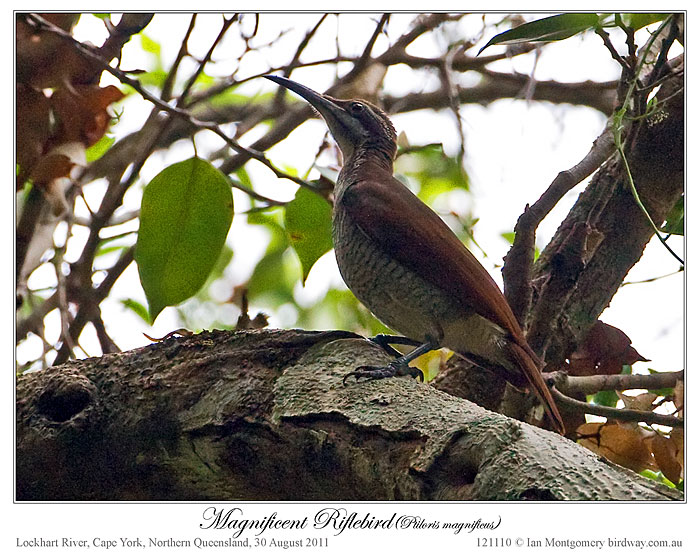
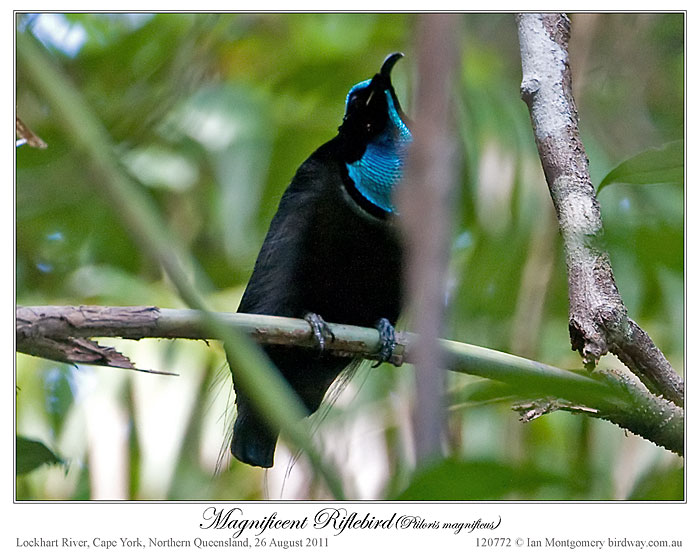
Magnificent Riflebird (Ptiloris magnificus) by Ian
Magnificent Riflebird (Ptiloris magnificus) is a species of passerine bird of the Paradisaeidae family. The magnificent riflebird is widely distributed throughout lowland rainforests of western New Guinea and the northern Cape York Peninsula.
Medium-sized (up to 34 cm long). the male is velvet-black bird-of-paradise with elongated black filamental flank plumes, an iridescent blue-green crown, a wide, triangle-shaped breast shield, and on central tail feathers. It has a black curved bill, yellow mouth, blackish feet and a dark brown iris. The female is brownish with dark spots and buff bars below with a white brow. The immature male resembles the male but with less tail plumes.
Males perform solitary courtship displays on a ‘dancing perch’. During these displays, the male fully extends his wings and raises his tail; he hops upward while swinging his head from side to side, showing off his metallic blue-green breast shield. Multiple females will observe these displays. Mated females subsequently build nests, incubate, brood, and feed young without male assistance.
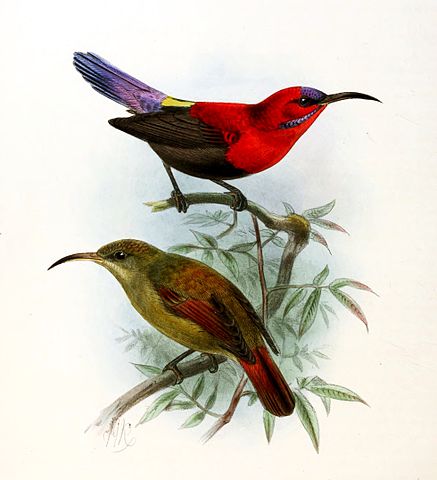
Magnificent Sunbird (Aethopyga magnifica) ©WikiC Drawing
Magnificent Sunbird (Aethopyga magnifica) is a species of bird in the sunbird family which feed largely on nectar, although they will also take insects, especially when feeding young. Flight is fast and direct on their short wings. Most species can take nectar by hovering like a hummingbird, but usually perch to feed most of the time. It is endemic to the western Philippines and was once considered a subspecies of the crimson sunbird.
Birds whose first name starts with “M”
*
[Definitions from Webster’s Dictionary of American English (1828), unless noted. Bird info from Wikipedia plus. Both with editing]
“That if thou shalt confess with thy mouth the Lord Jesus, and shalt believe in thine heart that God hath raised him from the dead, thou shalt be saved. For with the heart man believeth unto righteousness; and with the mouth confession is made unto salvation.” (Romans 10:9-10 KJV)
My Christian friends I have met through blogging, Aussiebirder, just put out a very interesting and applicable application for faith. Please check out this blog:

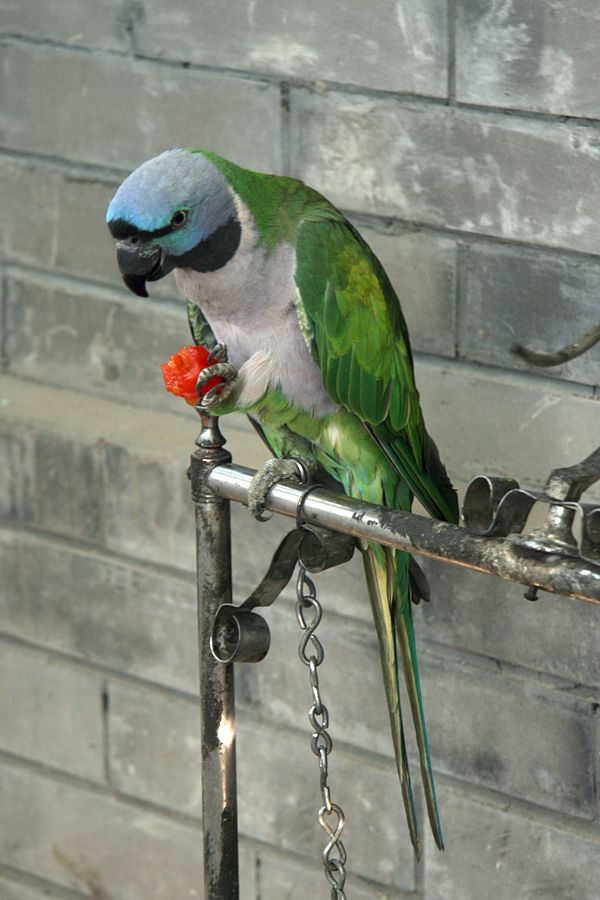
Lord Derby’s Parakeet (Psittacula derbiana) ©WikiC
“God that made the world and all things therein, seeing that he is Lord of heaven and earth, dwelleth not in temples made with hands;” (Acts 17:24 KJV)
Avian and Attributes – Lord
LORD, n.
1. A master; a person possessing supreme power and authority; a ruler; a governor.
Man over man he made not lord.
But now I was the lord of this fair mansion.
2. A tyrant; an oppressive ruler.
3. A husband.
I oft in bitterness of soul deplores my absent daughter, and my dearer lord.
My lord also being old. Gen 18.
4. A baron; the proprietor of a manor; as the lord of the manor.
5. A nobleman; a title of honor in Great Britain
6. An honorary title bestowed on certain official characters; as lord advocate, lord chamberlain, lord chancellor, lord chief justice, &c.
7. In scripture, the Supreme Being; Jehovah. When Lord, in the Old Testament, is prints in capitals, it is the translation of JEHOVAH, and so might, with more propriety, be rendered. The word is applied to Christ, Psa 110. Col 3. and to the Holy Spirit, 2 Th 3. As a title of respect, it is applied to kings, Gen 40. 2 Sam 19. to princes and nobles, Gen 42. Dan 4. to a husband, Gen 18. to a prophet, 1 Ki 18. 2 Ki 2. and to a respectable person, Gen 24. Christ is called the Lord of glory, 1 Cor 2. and Lord of lords, Rev 19.
LORD, v.t. To invest with the dignity and privileges of a lord.
LORD, v.i. To domineer; to rule with arbitrary or despotic sway; sometimes followed by over, and sometimes by it, in the manner of a transitive verb.
“For God hath not appointed us to wrath, but to obtain salvation by our Lord Jesus Christ,” (1 Thessalonians 5:9 KJV)
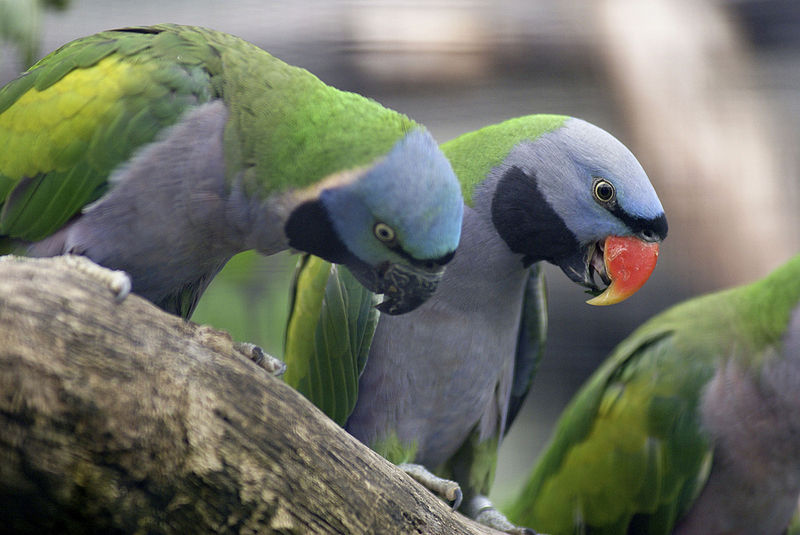
Lord Derby’s Parakeet (Psittacula derbiana) by Wilhelma Zoo©WikiC
Lord Derby’s Parakeet (Psittacula derbiana), also known as Derbyan parakeet, is a monotypic parrot species, which is confined to small pocket of moist evergreen forest in the hills and mountains of the Indian states of Arunachal Pradesh and Assam, and adjoining parts of Tibet, Sichuan and Yunnan in China. The species suffers from cutting of old trees (important for nesting sites) and poaching for the illegal wildlife trade. The adult male and female are easily distinguished because they have different beak colours and slightly different plumage.
The name of this bird commemorates Edward Stanley, 13th Earl of Derby
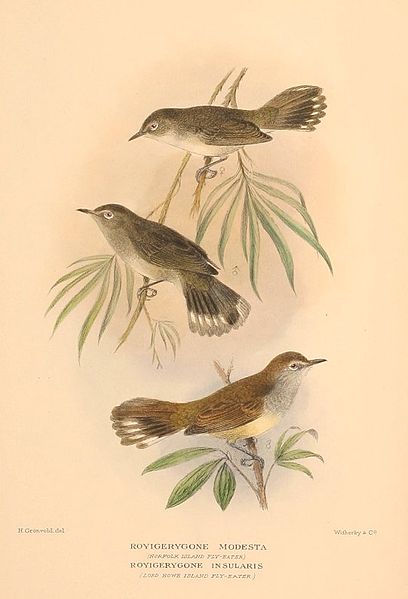
Lord Howe Gerygone (Gerygone insularis) ©Drawing WikiC
Lord Howe Gerygone (Gerygone insularis) was a small bird in the family Acanthizidae, brown and greyish in color. Its head was brown apart from a pale grey eye-ring and a grey throat and chin, many parts of the animal varied to the colour of yellow, this being apparent in its bright yellow belly. It made its home in the canopies of the island’s forest until the early 20th century. The bird has had a variety of monikers: locally, it was known as the “rain-bird” due to its activity after the rains, or the “pop-goes-the-weasel”, due to the similarity of its song to the well-known tune. The bird was endemic to Lord Howe Island in the Tasman Sea.
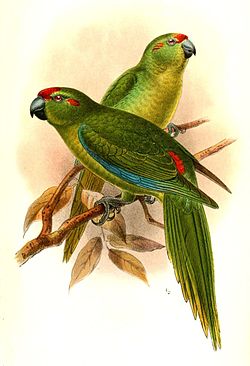
Lord Howe Parakeet (Cyanoramphus subflavescens †) ©Drawing WikiC
Lord Howe Parakeet (Cyanoramphus subflavescens), also known as the Lord Howe red-fronted parakeet, is an extinct parrot endemic to Lord Howe Island in the Tasman Sea, part of New South Wales, Australia. It was described as full species by Tommaso Salvadori in 1891, but subsequently, it has been regarded as subspecies of the red-crowned parakeet.

Lord Howe Woodhen (Gallirallus sylvestris) by Ian
Lord Howe Woodhen (Gallirallus sylvestris), also known as the Lord Howe Island woodhen or Lord Howe (Island) rail, is a flightless bird of the rail family, (Rallidae). It is endemic to Lord Howe Island off the Australian coast.
Birds whose first name starts with “L”
*
[Definitions from Webster’s Dictionary of American English (1828), unless noted. Bird info from Wikipedia plus.]
“For the wages of sin is death; but the gift of God is eternal life through Jesus Christ our Lord.” (Romans 6:23 KJV)
*** I am still tracking down those broken links. That is one reason the blogs haven’t come out as frequently as before. Stay tuned! ***
“And the evening and the morning were the fourth day. And God said, Let the waters bring forth abundantly the moving creature that hath life, and fowl that may fly above the earth in the open firmament of heaven. And God created great whales, and every living creature that moveth, which the waters brought forth abundantly, after their kind, and every winged fowl after his kind: and God saw that it was good. And God blessed them, saying, Be fruitful, and multiply, and fill the waters in the seas, and let fowl multiply in the earth. And the evening and the morning were the fifth day. And God said, Let the earth bring forth the living creature after his kind, cattle, and creeping thing, and beast of the earth after his kind: and it was so. And God made the beast of the earth after his kind, and cattle after their kind, and every thing that creepeth upon the earth after his kind: and God saw that it was good.” (Genesis 1:19-25 KJV)
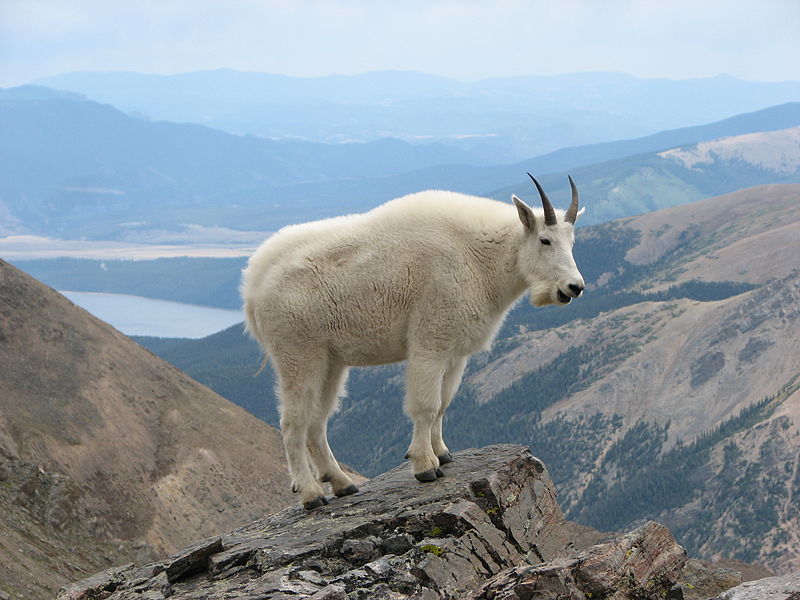
Mountain Goat at Mount Massive ©WikiC
We sing the mighty power of God
that made the mountains rise,
that spread the flowing seas abroad
and built the lofty skies.
We sing the wisdom that ordained
the sun to rule the day;
the moon shines full at his command,
and all the stars obey.

Mountain Bluebird (Sialia currucoides)
We sing the goodness of the Lord
that filled the earth with food;
he formed the creatures with his word
and then pronounced them good.
Lord, how your wonders are displayed,
where’er we turn our eyes,
if we survey the ground we tread
or gaze upon the skies.
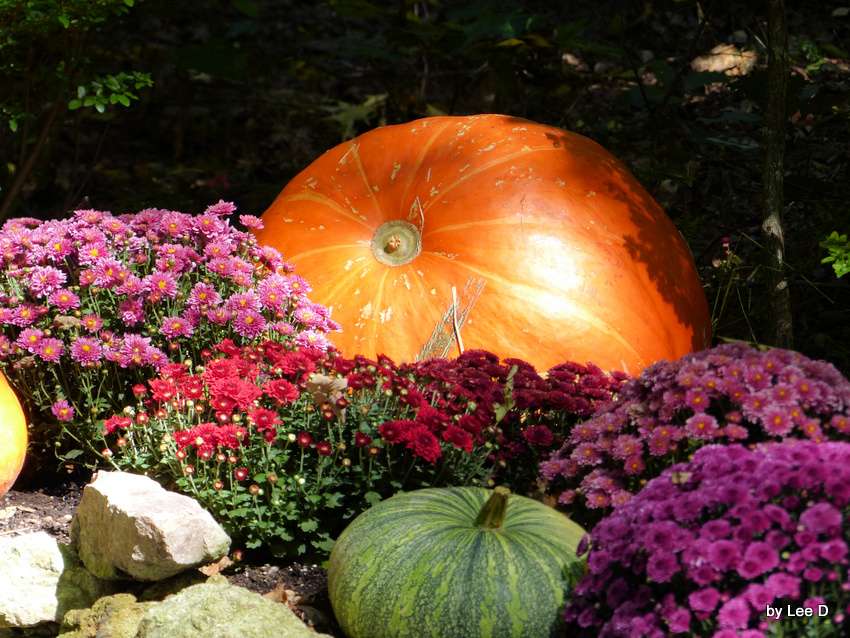
Landscape at Parrot Mountain
There’s not a plant or flower below
but makes your glories known,
and clouds arise and tempests blow
by order from your throne;
while all that borrows life from you
is ever in your care,
and everywhere that we can be,
you, God, are present there.
From the Psalter Hymnal, 1987


Yellow-Breasted Chat (Icteria virens) USGS
“The wild beasts of the desert shall also meet with the wild beasts of the island, and the satyr shall cry to his fellow; the screech owl also shall rest there, and find for herself a place of rest.” (Isaiah 34:14 KJV)
The I.O.C. Version 8.1 Update is finally completed on this blog. After issues with my Excel spreadsheet, all the pages are now current. It must have been some feathers from that family of birds they through up in the air. :) See: Hang On To Your Hat – I.O.C. 8.1 Update Underway the Thamnophilidae – Antbirds Family).
There actually was so many changes that I am only going to mention some of them. Here are the new families. The birds were taken from various families and given new places to dwell. Listed are the families at the end of the Passeriformes Order. Some were divided and others had avian wonders pulled from families and placed in these new ones. DNA research is the reason for Most of this shuffling.

Western Chat-Tanager (Calyptophilus tertius) ©Flickr Rafy Rodriguez
Emberizidae – Buntings – Split of New World Sparrows
Passerellidae – New World Sparrows – New
Calyptophilidae – Chat-tanagers – New
Phaenicophilidae – Hispaniolan Tanagers – New
Nesospingidae – Puerto Rican Tanager – New
Spindalidae – Spindalises – New
Zeledoniidae – Wrenthrush – New
Teretistridae – Cuban Warblers – New
Icteriidae – Yellow-breasted Chat – New
Icteridae – Oropendolas, Orioles and Blackbirds – Same
Parulidae – New World Warblers – Gave up birds
Mitrospingidae – Mitrospingid Tanagers – New
Cardinalidae – Cardinals, Grosbeaks and allies – Same
Thraupidae – Tanagers and allies – Gave up birds
“The trees of the LORD are full of sap; the cedars of Lebanon, which he hath planted; Where the birds make their nests: as for the stork, the fir trees are her house.” (Psalms 104:16-17 KJV)
I realize that for most casual birdwatchers, this means very little. Yet, some birders take photos, myself included, and we like to put the correct name on the birds. Also, my photos are stored by families. This helps when writing articles or just trying to find a photo. The desire is that these updates also assist those reading and using the blog.
There are other changes and the best way to find them is by going to these pages from the I.O.C.:
Be sure to check out the Birds of the World pages:
*
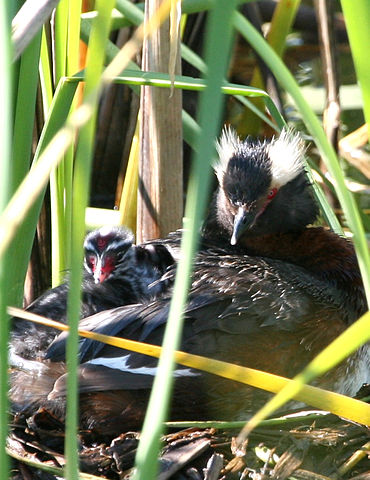
Horned Grebe (Podiceps auritus) ©WikiC
“The God of my rock; in him will I trust: he is my shield, and the horn of my salvation, my high tower, and my refuge, my saviour; thou savest me from violence.” (2 Samuel 22:3 KJV)
“The LORD is my rock, and my fortress, and my deliverer; my God, my strength, in whom I will trust; my buckler, and the horn of my salvation, and my high tower.” (Psalms 18:2 KJV)
Avian and Attributes – Horn
“Blessed be the Lord God of Israel; for he hath visited and redeemed his people, And hath raised up an horn of salvation for us in the house of his servant David;” (Luke 1:68-69 KJV)
HORN, n. [L. cornu]
1. A hard substance growing on the heads of certain animals, and particularly on cloven-footed quadrupeds; usually projecting to some length and terminating in a point. Horns are generally bent or curving, and those of some animals are spiral. They serve for weapons of offense and defense. The substance of horns is gelatinous, and in Papin’s digester it may be converted into jelly.
Horn is an animal substance, chiefly membranous, consisting of coagulated albumen, with a little gelatin and phosphate of lime.
The horns of deer possess exactly the properties of bone, and are composed of the same constituents, only the proportion of cartilage is greater.
2. A wind instrument of music, made of horn; a trumpet. Such were used by the Israelites.
3. In modern times, a wind instrument made of metal.
10. In Scripture, horn is a symbol of strength or power.
The horn of Moab is cut off. Jer 48.
Horn is also an emblem of glory, honor, dignity.
My horn is exalted in the Lord. 1 Sam 2.
In Daniel, horn represents a kingdom or state. [Edited]
Hornbills and Horned Birds


Hornbill Friarbird
Hornbills
Hornby’s Storm Petrel
Horned Coot
Horned Curassow
Horned Grebe
Horned Guan
Horned Lark
Horned Parakeet
Horned Puffin
Horned Screamer
Horned Sungem
Birds whose first name starts with “H”
Birds whose last name starts with “H”
*
[Definitions from Webster’s Dictionary of American English (1828), unless noted. Bird info from Wikipedia plus.]
 Lee's Birdwatching Adventures Plus