ANCIENT HUMMINGBIRDS WERE QUITE MODERN – Repost

Ruby-throated Hummingbird by Ray's Wildlife

Ruby-throated Hummingbird by Ray’s Wildlife

ANCIENT HUMMINGBIRDS WERE QUITE MODERN from Creation Moments

“And God said, Let the waters bring forth abundantly the moving creature that hath life, and fowl that may fly above the earth in the open firmament of heaven.” (Genesis 1:20)

Today, hummingbirds are found only in North, Central and South America. Of course, since Noah’s Ark landed in the mountains of Ararat, they had to cross Europe and the Atlantic or Asia to get there. However, until now, there was no evidence for this migration.

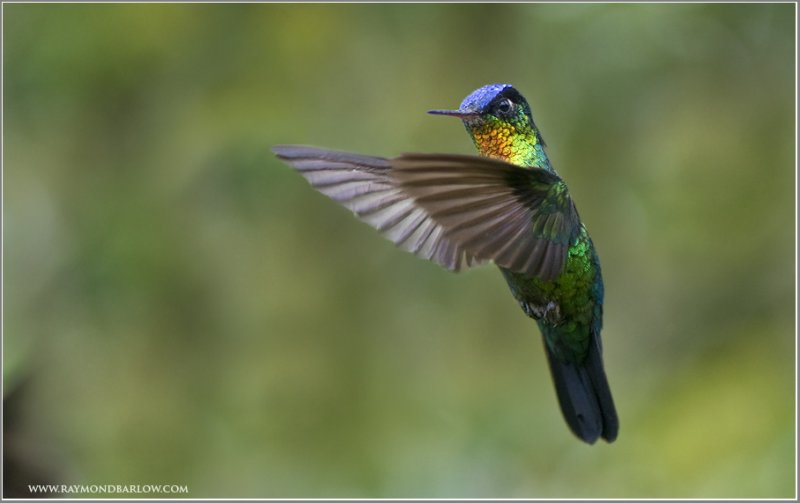
Fiery-throated Hummingbird (Panterpe insignis) by Raymond Barlow

Fiery-throated Hummingbird (Panterpe insignis) by Raymond Barlow

Ancient Hummingbirds Were Quite Modern Scientists have now discovered two hummingbird fossils in a clay pit in southwestern Germany. These tiny fossils are remarkable in many ways. Until now, evolutionists claimed the earliest hummingbird fossils to be one million years old. The new fossils are said to be 30 to 34 million years old. While we would not agree with the evolutionary dating, we would expect the hummingbird fossils in Europe or Asia to predate those in the New World. Even more interesting is that the fossils suggest that these older birds are fully functional hummingbirds. Their wing bones are like those of modern hummingbirds, which suggest that they could hover and fly backward just like the hummingbirds we know today. Their beaks were twice as long as their skulls, suggesting that they drank nectar just like modern hummingbirds. In other words, there is no sign of any evolutionary development, another fact we would expect.

While the evidence for the history of hummingbirds is what we would expect, we do not need scientific evidence to uphold scriptural truth. We have God’s Word on it.

Prayer:
I thank You, Lord, for the beauty of Your creation, which remains beautiful, despite our sin. Amen.

Notes:
Science News, 5/8/04, p. 292, S. Perkins, “Ancient Buzzing.”
Creation Moments ©2016 (used with permission)

*

More Creation Moment Articles

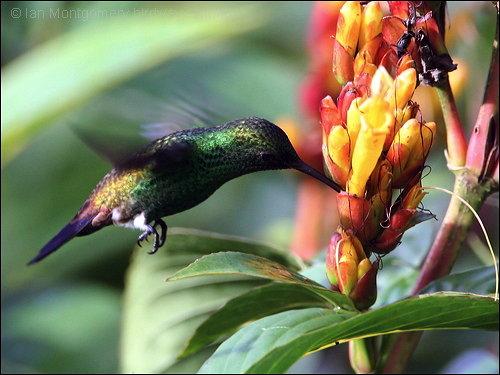
Copper-rumped Hummingbird (Amazilia tobaci) by Ian

Copper-rumped Hummingbird (Amazilia tobaci) by Ian


Lee’s Two Word Tuesday – 12/13/16

***

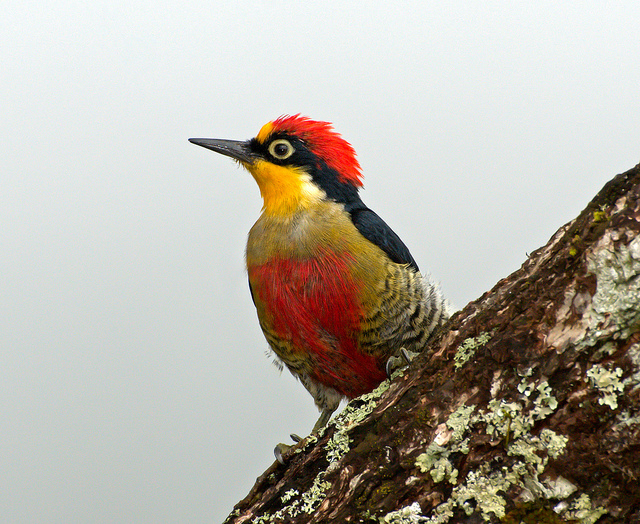
Yellow-fronted Woodpecker (Melanerpes flavifrons) by Dario Sanches

FAIR COLORS

***


“O thou afflicted, tossed with tempest, and not comforted, behold, I will lay thy stones with fair colors, and lay thy foundations with sapphires. (Isaiah 54:11)

Yellow-fronted Woodpecker (Melanerpes flavifrons) by Dario Sanches

*

More Daily Devotionals

*

Lee’s One Word Monday – 12/12/16

***

Fantail Pigeon ©WikiC

FULNESS

***


“And to know the love of Christ, which passeth knowledge, that ye might be filled with all the fulness of God.” (Ephesians 3:19 KJV)

Fantail Pigeon ©WikiC

*

More Daily Devotionals

*

Lee’s Seven Word Sunday – 12/11/16

***

WITH GREAT WINGS, LONG-WINGED,

FULL OF FEATHERS

***


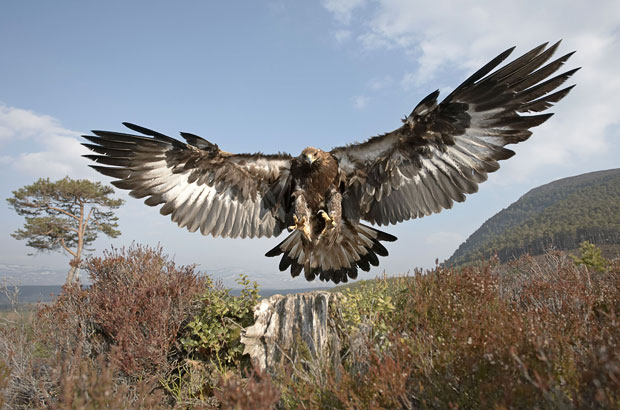
“And say, Thus saith the Lord God; A great eagle with great wings, long-winged, full of feathers, which had diverse colors, came unto Lebanon, and took the highest branch of the cedar.” (Ezekiel 17:3)

Golden Eagle (Aquila chrysaetos) Swooping Down ©Netns Wildlifezone

*

More Daily Devotionals

*

Sunday Inspiration – The Last of the Anatidae Family

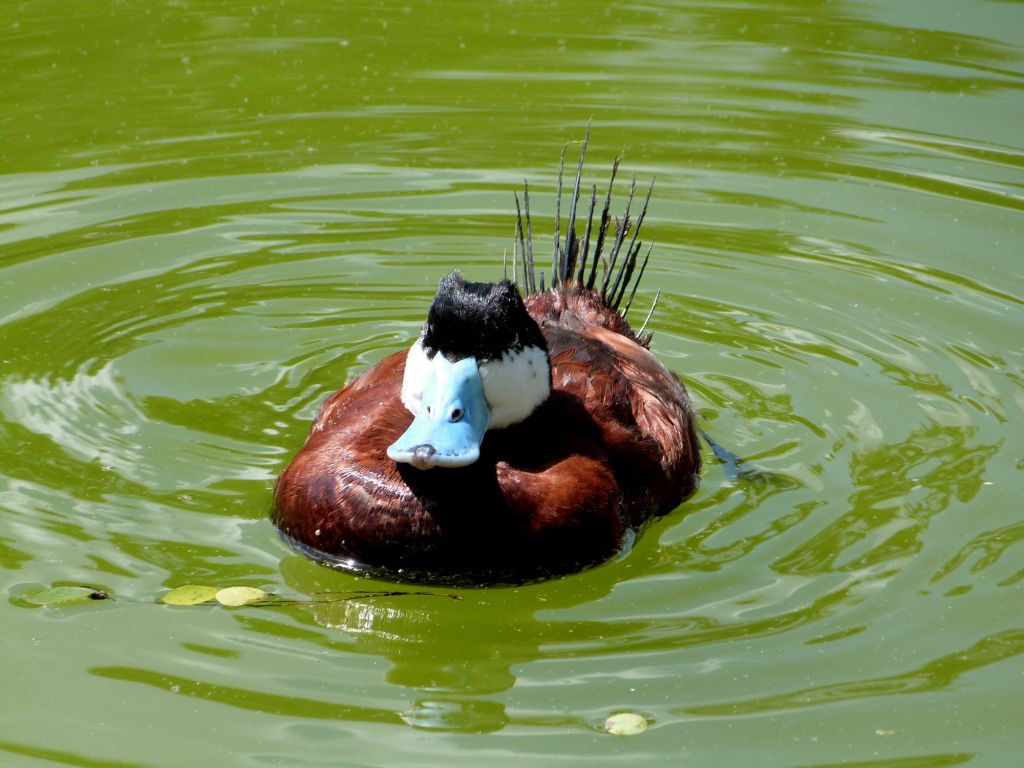
Ruddy Duck (Oxyura jamaicensis) Zoo Miami by Lee

Ruddy Duck (Oxyura jamaicensis) Zoo Miami by Lee

“And she shall bring forth a son, and thou shalt call his name JESUS: for he shall save his people from their sins.” (Matthew 1:21 KJV)

Surprise! We are finally at the last of the Anatidae Family of Ducks, Geese, and Swans. There are 31 left, and today we will reveal the rest of them. There is a total of 173 species in this family. Trust you didn’t mind them being divided into different articles [in taxonomic order]. A list of the whole series of these avian wonders is at the end of the article.

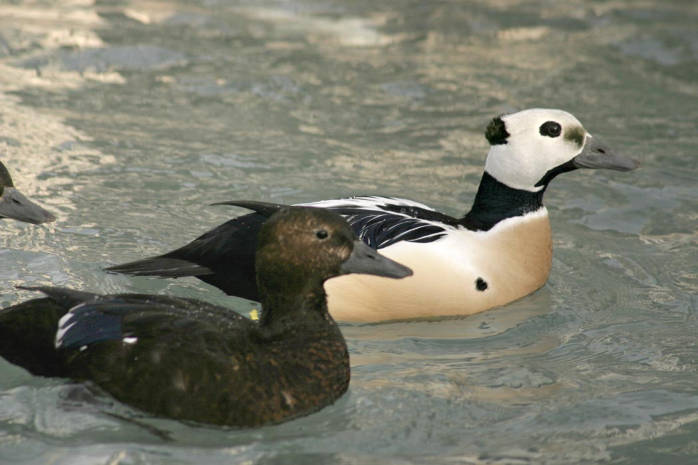
Today, we start off with four Eiders that are in two genera. They are the Steller’s Eider (Polysticta stelleri), Spectacled Eider (Somateria fischeri), and the King Eider (Somateria spectabilis), Common Eider (Somateria mollissima).What are an interesting looking group.

Steller’s Eider (Polysticta stelleri) Pair ©USFWS

Eiders (/ˈ.dər/)

Steller’s Eider (Polysticta stelleri)is the smallest eider at 45 cm (18 in) long. The male is unmistakable with his white head marked by a thick black eye ring and greenish-black tufts of feathers on the forehead and the back of the head. Chin, throat and neck are also black, as are the back, tail, and rump. Wings are dark bluish-purple with white edging. When folded, they give a striped appearance across the back. The speculum is metallic blue bordered with white. The breast and flanks are cinnamon-buff marked with a black spot on each side just above the waterline. Legs, feet and bill are dark bluish-grey. The female is a dark brown bird, smaller with a more typically duck-shaped head and body than other eider species.

Spectacled Eider (Somateria fischeri) ©USFWS

Spectacled Eider (Somateria fischeri) ©USFWS

The Eider genus, Somateriaare large seaducks . The scientific name is derived from Ancient Greek somatos “body” and erion “wool”, referring to eiderdown. They all breed in the cooler latitudes of the Northern Hemisphere. The down feathers of eider ducks, and some other ducks and geese, are used to fill pillows and quilts—they have given the name to the type of quilt known as an eiderdown.

I think that when the Lord God, the Creator of all these “duck family” critters, He was proving these verses we read in the Bible: “Wherein he hath abounded toward us in all wisdom and prudence; Having made known unto us the mystery of his will, according to his good pleasure which he hath purposed in himself:” (Ephesians 1:8-9 KJV) [emphasis mine]

As you will see as we continue through the rest of these swimming critters, the variety of design, color, shapes, and provisions for them. What a Creator!

Harlequin Duck (Histrionicus histrionicus) ©WikiC

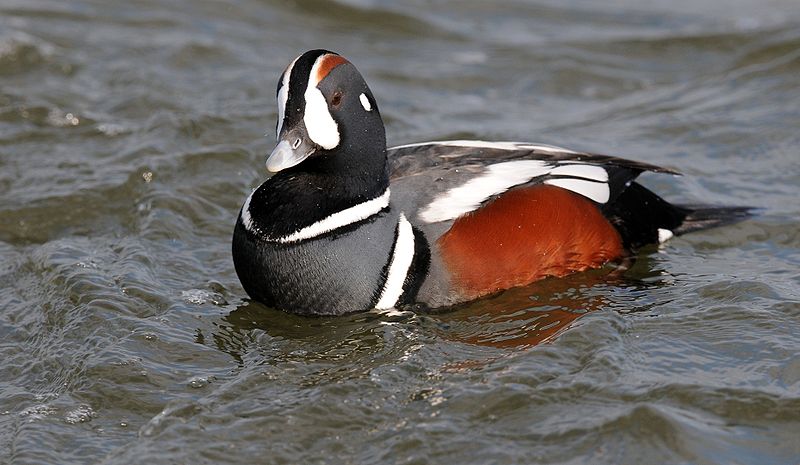
Harlequin Duck (Histrionicus histrionicus) ©WikiC

The Harlequin Duck (Histrionicus histrionicus) is a small sea duck. It takes its name from Harlequin (French Arlequin, Italian Arlecchino), a colourfully dressed character in Commedia dell’arte. The species name comes from the Latin word “histrio”, “actor”. In North America it is also known as lords and ladies. Other names include painted duck, totem pole duck, rock duck, glacier duck, mountain duck, white-eyed diver, squeaker and blue streak.

Labrador Duck (Camptorhynchus labradorius) Specimen ©WikiC

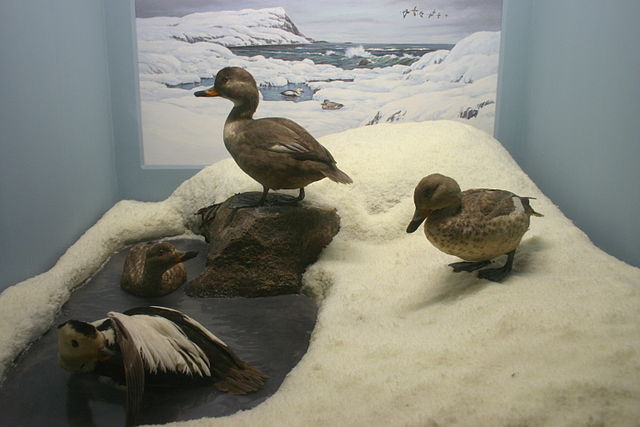
Labrador Duck (Camptorhynchus labradorius) Specimen ©WikiC

The Labrador Duck (Camptorhynchus labradorius) is an extinct North American bird; it has the dubious distinction of being the first endemic North American bird species to become extinct after the Columbian Exchange. It was already a rare duck before European settlers arrived, and became extinct shortly after. As a result of its rarity, information on the Labrador duck is not abundant, but some, such as its habitat, characteristics, dietary habits, and reasons behind extinction, are known. Specimens of the Labrador duck are preserved in museum collections worldwide.

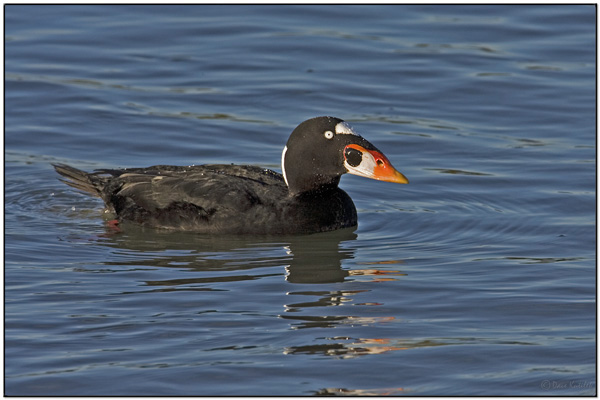
Surf Scoter (Melanitta perspicillata) by Daves BirdingPix

Surf Scoter (Melanitta perspicillata) by Daves BirdingPix

The Scoters of the Melanitta genus come next: The Surf Scoter (Melanitta perspicillata), Velvet Scoter (Melanitta fusca),  White-winged Scoter (Melanitta deglandi),  Common Scoter (Melanitta nigra),  Black Scoter (Melanitta americana)

They are stocky seaducks. The drakes are mostly black and have swollen bills. Females are brown. The genus name is derived from Ancient Greek melas “black” and netta “duck”.

They breed in the far north of Europe, Asia, and North America, and winter farther south in temperate zones of those continents. They form large flocks on suitable coastal waters. These are tightly packed, and the birds tend to take off together. Their lined nests are built on the ground close to the sea, lakes or rivers, in woodland or tundra. These species dive for crustaceans and molluscs.

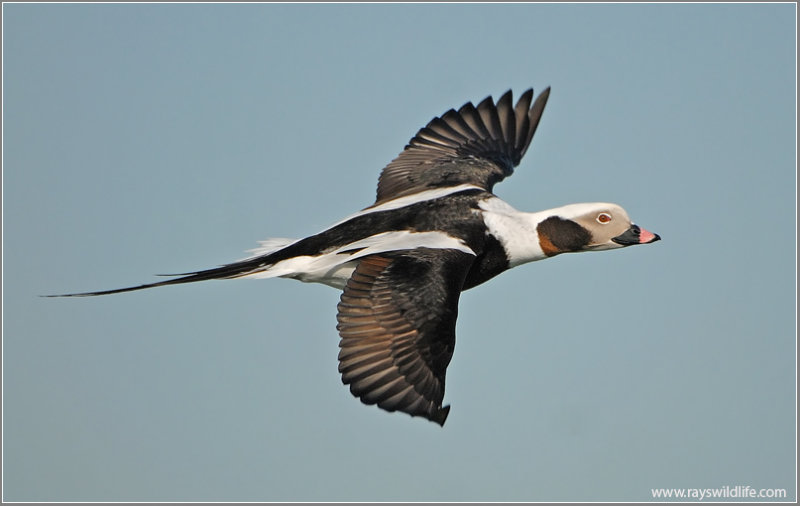
Long-tailed Duck (Clangula hyemalis) by Ray

Long-tailed Duck (Clangula hyemalis) by Ray

Long-tailed Duck (Clangula hyemalis), once known as oldsquaw, is a medium-sized sea duck. Their breeding habitat is in tundra pools and marshes, but also along sea coasts and in large mountain lakes in the North Atlantic region, Alaska, northern Canada, northern Europe, and Russia. The nest is located on the ground near water; it is built using vegetation and lined with down. They are migratory and winter along the eastern and western coasts of North America, on the Great Lakes, coastal northern Europe and Asia, with stragglers to the Black Sea. The most important wintering area is the Baltic Sea, where a total of about 4.5 million gather.

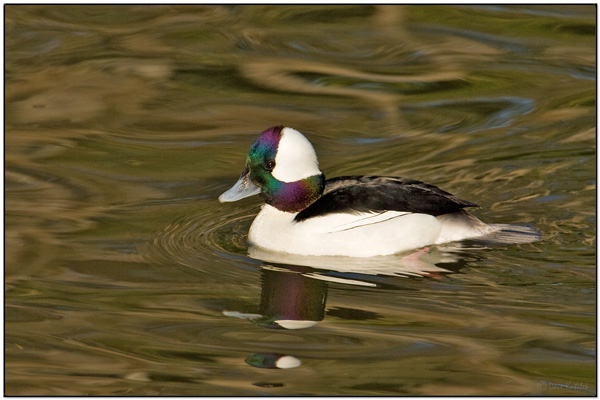
Bufflehead (Bucephala albeola) by Daves BirdingPix

Bufflehead (Bucephala albeola) by Daves BirdingPix

Bucephala is a genus of ducks found in the Northern Hemisphere. The genus name is derived from Ancient Greek boukephalos, “bullheaded”, from bous “bull”, and kephale, “head”, a reference to the crest of the bufflehead making its head look large. They are the Bufflehead (Bucephala albeola),  Common Goldeneye (Bucephala clangula),  Barrow’s Goldeneye (Bucephala islandica)

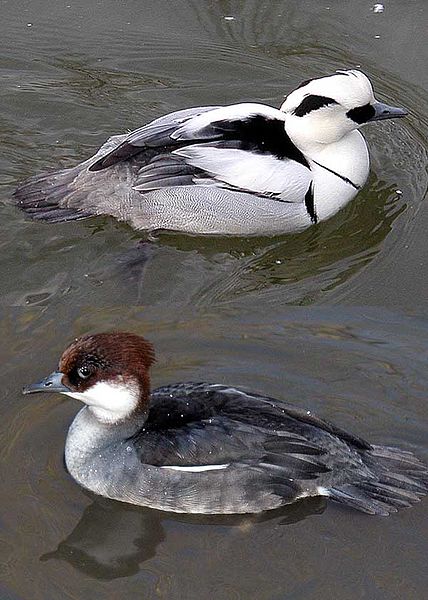
Smew (Mergellus albellus) ©WikiC

Smew (Mergellus albellus) ©WikiC

Smew (Mergellus albellus) – The drake smew, with its ‘cracked ice’ and ‘panda’ appearance, is unmistakable, and looks very black-and-white in flight. The females and immature males are grey birds with chestnut foreheads and crowns, and can be confused at a distance with the ruddy duck; they are often known as “redhead” smew. It has oval white wing-patches in flight. The smew’s bill has a hooked tip and serrated edges, which help it catch fish when it dives for them.

Hooded Merganser Viera Wetlands in clear with hood down.

Hooded Merganser Viera Wetlands with hood down by Lee

Hooded Merganser (Lophodytes cucullatus) is a species of small duck. It is the only extant species in the genus Lophodytes. The bird is striking in appearance; both sexes have crests that they can raise or lower, and the breeding plumage of the male is handsomely patterned and coloured. The hooded merganser has a sawbill but is not classified as a typical merganser.

Common Merganser (Mergus merganser) Male Zoo Miami by Lee

Common Merganser (Mergus merganser) Male Zoo Miami by Lee

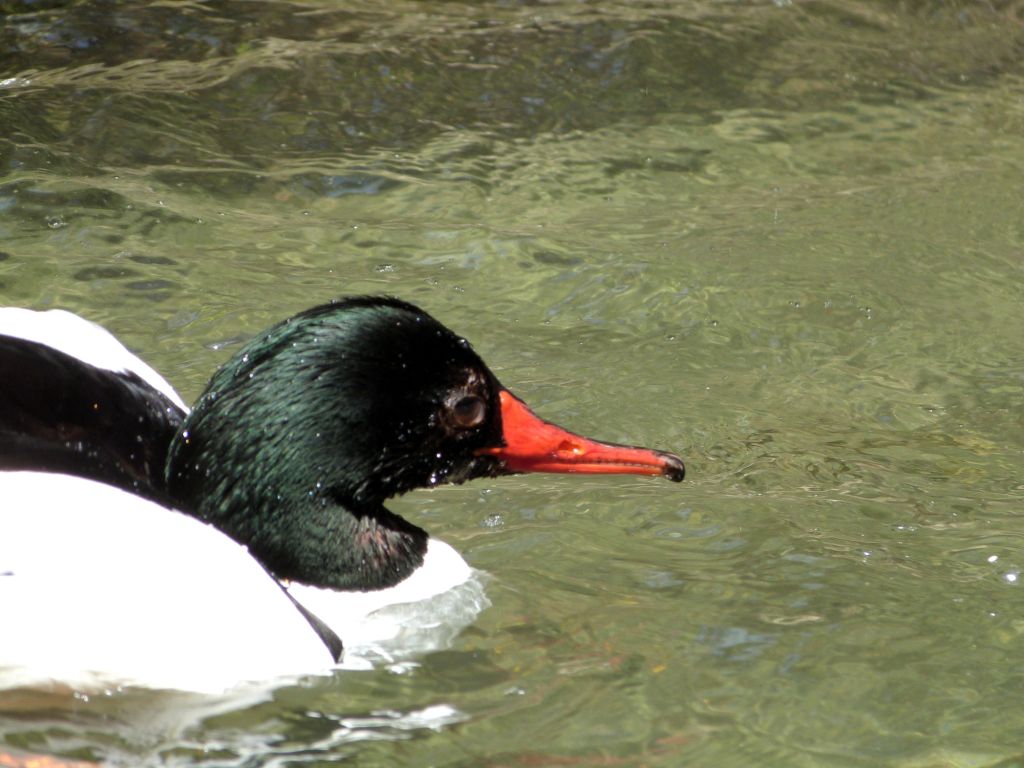
The Merus genus of Typical Mergansers: New Zealand Merganser (Mergus australis) Extinct,  Brazilian Merganser (Mergus octosetaceus),  Common Merganser (Mergus merganser),  Red-breasted Merganser (Mergus serrator),  Scaly-sided Merganser (Mergus squamatus)

Although they are seaducks, most of the mergansers prefer riverine habitats, with only the red-breasted merganser being common at sea. These large fish-eaters typically have black-and-white, brown and/or green hues in their plumage, and most have somewhat shaggy crests. All have serrated edges to their long and thin bills that help them grip their prey. Along with the Smew and Hooded Merganser, they are therefore often known as “sawbills“.

Black-headed Duck (Heteronetta atricapilla) ©©Klaus Rudloff

The Black-headed Duck (Heteronetta atricapilla) is a South American duck allied to the stiff-tailed ducks in the subfamily Oxyurinae of the family Anatidae. It is the only member of the genus Heteronetta.

This is the most basal living member of its subfamily, and it lacks the stiff tail and swollen bill of its relatives.

Masked Duck (Nomonyx dominicus) ©WikiC

Masked Duck (Nomonyx dominicus) ©WikiC

Masked Duck (Nomonyx dominicus) is a tiny stiff-tailed duck ranging through the tropical Americas. They are found from Mexico to South America and also in the Caribbean. Primarily not migratory, masked ducks are reported as very uncommon vagrants in the southernmost United States, along the Mexican border and in Florida.

These ducks mainly feed on seeds, roots, and leaves of aquatic plants. They also eat aquatic insects and crustaceans. They feed by diving.

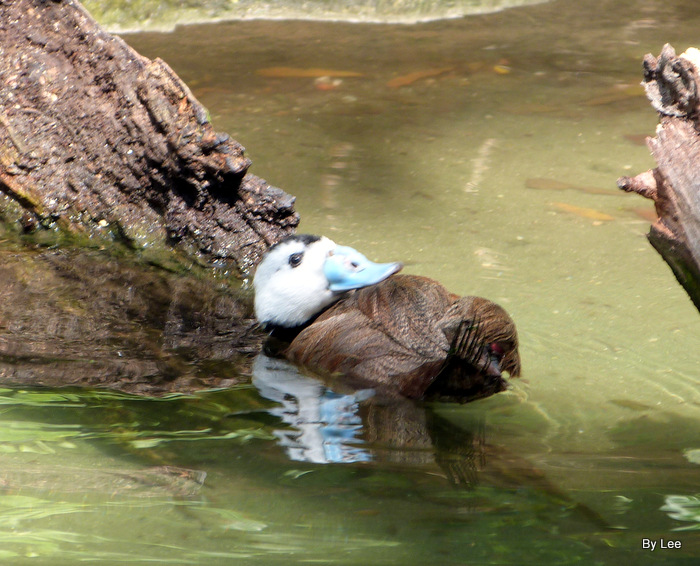
ANS-Anat White-headed Duck (Oxyura leucocephala)

White-headed Duck (Oxyura leucocephala) Zoo Miami by Lee

The Oxyura genus has 6 Ducks, the Ruddy Duck (Oxyura jamaicensis),  Andean Duck (Oxyura ferruginea),  Lake Duck (Oxyura vittata),  Blue-billed Duck (Oxyura australis),  Maccoa Duck (Oxyura maccoa),  and the White-headed Duck (Oxyura leucocephala).

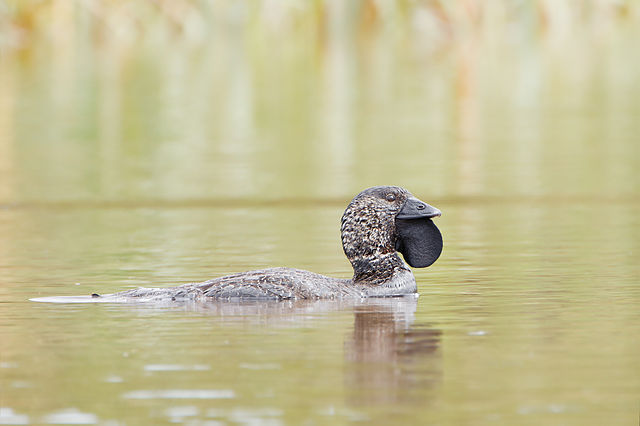
Musk Duck (Biziura lobata) Male ©WikiC

The Musk Duck (Biziura lobate) is a highly aquatic, stiff-tailed duck native to southern Australia. It is the only living member of the genus Biziura. This animal derives its common name from the peculiar musky odour it emanates during the breeding season. Musk ducks are moderately common through the Murray-Darling and Cooper Creek basins, and in the wetter, fertile areas in the south of the continent: the southwest corner of Western Australia, Victoria, and Tasmania.

[Information from Wikipedia with editing]

This slideshow requires JavaScript.

*

Saying, Where is he that is born King of the Jews? for we have seen his star in the east, and are come to worship him.” (Matthew 2:2 KJV)

“Birthday of the King” ~ Dr. Richard Gregory

*

More Sunday Inspirations

Anatidae Family Sunday Inspirations:

10 Reasons Jesus Came to Die

*

Lee’s Six Word Saturday – 12/10/16

***

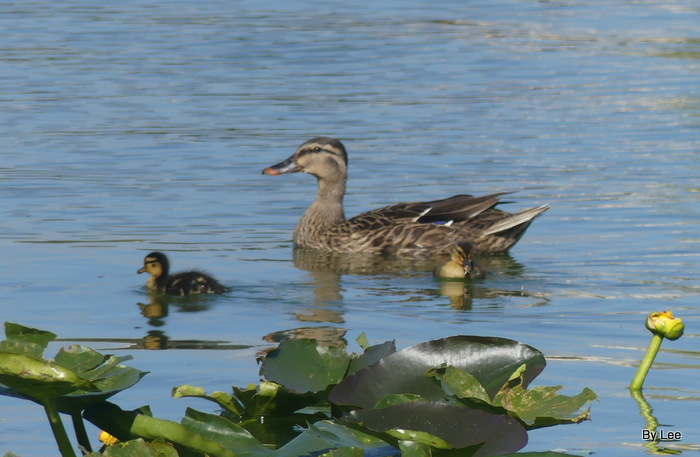
Momma Mallard and 2 Babies at Lake Morton

FOR THEY WATCH FOR YOUR SOULS

***


“Obey them that have the rule over you, and submit yourselves: for they watch for your souls, as they that must give account, that they may do it with joy, and not with grief: for that is unprofitable for you.” (Hebrews 13:17 KJV)

Momma Mallard and 2 Babies at Lake Morton by Lee


*

More Daily Devotionals

*

SAFETY MONITORING by Canaries, Crayfish, and Brook Trout

SAFETY MONITORING by Canaries, Crayfish, and Brook Trout

Dr. James J. S. Johnson canary-caged-for-mines-heritagetrail

Canary “recruited” for Mining Safety    (U.K. gov’t/public domain)

Son of man, I have made thee a watchman unto the house of Israel: therefore hear the word at my mouth, and give them warning from me. (Ezekiel 3:17)

It’s good to have warning devices – like smoke detectors — that monitor environmental conditions, to give us an alarm if a deadly danger is imminent. However, long before humans invented mechanical safety monitoring devices, God had installed creatures all over the planet, with traits that equip them to serve us a safety monitors who can alarm us humans regarding environmental hazards.
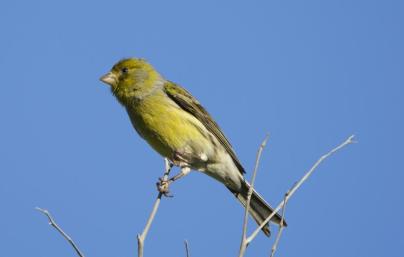
island-canary-hbw-alive

ISLAND CANARY photo credit: HBW Alive

CANARIES, AS AIR QUALITY MONITORS

The Canary (Serinus canaria, a/k/a the “Island Canary” or “Wild Canary”) is an amazingly valuable finch.  For generations it has been commonly known, at least within the mining community, that canaries are good safety indicators  —  serving as caged air quality monitors  –  if the air is becoming dangerous, the Canary provides the alarm, signaling (by its distress) that it’s time to evacuate(!).

BIRDS AS DANGER SIGNALS – Until 1992 miners used to take a caged canary underground to warn them of dangerous gases [such as carbon monoxide] in the mine. The bird would react to poisons in the air before miners became aware of them.  …  Canaries were used [by] rescue teams in coal mines to detect poisonous carbon monoxide gas.  Reacting more rapidly than humans, their fluttering and other [behavioral] signs of distress gave warning when [dangerous] gas was present.  Oxygen was also carried to help birds recover.  No detecting apparatus was so reliable and canaries were used until 1992 when new electronic equipment, which can also meter the concentration of gas, was introduced.

[Quoting Colin Harrison & Howard Loxton, THE BIRD: MASTER OF FLIGHT (Hauppauge, NY: Barron’s Educational Series, 1993), page 277.]  Perhaps we should not be surprised that canaries have been used as “watchdogs”, in mines, to give warning of dangers  –  the word “canary” points to the historic discovery of that species of yellow-and-brown finches, in the Canary Islands (and Madeira and the Azores), by Spanish conquistadores.  The term “Canary Islands” means “dog islands”, i.e., canine islands, so it makes sense, philologically speaking, that canaries have been harnessed to serve humans as air quality “watchdogs”.

On 1478, when the Spanish invaded the Canaries, they started to export these birds throughout Europe. There followed intensive rearing in captivity, giving rise to the remarkable varieties of forms with their great varieties of forms with their great variety of plumage coloration.

[Quoting Gionfranco Bologna, SIMON & SCHUSTER’S GUIDE TO BIRDS OF THE WORLD (London: Fireside Books, 1990; edited by John Bull), page 365-366.]
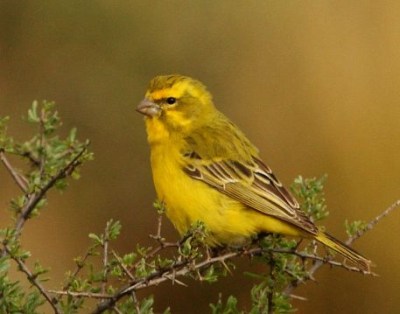
Yellow Canary (Crithagra flaviventris) Male ©WikiC

Yellow Canary (Crithagra flaviventris) Male ©WikiC

But what is a Canary? Do we see them – or their cousins – in America?

The original Canary (Serinus canaria) is a small yellow and brown species of finch with a lively manner and a cheerful song.  The familiar yellow bird of today is the result of controlled breeding [i.e., real “selection” of phenotype-coded genotypes, by human breeders] usually suppressing the dark pigments in the plumage.  Breeding has also produced a wide range of color in shades and mixtures of white, red (which needs a carotene-rich diet to maintain the color), green and brown, tufted headcaps and variations in body shape.  Birds produced by crossbreeding with Red Hooded Siskins (to produce red) and Mules (hybrids with other finches such as the Goldfinch and Linnet), are not taxonomically true canaries but are exhibited as such.  The Roller, Malinois and Spanish Timbrado are considered the most musical breeds.

[Quoting Colin Harrison & Howard Loxton, THE BIRD: MASTER OF FLIGHT (Hauppauge, NY: Barron’s Educational Series, 1993), page 236.]  Thus, within the extended “family” of finches, the American Goldfinch (Carduelis tristis) is a cousin to the wild Canary (Serinus canaria) of the Canary Islands.
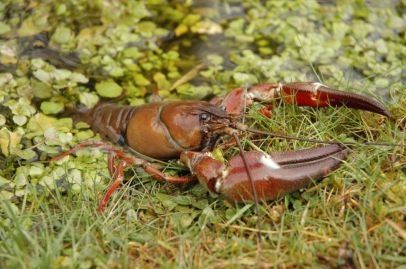
crayfish-at-shoreline-aaronlesieur

CRAYFISH crawling out of drainage ditch water    photo credit: Aaron LeSieur

CRAYFISH, AS WATER QUALITY MONITORS

While caged Canaries can monitor the underground air quality, Crayfish (e.g., Procambus, Orconectes, Cambarus, Fallicambarus, & Faxonella species) serve as water quality monitors.  (This is a service that I especially appreciate, having previously served the Texas Natural Resource Conservation Commission and the Trinity River Authority of Texas, as a Certified Water Quality Monitor, and having taught a course in Environmental Limnology at Dallas Christian College, back in the AD1990s.)

Just as canaries are sensitive to airborne poisons, crayfish (called “crawfish” by Louisiana Cajuns, as well as “mudbugs”) serve as indicators of lotic freshwater quality, as well as indicating the freshwater quality of lacustrine margins and muddy-water bayous.

[C]rawfishes have proved to be good indicators of the health of streams and other aquatic ecosystems [such as drainage ditches] and are of great interest to environmental biologists. Because the lives of these creatures are tied so closely to water, pollution and lowered water quality often lead to loss of crawfish populations over both small and large areas.  Some studies suggest tha talmsot half the species of eastern American crawfishes suffer from increasingly poor water quality and rapid loss of their aquatic habitats to agriculture or human housing development.  A few species in other states appear to have become extinct [i.e., locally or regionally extirpated], and several others – including some in Louisiana – could disappear within the next few decades.

[Quoting Jerry G. Walls, CRAWFISHES OF LOUISIANA (Baton Rouge:  Louisiana State University Press, 2009), page 1.]  For further (and very comprehensive) details, on the need for relatively pure freshwater, for successful crayfish habitats, see Walls’ book (CRAWFISHES OF LOUISIANA), at pages 34-37 & 52-54.

As a youth, I learned to observe and appreciate (and  catch) crayfish, in rural Baltimore County (Maryland), as reported elsewhere — see “Catching Crayfish, a Lesson in Over-Reacting”.  These wetland-loving freshwater decapods are true shellfish, creative constructions of crustacean beauty, exhibiting God’s bioengineering brilliance.

So America’s Crayfish, which come in a variety of species, are water quality monitors, indicating by their presence (or absence) whether the freshwaters in streams and drainage ditches are relatively healthy.

Consequently, in recent years, I have been glad to see the mud “chimneys” of crayfish, on the sides of a drainage ditch that runs runoff rainwater alongside my front yard, in the shadow of my mailbox. Even gladder, I was, when I saw active crayfish, darting here and there in the pooled up rainwater-runoff water that accumulates in that drainage ditch.  In other words, the crayfish in my front yard’s drainage ditch are (by their very lives!) signaling me that the drainage ditch has fairly “healthy” freshwater quality!  As a former Certified Water Quality Monitor, I was happy for the crayfish’s monitoring “report”.
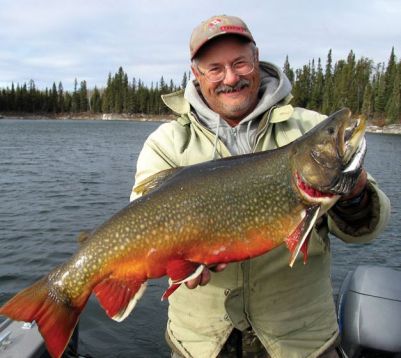
Brook-Trout-in-Manitoba.troutster.jpg

BROOK TROUT    ( photo credit:  troutster.com )

BROOK TROUT, AS WATER QUALITY MONITORS

Of course, the Crayfish  is not the only indicator of freshwater quality.  Another example is the Brook Trout (Salvelinus fontinalis – a/k/a “brook charr”, “speckled trout”, “mud trout”, etc.), a salmonid famous for inhabiting freshwater streams, as its name suggests. It prefers ponds and streams with clean, clear, cold waters.

The importance of Brook Trout, to mankind, is illustrated by the fact that it is the official fish of 9 states: Michigan (where a potamodromous [fish that migrate only within contiguous freshwaters] population in Lake Superior is called “coaster trout”), New Hampshire, New Jersey, New York, North Carolina, Pennsylvania, Vermont, Virginia, and West Virginia – plus it is Nova Scotia’s official “provincial fish”.

Since the Brook Trout thrives only in clean freshwater, it too is an indicator – a water quality monitor of sorts – whose presence exhibits that its home-waters are relatively healthy, i.e., unpolluted.

The brook trout (Salvelinus fontinalis) is a small, brilliantly colored freshwater fish native to clear, cold streams and rivers in the headwaters of the [Chesapeake] Bay watershed. … There fish thrive in clear, silt-free, well-shaded freshwater streams with numerous pools and a substrate made of mixed gravel, cobble and sand.  Because brook trout are not tolerant of water temperatures above 75 degrees Fahrenheit, they are rarely found in developed areas. . . .

In addition to being noted for their recreational value [as a “prized game fish”], brook trout are also very significant biologically [i.e., ecologically]. Because they require pristine, stable habitat with high water quality conditions, brook trout are viewed as indicators of the biological integrity of streams.  As the water quality in headwater streams has declined so have brook trout populations.

[Quoting Kathy Reshetiloff, “Got Brook Trout?  Then You’ve Also Got a Healthy Stream”, CHESAPEAKE BAY JOURNAL, 26(8):40 (November 2016).   For further (and more comprehensive) details regarding how urban, agricultural, and/or industrial development routinely reduces water quality in affected stream-waters, review Kathy Reshetiloff’s article (cited above), regarding streamside vegetation impacts, sedimentation, rate changes to waterflow, water temperature impacts, acidic runoff, erosion impacts, etc.

In sum, if your stream-water hosts healthy Brook Trout, the stream-water itself is healthy!  Like a water quality monitoring device, these salmonids detect and report (by their populational successes or failures) lotic freshwater quality.

FINISHING THOUGHTS:  It’s good to have an “early warning” system, a safety monitor who provides a timely alarm of approaching danger. And yet we who have God’s Gospel, the Gospel of Christ’s redemptive grace, are obligated to warn others about the realities of eternity – woe unto whoever shuts his or her ears to the good news of Christ the Redeemer.  The time to secure one’s proper relationship to God, through Christ, is now:  today is the day of salvation!

He heard the sound of the trumpet, and took not warning; his blood shall be upon him; but he who takes warning shall deliver his soul.   (Ezekiel 33:5)

Whom [i.e., Christ] we preach, warning every man, and teaching every man in all wisdom, that we may present every man perfect in Christ Jesus. (Colossians 1:28)

For He saith, I have heard thee in a time accepted, and in the day of salvation have I helped thee: behold, now is the accepted time; behold, now is the day of salvation(2nd Corinthians 6:2)

*

Catching Crayfish, a Lesson in Over-Reacting

*

Lee’s Five Word Friday – 12/9/16

***

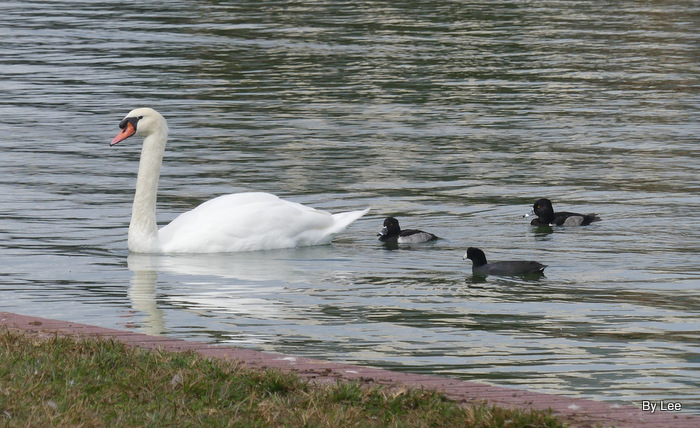
Mute Swan and Escorts

NOW THOSE WHO ESCORTED PAUL

***


Now those who escorted Paul brought him as far as Athens; and receiving a command for Silas and Timothy to come to him as soon as possible, they left.” (Acts 17:15 NASB)

Mute Swan and Escorts

*

More Daily Devotionals

*

Latest Birdwatching Adventure to Lake Morton

View at Lake Morton

View at Lake Morton

We made a short birdwatching trip over to Lake Morton in Lakeland, FL recently. Dan wanted to check out something with his camera and of course I tagged along. As I have mentioned lately, my back is acting up, so I just walked about 40 feet and sat on a bench. It is amazing what you can see at the lake just sitting in one spot. I was about that far from the shore to watch all the activity swimming by.

First I was greeted with a momma Mallard swimming with her to babies.

Momma Mallard and 2 Babies at Lake Morton

Momma Mallard and 2 Babies at Lake Morton

Then a Black-necked Swan went the other way.

Black-necked Swan at Lake Morton

Black-necked Swan at Lake Morton

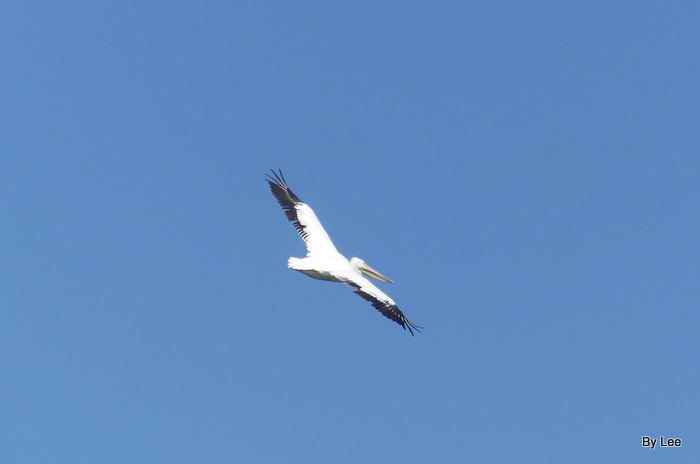
White Pelican made several circles over head:

White Pelican Flying Overhead

White Pelican Flying Overhead

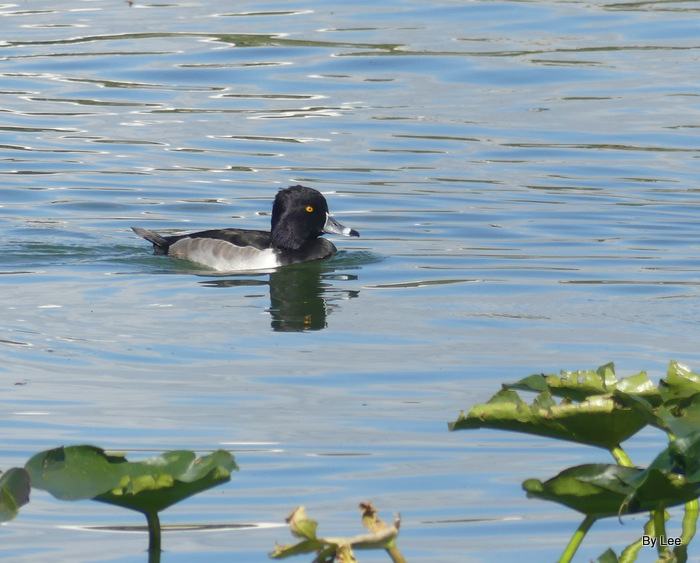
A Male Ring-necked Duck swam by:

Ring-neck Duck Swimming

Ring-necked Duck Swimming

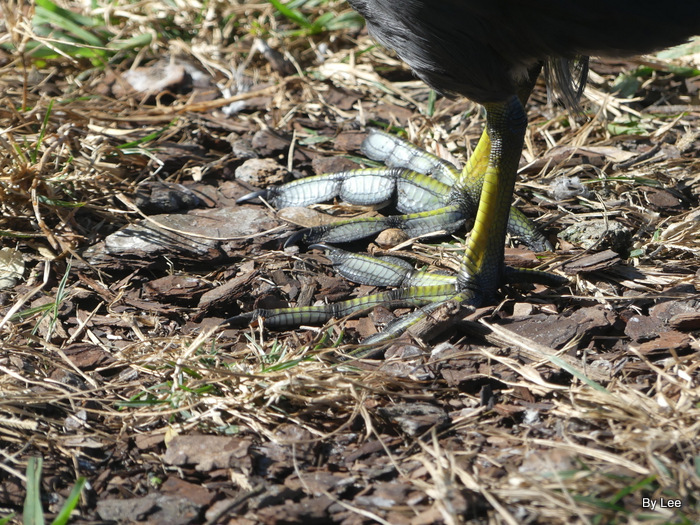
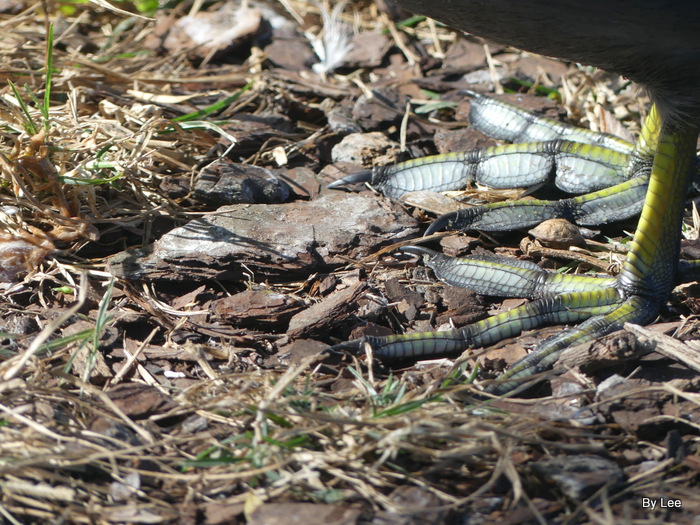
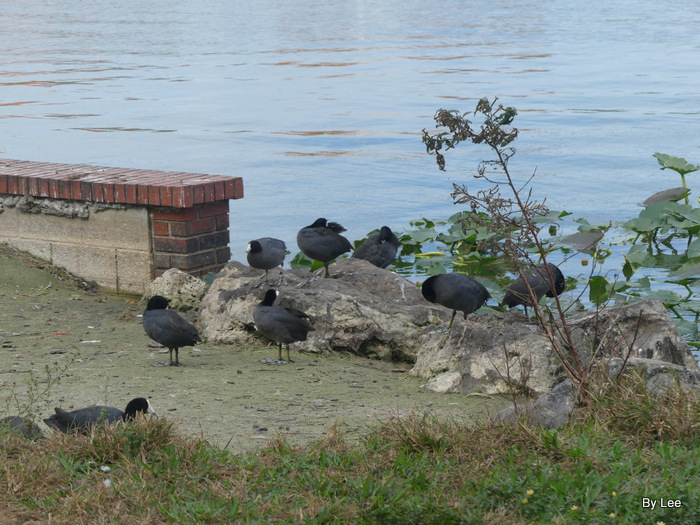
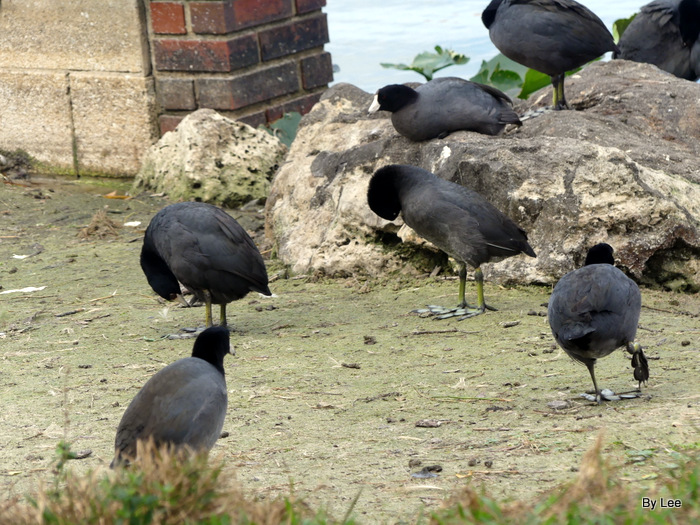
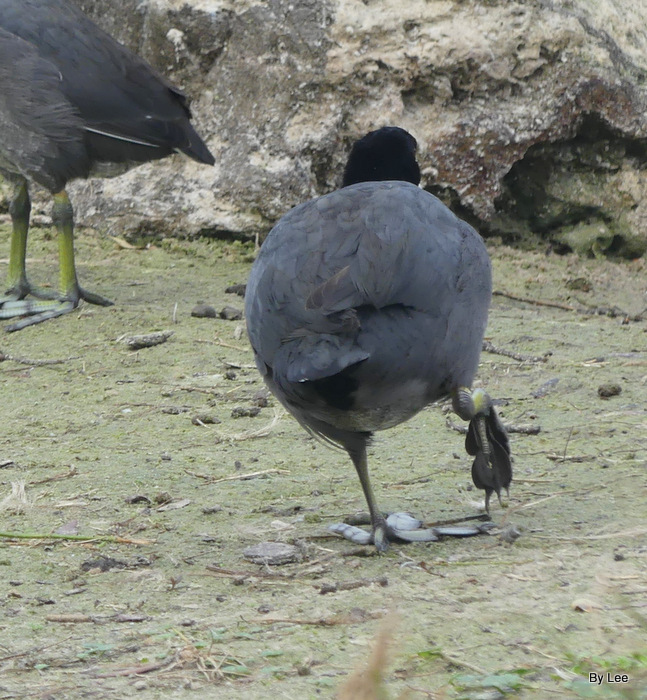
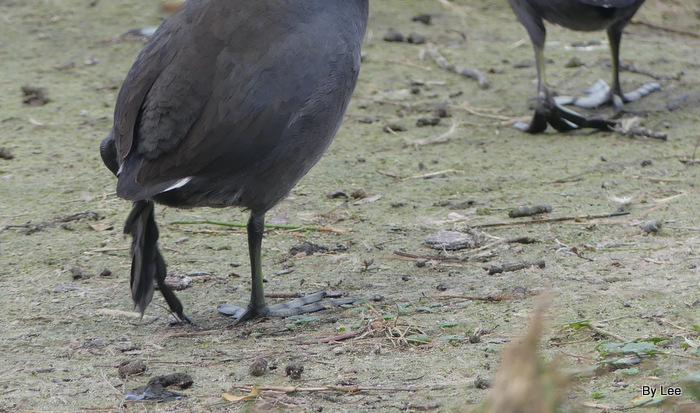
My attention turned to one of the Avian Wonders I am so amazed at watching. “Big Foot” Coot came by. I always like to watch their feet. Then a group of them came by and while watching them walk away from me, I actually saw a bit of the underside of those amazing feet. Here is a series of photos of the Coots:

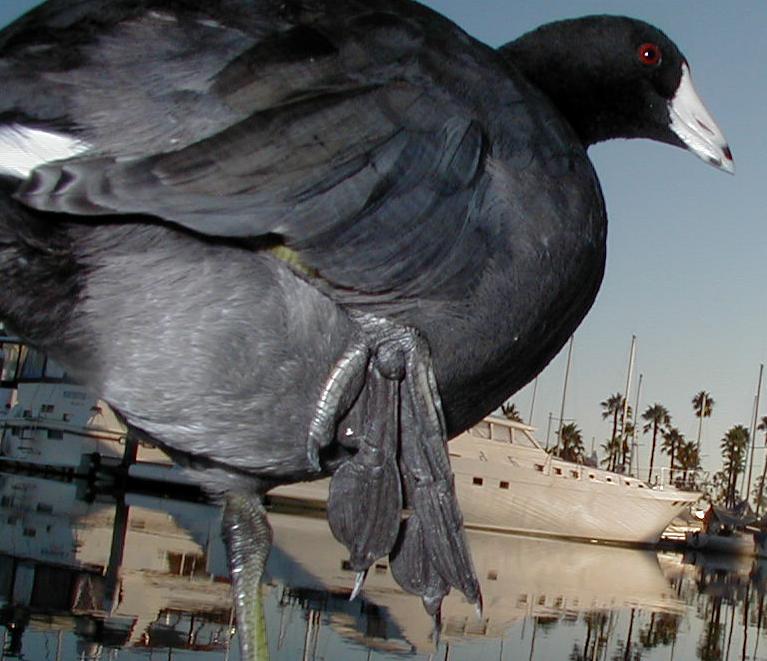
It always amazes me how they can walk without stumbling over their own feet. Their feet are so useful in the water, but on shore they seem “weird” to me. See Birdwatching – American Coot.

Took this photo from the internet:

Lobed Feet of American Coot - Underside ©Beakycoot

Lobed Feet of American Coot – Underside ©Beakycoot

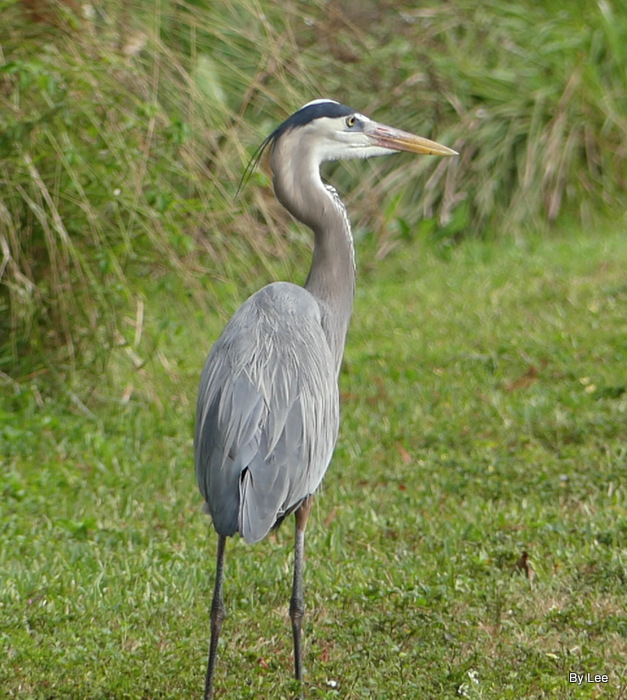
The last bird we watched before leaving was a favorite around here. A Great Blue Heron stopped by.

Great Blue Heron

Great Blue Heron

There were other birds around, but for now, this gives you a little bit of my latest blessings from birdwatching. Not bad birdwatching for just sitting in one spot. The Lord is Good.

“He does great things past finding out, Yes, wonders without number.” (Job 9:10 NKJV)

*

Birdwatching – American Coot

C is for Coot and Corvids: “C” Birds”, Part 2

Child’s Book of Water Birds ~ The Coot

Rallidae – Rails, Crakes & Coots

Lee’s One Word Monday – 10/17/16

Lee’s Five Word Friday – 7/22/16

*

Lee’s Four Word Thurday – 12/8/16

***

Green Jay (cyanocorax luxuosus) by DavesBP

COAT OF MANY COLORS

***


“Now Israel loved Joseph more than all his children, because he was the son of his old age: and he made him a coat of many colors. (Genesis 37:3)

Green Jay (cyanocorax luxuosus) by DavesBP

*

More Daily Devotionals

*

CHICKADEE-DEE-DEE DANGER – Repost

Black-capped Chickadee on snowy conifer

Black-capped Chickadee on snowy conifer

CHICKADEE-DEE-DEE DANGER

“And Jesus said unto him, Foxes have holes, and birds of the air have nests; but the Son of man hath not where to lay his head.” (Matthew 8:20)

Millions of North Americans are familiar with the call of the Black-Capped chickadee: “Chicka-dee”. However, most bird-watchers know that the little chickadee communicates danger with its “chickadee-dee-dee” call. Bird-watchers also know that chickens use different warnings for dangers from the air or from the ground.

Scientists decided to see if chickadees used specialized calls for different dangers. In their first experiments they used a stuffed hawk to see what the chickadees in an outdoor aviary would do. However, they were only fooled once, and after that researchers had to use live hawks. After studying over 5,000 responses, a pattern emerged. Small, agile raptors like hawks are more dangerous to chickadees than, say, a large, horned owl, which the chickadees can easily evade. When confronted by a smaller raptor, the birds’ “chicka” call added up to four “dee”s in rapid succession, instead of two more leisurely “dee”s. Even more “dee”s might be added if the chickadees evaluated the danger as greater. Most frightening to the little birds was a pygmy owl that rated 23 “dee”s.

God cares for all His creatures and, knowing that predation would enter the creation with man’s sin, provided them with ways to warn each other. He also gave man His Word to warn us how to avoid sin and how to escape from it through Jesus Christ, should we become entrapped.

Prayer:
I thank You, Lord, for Your protection from all the dangers we face, especially the danger of our sin. Amen.

Notes:
Science News, 6/25/05, pp. 403-404, S. Milius, “Dee for Danger.” See also: http://www.allaboutbirds.org/guide/black-capped_chickadee/sounds

Creation Moments ©2016 – Used with permission

Mountain Chickadee (Poecile gambeli) ©WikiC

Mountain Chickadee (Poecile gambeli) ©WikiC

*

More articles about these Avian Wonders:

Tiny Yet Tough: Chickadees Hunker Down for Winter

Black-capped Chickadees Fed by Hand

Sunday Inspiration – Tits, Chickadees and Penduline Tits

Birds Vol 1 #5 – The Black-capped Chickadee

*


Lee’s Three Word Wednesday – 12/7/16

***

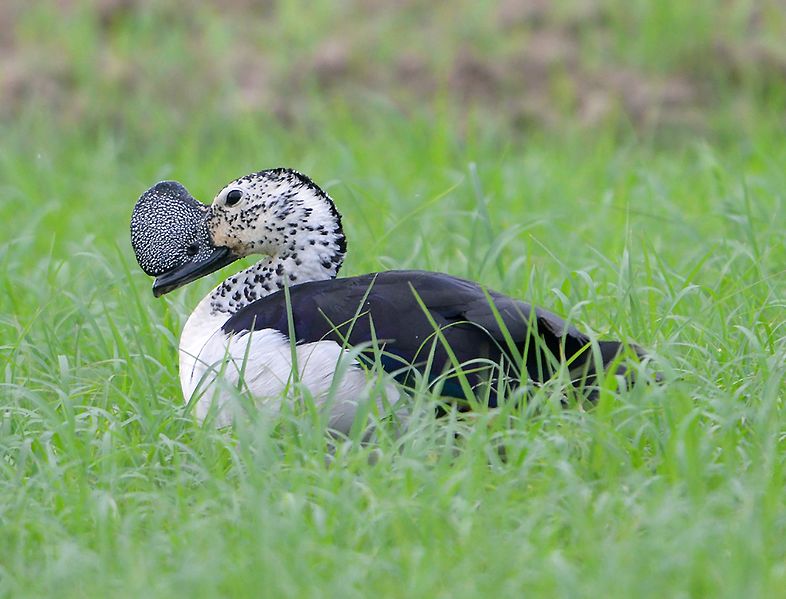
Knob-billed Duck (Sarkidiornis melanotos) ©WikiC

FAITH GROWS EXCEEDINGLY

***


“We are bound to thank God always for you, brethren, as it is fitting, because your faith grows exceedingly, and the love of every one of you all abounds toward each other,” (2 Thessalonians 1:3 NKJV)

Knob-billed Duck (Sarkidiornis melanotos) ©WikiC

*

More Daily Devotionals

*