***
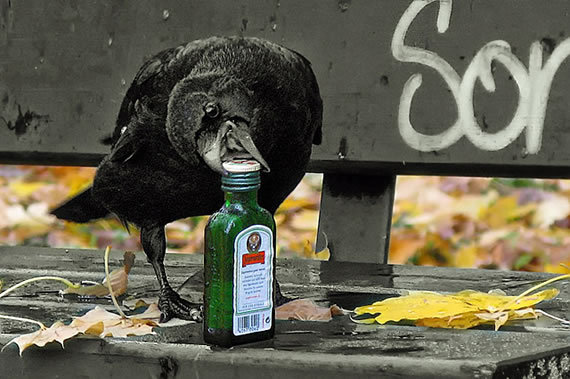
TO DRINK
***
“It is not for kings, O Lemuel, it is not for kings to drink wine; nor for princes strong drink:” (Proverbs 31:4)
Crow Trying To Drink ©Cutest Paw
*
*
“It is not for kings, O Lemuel, it is not for kings to drink wine; nor for princes strong drink:” (Proverbs 31:4)
Crow Trying To Drink ©Cutest Paw
*
*

“Her husband is known in the gates, when he sitteth among the elders of the land.” (Proverbs 31:23)
Birds on Gate – St. Peter Port ©Oriana
*
*

“She is not afraid of the snow for her household: for all her household are clothed with scarlet.” (Proverbs 31:21)
Robins in Snow ©Deanna Greens
*
*
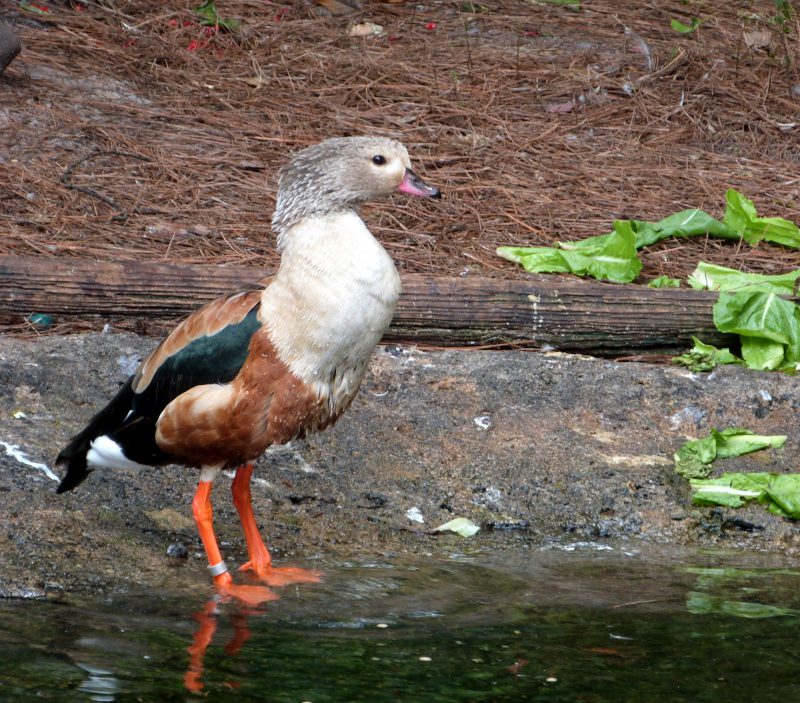
Orinoco Goose (Neochen Jubata) by Lee
“With him is wisdom and strength, he hath counsel and understanding.” (Job 12:13 KJV)
It’s Sunday and time for some more of the Anatidae Family. We have 18 more great swimmers for you to check out. These are in 10 different genera, with 9 Ducks, 9 Geese and 2 sheldgeese. The Lord created all of these with shapes and colors, but they all love being in or near water.
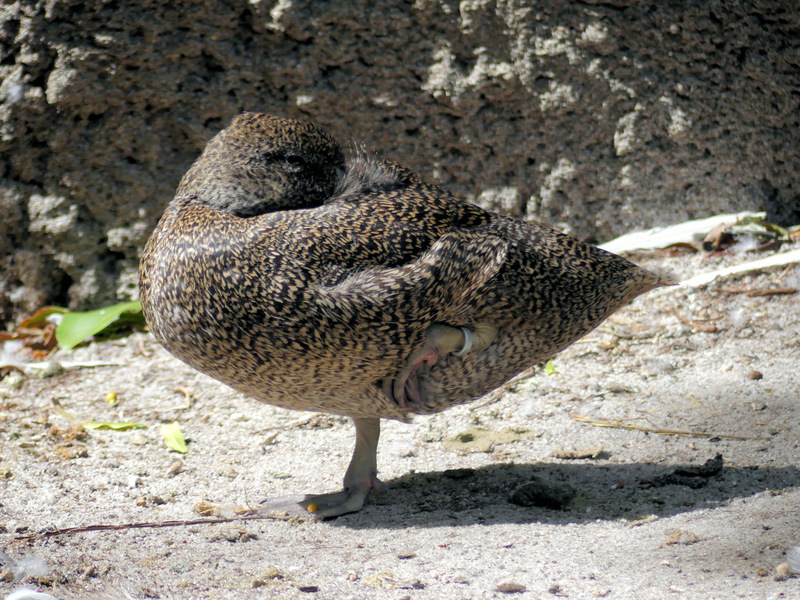
Freckled Duck (Stictonetta naevosa) by Lee at Zoo Miami
Freckled Duck (Stictonetta naevosa) – is a waterfowl species endemic to Australia and is among the rarest waterfowl in the world. The freckled duck has also been referred to as the monkey duck or the oatmeal duck in English, Punktchenente in German, canard mouchete in French and pato manchado in Spanish. These birds are usually present in mainland Australia, but disperse to coastal and subcostal wetlands in the dry period. During such times it is common for the freckled duck population to congregate in flocks in the same area, giving the impression that they are more common than they really are.
The freckled duck has a distinctive appearance. It is characterized, in adults, by dark grey to black plumage covered with small white flecks, which gives the duck the ‘freckled’ look. The feet, legs and bill of both sexes is of a slate grey color. Hatchlings and juveniles are distinguished by a uniform light grey plumage, which they lose around their 32nd week when they undergo a full body molt to assume the adult plumage.
In the past few decades, several institutions have established breeding programs to aid in supplementation of the freckled duck population. and Zoo Miami is one of the ones in this program. We saw these on our latest trip to the zoo.

Blue Duck (Hymenolaimus malacorhynchos) ©Flickr Phillip Capper
Blue Duck (Hymenolaimus malacorhynchos) is endemic to New Zealand. (Also known as “Whio”) It is the only member of the genus Hymenolaimus. It is an endemic resident breeder in New Zealand, nesting in hollow logs, small caves and other sheltered spots. It is a rare duck, holding territories on fast flowing mountain rivers. It is a powerful swimmer even in strong currents, but is reluctant to fly. It is difficult to find, but not particularly wary when located.
Captive North Island Whio are held and bred on both main islands of New Zealand, but the progeny are returned to their respective island. South Island whio are held and bred in captivity on the South Island only. All captives are kept by approved and permitted zoological and wildlife facilities as part of the national recovery plan. As part of this current ten-year plan (2009-2019) is the WHIONE program which works with specially trained nose dogs to locate nests. The eggs removed and ducklings hatched and raised in captivity. Later they are conditioned for coordinated release. Sounds like they are continuing the Genesis mandate. (Genesis 1:26-28) * The blue duck is depicted on the reverse side of the New Zealand $10 banknote.
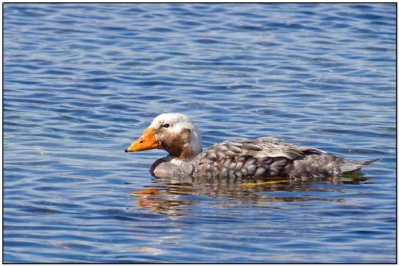
Falkland Steamer Duck (Tachyeres brachypterus) by Dave’s BirdingPix
The Steamer Ducks are a genus (Tachyeres) of ducks in the family Anatidae. All of the four species occur at the southern cone of South America in Chile and Argentina, and all except the Flying Steamer Duck are flightless; even this one species capable of flight rarely takes to the air. The genus name Tachyeres, “having fast oars” or “fast rower”, comes from Ancient Greek ταχυ- “fast” + ἐρέσσω “I row (as with oars)”. The common name “steamer ducks” arose because, when swimming fast, they flap their wings into the water as well as using their feet, creating an effect like a paddle steamer. They can be aggressive and are capable of chasing off predators like petrels.
The Steamer Ducks are the Flying Steamer Duck (Tachyeres patachonicus), Fuegian Steamer Duck (Tachyeres pteneres), Falkland Steamer Duck (Tachyeres brachypterus), and the Chubut Steamer Duck (Tachyeres leucocephalus)
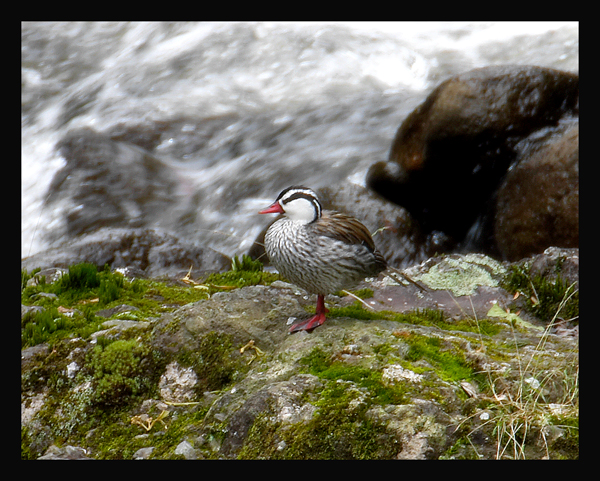
Torrent Duck (Merganetta armata) by Robert Scanlon
Torrent Duck (Merganetta armata) is the only member of the genus Merganetta. Its closest relative may be the blue duck of New Zealand.
This 43–46-centimetre (17–18 in) long species is a resident breeder in the Andes of South America, nesting in small waterside caves and other sheltered spots. Like the blue duck, it holds territories on fast flowing mountain rivers, usually above 1,500 metres (4,900 ft). It is a powerful swimmer and diver even in white water, but is reluctant to fly more than short distances. It is not particularly wary when located.
Male torrent ducks have a striking black and white head and neck pattern and a red bill. In flight they show dark wings with a green speculum. Females of all subspecies are somewhat smaller than the drakes; they have orange underparts and throat, with the head and upperparts grey and a yellower bill. Juveniles are pale grey above and whitish below.
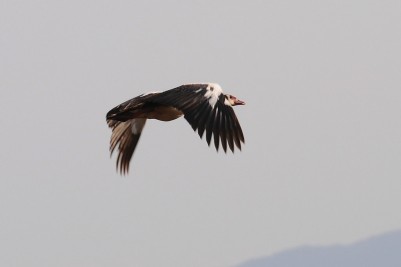
Spur-winged Goose (Plectropterus gambensis) by Bob-Nan
Spur-winged Goose (Plectropterus gambensis) is a large bird in the family Anatidae, related to the geese and the shelducks, but distinct from both of these in a number of anatomical features, and therefore treated in its own subfamily, the Plectropterinae. It occurs in wetlands throughout sub-Saharan Africa. Adults are 75–115 cm (30–45 in) long and weigh on average 4–6.8 kg (8.8–15.0 lb), rarely up to 10 kg (22 lb), with males noticeably larger than the females. The wingspan can range from 150 to 200 cm (59 to 79 in).
This species often occurs in open grasslands with lakes, seasonal pools, rivers, swamps and river deltas. Large inland rivers and lakes are perhaps most commonly inhabited, with saline lakes and upland areas generally being avoided, although the species can occur to an elevation of 3,000 m (9,800 ft) in eastern Africa. It is also absent from arid zones.

Comb Duck (Sarkidiornis sylvicola) by Nikhil Devasar
Comb Duck (Sarkidiornis sylvicola) and Knob-billed Duck (Sarkidiornis melanotos) are an unusual, pan-tropical duck, found in tropical wetlands in sub-Saharan Africa, Madagascar and south Asia from Pakistan to Laos and extreme southern China. It also occurs in continental South America south to the Paraguay River region in eastern Paraguay, southeastern Brazil and the extreme northeast of Argentina, and as a vagrant on Trinidad. These were subspecies that have both been raise to full species status.
These common species are unmistakable. One of the largest species of duck. Length can range from 56 to 76 cm (22 to 30 in), wingspan ranges from 116 to 145 cm (46 to 57 in) and weight from 1.03 to 2.9 kg (2.3 to 6.4 lb). Adults have a white head freckled with dark spots, and a pure white neck and underparts. The upperparts are glossy blue-black upperparts, with bluish and greenish iridescence especially prominent on the secondaries (lower arm feathers). The male is much larger than the female, and has a large black knob on the bill. Young birds are dull buff below and on the face and neck, with dull brown upperparts, top of the head and eyestripe.
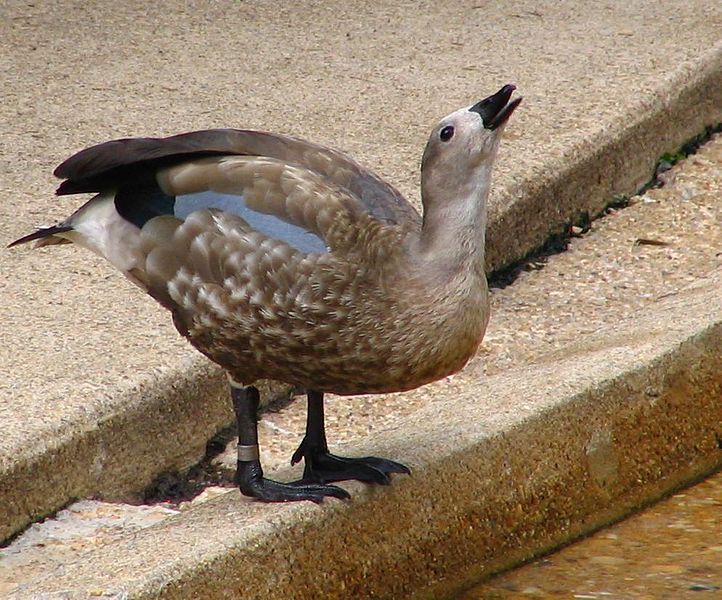
Blue-winged Goose (Cyanochen cyanoptera) at Zoo ©WikiC
Blue-winged Goose (Cyanochen cyanoptera) is a waterfowl species which is endemic to Ethiopia. It is the only member of the genus Cyanochen. This is a stocky grey-brown bird about 70 centimetres (28 in) long with a slightly paler head and upper neck. It has a small black bill and black legs. In flight, this species shows a pale blue forewing. Sexes are similar, but immature birds are duller. The plumage of these birds is thick and loose, furlike as an adaptation to the cold of the Ethiopian highlands.
It feeds by grazing, and is apparently largely nocturnal, loafing during the day. It can swim and fly well, but this terrestrial bird is reluctant to do either, and is quite approachable. It forms flocks outside the breeding season. It breeds by mountain lakes and streams. This little-known species is believed to build a lined nest amongst grass tussocks, and to lay 6–7 eggs.
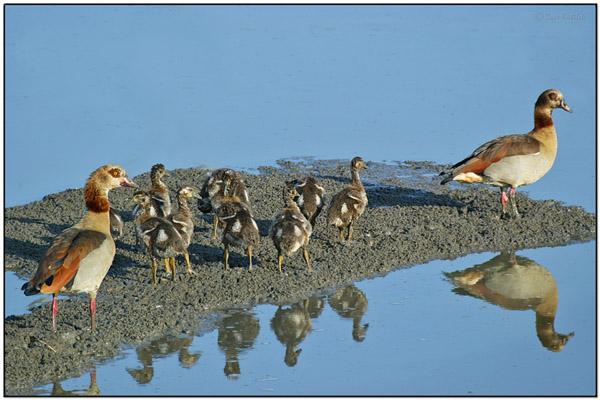
Egyptian Goose (Alopochen aegyptiaca) by Daves BirdingPix
The Egyptian Goose (Alopochen aegyptiacus) is native to Africa south of the Sahara and the Nile Valley. The other two species, Mauritius Sheldgoose (Alopochen mauritiana) became extinct in 1698 and Reunion Sheldgoose (Alopochen kervazoi) was extinct in the 1690’s. Both were over hunted.
Egyptian geese were considered sacred by the Ancient Egyptians, and appeared in much of their artwork. They have been raised for food and extensively bred in parts of Africa since they were domesticated by the ancient Egyptians. Because of their popularity chiefly as ornamental bird, escapes are common and small feral populations have become established in Western Europe.
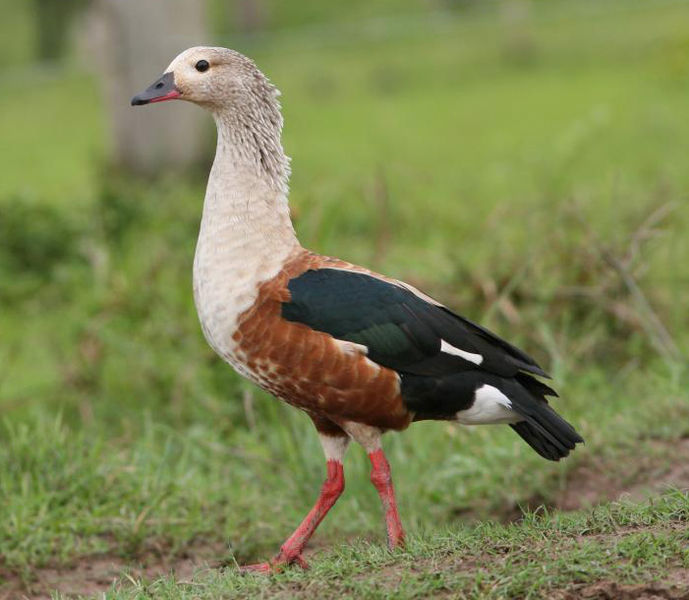
Orinoco Goose (Neochen jubata) ©WikiC
Orinoco Goose (Neochen jubata) are 61 to 76 cm (24 to 30 in) long and are resident breeders in the forests of tropical South America. Its preference is forest lakes or marshes with access to open woodland or savanna. This is a largely terrestrial species, which will also perch readily in trees. It rarely swims or flies unless hard pressed. In flight it looks heavy, more like a goose than a duck, hence the English name.
It has a pale head and neck, chestnut flanks and mantle and blackish wings with a white speculum. The legs are red and the bill is black and pinkish. The sexes of this striking species are identical in plumage, though the males are larger; juveniles have duller plumage than adults.

Upland Goose (Chloephaga picta) by Daves BirdingPix
The Chloephaga genus is made up of these Geese all from South America. The Andean Goose (Chloephaga melanoptera), Upland Goose (Chloephaga picta), Kelp Goose (Chloephaga hybrida), Ashy-headed Goose (Chloephaga poliocephala), and the Ruddy-headed Goose (Chloephaga rubidiceps). They are considered part of the Sheldgeese subfamily.
“Sheldgoose, any of the larger members of the duck tribe Tadornini, family Anatidae (order Anseriformes). The smaller members of the tribe are called shelducks. Sheldgeese inhabit tropical and subtropical regions worldwide. They are small-billed and rather long-legged, with upright stance; some have bony spurs—which function as weapons—at the wing bend. Typically they show white wing patches and are finely black-barred below. They are not true geese, though they resemble them in some anatomic features.” Encyclopaedia Britannica
(Information from Wikipedia with editing)
“In a moment, in the twinkling of an eye, at the last trump: for the trumpet shall sound, and the dead shall be raised incorruptible, and we shall be changed.” (1Co 15:52 KJV)
“I Will Rise” ~ Margaret and Sue, accompanied by Amy – cello and Jill – Keyboard
*
Anatidae – Ducks, Geese and Swans Family
*

“She is like the merchants’ ships; she bringeth her food from afar.” Proverbs 31:14
Common Kingfisher (Alcedo atthis) ©Kidwings
*
*
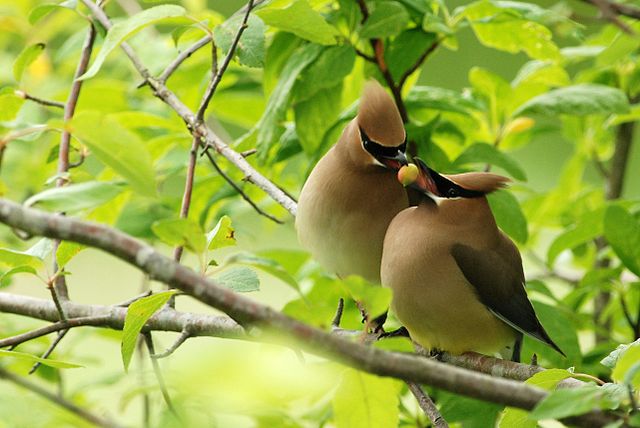
“Give her of the fruit of her hands; and let her own works praise her in the gates.” Proverbs 31:1
Cedar Waxwing (Bombycilla cedrorum) Passing Berries ©WikiC
*
*
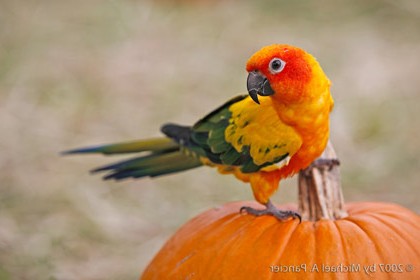
“Watch ye, stand fast in the faith, quit you like men, be strong.” (1 Corinthians 16:13 KJV)
Pumpkin Inspector ©Michael Puncer
*
*
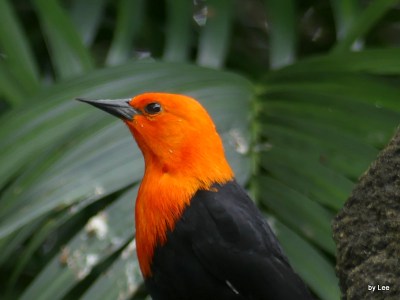
“She is not afraid of the snow for her household: for all her household are clothed with scarlet.” (Proverbs 31:21 KJV)
Scarlet-headed Blackbird at Zoo Miami by Lee
*
*

“Wash me throughly from mine iniquity, and cleanse me from my sin.” (Psalms 51:2 KJV)
Saffron Finch Zoo Miami by Dan
*
*
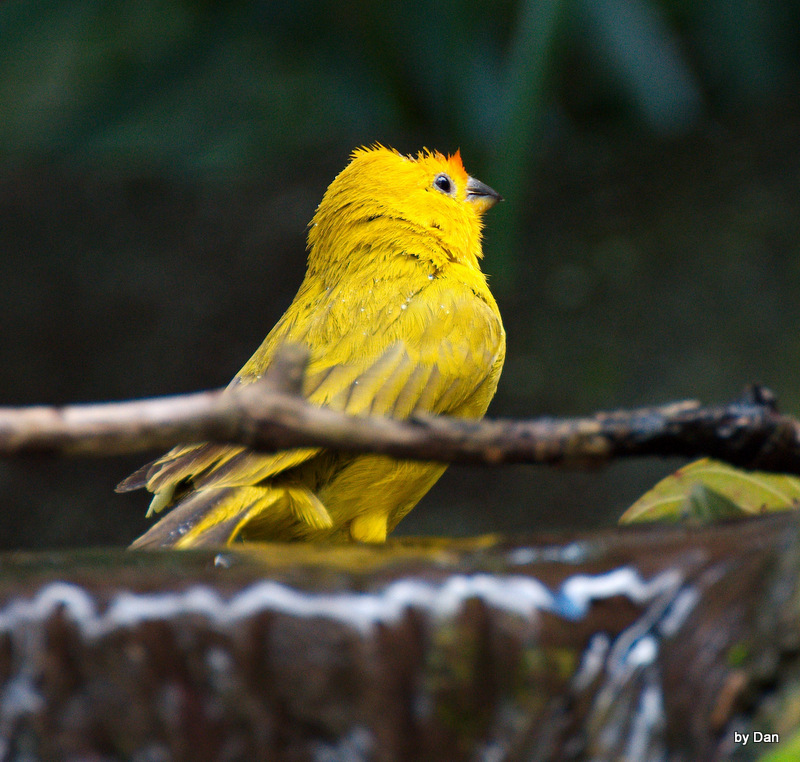
Saffron Finch – Male at Zoo Miami by Dan (Cropped by Lee)
“…covered with silver, and her (his) feathers with yellow gold.” (Psalms 68:13b KJV) (modified)
Dan and I took a ride down to Miami last week. A 200 mile ride. We stayed two nights before heading back home via Flamingo Gardens in Davie, Florida. We really have not been birdwatching too much lately, so this makes up for a very hot summer and health reasons. Monday and Tuesday we spent at Zoo Miami. On Monday, because we didn’t get there until 2 PM, we visited their Cloud Forrest and Amazon and Beyond Area. We spent all day Tuesday in the fantastic Wings of Asia Aviary. So, let the tales begin:
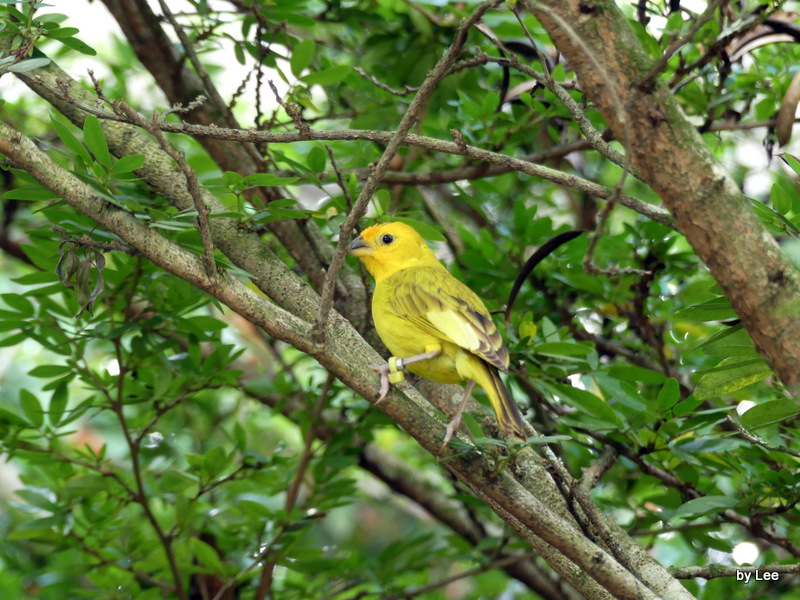
Saffron Finch (Sicalis flaveola) by Lee
I want to introduce you to the Saffron Finch (Sicalis flaveola). They are actually Tanagers from the Amazon Basin of South America. The Saffron Finch likes the open and semi-open lowlands and are widely distributed in “Columbia, northern Venezuela (where it is called “canario de tejado” or “roof canary”), western Ecuador, western Peru, eastern and southern Brazil (where it is called “canário da terra” or “native canary”), Bolivia, Paraguay, Uruguay, northern Argentina, and Trinidad and Tobago. It has also been introduced to Hawaii, Puerto Rico and elsewhere.”
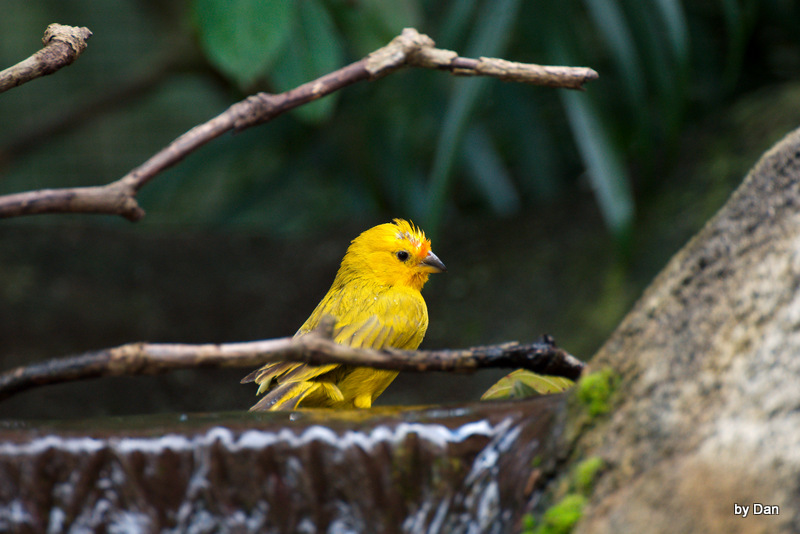
Saffron Finch Zoo Miami by Dan
“Although commonly regarded as a canary, it is not related to the Atlantic canary. Formerly, it was placed in the Emberizidae but it is close to the seedeaters. The male is bright yellow with an orange crown which distinguishes it from most other yellow finches (the exception being the orange-fronted yellow finch). The females are more confusing and are usually just a slightly duller version of the male, but in the southern subspecies S. f. pelzelni they are olive-brown with heavy dark streaks.”
Saffron Finch Zoo Miami by Dan
“Typically nesting in cavities, the saffron finch makes use of sites such as abandoned rufous hornero (Furnarius rufus) nests, bamboo branches and under house roofs – this species is tolerant of human proximity, appearing at suburban areas and frequenting bird tables. They have a pleasant but repetitious song which, combined with their appearance, has led to them being kept as caged birds in many areas.” (quotes are from Wikipedia’s Saffron Finch)
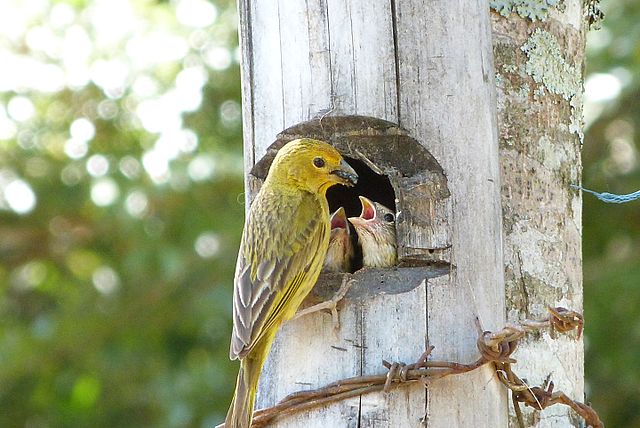
Saffron Finch (Sicalis flaveola) Female ©WikiC
I didn’t see the female, if they had one, but thought you might like to see the difference between the male and the female.
Interesting Facts from WhatBird.com
Here is some video that I shot of this beauty. I tried to catch him in the trees and that is a challenge, as any birdwatcher knows. But then, to my surprise, he just decided that he needed a bath. Wow!
We have lots of photos from the trip, so stay tuned!
“Purge me with hyssop, and I shall be clean: wash me, and I shall be whiter than snow.” (Psalms 51:7)
*
Zoo Miami and the Wings of Asia FL
Thraupidae Family – Tanagers and Allies
*
“That he might present it to himself a glorious church, not having spot, or wrinkle, or any such thing; but that it should be holy and without blemish.” (Ephesians 5:27)
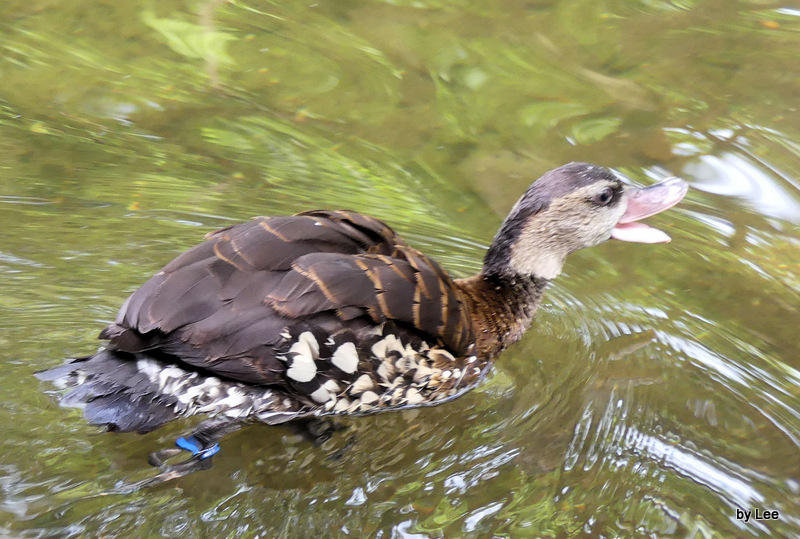
Spotted Whistling Duck (Dendrocygna guttata) by Lee at Zoo Miami
We were at Zoo Miami last week and I was able to take this photo.
*
*
“How hast thou helped him that is without power? how savest thou the arm that hath no strength?” (Job 26:2)
A friend sent me this email, and then I was able to find a video about it. Thought you all might enjoy this.
Officer James Givens has served with the Cincinnati Police Department for over 26 years, but has never quite experienced anything like this before. He was sitting in his patrol car in a parking lot when he got an unexpected visitor. A goose came up to his car and started pecking on the side of it. He threw out a bit of food for her, thinking that’s what she wanted, but she didn’t take it.
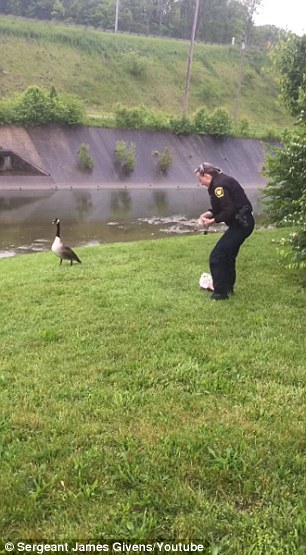
She continued to peck and quack, then walked away, stopped, and looked back at Officer Givens. Then she came back to his car and pecked at it again. She made it very obvious that she wanted Officer Givens to follow her, so he finally got out of his car and did just that.
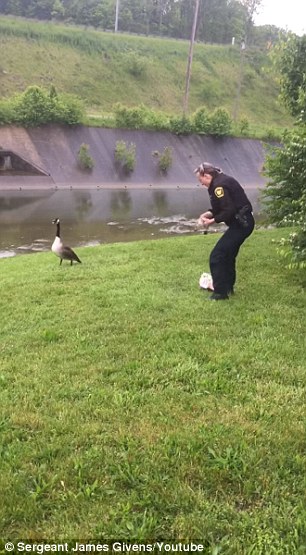
The goose led him 100 yard away to a grassy area near a creek. Sitting there was one of her babies, tangled up in a balloon string. He was kicking his feet, desperate for help. He was wary of helping the baby on his own, worried that the goose might attack him, so he called for help from the SPCA, but no wildlife rescuers were available at the moment.

Luckily, Given’s colleague, Officer Cecilia Charron, came to help. She began to untangle the baby, and the mother goose just stood there and watched, quacking. She didn’t become aggressive, and just let Officer Charron do what she had to do to set the baby free. It’s like the mother goose knew they were helping. Once she untangled the baby, she put her down and she ran right to her mom and they went back to swimming in the creek. Charron teared up and said it was the highlight of her 24 years on the force.
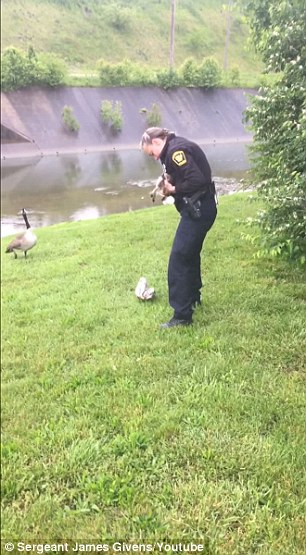
“It seems like something made up. It was just incredible,” Givens said. “I honestly don’t know why I decided to follow her, but I did. It makes me wonder – do they know to turn to humans when they need help?
We may never know the answer to this question, but what we do know is that Officer Givens was in the right place at the right time to help this mother and her baby!
“Life is precious because it is vulnerable, like a little bird. To love life means to love its vulnerability, asking for care, attention, guidance, and support.” — Fr. Henri Nouwen
“The only thing necessary for evil to triumph is for good men to do nothing.” – Edmund Burke (1729-97)
“They helped every one his neighbour; and every one said to his brother, Be of good courage.” (Isaiah 41:6)
*
 Lee's Birdwatching Adventures Plus