***
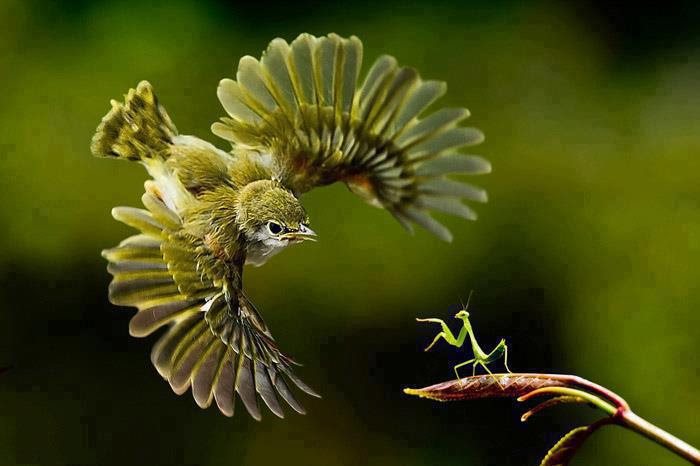
AND WHATEVER THINGS YOU ASK IN PRAYER
***
And whatever things you ask in prayer, believing, you will receive.” (Matthew 21:22 NKJV)
Bird ready to attack Praying Mantis – from email (I am not sure which is praying and believing the most.)
*
And whatever things you ask in prayer, believing, you will receive.” (Matthew 21:22 NKJV)
Bird ready to attack Praying Mantis – from email (I am not sure which is praying and believing the most.)
*
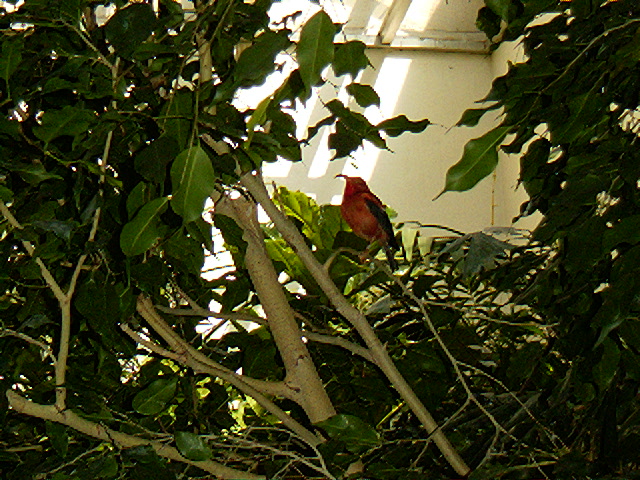
Iiwi (Drepanis coccinea) at National Zoo by Lee
Thou visitest the earth, and waterest it: thou greatly enrichest it with the river of God, which is full of water: thou preparest them corn, when thou hast so provided for it. (Psalms 65:9 KJV)
Last week, you were introduced to the Finch – Fringillidae Family part I. This week we will continue working our way through the 225 beautiful species of the family. I ended with the Carpodacus genus, because this weeks group has many Hawaiian birds with around fifteen of them now extinct.
The Poo-uli, Kakawahie,Lesser Koa Finch, Greater Koa Finch, Kona Grosbeak, Ou, Lanai Hookbill, Hawaii Mamo, Black Mamo, Ula-ai-hawane, Laysan Honeycreeper, Greater Amakihi, Lesser Akialoa, Oahu Akialoa, Kauai Akialoa, Maui-nui Akialoa, Oahu Nukupuu and Oahu Akepa are all listed as extinct. From that group only the Iiwi (Drepanis coccinea), Akohekohe (Palmeria dolei) and Apapane (Himatione sanguinea) are still living.

Hawaii Amakihi (Hemignathus virens) ©WikiC
Finches II is only featuring these thirty-nine birds, mainly from Hawaii, with fifteen extinct. Why are they becoming extinct, let’s see if we can find out. Wikipedia has this to say, “Some 20 species (that number includes early extinctions not counted today) of Hawaiian honeycreeper have become extinct in the recent past, and many more in earlier times, between the arrival of the Polynesians who introduced the first rats, chickens, pigs, and dogs, and hunted and converted habitat for agriculture.
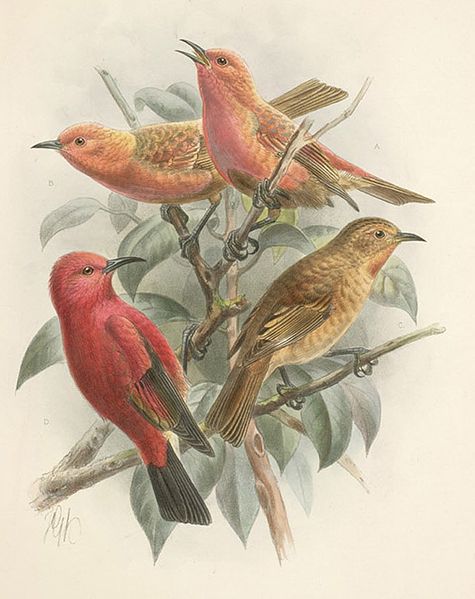
Laysan Honeycreeper (Himatione fraithii) ©Drawing WikiC
This whole group is referred to as Hawaiian honeycreepers are small, passerine birds endemic to Hawaiʻi. They are closely related to the rosefinches in the genus Carpodacus. Their great morphological diversity is the result of adaptive radiation in an insular environment. “Adaptive radiation is a rapid phenomenon because the variation is fully observable in many wild populations. Since macroevolutionary hypotheses of simple-to-complex evolutionary progress require vast eons, alterations produced by adaptive radiation occur quickly by comparison.” (by Brian Thomas, M.S. – ICR article)

Hawaii Akepa (Loxops coccineus) ©USFWS
The male Hawaiian honeycreepers are more brightly colored than the females in the Psittirostrini, but in the Hemignathini, they often look very similar. The flowers of the native ʻōhiʻa lehua (Metrosideros polymorpha) are favored by a number of nectarivorous honeycreepers. Many species of this subfamily have been noted to have a plumage odor that has been termed the “Drepanidine odor”, and is suspected to have a role in making the bird distasteful to predators. (Wikipedia with editing)
The wide range of bills in this group, from thick, finch-like bills to slender, downcurved bills for probing flowers have arisen through adaptive radiation. (Wikipedia with editing) The Lord graciously allowed these birds with beaks to meet their needs.
Which doeth great things past finding out; yea, and wonders without number. (Job 9:10 KJV)
*
“My Faith Has Found A Resting Place” ~ ©Artisans in Brass (Psalms, Hymns & Spiritual Songs-Album) Used with permission
Artisans in Brass (Website) – Artisans in Brass (Facebook)
Sunday Inspiration – Finches I
Hawaiian honeycreepers – Wikipedia
*
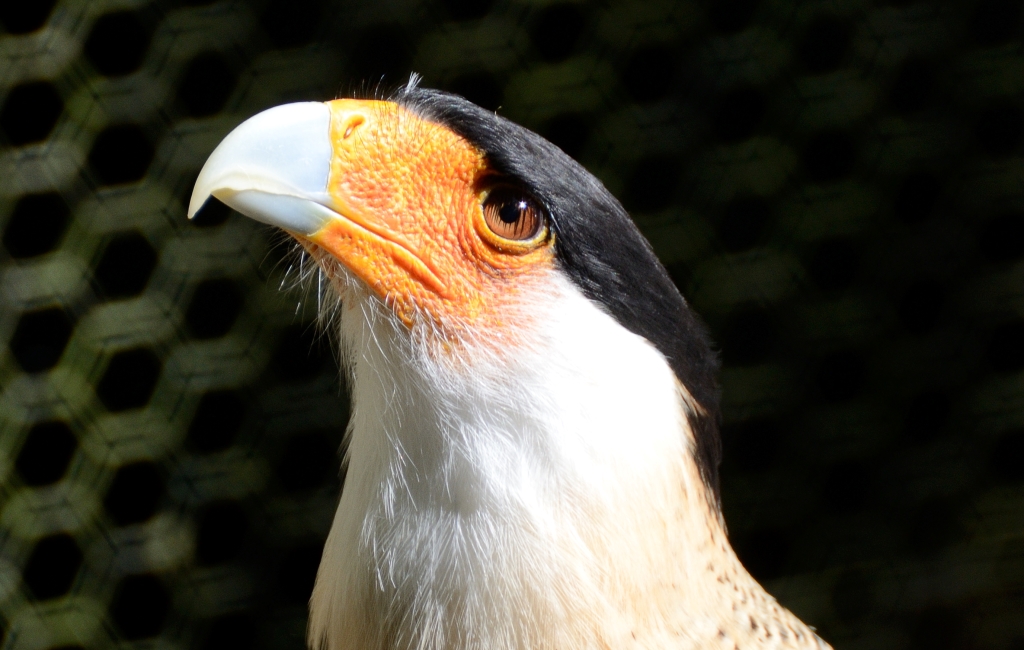
“I will lift up mine eyes unto the hills, from whence cometh my help.” (Psalms 121:1 KJV)
Crested Caracara – Dan’s at Flamingo Gardens
*
*

A good name is to be more desired than great wealth, Favor is better than silver and gold. (Proverbs 22:1 NASB)
Silver-eared Leiothrix (Leiothrix argentauris) by Ian
*
*

Great Egret on Alligator at Gatorland 3-8-16 by Lee
“Therefore be careful how you walk, not as unwise men but as wise,” (Ephesians 5:15 NASB)
You saw this photo in Lee’s Three Word Wednesday, but now here is a video of these birds catching their “Taxi Rides” there at Gatorland, FL.
In the first part of the video, notice the Great Egret gives the gator a nudge to get moving and the gator raises its head up. I didn’t realize that the Great Blue Heron was standing on that same alligators submerged tail. Talking to one of the workers, she said every once in a while the gators get hungry. Birds are playing a very dangerous game, in my opinion.
Most times these alligators and birds get along fine. People are tossing food to them and so they abide each other. It is amazing how different critters get along. I can only imagine how it must have been when they were first created. There was no desire of the gators to eat the birds. Today, under the curse, it is a totally different situation. That condition shall come again in the future.
“The wolf also shall dwell with the lamb, The leopard shall lie down with the young goat, The calf and the young lion and the fatling together; And a little child shall lead them. The cow and the bear shall graze; Their young ones shall lie down together; And the lion shall eat straw like the ox. (Isaiah 11:6-7 NKJV)
*
*
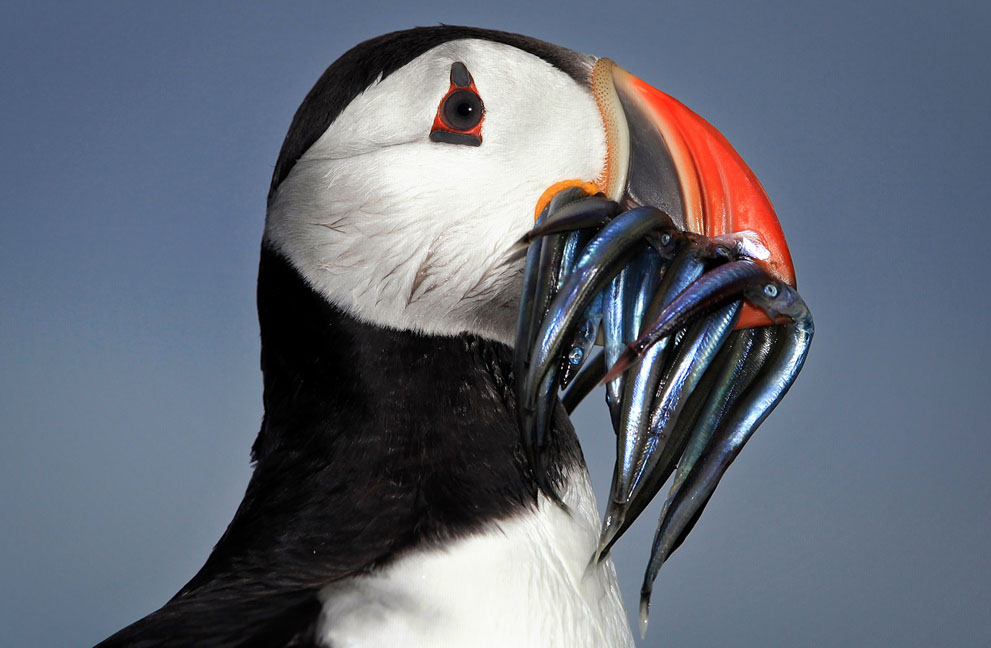
For he and all who were with him were astonished at the catch of fish which they had taken; (Luke 5:9 NKJV)
Puffin with Sand Eels
*
*
For no other foundation can anyone lay than that which is laid, which is Jesus Christ. (1 Corinthians 3:11 NKJV)
Great Egret on Alligator at Gatorland 3-8-16 by Lee

Great Egret on Alligator at Gatorland Close-up 3-8-16
*
*

O LORD our Lord, how excellent is thy name in all the earth! (Psalms 8:9 KJV)
Flamingo at Gatorland – 3/8/16 by Lee
*
*

Jesus Helps Me – Cover
I was contacted by Shelton Interactive on behalf of Callie Grant, the founder of Graham Blanchard, asked if I would review a children’s book by the title: Jesus Helps Me. She knew this blog is Christian based and about birds.
Jesus Helps Me is Christian and about birds. This book is another one in their Knowing My God series.
To begin with, the book is made to be handled by young children. The pages are very colorful, the photos of the bird are great. The verses are simple enough that a child can understand them, and are teaching good Biblical Truths.
As you turn the well made pages (thick, that can be handled by a youngster without tearing); they are colorful, have a bird photo and a simple description or information about the bird, and have a verse or partial verse that is spread over several pages. The page color is different each time you turn a page. That is for teaching colors to the young children.
The book is for babies, toddlers and young children. They suggested reading to babies because they thrive “just hearing your voice as you read the Bible passage in this book.” Toddlers can be shown and told about the birds and colors as a learning tool, besides the verses. As the children advance in age, they can be taught more about those verse to increase their knowledge.
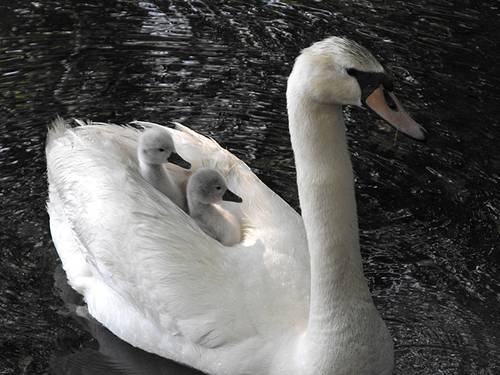
Mute Swan
As I was reviewing this book, besides the book teaching the little ones about verses, birds, colors, etc., I had another thought. What a great way to start training “new birdwatchers.” And, from a Christian perspective, no less. :)
Jesus mentioned the “little children” in many verses. In Matthew 18:2-5, Jesus taught this lesson:
“And Jesus called a little child unto him, and set him in the midst of them, And said, Verily I say unto you, Except ye be converted, and become as little children, ye shall not enter into the kingdom of heaven. Whosoever therefore shall humble himself as this little child, the same is greatest in the kingdom of heaven. And whoso shall receive one such little child in my name receiveth me. (Matthew 18:2-5 KJV)”
For more information, you can contact, www.grahamblanchard.com

Listen (consent and submit) to the words of the wise, and apply your mind to my knowledge; (Proverbs 22:17 AMP)
Common Starling (Sturnus vulgaris) with young ©©
*
*

The eyes of all wait upon thee; and thou givest them their meat in due season. (Psalms 145:15 KJV)
White-eyed Vireo (Vireo griseus) close-up ©©joule_e
*
*
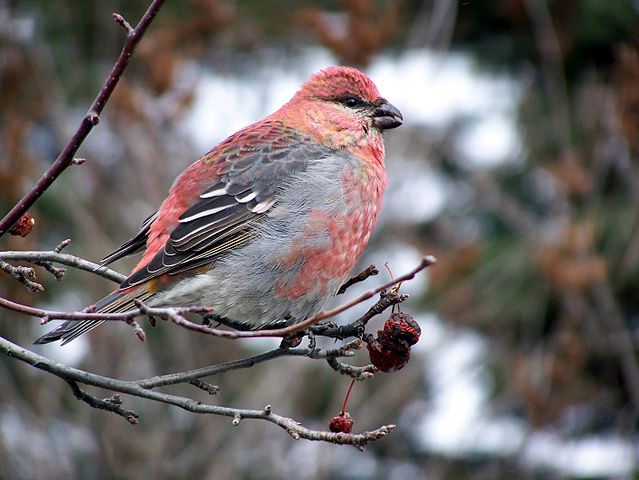
Pine Grosbeak (Pinicola enucleator) ©WikiC
The LORD is good to all: and his tender mercies are over all his works. All thy works shall praise thee, O LORD; and thy saints shall bless thee. (Psalms 145:9-10 KJV)
The Fringillidae – Finches are another large family. With 225 species, the Sunday Inspiration will again have to be divided. This first group includes the Fringilla, Mycerobas, Hesperiphona, Coccothraustes, Eophona, Pinicola, Pyrrhulla, Leucosticte and Carpodacus genus. That is a total of 61 beautiful creations for Our Lord to check out. So, let’s see who they are.
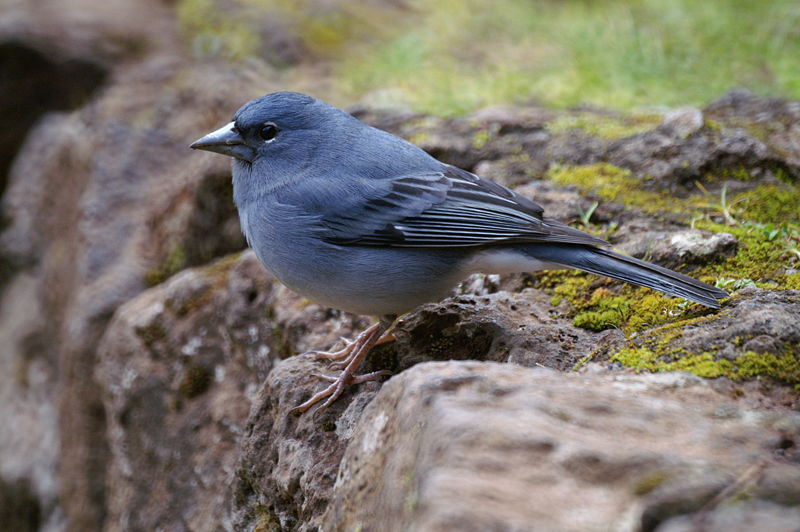
Blue Chaffinch (Fringilla teydea) ©WikiC
The first three are from the Fringilla genus. Common Chaffinch, Blue Chaffinch and Brambling. The Chaffinch and Brambling breed in much of Europe, across Asia to Siberia and in northwest Africa. It prefers open woodland and often forages on the ground.
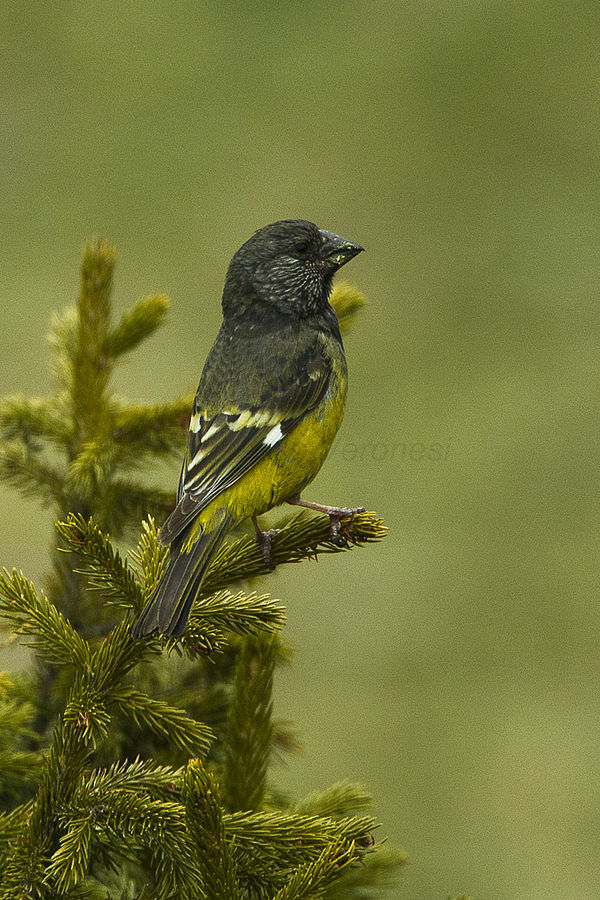
White-winged Grosbeak (Mycerobas carnipes) ©WikiC
The Mycerobas grosbeaks are a genus of finch in the Fringillidae family. They are colorful finches and are at 20–23 cm the largest species in the family. They are found in the southern Himalayas and across into China.
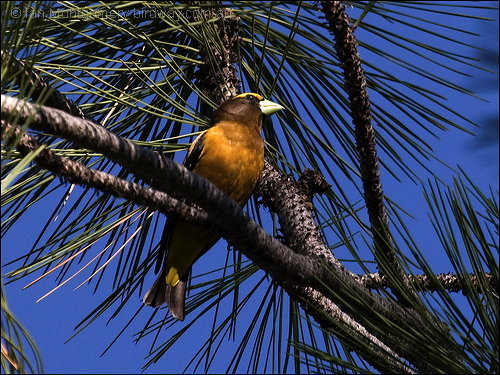
Evening Grosbeak (Hesperiphona vespertinus) by Ian
Hesperiphona is a genus of grosbeaks in the family Fringillidae (the true finches). This genus is native to the New World.
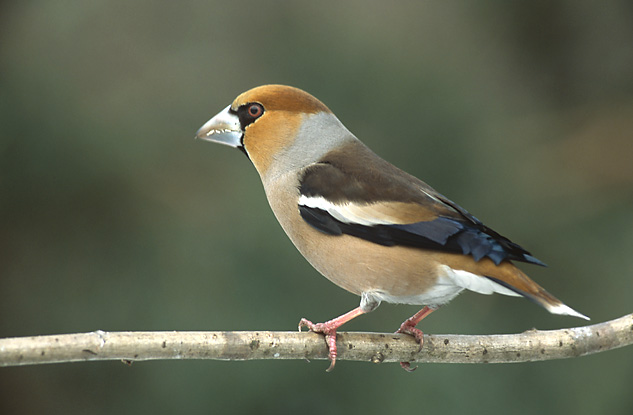
Hawfinch (Coccothraustes coccothraustes) ©WikiC
The Hawfinch, along with the Chinese and Japanese Grosbeaks, and Pine Grosbeak are more of the closely related Grosbeak group.
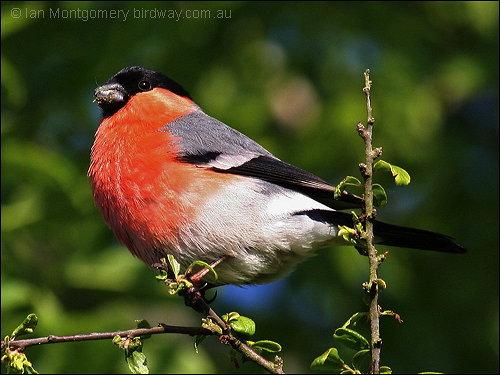
Eurasian Bullfinch (Pyrrhula) by Ian
The seven Bullfinches (Pyrrhula) have glossy black wings and tail feathers. They show a white rump. The legs and feet are fleshy brown. Their short, swollen bill is adapted to eat buds, and is black except for the brown bullfinch, which has a grey or greenish-grey bill. The males can be distinguished by their orange or red breast. Some species have a black cap. All species occur in Asia.
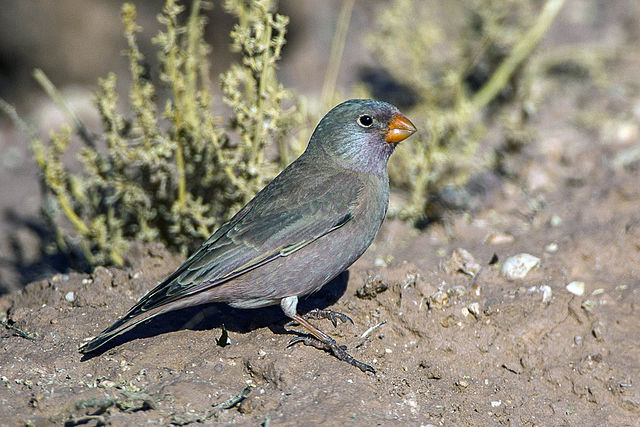
Trumpeter Finch (Bucanetes githagineus) ©WikiC
These next five genus only have six birds; Bucanetes, Agraphospiza, Callacanthis, Pyrrhoplectes, Procarduelis.

Grey-crowned Rosy Finch (Leucosticte tephrocotis) by Ian
The mountain finches are birds in the genus Leucosticte from the true finch family, Fringillidae. This genus also includes the rosy finches, named from their pinkish plumage.
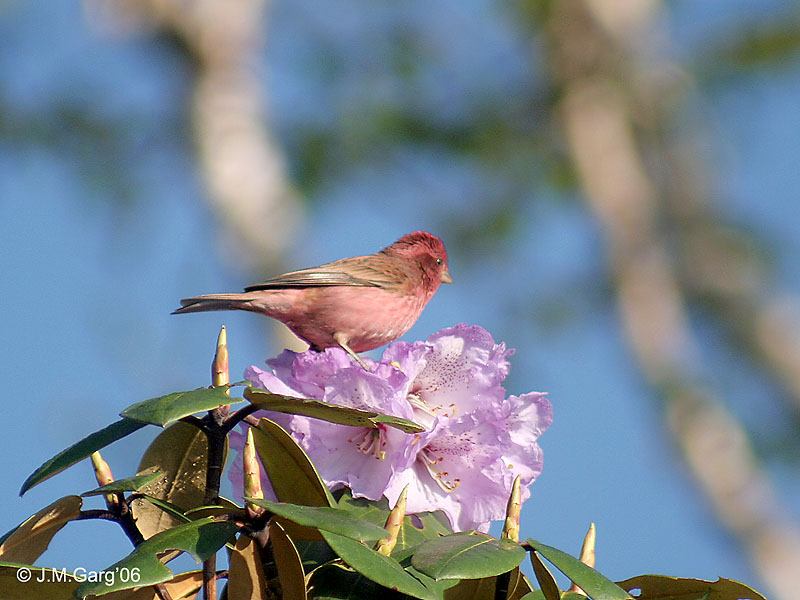
Pink-browed Rosefinch (Carpodacus rodochroa) ©Wiki
The rosefinches are a genus, Carpodacus, of passerine birds in the finch family Fringillidae. Most are called “rosefinches” and as the word implies, have various shades of red in their plumage. The common rosefinch is frequently called the “rosefinch”.
The Carpodacus rosefinches occur throughout Eurasia, but the greatest diversity is found in the Sino-Himalayas suggesting that the species originated in this region.
*
“Surely goodness and mercy shall follow me all the days of my life: and I will dwell in the house of the LORD for ever.” (Psalms 23:6 KJV)
“But I will sing of thy power; yea, I will sing aloud of thy mercy in the morning:” (Psalms 59:16a KJV)
“Mercies Anew” ~ by Lisa Brock, accompanied by Jill Foster
*
*
 Lee's Birdwatching Adventures Plus