***
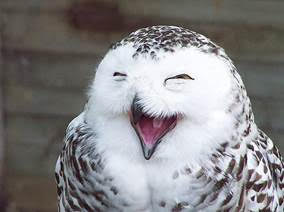
AND THEY LAUGHED
***
“And they laughed him to scorn, knowing that she was dead.” (Luke 8:53)
Happy Owl From Email
*
*
“And they laughed him to scorn, knowing that she was dead.” (Luke 8:53)
Happy Owl From Email
*
*
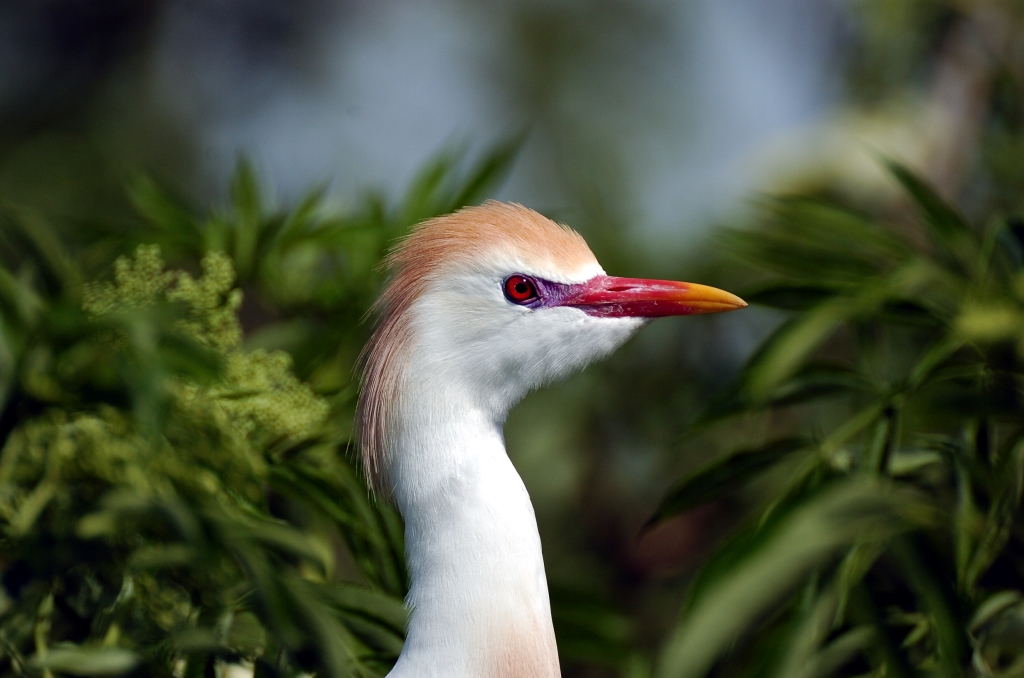
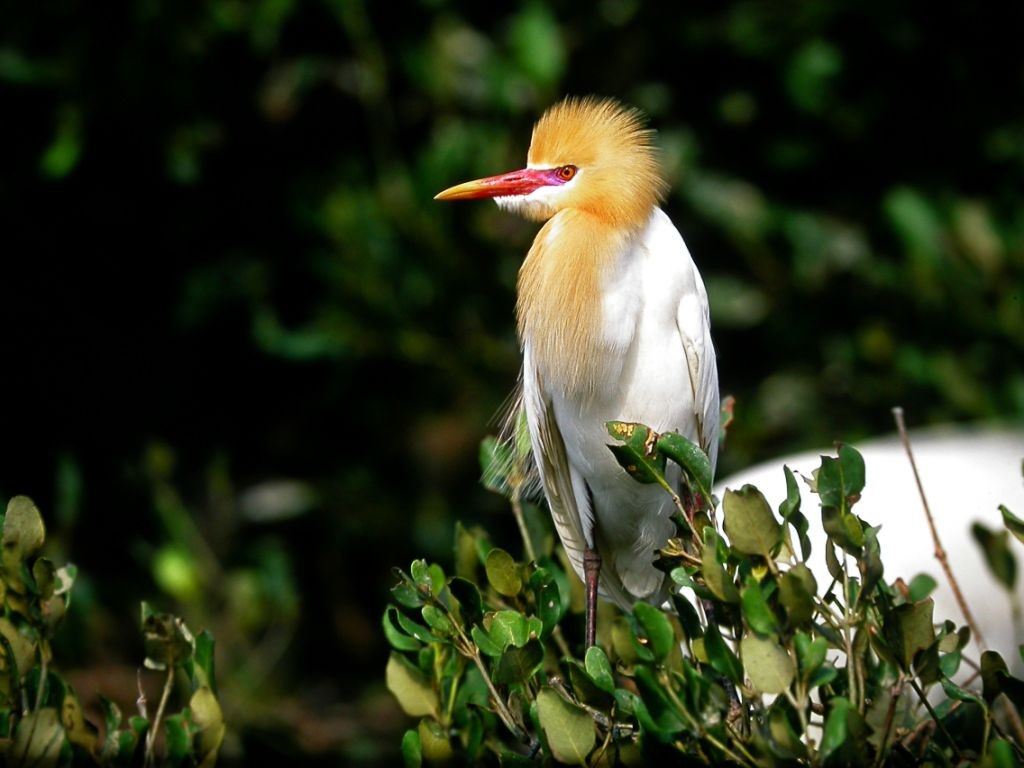
Cattle Egret In Breeding Plumage by Dan
~ by James J. S. Johnson
For this, Thou shalt not commit adultery, Thou shalt not kill, Thou shalt not steal, Thou shalt not bear false witness, Thou shalt not covet; and if there be any other commandment, it is briefly comprehended in this saying, namely, Thou shalt love thy neighbor as thyself. (Romans 13:9)
Being a good neighbor is a standard to live by. And good neighbors help one another. As Romans 13:9 indicates, it’s a norm for how to treat one’s neighbors.
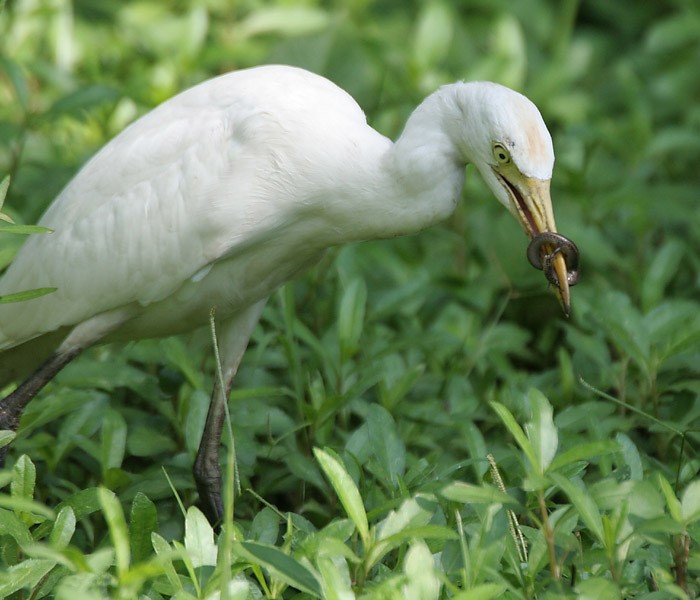
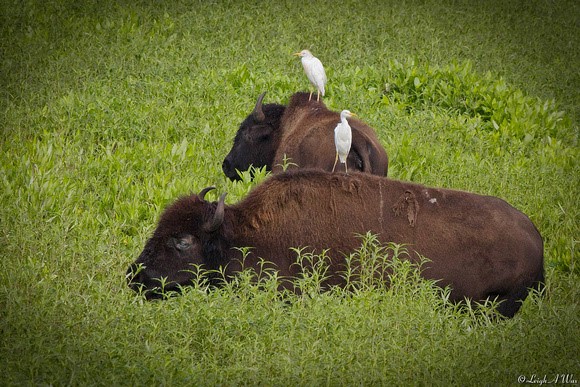
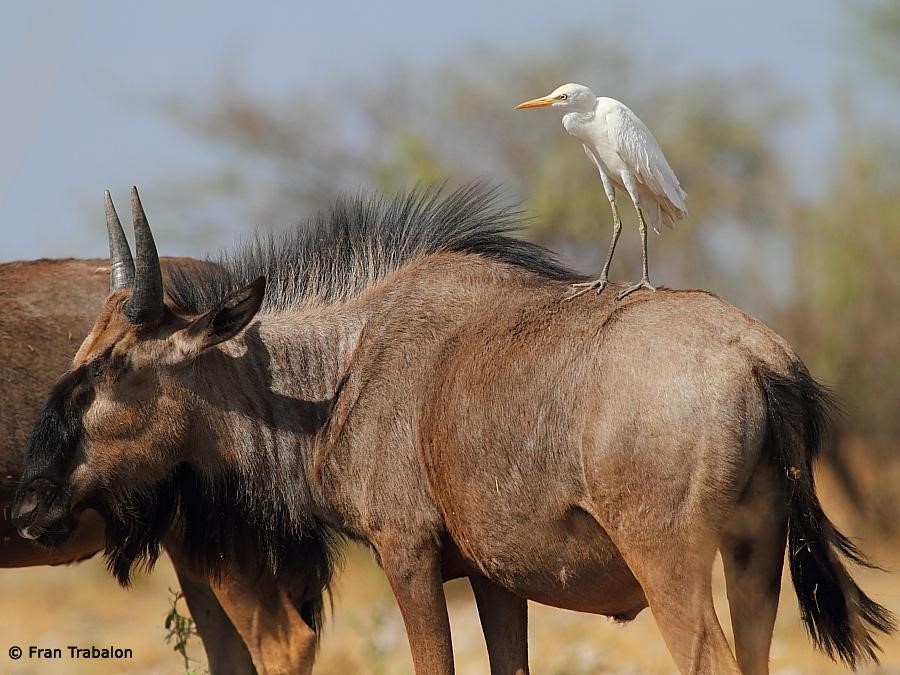
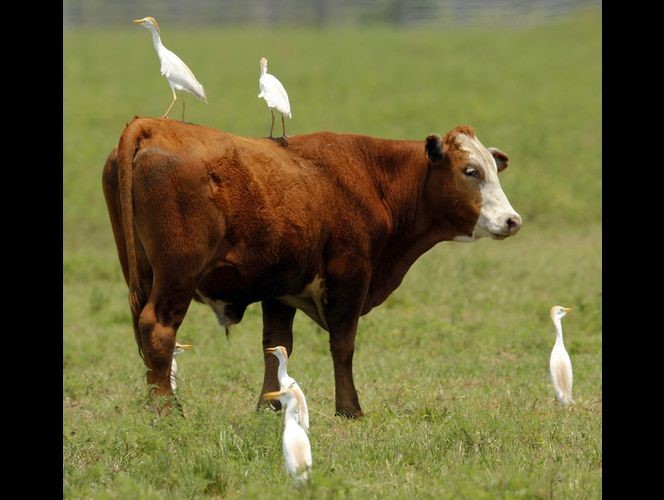
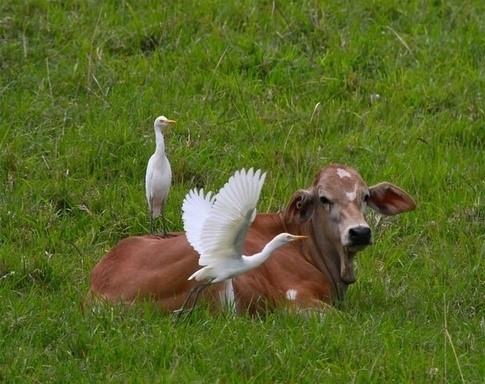
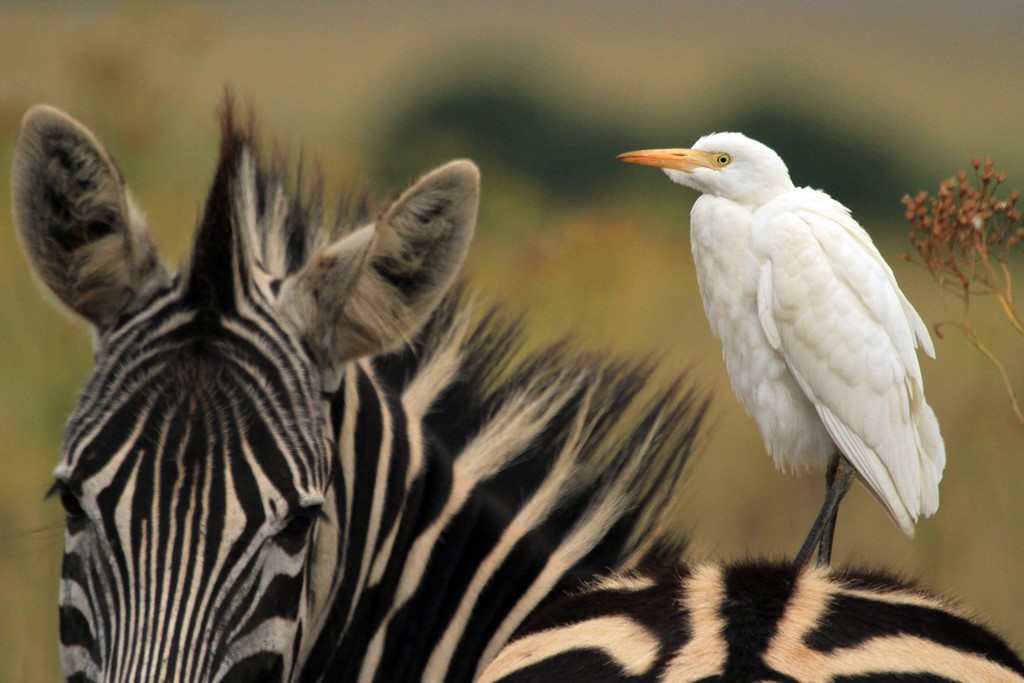
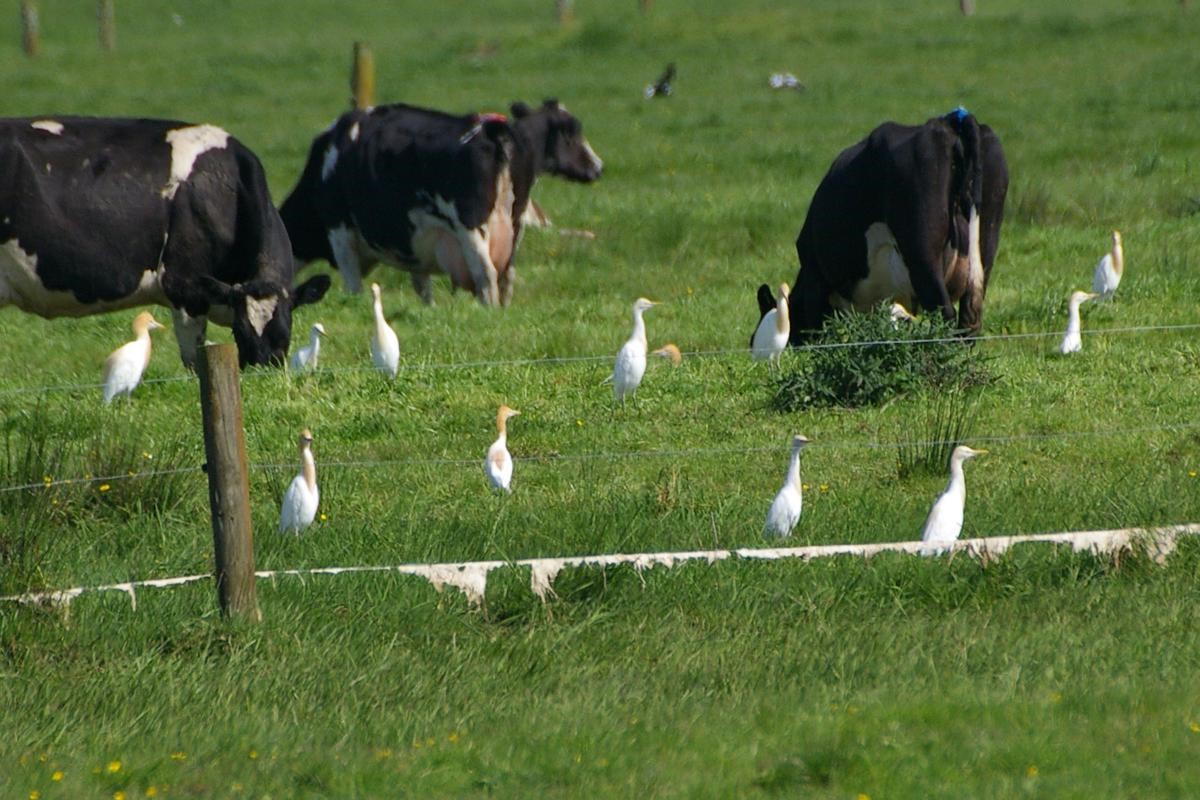
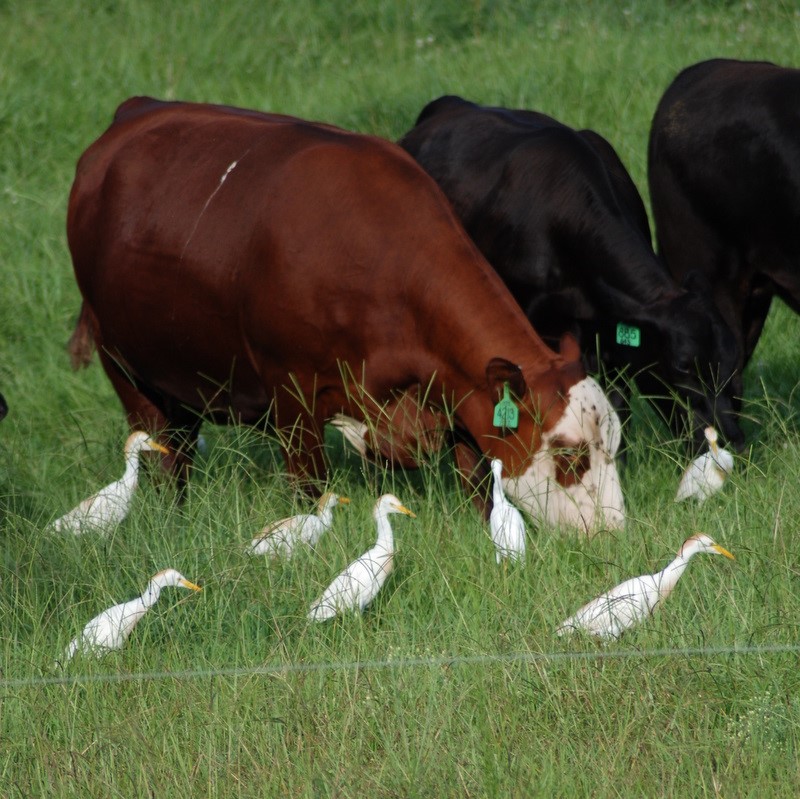
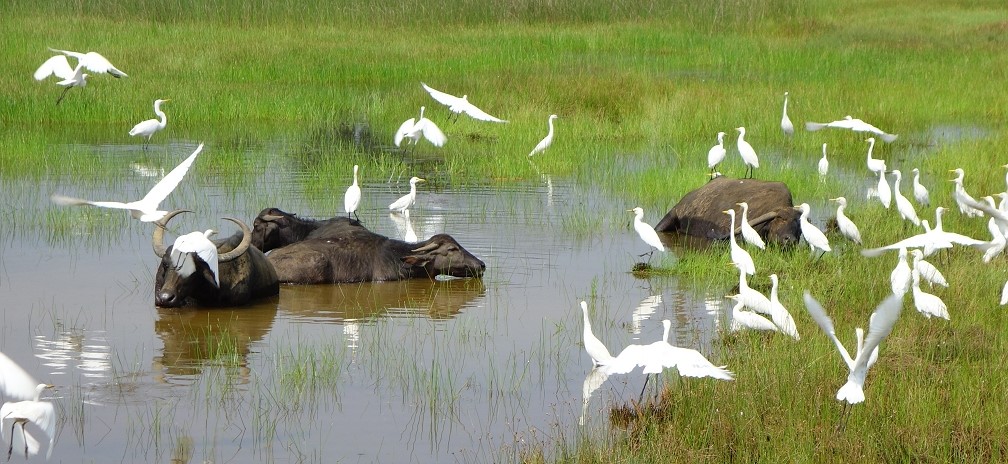
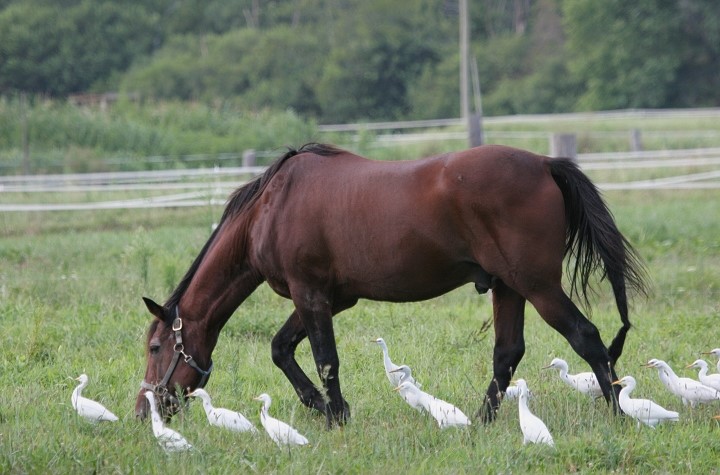
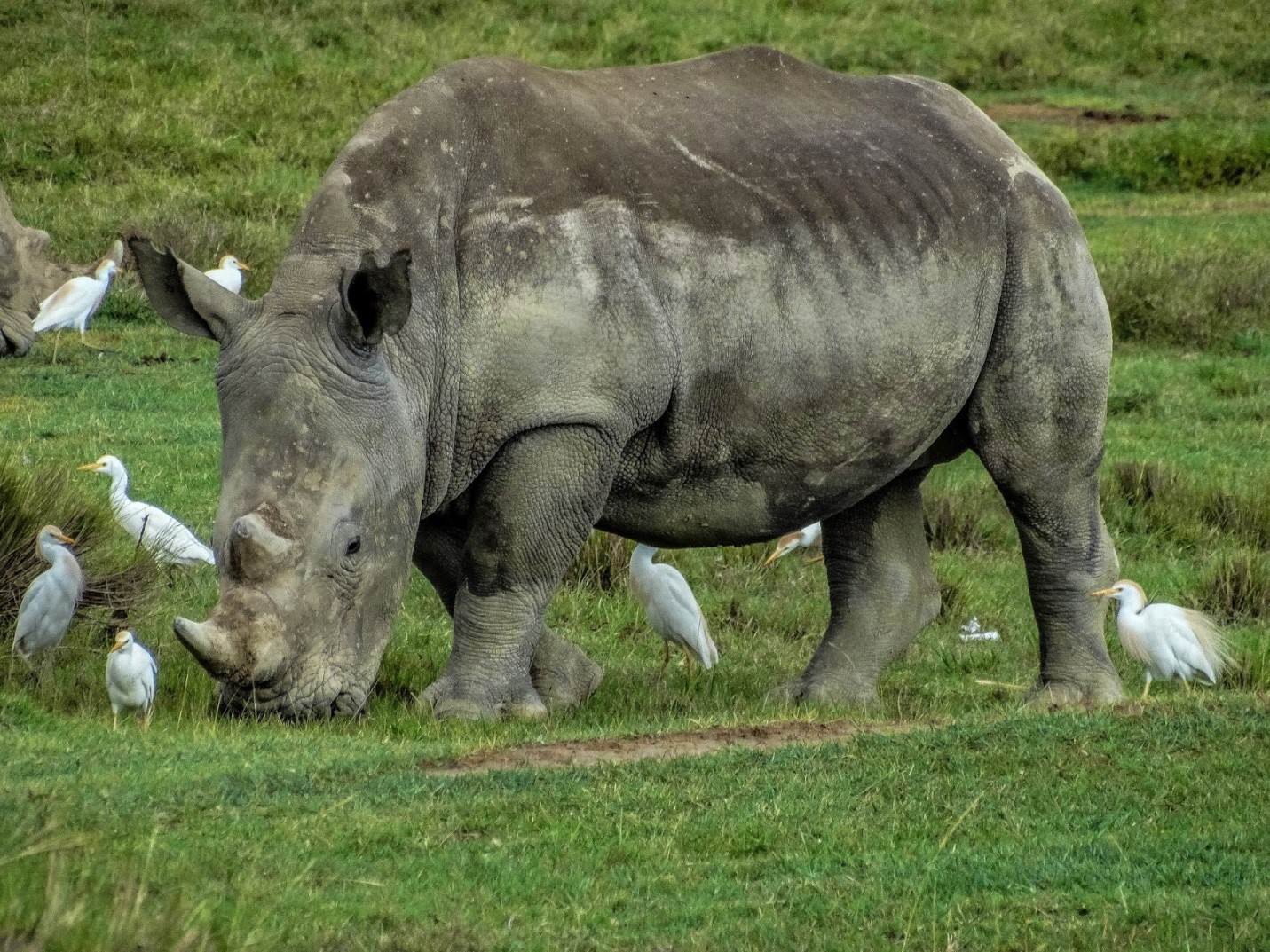
To some extent, this type of “win-win” situation sometimes occurs in nature, as is often (though not always) illustrated by the relationships of some birds — the best examples are Cattle Egrets with domestic Cattle, as well as with other large mammal herbivores (such as bison, water buffalo, bison, horses, zebras, giraffes, antelope, etc.), as the large mammals graze in tall grasses where bothersome insects and parasitic ticks abound.
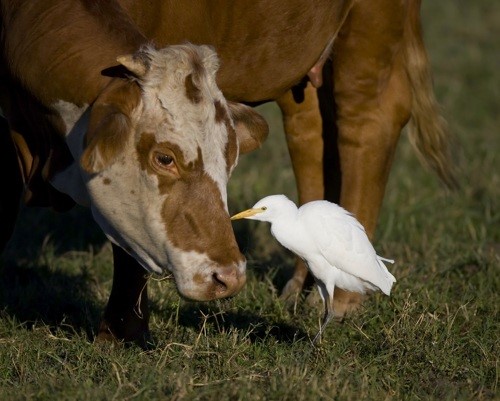
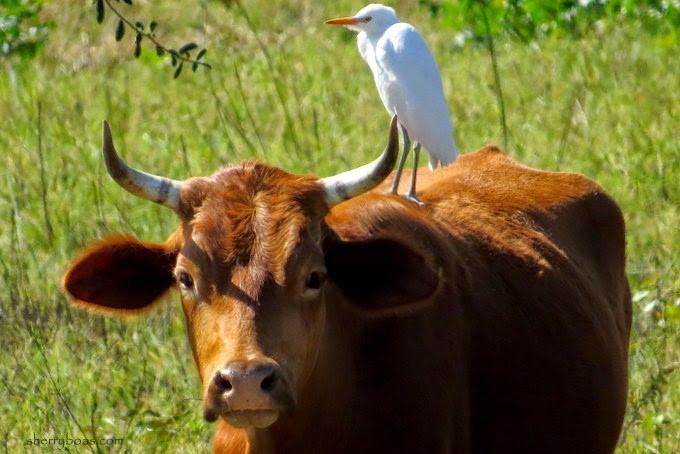
It should be no surprise that Cattle Egrets associate with cattle, picking (at and eating) bugs that pester those noble (and vulnerable) bovines.
The term used by ecologists, for this “win-win” relationship, is mutualistic symbiosis. In other words, they help each other as good neighbors should!
When cattle egrets tag along with cattle, whose quadrupedal movement through pastures (or non-agricultural grasslands) stir up insects or all kinds, the cattle egrets opportunistically snap up the dislodged bugs. Likewise, Cattle Egrets are not shy about perching atop cattle, to eat whatever insects or ticks (or insect larvae) may be trespassing on beleaguered bovine bodies.
The benefit to the birds is obvious – convenient meals, either on the bovine skin or in the stirred grasses that bovine feet brush against (causing bugs in the grass to show themselves as moving targets as they flee the bovine hooves). Yet the benefit inures to the cattle, too, because they have no hands to dislodge the pestering bugs (many of which are noxious parasites) off their backs – or to shoo away bugs that initially flit about near their feet, perhaps soon to light upon the bovine’s legs or back, to do what many bugs do – such as blood-sucking fleas or ticks or mosquitoes. The bugs really bug the bovines! – some are annoying parasites! – so the insectivorous habits of the bug-munching birds are a welcome-relief-providing blessing to the cattle.
Actually, the Cattle Egret is an African emigrant – Cattle Egrets migrated from Africa to South American almost a century ago. (See range map showing migration.) Migrating northward, Cattle Egrets quickly colonized the southern regions of North America too.
![[Fair Use image credit: https://upload.wikimedia.org/wikipedia/commons/thumb/9/92/Cattle_egret_spread.svg/2000px-Cattle_egret_spread.svg.png ]](https://leesbird.com/wp-content/uploads/2016/02/map-1.png)
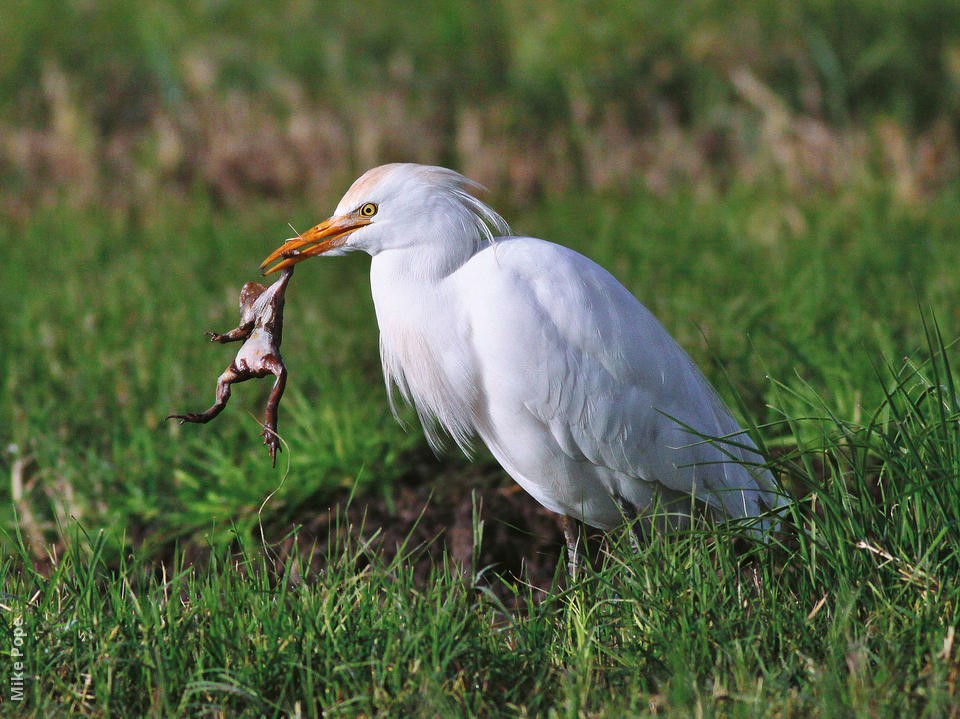
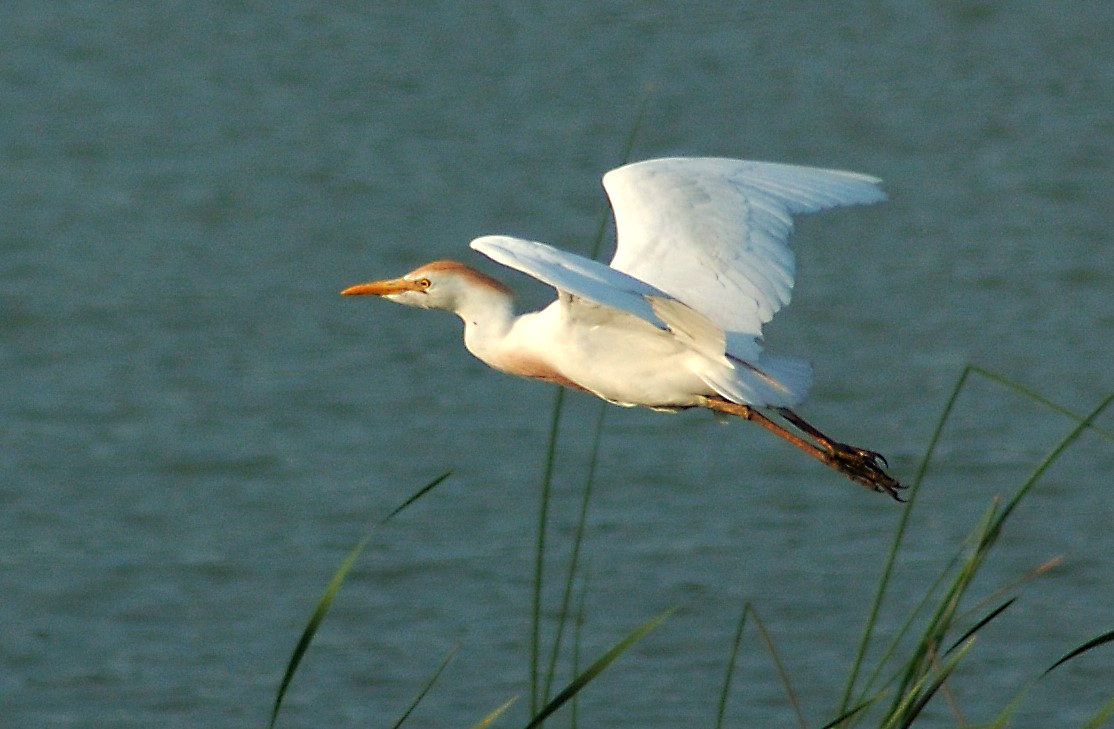
A few examples are given below, using a “photo-journalism” approach – the pictures tell it all, or at least tell a lot!
Click on a photo to see the Gallery.










More examples could be given – but this is enough to illustrate the trend!

Cattle Egret in breeding plumage – that’s a wrap! ©pinimg.com
(Surely God smiled, when He thought that one up!)
><> JJSJ
*
*
James J. S. Johnson
He giveth to the beast his food, and to the young ravens which cry. (Psalm 147:9)
Dearly beloved, I beseech you as strangers and pilgrims, abstain from fleshly lusts, which war against the soul. (1st Peter 2:11)
Raven and Peregrine Falcon in flight ©kitundu.wordpress
The Isle of Man has a strange and providential history, a mix of ravenous opportunists and hardy pilgrims, amidst the furious storms of the Irish Sea, weathering conflicts of Romans, Celts, and Nordic Vikings – all but concealing God’s clever and caring hand as He reaches the world with the Word of His Son.
Interestingly, the Isle of Man connects two aggressive birds together, the Peregrine Falcon and the Raven (often. [See illustration below, by G. E. Lodge & H. Grönvold, in H. Eliot Howard’s TERRITORY IN BIRD LIFE (E. P. Dutton & Company, 1920), page 216.]
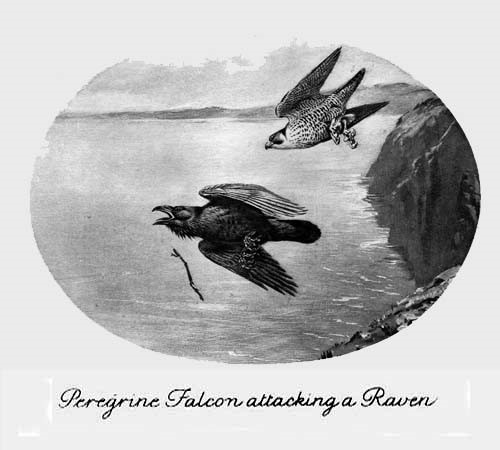
Soon we shall see how that is. Let us begin by considering the Common Raven (a/k/a Northern Raven), which may be “common” but nonetheless is an amazing bird, worldwide.
The black Raven (Corvus corax – often called the “Common Raven” or “Northern Raven“, to distinguish it from other very similar, yet recognizably variant, ravens, such as the Thick-billed Raven, Chihuahuan Raven, Fan-tailed Raven, Brown-necked Raven, Chough, and Jackdaw – regarding which, see A Diet of Jackdaws and Ravens, like our English word “ravenous” (see Isaiah 46:11; Ezekiel 39:4), denotes aggressive hunger and resourceful hunting, reminding us of rough-and-ready opportunists, a fitting emblem displayed on some of the Viking ship sails (and pennant banners) of old.

Peregrine Falcon On The Edge by Ray
What of the grey-hued Peregrine Falcon (Falco peregrinus)? Likewise, the word “peregrine” refers to a land-wanderer, a sojourner, a stranger-passing-through, an especially fitting label for Christians who daily experience the rough-and-tumble challenges of “pilgrim” life (Genesis 47:9; Exodus 6:4), on this presently fallen Earth, as we await our ultimate destiny that befits our heavenly citizenship (Philippians 3:20; Hebrews 11:13). Before finishing that thought, however, let us consider these two stalwart birds, the Raven and the Peregrine Falcon – and their connection to the ISLE OF MAN, a quasi-autonomous territory of the British Commonwealth.
In particular, behold the official Manx Coat of Arms – notice the two birds supporting the Manx Coast of Arms, a stark Raven and an equally stern Peregrine Falcon. Why do these birds so aptly match the Isle of Man?

Manx Coat of Arms of the Isle of Man ©WikiC
Before appreciating some details about these two noble birds, the Raven and the Peregrine Falcon, it might help to gain a glimpse of the turbulent times that the Isle of Man has seen, centuries ago, when Vikings sailed the Irish Sea (and many seas beyond!) – and used the Isle of man as a staging ground for their naval adventures.
One illustration involves the tourney on the high seas, in AD1156, between a Norse-Manx Viking king, named Somerled (an ancestor of Dr. Bill Cooper), and his arch-foe, Godred.
“Godred … [alarmed that Somerled’s son was installed as ruler of the Isle of Man] hurriedly got ready a fleet and sailed north against the forces of Somerled. It was high time for Somerled to do something about Godred [so Somerled] collected a large fleet of eighty [80!] longships and sailed out to confront his enemy. The story that follows incites our admiration for the impressive seamanship of both kings, and the seaworthiness of their ships. The battle took place at night, in the dead of winter, in the open ocean somewhere off the coasts of Islay, on the 5-6 of January 1156. How they managed to manoeuvre under oars (no sails were used during battle), in darkness, in wild winter seas, without most of their ships colliding or foundering, was a miracle. It must have been a titanic struggle and the Chronicle of Man describes the terrible slaughter which ensued. By dawn both sides were exhausted, neither having won, so they agreed to make peace and divided up the sea kingdom between them, in a rather awkward division. Godred retained [the Isle of] Man and the islands to the north of the Ardnamurchan peninsula [of Scotland], while Somerled kept all the islands to the south including Kintyre, which was still class as an island [it being largely coastland].” (Quoting from Kathleen MacPhee’s Somerled, Hammer of the Norse (Glascow: Neil Wilson Publishing, 2004), pages 80-82, as quoted within “DNA says Manx King, Somerled, the Celebrated Founding Father of Scottish Clans, had a “Norse” Patrilinear Ancestry !”, posted at Somerled Family History.
In short, Viking sea battles were not an adventure for the faint of heart. But, one might wonder: who cares today about such people nowadays?
In other words: why would we care about some Viking king (of the Isle of Man), who lived and adventured some 800 or 900 years ago? Has that Norse-Manx Viking’s life impacted your life or mine, at all, in any kind of meaningful way?
The answer, if you read or speak English, is both simple and surprising: as a direct ancestor of the King James who sponsored the Holy Bible in English translation, King Somerled’s biogenetic footprint has impacted our world–to God’s glory and our benefit–in a permanent and indispensable way.
“Consider the following descent from King Somerled and Queen Ragnhild. Then try to imagine the big-picture providence of God, interacting through space and time … producing uncountable effects from the resultant galaxies of Great Commission “destiny dominoes”, all around the world, especially from AD1066 to AD1611 and beyond.…
P1 Somerled & wife Ragnhild begat Angus Somerledsson (F1);
F1 Angus Somerledsson & wife Ragnhild of the Isles begat James (F2);
F2 James & wife (whose name is lost) begat Jean (F3);
F3 Jean & husband Alexander 4th High Steward begat James 5th High Steward (F4);
F4 James 5th High Steward & wife Cecilia begat Walter 6th High Steward (F5);
F5 Walter 6th High Steward & wife Marjorie begat Scotland’s king Robert II (F6);
F6 Robert II & first wife Elizabeth Mure begat John l/k/a Scotland’s king Robert III (F7);
F7 Robert III & wife Annabella Drummond begat Scotland’s king James I (F8);
F8 James I & wife Joan Beaufort8 begat Scotland’s king James II (F9);
F9 James II & wife Mary of Gueldres begat Scotland’s king James III (F10);
F10 James III & wife Margaret of Denmark begat Scotland’s king James IV (F11);
F11 James IV & wife Margaret Tudor begat Scotland’s king James V (F12);
F12 James V & wife Mary of Guise begat Scottish queen Mary Queen of Scots (F13);
F13 Mary Queen of Scots & Lord Darnley begat James VI (F14, of the “King James” Bible)!
Thus, the “King James” of Great Britain (simultaneously “James VI” as Scotland’s king, and “James I” as England’s king), who authorized what became famous as the “King James Bible”, was an F14 descendant of Viking King Somerled and his wife, Queen Ragnhild. (This impacts the whole world!)
In other words, Somerled’s family lineage was indispensable, 14 generations after, for the procreative arrival – in God’s providence – of the man whom history knows as KING JAMES of the King James Bible!
How many lives do you know, personally, who have been blessed by the English translation of the Holy Bible that we today call the King James Bible? As you think of the answer to that question, consider also that God providentially protected the life of Norse-Manx Viking, named Somerled, in order that there would be – half a millennium later – a baby boy born in Edinburgh, Scotland (in a room that my wife and I visited, during AD2002), who would grow up – by God’s grace – to be King James VI (of Scotland) and also King James I (of England)!
Now back to the birds, starting with the Northern Raven.
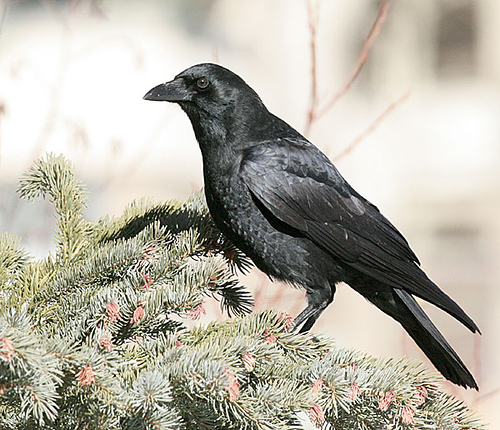
Northern/Common Raven (Corvus corax) by Kent Nickell
COMMON RAVEN a/k/a NORTHERN RAVEN (Corvus corax).
Ravens are repeatedly mentioned in Scripture; they are even mentioned once by Jesus Himself (Luke 12:24). What a beautiful bird, the Raven! – its monochrome plumage is iridescent black, appearing as glossy bluish-purple when sunlight reflects off the feathers (see Song of Solomon 5:11). Its omnivorous appetite matches its name: ravens are ravenous (Job 38:41; Proverbs 30:17)! Ravens eat small mammals, carrion (with its associated maggots and carrion beetles), small invertebrates (including roadkill invertebrates, such as dead grasshoppers and other bugs), amphibians, reptiles, bird eggs, human garbage (especially food with fat in it), — as well as plant food (such as agricultural grains) — whatever! Ravens are also infamous as “kleptoparasites” (prey thieves), i.e., they steal food from other carnivorous/omnivorous predators, such as grey wolf-kills in winter. Garbage dumps and landfills are special attractions — raven smörgåsbords!
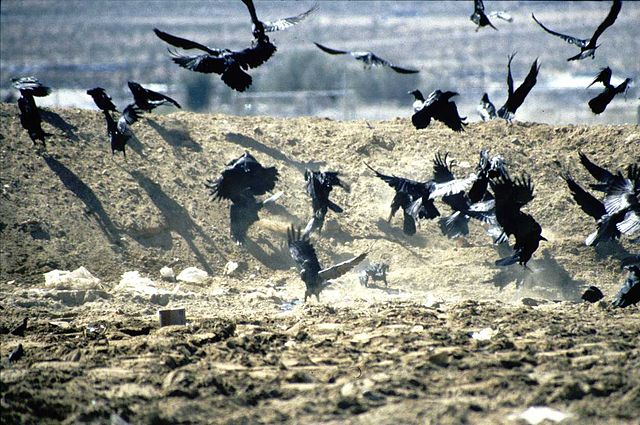
Common Ravens Feeding At Landfill ©WikiC
The historic role of a raven who survived the worldwide Flood with Noah’s family is recounted in Scripture (see Genesis 8:7). Ravens, ironically, were directed by God to feed the prophet Elijah (compare 1st Kings 17:4-6 with Luke 12:24).
The name “Common Raven” is not an exaggeration, because ravens are known to live in virtually all of the Northern Hemisphere (see range map below).

The Raven is a corvid – a term that simply means “crow-like” – like its close cousins: rooks, jays, carrion crows (and other crows), choughs, jackdaws, etc. [See generally Lee Dusing’s “Crows, Jays, Ravens – Corvidae Family”.]
Ravens are well known for various behavior habits, including their harsh crow-like vocalizations (Job 38:41).

Common Raven at Cypress Provincial Park, British Columbia ©WikiC
The Common Raven (Northern Raven) appears in various localized “subspecies”, based upon geographically localized population forms: (1) the paradigmatic European Raven (Corvus corax corax), ranging over and beyond continental Europe; (2) the Icelandic-Faeroese Raven (Corvus corax varius), somewhat smaller and less glossy than the European Raven; (3) the Southwest Asia Raven (Corvus corax subcorax), ranging from Greece to India, and parts of western China; (4) the North Africa Raven (Corvus corax tingitanus), ranging in North Africa and the Canary Islands, with the Canary Islands variety being somewhat browner in color; (5) the Himalayan Raven (Corvus corax tibetanus), the largest and glossiest subspecies, ranging in Tibet and other regions of the Himalayan Mountains; (6) the Northeastern Asia Raven (Corvus corax kamtschaticus), thicker-billed than the European Raven, ranging from northeastern Asia into the Baikal region; (7) North American Raven (Corvus corax principalis, a/k/a “Northern Raven” — which is confusing because both the species and this subspecies are known as “Northern Raven”), close cousins to those of Europe, according to mitochondrial DNA studies, these corvids range all over North America and Greenland, having the thickest bill of any Common Raven subspecies; (8) the Western Raven (Corvus corax sinuatus), ranging in south-central America and Mesoamerica. The term “Northern Raven” is better used for the species (i.e., the “Common Raven”) that encompasses all of these subspecies, because all of these subspecies reside in the Northern Hemisphere — so they are all “Northern” Ravens.
Also, it is worth mentioning that a football-playing variant (of “Ravens”) is famous in Maryland (on the East Coast of America), the “Baltimore Ravens” (see picture below — yet please notice that the Baltimore Ravens are not the kind of ravens who are mentioned in Luke 21:24 – see Hidden Assumptions Play ‘Hide Seek’ !

Regarding Ravens, the husband-wife ornithologist team of Donald and Lillian Stokes have observed their wariness of humans:
“The raven is … extremely wary of humans, spotting you form almost as far as half a mile away as you approach a nest, and then flying up and calling at your approach. … [so] studying ravens is best done through a scope or powerful binoculars….” [Quoting from Donald Stokes & Lillian Stokes, GUIDE TO BIRD BEHAVIOR, Volume 3 (Little, Brown & Company, 1989), page 299.]
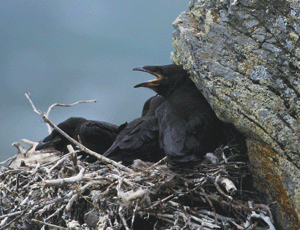
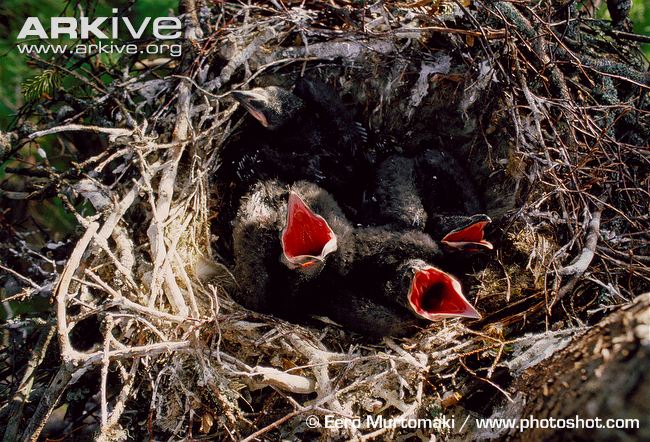
Raven Chicks
Ravens build a nest for their young, as most birds do. The behavior of the parent birds gives a clue as to when their eggs are being incubated, in expectation of hatching, according to the observations of the Stokes duo:
“One clue to incubation’s having started is seeing only one raven soaring above the nest. That would generally be the male since the incubating female spends most of her time on the eggs. During incubation, the male brings food to the female and gives it to her at the nest or nearby. When the female is about to receive the food she may flutter her wings close to her body and give the Kra-kra-call. … When the male is not actively hunting for food for himself or the female, he is usually perched near the nest on a dead branch or ledge. The female occasionally leaves he nest, at which time the male may come to the nest, but he does not actually incubate the eggs.” [Quoting from Stokes & Stokes, GUIDE TO BIRD BEHAVIOR, Volume 3, page 307.]
The nestling phase in the Raven family’s life cycle has been observed, with one activity making it easier to recognize where a raven nest is raising young:
“The young hatch over a period of a day or two. The female eats the shells [a good source of calcium!] and broods the young for about two and a half weeks. During this time the male does most of the feeding; after that, both parents participate in feeding the young. During the first weeks of intensive brooding, when the female takes periodic leaves, the male stays near or on the nest until she returns. The parents at first bring small food items for the young, picking the items apart before offering them to the young. Later in the nestling phase larger food items are left at the nest and the young pull them apart to eat. The parents may also come to the nest with water in their crops, which is then fed to the young. On cold days the young are buried in the nest lining for warmth; on hot days the female may wet her underfeathers and cover the young to give them relief from the heat. The young lift their tails as they defecate over the rim of the nest [there being no in-house plumbing accommodations!]. The nest rim or cliff ledge can have large white stains resulting from this behavior; the stains may help you locate the nest. The young may fledge over a period of days.” [Quoting from Stokes & Stokes, GUIDE TO BIRD BEHAVIOR, Volume 3, page 308.]]
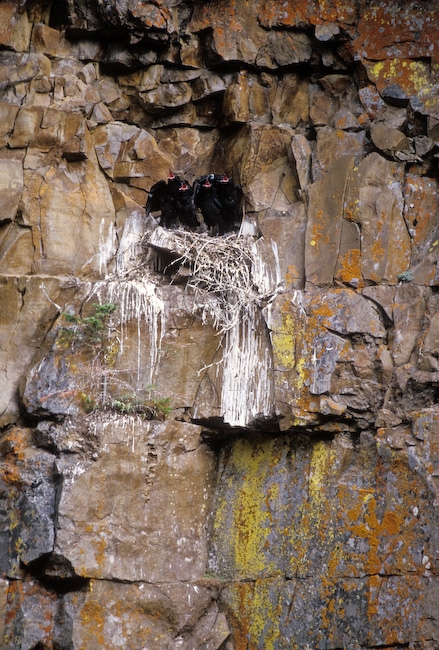
But now let us consider the other bird supporting the Manx coat-of-arms, the Peregrine Falcon.

Peregrine Falcon (Falco peregrinus) by Ray
PEREGRINE FALCON (Falco peregrinus).
The Peregrine Falcon (also called the “Peregrine”) is dominated by bluish-grey plumage, with a pale underside (barred white), and a slate-black head. Its eyes are large, for hunting prey, and its pale-yellow beak is strong, with a shape convenient for its carnivorous lifestyle – so it can tear into its diet of
True to its name (“peregrine” meaning “wanderer”, “sojourner”, one that goes through/throughout the land), the Peregrine’s range is worldwide [see range map below: yellow = summer breeding migrant range; green = year-round breeding; indigo blue = winter migrant range; Carolina blue = migrant passage range].
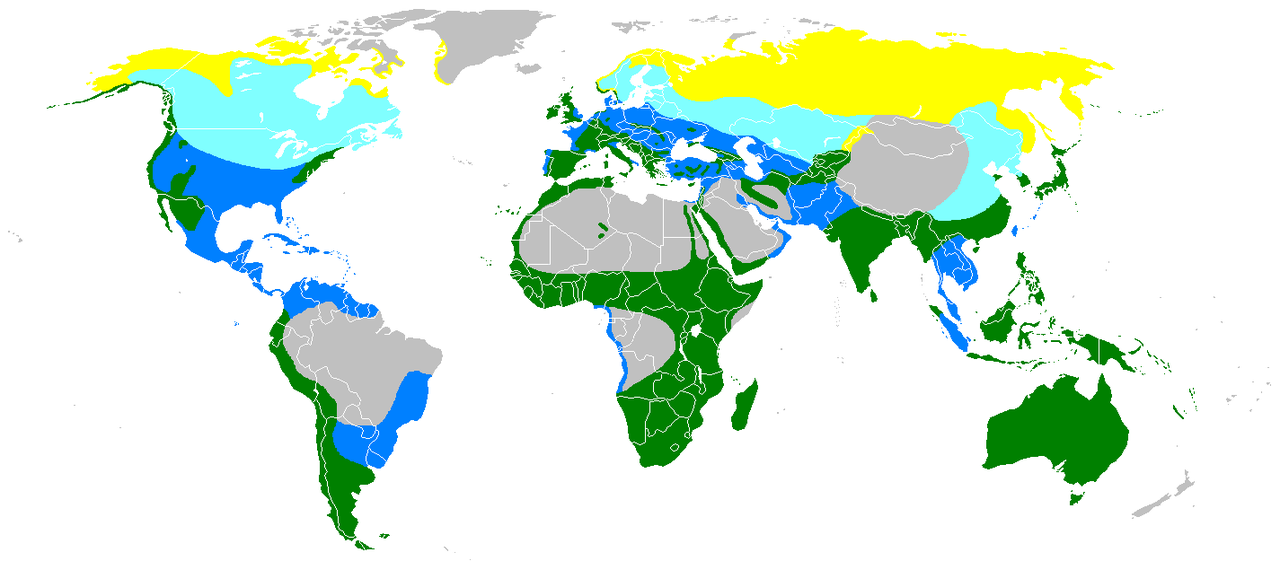
Peregrine Falcon Map ©WikiC
The Peregrine Falcon appears in about 20 various localized “subspecies”, based upon geographically localized population forms [see range map below, showing subspecies].
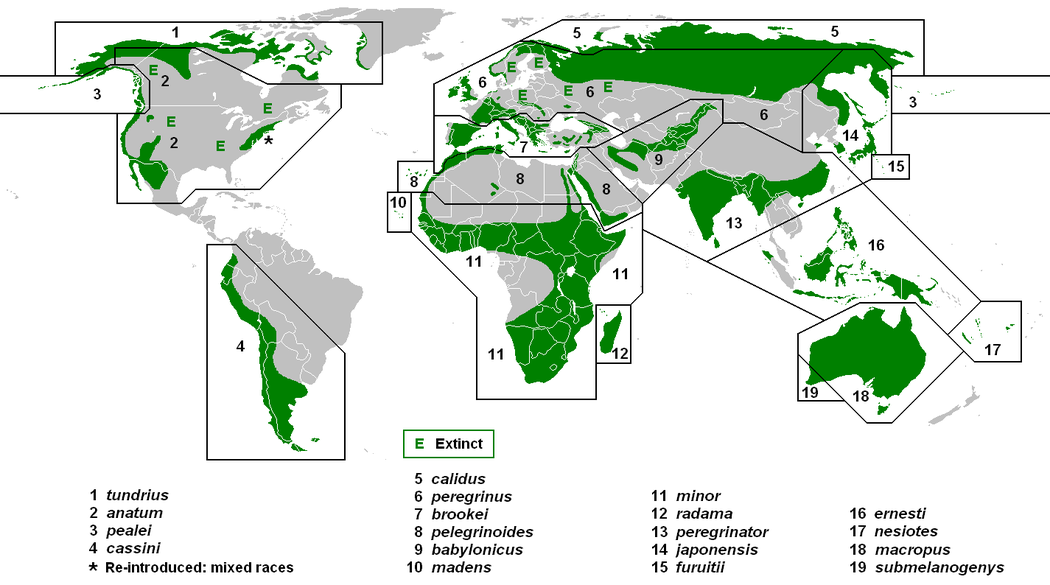
Breeding ranges of the subspecies of Peregrine Falcons ©WikiC
Six of those Peregrine subspecies are: (1) the paradigmatic Eurasian Peregrine Falcon (Falco peregrinus peregrinus), ranging throughout all of Europe, except for its Mediterranean Sea coastlands and the Iberian Peninsula, extending eastward through Siberia, except not its Arctic Ocean coastlands; (2) the once-endangered Arctic Peregrine Falcon (Falco peregrinus tundris), ranging in the tundras of northern Alaska, northern Canada, and Greenland; (3) the once-endangered American Peregrine Falcon (Falco peregrinus anatum, a/k/a “Duck Hawk”), ranging throughout all of North America, except the Arctic coastlands habituated by its Arctic cousin – although its main population clustering is in the Rocky Mountains regions. (However, Peregrine Falcons are making a “comeback” outside the Rockies, including revived populations in municipalities where they often prey on urban pigeons.) The Mediterranean Sea coastlands, as well as all of Spain and Portugal, are habituated by the Mediterranean Peregrine Falcon (Falco peregrinus brookei). The endangered close cousin of the Peregrine, in America, is the Northern Aplomado Falcon (Falco femoralis septentrionalis).
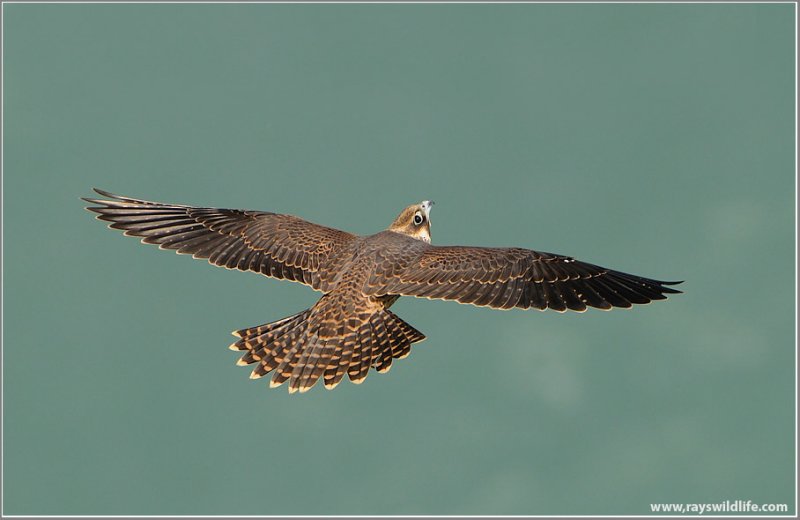
Peregrine Falcon in Flight by Ray
The Peregrine Falcon typically lives in coastal lands, river valleys, and in mountain ranges – yet urban skyscrapers are deemed montane “cliffs” for these birds of prey, so don’t be shocked when you see a falcon “dive-bomb” (and kill, in midair) a pigeon, in the air between city office buildings or high-rise apartments.
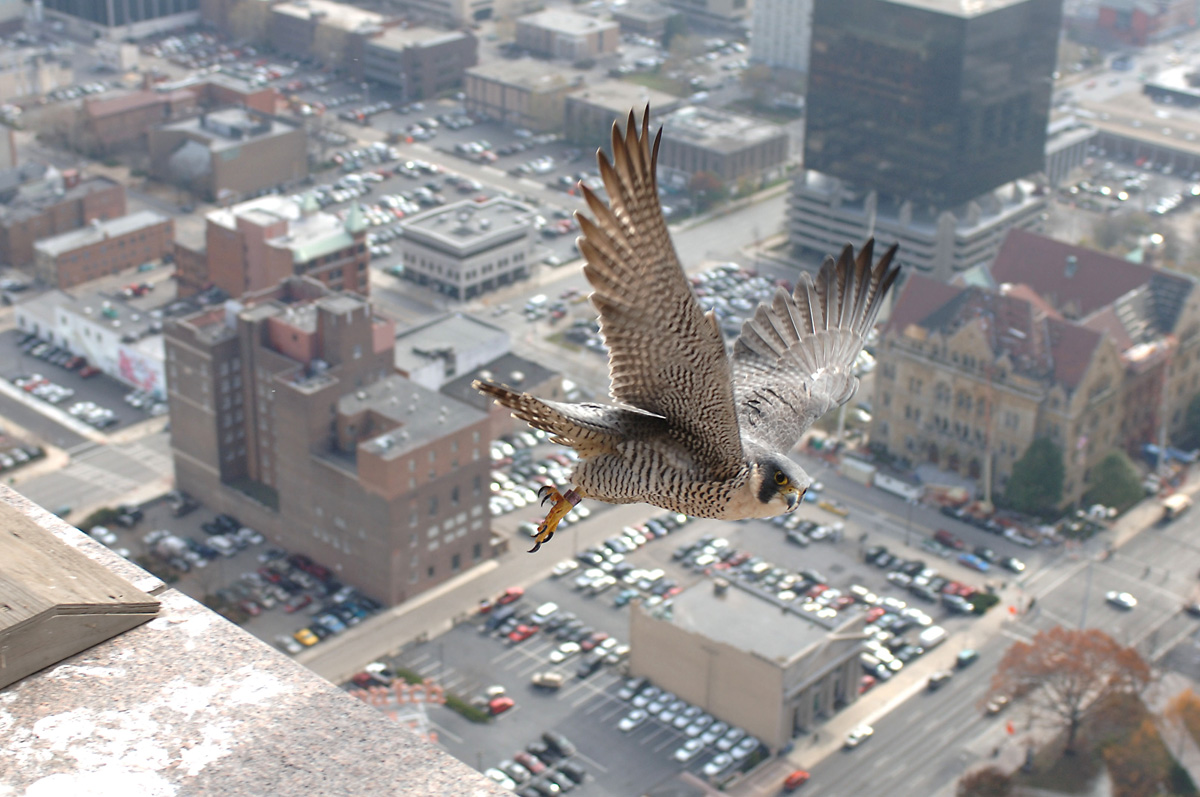
The typical nesting behavior of American Peregrine Falcons has been described as “… on cliff ledges [near to] open habitats from tundra, savanna [grassland], and seacoasts to high mountains, on which the falcon makes a well-formed scrape in piled debris … [sometimes using] abandoned tree nests or cavities … [or, in urban contexts] on ledges of tall buildings and bridges”. [Quoting Paul R. Ehrlich, David S. Dobkin, & Darryl Wheye, BIRDS IN JEOPARDY (Stanford University Press, 1992), page 48.]
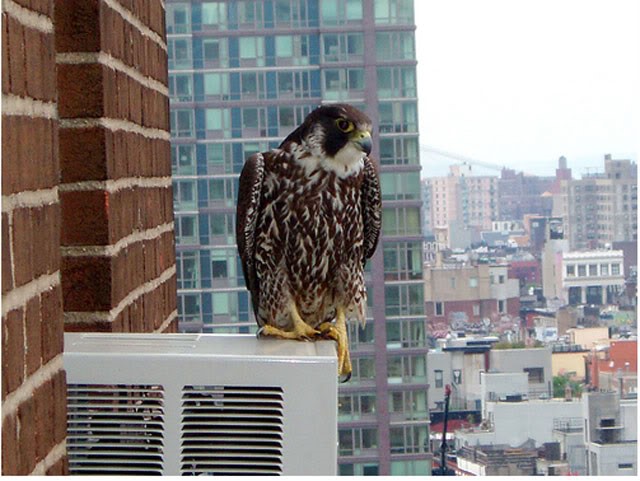
Peregrine Falcon by ©©Weebly Uploads
The American Peregrine Falcon’s diet is quite a mixed bag: “Birds, particularly doves and [other] pigeons, but also waterfowl [especially ducks], shorebirds, and passerines [i.e., perching songbirds, such as European Starlings] … [chasing and catching] prey in midair, dropping on flying birds from above and killing them in flight with a blow from their feet…. [sometimes involving speeds of] 60 miles per hour, in a [closed-wings] stoop on prey it can reach speeds exceeding 200 miles per hour”. [Again quoting Ehrlich, Dobkin, & Wheye, BIRDS IN JEOPARDY, at page 48.]
In cities a Peregrine’s diet might consist 80% of mourning doves and pigeons. Other avian fare (i.e., birds eaten as prey) include icterids (such as grackles and other blackbirds), thrushes (such as American robins), swifts, and other corvids (such as crows). However, when available, Peregrines will also eat small rodents, such as mice, rats, voles, squirrels – or other small mammals such as shrews or rabbits (or sometimes even bats, at night!).
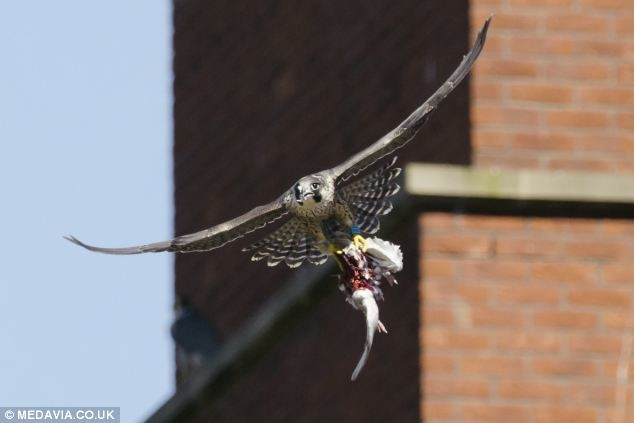
Peregrine Falcon (with doomed Pigeon in the falcon’s talons)
The flying abilities of Peregrine Falcons are almost legendary – they fly “with shallow elastic wingbeats in which [wing] tips [are] very springy (characteristic of the larger falcons)”. [Quoting Lars Jonsson, BIRDS OF EUROPE (Princeton University Press, 1992; translated by David Christie), page 160.]
And true to their name, they wander – they range to wherever they need to go.
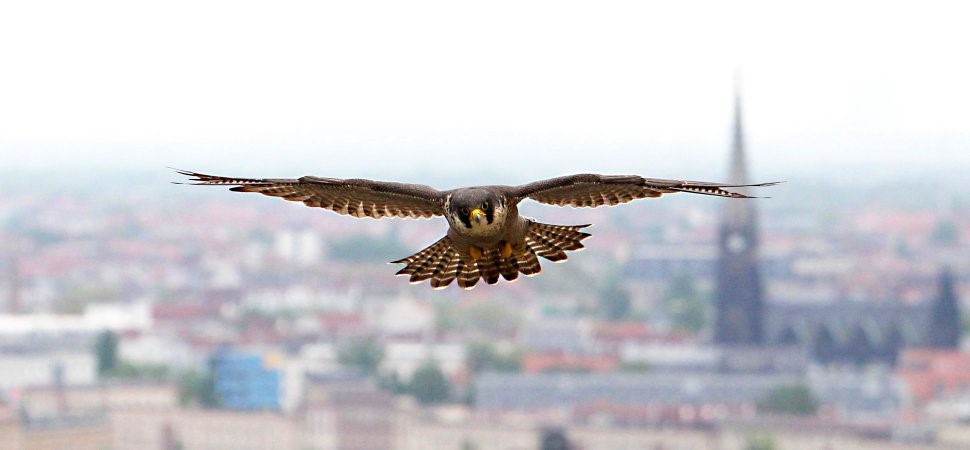
Peregrine Falcoln ©Images Inc
Lessons for the Journey, as We “Hike” on our Earthly Pilgrimage
So, as “pilgrims” awaiting our future citizenship, in the Kingdom that is not yet here (Philippians 3:20) how should we approach our sometimes-stormy future – which mixes furies, frustrations, and failings with hopes, helps, and hallelujahs?
Thy statutes have been my songs in the house of my pilgrimage. (Psalm 119:54)
In other words, Jesus put a song in my heart!
Stormy weather or calm, I can be (and should be) at least as brave as a Manx Viking rowing in a rainstorm, tossed up and down, from side to side, in the cold salt-spray of the Irish Sea.
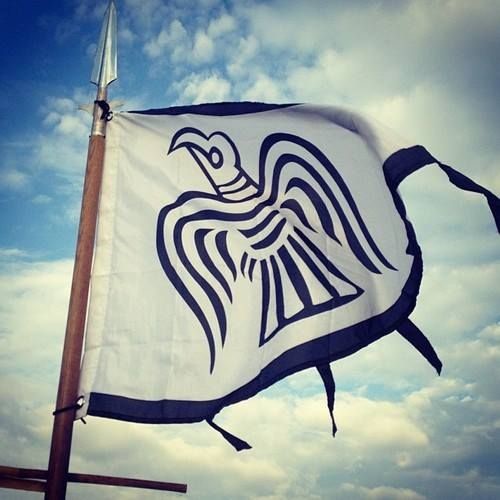
Pennant ©Pinimg.Com

Mainsail ©crwflags.com
Just as the resilient and resourceful Nordic seamen of old, including ancient Norse-Manx Vikings (and their biogenetic progeny, including sjøfolk that sail the Seven Seas today) strove to stay afloat — till they rhed their destined safe-haven — let us “labor at the oars” of (this) life, until God brings us securely Home (see http://www.icr.org/article/why-we-want-go-home ).
It is good to keep in mind that God Himself is our only real Home. Meanwhile, He can guide and keep us, on the stormy seas of this temporal life, until it’s “our turn” to enter into His holy and happy presence, with everlasting joy. ><> JJSJ
*
*
~ by James J. S. Johnson
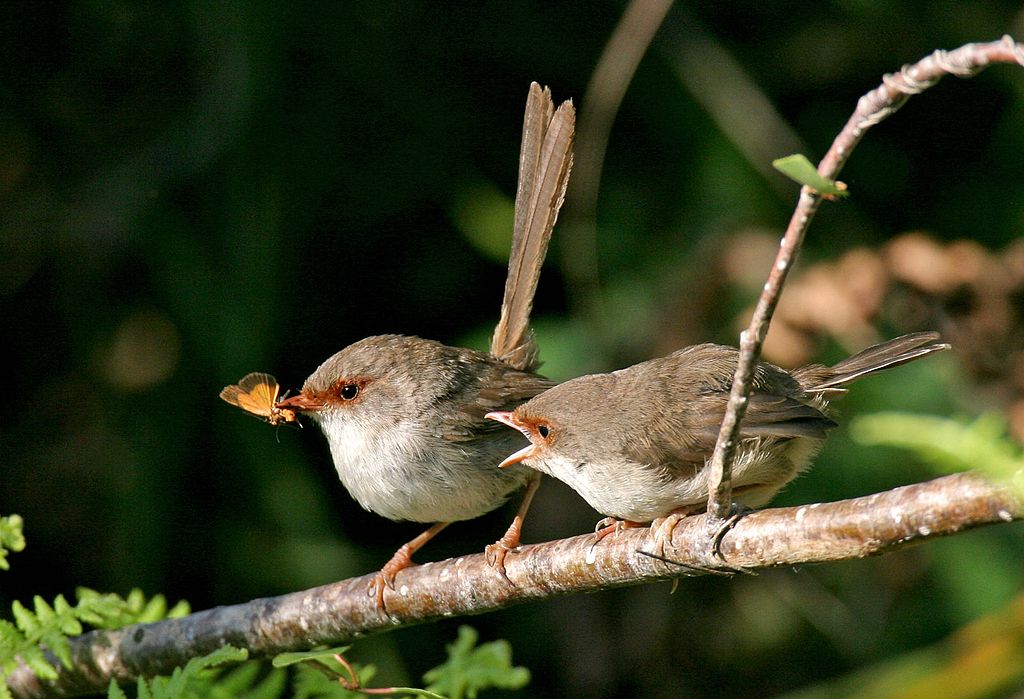
Superb Fairywren (Malurus cyaneus) Juvenile and Female ©WikiC
4 We will not hide them [“them” refers to God’s prophetic words – see verses 1-3] from their children, shewing to the generation to come the praises of the Lord, and His strength, and his wonderful works that He hath done. 5 For He established a testimony in Jacob, and appointed a law in Israel, which He commanded our [fore]fathers, that they should make them known to their children, 6 that the generation to come might know them, even the children which should be born [יִוָּלֵ֑דוּ — niphâl imperfect form of the verb yâlad], who should arise and declare [וִֽיסַפְּר֥וּ — piêl imperfect form of the verb sâphar] them to their children, 7 that they might set their hope in God, and not forget the works of God, but keep His commandments, 8 and [that they] might not be as their [fore]fathers, a stubborn and rebellious generation, a generation that set not their heart aright, and whose spirit was not steadfast with God. Psalm 78:4-8
Superb Fairywrens teach their children to use passwords, but how?
In this fallen world even bird families have troubles.
One kind of family problem, confronted by many bird parents, is the problem of “brood parasites”, which is really a sneaky kind of “home invasion”.
“Brood parasitism” is not a problem of parasitic worms or bugs. Rather, this is a different kind of parasite – a bold “home invasion” parasite – a “foster child”, from another bird family, who was dropped into a “host” family. The “host” family is thereafter burdened (unless and until the newcomer is evicted from the nest) with the cost of nurturing the intruding stranger who “moved in” without an invitation. Worse, the invasive “foster child” often competes with the legitimate nestling birds for food and shelter, sometimes even competing aggressively.
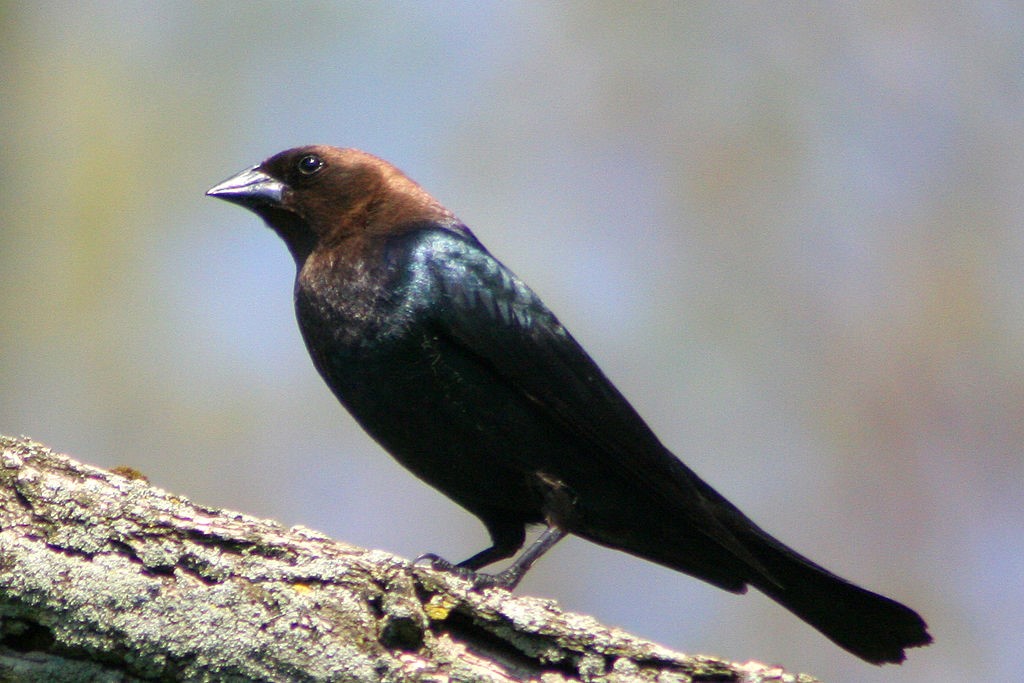
Male Brown-headed Cowbird (Molothrus ater) ©WikiC
One of the best-known examples of such “brood parasitism” practices is those of the Brown-headed Cowbird (Molothrus ater), an icterid (i.e., member of the blackbird family) with a head that is distinctively chocolate-brown in color.
“A small, black-bodied [and iridescent-plumed] bird, a bit larger than a House Sparrow, with a brown head and a rather finchlike bill. Females are nondescript gray [like the hue of female grackles] with a finchlike bill.
A brood parasite, the Cowbird lays its eggs in the nests of other birds.”
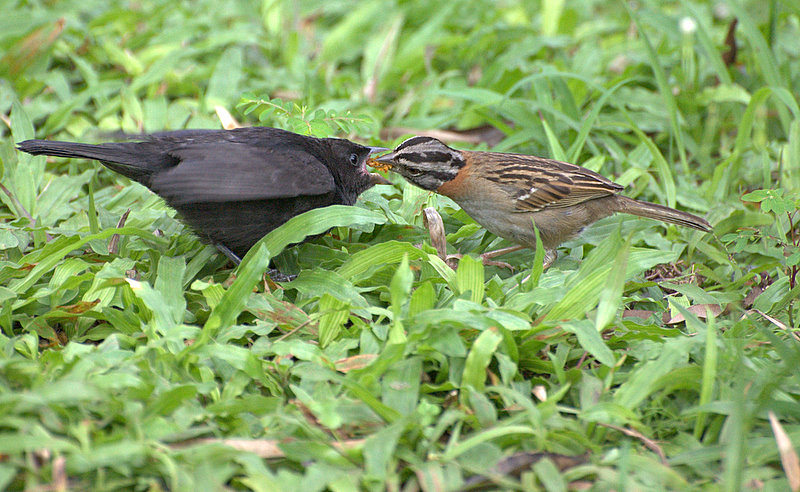
A Shiny Cowbird (Molothrus bonariensis) chick being fed by a Rufous-collared Sparrow (Zonotrichia Capensis)
[Quoting from Roger Tory Peterson, PETERSON FIRST GUIDE TO BIRDS: A Simplified Field Guide to the Commonest Birds of North America (Houghton Mifflin, 1986), page 102.]
But cowbirds of North America are not the only birds that abuse the (involuntary) charity care of avian “foster parents”; cuckoos (such as the Common Cuckoo of Eurasia) are known for the same “externalizing” of their parenting costs, producing nestling competitions that result in “changeling” conflicts.
“Once a brood parasite [mother] has managed to slip her egg into a host’s nest, her reproductive role is essentially over. She leaves each chick to fend for itself, in a [bird] family that did not choose to raise it.
There’s no reason to feel [too] sorry for the uninvited foster chick, however; it is the unwitting adoptive parents that might soon face an unexpected brutality—the ruthless slaying of all their own offspring.
Many brood parasites, such as cuckoos, immediately dispatch of their nest mates [i.e., the children of the caring bird parents who built and maintain the nest that is now compromised] as soon as they hatch by summarily tossing them over the side of the nest. [So much for refugee gratitude!]
Brown-headed Cowbird (Molothrus ater) Egg in Eastern Phoebe Nest ©WikiC
African Honeyguides use far deadlier methods to eliminate their [nest] fellows. Equipped from birth with hooks at the tips of their mandibles, they efficiently wield these needle-sharp barbs against their defenseless nest mates.
Cowbirds do not employ such direct methods, yet they just as effectively eliminate the competition. Their companions often die of starvation because the larger, more aggressive cowbird grabs all the food [delivered by the nestling-caring parent birds]. It is a wonder that the adults still feed the chick when they realize the disparity in size. Yet in most cases, the adults accept it [i.e., the cowbird “foster child”], even if it appears double the size of its foster parent and requires twice the care of its [foster] siblings.
Long-tailed Paradise Whydah by Dan
Not all brood parasites oust their nest mates. Parents of the whydah family choose species that closely resemble them, such as waxbills. Not only do the eggs match in coloration, but the chicks resemble their hosts as well. They even have the same markings in their gaping mouths which signal hunger to an observing adult. Whylahs blend in with their adopted families instead of destroying them.”
[Quoting from Sharon A. Cohen, BIRD NESTS (Harper Collins, 1993), page 110.]
So cowbird “parenting” is a short-lived experience, somewhat like clandestinely depositing a newborn on the front steps of an orphanage, trusting that the baby will be nurtured (successfully) by others. But is this surreptitious forced-fostering habit a guarantee of avian reproductive success, at the populational level?
“At first, you may wonder why more birds are not parasites—after all, parasites don’t need to build a nest [for raising their babies], and once they have laid eggs there is no more to it [i.e., to parenting responsibilities on a daily basis]; but there are hidden costs [and risks] to being a [brood] parasite, mainly that the [child-abandoning] bird gives up control over its eggs and young.
Female cowbirds lay an average of forty eggs per year, but only two or three [on average] mature to adulthood.”
[Quoting from Donald Stokes & Lillian Stokes, A GUIDE TO BIRD BEHAVIOR, VOLUME II (Little Brown & Company, 1983), page 213.]
So what does this have to do with avian parents teaching “passwords” to their natural progeny?
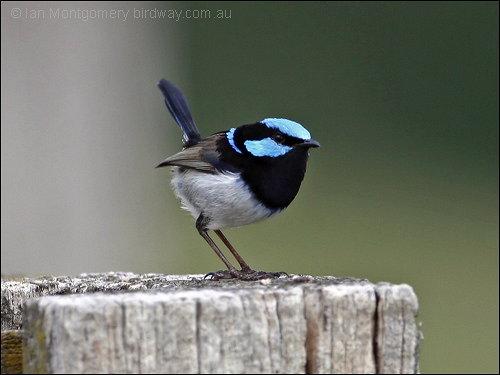
Male Superb Fairywren (Malurus cyaneus) by Ian
Consider this amazing news about the Superb Fairywren (Malurus cyaneus) of Australia, which is forced to react to the “child-abandonment” brood parasitism habits of the Horsfield’s Bronze Cuckoo. (Chrysococcyx basalis).
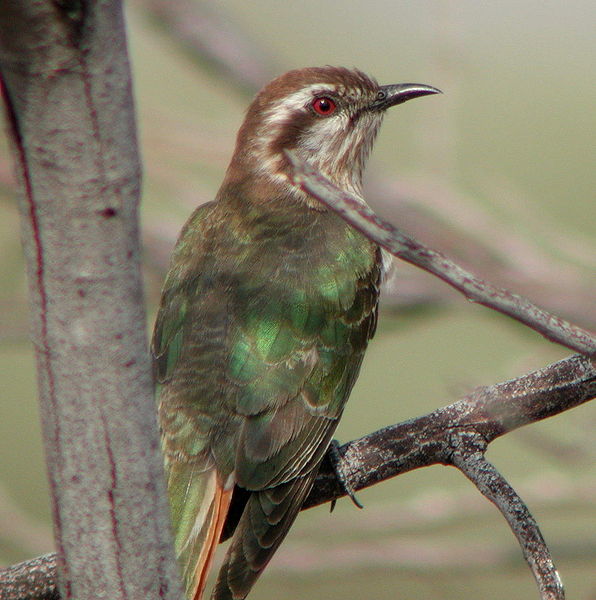
Male Horsfield’s Bronze Cuckoo (Chrysococcyx basalis) by Tom Tarrant
The Horsfield’s Bronze Cuckoo deposits its somewhat elongated pink-white egg, with rust-colored spots, into the nest of a fairywren. The rust-speckled egg looks like a fairywren egg, confusing the fairywren nest owners of its true biogenetic identity. (This is an avian version of family “identity fraud!) The fairywren’s upside-down-dome-shaped nest is often dark inside, so visual confusion about which eggs really belong there is common – hence Horsfield’s bronze cuckoos often get by with their “changeling” deceptions, recruiting fairywren parents into fostering cuckoo eggs that hatch into cuckoo nestlings.
After a dozen days of incubation, in a fairywren nest, a bronze cuckoo chick hatches – 2 days before the hatching of fairywren eggs. The “older” nestling often ejects the fairywren eggs from the nest, displacing the rightful “heirs”. (What kind of “refugee gratitude” is that?!)
What can fairywrens do about this parasitic (and quasi-predatory) menace?
Is there a way to avoid the involuntary “home invasion” of such Trojan horses?
Yes, there are a few defensive habits that help to protect the fairywren from such home hijackings, including:
(1) nesting in fairywren colonies – so that teamwork is employed to drive off trespassing cuckoos when cuckoos fly near the fairywrens’ nesting colony;
(2) females attend their nests with vigilance, usually, limiting the opportunities that stealthy cuckoos have to access unattended fairywren nests;
(3) when female fairywren recognize a “changeling” in the nest, prior to laying any fairywren eggs therein, the fairywren female may abandon that (cuckoo) egg and build herself a new nest elsewhere;
(4) female fairywrens “teach” their eggs vocal “passwords” to use, to prompt being fed by their mother. It is this last habit that demonstrates communication from (fairywren) mother to child, before the chick is hatched from its egg!
A few years ago, Diane Colombelli-Négrel, Sonia Kleindorfer, and colleagues from Flinders University in Australia discovered a remarkable way one bird fights back against brood parasites. Female superb fairywrens teach their embryos a “password” while they’re still in their eggs. Each female’s incubation call contains a unique acoustic element. After they hatch, fairywren chicks incorporate this unique element into their begging calls to ask for food. Colombelli-Négrel, Kleindorfer, and colleagues showed that chicks whose begging calls most resembled their mothers’ incubation calls received more food. But the brood parasites of the fairywren, Horsfield’s bronze-cuckoos, produced begging calls that did not so closely resemble the parental password.
[Quoting Mary Bates, “To Beat a Parasite, Birds Teach their Young a Secret Password”, posted at http://www.wired.com/2014/06/to-beat-a-parasite-birds-teach-their-young-a-secret-password/ , accessed 11-23-AD2015.]
If fairywrens observe cuckoos in the neighborhood they become more diligent in their efforts to teach the “please-feed-me” passwords to their unhatched progeny, increasing the likelihood that the babies will successfully beg for food (using the vocal “password”) when they soon become hatchling chicks.
“In a new study, Colombelli-Négrel, Kleindorfer, and colleagues again looked at the relationship between superb fairywrens and Horsfield’s bronze-cuckoos to see if a greater threat of brood parasitism would cause the fairywren to up its teaching efforts.
First, the researchers recorded calls from 17 fairywren nests in South Australia. They found the similarity between the mother’s password and the chick’s begging call was predicted by the number of incubation calls produced by the mother: If females made many incubation calls, their chicks ended up producing more similar begging calls.
Next, the researchers conducted a playback experiment at 29 nests. They broadcast either the song of Horsfield’s bronze-cuckoo or a neutral bird. After the cuckoo calls, but not after the neutral bird calls, female fairywrens made more incubation calls to their embryos. In other words, female fairywrens that heard a cuckoo near their nest increased their efforts to teach their password to their embryos. Colombelli-Négrel and Kleindorfer say their results provide a mechanism for how fairywrens could get better at decision-making and lower the probability of committing an acceptance error for a cuckoo chick or a rejection error for one of their own chicks. ‘When there are cuckoos in the area, you should call more to your eggs so that they have a higher call similarity after hatching and you can decide if the offspring is yours,’ Colombelli-Négrel and Kleindorfer wrote in an email. ‘We show a mechanism that starts in the nest and involves active teaching and sensorimotor learning in embryos.’” [again quoting Mary Bates, supra]
This is truly amazing! Anyone who is not amazed at how God programmed parenting skills into Superb Fairywrens is blind to the facts.
Also, by analogy, there may be a lesson for humans: be careful about vulnerabilities to intrusive “foster children” that are “accepted” without informed consent — your own legitimate children may be put unfairly at risk.
Meanwhile, just as fairywrens teach “passwords” to their children, so should we humans. But it is much more than “please feed me!” that we must teach our children, and our children’s children.
The vital “words of life” that we must teach, repeatedly, as the words of God, the Scriptures without which there is no real life, because mankind cannot live by physical bread alone, but by every Scriptural saying – every word that proceeds from God (Matthew 4:4).
4 We will not hide them [“them” refers to God’s prophetic words – see verses 1-3] from their children, shewing to the generation to come the praises of the Lord, and His strength, and his wonderful works that He hath done. 5 For He established a testimony in Jacob, and appointed a law in Israel, which He commanded our [fore]fathers, that they should make them known to their children, 6 that the generation to come might know them, even the children which should be born [יִוָּלֵ֑דוּ — niphâl imperfect form of the verb yâlad], who should arise and declare [וִֽיסַפְּר֥וּ — piêl imperfect form of the verb sâphar] them to their children, 7 that they might set their hope in God, and not forget the works of God, but keep His commandments, 8 and [that they] might not be as their [fore]fathers, a stubborn and rebellious generation, a generation that set not their heart aright, and whose spirit was not steadfast with God. Psalm 78:4-8
<> JJSJ
*
Maluridae – Australasian Wrens
James J. S. Johnson’s Articles
*
~ by James J. S. Johnson
Not that which goeth into the mouth defileth a man; but that which cometh out of the mouth, this defileth a man. … Do not ye yet understand, that whatsoever entereth in at the mouth goeth into the belly, and is cast out into the draught? But those things which proceed out of the mouth come forth from the heart; and they defile the man. For out of the heart proceed evil thoughts, murders, adulteries, fornications, thefts, false witness, blasphemies; these are the things which defile a man, but to eat with unwashen hands defileth not a man. (Matthew 15:11 & 15:17-20)

When thinking about the eating behavior of long-legged wading birds—such as the Little Blue Heron—I remembered this proverb, spoken by the Lord Jesus Christ (in Matthew 15:11-20 & Mark 7:15-23), that observes that digestion depends upon what is put into an eater’s mouth. Whatever exits out of a mouth (whether it be words or regurgitated food!) had to have been inside, already, before it can exit! On that happy note I now remember seeing a Little Blue Heron, wading in pondshore waters.
On a pleasant Saturday, June 20th of AD2015, in Ferris, Texas – a good day for an outdoor Rekefest (shrimp feast party – more on that later!), graced by a busy host of local birds, including Black-capped Chickadees, House Finches, Cardinals, and a Little Blue Heron.
This report will focus only on the Little Blue Heron, which I then saw, wading in shallow pondshore waters. (For the geographically curious, Ferris is a city about 15 miles south of Dallas, somewhat hilly and forested, covering land in both Dallas and Ellis Counties.)
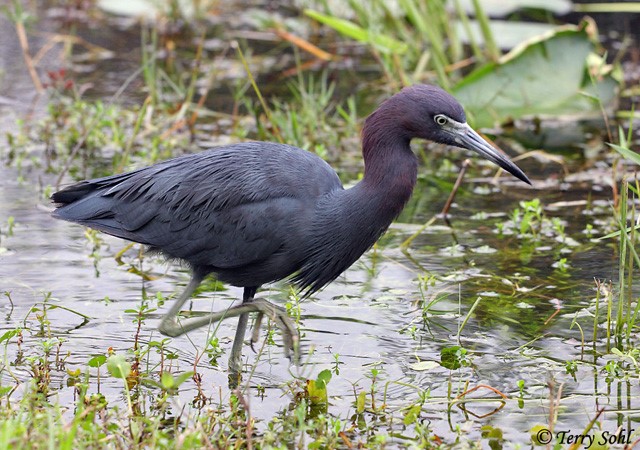
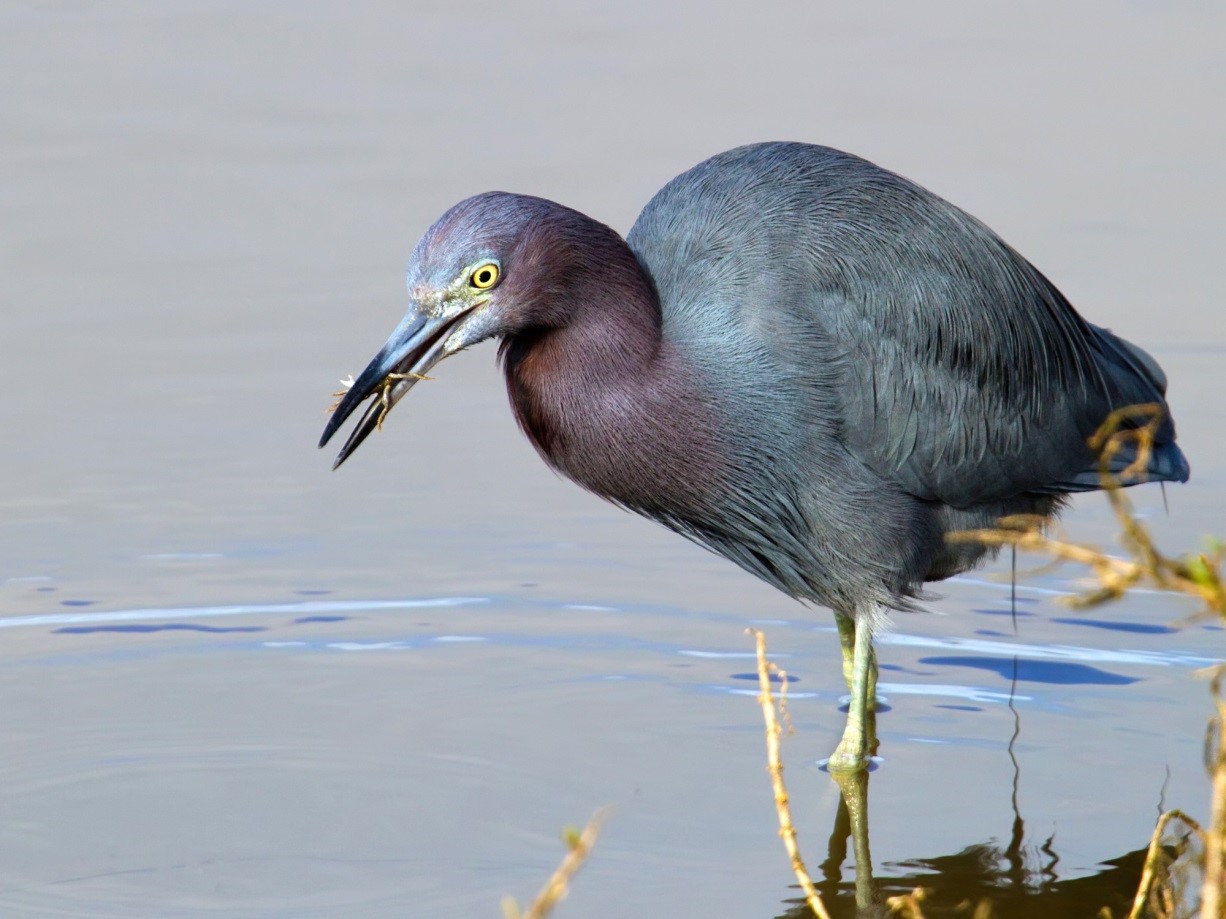
LITTLE BLUE HERON (Egretta caerulea, a/k/a Florida caerulea)
The Little Blue Heron is a long-legged wetland-dwelling wading bird (i.e., shorebird) of the heron/egret family, with a “summer” (March to October) breeding range that includes the eastern half of Texas.
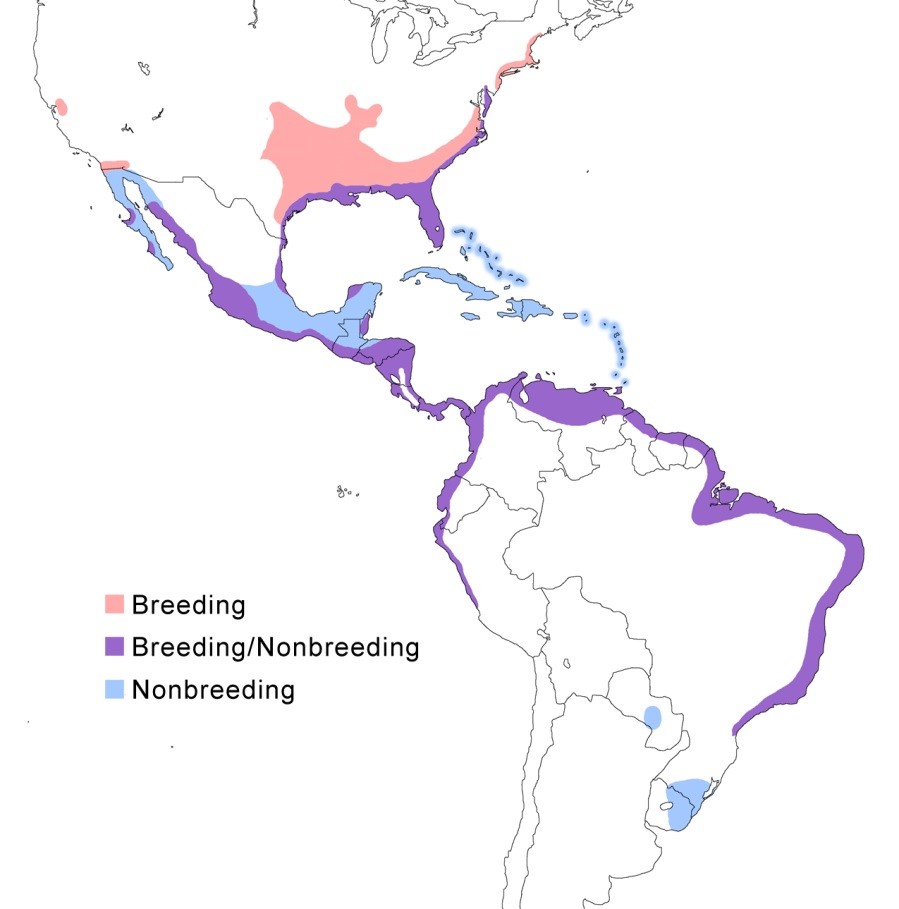
For these herons wetland habitats are “home” – whether they be freshwater pondshores, waterlogged meadows, brackish swamps, tidal mudflats, marshlands, estuaries, ricefields, or even slow-moving streams (e.g., where waters slow down and pool at bends in the stream). Little Blue Herons build stick nests, in colonies, like other herons and egrets, in trees and shrubs. [See Roger Tory Peterson, A FIELD GUIDE TO THE BIRDS OF TEXAS AND ADJACENT STATES (Houghton Mifflin, 1988), pages 16 & 28-29.]
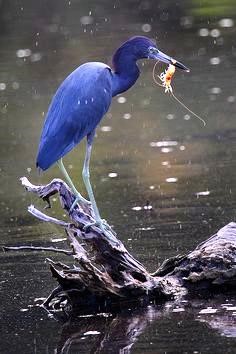
Depending on the lighting this bird’s plumage appears mostly as bluish-grey or even a dull purplish-blue (with a maroon head and neck, sometimes with bronze-like highlighting). Their eyes are yellowish, their legs are dull (depending upon lighting, sometimes appearing yellowish-green, sometimes as pale grey-blue), and their dark necks are distinctively maroon or purplish. Unlike the Reddish Egret’s pale-pink bill (with its black tip), the Little Blue Heron has a distinctively light-blue bill (also with a black tip).
Little Blue Herons grow to about 2 feet high, with an outstretched wingspan of about 3 feet! During their juvenile stage (first year) these herons are mostly white, except for darkish wing-tips (and dull green legs). Such juveniles resemble Snowy Egrets and sometimes are permitted to mingle with the snowies.
At rest, as well as in flight, Little Blue Herons typically hold their necks in an S-curve position.
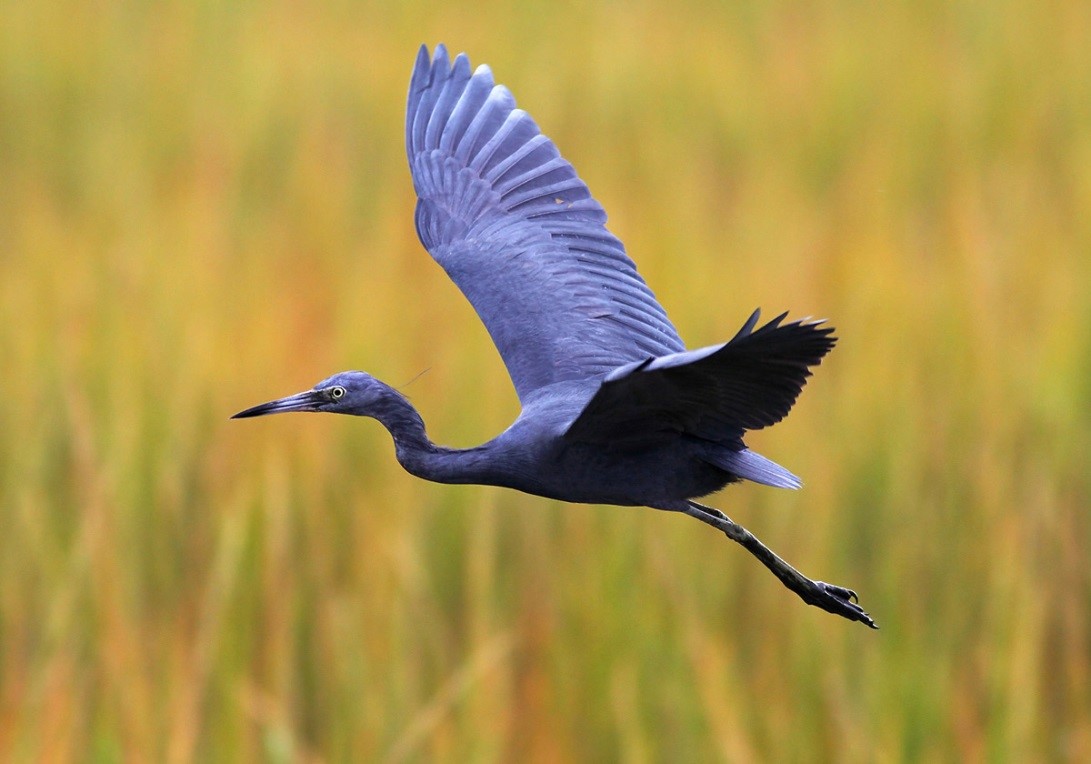
When the evening sun descends toward the horizon, and dusk approaches sunset, Little Blue Herons became active. At dawn, as the morning sun rises, they are likewise active. Wading into the shallow waters of a pond or the lotic pooling of brackish waters, these herons are known to spread their wings like a shady picnic umbrella, obscuring sunlight glare on the water – this enables them to better see and stalk potential prey in the shallow water – such as a frog or snake or fish.
If necessary, to catch evasive fish, these herons may dash about, chasing, in time stabbing their catch with their sharply pointed javelin-like bills. However, most of the time these herons prefer to stand still, like a statue, and wait for their meal to appear at a catchable spot in the shallow water.

Snatched food is swallowed whole, digested, and indigestible parts (like bones) are expelled by regurgitation. (Fun to watch if you know what you are looking at – imagine watching a Little Blue Heron eat a crayfish, followed by disposal of the indigestible parts!)
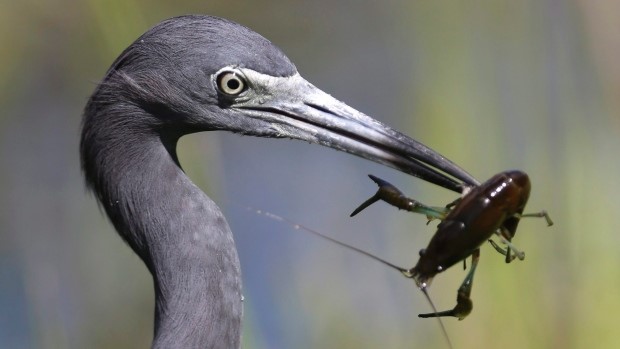
Also, like many other parent birds, these herons use regurgitation as a convenient mode of food transmission from parent to young, depositing partially digested food into the hungry mouths of their dependent chicks.
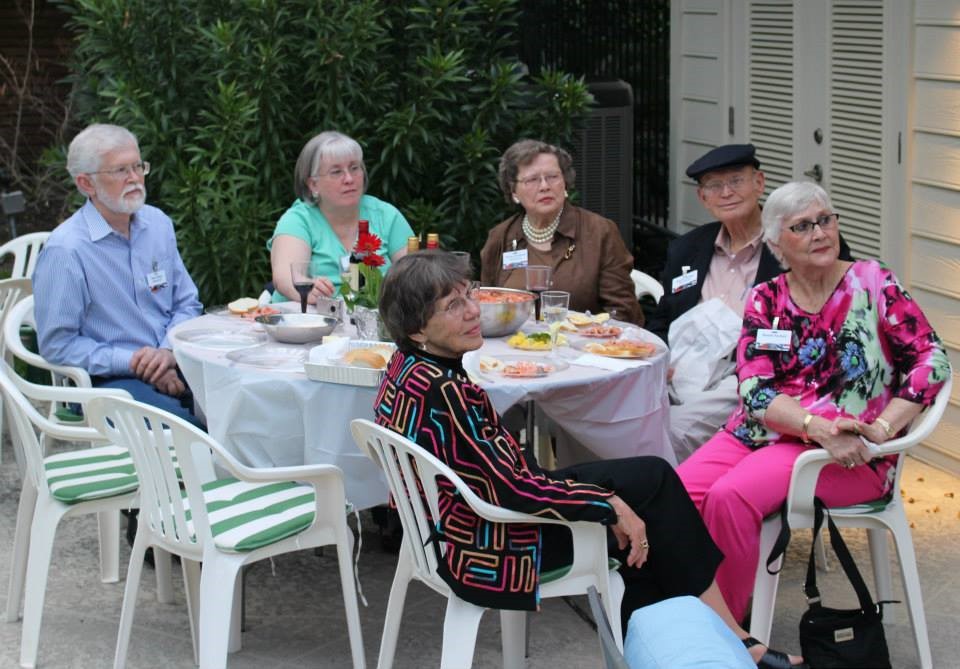
Back to the Rekefest event – which was the official reason why my wife and I were in Ferris (see photograph below — showing Dave Olson, Wayne Rohne, & others — at a different Rekefest hosted by NST’s Snorre chapter, in Houston), at the hospitable home of John and Mari-Anne Moore, that Saturday — eating Nordic shrimp the traditional (Norwegian) way, along with other members and guests of the Norwegian Society of Texas (Viking Chapter).
Of course I had sufficient table manners to not eat like a Little Blue Heron, so I disposed of the shells of my boiled shrimp (after enjoying each one that entered my own digestive system!) with proper etiquette. (And we bought extra shrimp “to go” before we left.)
But the lesson of the “in-and-out” proverb remains: whatever exits from our mouths must have been there, already, before it came out. Words flowing out, from our mouths, originate as thoughts, actively proceeding from our “hearts” – so let us carefully guard our hearts, and our lips, so that what we say is helpful, blessing others!
2 For in many things we offend all. If any man offend not in word, the same is a perfect man, and able also to bridle the whole body. 3 Behold, we put bits in the horses’ mouths, that they may obey us; and we turn about their whole body. 4 Behold also the ships, which though they be so great, and are driven of fierce winds, yet are they turned about with a very small helm, wherever the governor desires. 5 Even so the tongue is a little member, and boasts great things. Behold, how great a matter a little fire kindles! 6 And the tongue is a fire, a world of iniquity: so is the tongue among our members, that it defiles the whole body, and sets on fire the course of nature; and it is set on fire of hell. 7 For every kind of beasts, and of birds, and of serpents, and of things in the sea, is tamed, and hath been tamed of mankind. 8 But the tongue can no man tame; it is an unruly evil, full of deadly poison. 9 Therewith bless we God, even the Father; and therewith curse we men, which are made after the image of God. 10 Out of the same mouth proceedeth blessing and cursing; my brethren, these things ought not so to be! 11 Doth a fountain send forth at the same place sweet water and bitter? 12 Can the fig tree, my brethren, bear olive berries? Or a vine, figs? Likewise can no fountain both yield saltwater and freshwater. 13 Who is a wise man and endued with knowledge among you? Let him show out of a good conversation his works with meekness of wisdom. (James 3:2-13)
*
Fair Use image credit:
*
So it was, that while they were there, the days were completed for her to be delivered. And she brought forth her firstborn Son, and wrapped Him in swaddling cloths, and laid Him in a manger, because there was no room for them in the inn. (Luke 2:6-7 NKJV)
Here is a special video sent to me by James J. S. Johnson. It is about kids telling the story of Cwismus (Christmas) by the Mobberly Kids. Enjoy.
by James J. S. Johnson
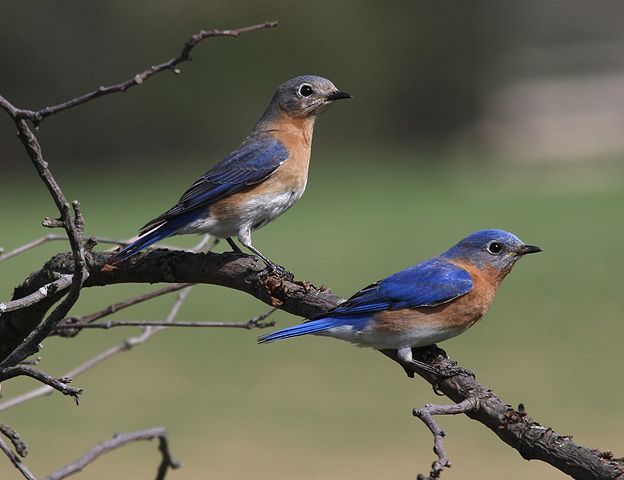
Eastern Bluebird (Sialia sialis) ©WikiC
Happy is the man that findeth wisdom, and the man that getteth understanding. (Proverbs 3:13)
He that handleth a matter wisely shall find good: and whoso trusteth in the Lord, happy is he. (Proverbs 16:20)
Happy is that people, that is in such a case: yea, happy is that people, whose God is the Lord. (Psalm 144:15)
In honor of the so-called “bluebird of happiness” (with apologies to song lyricist Edward Heyman and vocalist Jan Peerce), we can think for a moment about being “happy”. (In fact, nowadays, isn’t it just “ducky” to appreciate being “happy, happy, happy”?)
Years ago someone told me that the Bible only promises “joy” to godly people, never “happiness”. The idea was that “joy” is a gladness that is content in the Lord, regardless whether the surrounding circumstances are pleasant or unpleasant. (“Happiness depends on what is happening to you”, I was told, “but joy is only dependent upon your appreciation for God Himself — glorifying Him and enjoying Him forever.”)
Wise-sounding sound bites, right? But is that Biblically sound advice? Not quite.
While it is certainly true that our joy should be anchored in the Lord, as we appreciate belonging to Him (Nehemiah 8:10; Psalm 100:1; Luke 10:20 & 15:6-7; Philippians 1:3-6 & 1:25-26 & 4:4; etc.), — it is also Biblically proper to enjoy being happy — glad — as we enjoy appreciating and experiencing the many blessings that God gives to us, here and there, from time to time (Proverbs 3:13 & 16:20; Job 5:17; Psalm 146:5-9; Esther 8:16-17 & 9:17-19 & 9:22; John 13:17; Romans 14:21; 1st Peter 3:14 & 4:14)!
In fact, if a happy occasion is honoring to God, surely it will blend joy with happiness (compare holiday happiness in Esther 9:17-19 with the “joy” mentioned in Esther 9:22).

Fair Use credit: Norwegian Society of Texas, including Steve Ogden, toasting at Cranfills Gap Lutefisk Supper
[ Fair Use credit: Norwegian Society of Texas, including Steve Ogden, toasting at Cranfills Gap Lutefisk Supper]
So, it’s not unbiblical to be happy about being happy (being compassionately sensitive to context, of course – see Romans 12:15). In fact, we should enjoy being happy with gladness, living life with a song in our heart — and laughter should not be a stranger!
Accordingly, with those happy thoughts in mind, let us now consider the famous “bluebird of happiness”. (By the way, that popular phrase caused my own mother, who recently left Earth for glory, to especially appreciate Eastern Bluebirds — she was known to greet family and friends with the words, “welcome to the happy home!”) And all bluebirds need “homes” to nest in.
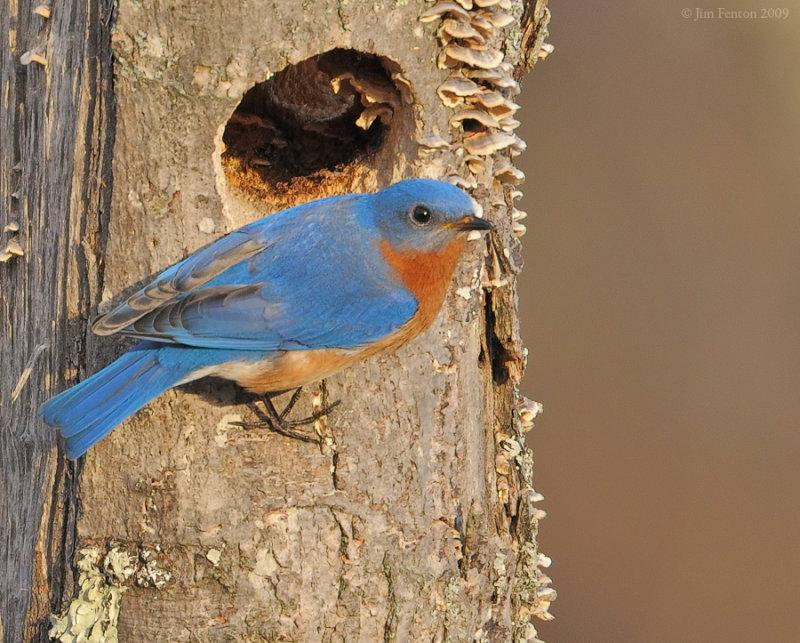
Eastern Bluebird (Sialia sialis) by J Fenton
So what kind of bluebirds (“of happiness”, presumably) do we have in America?
There are three bluebirds in America: Eastern Bluebird (Sialia sialis – bright blue above, orange underneath, ranging mostly east of the Rocky Mountains), Mountain Bluebird (Sialia currucides – bright blue above and light-blue underneath, ranging mostly in and west of the Rocky Mountains); and Western Bluebird (Sialia mexicana – bright blue above, with underside blue at the “bib” and orange on the lower underside, ranging mostly in and west of the Rocky Mountains).
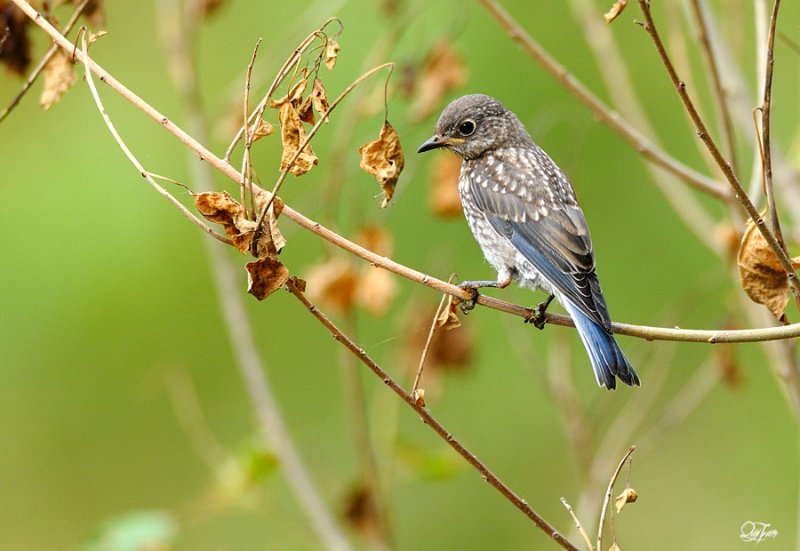
Western Bluebird (Sialia mexicana) juvenile by Quy Tran
–

Mountain Bluebird (Sialia currucoides) by Daves BirdingPix
Since last Saturday I saw a brilliant blue-backed Eastern Bluebird, flying in the Texas “hill country” (where they often winter), I will now limit my comments to the Eastern Bluebird.
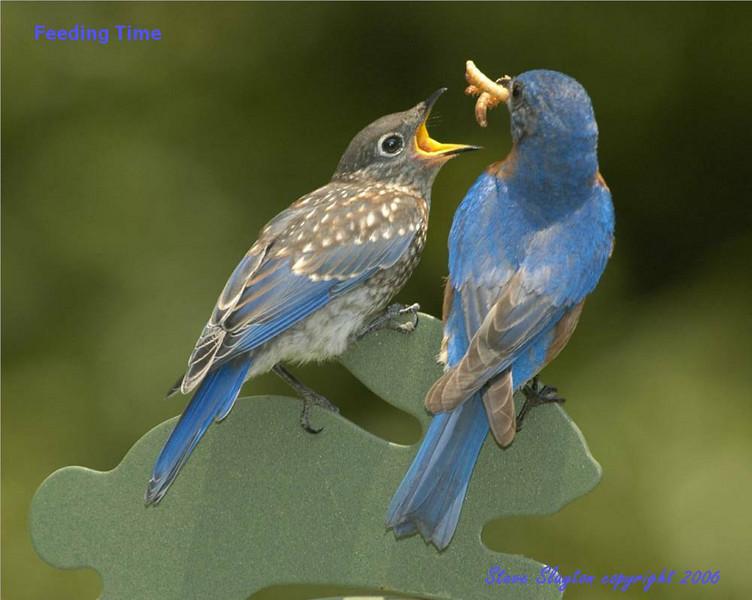
Eastern Bluebird (Sialia sialis) by S Slayton
Roger Tory Peterson gives the following description of the Eastern Bluebird:
“A bit larger than a sparrow, a blue bird with a rusty red breast; appears round-shouldered when perched. Female duller than male [no jokes, please!]; young bird is speckle-breasted, grayish, devoid of red, but always with the same telltale blue in wings and tail. … Habitat: Open country with scattered trees; farms, roadsides.”
[Quoting from Roger Tory Peterson, A FIELD GUIDE TO THE BIRDS: A Completely New Guide to All the Birds of Eastern and Central North America, 4th ed. (Houghton Mifflin, 1980; abbreviated title: EASTERN BIRDS), page 220 & Map 301.]
[another picture of an Eastern Bluebird, or 2 or more]
In fact, the Eastern Bluebird is the official state bird for both Missouri (since AD1927) and New York (since AD1970), where it is often found, especially in summer months (according the Peterson’s EASTERN BIRDS, at Map 266). In America, the Eastern Bluebird is the most common of the three bluebirds, and it is the only one that is commonly found east of the Great Plains.
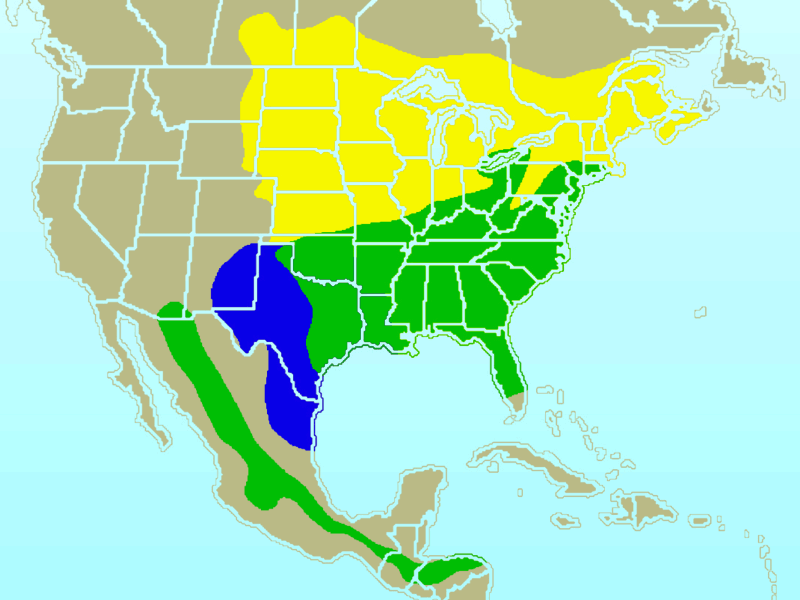
Eastern_Bluebird-rangemap rangemap Y-Sum B-win G-yr rnd ©WikiC
Just a couple of generations ago, colorful bluebirds frequently (and happily) displayed their brilliant blue plumage plentifully in Texas, – ranging from the Piney Woods of East Texas, westward into the Hill Country (east of where West Texas touches the Rocky Mountains). However, their numbers have declined, as their nesting range habitats have shrunk (and as competitive avian “demographics” have changed their nesting-dependent procreative opportunities).
At one point Eastern Bluebird populations were so depressed (due to nesting challenges, especially as bluebird-friendly cavity trees disappeared), that efforts (by local Audubon Society chapters and other bird-lovers) were exerted to expand their nesting opportunities, by providing birdhouses equipped with ingress-egress holes tailored to suit these birds (and thus to deter their nests from invading competitors or predators).
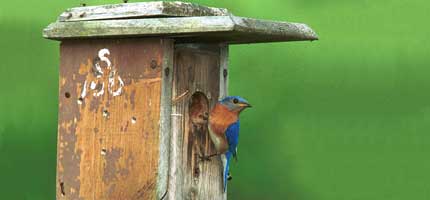
Eastern Bluebird (by http://www.portal.state.pa.us)
Specifically, birdhouse openings were sized to be no larger than 1.5 inches in diameter, in places where bluebirds habituate (such as along roadsides and in open fields), and bluebird populations have improved — happily! So the population trend, for America’s bluebirds, appears to be headed for a “happy ending”.
Now I return to why I was traveling in the Texas Hill Country, when I saw a bright blue Eastern Bluebird – flying from one rural field over to another – on a cool winter morning.
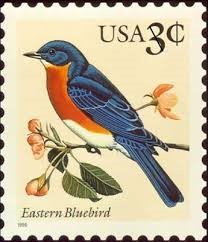
Eastern Bluebird postage PD
In fact, my wife and I were driving through Bosque County, into Clifton and later onto Cranfills Gap, to celebrate Norwegian Christmas festivities.
And, for the brave at heart (and stomach), the highlight of that Saturday was a Lutefisk Supper, a tradition (in that area) originally sponsored by St. Olaf Lutheran Church (of Cranfills Gap), now provided as a feast-fundraiser for Cranfills Gap High School. Of course, Norwegian-American Christmas festivities are happy activities, which is only proper — because holiday happiness has a Biblical precedent from the Old Testament (see, e.g., Esther 8:17-19).
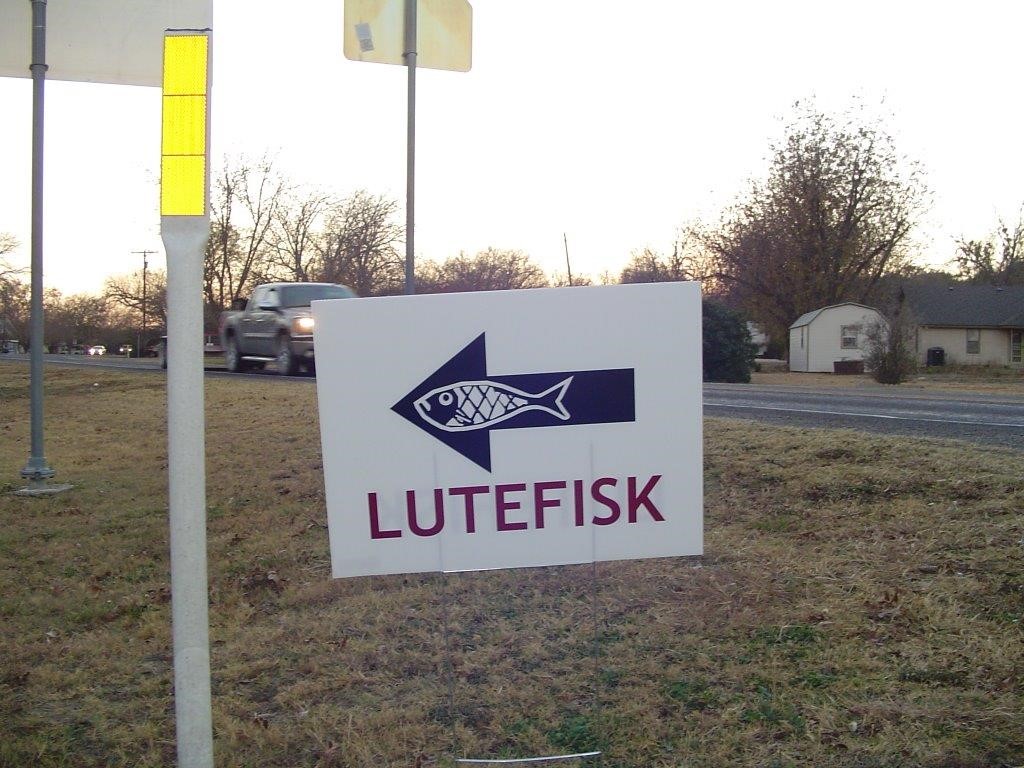
Cranfills Gap Lutefisk Supper road-sign photograph by James J. S. Johnson
So what is a “lutefisk supper”? Why do some regard it as a holiday festivity?
For many of Nordic heritage, especially those who are unusually brave in their cuisine adventures, a unique and historic preparation of codfish, called LUTEFISK, is an unforgettable Christmas tradition:
LUTEFISK SUPPER
‘The Lutefisk Supper is one of the most interesting events in Cranfills Gap [a town in Bosque County, Texas] and is centered round a dried fish imported from Norway. The tradition began many years ago sponsored by the Ladies’ Aid [Society] of the St. Olaf Lutheran Church. After several years of time-consuming preparations, organizing, cooking, and serving, the crowds attending the supper became so large that the ladies of the church felt they could no longer carry on this custom so it was discontinued.
In 1965, Oliver Hanson had an idea for a way to financially help the [Cranfills Gap] school’s athletic programs. To do this, the Lions’ Booster Club of Cranfills Gap High School revived the tradition of serving the Lutefisk Supper.
This group took on the arduous task of preparing the fish. The fish comes from Norway in 100-pound bales [i.e., stacks of dried codfish]. The weight of each dry fish is from one and a half to two pounds and has already been split in half. Volunteers saw each dried fish into chunks [note: nowadays the hard-dried codfish is usually cut by a woodshop’s power jigsaw] about four inches long, and then skin the fish of its dry, parchment-like skin. This is a slow and difficult job. Next, the fish is soaked in a solution of lye [a strongly alkaline solution, usually dominated by potassium hydroxide] and water for 72 hours. At the end of these three days, the [now softened] fish is taken out and rinsed and cleaned of any excess skin or any brown spots. Most of the fins are removed. Next, the fish is soaked in a solution of lime [limewater is an alkaline solution of calcium hydroxide] and water for a period of 72 hours. The fish are taken out at the end of that time and carefully cleaned again. After this cleansing, the fish are then soaked in clear water for 96 hours, changing the water every twelve hours [culminating ten days of various soakings of the no-longer-stiff stockfish!]. By this time the chunks have swelled to four and a half to five times the beginning size and are white. At cooking time, the fish are placed into a cheesecloth bag, put into a pot of salted, boiling water and boiled about five to ten minutes. The boiled fish is served with melted butter, white sauce, and boiled Irish potatoes. Plenty of salt and pepper is a necessity!
Lutefisk serves to bring the [Bosque County] community together as an all out effort probably not seen anywhere else. On the first Saturday of December almost every able-bodied person in the Gap community begins his or her assigned task[s]—some bake turkeys, some peel potatoes, some bake pies [one favorite being a combined cherry-and-apple pie!], others donate coffee, tea, or sugar. The person in charge of organizing the dinner assigned duties and food preparation. Tickets are usually sold in advance, but also at the door [of the Cranfills Gap High School gymnasium]. By 4:00 pm the guests begin to arrive. The [high school] cafetorium will seat about 200 people at one time. The food is served family style and high school girls are the waitresses. The boys wash the dishes. Through the years, each December as many as 900—1,000 guests have eaten a very delicious meal.
If a diner is not so certain about lutefisk…[!] turkey, dressing, green beans, [cranberry sauce, in lieu of lingonberries] and pie complete the menu. The cost of the fish has increased from $500 for a 100# bale to $2000 for an 80# box. An adult ticket in 1965 cost $4.50, but today the ticket is $18. In the fifty years the Booster Club has sponsored this traditional supper, $250,000 has been donated to the school towards various projects and improvements.
Betty Carlson Smith added more interest in this event when she began teaching elementary age kids several Norwegian [folk] dances. These dances are performed in the gym for those waiting for their time to be served. Betty has since retired but the dance tradition [in the gymnasium ‘waiting room’] continues. For a very reasonable price there is good food, great service, friendly hospitality, and fun.”
Quoting from Darla Kinney, Charlene Tergerson, Rita Hanson, & Laverne Smith, CRANFILLS GAP, TEXAS: LOKING BACK AND MOVING FORWARD, November 2015 edition (Cranfills Gap, Texas: Cranfills Gap Chamber of Commerce Historical Committee, 2015), page 56-58.
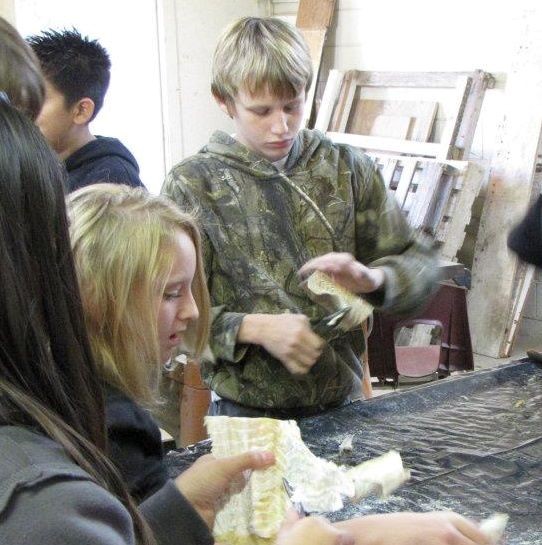
Students Skinning Codfish, in preparation for Cranfills Gap Lutefisk Supper
So there you have it! Lutefisk banquets, to Nordic-Americans, are often part of Christmas tradition, — and if you are anywhere near Cranfills Gap (Texas), for the first weekend in December, you might want to check out the annual Lutefisk Supper (Saturday evening), and enjoy watching young children dance, as you wait to be called to the banquet table!
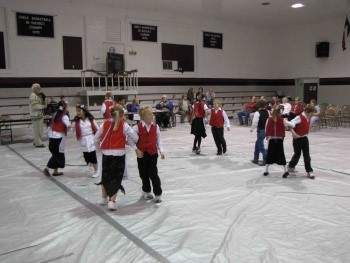
Norwegian folk dancing by children at Cranfills Gap: entertainment before lutefisk supper
Some of us are happy as bluebirds when feasting on lutefisk. (And some, for various reasons, prefer to abstain!)
But regardless of how you celebrate the Savior’s birth at Bethlehem (fulfilling the Messianic prophecy of Micah 5:2), — whether by eating lutefisk, lefse, and lingonberries – or whether you rejoice in Christ’s historic arrival, by observing some other cultural custom, – the key is to joyously and gratefully appreciate that the Lord Jesus Christ is the Reason for the season! JOY TO THE WORLD, THE LORD IS COME!
*
[Fair Use image credit:
*
Endemic Treasures of the Cook Islands:
Atiu Swiftlet and ‘Gospel Day’ Holidays
James J. S. Johnson
I thank my God upon every remembrance of you, always in every prayer of mine for you all making request with joy, for your fellowship in the Gospel from the first day until now, being confident of this very thing, that He Who has begun a good work in you will perform it until the day of Jesus Christ. (Philippians 1:3-6)

Atiu Swiftlet (Aerodramus sawtelli, a/k/a Kopeka) ©WikiC
The Atiu Swiftlet (Aerodramus sawtelli, a/k/a Sawtelli’s Swift), known locally as the “Kopeka”, is a small member of the swift family, only known to dwell on the Pacific island of Atiu, one of the Cook Islands.
Like other swifts it is sooty-brown in color, with its upper side being darker than its lower side. Those who have studied the Atiu Swiftlet report that it nests in limestone caves, yet ranges over farmed lands and areas dominated by ferns.
Because it appears to only reside in one place, in the wild, it is said to be “endemic”, i.e., endemic to the island of Atiu. However, some taxonomists think the Atiu Swiftlet is only an inbred variety of swift that is conspecific with the Polynesian Swiftlet (Aerodramus leucophaeus, a/k/a Tahitian Swiftlet), the White-rumped Swiftlet (Aerodramus spodiopygius), and maybe even the Australian Swiftlet (Aerodramus terraereginae). Regardless of taxonomic “lumping” or “splitting”, the Atiu Swiftlet is mainly distinguished from other swifts by its troglodyte nesting habits and its limited range.) But for now we may assume that the Atiu Swiftlet, as a separate “species” or as an endemic “subspecies”, is unique to the Cook Islands. Most who read these sentences, before today, had never heard of an “Atiu Swiftlet” – but the Atiu Swiftlets are not worried about their relative obscurity, because God’s caring providence is what they need (Matthew 5:26), not acclaim or fame from folks around the world.
In fact, the Cook Islands host another unusual, not-so-famous, “endemic” treasure – a set of “Gospel Day” holidays, commemorating how God provided the Gospel of Christ (via British missionaries) unto that group of islands in the South Pacific.

In particular, the Cook Islands – for many years – have officially celebrated, with pageantry and gratitude to God, the arrival of Bible-based Christianity (in the early AD1800s), with the various component islands having specific days for recognizing “Gospel Day” as a memorial of the British missionary outreach that blessed their respective islands.
Here are the days that have been (historically) celebrated as “Gospel Day” in the Cook Islands archipelago: March 13th (Penrhyn Gospel Day); May 25th (Palmerston Gospel Day); June 15th (Mangaia Gospel Day); July 19th (Atiu Gospel Day, Mitiaro Gospel Day, and Mauke Gospel Day); August 8th (Manihiki Gospel Day), August 15th (Rakahanga Gospel Day); October 26th (Aitutaki Gospel Day); December 6th (Pukapuka Gospel Day); — plus there is a “National Gospel Day” collectively celebrated in the Cook Islands on October 27th.
Wow! What godly tradition! What other nations show such respect for Christ?

As part of celebrating Gospel Day, in the Cook Islands, elaborate and expressive “nuku” dramas are acted out, by actors wearing colorful costumes who dramatize mankind’s opportunity to be redeemed, in Christ, from sin (sometimes even enacting New York City’s 9/11 Twin Towers disaster, to illustrate the global war between good and evil). Hymn singing – and lots of it! – and dancing and music-making dominate much of the day, as well as feasting (coconut, arrowroot, pawpaw fruit, chicken, salt-meat, etc.), prayer, and interactive Bible-based worship activities.

The missionary efforts of John Williams (“Apostle of the South Seas”, born near London), an English missionary to the Pacific, is recalled with thanksgiving, as well as the historic themes of Christianity. John Williams (of the London Missionary Society) was murdered (and cannibalized) in AD1839 on the beach at Erromango, in Vanuatu, after a fruitful season of faithful missionary outreach to South Pacific islanders.
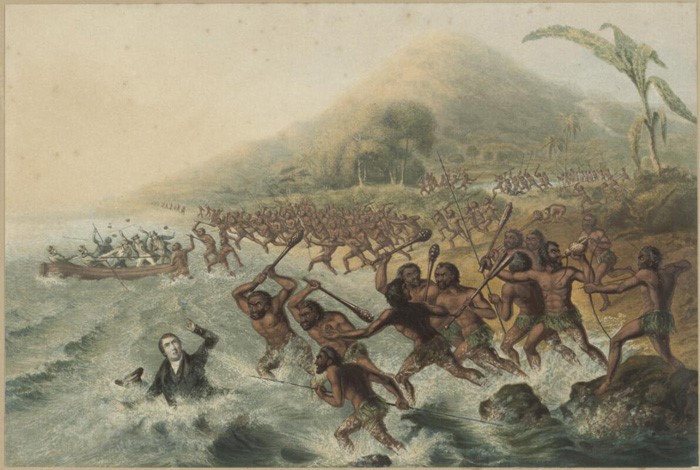
[For more details on how Gospel Day is celebrated in the Cook Islands, see http://www.cookislands.org.uk/gospelday.html and, especially for diary-like details, see youtube clip: https://www.youtube.com/watch?v=IN9S9m1pNes .]

The tradition continues, although the calendaring aspects of this multi-island tradition have changed, in recent times, due to a governmental effort to standardize the holiday (for the Sunday closest to the original Gospel Day, for each island), and to coordinate with a new public holiday called “Ra O Te Ui Airki” (on July 6th), according to a news report (dated October 19, 2011) saying:
“From next year, October 26 will be the only public holiday to celebrate Gospel Day as all individual outer island gospel days, including that of Rarotonga, will be celebrated on the closest Sunday to the date of Christianity arriving to the respective islands. The change in the public holiday status of the island Gospel Days is due to a new public holiday on July 6 to be known as the Ra O Te Ui Ariki out of respect for the countrys aronga mana, its ui ariki, ui mataiapo, ui rantagira and taunga [whatever that means!]. Next year churches will have the opportunity once again put their Bible story telling skills on display again when the nuku is organised to commemorate the national Gospel Day.” [Quoting from http://www.cookislandsnews.com/item/32483-no-nuku-on-gospel-day/32483-no-nuku-on-gospel-day ].
Regardless of whatever day the arrival of the Christian Gospel is celebrated in each of the Cook Islands (as well as the historic day when each one of us, individually, received the Gospel), every day should be a day of appreciating the precious Gospel truth — and a time of joy (Luke 10:20) in knowing that God cares to reach and to forgive us, in His Son, the Lord Jesus (Philippians 1:3-6), if we willingly receive Him (John 1:12). ><> JJSJ

*
Photo Credits:
[ Fair Use photo credit: https://en.wikipedia.org/wiki/Atiu_swiftlet#/media/File:Kopeka_bird.jpg ]
[Fair Use credit: http://www.pacificresort.com/Images/WhatsOn/national-gospel-day-public-holiday-pacific-resort-rarotonga.jpeg]
[Fair Use image credit: http://www.cookislands.org.uk/image/gospeldays-CORRECTED.jpg]
*
More:
*
Not forsaking the assembling of ourselves together, as the manner of some is; but exhorting one another, and so much the more, as ye see the day approaching. (Hebrews 10:25)
James J. S. Johnson
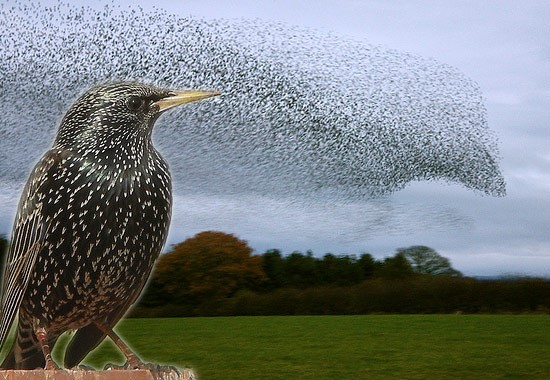
Starling and Murmeration
Not only do “birds of a feather flock together”, people who belong together should get together. And the orderly assembling of both people and birds can give us a preview of coming attractions – when the world that we now know is replaced by one redeemed (Romans 8:18-28), where we gather together in glory, as a harmonious heavenly host.
Accordingly, seeing hundreds (if not thousands) of European starlings, flying like a flexible fluid, in choreographed unison, provides an birdwatching foretaste of (someday) seeing the heavenly host in action. But there are other notable types of gatherings-in-motion, of kindred spirits “flocking together”.
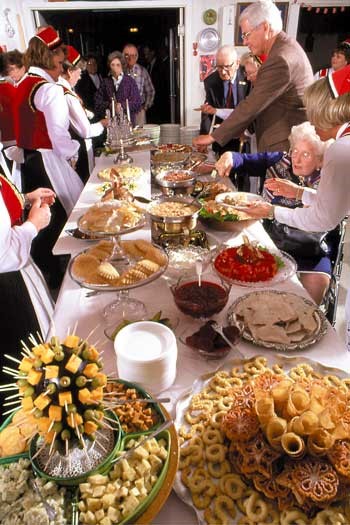
Serving line at Norse smörgåsbord, showing artistic presentation of Nordic cuisine
Last Saturday was a special event for my wife and me: the annual Norwegian smörgåsbord hosted by the Women’s auxiliary of Our Savior’s Lutheran Church of Norse, Texas. The event is so popular that you must (literally) “win the lottery” to be allowed to purchase tickets to the event!

Copy of announcement of 67th annual smörgåsbord hosted by Our Savior’s Lutheran Church of Norse, Texas
This delightfully colorful and tasty feast, hosted by a rural Norwegian-immigrant-established rural congregation in the Texas “hill country” of Bosque County (located between Clifton and Cranfills Gap) is a multi-generational tradition of faith, food, fun, and fellowship – and a fundraiser for the more-than-a-century-old church (see http://oursaviorsnorse.org/ ).

hors d’ouvres served at Norse smörgåsbord
Church members dress in bunads (festive Norwegian costume of the AD1800s), as they usher attendees and/or serve attendees. The feast begins with a Scripture-based devotional with bilingual music and table prayer, in the sanctuary, followed by a short walk to the fellowship hall, where the meal is served.
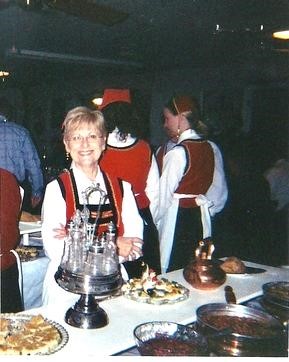
Serving line at Norse smörgåsbord, showing servers in bunad costumes
The mix of delectable dishes, of Norwegian-American cuisine, is too many for me to mention here — however, I will mention just a few that I enjoyed: pickled herring, salmon mold, Norwegian meatballs, ham, turkey, stuffed eggs (i.e., what many non-Norwegians call “deviled eggs”), several kinds of cheese (including gjetost, brunost, gamalost), lefse (i.e., Norwegian potato bread that looks like a flour tortilla), lingonberry jam, lima beans, beets, various breads (including Swedish rye), potato salad, outstanding coffee, and various cookies (including krumkaker, rosettes, sandbakkels, fattigman). And more!

Dessert tray served at Norse smörgåsbord
The Lutheran church building itself, which includes modernized modifications of the original structure, is a reverent monument to the glory and worship of God — the church was established by Norwegian immigrant settlers who came in AD1854. The church building was begun in AD1875 and originally completed in AD1885. The church sanctuary pews (and other chancel furniture) are original.

Our Savior’s Lutheran Church of Norse, in Bosque County, Texas

Bosque County’s Norwegian pioneers burial site in Norse
But more than that splendid kindred-spirit event, at the Lutheran Church last Saturday, reminded me of the phrase “birds of feather flock together”. Why? Because en route to that wonderful event, which was about a 3-hour-drive (one way) for my wife and me, we were slowed down in our southward trek through construction-delayed traffic, along Interstate 35-W. The construction activities on the west side of highway were reshaping the land surfaces and drainage patterns, enabling recent rainwater to collect in a large mud-puddle, by a large “blanket” of black that somehow quivered with motion. Why was that black “blanket” moving? It was a mob of star-spangle-jacketed European starlings (Sturnus vulgaris) congregated there – more than your eyes could count! The pooled water had attracted a mega-flock of European starlings (which at first glance looked like a black blanket covering the ground), some of which drank water while others waited nearby, for their turns at the “watering hole”.
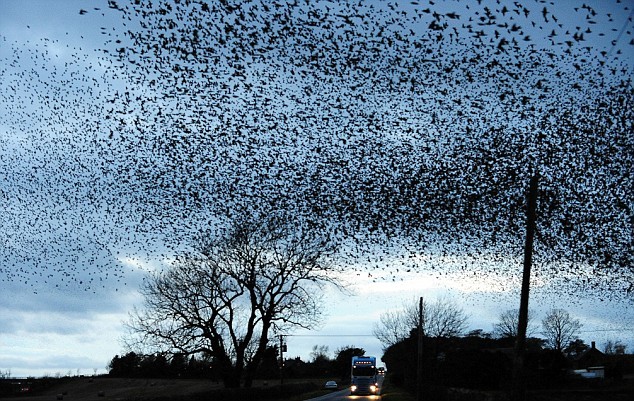
Murmuration by Dailymail
But more spectacular than these earth-bound starlings (in and at the mud-puddle) were their swarming legions of cousins, swirling, and looping in the air above, — called a “murmuration” of starlings. This fluid flock of aerial acrobats were graciously swirling, curving, arching, banking, spinning, irrupting, swerving, pouring, turning, dipping, spreading, blending, soaring – in harmony, each one perfectly synched to one another like a living fabric of black-winged wonders, dancing in the wind – a choreographed choir of chattering starlings.
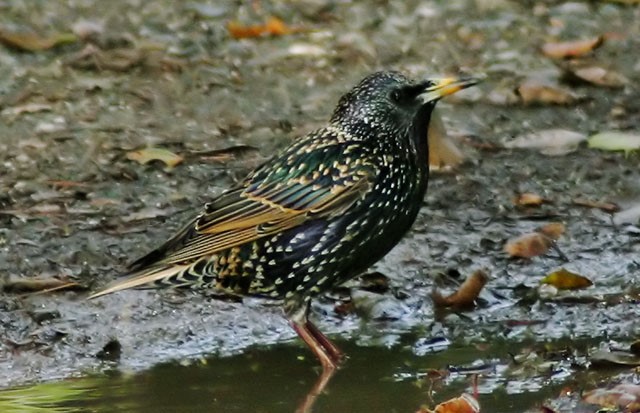
European Starling
There is nothing quite like watching a living, flowing, swirling cloud of European starlings, flying as a fluid flock – a harmonious team of airborne navigators – in numbers and motions that prevent spectator quantification. The starlings’ murmuration is more than “birds of a feather flock together”; this is “birds of a feather fly like a fluid-fabric together!” – truly an amazing display of God’s handiwork in flying feathers.
As we watched in amazement, at the synchronized motions of these little black (and somewhat iridescent) marvels, we thought about the high-speed harmony God has directed these starlings to implement, in their humble little lives. God-honoring harmony – what a concept!
Of course, if we “forsake the assembling of ourselves together” we cannot achieve any such choreography. And, when we do get together, we do well to focus on our unity in Christ, which means prioritizing and practicing the truth in love.
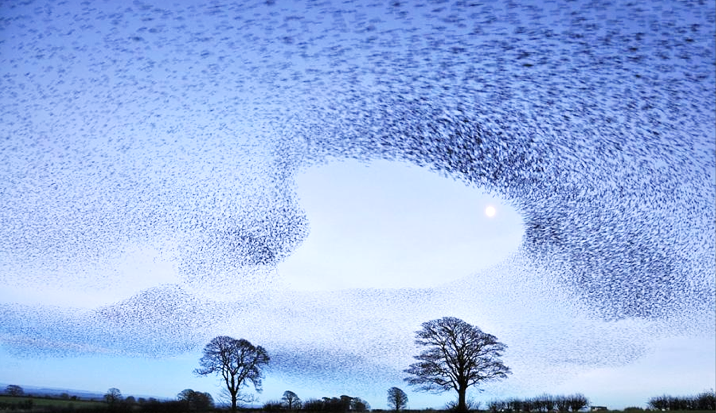
Starling Flying Mob
Behold, how good and how pleasant it is for brethren to dwell together in unity! (Psalm 133:1)

Starling Murmuration ©Flickr Donald Macauley
More Orni-Theology Articles
More of James J. S. Johnson’s Articles
*
James J. S. Johnson
1 Make a joyful noise unto the Lord, all ye lands. 2 Serve the Lord with gladness; come before His presence with singing. 3 Know ye that the Lord He is God; it is He Who hath made us, and not we ourselves; we are His people, and the sheep of His pasture. 4 Enter into His gates with thanksgiving, and into His courts with praise; be thankful unto Him, and bless His name. 5 For the Lord is good; His mercy is everlasting; and His truth endureth to all generations. (Psalm 100)
Sometimes what you expect to find, is not what you find. This is true of Grenada’s official bird, if you assume it matches Grenada’s official coat of arms. This is also true if you imagine that the Thanksgiving holiday, as it is celebrated in Grenada, is like the Thanksgiving holiday as it is celebrated in America.

Grenada’s official coat of arms includes an Armadillo and a Grenada Dove (Leptotila wells — a/k/a Well’s dove or pea dove), positioned above the motto “Ever conscious of God, we aspire, build, and advance as one people.” The Grenada Dove is endemic to Grenada – i.e., only on the island of Grenada is the Grenada Dove found in the wild, and even there it is critically “endangered” (i.e., close to extinction). The dove’s coloring, as depicted on the Grenada coat of arms, however, does not closely match the actual coloring of the real bird.

The dove’s coloring, as depicted on the Grenada coat of arms, however, does not closely match the actual coloring of the real bird. The actual Grenada Dove has little blue to it (depending on the lighting used to view it) – rather, brown and buff dominate its overall coloring. One wonders why, therefore, the heraldic depiction shows indigo-blue and azure, with yellow highlighting. Consider the more realistic depictions before, as shown by photographic and postage images.
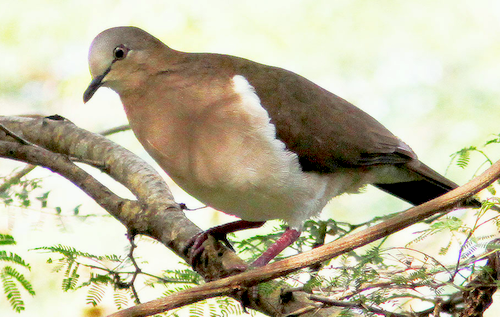 https://grenadanationalarchives.wordpress.com/tag/leptotila-wellis/ (from the website of the National Archives of Grenada)
Consider also these special World Wildlife Fund-logo Grenada postage stamps, showing Grenada Doves.
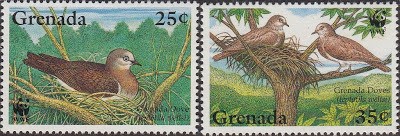
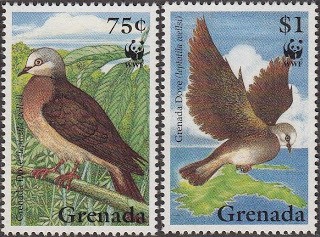
The lesson here, apparently, is that heraldic coat-of-arms depictions of birds can (sometimes) be quite unrealistic – or else the artist might be depicting the wrong bird!
But Grenada’s coat of arms is not the only surprise in its national symbols.
Consider now the holiday we call “Thanksgiving”.
In the United States of America, for a contrasting example, the holiday of “Thanksgiving” (celebrated on the fourth Thursday in November) commemorates the gratitude of Plymouth Pilgrims, as pioneer survivors, who thanked God at harvest time in AD1621, for His providence — see “Strangers and Pilgrims (and the American Turkey)”, posted at https://leesbird.com/2014/11/25/strangers-and-pilgrims/ . The Pilgrims’ survival and early successes, due to God’s providence, are also celebrated in the Netherlands, in Leiden, to commemorate how the Pilgrims lived in Holland during AD1609-AD1620. A special Thanksgiving worship service is conducted, there, on the morning of America’s Thanksgiving, in Pieterskerk [“Peter’s church”], a Gothic church that was originally Roman Catholic (from its architectural beginning in AD1390), yet became Protestant during the Dutch Reformation, and became the burial site for John Robinson, pastor of the Pilgrims prior to their migratory journey to America.
Canadians observe a similar holiday, called l’Action de grâce in French, on the second Monday in October.
Norfolk Island, an external territory of Australia, celebrates Thanksgiving on the last Wednesday of November, so that Norfolk Island’s celebration of Thanksgiving occcurs either the day before, or six days after, the day when Americans celebrate Thanksgiving.
Saint Lucia, an island nation on the eastern edge of the Caribbean Sea, celebrates Thanksgiving on the first Monday in October.
Christians in Germany have a similar harvest-thanksgiving holiday, Erntedankfest, in early October, at about the same time that its Bavarians are celebrating Oktoberfest.
Thanksgiving is supposed to be focused on thanking God — even the name of the holiday suggests as much. However, although gratitude to God –- for harvest blessings — was the original reason for most harvest festival-oriented “thanksgiving” holidays, many Thanksgiving traditions have forgotten the historic importance of thanking God for His caring providences, by focusing more on distractive parades (e.g., Macy’s, IKEA’s, McDonald’s), football games, and feasting — with such festive celebrations discounted in slang as “Turkey Day”. (British Laird Bill Cooper was quite disappointed to learn of this trivialized secularization of what was originally a holy day/holiday.)
But how is Thanksgiving celebrated in Grenada, and why ?
First, consider where Grenada is located – Grenada is an island nation situated slightly east of South America, north of Venezuela. Politically speaking, the nation of Grenada actually includes the main island (called “Grenada”) plus a few smaller islands, some but not all of “the Grenadines”, which are situated north of the Martinique Channel – with several of the other Grenadine islands (located south of the Martinique Channel) jurisdictionally belonging to the Caribbean nation called “St. Vincent and the Grenadines”.

In AD1498 the main island of Grenada was visited by Christopher Columbus, who named it “Concepcion”.
Grenada was later visited by Britons, then French; it was eventually settled by French colonists. Later, as part of the Treaty of Paris (in AD1763), Grenada became a British colony. Grenada shed its colonial status, however, in AD1974, as it then became officially independent of the United Kingdom, although it remained an affiliate of the British Commonwealth.
So far so good, it seemed, until AD1983, when a Communist military takeover occurred on the island, led by General Hudson Austin (who was politically backed by Cuba, and aided by Cuban soldiers), actually seized control from a prior Communist takeover (i.e., one Communist regime killed off the leadership of a prior Communist dictatorship). American students were put in jeopardy so President Ronald Reagan authorized a military rescue operation, which included defeating the “New Jewel Movement” (i.e., the second Communist dictatorship).
Thus, beginning on October 25th of AD1983, the “New Jewel Movement” Communists, who had seized the country, were soon opposed by a coalition of rescue forces, comprised of the United States and several Caribbean allies (from six Caribbean nations, including Jamaica and Barbados), in a complicated military effort called “Operation Urgent Fury” – which included U.S. Army Rangers, U.S. Marines, Delta Force, 82nd Airborne paratroopers, and U.S. Navy SEALs. Because the rescue operation was so successful – and peace was restored to Grenada (with the Cuban soldiers being expelled) a holiday of gratitude was established – October 25th became Thanksgiving Day for Grenada.

Bottom line: we all – whether Americans or Grenadians or anyone else for whom Christ died — have a lot to be thankful for, on whatever day that we celebrate Thanksgiving (and on every other day of the year!).
In accord with Psalm 100 we should, daily, “enter into His gates with thanksgiving, and into His courts with praise; be thankful unto Him, and bless His name”.

An inflatable dummy tank ©WikiC
– by James J. S. Johnson, J.D., Th.D. *
[Lee’s introduction: The current Acts & Facts from Institute for Creation Research has this very interesting article by Dr. James J. S. Johnson, who formerly taught courses on ornithology, ecology, limnology, and other bioscience-related courses at Dallas Christian College.]
Sometimes the best defense is an offense, even when the “offense” is really a bold bluff. This tactic is valued in wartime, and when God uses this principle He deserves our reverent adn admiring appreciation.
America’s top-secret World War II “Ghost Army” used cleverness and technology to fool German forces by masking military vulnerabilities. Yet the main fakery they used wasn’t mere camouflage—the daring deception involved threat-reversal mimicry….
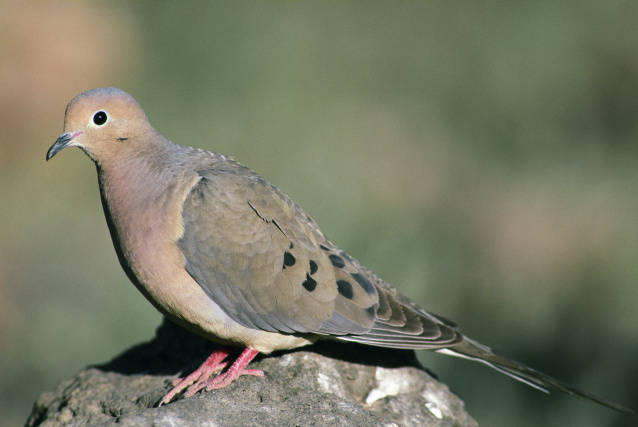
Mourning Dove (Zenaida macroura) ©USFWS
Such is ordinary life for the mourning dove (Zenaida macroura), which feeds on the ground and nests there or within shrubs, on buildings, or in trees—the same places where opportunistic and omnivorous rats, like Rattus rattus and Rattus norvegicus, roam for food. Consequently, dove eggs and hatchlings are sometimes vulnerable to prowling predatory rats.3 … [Click here to see the whole article.]
O the depth of the riches both of the wisdom and knowledge of God! how unsearchable are his judgments, and his ways past finding out! For who hath known the mind of the Lord? or who hath been his counsellor? (Romans 11:33-34 KJV)
*
*

Clapper Rail (Rallus crepitans) ©WikiC
Skinny as a rail? Not me!
~ James J. S. Johnson
“But when thou art bidden, go and sit down in the lowest room; that when he that bade thee cometh, he may say unto thee, Friend, go up higher: then shalt thou have respect in the presence of them that sit at meat with thee.” (Luke 14:10)

Orni-Theology
Is it really advantageous to be frequently noticed? Is having a “low profile” a prudent practice? Surely when someone gets a reputation, for being a “show-off”, the spotlight becomes a disadvantage.
When I was a teenager I was called “skinny as a rail”. Once I arrived at age 20, however, for some reason I stopped hearing that description. Of course, I blame my weight gain on getting married to a wonderful cook (who, for 3-dozen-plus years, has made eating an ongoing adventure!)! Actually, I am not too far from being double the weight that I had, 121 pounds, when I got married!
Hmmm – maybe exercise has something to do with it, too. It’s been a long time since someone said (of me), “he’s so skinny, if he turned sideways we couldn’t see him!” It is the literal truth that my wife has been with me “through thick and thin”.
But this is supposed to be about birds.

Railway ©WikiC
So now we should consider something that Robert and Alice Lippson, both ecologists, have to say about being “skinny as a rail”.
“’As thin as a rail’—is it the narrow steel ribbon of a railroad track or the slim boards that make up a fence? Just where did that old saw come from, anyway? It pertains to certain members of the Rallidae family, the rails, which also includes coots and gallinules. The rails have thin, compressed bodies that allow them to thread their way through seemingly impenetrable thickets and literally to disappear into the marsh. … Rails are usually brown and patterned or mottled with white [feathers], while coots are slate or soot colored. Rails are found in the [Chesapeake] Bay wetlands year-round.”
[Quoting Alice Jane Lippson & Robert L. Lippson, LIFE IN THE CHESAPEAKE BAY: An Illustrated Guide to the Fishes, Invertebrates, Plants, Birds, and Other Inhabitants of the Bays and Inlets from Cape Cod to Cape Hatteras, 3rd Edition (Baltimore: The Johns Hopkins University Press, 2006), page 232.]
Perhaps the most prominent rail in the Chesapeake Bay region is the Marsh Hen, also called the “Clapper Rail” (Rallus crepitans, a/k/a Rallus longirostris), known for its harsh-sounding clattering vocalizations [klek-klek-klek-klek-klek] that almost sounds like rattling or rapid clapping.
The Clapper Rail is routinely found in salt marshes and some freshwater marshes on America’s East Coast, from Massachusetts to Florida, plus in wetlands bordering California’s inland Salton Sea, and even along the banks of the lower parts of the Colorado River. [See John Bull & John Farrand, Jr., NATIONAL AUDUBON SOCIETY FIELD GUIDE TO NORTH AMERICAN BIRDS, EASTERN REGION, revised edition (New York: Alfred A. Knopf, 1994), page 455.]
Have I ever seen one? Probably not. But that’s not unusual, according to Lippson & Lippson, who say that hearing one is more likely than seeing one, especially due to their habit of being more active at night. [Lippson & Lippson, page 232.] But, if you do see a Clapper Rail, it might not realize you are watching!

Clapper Rail (Rallus crepitans) ©WikiC
“Clapper rails are secretive birds and are usually not seen unless forced off the reed floor by high tides. Then they are frequently seen along the edge of the marsh and even along nearby roads. Even though they are in the open and quite visible, clapper rails apparently think they are still in the marsh, unseen and safe. Like the least bittern, they are reluctant fliers and when flushed will make brief [airborne] sorties, legs dangling, then drop and disappear into the marsh vegetation. Curiously enough, rails are capable of making long migratory flights. The best way to ‘see’ a rail is with your ears: listen for the clattering “kek-kek-kek”, especially in the early evening and at dawn. The clapper rail is widely distributed throughout the [Chesapeake] Bay.” [Quoting Lippson & Lippson, page 232.]
So much for keeping a low profile, especially when perils are near! If you can be inconspicuous, it’s usually to your advantage, — but, if not, it’s good to have a Plan B (like the Clapper Rail’s getaway response) if you need one.
Meanwhile, don’t forget the lesson of Luke 14:10. Routinely assume that you should take a “low profile”. If you are directed “up” (i.e., promoted to a “higher” responsibility), so be it, — trusting God to guide you, use the “high profile” opportunity to honor God. Yet don’t forget: the Clapper Rail strategy has its merits – if you are inconspicuous you are less likely to become somebody’s target!
*
Rallidae – Rails, Crakes and Coots

Clapper Rail by Lee at Merritt Island NWR
*

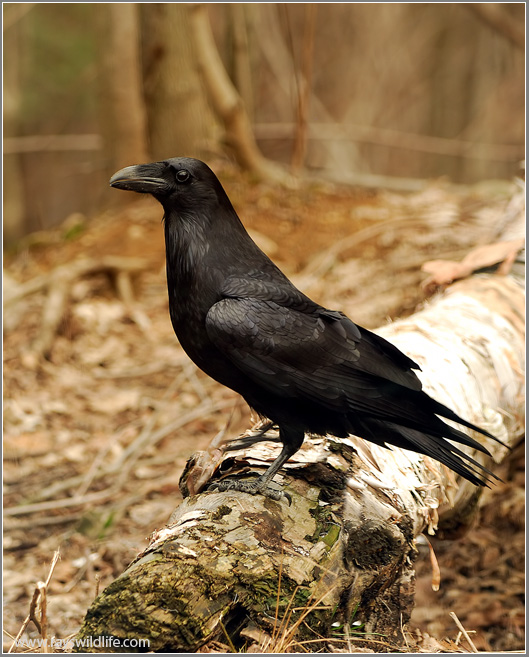
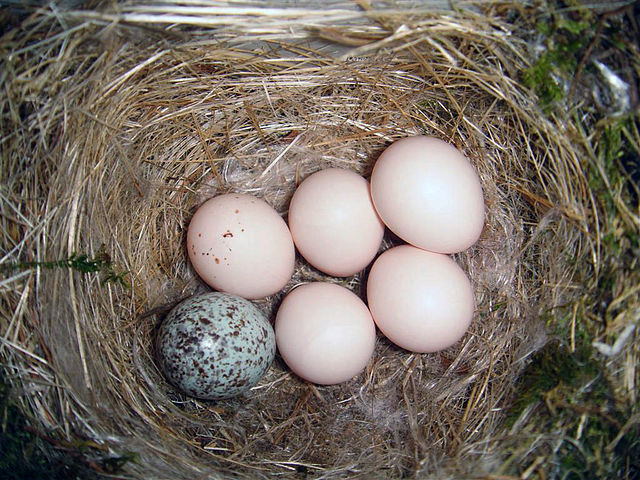
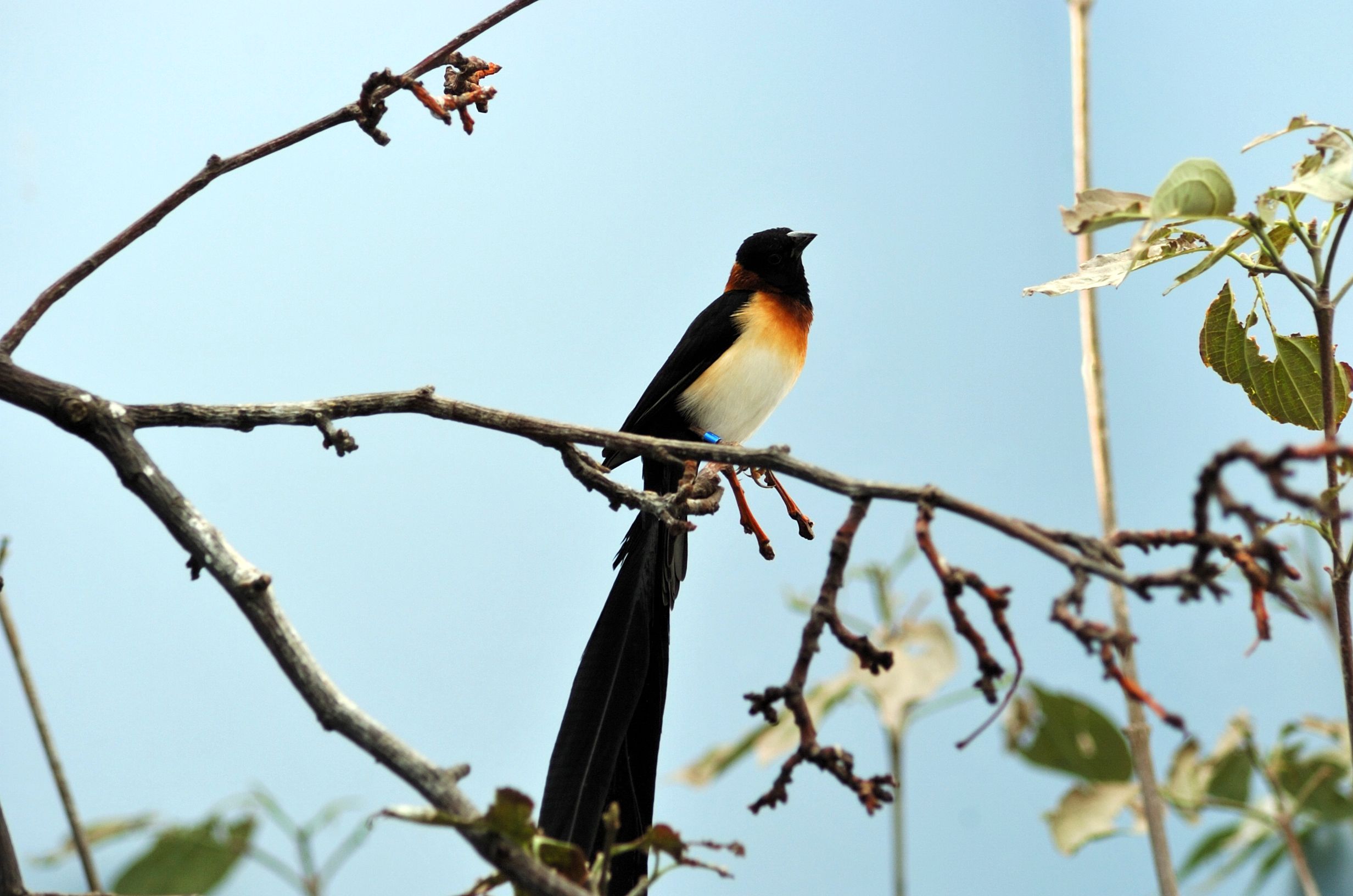
 Lee's Birdwatching Adventures Plus