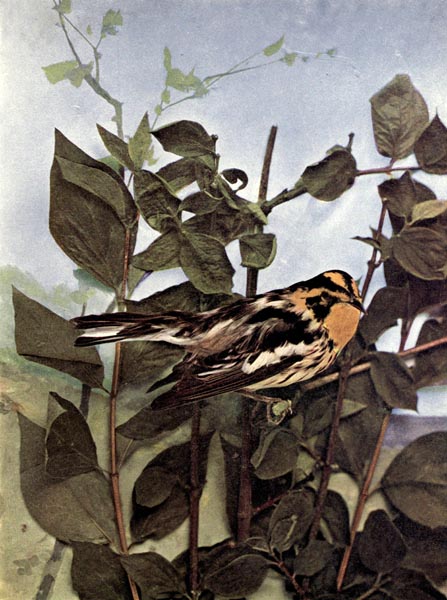
Blackburnian Warbler of Birds Illustrated by Color Photography, 1897
From col. Chi. Acad. Sciences. Copyrighted by
Nature Study Pub. Co., 1897, Chicago.
THE BLACKBURNIAN WARBLER.
(RELOCATED – CLICK HERE)
Blackburnian Warbler of Birds Illustrated by Color Photography, 1897
From col. Chi. Acad. Sciences. Copyrighted by
Nature Study Pub. Co., 1897, Chicago.
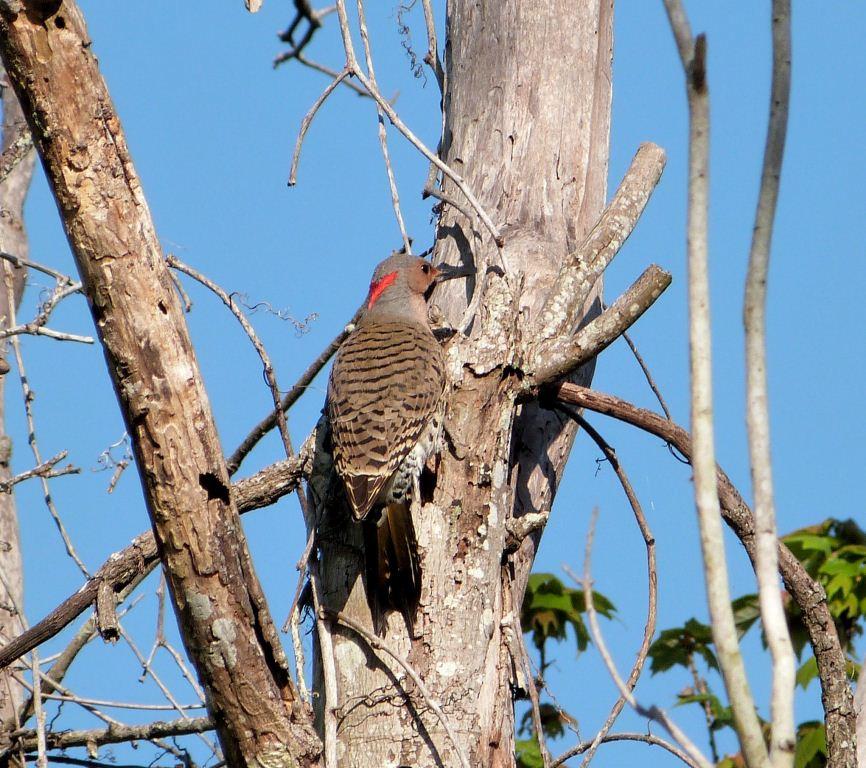
Northern Flicker at S. Lake Howard by Lee
Dan and I went birdwatching last week at South Lake Howard Nature Park here in Winter Haven. We just stopped by on the way home from an errand. Captured a Northern Flicker with the camera, but the video is of the Coot’s feet. I have trying to get a photo of them because they are so different from other bird’s feet. Their feet are not webbed, but sort of flattened out. We only see them down here in the winter. See the Wikipedia information below. Apparently it helps them walk on the land, but it seems that a soft soil just under the water would be “squishy” and that may help their footing. Isn’t it neat how the Lord, in Him wisdom, provided for them in such a way.
O LORD, how manifold are your works! In wisdom have you made them all; the earth is full of your creatures. (Psalms 104:24 ESV)
The American Coot (Fulica americana) is a bird of the Rallidae – Rails, Crakes & Coots Family. Though commonly mistaken to be ducks, American Coots come from a distinct family. Unlike ducks, Coots have broad lobes of skin that fold back with each step in order to facilitate walking on dry land. They live near water, typically inhabiting wetlands and open water bodies in North America. Groups of these black-feathered, white-billed birds are called covers or rafts. The oldest known Coot lived to be 22 years old.
The American coot is a migratory bird that occupies most of North American. They live in the Southwestern United States, Mexico, and the pacific coast year round, and only occupy the northeastern regions during the summer breeding season. In the winter they can be found as far south as Panama. They generally build floating nests and lay 8-12 eggs per clutch. American coots eat primarily algae and other aquatic plants but they do eat animals (both vertebrates and invertebrates) when available.
Much research has been done on the breeding habits of American Coots. Studies have found that mothers will preferentially feed offspring with the brightest plume feathers, a characteristic known as chick ornaments. American coots are also susceptible to conspecific brood parasitism, and identify which offspring are theirs and which are from parasitic females.
The American Coot measures 13–17 in (34–43 cm) in length and 23–28 in (58–71 cm) across the wings. Adults have a short thick white bill and white frontal shield, which usually has a reddish-brown spot near the top of the bill between the eyes. Males and females look alike, but females are smaller. Juvenile birds have olive-brown crowns and a gray body. They become adult-colored around 4 months of age
The American Coot has a variety of repeated calls and sounds. Male and female Coots make different types of calls to similar situations. Male alarm calls are “puhlk” while female alarm calls are “poonk”. Also, stressed males go “puhk-cowah” or “pow-ur” while females call “cooah”
See the Sounds page of All About Birds for the American Coot.
American Coots are found near water—reed-ringed lakes and ponds, open marshes, and sluggish rivers. They prefer freshwater environments, but may temporarily live in saltwater environments during the winter months.
The American Coot’s breeding habitat extends from marshes in southern Quebec to the Pacific coast of North America and as far south as northern South America. Birds from temperate North America east of the Rocky Mountains migrate to the southern United States and southern British Columbia. It is often a year-round resident where water remains open in winter. The number of birds that stay year-round near the northern limit of the species’ range seems to be increasing.
Autumn migration occurs from August to December, with males and non-breeders moving south before the females and juveniles. Spring migration to breeding ranges occurs from large February to mid-May, with males and older birds moving North first. There has been evidence of birds travelling as far north as Greenland and Iceland. It is a rare but regular vagrant to Europe. The American Coot is a highly gregarious species, particularly in the winter, when its flocks can number in the thousands. The picture below is just of one group of hundreds at Viera Wetlands that day (2012)

American Coot (Fulica americana) at Viera Wetlands by Lee
The American Coot can dive for food but can also forage and scavenge on land. It is omnivorous, eating plant material, arthropods, fish, and other aquatic animals. Its principal source of food is aquatic vegetation, especially algae. During breeding season, Coots are more likely to eat aquatic insects and mollusks—which constitute the majority of a chick’s diet.
The American Coot is a prolific builder and will create multiple structures during a single breeding season. It nests in well-concealed locations in tall reeds. There are three general types of structures: display platforms, egg nests and brood nests. Egg nests are typically 12 inches in diameter with a 12-15 inch ramp that allows the parents to enter and exit without tearing the sides of the nests. Coots will often build multiple egg nests before selecting one to lay their eggs in. Brood nests are nests that are either newly constructed or have simply been converted from old egg nests after the eggs hatch. They are simply larger egg nests. Egg and brood nests are actually elaborate rafts, and must be constantly added to in order to stay afloat. Females typically do the most work while building.
Females deposit one egg a day until the clutch is complete. Eggs are usually deposited between sunset and midnight. Typically, early season and first clutches average two more eggs than second nesting and late season clutches. Early season nests see an average of 9.0 eggs per clutch while late clutches see an average of 6.4 eggs per clutch. There is an inverse relationship between egg weights and laying sequence, wherein earlier eggs are larger than eggs laid later in the sequence. It is possible to induce a female Coot to lay more eggs than normal by either removing all or part of her clutch. Sometimes, a female may abandon the clutch if enough eggs are removed. Coots, however, do not respond to experimental addition of eggs by laying fewer eggs.
Incubation start time in the American Coot is variable, and can begin anywhere from the deposition of the first egg to after the clutch is fully deposited. Starting incubation before the entire clutch has been laid is an uncommon practice among birds. Once incubation starts it continues without interruption. Male and female Coots share incubation responsibility, but males do most of the work during the 21-day incubation period. Females will begin to re-nest clutches in an average of six days if clutches are destroyed during incubation.
Hatch order usually follows the same sequence as laying order. Regardless of clutch size, eight is the typical maximum size of a brood. Egg desertion is a frequent occurrence among Coots because females will often deposit more than eight eggs. Brood size limits incubation time, and when a certain number of chicks have hatched the remaining eggs are abandoned. The mechanism for egg abandonment has not yet been discovered. Food resource constraints may limit the number of eggs parents let hatch, or the remaining eggs may not provide enough visual or tactile stimulation to elicit incubation behavior. An American Coot can be forced to hatch more eggs than are normally laid. These additional offspring, however, suffer higher mortality rates due to inadequacy in brooding or feeding ability.
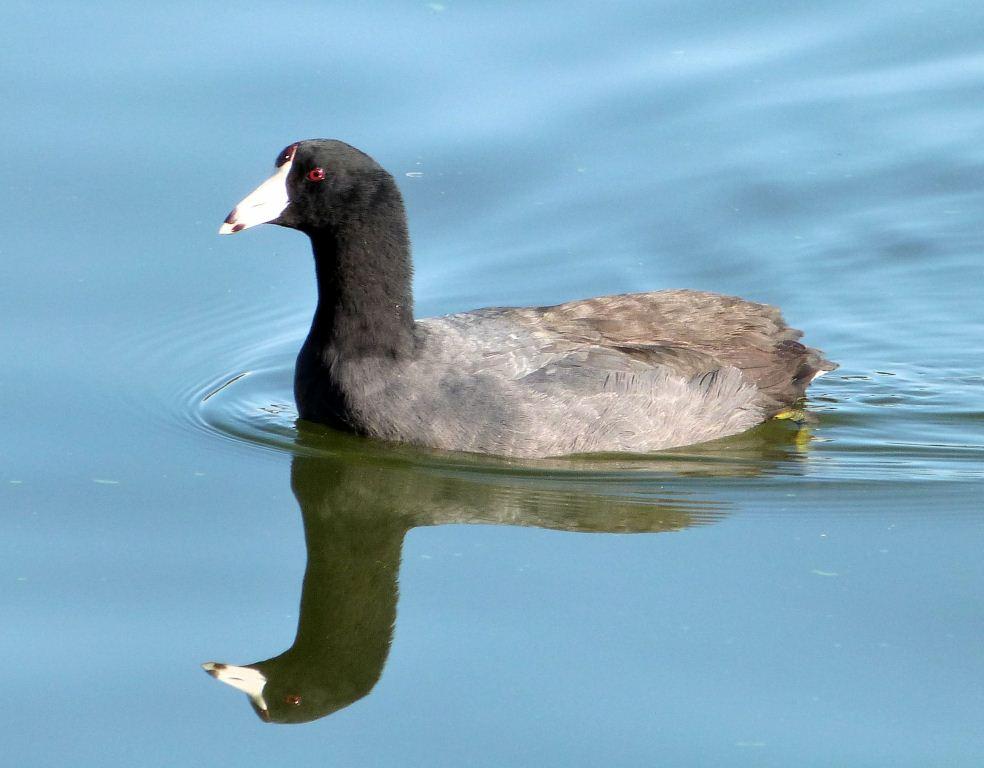
American Coot (Fulica americana) by Lee at Lk Morton
The American Coot, unlike other parasitized species, has the ability to recognize and reject conspecific parasitic chicks from their brood. Parents aggressively reject parasite chicks by pecking them vigorously, drowning them, preventing them from entering the nest, etc. They learn to recognize their own chicks by imprinting on cues from the first chick that hatches. The first-hatched chick is a reference to which parents discriminate between later-hatched chicks. Chicks that do not match the imprinted cues are then recognized as parasite chicks and are rejected.
Chick recognition reduces the costs associated with parasitism, and Coots are one of only three bird species in which this behavior has been observed. This is because hatching order is predictable in parasitized Coots—host eggs will reliably hatch before parasite eggs. In other species where hatching order is not as reliable, there is a risk of misimprinting on a parasite chick first and then rejecting their own chicks. In these species, the cost of accidentally misimprinting is greater than the benefits of rejecting parasite chicks.
The first evidence for parental selection of exaggerated, ornamental traits in offspring was found in American Coots. Black American Coot chicks have conspicuously orange-tipped ornamental plumes covering the front half of their body that are known as “chick ornaments” that eventually get bleached out after six days. This brightly colored, exaggerated trait makes Coot chicks more susceptible to predation and does not aid in thermoregulation, but remains selected for by parental choice. These plumes are not necessary for chick viability, but increased chick ornamentation increases the likelihood that a chick will be chosen as a favorite by the parents. Experimental manipulation of chick ornamentation by clipping the bright plumes have shown that parents show clear preferences for ornamented chicks over non-ornamented ones.
The American Coot is fairly aggressive in defense of its eggs and, in combination with their protected nesting habitat, undoubtedly helps reduce losses of eggs and young to all but the most determined and effective predators. American Crows, Black-billed Magpies and Forster’s Tern can sometime take eggs. Mammalian predators (including red foxes, coyotes, skunks and raccoons) are even less likely to predate coot nests, though nests are regularly destroyed in usurpation by muskrats. Conversely, the bold behavior of immature and adult coots leads to them falling prey with relative regularity once out of the breeding season. Regular, non-nesting-season predators include Great Horned Owls, Northern Harriers, Bald Eagles, Golden Eagles, American alligators, bobcats, Great Black-backed and California Gulls. In fact, Coots may locally comprise more than 80% of the Bald Eagle diet.
In culture – On the Louisiana coast, the Cajun word for coot is pouldeau, from French for “coot”, poule d’eau – literally “water hen”. Coot can be used for cooking; it is somewhat popular in Cajun cuisine, for instance as an ingredient for gumbos cooked at home by duck hunters.
(From Wikipedia and All About Birds with editing)
See also:
Rallidae – Rails, Crakes & Coots Family
American Coot – What Bird
American Coot – All About Birds
American Coot – Wikipedia
*

Purple Gallinule by Lee at Lake Hollingsworth by Lee
And the swan, and the bittern, and the porphyrion. (Leviticus 11:18 DRB)
And the swan, and the pelican, and the gier eagle, (Leviticus 11:18 KJV)
the white owl, the jackdaw, and the carrion vulture; (Leviticus 11:18)
et cygnum, et onocrotalum, et porphyrionem, (Leviticus 11:18 clVulgate)
A quote from the article mentioned in Birds of the Bible – Names of Birds Study Introduction from Kosher Animals – Birds about the “porphyrion”:
“An additional complexity arises from the fact that the porphyrion has not yet been identified, and classical Greek literature merely identifies a number of species that are not the porphyrion, including the peacock, grouse, and robin, and implies that the porphyrion is the cousin of the kingfisher; from these meagre clarifications, the porphyrion can only be identified as anything from the Lilac-breasted Roller, Indian Roller, or Northern Carmine Bee-eater, to the flamingo.”
This caused studying to find out more about this. Working so much with the names of birds of the world that I list, a search of that database came up with these Latin named birds with similar spelling and the Waterhen listed in some Bible translations, so it is listed also.:
Purple Swamphen (Porphyrio porphyrio)
African Swamphen (Porphyrio madagascariensis)
White Swamphen (Porphyrio albus) † Extinct
Mohoau (Porphyrio mantelli) † Extinct
Takahe (Porphyrio hochstetteri)
Allen’s Gallinule (Porphyrio alleni)
Purple Gallinule (Porphyrio martinicus)
Azure Gallinule (Porphyrio flavirostris)
Purple-throated Cotinga (Porphyrolaema porphyrolaema) ©Cincinnati Zoo
Blue Finch (Porphyrospiza caerulescens) Wikipedia
White-breasted Waterhen (Amaurornis phoenicurus)
Interesting. The Cotinga and the Finch, I believe could be eliminated as birds not on the unclean list. The birds left are all part of the Rails, Crakes and Coots-Rallidae Family. Also looking back over previous posts, the Water-hen was written about in Birds of the Bible – Water-hen or Water hen. Some insight was discovered in that article.
Which bird is intended by the Bible? I have no definite answer. But, for the sake of learning more about birds, let’s look at the ones left on the list above. Notice that “purple” does show up in most of these birds.

Purple Swamphen (Porphyrio porphyrio) by Bob-Nan
The Purple Swamphen (Porphyrio porphyrio), also known as the Pūkeko, African Purple Swamphen, Purple Moorhen, Purple Gallinule or Purple Coot, is a large bird in the family Rallidae (rails). From its name in French, talève sultane, it is also known as the Sultana Bird. This chicken-sized bird, with its huge feet, bright plumage and red bill and frontal shield is easily-recognisable in its native range. It should not be confused with the American Purple Gallinule, Porphyrio martinica.
There are 13 or more subspecies of the Purple Swamphen (depending on the authority) which differ mainly in plumage colour.
The species makes loud, quick, bleating and hooting calls, which are hardly bird-like in tone. It is particularly noisy during the breeding season. Despite being clumsy in flight it can fly long distances, and it is a good swimmer, especially for a bird without webbed feet.
The Purple Swamphen is occasionally recorded as an escape from captivity in Britain and elsewhere. An introduced population exists in Florida, though state wildlife biologists are trying to eradicate the birds.
The Purple Swamphen was introduced to North America in the late 1990s due to avicultural escapes in the Pembroke Pines, Florida area. The birds multiplied and can now be found in many areas of southern Florida. Ornithological authorities consider it likely that the swamphen will become an established part of Florida’s avifauna.
The Florida birds are mostly or entirely of the gray-headed race poliocephalus, native to the area around the Caspian Sea.
The most common call from the Florida birds is a loud, high-pitched “creek,” often doubled.
**********

White Swamphen (Lord Howe) (Porphyrio albus) † Extinct ©WikiC
The Lord Howe Swamphen or White Gallinule, Porphyrio albus, was a large bird in the family Rallidae endemic to Lord Howe Island, Australia. It was similar to the Purple Swamphen, but with shorter and more robust legs and toes. Its plumage was white, sometimes with a few blue feathers, and it was probably flightless, like its other close relative the Takahe. Similar, entirely blue birds were also described, but it is not clear if they belong to this species or are simply Purple Swamphens (which can also be found on the island). The feathers on the two extant skins are white.
This bird was first described by John White in his Journal of a Voyage to New South Wales (1790), which also contained an illustration. It was not uncommon when the bird was first described, but was soon hunted to extinction by whalers and sailors.
There are two skins of the bird in existence, one in the collection of the World Museum in Liverpool and the other in the Naturhistorisches Museum Wien in Vienna. There are also several paintings, and some subfossil bones.
************

Mohoau (Porphyrio mantelli) † Extinct (North Island Takahē) ©WikiC
The North Island Takahē or Mōho, or Mohoau (Porphyrio mantelli) is an extinct rail that was found in the North Island of New Zealand. This flightless species is known from subfossils from a number of archeological sites and from one possible 1894 record (Phillipps, 1959). It appeared to have been even larger than the South Island Takahē and, if it did survive until the 1890s, would have been the largest rail in historic times. The decline of the species has generally been attributed to the increasing incursion of forest into the alpine grasslands through the Holocene, although hunting by the Māori also played a major role.
Traditionally the North Island Takahē was considered conspecific with the threatened South Island Takahe P. hochstetteri. Trewick (1996) presented evidence that the two taxa were independently derived from flying ancestors, so proved to be separate species.
*************************
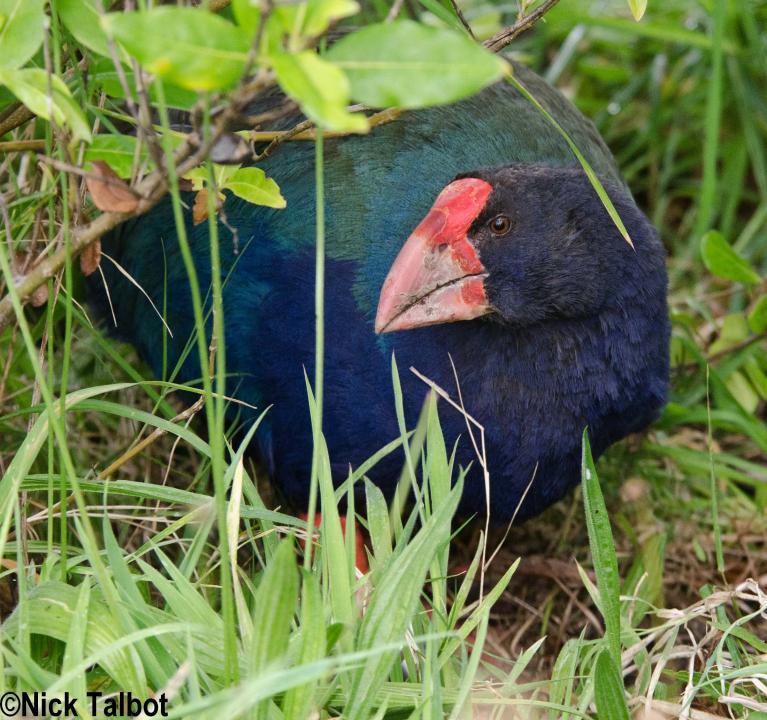
Takahe (Porphyrio hochstetteri) by Nick Talbot
The Takahē (Porphyrio hochstetteri) or South Island Takahē (Porphyrio hochstetteri) is a flightless bird indigenous to New Zealand and belonging to the rail family. It was thought to be extinct after the last four known specimens were taken in 1898. However, after a carefully planned search effort the bird was rediscovered by Geoffrey Orbell near Lake Te Anau in the Murchison Mountains, South Island, on 20 November 1948.
The Takahē is the largest living member of the Rallidae family. Its overall length averages 63 cm (24.8 in) and its average weight is about 2.7 kg (6 lbs) in males and 2.3 kg (5 lb) in females, ranging from 1.8-4.2 kg (4-9.2 lbs). The standing height is around 50 cm (20 in). It is a stocky bird, with reduced wings, strong legs and a massive bill.
The adult Takahē is mainly purple-blue in colour, with a greenish back and inner wings. It has a red frontal shield and red-based pink bill. The legs are pink. This is a noisy species with a loud clowp call. Contact call is easely confused with that of the Weka (Gallirallus australis), but is generally more resonant and deeper.
***********

Allen’s Gallinule (Porphyrio alleni) ©WikiC
The Allen’s Gallinule (Porphyrio alleni), formerly known as the Lesser Gallinule is a small waterbird of the family Rallidae. Its former binomial name is Porphyrula alleni.
Its breeding habitat is marshes and lakes in sub-Saharan Africa. They build a floating nest in marshes and swamps, laying 2-5 eggs. This species is partially migratory, undertaking seasonal movements.
Remarkably, this apparently weakly flying bird is not only the only species with a purely sub-Saharan African range to have reached Great Britain, but has done so twice. It has also occurred as a vagrant in several other European countries.
They are similar in size to the only slightly larger Water Rail. The Allen’s Gallinule has a short red bill, greenish back and purple upperparts. They have red legs with long toes, and a short tail which is white with a dark central bar underneath. Breeding males have a blue frontal shield, which is green in the female. Immature Allen’s Gallinules are sandy brown with a buff undertail. The downy chicks are black, as with all rails.
These birds probe with their bill in mud or shallow water, also picking up food by sight. They mainly eat insects and aquatic animals. They nod their heads as they swim.
Allen’s Gallinules are very secretive in the breeding season, particularly in the dense swamps they favour, and are mostly heard rather than seen. They are then rather noisy birds, with a sharp nasal pruk call. They can be easier to see on migration or when wintering.
This bird is named after British naval officer Rear-Admiral William Allen (1770-1843).
******************

Framed Purple Gallinule by Dan
The (American) Purple Gallinule (Porphyrio martinicus) is a “swamp hen” in the rail family Rallidae. This is a medium-sized rail, measuring 26–37 cm (10–15 in) in length, spanning 50–61 cm (20–24 in) across the wings and weighing 141–305 g (5.0–10.8 oz). Males, averaging 257 g (9.1 oz) in mass, are slightly larger than females, at 215 g (7.6 oz) on average. The adult Purple gallinule has big yellow feet, purple-blue plumage with a green back, and red and yellow bill. It has a pale blue forehead shield and white undertail. Darkness or low light can dim the bright purple-blue plumage of the adult to make them look dusky or brownish, although the forehead shield color differentiates them from similar species such as Common Gallinules.
Juveniles are brown overall with a brownish olive back. These gallinules will fly short distances with dangling legs. Their breeding habitat is warm swamps and marshes in southeastern states of the United States and the tropical regions of Central America, the Caribbean and northern South America. This species is resident in southern Florida and the tropics, but most American birds are migratory, wintering south to Argentina. The nest is a floating structure in a marsh. Five to ten eggs are laid. Their coloration is buff with brown spots.
The diet of these rails is omnivorous, being known to include a wide variety of plant and animal matter, including seeds, leaves and fruits of both aquatic and terrestrial plants, as well as insects, frogs, snails, spiders, earthworms and fish. They have also been known to eat the eggs and young of other birds.
This species is a very rare vagrant to western Europe and southwestern Africa. There is a similar species in southern Europe, the Purple Swamphen, Porphyrio porphyrio, but that bird is much larger.
This species is sometimes referred to by the alternative name, Yellow-legged Gallinule.
***********
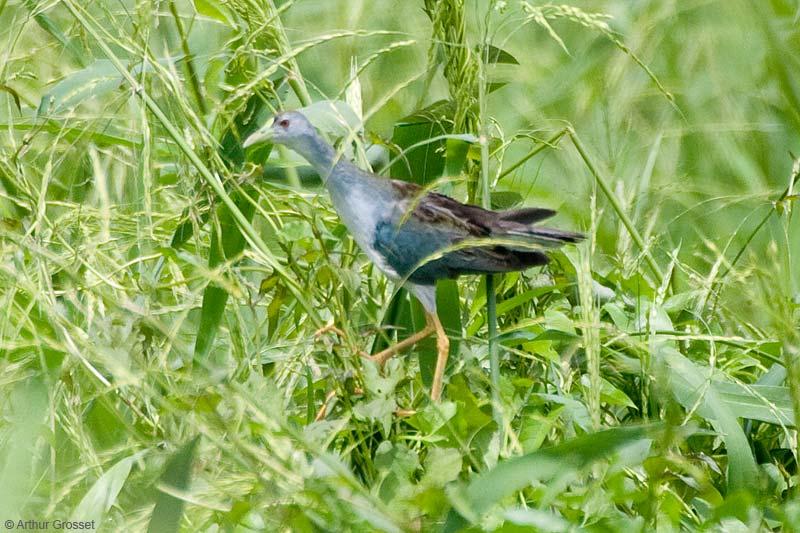
Azure Gallinule (Porphyrio flavirostris) ©Arthur Grosset
The Azure Gallinule (Porphyrio flavirostris) is a species of bird in the Rallidae family. It is found in Argentina, Bolivia, Brazil, Colombia, Ecuador, French Guiana, Guyana, Paraguay, Peru, Suriname, Trinidad and Tobago, the United States, and Venezuela.
The bill and frontal shield is a pale greenish-yellow.The wing coverts are greenish-blue while the back and tail are browner. The throat and underparts are white while the legs are yellow.
It is found in freshwater marshes where there is floating vegetation and this includes marshy edges of rivers and lakes. Nest is an open cup of leaves concealed in dense marsh vegetation. Clutch size is 4-5 eggs, incubated by both parents. Diet consists of invertebrates, insects and seeds taken from water and vegetation. Climbs in reed stems to bend them over water to pick up food.
***************
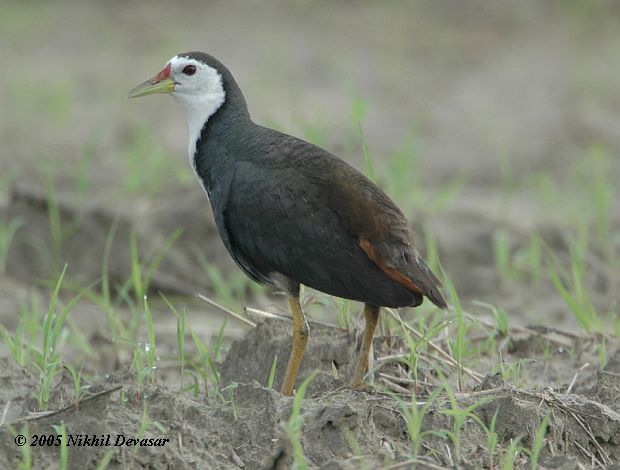
White-breasted Waterhen (Amaurornis phoenicurus) by Nikhil Devasar
The White-breasted Waterhen (Amaurornis phoenicurus) is a waterbird of the rail and crake family Rallidae that is widely distributed across Southeast Asia and the Indian Subcontinent. They are dark slaty birds with a clean white face, breast and belly. They are somewhat bolder than most other rails and are often seen stepping slowly with their tail cocked upright in open marshes or even drains near busy roads. They are largely crepuscular in activity and during the breeding season, just after the first rains, make loud and repetitive croaking calls.
Adult White-breasted Waterhens have mainly dark grey upperparts and flanks, and a white face, neck and breast. The lower belly and undertail are cinnamon coloured. The body is flattened laterally to allow easier passage through the reeds or undergrowth. They have long toes, a short tail and a yellow bill and legs. Sexes are similar but females measure slightly smaller. Immature birds are much duller versions of the adults. The downy chicks are black, as with all rails.
************
The other reference to the Porphyrion is found in Deuteronomy 14:16 with that list of unclean birds. Again, the translations give a wide variation in which bird is meant. Swan, owl, water-hen,
The little owl and the great owl and the water-hen; (Deuteronomy 14:16 BBE)
the little owl and the great owl, the water hen (Deuteronomy 14:16 NRSVA)
and G2532 heron, G2064.1 and G2532 swan, G2945.2 and G2532 ibis, G2395.1 (Deuteronomy 14:16 ABP+)
The little owl, the great owl, the horned owl, (Deuteronomy 14:16 AMP)
The litle Owle, the great Owle, nor the Redshanke. (Deuteronomy 14:16 Bishops)
Neither the litle owle, nor the great owle, nor the redshanke, (Deuteronomy 14:16 Geneva)
and the heron, and the swan, and the stork, (Deuteronomy 14:16 Brenton)
herodium ac cygnum, et ibin, (Deuteronomy 14:16 clVulgate) (Cygnus is the Latin word for swan, the romanized form of the ancient Greek κύκνος (kyknos) “swan”.)
the little owl, and the eared owl, and the barn owl, (Deuteronomy 14:16 LITV-TSP)The little owl, and the great owl, and the swan, (Deuteronomy 14:16 KJV)
(H853) The little owl,H3563 and the great owl,H3244 and the swan,H8580 (Deuteronomy 14:16 KJV+)
the little H3563b owl H3563b, the N1great H3244 owl H3244, the white H8580 owl H8580, (Deuteronomy 14:16 NASB+) (This translation of H8580 amazes me. They translate it white owl yet here is what it says in H8580)
H8580 (Strong’s LXX)
תּנשׁמת
tanshemeth
tan-sheh’-meth
From H5395; properly a hard breather, that is, the name of two unclean creatures, a lizard and a bird (both perhaps from changing color through their irascibility), probably the tree toad and the water hen: – mole, swan.
_____
But, if you look at some of the others:
H8580 (Brown-Driver-Briggs)
תּנשׁמת
tanshemeth
BDB Definition:
1) an unclean animal of some kind
1a) an unclean bird
1a1) perhaps the ibis, water-hen, species of owl, barn owl
1b) an unclean lizard
1b1) perhaps the chameleon
1c) perhaps an extinct lizard or bird, exact meaning unknown
Part of Speech: noun feminine
A Related Word by BDB/Strong’s Number: from H5395
Same Word by TWOT Number: 1433b
_____
H8580 (This is a combo of many BTSCTVM+)
– Original: תּנשׁמת
– Transliteration: Tanshemeth
– Phonetic: tan-sheh’-meth
– Definition:
1. an unclean animal of some kind
a. an unclean bird
1. perhaps the ibis, water-hen, species of owl, barn owl
b. an unclean lizard
1. perhaps the chameleon
c. perhaps an extinct lizard or bird, exact meaning unknown
– Origin: from H5395
– TWOT entry: 1433b
– Part(s) of speech: Noun Feminine
– Strong’s: From H5395; properly a hard breather that is the name of two unclean creatures a lizard and a bird (both perhaps from changing color through their irascibility) probably the tree toad and the water hen: – mole swan.
Total KJV Occurrences: 3
• mole, 1
Lev_11:30
• swan, 2
Lev_11:18; Deu_14:16
_____
Well, I don’t know about you, but I still don’t have a definite answer. Though, isn’t it enjoyable to study God’s Word. Like it was posted before, what ever bird it was is not as important as the obedience that was involved. They knew which birds they were not to eat and they were expected to obey. Today, when we read the Bible, we come across clear commands and we are expected to obey. (Bonus – I was birdwatching in Scripture)
And Samuel said, Hath the LORD as great delight in burnt offerings and sacrifices, as in obeying the voice of the LORD? Behold, to obey is better than sacrifice, and to hearken than the fat of rams. (1 Samuel 15:22 KJV)
Know ye not, that to whom ye yield yourselves servants to obey, his servants ye are to whom ye obey; whether of sin unto death, or of obedience unto righteousness? (Romans 6:16 KJV)
**********
See also:
Birds of the Bible – Water-hen
Birds of the Bible – Swans
Birds of the World – Rallidae – Rails, Crakes & Coots
List of animals in the Bible – Wikipedia
Porphyrion (Greek Mythology) – Wikipedia
(Information from Wikipedia and other internet sources, plus the e-Sword program)
*
Today at 10:00 we say, “until we meet again” to a Deacon, Head Usher, Marine veteran and a dear friend at our church. He went on to glory last Saturday and this is in honor of him and an encouragement for his dear wife and all of us his friends.
But I would not have you to be ignorant, brethren, concerning them which are asleep, that ye sorrow not, even as others which have no hope. For if we believe that Jesus died and rose again, even so them also which sleep in Jesus will God bring with him. (1 Thessalonians 4:13-14)
(Below was taken from the 2000+ Illustrations.)
Rejoicing Always
A saintly woman who had suffered for weary months from a painful illness said to her pastor, “I have such a lovely robin that sings outside my window. In the early mornings as I lie here, he serenades me.”
Then a smile brightened her thin features as she added, “I love him because he sings in the rain.”
That is the most beautiful thing about a robin. When a storm has silenced every other songbird, the robin sings on. That is what the Christian who is with Christ may do. Any one can sing in the sunshine. You and I should sing on when the sun has gone down, or when clouds pour out their rain, for Christ is with us.
American Robin Singing
European Robin Singing Rain or Shine
*

American Robin (Turdus migratorius) eating by Jim Fenton
“A few years ago my mom began feeding the birds on a regular basis in our backyard. At first, some of the birds were greedy. They weren’t sure if there would be enough food to go around. The starlings were especially mean, which doesn’t surprise anyone familiar with birds. They would attack the robins, cardinals, and sparrows that came to get a taste. This situation continued for several months until one day there was a noticeable change in the bird’s behavior.
After years of regular feeding from the unlimited supply, the birds appeared to be less greedy with the food. Now they were feeding at their leisure—realizing there would be more food when their current supply was finished. Then, last month, something even more remarkable happened. After all these months of hording, greed, and then cautiously enjoying, the birds began to demonstrate a nobler characteristic. They began calling for one another at mealtime.
Today, when the seed is spread for the birds, one will call for the others to share what they’ve discovered. The greed is less frequent. The jealous pecking is rare. The trees seem fuller these days with the joy of satisfaction from birds that have learned to share. The music of multiple species fills the air. Now they know the supply is unlimited. And as far as their appetite is concerned, it’s inexhaustible.
Just this morning, I noticed a sparrow feeding right beside a starling. Miracles never cease.
Why can’t this happen in the church?
God’s grace is inexhaustible and we ought to be calling other sinners to the fount where we’ve found refreshment and renewal.”
Charles K. Grant (An Illustration from SermonCentral.com)
All the earth will worship You, And will sing praises to You; They will sing praises to Your name.” Selah. Come and see the works of God, Who is awesome in His deeds toward the sons of men. (Psalms 66:4-5 NASB)
*
Where do we start? (See the Introduction to this study) I personally just re-read the following articles:
I had forgotten that I have been so busy. This is being composed as I am doing my study and will describe my actions as I do them. My e-Sword program is running, plus I have the internet available. There are other great Bible programs out there, but e-Sword is easy to use and it’s free. I have purchased some various versions and commentaries to use with over the years. Also, if you go to the Links section of e-Sword, there you will find places for more additions to add to your e-Sword program. My favorite is Bible Support.

List of all my Bibles in e-Sword
Needless to say, I don’t use them all, but like to have them for when I compare the different versions as you have read in other articles.

Menu Bar for e-Sword
This is the best place to start. The menu bar has the Binoculars close to the center of the photo. (All true birdwatchers know what those are) When the Search (binocular) is pressed a dialog box pops up. I put in “bird name” and then pressed the “OK” button. Here is what comes up.
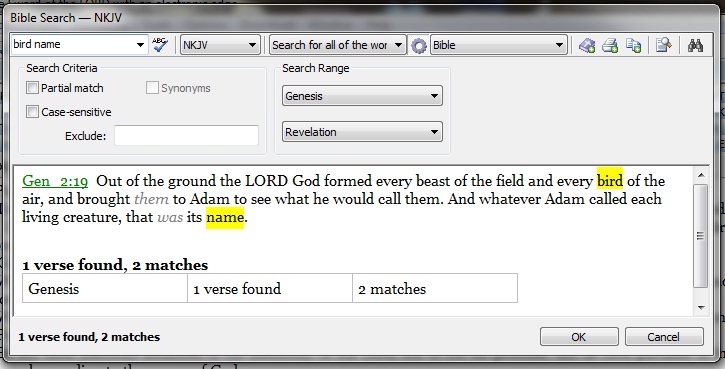
Bible Search – bird name
When I did that first with the KJV nothing came up because that verse uses “fowl” not “bird” so the NKJV was selected and this is the result. The first place where birds were named and by whom.
Out of the ground the LORD God formed every beast of the field and every bird of the air, and brought them to Adam to see what he would call them. And whatever Adam called each living creature, that was its name. (Genesis 2:19 NKJV)
Using compare opens with all the different versions showing that verse. The KJV+ in the photo shows the Strong’s numbers and when the mouse is placed on the numbers a box appears. Now you can see the words in the original languages. If we are going to study about the different names for the clean and unclean birds and other birds throughout the Bible, this will be very handy. Whether you are studying about birds or whatever, this is very useful.
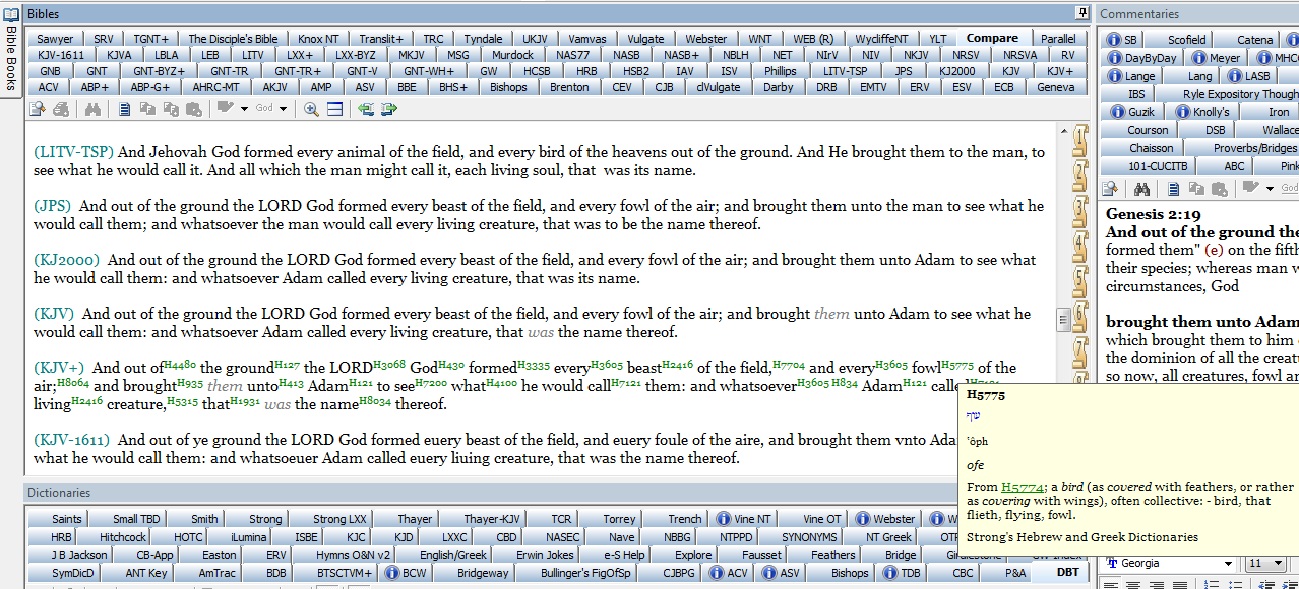
Compare of Genesis 2:19 with Hebrew 5775 for fowl open.
Okay for now. If you do not have a Bible program, try loading one and you can always use e-Sword. There are other Bible programs for the Tablets that will let you do searches also. I also have Study Bibles and my Bird Books handy. Get prepared and this will be continued. Don’t forget to ask for the Lord’s help.
In the mean time, my real binoculars are calling to me to aim them at some birds.

Bald Eagle (Haliaeetus leucocephalus) by AestheticPhotos
There have been several articles here about the Names of the Birds. See:
Now we are going to look at the Names of the Birds from another angle. I received this comment on the Clean vs Unclean blog.
Lee, my search on the topic of clean and unclean birds led met to a Wikipedia article and I discovered that when you look at the Hebrew words (found in the Masoretic text) for the names of various unclean birds, they sound like descriptions, ex. “bone breaker”, “plunger”, “one who darts”, and even “vomiting”. So perhaps the reason we don’t have “clear rules” listed (something I’ve wondered for a long time) is because the traits and characteristics were there all along, but not knowing Hebrew, we had no idea. Anyway, check it out http://en.wikipedia.org/wiki/Kosher_animals#Birds
It is a very interesting article and will take some digging to discover some more insight into these birds and how they are named. If you have been following this blog, you know that it has been curious to me how the different versions of the Bible have given different names for the birds. Maybe we can solve some of those mysteries. It won’t be done in one article. That is for sure.
First let’s look at some highlights from the Wikipedia article (with editing).

Great Horned Owl – Lowry Pk Zoo by Lee
Birds
In regard to birds, no general rule is given, and instead Leviticus 11:13-19 and Deuteronomy 14:11-18 explicitly list the prohibited birds: The masoretic text lists the birds as:
The list in Deuteronomy has an additional bird, the dayyah, which seems to be a combination of da’ah and ayyah, and may be a scribal error; the Talmud regards it as a duplication of ayyah. This, and the other terms are vague and difficult to translate, but there are a few further descriptions, of some of these birds, elsewhere in the Bible:
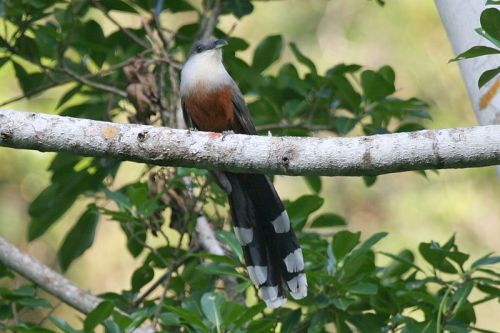
Chestnut-bellied Cuckoo (Coccyzus pluvialis) ©WikiC
Although the first ten of the birds identified by the Septuagint seem to fit the descriptions of the masoretic text, the ossifrage (Latin for bone breaker) being a good example, the correspondence is less clear for most of the remaining birds; it is also obvious that the list in Leviticus, or the list in Deuteronomy, or both, are in a different order in the Septuagint, compared to the masoretic text. Attempting to determine the correspondence is problematic; for example, the pelican may correspond to qa’at (vomiting), in reference to the pelican’s characteristic behaviour, but it may also correspond to kos (cup), as a reference to the pelican’s jaw pouch. An additional complexity arises from the fact that the porphyrion has not yet been identified, and classical Greek literature merely identifies a number of species that are not the porphyrion, including the peacock, grouse, and robin, and implies that the porphyrion is the cousin of the kingfisher; from these meagre clarifications, the porphyrion can only be identified as anything from the Lilac-breasted Roller, Indian Roller, or Northern Carmine Bee-eater, to the flamingo.
During the Middle Ages, classical descriptions of the hoopoe were mistaken for descriptions of the lapwing, on account of the lapwing’s prominent crest, and the hoopoe’s rarity in England, resulting in lapwing being listed in certain bible translations instead of hoopoe; similarly the sea eagle has historically been confused with the osprey, and translations have often used the latter bird in place of the former. Because strouthos (ostrich) was also used in Greek for the sparrow, a few translations have placed the sparrow among the list. In Arabic, the Egyptian Vulture is often referred to as rachami, and therefore a number of translations render racham as gier eagle, the old name for the Egyptian Vulture.
Variations arise when translations follow other ancient versions of the Bible, rather than the Septuagint, where they differ. Rather than vulture (gyps), the Vulgate has milvus, meaning Red Kite, which historically has been called the glede, on account of its gliding flight; similarly, the Syriac Peshitta has owl rather than ibis. Other variations arise from attempting to base translations primarily on the masoretic text; these translations generally interpret some of the more ambiguous birds as being various different kinds of vulture and owl. All of these variations mean that most translations arrive at a list of 20 birds from among the following (links are to articles already written here):

Lilac-breasted Roller (Coracias caudatus) by Bob-Nan
The fruit bat, a frugivorous vegetarian species of bat, eating some fruit
Despite being listed among the birds by the bible, bats are not birds, and are in fact mammals. Most of the remaining animals on the list are either birds of prey or birds living on water, and the majority of the latter in the list also eat fish or other seafood. The Septuagint’s version of the list comprehensively lists most of the birds of Canaan that fall into these categories. The conclusion of modern scholars is that, generally, ritually unclean birds were those clearly observed to eat other animals.
Although it does regard all birds of prey as being forbidden, the Talmud is uncertain of there being a general rule, and instead gives detailed descriptions of the features that distinguish a bird as being ritually clean. The Talmud argues that clean birds would have craws, an easily separated double-skin, and would eat food by placing it on the ground (rather than holding it on the ground) and tearing it with their bills before eating it; however, the Talmud also argues that only the birds in the biblical list are actually forbidden – these distinguishing features were only for cases when there was any uncertainty in the bird’s identity
Origin
The earliest rationalistic explanations of the laws against eating certain birds focused on symbolic interpretations; the first indication of this view can be found in the 1st century BC Letter of Aristeas, which argues that this prohibition is a lesson to teach justice, and is also about not injuring others. Such allegorical explanations were abandoned by most Jewish and Christian theologians after a few centuries, and later writers instead sought to find medical explanations for the rules; Nachmanides, for example, claimed that the black and thickened blood of birds of prey would cause psychological damage, making people much more inclined to cruelty.
However, other cultures treated the meat of certain carnivorous birds as having medical benefits, the Romans viewing Owl meat as being able to ease the pain of insect bites, for example; conversely, modern scientific studies have discovered very toxic birds such as the Pitohui, which are neither birds of prey nor water birds, and therefore the biblical regulations allow them to be eaten. Laws against eating any carnivorous birds also existed in Vedic India and Harran, and the Egyptian priests also refused to eat carnivorous birds.
Modern practical considerations
Due to the difficulty of identification, religious authorities have restricted consumption to specific birds for which Jews have passed down a tradition or permissibility from generation to generation. Birds for whom there has been a tradition of their being kosher include: the sparrow, pigeon, turtle dove, quail, the European and Middle Eastern partridges, the pheasant, ducks, geese, chickens, guineafowl among others. As a general principle, scavenging birds such as vultures and birds of prey such as hawks and eagles (which eat carrion when they find it) are not kosher. Turkey does not have a tradition, but because so many Orthodox Jews have come to eat it and it possesses the simanim (signs) required to render it a kosher bird, an exception is made, but with all other birds a Mesorah (tradition) is required.
Birds such as songbirds, which are consumed as delicacies in many societies, may be kosher in theory, but are not eaten in kosher homes as there is no tradition of them being eaten as such. Pigeons and doves are known to be kosher based on their permissible status as sacrificial offerings in the Temple. Likewise, though swans are kosher in theory if kosher-slaughtered, there is no Jewish tradition of eating them. (from Wikipedia)
***********
Second, Study is not necessarily a weariness as Ecclesiastes 12:12 says,
And further, by these, my son, be admonished: of making many books there is no end; and much study is a weariness of the flesh. (KJV)
but we should study and even enjoy digging into God’s Word.
Study to shew thyself approved unto God, a workman that needeth not to be ashamed, rightly dividing the word of truth. (2 Timothy 2:15 KJV)
I am going to use my e-Sword program. If you have not used it, it is free and very useful. It has the KJV+ as part of it and it list the Greek and Hebrew words with their definitions. Will you join me in studying about the bird names in the languages of the Bible. Join me as we look at these words and compare them to the birds. Don’t let those weird-looking words scare you. You might find that learning to study about birds, might help you carry the method into studying more of God Word.
Look for future articles in this series.
P.S. A Lilac-breasted Roller is new to me. I can’t wait to find out the connection there.
*
*

Sarus Crane (Grus antigone) by Lee at Wings of Asia
The 15 species of Cranes worldwide are: Black Crowned, Black-necked, Brolga, Demoiselle, Eurasian, Grey Crowned, Hooded, Red-Crowned, Sandhill, Sarus(tallest flying bird-6’ tall), Siberian, Wattled, White-naped, and the Whooping Crane (tallest N. American flying bird-5’ tall). The Cranes belong to the Gruidae – Cranes Family.
Cranes are tall birds from 3 to 6 feet tall, with wingspans over 6 feet. The tallest Crane is the Sarus and the shortest is the Demoiselle. They fly with their neck straight out and their long legs trailing. They chatter and call when flying. We have plenty of Sandhill Cranes here in Central Florida walking around the neighborhoods. They seem pretty tame sometimes and will eat out of your hand. They were bringing a small flock of Whooping Cranes to Florida every fall that followed an Ultra Light Aircraft from Wisconsin. We have a few non-migratory Whooping Cranes in the area that I have seen in a cow field off US 27.

Sandhill Cranes and Babies in yard
There are only two verses in the Bible that mention the Crane.
Cranes migrate by following known paths taught them by their parents, or substitutes. Migrating birds know when and where to go and when to come. When God created them, He put that information in them.
Like a crane or a swallow, so did I chatter: I did mourn as a dove: mine eyes fail with looking upward: O LORD, I am oppressed; undertake for me. (Isaiah 38:14 KJV)
“So did I chatter – … The idea here is doubtless that of pain that was expressed in sounds resembling that made by birds – a broken, unmeaning unintelligible sighing; or quick breathing, and moaning. ” Barnes Commentary
Yea, the stork in the heaven knoweth her appointed times; and the turtle and the crane and the swallow observe the time of their coming; but my people know not the judgment of the LORD. (Jeremiah 8:7 KJV)
“The instinct of the migratory birds leads them with unfailing regularity to return every spring from their winter abodes in summer climes (Song of Solomon 2:12); but God’s people will not return to Him even when the winter of His wrath is past, and He invites them back to the spring of His favor.” Jameison, Faussett, and Brown Commentary
As you watch the following video notice that the two Bible verses are being demonstrated. Notice the chattering as they fly about and also that they are heading out for their migration to warmer climates. Migration means travel to another area. Usually here in America, the birds go south in the winter and then return north in the spring as it warms back up. This is God’s way of protecting birds that cannot survive in the cold.
Sandhill Cranes(grey) at the Plate River and some Whooping Cranes (white)
See:
On Our Main Site See:
*
Sandhill Cranes and Babies in yard
Cranes know when it’s time to move south for winter. And robins, warblers, and bluebirds know when it’s time to come back again. But my people? My people know nothing, not the first thing of GOD and his rule. (Jeremiah 8:7 MSG)
The Crane page of the Bible Birds has been updated. I added a Gallery of most of the Cranes and some other information. Cranes are interesting and we get to see them quite often. We have two that walk through the yard almost daily. They are Sandhill Cranes. When they have young, they have been known to parade them through the yard to “show them off.”
The tallest Crane I have seen were the two Sarus Cranes which we encountered at the Wings of Asia Aviary at Zoo Miami. They came strolling down the walkway in the aviary right past me. I am only 4′ 10″ and they are 5′ 6″. Needless to say, I had to look up to them. I also gave them some space.
Isn’t the Creator fantastic in the variety of critters, especially the birds, that He has made and for us to enjoy.
Sarus Crane (Grus antigone) by Lee at Wings of Asia
*
How long will the land have grief, and the plants of all the land be dry? because of the sins of the people living in it, destruction has overtaken the beasts and the birds; because they said, God does not see our ways. (Jeremiah 12:4 BBE)
Because of someone shooting a Bald Eagle, which is against the law, this bird was seriously injured.
Below are two video explaining what happened to Beauty, the Bald Eagle, and how they came to make a new beak for her. Enjoy.
*
*
Eagles are one of the Birds of the Bible and are in the Accipitridae – Family (Kites, Hawks & Eagles)
*
*
What an amazing animal! God did some very special engineering from the git-go! None of this “grocery store” new and improved nonsense. He got it entirely right the first time.
(From Moody Press)
If you ever doubted that God exists, Meet the Very Technical, Highly Engineered Dromedary Camel.

When I’m hungry, I’ll eat almost anything-A leather bridle, a piece of rope, my master’s tent, Or a pair of shoes.

My mouth is so tough a thorny cactus doesn’t bother it. I love to chow down grass and other plants That grow here on the Arabian desert.

I’m a dromedary camel, the one-hump kind That lives on hot deserts in the Middle East.
My hump, all eighty pounds of it, Is filled with fat-my body fuel-not water as some people believe. My Mighty Maker gave it to me because He knew I wouldn’t always be able to find food As I travel across the hot sands. When I don’t find any chow, my body automatically Takes fat from the hump, feeds my system, And keeps me going strong. This is my emergency food supply.

If I can’t find any plants to munch, my body uses up my hump. When the hump gets smaller, it starts to tip to one side. But when I get to a nice oasis and begin to eat again, My hump soon builds back to normal.
I’ve been known to drink twenty-seven gallons of water in ten minutes. My Master Designer made me in such a fantastic way that In a matter of minutes all the water I’ve swallowed Travels to the billions of microscopic cells that make up my flesh.

Naturally, the water I swallow first goes into my stomach. There thirsty blood vessels absorb and carry it to every part of my body. Scientists have tested my stomach and found it empty Ten minutes after I’ve drunk twenty gallons.
In an eight hour day I can carry a four hundred pound load A hundred miles across a hot, dry desert And not stop once for a drink or something to eat. In fact, I’ve been known to go eight days without a drink, But then I look a wreck. I lose 227 pounds, my ribs show through my skin, And I look terribly skinny. But I feel great! I look thin because the billions of cells lose their water. They’re no longer fat. They’re flat.

Normally my blood contains 94 percent water, just like yours. But when I can’t find any water to drink, The heat of the sun gradually robs a little water out of my blood. Scientists have found that my blood can lose up to 40 percent of its water, and I’m still healthy.
Doctor’s say human blood has to stay very close to 94 percent water. If you lose 5 percent of it, you can’t see anymore; 10 percent, you can’t Hear and you go insane; 12 percent, your blood is as thick as molasses And your heart can’t pump the thick stuff. It stops, and you’re dead.

But that’s not true with me. Why? Scientists say my blood is different. My red cells are elongated. Yours are round. Maybe that’s what makes the difference.

This proves I’m designed for the desert, Or the desert is designed for me. Did you ever hear of a design without a Designer?
After I find a water hole, I’ll drink for about ten minutes And my skinny body starts to change almost immediately. In that short time my body fills out nicely, I don’t look skinny anymore, And I gain back the 227 pounds I lost.

Even though I lose a lot of water on the desert, My body conserves it too. Way in the beginning when my intelligent Engineer made me, He gave me a specially designed nose that saves water. When I exhale, I don’t lose much. My nose traps that warm, moist air from my lungs And absorbs it in my nasal membranes.

Tiny blood vessels in those membranes take that back into my blood. How’s that for a recycling system? Pretty cool, isn’t it. It works because my nose is cool. My cool nose changes that warm moisture in the air From my lungs into water.
But how does my nose get cool? I breath in hot dry desert air, And it goes through my wet nasal passages. This produces a cooling effect, and my nose stays as much as 18 degrees cooler than the rest of my body.
I love to travel the beautiful sand dunes. It’s really quite easy, because My Creator gave me specially engineered sand shoes for feet. My hooves are wide, and they get even wider when I step on them. Each foot has two long, bony toes with tough, leathery skin between my soles, are a little like webbed feet.

They won’t let me sink into the soft, drifting sand. This is good, because often my master wants me to carry him one hundred miles across the desert in just one day. (I troop about ten miles per hour.)

Sometimes a big windstorm comes out of nowhere, bringing flying sand with it. My Master Designer put special muscles in my nostrils that close the openings, keeping sand out of my nose but still allowing me enough air to breathe.
My eyelashes arch down over my eyes like screens, keeping the sand and sun out but still letting me see clearly. If a grain of sand slips through and gets in my eye, the Creator took care of that too. He gave me an inner eyelid that automatically wipes the sand off my eyeball just like a windshield wiper.
Some people think I’m conceited because I always walk around with my head held high and my nose in the air.

But that’s just because of the way I’m made. My eyebrows are so thick and bushy I have to hold my head high to peek out from underneath them. I’m glad I have them though. They shade my eyes from the bright sun.

Desert people depend on me for many things. Not only am I their best form of transportation, but I’m also their grocery store. Mrs. Camel gives very rich milk that people make into butter and cheese. I shed my thick fur coat once a year, and that can be woven into cloth. A few young camels are used for beef, but I don’t like to talk about that.

For a long time we camels have been called the “ships of the desert” because of the way we sway from side to side when we trot. Some of our riders get seasick.
I sway from side to side because of the way my legs work. Both legs on one side move forward at the same time, elevating that side. My “left, right left, right” motion makes my rider feel like he is in a rocking chair going sideways.

When I was six months old, special knee pads started to grow on my front legs. The intelligent Creator knew I had to have them. They help me lower my 1000 pounds to the ground.

If I didn’t have them, my knees would soon become sore and infected, and I could never lie down. I’d die of exhaustion.

By the way, I don’t get thick knee pads because I fall on my knees. I fall on my knees because I already have these tough pads. Someone very great thought of me and knew I needed them. He designed them into my genes.
It’s real difficult for me to understand how some people say I evolved into what I now am. I’m very technical, highly engineered dromedary camel. Things like me don’t just happen.

They’re planned on a drawing board by Someone very brilliant, Someone very logical.
John 1:1 says,
“In the beginning was the Word.
And the Word was with God,
and the Word was God.”
The Word means “logical, intelligent One.”
(Received in an e-Mail, but found it on the Lakeside Church of Christ website. Not sure who to give the credit to. Could not find it on the Moody site. We do know the ultimate credit goes to – The Creator.)
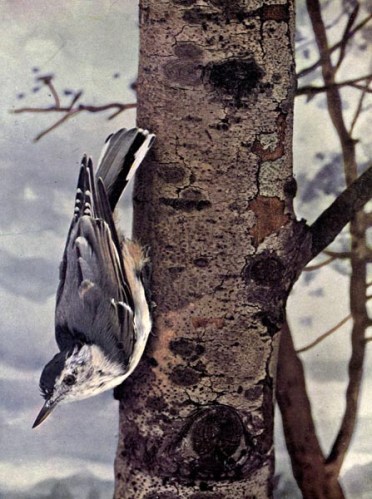
White-breasted Nuthatch or Birds Illustrated by Color Photography, 1897
From col. F. M. Woodruff. Copyrighted by
Nature Study Pub. Co., 1897, Chicago.
 Lee's Birdwatching Adventures Plus