Bible Birds – Cranes I

Sarus Crane (Grus antigone) by Lee at Wings of Asia

Sarus Crane (Grus antigone) by Lee at Wings of Asia

The 15 species of Cranes worldwide are: Black Crowned, Black-necked, Brolga, Demoiselle, Eurasian, Grey Crowned, Hooded, Red-Crowned, Sandhill, Sarus(tallest flying bird-6’ tall), Siberian, Wattled, White-naped, and the Whooping Crane (tallest N. American flying bird-5’ tall). The Cranes belong to the Gruidae – Cranes Family.

Cranes are tall birds from 3 to 6 feet tall, with wingspans over 6 feet. The tallest Crane is the Sarus and the shortest is the Demoiselle. They fly with their neck straight out and their long legs trailing. They chatter and call when flying. We have plenty of Sandhill Cranes here in Central Florida walking around the neighborhoods. They seem pretty tame sometimes and will eat out of your hand. They were bringing a small flock of Whooping Cranes to Florida every fall that followed an Ultra Light Aircraft from Wisconsin. We have a few non-migratory Whooping Cranes in the area that I have seen in a cow field off US 27.

Sandhill Cranes and Babies in yard

Sandhill Cranes and Babies in yard

There are only two verses in the Bible that mention the Crane.

Cranes migrate by following known paths taught them by their parents, or substitutes. Migrating birds know when and where to go and when to come. When God created them, He put that information in them.

Like a crane or a swallow, so did I chatter: I did mourn as a dove: mine eyes fail with looking upward: O LORD, I am oppressed; undertake for me. (Isaiah 38:14 KJV)

“So did I chatter – … The idea here is doubtless that of pain that was expressed in sounds resembling that made by birds – a broken, unmeaning unintelligible sighing; or quick breathing, and moaning. ” Barnes Commentary

Yea, the stork in the heaven knoweth her appointed times; and the turtle and the crane and the swallow observe the time of their coming; but my people know not the judgment of the LORD. (Jeremiah 8:7 KJV)

“The instinct of the migratory birds leads them with unfailing regularity to return every spring from their winter abodes in summer climes (Song of Solomon 2:12); but God’s people will not return to Him even when the winter of His wrath is past, and He invites them back to the spring of His favor.” Jameison, Faussett, and Brown Commentary

As you watch the following video notice that the two Bible verses are being demonstrated. Notice the chattering as they fly about and also that they are heading out for their migration to warmer climates. Migration means travel to another area. Usually here in America, the birds go south in the winter and then return north in the spring as it warms back up. This is God’s way of protecting birds that cannot survive in the cold.

Sandhill Cranes(grey) at the Plate River and some Whooping Cranes (white)

See:

On Our Main Site See:

*

Updated the Bible Birds – Crane Page

Sandhill Cranes and Babies in yard

Sandhill Cranes and Babies in yard

Cranes know when it’s time to move south for winter. And robins, warblers, and bluebirds know when it’s time to come back again. But my people? My people know nothing, not the first thing of GOD and his rule. (Jeremiah 8:7 MSG)

The Crane page of the Bible Birds has been updated. I added a Gallery of most of the Cranes and some other information. Cranes are interesting and we get to see them quite often. We have two that walk through the yard almost daily. They are Sandhill Cranes. When they have young, they have been known to parade them through the yard to “show them off.”

The tallest Crane I have seen were the two Sarus Cranes which we encountered at the Wings of Asia Aviary at Zoo Miami. They came strolling down the walkway in the aviary right past me. I am only 4′ 10″ and they are 5′ 6″. Needless to say, I had to look up to them. I also gave them some space.

Isn’t the Creator fantastic in the variety of critters, especially the birds, that He has made and for us to enjoy.

Sarus Crane (Grus antigone) by Lee at Wings of Asia

Sarus Crane (Grus antigone) by Lee at Wings of Asia

Wordless Book

*

Absolutely Amazing Videos of Eagle Receiving A New Beak

How long will the land have grief, and the plants of all the land be dry? because of the sins of the people living in it, destruction has overtaken the beasts and the birds; because they said, God does not see our ways. (Jeremiah 12:4 BBE)

Because of someone shooting a Bald Eagle, which is against the law, this bird was seriously injured.

Below are two video explaining what happened to Beauty, the Bald Eagle, and how they came to make a new beak for her. Enjoy.

*

*

Eagles are one of the Birds of the Bible and are in the Accipitridae – Family (Kites, Hawks & Eagles)

*

Wordless Birds

*

Interesting Things – The Amazing Camel and It’s Creator

What an amazing animal! God did some very special engineering from the git-go! None of this “grocery store” new and improved nonsense. He got it entirely right the first time.

The Amazing Camel and It’s Creator

(From Moody Press)

If you ever doubted that God exists, Meet the Very Technical, Highly Engineered Dromedary Camel.

When I’m hungry, I’ll eat almost anything-A leather bridle, a piece of rope, my master’s tent, Or a pair of shoes.

My mouth is so tough a thorny cactus doesn’t bother it. I love to chow down grass and other plants That grow here on the Arabian desert.

I’m a dromedary camel, the one-hump kind That lives on hot deserts in the Middle East.

My hump, all eighty pounds of it, Is filled with fat-my body fuel-not water as some people believe. My Mighty Maker gave it to me because He knew I wouldn’t always be able to find food As I travel across the hot sands. When I don’t find any chow, my body automatically Takes fat from the hump, feeds my system, And keeps me going strong. This is my emergency food supply.

If I can’t find any plants to munch, my body uses up my hump. When the hump gets smaller, it starts to tip to one side. But when I get to a nice oasis and begin to eat again, My hump soon builds back to normal.

I’ve been known to drink twenty-seven gallons of water in ten minutes. My Master Designer made me in such a fantastic way that In a matter of minutes all the water I’ve swallowed Travels to the billions of microscopic cells that make up my flesh.

Naturally, the water I swallow first goes into my stomach. There thirsty blood vessels absorb and carry it to every part of my body. Scientists have tested my stomach and found it empty Ten minutes after I’ve drunk twenty gallons.

In an eight hour day I can carry a four hundred pound load A hundred miles across a hot, dry desert And not stop once for a drink or something to eat. In fact, I’ve been known to go eight days without a drink, But then I look a wreck. I lose 227 pounds, my ribs show through my skin, And I look terribly skinny. But I feel great! I look thin because the billions of cells lose their water. They’re no longer fat. They’re flat.

Normally my blood contains 94 percent water, just like yours. But when I can’t find any water to drink, The heat of the sun gradually robs a little water out of my blood. Scientists have found that my blood can lose up to 40 percent of its water, and I’m still healthy.

Doctor’s say human blood has to stay very close to 94 percent water. If you lose 5 percent of it, you can’t see anymore; 10 percent, you can’t Hear and you go insane; 12 percent, your blood is as thick as molasses And your heart can’t pump the thick stuff. It stops, and you’re dead.

But that’s not true with me. Why? Scientists say my blood is different. My red cells are elongated. Yours are round. Maybe that’s what makes the difference.

This proves I’m designed for the desert, Or the desert is designed for me. Did you ever hear of a design without a Designer?

After I find a water hole, I’ll drink for about ten minutes And my skinny body starts to change almost immediately. In that short time my body fills out nicely, I don’t look skinny anymore, And I gain back the 227 pounds I lost.

Even though I lose a lot of water on the desert, My body conserves it too. Way in the beginning when my intelligent Engineer made me, He gave me a specially designed nose that saves water. When I exhale, I don’t lose much. My nose traps that warm, moist air from my lungs And absorbs it in my nasal membranes.

Tiny blood vessels in those membranes take that back into my blood. How’s that for a recycling system? Pretty cool, isn’t it. It works because my nose is cool. My cool nose changes that warm moisture in the air From my lungs into water.

But how does my nose get cool? I breath in hot dry desert air, And it goes through my wet nasal passages. This produces a cooling effect, and my nose stays as much as 18 degrees cooler than the rest of my body.

I love to travel the beautiful sand dunes. It’s really quite easy, because My Creator gave me specially engineered sand shoes for feet. My hooves are wide, and they get even wider when I step on them. Each foot has two long, bony toes with tough, leathery skin between my soles, are a little like webbed feet.

They won’t let me sink into the soft, drifting sand. This is good, because often my master wants me to carry him one hundred miles across the desert in just one day. (I troop about ten miles per hour.)

Sometimes a big windstorm comes out of nowhere, bringing flying sand with it. My Master Designer put special muscles in my nostrils that close the openings, keeping sand out of my nose but still allowing me enough air to breathe.

My eyelashes arch down over my eyes like screens, keeping the sand and sun out but still letting me see clearly. If a grain of sand slips through and gets in my eye, the Creator took care of that too. He gave me an inner eyelid that automatically wipes the sand off my eyeball just like a windshield wiper.

Some people think I’m conceited because I always walk around with my head held high and my nose in the air.

But that’s just because of the way I’m made. My eyebrows are so thick and bushy I have to hold my head high to peek out from underneath them. I’m glad I have them though. They shade my eyes from the bright sun.

Desert people depend on me for many things. Not only am I their best form of transportation, but I’m also their grocery store. Mrs. Camel gives very rich milk that people make into butter and cheese. I shed my thick fur coat once a year, and that can be woven into cloth. A few young camels are used for beef, but I don’t like to talk about that.

For a long time we camels have been called the “ships of the desert” because of the way we sway from side to side when we trot. Some of our riders get seasick.

I sway from side to side because of the way my legs work. Both legs on one side move forward at the same time, elevating that side. My “left, right left, right” motion makes my rider feel like he is in a rocking chair going sideways.

When I was six months old, special knee pads started to grow on my front legs. The intelligent Creator knew I had to have them. They help me lower my 1000 pounds to the ground.

If I didn’t have them, my knees would soon become sore and infected, and I could never lie down. I’d die of exhaustion.

By the way, I don’t get thick knee pads because I fall on my knees. I fall on my knees because I already have these tough pads. Someone very great thought of me and knew I needed them. He designed them into my genes.

It’s real difficult for me to understand how some people say I evolved into what I now am. I’m very technical, highly engineered dromedary camel. Things like me don’t just happen.

They’re planned on a drawing board by Someone very brilliant, Someone very logical.

John 1:1 says,
“In the beginning was the Word.
And the Word was with God,
and the Word was God.”
The Word means “logical, intelligent One.”

(Received in an e-Mail, but found it on the Lakeside Church of Christ website. Not sure who to give the credit to. Could not find it on the Moody site. We do know the ultimate credit goes to – The Creator.)

Birds of the Bible – Trusting Under The Wing

Red-necked Grebe (Podiceps grisegena) young on her wing ©USFWS

Red-necked Grebe (Podiceps grisegena) young on her wing ©USFWS

The LORD recompense thy work, and a full reward be given thee of the LORD God of Israel, under whose wings thou art come to trust. (Ruth 2:12 KJV)

While searching for “wing” or “wings” in my e-Sword, I discovered this really great verse. Let’s dig into it.

Searching further using “under” and “wing” here are a few more verses that sort of relate to the verse above:

Keep me as the apple of the eye, hide me under the shadow of thy wings, (Psalms 17:8 KJV)

How excellent is thy lovingkindness, O God! therefore the children of men put their trust under the shadow of thy wings. (Psalms 36:7 KJV)

He shall cover thee with his feathers, and under his wings shalt thou trust: his truth shall be thy shield and buckler. (Psalms 91:4 KJV)

Matthew 23:37 and Luke 13:34 mention being gathered under the wing, but they were not willing. Also, in  we covered. no pun intended, how birds protect their young under their wings and how God protects us. But the verse above seem to imply our trust.

What is being trusted? Boaz is implying that Ruth is trusting in the “LORD God of Israel.” She is from another country, another culture and religious way of life, but has turned her trust over to the LORD. That is something I did personally way back in 1960. I put my trust in the Lord to be my personal Savior. It was the best decision of my life.

Storks Shadowing Baby in Lakeland by Dan

Storks Shadowing Baby in Lakeland by Dan

In the Psalms verses, we can know that the Lord keeps His Eye on His own and we should desire to be the “apple of the eye.” Notice in the other verses that while we are under the wings we are trusting. Who? The Lord or LORD. Why do we trust? Wow! Look around at all the Lord has done just in creation and care of the birds. How about our care? We know through promises all through the Word of God that He cares for us. We know He doesn’t lie or do things for our harm. We also know that He is just and will give judgment when needed.  We could go on and on, but you can also see that the Lord Jesus Christ is “trustworthy.”

Baby Chick Peeping Out From Under His Mom's Wing - ©©

Baby Chick Peeping Out From Under His Mom’s Wing – ©©

We know the birds trust their parents to protect them while they are under their wings. Should we not trust the Savior while we are under His wings?

Here is a quote from the Believer’s Bible Commentary:

“2:4-12 When Boaz arrived from Bethlehem, he asked the identity of the young woman. Learning that she was Naomi’s daughter-in-law, he cordially invited her to continue gleaning in his fields and to share the water provided for his workers. In praising her for the loyal and selfless step that she had taken, Boaz concluded with a little prayer for her:
The LORD repay your work, and a full reward be given you by the LORD God of Israel, under whose wings you have come for refuge (v. 12).
Leon Morris comments:

In due course, the prayer was answered through him who uttered it. He recognizes the religious aspect of Ruth’s change of country by saying that she has come to trust (AV) under Yahweh’s wings. The imagery is probably that of a tiny bird struggling under the wings of a foster-mother. It gives a vivid picture of trust and security. . . .

From J. Vernon McGee:

“She had come to trust the Lord God. This is the reason she had left the land of Moab and made that radical decision. She had said that the God of Naomi would be her God. She had turned from idolatry to the living and true God. This woman has come to trust God; she was one of His children. Therefore this is the wonderful testimony that she had there in the land of Israel. And Boaz says, “May a full reward be given to you. May you be recompensed for this decision.”

From Matthew Henry:

“(5.) He (Boaz) prayed for her (Ruth_2:12): The Lord recompense thy work. Her strong affection to the commonwealth of Israel, to which she was by birth an alien, was such a work of the divine grace in her as would certainly be crowned with a full reward by him under whose wings she had come to trust. Note, Those that by faith come under the wings of the divine grace, and have a full complacency and confidence in that grace, may be sure of a full recompense of reward for their so doing. From this expression, the Jews describe a proselyte to be one that is gathered under the wings of the divine majesty.”

From John Gill’s Exposition:

“under whose wings thou art come to trust; whom she professed to be her God, and whom she determined to serve and worship; whose grace and favour she expected, and to whose care and protection she committed herself: the allusion is either to fowls, which cover their young with their wings, and thereby keep them warm and comfortable, and shelter and protect them, see Psa_36:7 or to the wings of the cherubim overshadowing the mercy seat, Exo_25:20 and the phrase is now adopted by the Jews to express proselytism; and so the Targum here,”thou art come to be proselyted, and to be hid under the wings of the Shechinah of his glory,”or his glorious Shechinah.”

My all time favorite photo showing this:

Under His Wings - (Dove - photographer unknown)

Under His Wings – by Ric Seet

Other Articles to check out:

*

Birds of the Bible – Cuckoo III

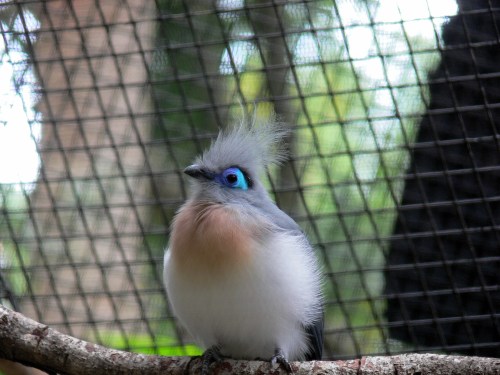
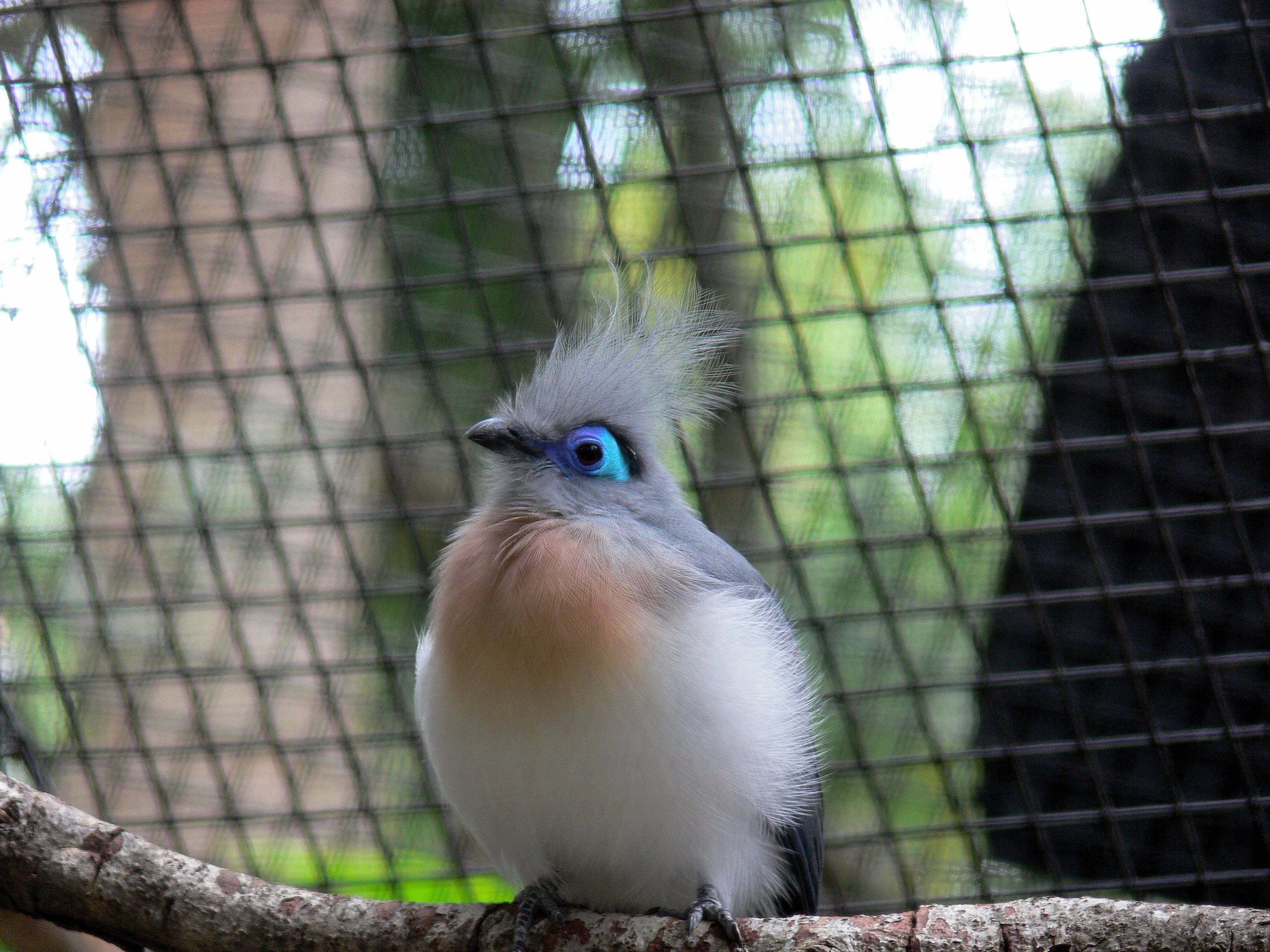
Crested Coua (Coua cristata) by Lee LPZ

Crested Coua (Coua cristata) by Lee Lowry Park Zoo

And the owl, and the night hawk, and the cuckow, and the hawk after his kind, (Leviticus 11:16 KJV)

What an interesting Family to which the Cuckoo belongs. Having posted Ian’s Bird of the Week – Little Bronze Cuckoo yesterday, I worked on the Cuckoo – Cuculidae Family to find some more photos. There are a few missing photos, but some of them are of endangered or rarely seen birds. There are some interesting species and some beautiful one also. The Coua genus have the most beautiful eyes. They remind me of the Egyptian Eyes on statues and paintings. We get to see the Crested Coua every time we go over to the Lowry Park Zoo in Tampa. We have to photograph through the mesh, but this one of my better attempts. (See Above) Click through these links and you will see some of the Lord’s Creative Hand at work.

Crested Coua (Coua cristata) by Lee at LowryPkZoo – *LLABS*
Verreaux’s Coua (Coua verreauxi) IBC
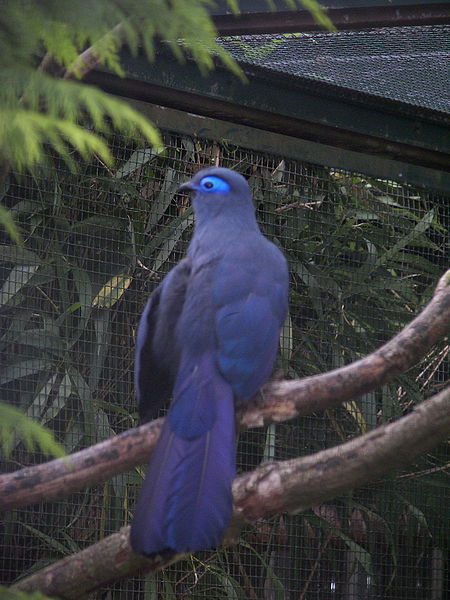
Blue Coua (Coua caerulea) ©WikiC
Red-capped Coua (Coua ruficeps) IBC
Red-fronted Coua (Coua reynaudii) IBC
Coquerel’s Coua (Coua coquereli) IBC
Running Coua (Coua cursor) IBC
Giant Coua (Coua gigas) WikiC
Red-breasted Coua (Coua serriana) IBC

Aren’t they amazing? Wow! At least I think they are.

In Birds of the Bible – Cuckoo II it was explained how Leviticus 11:16 and Deuteronomy 14:15 uses Cuckow, Cuckoo, Sea-gull, Sea-hawk in the different versions. I have since added several more Bible Translations to my e-Sword program, so lets see if anything new shows up. The “cuckow” is in the AKJV, “sea gull” in the AMP, the “coockowe” in the Bishops, CJB calls it the “seagull”, Geneva has “seameaw”, the Tyndale calls it a “cocow” and UKJV the “cuckoo.” Seems that it is still split between the same birds. Thus they get to be one of our Birds of the Bible to study.

As mentioned before, it gives us a chance to learn about the many birds that we are blessed with and a reason to concentrate on this family. Notice that both references mention after their kind:

And the owl, and the night hawk, and the cuckow, and the hawk after his kind, (Deuteronomy 14:15 KJV)

The whole family of the Cuculidae includes not only the Cuckoo, but also the Ani, Roadrunner, Ground, Bronze, Coucal, Coua, Malkoha, Koel, Bronze Cuckoo, Long-tailed Cuckoo, Hawk-Cuckoo, Drongo-Cuckoo, and Lizard Cuckoos. Most in America are familiar with the Roadrunner if by no other way than by Wile E Coyote who is always chasing the Roadrunner in the Looney Tune Cartoons.

Wile E Coyote  - Looney Tunes ”©WikiC

Wile E Coyote – Looney Tunes ”©WikiC

Roadrunner - Looney Tunes ”©WikiC

Roadrunner – Looney Tunes ”©WikiC

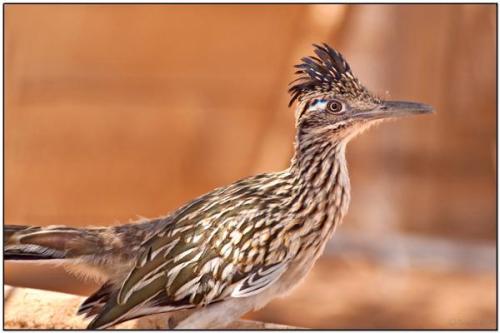
Here is a real Roadrunner:

Greater Roadrunner (Geococcyx californianus) by Daves BirdingPix

Greater Roadrunner (Geococcyx californianus) by Daves BirdingPix

Notice the Eyes even on a Roadrunner. Roadrunners are fast-running birds that have  long tails and a crests. The birds are found in southwestern United States and Mexico. They range from 18-22 in. (46-56 cm) from the beak to the tail. Speeds of up to 20 miles per hour (32 km/h) have been reported. They can fly, but prefer to sprint instead.

More about this family later. Thought you might enjoy seeing some more of our Birds of the Bible that are here to enjoy and be blessed by from the Hand of the Lord.

See also:

Sharing The Gospel

*

Version 3.2 IOC List of Birds Updated – Finally

Green-headed Tanager (Tangara seledon) by Dario Sanches

Green-headed Tanager (Tangara seledon) by Dario Sanches

I deleted this info because it was out of date and causing 404 errors. See

Birds of the World Families

for most upto date links.

O LORD, our Lord, How excellent is Your name in all the earth, Who have set Your glory above the heavens! … When I consider Your heavens, the work of Your fingers, The moon and the stars, which You have ordained, What is man that You are mindful of him, And the son of man that You visit him? For You have made him a little lower than the angels, And You have crowned him with glory and honor. You have made him to have dominion over the works of Your hands; You have put all things under his feet, All sheep and oxen— Even the beasts of the field, The birds of the air, And the fish of the sea That pass through the paths of the seas. O LORD, our Lord, How excellent is Your name in all the earth! (Psalms 8:1-9 NKJV)

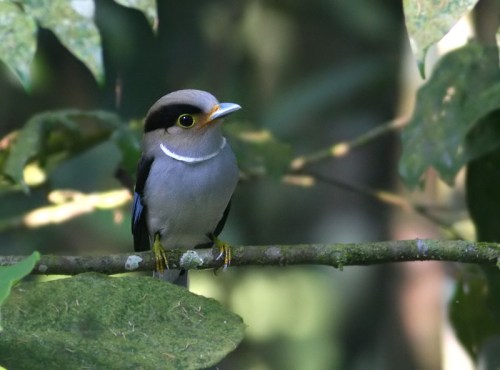
Silver-breasted Broadbill (Serilophus lunatus) by Peter Ericsson

Silver-breasted Broadbill (Serilophus lunatus) by Peter Ericsson

See:

*

Your First Bird Sighted in 2013 – Please Comment

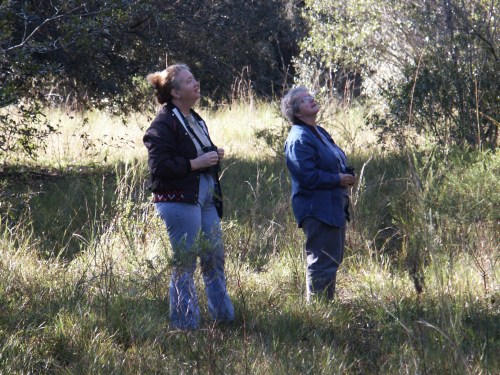
Marian (Naturalist at Avon Park Range) and Lee 2004

Marian (Naturalist at Avon Park Range) and Lee 2004

I beseech you therefore, brethren, by the mercies of God, that you present your bodies a living sacrifice, holy, acceptable to God, which is your reasonable service. And do not be conformed to this world, but be transformed by the renewing of your mind, that you may prove what is that good and acceptable and perfect will of God. (Romans 12:1-2 NKJV)

Well here we are at the end of 2012 and the beginning of 2013. Wow! What a fast year, now we get to renew ourselves and start afresh with a new list of birds for the year.

What will it be? The first one you sight. Will it be an old familiar friend or something new to you? Let us know what you see. Please leave a comment and tell us your first bird of 2013. You might even tell us your last bird of 2012. As I write this, it is only 9:00 am on Dec 31st, but some of you around the world are all ready celebrating the new year.

When you leave your bird sighted, tell us at least where you are, even if it is only your country. If you don’t see Comments on the page, click the Leave a Comment at the end of the article and it will take you to the full article.

I am excited to read about your first (and last) birds from around the world. I will post mine as soon as I spot them in the morning.

HAPPY NEW YEAR AND LORD BLESS YOU!

Wordless Birds

*

2012 in Review – Lee’s Birdwatching Adventures Plus

The WordPress.com stats helper monkeys prepared a 2012 annual report for this blog. (Lee’s Birdwatching Adventures Plus)

Here’s an excerpt:

About 55,000 tourists visit Liechtenstein every year. This blog was viewed about 380,000 times in 2012. If it were Liechtenstein, it would take about 7 years for that many people to see it. Your blog had more visits than a small country in Europe!

Click here to see the complete report.

Wow! Thank you all for coming to visit the blog this year!

Birds of the Bible – Roseate Spoonbill

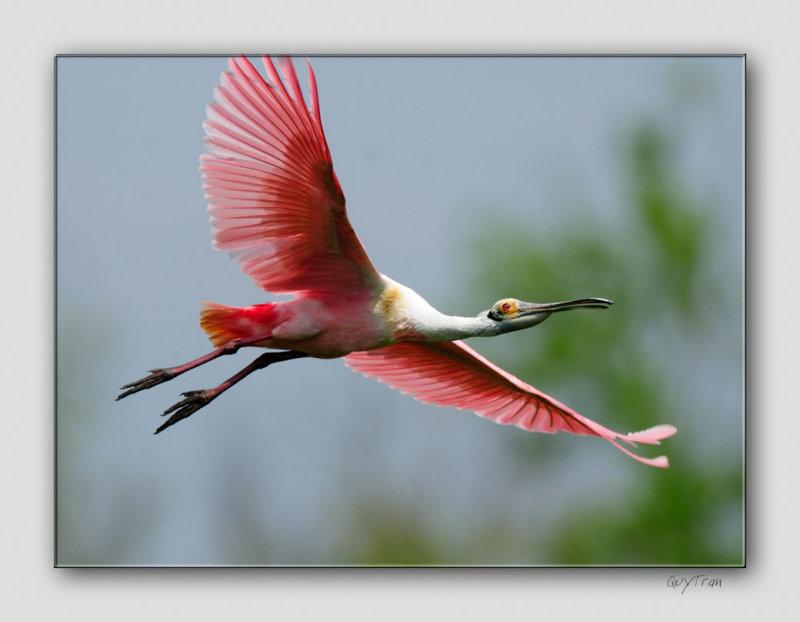
Roseate Spoonbill (Platalea ajaja) by Quy Tran

Roseate Spoonbill (Platalea ajaja) by Quy Tran

Birds of the Bible – Roseate Spoonbill

The Roseate Spoonbill is a member of the Threskiornithidae – Ibises, Spoonbills Family. We see them quite often in this area, especially in the Fall and Winter time.  I am always thrilled when we come upon them in our birdwatching adventures. Their cousins, Ibises, are a Bird of the Bible.

Then God said, “Let the waters abound with an abundance of living creatures, and let birds fly above the earth across the face of the firmament of the heavens.” So God created great sea creatures and every living thing that moves, with which the waters abounded, according to their kind, and every winged bird according to its kind. And God saw that it was good. And God blessed them, saying, “Be fruitful and multiply, and fill the waters in the seas, and let birds multiply on the earth.” So the evening and the morning were the fifth day. (Genesis 1:20-23 NKJV)

Since the Lord created all the birds, this is one of His neater creations, at least in my opinion. Their spoon-shaped bill is sort of unique to the birds. There are actually five other Spoonbills besides the Roseate.

The Roseate Spoonbill is 28–34 in (71–86 cm) long, with a  47–52 in (120–133 cm) wingspan and a weigh 2.6–4.0 lb (1.2–1.8 kg). The legs, bill, neck and spatulate bill all appear elongated. Adults have a bare greenish head (“golden buff” when breeding) and a white neck, back, and breast (with a tuft of pink feathers in the center when breeding), and are otherwise a deep pink. The bill is grey. There is no significant sexual dimorphism.

Like the American Flamingo, their pink color is diet-derived, consisting of the carotenoid pigment canthaxanthin. Another carotenoid, astaxanthin, can also be found deposited in flight and body feathers. The colors can range from pale pink to bright magenta, depending on age and location. Captive Spoonbill are fed their normal diets, plus some include juices made from carrots.

Unlike herons, spoonbills fly with their necks outstretched. They alternate groups of stiff, shallow wingbeats with glides.

Spoonbills feeding in a pond by the school. Cloudy day. Not the best, but you can see their eating behavior. Taken by me.

This species feeds in shallow fresh or coastal waters by swinging its bill from side to side as it steadily walks through the water, often in groups. The spoon-shaped bill allows it to sift easily through mud. It feeds on crustaceans, aquatic insects, frogs, newts and very small fish ignored by larger waders. In the United States a popular place to observe Roseate Spoonbills is “Ding” Darling National Wildlife Refuge in Florida. (Also at Circle B Bar Reserve as you can see by the list below of some of my sighting on e-Bird) Roseate Spoonbills must compete for food with Snowy Egrets, Great Egrets, Tricolored Herons, and American White Pelicans.

We came upon a group of them roosting at Ding” Darling National Wildlife Refuge. It was the first time I had seen that many in one place and so close to us.

Enlarge - Count at least 20 Spoonbills

Roseate Spoonbills at Ding Darling NWR – Dan at work.

The Roseate Spoonbill nests in shrubs or trees, often mangroves, laying 2 to 5 eggs, which are whitish with brown markings. Immature birds have white, feathered heads, and the pink of the plumage is paler. The bill is yellowish or pinkish.

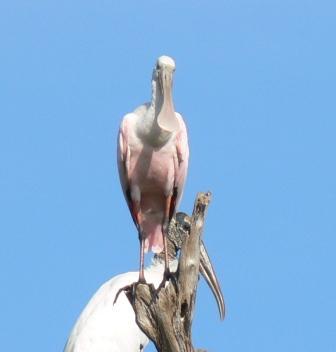
Here is one I caught in a tree at Circle B Bar Reserve:

Roseate Spoonbill and Wood Stork by Lee

Roseate Spoonbill and Wood Stork by Lee

What prompted writing about one of the bird friends I always enjoy seeing, is an article about the Roseate Spoonbill in one of my latest additions of BirdWatching. It’s a great magazine and I am not condemning it. I am used to “reading around the evolutionary influences” in articles about birds. But I was offended by this remark, “It’s hard not to look at the Roseate Spoonbill in the Everglades and think, ‘What happened here:’ Amid the herons and cormorants, the spoonbill seems like an evolutionary hiccup, a failed experiment.

One, the Roseate Spoonbill is far from an “evolutionary hiccup!” It hasn’t evolved, it was created by a loving all knowing Creator, that knew exactly what He was doing. Two, it definitely was not a “failed experiment.” The way the bill is designed and the sensitivity of its touch is amazing. The Lord promised to provide for all His creatures as well as His own people. Nor are we “hiccups.” We are all created by him, but there are differences and varieties in the birds just as there is in our talents and abilities.

I know all the birds of the mountains, And the wild beasts of the field are Mine. (Psalms 50:11 NKJV)

Look at the birds of the air, for they neither sow nor reap nor gather into barns; yet your heavenly Father feeds them. Are you not of more value than they? (Matthew 6:26 NKJV)

All the birds of the heavens made their nests in its boughs; Under its branches all the beasts of the field brought forth their young; And in its shadow all great nations made their home. (Ezekiel 31:6 NKJV)

(Wikipedia and other internet resources consulted)

See:

Birds of the Bible

Birds of the Bible – Ibises

Bible Birds – Ibises

Birds of the Bible – Isaiah 34:11

Birds of the World – Threskiornithidae – Ibises, Spoonbills

World – Life Observations – Roseate Spoonbill

  Location Date
1 Roseate Spoonbill Corpus Christi 8-Nov-01
2 Roseate Spoonbill Circle B Bar Reserve 9-Feb-07
3 Roseate Spoonbill Viera Wetlands 20-Nov-07
4 Roseate Spoonbill Merritt Island NWR–Black Point Wildlife Dr. 22-Nov-07
5 Roseate Spoonbill Circle B Bar Reserve 10-May-08
6 Roseate Spoonbill Lake John Rookery 15-May-08
7 Roseate Spoonbill J. N. Ding Darling NWR 15-Jul-08
8 Roseate Spoonbill Circle B Bar Reserve 1-Nov-08
9 Roseate Spoonbill 6 Circle B Bar Reserve 28-Nov-08
10 Roseate Spoonbill 16 Merritt Island NWR–Black Point Wildlife Dr. 20-Jan-09
11 Roseate Spoonbill 3 Circle B Bar Reserve 24-Feb-09
12 Roseate Spoonbill 4 Circle B Bar Reserve 10-Mar-09
13 Roseate Spoonbill 15 Circle B Bar Reserve 24-Oct-09
14 Roseate Spoonbill 15 Circle B Bar Reserve 23-Dec-09
15 Roseate Spoonbill 5 Hillsborough 4-Feb-10
16 Roseate Spoonbill 1 MacDill AFB 31-Jan-11
17 Roseate Spoonbill 1 Lake Parker Park 7-Jan-12
18 Roseate Spoonbill 3 Circle B Bar Reserve 16-Jan-12
19 Roseate Spoonbill 2 Picnic Island Beach 24-Jan-12
20 Roseate Spoonbill 1 Lake Hollingsworth 26-Jan-12
21 Roseate Spoonbill 3 MacDill AFB 16-Aug-12
22 Roseate Spoonbill 3 Circle B Bar Reserve 10-Nov-12

*