Lee’s Two Word Tuesday – 6/13/17

***

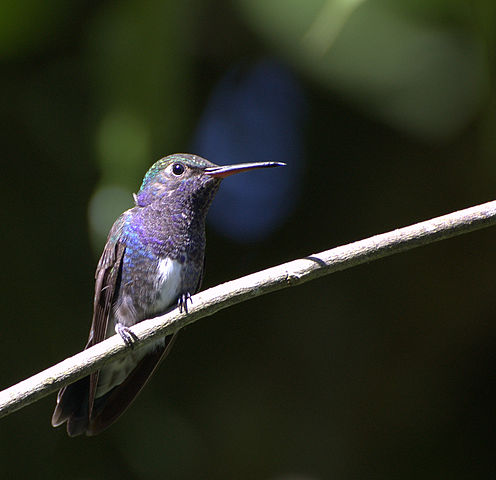
Sapphire-spangled Emerald (Amazilia lactea) ©WikiC

PURPLE RAINMENT

***


“And the weight of the golden earrings that he requested was a thousand and seven hundred shekels of gold; beside ornaments, and collars, and purple raiment that was on the kings of Midian, and beside the chains that were about their camels’ necks.  (Judges 8:26)

Sapphire-spangled Emerald (Amazilia lactea) ©WikiC

*

More Daily Devotionals

*

Lee’s One Word Monday – 6/12/17

***

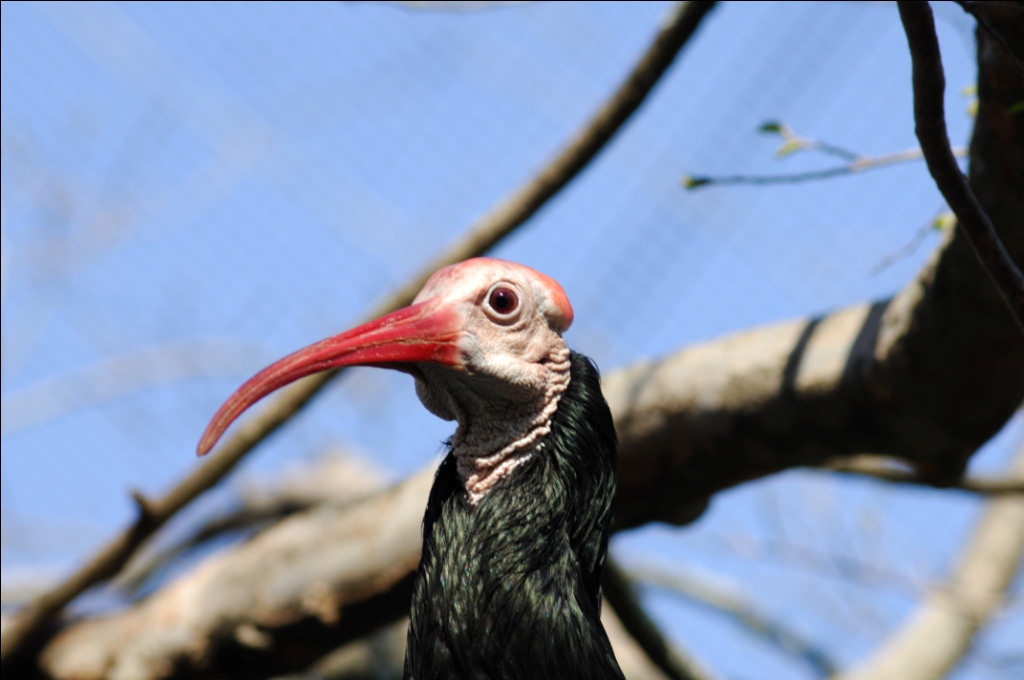
Southern Bald Ibis (Geronticus calvus) by Dan at LPZoo

BALD

***


“And the man whose hair is fallen off his head, he is bald; yet is he clean.”  (Leviticus 13:40)

Southern Bald Ibis (Geronticus calvus) by Dan at LPZoo

*

More Daily Devotionals

*

Vermilion Flycatchers: Watching from Above

Vermilion Flycatchers: Watching from Above

Dr. James J. S. Johnson

For the ways of man are before the eyes of the Lord, and He pondereth all his goings.  (Proverbs 5:21)

The eyes of the Lord are in every place, beholding the evil and the good  (Proverbs 15:3)

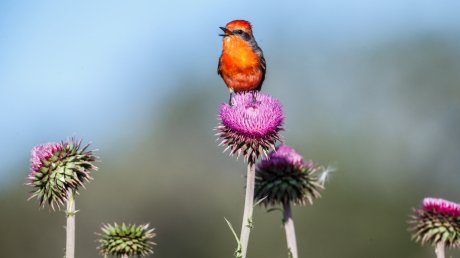
Vermillion-Flycatcher-on-thistle.Links-of-Utopia

As our providence-giving Creator, God surveys (and interacts with) all of the world, watching from above. Yet many small parts of the earth are also “watched from above”, by many of the smallest creatures that God made on Day #5 –  the birds of the air, such as the Vermillion Flycatcher.

If you catch flies (or dragonflies!) for a living, you must fly yourself – quickly, darting here and there. Also, before nabbing an airborne lunch, you must perch and wait  —  attentively watch for it to appear within snatching distance, then go get it! In other words, before you catch, you need to “watch from above” – and that is what wary Vermilion (also spelled “Vermillion”) Flycatchers do.

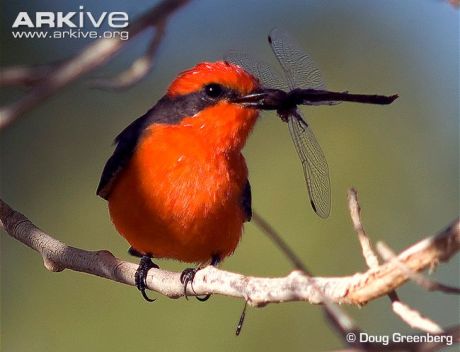
“Catching flies” is a feat that many outfielders perform in baseball parks, but the real flycatchers (i.e., the tyrant flycatcher family of perching birds, known as Tyrrannidae) rely on snatching their aerial insect prey as their primary dietary habit  —  and the colorful Vermilion Flycatcher (Pyrocephalus rubinus) is no exception.  In addition to flying insects (such as flies, wasps, honeybees, damselflies, and dragonflies), this tyrant flycatcher happily eats jumping insects (such as grasshoppers and crickets) and crawling bugs (such as beetles, spiders, and termites).

Vermilion-Flycatcher-male-with-dragonfly-prey.DougGreenberg-Arkive-photo

Typically, though, these acrobats nest in tree canopies, feeding in-flight. [Janine M. Benyus, THE FIELD GUIDE TO WILDLIFE HABITATS OF THE WESTERN UNITED STATES (New York: Simon & Schuster/Fireside Books), page 169.]

http://www.hbw.com/sites/default/files/ibc/v/converted/551596/vermilion_flycatcher_0_mp4_sd_1488396039.mp4 

https://www.youtube.com/watch?v=l3HyWMnvPk0  

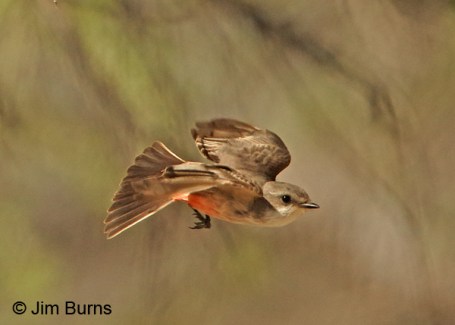
Vermilion-Flycatcher-female-flying.JimBurns

The ability of birds to watch “from above” is well-known. In fact, a 8-year-old poet (Sydney) recently alluded to that trait, in her succinct free verse:

     Birds:

     Fun colors, flying, watching from above.

     Birds.

[Poem “BIRDS” by Sydney Ledbetter, 5-27-AD2017.]

Sydney.earrings

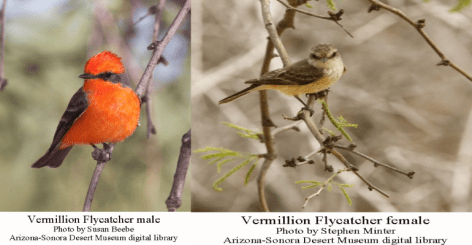
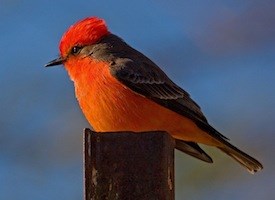
Actually, it is the male of the species that is so strikingly colorful —  with its bright scarlet head crest (which matches its technical name, meaning “fiery-head”), forehead, and neck, and its belly’s stark vermilion plumage  —  contrasted against its dark UPS-truck-brown eye-shadow “mask”, wings and tail.  (Vermilion, as a color, is a synonym for scarlet, perhaps connoting a hint of cinnamon-like orange shading, as in the mercury sulfide-dominated cinnabar pigment historically used by painters  —  see Jeremiah 22:14 & Ezekiel 23:14, KJV, referring to vermillion as a bright pigment painted on paneling).

Vermillion-Flycatcher-pair.Arizona-SonoranDesertMuseum

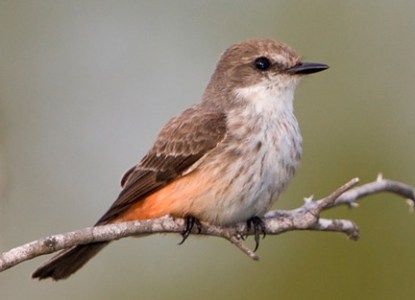
In drab contrast, the females have brown-grey plumage atop, with a whitish underside, featuring a whitish breast with mottled grey streaks, down to a lower belly of pinkish-peach plumage – somewhat like a juvenile Scissor-tailed Flycatcher, except the female Vermilion Flycatcher’s head is dark brown-grey. [See Roger Tory Peterson & Virginia Marie Peterson, A FIELD GUIDE TO WESTERN BIRDS (Boston: Houghton Mifflin, 1990), pages 230-231 and map M251.]  The Vermilion Flycatchers are relatively small birds, being only a fraction longer than 5 inches, and typically weighing less than a half-ounce!

Vermillion Flycatcher

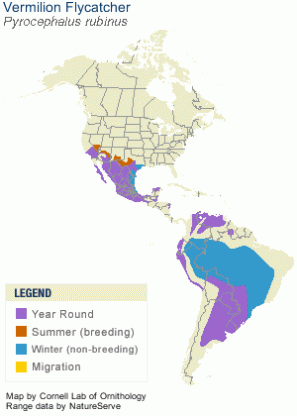
So where do Vermilion Flycatchers live? These aerial insectivores range widely in America’s Southwest  (mostly in the southern parts of California, Arizona, New Mexico, and Texas) and almost all of Mexico, plus southward into Central America (and even a few parts of South America).  Thus, the Vermilion Flycatcher is a year-round resident of the Chihuahuan, Sonoran, and Mojave Deserts.  Although the Vermilion Flycatchers generally prefer warm desert and semi-desert climes, they sometimes breed a bit north of their usual range, during spring-summer  —  such as in southern Nevada, where a pair was observed in the Great Basin scrubland near Reno, during mid-May of AD1981.  [See Fred A. Ryser, Jr., BIRDS OF THE GREAT BASIN (Reno: University of Nevada Press, 1985), page 346.]

A wide-ranging bird, this usually warm-climate passerine has even been observed crossing America’s northern border, up into Canada — and now there is even a webcam-verified report (4-17-AD2017) of a stray in Maine, on Hog Island [ see http://www.audubon.org/news/maines-first-verified-vermilion-flycatcher-captured-live-hog-island-web-cam ]!

Vermillion-Flycatcher-Range-MAP.Cornell

Geographically, speaking, what kind of habitats can be settled as “home” by Vermilion Flycatchers? Most places with adequate room for flying, and spying flies, will suffice, such as open meadows, farmland, ranchland, semiarid prairies, sagebrush-sprinkled scrublands, and brushy areas near water, such as desert streambanks, pond-edges, and mud-puddles  — i.e., wherever insects often congregate.  Their nests are known be constructed in cottonwoods, mesquites, oaks, sycamores, willows, especially alongside streambanks.

Although many birds of the desert and semi-desert scrublands are drab, including the Vermilion Flycatcher female, the Vermilion Flycatcher male is anything but drab! Its “fiery head” matches its scientific genus name, Pyrocephalus, and its species name, rubinus, reminds us of its ruby-like plumage.

Accordingly, as Pyrocephalus rubinus “watches from above” (with its “fun colors”, like the bright vermillion mentioned in Jeremiah 22:14),  we are reminded of how God Himself watches us from above,  providentially providing our lives with color and action and beauty,   —  maybe someday even including an opportunity to view a pair of Vermilion Flycatchers in America’s Great Southwest.      ><>  JJSJ

Vermillion-Flycatcher-on-post.LoisManowitz

FAIR USE IMAGE CREDITS:

Vermilion Flycatcher male perched on post: Lois Manowitz / Cornell

Vermilion Flycatcher atop thistle: Links of Utopia

Vermilion Flycatcher female flying:  Brent Paull

Vermilion Flycatcher male with dragonfly prey: Doug Greenberg / Arkive.org

Vermilion Flycatcher female perching: BirdFellow Productions

Vermilion Flycatcher female flying:  Jim Burns

Vermilion Flycatcher range map: Cornell Lab of Ornithology

Vermilion Flycatcher male & female: Arizona-Sonora Desert Museum

Sydney, wearing pierced-ear cross: Krista Ledbetter

s

Dueling with a Diamondback in the Desert: Roadrunner vs. Rattlesnake!

DUELING  WITH   A  DIAMONDBACK  IN  THE  DESERT:  ROADRUNNER  vs.  RATTLESNAKE!  

Dr. James J. S. Johnson

Let their table become a snare before them; and that which should have been for their welfare, let it become a trap.   (Psalm 69:22)

Roadrunner-approaches-coiled-Rattlesnake-in-desert

Sometimes hunting backfires: the hunter becomes the hunted!

Recall how Haman, in the Book of Esther, plotted to persecuted the Jews, to death, during his heyday in the Persian Empire?  The result was the opposite of his diabolical scheme, however – and it was the Jews who deftly ended as victors (over their persecutors), with Haman himself being hanged to death, on the very gallows that he had constructed for hanging his Jewish rival, Mordecai!(1)

Amazingly, the animal kingdom sometimes sees something comparable happen – such as the scrubland showdown that sometimes occurs when a rattlesnake decides to prey upon a roadrunner. For an action-packed documentation of such a do-or-die duel, see the National Geographic video footage (“Roadrunner vs. Rattlesnake”) posted at  http://video.nationalgeographic.com/tv/roadrunner-vs-rattlesnake  (slightly longer than 2 minutes).
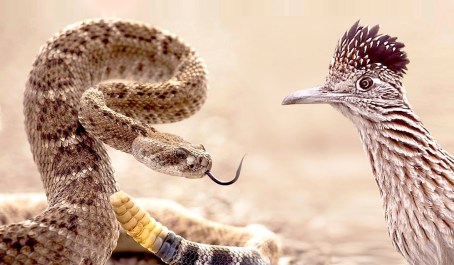
Rattlesnake-attacks-Roadrunner.Natl-Geo-youtube-pic

Hence, here is a poetic tribute (in limerick format) to the roadrunner, whom God caringly designed to “hold its own”, and then some (!), when dueling with a diamondback in the desert!

RATTLESNAKE  ATTACKS  MAMA  ROADRUNNER!

(JJSJ’s poetic review of predator-prey turnabout)

A rattlesnake, hunting for prey,

Met Mama Roadrunner that day;

The coiled snake grinned with glee,

But the fowl did not flee —

Thus, a bird, the snake aimed to slay.


The roadrunner brave, the snake brash;

Twin fangs lunged – but no gash!

The bird’s flesh he had missed —

The bird jumped, the snake hissed;

Again, the snake struck in a flash!

Rattler-fangs-ready2bite.Pinterest

Missed again! – the bird jumped aside!

Once again, snake-fangs were denied;

So the shrewd snake re-set,

As the bird watched the threat —

Then a target the roadrunner eyed.


The roadrunner now used her skill,

To bite the snake hard, with her bill!

Between the fangs, she had bit —

Vise-clamped bite! – she won’t quit!

Fangs dangling, the snake couldn’t kill!

Roadrunner-bites-Rattlesnake.Pinterest

Struggle, wiggle, — the trapped snake did strain,

To loose the bird’s grip, but in vain!

The bird’s bite, firm and fierce —

The snake’s fangs, naught could pierce;

The snake’s plight, now dire, with pain!

Roadrunner-biting-smashing-Rattlesnake-head

The bird aims – the snake’s head now bashed

On rocks, the snake’s head, thrashed and smashed.

Hammering the snake’s head,

Till it’s broken and dead —

The snake’s crown is thus cracked and crashed.

Roadrunner-biting-crushing-Rattlesnake-head

This showdown, so furious and fast,

Ends with the rattler breathing his last;

The snake thought he found prey,

But on that fateful day,

‘Twas the snake as roadrunner’s repast!
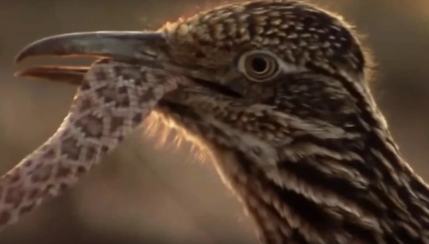
Roadrunner-eats-Rattlesnake.closeup

Of this duel, the moral is clear

(If, your own life, you would hold dear):

A predator, one day,

On the next, may be prey!

And Mama Roadrunner, you’d best fear!
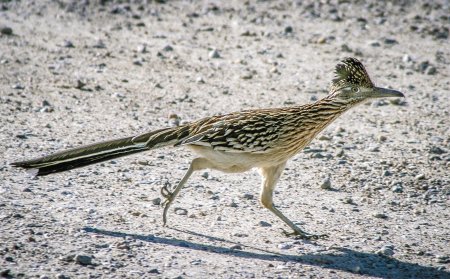
Roadrunner-in-desert.SanDiegoUnionTribune.jpg

Roadrunners are fast. These chaparral birds live in deserts and xeric scrub (such as sage-dominated scrublands), and in other rural and semi-rural regions of America’s Southwest, feeding on bugs, scorpions, lizards, and snakes.

But can roadrunners survive showdowns with diamondback rattlesnakes? Yes! Although roadrunners are famous for running from danger, they aggressively attack rattlesnakes, face to face—i.e., bill to fangs!  Amazingly, God has so designed the roadrunner that it can speedily aim at the face and fangs of a striking rattle, using its pointed bill to bite (and clamp) onto the rattler’s open mouth, between the upper fangs, rapidly lock-biting the snake in a death-grip. Then the bird repeatedly thrashes and crushes the serpent’s head against rocks—killing the rattlesnake. The victorious roadrunner then eats the dead diamondback!(2)

The arid, torrid wastelands that we call deserts are relatively inhospitable, for most creatures, yet God has providentially fitted some animals to fill desert habitats—such as desert rats, rabbits, roadrunners, and rattlesnakes.(3)

God loves variety!   (For some Bible-based analysis regarding this timeless truth, see “Valuing God’s Variety”, posted at http://www.icr.org/article/valuing-gods-variety/ .)

Desert-dwelling creatures — like Roadrunners (or Diamondback Rattlesnakes!)  —  daily demonstrate that fact, for those who have eyes to see.  And sometimes, if you happen to live in the America’s Southwest,  you need not journey all the way out to a desert, to see such God-created marvels as the resilient roadrunner.    (Meep, meep!)

Roadrunner-on-table

References

 (1)  Esther 7:10.

(2)  “Roadrunner vs. Rattlesnake”, National Geographic video clip, posted at http://video.nationalgeographic.com/tv/roadrunner-vs-rattlesnake .

(3)  Many creatures are providentially fitted to fill hot or cold desert (and similar xeric scrub) habitats, e.g., the Sage Grouse, named for its sagebrush-nesting habits and for eating sagebrush buds and leaves. See James A. MacMahon, Deserts (Alfred A. Knopf, 1986), especially page 583 & plate 545. See also, generally, Knut Schmidt-Nielsen, Desert Animals: Physiological Problems of Heat and Water (Dover Publications, 1979), especially pages 204-224 (desert birds) & pages 225-251 (desert reptiles).


PHOTO CREDITS:

Rattlesnake showdown with Roadrunner:  National Geographic video

Roadrunner approaching Rattlesnake: Viral Portal

Roadrunner bites Rattlesnake: Pinterest

Roadrunner biting/smashing Rattler: Viral Portal

Roadrunner thrashing/crushing Rattler’s head: National Geographic video

Roadrunner running in desert: San Diego Union Tribune

Roadrunner eating Rattle:  Kami.com

Roadrunner on patio table:  original source unknown / RockDoveBlog


Common Icterid, with Uncommon Beauty

Common Icterid, with Uncommon Beauty

Dr. James J. S. Johnson

Deck thyself now with majesty and excellency; and array thyself with glory and beauty.    (Job 40:10).

CommonGrackle-bronze-morph.RhodeIslandBirdHunter.jpg

One of the most spectacular icterids, known for its iridescent shine, is the Common Grackle. As I observed years ago, it is a sobering thought to realize that God could have – if He had chosen to – made me (or you) a grackle!  [See “Of Grackles and Gratitude”]

One birdwatcher in Maryland describes the Common Grackle as follows:

The common grackle (Quiscalus quiscula) is a widespread, common bird in the eastern United States.  Bigger than most other blackbirds [and robins], it stretches to about 12 inches from its long, tapered tail to its bill.  The black beak is prominent, more long than heavy.  Grackles stand on tall, stout black legs.  They prefer to forage on the ground but they will perch precariously if necessary to reach food.  The diet of the common grackle centers on grain, especially corn [i.e., maize].  Common grackles will descend upon a corn field from the moment it’s planted until it’s harvested.  Walking boldly behind planting equipment [!], they peck at newly sown seeds or unearthed grubs.  As the corn begins to tassel, they tear at maturing ears to eat growing cobs.  After the harvest, they descend [in a mob] like a dark cloud, eating any remaining kernels.  Common grackles do millions of dollars of damage [“robbing” cornfields] annually.  …  Though they prefer grains, grackles readily eat thistle, suet or sunflower seeds.  If those foods are not available, grackles will eat just about anything else on hand, including insects, frogs, mice, worms, other birds and even fish.  (Grackles wade into shallow water to nab schooling minnows.)  Discarded garbage [including fast-food litter] is another food source for these omnivores.

[Quoting Mike Burke, “Grackles’ Aggressive Behavior Not Helping its Survival – A Lesson?”, in CHESAPEAKE BAY JOURNAL, 27(3):39 (May 2017).

Ranging from the Midwest to the Eastern coastlands of America (plus some summer breeding ranges northward into central Canada), with most of their wintering range limited to the lands from the East Coast to the sates that straddle the Mississippi River Valley, the Common Grackle is known throughout most of America’s Lower 48 states.

But the Common Grackle’s iridescent plumage is its most conspicuous glory:

Common grackles display an odd geographic variation in color. Those south and east of the Appalachian Mountains [i.e., the so-called “Purple Grackle” variety] have an iridescent purple-blue head, purple belly, and blue-green tail.  Those north and west of the Eastern continental divide [i.e., the so-called “Bronze Grackle” variety of New England and west of the Appalachians] have blue-green heads and brassy bronze bodies.  From afar, all of the birds look black, but at closer distances the iridescent head is easily distinguishable from the glossy body.  Of course, there are exceptions, but generally the grackles in the Chesapeake [Bay] watershed have purple-blue heads.

[Quoting again from Mike Burke, “Grackles’ Aggressive Behavior Not Helping its Survival – A Lesson?”, in CHESAPEAKE BAY JOURNAL, 27(3):39 (May 2017).  Of course, these grackles are similar to the Boat-tailed Grackles that I’ve observed in Florida, and the Great-tailed Grackles that dominate Texas, but the tails of Common Grackles are not as conspicuously lengthy as those of its cousins in Florida and Texas.

CommonGrackle.BillHubick-photo

Like most grackles, the Common Grackle is noisy, gregarious (often congregating on power lines, or in trees near shopping centers), and confident (strutting about in parking lots, hunting for edibles discarded by humans).  Grackles are routinely bold, sometimes to the point of being aggressive.

But is this temperament-like habit a guarantee of the Common Grackle’s success?  Apparently not, according to the Breeding Bird Survey.

The North American Breeding Bird Survey is a joint venture of the U.S. Geological Survey and the Canadian Wildlife Service, for monitoring avian populations, provided time-indexed data that is relied upon for bird conservation policy and programs.  Because these voracious blackbirds are an expensive nuisance to crop farmers, their recent population decline is unlikely to evoke lamentations by crop farmers.

Common grackles are in serious decline. Although they seem to be expanding farther westward and they are still [very much] abundant, the population has fallen nearly 60 percent since 1966, according to the [often-relied-upon] Breeding Bird Survey.  Ornithologists are thus far stumped about why the bird’s abundance has fallen so significantly.

[Quoting again from Mike Burke, “Grackles’ Aggressive Behavior Not Helping its Survival – A Lesson?”, in CHESAPEAKE BAY JOURNAL, 27(3):39 (May 2017).

Could it be habitat loss?  Of course, the Eastern half of the United States continues to convert its croplands to urban and suburban development —  the farmlands of America continue to disappear all too quickly (and the Common Grackle’s “robberies” are not the main cause!).  The cornfields that I knew as a boy (and sometimes worked in), growing up in different parts of Maryland, have substituted housing complexes and shopping centers for what were cornfields (and other crop fields).   If the habitat shrinks, and the readily available food supply shrink, is it any wonder that the population shrinks too?

Another possibility should be considered, too, the empirical science may be less than accurate –  i.e., it may be that the grackle population measurements are not as reliable as the “authoritative” data that they are advertised to be.  To illustrate this possibility, consider how the Atlantic Sturgeon was lamented for years – by Chesapeake Bay bioscientists who opined that it was nearly extirpated, only to be embarrassed to learn that they were looking for the anadromous fish at the wrong season of the year, phenologically speaking, and the fish was actually thriving in some of the Chesapeake Bay’s tributary waters!  [For details on that empirical science foible, see “Anadromous Fish ‘that Swam with Dinosaurs’ Neither Extinct Nor Extirpated,” Creation Research Society Quarterly, 51 (3): 207-208 (winter 2015).]

But to close on a simpler note: the Common Grackle may be common in many parts of America, yet its beautiful shimmering and glossy iridescent colors are anything but common.   Only God’s artistry could design and build a blackbird that reflects sunlight with such majestic magnificence.


FAIR USE PHOTO CREDITS:

Bill Hubick, Maryland: Common Grackle (bold pose & hungry pose)

Jason Major, Rhode Island:  Common Grackle perching (bronze variety)


Home, Home on the Sage: Nothing to Grouse about!

HOME, HOME ON THE SAGE:  NOTHING TO GROUSE ABOUT!

Dr. James J. S. Johnson

And it came to pass, that at even the quails came up, and covered the camp: and in the morning the dew lay round about the host.   (Exodus 16:13)

Among ground-fowl birds there are some galliforms – called Phasianidae – that resemble one another enough that they are often grouped together, taxonomically, as if they are all super-family “cousins”:  quails, pheasants, partridges, ptarmigans, chickens, peafowl, and grouse-fowl.  One of these Phasianid galliforms, almost the size of a turkey,  will now be considered:  the Greater Sage Grouse.  Since one of the bird’s favorite foods is sagebrush leaves, it is no wonder than the quail-like fowl is often found nesting or foraging in sagebrush-dominated terrain.  Sage grouse eat other leaves as well, if and when accessible, as well as buds, forbs, flowers and bugs.  Insects often eaten by sage grouse include grasshoppers, beetles, and ants.

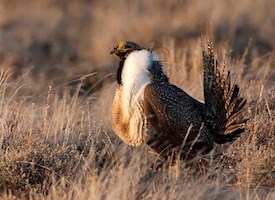
GreaterSageGrouse.Wikipedia

Greater Sage Grouse   (Centrocercus urophasianus), photo credit: Wikipedia

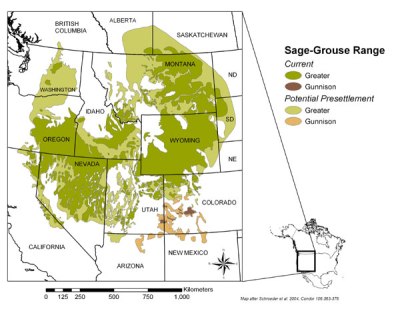
The GREATER SAGE GROUSE routinely inhabits the Great Basin Desert, thriving in xeric shrublands, a dry steppe-like blend of desert and scrub-grasslands, as well as other sagebrush-dominated lands east of the Great Basin [see Fort Collins Science Center range map, for America’s Sage Grouse].  To appreciate the Greater Sage Grouse’s scrubland habitat, a quick review of the Great Basin Desert is worthwhile.

SageGrouse-RangeMap.FortCollinsScienceCenter

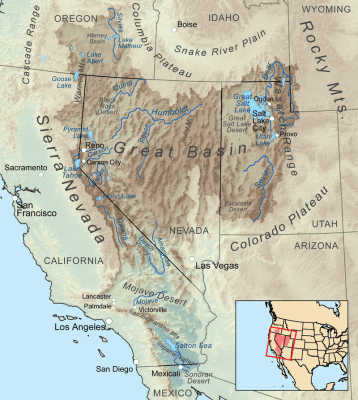
The “Great Basin” Desert is not the typical “desert” of hot, hot, dry, dry mostly-barren land, studded with cactus and sagebrush vegetation. Rather the Great Basin Desert is a “cold” scrubland desert, meaning that it is dry most of the year, but its temperatures are not hot year-round – in fact, it usually gets more annual precipitation via snowfall than by rainfall.  In other words, the Great Basin is dry enough to qualify as a “desert” (and thus it is not “covered” by forests or grasslands, and typically hot during summer, yet it get quite cold in the winter, with snow winters as the norm.  In this respect the Great Basin is in a class by itself, in North America, unlike America’s other 3 major deserts (the Sonoran, Chihuahuan, and Mojave deserts) which hare truly “hot deserts”. [See map of the Great Basin Desert, below, compliments of Wikipedia.]

GreatBasinDesert-MAP.Wikipedia.png

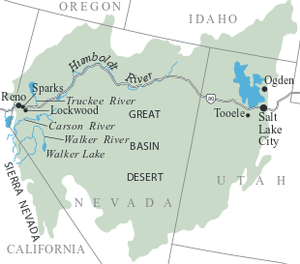
Ecologicallly speaking, the Great Basin includes a mix of rocky soils and scrublands, many dominated by sagebrush, greasewood, saltbush and salty-soil areas, mudflats, and sand dunes, as well as pinyon-juniper woodlands in higher elevations. Geographically speaking, the Great Basin covers almost all of Nevada, plus western Utah, a bit of southern Idaho, and part of the south-central part of Oregon.  [See map, below, compliments of the U.S. Geological Survey, a bureau of the U.S. Department of the Interior.]

GreatBasinDesert-MAP.USGS

Great Basin Desert, USGS map [public domain]

Since the Great Basin Desert is not hot year-round, but routinely experiences snowy winters, its inhabitants must apply climate-response strategies that successfully resolve temperature extremes, such as how to deal with hot and dry summers, plus cool-to-cold winters. Some Great Basin animals migrate, seasonally, while other hibernate, to avoid the inconveniences of snowfall and frigidity.  But how do Greater Sage Grouse deal with the seasonal “climate change” challenges of the Great Basin?

Sagebrush-terrain.Defenders-of-Wildlife-Blog-ScottSmith.jpg

Sagebrush-dominated terrain (photo credit: Scott Smith / Defenders of Wildlife Blog)

In short, the sage grouse stay put, for the most part, throughout all or most of the year.  [See Roger Tory Peterson, A FIELD GUIDE TO WESTERN BIRDS (Peterson Field Guides / Houghton Mifflin, 1990), pages 158-159 & Map 96.]  If need be, however, they “micro-migrate” to other nearby areas, although usually only for relatively short distances, so they are not true “migrants”, phenologically speaking.  In other words, depending upon the severity of winter weather, sage grouse may undertake short-distance migrations, to find user-friendly winter habitat, going as far as 100 miles if necessary, although less than 20 miles is more typical.

SageGrouse-with-Pronghorn.sagebrush.jpg

Sage Grouse, with Pronghorn, in sagebrush  (photo credit” Defenders of Wildlife Blog)

Consider the following facts, summarized by the U.S. Fish & Wildlife Service, about the Greater Sage Grouse:

Greater sage-grouse (Centrocercus urophasianus) are members of the Phasianidae family. They are one of two species; the other species in the genus is the Gunnison sage-grouse (Centrocercus minimus). The Greater sage-grouse is the largest North American grouse species. Adult male greater sage-grouse range in length from 26 to 30 inches and weigh between 4 and 7 pounds. Adult females are smaller, ranging in length from 19 to 23 inches and weighing between 2 and 4 pounds.  During the spring breeding season, male sage-grouse gather together to perform courtship displays on areas called leks. Areas of bare soil, short-grass steppe, windswept ridges, exposed knolls, or other relatively open sites typically serve as leks, which are often surrounded by denser shrub-steppe cover, which is used for escape, thermal and feeding cover. The proximity, configuration, and abundance of nesting habitat are key factors influencing lek location. Leks can be formed opportunistically at any appropriate site within or adjacent to nesting habitat. Therefore, lek habitat availability is not considered to be a limiting factor for sage-grouse. Leks are indicative of nesting habitat.   Productive nesting areas are typically characterized by sagebrush with an understory of native grasses and forbs, with horizontal and vertical structural diversity that provides an insect prey base, herbaceous forage for pre-laying and nesting hens, and cover for the hen while she is incubating. Shrub canopy and grass cover provide concealment for sage-grouse nests and young, and are critical for reproductive success. The average distance between a female’s nest and the lek on which she was first observed ranged from 2.1 mi to 4.8 mi in five studies examining 301 nest locations, but actual distances can be highly variable. Male sage-grouse do not participate in nesting or rearing of the chicks.   …

During the spring and summer sage-grouse will primarily eat insects and forbs, but they rarely stray from the edge of sagebrush, which provides cover year round. In the fall, sage-grouse shift their diet entirely to sagebrush, depending on the shrub for both food and cover. Sage-grouse obtain their water from the food they eat. However, they will drink water if available. …  Currently, greater sage-grouse occur in 11 States (Washington, Oregon, California, Nevada, Idaho, Montana, Wyoming, Colorado, Utah, South Dakota, and North Dakota), and 2 Canadian provinces (Alberta and Saskatchewan), occupying approximately 56 percent of their historical range. Approximately 2 percent of the total range of the greater sage-grouse occurs in Canada, with the remainder in the United States. Sage-grouse have been extirpated from Nebraska, British Columbia, and possibly Arizona. Current distribution of the greater sage-grouse is estimated at 258,075 mi2. Changes in distribution are the result of sagebrush alteration and degradation [because sage grouse depend heavily upon sagebrush for their habitat needs]. …

[Quoting from USFWS, “Beginner’s Guide to Greater Sage-Grouse”.]

So there you have it, Sage Grouse like to live around — and eat — desert scrub sagebrush, so expect to find them living in the sagebrush-dominated areas of the Great Basin Desert..  Perhaps they also have a “dry” sense of humor!


GreaterSageGrouse.Cornell-StephenParsons

Featured image photo credit:  Stephen Parsons / Cornell

Lee’s Three Word Wednesday – 4/26/17

***

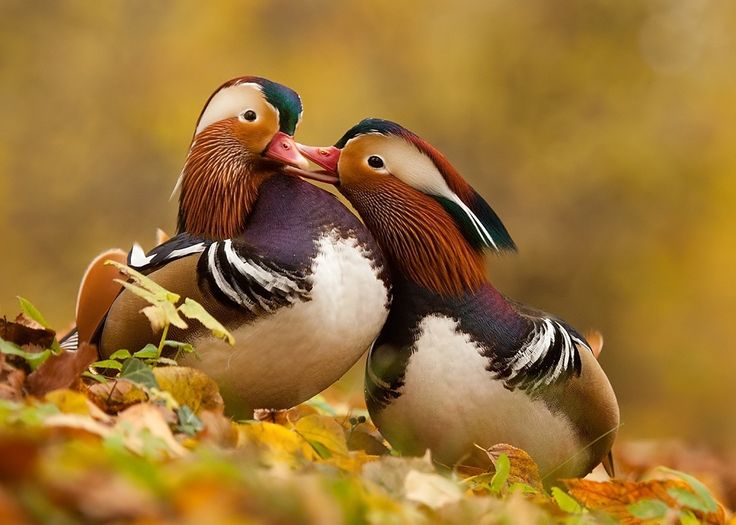
Wood Duck (Aix sponsa) Shuting Mouth ©S-Media-Cache

SHUT THEIR MOUTH

***


“So shall he sprinkle many nations; the kings shall shut their mouths at him: for that which had not been told them shall they see; and that which they had not heard shall they consider.”  (Isaiah 52:15)

Wood Duck (Aix sponsa) Shuting Mouth ©S-Media-Cache

*

More Daily Devotionals

Why Kangaroo Rats Don’t Get Dehydrated in the Desert

An interesting article by Dr. Jim, JJSJ. I am reposting it here. The Lord’s amazing Providential Design is beyond our human comprehension of His Love and Care for all critters.

JJSJ's avatarrockdoveblog

Behold, the hindermost of the nations shall be a wilderness, a dry land, and a desert. (Jeremiah 50:12b)

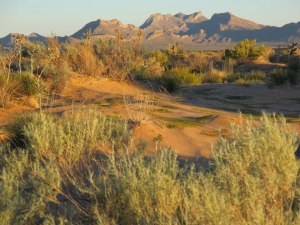
DESERT SCRUBLAND near EL PASO, TX photo credit: Pinterest

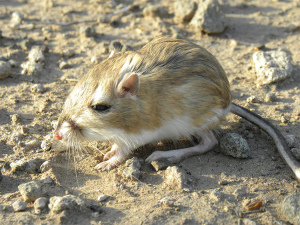
Kangaroo rats thrive in America’s hot, dry deserts — why don’t they suffer from being dehydrated?  How do they get enough water to survive, since they don’t need to drink water like almost all other mammals?   In short, God has designed and constructed kangaroo rats so that they get their water from their food, especially drought-resistant seeds that abound in the desert.  As they digest such xeric foods, the rats produce (within themselves) all the water that they need, metabolically (i.e., from the normal digestion process), and they retain most of that water by releasing very little of it in their urine (as noted below).

In sum, kangaroo rats are made to get their water form their food and to conserve it…

View original post 1,055 more words

Lee’s Seven Word Sunday – 4/23/17

***

Black-cheeked Lovebird (Agapornis nigrigenis) ©ImagesFromAfrica

FOR WHERE YOU GO, I WILL GO

AND WHERE YOU LODGE, I WILL LODGE

***


“And Ruth said, entreat me not to leave thee, or to return from following after thee; for where you go, I will go; and where you lodge, I will lodge: thy people shall be my people, and thy God my God.  (Ruth 1:16)

Name and Credit for Bird Photo

*

More Daily Devotionals

Lee’s Six Word Saturday – 4/22/17

***

Three Geese Heading Out ©Photofeathers

SURELY WE WILL RETURN WITH THEE

***


“And they said unto her, Surely we will return with thee unto thy people.”  (Ruth 1:10)

Three Geese Heading Out ©Photofeathers

*

More Daily Devotionals

*

Lee’s Five Word Friday – 4/21/17 ex

***

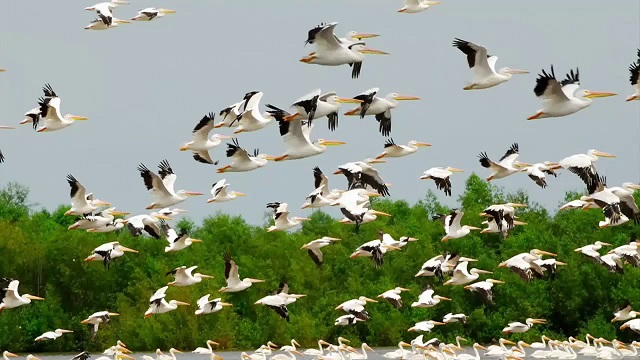
American White Pelican (Pelecanus erythrorhynchos) ©WTTW

ON THE WAY TO RETURN

***


“Wherefore she went forth out of the place where she was, and her two daughters in law with her; and they went on the way to return unto the land of Judah.”  (Ruth 1:7)

American White Pelican (Pelecanus erythrorhynchos) ©WTTW

*

More Daily Devotionals

*

Lee’s Four Word Thursday – 4/20/17

***

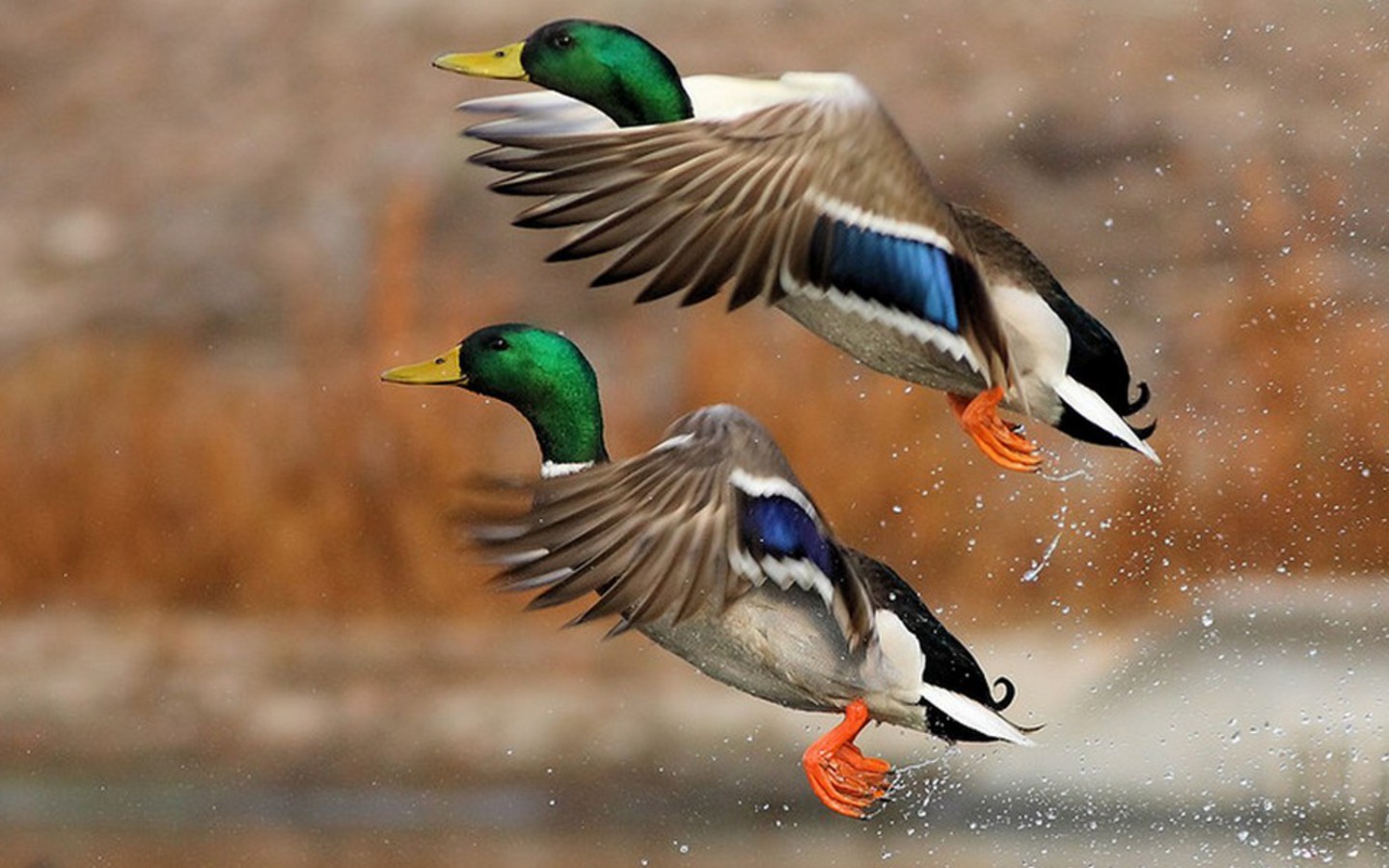
Two Mallards Taking Off ©WallpaperSafari

SO THEY TWO WENT

***


So they two went until they came to Bethlehem. And it came to pass, when they were come to Bethlehem, that all the city was moved about them, and they said, Is this Naomi?  (Ruth 1:19)

Two Mallards Taking Off ©WallpaperSafari

*

More Daily Devotionals

*