The IOC World Bird List 14.1 contains 11032 extant species (and 162 extinct species) classified in 44 Orders, 253 Families and 2,384 Genera. The list also includes 19,802 subspecies, their ranges and authors.
Before we can dig into these Latin/scientific names of birds, it is best to update the number of birds now listed by the I.O.C. Our last update here, which is out of date, was the List 9.2:
At the time those articles were written there were 10,758 living species. Now it contains 11,032. That doesn’t include all the subspecies. Not sure how much we will update this site, but I will refer to the new names and subspecies as we investigate the scientific/Latin names of birds.
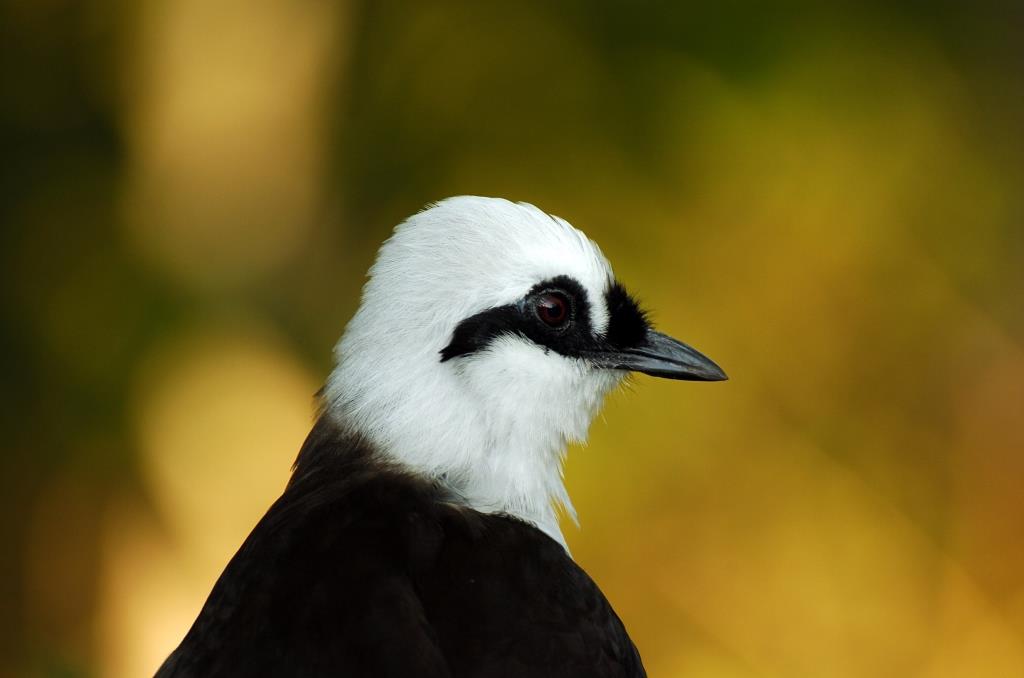
Sumatran Laughingthrush (Garrulax bicolor) by Dan at Wing of Asia ZM
Here is a listing, with of all the current Birds of the World which is better than any list we could produce here.
The last few articles have been to lay the foundation for investigating some of these Scientific/Latin names for birds. Below are links to the experts in keeping track of the Avian Wonders:
While researching for a way to present birds from their Latin names, I checked out some of our previous posts that mentioned the naming of birds. There have been quite a few articles about this, and here is a fantastic one that William Wise wrote:
William said exactly what I was thinking “It’s all Greek to me!” He also explains about God’s Name. It NEVER changes.
American Robin (Turdus migratorius) eating by Jim Fenton
How Birds are Named explains the modern naming system that is used for birds.
“Birds have two kinds of names. One is a common, vernacular, or popular name; the other is a technical or scientific name. The first is usually given to the living bird by the people of the country it inhabits. The second is applied to specimens of birds by ornithologists who classify them.
Common names in their origin and use know no law. Technical names are bestowed under the system of nomenclature established by Linnæus and their formation and application are governed by certain definite, generally accepted rules. The Linnæan system, as it is now employed by most American ornithologists, provides that a bird, in addition to being grouped in a certain Class, Order, Family, etc., shall have a generic and specific name which, together, shall not be applied to any other animal.
Our Robin, therefore, is classified and named as follows:
The Genus and the Species names are the ones that will be emphasized in the new series, (name to be determined, any suggestions?). The recent articles and the list below are listed to acquaint you with how the Genus and Species are used in the bird names.
Stay tuned!
“I know all the birds of the mountains, And the wild beasts of the field are Mine.”
(Psalms 50:11 NKJV)
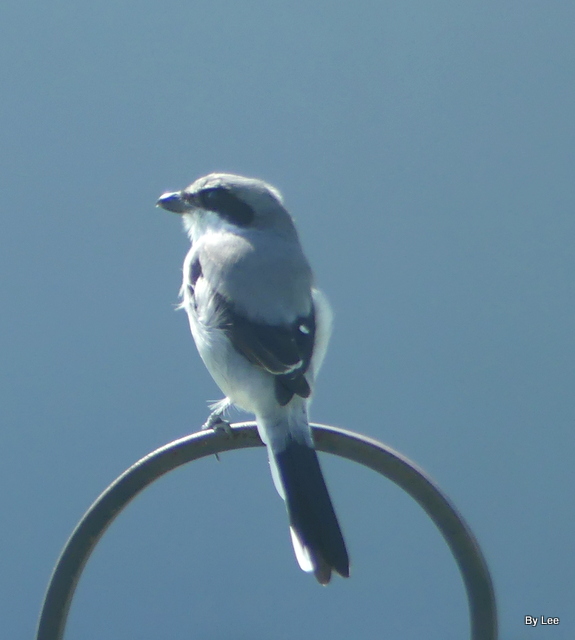
Loggerhead Shrike on Bench outside our back patio door.
“Look at the birds of the air, for they neither sow nor reap nor gather into barns; yet your heavenly Father feeds them. Are you not of more value than they?” (Matthew 6:26 NKJV)
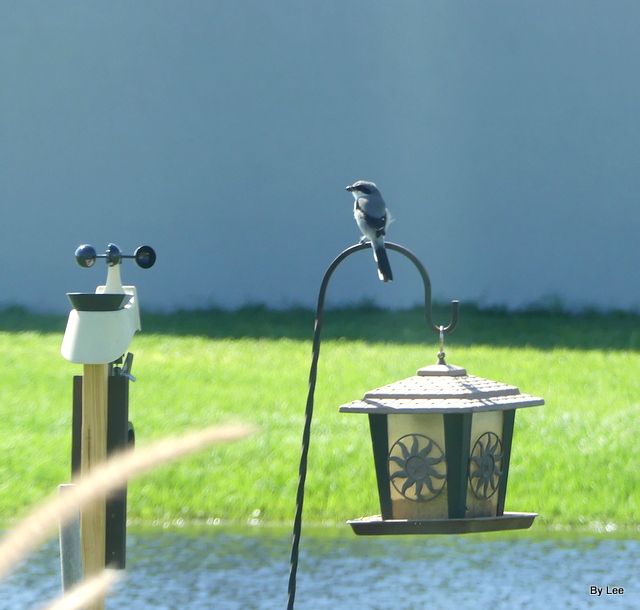
While eating our supper this evening, our friendly Loggerhead Shrike showed up again. He landed on his favorite perch, the hook out in the yard. (these are older photos, who keeps a camera at the table?)
Loggerhead Shrike (Lanius ludovicianus) on hook – by Lee Closeup
He and the Mockingbird takes turns using that favorite spot to land and watch for breakfast, lunch, or dinner. We see both of them quite often, especially this time of the year.
In case you’re curious, the Latin name Lanius is Great Grey Shrike. The ludovicianus means “butcher” and laniare – “to tear to pieces.” They have been referred to at times a “butcher birds” because of what they do to their victims.
We have featured quite a few articles about this beautiful bird, and here is one, written by JJSJ, “Dr. Jim”, that tells and shows the “butcher bird” at work:
Thankfully, we haven’t found any of these kinds of catches hanging around in our yard!
Just thought I’d share our latest visitor to the yard. I’m sure he will migrate north soon, but hopefully we will see him in the fall again. I still never cease to be amazed by the Lord’s designs in His Creation!
Check out some of the many articles about this beautiful bird that we have written about before:
Here’s an interesting video of a friendly crow in Denmark who has befriended a youngster. Trust you will enjoy watching the interactions between them.
“For every kind of beast and bird, of reptile and creature of the sea, is tamed and has been tamed by mankind.” (James 3:7 NKJV)
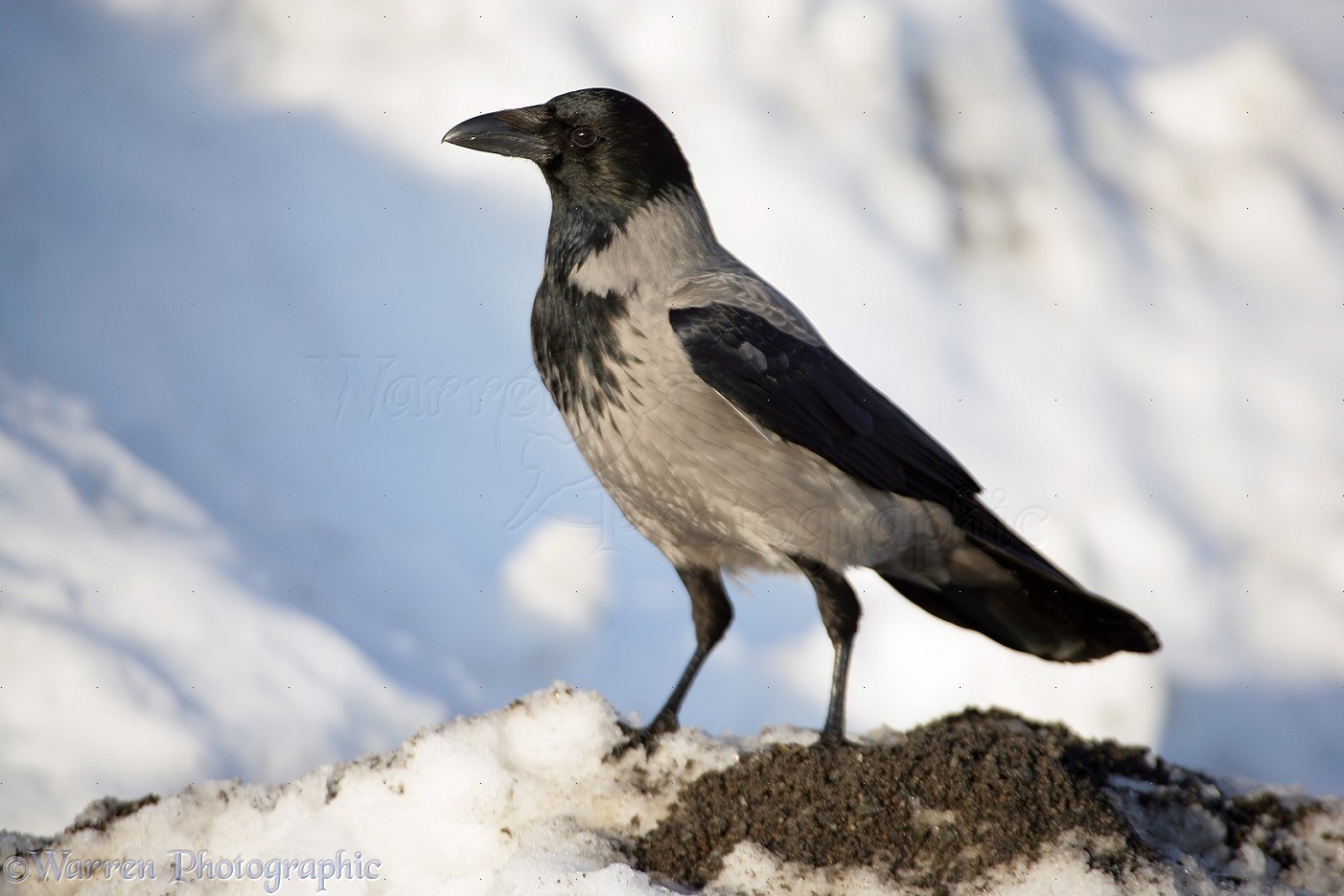
I believe this is a Hooded Crow.
Hooded Crow. Warren Photographic
The Hooded Crow, also called the scald-crow or hoodie, is a Eurasian bird species in the genus Corvus. Widely distributed, it is found across Northern, Eastern, and Southeastern Europe, as well as parts of the Middle East. It is an ashy grey bird with black head, throat, wings, tail, and thigh feathers, as well as a black bill, eyes, and feet. Like other corvids, it is an omnivorous and opportunistic forager and feeder. Wikipedia
Dr. “Jim” (James J. S. Johnson) shared this with me and asked me (Lee) to post it. He’s tied up in a conference.
I would like to apologize for my lack of posting any articles since back in February of this year. (More explanation later.) What I am really thankful for is Dr. James J.S. Johnson, Dr. Jim, as Dan and I affectionately call him.
THANK YOU, DR. JIM!
Also a Hugh THANK YOU to all of you who have continued to stop by this blog. Many of you have read and commented of his articles and other previously published posts.
Black-bellied Whistling Ducks feeding in yard.
Back in February, a number of health problems began, and it seemed like about the time I improved, some other issue came up. It seems that it has just been one thing after another. Needless to say between Doctor visits, physical therapy, medical test, using cane or walker, etc. etc., birdwatching has come to a halt other than my view out the back door.
“God is faithful, by whom you were called into the fellowship of His Son, Jesus Christ our Lord.” (1 Cor. 1:9)
That top photo about describes the lack of birds lately. Like many of you around the country and parts of the world, we have had some very high heat indexes. Plus, the wintering birds have not arrived yet.
Other than Muscovy Ducks and the neighborhood Robins and Doves, there hasn’t been much going on.
Lord willing, I trust that there will be more post from me. Now that I’m improving some, I will try to at least write more about God’s amazingly Created Avian Wonders. Stay tuned!
Thanks again to all our visitors to this blog and “Dr. Jim” for keeping us blessed by his great articles.
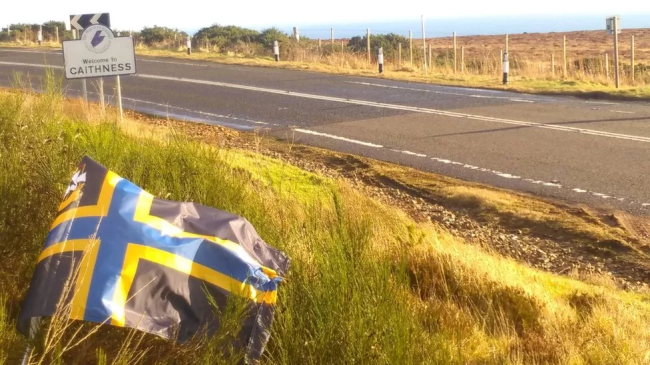
County Caithness Can Now Rave about their Raven Flag
Dr. James J. S. Johnson
CAITHNESS flag by roadside (BBC photo credit)
Who provides for the raven his food? — when its young ones cry unto God, they wander for lack of meat.
( Job 38:41 )
Having a bird featured upon an official flag is nothing new, so the above flag of Scotland’s County Caithness, which became official (ceremonially celebrated January 26th of A.D.2016) is not a novel concept.
Flag Institute unveiling of County Caithness flag (BBC photo credit)
However, that vexillological event was and is worth noticing, especially to all of us who appreciate ravens — including Mrs. Lee Dusing, and the rest of us who appreciate her world-class bird-blog! (E.g., see one of Lee’s several blogposts, on ravens (and other corvids), at https://leesbird.com/2013/07/03/birds-of-the-bible-raven-iii/ .)
In fact, the first bird to be named (by its kind) within the Holy Bible was a raven. WOW! That’s quite an incomparable honor!
And he [i.e., Noah] sent forth the raven [‘ōrēb], which went forth to and fro, until the waters were dried up from off the earth.
( Genesis 8:7 )
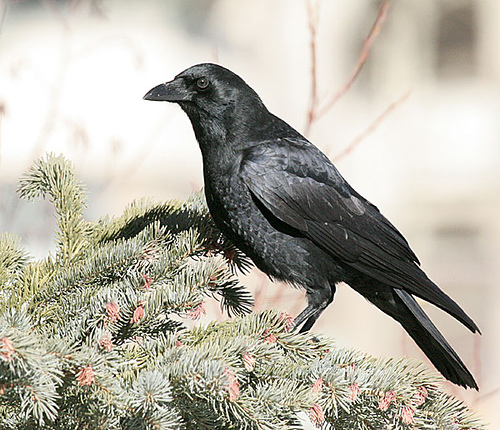
COMMON RAVEN of North America (Wikipedia photo credit)
Likewise, the godly Bible translator and leading Reformer, Dr. Martin Luther, carefully observed and appreciated flocks of ravens (and jackdaws, their corvid cousins), during the adventurous times of the Protestant Reformation’s first generation in Germany. (See “A Diet of Jackdaws and Ravens”, posted at https://leesbird.com/2015/09/16/a-diet-of-jackdaws-and-ravens/ .)
Obviously, ravens are special birds, because God providentially cares for their kind — and tells us so in the Scriptures!
For example, in the Old Testament, within God’s creation sermon to the patriarch Job, Job was questioned about how God takes spare of ravens.
Who provides for the raven his food? — when its young ones cry unto God, they wander for lack of meat.
( Job 38:41 )
Likewise, in the New Testament, the Lord Jesus Christ refers to God’s provision for the physical needs of ravens.
Consider the ravens: for they neither sow nor reap; which neither have storehouse nor barn; and God feeds them; how much more are ye better than the fowls?
( Luke 12:24 )
Ravens are something to rave about!
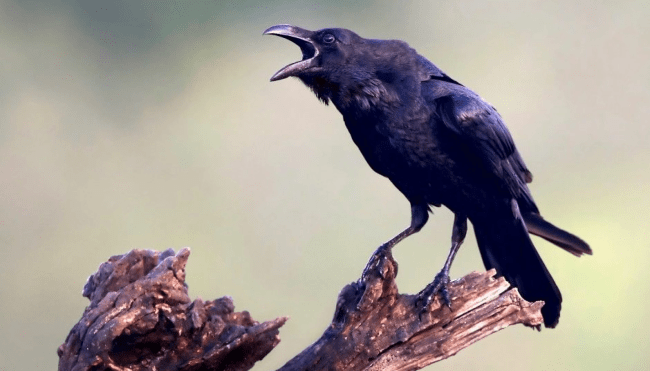
RAVEN in Norway ( ScienceNorway.NO Dennis Jacobsen, Colourbox photo credit )
ISLE OF MAN’s Coat of Arms, with Peregrine and Raven (public domain)
In fact, this Christian birdwatching blog has previously blended ornithology (i.e., systematic study of birds) with vexillology (i.e., systematic study of flags). Specifically, years ago (during A.D.2015), this bird-blog features a mini-series captioned “FLAG THAT BIRD!” — about flags of the world that feature a bird.
So, this blogpost, celebrating the Caithness Raven, now succinctly supplements that ornithological-vexillological series.
Official flag of Scotland’s County CAITHNESS (public domain image)
Caithness thus celebrates its Viking heritage, with a flag that contains a Nordic cross, plus the raven of antiquity, well known to Viking literature, along with a galley ship, reminiscent of ocean-faring adventures of northeastern Scotland’s Viking forebears, some who came as visitors, yet many who settled as immigrants, blending in with native Celts, providentially producing future generations of Count Caithness natives (Psalm 102:18).
In the First Bird Species Named post, you found out that it was the Raven that was sent out first from the Ark. He never came back in, but may have landed on it now and then. The Raven family has a very resourceful way of finding and collecting food and objects.
Today there are several species in the Raven family (Covidae). Of course, not all of those species were on the Ark. They spread out and reproduced after their kind. “every raven after its kind,” (Lev 11:15)
As was pointed out in that article, how the ravens came and fed Elijah. They brought him bread and flesh. (I Kings 17:6) But where do the Ravens get their food? (Job 38:41)
Much has been written about these interesting birds here over the years. Here are some of the links to help you find out more about the Ravens and their kind:
“A time to weep, And a time to laugh; A time to mourn, And a time to dance;” (Ecc 3:4)
I apologize for not posting lately but was sick with food poisoning that zapped me for a while. All is well now and hope to get back to the Birds of the Bible II series.
Drop a comment and help decide which to use. For today’s article, I stuck with “Looking Back.”
To begin this series, I found all the post that looked back over the Anniversaries of Lee’s Birdwatching Adventures Plus. If you scan through them, you will discover why it was started and how the Lord has been blessing it over the years. As different writers began adding articles, photographers gave permission to use their photos, and linked their websites, the blog has continued to grow.
As we head into the new year, 2023, many like to look back over the last year. They find many good memories and blessings, plus a few not so pleasant ones. Many of you liked and made remarks about the Christmas Bird Review series (that was just completed). It seems you do not mind looking back.
That thought started me thinking about a new series that we could begin. “Looking Back – “, “Reviving the Past – “, or some other name to give it. ANY IDEAS?
Hornbill at Brevard Zoo by Dan Aug-2014
Many of you have chosen to follow this blog through many years, and some have just begun following us.
How did this all begin? Purpose?
When did it begin?
What topics have we covered?
What Birds have we highlighted?
Who have been the writers and photographers over the years?
As many know, I have been dealing with medical issues which have slowed our birding adventures down considerably. I still watch birds, but on a more limited basis. Having just received a new computer, and trying to transfer photos over to it, I have been finding photos that could be used to update or enhance updates.
I especially am thinking about the original purpose, which was to show and thank the Lord for all the Birds of the Bible.
“I will give You thanks in the great assembly; I will praise You among many people.” (Psalm 35:18)
This is from the main page Menu. As of today (Dec 30, 2022), that number is:
2,371,257 visits
THANKS TO VISITORS
Moved to WordPress
00,000 – July 05, 2008
50,000 – Oct 10, 2009
100,000 – Apr 5, 2010
150,000 – Sep 6, 2010
200,000 – Dec 30, 2010
250,000 – Apr 9, 2011
300,000 – June 29, 2011
350,000 – Sep 19, 2011
400,000 – Nov 18, 2011
450,000 – Jan 21, 2012
500,000 – Mar 1, 2012
600,000 – May 24, 2012
700,000 – Sep 2, 2012
800,000 – Dec 16, 2012
900,000 – Ap 13, 2013
1,000,000 – Oct 20, 2013
2,200,000 – Jun 5, 2021
So, what are your thoughts? Please leave a comment, or at least a like. And even a suggestion for a series title.
Thanks for all your visits, likes, and remarks over the years.
Here is a new Christmas Birds. These are some of my favorite photos of the Lord’s Creatures that we have taken over the years. I would most likely put them in the Ornament or just Favorites category. (This just a sampling)
“Thanks be to God for His indescribable gift!” (2Co 9:15) “For by grace you have been saved through faith, and that not of yourselves; it is the gift of God, not of works, lest anyone should boast.” (Eph 2:8-9);
We have the Greatest gift of Christ as the Savior, and as the Creator of all these beautiful birds that we have had the privilege to see, some up very close.
*
This slideshow requires JavaScript.
“Beloved, let us love one another, for love is of God; and everyone who loves is born of God and knows God. He who does not love does not know God, for God is love. In this the love of God was manifested toward us, that God has sent His only begotten Son into the world, that we might live through Him. In this is love, not that we loved God, but that He loved us and sent His Son to be the propitiation for our sins. Beloved, if God so loved us, we also ought to love one another.” (1Jn 4:7-11)
*
“Jesus Loves Me” by Bonnie Standifer
This piece was written and played by Bonnie Standifer. Played at our Orchestra Concert in March of 2013 at Faith Baptist Church. You have never heard it played this way before. Bonnie is a very gifted arranger and pianist. (I’ve used her song before, but it is so fantastic.)
Here are the last of the Christmas Birds. The colors and designs would be pretty in ornaments. But most of all, they are superb examples of the Lord’s omniscient creative designs.
He was in the world, and the world was made by him, and the world knew him not. He came unto his own, and his own received him not. But as many as received him, to them gave he power to become the sons of God, even to them that believe on his name:.. And the Word was made flesh, and dwelt among us, (and we beheld his glory, the glory as of the only begotten of the Father,) full of grace and truth. (John 1:10-12, 14 KJV)
*
This slideshow requires JavaScript.
Whose adorning let it not be that outward adorning of plaiting the hair, and of wearing of gold, or of putting on of apparel; But let it be the hidden man of the heart, in that which is not corruptible, even the ornament of a meek and quiet spirit, which is in the sight of God of great price. (1 Peter 3:3-4 KJV)
*
Music to listen to while viewing the photos. “Ring The Bells” – Men’s Quartet – Faith Baptist 2012











 Lee's Birdwatching Adventures Plus
Drop a comment and help decide which to use. For today’s article, I stuck with “Looking Back.”
To begin this series, I found all the post that looked back over the Anniversaries of Lee’s Birdwatching Adventures Plus. If you scan through them, you will discover why it was started and how the Lord has been blessing it over the years. As different writers began adding articles, photographers gave permission to use their photos, and linked their websites, the blog has continued to grow.