***
WATER TO DRINK
***
“Prove thy servants, I beseech thee, ten days; and let them give us pulse to eat, and water to drink.” (Daniel 1:12 KJV)
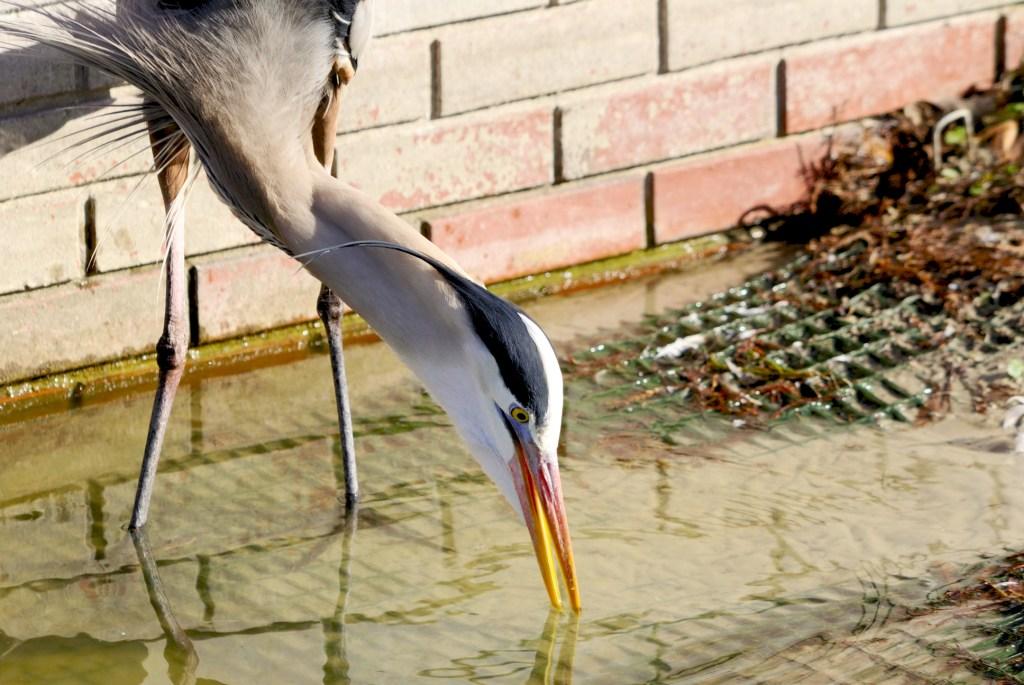
Great Blue Heron (Drinking) at Lake Morgan by Dan
*
*
“Prove thy servants, I beseech thee, ten days; and let them give us pulse to eat, and water to drink.” (Daniel 1:12 KJV)
Great Blue Heron (Drinking) at Lake Morgan by Dan
*
*
One of the birders that I follow, has a Channel on YouTube, VideoBirder of their birdwatching videos. This Prothontary Warbler, shows the difficulty that photographers and videographers have of trying to catch a bird. They flit all over the place and if your lucky or blessed, you may get a brief view. In this video, this beautiful bird sings, and then off he goes again.
But seek ye first the kingdom of God, and his righteousness; and all these things shall be added unto you. Take therefore no thought for the morrow: for the morrow shall take thought for the things of itself. Sufficient unto the day is the evil thereof. (Matthew 6:33-34 KJV)
As I was watching that video and thinking about the verse above, why do we worry or fret? Sometimes life is like that bird. We are busy going from here to there. Some times you can see him clearly and so in life things seem clear and we have “smooth sailing.” Other times, that bird is hidden behind the branches and you can’t see it so clear. In our lives things can have “bumps in the road” or problems that show up. Yet, the Lord knows all about it and guides us through those rough parts of our walk through life.
Right now, Dan and I have been dealing with health issues. One reason you have not seen very few, if any “birdwatching adventures” lately, is because we haven’t been on any adventures. At least not that kind. I am so thankful for James J. S. Johnson and Emma Forster for helping supply articles for the blog. Others have sent emails with birds which we have placed on the blog. Even the daily devotionals have helped keep this blog active. Dr. Jim, (James Johnson) as I call him, has even been helping with ideas for the devotionals.

Prothonotary Warbler (Protonotaria citrea) In a cavity nest ©WikiC
So, if you have wondered where the “adventures” have been, now you know.
First I slipped the disc in my back, back in the fall, and I have been living with that. Made it almost through the winter and caught Bronchitis, which usually last longer than I would like. Now Dan, who is our main photographer, at least the better one, has been dealing with something for almost the last two months. Even spent time in the hospital last week, and we are still dealing with tests and Doctor visits.
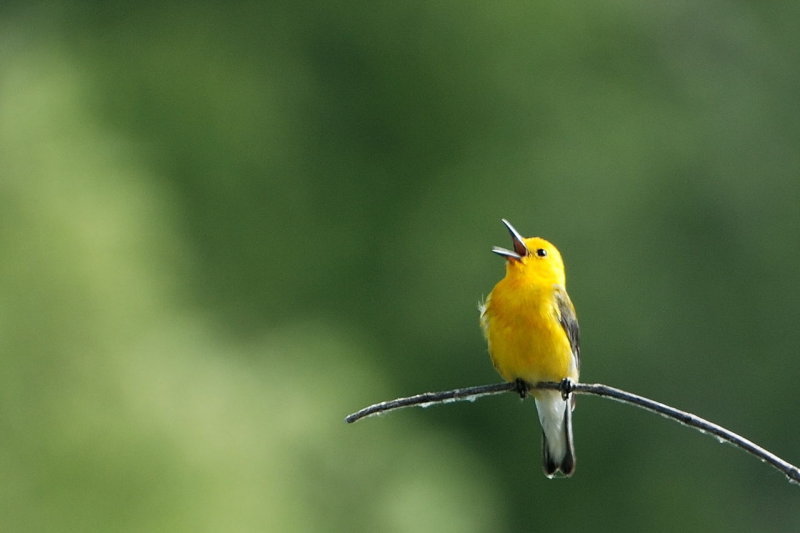
Prothonotary Warbler (Protonotaria citrea) Neal Addy Gallery
Like the bird, we are flitting here and there, yet, we can still sing. We have a Savior, the Lord Jesus Christ, who knows all about our issues and none of this is catching Him by surprise. He knows what the outcome will be of the tests, diagnosis, and cure. Dan has lost quite a bit of weight and is still weak, plus other issues. We are just resting and trusting in Him. Many of our friends are praying to us and your prayers will also be appreciated.
If a day gets missed and no blog comes out, this may give you an idea why. We are looking forward to getting back out there birdwatching and trying to catch a photo of birds like that Prothontary Warbler, or a Warbler we see here. Lord’s Blessings on all of you.
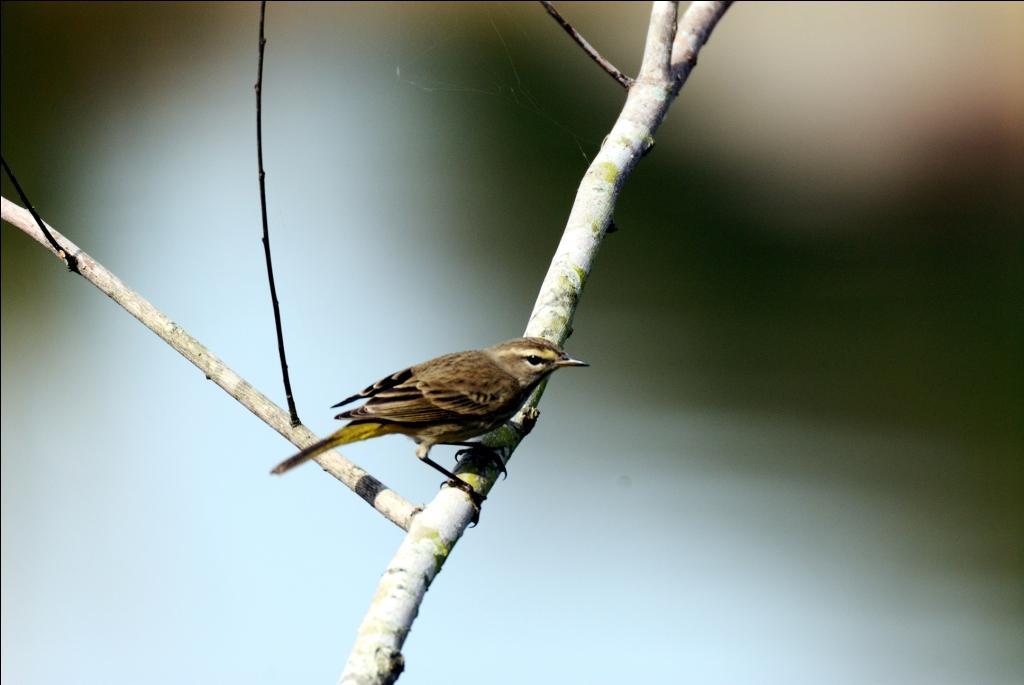
Palm Warbler by Dan
“Fear ye not therefore, ye are of more value than many sparrows.” (Matthew 10:31 KJV)
Prothonotary Warbler – All About Birds
Prothonotary Warbler – Wikipedia
“A man that hath friends must shew himself friendly: and there is a friend that sticketh closer than a brother.” (Proverbs 18:24 KJV)
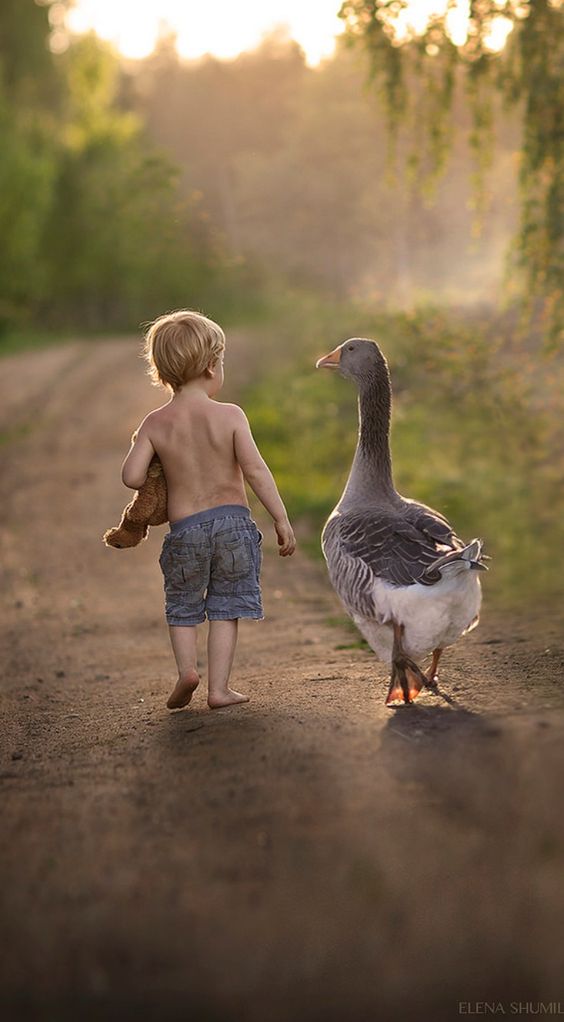
Greylag Goose (Anser anser) Pals Walking ©Pinterest
*
*

“And in the second year of the reign of Nebuchadnezzar Nebuchadnezzar dreamed dreams, wherewith his spirit was troubled, and his sleep brake from him.” (Daniel 2:1 KJV)
Black-cheeked Lovebird (Agapornis nigrigenis) Sleeping ©Worth 1000
*
*
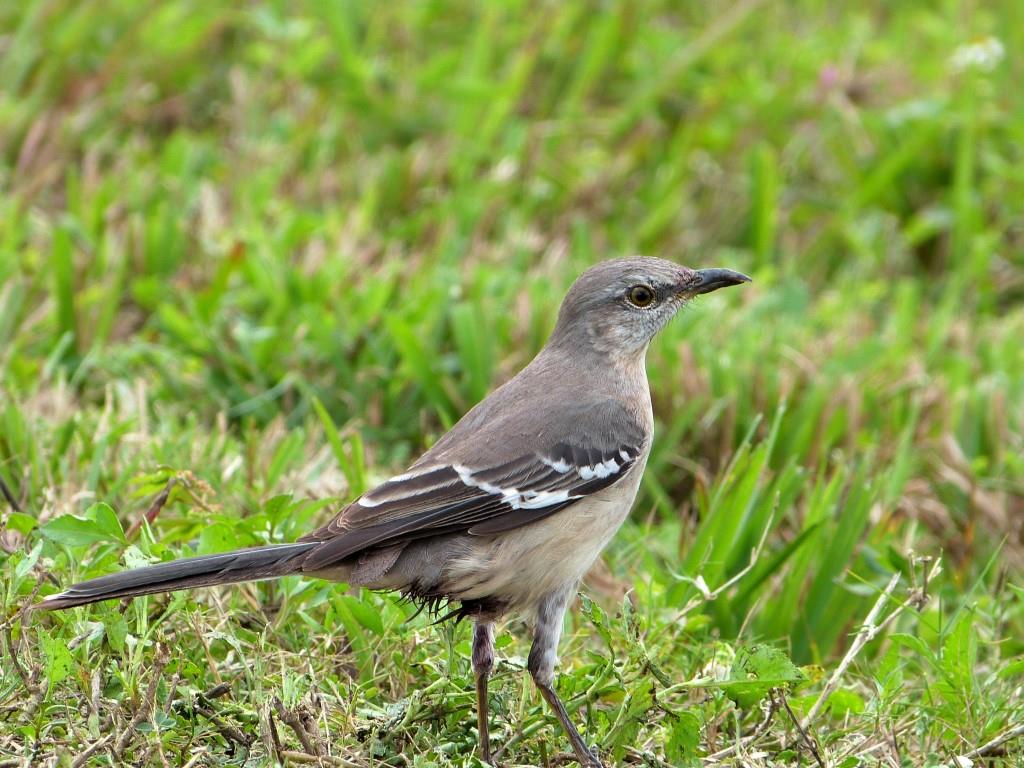
Northern Mockingbird Viera Wetlands
There once was a Mockingbird named Georgina who lived in a large bustling city in the south. She had built her nest on top of a street light in the middle of a busy street. Every day, Georgina would watch the busy cars drive by as they beeped their horns. The scenery was nice during the winter, which was always mild, but Georgina never liked the city during the summertime. It was too hot and crowded for her.
Every day, since Georgina was a mockingbird, she would try to mimic the sounds that she heard in the city all of the time. But the hotter it became, the more Georgina grew tired of all the noises in the city and the hard work of mimicking them.
It was on one very busy, very hot day that Georgina decided that she needed a vacation. She decided that it would have to be somewhere cool and near the ocean. First she needed a map.
Georgina was flying around one day when she found a quarter that someone had dropped on the sidewalk. Georgina picked it up in her beak and used to it buy a map by the newspaper stand.
When Georgina flew back to her nest above the busy street, she searched the map looking for a place that seemed like a good vacation spot. Eventually she decided that she needed to fly north because it was colder up north no matter what time of the year.
Georgina left the busy city early one morning to fly north. She decided that she would come back in a few weeks when it was sure to not be as hot. For now, it was cool because it was early in the morning.
Georgina guessed that if she followed the map she would be able to travel farther up north in the direction she wanted to fly. She would stop when it became cold enough.

Northern Mockingbird (Mimus polyglottos) At Sunset Beach NC ©WikiC
After a few days, the weather was still hot, but it was nice because Georgina was flying close to a beach. Georgina settled on top of a tall palm tree and made her nest out of broken sticks and twigs. She watched the waves ripple back and forth. Seagulls flew in all directions and the palm trees swayed. Georgina liked the peace and quiet. This was much better than the city.
But after a while, Georgina began to become uncomfortable. She had gone on vacation to get away from the noises of the city, but the ocean was pretty noisy too. Georgina mimicked a lot of the noises of the beach, but she eventually began to get tired of it. It was really hot near the beach as well. She didn’t remember mockingbirds ever going to the beach, and the heat was probably why. Georgina began to miss the city and all of its noises.

Northern Mockingbird (Mimus polyglottos) In Flight ©Flickr Tom Wicker
Georgina decided it was time to fly back to the city. As she began traveling back, the weather didn’t seem as hot as she remembered it to be. When she flew back to her nest on top of the street light, the weather already felt cooler in the city.
Georgina decided she would never go back to the beach. She would always be content where she was. Even if the summer was a little uncomfortable in the city with all the people, Georgina would stay all year round. And the next time she decided to travel, Georgina would buy a travel magazine.
THE END
Lee’s Addition:
Not that I speak in respect of want: for I have learned, in whatsoever state I am, therewith to be content. (Philippians 4:11 KJV)
Great story, Emma. Many times humans act like Georgina and become discouraged with how things are. They think like the cattle. They think the “grass is greener on the other side.” Maybe a nest in a tree rather than on a street light. Keep up the great stories. We are all enjoying them.
See more of Emma’s stories along with some of our other guest writers.
*

“And he prayed again, and the heaven gave rain, and the earth brought forth her fruit.” (James 5:18 KJV)
Cedar Waxwing (Bombycilla cedrorum) by Daves BirdingPix
*
*
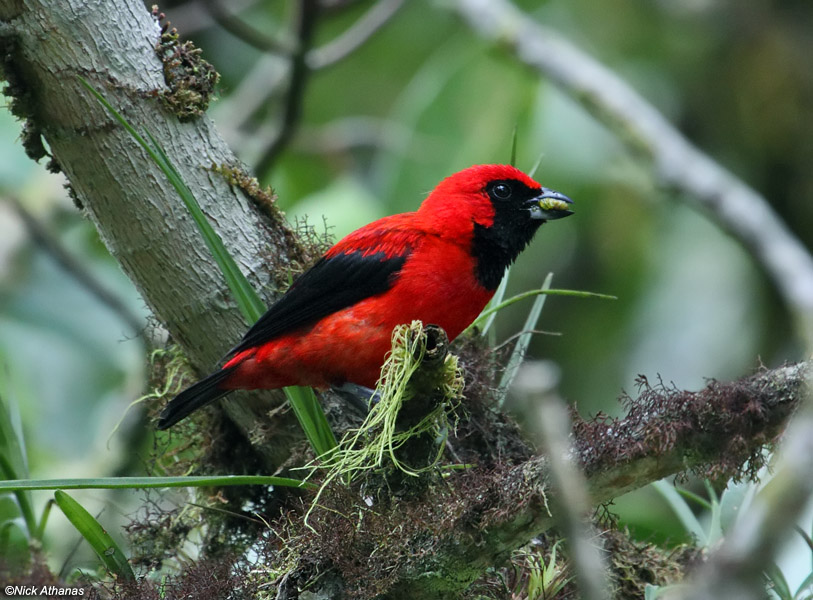
Vermilion Tanager (Calochaetes coccineus) ©Nick Athanas
Come now, and let us reason together, saith the LORD: though your sins be as scarlet, they shall be as white as snow; though they be red like crimson, they shall be as wool. (Isaiah 1:18 KJV)
Last week’s Sunday Inspiration of Tanagers and Allies started us off on this huge family. We will continue, starting with the five Lanio genus of Shrike-Tanagers.
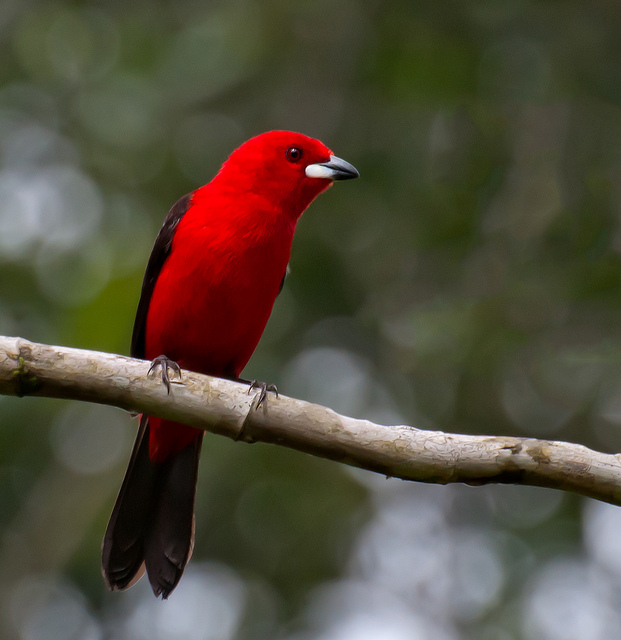
Brazilian Tanager (Ramphocelus bresilius) by Dario Sanches
The words of the LORD are pure words: as silver tried in a furnace of earth, purified seven times. (Psalms 12:6 KJV)
Wait until you see the second very colorful genus, the Ramphocelus. These are Neotropical birds that have enlarged shiny whitish or bluish-grey lower mandibles, which are pointed upwards in display. However, this is greatly reduced in the females of most species. Males are black and red, orange or yellow, while females resemble a duller version of the males, or are brownish or greyish combined with dull red, orange or yellowish.
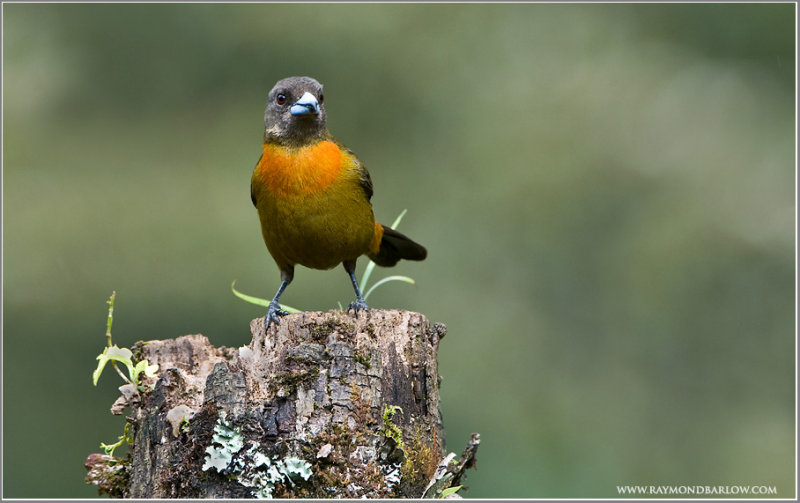
Cherrie’s Tanager (Ramphocelus costaricensis) Female by Raymond Barlow
Ramphocelus tanagers are found in semi-open areas. The nest is a cup built by the female of plant materials such as moss, rootlets, and strips of large leaves like banana or Heliconia, and is often in a fairly open site in a tree. The female usually lays pale blue eggs, with grey, brown or lavender spots, and the young stay in the nest for only about 12 days. The songs of this genus are repetitions of rich one- or two-syllable whistles. Most of these are of a crimson or reddish hue.
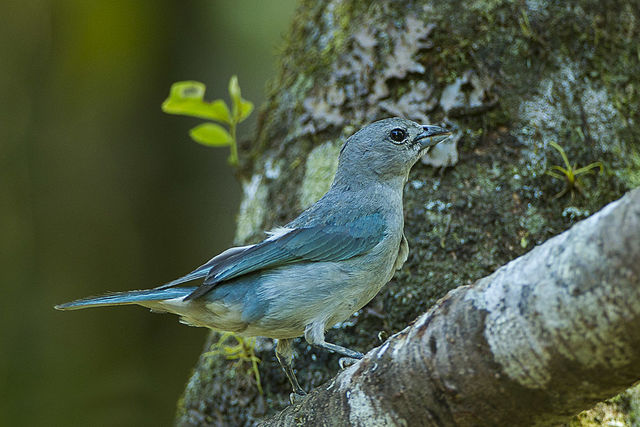
Sayaca Tanager (Thraupis sayaca) ©WikiC
The Thraupis Tanagers are another beautiful genera of the Lord’s Creation. This time, blue will is the dominate color. “These tanagers are mainly found in semi-open habitats including plantations and open woodland, but some will venture into towns. They feed from medium to high levels in trees, taking mainly fruit, with some nectar, and insects which may be taken in flight.” (Wikipedia)

Blue-backed Tanager (Cyanicterus cyanicterus) ©Francesco_Veronesi
This week will end with two genus that have only one species each, the Vermilion Tanager (Calochaetes coccineus) and the Blue-backed Tanager (Cyanicterus cyanicterus). All the birds this week live from Mexico down through South America.
I know all the birds of the mountains, And the wild beasts of the field are Mine. (Psalms 50:11 NKJV)
“My Faith Still Holds” ~ Faith Baptist Orchestra
*
Sunday Inspiration – Thraupidae – Tanagers and Allies I
Traupidae Family – Tanagers and Allies
*

“The LORD looked down from heaven upon the children of men, to see if there were any that did understand, and seek God.” (Psalms 14:2 KJV)
Micronesian Kingfisher (Todiramphus cinnamominus) Houston Zoo 5-6-15 by Lee
*
*
“And so, after he had patiently endured, he obtained the promise.” (Hebrews 6:15 KJV)
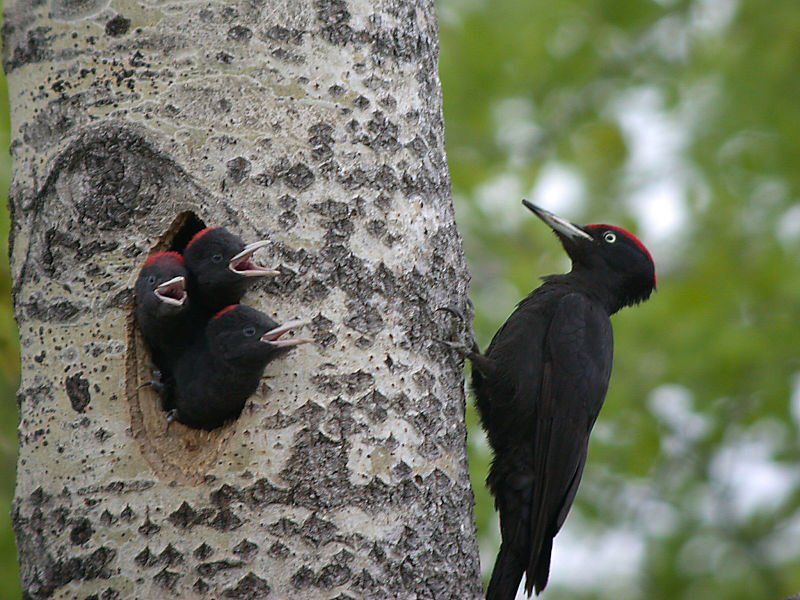
Black Woodpecker (Dryocopus martius) with Young ©WikiC
*
*
Washington, D.C.’s Official Bird: Trouble at the Home Front
Dr. James J. S. Johnson
AND IF A HOUSE BE DIVIDED AGAINST ITSELF, THAT HOUSE CANNOT STAND. MARK 3:25
The District of Columbia’s official bird’s population faces precarious peril, nowadays, and there seems to be a “homeland security” problem. But how is that? And what is the official bird of Washington, D.C., anyway? It’s not the Bald Eagle – that’s America’s national bird. Washington, D.C. has its own official bird.(1)


Flag of Washington, D.C., based on George Washington’s family coat-of-arms
The typical birdwatcher is well aware of his or her state’s official bird.
So if you were born in Maryland, your official state bird is the Baltimore Oriole.(2) [Regarding the Baltimore Oriole, see my “Appreciating Baltimore Orioles and my First Bird Book”, later condensed as “Attracted to Genesis by Magnets and a Bird Book”, Acts & Facts, 44(8):19 (August 2015.]
Like typical politicians of Foggy Bottom, D.C.’s official bird is an omnivore – willing to consume most of whatever is available, whether that be bugs (including their larvae), snails, salamanders, or fruits (especially those having more lipids).
Yet, also like Washington politicians, this bird is itself targeted by many predators. The adults (of D.C.’s official bird) are themselves sometimes eaten by owls and hawks that frequent deciduous wet woods. Also, this bird’s young (i.e., eggs and hatchlings) are preyed upon by several larger birds (such as corvids, icterids, owls, and accipiter hawks), a few mammals (such as house cats, raccoons, weasels, squirrels, and chipmunks), and even some snakes.(3)
So what is the official bird of the District of Columbia? (With a name like “Columbia” you must expect it to be a dove, since “Columbia” is a form of the Latin word for “dove”.) Or you might expect, based upon the official coat-of-arms fo the George Washington family, that D.C.’s bird would be a raven. For many years the District of Columbia had no official bird of its own. In fact, until D.C. was granted a limited form of “home rule” (starting in AD1967), by Congress, D.C. didn’t have jurisdictional authority to designate an official bird for its domain.(1)

Wood Thrush (Hylocichla mustelina) ©Nhptv.org
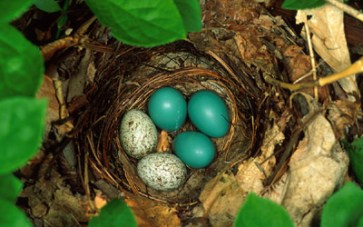
Nevertheless, among Washingtonian birders, many unofficially adopted the Wood Thrush (Hylocichla mustelina), a rather inconspicuous passerine who vocalizes flute-like notes, brown above and mottled brown-on-white below, as D.C.’s special bird. One illustration of this came shortly after World War II, when the D.C. Audubon Society (now called the “Audubon Naturalist Society”) was incorporated; its new monthly journal was called The Wood Thrush.(1)
Finally, in January of AD1967, D.C. Commissioners (armed with new powers delegated to them by Congress) took official action, and decreed that the Wood Thrush was D.C. official home-rule bird. Then came the question: how many Wood Thrush residents actually lived inside D.C.’s boundaries? This question was not (and is not) easy to answer, with accuracy, because bird surveys often involve bird counters (driving cars) who pull off the road, onto the shoulder, to observe birds in wooded areas next to roads. But D.C. has very few such shoulders (on the wood-edge roads), so mobile bird counters are handicapped from using their usual observation habits. So the real numbers of their questionable population are estimated more by guesswork than by direct observation.
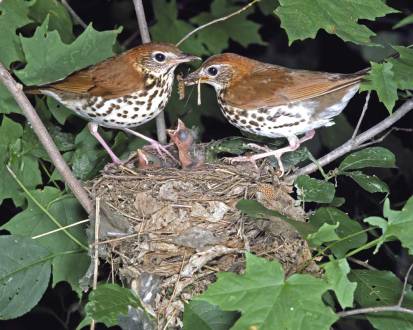
Wood Thrush family at mealtime ©Audubon
Although often hidden from curious human eyes, at least the flute-like notes of these birds can often be heard in D.C.’s Rock Creek Park (a national park since AD1890!), a well-wooded deciduous forest of the nation’s capital.(1) In more ways than one, the Wood Thrush is not “out of the woods”. In fact, its population stability is threatened by woodland habitat loss, as remaining wet woods inexorably yield to more and more “creeping” urban and suburban development.
Yet probably worse, however, the Wood Thrush population suffers from brood parasitism by Brown-headed Cowbirds – “home invaders” that intrude via false pretenses – as the brown-headed “foster children” greedily consume food intended for the nest’s “rightful heirs”, displacing the thrush nest’s rightful nestlings in the process: “The wood thrush mistakenly protects these [home invader] eggs and feeds the [soon-hatched] cowbird young – who are larger and more aggressive, frequently causing wood thrush hatchlings to starve.”(4)
Once again, one finds a comparison with Washington’s federal politics – a failure of homeland security, a fundamental defalcation in defensive gatekeeping.(5) It’s “like déjà vu all over again”. Maybe the precarious population of D.C.’s official bird should remind us to protect our own homes better. ><> JJSJ
References
*

Speckled Tanager (Tangara mexicana) ©WikiC
CAN TWO WALK TOGETHER, EXCEPT THEY BE AGREED? (AMOS 3:3)
“Survival of the fittest” has been a dominating tenet of Darwinian evolution for more than 150 years now. But a trio of colorful birds, living on islands off Venezuela’s coast, provides debunking evidence that, as Dr. Steve Austin would say, Darwin was wrong, when he alleged that do-or-die competition was the fundamental force that shapes nature. So how do these birds dispute Darwin? By eating!
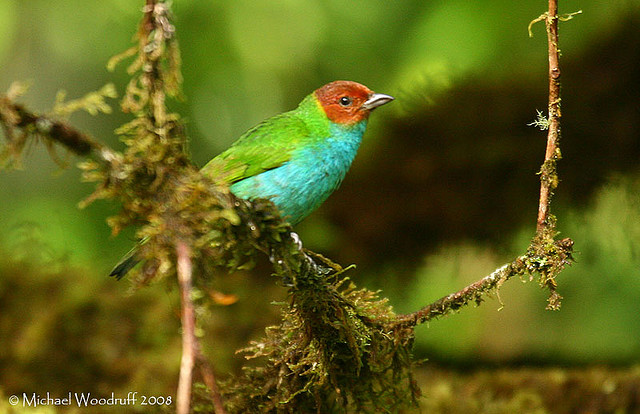
Bay-headed Tanager (Tangara gyrola) by Michael Woodruff
Three varieties of Trinidad tanagers share bugs on the same trees as they silently undermine the “natural selection” myth’s survivalism principle. Without wasteful confrontations over limited food resources, found on the same trees that each of these birds forage upon: (1) speckled tanagers pick off bugs from tree leaves, (2) bay-headed tanagers prefer to eat bugs from under large branches, and (3) turquoise tanagers snap up bugs from twigs.1
Admitting that adversarial competition was lacking, these evolutionist scientists reported the following: “In the 1960s, two ecologists made careful [empirical] studies on the island of Trinidad of the niches of eight coexisting species of tanager–brightly colored songbirds of the New World tropics. Of the eight species, three, the speckled (Tangara guttata), the bay-headed (T. gyrola), and the turquoise tanager (T. mexicana), were extremely closely related. They all belonged to the same genus, lived in the same trees and bushes, and fed on insects and fruit. This suggests little in the way of division of resources, for all three species seemed to be using the same ones. More detailed field observations, though, showed up the niche differences, as is clearly demonstrated by considering one aspect of the pattern of resource division. In hunting for small insect prey in vegetation, the speckled tanager almost exclusively searches the leaves themselves. It clings to them upside down, picking off insects, or it walks along small twigs, picking off insects from the leaves above it. The other two species only rarely feed like this. Instead, both obtain most of their insect prey form the undersides of branches. The bay-headed species does this mainly on quite substantial branches, hopping along and leaning over each side alternately to reach under it for insects. The turquoise tanager, in contrast, almost always takes insects from fine twigs, usually those less than half an inch in diameter. It also has a predilection for the insects found on dead twigs, which are usually untouched by the other two species. These detailed observations show that insect food resources and specific feeding areas on the island of Trinidad are neatly split even between very closely related birds.” [Quoting from Whitfield, Moore, & Cox, THE ATLAS OF THE LIVING WORLD — see endnote #1 below.]
In other words, illustrating what ecologists call noncompetitive niche positioning, this tanager trio avoids antagonistic competition.1 To appreciate how this peaceful prey sharing upsets the presumptions of Charles Darwin, Thomas Huxley, and their modern ilk, it’s helpful to review why Darwin’s ideas were welcomed so fervently by academics who scoffed at Genesis.
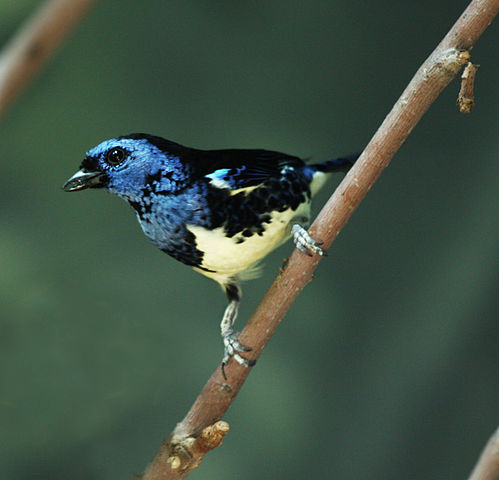
Turquoise Tanager (Tangara mexicana) ©WikiC
Generations before Darwin’s “natural selection” theory first became popular, deists (people who essentially believed in a God yet rejected the Bible) like Charles Lyell and James Hutton, effectively laid the groundwork for the acceptance of evolution’s survivalism themes. (Neither deists nor Darwinists anchor their research on Scripture, yet they also oppose each other.)
Both deists and Darwinists have misreported living conditions on Earth, yet they do so in opposite ways. Deists err on the “see no evil” extreme, underestimating the terrible fallenness of creation.2 Darwinists, however, overemphasize “conquer or be conquered” survivalism—even nominating death as nature’s hero and means of “progress”, instead of recognizing death as the terrible “last enemy” to be destroyed.3 Both extremes misrepresent nature as they actively oppose and/or passively ignore the facts of Scripture. Unsurprisingly, the true portrayal of nature’s condition is found in holy Scripture, starting in Genesis, a Mosaic book that Christ Himself endorsed as authoritative (John 5:44-47).
The deists’ approach produces worthwhile observations of natural beauty, orderliness, and efficiency but then fails to account for how Earth “groans” after Eden.2 What about birds that peck other birds to death, while fighting over food and territory? That’s not beautiful! In the first half of the 1800s, deism failed to explain such ugly forms of competition, so many academics sought a humanistic theory that explained Earth’s uglier features—disease, deprivation, dying—without resorting to God’s revealed answers in Genesis.
Enter Charles Darwin’s magic mechanism of “natural selection”!—an animistic theory invented to substitute for God role as Creator. This now-popular form of quasi-polytheistic animism often uses the alias “survival of the fittest.”
Darwin and his followers imagined the global ecosystem as a closed “fight-to-the-death” arena, swarming with vicious creatures scrapping for limited resources. In a one-sum game (“red in tooth and claw,”4 adopting a phrase from Tennyson to fit Darwin’s theory), gain by one competitor meant loss to another. This selfish competition was quickly heralded as “nature’s law”, so explaining wildlife interactions soon required interpretations based on that brutal assumption.2
But real-world data routinely refuse to fit the evolutionary paradigm. Yet like today, the embarrassing and uncooperative facts were routinely dismissed and ignored during the 1800s and 1900s.5
Embarrassing Darwin’s theory, even moreso than a lack of wasteful competition, is the prevalent reality of mutual aid, also called mutualistic symbiosis, where different life forms help each other, such as algae and fungus coexisting as lichen or bees pollinating the flowers from which they harvest nectar. Like noncompetitive eco-niche positioning,1 mutual aid doesn’t harmonize with Darwin’s antagonistic competition “song,” so mutual reciprocity (and self-sacrificing altruism) displays are also censured from or marginalized by academics who are gatekeepers of science education curricula.6
Consequently, field studies are often skewed by researchers who quickly jump to conclusions that endorse antagonistic survivalism—as if “natural law” always requires adversarial competition.
Even today, modern Darwinians (both atheistic and theistic), lauding mystical “natural selection”, trumpet creation’s fallenness as Earth’s foremost feature — all the while discarding or disparaging or detouring the historical documentation that God has provided in Genesis regarding what triggered Earth’s undeniable fallenness.
Meanwhile, creatures like tree-snacking Trinidad tanagers make a mockery of Darwinian dogma, as they peaceably share food.
References
Dr. James J. S. Johnson formerly taught ornithology/ avian conservation, as well as courses in ecology, limnology, and bioscience, for Dallas Christian College, and continues to be a “serious birder”. A condensed version of this creation science article appears as James J. S. Johnson, Tree-Snacking Tanagers Undermine Darwin, Acts & Facts, 45 (6):21 (June 2016).
*

“In that day the Branch of the LORD shall be beautiful and glorious; And the fruit of the earth shall be excellent and appealing For those of Israel who have escaped.” (Isaiah 4:2 NKJV)
Marvelous Spatuletail (Loddigesia mirabilis) ©©Dubi Shapiro
Sorry about mixing up yesterday’s devotional. Since I (Lee) put the 4 word one up by mistake, today we are putting up the 3 word one. (My husband, Dan, has been sick and we put him in the hospital yesterday.) Mistakes happen. This was not Jim Johnson’s fault .
*
*
 Lee's Birdwatching Adventures Plus