The blessing of the LORD, it maketh rich, and he addeth no sorrow with it. (Proverbs 10:22 KJV)
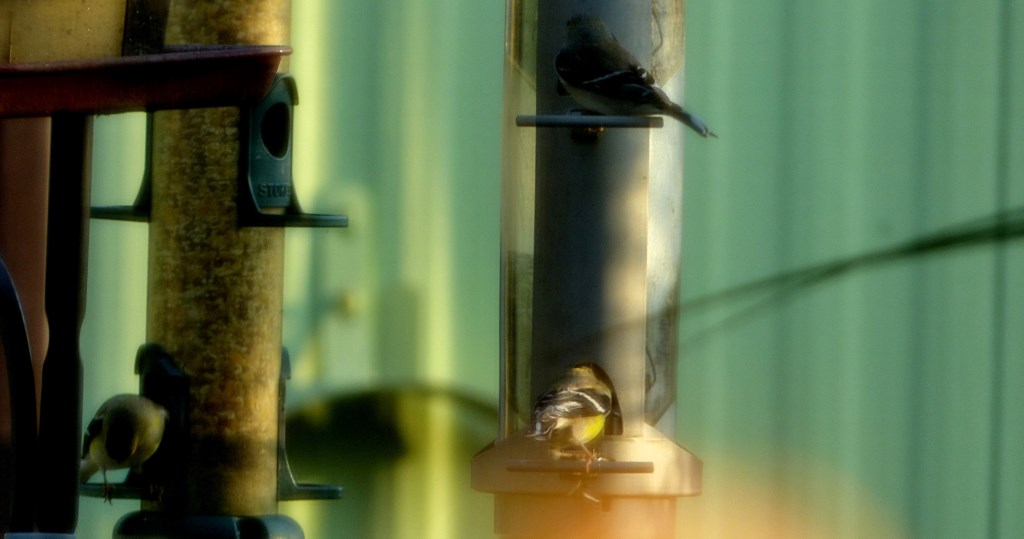
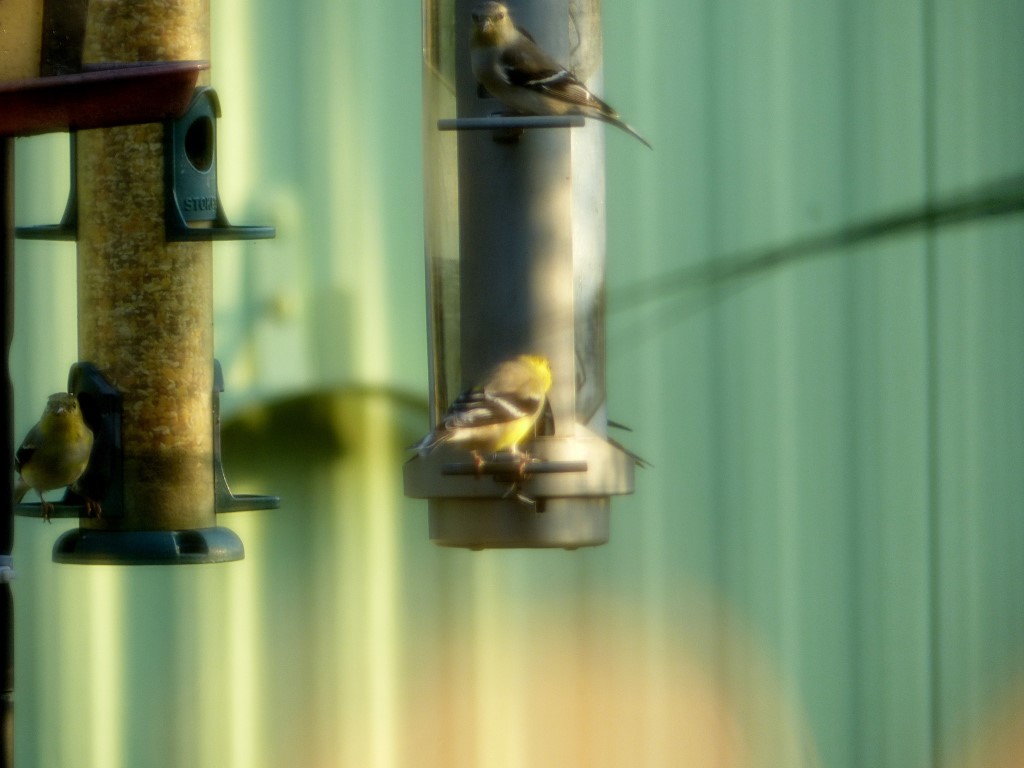
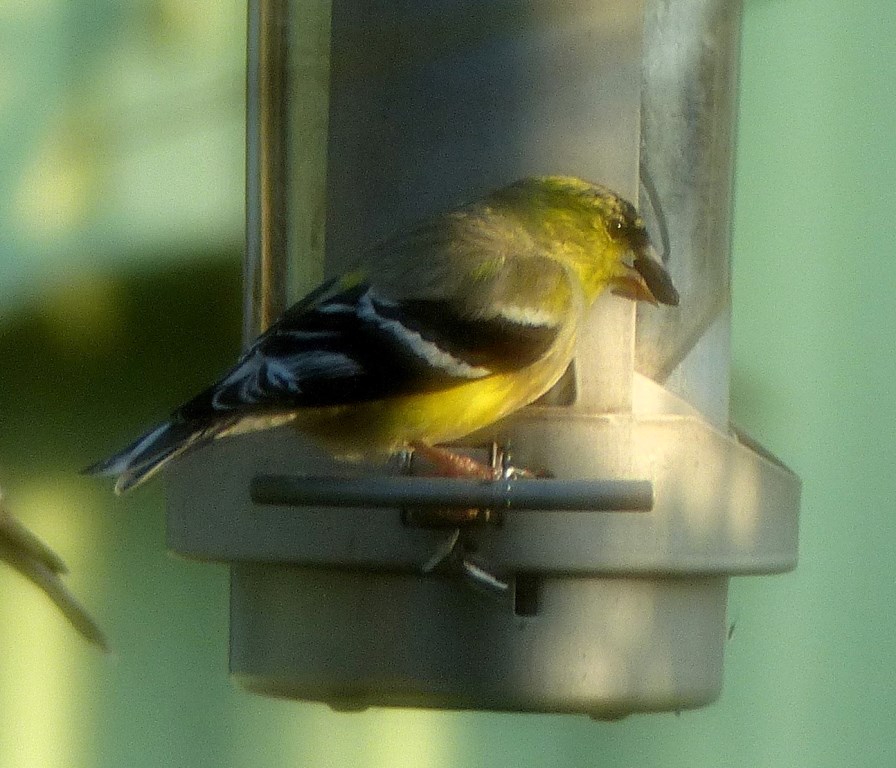
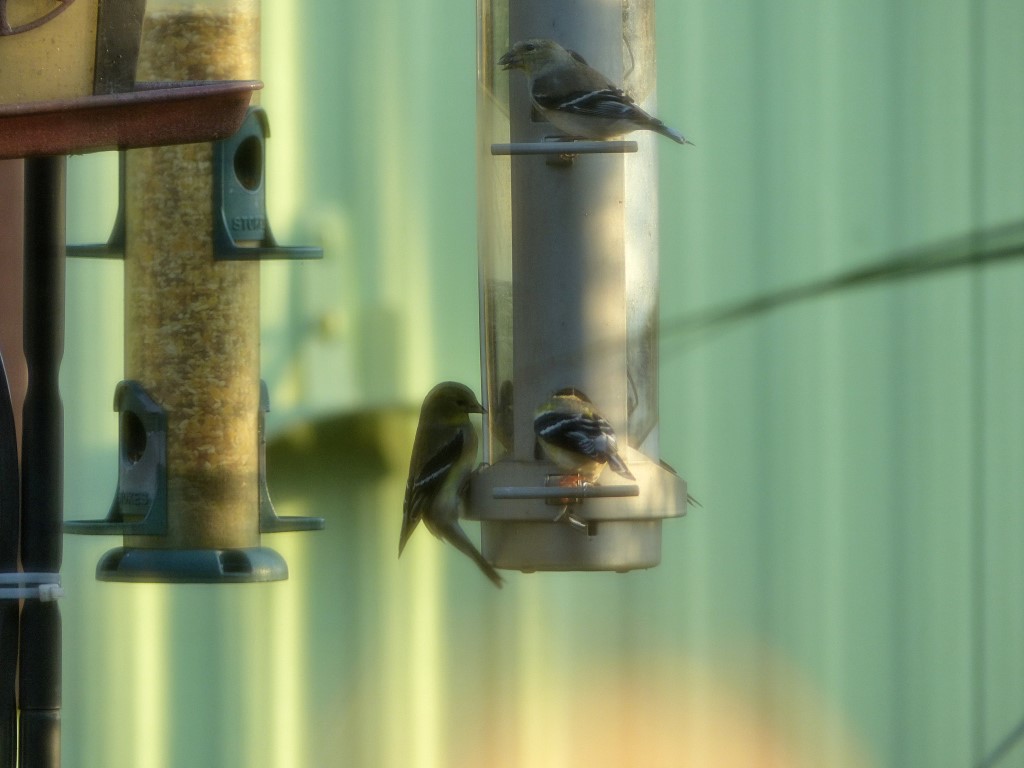
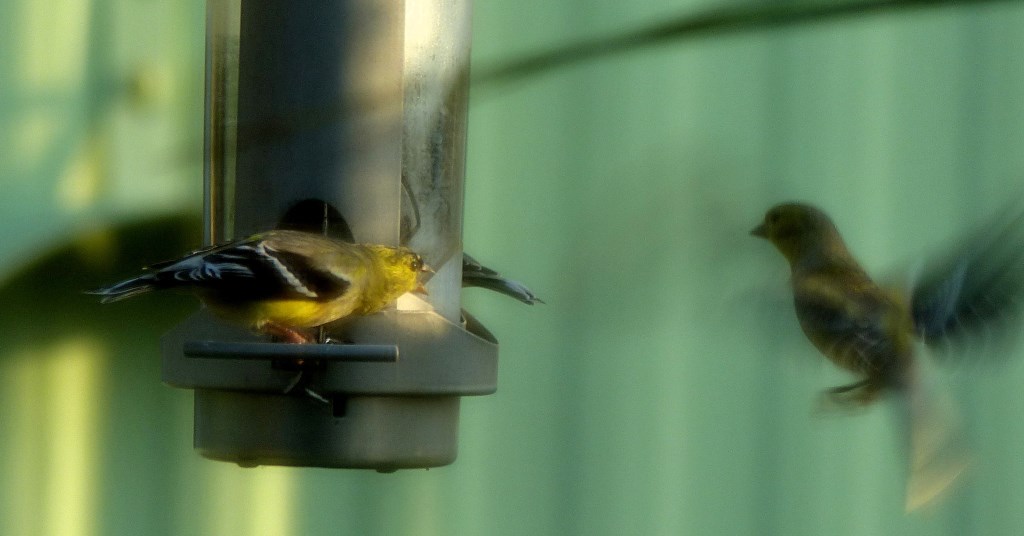
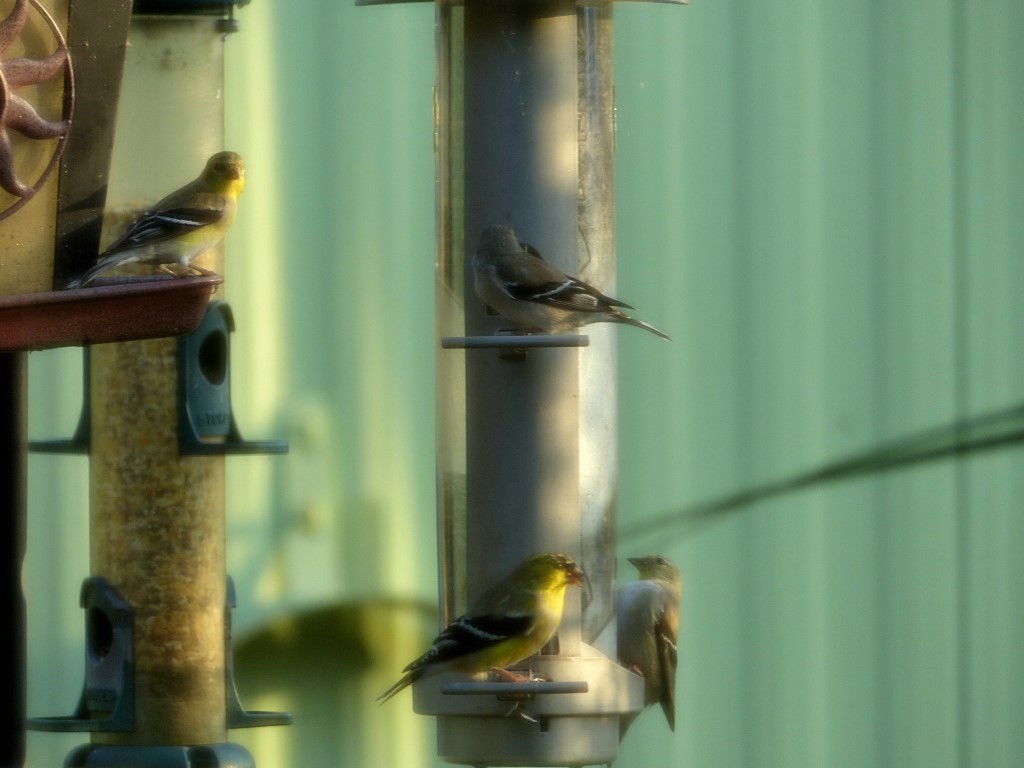
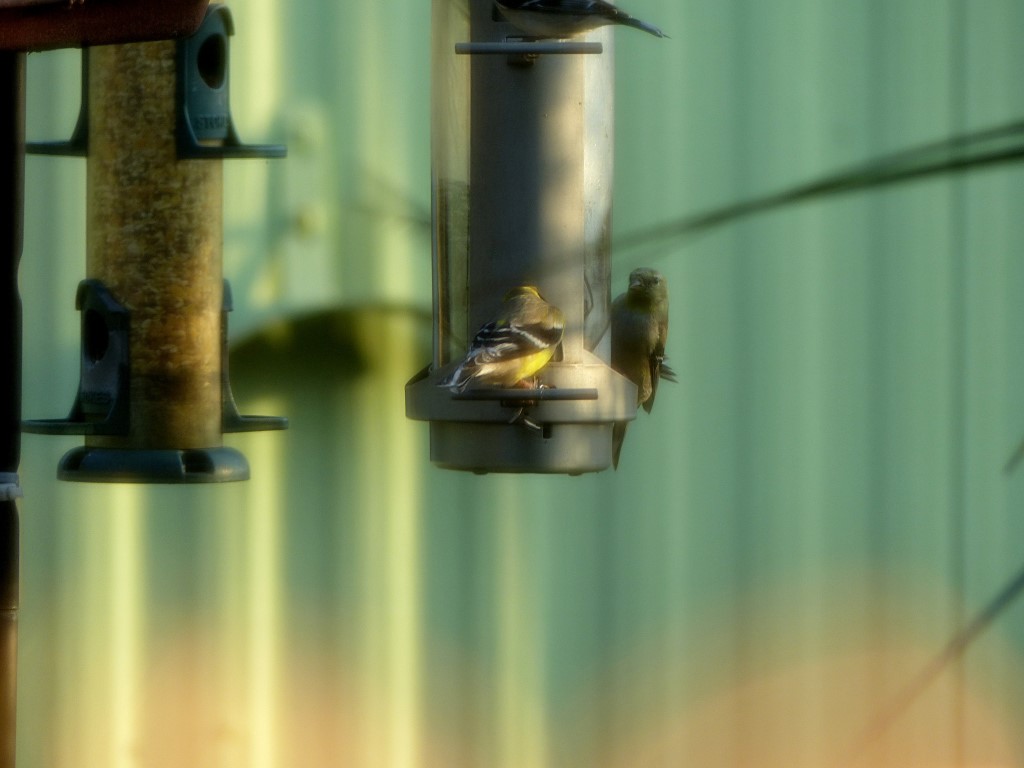
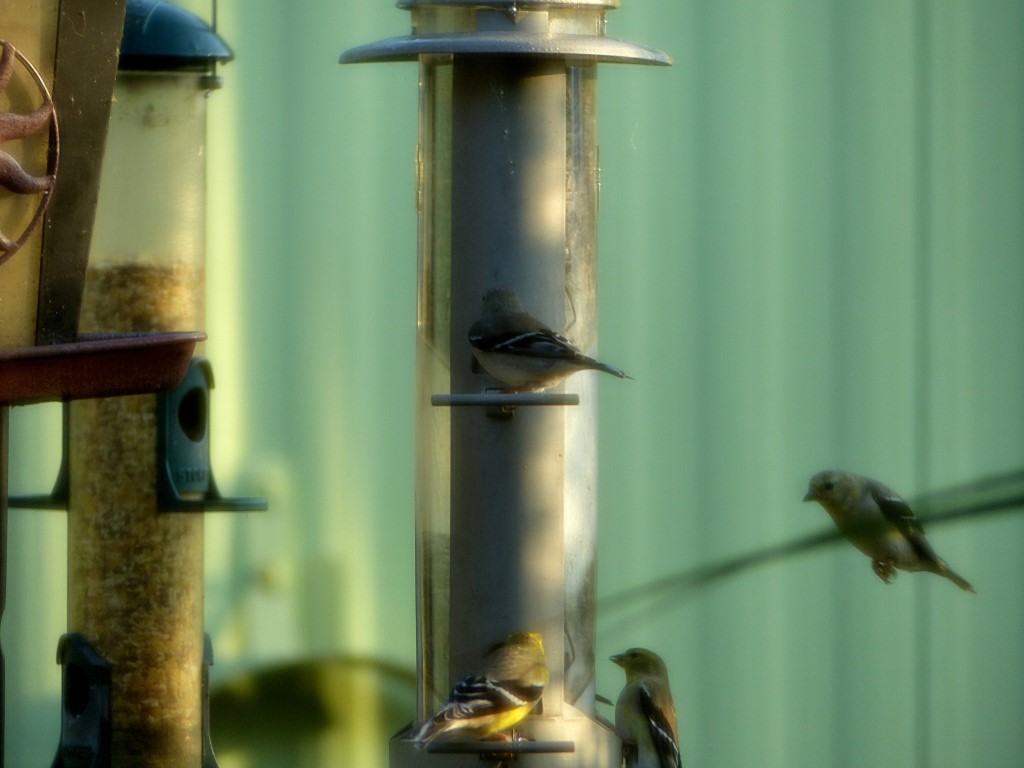
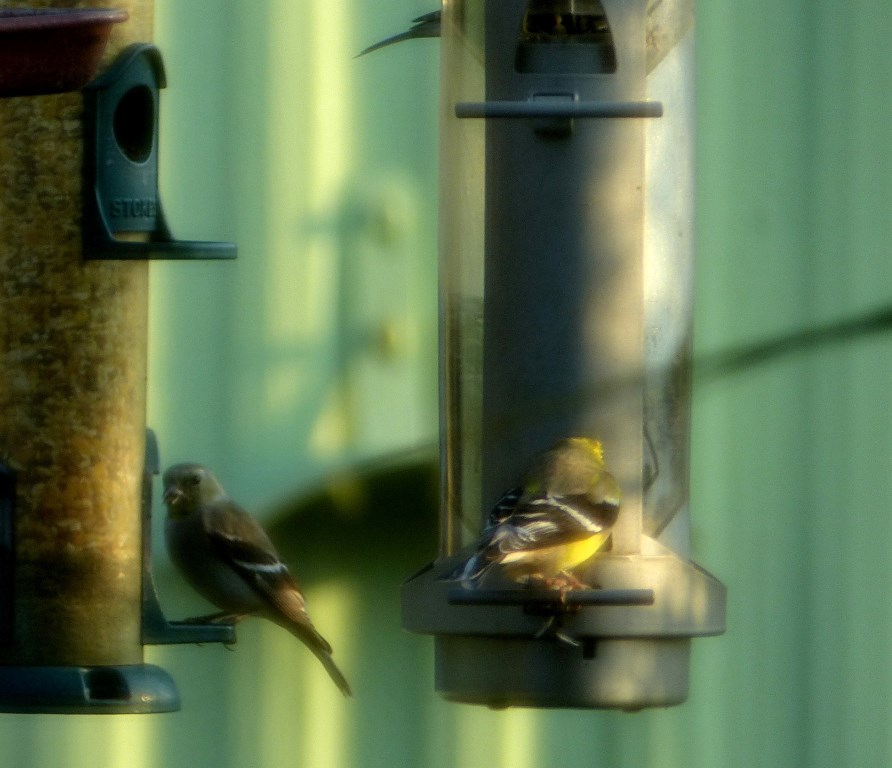
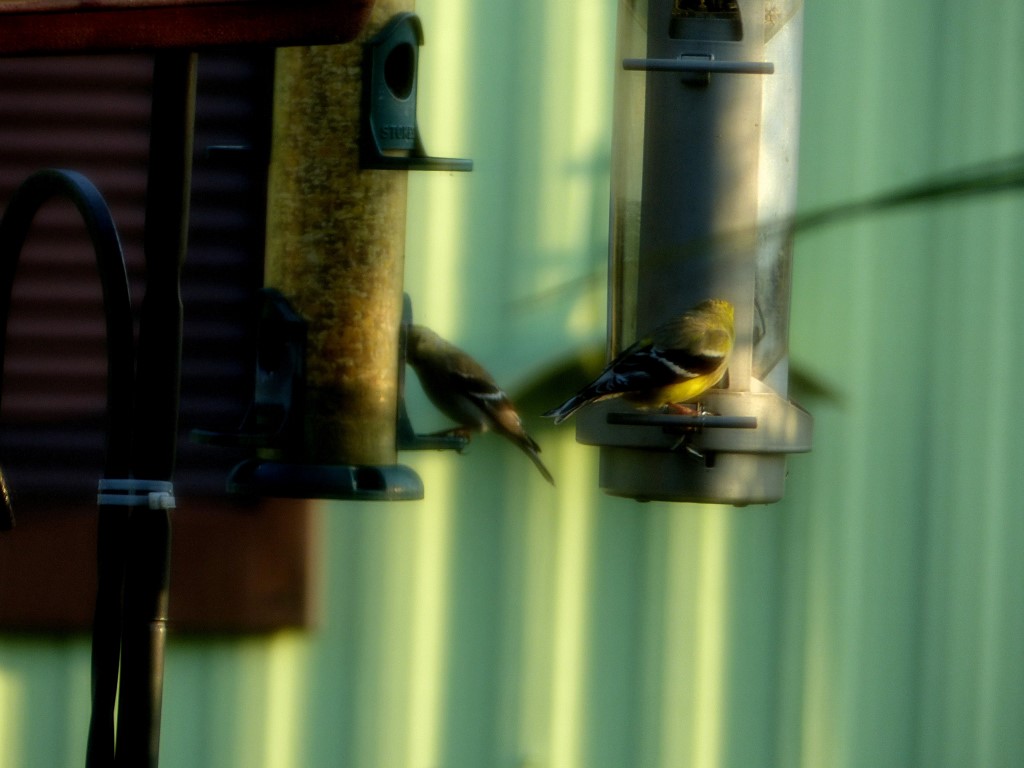
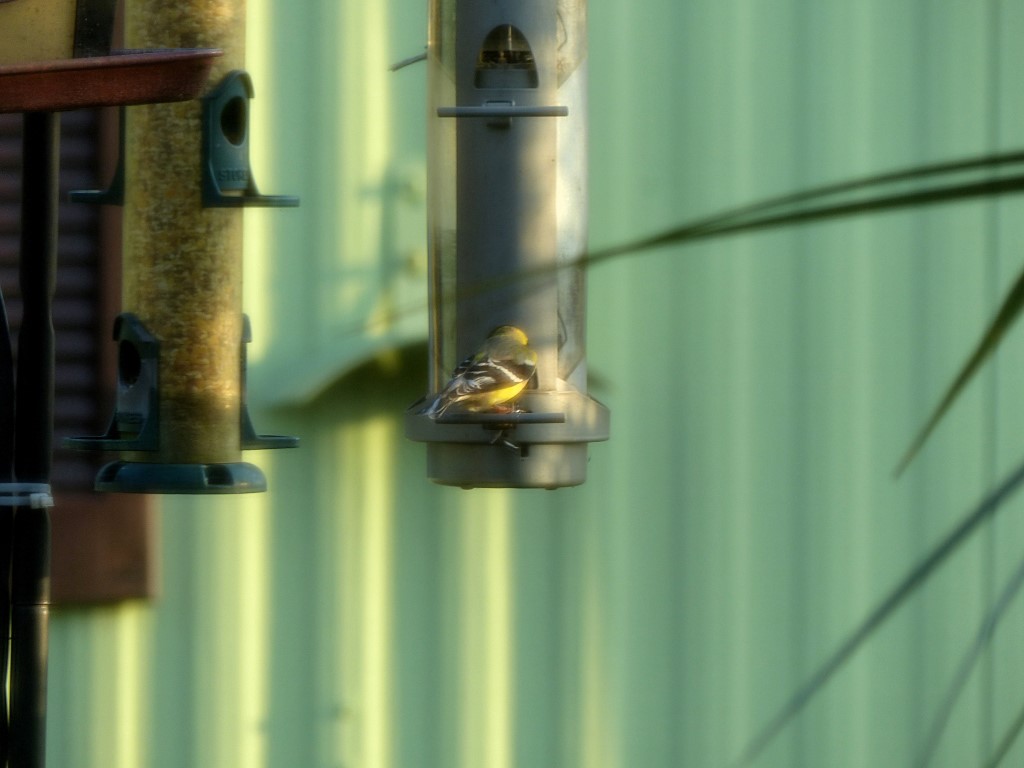
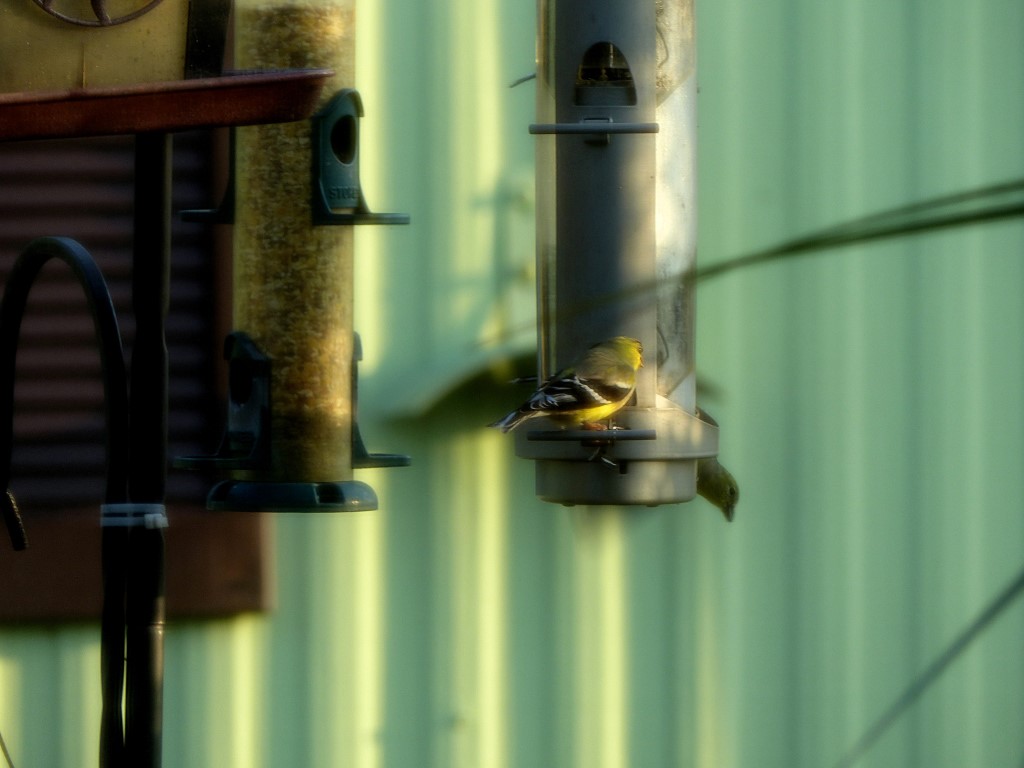
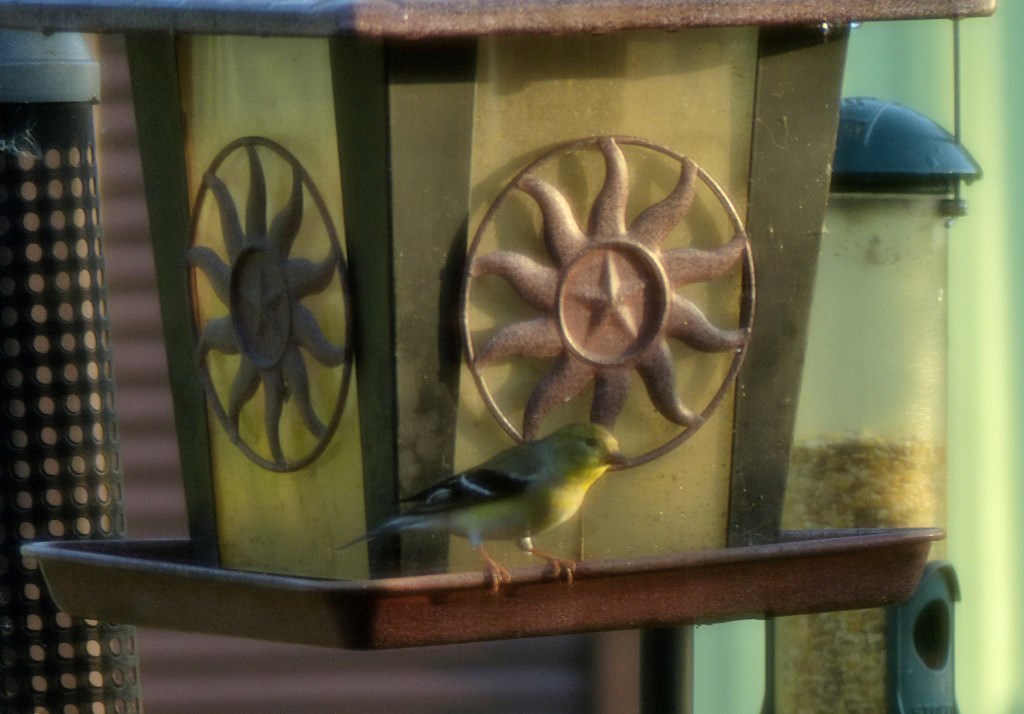
What a great surprise and blessing when I looked out the kitchen window this morning. Spotted an American Goldfinch at my feeder. Haven’t seen any in months. So it was neat to watch them. They kept coming and before long there were at least six. Went to get the camera when the first one showed up and recorded them as they kept coming in.
These photos are through the screen, so forgive the quality, but just wanted to share them with you. I have been battling another round of bronchitis, third one this winter, hence not many birdwatching adventures to report lately. They almost put me in hospital yesterday with possible pneumonia, because of a low oxygen reading. Because of this, I have not been to many of your sites lately to stop by. Your prayers are again appreciated and always welcome.
One was posted several years back, but it is worth seeing again and getting a “tickle.”
The LORD opens the eyes of the blind; The LORD raises up those who are bowed down; The LORD loves the righteous; (Psalms 146:8 NASB)
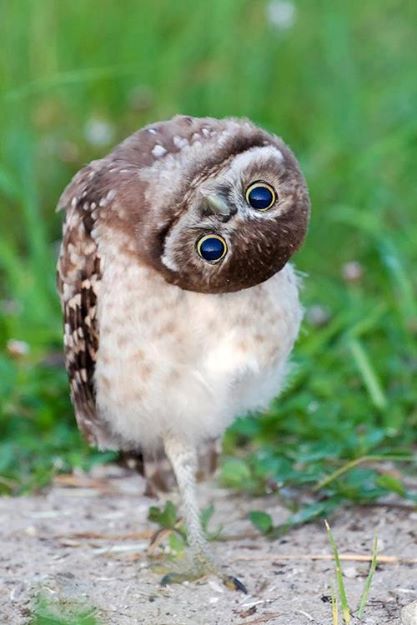
The burrowing owl (Athene cunicularia) is another of the Lord’s creation, It is a small, long-legged owl found throughout open landscapes of North and South America. Burrowing owls can be found in grasslands, rangelands, agricultural areas, deserts, or any other open dry area with low vegetation. They nest and roost in burrows, such as those excavated by prairie dogs (Cynomys spp.). Unlike most owls, Burrowing Owls are often active during the day, although they tend to avoid the midday heat. But like many other kinds of owls, burrowing owls do most of their hunting from dusk until dawn, when they can use their night vision and hearing to their advantage
Burrowing owls have bright eyes; their beaks can be dark yellow or gray depending on the subspecies. They lack ear tufts and have a flattened facial disc. The owls have prominent white eyebrows and a white “chin” patch which they expand and display during certain behaviors, such as a bobbing of the head when agitated.
Adults have brown heads and wings with white spotting. The chest and abdomen are white with variable brown spotting or barring, also depending on the subspecies. Juvenile owls are similar in appearance, but they lack most of the white spotting above and brown barring below. The juveniles have a buff bar across the upper wing and their breast may be buff-colored rather than white. Burrowing owls of all ages have grayish legs longer than other owls.
Bonus:
If I say, “My foot slips,” Your mercy, O LORD, will hold me up. (Psalms 94:18 NKJV)
Here are three more families of Passerine birds. Today’s three families live mostly in the Austro-Papuan (Australia, New Guinea, Paupa) vicinity.
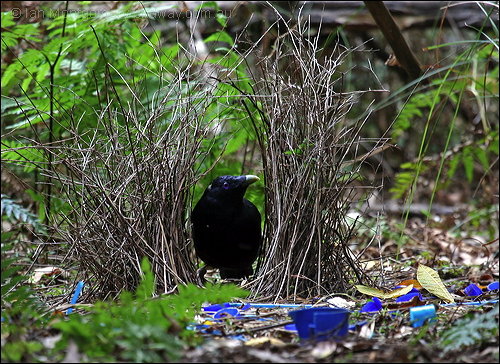
Satin Bowerbird (Ptilonorhynchus violaceus) in bower by Ian
My son, if sinners entice you, Do not consent. (Proverbs 1:10 NKJV)
The Ptilonorhynchidae – Bowerbirds are renowned for their unique courtship behaviour, where males build a structure and decorate it with sticks and brightly coloured objects in an attempt to attract a mate.
Their diet consists mainly of fruit but may also include insects (especially for nestlings), flowers, nectar and leaves in some species. The satin and spotted bowerbirds are sometimes considered agricultural pests due to their habit of feeding on introduced fruit and vegetable crops and have occasionally been killed by affected orchardists.
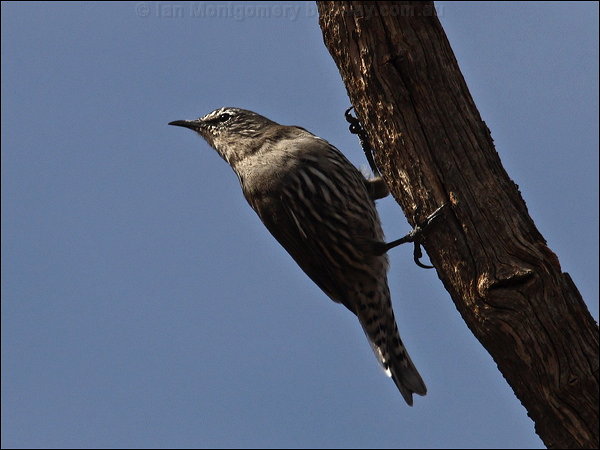
White-browed Treecreeper (Climacteris affinis) by Ian
Let love be without hypocrisy. Abhor what is evil. Cling to what is good. (Romans 12:9 NKJV)
The Climacteridae – Australasian Treecreepers are separate from the European Treecreeper family, which will be highlighted later. As their name implies, treecreepers forage for insects and other small creatures living on and under the bark of trees, mostly eucalypts, though several species also hunt on the ground, through leaf-litter, and on fallen timber. Unlike the Holarctic treecreepers they do not use their tail for support when climbing tree trunks, only their feet.
Let them praise the name of the LORD, For He commanded and they were created. (Psalms 148:5 NKJV)
The Maluridae – Australasian Wrens are a family of small, insectivorous passerine birds endemic to Australia and New Guinea. Commonly known as wrens, they are unrelated to the true wrens of the Northern Hemisphere. The family includes 14 species of fairywren, 3 emu-wrens, and 10 grasswrens.
Malurids are small to medium birds, inhabiting a wide range of environments, from rainforest to desert, although most species inhabit grassland or scrub. The grasswrens are well camouflaged with black and brown patterns, but other species often have brilliantly coloured plumage, especially in the males. They are insectivorous, typically foraging in underbrush. They build domed nests in areas of dense vegetation, and it is not unusual for the young to remain in the nest and assist in raising chicks from later clutches.
This slideshow requires JavaScript.
“How Can I Keep From Singing” ~ Pastor Jerry Smith, Jessie and Caleb Padgett and Reagan Osborne
“For which of you, intending to build a tower, sitteth not down first, and counteth the cost [psêphizei tôn dapanên], whether he have sufficient to finish it? Lest haply, after he hath laid the foundation, and is not able to finish it, all that behold it begin to mock him, saying, ‘This man began to build, and was not able to finish’.” (Luke 14:28-30)
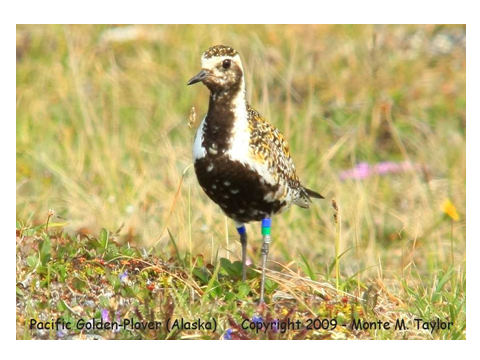
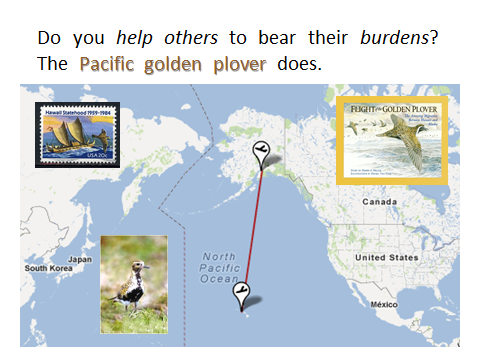
Imagine how inconvenient it would be for a bird to emigrate from Alaska, to Hawaii, only to run out of fuel en route, fall out of the sky from exhaustion, only to drown in the Pacific Ocean, somewhere north of Hawaii. What a shame that would be! And yet the Golden Plover’s pre-winter migratory mission, each year, would seem doomed from the start for that very reason – yet the little sandpiper-like migrant survives the journey on less fuel than seems possible. How do they do it?
“The average weight of the golden plover before it leaves Alaska to fly to Hawaii is 200grams. It is a small bird about the size of a pigeon. It is also a bird that does not swim! Researchers have concluded that 70 grams of its 200 grams is burnable energy. The rate at which the bird burns fuel when flying is about one gram per hour. This means right at 70 hours of flight is possible. Now we have a potentially disastrous situation. The flight to Hawaii takes 88 hours of continuous, non-stop flight!The little bird must fly for 3 days and 4 nights without food or rest or stopping at all. Impossible! How does it do this? The birds fly in a formation that breaks the wind, taking [~1/4] less energy to fly. New leaders are constantly rotating in and out. Formation flight saves energy and when the birds arrive in Hawaii, they have as much as 6 grams of fuel left over. God must have built the reserve fuel supply into the plover in case of a strong head wind along the way. Scientists are not certain how the plovers navigate from Alaska to Hawaii and back, since there is no land under their flight path. Utilization of earth’s magnetic field seems to be the best solution at this point. Some have suggested that they use the sun and stars. And how do the young birds find their way to Hawaii without an experienced adult guide, weeks after their parents have already flown back to Hawaii? A one degree mistake in navigation over the more than 4,000 kilometer flight and the birds miss Hawaii completely! But they never miss!”
[Quoting Dr. Jobe Martin, The Evolution of a Creationist, rev. ed. (Rockwall, TX: Biblical Discipleship Publishers, 2004), page 203, emphasis added.]
That’s amazing! Due to their instinctive behavior to “take turns” as “point man”, the migrating plovers use only ¾ of the food energy they would need to use if flying solo. Birds display God’s providential programming in their anatomies and physiologies! Why is that? Because God carefully planned them before He created their original ancestors on Day 5 of Creation Week (Genesis 1:21). God planned their genetics, their bio-diversity potentials and limits, their developmental biologies, and all of the bio-engineering needed to accomplish all the contingent details, — and God has been actively participating in and regulating their lives and world ever since.
As humans we often need to plan out projects before we undertake them; we need to “count the cost” before embarking on an expensive and risky undertaking. Yet God has already done this for the Pacific Golden Plover, to ensure its successful migrations twice a year. And notice how God designed teamwork to be part of His plan – and that teamwork involves bearing one another’s burdens.
Bear ye one another’s burdens, and so fulfil the law of Christ. (Galatians 6:2)
In sum, collaborating with teammates is usually a good idea, — so long as your colleagues are aimed at the same goal as you (see Amos 3:3.)
Dr. James J. S. Johnson has served as a lecturer (on ecology, geography, and history of Alaska) aboard 4 cruise ships visiting Alaska and the Inside Passage (Norwegian Wind, Norwegian Sky, Radiance of the Seas, and Rhapsody of the Seas). During those trips he tried valiantly to (and did) eat lots of finfish, such as Pacific salmon and halibut, and shellfish, such as Dungeness crabs – but no Golden Plover.
*
I asked Dr. Jim to post this article because of the devotional emphasis he used. We have used the Plover before, see Incredible Pacific Golden Plover, which is all about the science and creation aspect of this remarkable Plover. Just wanted to review for you an amazing bird our Creator has created for us to learn about and from.
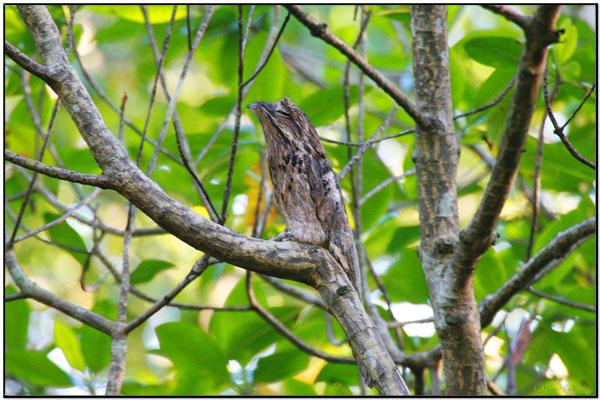
I came across this photo again yesterday and it reminded me of a recent devotional, blog or sermon I heard. It had to do with how Christians become entangled with the world. This Common Potoo is so blended into its surroundings that it is hard to spot.
Do we as Christians so entangle ourselves with the world that we act no different from the unsaved?
The Lord warns us through His Word to not become re-entangled with the yoke of bondage.
Stand fast therefore in the liberty by which Christ has made us free, and do not be entangled again with a yoke of bondage. (Galatians 5:1 NKJV)
For if, after they have escaped the pollutions of the world through the knowledge of the Lord and Savior Jesus Christ, they are again entangled in them and overcome, the latter end is worse for them than the beginning. (2 Peter 2:20 NKJV)
Common Potoo (Nyctibius griseus) by Daves BirdingPix
For this reason it says, “Awake, sleeper, And arise from the dead, And Christ will shine on you.” Therefore be careful how you walk, not as unwise men but as wise, making the most of your time, because the days are evil. So then do not be foolish, but understand what the will of the Lord is. (Ephesians 5:14-17 NASB)
In fact, it seems (based on a survey done by wildlife ecologists in Maryland) that we humans like to watch birds — moreso than any other kind of wildlife. People love birds, and well they should! Specifically, according to a U.S. Fish & Wildlife Service officer, birds are the main attraction when it comes to people viewing wildlife. “The 2011 National Survey of Fishing, Hunting and Wildlife-Associated Recreation noted that 71.8 million American participated in some kind of wildlife-watching recreation, including observing, feeding or photographing [wildlife]. Birds attract the biggest following of all U.S. wildlife. Approximately 46.7 million people observed birds around the house and on trips in 2001. A large majority, 88 percent (41.3 million), observed wild birds around the home, while 38 percent (17.8 million) took trips away from home to observe wild birds. Home birders averaged 119 days, while away-from-home birders averaged 13 days.” (Quoting from Kathy Reshetiloff, “Services Provided by Migratory Birds Don’t Come Cheaply”, Chesapeake Bay Journal, 24(3):1 (May 2014). As noted previously, birds often don’t notice when we are watching them – and that is when we see them acting true to character. [See https://leesbird.com/2014/10/06/busy-hummingbirds-oblivious-to-spectators/ ]
A plastic “toy” cardinal can make you wonder about motion sensitivity. (More on that below.)
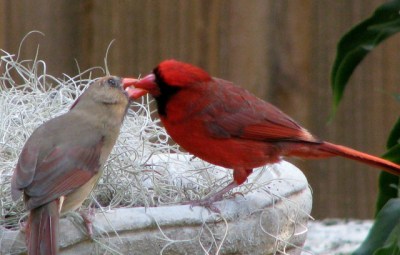
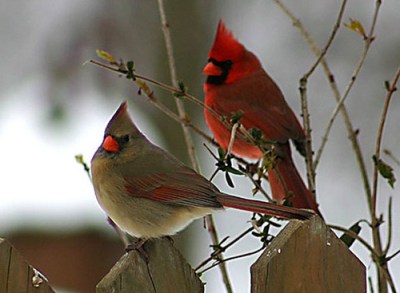
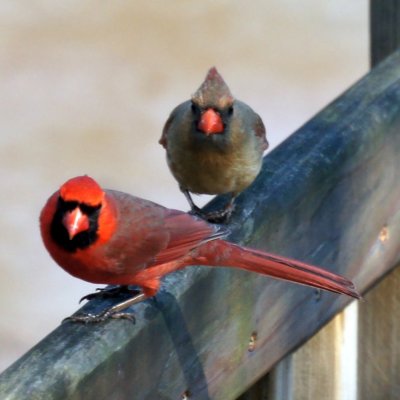
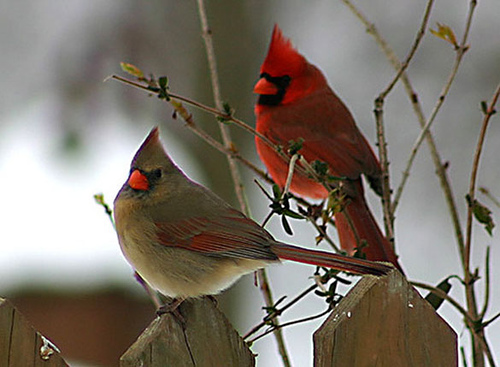
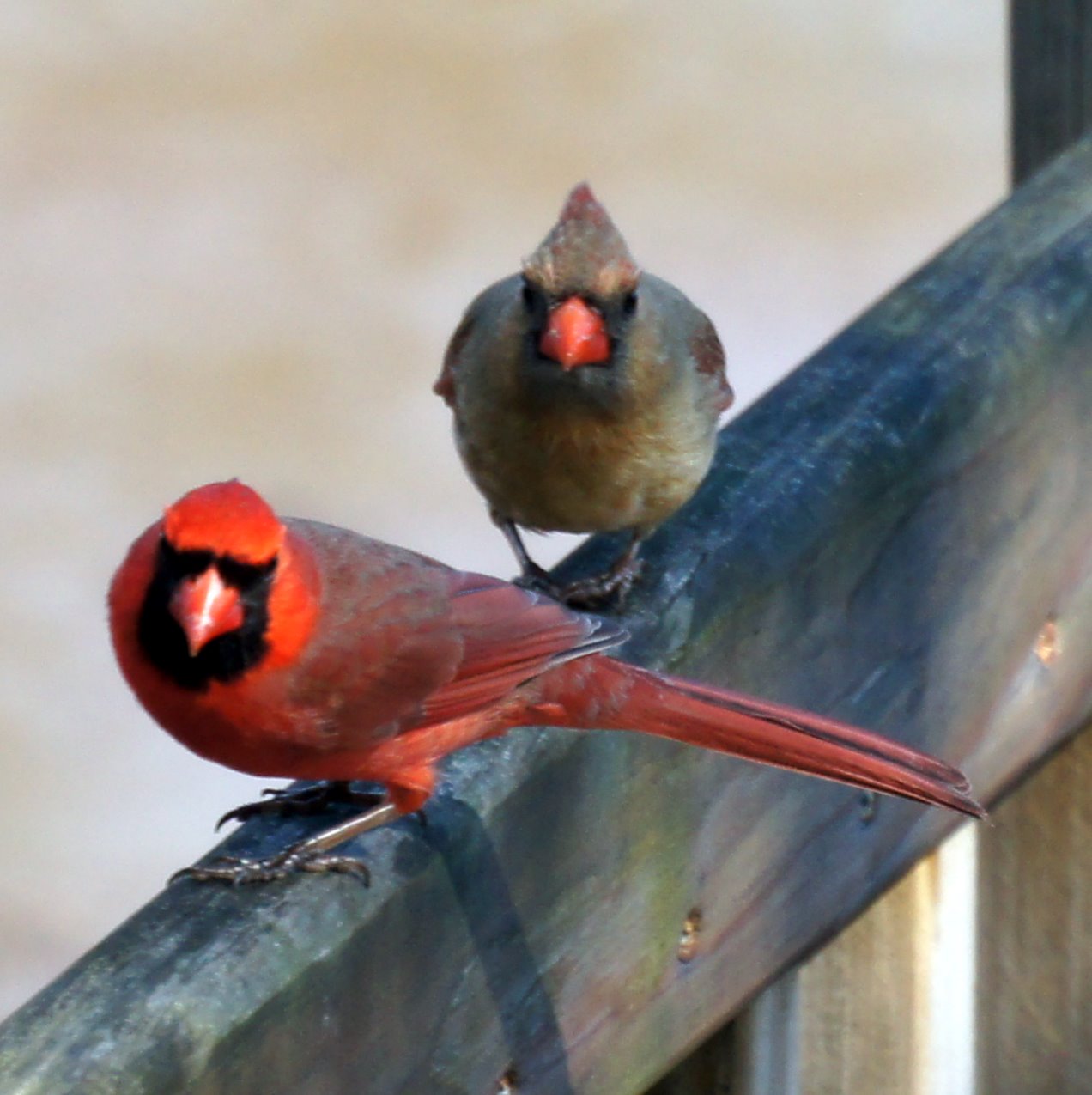
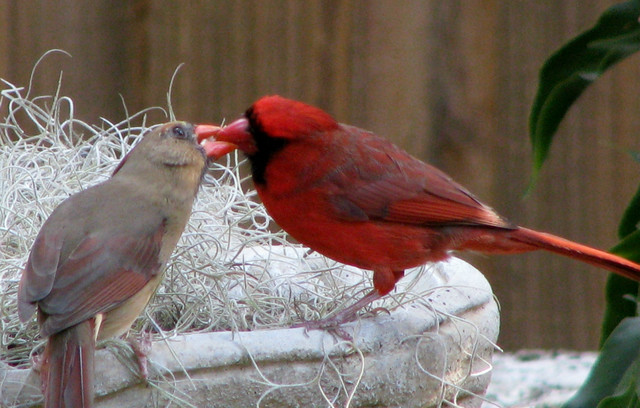
The Northern Cardinal (Cardinalis cardinalis), a/k/a “redbird” is a beauty to behold – and to hear. Cardinals are so highly appreciated that seven states claim it as their official state bird: Illinois, Indiana, Kentucky, North Carolina, Ohio, Virginia, and West Virginia!
Cardinals are songbirds that are easily seen (especially the males), due to their colored plumage contrasting with the green foliage of spring and summer, — or with the bright white of winter snow.
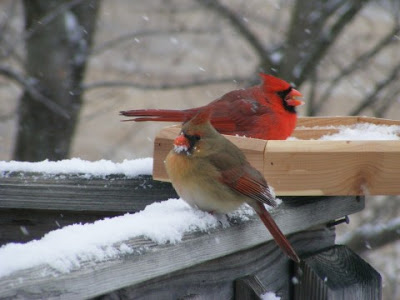
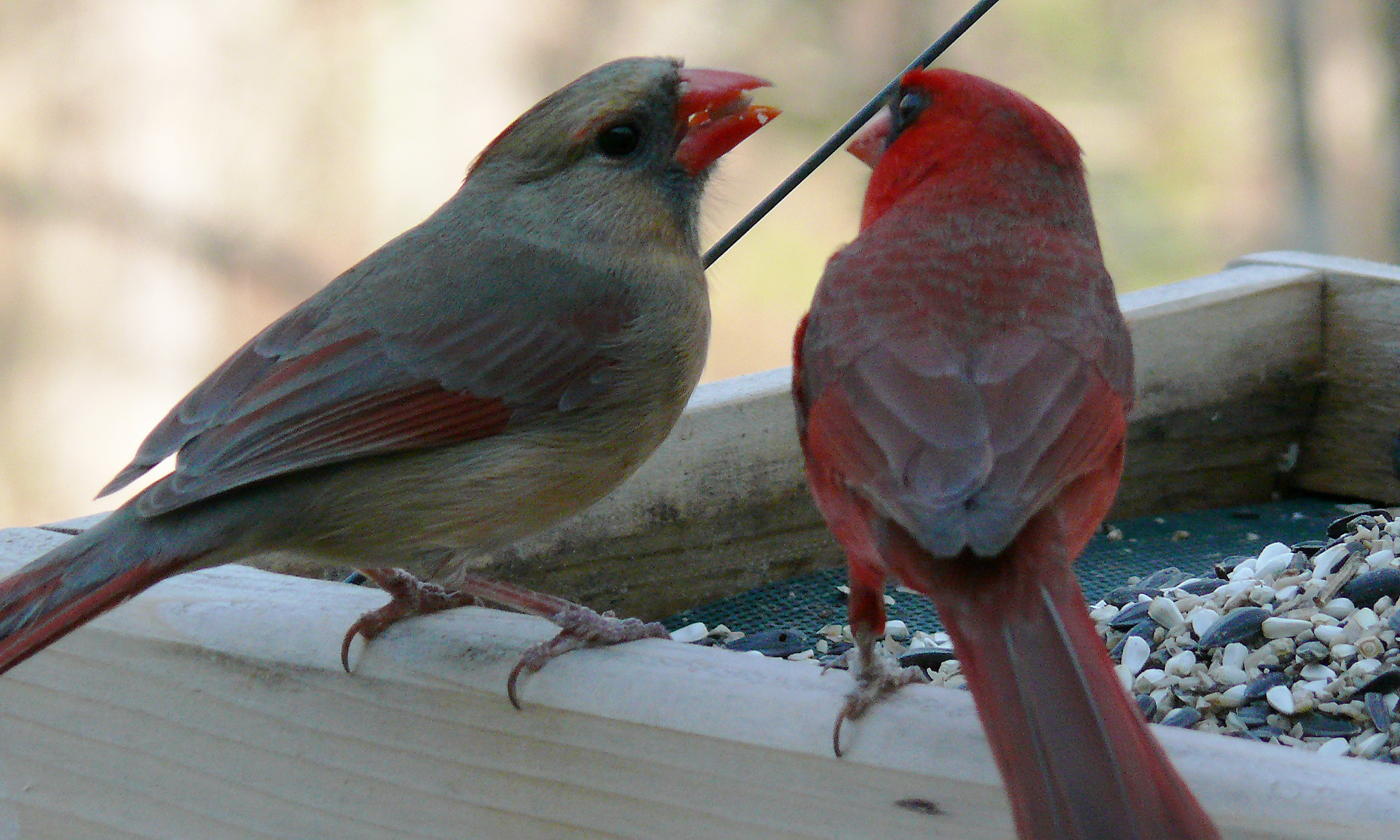
Surely a view of cardinals, eating safflower and sunflower seeds (or other cracked corn, peanuts, or even raisins!), will make you wonder at God’s creative genius and love of beauty, when He chose to make (see Genesis 1:21) the male and female of that beautiful songbird species!
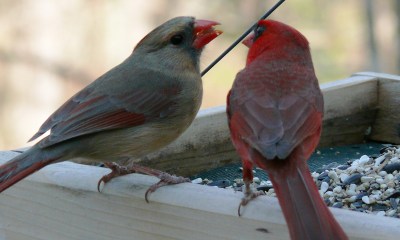
“The cardinal is a favorite bird of many people and it’s easy to see why. The brilliant scarlet plumage of the male and the subtle shades of the female, combined with their clear melodic song, make them enjoyable to watch (and to listen to] in any season.” [Quoting from Donald Stokes & Lillian Stokes, A Guide to Bird Behavior, Volume II (Little, Brown & Co., 1983), page 247.]
But, could it be that birds also like to watch humans? And could it even be that mechanical “birds” appreciate humans who move around in front of them?
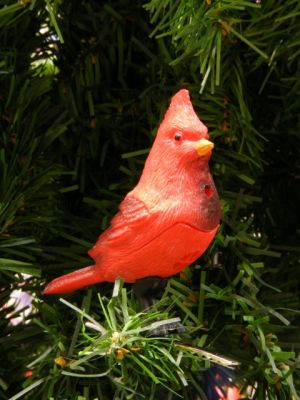
Lately my wife have been having fun at my expenses, using a “toy” cardinal. The cardinal was given to her by Marcia Webel (of Florida, wife of Chaplain Bob Webel). It is a smaller than life-sized bird shaped and colored like a male cardinal, and it can make “vocal” noises like one, too. But it is a “motion-activated” machine. In other words, it is “selective” in when it “chooses” to sound off its recorded chirping sounds (which do sound like a real cardinal). But it’s not really making decisions about when to chirp; it’s just a programmed machine that is designed with receptor features that sense motion nearby, and the inventor designed the machine to “trigger” its recorded sounds whenever its receptors “recognize” such motions.
So far, so good.
But here is the puzzle: my wife moves in front of the “cardinal” and he chirps for her, just like the toy’s inventor designed him to do. Then I dance (not in public, of course, — just in the privacy of our kitchen) in front of the “cardinal” and he is silent. Silent! So I dance again. Silent, silent! So I try a few Tae Kwon Do maneuvers (kicking, punching, whirling, bowing) – and he is still silent. If proving my body’s mobility was dependent upon the “cardinal” chirping I would be diagnosed as paralyzed or unconscious.
It seems like the “cardinal” is “selective” regarding which human he is “willing” to chirp for. But that can’t be, you say, and you are right.
A lifeless machine – even one that looks like and sounds like a male cardinal – cannot really “select” anything.
The very idea that anything lifeless can “select” anyone or anything is silly, because the English word “select” necessarily includes the actions of thinking and choosing. (Of course, the preprogrammed actions of the machine do reveal the thought and choices of the machine’s inventor.)
By now I’m sure you see the parallel to God our Creator, Who programmed all of creation to perform according to how He invented His creatures and the world that He put them in. (He made the planning and programming choices needed to invent all the birds, and ourselves, and everything else — God did it, not “nature”.)
It is both silly and deceptive to use the phrase “natural selection” to imply that nonliving substances (like sunlight, wind, rain, snow, lightning bolts, etc.) are a kind of “natural selection” that orders “nature”. In fact, the phrase “natural selection” is a science-fiction example of “bait-and-switch” [See “Bait and Switch”, at http://www.icr.org/article/bait-switch-trick-used-by-both-anglerfish ]
Yet that very misleading phrase (“natural selection”) is spun as a secular God-substitute, to explain the origin of species that inhabit our fine-tuned planet. [See “DNA and RNA: Providential Coding to ‘Revere’ God”, at http://www.icr.org/article/dna-rna-providential-coding-revere ] Obviously, the mechanical “cardinal”, with its puzzling actions that “react” to some (but not all) motions, was invented by a clever inventor. How much moreso is our Creator-God a clever inventor! It is God Who selected how to make our bodies, to eat food (Acts 14:17) and to grow (Psalm 139) and to do so many other amazing things during our earthly lives. And He also invented the real cardinals! (And sometimes real cardinals watch me, so there!)
Maybe I don’t have the kind of “walk” that causes a mechanical cardinal to “sing”. As we all know, you need to have the “walk”, not just the “talk”.
So who do you watch? If you only sang a song if and when someone walked in front of you, but not if he (or she) merely talked, who would you sing for?
The best sermons are role-modeled – those who “walk” their “talk” are truly the best communicators! When we consider the “talk” and “walk” of other Christians, as we do without consciously trying, we are evaluating which Christians we think are moving in step with God’s Word. Some are. Others aren’t. (And some we can’t be too sure about – see 1st Timothy 5:24.)
Meanwhile, as we move through this world, from day to day, are our own lives worth watching?
Let your light so shine before men, that they may see your good works, and glorify your Father which is in heaven. (Matthew 5:16)
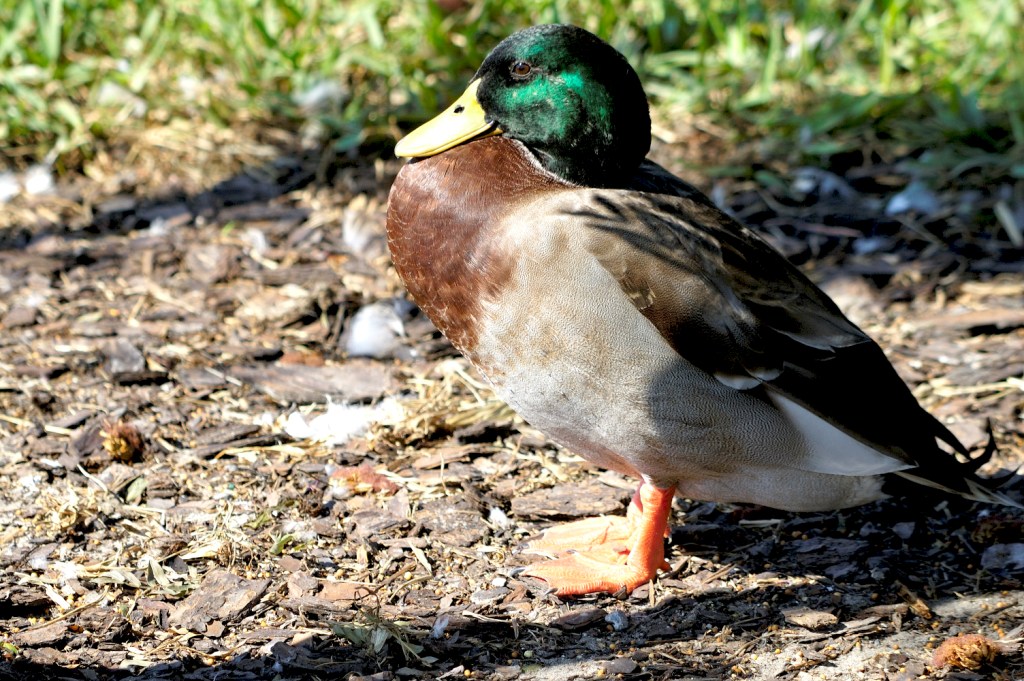
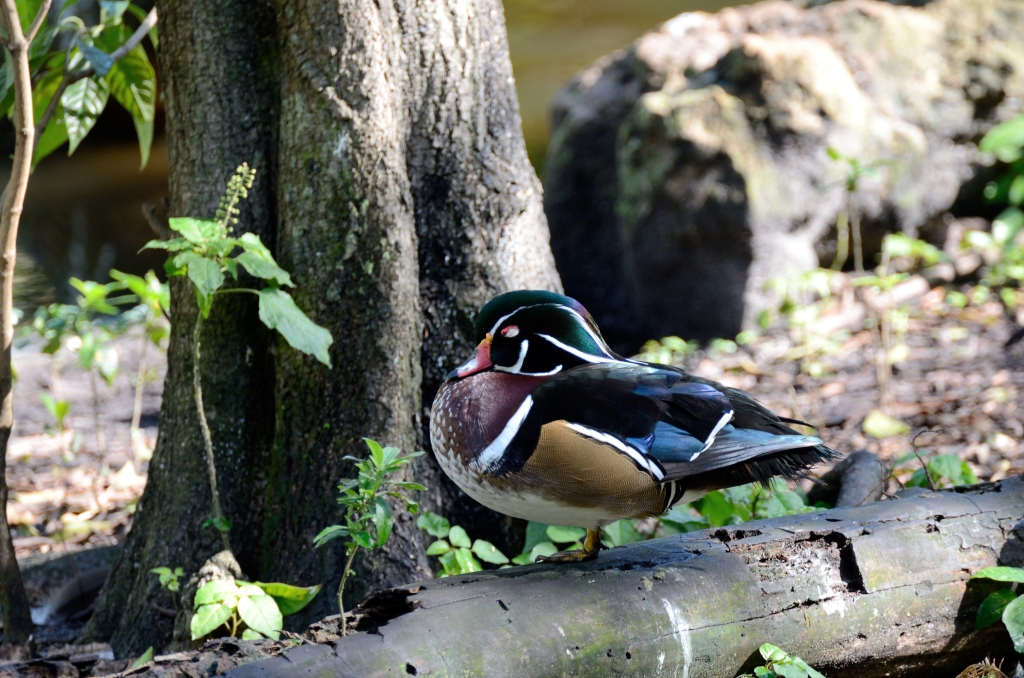
This just happened according to evolution. Wood Duck by Dan
“The fear of the LORD is the beginning of knowledge: but fools despise wisdom and instruction.” Proverbs 1:7
How smart are Americans when it comes to science? That’s what the National Science Foundation attempts to find out every two years. The results of their 2014 survey – which included more than 2,200 adults – gave Americans a rather poor grade. But are Americans really less knowledgeable about science or is the NSF’s survey biased against the many Bible-believing Christians in America? Let’s take a look.
While the survey included such questions as “Does the Earth go around the Sun or does the Sun go around the Earth?”, the survey also included questions like: “True or false: the universe began with a huge explosion.” And true or false: “Human beings, as we know them today, developed from earlier species of animals.” For people who believe what the Bible has to say, their answers were scored as “wrong” by the NSF survey.
Interestingly, more than 60 percent of Americans gave the so-called “wrong” answers to these questions. They simply do not accept the Big Bang theory despite what they were taught in school. And more than 50 percent of Americans disagreed with the NSF when it comes to evolution. According to the Atlantic Online, “This seems to indicate that many Americans are familiar with the theories of evolution and the Big Bang; they simply don’t believe they’re true.”
What the unbelieving world views as right is often wrong in light of what God tells us in the Bible. For Christians, the Bible is the ultimate authority – not what we’re told by Bible-denying evolutionists.
Prayer: Heavenly Father, I pray that You will strengthen me whenever I am pressured by the world to choose wrong over right. Make me be willing to be thought a fool in the world’s eyes. In Jesus’ Name. Amen.
And God blessed them, saying, “Be fruitful and multiply, and fill the waters in the seas, and let birds multiply on the earth.” So the evening and the morning were the fifth day. (Genesis 1:22-23 NKJV)
“All flesh is not the same flesh: but there is one kind of flesh of men, another flesh of beasts, another of fishes, and another of birds.” 1 Corinthians 15:39
Evolutionists tell us a 66-million-year-old feathered dinosaur resembling a giant demonic bird was discovered in the fossil-rich Hell Creek formation of South and North Dakota. Not surprisingly, this newly discovered dinosaur species was dubbed the “chicken from hell”.
Chicken From Hell – Illustration: Anzu wyeliei
It was “as close as you can get to a bird without being a bird,” said vertebrate paleontologist Matt Lamanna. In addition to its long limbs, the research team found that the 11-foot-long, 500-pound dinosaur sported a stubby tail, likely framed by a fan of tail feathers.”What’s this? A tail likely framed by a fan of tail feathers? Not even National Geographic could stop themselves from telling the truth when they admitted: “Though the team didn’t find direct evidence of feathers, the species was so closely related to birds that it was very likely covered in feathers that looked identical to those of modern birds.”
The illustration accompanying the article shows the dinosaur’s forelimbs and tail covered with large feathers. Indeed, National Geographic and others have been doing this for years as they attempt to show that modern-day birds are the evolutionary descendents of dinosaurs. No real evidence required!
The Bible, on the other hand, is supported by a large amount of evidence, including archaeological discoveries, the fulfillment of Bible prophecies and much more. Christians also have the internal witness of the Holy Spirit that convinces us that God’s Word is true and that His Son is the Truth who alone provides salvation from sin.
Prayer: Father, I thank You that Your Word doesn’t need to be supported by the imaginative speculations of fallible men. I know that the Bible is true from the first word to the last! In Jesus’ Name. Amen.
O Timothy, keep that which is committed to thy trust, avoiding profane and vain babblings, and oppositions of science falsely so called: (1 Timothy 6:20 KJV)
Evolutionists just refuse to even consider creation, so they make up more concoctions of feather-brained ideas.
Tityridae is a family of suboscine passerine birds found in forest and woodland in the Neotropics. The approximately 45 species in this family were formerly spread over the families Tyrannidae, Pipridae and Cotingidae (see Taxonomy). As yet, no widely accepted common name exists for the family, although tityras and allies and tityras, mourners and allies have been used. They are small to medium-sized birds. Under current classification, the family ranges in size from the buff-throated purpletuft, at 9.5 cm (3.75 in) and 10 grams (0.35 oz), to the masked tityra, at up to 22 cm (8.7 in) and 88 grams (3.1 oz). Most have relatively short tails and large heads.
Superb Lyrebird by Ian
A Lyrebird is either of two species of ground-dwelling Australian birds, that form the family Menuridae. They are most notable for their superb ability to mimic natural and artificial sounds from their environment. As well as their extraordinary mimicking ability, lyrebirds are notable because of the striking beauty of the male bird’s huge tail when it is fanned out in display; and also because of their courtship display. Lyrebirds have unique plumes of neutral-coloured tailfeathers and are among Australia’s best-known native birds.
The lyrebirds are large passerine birds, amongst the largest in the order. They are ground living birds with strong legs and feet and short rounded wings. They are generally poor fliers and rarely take to the air except for periods of downhill gliding. The superb lyrebird is the larger of the two species. Females are 74–84 cm long, and the males are a larger 80–98 cm long—making them the third-largest passerine bird after the thick-billed raven and the common raven. Albert’s lyrebird is slightly smaller at a maximum of 90 cm (male) and 84 cm (female) (around 30–35 inches) They have smaller, less spectacular lyrate feathers than the superb lyrebird, but are otherwise similar.
Scrubbirds are shy, secretive, ground-dwelling birds of the family Atrichornithidae. There are just two species. The rufous scrubbird is rare and very restricted in its range, and the noisy scrubbird is so rare that until 1961 it was thought to be extinct. Both are native to Australia. The scrubbird family is ancient and is understood to be most closely related to the lyrebirds, and probably also the bowerbirds and treecreepers.
Birds of both species are about the same size as a common starling and cryptically coloured in drab browns and blacks. They occupy dense undergrowth and are adept at scuttling mouse-like under cover to avoid notice. They run fast, but their flight is feeble.
The males’ calls, however, are powerful: ringing and metallic, with a ventriloquial quality, so loud as to be heard from a long distance in heavy scrub and almost painful at close range. Females build a domed nest close to the ground and take sole responsibility for raising the young.
Also recently, this site was updated to the I.O.C. Version 5.1.
This slideshow requires JavaScript.
Let the words of my mouth, and the meditation of my heart, be acceptable in thy sight, O LORD, my strength, and my redeemer. (Psalms 19:14 KJV)
Watch and listen to a piano solo, “There is a Redeemer,” played by Nell Reese (I think) at Faith Baptist Church last Sunday.
And they remembered that God was their rock, and the high God their redeemer. (Psalms 78:35 KJV)
Amateur photographer Martin Le-May, from Essex, has recorded the extraordinary image of a weasel riding on the back of a green woodpecker as it flies through the air.
Now behold, there was a man named Zacchaeus who was a chief tax collector, and he was rich. And he sought to see who Jesus was, but could not because of the crowd, for he was of short stature. So he ran ahead and climbed up into a sycamore tree to see Him, for He was going to pass that way. And when Jesus came to the place, He looked up and saw him, and said to him, “Zacchaeus, make haste and come down, for today I must stay at your house.” (Luke 19:2-5 NKJV)
Maybe the Weasel, like Zacchaeus, thought Jesus was going to come by and he wanted to get a better look.
* Picadae – Woodpeckers
Having other things to attend to, or rather having other things to arouse his curiosity, Peter Rabbit did not visit the Old Orchard for several days. When he did it was to find the entire neighborhood quite upset. There was an indignation meeting in progress in and around the tree in which Chebec and his modest little wife had their home. How the tongues did clatter! Peter knew that something had happened, but though he listened with all his might he couldn’t make head or tail of it.
Finally Peter managed to get the attention of Jenny Wren. “What’s happened?” demanded Peter. “What’s all this fuss about?”
Jenny Wren was so excited that she couldn’t keep still an instant. Her sharp little eyes snapped and her tail was carried higher than ever. “It’s a disgrace! It’s a disgrace to the whole feathered race, and something ought to be done about it!” sputtered Jenny. “I’m ashamed to think that such a contemptible creature wears feathers! I am so!”
“But what’s it all about?” demanded Peter impatiently. “Do keep still long enough to tell me. Who is this contemptible creature?”
“Sally Sly,” snapped Jenny Wren. “Sally Sly the Cowbird. I hoped she wouldn’t disgrace the Old Orchard this year, but she has. When Mr. and Mrs. Chebec returned from getting their breakfast this morning they found one of Sally Sly’s eggs in their nest. They are terribly upset, and I don’t blame them. If I were in their place I simply would throw that egg out. That’s what I’d do, I’d throw that egg out!”
Peter was puzzled. He blinked his eyes and stroked his whiskers as he tried to understand what it all meant. “Who is Sally Sly, and what did she do that for?” he finally ventured.
“For goodness’ sake, Peter Rabbit, do you mean to tell me you don’t know who Sally Sly is?” Then without waiting for Peter to reply, Jenny rattled on. “She’s a member of the Blackbird family and she’s the laziest, most good-for-nothing, sneakiest, most unfeeling and most selfish wretch I know of!” Jenny paused long enough to get her breath. “She laid that egg in Chebec’s nest because she is too lazy to build a nest of her own and too selfish to take care of her own children. Do you know what will happen, Peter Rabbit? Do you know what will happen?”
A Shiny Cowbird (Molothrus bonariensis) chick being fed by a Rufous-collared Sparrow (Zonotrichia Capensis)
Peter shook his head and confessed that he didn’t. “When that egg hatches out, that young Cowbird will be about twice as big as Chebec’s own children,” sputtered Jenny. “He’ll be so big that he’ll get most of the food. He’ll just rob those little Chebecs in spite of all their mother and father can do. And Chebec and his wife will be just soft-hearted enough to work themselves to skin and bone to feed the young wretch because he is an orphan and hasn’t anybody to look after him. The worst of it is, Sally Sly is likely to play the same trick on others. She always chooses the nest of some one smaller than herself. She’s terribly sly. No one has seen her about. She just sneaked into the Old Orchard this morning when everybody was busy, laid that egg and sneaked out again.”
“Did you say that she is a member of the Blackbird family?” asked Peter.
Jenny Wren nodded vigorously. “That’s what she is,” said she. “Thank goodness, she isn’t a member of MY family. If she were I never would be able to hold my head up. Just listen to Goldy the Oriole over in that big elm. I don’t see how he can sing like that, knowing that one of his relatives has just done such a shameful deed. It’s a wierd thing that there can be two members of the same family so unlike. Mrs. Goldy builds one of the most wonderful nests of any one I know, and Sally Sly is too lazy to build any. If I were in Goldy’s place I—”
“Hold on!” cried Peter. “I thought you said Sally Sly is a member of the Blackbird family. I don’t see what she’s got to do with Goldy the Oriole.”
“You don’t, eh?” exclaimed Jenny. “Well, for one who pokes into other people’s affairs as you do, you don’t know much. The Orioles and the MeadowLarks and the Grackles and the Bobolinks all belong to the Blackbird family. They’re all related to Redwing the Blackbird, and Sally Sly the Cowbird belongs in the same family.”
Peter gasped. “I—I—hadn’t the least idea that any of these folks were related,” stammered Peter.
“Well, they are,” retorted Jenny Wren. “As I live, there’s Sally Sly now!”
Peter caught a glimpse of a brownish-gray bird who reminded him somewhat of Mrs. Redwing. She was about the same size and looked very much like her. It was plain that she was trying to keep out of sight, and the instant she knew that she had been discovered she flew away in the direction of the Old Pasture. It happened that late that afternoon Peter visited the Old Pasture and saw her again. She and some of her friends were busily walking about close to the feet of the cows, where they seemed to be picking up food. One had a brown head, neck and breast; the rest of his coat was glossy black. Peter rightly guessed that this must be Mr. Cowbird. Seeing them on such good terms with the cows he understood why they are called Cowbirds.
Sure that Sally Sly had left the Old Orchard, the feathered folks settled down to their personal affairs and household cares, Jenny Wren among them. Having no one to talk to, Peter found a shady place close to the old stone wall and there sat down to think over the surprising things he had learned. Presently Goldy the Baltimore Oriole alighted in the nearest apple-tree, and it seemed to Peter that never had he seen any one more beautifully dressed. His head, neck, throat and upper part of his back were black. The lower part of his back and his breast were a beautiful deep orange color. There was a dash of orange on his shoulders, but the rest of his wings were black with an edging of white. His tail was black and orange. Peter had heard him called the Firebird, and now he understood why. His song was quite as rich and beautiful as his coat.
Shortly he was joined by Mrs. Goldy. Compared with her handsome husband she was very modestly dressed. She wore more brown than black, and where the orange color appeared it was rather dull. She wasted no time in singing. Almost instantly her sharp eyes spied a piece of string caught in the bushes almost over Peter’s head. With a little cry of delight she flew down and seized it. But the string was caught, and though she tugged and pulled with all her might she couldn’t get it free. Goldy saw the trouble she was having and cutting his song short, flew down to help her. Together they pulled and tugged and tugged and pulled, until they had to stop to rest and get their breath.
“We simply must have this piece of string,” said Mrs. Goldy. “I’ve been hunting everywhere for a piece, and this is the first I’ve found. It is just what we need to bind our nest fast to the twigs. With this I won’t have the least bit of fear that that nest will ever tear loose, no matter how hard the wind blows.”
Once more they tugged and pulled and pulled and tugged until at last they got it free, and Mrs. Goldy flew away in triumph with the string in her bill. Goldy himself followed. Peter watched them fly to the top of a long, swaying branch of a big elm-tree up near Farmer Brown’s house. He could see something which looked like a bag hanging there, and he knew that this must be the nest.
“Gracious!” said Peter. “They must get terribly tossed about when the wind blows. I should think their babies would be thrown out.”
“Don’t you worry about them,” said a voice.
Peter looked up to find Welcome Robin just over him. “Mrs. Goldy makes one of the most wonderful nests I know of,” continued Welcome Robin. “It is like a deep pocket made of grass, string, hair and bark, all woven together like a piece of cloth. It is so deep that it is quite safe for the babies, and they seem to enjoy being rocked by the wind. I shouldn’t care for it myself because I like a solid foundation for my home, but the Goldies like it. It looks dangerous but it really is one of the safest nests I know of. Snakes and cats never get ‘way up there and there are few feathered nest-robbers who can get at those eggs so deep down in the nest. Goldy is sometimes called Golden Robin. He isn’t a Robin at all, but I would feel very proud if he were a member of my family. He’s just as useful as he is handsome, and that’s saying a great deal. He just dotes on caterpillars. There’s Mrs. Robin calling me. Good-by, Peter.”
With this Welcome Robin flew away and Peter once more settled himself to think over all he had learned.
*
Let him who stole steal no longer, but rather let him labor, working with his hands what is good, that he may have something to give him who has need. (Ephesians 4:28 NKJV)
That is an interesting verse. Did Sally Sly “steal” another bird’s nest? Could she have made her own nest, raise her own chicks and feed them? Sure she could have and many of the Cowbirds do. But there are a few that sneak around and place eggs in other nests.
Are we suppose to steal answers from someone else’s paper? No, we are supposed to study and write our own answers.
*
Why were all the birds upset?
What kind of bird caused the problem?
What Family of birds does it belong to?
What other birds belong to that bird family?
Was Sally Sly being kind?
Eph 4:32 And be kind to one another, tenderhearted, forgiving one another, even as God in Christ forgave you.