Just Because – If It Fits, I Sits Supercut Video

Owl in Drain - If It Fits-I Sits

Owl in Drain – If It Fits-I Sits

Here is the  – If It Fits, I Sits Supercut Video

If they obey and serve Him, they shall spend their days in prosperity and their years in pleasantness and joy. (Job 36:11 AMP)

I couldn’t resist. I received an email with a lot of photos and then found this video. Enjoy!

*

*

Additional Photos

*

The First Birds of 2014

American White Ibis (Eudocimus albus) 1st Birds of 2014 by Lee

American White Ibis (Eudocimus albus) 1st Birds of 2014 by Lee

About 8:30 am I was sitting at our table and caught a glimpse of some white birds landing in the front yard. Looking out, I saw 22 American White Ibises. Yeah! My first birds sighted in 2014. I went back in and after a while decided to get my camera. Three had left, but 19 were left. Here are some photos and a video I made of them.

Oh, sing to the LORD a new song! Sing to the LORD, all the earth. (Psalms 96:1 NKJV)

For the Athenians, all of them, and the foreign residents and visitors among them spent all their leisure time in nothing except telling or hearing something newer than the last– (Acts 17:21 AMP)

American White Ibis (Eudocimus albus) 1st Birds of 2014 by Lee

American White Ibis (Eudocimus albus) 1st Birds of 2014 by Lee

The photos are blurred around their heads, but when you watch the video, you will see why. Their heads are bobbing constantly as they probe for goodies out of my neighbor’s and my yard. They had originally landed in our yard on the right. By the time I got the camera, they had worked their way next door. I figured that I would do good to get a photo. But! They turned around and worked their way back to our yard.

As you can tell it was drab and drizzling rain. It was also cool and I was standing out in my bare feet and my pajamas. What we won’t do to get that 1st sighting and photo of a bird in a new year.

Boat-tailed Grackle (Quiscalus major) 2nd Bird of 2014 by Lee

Boat-tailed Grackle (Quiscalus major) 2nd Bird of 2014 by Lee

I kept hearing a Boat-tailed Grackle in the tree, so decided to get his photo. So he was #2 and as I looked through the lens, there was #3 behind him. That is an Eurasian Collared Dove. Not to be left out, #4 landed on that tree. A male Red-bellied Woodpecker.

Eurasian Collared Dove (Streptopelia decaocto) Red-bellied Woodpecker (Melanerpes carolinus) 3rd and 4th Birds of 2014 by Lee

Eurasian Collared Dove and Red-bellied Woodpecker 3rd and 4th Birds of 2014 by Lee

There you have my first birds of 2014
1. American White Ibis (Eudocimus albus)
2. Boat-tailed Grackle (Quiscalus major)
3. Eurasian Collared Dove (Streptopelia decaocto)
4. Red-bellied Woodpecker (Melanerpes carolinus)

How about you? 

Also, if there are any photographers that would like to share photos with the blog on a regular basis, contact me at Lee@Leesbird.com. I am always eager to have photos available for showing the birds as we write about them. A link and credit are given to you.

This slideshow requires JavaScript.

*

*

2014′s First Bird Seen

*

2014’s First Bird Seen

Sandhill Crane (Grus canadensis) Lake June-in-Winter S Pk

Sandhill Crane (Grus canadensis) Lake June-in-Winter S Pk

Happy New Year!

What was the first bird you saw in 2014? I am taking a survey and will publish the results in a few days.

My last birds seen in 2013 were 10 Sandhill Cranes and then just before dark I saw a Downy Woodpecker. It is still 2013 as this is being posted. I will add my first bird in the morning.

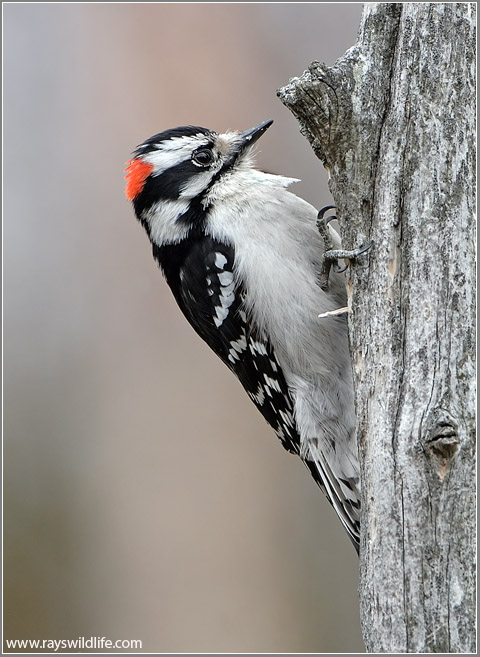
Downy Woodpecker (Picoides pubescens) by Raymond Barlow

Downy Woodpecker (Picoides pubescens) by Raymond Barlow

*

*

ON THE first day of the seventh month [on New Year’s Day of the civil year], you shall have a holy [summoned] assembly; you shall do no servile work. It is a day of blowing of trumpets for you [everyone blowing who wishes, proclaiming that the glad New Year has come and that the great Day of Atonement and the Feast of Tabernacles are now approaching]. (Numbers 29:1 AMP)

*

You might want to leave a comment just in case the survey doesn’t work. It’s a new attempt on my part. Leave bird and country.

*

2013 in Review – Lee’s Birdwatching Adventures Plus

The WordPress.com stats helper monkeys prepared a 2013 annual report for this blog.

Here’s an excerpt:

The Louvre Museum has 8.5 million visitors per year. This blog was viewed about 220,000 times in 2013. If it were an exhibit at the Louvre Museum, it would take about 9 days for that many people to see it.

Click here to see the complete report.

*

Lee at Lake Morton by Dan

Lee at Lake Morton by Dan

We give thanks to God always for you all, making mention of you in our prayers; (1 Thessalonians 1:2 KJV)

Thank you all for visiting this site during 2013. I trust you have learned many things about the birds and other things of creation and have also been blessed. Also, thank you for making it possible to have the 1 Millionth visitor arrive on October 20, 2013. WOW!

Will do the best we can to make 2014 even better.

Happy New Year!

Lord Bless,

Lee and all the contributing writers and photographers.

*

Top Posts for 365 days ending 2013-12-31 (Summarized)

2012-12-31 to Today

Title Views
Home page / Archives More stats 26,590
Birds of the Bible – Eagle’s Renewal More stats 11,313
Interesting Things – Dragonflies More stats 8,435
Weaver Birds More stats 4,711
South Lake Howard Nature Park More stats 2,612
Birds of the Bible More stats 2,497
Trochilidae – Hummingbirds More stats 2,180
Hymns More stats 1,819
Columbidae – Pigeons, Doves More stats 1,728
Eagle Photos More stats 1,713
Anatidae – Ducks, Geese & Swans More stats 1,622
Interesting Things – The Egyptian “Crocodile Bird” Plover More stats 1,616
Strigidae – Owls More stats 1,548
Estrildidae – Waxbills, Munias & Allies More stats 1,464
When I Consider! – Elephant Ears and Scarab Beetles More stats 1,442
Phasianidae – Pheasants, Fowl & Allies More stats 1,369
Accipitridae – Kites, Hawks and Eagles More stats 1,332
Psittacidae – Parrots More stats 1,321
Alcedinidae – Kingfishers More stats 1,282
Fringillidae – Finches More stats 1,189
Muscicapidae – Chats, Old World Flycatchers More stats 1,114
Thraupidae – Tanagers and Allies More stats 1,062
Birds of the Bible – Clean vs. Unclean More stats 1,011
Birds of the Bible – Partridge II More stats 954
Rallidae – Rails, Crakes & Coots More stats 951
Nectariniidae – Sunbirds More stats 902
Birds of the Bible – Dove’s Eyes and Voice More stats 895
Corvidae – Crows, Jays More stats 870
Sturnidae – Starlings More stats 852
Birds of the Bible – Sparrows I More stats 825
Life List of All Birds We Have Seen More stats 816
Turdidae – Thrushes More stats 787
Picidae – Woodpeckers More stats 780
Falconidae – Caracaras, Falcons More stats 771
Birds of the Bible – Ossifrage More stats 740
Leopard More stats 721
Paradisaeidae – Birds-of-paradise More stats 708
Leiothrichidae – Laughingthrushes More stats 673
Pycnonotidae – Bulbuls More stats 673
Furnariidae – Ovenbirds More stats 671
Apodidae – Swifts More stats 631
Icteridae – Oropendolas, Orioles & Blackbirds More stats 622
Zosteropidae – White-eyes More stats 616
Birds in Songs – On Eagle’s Wings More stats 615
Ploceidae – Weavers, Widowbirds More stats 613
Birds of the Bible – Swallows More stats 605
Birds Vol 1 #3 – The Brown Thrush (Thrasher) More stats 605
Emberizidae – Buntings, New World Sparrows & Allies More stats 603
Tinamidae – Tinamous More stats 596
Photos More stats 589
Monarchidae – Monarchs More stats 586
Doves and Pigeons More stats 584
Ardeidae- Herons, Bitterns More stats 580
Birds of the Bible – Names of Birds More stats 577
The Eagle – The Loyal Mate.. More stats 573
Meliphagidae – Honeyeaters More stats 569
Cuculidae – Cuckoos More stats 561
Birds – Hymns More stats 548
Birds of the Bible – Descending Like A Dove More stats 545
Eagles More stats 536
Birds of the Bible – Osprey II More stats 504
Birds – World More stats 500
Birdwatching More stats 498
Birds of the Bible – Hawk Migration More stats 489
Cardinalidae – Grosbeaks, Saltators & Allies More stats 486
Procellariidae – Petrels, Shearwaters More stats 478
Campephagidae – Cuckooshrikes More stats 470
Scolopacidae – Sandpipers, Snipes More stats 468
Birds of the Bible – Sea Gulls More stats 446
Cisticolidae – Cisticolas and allies More stats 441
Tyrannidae – Tyrant Flycatchers More stats 436
Bucerotidae – Hornbills More stats 426
Ostrich More stats 423
Thamnophilidae – Antbirds More stats 420
Chicken, Hens, and Roosters More stats 411
Scripture Alphabet of Animals: The Ass (Donkey) More stats 411
Birds Vol 1 #2 – The American Red Bird More stats 410
Interesting Things – Grand Canyon and Squirrels More stats 402
Laridae – Gulls, Terns and Skimmers More stats 396
Troglodytidae – Wrens More stats 393
Some Very Unusual Birds More stats 393
Rhinocryptidae – Tapaculos More stats 392
Birds of the Bible – Review More stats 390
Birds of the Bible – How Many Are There? Part I More stats 386
Birds Illustrated by Color Photography – Revisited More stats 385
Birds of the Bible – Singing Birds More stats 383
Scripture Alphabet of Animals: The Camel More stats 380
Hirundinidae – Swallows, Martins More stats 380
Sharing the Gospel and Pointing Someone to Christ in the Scripture More stats 380
Bird – Week More stats 377
Birds of the Bible – Under His Wing More stats 376
Acanthizidae – Australasian Warblers More stats 369
About More stats 368
Sparrows More stats 365
Parulidae – New World Warblers More stats 360
Scripture Alphabet of Animals: The Vulture More stats 359
When I Consider! – Couch’s Spadefoot Toad More stats 356
Phylloscopidae – Leaf warblers and allies More stats 356
Ramphastidae – Toucans More stats 347
Birds of the Bible – Dove’s Dung More stats 341
Pellorneidae – Fulvettas, Ground Babblers More stats 337
Motacillidae – Wagtails, Pipits More stats 334
Caprimulgidae – Nightjars More stats 331
Passeridae – Old World Sparrows, Snowfinches More stats 328
Megapodiidae – Megapodes More stats 325
Birds of the Bible – Owls More stats 323
Peacocks More stats 320
The Futuristic Whip-poor-wills…. More stats 320
Birds of the Bible – Turtle Doves More stats 318
Birds of the Bible – Dove and Turtle-Dove More stats 318
Herons More stats 316
Birds of the Bible – Vulture More stats 314
Acrocephalidae – Reed warblers and allies More stats 314
Lybiidae – African Barbets More stats 313
Birds of the Bible – Quail More stats 308
Interesting Things – The Weaver Bird More stats 302
Birds of the Bible – Swift More stats 302

*

A Red-headed Cousin (Red-headed Woodpecker)

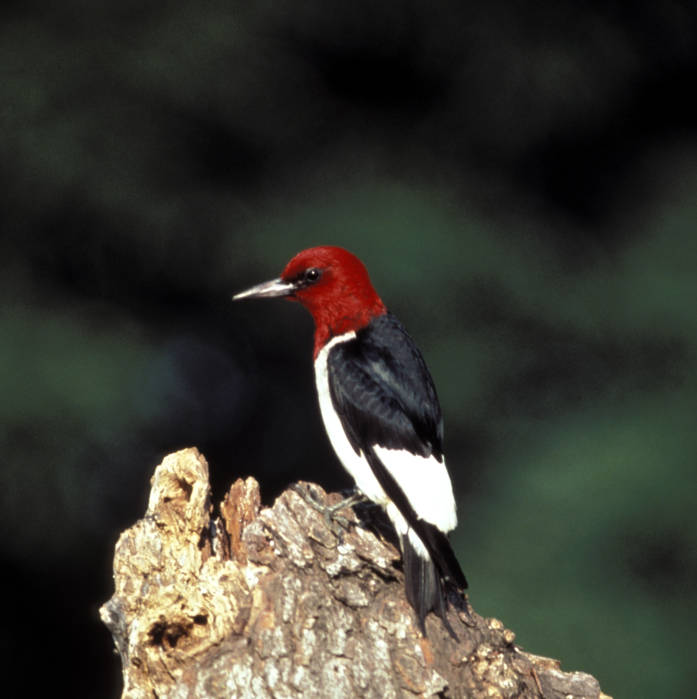
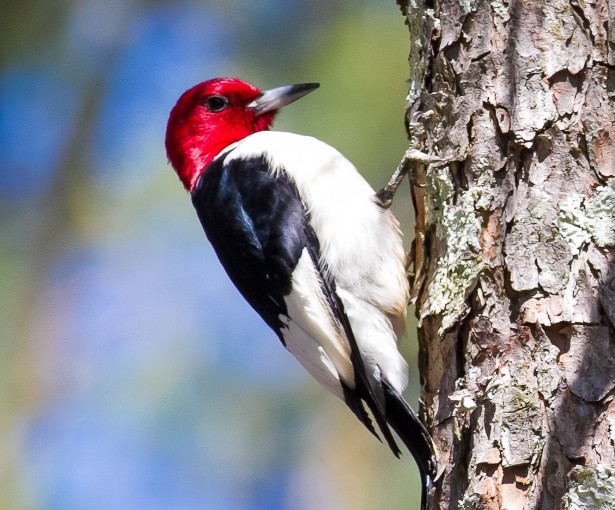
Red-headed Woodpecker (Melanerpes erythrocephalus) ©USFWS

Red-headed Woodpecker (Melanerpes erythrocephalus) ©USFWS

IX

A RED-HEADED COUSIN

Besides his half-brothers, the narrow-fronted and ant-eating woodpeckers, the Carpenter has a numerous family of cousins,—the red-headed, the red-bellied, the golden-fronted, the Gila, and the Lewis’s woodpeckers. These all belong to one genus, and are much alike in structure, though totally different in color. Most of them are Western or Southwestern birds, but one is found in nearly all parts of the United States lying between the Hudson River and the Rocky Mountains, and is the most abundant woodpecker of the middle West. This well-known cousin is the red-headed woodpecker, the tricolored beauty that sits on fence-posts and telegraph poles, and sallies out, a blaze of white, steel-blue, and scarlet, a gorgeous spectacle, whenever an insect flits by. He is the one that raps so merrily on your tin roofs when he feels musical.

So named from being found along the Gila River.

In many ways the red-head, as he is familiarly called, is like his carpenter cousin. Both indulge in long-continued drumming; both catch flies expertly on the wing; and both have the curious habit of laying up stores of food for future use. The Californian woodpecker not only stores acorns, but insect food as well. But though the Carpenter’s habits have long been known, it is a comparatively short time since the red-head was first detected laying up winter supplies.

The first to report this habit of the red-head was a gentleman in South Dakota, who one spring noticed that they were eating young grasshoppers. At that season he supposed that all the insects of the year previous would be dead or torpid, and certainly full-grown, while those of the coming summer would be still in the egg. Where could the bird find half-grown grasshoppers? Being interested to explain this, he watched the red-heads until he saw that one went frequently to a post, and appeared to get something out of a crevice in its side. In that post he found nearly a hundred grasshoppers, still alive, but wedged in so tightly they could not escape. He also found other hiding-places all full of grasshoppers, and discovered that the woodpeckers lived upon these stores nearly all winter.

But it is not grasshoppers only that the red-head hoards, though he is very fond of them. In some parts of the country it is easier to find nuts than to find grasshoppers, and they are much less perishable food. The red-head is very fond of both acorns and beechnuts. Probably he eats chestnuts also. Who knows how many kinds of nuts the red-head eats? You might easily determine not only what he will eat, but what he prefers, if a red-headed woodpecker lives near you. Lay out different kinds of nuts on different days, putting them on a shed roof, or in some place where squirrels and blue jays would not be likely to dare to steal them, and see whether he takes all the kinds you offer. Then lay out mixed nuts and notice which ones he carries off first. If he takes all of one kind before he takes any of the others, we may be sure that he has discovered his favorite nut. Such little experiments furnish just the information which scientific men are glad to get.

Red-headed Cousin

It is well known that the red-head is very fond of beechnuts. Every other year we expect a full crop of nuts, and close observation shows that the red-heads come to the North in much larger numbers and stay much later on these years of plenty than on the years of scanty crops. Lately it has been discovered that they not only eat beechnuts all the fall, but store them up for winter use. This time the observation was made in Indiana. There, when the nuts were abundant, the red-heads were seen busily carrying them off. Their accumulations were found in all sorts of places: cavities in old tree-trunks contained nuts by the handful; knot-holes, cracks, crevices, seams in the barns were filled full of nuts. Nuts were tucked into the cracks in fence-posts; they were driven into railroad ties; they were pounded in between the shingles on the roofs; if a board was sprung out, the space behind it was filled with nuts, and bark or wood was often brought to cover over the gathered store. No doubt children often found these hiding-places and ate the nuts, thinking they were robbing some squirrel’s hoard.

In the South, where the beech-tree is replaced by the oak, the red-heads eat acorns. I should like to know whether they store acorns as they do beechnuts. Are chestnuts ever laid up for winter? How far south is the habit kept up? Is it observed beyond the limits of a regular and considerable snowfall? That is, do the birds lay up their nuts in order to keep them out of the snow, or for some other reason?

It remains to be discovered if other woodpeckers have hoarding-places. We know that the sapsucker eats beechnuts, and the downy and the hairy woodpeckers also; that the red-bellied woodpecker and the golden-winged flicker eat acorns; and I have seen the downy woodpecker eating chestnuts, or the grubs in them, hanging head downward at the very tip of the branches like a chickadee. It may be possible that some of these lay up winter stores.

*

This is Chapter XI from The Woodpeckers book. Our writer, Fannie Hardy Eckstorm, wrote this in 1901. There are 16 chapters, plus the Forward, which are about the Woodpecker Family here in America. All the chapters can be found on The Woodpeckers page. I added photos to help enhance the article. In 1901, photography was not like today.

Woodpeckers belong to the Picidae – Woodpeckers Family.


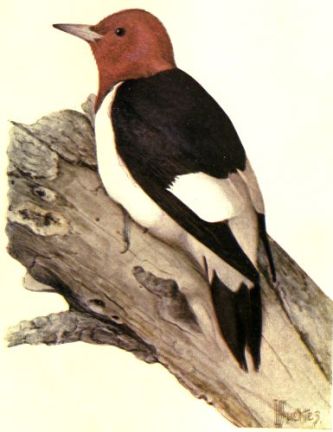
Red-headed Woodpecker (Melanerpes erythrocephalus) ©Bing

Red-headed Woodpecker (Melanerpes erythrocephalus) ©Bing

Lee’s Addition:

Come now, and let us reason together, saith the LORD: though your sins be as scarlet, they shall be as white as snow; though they be red like crimson, they shall be as wool. (Isaiah 1:18 KJV)

He answered and said unto them, When it is evening, ye say, It will be fair weather: for the sky is red. And in the morning, It will be foul weather to day: for the sky is red and lowring. O ye hypocrites, ye can discern the face of the sky; but can ye not discern the signs of the times? (Matthew 16:2-3 KJV)

The Red-headed Woodpecker (Melanerpes erythrocephalus), which belongs to the Picidae – Woodpeckers Family, is a small or medium-sized woodpecker from temperate North America. Their breeding habitat is open country across southern Canada and the eastern-central United States.

The Red-headed Woodpecker was one of the many species originally described by Linnaeus in his 18th-century work Systema Naturae. The specific epithet is derived from the Ancient Greek words erythros ‘red’ and kephalos ‘head’.

Adults are strikingly tri-colored, with a black back and tail and a red head and neck. Their underparts are mainly white. The wings are black with white secondary remiges. Adult males and females are identical in plumage. Juveniles have very similar markings, but have an all grey head.

These birds fly to catch insects in the air or on the ground, forage on trees or gather and store nuts. They are omnivorous, eating insects, seeds, fruits, berries, nuts, and occasionally even the eggs of other birds. About two-thirds of their diet is made up of plants. They nest in a cavity in a dead tree, utility pole, or a dead part of a tree. They lay 4 to 7 eggs in early May which are incubated for two weeks. Two broods can be raised in a single nesting season. (Wikipedia with editing)

**

Interesting Bird Facts about the Red-headed Woodpecker

  • It has the greatest G-force (acceleration due to gravity): beak of red-headed woodpecker hitting bark at 20.9 km/h (13 mph). (Internet)
  • The Red-headed Woodpecker has many nicknames, including half-a-shirt, shirt-tail bird, jellycoat, flag bird, and the flying checker-board. (All About Birds)

*

*

2013’s Christmas Day

©©Bing

©©Bing

Well, here we are on Christmas Day, December 25th. We hope you are having a very pleasant and blessed day, as the birth of Our Savior, Jesus Christ’s “birthday” is celebrated. We know from Scripture that He has always been.

I have been established from everlasting, From the beginning, before there was ever an earth. (Proverbs 8:23 NKJV)

And the angel said unto them, Fear not: for, behold, I bring you good tidings of great joy, which shall be to all people. For unto you is born this day in the city of David a Saviour, which is Christ the Lord. (Luke 2:10-11 KJV)

The Lord chose to take on human flesh, to live a sinless life, and then die as a substitute for us and our sins on the cross. He was both God and man. What Love was shown to us by this. Salvation comes through Christ and Christ alone.

The last week or so, we have shown all the beautifully and colorfully created birds and also excerpts from our Everlasting Life Cantata. There are links at the bottom to those articles. There are some differences in the birds chosen for slideshows on the two blogs.

Today, we have the conclusion of the Everlasting Life cantata by Faith Baptist Church. Our pastor, Nathan Osborne III, speaks, prays and then the concluding finale by the choir. I trust you will enjoy it.

Lord Bless you and Merry Christmas.

*

*

The Christmas Birds: Lee’s Birdwatching Adventures Plus


Joyous Christmas 2013

Dove in Snow ©©Flickr Roguey000

Dove in Snow ©©Flickr Roguey000

I’ve dusted the Christmas post from the past. But the message is still the same and I wanted to present our pastor’s illustration at the Cantata ’08. It has a very good message.

Christmas of 2013 is here and those of us at Lee’s Birdwatching Adventures; Lee, Dan, A J, Ian and all the guest writers would like to wish you a very Merry Christmas. We are busy doing things for the special day when we celebrate the birth of the Lord Jesus Christ.  We will be seeing our relatives again this year and will enjoy our time together. Tonight, Christmas Eve, we will be sharing the Candlelight Service with all of our friends at church. We hope your Christmas Day and week are just as enjoyable as ours will be.

During all the festivities, pause to reflect on the true meaning of Christmas. We enjoy our birdwatching adventures throughout the year, and try to write and photograph our friends the birds, but our goal is to show God’s magnificent creation and point you to Him. We do not worship nature, but we do worship the Lord who created it all.

Please watch the video of my pastor, Nathan Osborne, III, as he gave an excellent illustration about birds out in the cold and snow. It helps to explain the true meaning of Christmas. (Part of our Christmas cantata, “From the Manger to the Cross”)

He came unto his own, and his own received him not. But as many as received him, to them gave he power to become the sons of God, even to them that believe on his name: Which were born, not of blood, nor of the will of the flesh, nor of the will of man, but of God. And the Word was made flesh, and dwelt among us, (and we beheld his glory, the glory as of the only begotten of the Father,) full of grace and truth. (John 1:11-14 KJV)

*

Sharing The Gospel

*

Hidden-in-Plain-View Lesson from a Motmot: by James J. S. Johnson

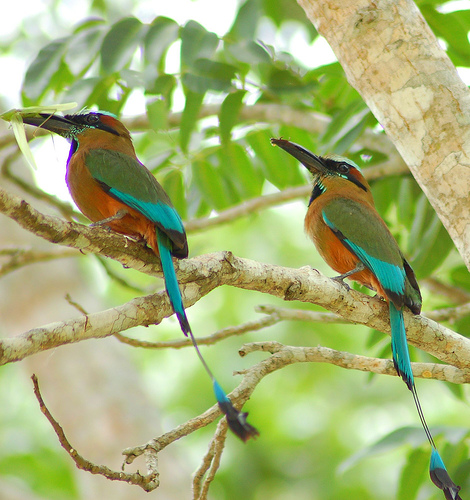
Turquoise-browed Motmot (Eumomota superciliosa) perching from JJSJ

Turquoise-browed Motmot (Eumomota superciliosa) perching from JJSJ

Hidden-in-Plain-View Lesson from a Motmot: 

God’s Beauty Outshines Human Ugliness

by James J. S. Johnson

The turquoise-browed motmot (Eumomota superciliosa) is an amazingly beautiful bird that few will see in the wild.  That kingfisher-like bird is a living testimony of God’s beauty and care.  Yet what a contrast that bird is to some of the ugliness sinful mankind has soiled this weary world with.  Consider the following as an illustration of this bittersweet contrast.

Consider the ancient Mayan ruins at Chichen Itza in the Yucatan peninsula of Mexico. At the top of the Temple of Kukulcan in Chichen Itza, human sacrifices took place. A stone knife was used to slice open the victim’s chest cavity, the heart was pulled out, held up as a sacrifice to the sun god while it was still beating, the head was severed, and the body tumbled down the stairs. Once the bloody bodies reached the bottom of the stairs, they were often eaten. Is it any wonder that the Mayas had problems with plagues, dying of diseases by the thousands?  (Providentially, God used Spanish conquistadors, such as Hernando Cortez, to abolish this genocidal holocaust.)

Also, there is a sinkhole located north of the Mayan Temple of Kukulcan, which is called the Sacred Cenote, or “Well of Sacrifice,” where they would toss people in to die by drowning in the murky water, and then the spectators would drink the water.  Some of the walls, not far from the temple and the cenote, exhibit rows upon rows (comparable to courses of bricks laid by bricklayers) of skull carvings (called “tzompantli”). The facial shape and expression of each skull carving is different—not just one generic skull model. Perhaps the sculptors were probably looking at different skulls when they carved them. Hundreds, even thousands of humans were sacrificed by the Mayas of the Yucatan and their neighbors. Similar holocausts were committed by the Aztecs of Central Mexico, where human sacrifices were processed in the Nahuatl language.

Fallen humanity, if unrestrained by the gospel and redeeming work of the Lord Jesus Christ, is a very ugly and cruel thing to see. Instead of seeing God’s traits of kindness, goodness, intelligence, the exact opposite is seen. In this Chichen Itza is no different than many other cultures, including the humanistic (human-preoccupied) cultures of our modern world. Humans have ignored God’s prior judgments and will continue to do so. God provides a witness; He provides an opportunity of deliverance through His grace, but many reject it.

But there is a brighter side to all of this:  God never leaves Himself without a witness (or a remnant).

Ironically, Chichen Itza displays not only God’s wrath (which is displayed by how God historically gave the bloodthirsty Mayas over to their own sinfulness), but also, if you look carefully, there is an avian exhibit of God’s love of beauty, even there: the turquoise-browed motmot which inhabits this region of Mexico’s Yucatan Peninsula.

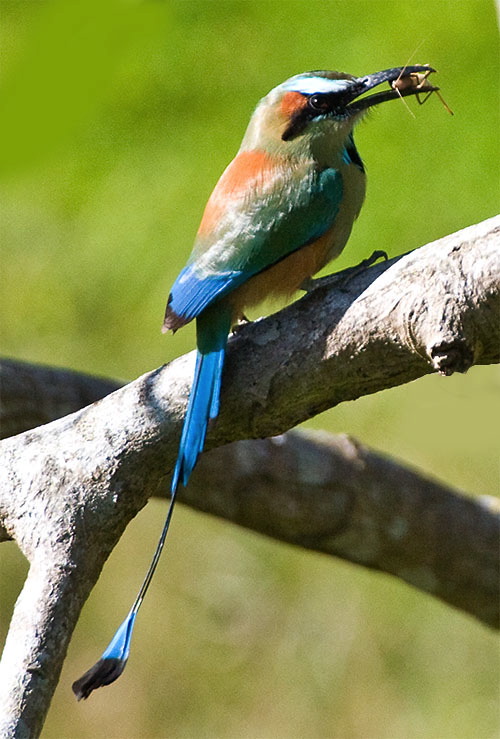
Turquoise-browed Motmot (Eumomota superciliosa)-closeup from JJSJ

Turquoise-browed Motmot (Eumomota superciliosa)-closeup from JJSJ

Specifically, if you walk northward from Kukulcan’s temple to the cenote (sacrifice sink-hole), there is a forest edge on the west side of the pathway, just before you arrive at the cenote, and in the large tree there (at that forest edge), creation scientists (Dr. Jan Mercer and this author) have observed turquoise-browed motmots perched in plain sight of those who walk by.  Here you can see two “pipe-cleaner” extensions of the tail, both with a colorful “brush” or “fan” on the end of those long tail feathers. What a beautiful bird!—a witness of God’s beauty in a place that was loaded with cruelty.

Unlike the colorful racquet-tailed turquoise-browed motmot, the Mayan handiwork at Chichen Itza was mostly a glorification of vile death, wretched idolatry, and ugly cruelty.  Tragically, for many generations, there, God’s truth was rejected, and idolatry prevailed.  The result is they “changed the truth of God into a lie” (Romans 1:25). What does God do with those who reject His Creatorship, according to Romans chapter one?  God punishes them with a “reprobate mind” (Romans 1:28), something like spiritual insanity. The “reprobate mind” judgment does not wait until the next life; it is imposed in this earthly life! One of the severest punishments that God ever imposes, unto those who reject the witness of His Creatorship and His glory, is that He gives people over to their love-of-the-lie wickedness.  (Romans 1:24).

Interestingly, the verb (in Romans 1:24) is an aorist verb, meaning the action is viewed as an event, as if it happened in a moment. It doesn’t mean it literally happened in just a split second, but it means it is being viewed as one action or one unit. There was a specific time when someone had rejected so much God-provided truth, inexcusably, that God said, “That’s it. I’m giving you over.” It’s a scary thing when God pulls back His restraints and mankind is allowed to just live out the selfish ugliness that is in the human heart.

When we reflect upon the season of Christmas, which we should do (suspending our distractions long enough to recall the Reason for this season), we should appreciate that God sent Christ to save a race of helplessly wretched sinners, Adam’s fallen race,   —  us  —  from the ugliness of self-proud and self-deluded ungodliness.  Yes, we all desperately need a Savior, Jesus Christ the righteous.  It is our Lord Jesus Christ – the Reason for the (CHRISTmas) season  —  Who is the author and finisher of everything that is truly beautiful in our lives.  God loves beauty, but our ungodliness is ugly.  So only God can (and does, if we avail ourselves to Him) salvage and remediate us from ugliness, both here and hereafter.  What a generous and gracious Kinsman-Redeemer Jesus is!

So even at Chichen Itza, a monument to human ugliness, we have the turquoise-browed motmot! —a wonderful witness of God’s shining beauty and love of life.   ><> JJSJ

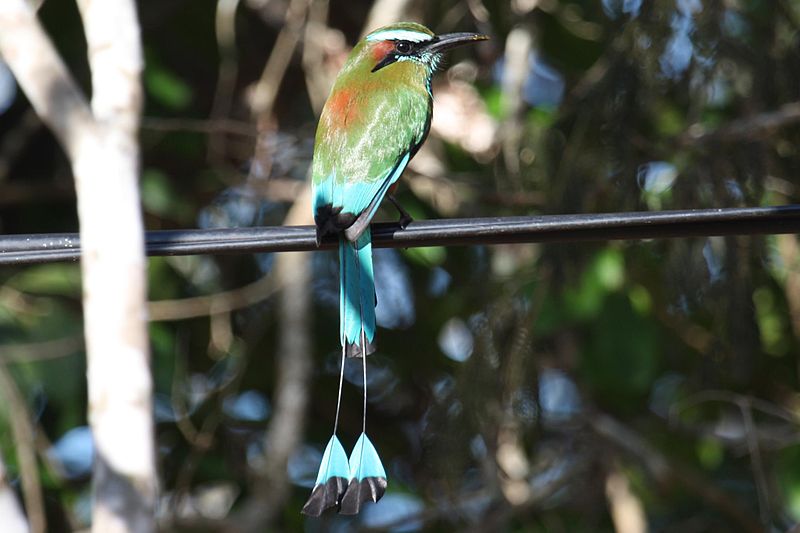
Turquoise-browed Motmot (Eumomota superciliosa) ©WikiC

Turquoise-browed Motmot (Eumomota superciliosa) ©WikiC

(Adapted from James J. S. Johnson, “Turquoise-browed Motmot at Chichen Itza: Contrasting God’s Beauty with Mayan Ugliness”, Norfolk Heritage Review, June 1999; © AD1999 James J. S. Johnson)

See:

Other articles by James J. S. Johnson

Motmot Family – Momotidae – Motmots

*

Christmas Birds – Ornaments 2013

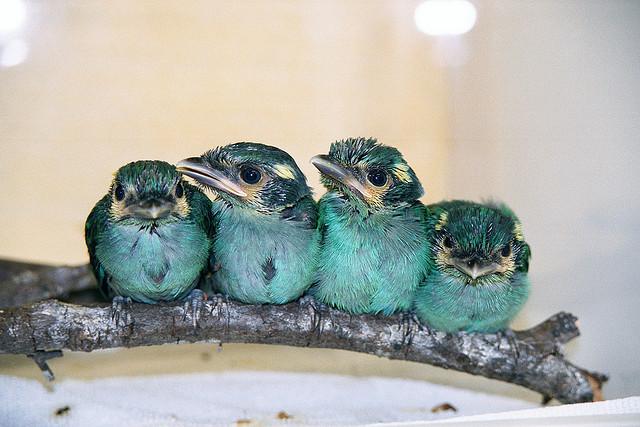
Long-tailed Broadbill (Psarisomus dalhousiae) babies ©WikiC coracii

Long-tailed Broadbill (Psarisomus dalhousiae) babies ©WikiC coracii

Here are the last of the Christmas Birds. The colors and designs would be pretty in ornaments. But most of all, they are superb examples of the Lord’s omniscient creative designs.

He was in the world, and the world was made by him, and the world knew him not. He came unto his own, and his own received him not. But as many as received him, to them gave he power to become the sons of God, even to them that believe on his name:.. And the Word was made flesh, and dwelt among us, (and we beheld his glory, the glory as of the only begotten of the Father,) full of grace and truth. (John 1:10-12, 14 KJV)

*

This slideshow requires JavaScript.

Whose adorning let it not be that outward adorning of plaiting the hair, and of wearing of gold, or of putting on of apparel; But let it be the hidden man of the heart, in that which is not corruptible, even the ornament of a meek and quiet spirit, which is in the sight of God of great price. (1 Peter 3:3-4 KJV)

*

Music to listen to while viewing the photos. “Ring The Bells” – Men’s Quartet – Faith Baptist 2012

*

See the original article – Christmas Birds – Ornaments

The Christmas Birds 2013 so far:

*

Christmas Birds – Silver and Gold 2013

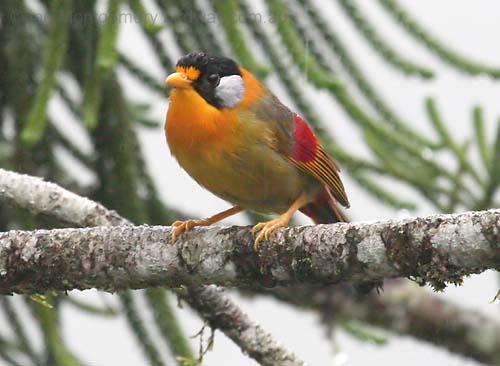
Silver-eared Mesia (Leiothrix argentauris) by Ian

Silver-eared Mesia (Leiothrix argentauris) by Ian

This time the Silver and Gold are both found on the birds. When the Lord created all the beautiful and colorful birds, He did not lack using variety.

Receive my instruction, and not silver; and knowledge rather than choice gold. (Proverbs 8:10 KJV)

How much better is it to get wisdom than gold! and to get understanding rather to be chosen than silver! (Proverbs 16:16 KJV)

*

This slideshow requires JavaScript.

*

knowing that you were not redeemed with corruptible things, like silver or gold, from your aimless conduct received by tradition from your fathers, but with the precious blood of Christ, as of a lamb without blemish and without spot. He indeed was foreordained before the foundation of the world, but was manifest in these last times for you (1 Peter 1:18-20 NKJV)

Joy To The World played by the Faith Baptist Orchestra 2012

The Christmas Birds 2013 so far:

*

Who Paints The Leaves?

*

(I know, I kind of took a few liberties with the photos. This was one of the harder challenges.)

*

Christmas Birds – Gold 2013

Golden Tanager (Tangara arthus goodsoni) ©BirdPhotos.com

Golden Tanager (Tangara arthus goodsoni) ©BirdPhotos.com

Hope you have been enjoying the updated Christmas Birds. This is another new one to the series. Gold is in the names of birds and their goldish-yellow colors are plentiful.

When they had heard the king, they departed; and, lo, the star, which they saw in the east, went before them, till it came and stood over where the young child was. When they saw the star, they rejoiced with exceeding great joy. And when they were come into the house, they saw the young child with Mary his mother, and fell down, and worshipped him: and when they had opened their treasures, they presented unto him gifts; gold, and frankincense, and myrrh. (Matthew 2:9-11 KJV)

*

This slideshow requires JavaScript.

*

Then entered in those Wise Men three,
Full reverently upon the knee,
And offered there, in His presence,
Their gold and myrrh and frankincense.

Noel, Noel, Noel, Noel,
Born is the King of Israel.

The Christmas Birds 2013 so far:

*

Wordless Birds

*

Christmas Birds – Silver 2013

Silver-breasted Broadbill (Serilophus lunatus) by Peter Ericsson

Silver-breasted Broadbill (Serilophus lunatus) by Peter Ericsson

This year I am adding Silver Birds to our collection of Christmas Birds. Grey and white sometimes look like silver when in certain light. Some of them are also used.

The words of the LORD are pure words: as silver tried in a furnace of earth, purified seven times. Thou shalt keep them, O LORD, thou shalt preserve them from this generation for ever. (Psalms 12:6-7 KJV)

*

This slideshow requires JavaScript.

saying, “Where is He who has been born King of the Jews? For we have seen His star in the East and have come to worship Him.”
(Matthew 2:2 NKJV)

*

Listen to Silver Star by Horatio R. Palmer (1834-1907) as you view the slideshow. I have inserted the words to this song at the bottom. Never heard it before, but the words are great.

The Christmas Birds 2013 so far:

*

Silver Star

On the brow of night there shines a silver star,
And the wise men gaze on its heav’nly rays,
Till they find the King, whose throne they sought afar,
In the Babe of Bethlehem.

Refrain

Silver star, holy light,
Shine afar, o’er the night,
Till the world shall come where the young Child lay,
And enter the gates of the newborn day.

’Tis the lamp of God high hanging in the air,
And it guides our feet thro’ the royal street;
There is sweet soul-rest for those who seek it there,
From the Babe of Bethlehem.

Refrain

Silver star, holy light,
Shine afar, o’er the night,
Till the world shall come where the young Child lay,
And enter the gates of the newborn day.

Bring your gifts of gold, of frankincense and myrrh,
For the King we own is on David’s throne;
Let the holy Child your best affections stir;
’Tis the Babe of Bethlehem.

Refrain

Silver star, holy light,
Shine afar, o’er the night,
Till the world shall come where the young Child lay,
And enter the gates of the newborn day.

*