“A man that hath friends must shew himself friendly: and there is a friend that sticketh closer than a brother.” (Proverbs 18:24 KJV)”
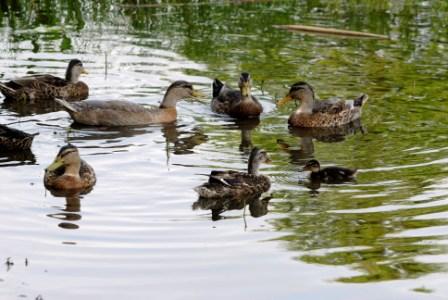
So far we haven’t seen many birds. My sister-in-law has a pond behind here with Mallards. Also, a Blue Jay has been calling, but has refused to show himself.
The ponds around town, Indianapolis, has lots of Canadian Geese hanging out. The one batch/flock had about 20 or so, and they were all faced south. Maybe they were getting aligned so they could get started South for the winter. Yet, up here it is still summer weather. Maybe they aren’t sure when to leave. Also, the remnants of Tropical Storm Gordon is going to come through tomorrow. The rain chance is 100% and flood warnings are being issued starting tomorrow. Welcome to Indiana.
Canada Goose (Branta canadensis) by Ian
Dan’s 60th High School reunion starts today and will be having gatherings for the next two days. We plan to leave here Sunday afternoon to go to Cincinnati area. Plans, depending on all this rain, we hope to go to the Cincinnati Zoo and then the Creation Museum. Then mosey home.
“But I trust I shall shortly see thee, and we shall speak face to face. Peace be to thee. Our friends salute thee. Greet the friends by name.” (3 John 1:14 KJV)
So far, praise the Lord, I have been handling this trip. My recent back surgery is still causing pain, but doing okay so far.
Unfortunately, my relative has NO INTERNET!!! :( So here I sit at McDonalds. Yeah, for free internets! That is why the posts are intermitten. Trust to post photos from the Zoo later. Hope they won’t have raindrops dripping off of them. :)
Looking forward to our northern birds to begin heading down for the winter. Actually, there have been reports already of migrating birds in various places around Florida. Unfortunately, some of them currently in Florida may be grounded for awhile until Tropical Storm Gordon blows out of the state.
“I would hasten my escape from the windy storm and tempest.” (Psalms 55:8 KJV)
Hurricane season gets active about the same time the fall migration gets underway. The Lord has given most of the birds the instinct to take cover during these disturbances.
We are currently headed the opposite direction. We are going North for a few days. Hope there will be a few birds left up there to enjoy while we are there. Dan has a High School reunion [60th] to attend. I will be visiting with a niece that I haven’t seen in years. When we get back home, maybe we will have some winter bird visitors already in Florida setting up their lawn chairs for the winter. That will give us some birding photos to take. Summer time is pretty slim on birding.
I am trusting the Lord to help me heal from my back surgery so we can get out and about with the birds again. So far, I am getting better, but still taking it easy. Also hope to get a few photos taken while on trip. Stay tuned!
“For the word of God is quick, and powerful, and sharper than any twoedged sword, piercing even to the dividing asunder of soul and spirit, and of the joints and marrow, and is a discerner of the thoughts and intents of the heart. Neither is there any creature that is not manifest in his sight: but all things are naked and opened unto the eyes of him with whom we have to do.” (Hebrews 4:12-13 KJV)
Avian and Attributes – Sharp
SH’ARP, a.
1. Having a very thin edge or a fine point; keen; acute; not blunt. Thus we may say, a sharp knife, or a sharp needle. A sharp edge easily severs a substance; a sharp point is easily made to penetrate,it.
2. Terminating in a point or edge; not obtuse; as, a hills terminates in a sharp peak, or a sharp ridge.
3. Forming an acute or too small angle at the ridge; as a sharp roof.
4. Acute of mind; quick to discern or distinguish; penetrating; ready at invention; witty; ingenious.
“Thy tongue deviseth mischiefs; like a sharp razor, working deceitfully.” (Psalms 52:2 KJV)
There are many “Sharp” named birds, but for this post, we will mention two of them. The Sharp-beaked Ground Finch and the Sharpbill. There will be more in a second article.
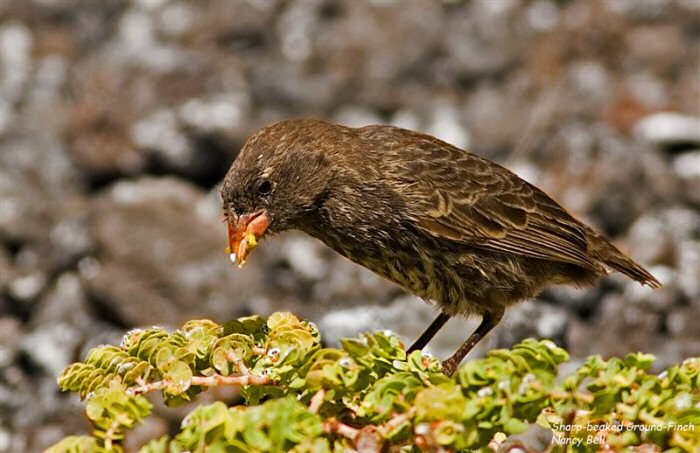
The Sharp-beaked Ground Finch(Geospiza difficilis) is a species of bird in the Tanager family Thraupidae. It is classified as a least-concern species by the International Union for Conservation of Nature and it is native to the Galápagos Islands in Ecuador. It has a mass of around 20 grams (0.71 oz) and the males have black plumage, while females have streaked brown plumage. This finch was described by Richard Bowdler Sharpe in 1888.
This relatively small, slender-billed finch is endemic to the Galápagos Islands, where it is found on Fernandina, Santiago, Pinta, Genovesa, Darwin, and Wolf Islands. On the first three islands, it breeds in the humid highlands and disperses afterwards, but on the remaining smaller and lower islands the sharp-beaked ground finch is found in the arid zone year-round. Due to habitat destruction its range has decreased. It was formerly also present in the highlands of several other islands, and it is possible it still occurs on Isabela.
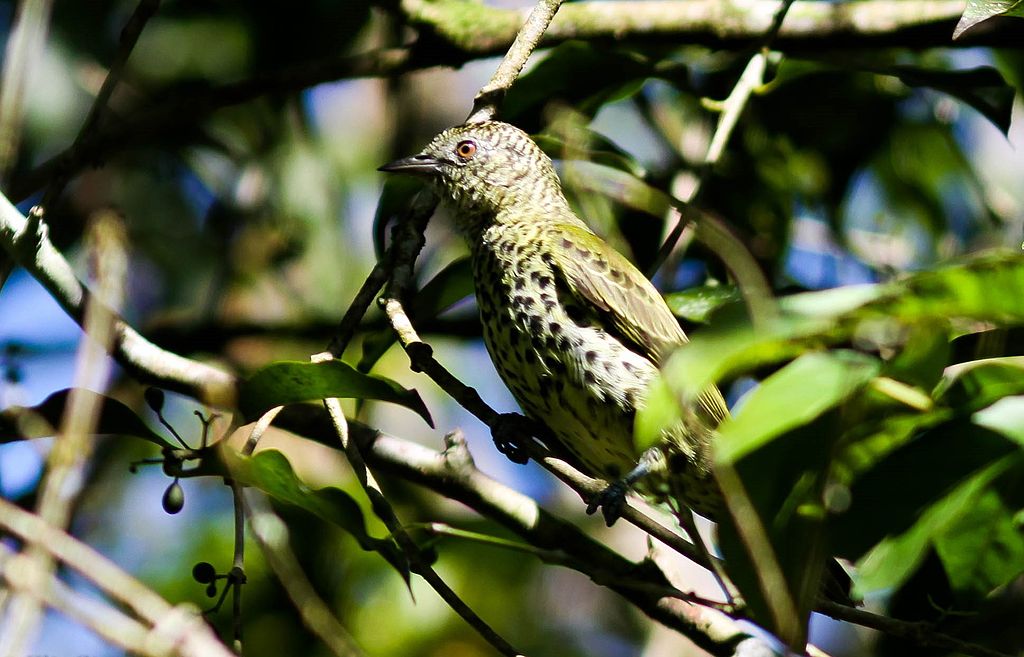
The Sharpbill (Oxyruncus cristatus) is a small passerine bird in the family Tityridae. Its range is from the mountainous areas of tropical South America and southern Central America (Panama and Costa Rica).
It inhabits the canopy of wet forest and feeds on fruit and some invertebrates. It has an orange erectile crest, black-spotted yellowish underparts and scaling on the head and neck. As its name implies, it has a straight, pointed beak, which gives its common name.
Sharpbills are most commonly found in tall dense forests but occasionally venture to the forest edge. Their diet consists of primarily of fruit, but they will also take insects, hanging upside down in from twigs to obtain insect larvae.
“Yea, the stork in the heaven knoweth her appointed times; and the turtle and the crane and the swallow observe the time of their coming; but my people know not the judgment of the LORD.” (Jeremiah 8:7 KJV)
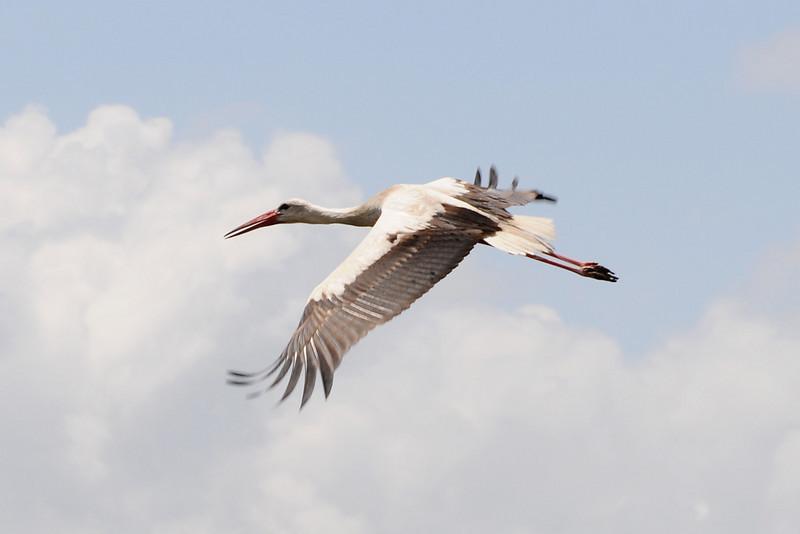
This migrating stork was tagged with a tracking device and ended up running up quite a phone bill. Here are excerpts from two different articles about Kajtek, the White Stork.
“A migrating, tagged, male white stork—known to the Polish environmentalists who were tracking him as “Kajtek”—blipped out of contact on 26 April.
That, however, did not stop him from making good use of the SIM card in his GPS tracker, with which the bird—or somebody who found the GPS device and picked it apart in order to get at the card—racked up a $2,700 phone bill.” [SIM card in bird’s GPS tracker]
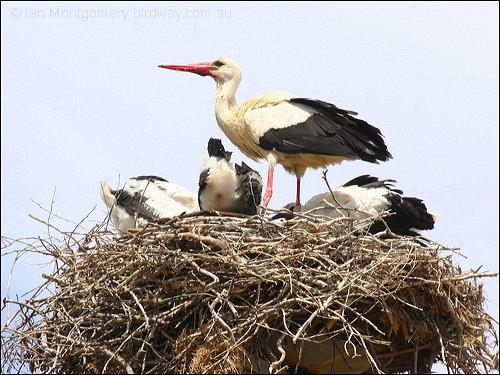
White Stork (Ciconia ciconia) by Ian
“In a Facebook post, the group explains that “for unknown reasons” Kajtek stayed in the area for over two months, “travelling 25 kms in different directions during the day”.
Last month, EkoLogiczna was surprised with a phone bill linked to the SIM card installed in the Kajtek’s GPS tracker for a total amount of 10,000 PLN (€2,278).
“Someone quite simply removed the card from the tracker, put it in a phone and used it for 20 hours of communication,” the group said in the Facebook post.
According to the EuroNatur Foundation, Poland is a major centre of distribution for the white stork, accounting for 40% of the bird’s world population.”
“Let him that stole steal no more: but rather let him labour, working with his hands the thing which is good, that he may have to give to him that needeth.” (Ephesians 4:28 KJV)
“If I say, “My foot slips,” Your mercy, O LORD, will hold me up. In the multitude of my anxieties within me, Your comforts delight my soul.” (Psalms 94:18-19 NKJV)
A Black Skimmer chick holding on to it’s parent. Adorable!
Ian’s Bird of the Moment – Masked Finch by Ian Montgomery
Surprise, surprise: a Bird of the Moment! I’ve been on a couple of camping trips in the last few months, so I have a few birds to share with you. The first trip was prompted by some birding friends who had found some Red-browed Pardalotes at a place called Cumberland Dam about half way between the Gulf of Carpentaria and both Cairns and Townsville. See the map below from the ebook Where to Find Birds in North-east Queensland.
At the time I was doing a major revision of the book and needed photos of both Cumberland Dam and Red-browed Pardalote, so I downed tools and set of with a couple of friends. The photo of the Dam proved easy enough (below) but the Pardalotes were more difficult. Cumberland was a gold mining town in the fourth quarter of the nineteenth century and at its peak in 1886 nearly 400 mine workers and their families lived there. Now all that is left is this square brick chimney and the dam, both built to serve the boilers that powered the batteries for crushing the gold-containing ore. See http://www.travelling-australia.info/Journal2011/22JulPtB.html.
Cumberland Dam is a well known birding spot. The area has a average annual rainfall of about 800mm/31in but 80% of that falls in the northern wet season from October to April so any persistent bodies of water in the dry season attract many birds. In addition, the region is on the western slopes of the Great Dividing Range – the Torresian Barrier of Schodde and Mason (1980) – so one can expect to find some species and races of birds different from those of coastal northeastern Queensland.
A striking example of these is the Cape York race of the Masked Finch, sometimes called the White-eared Finch. Cumberland is at the very southern tip of its range, shown below from The Directory of Australian Birds by Schodde and Mason (1999). The nominate race ranges from far northwestern Queensland to Broome in northern Western Australia and the ranges of the two races are disjoint.
When looking for the elusive Red-browed Pardalote, I found this pair of Masked Finches near the dam very busy gathering nesting material.
Their favourite material seemed to be what looked like thistle down but they also brought in feathers.
I assumed the nest was in a nearby clump of trees but on the second day they were still working away and I saw them taking the material into this clump of thick dried grass beside a barbed wire fence near where I’d first spotted them.
Here, incidentally is the nominate, western race of the Masked Finch so you can see why the Cape York race is called the White-eared Finch.
Pardalotes are easy to hear but hard to see as, unless you are lucky enough to find them at a nesting hollow on the ground, they spend their time in the outer foliage of trees. The Red-browed Pardalote has a distinctive call of about six notes, starting slow and low in pitch and then accelerating and rising. We heard three at Cumberland Dam and I went on a couple of wild-goose chases through forest and grazing country but got no more than a glimpse of one flying away and no photos. The Red-browed Pardalote quest ultimately succeeded on another camping trip: to be continued!
It has been some time since Ian Montgomery has produced on of his great articles. I trust you enjoy this latest one. Ian went from a Bird of the Week, to Bird of the Month, and now to the Bird of the Moment. Hew has been struggling with his health. We are always glad when he is able to produce a blog.
Ian, you are in our prayers that things are improving.
Ian’s searching for that Red-browed Paratote reminds me of the verse about seeking and searching with all your heart. In this case, it is a bird that is being searched for, yet we are to seek the Lord. He is the Creator of all these birds. He wants us to find Him and accept His gift of Salvation.
“And you will seek Me and find Me, when you search for Me with all your heart.” (Jeremiah 29:13 NKJV)
Then God said, “Let the waters abound with an abundance of living creatures, and let birds fly above the earth across the face of the firmament of the heavens.” (Genesis 1:20 NKJV)
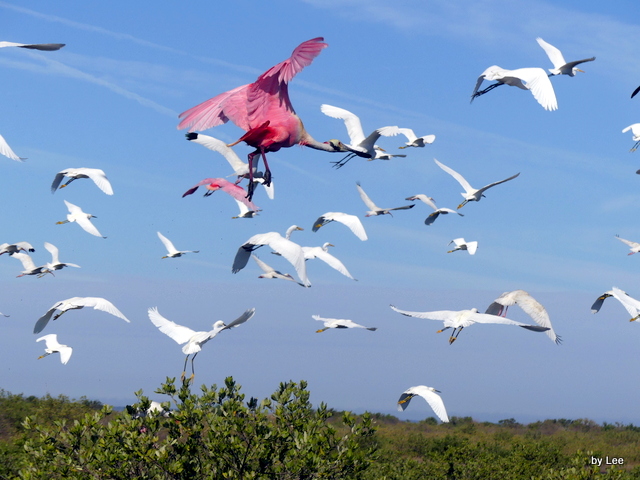
Mixed Flock Flyiing 122717 Merritt Is NWR by Lee
My friend Woodstock, from the Peanuts cartoons has been entertaining me lately. This is just one of many that have lightened my day.
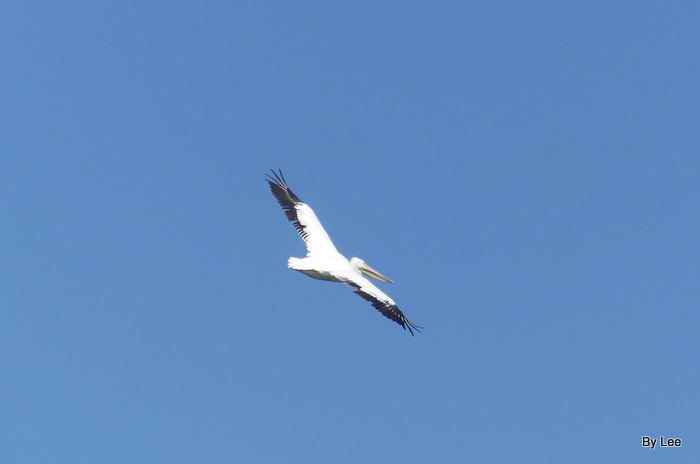
White Pelican Flying Overhead
Flying where it’s safer.
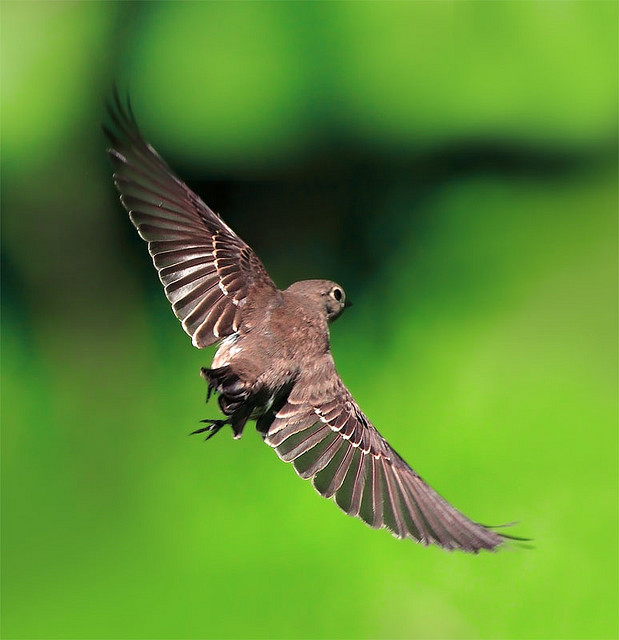
Spotted Flycatcher (Muscicapa striata) by John&Fish
Bald Eagle (Haliaeetus leucocephalus) Flying by Aesthetic Photos
For thus says the LORD: “Behold, one shall fly like an eagle, And spread his wings over Moab. (Jeremiah 48:40 NKJV)
As many of the readers of this blog know, I had back surgery on August 3rd. Before I mention the results of the surgery, I want to give some thanks.
#1 I want to thank the Lord for His Watching over all that has happened during this. Thanks and praise to a wonderful Savior who cares so much about us.
“O give thanks unto the LORD; call upon his name: make known his deeds among the people.” (Psalms 105:1 KJV)
#2 I want to thank all of you for your prayers and well wishes. Also, for continuing to keep up with the blog. I cannot thank you enough for that. Thank you.
“For the eyes of the Lord are over the righteous, and his ears are open unto their prayers: ” (1 Peter 3:12a KJV)
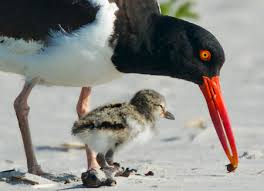
American Oystercatchers (American Bird Conservancy photo)
#3 I want to especially thank Dr. James J. S. Johnson, who has been practically carrying on this blog, by providing almost an article a day. The articles have been very interesting and entertaining, as I detect by the remarks that have been posted. He posts occasional posts here, but Dr. Jim, as I call him, has written the last 11 posts. Thank you, Dr. Jim.
“We therefore ought to receive such, that we might be fellowhelpers to the truth.” (3 John 1:8 KJV)
My forty-five (45) minute surgery and an overnight stay in the hospital ended up being a two and a half hour surgery and five nights in the hospital. Then we I returned home on Tuesday (100 mile ride), I ended up in the Emergency Room the next day, here in town. It is taking me a while to get back up to strength.
I just found out yesterday why the longer surgery. While they were placing the wedge/cage by my vertebra, the vertebrae fractured due to soft bone. I started bleeding immediately and they had to stop to get that stopped. Then they had to figure out what to do with the vertebra. [How many times I have prayed for other’s surgeries that the Lord would guide their hands, and their thinking.] Thank you for praying.
As a result of that, I ended up with fluid in the sac by the lung. That had to be drained a few days after the surgery. I believe I am now on the mend. I am still weak and on medicine that has slowed me down from even thinking about blogging. See why I am so thankful for the last 11 articles by Dr. Johnson. Needless to say, I have not done any birdwatching. :)
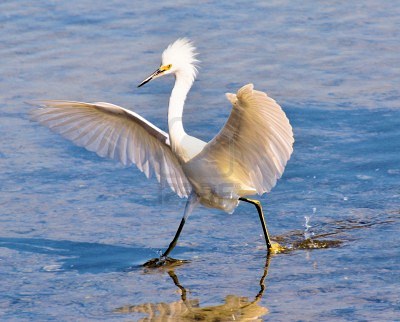
SNOWY EGRET wading & shading (Mrs. Bursk Science Class blog)
Thanks again to all of you for your thoughts and prayers, and especially for the Lord who knew all about this before, during, and after the surgery, and never left me.
“The LORD is thy keeper: the LORD is thy shade upon thy right hand.” (Psalms 121:5 KJV)
Avian and Attributes – Shade
SHADE, n. [L. scutum, a shield.]
1. Literally, the interception, cutting of or interruption of the rays of light; hence, the obscurity which is caused by such interception. Shad differs from shadow, as it implies no particular form or definite limit. whereas a shadow represents in form the object which intercepts the light. Hence when we say, let us resort to the shade of a tree, we have no reference to its form; but when we speak of measuring a pyramid or other object by its shadow, we have reference to its extent.
2. Darkness; obscurity; as the shades of night.
3. An obscure place, properly in a grove or close wood, which precludes the sun’s rays; an hence, a secluded retreat.
4. A screen; something that intercepts light or heat.
5. Protection; shelter.
6. In painting, the dark part of the picture.
7. Degree or gradation of light.
White, red, yellow, blue, with their several degrees, or shades and mixtures, as green, come only in by the eyes. Locke.
8. A shadow.
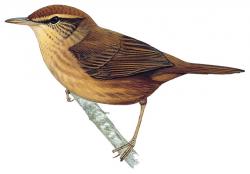
Shade Bush Warbler in Middle Drawing by John Anderton
Shade Bush Warbler (Horornis parens) or shade warbler (Horornis parens) is a species of bird in the family Cettiidae. It is found only in Solomon Islands, where it is endemic to the island of Makira (formerly San Cristobal Island). Its natural habitats are tropical moist lowland forests and tropical moist montane forest above 600m. It feeds on insects in the undergrowth and on the ground.
Reddy Fox wasted very little time waiting for Peter Rabbit to come out from under that pile of brush where he had hidden at Sammy Jay’s warning. After making some terrible threats just to try to frighten Peter, he trotted away to look for some Mice. Peter didn’t mind those threats at all. He was used to them. He knew that he was safe where he was, and all he had to do was to stay there until Reddy should be so far away that it would be safe to come out.
Just to pass away the time Peter took a little nap. When he awoke he sat for a few minutes trying to make up his mind where to go and what to do next. From ‘way over in the direction of the Old Pasture the voice of Blacky the Crow reached him. Peter pricked up his ears, then chuckled.
“Reddy Fox has gone back to the Old Pasture and Blacky has discovered him there,” he thought happily. You see, he understood what Blacky was saying. To you or me Blacky would have been saying simply, “Caw! Caw!” But to all the little people of the Green Forest and Green Meadows within hearing he was shouting, “Fox! Fox!”
“I wonder,” thought Peter, “where Blacky is nesting this year. Last year his nest was in a tall pine-tree not far from the edge of the Green Forest. I believe I’ll run over there and see if he has a new nest near the old one.”
So Peter scampered over to the tall pine in which was Blacky’s old nest. As he sat with his head tipped back, staring up at it, it struck him that that nest didn’t look so old, after all. In fact, it looked as if it had recently been fixed up quite like new. He was wondering about this and trying to guess what it meant, when Blacky himself alighted close to the edge of it.
There was something in his bill, though what it was Peter couldn’t see. Almost at once a black head appeared above the edge of the nest and a black bill seized the thing which Blacky had brought. Then the head disappeared and Blacky silently flew away.
“As sure as I live,” thought Peter, “that was Mrs. Blacky, and Blacky brought her some food so that she would not have to leave those eggs she must have up there. He may be the black-hearted robber every one says he is, but he certainly is a good husband. He’s a better husband than some others I know, of whom nothing but good is said. It just goes to show that there is some good in the very worst folks. Blacky is a sly old rascal. Usually he is as noisy as any one I know, but he came and went without making a sound. Now I think of it, I haven’t once heard his voice near here this spring. I guess if Farmer Brown’s boy could find this nest he would get even with Blacky for pulling up his corn. I know a lot of clever people, but no one quite so clever as Blacky the Crow. With all his badness I can’t help liking him.”
Twice, while Peter watched, Blacky returned with food for Mrs. Blacky. Then, tired of keeping still so long, Peter decided to run over to a certain place farther in the Green Forest which was seldom visited by any one. It was a place Peter usually kept away from. It was pure curiosity which led him to go there now. The discovery that Blacky the Crow was using his old nest had reminded Peter that Redtail the Hawk uses his old nest year after year, and he wanted to find out if Redtail had come back to it this year.
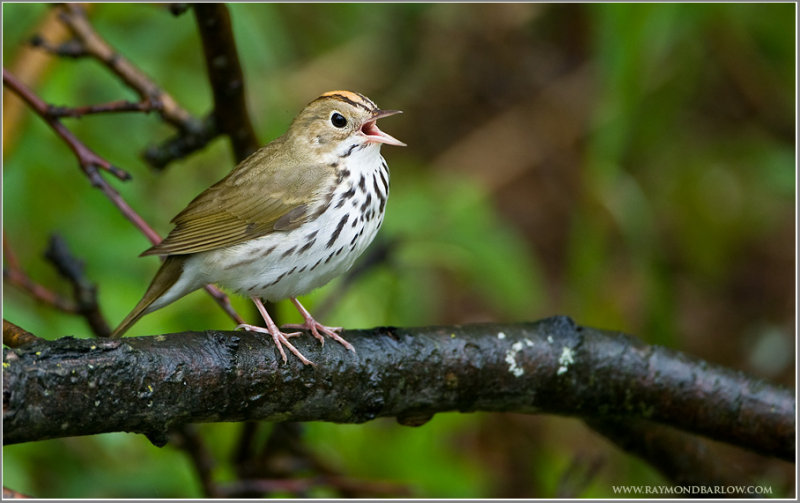
Halfway over to that lonesome place in the Green Forest a trim little bird flew up from the ground, hopped from branch to branch of a tree, walked along a limb, then from pure happiness threw back his head and cried, “Teacher, teacher, teacher, teacher, teacher!” each time a little louder than before. It was Teacher the Oven Bird.
Ovenbird (Seiurus aurocapilla) by Raymond Barlow
In his delight at seeing this old friend, Peter quite forgot Redtail the Hawk. “Oh, Teacher!” cried Peter. “I’m so glad to see you again!”
Teacher stopped singing and looked down at Peter. “If you are so glad why haven’t you been over to see me before?” he demanded. “I’ve been here for some time.”
Peter looked a little foolish. “The truth is, Teacher,” said he very humbly, “I have been visiting the Old Orchard so much and learning so many things that this is the first chance I have had to come ‘way over here in the Green Forest. You see, I have been learning a lot of things about you feathered folks, things I hadn’t even guessed. There is something I wish you’d tell me, Teacher; will you?”
“That depends on what it is,” replied Teacher, eyeing Peter a little suspiciously.
“It is why you are called Oven Bird,” said Peter.
“Is that all?” asked Teacher. Then without waiting for a reply he added, “It is because of the way Mrs. Teacher and I build our nest. Some people think it is like an oven and so they call us Oven Birds. I think that is a silly name myself, quite as silly as Golden Crowned Thrush, which is what some people call me. I’m not a Thrush. I’m not even related to the Thrush family. I’m a Warbler, a Wood Warbler.”
“I suppose,” said Peter, looking at Teacher thoughtfully, “they’ve given you that name because you are dressed something like the Thrushes. That olive-green coat, and white waistcoat all streaked and spotted with black, certainly does remind me of the Thrush family. If you were not so much smaller than any of the Thrushes I should almost think you were one myself. Why, you are not very much bigger than Chippy the Chipping Sparrow, only you’ve got longer legs. I suppose that’s because you spend so much time on the ground. I think that just Teacher is the best name for you. No one who has once heard you could ever mistake you for any one else. By the way, Teacher, where did you say your nest is?”
“I didn’t say,” retorted Teacher. “What’s more, I’m not going to say.”
“Won’t you at least tell me if it is in a tree?” begged Peter.
Teacher’s eyes twinkled. “I guess it won’t do any harm to tell you that much,” said he. “No, it isn’t in a tree. It is on the ground and, if I do say it, it is as well hidden a nest as anybody can build. Oh, Peter, watch your step! Watch your step!” Teacher fairly shrieked this warning.
Peter, who had just started to hop off to his right, stopped short in sheer astonishment. Just in front of him was a tiny mound of dead leaves, and a few feet beyond Mrs. Teacher was fluttering about on the ground as if badly hurt. Peter simply didn’t know what to make of it. Once more he made a movement as if to hop. Teacher flew right down in front of him. “You’ll step on my nest!” he cried.
Peter stared, for he didn’t see any nest. He said as much.
“It’s under that little mound of leaves right in front of your feet!” cried Teacher. “I wasn’t going to tell you, but I just had to or you certainly would have stepped on it.”
Very carefully Peter walked around the little bunch of leaves and peered under them from the other side. There, sure enough, was a nest beneath them, and in it four speckled eggs. “I won’t tell a soul, Teacher. I promise you I won’t tell a soul,” declared Peter very earnestly. “I understand now why you are called Oven Bird, but I still like the name Teacher best.”
Feeling that Mr. and Mrs. Teacher would feel easier in their minds if he left them, Peter said good-by and started on for the lonesome place in the Green Forest where he knew the old nest of Redtail the Hawk had been. As he drew near the place he kept sharp watch through the treetops for a glimpse of Redtail. Presently he saw him high in the blue sky, sailing lazily in big circles. Then Peter became very, very cautious. He tiptoed forward, keeping under cover as much as possible. At last, peeping out from beneath a little hemlock-tree, he could see Redtail’s old nest. He saw right away that it was bigger than it had been when he saw it last. Suddenly there was a chorus of hungry cries and Peter saw Mrs. Redtail approaching with a Mouse in her claws. From where he sat he could see four funny heads stretched above the edge of the nest.
“Redtail is using his old nest again and has got a family already,” exclaimed Peter. “I guess this is no place for me. The sooner I get away from here the better.”
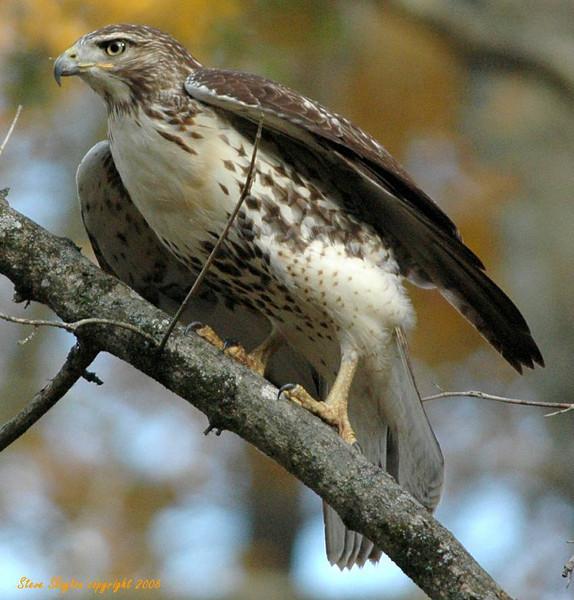
Red-tailed Hawk- Cochran Shoals Unit Chattahoochee River by SSlayton
Just then Redtail himself dropped down out of the blue, blue sky and alighted on a tree close at hand. Peter decided that the best thing he could do was to sit perfectly still where he was. He had a splendid view of Redtail, and he couldn’t help but admire this big member of the Hawk family. The upper parts of his coat were a dark grayish-brown mixed with touches of chestnut color. The upper part of his breast was streaked with grayish-brown and buff, the lower part having but few streaks. Below this were black spots and bars ending in white. But it was the tail which Peter noticed most of all. It was a rich reddish-brown with a narrow black band near its end and a white tip. Peter understood at once why this big Hawk is called Redtail.
It was not until Mr. and Mrs. Redtail had gone in quest of more food for their hungry youngsters that Peter dared steal away. As soon as he felt it safe to do so, he headed for home as fast as he could go, lipperty-lipperty-lip. He knew that he wouldn’t feel safe until that lonesome place in the Green Forest was far behind.
Yet if the truth be known, Peter had less cause to worry than would have been the case had it been some other member of the Hawk family instead of Redtail. And while Redtail and his wife do sometimes catch some of their feathered and furred neighbors, and once in a while a chicken, they do vastly more good than harm.
This story gives good examples of friends watching out for friends. Also, friends love their neighbors and go for visits now and then.
“But you be watchful in all things,…” (2 Timothy 4:5a NKJV)
*
Who was the one warning the animal and bird friends?
What is a call of the Crow?
Is it good for us to warn others of danger?
What does Peter really think it says?
Who was the little bird that Peter spotted up in the tree?
Why is he called by that name?
When Peter began to leave, why did the little bird become upset?
What bird was Peter looking for, yet had to make sure that bird didn’t see him?
Why didn’t Peter want to be seen?
Who sees us all the time? Can we hide from Him?
*
“A friend loveth at all times,…” (Proverbs 17:17a KJV)
“The same day went Jesus out of the house, and sat by the sea side.” (Matthew 13:1 KJV)
“And he began again to teach by the sea side: and there was gathered unto him a great multitude, so that he entered into a ship, and sat in the sea; and the whole multitude was by the sea on the land.” (Mark 4:1 KJV)
Avian and Attributes – Seaside
Sea-side
SE’A-SIDE, n. [sea and side.]
The land bordering on the sea; the country adjacent to the sea, or near it.
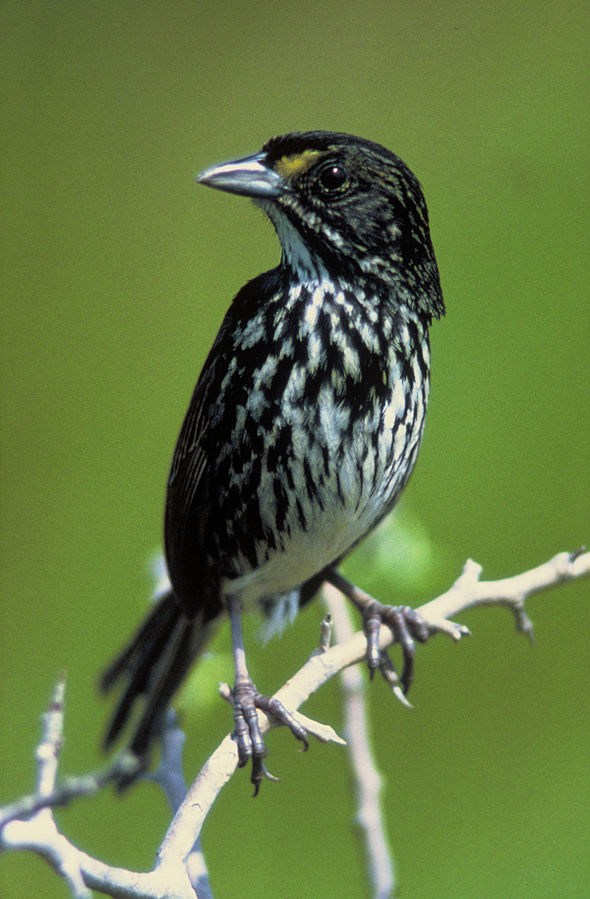
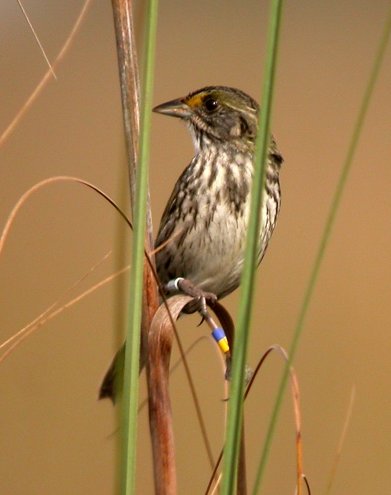
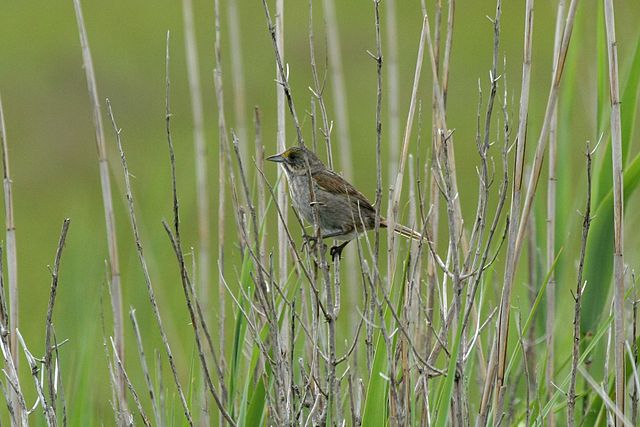
Seaside Sparrow (Ammodramus maritima) is a small American sparrow.
Adults have brownish upperparts with gray on the crown and nape, and a grayish-buff-colored breast with dark streaks; they have a dark face with gray cheeks, a white throat, and a short, pointed tail. Birds show a small yellow streak just above the eye.
Their breeding habitat is salt marshes on the Atlantic and Gulf coasts of the United States from southern New Hampshire to southern Texas. The nest is an open cup usually built in the salt marsh on tidal reeds and spartina grasses. Females lay two to five eggs.
Northern birds most often migrate further south along the eastern coast of the United States. They forage on the ground or in marsh vegetation, sometimes probing in mud. They mainly eat insects, marine invertebrates and seeds. Their feeding areas are often some distance away from the areas they choose to nest.
The song is a raspy buzz that closely resembles a distant red-winged blackbird.
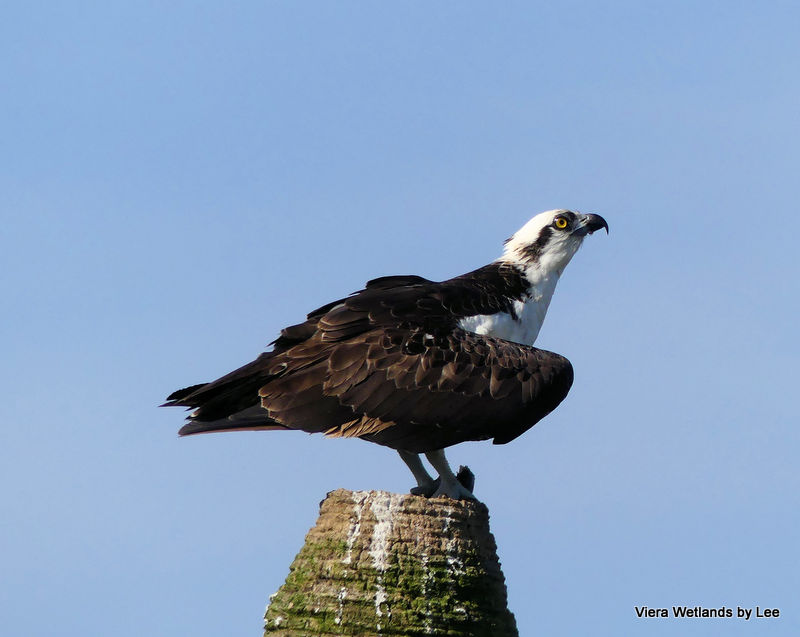
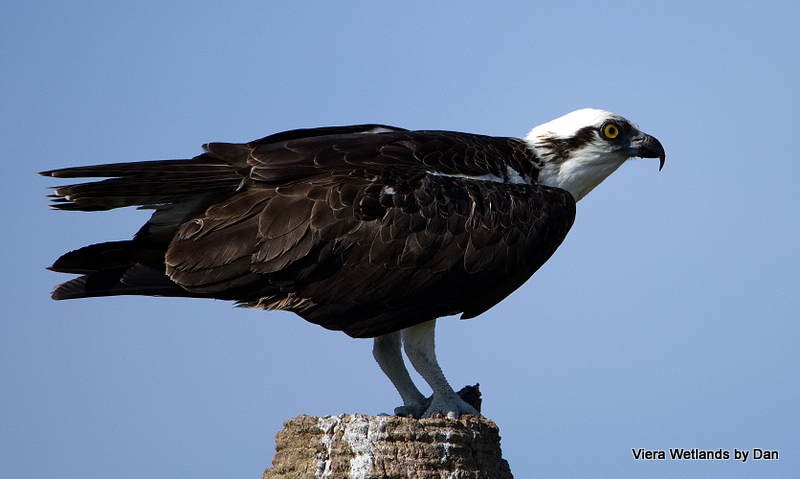
Osprey at Viera looking to the Creator and hopefully he is thanking Him for the fish.
“Who provideth for the raven [and Ospreys] his food? when his young ones cry unto God, they wander for lack of meat.” (Job 38:41 KJV)
Dan took a couple of really nice photos of the hungry Osprey.
Now for Dan’s great photos.
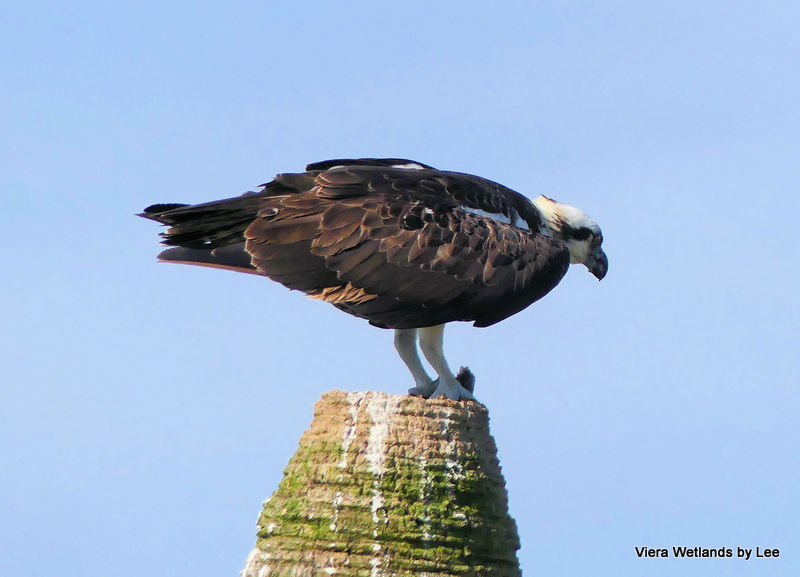
Time to strip the innards! Yuck!
When we were last at Viera Wetlands, we caught an Osprey eating a fish. Apparently he doesn’t like the “guts.” We watched it pull them out and then drop them. Did that several times, and then started eating the fish.
“But God giveth it a body as it hath pleased him, and to every seed his own body. All flesh is not the same flesh: but there is one kind of flesh of men, another flesh of beasts, another of fishes, and another of birds.” (1 Corinthians 15:38-39 KJV)
I am thankful that the Lord let me be born as a human. I am also very thankful that He provided salvation for our fallen sinful human nature.












 Lee's Birdwatching Adventures Plus