Peter Learns Something He Hadn’t Guessed – Chapter 5

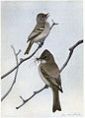
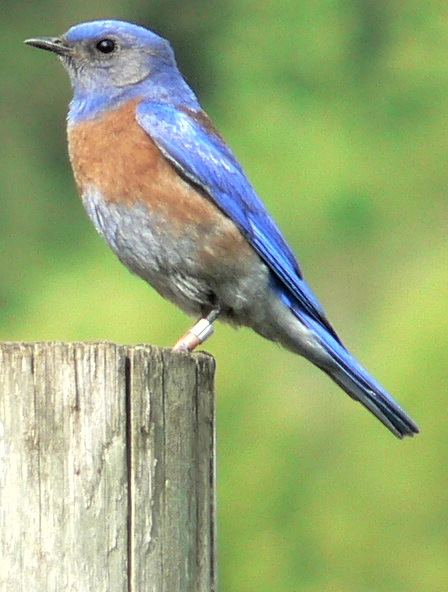
Western Bluebird (Sialia mexicana) ©WikiC

Western Bluebird (Sialia mexicana) ©WikiC

Peter Learns Something He Hadn’t Guessed

The Bluebird and the Robin

*

Listen to the story read.

CHAPTER 5. Peter Learns Something He Hadn’t Guessed.

Running over to the Old Orchard very early in the morning for a little gossip with Jenny Wren and his other friends there had become a regular thing with Peter Rabbit. He was learning a great many things, and some of them were most surprising.

Now two of Peter’s oldest and best friends in the Old Orchard were Winsome Bluebird and Welcome Robin. Every spring they arrived pretty nearly together, though Winsome Bluebird usually was a few days ahead of Welcome Robin. This year Winsome had arrived while the snow still lingered in patches. He was, as he always is, the herald of sweet Mistress Spring. And when Peter had heard for the first time Winsome’s soft, sweet whistle, which seemed to come from nowhere in particular and from everywhere in general, he had kicked up his long hind legs from pure joy. Then, when a few days later he had heard Welcome Robin’s joyous message of “Cheer-up! Cheer-up! Cheer-up! Cheer-up! Cheer!” from the tiptop of a tall tree, he had known that Mistress Spring really had arrived.
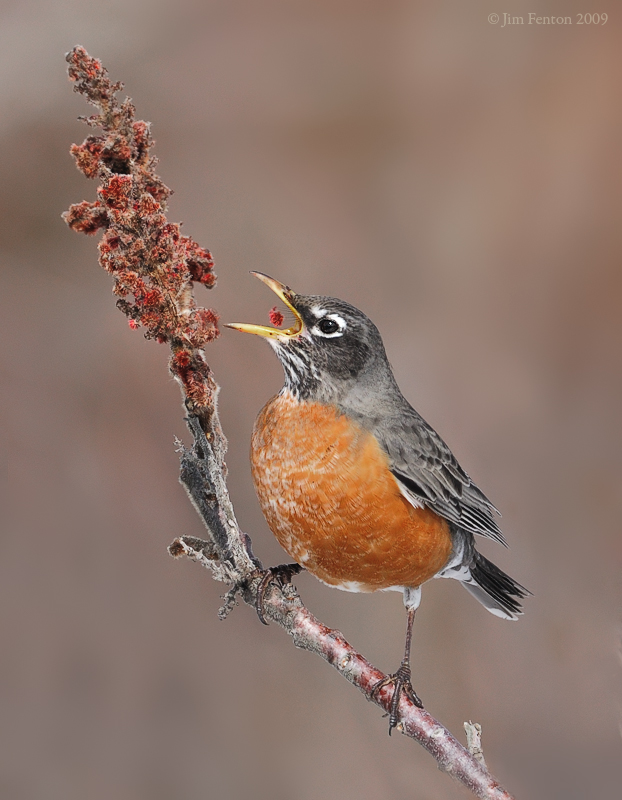
Robin Eating by Jim Fenton

Robin Eating by Jim Fenton

Peter loves Winsome Bluebird and Welcome Robin, just as everybody else does, and he had known them so long and so well that he thought he knew all there was to know about them. He would have been very indignant had anybody told him he didn’t.

“Those cousins don’t look much alike, do they?” remarked Jenny Wren, as she poked her head out of her house to gossip with Peter.

“What cousins?” demanded Peter, staring very hard in the direction in which Jenny Wren was looking.

“Those two sitting on the fence over there. Where are your eyes, Peter?” replied Jenny rather sharply.

Peter stared harder than ever. On one post sat Winsome Bluebird, and on another post sat Welcome Robin. “I don’t see anybody but Winsome and Welcome, and they are not even related,” replied Peter with a little puzzled frown.

“Tut, tut, tut, tut, tut, Peter!” exclaimed Jenny Wren. “Tut, tut, tut, tut, tut! Who told you any such nonsense as that? Of course they are related. They are cousins. I thought everybody knew that. They belong to the same family that Melody the Thrush and all the other Thrushes belong to. That makes them all cousins.”

“What?” exclaimed Peter, looking as if he didn’t believe a word of what Jenny Wren had said. Jenny repeated, and still Peter looked doubtful.

Then Jenny lost her temper, a thing she does very easily. “If you don’t believe me, go ask one of them,” she snapped, and disappeared inside her house, where Peter could hear her scolding away to herself.

The more he thought of it, the more this struck Peter as good advice. So he hopped over to the foot of the fence post on which Winsome Bluebird was sitting. “Jenny Wren says that you and Welcome Robin are cousins. She doesn’t know what she is talking about, does she?” asked Peter.
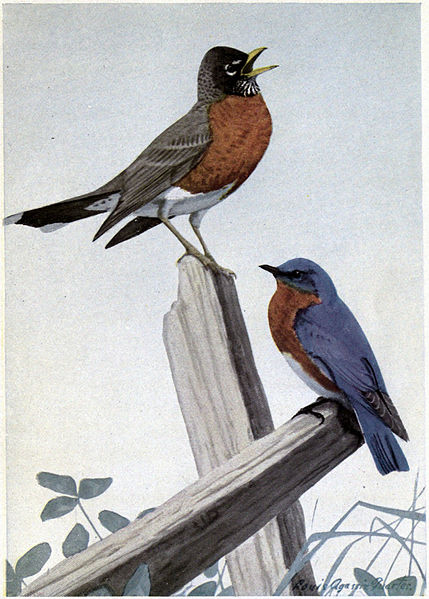
Winsome chuckled. It was a soft, gentle chuckle. “Yes,” said he, nodding his head, “we are. You can trust that little busybody to know what she is talking about, every time. I sometimes think she knows more about other people’s affairs than about her own. Welcome and I may not look much alike, but we are cousins just the same. Don’t you think Welcome is looking unusually fine this spring?”

“Not a bit finer than you are yourself, Winsome,” replied Peter politely. “I just love that sky-blue coat of yours. What is the reason that Mrs. Bluebird doesn’t wear as bright a coat as you do?”

“Go ask Jenny Wren,” chuckled Winsome Bluebird, and before Peter could say another word he flew over to the roof of Farmer Brown’s house.

Back scampered Peter to tell Jenny Wren that he was sorry he had doubted her and that he never would again. Then he begged Jenny to tell him why it was that Mrs. Bluebird was not as brightly dressed as was Winsome.

“Mrs. Bluebird, like most mothers, is altogether too busy to spend much time taking care of her clothes; and fine clothes need a lot of care,” replied Jenny. “Besides, when Winsome is about he attracts all the attention and that gives her a chance to slip in and out of her nest without being noticed. I don’t believe you know, Peter Rabbit, where Winsome’s nest is.”

Peter had to admit that he didn’t, although he had tried his best to find out by watching Winsome. “I think it’s over in that little house put up by Farmer Brown’s boy,” he ventured. “I saw both Mr. and Mrs. Bluebird go in it when they first came, and I’ve seen Winsome around it a great deal since, so I guess it is there.”

“So you guess it is there!” mimicked Jenny Wren. “Well, your guess is quite wrong, Peter; quite wrong. As a matter of fact, it is in one of those old fence posts. But just which one I am not going to tell you. I will leave that for you to find out. Mrs. Bluebird certainly shows good sense. She knows a good house when she sees it. The hole in that post is one of the best holes anywhere around here. If I had arrived here early enough I would have taken it myself. But Mrs. Bluebird already had her nest built in it and four eggs there, so there was nothing for me to do but come here. Just between you and me, Peter, I think the Bluebirds show more sense in nest building than do their cousins the Robins. There is nothing like a house with stout walls and a doorway just big enough to get in and out of comfortably.”

Peter nodded quite as if he understood all about the advantages of a house with walls. “That reminds me,” said he. “The other day I saw Welcome Robin getting mud and carrying it away. Pretty soon he was joined by Mrs. Robin, and she did the same thing. They kept it up till I got tired of watching them. What were they doing with that mud?”
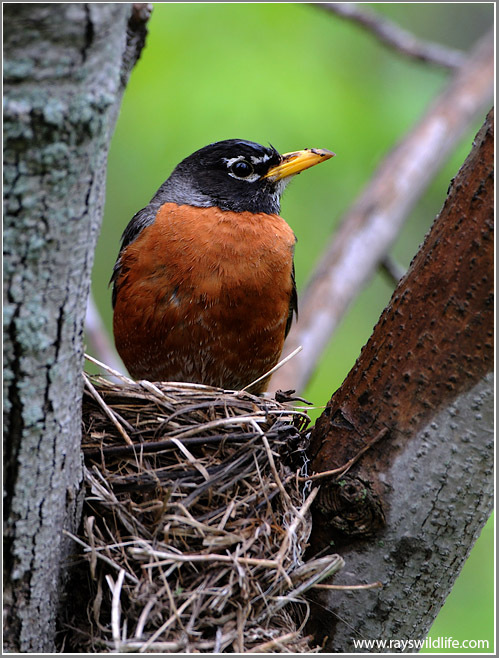
American Robin (Turdus migratorius) in nest by Ray

American Robin (Turdus migratorius) in nest by Ray

“Building their nest, of course, stupid,” retorted Jenny. “Welcome Robin, with that black head, beautiful russet breast, black and white throat and yellow bill, not to mention the proud way in which he carries himself, certainly is a handsome fellow, and Mrs. Robin is only a little less handsome. How they can be content to build the kind of home they do is more than I can understand. People think that Mr. Wren and I use a lot of trash in our nest. Perhaps we do, but I can tell you one thing, and that is it is clean trash. It is just sticks and clean straws, and before I lay my eggs I see to it that my nest is lined with feathers. More than this, there isn’t any cleaner housekeeper than I am, if I do say it.

“Welcome Robin is a fine looker and a fine singer, and everybody loves him. But when it comes to housekeeping, he and Mrs. Robin are just plain dirty. They make the foundation of their nest of mud,—plain, common, ordinary mud. They cover this with dead grass, and sometimes there is mighty little of this over the inside walls of mud. I know because I’ve seen the inside of their nest often. Anybody with any eyes at all can find their nest. More than once I’ve known them to have their nest washed away in a heavy rain, or have it blown down in a high wind. Nothing like that ever happens to Winsome Bluebird or to me.”

Jenny disappeared inside her house, and Peter waited for her to come out again. Welcome Robin flew down on the ground, ran a few steps, and then stood still with his head on one side as if listening. Then he reached down and tugged at something, and presently out of the ground came a long, wriggling angleworm. Welcome gulped it down and ran on a few steps, then once more paused to listen. This time he turned and ran three or four steps to the right, where he pulled another worm out of the ground.

“He acts as if he heard those worms in the ground,” said Peter, speaking aloud without thinking.

“He does,” said Jenny Wren, poking her head out of her doorway just as Peter spoke. “How do you suppose he would find them when they are in the ground if he didn’t hear them?”

“Can you hear them?” asked Peter.

“I’ve never tried, and I don’t intend to waste my time trying,” retorted Jenny. “Welcome Robin may enjoy eating them, but for my part I want something smaller and daintier, young grasshoppers, tender young beetles, small caterpillars, bugs and spiders.”

Peter had to turn his head aside to hide the wry face he just had to make at the mention of such things as food. “Is that all Welcome Robin eats?” he asked innocently.

“I should say not,” laughed Jenny. “He eats a lot of other kinds of worms, and he just dearly loves fruit like strawberries and cherries and all sorts of small berries. Well, I can’t stop here talking any longer. I’m going to tell you a secret, Peter, if you’ll promise not to tell.”

Of course Peter promised, and Jenny leaned so far down that Peter wondered how she could keep from falling as she whispered, “I’ve got seven eggs in my nest, so if you don’t see much of me for the next week or more, you’ll know why. I’ve just got to sit on those eggs and keep them warm.”

*

*

  1. What bird family do the Bluebird and Robin belong to?
  2. Why is it good that Mrs. Bluebird isn’t brightly dressed?
  3. When the Robin runs and then stops, what is he doing? What might he find to eat?
  4. What colors are the Robin’s head, breast, throat and bill?
  5. What does the Robin’s song sound like?
  6. Should we have an attitude like the Robin’s Song?

“Is anyone among you suffering? Then he must pray. Is anyone cheerful? He is to sing praises. (James 5:13 NASB)

“A joyful heart makes a cheerful face, But when the heart is sad, the spirit is broken. (Proverbs 15:13 NASB)

“Even the stork in the sky Knows her seasons; And the turtledove and the swift and the thrush Observe the time of their migration; But My people do not know The ordinance of the LORD. (Jeremiah 8:7 NASB)

Links:

*

Links:

Chebec the Least Flycatcher, Dear Me the Phoebe - Burgess Bird Book ©©


  Next Chapter – An Old Friend In a New Home. 


Burgess-Bird-Book-for-Children


Burgess Bird Book For Children


Green-billed Toucan (Ramphastos dicolorus) ©WikiC

Wordless Toucan


Wordless Birds – Toucan


*


Chippy, Sweetvoice, and Dotty – Chapter 4

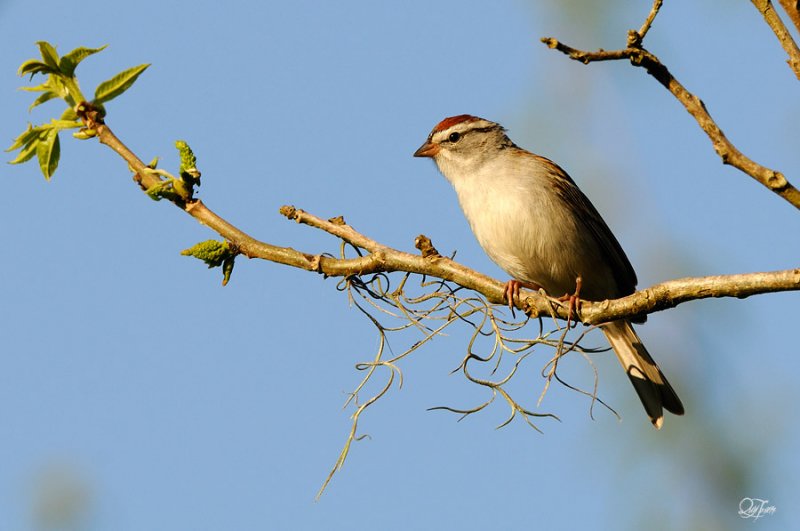
Chipping Sparrow (Spizella passerina) by Quy Tran

Chippy, Sweetvoice, and Dotty

The Chipping, Vesper and Tree Sparrows

The Burgess Bird Book For Children

*

Listen to the story read.

CHAPTER 4. Chippy, Sweetvoice, and Dotty.

For a while Jenny Wren was too busy to talk save to scold Mr. Wren for spending so much time singing instead of working. To Peter it seemed as if they were trying to fill that tree trunk with rubbish. “I should think they had enough stuff in there for half a dozen nests,” muttered Peter. “I do believe they are carrying it in for the fun of working.” Peter wasn’t far wrong in this thought, as he was to discover a little later in the season when he found Mr. Wren building another nest for which he had no use.

Finding that for the time being he could get nothing more from Jenny Wren, Peter hopped over to visit Johnny Chuck, whose home was between the roots of an old apple-tree in the far corner of the Old Orchard. Peter was still thinking of the Sparrow family; what a big family it was, yet how seldom any of them, excepting Bully the English Sparrow, were to be found in the Old Orchard.

“Hello, Johnny Chuck!” cried Peter, as he discovered Johnny sitting on his doorstep. “You’ve lived in the Old Orchard a long time, so you ought to be able to tell me something I want to know. Why is it that none of the Sparrow family excepting that noisy nuisance, Bully, build in the trees of the Old Orchard? Is it because Bully has driven all the rest out?”

Johnny Chuck shook his head. “Peter,” said he, “whatever is the matter with your ears? And whatever is the matter with your eyes?”

“Nothing,” replied Peter rather shortly. “They are as good as yours any day, Johnny Chuck.”

(Chipping Sparrow singing ©xeno-canto.org by Ian Cruickshank)

Johnny grinned. “Listen!” said Johnny. Peter listened. From a tree just a little way off came a clear “Chip, chip, chip, chip.” Peter didn’t need to be told to look. He knew without looking who was over there. He knew that voice for that of one of his oldest and best friends in the Old Orchard, a little fellow with a red-brown cap, brown back with feathers streaked with black, brownish wings and tail, a gray waistcoat and black bill, and a little white line over each eye—altogether as trim a little gentleman as Peter was acquainted with. It was Chippy, as everybody calls the Chipping Sparrow, the smallest of the family.

Chipping Sparrow (Spizella passerina) by Daves BirdingPix

Peter looked a little foolish. “I forgot all about Chippy,” said he. “Now I think of it, I have found Chippy here in the Old Orchard ever since I can remember. I never have seen his nest because I never happened to think about looking for it. Does he build a trashy nest like his cousin, Bully?”

Johnny Chuck laughed. “I should say not!” he exclaimed. “Twice Chippy and Mrs. Chippy have built their nest in this very old apple-tree. There is no trash in their nest, I can tell you! It is just as dainty as they are, and not a bit bigger than it has to be. It is made mostly of little fine, dry roots, and it is lined inside with horse-hair.”

“What’s that?” Peter’s voice sounded as it he suspected that Johnny Chuck was trying to fool him.

“It’s a fact,” said Johnny, nodding his head gravely. “Goodness knows where they find it these days, but find it they do. Here comes Chippy himself; ask him.”

Chippy and Mrs. Chippy came flitting from tree to tree until they were on a branch right over Peter and Johnny. “Hello!” cried Peter. “You folks seem very busy. Haven’t you finished building your nest yet?”

“Nearly,” replied Chippy. “It is all done but the horsehair. We are on our way up to Farmer Brown’s barnyard now to look for some. You haven’t seen any around anywhere, have you?”

Peter and Johnny shook their heads, and Peter confessed that he wouldn’t know horsehair if he saw it. He often had found hair from the coats of Reddy Fox and Old Man Coyote and Digger the Badger and Lightfoot the Deer, but hair from the coat of a horse was altogether another matter.

“It isn’t hair from the coat of a horse that we want,” cried Chippy, as he prepared to fly after Mrs. Chippy. “It is long hair from the tail or mane of a horse that we must have. It makes the very nicest kind of lining for a nest.”

Chippy and Mrs. Chippy were gone a long time, but when they did return each was carrying a long black hair. They had found what they wanted, and Mrs. Chippy was in high spirits because, as she took pains to explain to Peter, that little nest would not soon be ready for the four beautiful little blue eggs with black spots on one end she meant to lay in it.

“I just love Chippy and Mrs. Chippy,” said Peter, as they watched their two little feathered friends putting the finishing touches to the little nest far out on a branch of one of the apple-trees.

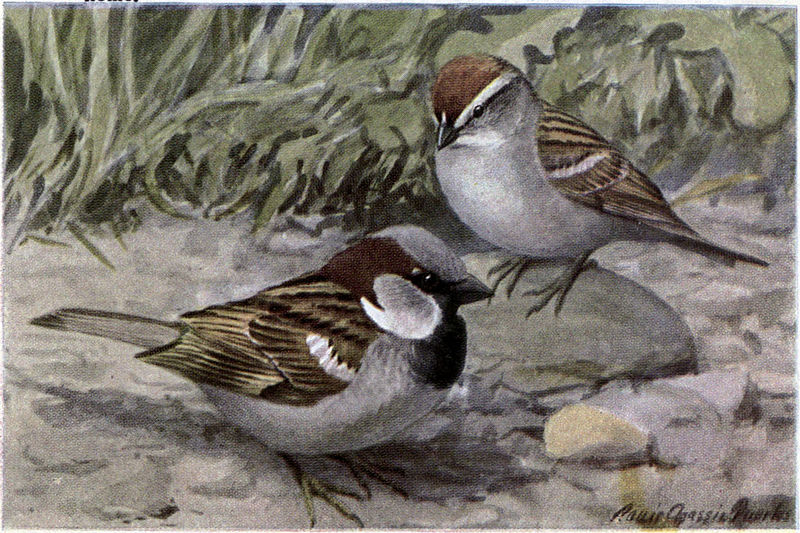
Bully the English Sparrow, Chippy the Chipping Sparrow - Burgess Bird Book ©©

Bully the English Sparrow, Chippy the Chipping Sparrow – Burgess Bird Book ©©

“Everybody does,” replied Johnny. “Everybody loves them as much as they hate Bully and his wife. Did you know that they are sometimes called Tree Sparrows? I suppose it is because they so often build their nests in trees?”

“No,” said Peter, “I didn’t. Chippy shouldn’t be called Tree Sparrow, because he has a cousin by that name.”

Johnny Chuck looked as if he doubted that, “I never heard of him,” he grunted.

Peter grinned. Here was a chance to tell Johnny Chuck something, and Peter never is happier than when he can tell folks something they don’t know. “You’d know him if you didn’t sleep all winter,” said Peter. “Dotty the Tree Sparrow spends the winter here. He left for his home in the Far North about the time you took it into your head to wake up.”

“Why do you call him Dotty?” asked Johnny Chuck.

“Because he has a little round black dot right in the middle of his breast,” replied Peter. “I don’t know why they call him Tree Sparrow; he doesn’t spend his time in the trees the way Chippy does, but I see him much oftener in low bushes or on the ground. I think Chippy has much more right to the name of Tree Sparrow than Dotty has. Now I think of it, I’ve heard Dotty called the Winter Chippy.”

“Gracious, what a mix-up!” exclaimed Johnny Chuck. “With Chippy being called a Tree Sparrow and a Tree Sparrow called Chippy, I should think folks would get all tangled up.”

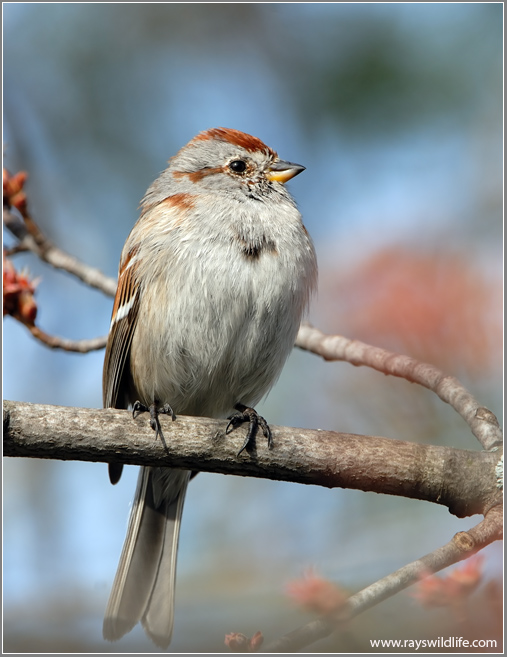
“Perhaps they would,” replied Peter, “if both were here at the same time, but Chippy comes just as Dotty goes, and Dotty comes as Chippy goes. That’s a pretty good arrangement, especially as they look very much alike, excepting that Dotty is quite a little bigger than Chippy and always has that black dot, which Chippy does not have. Goodness gracious, it is time I was back in the dear Old Briar-patch! Good-by, Johnny Chuck.”

American Tree Sparrow by Ray

American Tree Sparrow by Ray

Away went Peter Rabbit, lipperty-lipperty-lip, heading for the dear Old Briar-patch. Out of the grass just ahead of him flew a rather pale, streaked little brown bird, and as he spread his tail Peter saw two white feathers on the outer edges. Those two white feathers were all Peter needed to recognize another little friend of whom he is very fond. It was Sweetvoice the Vesper Sparrow, the only one of the Sparrow family with white feathers in his tail.

“Come over to the dear Old Briar-patch and sing to me,” cried Peter.

Sweetvoice dropped down into the grass again, and when Peter came up, was very busy getting a mouthful of dry grass. “Can’t,” mumbled Sweetvoice. “Can’t do it now, Peter Rabbit. I’m too busy. It is high time our nest was finished, and Mrs. Sweetvoice will lose her patience if I don’t get this grass over there pretty quick.”

“Where is your nest; in a tree?” asked Peter innocently.

“That’s telling,” declared Sweetvoice. “Not a living soul knows where that nest is, excepting Mrs. Sweetvoice and myself. This much I will tell you, Peter: it isn’t in a tree. And I’ll tell you this much more: it is in a hoofprint of Bossy the Cow.”

“In a WHAT?” cried Peter.

“In a hoofprint of Bossy the Cow,” repeated Sweetvoice, chuckling softly. “You know when the ground was wet and soft early this spring, Bossy left deep footprints wherever she went. One of these makes the nicest kind of place for a nest. I think we have picked out the very best one on all the Green Meadows. Now run along, Peter Rabbit, and don’t bother me any more. I’ve got too much to do to sit here talking. Perhaps I’ll come over to the edge of the dear Old Briar-patch and sing to you a while just after jolly, round, red Mr. Sun goes to bed behind the Purple Hills. I just love to sing then.”

“I’ll be watching for you,” replied Peter. “You don’t love to sing any better than I love to hear you. I think that is the best time of all the day in which to sing. I mean, I think it’s the best time to hear singing,” for of course Peter himself does not sing at all.

(Vesper Sparrow singing ©xeno-canto.org by Chris Parrish)

That night, sure enough, just as the Black Shadows came creeping out over the Green Meadows, Sweetvoice, perched on the top of a bramble-bush over Peter’s head, sang over and over again the sweetest little song and kept on singing even after it was quite dark. Peter didn’t know it, but it is this habit of singing in the evening which has given Sweetvoice his name of Vesper Sparrow.

“Serve the LORD with gladness: come before his presence with singing.” (Psalms 100:2 KJV)

*

  • Who was the first new Sparrow we meet?
  • What were they busy doing?
  • Their nest was being built with what material?
  • What was the one thing needed to finish their nest?

*

  • Who was the next Sparrow that showed up?
  • Why did it confuse Johnny Chuck?
  • Why did the name “Dotty” fit for that sparrow?
  • Was Dotty or Chippy larger?

*

  • Sweetvoice is what kind of Sparrow?
  • What were these Sparrows making their nest out of?
  • Where was their nest?
  • When does Sweetvoice like to sing?

*

Are you busy doing the things that need to done? Do you sing? Most thought better of Chippy than Bully. Are more like Chippy or Bully?

Speaking to yourselves in psalms and hymns and spiritual songs, singing and making melody in your heart to the Lord; Giving thanks always for all things unto God and the Father in the name of our Lord Jesus Christ;
(Ephesians 5:19-20 KJV)

Links:

*

Links:

 Next Chapter –  Peter Learns Something He Hadn’t Guessed


Burgess-Bird-Book-for-Children


Burgess Bird Book For Children


 ABC’s of the Gospel


*

Burgess Bird Book For Children


*


Jenny Has a Good Word for Some Sparrows – Chapter 3

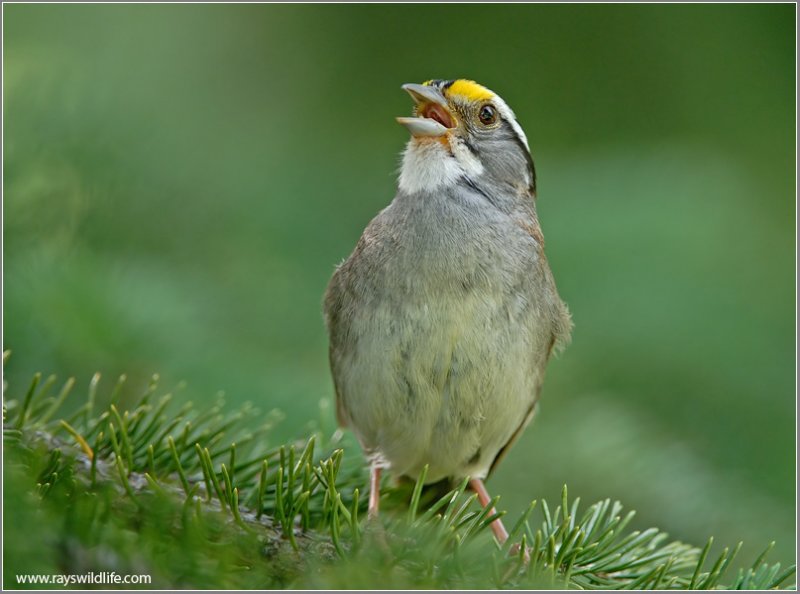
White-throated Sparrow by Ray

Jenny Has a Good Word for Some Sparrows

The Song, White-throated and Fox Sparrows.

The Burgess Bird Book For Children

*

Listen to the story read.

CHAPTER 3. Jenny Has a Good Word for Some Sparrows.

The morning after the fight between Jenny and Mr. Wren and Bully the English Sparrow found Peter Rabbit in the Old Orchard again. He was so curious to know what Jenny Wren would do for a house that nothing but some very great danger could have kept him away from there. Truth to tell, Peter was afraid that not being able to have their old house, Jenny and Mr. Wren would decide to leave the Old Orchard altogether. So it was with a great deal of relief that as he hopped over a low place in the old stone wall he heard Mr. Wren singing with all his might.

The song was coming from quite the other side of the Old Orchard from where Bully and Mrs. Bully had set up housekeeping. Peter hurried over. He found Mr. Wren right away, but at first saw nothing of Jenny. He was just about to ask after her when he caught sight of her with a tiny stick in her bill. She snapped her sharp little eyes at him, but for once her tongue was still. You see, she couldn’t talk and carry that stick at the same time. Peter watched her and saw her disappear in a little hole in a big branch of one of the old apple-trees. Hardly had she popped in than she popped out again. This time her mouth was free, and so was her tongue.

“You’d better stop singing and help me,” she said to Mr. Wren sharply. Mr. Wren obediently stopped singing and began to hunt for a tiny little twig such as Jenny had taken into that hole.

“Well!” exclaimed Peter. “It didn’t take you long to find a new house, did it?”

“Certainly not,” snapped Jenny “We can’t afford to sit around wasting time like some folk I know.”

Peter grinned and looked a little foolish, but he didn’t resent it. You see he was quite used to that sort of thing. “Aren’t you afraid that Bully will try to drive you out of that house?” he ventured.

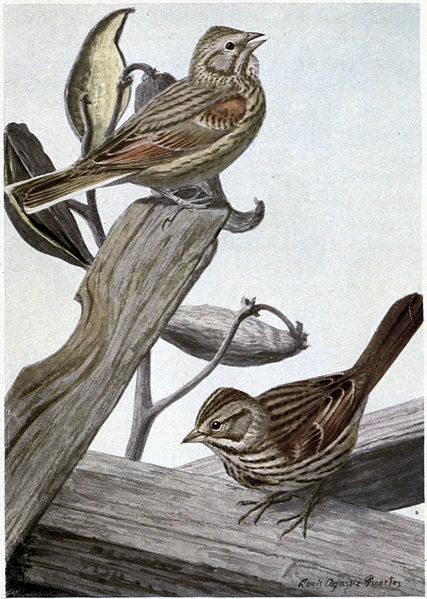
Sweet Voice the Vesper Sparrow, Little Friend the Song Sparrow – Burgess Bird Book ©©

Jenny Wren’s sharp little eyes snapped more than ever. “I’d like to see him try!” said she. “That doorway’s too small for him to get more than his head in. And if he tries putting his head in while I’m inside, I’ll peck his eyes out! She said this so fiercely that Peter laughed right out.

“I really believe you would,” said he.

“I certainly would,” she retorted. “Now I can’t stop to talk to you, Peter Rabbit, because I’m too busy. Mr. Wren, you ought to know that that stick is too big.” Jenny snatched it out of Mr. Wren’s mouth and dropped it on the ground, while Mr. Wren meekly went to hunt for another. Jenny joined him, and as Peter watched them he understood why Jenny is so often spoken of as a feathered busybody.

For some time Peter Rabbit watched Jenny and Mr. Wren carry sticks and straws into that little hole until it seemed to him they were trying to fill the whole inside of the tree. Just watching them made Peter positively tired. Mr. Wren would stop every now and then to sing, but Jenny didn’t waste a minute. In spite of that she managed to talk just the same.

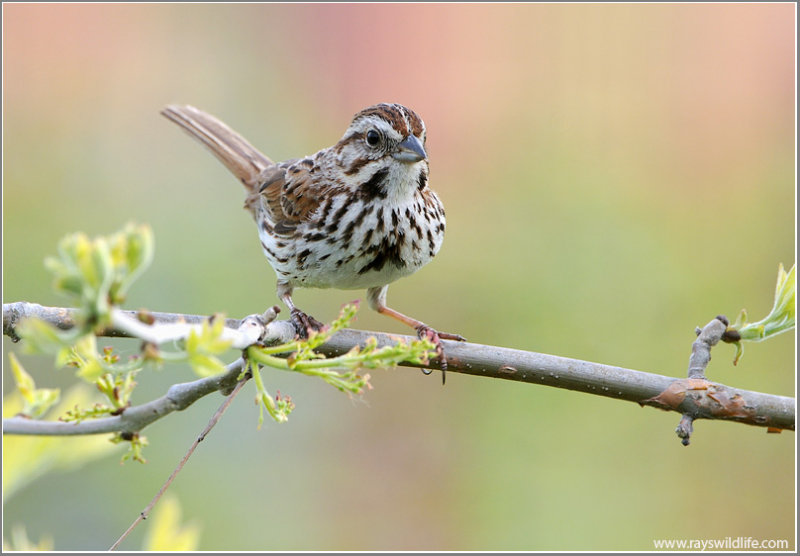
Song Sparrow by Ray

Song Sparrow by Ray

“I suppose Little Friend the Song Sparrow got here some time ago,” said she.

Peter nodded. “Yes,” said he. “I saw him only a day or two ago over by the Laughing Brook, and although he wouldn’t say so, I’m sure that he has a nest and eggs already.”

Jenny Wren jerked her tail and nodded her head vigorously. “I suppose so,” said she. “He doesn’t have to make as long a journey as we do, so he gets here sooner. Did you ever in your life see such a difference as there is between Little Friend and his cousin, Bully? Everybody loves Little Friend.”

Once more Peter nodded. “That’s right,” said he. “Everybody does love Little Friend. It makes me feel sort of all glad inside just to hear him sing. I guess it makes everybody feel that way. I wonder why we so seldom see him up here in the Old Orchard.”

“Because he likes damp places with plenty of bushes better,” replied Jenny Wren. “It wouldn’t do for everybody to like the same kind of a place. He isn’t a tree bird, anyway. He likes to be on or near the ground. You will never find his nest much above the ground, not more than a foot or two. Quite often it is on the ground. Of course I prefer Mr. Wren’s song, but I must admit that Little Friend has one of the happiest songs of any one I know. Then, too, he is so modest, just like us Wrens.”

Peter turned his head aside to hide a smile, for if there is anybody who delights in being both seen and heard it is Jenny Wren, while Little Friend the Song Sparrow is shy and retiring, content to make all the world glad with his song, but preferring to keep out of sight as much as possible.

Jenny chattered on as she hunted for some more material for her nest. “I suppose you’ve noticed,” said she, “that he and his wife dress very much alike. They don’t go in for bright colors any more than we Wrens do. They show good taste. I like the little brown caps they wear, and the way their breasts and sides are streaked with brown. Then, too, they are such useful folks. It is a pity that that nuisance of a Bully doesn’t learn something from them. I suppose they stay rather later than we do in the fall.”

“Yes,” replied Peter. “They don’t go until Jack Frost makes them. I don’t know of any one that we miss more than we do them.”

“Speaking of the sparrow family, did you see anything of Whitethroat?” asked Jenny Wren, as she rested for a moment in the doorway of her new house and looked down at Peter Rabbit.

Peter’s face brightened. “I should say I did!” he exclaimed. “He stopped for a few days on his way north. I only wish he would stay here all the time. But he seems to think there is no place like the Great Woods of the North. I could listen all day to his song. Do you know what he always seems to be saying?”

“What?” demanded Jenny.

I live happ-i-ly, happ-i-ly, happ-i-ly,” replied Peter. “I guess he must too, because he makes other people so happy.” (listen-©xeno-canto)

Jenny nodded in her usual emphatic way. “I don’t know him as well as I do some of the others,” said she, “but when I have seen him down in the South he always has appeared to me to be a perfect gentleman. He is social, too; he likes to travel with others.”

“I’ve noticed that,” said Peter. “He almost always has company when he passes through here. Some of those Sparrows are so much alike that it is hard for me to tell them apart, but I can always tell Whitethroat because he is one of the largest of the tribe and has such a lovely white throat. He really is handsome with his black and white cap and that bright yellow spot before each eye. I am told that he is very dearly loved up in the north where he makes his home. They say he sings all the time.”

Fox Sparrow (Passerella iliaca) by Ray

Fox Sparrow (Passerella iliaca) by Ray

“I suppose Scratcher the Fox Sparrow has been along too,” said Jenny. “He also started sometime before we did.”

“Yes,” replied Peter. “He spent one night in the dear Old Briar-patch. He is fine looking too, the biggest of all the Sparrow tribe, and HOW he can sing. The only thing I’ve got against him is the color of his coat. It always reminds me of Reddy Fox, and I don’t like anything that reminds me of that fellow. When he visited us I discovered something about Scratcher which I don’t believe you know.”

“What?” demanded Jenny rather sharply.

“That when he scratches among the leaves he uses both feet at once,” cried Peter triumphantly. “It’s funny to watch him.”

“Pooh! I knew that,” retorted Jenny Wren. “What do you suppose my eyes are make for? I thought you were going to tell me something I didn’t know.”

Peter looked disappointed.

The heart of the wise instructs his mouth And adds persuasiveness to his lips. Pleasant words are a honeycomb, Sweet to the soul and healing to the bones. (Proverbs 16:23-24 NASB)

*

Jenny seems to be in a kinder mood in this chapter. She has kind words about three different Sparrows. Can you name them?

What kind of sparrow was Little Friend? What kind of songs does he sing? Where does he like to live? What color cap does he have?

Our second sparrow is pictured at the top. Where was Whitethroat headed? What color is his cap? What does his song sound like? (When people use word to descrbe a song, that is called – Mnemonics.

Who is the largest sparrow? What color is Scratcher’s coat? Why is he called “Scratcher”?

Jenny is using nice words about the sparrows this time. Don’t you like to have good words spoken about you? Do you use nice words when talking about someone?

Read the two verses and think about how the Lord wants your speech.

Let the words of my mouth and the meditation of my heart Be acceptable in Your sight, O LORD, my strength and my Redeemer. (Psalms 19:14 NKJV)

Bonus – A Fox Sparrow Scratching

Links:

*

Links:

Bully the English Sparrow, Chippy the Chipping Sparrow - Burgess Bird Book ©©


  Next Chapter – Chippy, Sweetvoice, and Dotty.


Burgess-Bird-Book-for-Children


Burgess Bird Book For Children


Yellow-fronted Woodpecker (Melanerpes flavifrons) ©WikiC


*


The Old Orchard Bully – Chapter 2

House Sparrow (Passer domesticus) by Nikhil

House Sparrow (Passer domesticus) by Nikhil

The Old Orchard Bully

The English or House Sparrow

The Burgess Bird Book For Children

*

Listen to the story read.

CHAPTER 2. The Old Orchard Bully.

Peter Rabbit’s eyes twinkled when Jenny Wren said that she must look her old house over to see if it was fit to live in. “I can save you that trouble,” said he.

“What do you mean?” Jenny’s voice was very sharp.

“Only that our old house is already occupied,” replied Peter. “Bully the English Sparrow has been living in it for the last two months. In fact, he already has a good-sized family there.”

“What?” screamed Jenny and Mr. Wren together. Then without even saying good-by to Peter, they flew in a great rage to see if he had told them the truth. Presently he heard them scolding as fast as their tongues could go, and this is very fast indeed.

“Much good that will do them,” chuckled Peter. “They will have to find a new house this year. All the sharp tongues in the world couldn’t budge Bully the English sparrow. My, my, my, my, just hear that racket! I think I’ll go over and see what is going on.”

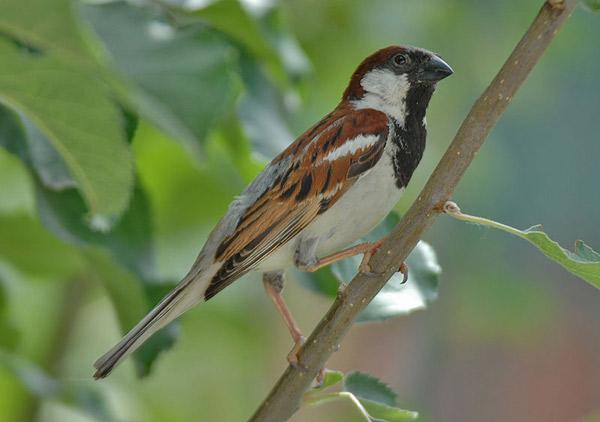
So Peter hopped to a place where he could get a good view of Jenny Wren’s old home and still not be too far from the safety of the old stone wall. Jenny Wren’s old home had been in a hole in one of the old apple-trees. Looking over to it, Peter could see Mrs. Bully sitting in the little round doorway and quite filling it. She was shrieking excitedly. Hopping and flitting from twig to twig close by were Jenny and Mr. Wren, their tails pointing almost straight up to the sky, and scolding as fast as they could make their tongues go. Flying savagely at one and then at the other, and almost drowning their voices with his own harsh cries, was Bully himself. He was perhaps one fourth larger than Mr. Wren, although he looked half again as big. But for the fact that his new spring suit was very dirty, due to his fondness for taking dust baths and the fact that he cares nothing about his personal appearance and takes no care of himself, he would have been a fairly good-looking fellow. His back was more or less of an ashy color with black and chestnut stripes. His wings were brown with a white bar on each. His throat and breast were black, and below that he was of a dirty white. The sides of his throat were white and the back of his neck chestnut.

By ruffling up his feathers and raising his wings slightly as he hopped about, he managed to make himself appear much bigger than he really was. He looked like a regular little fighting savage. The noise had brought all the other birds in the Old Orchard to see what was going on, and every one of them was screaming and urging Jenny and Mr. Wren to stand up for their rights. Not one of them had a good word for Bully and his wife. It certainly was a disgraceful neighborhood squabble.

Bully the English Sparrow, Chippy the Chipping Sparrow - Burgess Bird Book ©©

Bully the English Sparrow, Chippy the Chipping Sparrow – Burgess Bird Book ©©

Bully the English Sparrow is a born fighter. He never is happier than when he is in the midst of a fight or a fuss of some kind. The fact that all his neighbors were against him didn’t bother Bully in the least.

Jenny and Mr. Wren are no cowards, but the two together were no match for Bully. In fact, Bully did not hesitate to fly fiercely at any of the onlookers who came near enough, not even when they were twice his own size. They could have driven him from the Old Orchard had they set out to, but just by his boldness and appearance he made them afraid to try.

All the time Mrs. Bully sat in the little round doorway, encouraging him. She knew that as long as she sat there it would be impossible for either Jenny or Mr. Wren to get in. Truth to tell, she was enjoying it all, for she is as quarrelsome and as fond of fighting as is Bully himself.

“You’re a sneak! You’re a robber! That’s my house, and the sooner you get out of it the better!” shrieked Jenny Wren, jerking her tail with every word as she hopped about just out of reach of Bully.

“It may have been your house once, but it is mine now, you little snip-of-nothing!” cried Bully, rushing at her like a little fury. “Just try to put us out if you dare! You didn’t make this house in the first place, and you deserted it when you went south last fall. It’s mine now, and there isn’t anybody in the Old Orchard who can put me out.”

Peter Rabbit nodded. “He’s right there,” muttered Peter. “I don’t like him and never will, but it is true that he has a perfect right to that house. People who go off and leave things for half a year shouldn’t expect to find them just as they left them. My, my, my what a dreadful noise! Why don’t they all get together and drive Bully and Mrs. Bully out of the Old Orchard? If they don’t I’m afraid he will drive them out. No one likes to live with such quarrelsome neighbors. They don’t belong over in this country, anyway, and we would be a lot better off if they were not here. But I must say I do have to admire their spunk.”

All the time Bully was darting savagely at this one and that one and having a thoroughly good time, which is more than could be said of any one else, except Mrs. Bully.

“I’ll teach you folks to know that I am in the Old Orchard to stay!” shrieked Bully. “If you don’t like it, why don’t you fight? I am not afraid of any of you or all of you together.” This was boasting, plain boasting, but it was effective. He actually made the other birds believe it. Not one of them dared stand up to him and fight. They were content to call him a bully and all the bad names they could think of, but that did nothing to help Jenny and Mr. Wren recover their house. Calling another bad names never hurts him. Brave deeds and not brave words are what count.

Red-tailed Hawk (Buteo jamaicensis) Mobbed by Crows ©WikiC

Red-tailed Hawk (Buteo jamaicensis) Mobbed by Crows ©WikiC

How long that disgraceful squabble in the Old Orchard would have lasted had it not been for something which happened, no one knows. Right in the midst of it some one discovered Black Kitty, the cat who lives in Farmer Brown’s house, stealing up through the Old Orchard, her tail twitching and her yellow eyes glaring eagerly. She had heard that dreadful racket and suspected that in the midst of such excitement she might have a chance to catch one of the feathered folks. You can always trust Black Kitty to be on hand at a time like that.

No sooner was she discovered than everything else was forgotten. With Bully in the lead, and Jenny and Mr. Wren close behind him, all the birds turned their attention to Black Kitty. She was the enemy of all, and they straightway forgot their own quarrel. Only Mrs. Bully remained where she was, in the little round doorway of her house. She intended to take no chances, but she added her voice to the general racket. How those birds did shriek and scream! They darted down almost into the face of Black Kitty, and none went nearer than Bully the English Sparrow and Jenny Wren.

Now Black Kitty hates to be the center of so much attention. She knew that, now she had been discovered, there wasn’t a chance in the world for her to catch one of those Old Orchard folks. So, with tail still twitching angrily, she turned and, with such dignity as she could, left the Old Orchard. Clear to the edge of it the birds followed, shrieking, screaming, calling her bad names, and threatening to do all sorts of dreadful things to her, quite as if they really could.

When finally she disappeared towards Farmer Brown’s barn, those angry voices changed. It was such a funny change that Peter Rabbit laughed right out. Instead of anger there was triumph in every note as everybody returned to attend to his own affairs. Jenny and Mr. Wren seemed to have forgotten all about Bully and his wife in their old house. They flew to another part of the Old Orchard, there to talk it all over and rest and get their breath. Peter Rabbit waited to see if they would not come over near enough to him for a little more gossip. But they didn’t, and finally Peter started for his home in the dear Old Briar-patch. All the way there he chuckled as he thought of the spunky way in which Jenny and Mr. Wren had stood up for their rights.

A soft answer turns away wrath, But a harsh word stirs up anger. The tongue of the wise uses knowledge rightly, But the mouth of fools pours forth foolishness. The eyes of the LORD are in every place, Keeping watch on the evil and the good. A wholesome tongue is a tree of life, But perverseness in it breaks the spirit. (Proverbs 15:1-4 NKJV)


*

What caused all the fuss between the Sparrows and the Wrens?

Why did Bully have a right to the house?

Where had the Wrens gone?

When the cat came by, do you know what it is called when birds attack like that? It is called – Mobbing. (A simple definition of mobbing is an group of individuals around a potentially dangerous predator (the cat).

Are we suppose to get angry when things don’t go our way?

Sparrows are listed in the Bible several times and usually with a promise of God taking care of them.

Wrens are really nice birds that sing often and do raise their tail frequently.

Carolina Wren by Lee at Circle B

Carolina Wren by Lee at Circle B

“Are not five sparrows sold for two copper coins? And not one of them is forgotten before God. But the very hairs of your head are all numbered. Do not fear therefore; you are of more value than many sparrows. (Luke 12:6-7 NKJV)

More:

Links:

Sweet Voice the Vesper Sparrow, Little Friend the Song Sparrow - Burgess Bird Book ©©


  Next Chapter (Jenny Has a Good Word for Some Sparrows.)


Burgess-Bird-Book-for-Children


Burgess Bird Book For Children


ABC's of the Gospel


  ABC’s of the Gospel


*

*


Jenny Wren Arrives – Chapter 1

House Wren (Troglodytes aedon) by Ray

House Wren (Troglodytes aedon) by Ray

Jenny Wren Arrives

Introducing the House Wren

The Burgess Bird Book For Children

*

CHAPTER I. Jenny Wren Arrives.

*

Listen to the story read.

Lipperty-lipperty-lip scampered Peter Rabbit behind the tumble-down stone wall along one side of the Old Orchard. It was early in the morning, very early in the morning. In fact, jolly, bright Mr. Sun had hardly begun his daily climb up in the blue, blue sky. It was nothing unusual for Peter to see jolly Mr. Sun get up in the morning. It would be more unusual for Peter not to see him, for you know Peter is a great hand to stay out all night and not go back to the dear Old Briar-patch, where his home is, until the hour when most folks are just getting out of bed.

Peter had been out all night this time, but he wasn’t sleepy, not the least teeny, weeny bit. You see, sweet Mistress Spring had arrived, and there was so much happening on every side, and Peter was so afraid he would miss something, that he wouldn’t have slept at all if he could have helped it. Peter had come over to the Old Orchard so early this morning to see if there had been any new arrivals the day before.

“Birds are funny creatures,” said Peter, as he hopped over a low place in the old stone wall and was fairly in the Old Orchard.

Jenny Wren - Burgess Bird Book ©©

Jenny Wren – Burgess Bird Book ©©

“Tut, tut, tut, tut, tut!” cried a rather sharp scolding voice. “Tut, tut, tut, tut, tut! You don’t know what you are talking about, Peter Rabbit. They are not funny creatures at all. They are the most sensible folks in all the wide world.”

Peter cut a long hop short right in the middle, to sit up with shining eyes. “Oh, Jenny Wren, I’m so glad to see you! When did you arrive?” he cried.

“Mr. Wren and I have just arrived, and thank goodness we are here at last,” replied Jenny Wren, fussing about, as only she can, in a branch above Peter. “I never was more thankful in my life to see a place than

I am right this minute to see the Old Orchard once more. It seems ages and ages since we left it.”

“Well, if you are so fond of it what did you leave it for?” demanded Peter. “It is just as I said before—you birds are funny creatures. You never stay put; at least a lot of you don’t. Sammy Jay and Tommy Tit the Chickadee and Drummer the Woodpecker and a few others have a little sense; they don’t go off on long, foolish journeys. But the rest of you—”

“Tut, tut, tut, tut, tut!” interrupted Jenny Wren. “You don’t know what you are talking about, and no one sounds so silly as one who tries to talk about something he knows nothing about.”

Peter chuckled. “That tongue of yours is just as sharp as ever,” said he. “But just the same it is good to hear it. We certainly would miss it. I was beginning to be a little worried for fear something might have happened to you so that you wouldn’t be back here this summer. You know me well enough, Jenny Wren, to know that you can’t hurt me with your tongue, sharp as it is, so you may as well save your breath to tell me a few things I want to know. Now if you are as fond of the Old Orchard as you pretend to be, why did you ever leave it?”

Jenny Wren’s bright eyes snapped. “Why do you eat?” she asked tartly.

“Because I’m hungry,” replied Peter promptly.

“What would you eat if there were nothing to eat?” snapped Jenny.

“That’s a silly question,” retorted Peter.

“No more silly than asking me why I leave the Old Orchard,” replied Jenny. “Do give us birds credit for a little common sense, Peter. We can’t live without eating any more than you can, and in winter there is no food at all here for most of us, so we go where there is food. Those who are lucky enough to eat the kinds of food that can be found here in winter stay here. They are lucky. That’s what they are—lucky. Still—” Jenny Wren paused.

“Still what?” prompted Peter.

“I wonder sometimes if you folks who are at home all the time know just what a blessed place home is,” replied Jenny. “It is only six months since we went south, but I said it seems ages, and it does. The best part of going away is coming home. I don’t care if that does sound rather mixed; it is true just the same. It isn’t home down there in the sunny South, even if we do spend as much time there as we do here. THIS is home, and there’s no place like it! What’s that, Mr. Wren? I haven’t seen all the Great World? Perhaps I haven’t, but I’ve seen enough of it, let me tell you that! Anyone who travels a thousand miles twice a year as we do has a right to express an opinion, especially if they have used their eyes as I have mine. There is no place like home, and you needn’t try to tease me by pretending that there is. My dear, I know you; you are just as tickled to be back here as I am.”

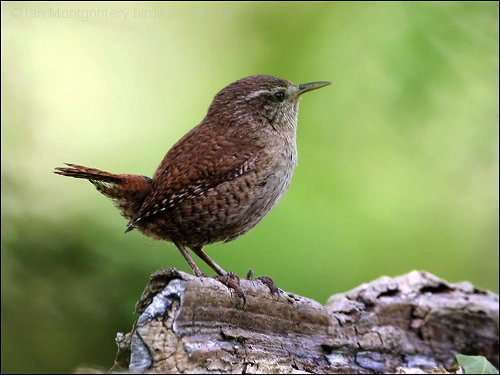
House Wren (Troglodytes aedon) by Ian

House Wren (Troglodytes aedon) by Ian

“He sings as if he were,” said Peter, for all the time Mr. Wren was singing with all his might.

Jenny Wren looked over at Mr. Wren fondly. “Isn’t he a dear to sing to me like that? And isn’t it a perfectly beautiful spring song?” said she. Then, without waiting for Peter to reply, her tongue rattled on. “I do wish he would be careful. Sometimes I am afraid he will overdo. Just look at him now! He is singing so hard that he is shaking all over. He always is that way. There is one thing true about us Wrens, and this is that when we do things we do them with all our might. When we work we work with all our might. When Mr. Wren sings he sings with all his might.”

“And, when you scold you scold with all your might,” interrupted Peter mischievously.

Jenny Wren opened her mouth for a sharp reply, but laughed instead. “I suppose I do scold a good deal,” said she, “but if I didn’t goodness knows who wouldn’t impose on us. I can’t bear to be imposed on.”

“Did you have a pleasant journey up from the sunny South?” asked Peter.

“Fairly pleasant,” replied Jenny. “We took it rather easily, Some birds hurry right through without stopping, but I should think they would be tired to death when they arrive. We rest whenever we are tired, and just follow along behind Mistress Spring, keeping far enough behind so that if she has to turn back we will not get caught by Jack Frost. It gives us time to get our new suits on the way. You know everybody expects you to have new things when you return home. How do you like my new suit, Peter?” Jenny bobbed and twisted and turned to show it off. It was plain to see that she was very proud of it.

“Very much,” replied Peter. “I am very fond of brown. Brown and gray are my favorite colors.” You know Peter’s own coat is brown and gray.

“That is one of the most sensible things I have heard you say,” chattered Jenny Wren. “The more I see of bright colors the better I like brown. It always is in good taste. It goes well with almost everything. It is neat and it is useful. If there is need of getting out of sight in a hurry you can do it if you wear brown. But if you wear bright colors it isn’t so easy. I never envy anybody who happens to have brighter clothes than mine. I’ve seen dreadful things happen all because of wearing bright colors.”

“What?” demanded Peter.

“I’d rather not talk about them,” declared Jenny in a very emphatic way. “‘Way down where we spent the winter some of the feathered folks who live there all the year round wear the brightest and most beautiful suits I’ve ever seen. They are simply gorgeous. But I’ve noticed that in times of danger these are the folks dreadful things happen to. You see they simply can’t get out of sight. For my part I would far rather be simply and neatly dressed and feel safe than to wear wonderful clothes and never know a minute’s peace. Why, there are some families I know of which, because of their beautiful suits, have been so hunted by men that hardly any are left. But gracious, Peter Rabbit, I can’t sit here all day talking to you! I must find out who else has arrived in the Old Orchard and must look my old house over to see if it is fit to live in.”

*

Why did Jenny and Peter Wren leave? Do you know what that is called?

How far did they travel?

What color are they and why does Jenny like it?

What kind of tongue did Jenny have? How is your tongue?

Even the stork in the sky Knows her seasons; And the turtledove and the swift and the thrush Observe the time of their migration; But My people do not know The ordinance of the LORD. (Jeremiah 8:7 NASB)

*

Links:
Bully the English Sparrow, Chippy the Chipping Sparrow - Burgess Bird Book ©©
  Next Chapter – The Old Orchard Bully
Burgess-Bird-Book-for-Children
  Burgess-Bird-Book-for-Children
Grasshopper Sparrow (Ammodramus savannarum) ©WikiC    Wordless Birds
*

Mr. Plain Sparrow Calls on Ducks

House Sparrow (Passer domesticus)

House Sparrow (Passer domesticus)

MR. PLAIN SPARROW CALLS ON DUCKS

"Would you like to join us?"

“Would you like to join us?”

“It was such a hot day yesterday,” said daddy, “that Mr. Plain Sparrow simply could not get cool. You see he never goes away in the winter and so he gets used to really cold weather. On a day as hot as it was yesterday he simply doesn’t know what to do with himself. He called himself Mr. Plain Sparrow because that was exactly what he was. He was just a plain, ordinary sparrow, and he thought it such a wise thing to call himself that—and not put on any silly frills. He prided himself on being sensible.

“‘If there’s anything in this world I hate,’ he said, ‘it’s pretending to be what a creature is not.’ And so he called himself by the name of Mr. Plain Sparrow, and his wife was Mrs. Plain Sparrow, and his children were the Plain Sparrow Children.

“‘I think,’ he said, ‘that I will take a walk or a fly to the duck pond in the park nearby. Yes, it seems to me that’s an excellent scheme. I would like to see those ducks, for they’re right smart creatures, and I like to hear their funny quack-quack talk.’

“‘What are you up to, ducks?’ he called, as he flew over the pond, and then perched on a small bush that was at one side.

“‘We’re well,’ said the ducks. ‘We’re enjoying a cooling drink between swims. Would you like to join us? It’s just tea time.’

“‘Tea time, eh?’ said Mr. Plain Sparrow. ‘And would you give a fellow a good, fat worm in place of bread and butter and cake?’

“‘Quack-quack! ha, ha!’ laughed the ducks. ‘We don’t like bread and butter and cake. But we can’t get the worm for you just now, as we’re not very good at digging on such a hot day!’

“‘Well, then, how about my digging for a couple of them, and then joining all you nice ducks when you’re ready to have your tea?’

“‘Splendid idea,’ quacked the ducks. And off went Mr. Plain Sparrow to a soft place in the earth where he thought there would be some good worms.

“Pretty soon he came back with some fine ones, and he sat on his perch and ate them, while the ducks nibbled at their food, and had drinks of pond water, which they called tea. Mr. Plain Sparrow flew down and took sips of water by the side of the pond, and in one very shallow place he had some nice showerbaths while the ducks were having swims. And before he left he told the ducks what a good time he had had, and how nice and cool he felt.

“‘Well, you’re so friendly we’re glad you came,’ quacked the ducks once again.”


House Sparrow by Nikhil Devasar

Lee’s Addition:

A man who has friends must himself be friendly, But there is a friend who sticks closer than a brother. (Proverbs 18:24 NKJV)

Here is another Bird Tale to remind us to be friendly. Even though Mr. Plain Sparrow was having a rough day, he still showed himself friendly to others around him. When things don’t go the way we want, do we become unfriendly to those around us? What should we do?

Who is the friend who sticks closer than a brother? See ABC’s of the Gospel


From

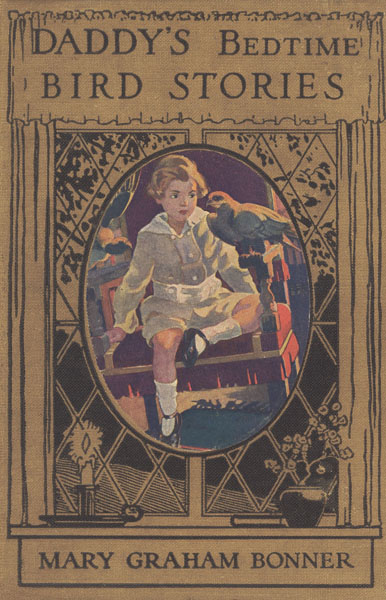
Daddy’s Bedtime Bird Stories – Gutenberg ebooks

By

Mary Graham Bonner

With four illustrations in color by
Florence Choate and Elizabeth Curtis

Daddys Bedtime Story Images


These stories first appeared in the American Press Association Service and the Western Newspaper Union.


Many of the sketches in this volume are the work of Rebecca McCann, creator of the “Cheerful Cherub,” etc.

Daddy's Bedtime Bird Stories by Mary Graham Bonner - 1917

*
Daddy’s Bedtime Bird Stories by Mary Graham Bonner – 1917

*

Links:

Painted Bunting (Passerina ciris) ©©Flickr


  Bird Tales


  Daddy’s Bedtime Bird Stories


Spanish Sparrow (Passer Hispaniolensis) female ©WikiC


  Wordless Birds


*

The Winter Wrens’ Dew-drop Baths

Winter Wren (Troglodytes troglodytes) by Ian

Winter Wren (Troglodytes troglodytes) by Ian

THE WINTER WRENS’ DEW-DROP BATHS

“The winter wren is really with us during the summer too,” said daddy. “But he is too shy to be near us. We can only hear him sing sometimes. When winter comes, though, he goes to people for protection and picks up the crumbs they give him.

“Yesterday he was sitting on a snow-berry bush with a tiny companion. The snow-berry bushes are full and leafy, and in the spring and summer are covered with very tiny pink blossoms. In the autumn and winter they are covered with little berries which look as if they had been made out of snow.

“‘Oh, how I dread the winter!’ said the tiny wren. ‘Just imagine how dreadful it would be if no one put any bread crumbs out for us, or no dog left us some of his dinner on a back porch.’

“‘Now,’ said Mr. Brown Wren, ‘you mustn’t think of such sad thoughts. You always [p.11]do! Someone will look after us. And maybe we’ll find a few spiders now and then in the cracks, and then well have a regular feast.’

“The next day they were back again on the snow-berry bush, and the day was much warmer. Now the wrens love to bathe above all things! Even in the winter they will go through a little sheet of ice and get into the cold, cold water underneath. For they must get their baths! And in the spring, when the tiny wrens are brought forth from their mossy nests, the first lesson they have is of bathing in some nearby brook.

“But this day it was early in the morning, the snow-berry bush was covered with dew-drops and the wrens were delighted.

“‘The sun will drive them away soon. Let’s take them while we get the chance,’ whispered Mr. Brown Wren.

“‘Yes, yes,’ said his small companion. ‘We will soon have to bathe when it is so cold. Let us have a good warm bath first.’

“And then those two little brown wrens took the dew-drops in their beaks, and dropped each one in turn on their feathers. [p.12]Then they got under some leaves full of dew-drops and shook them down over their little feathered bodies.

“After they were well covered with the dew-drops they began to shake all over just as every bird does when he takes a bath. And back they went to take another bath when this one was over. For they seemed to enjoy their last warm bath so much!

“Finally they had bathed enough, and the sun appeared strong as could be, and shining very hard. They perched still on the branches of the snow-berry bush and bathed now in the hot sun. Soon their little feathers were quite dry and they began to sing.

“And truly I think their song was one of gladness because of their dew-drop baths!”


Winter Wren (Troglodytes troglodytes) by Ian

Winter Wren (Troglodytes troglodytes) by Ian

Lee’s Addition:

My message shall drop as the rain, my speech shall distil as the dew, as the light rain upon the tender grass, and as the showers upon the herb. (Deuteronomy 32:2 AMP)

By His knowledge the depths were broken up, And clouds drop down the dew. (Proverbs 3:20 NKJV)

And who do you think is the father of rain and dew, (Job 38:28 MSG)

Another Bird Tales

From

Daddy’s Bedtime Bird Stories – Gutenberg ebooks

By

Mary Graham Bonner

With four illustrations in color by
Florence Choate and Elizabeth Curtis

Daddys Bedtime Story Images


These stories first appeared in the American Press Association Service and the Western Newspaper Union.


Many of the sketches in this volume are the work of Rebecca McCann, creator of the “Cheerful Cherub,” etc.

Daddy's Bedtime Bird Stories by Mary Graham Bonner - 1917

*
Daddy’s Bedtime Bird Stories by Mary Graham Bonner – 1917

*

Links:

Painted Bunting (Passerina ciris) ©©Flickr


  Bird Tales


  Daddy’s Bedtime Bird Stories


Spanish Sparrow (Passer Hispaniolensis) female ©WikiC


  Wordless Birds


Winter Wren (Troglodytes troglodytes) by Ian


  Troglodytidae – Wrens Family


*

The Wren Who Brought Fire

House Wren (Troglodytes aedon) by Ian

House Wren (Troglodytes aedon) by Ian

The Wren Who Brought Fire ~ from The Curious Book of Birds

THE WREN WHO BROUGHT FIRE

Cur Book of Birds letter-cENTURIES and centuries ago, when men were first made, there was no such thing as fire known in all the world. Folk had no fire with which to cook their food, and so they were obliged to eat it raw; which was very unpleasant, as you may imagine! There were no cheery fireplaces about which to sit and tell stories, or make candy or pop corn. There was no light in the darkness at night except the sun and moon and stars. There were not even candles in those days, to say nothing of gas lamps or electric lights. It is strange to think of such a world where even the grown folks, like the children and the birds, had to go to bed at dusk, because there was nothing else to do.

But the little birds, who lived nearer heaven than men, knew of the fire in the sun, and knew also what a fine thing it would be for the tribes without feathers if they could have some of the magic element.

One day the birds held a solemn meeting, when it was decided that men must have fire. Then some one must fly up to the sun and bring a firebrand thence. Who would undertake this dangerous errand? Already by sad experience the Kingfisher had felt the force of the sun’s heat, while the Eagle and the Wren, in the famous flight which they had taken together, had learned the same thing. The assembly of birds looked at one another, and there was a silence.

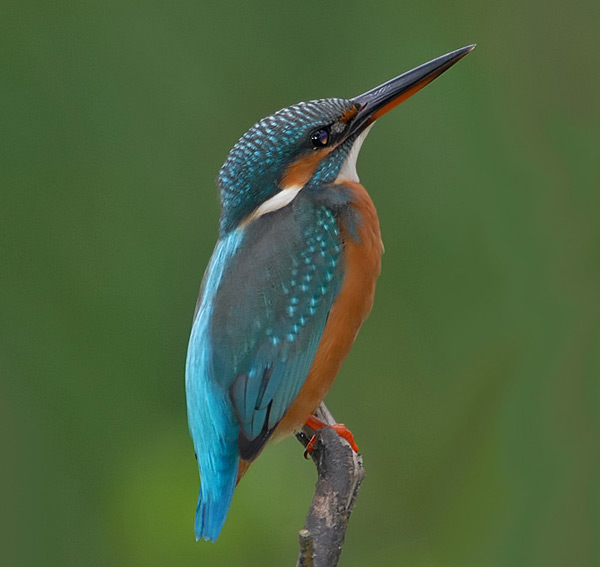
Common Kingfisher (Alcedo atthis) by W Kwong

Common Kingfisher (Alcedo atthis) by W Kwong

“I dare not go,” said the Kingfisher, trembling at the idea; “I have been up there once, and the warning I received was enough to last me for some time.”

Indian Peafowl (Pavocristatus) by Nikhil Devasar

Indian Peafowl (Pavocristatus) by Nikhil Devasar

“I cannot go,” said the Peacock, “for my plumage is too precious to risk.”

Crested Lark (Galerida cristata) by Nikhil Devasar

Crested Lark (Galerida cristata) by Nikhil Devasar

“I ought not to go,” said the Lark, “for the heat might injure my pretty voice.”

Yellow-billed Stork (Mycteria ibis) ©USFWS

Yellow-billed Stork (Mycteria ibis) ©USFWS

“I must not go,” said the Stork, “for I have promised to bring a baby to the King’s palace this evening.”

European Turtle Dove (Streptopelia turtur) ©WikiC

European Turtle Dove (Streptopelia turtur) ©WikiC

“I cannot go,” said the Dove, “for I have a nestful of little ones who depend upon me for food.”

Chipping Sparrow (Spizella passerina) by Quy Tran

Chipping Sparrow (Spizella passerina) by Quy Tran

“Nor I,” said the Sparrow, “for I am afraid.” “Nor I!” “Nor I!” “Nor I!” echoed the other birds.

Western Screech Owl (Megascops kennicottii)(captive) by Raymond Barlow

Western Screech Owl (Megascops kennicottii)(captive) by Raymond Barlow

“I will not go,” croaked the Owl, “for I simply do not wish to.”

Then up spoke the little Wren, who had been keeping in the background of late, because he was despised for his attempt to deceive the birds into electing him their king. (see King of the Birds)

Rufous-naped Wren (Campylorhynchus rufinucha) by Ray

Rufous-naped Wren (Campylorhynchus rufinucha) by Ray

“I will go,” said the Wren. “I will go and bring fire to men. I am of little use here. No one loves me. Every one despises me because of the trick which I played the Eagle, our King. No one will care if I am injured in the attempt. I will go and try.”

“Bravely spoken, little friend,” said the Eagle kindly. “I myself would go but that I am the King, and kings must not risk the lives upon which hangs the welfare of their people. Go you, little Wren, and if you are successful you will win back the respect of your brothers which you have forfeited.”

The brave little bird set out upon his errand without further words. And weak and delicate though he was, he flew and he flew up and up so sturdily that at last he reached the sun, whence he plucked a firebrand and bore it swiftly in his beak back toward the earth. Like a falling star the bright speck flashed through the air, drawing ever nearer and nearer to the cool waters of Birdland and the safety which awaited him there. The other birds gathered in a flock about their king and anxiously watched the Wren’s approach.

Suddenly the Robin cried out, “Alas! He burns! He has caught fire!” And off darted the faithful little friend to help the Wren. Sure enough, a spark from the blazing brand had fallen upon the plumage of the Wren, and his poor little wings were burning as he fluttered piteously down, still holding the fire in his beak.

American Robin (Turdus migratorius) by Daves BirdingPix

American Robin (Turdus migratorius) by Daves BirdingPix

The Robin flew up to him and said, “Well done, brother! You have succeeded. Now give me the fire and I will relieve you while you drop into the lake below us to quench the flame which threatens your life.”

So the Robin in his turn seized the firebrand in his beak and started down with it. But, like the Wren, he too was soon fluttering in the blaze of his own burning plumage, a little living firework, falling toward the earth.

Desert Lark (Ammomanes deserti) by Nikhil Devasar

Desert Lark (Ammomanes deserti) by Nikhil Devasar

Then up came the Lark, who had been watching the two unselfish birds. “Give me the brand, brother Robin,” she cried, “for your pretty feathers are all ablaze and your life is in danger.”

So it was the Lark who finally brought the fire safely to the earth and gave it to mankind. But the Robin and the Wren, when they had put out the flame which burned their feathers, appeared in the assembly of the birds, and were greeted with great applause as the heroes of the day. The Robin’s breast was scorched a brilliant red, but the poor, brave little Wren was wholly bare of plumage. All his pretty feathers had been burned away, and he stood before them shivering and piteous.

Bald Eagle (close up) Lowry Park Zoo by Lee

Bald Eagle (close up) Lowry Park Zoo by Lee

“Bravo! little Wren,” cried King Eagle. “A noble deed you have done this day, and nobly have you won back the respect of your brother birds and earned the everlasting gratitude of men. Now what shall we do to help you in your sorry plight?” After a moment’s thought he turned to the other birds and said, “Who will give a feather to help patch a covering for our brave friend?”

“I!” and “I!” and “I!” and “I!” chorused the generous birds. And in turn each came forward with a plume or a bit of down from his breast. The Robin first, who had shared his peril, brought a feather sadly scorched, but precious; the Lark next, who had helped in the time of need. The Eagle bestowed a kingly feather, the Thrush, the Nightingale,—every bird contributed except the Owl.

Great Horned Owl (Bubo virginianus) by Bob-Nan

Great Horned Owl (Bubo virginianus) by Bob-Nan

But the selfish Owl said, “I see no reason why I should give a feather. Hoot! No! The Wren brought me into trouble once, and I will not help him now. Let him go bare, for all my aid.”

“Shame! Shame!” cried the birds indignantly. “Old Master Owl, you ought to be ashamed. But if you are so selfish we will not have you in our society. Go back to your hollow tree!”

“Yes, go back to your hollow tree,” cried the Eagle sternly; “and when winter comes may you shiver with cold as you would have left the brave little Wren to shiver this day. You shall ruffle your feathers as much as you like, but you will always feel cold at heart, because your heart is selfish.”

And indeed, since that day for all his feathers the Owl has never been able to keep warm enough in his lonely hollow tree.

But the Wren became one of the happiest of all the birds, and a favorite both with his feathered brothers and with men, because of his brave deed, and because of the great fire-gift which he had brought from the sun.

Carolina Wren (Thryothorus ludovicianus)  by Quy Tran

Carolina Wren (Thryothorus ludovicianus) by Quy Tran


Lee’s Addition:

In the daytime also he led them with a cloud, and all the night with a light of fire. (Psalms 78:14 KJV)

As soon then as they were come to land, they saw a fire of coals there, and fish laid thereon, and bread. Jesus saith unto them, Bring of the fish which ye have now caught. Simon Peter went up, and drew the net to land full of great fishes, an hundred and fifty and three:… Jesus saith unto them, Come and dine. And none of the disciples durst ask him, Who art thou? knowing that it was the Lord. (John 21:9-12 KJV)

Trust you enjoyed this tale from The Curious Book of Birds. These entertaining stories were written 1903 and they are just as delightful and fun to read today.

(Photos added by me.)

Links:

House Wren (Troglodytes aedon) by Ian


Troglodytidae – Wrens Family


Painted Bunting (Passerina ciris) ©©Flickr


  Bird Tales


Curious Book of Birds - Cover


  The Curious Book of Birds


Spanish Sparrow (Passer Hispaniolensis) female ©WikiC


  Wordless Birds


*

The Forgetful Kingfisher

Pied Kingfisher (Ceryle rudis) by Ian

Pied Kingfisher (Ceryle rudis) by Ian

The Forgetful Kingfisher ~ from The Curious Book of Birds

THE FORGETFUL KINGFISHER

Cur Book of Birds letter-iN these days the Kingfisher is a sad and solitary bird, caring not to venture far from the water where she finds her food. Up and down the river banks she goes, uttering a peculiar plaintive cry. What is she saying, and why is she so restless? The American Kingfisher is gray, but her cousin of Europe is a bird of brilliant azure with a breast of rusty red. Therefore it must have been the foreign Kingfisher who was forgetful, as you shall hear.

Long, long after the sorrows of Halcyone, the first Kingfisher, were ended, came the great storm which lasted forty days and forty nights, causing the worst flood which the world has ever known. That was a terrible time. When Father Noah hastened to build his ark, inviting the animals and birds to take refuge with him, the Kingfisher herself was glad to go aboard. For even she, protected by Æolus from the fury of winds and waters, was not safe while there was no place in all the world for her to rest foot and weary wing. So the Kingfisher fluttered in with the other birds and animals, a strange company! And there they lived all together, Noah and his arkful of pets, for many weary days, while the waters raged and the winds howled outside, and all the earth was covered fathoms deep out of sight below the waves.

But after long weeks the storm ceased, and Father Noah opened the little window in the ark and sent forth the Dove to see whether or not there was land visible on which the ark might find rest. Now after he had sent out the Dove, Noah looked about him at the other birds and animals which crowded around him eagerly, for they were growing very restless from their long confinement, and he said, “Which of you is bravest, and will dare follow our friend the Dove out into the watery world? Ah, here is the Kingfisher. Little mother, you at least, reared among the winds and waters, will not be afraid. Take wing, O Kingfisher, and see if the earth be visible. Then return quickly and bring me faithful word of what you find out yonder.”

Day was just beginning to dawn when the Kingfisher, who was then as gray as gray, flew out from the little window of the ark whence the Dove had preceded her. But hardly had she left the safe shelter of Father Noah’s floating home, when there came a tremendous whirlwind which blew her about and buffeted her until she was almost beaten into the waves, which rolled endlessly over the face of the whole earth, covering the high hills and the very mountains. The Kingfisher was greatly frightened. She could not go back into the ark, for the little window was closed, and there was no land anywhere on which she could take refuge. Just think for a moment what a dreadful situation it was! There was nothing for her to do but to fly up, straight up, out of reach from the tossing waves and dashing spray.

The Kingfisher was fresh and vigorous, and her wings were strong and powerful, for she had been resting long days in the quiet ark, eating the provisions which Father Noah had thoughtfully prepared for his many guests. So up, up she soared, above the very clouds, on into the blue ether which lies beyond. And lo! as she did so, her sober gray dress became a brilliant blue, the color caught from the azure of those clear heights. Higher and higher she flew, feeling so free and happy after her long captivity, that she quite forgot Father Noah and the errand upon which she had been sent. Up and up she went, higher than the sun, until at last she saw him rising far beneath her, a beautiful ball of fire, more dazzling, more wonderful than she had ever guessed.

“Hola!” she cried, beside herself with joy at the sight. “There is the dear sun, whom I have not seen for many days. And how near, how beautiful he is! I will fly closer still, now that I have come so near. I will observe him in all his splendor, as no other bird, not even the high-flying, sharp-eyed Eagle, has ever seen him.”

And with that the foolish Kingfisher turned her course downward, with such mad, headlong speed that she had scarcely time to feel what terrible, increasing heat shot from the sun’s rays, until she was so close upon him that it was too late to escape. Oh, but that was a dreadful moment! The feathers on her poor little breast were scorched and set afire, and she seemed in danger not only of spoiling her beautiful new blue dress but of being burned into a wretched little cinder. Horribly frightened at her danger, the Kingfisher turned once more, but this time toward the rolling waters which covered the earth. Down, down she swooped, until with the hiss of burning feathers she splashed into the cold wetness, putting out the fire which threatened to consume her. Once, twice, thrice, she dipped into the grateful coolness, flirting the drops from her blue plumage, now alas! sadly scorched.

Common Kingfisher (Alcedo atthis) by W Kwong

Common Kingfisher (Alcedo atthis) by W Kwong

When the pain of her burns was somewhat relieved she had time to think what next she should do. She longed for rest, for refuge, for Father Noah’s gentle, caressing hand to which she had grown accustomed during those stormy weeks of companionship in the ark. But where was Father Noah? Where was the ark? On all the rolling sea of water there was no movement of life, no sign of any human presence. Then the Kingfisher remembered her errand, and how carelessly she had performed it. She had been bidden to return quickly; but she had wasted many hours—she could not tell how many—in her forgetful flight. And now she was to be punished indeed, if she could not find her master and the ark of refuge.

The poor Kingfisher looked wildly about. She fluttered here and there, backward and forward, over the weary stretch of waves, crying piteously for her master. He did not answer; there was no ark to be found. The sun set and the night came on, but still she sought eagerly from east to west, from north to south, always in vain. She could never find what she had so carelessly lost.

The truth is that during her absence the Dove, who had done her errand faithfully, returned at last with the olive leaf which told of one spot upon the earth’s surface at last uncovered by the waves. Then the ark, blown hither and thither by the same storm which had driven the Kingfisher to fly upward into the ether-blue, had drifted far and far to Mount Ararat, where it ran aground. And Father Noah, disembarking with his family and all the assembled animals, had broken up the ark, intending there to build him a house out of the materials from which it was made. But this was many, many leagues from the place where the poor Kingfisher, lonely and frightened, hovered about, crying piteously for her master.

And even when the waters dried away, uncovering the earth in many places, so that the Kingfisher could alight and build herself a nest, she was never happy nor content, but to this day flies up and down the water-ways of the world piping sadly, looking eagerly for her dear master and for some traces of the ark which sheltered her. And the reflection which she makes in the water below shows an azure-blue body, like a reflection of the sky above, with some of the breast-feathers scorched to a rusty red. And now you know how it all came about.


Common Kingfisher (Alcedo atthis) by Nikhil Devasar

Common Kingfisher (Alcedo atthis) by Nikhil Devasar

Lee’s Addition:

An enjoyable Bird Tale from The Curious Book of Birds. Kingfishers belong to the Alcedinidae – Kingfishers Family.

We know the Lord created Kingfishers and gave them their colors, but it is fun to read stories about them, even if they are make-believe. The flood and the ark were true, but that is not quite how they came to fly up and down the waterways.

That they may set their hope in God, And not forget the works of God, But keep His commandments; (Psalms 78:7 NKJV)

My son, do not forget my law, But let your heart keep my commands; (Proverbs 3:1 NKJV)

Get wisdom! Get understanding! Do not forget, nor turn away from the words of my mouth. (Proverbs 4:5 NKJV)

Kingfishers have been created by a loving Creator just as we have been. We differ from the birds because we were made in God’s image. Therefore, we need to remember our teachings about God and Christ and not forget them. That also includes what your parents ask you to do also.

(Photos added by me.)

Links:

White-throated Kingfisher (Halcyon smyrnensis) by Nikhil Devasar


  Alcedinidae – Kingfishers Family


Painted Bunting (Passerina ciris) ©©Flickr


  Bird Tales


Curious Book of Birds - Cover


  The Curious Book of Birds


Spanish Sparrow (Passer Hispaniolensis) female ©WikiC


  Wordless Birds


*

The Robins Come To The Rescue

THE ROBINS COME TO THE RESCUE


Saving the Little Birds from Danger.

Saving the Little Birds from Danger.


The honeysuckles were beginning to bud. Already the humming-birds were hovering near and had built a nest right in the heart of the vine. This vine was in a nice old-fashioned garden, but near by there was a vacant lot which was very swampy.

“You know the garden by the vacant lot?” began daddy.

“Yes,” replied both children, “are you going to tell us a story about that garden?”

“I am going to tell you,” said daddy, “about the mother humming-bird whose little ones were attacked by a cruel snake when they were rescued by the brave robins.

“The snake had come over from the vacant field and had crawled up the honeysuckle vine as the mother humming-bird had gone off for some food. Some robins hovering near had seen the awful snake. They had cried out in terror and had flown over to the nest.

“The mother humming-bird heard the cries and hurried back, but the robins had frightened off the snake. The snake was not a very large one, and really he had been frightened by all the noise the robins had made, and when he saw so many birds flying toward him he got away very quickly.

“The mother humming-bird got back just as the snake was leaving the nest.

“She couldn’t thank the robins enough for flying to the rescue and saving her beloved little ones, but the robins didn’t want any thanks. They were thankful, too, that the dear little birds had been saved, for birds are very loyal to one another and will risk any danger to save each other.”

“I am so glad,” said Evelyn, “that the little humming-birds were saved, for I love to see them having such a good time in the honeysuckle vines, and the more there are of them the nicer it makes the summer seem.”

“It was brave of the robins to come to the rescue, though, wasn’t it, daddy?”

“Indeed it was,” said daddy; “but almost all animals and birds will do anything they can to help one another, and they seem to forget that there is such a thing as being afraid if they see any creature in danger or distress.

“After the mother humming-bird had recovered from the awful fright, and after the little ones had shown that they were perfectly well and strong, with no ill effects from their fright, the mother humming-bird invited the robins to partake of the delicious meal she had succeeded in getting before the cries came from the robins.”

Daddys Bedtime Story Images (34)

“THE MOTHER HUMMING-BIRD HURRIED BACK.”


Lee’s Addition:

Then shalt thou walk in thy way safely, and thy foot shall not stumble. (Pro 3:23)

Did the Robin brag about what they did? No. Was the Humming-bird thankful? Yes. Were they friends, yes. What can we learn from this story?

We should be willing to watch out for our friends and we should not forget to appreciate and thank those who do things for us. Also, the Lord said that He knows about the birds (Sparrows) and cares about them and us. The Lord cares more about you than the birds.

Are not five sparrows sold for two farthings, and not one of them is forgotten before God? But even the very hairs of your head are all numbered. Fear not therefore: ye are of more value than many sparrows. (Luk 12:6-7)

*

Another Bird Tales

From

Daddy’s Bedtime Bird Stories – Gutenberg ebooks

By

Mary Graham Bonner

With four illustrations in color by
Florence Choate and Elizabeth Curtis

Daddys Bedtime Story Images


These stories first appeared in the American Press Association Service and the Western Newspaper Union.


Many of the sketches in this volume are the work of Rebecca McCann, creator of the “Cheerful Cherub,” etc.

Daddy's Bedtime Bird Stories by Mary Graham Bonner - 1917

*
Daddy’s Bedtime Bird Stories by Mary Graham Bonner – 1917

*

Links:

Painted Bunting (Passerina ciris) ©©Flickr


  Bird Tales


  Daddy’s Bedtime Bird Stories


Spanish Sparrow (Passer Hispaniolensis) female ©WikiC


  Wordless Birds


*

American Robin (Turdus migratorius) eating by Jim Fenton


  Turdidae – Thrushes Family


*

Vol 2 #2 – Gambel’s Partridge

Gambel's Quail (Callipepla gambelii)

Gambel’s Partridge by Birds Illustrated by Color Photography

From col. F. M. Woodruff.

GAMBEL’S PARTRIDGE.

imgg

AMBEL’S PARTRIDGE, of which comparatively little is known, is a characteristic game bird of Arizona and New Mexico, of rare beauty, and with habits similar to others of the species of which there are about two hundred. Mr. W. E. D. Scott found the species distributed throughout the entire Catalina region in Arizona below an altitude of 5,000 feet. The bird is also known as the Arizona Quail.

The nest is made in a depression in the ground sometimes without any lining. From eight to sixteen eggs are laid. They are most beautifully marked on a creamy-white ground with scattered spots and blotches of old gold, and sometimes light drab and chestnut red. In some specimens the gold coloring is so pronounced that it strongly suggests to the imagination that this quail feeds upon the grains of the precious metal which characterizes its home, and that the pigment is imparted to the eggs.

After the nesting season these birds commonly gather in “coveys” or bevies, usually composed of the members of but one family. As a rule they are terrestrial, but may take to trees when flushed. They are game birds par excellence, and, says Chapman, trusting to the concealment afforded by their dull colors, attempt to avoid detection by hiding rather than by flying. The flight is rapid and accompanied by a startling whirr, caused by the quick strokes of their small, concave, stiff-feathered wings. They roost on the ground, tail to tail, with heads pointing outward; “a bunch of closely huddled forms—a living bomb whose explosion is scarcely less startling than that of dynamite manufacture.”

The Partridge is on all hands admitted to be wholly harmless, and at times beneficial to the agriculturist. It is an undoubted fact that it thrives with the highest system of cultivation, and the lands that are the most carefully tilled, and bear the greatest quantity of grain and green crops, generally produce the greatest number of Partridges.

Summary:

GAMBEL’S PARTRIDGE.Callipepla gambeli.

Range—Northwestern Mexico, Arizona, New Mexico, southern Utah, and western Utah and western Texas.

Nest—Placed on the ground, sometimes without any lining.

Eggs—From eight to sixteen.


Gambel's Quail (Callipepla gambelii) by S Slayton

Gambel’s Quail (Callipepla gambelii) by S Slayton

Lee’s Addition:

Partridges are mentioned in two verses, thus making it a Bible Bird. Of course, the Gambel’s is not mentioned, only his family. They belong to the Galliformes order and are now called the Gambel’s Quail. They are in the Odontophoridae – New World Quail Family along with 33 other species (3.1 IOC).

Now therefore, let not my blood fall to the earth away from the presence of the LORD, for the king of Israel has come out to seek a single flea like one who hunts a partridge in the mountains. (1 Samuel 26:20 ESV)

Like the partridge that gathers a brood that she did not hatch, so is he who gets riches but not by justice; in the midst of his days they will leave him, and at his end he will be a fool. (Jeremiah 17:11 ESV)

Since they are now known as Quails, that species also appears in Scripture four times. Exodus 16:13, Numbers 11:31-32, and Psalms 105:40 all mention quail as a provision for His people. We were privileged to see the Gambel’s Quail in California in 1999. They are so neat walking around with that top knot bobbing along.

In the evening quail came up and covered the camp, and in the morning dew lay around the camp. (Exodus 16:13 ESV)

Then a wind from the LORD sprang up, and it brought quail from the sea and let them fall beside the camp, about a day’s journey on this side and a day’s journey on the other side, around the camp, and about two cubits above the ground. And the people rose all that day and all night and all the next day, and gathered the quail. Those who gathered least gathered ten homers. And they spread them out for themselves all around the camp. (Numbers 11:31-32 ESV)

They asked, and he brought quail, and gave them bread from heaven in abundance. (Psalms 105:40 ESV)

Gambel's Quail (Callipepla gambelii) ©WikiC

Gambel’s Quail (Callipepla gambelii) ©WikiC

“The Gambel’s Quail, Callipepla gambelii, is a small ground-dwelling bird in the New World quail family. It inhabits the desert regions of Arizona, California, Colorado, New Mexico, Nevada, Utah, Texas, and Sonora; also New Mexico-border Chihuahua and the Colorado River region of Baja California. The Gambel’s quail is named in honor of William Gambel, a 19th century naturalist and explorer of the Southwestern United States.” (Wikipedia)

*

Birds Illustrated by Color Photography – Revisited – Introduction

The above article is the first article in the monthly serial that was started in January 1897 “designed to promote Knowledge of Bird-Live.” These include Color Photography, as they call them, today they are drawings. There are at least three Volumes that have been digitized by Project Gutenberg.

To see the whole series of – Birds Illustrated by Color Photography – Revisited

*

(Information from Wikipedia and other internet sources)

Next Article – The Yellow Warbler

The Previous Article – To A Water-Fowl

ABC’s Of The Gospel

Links:

Odontophoridae – New World Quail Family

GALLIFORMES – Fowl, Quail, Guans, Currasows, Megapodes Order

Gambel’s Quail – Wikipedia

Gambel’s Quail – All About Birds

*


Vol 2 #2 – To A Water-Fowl

Black Swan and Wood Duck female - Lake Morton 6-28-12 by Lee

Black Swan and Wood Duck female

TO A WATER-FOWL

Whither, ’midst falling dew
While glow the heavens with the last steps of day,
Far through their rosy depths dost thou pursue
Thy solitary way?

Vainly the fowler’s eye
Might mark thy distant flight to do thee wrong,
As, darkly painted on the crimson sky,
Thy figure floats along.

Seek’st thou the plashy brink
Of weedy lake, or marge of river wide,
Or where the rocky billows rise and sink
On the chafed ocean side.

There is a Power whose care
Teaches thy way along that pathless coast—
The desert and illimitable air—
Lone wandering, but not lost.

All day thy wings have fanned,
At that far height, the cold thin atmosphere,
Yet stoop not, weary, to the welcome land
Though the dark night is near.

And soon that toil shall end;
Soon shalt thou find a summer home, and nest,
And scream among thy fellows; reeds shall bend,
Soon o’er thy sheltered nest.

Thou’rt gone, the abyss of heaven
Hath swallowed up thy form; yet on my heart
Deeply has sunk the lesson thou hast given,
And shall not soon depart.

He who from zone to zone,
Guides through the boundless sky thy certain flight,
In the long way that I must tread alone,
Will lead my steps aright.

William Cullen Bryant.


Cape Barren Goose (Cereopsis novaehollandiae) by Ian

Cape Barren Goose (Cereopsis novaehollandiae) by Ian

Lee’s Addition:

Storks know when to fly south. So do doves, swifts and thrushes. But my people do not know what I require them to do. (Jeremiah 8:7 NIrV)

“But now ask the beasts, and they will teach you; And the birds of the air, and they will tell you; (Job 12:7 NKJV)

Wikipedia say this of Waterfowl They “are certain wildfowl of the order Anseriformes, especially members of the family Anatidae, which includes ducks, geese, and swans.
They are strong swimmers with medium to large bodies. They have historically been an important food source, and continue to be hunted as game, or raised as poultry for meat and eggs. The domestic duck is sometimes kept as a pet.

Some definitions of the term ‘waterfowl’ include the saltwater shorebirds or waders, gulls, pelicans, and herons, as well as seabirds such as the albatross, but ‘fowl’ especially refers to birds used by humans for game.

*

Birds Illustrated by Color Photography – Revisited – Introduction

The above article is the first article in the monthly serial that was started in January 1897 “designed to promote Knowledge of Bird-Live.” These include Color Photography, as they call them, today they are drawings. There are at least three Volumes that have been digitized by Project Gutenberg.

To see the whole series of – Birds Illustrated by Color Photography – Revisited

*

(Information from Wikipedia and other internet sources)

Next Article –  Gambel’s Partridge

The Previous Article – The Turkey Vulture

Wordless Birds

Links:

Anseriformes Order

Anatidae Family

*