Barn Swallows, a Nostalgic Reminder of Home

Barn Swallow (same)

Barn Swallow (same)

Barn Swallows, a Nostalgic Reminder of Home

by James J. S. Johnson

Whereas ye know not what shall be on the morrow. For what is your life? It is even a vapour, that appeareth for a little time, and then vanisheth away.  For that ye ought to say, If the Lord will, we shall live, and do this, or that.  (James 4:14-15).

Luzon Bleeding-heart by Dan

Orni-Theology

As daylight slid slowly into nighttime darkness, one warm summer evening in Sweden, I thought I recognized the sleek silhouettes of swallows, flitting and zooming here and there, like aerial fighter pilots, catching hapless insects in the air.  It was too dark, and they were too fast, to positively confirm them as Barn Swallows, but surely that’s what they were.  Little hatchlings, waiting hungrily in mud-nests nearby, likewise appreciated the aerial insect-grabbing of their caring parents.  The day would come, in time, when the hungry nestlings would do the same for their progeny.

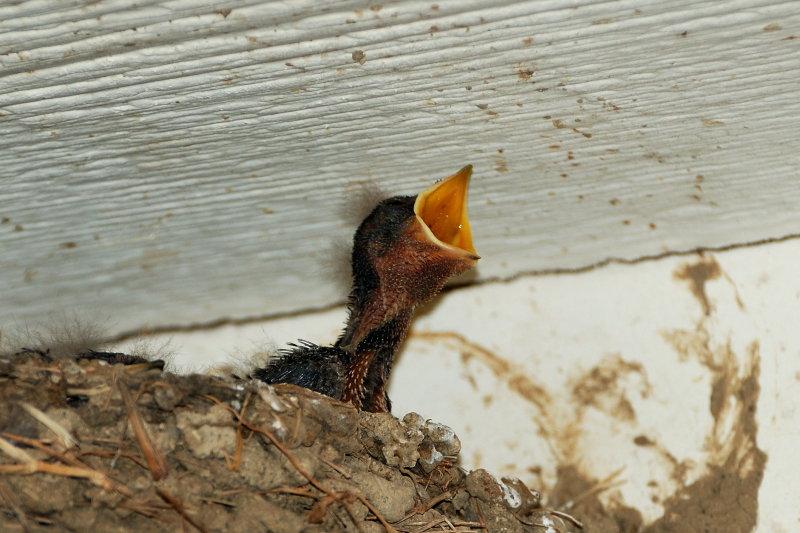
Barn Swallow (Hirundo rustica) baby by Neal Addy Gallery

Barn Swallow (Hirundo rustica) baby by Neal Addy Gallery

In Europe one of the common summer migrants is the Swallow (Hirunda rustica), known in America as the Barn Swallow, due to their habit of nesting colonies near the roofs of barns, stables, and other wooden buildings.  Barn swallows are easily recognized by their long tail streamers, narrow and pointed wings, iridescent blue-black upper feather coat, contrasting with a white underside sporting a rusty orange forehead and chin-throat bib.  (The sexes are similar except that the female has shorter tail streamers.)   Like other swallows, the barn swallow is mostly insectivorous, catching bugs on the fly, as it darts and arcs with graceful flight patterns, powered by deep wing-beats.  [See Jürgen Nicolai, Detlef  Singer, & Konrad Wothe, Birds of Britain and Europe (Harper Collins, AD1994; translated by Ian Dawson), page 170.]

One of the most nostalgic folk songs of Scandinavia (especially Sweden) is Hälsa dem därhemma  (“Greet those at Home” – audio and bilingual lyrics at http://treasures2.weebly.com/haumllsa-dem-daumlrhemma.html ), a song about a young sailor aboard a ship, as night falls, homesick for his family and homeland, who sees a flight of migratory swallows.  In song the homesick sailor asks the little swallows (“lilla svala”) to give greetings to “those at home”, including his father, mother, and little brother – and even the green fields that the sailor left behind.  To those of us who have heard it sung, many times and in many places, the emotional recall of days (and homes) gone by pull at our hearts and memories, as we too can think of loved ones we have left behind, one way or another, as we have traveled our life journeys in this busy world.

If swallows could transmit greetings, from us to loved ones now out of reach, what greetings would that be?  The New Testament epistle of James reminds us that we have no control on the day that unfolds us, much less on the many tomorrows that approach our horizons.  But the future is not “up for grabs” – it belongs to God.  It is good to know that our great God sovereignly rules the world — and us therein.

Whereas ye know not what shall be on the morrow. For what is your life? It is even a vapour, that appeareth for a little time, and then vanisheth away.  For that ye ought to say, If the Lord will, we shall live, and do this, or that.  (James 4:14-15).

Barn Swallow (Hirundo rustica) baby by Neal Addy Gallery

Barn Swallow (Hirundo rustica) baby by Neal Addy Gallery

Life has many changes.  Homes come and go.  People come and go  —  even loved ones.

But God is always there and He changes not (Malachi 3:6).  And He prepares a place for us, as a permanent and perfect Home, for that day appointed for our Earth-leaving, which is the day of our true Home-going/Home-coming.  And yet, we are already Home, now, if we belong to the Lord Jesus Christ, because God Himself is our permanent home.  What a wonderful privilege it is to be created by Him, redeemed by Him, and to belong to Him (and to His loved ones) now and forever.

It’s okay to be homesick,  —  and to appreciate the migratory swallows that go “home” each year,  — but our true home awaits us, in Christ, and there are many mansions there (John 14:2-3).  Heaven is a prepared place for a prepared people.  ><> JJSJ

*

Orni-Theology

Hirundinidae – Swallows, Martins

Birds of the Bible – Swallows

Gospel Message

*

Angry (Mocking) Bird

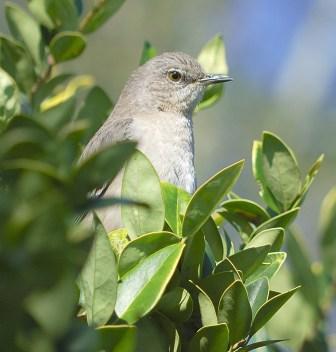
Northern Mockingbird (Mimus polyglottos) by Dan

Northern Mockingbird (Mimus polyglottos) by Dan

Luzon Bleeding-heart by Dan

Orni-Theology

We have been attacked repeatedly lately by an Angry Bird. A Northern Mockingbird has decided that he has a rival inside our windows. As the sun shines on different windows during the day, he attacks those windows with vigor.

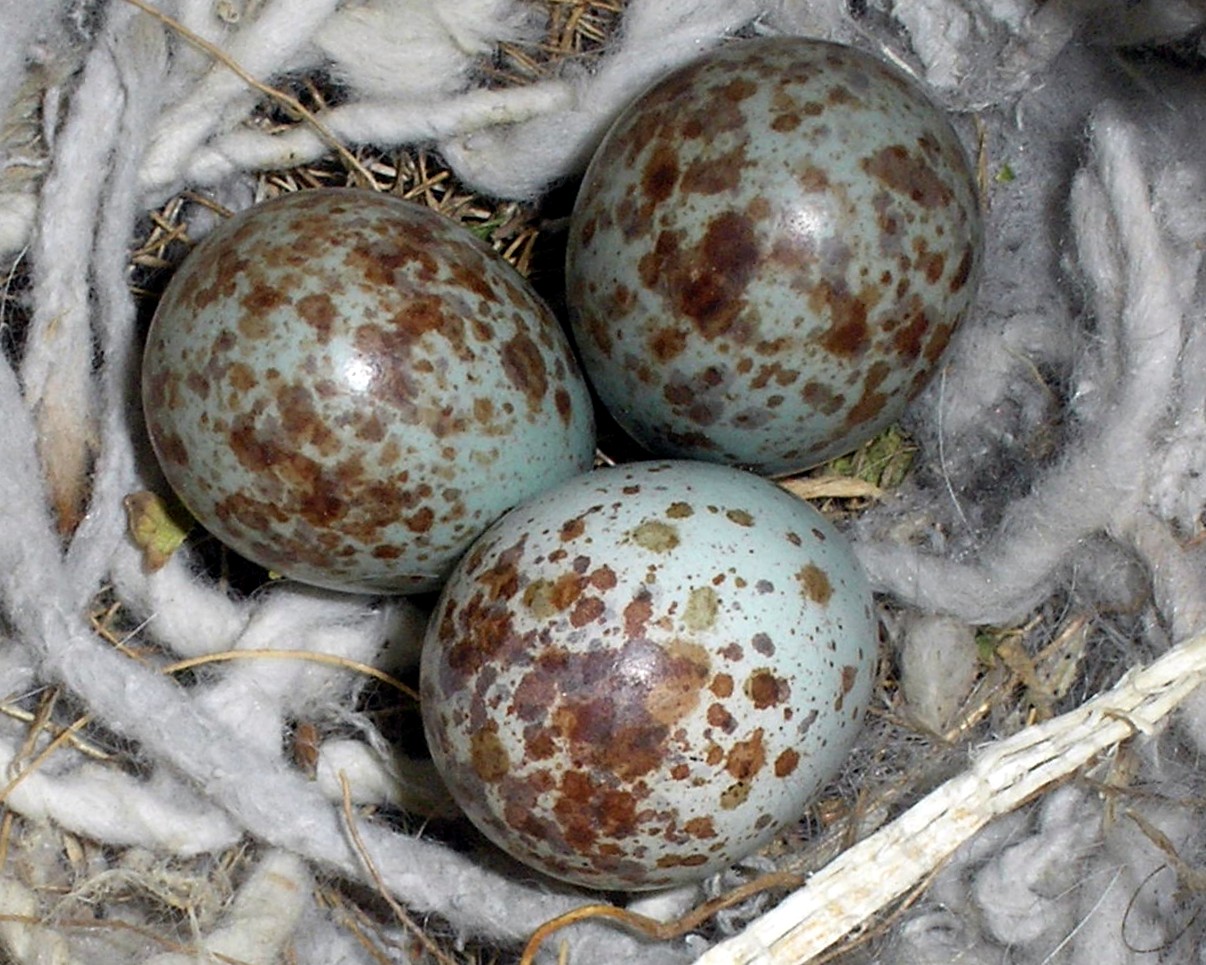
Northern Mockingbird (Mimus polyglottos) eggs ©WikiC

Northern Mockingbird (Mimus polyglottos) eggs ©WikiC

Apparently he has been thinking about starting another family and is trying to clear the area of competitors. He starts at early light and attacks the bird (his imaginary enemy) at one of the two bedroom windows. Then he goes out front and sits in the palm tree by the Florida room windows. Lo and behold, his enemy arrives and he starts attacking that window. It even has a screen on it. Later in the day, about mid-morning his “enemy” shows up in the side window of our living room.

I put some stick-on Christmas tree decorations on the back window, but he still sees his enemy and bangs on the windows. You just have to chuckle.

©©Bing

Angry Bird ©©Bing

As most of you already know, our Northern Mockingbird is seeing his own reflection in the windows. I told Dan yesterday that the Angry Bird is “His own worst enemy!” He is causing his own problems. If he would just relax, (and stay away from the windows) things would be okay.

But be doers of the word, and not hearers only, deceiving yourselves. For if anyone is a hearer of the word and not a doer, he is like a man observing his natural face in a mirror; for he observes himself, goes away, and immediately forgets what kind of man he was. (James 1:22-24 NKJV)

Northern Mockingbird (Mimus polyglottos) Juvenile ©WikiC

Northern Mockingbird (Mimus polyglottos) Juvenile ©WikiC

How many times are we “our own worst enemy?” We make big “to-dos” about nothing. Or we think we have an issue when we really don’t have one. Sometimes we cause our own problems.

But seek first the kingdom of God and His righteousness, and all these things shall be added to you. Therefore do not worry about tomorrow, for tomorrow will worry about its own things. Sufficient for the day is its own trouble. (Matthew 6:33-34 NKJV)

One of the passages that mentions “face to face” that I like is:

“When I was a child, I spoke as a child, I understood as a child, I thought as a child; but when I became a man, I put away childish things. For now we see in a mirror, dimly, but then face to face. Now I know in part, but then I shall know just as I also am known. And now abide faith, hope, love, these three; but the greatest of these is love. (1 Corinthians 13:11-13 NKJV)

Our angry Mockingbird is definitely not showing love.

Have a great day and remember to put your trust in the Lord and not in things you think you see.

*
Songs In The Night From The Mockingbird

Mimidae – Mockingbirds, Thrashers

Northern Mockingbird

Eye of the Beholder – Mockingbird

Orni-Theology

*

Dad and Mom its feeding time..

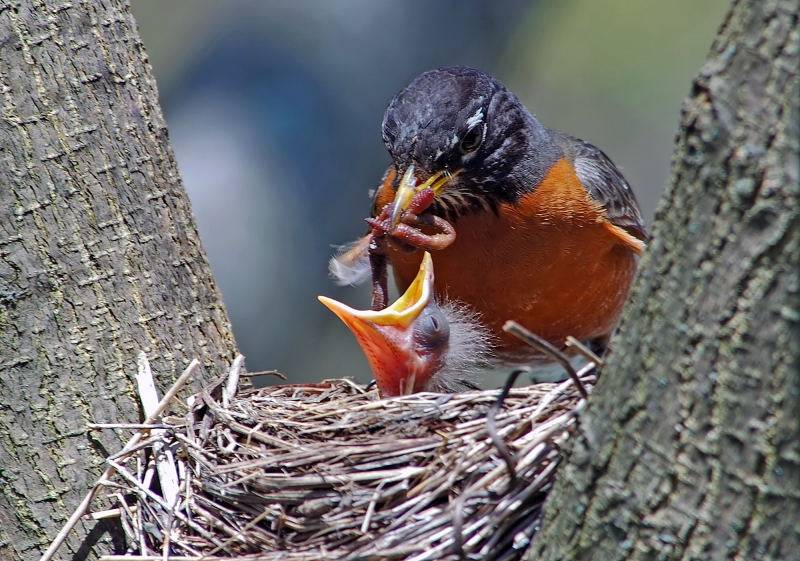
American Robin (Turdus migratorius)with youngsters by Raymond Barlow

American Robin (Turdus migratorius)with youngsters by Raymond Barlow

This is for every blessed parent who so anxiously works hard in raising their kids in the way of the Lord…
And for the kids being fed by their parents.

Birds emerge from the shell blind and so weak
they can’t even hold their heads up.
Parents must feed babies frequently because
baby birds digest their food quickly.

The larger the babies grow, the more food they require.
Baby Crows need at least half their weight in food
every day just to stay alive.
a baby Belted Kingfishers eat 1 to 1 3/4 times
their weight in fish every day.
American Robin (Turdus migratorius) with young in nest

American Robin (Turdus migratorius) with young in nest

On average, a songbird nestling
receives four-12 feedings
of protein-rich insect food every hour.
Young Hawks are fed about once an hour.
Feeding duties aren’t always divided
equally between the sexes.
This varies with the species and
the inclination of the individual bird.
One male House Wren – a single male
whose mate disappeared – fed his nestlings
1,217 times between 4:15 a.m. and 8 p.m.
That’s about one trip every 47 seconds.
It’s astonishing how much a young bird can eat.
In one instance, a young American Robin,
who was supposed to leave the nest that day,
was experimentally fed all the earthworms it would eat.
Each worm was measured.
The Robin ate 14 feet of worms.
Orni-Theology

Orni-Theology

If birds can feed so much to their chicks every day,

how much would God expect us as a parent
to nourish our kids with spiritual food.
Well, do we feed the word of God to our kids every day?
Kids, are you eating well? Are you reading and listening to the Word of God?

“In the beginning was the Word, and the Word was with God, and the Word was God.” John 1:1/blockquote>

Yours in YESHUA,
a j mithra
(Found this on the Kid’s blog. AJ wrote it especially for that blog before joining the Lord in Glory)

*

Busy Hummingbirds, Oblivious to Spectators

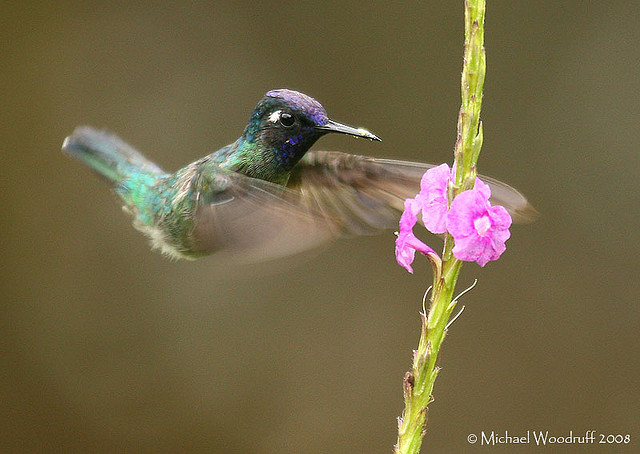
Violet-headed Hummingbird (Klais guimeti) by Michael Woodruff

Violet-headed Hummingbird (Klais guimeti) by Michael Woodruff

Busy Hummingbirds, Oblivious to Spectators

“Let your light so shine before men, that they may see your good works, and glorify your Father Who is in heaven.” (Matthew 5:16)

Luzon Bleeding-heart by Dan

Orni-Theology

As the cooling days of September fall from the calendar, like the abscission of colorful autumn leaves, the shelf-life of flower nectar nears its expiry date.  For just a few more days, the nectar pantries of bright-hued flowers are “open for business”, ready to feed the voracious appetites of neighborhood hummingbirds  —  those petite, iridescence-sparkled, blurry-winged wonders with super-sized metabolic fuel needs.  Floral nectar is a sweet resource!  Yet, as winter approaches, such fly-by “fast-food” opportunities cannot be taken for granted, especially if one is an energy-craving hummingbird.

Steely-vented Hummingbird by Wildstock Photos

Steely-vented Hummingbird by Wildstock Photos

Hummingbirds are famous for their (males’) jewel-like throats, their hovering and multi-directional flying, and their ability to change directions   —  stop, go, up, down, left, right, backward, forward, — using high-speed wings that whip figure-eight patterns faster than human eyes can follow, producing a humming sound (that explains their name) that almost sounds like a contented cat purring.   Hummingbirds, due to their speedy, darting movements, and their iridescent green colors, attract the eye.  So you see them  –  zip!  –  then you don’t.  Zip!  –  then you see them again.   The summer range of hummingbirds (such as the Ruby-throated Hummingbird, Archilochus colubris) is broad enough that most of us have seen hummingbirds, though it is unlikely that we ever see one relaxing!  No time to relax  —  their needle-like bills must sip up nectar where and when it is available!

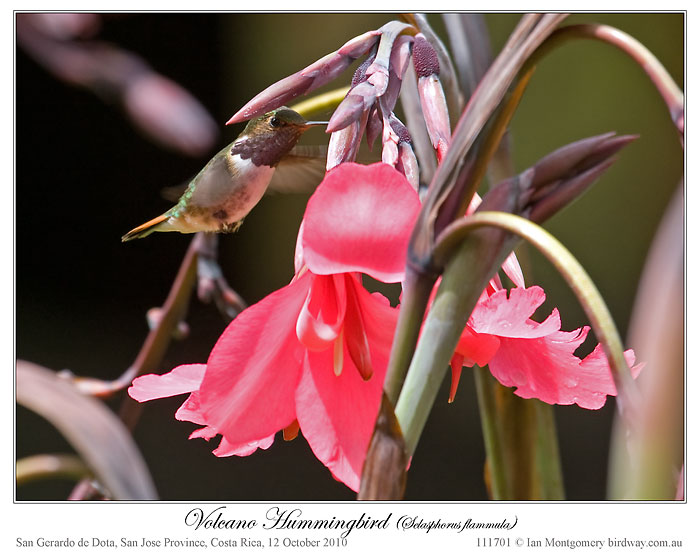
Volcano Hummingbird (Selasphorus flammula) by Ian

Volcano Hummingbird (Selasphorus flammula) by Ian

The business of a hummingbird’s life is so intense, so metabolically demanding, that slurping up available nectar is a lifestyle priority, requiring dietary focus and persistence:  “Get nectar, get more nectar, get even more nectar!  Hurry, hurry, hurry!”  Sugar substitutes are unacceptable for hummingbirds – they must have real sugar to thrive.  See Elizabeth Mitchell, Our Creator’s Sweet Design for Hummingbird Taste, with a link (in its Footnote #1) to video footage of hummingbird sugar consumption.  (Obviously hummingbirds are a living exhibit that refutes “natural selection” mythology  —  see Frank Sherwin, Hummingbirds at ICR”, Acts & Facts, 35(9), September 2006 issue.

What an enormous appetite for such a miniature bird!  The calories consumed and burned by hummingbirds, on a boy weight ratio, are comparable to a human eating more than a 1000 hamburgers every day, as body fuel needed for a day’s normal activities!  (See Denis Dreves, The Hummingbird:  God’s Tiny Miracle, subtitled “If you operated at this bird’s energy level, you would burst into flames!”.

It is no surprise, therefore, that a hungry hummingbird hovered by brilliant vermillion flowers, in a garden spot I casually visited, as he (or she) slurped up nectar from one flower, then another flower, then another, — without any (apparent) concern for my physical presence or proximity, only a few steps from him (or her).  Why was the buzzing hummer oblivious of me, the birdwatcher so close by?

The hungry hummer was too preoccupied with the pressing business of life, to notice me, a quiet spectator.  What a privilege it was, to watch – for a long time, actually – this sparkling-in-the-sunlight hummingbird, darting among the bright flowers.

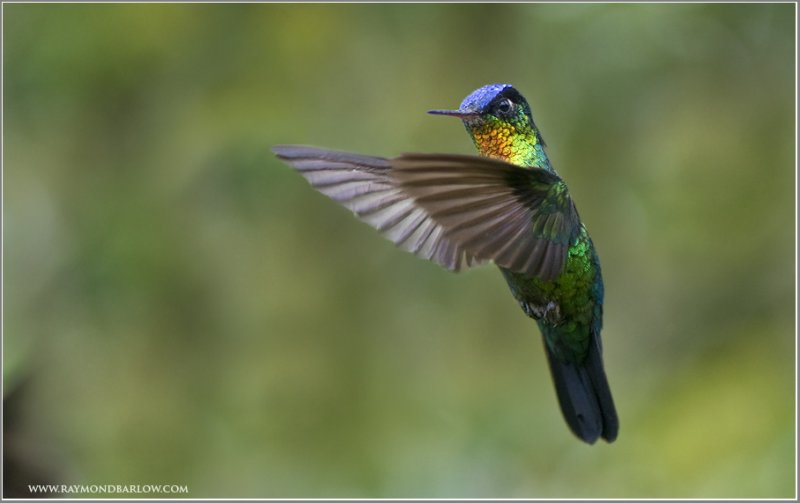
Fiery-throated Hummingbird (Panterpe insignis) by Raymond Barlow

Fiery-throated Hummingbird (Panterpe insignis) by Raymond Barlow

Yet are not our own lives, at least somewhat, like that busy hummingbird?  Are we not – day by day, hour by hour, minute by minute, moment by moment – preoccupied with the ever-pressing business of life, darting here-and-there, from this task to the next one, such that we often ignore the spectators, those watching eyes who observe and appreciate our lives – those who (hopefully) see God’s beauty and wisdom imaged in our own attitudes and actions?

Yes, we have audiences we should not be oblivious of.  As we live the moments of our fast-paced lives we should not forget three audiences, who watch us much more than we consciously realize.

First, there are many curious humans who watch our busy lives, especially those who are younger than us.  What kind of role-models are we?  Hopefully our Christian lives are like the Thessalonian believers whom Paul commended as examples to all of the believers in Macedonia and Greece (1st Thessalonians 1:7).  Who is watching us? Who is listening?  Who is evaluating the message(s) of our lives, comparing our “walk” to our “talk”?  Do our lives “shine” as God’s testifying “lights” (Matthew 5:16), such that our good deeds prompt spectators to glorify God our Heavenly Father?

Black-chinnedHummingbird (Archilochus alexandri) by S Slayton

Black-chinnedHummingbird (Archilochus alexandri) by S Slayton

Second, there are non-human spectators watching our lives:  angels!   Angels learn from watching the “spectacle” of human lives (1st Corinthians 4:9 & 11:10).  Indeed, the effect of God’s gospel of grace, in the earthly lives of redeemed humans, is something that angels can only learn about as spectators (1st Peter 1:12, since redemption is never experienced by angels.

Yet the most important audience we have, always, is the Lord Himself  (Jehovah-jireh, the God Who is and sees).  Our primary audience, always, is our omniscient and omnipresent Creator-God.  It is our wonderful Maker Who watches every sparrow’s avian lifespan, and we are of much greater value to God than the lives of many sparrows (Matthew 10:29-31; Luke 12:7).  As the Lord Jesus Christ’s vicarious death and resurrection has peremptorily proved, for all time and eternity, we are God’s favorite creatures.  God is caringly concerned with every detail of our busy lives (from creation to ultimate redemption), so let us not be oblivious to our most important Audience.  Do we live our earthly lives as ingrates, ignoring Him and His Word?  Or do we live life appreciative of Him and His Word, grateful that He created us and provided us with redemption in Christ?

Accordingly, with these three audiences in mind, as spectators of our busy lives, let us consider the prophet Ezekiel’s serious question (Ezekiel 33:10):  “how should we then live?”

By James J. S. Johnson

*

More Orni-Theology

Changed From the Inside Out

*


Yellow-headed and Red-winged Blackbirds: Living on the Inside or the Outside?

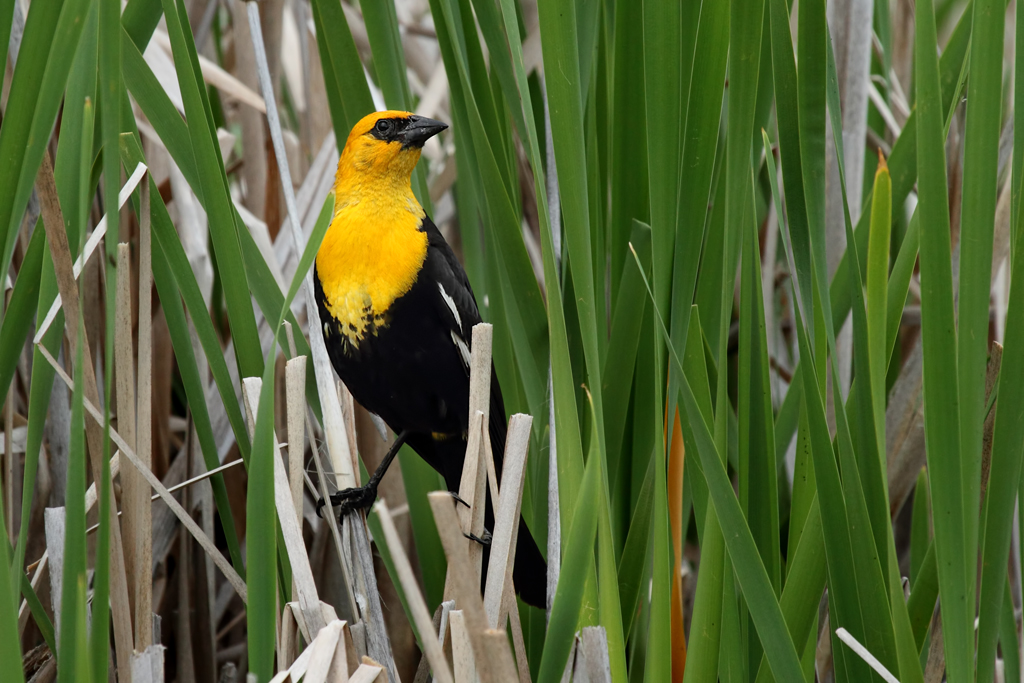
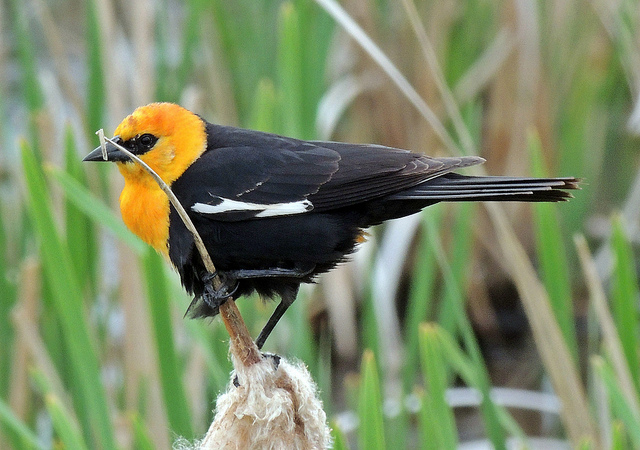
Yellow-headed Blackbird (Xanthocephalus xanthocephalus) ©WikiC Alan Vernon

Yellow-headed Blackbird (Xanthocephalus xanthocephalus) ©WikiC Alan Vernon

Draw nigh to God and He will draw nigh to you. (James 4:8)

Luzon Bleeding-heart by Dan

Orni-Theology

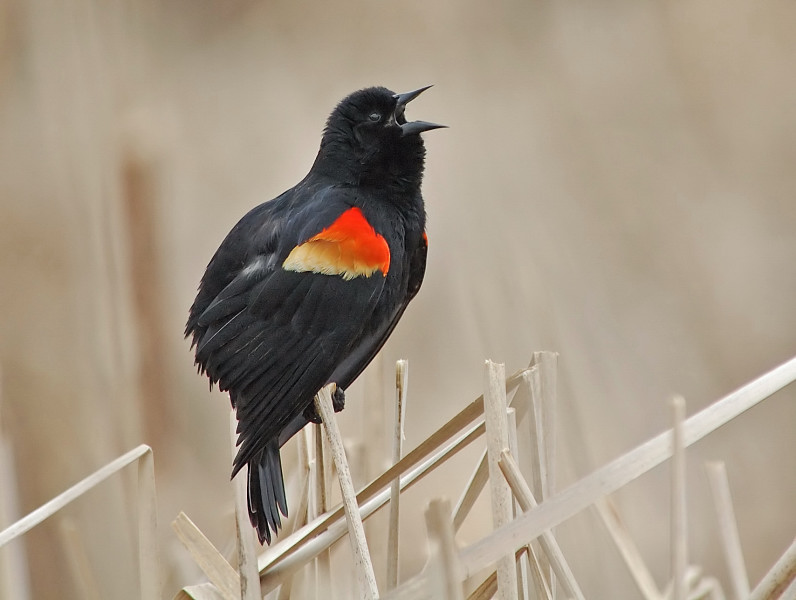
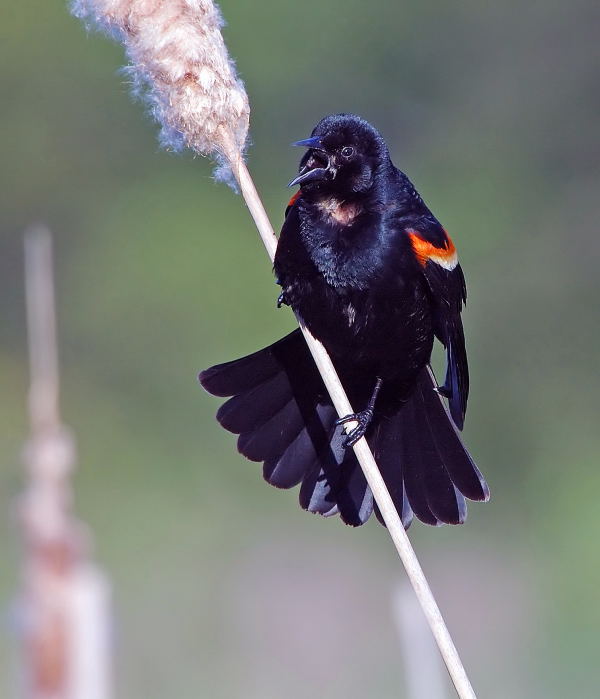
The Visitor Center at Jackson Hole, Wyoming (“Jackson Hole & Greater Yellowstone Visitor Center”), is a good place to go to for information on Grand Teton National Park, which borders the more-famous Yellowstone National Park.  Yet for bird-lovers, the visitor’s center itself is an attraction, in summer, because the marshy ponded area next to the building hosts a congregation of blackbirds, both Red-winged Blackbirds (Agelaius phoeniceus) and Yellow-headed Blackbirds (Xanthocephalus xanthocephalus).

If you are helping city kids to see these passerine icterids, tell them to “look for the tall corny-dogs growing in the wild” (cattails – Typha species, tall-stemmed wetland plants topped by a sausage-shaped flowering “spike”), around the pond.

As in many other lacustrine marshlands, red-winged blackbirds are often found perched among the cattails that grow as emergents among the wavy shoreline of pond.  For a redwing this is “prime real estate”, until the yellow-heads move in. How so?  In cattail dominated marsh-ponds, if both yellow-heads and red-wings are both present, the innermost places of the cattail “ring” are routinely occupied by the yellow-headed blackbirds, leaving the “outer” cattail positions (i.e., slightly farther away from the pond-water) for the redwings.

Why?  I have no idea why, but others have notice this. [E.g., see W. Braun’s observations in Blackbirds In Cattail Marshes , saying “The YHBs [yellow-headed blackbirds] clearly are the rulers of the cattails. They often, but not always, nest in the same marsh as the Red-winged Blackbird and the Common Grackles. The larger Yellow-headed Blackbird is dominant to the Red-winged Blackbird and displaces the smaller blackbird from the prime nesting spots.”]

Red-winged and Yellow-headed Blackbirds on Cattails ©Orcawatcher.com

Red-winged and Yellow-headed Blackbirds on Cattails ©Orcawatcher.com

Photo credit Orcawatcher.Com

But it reminds me of the dramatic difference between the apostle Peter and the Pharisee Nicodemus.  Peter was (almost) always close to Christ, and often so, but Nicodemus mostly kept his distance from Christ, at least publicly.

Far from being infallible, Peter is infamous for his cowardice that was indicted by a rooster crowing thrice (Luke 22:54-61).  Peter is also remembered for getting distracted, and becoming fearful, and sinking into the Sea of Galilee, after having miraculously walked on water for only a few steps (Matthew 14:24-33).  But Peter was wise enough to immediately cry out “Lord, save me!”  (And Jesus did.)  At least Peter did some walking on water (at Christ’s command, of course), which is a lot better than the other disciples who just stayed in the boat, as mere spectators, wonderfully how Jesus was enabling Peter to walk on water.

Red-winged Blackbird (Agelaius phoeniceus) by Ray

Red-winged Blackbird (Agelaius phoeniceus) by Ray

Likewise, Peter had the courage to step up and speak up – to call Jesus “the Christ, the Son of the living God” – a deed that the Lord Jesus commended Peter  — and God the Father —  for doing (Matthew 16:15-17).  And Peter did what he could to defend Jesus, in the Garden of Gethsemane, as Jesus was being arrested – Peter used a sword to chop off one man’s ear (Luke 22:49-51; John 18:10-11)!  (But unlike the Orcadian Viking known to history as Thorfinn Skull-splitter, Peter missed most of his victim’s head.)  It’s the thought that counts, right?

Yellow-hooded Blackbird (Chrysomus icterocephalus) ©Flickr Bob

Yellow-hooded Blackbird (Chrysomus icterocephalus) ©Flickr Bob

So you really have to love Peter.  (Jesus certainly did!)  Peter was one of the “inner” circle of three  –  just James, John, and Peter  — who were invited to witness the Lord Jesus Christ being glorified upon the Mount of Transfiguration (Matthew 17:1-8).  What an unforgettable privilege that was (2nd Peter 1:16-18)!  Jesus later invited the same “inner circle” of three to pray for Him in the Garden of Gethsemane (Matthew 26:37-38).  With all his faults, Peter was a truly privileged member of Christ’s “inner circle”.

But Peter’s privileges are not so high that we should feel sorry for Nicodemus.  Not at all!

Red-winged Blackbird (Agelaius phoeniceus) by Ray

What a privilege it was for Nicodemus to be the first listener to hear, what we now read in, John’s third chapter (John 3:1-9), including the everlastingly famous promise of John 3:16, spoken by Jesus Himself!  Later Nicodemus took a modest stand for Jesus (John 7:50-52), and in time Nicodemus had an official role in Christ’s burial (John 19:39-40) three days before Jesus rose triumphantly from the grave!

Even so, if one had the choice, why visit Christ, in secret, keeping a distance from Him in public, when the opportunity to belong to His “inner circle” is available?

Am I more like Peter or Nicodemus?  Maybe that question will come to mind next time you see a group of “inner circle” yellow-headed blackbirds, perching on cattails, as the “outer circle” of cattails hosts the red-winged blackbirds. And, if you like the idea of being in the Lord’s “inner circle”, you might sing this as a prayer:  “Just a closer walk with Thee…”

James J. S. Johnson, with his family, has repeatedly visited Wyoming’s Jackson Hole Visitor Center, in summer, to admire the yellow-headed and red-winged blackbirds that congregate on and among the pond-ringed cattails there. (And a very special thank-you to Lee for teaching me how to edit the typos in this blog.)

*

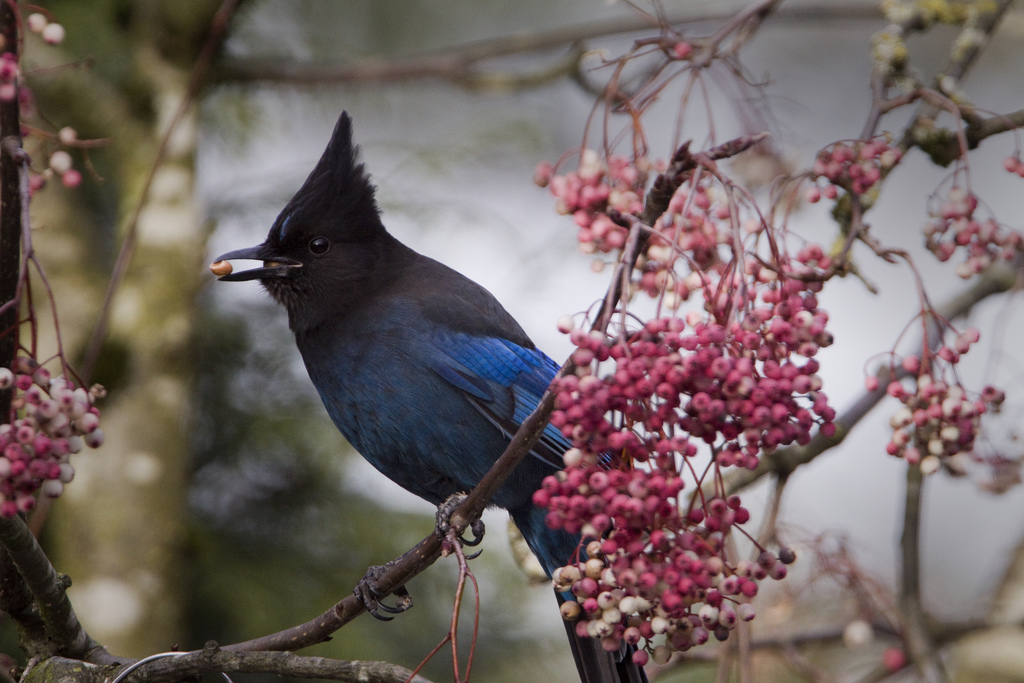
Steller’s Jay: A Lesson in Choosing What Is Valuable

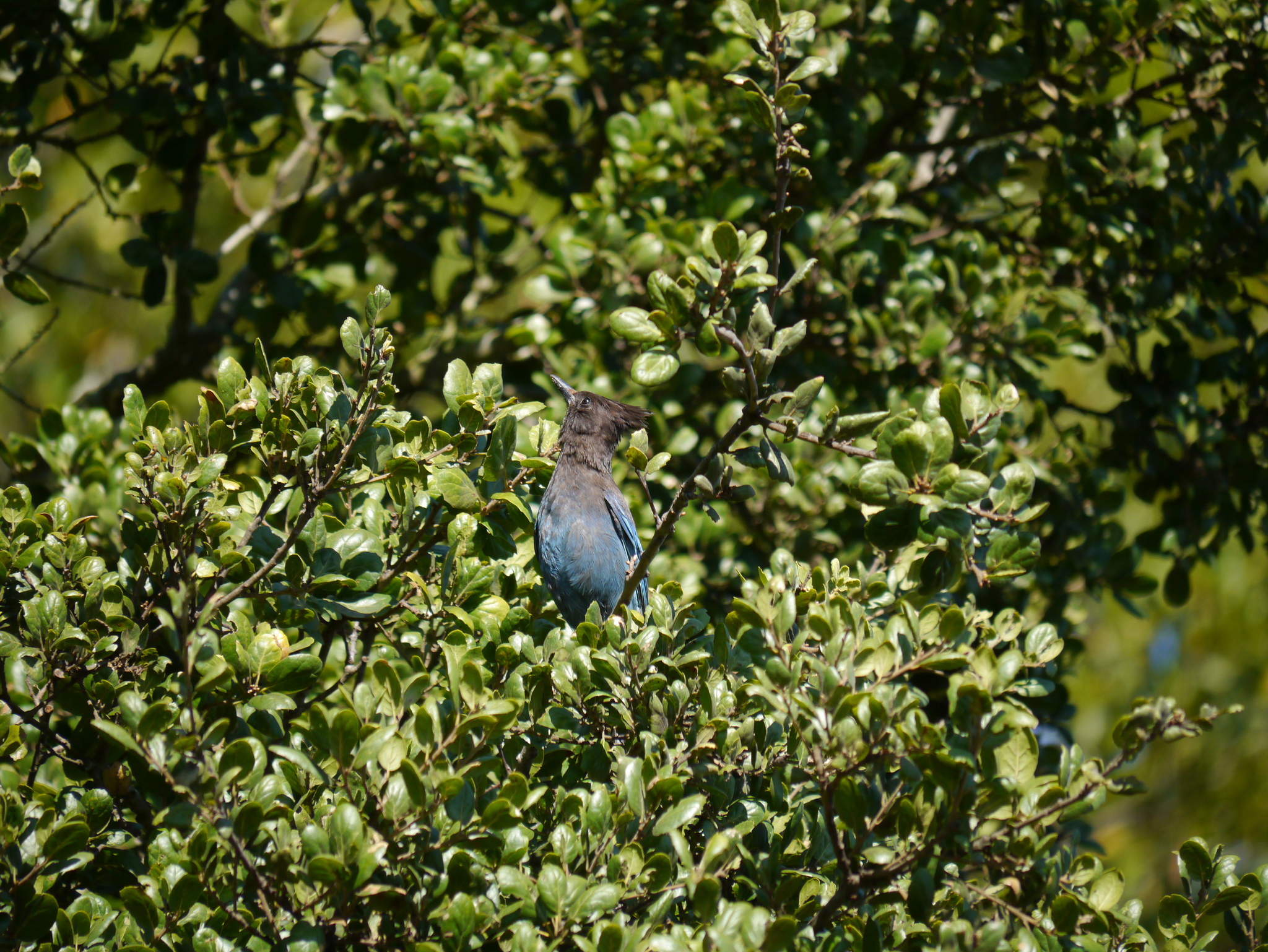
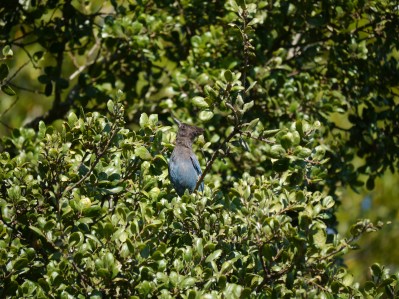
Steller’s Jay (Cyanocitta stelleri) ©Flickr LeeJaffe

by Dr. James J. S. Johnson

My son, despise not the chastening of the LORD; neither be weary of his correction: For whom the LORD loveth he correcteth; even as a father the son in whom he delighteth. Happy is the man that findeth wisdom, and the man that getteth understanding. For the merchandise of it is better than the merchandise of silver, and the gain thereof than fine gold. She is more precious than rubies: and all the things thou canst desire are not to be compared unto her.
(Proverbs 3:11-15 KJV)
Luzon Bleeding-heart by Dan

Orni-Theology

What can we learn from a Steller’s Jay, about how differently people measure what is valuable and what is worthless?  One clue to answering that question is found in a strange context, negotiating a contract! But before we examine one of the most famous contracts in human history, to illustrate how differently people value things in this life, let’s review a few facts about the star of today’s show:  the Steller’s Jay, a bird that looks more like Batman than any other bird.

Steller's Jay (Cyanocitta stelleri) by Lee at Desert Museum AZ

Steller’s Jay (Cyanocitta stelleri) by Lee at Desert Museum AZ

What’s in a name?  (So who was George Wilhelm Steller?) Before analyzing the Steller’s jay as a bird, let’s consider the bird’s name.  It’s not “stellar jay”, although the Steller’s jay is quite a superstar in his own right!  The bird is named for Germany’s Georg Wilhelm Steller (also spelled Stöller and Stohler), a world-traveling scientist, accomplished in botany, zoology (including ornithology!), medicine (including surgery), and ecology.  It was Steller who identified and studied the bird (Cyanocitta stelleri) in AD1741.

How did a German scientist discover the Batman-looking bird that habituates many forested areas of North America’s western half?  On behalf of the Russian czar, Denmark’s Vitus Jonassen Bering left Saint Petersburg in AD1733, with two outfitted ships (St. Paul and St. Peter) to explore parts of eastern Siberia and its coastal waters.  In AD1738 Georg and his wife (Brigitta) left to join them, but Brigitta abandoned the venture in Moscow, while Georg continued eastward, joining Bering’s expedition in AD1740.  Adventures on Siberia’s Kamchatka Peninsula included travelling by dogsled, a mode of transport still common in Alaska today.  Bering decided to sail between Russia and North America (what is today “Alaska”) and the outcome including adventures, tragedy, and discoveries. When the St. Peter made landfall on one of Alaska’s Aleutian Islands (apparently Kayak Island), amidst dangers and death, Vitus Bering intended only to replenish the ship’s freshwater supplies.  But Georg Steller begged for time to do some scientific research, hoping to prove that the land was connected to North America (not Asia).  Bering conceded ten hours only – so whatever scientific research Steller could do, in that short timeframe, must suffice! During those ten hours Steller empirically scrutinized (and journalistically documented) a variety of North American plants and animals,  –  one of them being a crested black-and-blue jaybird, later called “Steller’s Jay” (which was only found in North America, proving that the Aleutian Islands were ecologically connected to North America)!
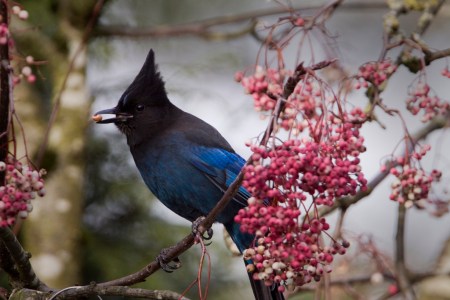
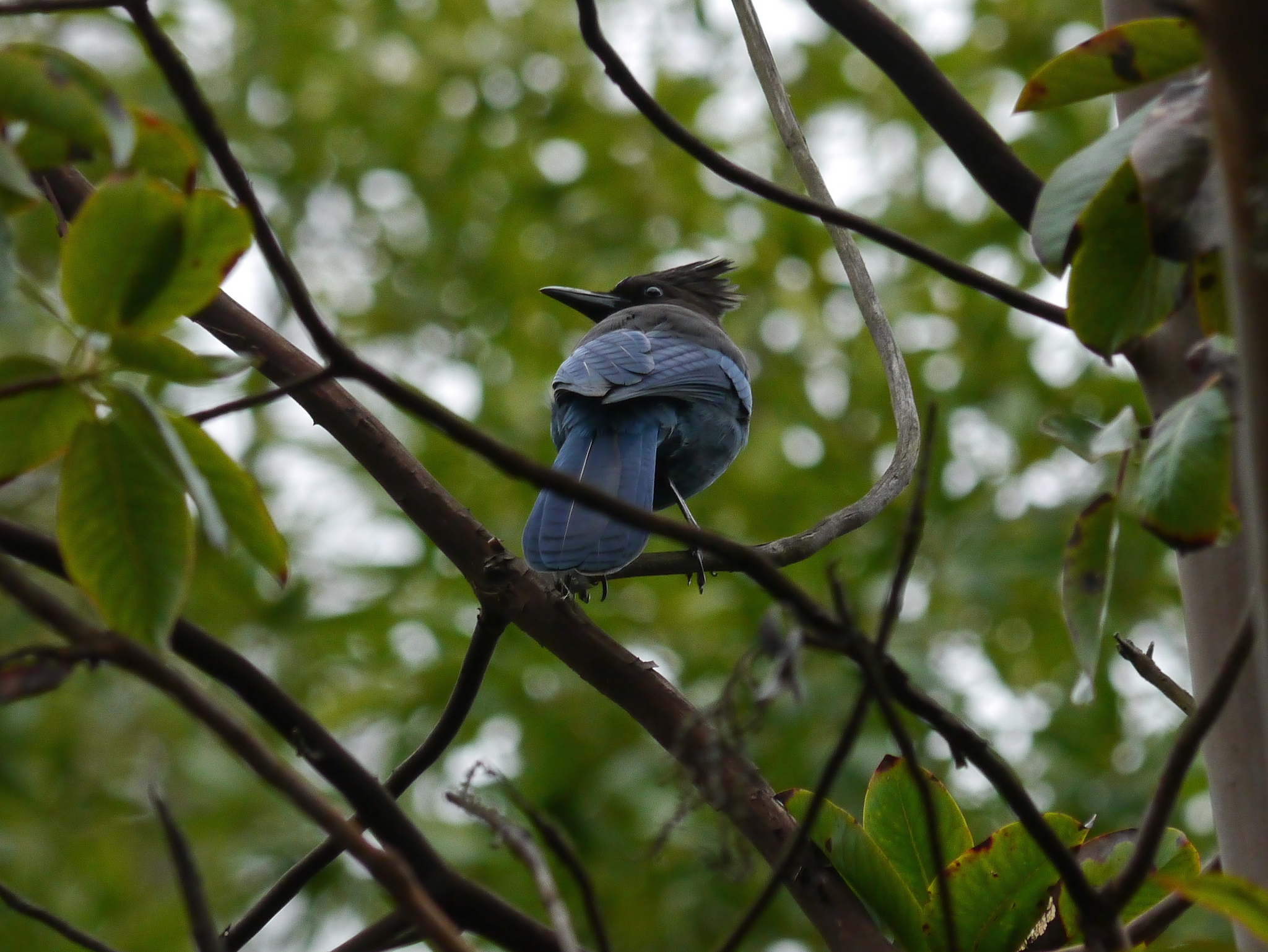
PAS-Corv Steller's Jay (Cyanocitta stelleri) ©Flickr RichLeche

Steller’s Jay (Cyanocitta stelleri) ©Flickr RichLeche

Other creatures bearing Steller’s name include two birds, a smallish sea duck called the Steller’s Eider (Polysticta stelleri) and the Steller’s Sea Eagle (Haliaeetus pelagicus), plus two marine mammals, a pinnipeds, the Steller’s sea lion (Eumetopias jubatus, and a sirenian, the now-extinct (manatee-like) Steller’s sea cow (Hydrodamalis gigas).

Steller's Jay (Cyanocitta stelleri) Decription ©sheriAnsel www.exploringnature.org

Steller’s Jay (Cyanocitta stelleri) Decription © Sheri Amsel http://www.exploringnature.org

What kind of bird is a Steller’s Jay? The Steller’s jay is a large-sized, tough-built corvid (meaning a crow-like bird), having a large wingspan, strong legs, a very tough bill, and a prominent crest.  Though this would be hard (or, at least, expensive) to prove, all corvids may descend from seven pairs of corvids who safely rode out the global Flood with Noah’s family (compare Genesis 7:3 & 8:7 with Leviticus 11:15 and Deuteronomy 14:14).  It is indisputable that Steller’s jays are true cousins of Blue Jays (Cyanocitta cristata), because they are known to hybridize, especially in Colorado. (In fact, the only North American corvids with a crest are the Steller’s Jay and the Blue Jay.)

Taxonomists categorize it as a passerine (i.e., perching) bird of the Order Passeriformes, Family Corvidae, with the Genus-species name Cyanocitta stelleri.  The corvid family includes a variety of jays and crow-like songbirds, such as the common raven, rook, European jackdaw, American crow, Jamaican crow, magpie, Eurasian jay, Siberian jay, grey jay, scrub jay, pinyon jay, blue jay, Yucatan jay, Clark’s nutcracker, and more.  The corvid family includes the largest-sized passerine birds.  Not only is there an impressive variety within the corvid family, the corvids can vocalize a variety of sounds, including imitated sounds – in a montane pine forest you may hear a jaybird imitating other birds, or “squirrels, cats, dogs, chickens, and some mechanical objects”. [Quoting from the Cornell Lab of Ornithology, “All About Birds:  Steller’s Jay (Life History)”, posted at http://www.allaboutbirds.org/guide/stellers_jay/lifehistory .]
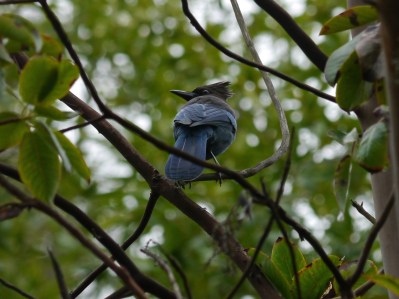
Steller's Jay (Cyanocitta stelleri) ©Flickr LeeJaffe

Steller’s Jay (Cyanocitta stelleri) ©Flickr LeeJaffe

Most jays (like most corvids) don’t migrate, but some do, especially if food becomes seasonally scarce where they reside.  In North America only the Steller’s Jay and its close cousin, the Blue Jay, are known to use mud for building their nests.  Steller’s jays are most likely to nest, and to be seen in conifer forests, though mixed woodlands with some open spaces characterize some of their ranges. Steller’s Jays are famous for “moving up in the world” – they prefer to reside on “higher ground”, at elevations somewhere between 3000 to 10,000 feet.

Steller's Jay (Cyanocitta stelleri) US Range Map ©WikiC

Steller’s Jay (Cyanocitta stelleri) US Range Map ©WikiC

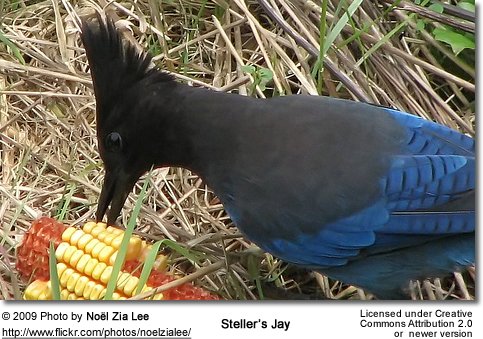
Typical ranges for the Steller’s Jay are found in southern Alaska, western Canada, Washington, Oregon, Idaho, Montana, Colorado, Utah, Nevada, California, Arizona, New Mexico, and Mexico.  [For a different yet similar range map, see Donald & Lillian Stokes, Stokes Field Guide to Birds, Western Region (Little, Brown & Co., 1996), page 324.] Jays, like their crow cousins, are opportunistic food-finders.  Steller’s Jays are hunter-gatherers famous for scavenging and “cleaning up” picnic sites – eating feed intended for cattle, dog food, frogs, acorns, sometimes even small birds, plus a cornucopia of human foodstuffs, intended for human consumption as well as some of what is rejected as garbage by humans.   Like Blue Jays, the Steller’s Jay is fiercely territorial, killing (and sometimes eating) smaller birds that “trespass” what it deems to be its “property”, so most Dark-Eyed Juncos (and other smaller birds) know to flee when a Steller’s Jay threateningly appears.
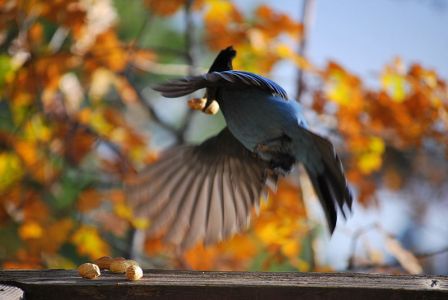
Steller's Jay (Cyanocitta stelleri) ©WikiC

Steller’s Jay (Cyanocitta stelleri) ©WikiC

Steller's Jay (Cyanocitta stelleri) ©Flickr NoelZipLee
Like other corvids, Steller’s Jays are known to collect dozens of pinyon pine seeds in their throat-pouch, to hide (i.e., bury) them in protected locations for retrieval during winter months (when their food supplies are less plentiful).  Of course, as with other corvids that do the same (see, e.g., the Pinyon Jay), many such buried seeds, if not retrieved in time, germinate and sprout into the next generation of pinyon pine trees!  [See James J. Scofield Johnson, “Providential Planting:  The Pinyon Jay”, Creation Ex Nihilo 19(3):24-25 (June 1997), posted at https://answersingenesis.org/evidence-for-creation/providential-planting/ and http://creation.com/providential-planting .] It is the jaybird’s garbage-foraging habit that reminds me of today’s Bible text, Proverbs 3:11-15, quoted above.   Why?  Because many times (for many pleasant hours, actually, especially in the evening hours before sunset), at a huge metal dumpster, near huge conifer trees (close to a dining hall’s kitchen, where table scraps are disposed of after every meal), I have quietly watched and photographed Steller’s jays sifting through human garbage, at Horn Creek Family Camp in Colorado (a complex of Christian family camp facilities in the Sangre de Cristo Mountains).

1mans-trash=anothers-treasure.pptslide

What a joy it was to see those happy jaybirds, darting into the dumpster for food, flitting about, perching, eating, standing watch-guard (as others dove for “buried treasure” –  bread morsels, eggs, anything with nuts, seeds, or berries, etc.  What humans discarded as worthless, the jays grabbed as food!

“One man’s trash is another man’s treasure.” What makes the marketplace move with deal-making?  Disagreements about value.  Consider the scenario of a tourist eating a lunch at a café.  The seller is willing to sell a lunch for $10, and a buyer is willing to buy that lunch for $10.  What does their transaction display?  Differing opinions about value.  The seller values the $10 more than keeping the lunch.  The buyer values the lunch more than keeping the $10.  So the seller trades the lunch for the $10, and the buyer gladly surrenders $10 to get the lunch. In other words, all voluntary deals illustrate that the buyer preferred the purchase more than the money spent to gain what was purchased.  Obviously the seller thought the opposite, or else the seller would have refused to sell at the purchase price.  Every day we are making value judgments  —  deciding the values of things, and we make value judgments differently. This is illustrated in Genesis 25:29-34, when Esau exchanged his birthright for a bowl of red lentil soup.  Esau’s twin brother, Jacob, was so pleased with the deal that he added complimentary bread to go with the red soup!  Think of how those two men disagreed about the value of the birthright – the Bible says that this transaction showed how Esau “despised his birthright” (Genesis 25:34):   it was worth less than a bowl of soup to him!  Yet that specific birthright had a unique (and eternal) feature to it, it carried the Messianic lineage, the human ancestry of Christ.  Priceless!  Yet Esau traded it for a transitory value, a bowl of red soup. Surely we would not foolishly sacrifice something so valuable, something with eternal spiritual value, for something so ephemeral and worldly, as soup, right? Yet the Book of Proverbs challenges us, axiologically speaking, on that same value-choice:  how much do we really value God’s wisdom, godly understanding?  What if getting that kind of wisdom involves some experiences of discomfort, or pain, or afflictions, or a series of parental “spankings” from our caring Heavenly Father?

My son, despise not the chastening of the LORD; neither be weary of his correction: For whom the LORD loveth he correcteth; even as a father the son in whom he delighteth. Happy is the man that findeth wisdom, and the man that getteth understanding. For the merchandise of it is better than the merchandise of silver, and the gain thereof than fine gold. She is more precious than rubies: and all the things thou canst desire are not to be compared unto her.
(Proverbs 3:11-15 KJV)

Many earthbound humans strive to gain the treasures of this temporal life:  the merchandise of silver, gold, rubies, — or maybe high-tech equivalents of those treasures.  But true wisdom and godly understanding are better than those, “and all the things thou canst desire are not to be compared” unto God’s wisdom (Proverbs 3:15) and what it gains, in time and especially in eternity.  Some have traded spiritual opportunities for the values of this wayward world. Others have done the opposite, trading the worldly opportunities of this wayward world for Christ-honoring “investments”, laid up in Heaven. That’s why, whenever I remember those Steller’s jays foraging at the family camp dumpster, by those Colorado conifers, I’m reminded:  “one man’s trash is another man’s treasure.”  As the serious-about-living-life missionary Charles T. Studd once put it: Only one life, ’twill soon be past; only what’s done for Christ will last.
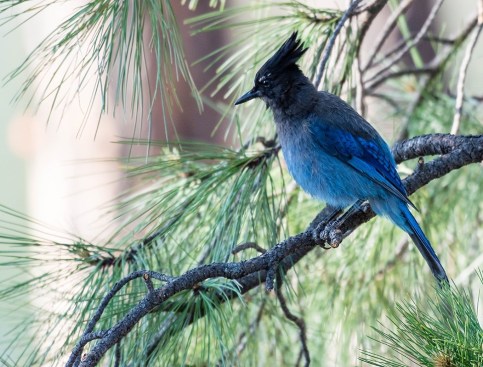
stellersjay-in-pine.pamelaparker-arizonahighways

STELLER’S JAY in pine tree   (Arizona Highways  /  Pamela Parker photo)

 ============================================

Jim Johnson (who formerly taught ornithology and avian conservation at Dallas Christian College)  has been fascinated with Steller’s jays from the first time he saw one in Colorado, even though it gained him a reputation for “always hanging out by the [camp] dumpster” to watch them.  By God’s grace, Jim tries to live his fast-paced life according to the values of Proverbs 3:13-15.

See:

*

Rock Partridges: Lessons About Hunting And Hatching

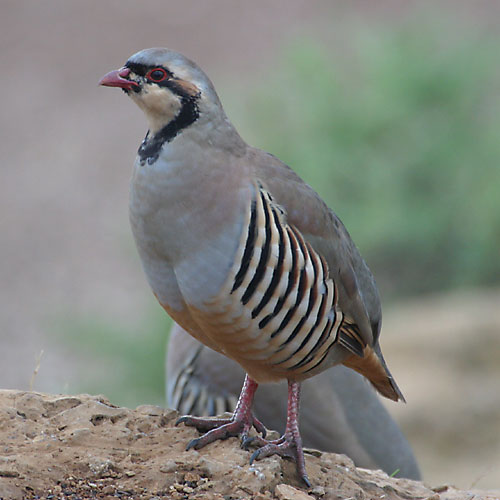
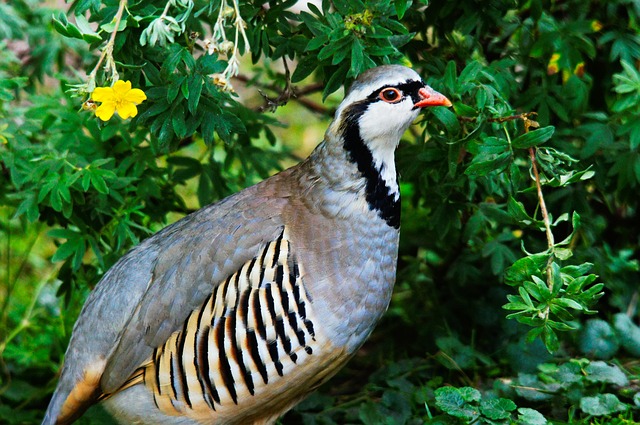
Rock Partridge (Alectoris graeca) WikiC

Rock Partridge (Alectoris graeca) WikiC

Rock Partridges: Lessons about Hunting and Hatching ~ James J. S. Johnson

Now therefore, let not my blood fall to the earth before the face of the LORD: for the king of Israel is come out to seek a flea, as when one doth hunt a partridge in the mountains. (1 Samuel 26:20 KJV)

Luzon Bleeding-heart by Dan

Orni-Theology

Rock Partridges – like other partridges – prefer to hide from people, yet their voices are quite detectable. “Rock partridges are masters of concealment and are best spotted when perched on a boulder sending out a challenge; however, when we were [in Israel] we probably heard ten for every one of which we had a glimpse” [quoting George Cansdale, All the Animals of the Bible Lands (Zondervan, 1970), pages 165-166].   Yet if we look for partridges carefully, in Scripture, we will find them mentioned twice, providing us with two lessons for our own lives (and “callings”, pardon the pun).  But, before looking at those two Bible passages, first let us consider what a “partridge” is.

 So what is a partridge?

Partridges are chicken-sized ground-dwelling birds, classified together with other “pheasant family” birds like pheasant, grouse, bobwhite, quail, junglefowl, chicken, peafowl, and ptarmigan. Specifically, partridges are categorized as fowl belonging to the order Galliformes, family Phasianidae, subfamily Perdicinae).

Partridges don’t migrate.  Partridges  — such as the Rock Partridges of the Holy Land — often nest in hilly or montane areas, in fairly dry climate zones, laying more than a dozen eggs in a minimally lined ground scrape – quite a humble nest!   This habit leaves partridge eggs quite vulnerable, for many ovivorous predators (including hungry humans – see Deuteronomy 22:6-7) hunt around the nesting grounds of partridges.  Resourceful foragers themselves, partridges routinely eat accessible ants, seeds, berries, lichen, and other low-to-the-ground vegetation.  Like other land-fowl partridges spend most of their time on the ground, hidden in ground cover, so don’t expect to see them flying around much, or perching in tree branches.

Partridges are mentioned only twice in the Old Testament (noted below), as translations of the Hebrew word qoré’ – a noun derived from the verb qara’ (meaning “to call”, “to cry”).   The Hebrew root  verb qara’ is used to describe calling out someone’s name, when you wish to speak to that person, and it is used to describe God’s actions when He “called” the light Day, the dark Night, the dry land Earth, etc. (in Genesis chapter 1).  Partridges, therefore, are “criers”, famous for their calls.  The Rock Partridge (Alectoris graeca), which seems to have been common during Bible times, is known for its “cok-cok-cokrr” call, in the arid piedmonts of Israel.

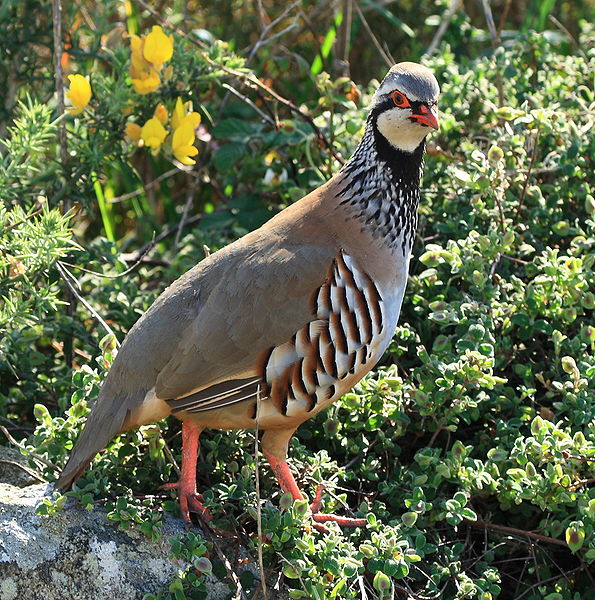
The Rock Partridge ranges “from the mountains of Lebanon in the north across the coastal plains to the dry hills of Judaea, but its range also extends westwards through Greece and all over Italy” [quoting George Cansdale, All the Animals of the Bible Lands (Zondervan, 1970), page 165].  Its Holy Land cousin, the Red-legged Partridge (Alectoris rufa), resembles the Rock Partridge from a distance, so the Bible could refer to either or both, as well as any hybrids.  Another partridge found in Israel’s desert lands is Hey’s Partridge (Ammoperdrix heyi), by the Dead Sea.

“Partridges” ae mentioned once in 1st Samuel 26:20 and once in Jeremiah 17:11.  Both verses illustrate important life lessons.

Red-legged Partridge (Alectoris rufa) ©WikiC

Red-legged Partridge (Alectoris rufa) ©WikiC

Living life on the run

As a fugitive trying to escape King Saul, David compares himself (in 1st Samuel 26:20, quoted above) to a partridge being hunted in the mountains.  Because partridges don’t fly far away, as chased ducks or geese may, hunters chase partridges in the hilly scrublands, causing the partridges to run this way and that, often wearying the partridges to the point that they became targets for whatever weapons (even sticks used for clubbing) the hunters have available.  Surely David saw such partridges in the arid wilderness scrublands he hid in, and likely David himself hunted, caught, and ate such partridges.  Because David was daily fleeing Saul’s soldiers, in the hilly wilderness  of Israel, David knew what partridges felt like, being pursued by hunters.  Yet God protected David from Saul’s evil efforts, and in God’s providence it was David, when the dust settled, who survived and reigned over Israel, not Saul.

What can we learn from David’s fugitive plight?

First, there is no good reason to surrender to one’s enemies!  When persecutors aim at innocent victims, as has been the plight of believers ever since Cain murdered Abel (Genesis 4:8-9; Matthew 23:35; Luke 11:51), we are counseled to evade persecutions when possible (Matthew 7:6 & 10:14 & 10:23; Luke 9:5 & 10:11 & 21:21; Acts 9:25 & 13:51).

Second, David’s example reminds us that God is sovereign – He will not let us die until it is the proper time for dying.  So long as God has earthly work for us to do, He will sustain us (James 4:13-15).

Rock Partridge (Alectoris graeca) ©Arthur Grosset

Rock Partridge (Alectoris graeca) ©Arthur Grosset

Don’t count your chickens (or partridges) before they hatch

Another lesson from the partridge comes from Jeremiah 17:11.  It seems that partridges have a bad reputation for being less than fully successful in hatching their eggs!  This parental deficiency is compared to the tentative gains of those who acquire wealth by unrighteous means – they will, in the end, be seen as the fools they are!  Why?  Because the wealth of this world, even if kept until death, is only transitory wealth.  It is like eggs laid in a slipshod nest, never to be successfully hatched.

Don’t invest the best of your life in the transitory things of this world  —  because the investment will be a disappointment, when life is over.  Rather, invest your time and treasure in what God values.  It is truly foolish to lay up temporal treasures, “where moth and rust doth corrupt, and where thieves break through and steal” (Matthew 6:19).  Materialistic treasures are a long-term waste of investment, to be displayed as folly in eternity (and often earlier, on earth), as “gains” wrongly gotten – because we are only stewards of the assets God entrusts to us.

Therefore, let us rather, on a daily basis, accrue (by God’s grace) “treasures in Heaven, where neither moth nor rust doth corrupt, and where thieves do not break through nor steal” (Matthew 6:20).  It’s really a matter of the heart:  “For where your treasure is, there will your heart be also” (Matthew 6:21).

(Dr. James J. S. Johnson, an apologetics professor for ICR, previously taught ornithology at Dallas Christian College.)


Rock Partridge (Alectoris graeca) ©Pixabay

Rock Partridge (Alectoris graeca) ©Pixabay

Lee’s Addition:

Rock Partridges belong to:

*
P.S. – As of this post, James J. S. Johnson is now one of our regular contributors to the blog. An introduction will be given soon.

*

Sneaky Roadrunner

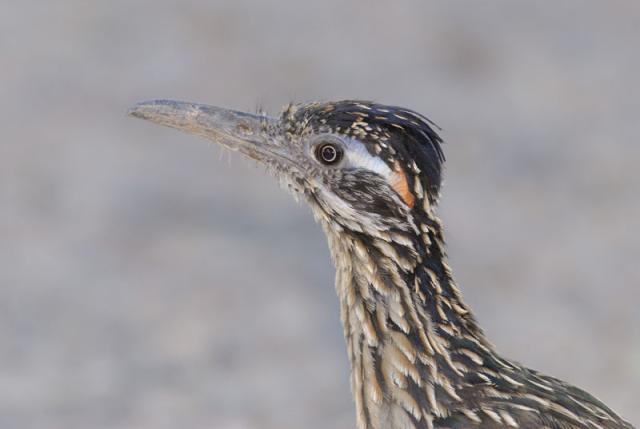
Greater Roadrunner (Geococcyx californianus) Reinier Munguia

Greater Roadrunner (Geococcyx californianus) Reinier Munguia

Sneaky Roadrunner ~ by Dr. James J. S. Johnson

There is no fear in love; but perfect love casteth out fear: because fear hath torment. He that feareth is not made perfect in love. (1 John 4:18 KJV)

Luzon Bleeding-heart by Dan

Orni-Theology

Roadrunners are unusual birds.   When you think of birds, usually you think of birds that fly.  But not roadrunners – mostly they run (up to 20 miles per hour!), or walk very quickly (“race-walking”).  But roadrunners sometimes fly short distances, if they want to escape someone.  Once I saw one fly from my home’s front yard to the roof of our house.  But a roadrunner’s usual exit strategy is to run.  But not always. Sometimes they try to be sneaky. Before recalling a memorable example of roadrunner sneakiness, however, a few fact about roadrunners should be reviewed.

Greater Roadrunner (Geococcyx californianus) by Daves BirdingPix

Greater Roadrunner (Geococcyx californianus) by Daves BirdingPix

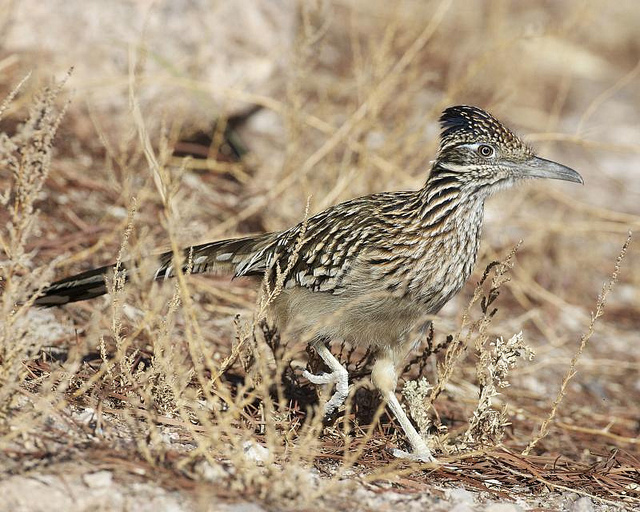
Roadrunners have longer legs, in proportion to their bodies, than do most birds.  Obviously God designed these roadrunners to get around on foot!  Taxonomists (i.e., those who categorize creatures into groups of common traits, by “lumping” on similarities and “splitting” on dissimilarities) classify the Greater Roadrunner (Geococcyx californianus – meaning “Californian earth-cuckoo”) as a member of the cuckoo family, birds that look like half-starved chickens with long tails.  Roadrunners thrive in desert habitats, yet these black-and-white fowl are also found living in shrub-dominated lands known for hot, dry climates, such as the western half of Texas (as well as most of Oklahoma, New Mexico, Arizona, and California).  See Roger Tory Peterson, WESTERN BIRDS (Houghton Mifflin, 3rd ed., 1990), range map 192.  Roadrunners can also be seen, though less frequently, in contiguous states, such as Kansas, Colorado, Utah, Nevada, Missouri, and Arkansas.

Greater Roadrunner (Geococcyx californianus) ©©Alan Murphy Flickr

Greater Roadrunner (Geococcyx californianus) ©©Alan Murphy Flickr

Roadrunners are not picky eaters.  Roadrunners are happy to eat bugs (insects and spiders), seeds, fruits, millipedes, centipedes, scorpions, and even small birds (and their eggs), small mammals (usually rodents like mice, rats, and voles), and small reptiles (such as lizards).  One of the more unusual insects, that roadrunners are known to eat, is the tarantula hawk wasp – an amazing spider-killing wasp that the U.S. Army named one of its “unmanned aircraft” reconnaissance units after.  [See my article at www.icr.org/article/slow-death-for-tarantula-lesson-arachnid/ — “Slow Death for a Tarantula”.]

Greater Roadrunner (Geococcyx californianus) ©©Flickr

Greater Roadrunner (Geococcyx californianus) ©©Flickr

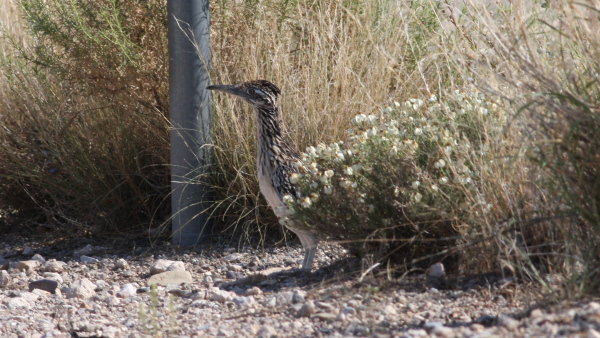
So how can a roadrunner be “sneaky”?  A few months ago I walked out of my house’s front door, and saw a roadrunner in my path.  Startled by my approach, the roadrunner skittishly scuttled around my van, which was parked in the driveway in front of my house.  So now I was standing on the north side of my van, and the roadrunner was standing on the south side of my van.

How do I know that, since I don’t have “x-ray eyes” that can see through a parked van?   As I slowly and silently crept, counter-clockwise around the west side of my van, I could see the roadrunner, standing on the south side of my blue van: he (or was it a she?) was bent over with his head turned to the southeast, with his slender bill and face aimed directly away from me.  By bending down his head, and aiming it away from where I was standing, the roadrunner must have thought that he was hiding from me, and that I could not see him – because he could not see me!  If I had impolitely startled him, then, surely it would have hurt his feelings, or his pride, because he obviously thought he really had me fooled.  So I stood silently, unmoving, for quite a while, to see if he would notice me – only about 3 feet form him – with nothing but air between us!  The roadrunner never moved, and he never turned his head to see me, so perhaps he thought I still could not see him.  Not having the heart to correct him, I slowly and silently backed up to the north side of the van, then retreated back through my front door, into my house.  To this day the roadrunner probably thinks that his bent-over, head-turned “hiding” had fooled me.

Greater Roadrunner (Geococcyx californianus) ©©thedrinkingbird Bing

Greater Roadrunner (Geococcyx californianus) ©©thedrinkingbird Bing

Then I got to thinking about how often we humans act as though we could hide ourselves from God.  When our first parents first sinned (Genesis 3:8-10) they tried to hide from God, among the trees in the Garden of Eden.  (If there had been a blue van there they might have tried to hide behind it.)  Of course, the very thought of hiding from God is silly because He is omnipresent and omniscient (Psalm 139).  But, because the Lord Jesus Christ provides us with a free redemption (John 3:16), there is no good reason to be afraid of God (Hebrews 10:19), because “perfect love casts out fear” (1st John 4:18).

Greater Roadrunner (Geococcyx californianus) ©©Nathan Davis Bing

Greater Roadrunner (Geococcyx californianus) ©©Nathan Davis Bing

Roadrunners are fun to watch – I love watching them scoot around on their fast, race-walking legs! If roadrunners only knew how kindly I regard them they would not fear me – they don’t need to sneak around to escape me.  And, because of Jesus, there is no good reason for us to try to hide from God.

(Dr. James J. S. Johnson, now apologetics professor at ICR,  previously taught ornithology at Dallas Christina College. Mrs. Thelma Bumgardner, his second-grade teacher, introduced him to creationist ornithology.)

*

*


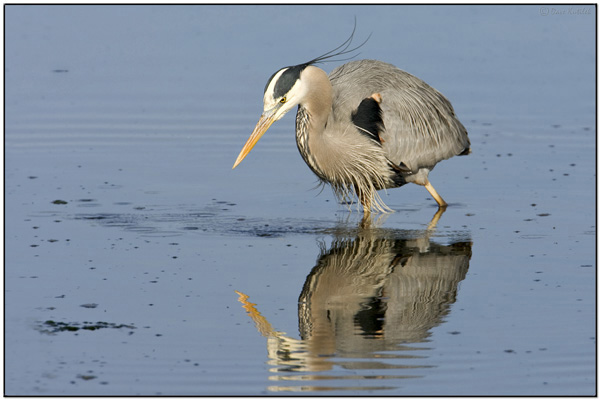
Great Blue Heron: Patient, Prompt, and (Rarely) Pugnacious

Great Blue Heron by Dan

Great Blue Heron

Great Blue Heron: Patient, Prompt, and (Rarely) Pugnacious

by Dr. James J. S. Johnson

Luzon Bleeding-heart by Dan

Orni-Theology

The heron family (family Ardeidae, which also includes bitterns and some egrets) and their cousins include some of my favorite long-legged wading birds:  great blue herons, green herons, grey herons, tri-colored herons, night herons, great white egrets, and cattle egrets.


Reddish-Snowys-Greats Egrets -Great Blue Heron all MacDill by Lee

Reddish-Snowys-Greats Egrets -Great Blue Heron by Lee

Their often smaller cousins (of the family Egretta) include the reddish egret, little blue heron, and the snowy egret.  Of these many regard the great blue heron (Ardea herodias) as a favorite:

“For most of us, sightings of great blue herons are confined to a glimpse of the bird as it flies slowly and steadily overhead, wings arching gracefully down with each beat, neck bent back, and feet trailing behind.  At other times we see it on its feeding grounds, standing motionless and staring intently into shallow water, or wading with measured steps as it searches for prey.” [Quoting from “Great Blue Heron”, by Donald & Lillian Stokes, in Bird Behavior, Volume III (Little, Brown & Co., 1989), page 25.]

Great Blue Heron by Dave's Pix

Great Blue Heron by Dave’s Pix

The Holy Bible mentions “herons” twice, in Leviticus 11:19 and in Deuteronomy 14:18 (both times translating the Hebrew noun ’anaphah), in Mosaic lists of ritually “unclean” birds.   The bird’s Hebrew name is based on a verb (’anaph) meaning “to snort” or “to be angry”.  Herons can be aggressive, and their almost-violent habit of “zapping” their prey could appear to resemble an aggressor angrily striking at unsuspecting victim. The more likely behavior that matches the Hebrew name, however, is the aggressive defense of a heron’s feeding grounds:

“Defense of feeding territories is commonly seen and involves aerial chases, Frahnk-calls, and aggressive [body language] displays, such as Upright, Bill-down-upright, Bent-neck.  Fighting rarely occurs, but when it does it can be violent, with one bird landing on the back of the other and either bird stabbing the other with its bill.” [Quoting from “Great Blue Heron”, by Donald & Lillian Stokes, above, page 30.]

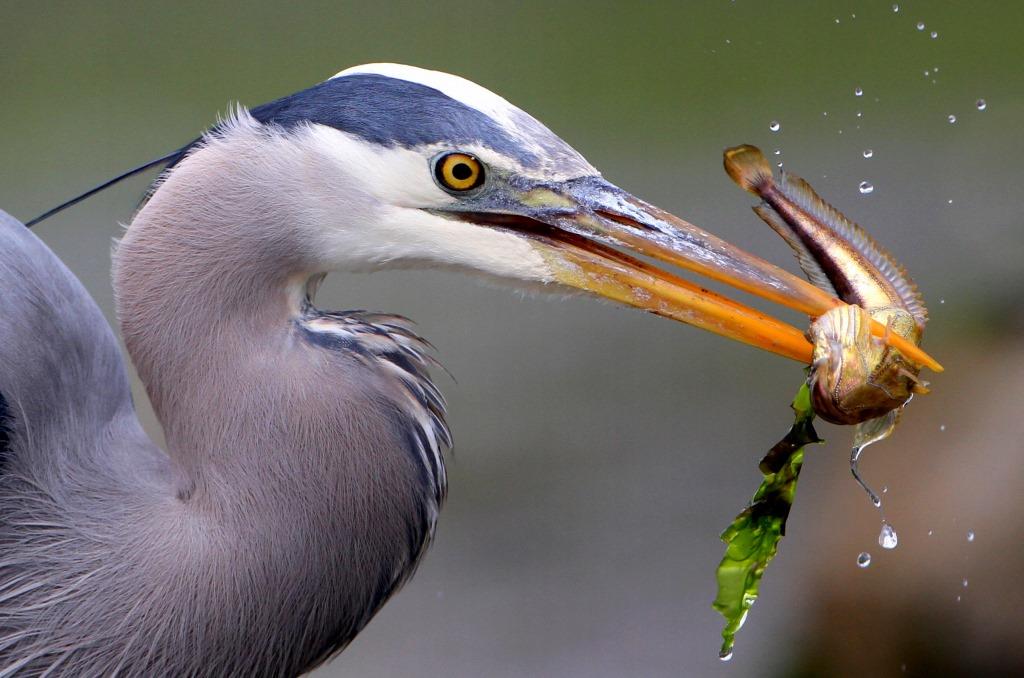
Yet do not imagine that the great blue heron is an erratic hothead that has no self-control, because its self-restraint, when seeking a meal at the shoreline of a pond, is so self-contained that the heron resembles a statue, for many minutes if necessary. Then, zap!  The statue suddenly fast-forwards his sharp beak toward a hapless fish or frog,   —  and instantly the heron is gulping down his dinner!

Great Blue Heron with fish ©© winnu on Flickr

This ability to strike like lightning, yet the choice to withhold doing so (unless the time for doing so is obvious), reminds us of the New Testament directive:  “be ye angry, and sin not” (Ephesians 4:26).

Also, in spiritual matters (Ephesians 6:12), we are exhorted to “contend earnestly” for the Biblical faith (Jude 1:3), in ways that do not involve flesh-and-blood fighting.  Such spiritual conflicts require both the patience and promptness of a sniper (or an opportunistic great blue heron)!   Yes, there may even come a time for the use of physical force, when the stakes are high enough –  remember how the Lord Jesus cleansed the Temple with a whip!  —  but most of the time our anger should be suppressed, with heron-like patience, in order to achieve the most worthy goals in life.

><> JJSJ

See:

Orni-Theology
Ardeidae- Herons, Bitterns
Birds of the Bible –  Herons
Dr. James J. S. Johnson – Guest Writer

*


Songs In The Night From The Mockingbird

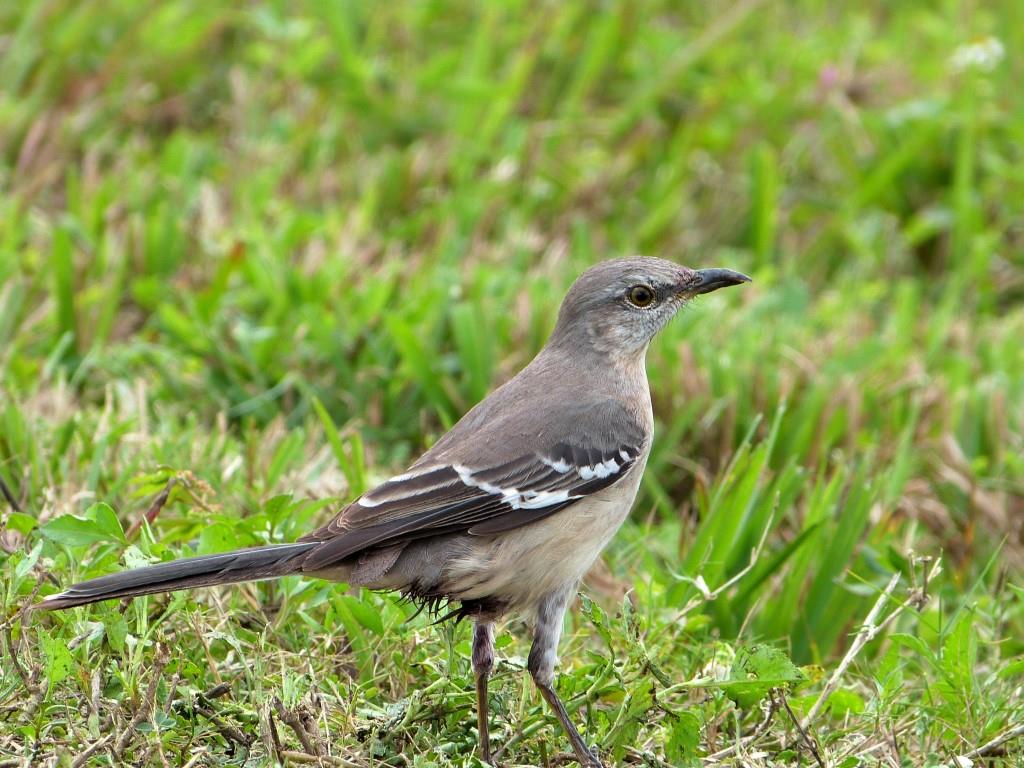
Northern Mockingbird (Mimus polyglottos) By Dan'sPix

Northern Mockingbird (Mimus polyglottos) By Dan

who teaches us more than the beasts of the earth and makes us wiser than the birds of the heavens?’ (Job 35:11 ESV)

Orni-Theology

Orni-Theology

Recently.a friend was telling me about a bird that has been singing every night. He said that it begins around 3 AM and continues for hours. He was frustrated by the bird’s behavior. After discussing it, we came to the conclusion that it is a Northern Mockingbird. They have one with a nest in their yard.

We used to have one that had a nest in the bush outside our bedroom window when we lived in south Florida. Whenever the babies were born, our Mockingbird started its “songs in the night.” The songs are pleasant, but in the middle of the night, the urge to throw a pillow out the window sounds tempting.

Northern Mockingbird (Mimus polyglottos) Juvenile ©WikiC

Northern Mockingbird (Mimus polyglottos) Juvenile ©WikiC

Northern Mockingbirds are members of the Mimidae – Mockingbirds, Thrashers Family. They are the only Mockingbird in North America and are the state bird in Arkansas, Florida, Mississippi, Tennessee and Texas, and formerly the state bird of South Carolina. They are omnivore, meaning it eats fruits and insects.

The Northern Mockingbird is a medium-sized mimid that has long legs and tail. Both males and females look alike. Its upper parts are colored gray, while its underparts have a white or whitish-gray color. It has parallel wing bars on the half of the wings connected near the white patch giving it a distinctive appearance in flight. The iris is usually a light green-yellow or a yellow, but there have been instances of an orange color. The bill is black with a brownish black appearance at the base. The juvenile appearance is marked by its streaks on its back, distinguished spots and streaks on its chest, and a gray or grayish-green iris. Northern Mockingbirds measure from 8.1 to 11.0 in (20.5 to 28 cm) including a tail almost as long as its body.

Although many species of bird imitate the vocalizations of other birds, the Northern Mockingbird is the best known in North America for doing so. It imitates not only birds, but also other animals and mechanical sounds such as car alarms. As convincing as these imitations may be to humans, they often fail to fool other birds. (Wikipedia with editing)

Northern Mockingbird Viera Wetlands

Northern Mockingbird Viera Wetlands by Lee

What is interesting about the Bible verse above is that the verse has been used many times before, but I have not used the previous verse. Here are the two verses together.

But no one says, ‘Where is God my Maker, Who gives songs in the night, Who teaches us more than the beasts of the earth, And makes us wiser than the birds of heaven?’ (Job 35:10-11 NKJV)

God our Maker and the Lord our Savior gives us songs in the night when all is well. Apparently, the Mockingbird is happy or joyful as he sings his songs in the night. We can learn from the songster of the night.

Looking at other verses, what can cause us to not have songs in the night?

The LORD will command His lovingkindness in the daytime, And in the night His song shall be with me— A prayer to the God of my life. (Psalms 42:8 NKJV)

Are we praying and staying in communication with the Lord? When sin creeps in, the songs stop ringing out.

You shall have a song as in the night when a holy feast is kept, and gladness of heart, as when one sets out to the sound of the flute to go to the mountain of the LORD, to the Rock of Israel. (Isaiah 30:29 ESV)

When we have Communion, our pastor always asks us to make sure our fellowship with the Lord and others is clear. When all is straightened out, then we can have our “feast” (communion) with a clear forgiven spirit.

About midnight Paul and Silas were praying and singing hymns to God, and the prisoners were listening to them, (Acts 16:25 ESV)

Even when circumstances are not what we would like are we still “praying and singing hymns to God”?

Why we should sing night or day:

speaking to one another in psalms and hymns and spiritual songs, singing and making melody in your heart to the Lord, (Ephesians 5:19 NKJV)

Let the word of Christ dwell in you richly in all wisdom, teaching and admonishing one another in psalms and hymns and spiritual songs, singing with grace in your hearts to the Lord. And whatever you do in word or deed, do all in the name of the Lord Jesus, giving thanks to God the Father through Him. (Colossians 3:16-17 NKJV)

*

*

Also:

*

Orni-Theology Introduction

Orni-Theology with Luzon Bleeding-heart by Dan

Orni-Theology with Luzon Bleeding-heart by Dan

In the last blog, the term “Orni-Theology” was introduced. (Orni-theology ~ The Master Carpenter) Since then, an Orni-Theology page has been established. There will be links there to the various articles that will feature some bird or bird characteristics with an application and challenge to principles from the Bible, with verses, that we should be applying to our lives.

Orni-Theology with Luzon Bleeding-heart by Dan

Orni-Theology

Also, each article that is of an Orni-Theology category will have this thumbnail attached. (Clicking the thumbnail will take you to the Orni-Theology page)

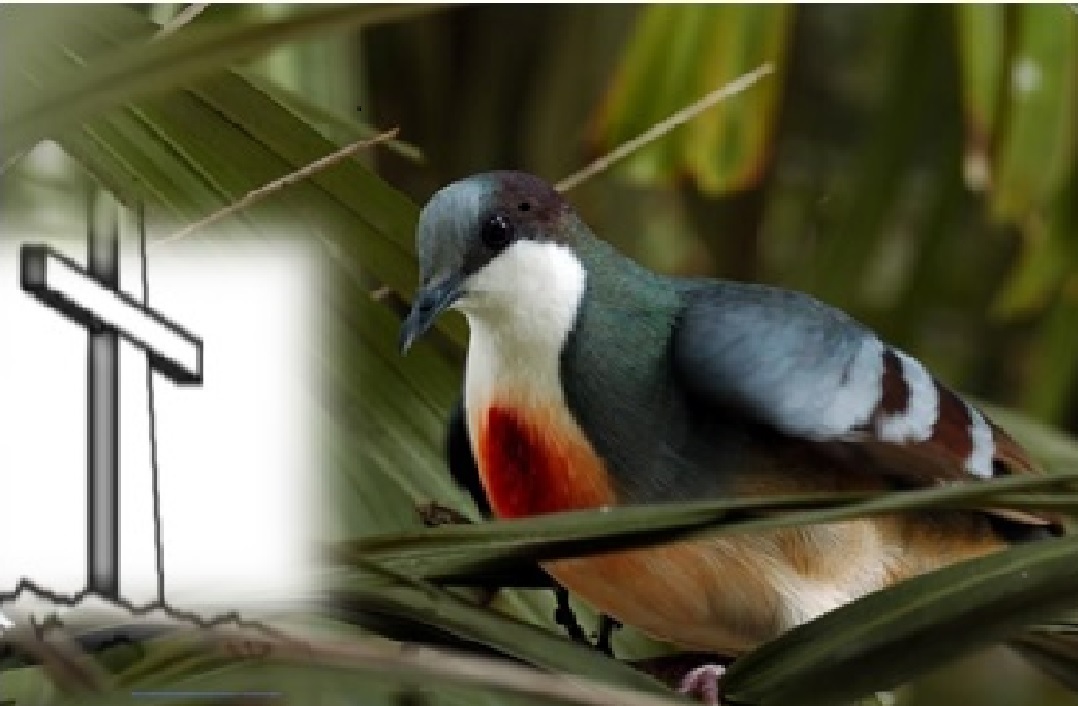
The Luzan Bleeding-heart above was chosen as our theme bird and I blended a cross with the photo. I can think of many illustrations just using that bird.

Wikipedia says, the Luzon Bleeding-heart (Gallicolumba luzonica) is one of a number of species of ground dove in the genus Gallicolumba that are called “bleeding-hearts”. They get this name from a splash of vivid red colour at the centre of their white breasts. The Luzon Bleeding-heart is the species in which this feature is most pronounced, and on first sight it is hard to believe that the bird has not recently been wounded. A reddish hue that extends down the belly furthers the illusion of blood having run down the bird’s front.

The species is endemic to the island of Luzon, Philippines. They eat seeds, berries and grubs. They are shy and secretive, and very quiet, and rarely leave the ground except when nesting. Unlike the other bleeding-hearts, they usually lay two eggs in each clutch.

The article below by Landry mentions that when the birds display, that the male rushes toward the female, stops, lowers his tail and then “throws his breast upwards so that the vivid blood mark is fully presented frontally.” He then bows and coos.

The application this time has to do with its appearance and behavior. Oh, my, where should I begin?

when your heart is lifted up, and you forget the LORD your God who brought you out of the land of Egypt, from the house of bondage; (Deuteronomy 8:14 NKJV)

That verse could indicate that pride was in control and not the Lord. We know that is not good.

These verses could indicate subjection to the Lord. We look to the Lord with our hearts lifted up, but bow in honor to Him.

My defense is of God, Who saves the upright in heart. (Psalms 7:10 NKJV)

The sacrifices of God are a broken spirit, A broken and a contrite heart— These, O God, You will not despise. (Psalms 51:17 NKJV)

I am sure you could come up with many applications also and Luzan Bleeding-heart will most likely be revisited again.

(This is an idea of how these articles will try to honor our Lord’s Fantastically Created birds and challenge us with our own relationship to Him.)

*

*

Orni-theology ~ The Master Carpenter

Master Carpenter 1

Whether you’re a bird person or not, this is stunning!!!

Not to detract from the sheer magic of it, but in practical terms.

How MANY trips would a bird have to make with that tiny little quantity of mud/clay it could carry? (and how far from the nest is the source?) Look at the pictures keeping this in mind.

This slideshow requires JavaScript.

If you take the construction of a circular bowl in your stride as instinctive, how does the bird come up with the windbreak/entrance design that shields the eggs/chicks from the elements, and at what point in fashioning the bowl do they start to construct it?

Master Carpenter 14
Even if you think you could build this…try it without using your hands!

Master Carpenter 15

And now…stop to consider this:

Where did the knowledge to do this come from?

TRULY THERE HAS TO BE A “MASTER CARPENTER”.

Orni-Theology with Luzan Bleeding-heart by Dan

Orni-Theology

*

This was received in an email again today from friends at I.C.R. It has been sent to me many times, but this makes a good article to start a new section of this blog. “Orni-theology”

In John Stott’s The Birds Our Teachers, Stott says, “So over the years I have been trying to develop a new branch of science, which a friend and I have jocularly called “orni-theology’, or the theology of birds. It is founded on an important biblical principle namely that in the beginning God made man, male and female, in his own image and gave us dominion of the earth and its creation.” (pg 10)

Then God said, “Let the earth bring forth the living creature according to its kind: cattle and creeping thing and beast of the earth, each according to its kind”; and it was so. And God made the beast of the earth according to its kind, cattle according to its kind, and everything that creeps on the earth according to its kind. And God saw that it was good. Then God said, “Let Us make man in Our image, according to Our likeness; let them have dominion over the fish of the sea, over the birds of the air, and over the cattle, over all the earth and over every creeping thing that creeps on the earth.” So God created man in His own image; in the image of God He created him; male and female He created them. Then God blessed them, and God said to them, “Be fruitful and multiply; fill the earth and subdue it; have dominion over the fish of the sea, over the birds of the air, and over every living thing that moves on the earth.” (Genesis 1:24-28 NKJV)

As far as I know, the term “Orni-Theology” is not copyrighted. We have been doing “Orni-Theology” blogs from the beginning, but this is the perfect name for those articles. The Birds of the Bible articles are about specific birds named in Scripture, where as Orni-Theology articles have a principle of a bird’s behavior applied in relation to Scripture.

A J Mithra’s articles have been great examples of “Orni-Theology. He introduced us to a bird and it’s behavior and challenged us with God’s Word to behave that way.

Give a few days as a new page is developed and added to the tabs at the top.

*