The World’s Ugliest Animal – Creation Moment

Blobfish ©Simon Elgood

Blobfish ©Simon Elgood

Now here is an interesting and “ugly” fish. This was shared by Creation Moments.

For in six days the LORD made heaven and earth, the sea, and all that in them is, and rested the seventh day: wherefore the LORD blessed the sabbath day, and hallowed it. (Exodus 20:11 KJV)

Published on Apr 22, 2015

http://www.CreationMoments.com

When this fish is taken out of the water, its face almost looks like a very sad person. In 2013 it was voted the “World’s Ugliest Animal”. What is this creature that was adopted as the mascot of the Ugly Animal Preservation Society? It’s the appropriately named blobfish.
Photos of the ugly blobfish have been making the rounds on the Internet. And yet, even the blobfish has beauty when you consider that it was designed to function perfectly in its environment.

Blobfish inhabit the deep waters off the coasts of Australia, Tasmania and New Zealand. If you wanted to see one in its natural habitat, you would have to dive to a depth of between 2,000 and 3,900 feet where the pressure is several dozen times higher than at sea level. The pressure is no problem for the blobfish, though. Its jelly-like body is slightly less dense than water, allowing it to float effortlessly just above the sea floor.
Blobfish don’t have much muscle for swimming, but they don’t need it. They simply swallow edible matter that floats into their mouth. Sadly, they are an endangered species because of fishing trawlers dragging their nets on the seafloor.

Yes, the blobfish is far from attractive. But it serves as a reminder that sinful human beings are unattractive in the sight of God. And yet, while we were still sinners, God sent His Son to die for us and to exchange His righteousness for our sins, making us acceptable in God’s sight. What a Savior!
Prayer:

Father, thank You for sending Your Holy Spirit to reveal the ugliness brought about by sin. Thank You also for sending Your Son to remove my sin and make me righteous in Your sight. Amen.

*

Plus

Ian’s Bird of the Week – Collared Sparrowhawk

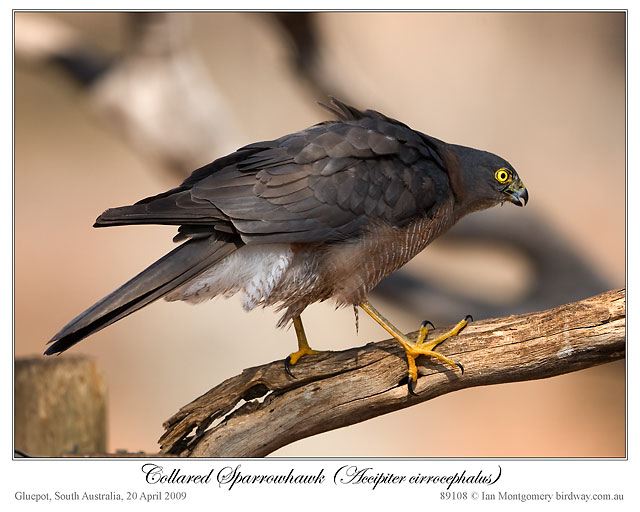
Collared Sparrowhawk (Accipiter cirrocephalus) by Ian

Ian’s Bird of the Week – Brown Sparrowhawk ~ by Ian Montgomery

Newsletter ~ 4/17/15

I sent the previous post by mistake when I was working on the ebook version of the birds of the week this afternoon. This was actually bird of the week in May 2009, and then I thought it was a Brown Goshawk until a raptor expert recently pointed out the error of my ways with these photos on the website.

I’m making good progress with the ebook. It’s getting quite large, so I’m going to publish it two volumes. The first will be 2002 to 2009. I’ll keep you posted on progress. I think I’m going to call it ‘Diary of a Bird Photographer‘ as it reads like a (weekly) diary.

Anyway, here is the full, corrected posting, six years late!

*Note: this was originally posted as a Brown Goshawk, but the bird is actually a Collared Sparrowhawk. Please accept my apologies.

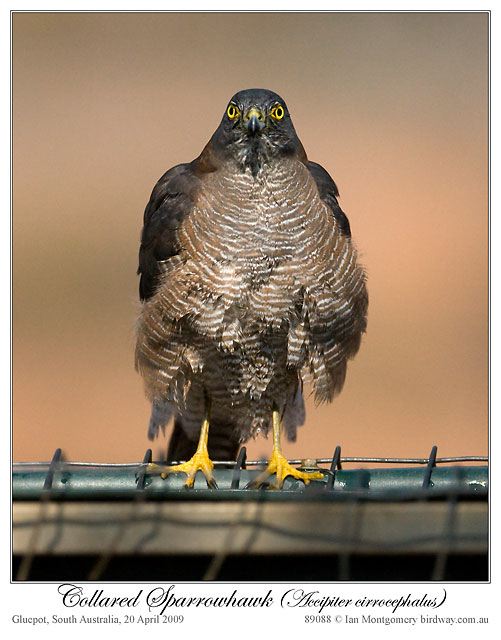
I’m still sorting through the photos that I took at Gluepot last month. One surprising visitor to the watering point near the hide was a Collared Sparrowhawk that came in to drink and bathe. She (it was rather large) spent nearly half an hour at the tank and bathed several times. Naturally, all the other traffic at the watering point came to a standstill, though I was amused to see a flock of Brown Honeyeaters becoming increasingly restless and approaching much closer than I would have expected. Eventually, she vanished as swiftly as she had appeared and things returned to normal.
Collared Sparrowhawk (Accipiter cirrocephalus) by Ian
The Sparrowhawk seemed very wary, particularly when preparing to bathe and looked around repeatedly as if making sure the coast was clear. It was almost as if the Queen of the Forest couldn’t be seen to be doing her toilet in public and she certainly looked very undignified both when bathing, second photo, and when she emerged wet and bedraggled from the water, third photo. I was impressed by how soft and owl-like the feathers were – the original stealth attack aircraft, I suppose.
Collared Sparrowhawk (Accipiter cirrocephalus) by Ian
Collared Sparrowhawks are smallish hawks,30-40cm/12-16in long, with a wingspan to 70cm/28in. As with many birds of prey, the females are larger and this is thought to be to protect the nestlings from the males in a weak moment. The Collared Sparrowhawk is widespread in all except the driest areas of Australia and New Guinea and because of its furtive behaviour and confusion with the similar Brown Goshawk, is probably commoner than might be supposed.

Recent updates* to the website include new galleries for the Australo-PapuanTreecreepers (), additional photos of various Honeyeaters, Wedge-tailed Eagle and White-bellied Sea-Eagle.

*recent in 2009, but the links are still valid.

**************************************************
Ian Montgomery, Birdway Pty Ltd,
454 Forestry Road, Bluewater, Qld 4818
Tel 0411 602 737 ian@birdway.com.au
Bird Photos http://www.birdway.com.au/
Where to Find Birds in Northern Queensland: iTunesGoogle Play Kobo Books
Recorder Society http://www.nqrs.org.au


Lee’s Addition:

Doth the hawk fly by thy wisdom, and stretch her wings toward the south? Doth the eagle mount up at thy command, and make her nest on high? She dwelleth and abideth on the rock, upon the crag of the rock, and the strong place. From thence she seeketh the prey, and her eyes behold afar off. (Job 39:26-29 KJV)

Another neat bird he has introduced us to, even though it is apparently six years late. Ian gave his permission and I started doing his newsletter in July of 2009. That Brown Goshawk (was dated in May 2009, so it was never written up) I did go back and catch some of his older newsletters as you can see from the list.

Wow! Has it been 6 years? Ian, thank you for that permission. With his newsletter and photograph usage, Ian has been a large input for this blog.

See:

Ian’s Bird of the Week (list of newsletters)

Ian’s Honeyeaters, Wedge-tailed Eagle and White-bellied Sea-Eagle.

Ian’s Accipitridae Family

Accipitridae – Kites, Hawks, Eagles Family

Collared Sparrowhawk – Wikipedia

Collared Sparrowhawk – Birds in Backyards

Collared Sparrowhawk – Avian Web

*

Ian’s Bird of the Week – Black-faced Monarch

Ian’s Bird of the Week – Black-faced Monarch ~ by Ian Montgomery

Newsletter ~ 4/15/15

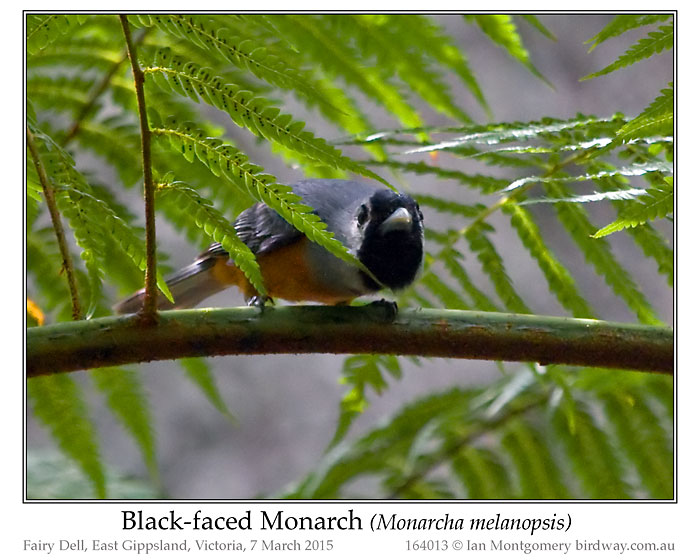
On the way to Orbost in East Gippsland in March on the great owl hunt, we stopped for a break at Fairy Dell Nature Reserve between Bairnsdale and Lakes Entrance. This has a lovely walk through temperate rainforest along a creek with plenty of interesting birds – we saw our first Lyrebird of the weekend here. We also found this Black-faced Monarch showing its black face to great advantage through the fronds of a tree fern.

Black-faced Monarch (Monarcha melanopsis) by Ian

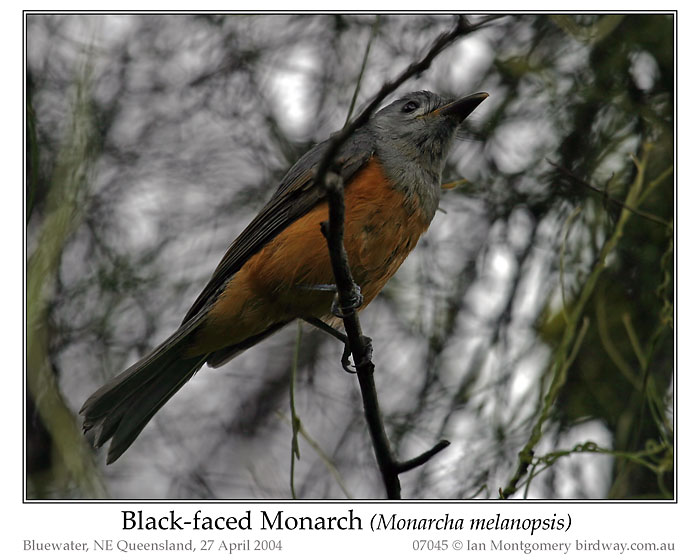
Black-faced Monarchs are usually inconspicuous solitary inhabitants of dense forest and are best located by their calls, the most distinctive of which is a vibrant fluty call, rendered by Pizzey and Knight as ‘Why-you, which-you’. Here they search for insects, sometimes making sallies after flying insects when they are easier to spot. The combination of grey back and wings, black face and rich, rufous underparts is striking, though the rufous breast is best seen in the gloom of the forest using a flash, as in the second photo taken in the highlands of Northeastern Queensland. These two photos encompass most of the breeding range of this species along the east coast of Australia from Melbourne to Cape York.

Black-faced Monarch (Monarcha melanopsis) by Ian

These birds are resident in the highlands of Northeastern Queensland but breeding summer visitors to areas farther south. In winter many migrate to southern and eastern New Guinea, and some immature birds spend their first summer there. In the lowlands of Northeastern Queensland, around Townsville for example, we see them only as passage migrants in March-April and September-October and I saw one last week along Bluewater Creek near the house, reminding me that autumn is here. The bird in the third photo is an immature one photographed on the creek ten years ago. Juvenile lack the black face, have brownish wings and dark bills with a pinkish edge to the base of the lower mandible – which you can just see in this photo.

Black-faced Monarch (Monarcha melanopsis) juvenile by Ian

Black-faced Monarch build beautiful, conical nests wedged into the fork of a shrub or sapling in moist gullies. This is constructed of fibrous plant material, including ferns and moss, glued together using gossamer from spiders’ webs as in the fourth photo.

Black-faced Monarch (Monarcha melanopsis) Nest by Ian

Autumn here means warm, clear sunny days and (relatively) cool nights with low humidity, very welcome after the wet season and my favourite time of the year. The wet usually leaves a legacy of lush green grassland and forest, though this year it has been fairly dry with good rain only in January. The Dollarbirds have left for the winter and the forests and gardens are rather silent without the loud calls of the Koels and Channel-billed Cuckoos, leaving just the Blue-winged Kookaburras and Bar-shouldered Doves to fill the gap.

Greetings
Ian

**************************************************
Ian Montgomery, Birdway Pty Ltd,
454 Forestry Road, Bluewater, Qld 4818
Tel 0411 602 737 ian@birdway.com.au
Bird Photos http://www.birdway.com.au/
Where to Find Birds in Northern Queensland:  iTunesGoogle Play Kobo Books
Recorder Society http://www.nqrs.org.au


Lee’s Addition:

“If a bird’s nest happens to be before you along the way, in any tree or on the ground, with young ones or eggs, with the mother sitting on the young or on the eggs, you shall not take the mother with the young; you shall surely let the mother go, and take the young for yourself, that it may be well with you and that you may prolong your days”. (Deuteronomy 22:6-7 NKJV)

What a nice looking bird, Ian. That breast color reminds me of our American Robin’s outfit. Thanks again for sharing so many birds with us over the weeks. With over 10,000 of the Lord’s avian creations flying around, you nor I will ever cover them all.

Here is the Black-faced Monarch’s call from xeno-canto:

You can see Ian’s Monarch family photos at Monarch Flycatchers & Allies [Family: Monarchidae]
Monarchidae – Monarchs Family

Black-faced Monarch –  Wikipedia
Black-faced Monarch – Birds in Backyards
Black-faced Monarch – New Zealand Birds Online

*

Ian’s Bird of the Week ~ Pilotbird

Ian’s Bird of the Week ~ Pilotbird ~ by Ian Montgomery

Newsletter ~ 3/31/15

The primary targets in East Gippsland were the Sooty and Masked Owls, but there were several daytime birds on the wanted list too. One of these was the Pilotbird, a smallish – 17cm/7in long – brown, ground-dwelling bird of the mountain ranges and dense coastal scrub of southeastern Australia from just south of Sydney almost to Melbourne. I’d seen one only once before, near Mittagong in New South Wales 16 years ago, but that encounter was only a glimpse and no photography was involved.

Pilotbird (Pycnoptilus floccosus) by Ian

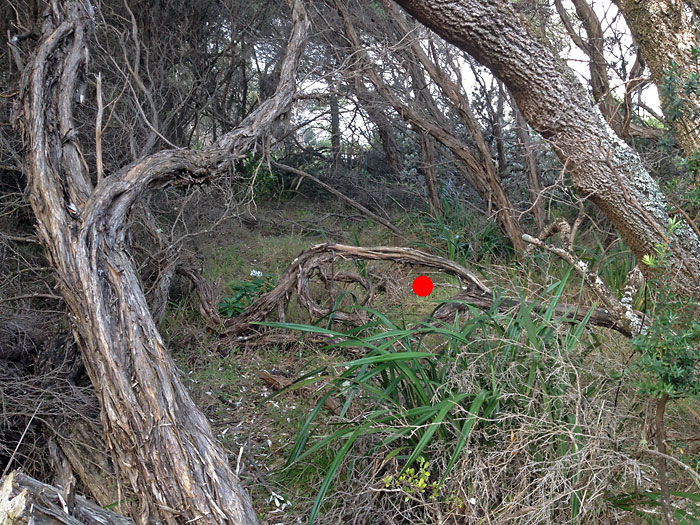
It’s an unobtrusive bird and easy to overlook, unless you know its flutey, far-carrying call, sometimes rendered as ‘guinea-a-week’. My Victorian friends knew a good spot for it in coastal scrub and we found one there with relative ease, returning the following day (first photo) to get better photos. It rummages around in thick undergrowth looking for invertebrates. The second photo has a red dot showing the exactly location, beyond the sinuous brown branch, so you can appreciate that we are lucky to be able to see anything much of it in the photo. It has unusual buff dark-edged feathers on the breast, giving it a scaly appearance. The plumage is apparently dense and silky as reflected in its scientific name: Pycnoptilus means thick-feathered, and floccosus is derived from the Latin floccus and means ‘full of flocks of wool’, which, I must admit, left me not much the wiser.

Pilotbird (Pycnoptilus floccosus) by Ian

Pilotbird (Pycnoptilus floccosus) location by Ian

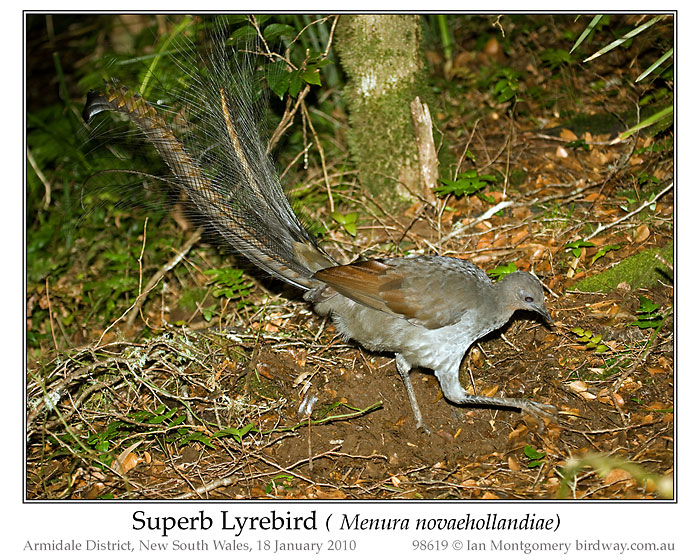
It’s common name Pilotbird arises from the bird frequently associating with Superb Lyrebirds, taking advantage of the digging habits of the latter (third photo) to snatch up revealed invertebrates. Some sources say the name Pilotbird comes from the similar habit of Pilotfish which associates with large marine predators such as sharks; other say that the Pilotbird by its call led early settlers looking for food to lyrebirds. I prefer the first explanation. Lyrebirds are very vocal in their own right and don’t need another species to advertise their presence. Lyrebirds are perhaps the world best mimics and are known to mimic Pilotbirds, and it would be easy to imagine that this attracted Pilotbirds in the first place and they then learned that this was an easy way to get dinner. We did in fact see several Superb Lyrebirds dashing across the roads of the forests where the owls lived, though the coastal scrub didn’t strike me as good lyrebird habitat.

Superb Lyrebird (Menura novaehollandiae by Ian

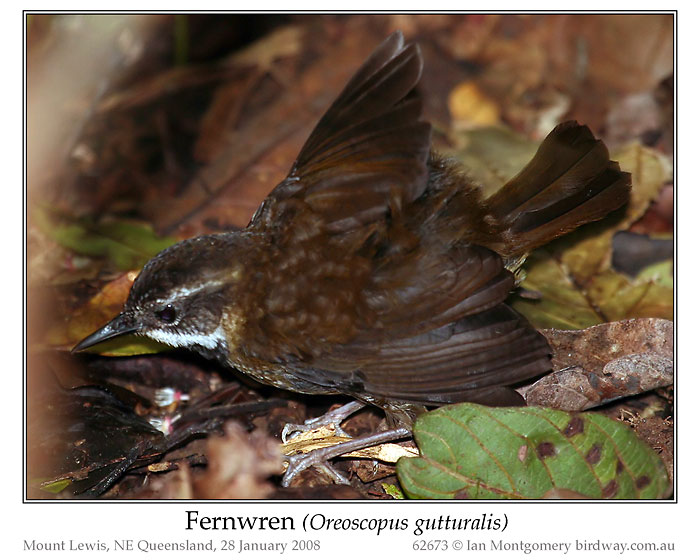
This photo of the lyrebird digging vigorously reminded me both of Scrub-turkeys and Chowchillas (fourth photo) and I wondered whether the Pilotbird had a behavioural counterpart in the forests of Northeastern Queensland. The Pilotbird is usually placed in the Acanthizidae, the family of thornbills and their allies (though it shows some affinities with the bristlebirds Dasyornithidae), so I checked up on the Fernwren (fifth photo) another brown, rummaging Acanthizid endemic to the Wet Tropics.

Chowchilla (Orthonyx spaldingii  by Ian

Sure enough, HBW (Handbook of Birds of the World) reports that the Fernwren “sometimes associates with Orange-footed Scrubfowl (Megapodius reinwardt) and Chowchilla (Orthonyx spaldingii), following in close proximity and catching prey disturbed by their feeding actions”. The Orange-footed Scrubfowl is, of course, a cousin of the Brush-turkey.

Fernwren 9Oreoscopus gutturalis)  by Ian

So maybe this week’s bird of the week should be entitled ‘small brown rummaging birds of the forest floors of eastern Australia’.

Greetings
Ian

**************************************************
Ian Montgomery, Birdway Pty Ltd,
454 Forestry Road, Bluewater, Qld 4818
Tel 0411 602 737 ian@birdway.com.au
Bird Photos http://www.birdway.com.au/


Lee’s Addition:

For you are my rock and my fortress; and for your name’s sake you lead me and guide me; (Psalms 31:3 ESV)

Teach me to do Your will; for You are my God; Your Spirit is good; lead me into the land of uprightness. (Psalms 143:10 MKJV)

What great protection colorations these birds have received from their Creator. I am sure when the birds of prey are in the area, rummaging types of birds are very thankful for their less colorful outfits.

*

*

Ian’s Bird of the Week – Greater Sooty Owl

Ian’s Bird of the Week – Greater Sooty Owl ~ by Ian Montgomery

Newsletter ~ 3/19/15

Here is the belated and sought-after bird of the week after a great trip to Victoria. I’ve been unwell since my return a week ago, but things are fine now and the wheels of my life are turning again.

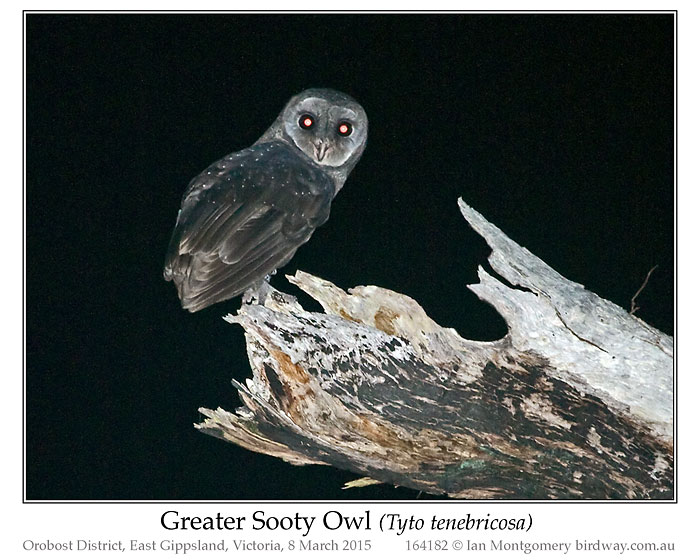
Your spiritual support and goodwill have done it again, so it’s another mission accomplished, though in English this time (having been Catalan and Spanish in the past). Actually, most credit should go to my sharp-eared, sharp-eyed, knowledgeable and passionate birding friends. With their hard work, the track record for target species in East Gippsland during our stay was fantastic. We went searching for owls on each of the three nights. The first night, we heard both Greater Sooty and Masked Owls – and the sharpest-eyed of the group saw a Masked Owl in flight. On the second night, at a different site we heard another Sooty Owl and eventually caught sight of it flying among the tall trees of the forest. It then flew over us and perched on a dead limb in the open high above us.

STI-Tyto Greater Sooty Owl (Tyto tenebricosa) by Ian

I got only this photo, discarding a second out of focus one. For the technically minded, I used manual focussing – it was too distant and the light and contrast too faint for auto focus – and guessed an exposure of 1/80sec at f5.6 and 1600 ISO using the 100-400mm zoom. As the passionate/obsessive birder would understand, it was worth travelling to Victoria for this one photo and, having taken it, misión completa (I have liked it in Spanish since finding the Resplendent Quetzel in Costa Rica in 2010) I was free to relax and enjoy whatever other gems came our way. In fact, one such, this Yellow-bellied Glider. sailed over our heads and landed in a nearby tree while we were trying to locate the calling Sooty Owl.

Yellow-bellied Glider (Petaurus australis) by Ian

These are fantastic, long-tailed, wrist-winged relatives of possums (the Striped Possum of Northeastern Queensland is in the same family, the Petauridae) and the Yellow-bellied can glide up to 150m/400ft. It is rabbit-sized with a huge bushy tail that it presumably uses as a rudder in flight. They’re called wrist-winged, to distinguish them from elbow-winged like the Great Glider, and if you look carefully in the photo you can see the black edge of the membrane attaching to the little finger of the left hand. This proved to be diagnostic as we were unsure of both its identify and of whether the large possum-like animal on the tree was the same creature as the pale form that glided over us.

They are reasonably common in suitable old growth forest in eastern Australia, though the northern race regina has a very restricted range in northeastern Queensland and is threatened by logging. Quite coincidentally, I received a request yesterday to support a petition to prevent the transferring of Tumoulin Forest Reserve near Ravenshoe to State Forest so that logging can resume. The petition is aimed directly at protecting the Yellow-bellied Glider, and if you think, like I do, that downgrading the status of nature reserves is disgraceful, then we should support it: http://www.thepetitionsite.com/851/727/614/protect-rare-possum-habitat-from-senseless-logging/.

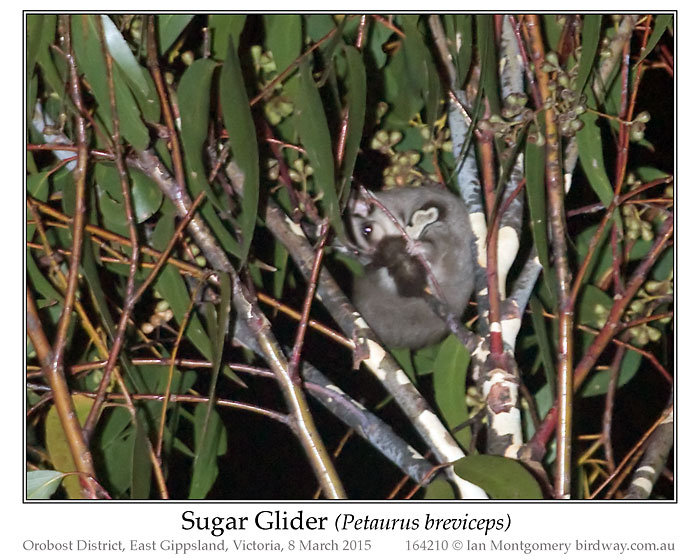
Later that evening, we returned to the Masked Owl site. We could hear one or two Masked Owls but they were wary, keeping their distance in the forest and moving away when spotlights were shone in their direction. We did, however, see one in flight and, having already photographed the Sooty Owl, I was satisfied with that, even though we did try again for photographs without success on the third night. We did, however, find this Sugar Glider, a small relative of the Yellow-bellied. It seemed to be keeping a low profile, very sensible given the presence of calling owls. Later still, we came across a juvenile Southern Boobook which flew up in front of us into a small tree beside the road. It didn’t dally for a photo, but that made it a three-owl evening which we all thought was special.

Sugar Glider (Petaurus briviceps) by Ian

I’ve barely mentioned Sooty Owls, as so much else happened that evening. There are two Australian forms: the Lesser Sooty in the wet tropics of northeastern Queensland and the Greater Sooty in eastern Australia from Eungella National Park near Mackay in Queensland to the Dandenong and Strzelecki Ranges in Victoria, both reasonably common in suitable habitat of wet, gully, forest but rarely seen. Another race, supposedly of the Greater Sooty, occurs throughout New Guinea. Currently the Lesser and Greater are treated as separate species by most authorities, though Christidis and Boles lumped them in 2008. Having one species with a disjoint range in New Guinea and eastern Australia and a closely-related separate one in between should make any student of biogeography laugh out loud, but that’s the way it is. Sooty Owls feed mainly on arboreal mammals, though they will take other prey such as birds.

Ian at work photographing Owl

Ian at work photographing Owl

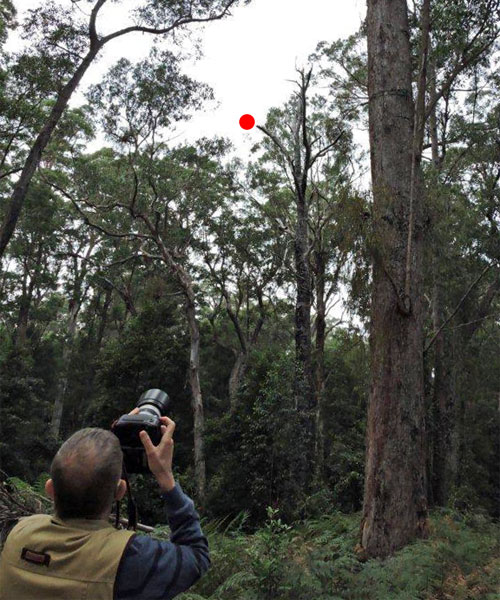
On the following day we returned to the Sooty Owl site and here is a photograph of me photographing it, the red spot showing where the bird in the photo was perched. I was surprised at how far up it was and felt very fortunate to have got the one reasonable photo. This forest also produced for us Tawny Frogmouth, Australian Owlet-Nightjar, Brush-tailed Possums, a bandicoot, a wombat and Black or Swamp Wallabies leaving us in no doubt about the value of old growth forests (reminder http://www.thepetitionsite.com/851/727/614/protect-rare-possum-habitat-from-senseless-logging/).

A few people have requested location information about the owls, but I have been sworn to secrecy by my friends as they don’t want them being disturbed too much or subjected to tapes of owl calls. So please understand my reticence.

Greetings
Ian

**************************************************
Ian Montgomery, Birdway Pty Ltd,
454 Forestry Road, Bluewater, Qld 4818
Tel 0411 602 737 ian@birdway.com.au
Bird Photos http://www.birdway.com.au/
Where to Find Birds in Northern Queensland: iTunes; Google Play Kobo Books
Recorder Society http://www.nqrs.org.au


Lee’s Addition:

the little owl, the fisher owl, and the screech owl; (Leviticus 11:17 NKJV)

What an adventure. Some birds just don’t want to be found. Thanks again, Ian, for sharing another trip with us. Glad you are feeling better.

Sooty Owls belong to the Tytonidae – Barn OIwls family which has 19 speciesIan’s Owls can be found at

http://birdway.com.au/tytonidae/index.htm and

http://birdway.com.au/strigidae/index.htm.

*

Ian’s Bird of the Week

Ian’s Birdway 

Tytonidae – Barn Owl Family

*


Ian’s Bird of the Week – Budgerigar

PSI-Psit Budgerigar (Melopsittacus undulatus) by Ian
Ian’s Bird of the Week – Budgerigar ~ by Ian Montgomery

Newsletter ~ 3/3/15

Judging by the number of emails that I received about Pied Butcherbirds, iconic species are popular and there were many interesting stories about experiences with them. So here is another, perhaps globally the most familiar Australian bird. Although it’s quite common and sometimes very abundant after good rains in the drier parts of Australia, you have to go out of your way to find it. So it it’s much less well-known as a wild bird than say other iconic species like Australian Magpie and Laughing Kookaburras that turn up in backyards.

It wasn’t until after I moved to North Queensland in 2002 that I first saw them in the wild, and that was on a trip to Moorrinya National Park between Torrens Creek and Aramac, 370km southwest of Townsville. In places like that you usually see them in small flocks of maybe 10-20 in rapid undulating flight. These make sudden turns in the sunlight showing alternately green and yellow in a characteristic and delightful display of vivid, fluorescent colour.

PSI-Psit Budgerigar (Melopsittacus undulatus) by Ian

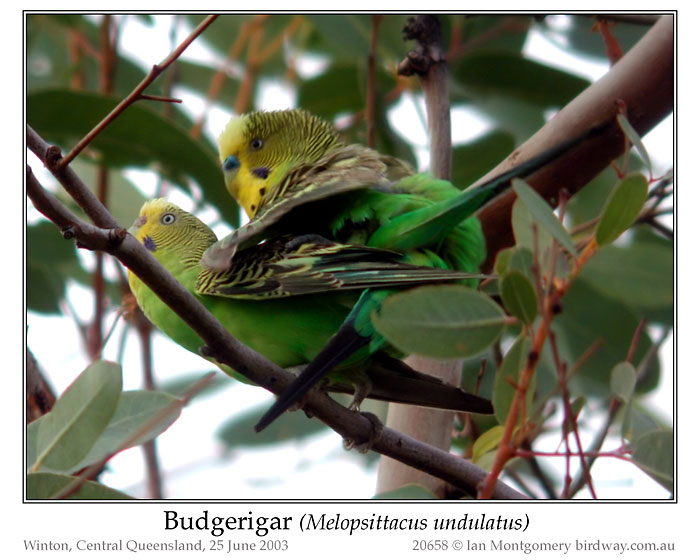
The sexes can be distinguished either by differences in behaviour, sometimes subtle as in the first photo with an attentive male and a bored or playing hard to get female, or less subtly as in the second photo. Her the male is concentrating seriously, and the female is rather inscrutably either in a state of bliss or thinking of the motherland. An easier way though is by the colour of the cere – the tissue surrounding the nostrils – blue in adult males, and brown in females. Juveniles have duller plumages, barred foreheads and lack the black spots on the neck.

PSI-Psit Budgerigar (Melopsittacus undulatus) by IanAfter good inland rains, the population can explode and Budgerigars may be seen in flocks of thousands. When dry conditions return and seeds become scare, flocks wander far and wide in search of food. They move into areas beyond their normal range and can turn up in coastal areas such as near Townsville. The birds in the third photo were near Woodstock just south of Townsville on the way to Charters Towers and I have seen them near Bluewater.

Sometimes escaped cage birds turn up in odd places in strange colours, such as this almost completely white one near the Strand in Townsville. I don’t know about you, but I prefer the natural colours. I was in Ireland once for a family funeral in February and was birding on Dun Laoghaire pier in Dublin Bay on a very cold, dull winter’s day, when I spotted a bright yellow budgie looking very out-of-place among some roosting waders. It was a moment of great empathy and I thought ‘you and I should be back in sunny Australia’.

PSI-Psit Budgerigar (Melopsittacus undulatus) by IanI’m in Melbourne at the moment to visit East Gippsland next weekend with my Victorian birding pals who know of a good site for both Greater Sooty Owls and Masked Owls (both cousins of Barn Owls) near Orbost. I haven’t seen or photographed either of these, so may I request your customary friendly support and spiritual goodwill to help us find them? It would be lovely to be able to bring at least one of them to you as the next bird of the week.

Greetings
Ian

**************************************************
Ian Montgomery, Birdway Pty Ltd,
454 Forestry Road, Bluewater, Qld 4818
Tel 0411 602 737 ian@birdway.com.au
Check the latest website updates:
http://www.birdway.com.au/#updates


Lee’s Addition:

Declare His glory among the nations, His wonders among all peoples. (Psalms 96:3 NKJV)

Ian is correct, at least for me. The Budgerigar or “Budgie” as I was taught, was one of the first bird names I ever knew. Almost everyone I have ever seen was in a cage or aviary. Few have been pets and one was sitting on someone glasses look down into their lens. But, to see them in the wild where they live would be a great experience.

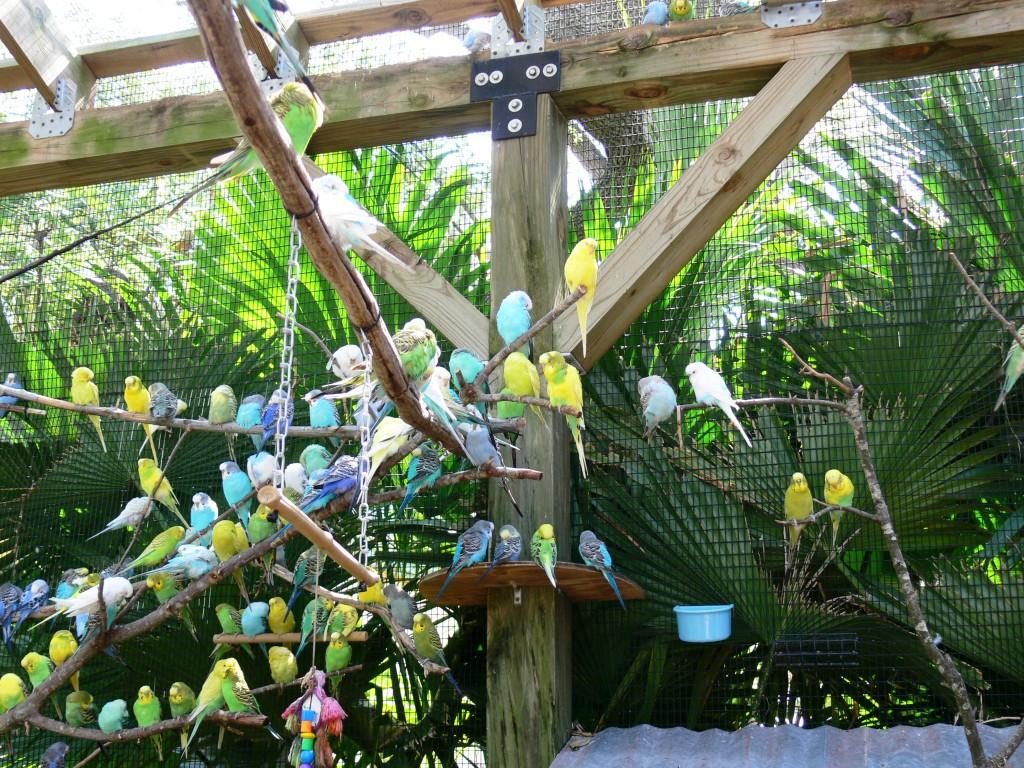
Thanks, Ian, for again sharing your adventures with us. The most I have ever seen at one time has been at Lowry Park Zoo. I’ll also be praying that Ian finds those Greater Sooty Owls and Masked Owls so that he will share them with us on another Bird of the Week.

Budgerigar (Melopsittacus undulatus) by Lee LPZ

Budgerigar (Melopsittacus undulatus) by Lee LPZ

Ian’s Birds of the Week

Ian’s Budgerigar Photos

Ian’s Psittacidae Family

Psittacidae – Parrots Family

*


Ian’s Bird of the Week – Pied Butcherbird

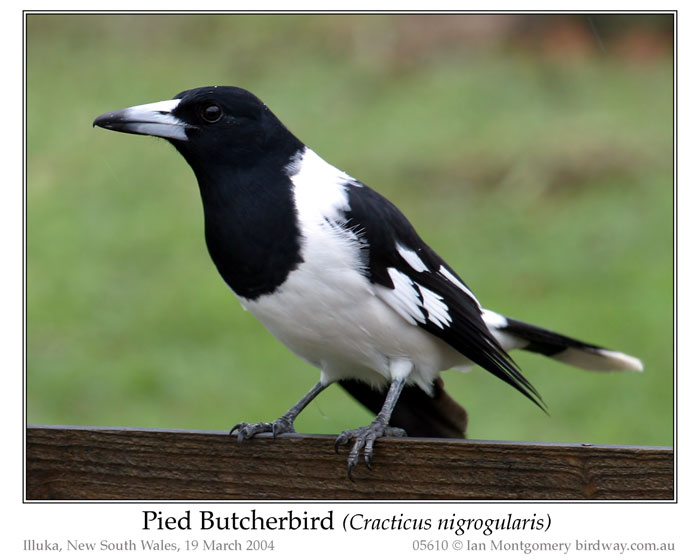
Pied Butcherbird (Cracticus nigrogularis) by Ian
Ian’s Bird of the Week – Pied Butcherbird ~ by Ian Montgomery

Newsletter ~ 2/22/14

Birds of the week are usually chosen on the basis of appearance, photo quality or species interest, but here for a change is one whose real claim to fame is auditory. Not that Pied Butcherbirds don’t look quite dapper, even if the hooked bill suggests a predatory existence and the black hood has the connotation of the executioner, at least for the Spanish : Verdugo Gorjinegro, where verdugo means executioner or hangman, and gorjinegro you can guess. However, their real claim to fame is their beautiful singing which has a clarity and sense of purpose that I think is unequalled. When I first heard a Pied Butcherbird singing in Australia in western New South Wales in 1971, I was fascinated. To me it seemed like it was practising the theme from an oboe concerto, as it would keep carefully repeating the phrases, each time slightly differently.

The first edition of Graham Pizzey’s Field Guide to the Birds of Australia (1980-2000) has wonderful descriptions – I bought it after reading his description of Musk Duck, which starts “A decidedly strange duck.” – so I’ll quote him on the Pied Butcherbird: “Superb: slow flute-like piping, of clear high-pitched and low mellow notes, throughout day and moonlit nights, best in early morning; often given by two or more birds alternatively, higher-pitched notes of one contrasting with more mellow notes of others. … Also accomplished mimicry, as part of quieter sub-song.”

I can’t just leave you hanging after a description like that. Here is a YouTube link to a lovely video of a duet

and here is another to a Pied Butcherbird mimicking a variety of species

Listen to these and I’m sure you’ll agree that this is one of the most beautiful song birds in the world.

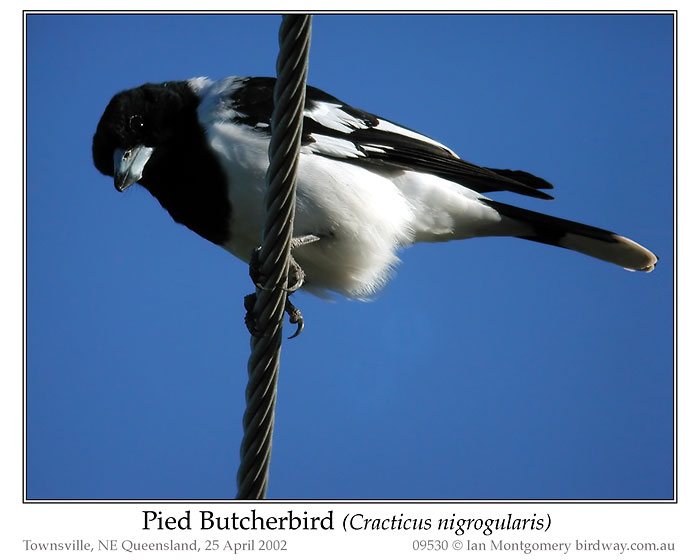
Pied Butcherbird (Cracticus nigrogularis) by Ian

On the subject of mimicry, I had an email from Rose Bay in Sydney recounting a conversation that took place between a Grey Butcherbird and the correspondent, thank you Jeremy, who whistled in response, over several months. The bird remained hidden and unidentified in foliage until a couple of weeks ago when, during such a talk, he spotted the bird and the mystery was solved. I’ve accompanied a Pied Butcherbird here in Bluewater on the treble recorder. I checked their vocal range using a pitch analyser on sound recordings and found that the mellow notes were close to middle C (C4), while the top notes were around D6, two octaves above middle C; an impressive range.

Pied Butcherbird (Cracticus nigrogularis) by Ian

And, yes, they do prey on small birds, mammals, reptiles and invertebrates and will even hunt in unison with Australian Hobbies. They get their name from their habit of wedging larger prey items in a fork in a tree (or clothes line) so that they can dismember it. If you think that sounds macabre, go and listen to Berlioz’s Symphonie Fantastique again, imagining the idée fixé played by a Pied Butcherbird, particular the rendering of it in the third movement on the oboe and by the clarinet in the fourth Marche au supplice. The latter appears briefly before the fall of the guillotine. I tried playing the first of the YouTube videos simulaneously with the third movement a short while ago and the result is, well, fantastic.

Pied Butcherbird (Cracticus nigrogularis) by Ian

Anyway, back to family matters. Pied Butcherbirds have group territories similar to those of their cousins the Australian Magpies with usually one breeding pair. The female does all the hard work of building the nest and incubating the eggs while, the male, presumably, sings. The other members of the group, usually offspring from earlier broods, do help to feed the young.

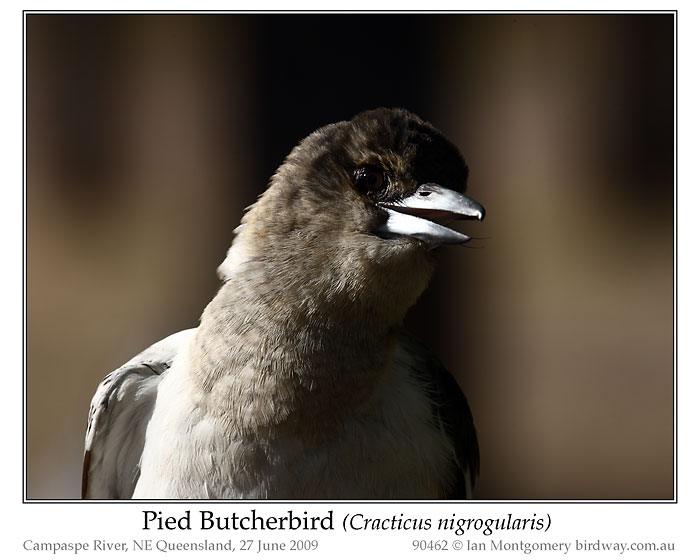
I should, I suppose, mention the photos. The first three are of adult birds, the last two of brownish immature birds. At 32-36cm/12.5-14in in length the Pied Butcherbird is intermediate between the smaller Grey and Black-backed Butcherbirds and the larger Black Butcherbird. The Pied Butcherbird occurs through most of mainland Australia, but is absent from very arid regions, most of South Australia and Victoria, and southeastern New South Wales. Here in the northeast Queensland, they show a preference for watercourses.

PAS-Arta Pied Butcherbird (Cracticus nigrogularis) by Ian 5

The bird of the week has been going out regularly, if not weekly, since late 2002. I have copies of almost all of them and I’ve decided to publish them as an electronic book under the umbrella “A Bird Photographer’s Diary”. At the moment, I’m progressing steadily through the second quarter of 2006, and I’m having great fun reliving all the experiences and places involved. The intention is to add photos of the various locations and habitats. I’ll keep you posted.

Greetings and sweet sounds,
Ian

**************************************************
Ian Montgomery, Birdway Pty Ltd,
454 Forestry Road, Bluewater, Qld 4818
Tel 0411 602 737 ian@birdway.com.au
Bird Photos http://www.birdway.com.au/
Where to Find Birds in Northern Queensland: iTunesGoogle Play Kobo Books
Recorder Society http://www.nqrs.org.au


Lee’s Addition:

The flowers appear on the earth; the time of the singing [of birds] has come, and the voice of the turtledove is heard in our land. (Song of Solomon 2:12 AMP)

Wow! What an amazing article about these birds and the videos only enhance it more. I especially like the them singing duet. Ian finds us the most interesting birds to see and hear. Thanks, Ian.

Check out Ian’s Butcherbirds in his Artamidae Family

Ian’s Bird of the Week

Artamidae – Woodswallows, butcherbirds and allies Family

Wordless Birds

*


Ian’s Bird of the Week – Australian Magpie

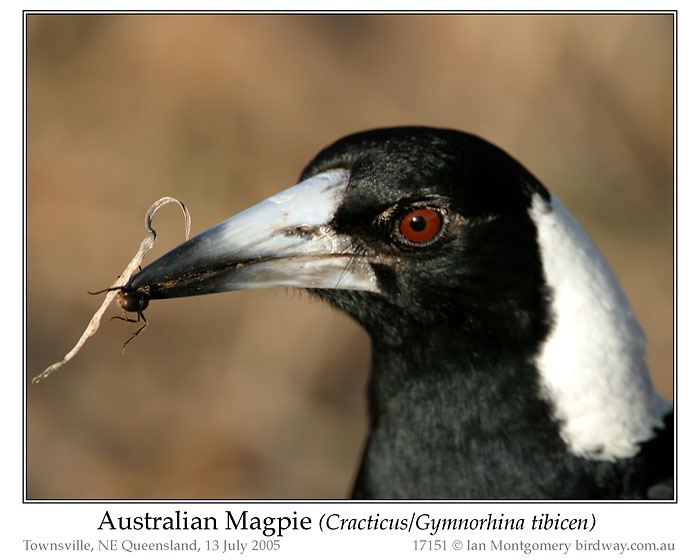
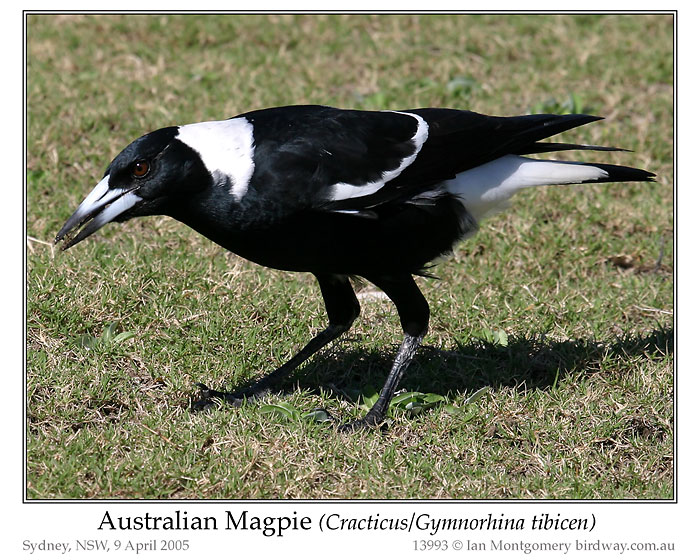
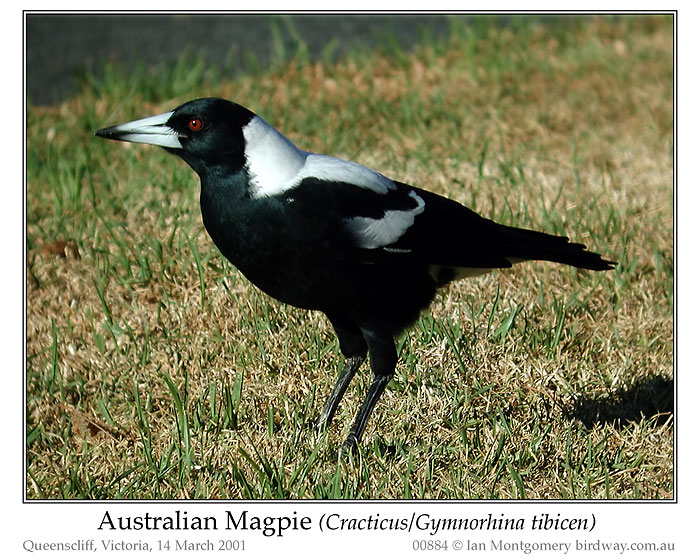
Australian Magpie (Gymnorhina tibicen) by Ian

National days are occasions in which icons play a big, maybe dominant or even overpowering role, and Australia’s, January 26th, is no exception. So here is the Australian Magpie. It’s not strictly a Magpie in the Northern Hemisphere sense and it’s not strictly Australian, as it also occurs naturally in southern Papua New Guinea and has been introduced to both the main islands of New Zealand.

It is, however, certainly iconic, and not just in the sense of something that is typical of Australia. It was incorporated in various South Australian insignia just after Federation, and features “displayed proper” against the risen sun of federation. All six state coat of arms were incorporated into the Australian coat of arms in 1912, so the magpie, along with the Black Swan of Western Australia, made it to the national coat of arms. The bird referred to in the original South Australian design documents is called the “Piping Shrike” but the Australian Magpie has had various names including “Piping Crow-shrike” (Charles Sturt, explorer, 1840).

Australian National Coat of Arms

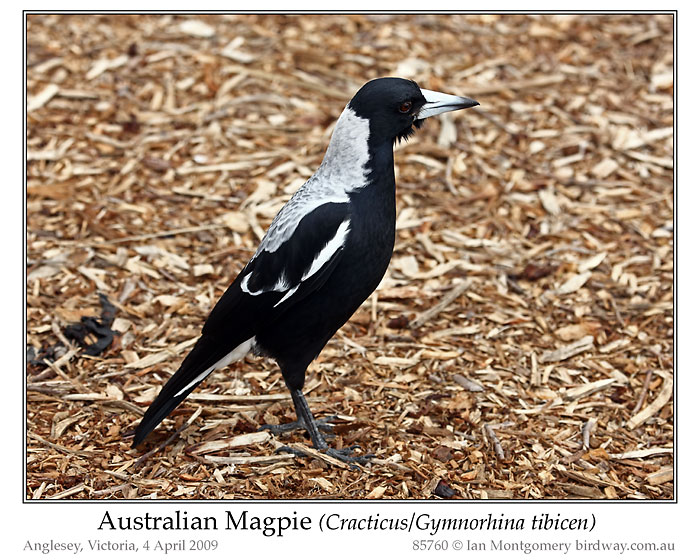
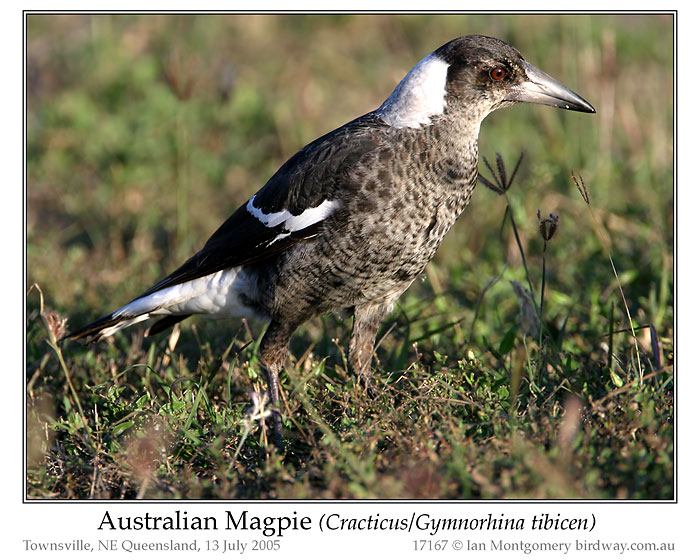
There are several races of the Magpie and I thought it would be easy to describe and illustrate them as part of this bird of the week. In fact, the descriptions, delineations and ranges of the various races are both messy and vague so I’ve settled for three easily recognised categories based on the colouration of their backs between the universally white (or pale grey) nape and rump: Black-backed, White-backed and Western.

Australian Magpie (Gymnorhina tibicen) by Ian

The Black-backed group, first and second photos, is the most widespread occurring everywhere except in SW Western Australia and SE Australia and Tasmania. The nominate race ‘tibicen’ of eastern Australia is Black-backed and the name is derived from the Latin for ‘trumpeter’: tubicen. Male and female Black-backed have similar patterning except that the females have greyish tinge to the white and the black is less intense.

Australian Magpie (Gymnorhina tibicen) by Ian

The familiar Magpie of Victoria, Tasmania and South Australia is the White-backed. The bird in the third photo is a male, while the one in the fourth photo is a female. The grey tinge and scalloping on her nape and back is quite obvious.

Australian Magpie (Gymnorhina tibicen) by Ian

The male of the Western Magpie in SW Western Australia is like the male White-backed. The female, however, has very dark scalloping on the back to the point where it is almost black, fifth photo.

Australian Magpie (Gymnorhina tibicen) by Ian

Australian Magpies have group territories with the group varying in size from a pair of adults to several adults and juveniles of varying ages. Usually only one pair in the group actually nests with the female doing the nest-building and most of the incubation. The young are fed by the female, often with help from her male partner and sometimes from other group members. Magpies can be aggressive towards people near the nest, and many Australians can recount stories of being attacked when cycling to or from school. Juveniles have greyish rather than black plumage, like the juvenile Black-backed in the sixth photo.

Australian Magpie (Gymnorhina tibicen) by Ian

Australian Magpies, and their close relatives the Butcherbirds, are candidates for being the finest song birds in Australia. The Magpie has a varied and complex repertoire and is well-known for its flute-like choruses by a pair or group. It is usually started by the senior male or female in the group with other members, including juveniles, joining in. Less intense warbling songs are done by individuals, often for long periods, contain elements of the choral singing and mimicry. The New Zealand Poet, Denis Glover, in his best known poem, The Magpies, rendered the song as ‘and Quardle oodle ardle wardle doodle/The magpies said’.

The flute-like quality of the voice features in various European names for the Australian Magpie: Cassican flûteur (F), Flötenvogel (G) and Verdugo Flautista (Sp). I think the Germans have got it right with their Fluting-bird – much better than naming it after some unrelated Northern Hemisphere bird that it vaguely resembles. Maybe we should launch a new name for it next Australia Day. Now that would be a fitting Australia Day honour.

Greetings
Ian

**************************************************
Ian Montgomery, Birdway Pty Ltd,
454 Forestry Road, Bluewater, Qld 4818
Tel 0411 602 737 ian@birdway.com.au
Bird Photos http://www.birdway.com.au/
Where to Find Birds in Northern Queensland:  iTunes; Google Play Kobo Books
Recorder Society http://www.nqrs.org.au


Lee’s Addition:

He (Solomon) spoke of trees, from the cedar that is in Lebanon even to the hyssop that grows on the wall; he spoke also of animals and birds and creeping things and fish. (1 Kings 4:33 NASB)

Ian, thanks again for sharing your Magpies from Australia. Seeing that he travels all around, he gets to see these different Magpies as he goes off on his birdwatching adventures. Their expressions give a look of intelligence to them.

Check out:

*


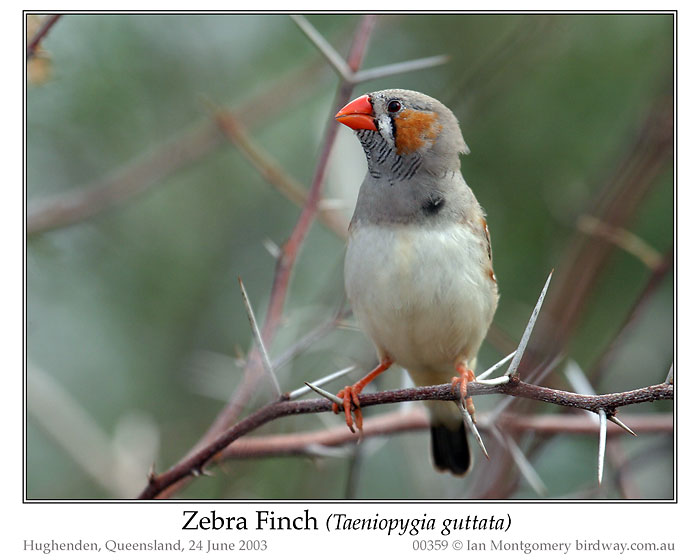
Ian’s Bird of the Week – Zebra Finch

PAS-Estr Zebra Finch (Taeniopygia by Ian

Ian’s Bird of the Week – Zebra Finch ~ by Ian Montgomery

Newsletter ~ 1/12/14

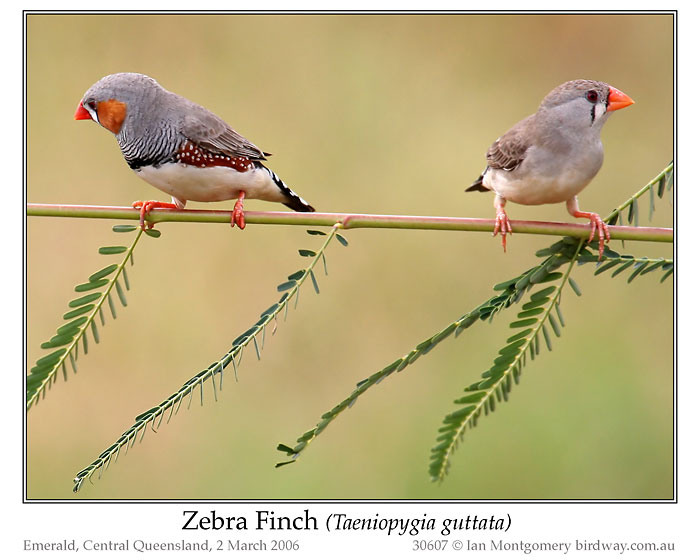
Here’s a perhaps surprising omission so far from the bird of the week series, the Zebra Finch, In Australia the most widespread of the grass- or weaver-finches (family Estrildidae). It is resident almost throughout mainland Australia, avoiding only the very driest deserts (such as the Nullabor Plain and the Great Sandy Desert), Cape York and the cooler and wetter regions of southern Victoria and southern Western Australia. It is absent from Tasmania. I qualified ‘surprising omission’ with ‘perhaps’, as it’s natural to rush into print with rarer and more sought-after species, such as Gouldian Finches, and overlook the more common ones.

With a length of 10cm/4in, it is among the smallest of the 19 species of Estrildid finches found in Australia (17 naturally; 2 introduced), but the males in particular (first photo) are beautiful birds and are hugely popular all over the world. Given the rigours of their natural habitat, they are hardy birds and easy to breed. One of my favourite ways to lazily photograph birds is to sit quietly near a waterhole in dry country and see what arrives, and you can see the bird in the first photo has wet breast and flank feathers from having a dip.

PAS-Estr Zebra Finch (Taeniopygia by Ian

The second photo shows a pair drinking at the same spot. The male on the left is recognisable by its chestnut-coloured cheeks, while the female has plainer plumage, lacking the chestnut plumage on the cheeks and flanks and the stripes on the neck. She still has the stripy tail, white rump and diagnostic vertical ‘tear-drop’ stripe below the eye. This acts as camouflage by obscuring the eye and breaking up the outline of the head.

PAS-Estr Zebra Finch (Taeniopygia by IanThe third photo shows another pair at the same place. They would appear to be having a difference of opinion about something, and the body language suggests to me that the female is getting the upper hand. Most females have plain breasts, but some have a faint breast band like this one. The fourth photo shows another pair, the female having the more typical plain plumage. These two look as if they’re not on very good terms either, definitely not speaking to each other, so you won’t be surprised to hear that Zebra Finches form permanent pair bonds.

PAS-Estr Zebra Finch (Taeniopygia by IanTheir breeding cycles depend on seeding grasses and therefore on rainfall patterns. If the weather is warm enough for grasses to flower, the birds start breeding in response to rain, timing the hatching of the young with the appearance of seed. They will also feed on insects, particular when feeding young. In good conditions, the birds breed repeatedly, and the young, independent 35 days after hatching, can breed when as young as 80 days. Although the pair-bonds are permanent, Zebra Finches are very sociable, often breeding colonially and forming large flocks outside the breeding season. The bonding doesn’t prevent the females from getting on cosy terms with other males, and about 10% of clutches have two fathers (HBW).

PAS-Estr Zebra Finch (Taeniopygia by Ian

PAS-Estr Zebra Finch (Taeniopygia by Ian

Young juveniles resemble the females, but have dark bills. The bird in the fifth photo is an older juvenile male with still only patchy development of the adult plumage.

A closely related population is resident in the Lesser Sundas from Lombok to Timor. This is slightly larger, has a recognisable different song and the males have plain grey rather than striped throats and upper breast. When mixed with Australian birds on captivity, they normally avoid interbreeding unless the male plumage is painted to look like the other type or young birds have been imprinted by being reared by foster parents of the other type. Such hybrids are fertile. Even so, some authorities treat the two races as different species, the Timor and Australian Zebra Finches. ‘Zebra’ doesn’t seem to me a suitable name for the unstriped Timor one, maybe ‘Unzebra’ would be better?

Greetings
Ian

**************************************************
Ian Montgomery, Birdway Pty Ltd,
454 Forestry Road, Bluewater, Qld 4818
Tel 0411 602 737 ian@birdway.com.au
Bird Photos http://www.birdway.com.au/
Where to Find Birds in Northern Queensland: iTunesGoogle Play Kobo Books
Recorder Society http://www.nqrs.org.au


Lee’s Addition:

Thanks again Ian for showing us some more beauties. I have seen these in captivity, but it is always nice to see them where they belong – out enjoying the great outdoors.

I also appreciate Ian telling us about how to distinguish between them. That third photo might be of the male being so “overwhelmed” by her beauty that he fell back and sat down to admire her. :0)  (We really never know what a bird is thinking, do we?)

Looking at these birds can’t help but bring these verses to mind:

But he was wounded for our transgressions, he was bruised for our iniquities: the chastisement of our peace was upon him; and with his stripes we are healed. All we like sheep have gone astray; we have turned every one to his own way; and the LORD hath laid on him the iniquity of us all. (Isaiah 53:5-6 KJV)

Maybe the Lord created these birds with stripes to remind us of that fact.

The Zebra Finches are members of the Estrildidae Family which has 141 species. See:

Ian’s Estrididae Family

Estrildidae – Waxbills, Munias & Allies here

*

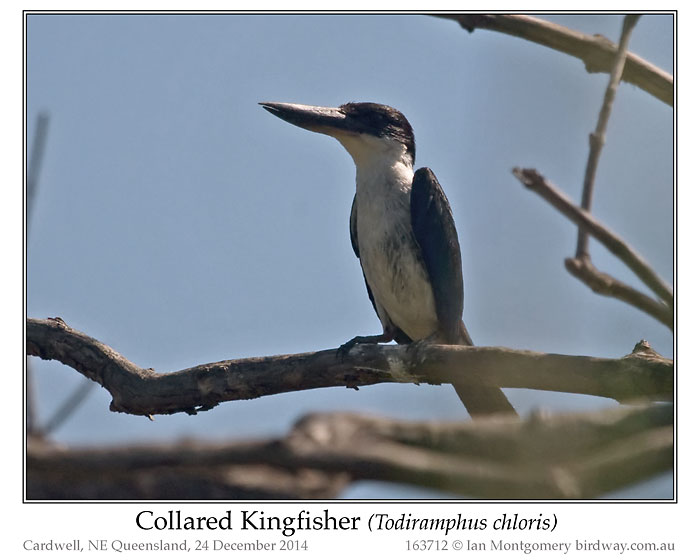
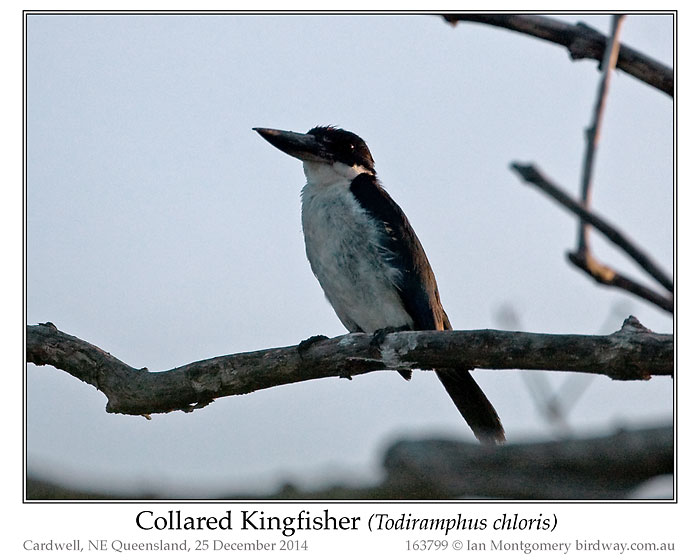
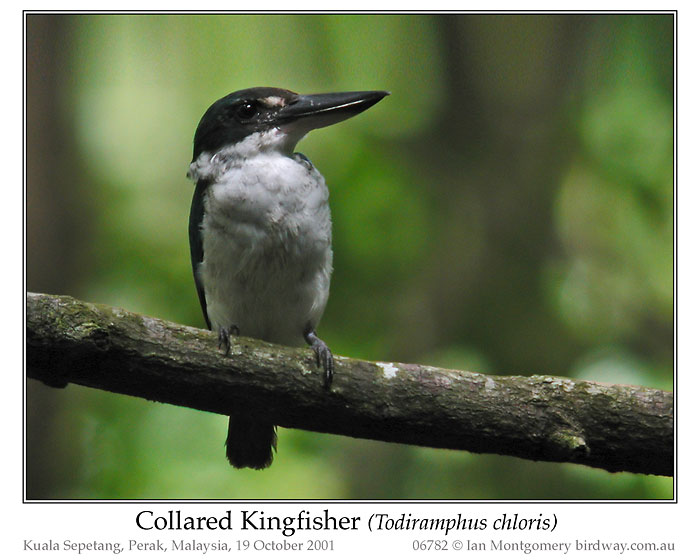
Ian’s Bird of the Week – Collared Kingfisher

Ian’s Bird of the Week – Collared Kingfisher ~ by Ian Montgomery

Newsletter ~ 12-30-14

The first photo shows a present from Santa that I want to share, taken late in the afternoon on Christmas Day: a Collared Kingfisher This species is the only one of the ten Kingfishers and Kookaburras normally found in Australia that hasn’t featured as bird of the week. It’s a close relative of the Sacred Kingfisher, but larger with a much heavier bill. In Australia it is almost exclusively a dweller of mangroves and feeds mainly on crustaceans such as crabs with a carapace width up to 2cm: hence the shell-crunching beak, it’s best field mark.

Common Kingfisher (Alcedo atthis) by Ian

Because of its preference for mangroves and because it’s not very common, I’ve found it a difficult species to photograph in Australia. Often the only access to mangroves is on boardwalks, so you can’t get close to anything that’s not close to the boardwalk and, even if you can, you usually can’t get an uninterrupted view in the dense vegetation. In fact, the only tolerable Australian photo that I had was one I took in Darwin in 2004 where there is a walking track into mangroves from Tiger Brennan Drive.


Common Kingfisher (Alcedo atthis) by IanWhen I pass through Cardwell travelling north towards Innisfail and Cairns, I always stop there as it’s a lovely place where the highway runs along the beach front with views of Hinchinbrook Island and a convenient 90 minutes from home. There’s a rest area at the southern end of town close to a patch of mangroves that regularly produces interesting birds. It was badly damaged by cyclone Yasi four years ago, but is now recovering and the path through the mangroves from the rest area to Port Hinchinbrook has been restored.

In early November, I saw a Collared Kingfisher perched in the open on a dead mangrove near the rest area; it was low tide and the bird was presumably looking for dinner on the mudflat. I didn’t get a photo of it – camera malfunction – but looked again on Christmas Eve on the way north and heard and then found one on a different perch in the middle of the mangroves. I got only the quick, back-lit, get-it-before-it-flies-away shot, second photo, before it did exactly that and I didn’t see it again.

Common Kingfisher (Alcedo atthis) by Ian

I returned home on Christmas Day and had another look, as the tide was going out and I hope that this would attract the bird into a more open position for a late feed. Just before I was about to give up, I heard the bird calling and found it perched near the beach. I got some distant shots, but when I approached it it flew over my head and returned to exactly the same back-lit spot where it had been on Christmas Eve. If you compare photos two and three, you can see from the guano stains on the branch that it is only a couple of centimetres apart on the two occasions. Clearly a bird of habits. This time, it tolerated my approach, and allowed me to leave the path, squelch through the mangroves and get around behind it where I took the first photo. Austral

Common Kingfisher (Alcedo atthis) by Ian

I’ve qualified some comments with ‘in Australia’. This species also ranges quite widely through Asia, and in some places it is found in many other habitats including suburban gardens and forested areas along rivers. I had no trouble photographing three in the space of week in Singapore and Malaysia, fourth photo, in 2001. These Asian birds belong to different races from the Australian ones and their taxonomy is very confused, with about 50 subspecies being currently recognized. The Malaysian and Australian races have white underparts but some others, particular those in the Pacific Islands east of New Guinea are quite buff, and some taxonomists think they should be transferred to the Sacred Kingfisher. The calls vary by location too. In Australia the usual contact call is a distinctive two note ‘kek KEK’, with the emphasis on the second one.

I hope Santa brought you what you wanted too.
Happy New Year!

Ian

**************************************************
Ian Montgomery, Birdway Pty Ltd,
454 Forestry Road, Bluewater, Qld 4818
Tel 0411 602 737 ian@birdway.com.au
Bird Photos http://www.birdway.com.au/


Lee’s Addition:

“And Jesus, walking by the sea of Galilee, saw two brethren, Simon called Peter, and Andrew his brother, casting a net into the sea: for they were fishers. And he saith unto them, Follow me, and I will make you fishers of men. And they straightway left their nets, and followed him.” (Matthew 4:18-20 KJV)

It is always enjoyable to happen upon a bird that is not always easy to find. Of course, when you bring out a camera, you never know if they will stay long enough to get a photo or not. Personally, for me, they seem to scatter. I am glad Ian was able to capture this beautiful Kingfisher’s photo.

You can see Ian’s Kingfisher photos here:

Collared Kingfisher

Sacred Kingfisher

Whole Kingfisher Family

and also enjoy many of his adventures here:

Ian’s Bird of the Week

Kingfishers – Alcedinidae – Whole Family

*

Ian’s Bird of the Week – Squatter Pigeon

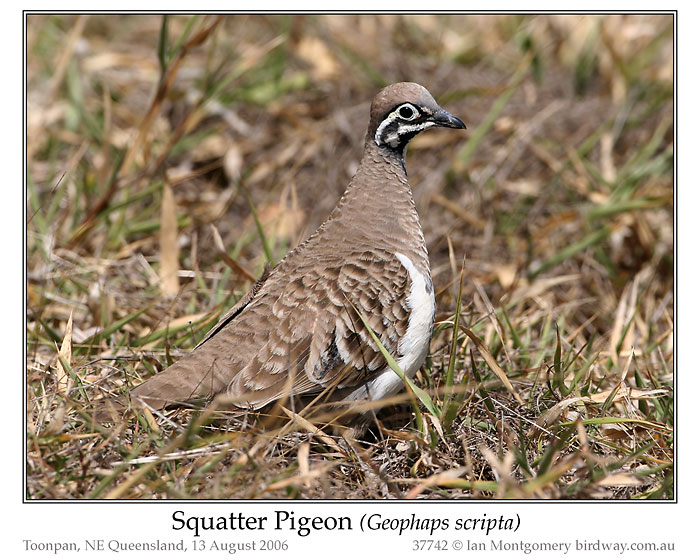
Squatter Pigeon (Geophaps scripta) by Ian

Ian’s Bird of the Week – Squatter Pigeon

~ by Ian Montgomery

Newsletter – 12-18-14

The series of raptors from Europe is perhaps a hard act to follow, so here is something quite different from much closer to (my) home: the Squatter Pigeon,an attractive ground pigeon not uncommon in the drier areas of northern Queensland. Its range used to extend to northern New South Wales, but it is very rare or extinct there and has declined in southern areas of Queensland. The reasons for its decline are not clear but is thought to be due to grazing pressure and perhaps predation by foxes and feral cats.

Toonpan, a short drive south of Townsville on the Flinders Highway is a good spot for this species. When Ross River Dam was built, part of the highway between Toonpan and Townsville was flooded and a new highway was built on higher ground. The old highway still exists and is a quiet roadway through grassland, popular with birders. The habitat in the second photo – taken from the ebook Where to Find Birds in North Queensland – may look uninspiring, but can be very productive often producing other such specialties such as Australian Bustard, various finches including Black-throated and, in winter on powerlines, Red-backed Kingfishers.

Mt Elliot from Old Flinders Highway, Toonpan, by IanIt’s not clear where the name Squatter Pigeon came from, presumably either from its habit of crouching and freezing when disturbed or because of its association with the cattle stations, the original occupants of which were called squatters. It was originally named by the Dutch zoologist Temminck in 1821 and he seemed very taken with it. Like Bonelli in the previous Bird of the Week, he published in French, calling it the Colombe marquetée and describing how each patch of white on the face was framed with black, producing an effect like ‘a sort of marquetry. He gave it the scientific name Geophaps scripta, meaning ‘ground pigeon with writing’, ‘phaps’ being the Greek for pigeon. Temminck, incidentally, named many species of animals and various others were named in his honour, such a Temminck’s Stint.

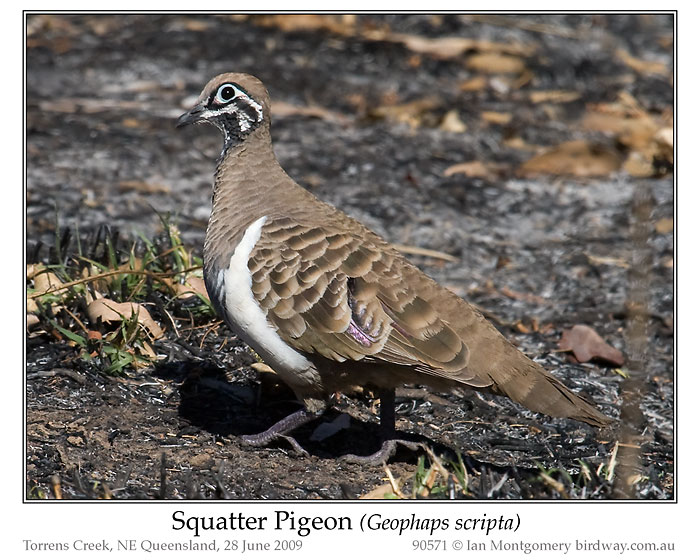
Squatter Pigeon (Geophaps scripta) by Ian

Sometimes you can see the iridescent feathers on the wing, third photo, a display feature shared with other ground pigeons notably the Bronzewings These feathers are usually hidden in Squatter Pigeons except in display and flight. The body shape is broken up by the white stripe between the breast and the wings, and the black and white facial markings disguise the head and make the eye less conspicuous. Squatter Pigeons nest in a scrape on the ground, so camouflage is important and it is easy to appreciate that a motionless bird crouching on the ground would be quite hard to spot.

Squatter Pigeon (Geophaps scripta) by Ian

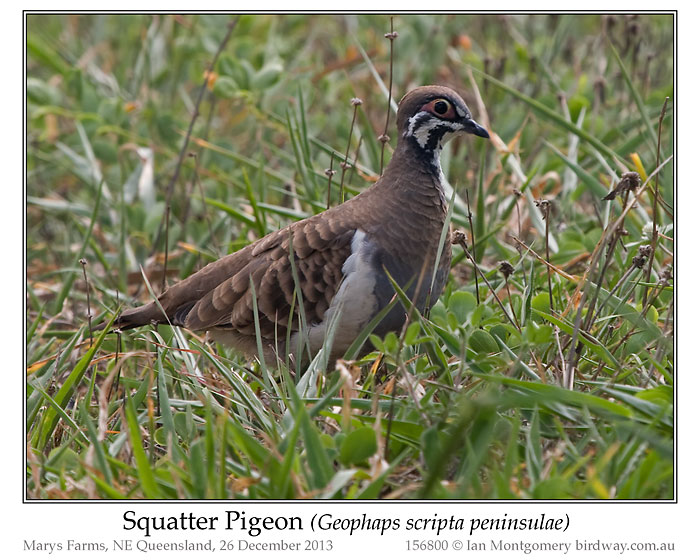
If you look carefully at both bare facial skin of both the Toonpan bird and the one in the third photo taken much farther west along the Flinders Highway, you’ll see the the skin is mainly pale blue around the eye with some pink at the edges in front and behind the eye. Two races of Squatter Pigeon have been described, with the nominate southern race having completely blue facial skin – fourth photo near Carnarvon Gorge – and a Cape York race peninsulae having reddish facial skin. The two races are not geographically well-defined and there is a broad band of intergradation with mixed blue and pink in the Townsville area.

Squatter Pigeon (Geophaps scripta) by Ian

Photos five and six show examples of the Cape York race. Both Marys Farms and the Mitchell River catchment are in the Mount Carbine district south of Cape York proper. The bird in the last photo is perched fairly high in a tree, just to prove that it will sometimes take refuge in trees.

Squatter Pigeon (Geophaps scripta) by Ian

It is the blue-faced southern race that has declined most and is regarded as ‘vulnerable’. The Cape York race and the hybrids in the Townsville district are still reasonably common. The Partridge Pigeon, G. smithii, replaces it in northwestern Australia. It also has races with different coloured faces, red in the Top End of the Northern Territory and yellow in the Kimberley district of northern Western Australia. It has also declined. Although I have seen it in Kakadu National Park I haven’t yet photographed it.

Greetings
Ian

**************************************************
Ian Montgomery, Birdway Pty Ltd,
454 Forestry Road, Bluewater, Qld 4818
Tel 0411 602 737 ian@birdway.com.au
Bird Photos http://www.birdway.com.au/
Recorder Society http://www.nqrs.org.au


Lee’s Addition:

“Behold, I send you forth as sheep in the midst of wolves: be ye therefore wise as serpents, and harmless as doves. (Matthew 10:16 KJV)

I like the markings on their faces. They are interesting, yet, it doesn’t keep them from being camouflaged.

The Squatter Pigeons belong to the Columbidae – Pigeons, Doves Family. (Only bird named Squatter in IOC 4.4 list)

“The Squatter Pigeon (southern) is a medium-sized, ground-dwelling pigeon that measures approximately 30 cm in length and weighs about 190-250 g. The adults are predominantly grey-brown, but have black and white stripes on the face and throat, blue-grey skin around the eyes, dark-brown (and some patches of iridescent green or violet) on the upper surfaces of the wings, blue-grey on the lower breast and belly, white on the lower region, flanks of the belly and extending onto the under surfaces of the wings, and a blackish-brown band along the trailing edge of the tail. They have black bills, dark-brown irises, and dull-purple legs and feet. The sexes are similar in appearance (Higgins & Davies 1996).

Juvenile Squatter Pigeons (southern) can be distinguished from the adults by their duller colouring, the patchy, less distinctive appearance of their black and white facial stripes, and the paler colouring (buff to pale-yellow) of the facial skin (Higgins & Davies 1996).

The southern and northern subspecies of the Squatter Pigeon are virtually identical except the southern subspecies tends to be slightly larger in the body, and the skin around the eyes is predominantly blue-grey compared to yellowy-orange to orange-red in the northern subspecies (Crome 1976b; Ford 1986; Higgins & Davies 1996; Squatter Pigeon Workshop 2011).” (from Australian Government)

*

Found a YouTube of Squatter Pigeons

*

Ian’s Bird of the Week – Great Frigatebird

Great Frigatebird (Fregata minor) Male by Ian

Ian’s Bird of the Week – Great Frigatebird ~ by Ian Montgomery

Newsletter – 8/28/14

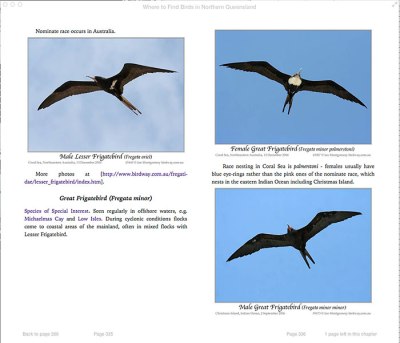
This week’s good news is that the ebook Where to Find Birds in Northern Queensland is now available on the iTunes store (in 51 countries). So if you have an iPhone, iPad, iPod Touch or Mac (running OS X Maverick) this is for you! Here is the link: https://itunes.apple.com/au/book/where-to-find-birds-in-northern/id912789825?mt=11&uo=4. To make a connection with this week’s bird, the Great Frigatebird, here is a screen shot from iBooks to show you what you can expect. All the text items highlighted in purple and links to either other places in the book – typically places, birds or lists – or external websites. The images are the same size as the ones that are included in the bird of the week, so if you double-click, or double-tap, on them, you can enlarge them to full size.
Great Frigatebird (Fregata minor) by Ian

If you think about birds in northern Queensland, perhaps iconic rainforest species like the Cassowary or Victoria’s Riflebird come to mind. Fair enough, but there is much more to this region than rainforest, important though that is.The area also has wonderful wetlands, tropical savannah forest, mountain ranges, dry country habitats and, last but not least, the coast with its Barrier Reef, beaches, mangroves, mudflats, continental islands and coral cays. So it should be no surprise that over 400 species of birds occur here and you need a reference devoted to the region to do it justice. I’ve chosen a dramatic seabird to make the point.

The term ‘frigate’ was first applied in the 17th century to warships built for speed and manoeuvrability and frigates were often used by pirates to attach merchant shipping. Frigatebirds, also called Man o’ War Birds, got their name for their piratical habitats of harrying other seabirds like boobies and tropicbirds to make them drop their prey. In fact, studies have shown that piracy accounts for perhaps only 20% of their food, and they are expert fishers as well. They fish by snatching prey, such as squid and young turtles, from the surface of the sea or in flight, in the case of their favourite prey, flying fish.

Great Frigatebird (Fregata minor) Female by Ian

Despite their naval name, frigatebirds are wonderfully adapted for flying and are poor swimmers to the extent that they are reluctant to land on water, as they can take off only in strong winds and their plumage is not waterproof. They have very light bones making up only 5% of the body, huge pectoral muscles, enormous wing area, long forked tails for rudders and streamlined bodies with small heads. Despite their size, they are very light, soar effortlessly in good winds and are very acrobatic. Female Great Frigatebirds, larger than males, are about 1m/40in long, have a wingspan to 2.3m/90in but weight only 1.2-1.6kg/2.6-3.5lb.
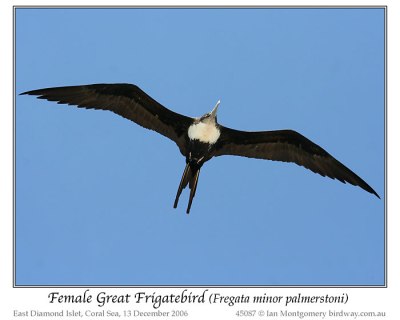
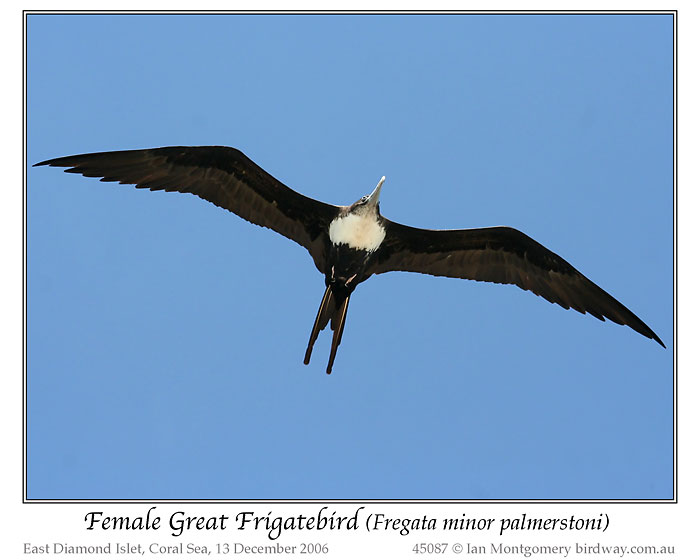
Great Frigatebird (Fregata minor palmerstoni) Female by Ian

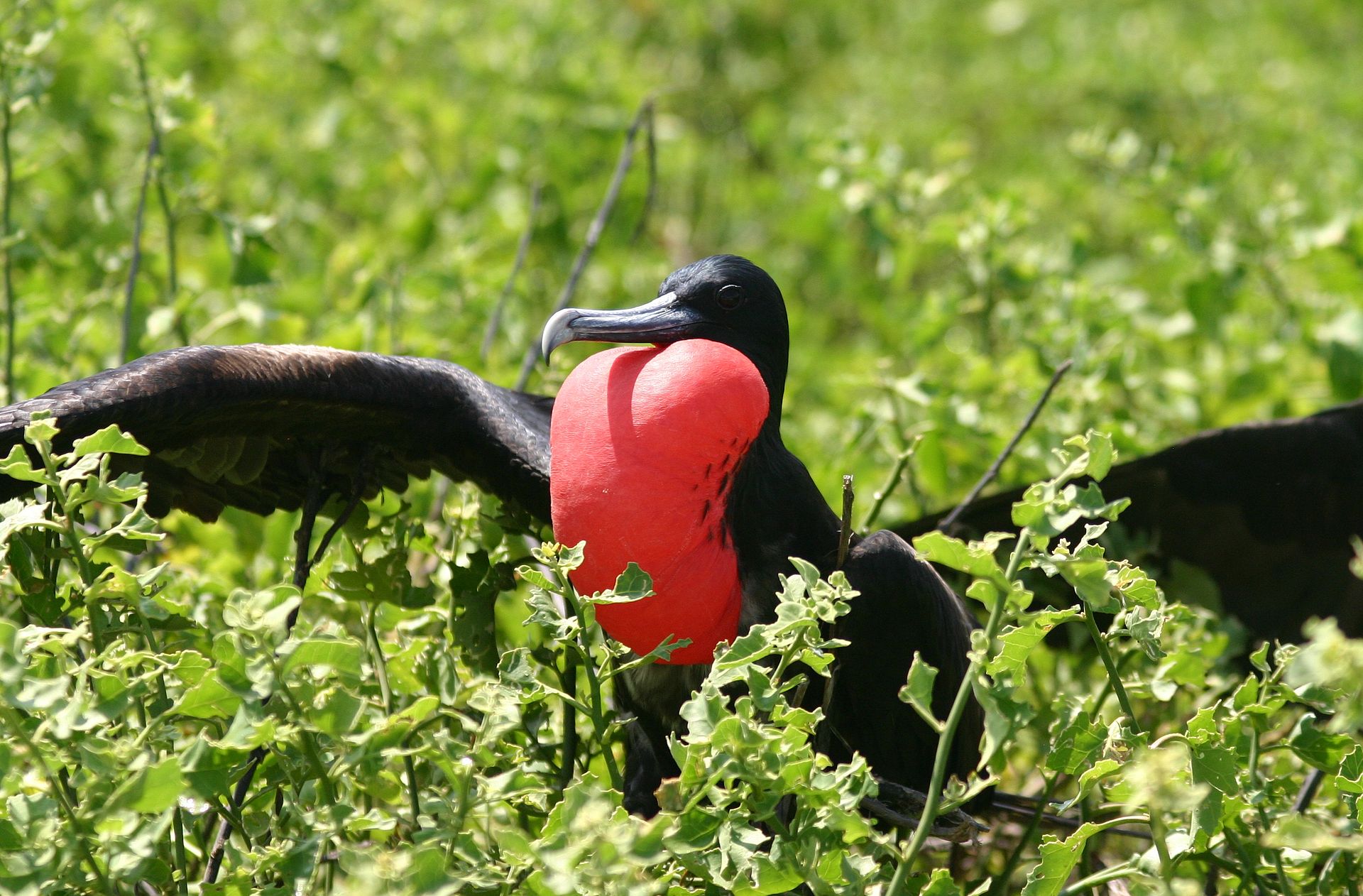
The male Great Frigatebird, first photo, is the only all-black frigatebird occurring in Australia – the other all-black males are the Magnificent Frigatebird of Atlantic Ocean and the eastern Pacific and the Ascencion Frigatebird of the east Atlantic. Frigatebirds are unusual among seabirds in drinking freshwater if they can get it, and this male is drinking at the mouth of freshwater stream on Christmas island by snatching a beak-full of water in flight. Frigatebirds also bathe in flight by splashing into the surface of the water and flying off. You can also see its red gular pouch. This is inflated to enormous size to impress females during courtship. I haven’t got a photo of displaying Great Frigatebird, but you can see a Magnificent Frigatebird doing so here: Magnificent_Frigatebird.
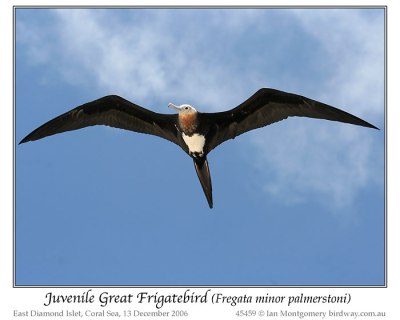
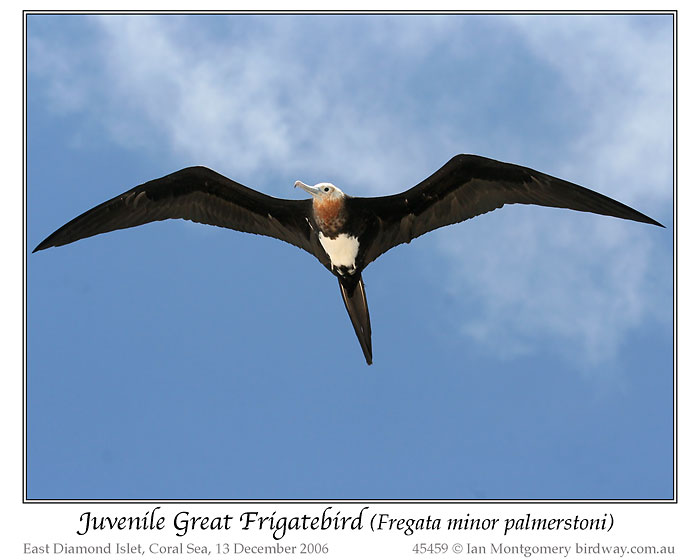
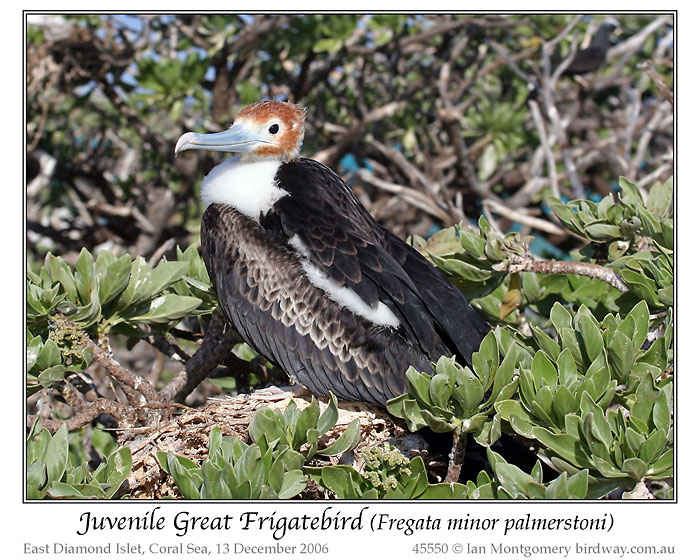
Great Frigatebird (Fregata minor palmerstoni) Juvenile by Ian

Female Great Frigatebirds have white breasts and care needs to be taken in distinguishing them from other female and juvenile frigatebirds – Lesser Frigatebirds of both sexes have white ‘spurs’ in the axil of the underwing, and Christmas Island Frigatebirds of both sexes, have white bellies. Birds in Indian Ocean waters in Australia belong to the nominate race minor, distinguished by the females having pink eye-rings, second photo. Birds in the Pacific belong to palmerstoni and usually have blue eye-rings, third photo, though doubt exists as to the validity of the races and the reliability of the fieldmarks.
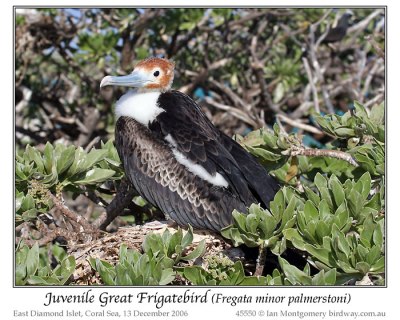
Great Frigatebird (Fregata minor palmerstoni) Juvenile by IanBecause of their need for consistent winds, frigatebirds are restricted to tropical waters where they can rely on the trade winds. Adults are sedentary and remain close to their roosting sites and breeding colonies, mostly on small isolated islands. Non-breeding birds and immature birds are pelagic and move over huge distances. Trade winds are unusual in that they form cumulus clouds and hence thermals over water both by day and night, and frigatebirds make great use of these to soar as high as the cloud base and will fly at night if conditions are right. Pelagic frigatebirds use the front of storms to move around and can cope with high winds very well. This is why they appear in coastal areas after cyclones and are supposed to be called ‘rain-brothers’ by Australian aborigines, though I haven’t been able to verify this.
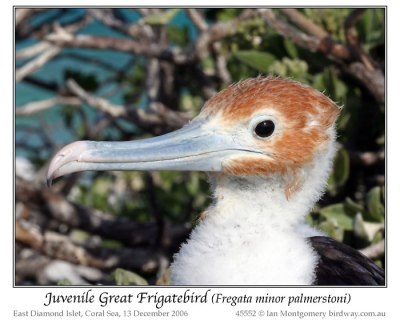
Great Frigatebird (Fregata minor palmerstoni) Juvenile by IanThe range of the Great Frigatebird includes the tropical Pacific, southern tropical Indian and western Atlantic Oceans. In Australia it breeds colonially on islands along the outer Great Barrier Reef, in the Coral Sea and on Christmas and Cocos (Keeling) Islands in the Indian Ocean, usually in mangroves. The juvenile in photos five and six was photographed on East Diamond Islet, about 600km east of Cairns http://www.satelliteviews.net/cgi-bin/w.cgi?c=cr&UF=34304&UN=456541&DG=ISL. Breeding birds form pair bonds and both parents share in the incubation and feeding of the young. The young develop very slowly. This is thought to adapt them to periods of starvation when the adults have trouble finding food, and remain under parental care for many months.

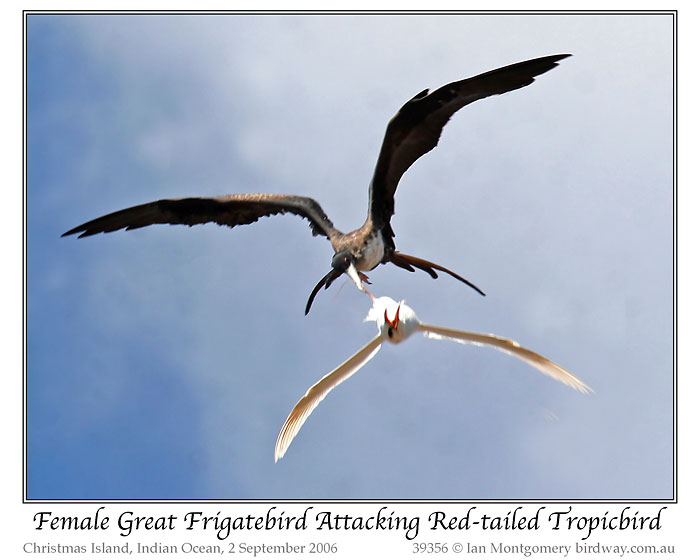
Great Frigatebird (Fregata minor) Female attacking Red-tailed Tropicbird by IanThe last photo shows a hapless Red-tailed Tropicbird near Christmas Island being harried by a female Great Frigatebird who has grabbed it by the tail-streamers. Frigatebirds hang out near seabird colonies waiting for birds carrying prey or with full crops returning to feed their young. It’s hard enough work being a parent without having to put up with this!

Greetings
Ian

**************************************************
Ian Montgomery, Birdway Pty Ltd,
454 Forestry Road, Bluewater, Qld 4818
Tel 0411 602 737 ian@birdway.com.au
Bird Photos http://www.birdway.com.au/
Recorder Society http://www.nqrs.org.au
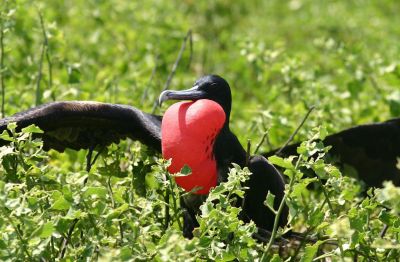

Great Frigatebird (Fregata minor) Male Displaying ©WikiC

Great Frigatebird (Fregata minor) Male Displaying ©WikiC

Lee’s Addition:

but those who trust in the LORD will renew their strength; they will soar on wings like eagles; they will run and not grow weary; they will walk and not faint. (Isaiah 40:31 HCSB)

Thanks again, Ian, for introducing us to another interesting bird. We have seen the Magnificent Frigatebirds here in Florida, but these Great ones are also amazing. That fact about only 5% of their weight being the bone structure is another fantastic design from their Creator.

Frigatebirds belong to the Fregatidae – Frigatebirds Family which only has five species in it.

*
Ian’s Bird of the Week

Ian’s Bird of the Week – Lesser Frigatebird

Fregatidae – Frigatebirds Family

Great Frigatebird – Wikipedia

*