AWESOME BIRDS OF THE PHILIPPINES ! – Re-Post

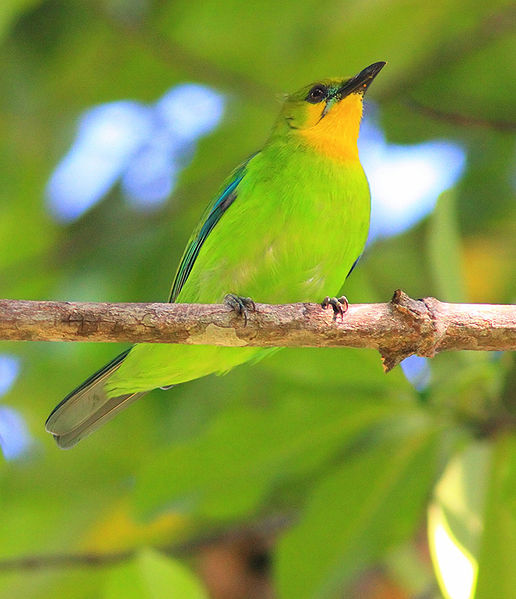
Yellow-throated Leafbird (Chloropsis palawanensis) @WikiC

Yellow-throated Leafbird (Chloropsis palawanensis) @WikiC

David Cabedo, who visits this site frequently, posted this article with the video on Philippines Birdwatching. It is fantastic. After showing the area of the Philippines, it then starts showing one bird after another that are in that area. Thanks, David, for finding and posting the YouTube. It is entitled, Avian Archipelago – Birdwatching in the Philippines” by avianarchipelago.

Enjoy!

*

*

He has made His wonderful works to be remembered; The LORD is gracious and full of compassion. (Psalms 111:4 NKJV)

See:

Philippine Birdwatching

Birds of the World

*

Birds of the Bible – Details

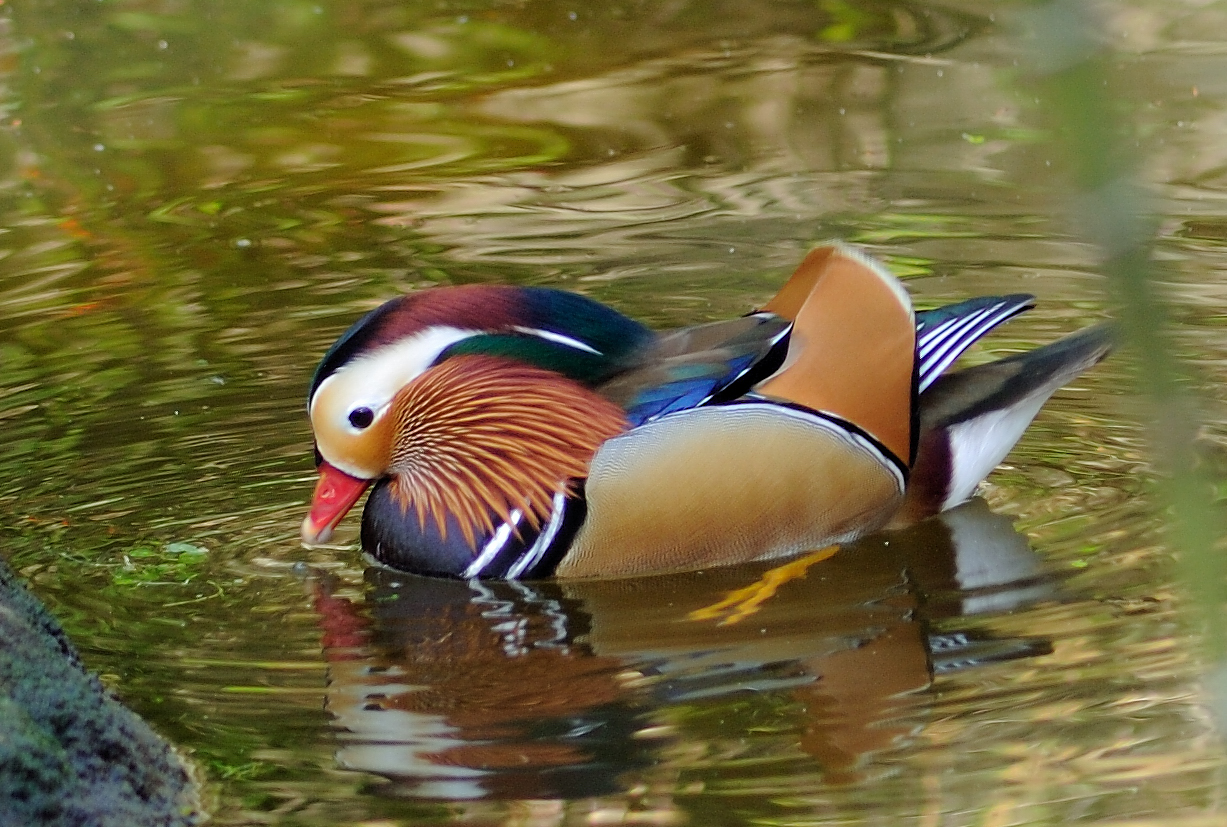
Mandarin Duck (Aix galericulata) by Dan

Mandarin Duck (Aix galericulata) by Dan

Currently, I am reading through Leviticus. When I cam to the Tabernacle, my first thoughts were, “Here we go again” with all the details about how to make it. The LORD gave Moses the details and then he shared those details with all the workers and skilled craftsmen as to how it was supposed to be prepared. It includes down to the number of rings to hold the curtains, like 50 on this side and 50 on that side, etc. The colors Gold, Blue, Purple and Scarlet are constantly mentioned.

Details, details, details. I stopped grumbling when I thought about how the LORD in His creative acts was so, “detailed.” Much of the Bible gives us details about God, the Lord, and the Holy Spirit.It is one of God’s attributes that He is so omnipotent, omniscient, understanding, etc. because He does know all the “details.”

For since the creation of the world His invisible attributes are clearly seen, being understood by the things that are made, even His eternal power and Godhead, so that they are without excuse, (Romans 1:20 NKJV)

We are told to look around us to observe creation and we can see His attributes. Think of just the birds. Are they not each different and made with so much detail. So, here is my attempt to share with you some of the neatly “detailed” birds in a slideshow. My first thoughts were of the Mandarin Duck with its lines and marks. Looks like a paintbrush was used by the Hand of our Creator. I have been trying to think of a bird that is gold, blue, purple and scarlet, but so far, it allude me. (The Mandarin Duck is close)

This slideshow is only featuring the colors and feather designs, but how about all the bills, feet, and other aspects of the birds? Enjoy these beautiful birds. (Thanks to all those who took the photos also.)

This slideshow requires JavaScript.

*

(I hardly got to the Passerines. Sorry)

See:

Birds of the Bible

Falling Plates

*

Ian’s Bird of the Week – Letter-winged Kite

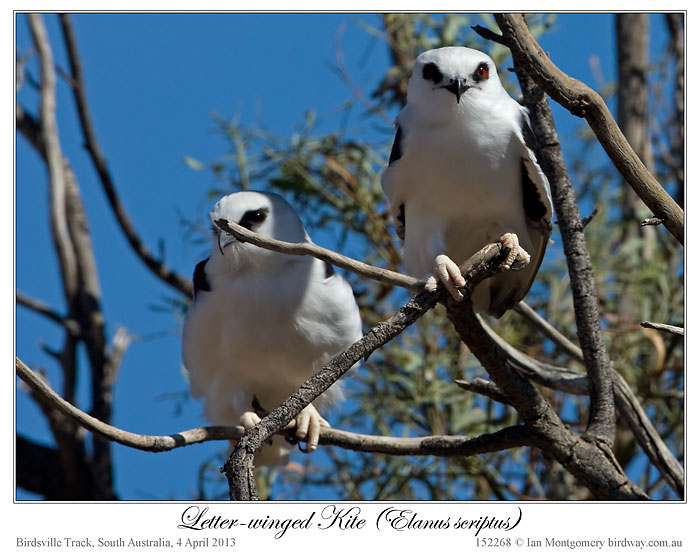
Letter-winged Kite (Elanus scriptus) by Ian 1

Letter-winged Kite (Elanus scriptus) by Ian 1

Ian’s Bird of the Week – Letter-winged Kite ~ by Ian Montgomery

Newsletter ~ 4/18/13

For all you patient bird of the week recipients, here is I hope a bird worth waiting for, the Letter-winged Kite, star attraction on the recent trip along the Birdsville Track in Northwestern South Australia.

The Letter-winged Kite saga that had its resolution here started in the 1970s when I was living in Surry Hills in inner city Sydney. One evening, I was walking around to the local pub, the Cricketers Arms, on Fitzroy Street a block away from busy South Dowling Street when I found a pair of Letter-winged Kites, unfazed by the traffic, landing in a small tree on the pavement. The L-shaped markings under the wing were clearly visible, so there was no doubt about the identification – I was going to the pub, not tottering home afterwards – no matter how unlikely the location for this species, usually more at home in the semi-desert of Central Australia.

I supposed at the time that they were escaped birds. I found out only later that not only are these Kites nocturnal, but that they spread far and wide in search of food from their usual, arid, home following the population crash that follows plagues of their main prey, the Long-haired Rat. Come to think of it, the rather arid open spaces of Moore Park lie on the other side of South Dowling Street, and I’m sure there are plenty of ordinary rats in Surry Hills.

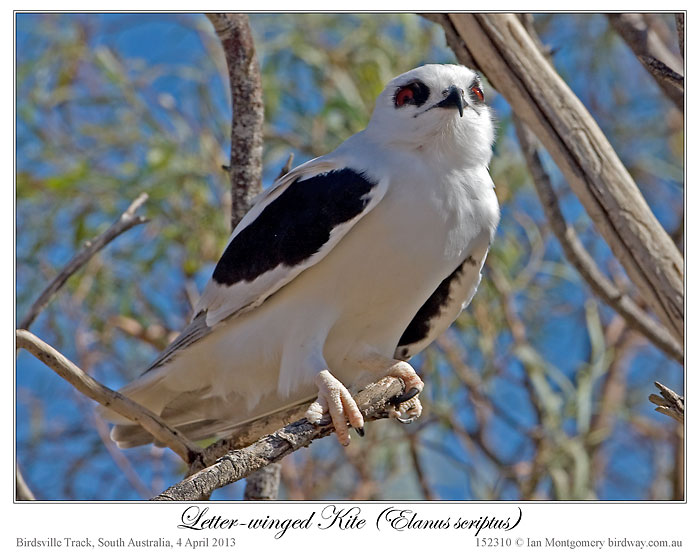
Letter-winged Kite (Elanus scriptus) by Ian 2

Letter-winged Kite (Elanus scriptus) by Ian 2

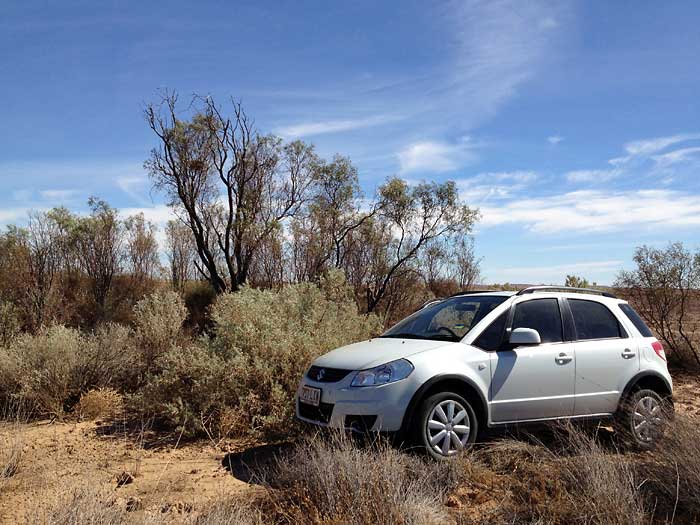
Ordinary people drive the 500km of dirt road that constitutes the legendary Birdsville Track from Birdsville in Southwestern Queensland to Marree in Northeastern South Australia (and the parallel Strzelecki Track) for the experience. Birders do it to search for elusive dry country birds, particularly the Letter-winged Kite and the Grey Falcon and both of these were top of my wanted list on this trip. Letter-winged Kites roost in trees by day, so I searched the few trees – nearly all in creek beds – along the Birdsville Track until, 252km south of Birdsville I spotted a couple of suspects, screeched to a halt in a cloud of dusk and approached them in the car. Birders have 4WD vehicles, such as my modest Suzuki SZ4, mainly so that they can use them as mobile bird hides as most birds are more tolerant of vehicles than pedestrians.

Letter-winged Kite (Elanus scriptus) by Ian 3

Letter-winged Kite (Elanus scriptus) by Ian 3

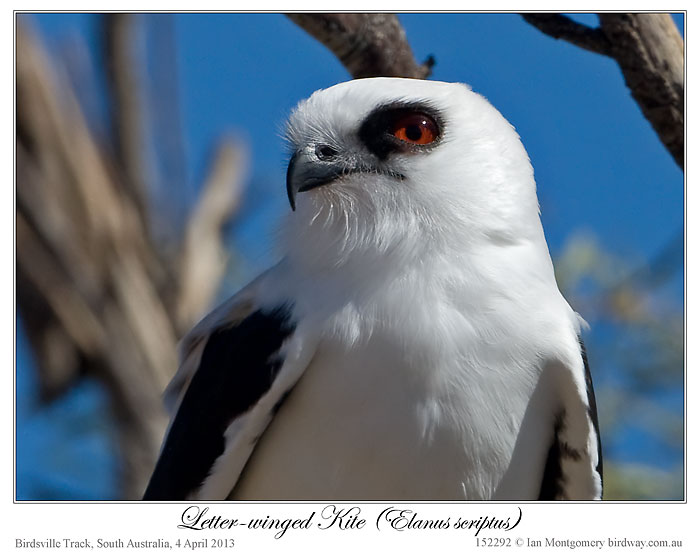
Letter-winged Kites indeed they were, but the tree was a tangle of branches and the sun was shining from behind the tree. The birds, however, seemed as unfazed by the traffic (relatively speaking) as the ones in Fitzroy Street, and let me approach to take the first photo (good lighting angle, bad branches), second photo (bad angle, good branches). Then they waited while I changed the lens from the 100-400mm to the 500mm and, eventually, looked on tolerantly while I got out of the car and did a relative close-up (third photo) and a portrait (fourth photo).

Letter-winged Kite (Elanus scriptus) by Ian 4

Letter-winged Kite (Elanus scriptus) by Ian 4

I then walked away to take a photo of the tree, the birds and a nest (I don’t know whether it was theirs) and turned around to find that they had silently vanished. If it hadn’t been for the photos definitely still on the SD card, the event might have all have been a fantasy. So I made do with a photo of the tree, the nest and the mobile bird hide, below.

 Letter-winged Kite (Elanus scriptus) by Ian 5

Letter-winged Kite (Elanus scriptus) by Ian 5

The Strzelecki Track is actually supposed to be better for Letter-winged Kites than the Birdsville, but, having found these birds, we decided to change our return travel plans from Plan B1 to Plan B2, skip the Strzelecki (similar landscape, worse road), spend a few days in the Flinders Ranges and drive home via Broken Hill, Bourke and Bowra (B2), instead of Birdsville, Bedourie and Boulia (B1).

Best wishes
Ian

**************************************************
Ian Montgomery, Birdway Pty Ltd,
454 Forestry Road, Bluewater, Qld 4818
Tel 0411 602 737 ian@birdway.com.au
Check the latest website updates:
http://www.birdway.com.au/#updates


Lee’s Addition:

And the glede, and the kite, and the vulture after his kind, (Deuteronomy 14:13 KJV)

What an awesome bird. They are beautiful. Thanks, Ian, for sharing another of your birdwatching adventures with us. His photography is fabulous also. I love that close-up in #4. Wow!

The Letter-winged Kite (Elanus scriptus) is a small, rare and irruptive Australian raptor with a core range in central Australia. The adult is a small and graceful, predominantly pale grey and white, raptor with black shoulders and red eyes. It is similar in appearance to the Black-shouldered Kite except for a very distinctive black underwing pattern of a shallow ‘M’ shape, seen when in flight. Roosting during the day in well-foliaged trees and hunting at night, it is the world’s only fully nocturnal raptor. Like all the elanid kites, it is a specialist predator of rodents, which it hunts by hovering in mid-air above grasslands and fields. (Wikipedia)

They belong to the Accipitridae Family . Check out all Ian’s Family Photos and then see the complete Accipitridae – Kites, Hawks and Eagles family list here.

See Also:

Ian’s Bird of the Week

White-tailed Kite ~ 1-7-11

Whistling Kite ~ 5-31-10

Birds of the Bible – Glede and Kites

*

Birds of the Bible – Coat of Many Colors II

Sunset Lorikeet (Trichoglossus forsteni) ©WikiC

Sunset Lorikeet (Trichoglossus forsteni) ©WikiC

Now Israel loved Joseph more than all his children, because he was the son of his old age: and he made him a coat of many colours. (Genesis 37:3 KJV)

After I finished the Birds of the World – Kingfishers, Australasian Warblers, White-Eyes and Doves article last week, I decided to finish up the Psittacidae – Parrots Family. I still needed 150 photos or drawings to complete the 363 species needed. Well, last night, it was finished and at 100% for images.

Looking at all those Parrots and others in the family, they definitely have “Coats of Many Colors” also. Just wanted to share their beautifully created plumage also. Most of us are familiar with parrots and parakeets. Many have them as pets or have seen them in the wild. So you are sort of familiar with them, but I am sure as you view the slideshow, you will see many that you haven’t seen before.

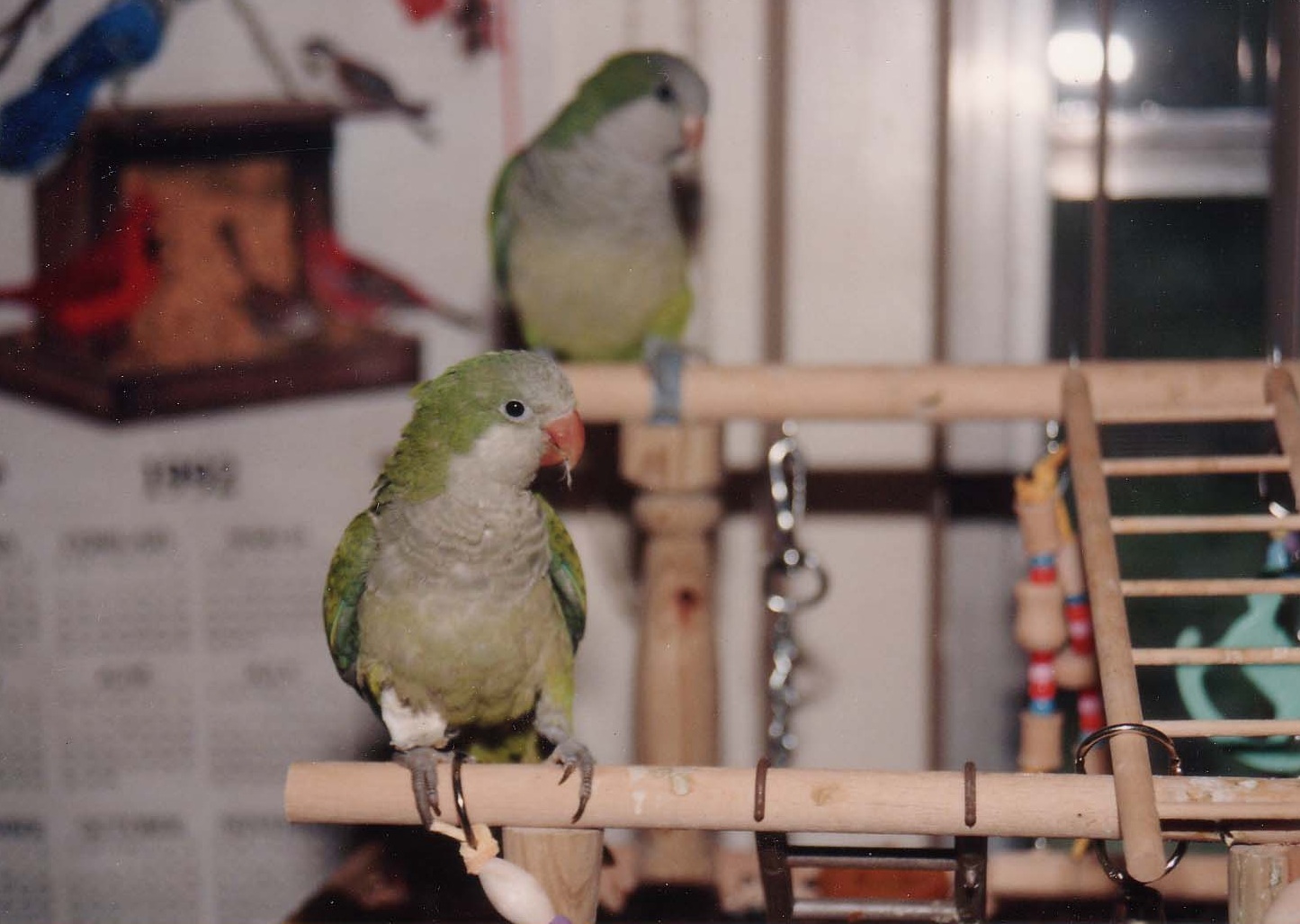
I also want to share the only birds I had personally. My preference is that the birds roam free, or are being kept from extinction in zoos or other similar situation. There is nothing wrong with having a pet, but I am just stating my preference. We ended up with two Monk Parakeets when we lived in south Florida. They are wild down there (up here also), but one day the neighbor boys came to my door and told me about an injured Monk Parakeet. A teenager had shot it out of a tree and the smaller boys found it. They said, “You love birds and you will know what to do.” That began the adventure with my bird. I had never kept a bird in my life, but knew that my veterinarian was also a bird vet. Long story short, I ended up with a one-winged bird that could never go back to the wild. My “free bird” ended up costing over $200 for vet bills. (This was over 20 years ago). Dan wanted to call it “One-armed Bandit” because it cost me so much, but I took the “t” off of “Bandit” and it became “Bandi.” I think it was a “she” because she was so sweet.

Well a year later, my friend bought two Monks and told me there was one more, but it had a deformed leg. Another long story short, I bought “Hoppy” for $25 and ended up spending another $200 getting a broken leg repaired. It was an amazing surgery the vet performed. “Hoppy” had to be a male, because he could be mischievous at times, but he learned to talk and was quite enjoyable (most of the time). The picture shows “Hoppy” with the bandage in front and “Bandi” in the background.

Monk Parakeet (Myiopsitta monachus) Hoppy & Bandi

Hoppy in front, Bandi in back – Monk Parakeet (Myiopsitta monachus)

The only two verses in Scripture, that I know of, that would apply to this would be:

For every kind of beasts, and of birds, and of serpents, and of things in the sea, is tamed, and hath been tamed of mankind: (James 3:7 KJV)

As a cage is full of birds, so are their houses full of deceit: therefore they are become great, and waxen rich. (Jeremiah 5:27 KJV)

Back to the Coats of Many Colors, below is a slideshow showing some of our beautiful and personable members of the Psittacidae – Parrots Family.

*

This slideshow requires JavaScript.

See Also:

Psittacidae – Parrots Family

Birds of the Bible – Coat of Many Colors I

Birds of the Bible 

Birds of the World

*

Birds of the World – Kingfishers, Australasian Warblers, White-Eyes and Doves

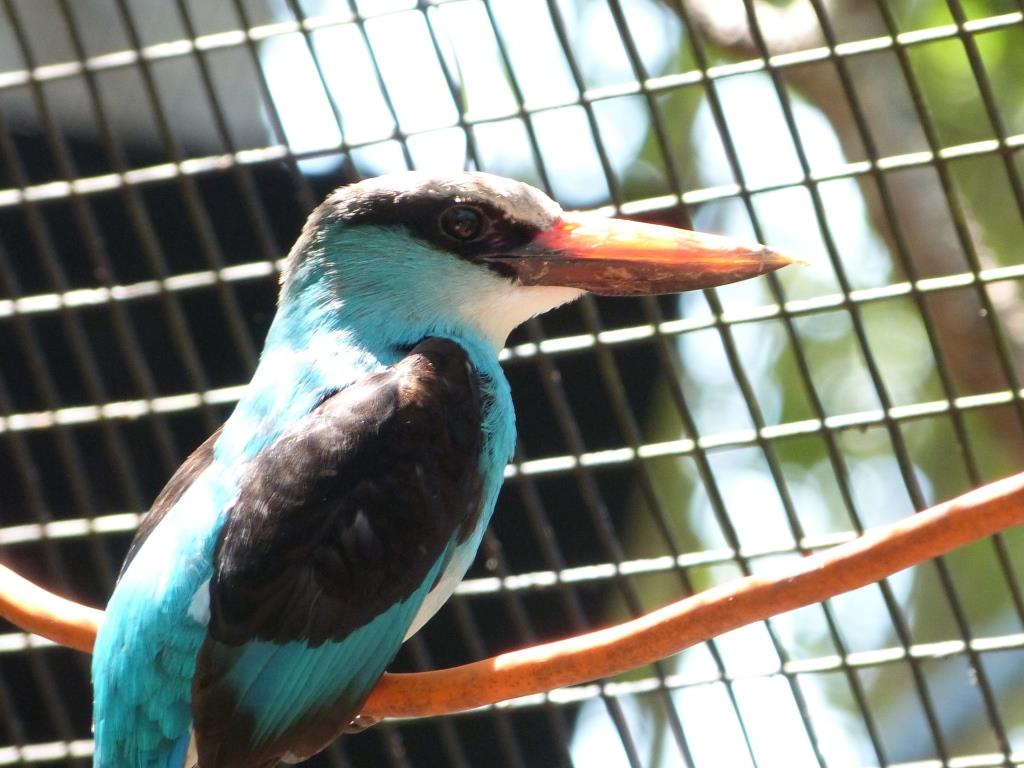
Blue-breasted Kingfisher (Halcyon malimbica) at LPZ by Lee

Blue-breasted Kingfisher (Halcyon malimbica) at LPZ by Lee – taken last week

Many, O LORD my God, are thy wonderful works which thou hast done, and thy thoughts which are to us-ward: they cannot be reckoned up in order unto thee: if I would declare and speak of them, they are more than can be numbered. (Psalms 40:5 KJV)

I have been working away on the different families of the Birds of the World. In the last few days, I was able to complete three more families at 100% and have one that needs five more images. Three of them have at least a photo or drawing of each of them. 100% done. That is a nice feeling. What beautiful birds are in those families. When the Lord created the birds, He used much variety in sizes, behaviors and colors. Even though it takes lots of time, it is enjoyable to be able to view so many of them. I am keeping an Excel spreadsheet of the families that shows each family, the number of species, how many are needed, and number seen so far. There are “10,476 extant species and 149 extinct species classified in 40 Orders,  231 Families (plus 6 Incertae Sedis) and 2268 Genera.” (IOC 3.3 Version) according to the IOC statement. Yet, when you add up the number of species of each family, they add up to 10,615. (10476+149=10,625) Somewhere there are 10 miscounted birds. Either way (10615 or 10,625), thats a lot of birds that are flying around the world for all of us to enjoy watching.

100 Percent of Images

Alcedinidae – Kingfishers – 95 Species

Acanthizidae – Australasian Warblers – 65 Species

Zosteropidae – White-eyes – 128 Species

The Pigeon and Doves have five photos that need to be found. After extensive search, they are still avoiding all the great photographers and artists out there. If any know of a source for these evaders, please leave a comment as to where to find a link to them. At least looking through these inspired the Birds of the Bible – Coat of Many Colors article.

Columbidae – Pigeons, Doves – 335 Species

** Need Photo **

  • Ryukyu Wood Pigeon (Columba jouyi †) Extinct
  • Rodrigues Pigeon (Nesoenas rodericana †) Extinct
  • Sulu Bleeding-heart (Gallicolumba menagei)
  • Mindanao Brown Dove (Phapitreron brunneiceps) 
  • Comoros Green Pigeon (Treron griveaudi)

Below are a few of the birds from each family.

This slideshow requires JavaScript.

*

Click on any of the Families to see the complete list of the species.

Alcedinidae – Kingfishers 

Acanthizidae – Australasian Warblers 

Zosteropidae – White-eyes

Columbidae – Pigeons, Doves

*

Wordless Birds

*

Birds of the Bible – Coat of Many Colors

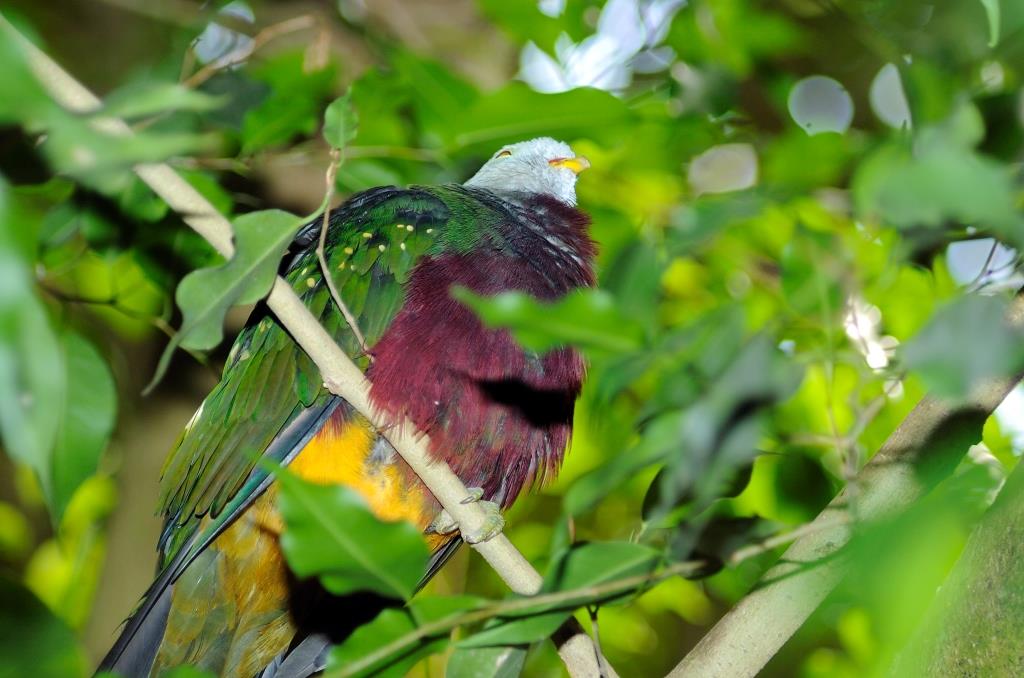
Many-colored Fruit Dove (Ptilinopus perousii) ©WikiC

Many-colored Fruit Dove (Ptilinopus perousii) ©WikiC

While working on the Columbidae – Pigeons, Doves Family, I was enjoying the Fruit Doves and their beautiful colors. Of course the verse about Joseph’s Coat of Many Colors kept crossing my mind. Then I actually found the Many-colored Fruit Dove.

Now Israel loved Joseph more than all his children, because he was the son of his old age: and he made him a coat of many colours. (Genesis 37:3 KJV)

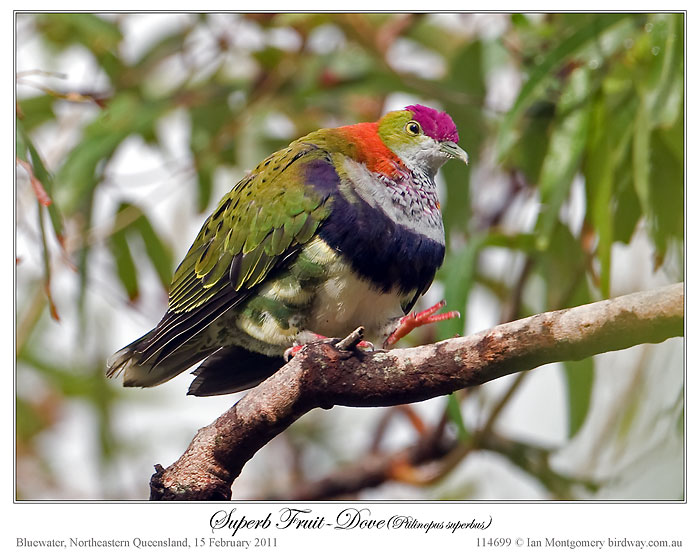
The Fruit Doves belong to the Ptilinopus genus. There are 53 Fruit Doves at present (I.O.C. 3.3) They eat fruit mostly and they may help enhance their colours, at least that is one opinion. “These small- to medium-sized doves generally have short, fan-shaped tails, and are remarkable for their colorful and often glossy plumage, as evidenced in the aptly named Orange Fruit Dove, Flame-breasted Fruit Dove, and Pink-headed Fruit Dove. Males and females of many fruit dove species look very different. For example, the female Many-coloured Fruit Dove shares the male’s crimson crown and deep pink undertail feathers, but is otherwise green, whereas the male has a crimson on the upper back and has areas of yellow, olive, cinnamon, and grey.

Wompoo Fruit Dove (Ptilinopus magnificus) by Dan at National Aviary

Wompoo Fruit Dove (Ptilinopus magnificus) by Dan at National Aviary

This is a large genus, most diverse in and around the island of New Guinea, in the Philippines, and in the biogeographical region of Wallacea. Some species have ranges as far west as the Sunda Islands, others north to Taiwan, south to Australia, and east into Polynesia.

Fruit doves, as their name implies, eat fruit — ficus is especially important — and live in various kinds of forest or woodland. Some species are restricted to primary forest, such as lowland rainforest, montane forest, or monsoon forest, while others prefer secondary forest or disturbed areas. Some species specialize in particular habitats, from lowland coastal forest to the cloud forest or moss forest of high altitudes. Some species of fruit doves are only found in habitats dominated by particular plants, such as mangrove, eucalyptus, or pandanus. Only a few species can commonly be seen around human habitation, these include the Knob-billed Fruit Dove, Makatea Fruit Dove, and Black-naped Fruit Dove, which are known to visit gardens and such.

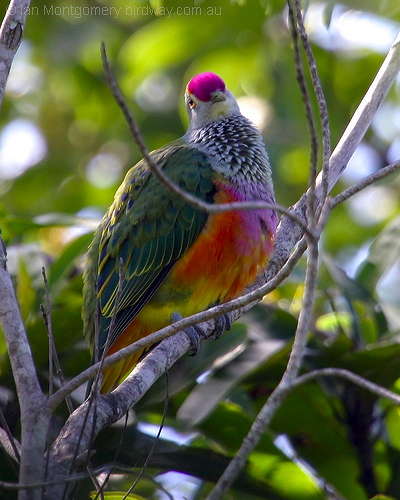
Superb Fruit Dove (Ptilinopus superbus) by Ian

Superb Fruit Dove (Ptilinopus superbus) by Ian

Much is still to be learned about fruit doves. Many species are shy and difficult to observe in their natural habitat. For example, there are several species in the Philippines, and for most of them, little or nothing is known of their breeding or nesting behavior.” (Wikipedia with editing)

We have had the privilege of seeing several of the Fruit Doves at the Zoos we have visited. They are so beautiful and colorful. Isn’t the Lord great in His providing them the ability to show off all their “coats of many colors?” I trust you will enjoy looking at the slideshow below and seeing them. These are the ones that I have permission to show. I am putting the whole list of them from the Family pages so that you can view the others.

Rose-crowned Fruit Dove (Ptilinopus regina) by Ian

Rose-crowned Fruit Dove (Ptilinopus regina) by Ian

Divers colours is only associated with one bird in Scripture and that is with an eagle:

And say, Thus saith the Lord GOD; A great eagle with great wings, longwinged, full of feathers, which had divers colours, came unto Lebanon, and took the highest branch of the cedar: (Ezekiel 17:3 KJV)

“Divers colours” is used 6 times in the King James Version, others translate that phrase as; various colors, beautiful feathers, long, colorful feathers , full of varicolored feathers, of variety,  feathers covered with spots, rich in plumage of many colors, full of plumage of embroidery, having different colors to him, multi-colored plumage, or in full plumage and bright colors.

I think those descriptions can well describe our feather colors  the Creator placed on these Fruit Doves. Doves are mentioned many times in the Bible. See the Birds of the Bible – Dove and Pigeon page.

This slideshow requires JavaScript.

****

Columbidae – Pigeons, Doves Family

Birds of the Bible – Dove and Pigeon

*

P.S. I’ll be adding more of our as I find them.

*

Seeing Pink at Circle B Bar Reserve – Gallery

Because the slideshow won’t allow larger photos, here are the photos for the Seeing Pink at Circle B Bar Reserve article in the Gallery format. Clicking any photo will begin an Image Gallery Carousel.

*

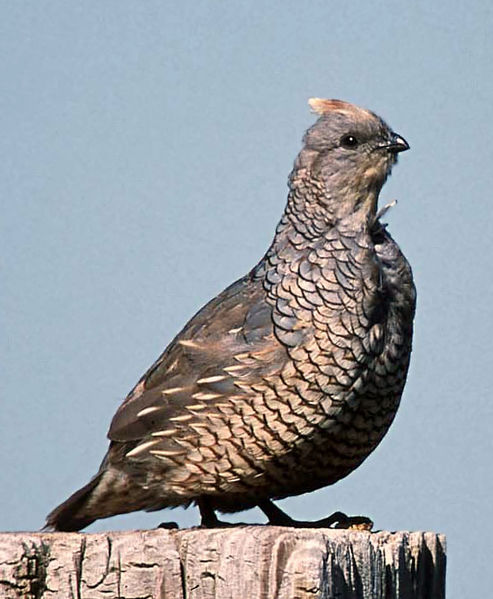
The Scaled Quail – The Cover Seeker

Scaled Quail (Callipepla squamata) ©WikiC

Scaled Quail (Callipepla squamata) ©WikiC

The Scaled Quail – The Cover Seeker ~ by ajmithra

The Scaled Quail (Callipepla squamata), also commonly called Blue Quail or Cottontop, is a species of the New World quail family. It is a bluish gray bird found in the arid regions of the Southwestern United States
to Central Mexico.

These birds seek for four different covers. They are as follows :

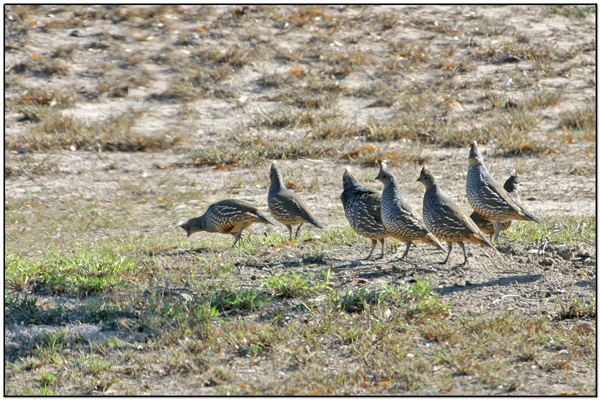
Feeding cover: Scaled Quail use grass clumps and shrubs for cover while feeding. In one study they were frequently seen crossing 82 to 165 feet (25–50 m) of bare ground. When disturbed, Scaled Quail hid in snakeweed (Gutierrezia spp.) or in grass clumps. In June and July foraging occurs on open grasslands which are not used at other times.

We have Jesus, our Good Shepherd, who makes us lie down beside still waters. But, times are fast approaching where the church may be stopped from feeding on the word of God and the church may have to hide during the times of tribulation..

Behold, the days come, saith the Lord GOD, that I will send a famine in the land, not a famine of bread, nor a thirst for water, but of hearing the words of the LORD. Amos 8:11
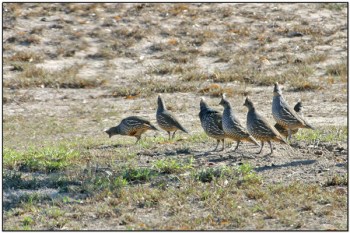
Scaled Quail (Callipepla squamata) by DavesBirdingPix

Scaled Quail (Callipepla squamata) by DavesBirdingPix

Loafing cover: Scaled Quail coveys occupy loafing or resting cover after early morning feeding periods. Scaled Quail occupy desert grassland or desert scrub with a minimum of one loafing covert per approximately 70 acres (28 ha). In northwestern Texas, loafing coverts were characterized by:

  1. overhead woody cover,
  2. lateral screening cover,
  3. a central area with bare soil, and
  4. one or more paths through the lateral cover.

Covert heights ranged from 1.6 to 5.9 feet (0.5–1.8 m) and 2.6 to 6.9 feet (0.8–2.1 m) in diameter. Cholla formed all or part of the overhead cover of 85% of coverts, even though they were dominant
at only 12% of the study locations. In areas where Scaled Quail occur without cholla, woody species such as wolfberry (Lycium spp.) and mesquite are important for overhead cover.

In Oklahoma pinyon-juniper habitats, Scaled Quail use the shade of tree cholla (Cylindropuntia imbricata) and human-made structures. In Arizona, Scaled Quail occupied wolfberry and mesquite 1.7 to 5 feet (0.5–1.5 m) tall for loafing cover. This overhead cover provides midday shade, but is open at the base to allow easy escape from predators. In Oklahoma, winter home ranges always contained skunkbush sumac, tree cholla, or human-made structures providing overhead cover.

The highlight during the migration of millions of Israelites across the wilderness for forty years is the overhead cover that God gave them in the form of Pillar of clouds during the day and Pillar of fire during the night. Our God is the same yesterday, today and forever. There is protection for everyone for all seasons..

And there shall be a tabernacle for a shadow in the daytime from the heat, and for a place of refuge, and for a covert from storm and from rain. Isaiah 4:6
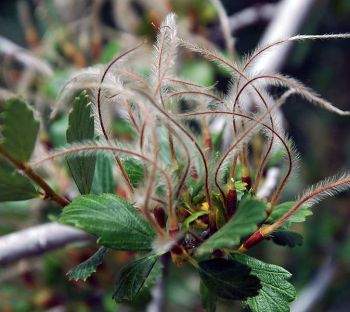
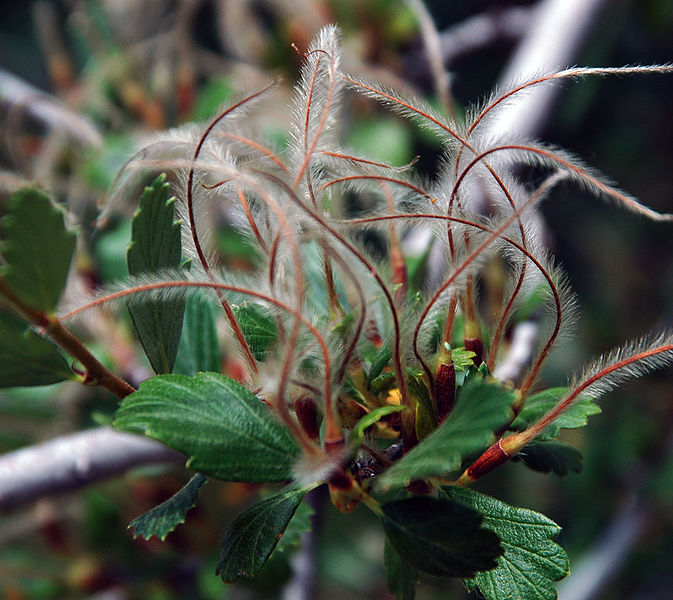
Mountain-Mahogany (Cercocarpus montanus) Cover for Scaled Quail ©WikiC

Mountain-Mahogany (Cercocarpus montanus) Cover for Scaled Quail ©WikiC

Night-roosting cover: Scaled Quail roosts were observed in yucca (Yucca angustifolia), tree cholla, and true mountain-mahogany (Cercocarpus montanus) – yucca-fragrant sumac (Rhus aromatica) vegetation types. The height of vegetation used for night roosts was less than 1.6 feet (0.5 m).

No matter wherever you are and whatever situation you are in, just remember what king David said..,

If I ascend up into heaven, thou art there: if I make my bed in hell, behold, thou art there. If I take the wings of the morning, and dwell in the uttermost parts of the sea; Even there shall thy hand lead me, and thy right hand shall hold me. Psalm 139: 8-10

Even during the darkest hour, as we stumble, confused and seeking direction, His protection and direction never seizes. He not only keeps His eyes on us, but also keeps us as the apple of His eyes. His light shall shine upon us to direct our path.

If I say, Surely the darkness shall cover me; even the night shall be light about me. Yea, the darkness hideth not from thee; but the night shineth as the day: the darkness and the light are both alike to thee.” Psalm 139:11-12

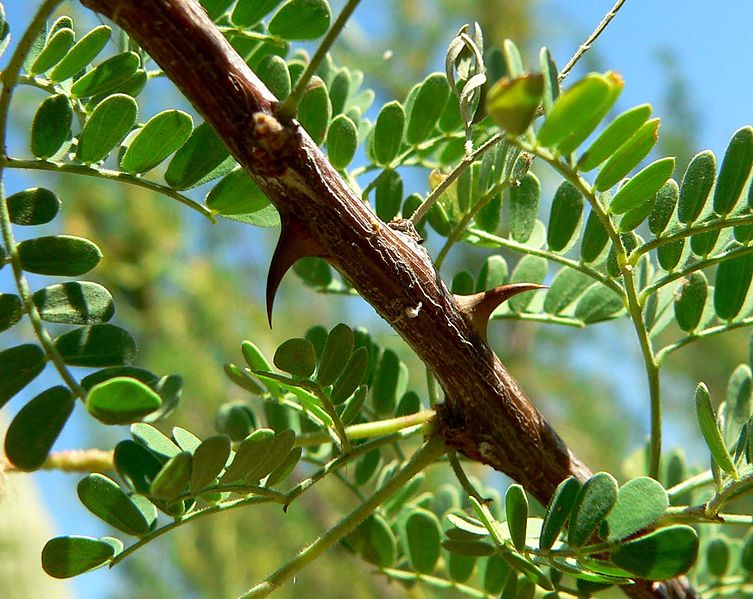
Catclaw Acacia (Acacia greggii) Cover for Scaled Quail ©WikiC

Catclaw Acacia (Acacia greggii) Cover for Scaled Quail ©WikiC

Nesting cover: In March or April winter coveys spread out into areas with less cover. This use of areas with less cover coincides with a seasonal decrease in the number of raptors in the same area.

Scaled Quail nests are constructed under tufts of grasses, and are sheltered by sagebrush (Artemisia spp.), creosotebush (Larrea tridentata), mesquite, catclaw acacia (Acacia greggii), cactus, or yucca; under
dead Russian-thistle (Salsola kali), mixed forbs, or soapweed yucca; or sheltered in old machinery or other human-made debris.

In Oklahoma, 66% of nests were in one of four situations:

  1. dead Russian-thistle,
  2. machinery and junk,
  3. mixed forbs, and
  4. soapweed yucca.

In New Mexico, ordination of breeding birds and vegetative microhabitats indicated that Scaled Quail were associated with increased levels of patchiness and increased cover of mesquite and cactus.

Birds build nests in different places, sometimes in the most unusual place. But still, the chicks prefer the protection under the wings of its parents.

Where do we seek for protection?

As an eagle stirreth up her nest, fluttereth over her young, spreadeth abroad her wings, taketh them, beareth them on her wings: Deuteronomy 32:11

He shall cover thee with his feathers, and under his wings shalt thou trust: his truth shall be thy shield and buckler. Psalm 91:4

The most secure cover for our lives does not come from our million dollars life insurance policies but from assurance that God has gave us through His bloodshed, suffering and death on the cross of Calvary.

Is your Life insured in Christ?

Have a blessed day!

Yours in YESHUA,
a j mithra

Please visit us at:

*

Check out his articles here at  A J Mithra and his Nuggets Pluss

*
Birds of the World – Asian and African Barbets

Fire-tufted Barbet (Psilopogon pyrolophus) by Dan at WA

Fire-tufted Barbet (Psilopogon pyrolophus) by Dan at Wings of Asia

Its leaves were beautiful, its fruit was abundant, and on it was food for all. Wild animals found shelter under it, the birds of the air lived in its branches, and every creature was fed from it. (Daniel 4:12 HCSB)

The Barbets used to be mainly in one big family, but they are being divided up in several families. The Internet Bird Collection and some other still have them in one family, but IOC, whose list is used here, breaks them into Asian Barbets (Megalaimidae Family) with 30 species and the African Barbets (Lybiidae Family) with 42 species. There is another family of Barbets here in the New World called New World Barbets (Capitonidae Family) that has 15 members. There are two Barbets, the Prong-billed and Toucan Barbet, that are by themselves in the Semnornithidae Family. Barbets are in the Piciformes Order which also has the Toucan,  JacamarPuffbirdHoneyguide and Woodpecker families.

I finished working on the Asian Barbet and African Barbet Family pages and decided to share some of them with you. They are a colorful bunch. The Lord put designs and color in their creation and yet in their natural habitats, they blend in well (camouflage). Some are beautiful and some are almost “gaudy” and have…started to put personality, but they are not humans, so maybe “birdality” might be a better term. Like this Brown-headed Barbet (Megalaima zeylanica) by Nikhil Devasar. My caption would be “hanging on by a nail.”

Brown-headed Barbet (Megalaima zeylanica) by Nikhil Devasar

Brown-headed Barbet (Megalaima zeylanica) by Nikhil Devasar

Here are some of their photos in a slideshow. (They are from all four families)

This slideshow requires JavaScript.

*

I am working on Our Birdwatching Photos of these families and will ready soon.  (Update – Just Finished Them)

Interesting Articles:

Coppersmith Barbet – The Fruit-giver ~ by ajmithra

Formed By Him – Bearded Barbet

Birds of the Bible – Names of Birds

Dan’s Pix Fire-tufted Barbet – Fire-tufted II

Africa’s Barbets by 10,000 Birds

*

Birds of the Bible – Goldfinches Are On The Way

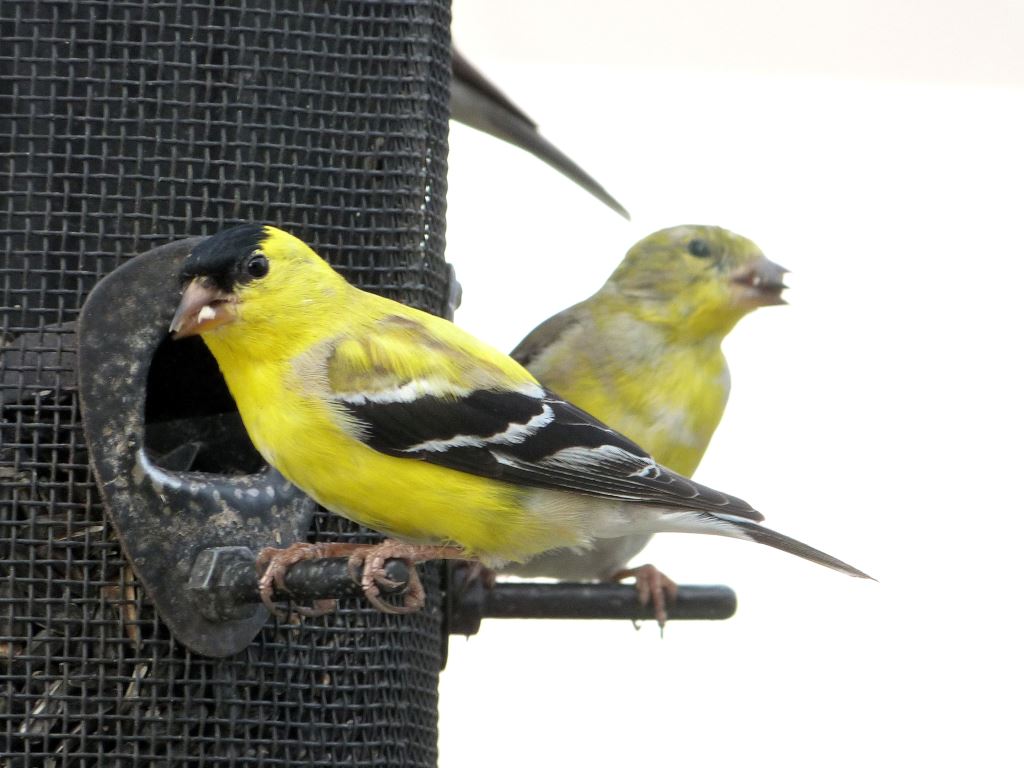
Goldfinches 4-1-13 No screen clean window (7)

Even the stork in the sky knows her seasons. The turtledove, swallow, and crane are aware of their migration, but My people do not know the requirements of the LORD. (Jeremiah 8:7 HCSB)

We have been having American Goldfinches at the feeders for the last few weeks. Don’t see them often, so was enjoying their presence. They kept building in numbers from 6 at first, then 12 about a week ago, then Easter Sunday there were at least 20 of them. It even motivated me to wash the window and take out the screen on Monday to get better photos of them.

Yesterday morning, Wednesday, I checked out the window to see how many there were now. Not a one! So throughout the morning I kept checking, NONE! When we went out, there was no singing in the trees that we have been hearing lately. Needless to say, I was a little disappointed, but it didn’t take long to figure out where they were. GONE!!!

Keep your eyes open up north, the Goldfinches are on the way. This is a spring occurrence down here. The birds fold up their lounge chairs, pack the bellies full of my sunflower seed and head back home. They have territories to claim, nest to build, broods to raise and give you now the pleasure of viewing them and listening to their songs. ENJOY!

It’s your turn to enjoy the Lord’s beautiful American Goldfinches as they migrate up to you. Treat them nice and when fall comes, send them back, please.

This slideshow requires JavaScript.

*
Birds of the Bible Articles

Bible Birds
*
Birds of the Bible – Wing Survey

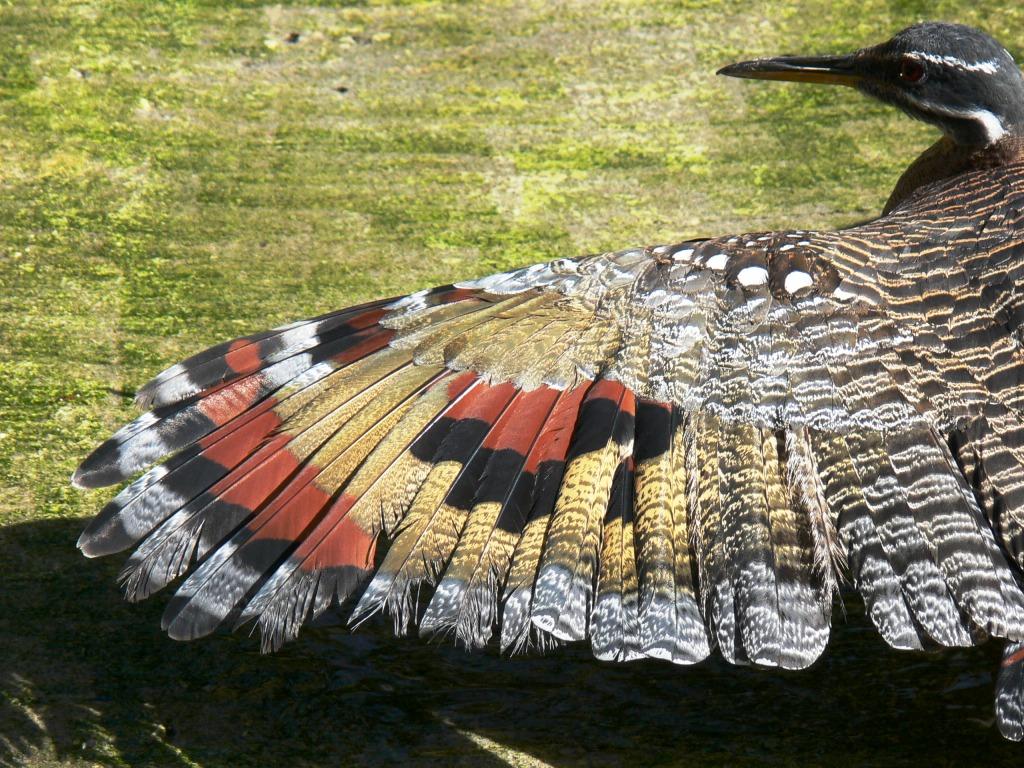
Sunbittern (Eurypyga helias) Left Wing by Lee at Lowry Park Zoo

Sunbittern (Eurypyga helias) Left Wing by Lee at Lowry Park Zoo

While reading in Exodus 25 this week, I noticed that the plan for the Ark is written out in quite specific details. The plans for the mercy seat was to be covered by the outstretched wings of the cherubims of gold.

And the cherubims shall stretch forth their wings on high, covering the mercy seat with their wings, and their faces shall look one to another; toward the mercy seat shall the faces of the cherubims be. (Exodus 25:20 KJV)

I wondered if I had written much about “wings”, so I checked and found only three articles, so far:

I am curious about what can be found, so, let’s see what we can find. Of course my e-Sword is fired up and ready for the searching. Searching first with just “wing”, only 6 verses show up. I Kings 6:24, 6:27; 2 Chronicles 3:11-2 all refer to the wing of the cherub. Isaiah 10:14 actually mentions a bird having its eggs taken and not moving its wing, opening its mouth or peeping. It is used as an illustration.

And my hand hath found as a nest the riches of the people: and as one gathereth eggs that are left, have I gathered all the earth; and there was none that moved the wing, or opened the mouth, or peeped. (Isaiah 10:14 KJV)

Ezekiel 17:23 is the verse used in Fowl (Birds) of Every Wing.

Searching again with “wings” this time shows 64 verses (KJV). Again the cherubims are mentioned in Exodus 25:20, 37:9; I Kings 6:26, 8:6, 8:7; 1 Chronicles 28:18; 2 Chronicles 3:11, 3:13, 5:7-8. Cherubim and serephim wings are again mentioned later in the prophecies of Isaiah (Isa 6:2, 8:8, 18:1, and 40:31), Ezekiel (Exe 1:6-11, 1:23-25, 3:13, 10:5-21, 11:22) and Daniel.  Ezekiel 17:3 & 7 mention “A great eagle with great wings, longwinged, full of feathers” and “another great eagle with great wings and many feathers” Daniel 7:4 and 6 mention “eagle’s wings” and “wings of a fowl

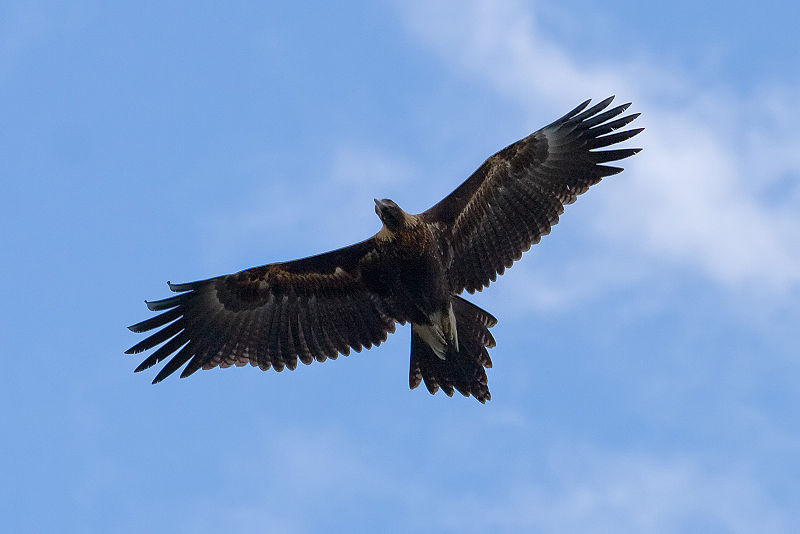
Wedge-tailed Eagle (Aquila audax) ©WikiC

Wedge-tailed Eagle (Aquila audax) ©WikiC

Eagles’ wings are mentioned several more times:

Ye have seen what I did unto the Egyptians, and how I bare you on eagles‘ wings, and brought you unto myself. (Exodus 19:4 KJV)

As an eagle stirreth up her nest, fluttereth over her young, spreadeth abroad her wings, taketh them, beareth them on her wings: (Deuteronomy 32:11 KJV)

Wilt thou set thine eyes upon that which is not? for riches certainly make themselves wings; they fly away as an eagle toward heaven. (Proverbs 23:5 KJV)

But they that wait upon the LORD shall renew their strength; they shall mount up with wings as eagles; they shall run, and not be weary; and they shall walk, and not faint. (Isaiah 40:31 KJV)

For thus saith the LORD; Behold, he shall fly as an eagle, and shall spread his wings over Moab. (Jeremiah 48:40 KJV)

Behold, he shall come up and fly as the eagle, and spread his wings over Bozrah: and at that day shall the heart of the mighty men of Edom be as the heart of a woman in her pangs. (Jeremiah 49:22 KJV)

Indian Peafowl (Pavo cristatus) by Nikhil Devasar

Indian Peafowl (Pavo cristatus) by Nikhil Devasar

Of course other birds are named such as:

Gavest thou the goodly wings unto the peacocks? or wings and feathers unto the ostrich? (Job 39:13 KJV)

Doth the hawk fly by thy wisdom, and stretch her wings toward the south? (Job 39:26 KJV)

And I said, Oh that I had wings like a dove! for then would I fly away, and be at rest. (Psalms 55:6 KJV)

Though ye have lien among the pots, yet shall ye be as the wings of a dove covered with silver, and her feathers with yellow gold. (Psalms 68:13 KJV)

Then lifted I up mine eyes, and looked, and, behold, there came out two women, and the wind was in their wings; for they had wings like the wings of a stork: and they lifted up the ephah between the earth and the heaven. (Zechariah 5:9 KJV)

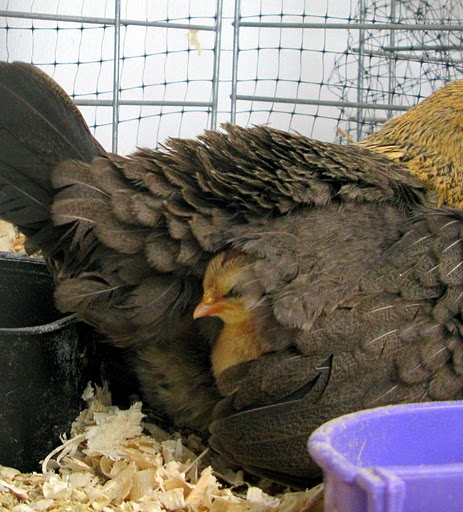
O Jerusalem, Jerusalem, thou that killest the prophets, and stonest them which are sent unto thee, how often would I have gathered thy children together, even as a hen gathereth her chickens under her wings, and ye would not! (Matthew 23:37 KJV)

O Jerusalem, Jerusalem, which killest the prophets, and stonest them that are sent unto thee; how often would I have gathered thy children together, as a hen doth gather her brood under her wings, and ye would not! (Luke 13:34 KJV)

Baby Chick Peeping Out From Under His Mom's Wing - ©©

Baby Chick Peeping Out From Under His Mom’s Wing – ©©

Other references to wings:

  • wings of the wind – 2 Samuel 22:11
  • under whose wings thou art come to trust. – Ruth 2:12
  • hide me under the shadow of thy wings – Psalm 17:8
  • fly upon the wings of the wind – Psalm 18:10
  • trust under the shadow of thy wings. – Psalm 36:7
  • in the shadow of thy wings will I make my refuge – Psalm 57:1
  • rust in the covert of thy wings – Psalm 61:4
  • in the shadow of thy wings will I rejoice – Psalm 63:7
  • He shall cover thee with his feathers, and under his wings shalt thou trust – Psalm 91:4
  • the wings of the wind – Psalm 104:3
  • If I take the wings of the morning – Psalm 139:9
  • for a bird of the air shall carry the voice, and that which hath wings shall tell the matter. – Ecclesiastes 10:20
  • stretching out of his wings – Isaiah 8:8
  • shadowing with wings – Isaiah 18:1
  • Give wings unto Moab, that it may flee and get away – Jeremiah 48:9
  • The wind hath bound her up in her wings – Hosea 4:19
  • healing in his wings – Malachi 4:2

That is an interesting survey of the verses with wing or wings in them. Now I will have to get busy and use this information in some future articles. There are definitely some trends that can be seen. Do you see them? Shadow, wind, healing and trust, just to name a few.

*

Birds of the Bible

Wordless Birds

*

What A Wonderful Savior

He is Risen from an e-mail

Tomorrow is Easter and many will attend church for many reasons. Some will go to show off a new outfit, some will go because it is the one time a year they always go, and many of us will go because it is our normal Sunday habit. Whatever the reason, it is a celebration of the resurrection of Our Savior. Yesterday, Good Friday, His death on the cross was commemorated.

Many of us have the knowledge of the death, burial and resurrection of Jesus Christ. Knowledge is one thing, belief is another. Many can quote John 3:16, even those who do not believe in Christ as their Savior:

For God so loved the world, that he gave his only begotten Son, that whosoever believeth in him should not perish, but have everlasting life. For God sent not his Son into the world to condemn the world; but that the world through him might be saved. He that believeth on him is not condemned: but he that believeth not is condemned already, because he hath not believed in the name of the only begotten Son of God. (John 3:16-18 KJV)

I like Easter and like many, I used to attend church once a year, no matter where I went to church; Catholic, Luther, Methodist, Baptist. Then in 1959, my sister’s father-in-law, Dulin, accepted the Lord as his personal Savior. He accepted the Gift that is offered by Christ’s sacrifice for our sins. He then started telling my sister and her husband, Sharry and Joe, about the Lord and so in February 1960 they were saved, by accepting the Lord. You guessed it, they started telling me about how Christ died for me and that I could be saved by believing in the Lord and accepting His gift of salvation.

So on March 20, 1960, after being invited to church with them, I decided to break a record and go to church two times in one year. Not having been raised in a Christian home, I wasn’t perfect, neither was I bad, but as I listened to Pastor Charlie Kittrell preach, I realized that I WAS a SINNER and I need Christ as my Savior. It finally clicked. The knowledge finally got from my head down to my heart. Praise the Lord I was led to the Lord that morning. My life has forever been changed.

Therefore if any man be in Christ, he is a new creature: old things are passed away; behold, all things are become new. (2 Corinthians 5:17 KJV)

So this Easter is my 53rd as a new creature in Christ. Praise the Lord, what a Wonder Savior He has been to me these many years. Am I prefect? No way, but I am forgiven and when I do mess up, I John 1:9 is always there to remind me to ask forgiveness. That is not to be saved again, but to return to fellowship with the Lord.

If we confess our sins, he is faithful and just to forgive us our sins, and to cleanse us from all unrighteousness. (1 John 1:9 KJV)

I was 16 then and this year I’ll turn 70. What a wonderful life the Lord has given me. He provided a super Christian husband that has put up with me all these years. We will be celebrating our 50th in July this year. Blessings and challenges, but Christ has always been there as we have tried to live for Him. We both had the privilege of graduating from Bob Jones University, though it took me 16 years to get through. (Speak of a slow learner :) ) We also have a fantastic church with a great Pastor and staff. Plus, He has given me an enjoyment of His creation, especially His birds. On and on I could go, but it all is from the Lord.

What about you? I trust you know Him also. If not, please consider what this weekend is all about. It is a celebration of God’s Son coming to earth and paying for our sins by His death on the cross. (short version) Best of all, it doesn’t end there. He is Risen! Death could not keep Him because  He was God in the Flesh. He loves you enough that He died for your sins. Won’t you accept His gift of salvation?

Therefore as by the offence of one judgment came upon all men to condemnation; even so by the righteousness of one the free gift came upon all men unto justification of life. (Romans 5:18 KJV)

For the wages of sin is death; but the gift of God is eternal life through Jesus Christ our Lord. (Romans 6:23 KJV)

Thanks be unto God for his unspeakable gift. (2 Corinthians 9:15 KJV)

For by grace are ye saved through faith; and that not of yourselves: it is the gift of God: (Ephesians 2:8 KJV)

Sharing The Gospel

Gospel Presentation is narrated by Pastor Nathan Osborne III and music is by Sean Fielder from Gospel Presentation