Birds Vol 2 #1 – Wood Duck

THE WOOD DUCK

THE WOOD DUCK

From col. F. M. Woodruff.

THE WOOD DUCK.

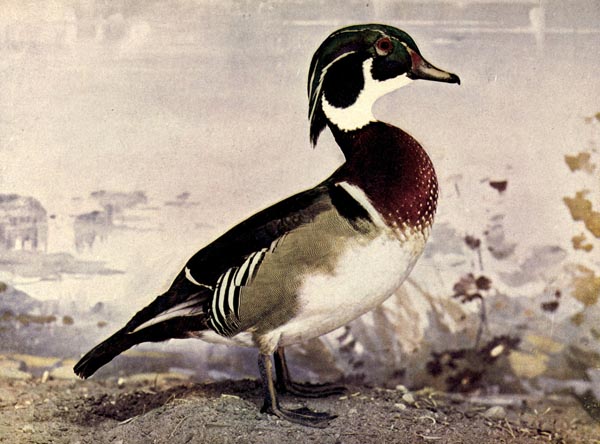
A great many people think that this is the most beautiful bird of North America. It is called Wood Duck because it usually makes its nest in the hollow of a tree that overhangs the water. If it can find a squirrel’s or woodpecker’s hole in some stump or tree, there it is sure to nest.

A gentleman who delighted in watching the Wood Duck, tells about one that built her nest in the hollow of a tree that hung over the water. He was anxious to see how the little ones, when hatched, would get down.

In a few days he knew that the ducklings were out, for he could hear their pee, pee, pee. They came to the edge of the nest, one by one, and tumbled out into the water.

You know a duck can swim as soon as it comes out of the egg.

Sometimes the nest is in the hollow of a tree that is a short distance from the water.

Now how do you suppose the ducklings get there as they do?

If the nest is not far from the ground, the mother bird lets them drop from it on the dried grass and leaves under the tree. She then carries them in her bill, one by one, to the water and back to the nest.

If the nest should be far from the ground, she carries them down one by one.

This same gentleman says that he once saw a Wood Duck carry down thirteen little ones in less than ten minutes. She took them in her bill by the back of the neck or the wing.

When they are a few days old she needs only to lead the way and the little ones will follow.

The Wood Duck is also called Summer Duck. This is because it does not stay with us during the winter, as most ducks do.

It goes south to spend the winter and comes back north early in the spring.


Wood Duck (Aix sponsa) by Dan

Wood Duck (Aix sponsa) by Dan

THE WOOD DUCK.
imgq

UITE the most beautiful of the native Ducks, with a a richness of plumage which gives it a bridal or festive appearance, this bird is specifically named Spousa, which means betrothed. It is also called Summer Duck, Bridal Duck, Wood Widgeon, Acorn Duck and Tree Duck.

It is a fresh water fowl, and exclusively so in the selection of its nesting haunts. It inhabits the whole of temperate North America, north to the fur countries, and is found in Cuba and sometimes in Europe. Its favorite haunts are wooded bottom-lands, where it frequents the streams and ponds, nesting in hollows of the largest trees. Sometimes a hole in a horizontal limb is chosen that seems too small to hold the Duck’s plump body, and occasionally it makes use of the hole of an Owl or Woodpecker, the entrance to which has been enlarged by decay.

Wilson visited a tree containing a nest of a Wood or Summer Duck, on the banks of Tuckahoe river, New Jersey. The tree stood on a declivity twenty yards from the water, and in its hollow and broken top, about six feet down, on the soft decayed wood were thirteen eggs covered with down from the mother’s breast. The eggs were of an exact oval shape, the surface smooth and fine grained, of a yellowish color resembling old polished ivory. This tree had been occupied by the same pair, during nesting time, for four successive years. The female had been seen to carry down from the nest thirteen young, one by one, in less than ten minutes. She caught them in her bill by the wing or back of the neck, landed them safely at the foot of the tree, and finally led them to the water. If the nest be directly over the water, the little birds as soon as hatched drop into the water, breaking their fall by extending their wings.

Many stories are told of their attachment to their nesting places. For several years one observer saw a pair of Wood Ducks make their nest in the hollow of a hickory which stood on the bank, half a dozen yards from a river. In preparing to dam the river near this point, in order to supply water to a neighboring city, the course of the river was diverted, leaving the old bed an eighth of a mile behind, notwithstanding which the ducks bred in the old place, the female undaunted by the distance which she would have to travel to lead her brood to the water.

While the females are laying, and afterwards when sitting, the male usually perches on an adjoining limb and keeps watch. The common note of the drake is peet-peet, and when standing sentinel, if apprehending danger, he makes a noise not unlike the crowing of a young cock, oe-eek. The drake does not assist in sitting on the eggs, and the female is left in the lurch in the same manner as the Partridge.

The Wood Duck has been repeatedly tamed and partially domesticated. It feeds freely on corn meal soaked in water, and as it grows, catches flies with great dexterity.

Summary

WOOD DUCK.Aix sponsa. Coloring varied; most beautiful of ducks. Other names: “Summer Duck,” “Bridal Duck,” “Wood Widgeon,” “Tree Duck.”

Range—North America. Breeds from Florida to Hudson’s Bay; winters south.

Nest—Made of grasses, usually placed in a hole in tree or stump.

Eggs—Eight to fourteen; pale, buffy white.


Wood Duck by Dan at Lake Hollingsworth

Wood Duck by Dan at Lake Hollingsworth

Lee’s Addition:

The Wood Duck is in the Anatidae – Ducks, Geese & Swans Family. The Aix genus includes the Wood Duck and also the beautiful Mandarin Duck (Aix galericulata). “The adult male has distinctive multicoloured iridescent plumage and red eyes,with a distinctive white flare down the neck. The female, less colourful, has a white eye-ring and a whitish throat. Both adults have crested heads.” When the male is in non-breeding plumage the colors are more like the female, but with some differences. Here is a photo taken yesterday at Lake Morton of a male Wood Duck.
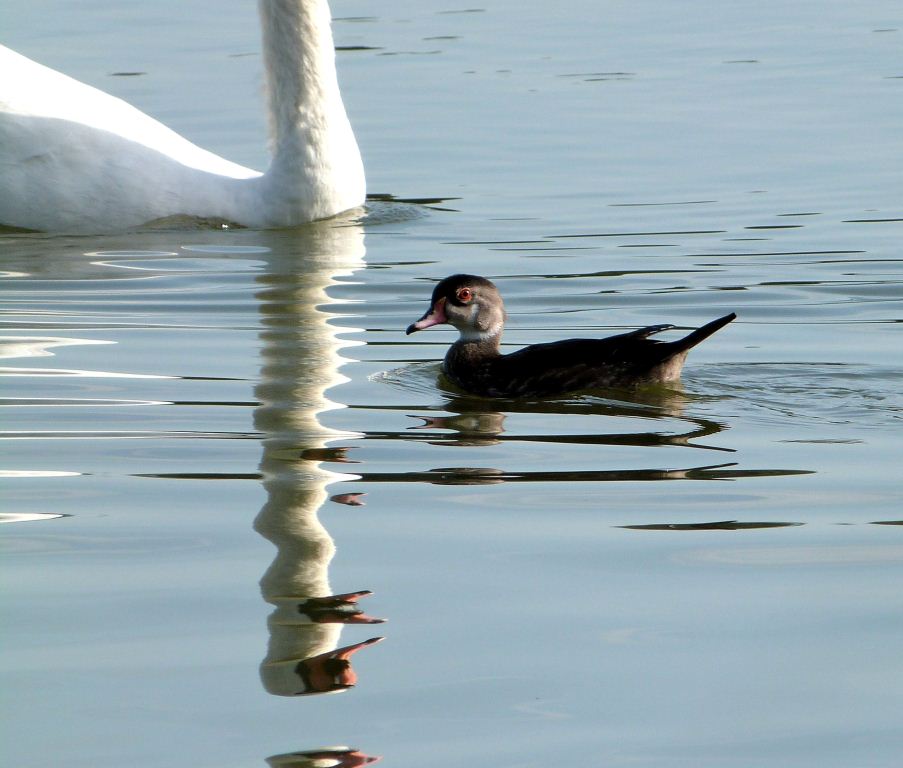
Wood Duck (Aix sponsa) Male Lake Morton 8-3-12

Wood Duck Male Lake Morton 8-3-12

Here is a picture of the female I also photographed yesterday.
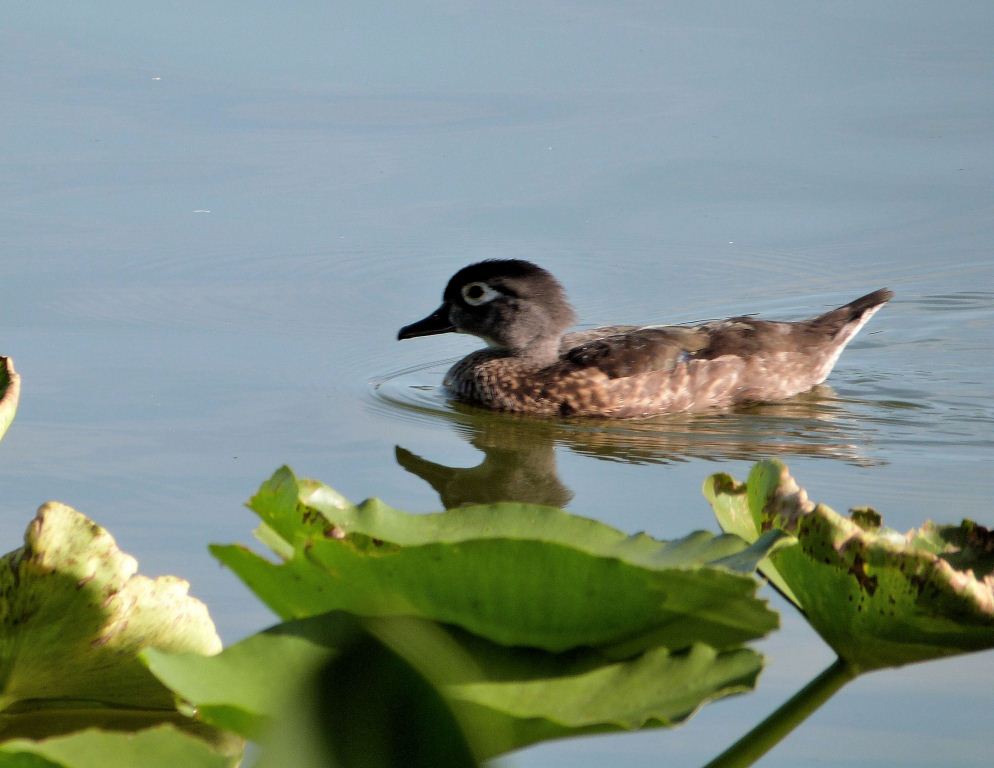
Wood Duck (Aix sponsa)

Wood Duck Female Lake Morton 8-3-12

The male’s call is a rising whistle, “jeeeeee”; the females utter a drawn-out, rising squeal, “oo-eek,” when flushed, and a sharp “cr-r-ek, cr-e-ek” for an alarm call.

Their breeding habitat is wooded swamps, shallow lakes, marshes or ponds, and creeks in eastern North America, the west coast of the United States and western Mexico. They usually nest in cavities in trees close to water, although they will take advantage of nesting boxes in wetland locations if available. Females line their nests with feathers and other soft materials, and the elevation provides some protection from predators. Unlike most other ducks, the Wood Duck has sharp claws for perching in trees and can, in southern regions, produce two broods in a single season—the only North American duck that can do so.

The population of the Wood Duck was in serious decline in the late 19th century as a result of severe habitat loss and market hunting both for meat and plumage for the ladies’ hat market in Europe. By the beginning of the 20th century Wood Ducks had virtually disappeared from much of their former range. In response to the Migratory Bird Treaty established in 1916 and enactment of the Federal Migratory Bird Treaty Act of 1918, wood duck populations began to recover slowly. By ending unregulated hunting and taking measures to protect remaining habitat, wood duck populations began to rebound in the 1920s. The development of the artificial nesting box in the 1930s gave an additional boost to Wood Duck production.

Landowners as well as park and refuge managers can encourage Wood Ducks by building Wood Duck nest boxes near lakes, ponds, and streams. Fulda, Minnesota has adopted the Wood Duck as an unofficial mascot, and a large number of nest boxes can be found in the area.

Expanding North American Beaver populations throughout the Wood Duck’s range have also helped the population rebound as beavers create an ideal forested wetland habitat for Wood Ducks.

Birds Illustrated by Color Photography – Revisited – Introduction

The above article is the first article in the monthly serial that was started in January 1897 “designed to promote Knowledge of Bird-Live.” These include Color Photography, as they call them, today they are drawings. There are at least three Volumes that have been digitized by Project Gutenberg.

To see the whole series of – Birds Illustrated by Color Photography – Revisited

*

(Information from Wikipedia and other internet sources)

Next Article – The Anhinga Or Snake Bird

Previous Article – The Canvas-Back Duck

Wordless Birds

Links:

Anatidae – Ducks, Geese & Swans

Wood Duck – All About Birds

Wood Duck – Wikipedia

Bet you never knew ducklings bounce – by xaandria86 – YouTube

*
Birds Vol 2 #1 – The American Avocet

American Avocet - Birds Illustrated by Color Photography, 1897

American Avocet – Birds Illustrated by Color Photography, 1897 From col. F. M. Woodruff

THE AMERICAN AVOCET.

imgw

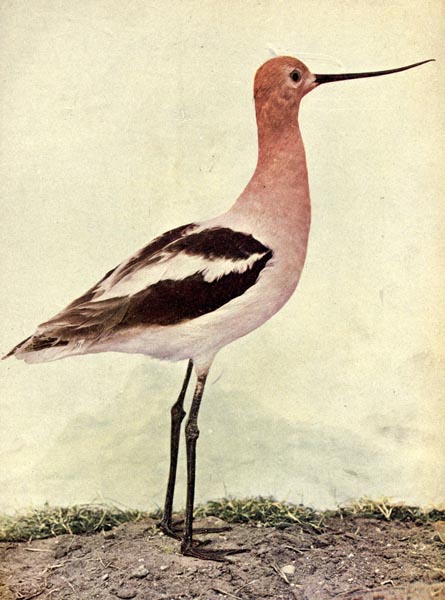
HITE SNIPE, Yelper, Lawyer, and Scooper are some of the popular names applied in various localities to this remarkably long-legged and long and slender-necked creature, which is to be found in temperate North America, and, in winter, as far south as Cuba and Jamaica. In north-eastern Illinois the Avocet generally occurs in small parties the last of April and the first of May, and during September and the early part of October, when it frequents the borders of marshy pools. The bird combines the characteristics of the Curlew and the Godwit, the bill being recurved.

The cinnamon color on the head and neck of this bird varies with the individual; sometimes it is dusky gray around the eye, especially in the younger birds.

The Avocet is interesting and attractive in appearance, without having any especially notable characteristics. He comes and goes and is rarely seen by others than sportsmen.

american avocet. From col. F. M. Woodruff.

Summary

AMERICAN AVOCET.Recurvirostra americana. Other names: “White Snipe,” “Yelper,” “Lawyer,” “Scooper.”

Range—Temperate North America.

Nest—A slight depression in the ground.

Eggs—Three or four; pale olive or buffy clay color, spotted with chocolate.


American Avocet (Recurvirostra americana) by Jim Fenton

American Avocet (Recurvirostra americana) by Jim Fenton

Lee’s Addition:

All things were made by him; and without him was not any thing made that was made. (John 1:3 KJV)

The American Avocet (Recurvirostra americana) is a large wader in the avocet and stilt family, Recurvirostridae. This avocet has long, thin, gray legs, giving it its colloquial name, “blue shanks”. The plumage is black and white on the back with white on the underbelly. The neck and head are cinnamon colored in the summer and gray in the winter. The long, thin bill is upturned at the end. The adult bird measures 16–20 in (40–51 cm) in length, 27–30 in (68–76 cm) and 9.7–15 oz (275–420 g) in weight.

The breeding habitat is marshes, beaches, prairie ponds, and shallow lakes in the mid-west and on the Pacific coast of North America. American avocets form breeding colonies numbering dozens of pairs. When breeding is over the birds gather in large flocks, sometimes including hundreds of birds. Nesting occurs near water, usually on small islands or boggy shorelines where access by predators is difficult. The female lays four eggs in a saucer-shaped nest, and both sexes take turns incubating them. Upon hatching, the chicks feed themselves; they are never fed by their parents. They can walk, swim, and even dive within 24 hours of hatching.

This species is migratory, and mostly winters on the southern Atlantic and Pacific coasts of Mexico and the United States.

The American Avocet forages in shallow water or on mud flats, often sweeping its bill from side to side in water as it seeks its crustacean and insect prey.

Birds Illustrated by Color Photography – Revisited – Introduction

The above article is the first article in the monthly serial that was started in January 1897 “designed to promote Knowledge of Bird-Live.” These include Color Photography, as they call them, today they are drawings. There are at least three Volumes that have been digitized by Project Gutenberg.

To see the whole series of – Birds Illustrated by Color Photography – Revisited

*

(Information from Wikipedia and other internet sources)

Next Article – The Canvas-Back Duck

The Previous Article – The Mallard Duck

ABC’s Of The Gospel

Links:

Recurvirostridae – Stilts, Avocets

American Avocet – All About Birds

American Avocet – Wikipedia

*

Birds Vol 2 #1 – The Canvas-back Duck

The Canvasback Duck, Birds Illustrated by Color Photography, 1897

The Canvasback Duck, Birds Illustrated by Color Photography, 1897

THE CANVAS-BACK DUCK.

imgw

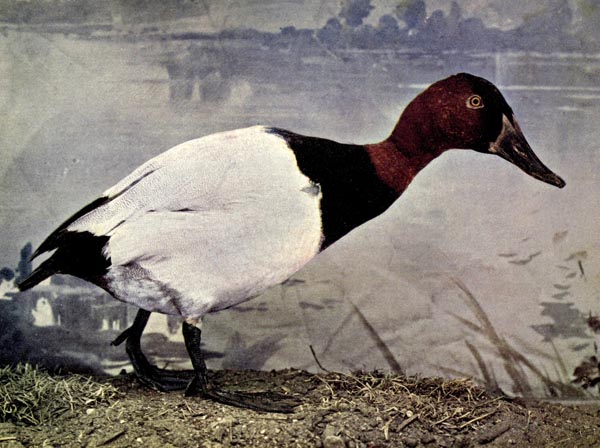
HITE-BACK, Canard Cheval, (New Orleans,) Bull-Neck, and Red-Headed Bull-Neck, are common names of the famous Canvas-Back, which nests from the northern states, northward to Alaska. Its range is throughout nearly all of North America, wintering from the Chesapeake southward to Guatemala.

“The biography of this duck,” says Mabel Osgood Wright, “belongs rather to the cook-book than to a bird list,” even its most learned biographers referring mainly to its “eatable qualities,” Dr. Coues even taking away its character in that respect when he says “there is little reason for squealing in barbaric joy over this over-rated and generally under-done bird; not one person in ten thousand can tell it from any other duck on the table, and only then under the celery circumstances,” referring to the particular flavor of its flesh, when at certain seasons it feeds on vallisneria, or “water celery,” which won its fame. This is really not celery at all, but an eel-grass, not always found through the range of the Canvas-Back. When this is scarce it eats frogs, lizards, tadpoles, fish, etc., so that, says Mrs. Osgood, “a certificate of residence should be sold with every pair, to insure the inspiring flavor.”

The opinion held as to the edible qualities of this species varies greatly in different parts of the country. No where has it so high a reputation as in the vicinity of Chesapeake Bay, where the alleged superiority of its flesh is ascribed to the abundance of “water celery.” That this notion is erroneous is evident from the fact that the same plant grows in far more abundance in the upper Mississippi Valley, where also the Canvas-Back feeds on it. Hence it is highly probable that fashion and imagination, or perhaps a superior style of cooking and serving, play a very important part in the case. In California, however, where the “water celery” does not grow, the Canvas-Back is considered a very inferior bird for the table.

It has been hunted on Chesapeake Bay and its tributaries with such inconsiderate greed that its numbers have been greatly reduced, and many have been driven to more southern waters.

In and about Baltimore, the Canvas-Back, like the famous terrapin, is in as high favor for his culinary excellence, as are the women for beauty and hospitality. To gratify the healthy appetite of the human animal this bird was doubtless sent by a kind Providence, none the less mindful of the creature comforts and necessities of mankind than of the purely aesthetic senses.

Summary

CANVAS-BACK.Aythya vallisneria. Other names: “White-Back,” “Bull-Neck,” “Red-Headed Bull-Neck.”

Range—North America. Breeds only in the interior, from northwestern states to the Arctic circle; south in winter to Guatemala.

Nest—On the ground, in marshy lakesides.

Eggs—Six to ten; buffy white, with bluish tinge.


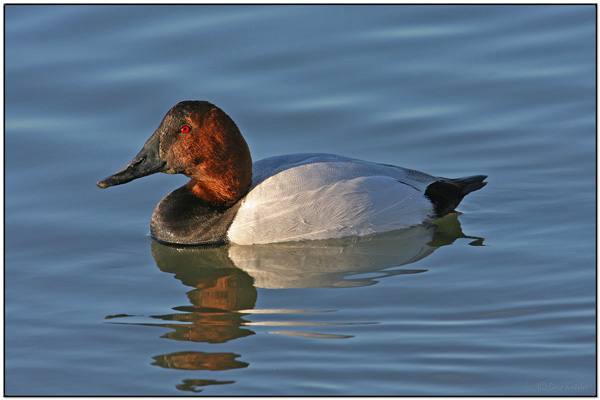
Canvasback (Aythya valisineria) by Daves BirdingPix

Canvasback (Aythya valisineria) by Daves BirdingPix

Lee’s Addition:

The Canvas-Back Duck is now the Canvasback (Aythya valisineria). Wikipedia (with editing) says The Canvasback is the largest of the North American diving ducks, that ranges from between 19–22 in (48–56 centimetres) long and weighs approximately 1.90–3.50 lbs (862–1,588 gram), with a wingspan of 31–35 in (79–89 centimetres). The canvasback has a distinctive wedge-shaped head and long graceful neck. The adult male (drake) has a black bill, a chestnut red head and neck, a black breast, a grayish back, black rump, and a blackish brown tail. The drake’s sides, back, and belly are white with fine vermiculation resembling the weave of a canvas, which gave rise to the bird’s common name. The bill is blackish and the legs and feet are bluish-gray. The iris is bright red in the spring, but duller in the winter. The adult female (hen) also has a black bill, a light brown head and neck, grading into a darker brown chest and foreback. The sides, flanks, and back are grayish brown. The bill is blackish and the legs and feet are bluish-gray. Its sloping profile distinguishes it from other ducks.

The breeding habitat of the Canvasback is in North America prairie potholes. The bulky nest is built from vegetation in a marsh and lined with down. Loss of nesting habitat has caused populations to decline. (That and apparently the killing of them per the article.) It prefers to nest over water on permanent prairie marshes surrounded by emergent vegetation, such as cattail and bulrushes, which provide protective cover. Other important breeding areas are the subarctic river deltas in Saskatchewan and the interior of Alaska.

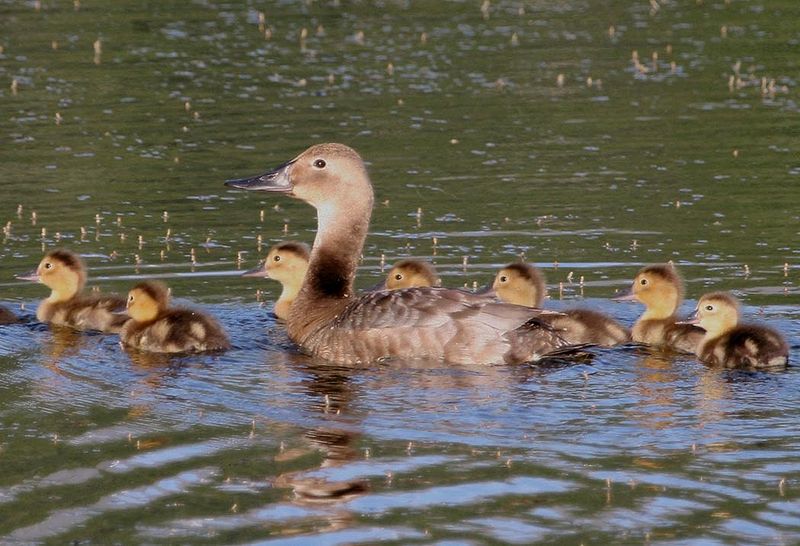
Canvasback (Aythya valisineria) with young ©WikiC

Canvasback (Aythya valisineria) with young ©WikiC

It has a clutch size of approximately 5-11 eggs that are a greenish drab. The chicks are covered in down at hatching and able to leave the nest soon after. The Canvasback sometimes lays its eggs in other Canvasback nests and Redheads often parasitize Canvasback nests.

In the early 1950s it was estimated that there were 225,000 Canvasbacks wintering in the Chesapeake Bay; this represented one-half of the entire North American population. By 1985, there were only 50,000 ducks wintering there, or one-tenth of the population. Canvasbacks were extensively hunted around the turn of the 19th to 20th century, but federal hunting regulations restrict their harvest, so hunting was ruled out as a cause for the decline. Scientists have now concluded that the decline in duck populations was due to the decline in  submerged aquatic vegetation acreage. Today the population has stabilized and is even increasing slightly, although it is nowhere near previous levels.

*

Birds Illustrated by Color Photography – Revisited – Introduction

The above article is the first article in the monthly serial that was started in January 1897 “designed to promote Knowledge of Bird-Live.” These include Color Photography, as they call them, today they are drawings. There are at least three Volumes that have been digitized by Project Gutenberg.

To see the whole series of – Birds Illustrated by Color Photography – Revisited

*

(Information from Wikipedia and other internet sources)

Next Article – The Wood Duck

Previous Article – Bird Song – July

Wordless Birds

Links:

Anatidae – Ducks, Geese & Swans Family

Canvasback – Wikipedia

*

Birds Vol 2 #1 – Bird Song~July

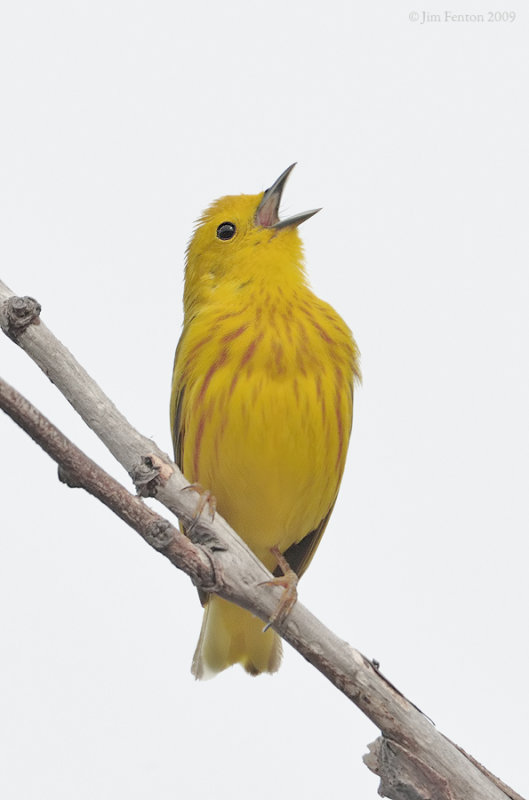
Good ground - American Yellow Warbler (Dendroica aestiva) by J Fenton

American Yellow Warbler (Dendroica aestiva) by J Fenton

Vol. II. No. 1. JULY, 1897.

BIRD SONG.

imgi
T SHOULD not be overlooked by the young observer that if he would learn to recognize at once any particular bird, he should make himself acquainted with the song and call notes of every bird around him. The identification, however, of the many feathered creatures with which we meet in our rambles has heretofore required so much patience, that, though a delight to the enthusiast, few have time to acquire any great intimacy with them. To get this acquaintance with the birds, the observer has need to be prepared to explore perilous places, to climb lofty trees, and to meet with frequent mishaps. To be sure if every veritable secret of their habits is to be pried into, this pursuit will continue to be plied as patiently as it has ever been. The opportunity, however, to secure a satisfactory knowledge of bird song and bird life by a most delightful method has at last come to every one.

A gentleman who has taken a great interest in Birds from the appearance of the first number, but whose acquaintance with living birds is quite limited, visited one of our parks a few days ago, taking with him the latest number of the magazine. His object, he said, was to find there as many of the living forms of the specimens represented as he could. “Seating myself amidst a small grove of trees, what was my delight at seeing a Red Wing alight on a telegraph wire stretching across the park. Examining the picture in Birds I was somewhat disappointed to find that the live specimen was not so brilliantly marked as in the picture. Presently, however, another Blackbird alighted near, who seemed to be the veritable presentment of the photograph. Then it occurred to me that I had seen the Red Wing before, without knowing its name. It kept repeating a rich, juicy note, oncher-la-ree-e! its tail tetering at quick intervals. A few days later I observed a large number of Red Wings near the Hyde Park water works, in the vicinity of which, among the trees and in the marshes, I also saw many other birds unknown to me. With Birds in my hands, I identified the Robin, who ran along the ground quite close to me, anon summoning with his beak the incautious angle worm to the surface. The Jays were noisy and numerous, and I observed many new traits in the Wood Thrush, so like the Robin that I was at first in some doubt about it. I heard very few birds sing that day, most of them being busy in search of food for their young.”

[continued on page 17.]

BIRD SONG—Continued from page 1.

Many of our singing birds may be easily identified by any one who carries in his mind the images which are presented in our remarkable pictures. See the birds at home, as it were, and hear their songs.

Those who fancy that few native birds live in our parks will be surprised to read the following list of them now visible to the eyes of so careful an observer as Mr. J. Chester Lyman.

“About the 20th of May I walked one afternoon in Lincoln Park with a friend whose early study had made him familiar with birds generally, and we noted the following varieties:

1  Magnolia Warbler.
2  Yellow Warbler.
3  Black Poll Warbler. (Black-polled Yellowthroat)
4  Black-Throated Blue Warbler.
5  Black-Throated Queen Warbler. (Black-throated Green Warbler?)
6  Blackburnian Warbler.
7  Chestnut-sided Warbler.
8  Golden-crowned Thrush.
9  Wilson’s Thrush. (Veery)
10 Song Thrush.
11 Catbird. (Grey)
12 Bluebird. (Eastern)
13 Kingbird. (Eastern)
14 Least Fly Catcher. (Flycatcher)
15 Wood Pewee Fly Catcher. (Eastern Wood Pewee)
16 Great Crested Fly Catcher. (Flycatcher)
17 Red-eyed Vireo.
18 Chimney Swallow. (Chimney Swift)
19 Barn Swallow.
20 Purple Martin.
21 Red Start. (American Redstart)
22 House Wren.
23 Purple Grackle. (Common)
24 White-throated Sparrow.
25 Song Sparrow.
26 Robin. (American)
27 Blue Jay.
28 Red-Headed Woodpecker.
29 Kingfisher. (Belted)
30 Night Hawk. (Common)
31 Yellow-Billed Cuckoo.
32 Scarlet Tanager, Male and Female.
33 Gull, or Wilson’s Tern. (Common Tern)
34 The Omni-present English Sparrow. (House)

“On a similar walk, one week earlier, we saw about the same number of varieties, including, however, the Yellow Breasted Chat, and the Mourning, Bay Breasted, and Blue Yellow Backed Warblers.”

The sweetest songsters are easily accessible, and all may enjoy their presence.

C. C. Marble.


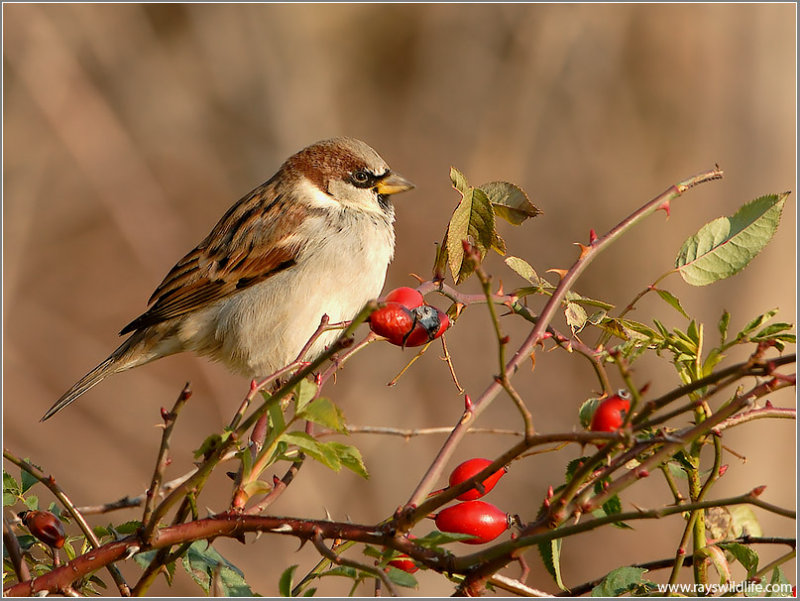
House Sparrow by Ray

Lee’s Addition:

You make springs gush forth in the valleys; they flow between the hills; they give drink to every beast of the field; the wild donkeys quench their thirst. Beside them the birds of the heavens dwell; they sing among the branches. (Psalms 104:10-12 ESV)

I added links to xeno-canto.org for the sound of the birds on the list. It took awhile to figure out what some of the birds are called today. I am sure some are incorrect, but did my best. I used the “song” recordings where available and a few of the “call” ones where either the birds don’t sing or no recording is available.

They each have a distinct sound even as an instrument does.

Even things without life, whether flute or harp, when they make a sound, unless they make a distinction in the sounds, how will it be known what is piped or played? For if the trumpet makes an uncertain sound, who will prepare for battle? (1 Corinthians 14:7-8 NKJV)

If the birds changed songs all the time, how would they find mates, defend their territory, or know the sound of an enemy? Isn’t the Lord gracious in the way He designed the birds to sing so uniquely.

Listening to them was actually quite enjoyable. They each have their own way of communicating to their fellow birds and/or enemies.

Birds Illustrated by Color Photography – Revisited – Introduction

The above article is the first article in the monthly serial that was started in January 1897 “designed to promote Knowledge of Bird-Live.” These include Color Photography, as they call them, today they are drawings. There are at least three Volumes that have been digitized by Project Gutenberg.

To see the whole series of – Birds Illustrated by Color Photography – Revisited

*

(Information from Wikipedia and other internet sources)

Next Article – The Canvas-Back Duck

Previous Article – The Mallard Duck

Western Tanager: Red, Yellow, Black and White

Links:

xeno-canto.org – Birds Sounds of the World

*


Birdwatching – South Lake Howard Nature Park 7-28-12

Black-Crowned Night Heron at S Lk Howard

Black-Crowned Night-Heron at S Lk Howard

We spent about 25 minutes at the South Lake Howard Nature Park seeing what was around. I was trying to learn how to take photos “right-eyed” (See Anniversary and Other Things). Dan can shut one eye or the other, winking, but I can’t. I only can close the right eye. When I try to wink with the left eye, both eyes go shut. Oh, well, no one is perfect. Glad we stopped by the park to practice my new “technique.”

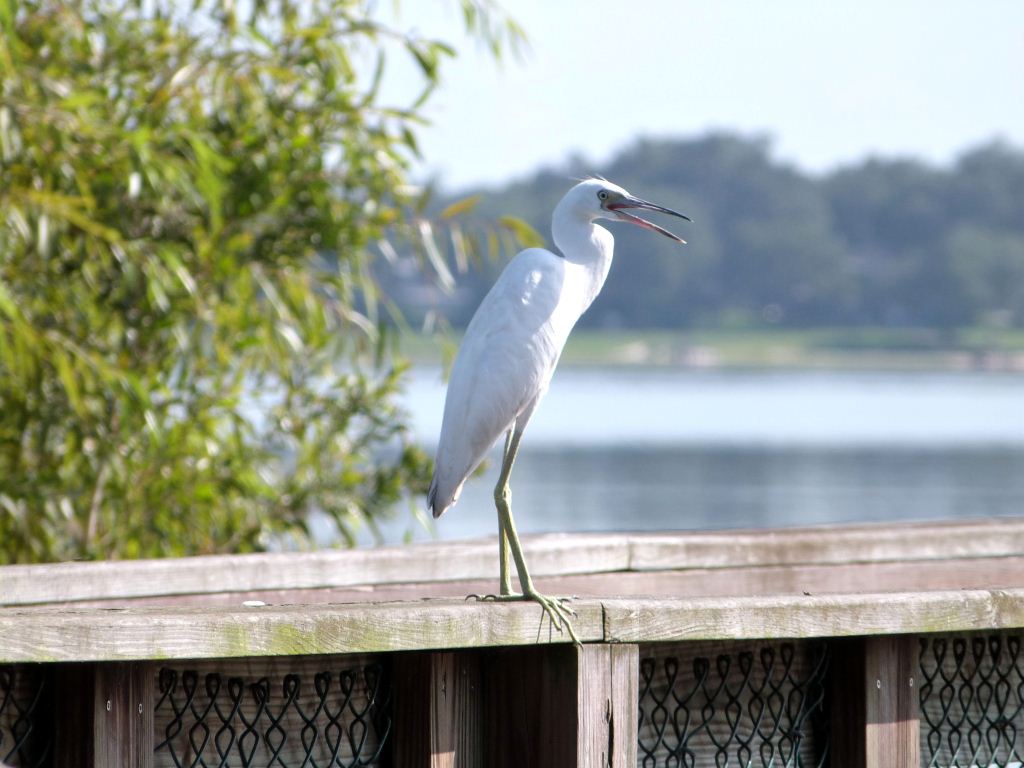
Little Blue Heron immature

Little Blue Heron immature

We were walking on the boardwalk on the Lake Howard side and spotted a Tricolored Heron and an immature Little Blue Heron. Just as we pulled up the cameras, a Black-crowned Night-Heron popped up on the rail between us and them. Wow! He was very close and we were able to get its photo. Dan kept getting closer to get better shots and the Heron just stayed there until I got too close. Most times we see a Night-Heron, they are hidden in the grass or not really visible. After he left, another Little Blue hopped up on the rail. An Anhinga was in a tree and one of the birds flew to a tree.

Red-winged Blackbird female

Red-winged Blackbird female

When we crossed the road to the pond side, we spotted a Great Blue Heron perched on a tree. The Osprey was up on the Tower checking out the normal Bald Eagles’s domain. I am including the 17 species that I turned in to the eBird.org listing service. It is a nice way to keep track of your birdwatching adventures here in America. It is only for our birds. Not sure if other countries have something like it or not.

Trust in the LORD, and do good; so shalt thou dwell in the land, and verily thou shalt be fed. Delight thyself also in the LORD; and he shall give thee the desires of thine heart. (Psalms 37:3-4 KJV)

Enjoy the Slideshow.

This slideshow requires JavaScript.

South Lake Howard Nature Park, Polk, US-FL
Jul 28, 2012 9:00 AM – 9:25 AM
Protocol: Traveling
0.5 mile(s)
17 species (+1 other taxa)
Muscovy Duck (Domestic type) 3
Great Blue Heron 1
Great Egret 3
Little Blue Heron 2
Tricolored Heron 1 Juvenile 1
Black-crowned Night-Heron 1
White Ibis 5
Black Vulture 1
Osprey 1
Common Gallinule 3
Limpkin 1
Mourning Dove 2
Monk Parakeet 4
Blue Jay 2
Fish Crow 1
Northern Mockingbird 1
Red-winged Blackbird 3
Boat-tailed Grackle 2
*

Anniversary and Other Things

Purple Gallinule Displaying at Lake Parker

Purple Gallinule Displaying at Lake Parker

Today is our 49th Anniversary. Wow! Doesn’t seem that long. We are thankful for the blessings the Lord has bestowed upon us over those years. We have not been perfect, but we have tried to live our lives for Christ and honor Him. He, the Lord, has been very gracious to us over the years. Dan has been a super husband also. Wouldn’t trade him.

This along with some other things going on the last two weeks have kept my blog a little slow lately. Last week we rearranged the room where I do the blog and the computer was offline for a few days. This week has been photo taking for the Music Camp at church and Doctors appointments. On Tuesday I received news that my left eye has a problem. I know it has been blurring on me lately. That is my picture-taking eye. So, yesterday, it was off to an eye specialist to be examined further. Long story short, I have a pucker in my retina. For now it is on a watch mode for a few months. Needless to say, I have been a little edgy and blogging has not been on my mind. The news yesterday was encouraging and I know it is in the Lord’s Hands. Your prayers are appreciated.

And we know that all things work together for good to them that love God, to them who are the called according to his purpose. (Romans 8:28 KJV)

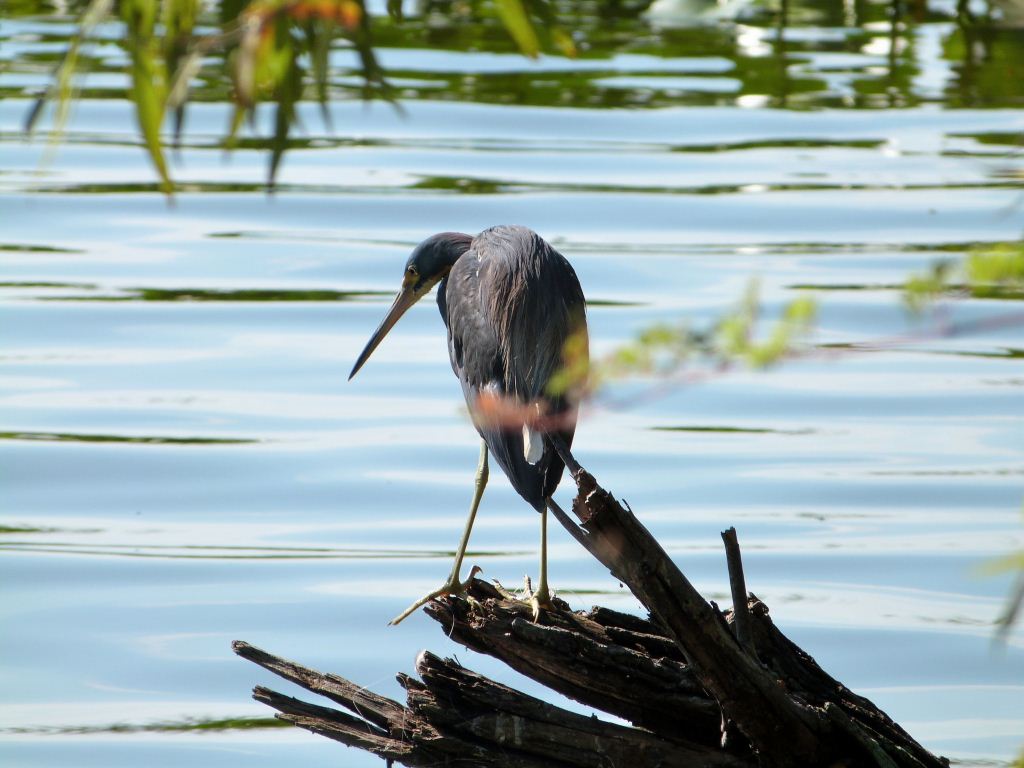
Tricolored Heron Looking at Lake Parker Park

Tricolored Heron Looking at Lake Parker Park

We did get to go birdwatching for a few minutes last week and managed to see Ospreys, Mourning Doves, 15 Wood Storks, 4 Sandhill Cranes, 15 White Ibises, Double-crested Cormorants, Great Blue Herons, Anhingas, Red-winged Blackbirds, Great Egrets, Pigeons, Boat-tailed Grackles, 10 Tricolored Herons, Family of Common Gallinules, Blue Jay, Fish Crows, Rooster and 2 hens,  Limpkin, Purple Gallinules – one displaying (first time ever saw that happen), Cattle Egrets, Eurasian Collared Doves. Those are in the order spotted as we rode up to Lake Parker and then home.

Thanks for all of you who stop by the blogs. Your visits are appreciated and trust that you receive a blessing and the information you are looking for.

Blogs:

*

Edited the Accipitriformes Order Page with some pictures.

*

Colorful Gapes…

Yellow Gape of a Starling Fledgeling ©WikiC

Yellow Gape of a Starling Fledgeling ©WikiC

Colorful Gapes…   ~ by a j mithra

Orni-Theology

Orni-Theology

Hey Kids,
Welcome to the colorful world of Bird.
I know you guys and gals love birds
and that too colorful birds..
But, I wonder how many really know
why God gave colorful gapes for chicks?
May be some of you would love to know the reason, right?
Here we go… Check this out..

Merlin (Falco columbarius) chick in nest ©USFWS

Merlin (Falco columbarius) chick with Red Gape ©USFWS

The mother bird understands
whether her chicks need food or not
from the colors of their gapes.
Similarly, the chick recognises its mother in this way
and understands that the food has arrived.
As seen in these examples in nature,
living beings need to know the meaning of colors
in order to survive.
They also need to possess proper systems of perception..
As kids you too should know the meaning of colors..
Whenever you see RED,
think of the blood that Jesus shed for you and me
on the cross of Calvary..
Whenever you see WHITE,
Think of the Holy Spirit who is willing
to intercede for us..
Whenever you see YELLOW,
think of the golden lanes of heaven,
where you and I would walk with our Lord Jesus…
When you see ORANGE,
think of the eternal fire in hell,
that would consume all sinner..

Though ye have lien among the pots, yet shall ye be as the wings of a dove covered with silver, and her feathers with yellow gold (Psalm 68:13)

Yours in YESHUA,
a j mithra

*

More Birdwatching Terms

More Orni-Theology

*

Ian’s Bird of the Week – Little Grebe

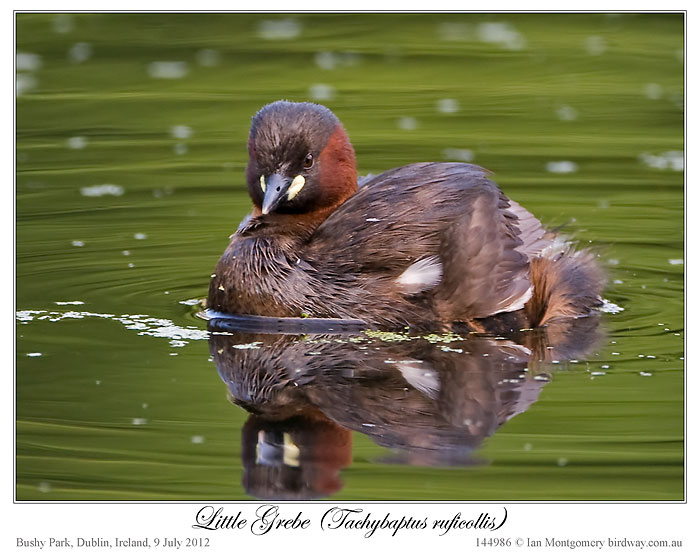
Little Grebe (Tachybaptus ruficollis) by Ian 1

Little Grebe (Tachybaptus ruficollis) by Ian 1

Ian’s Bird of the Week – Little Grebe ~ by Ian Montgomery

Newsletter – 7/22/12

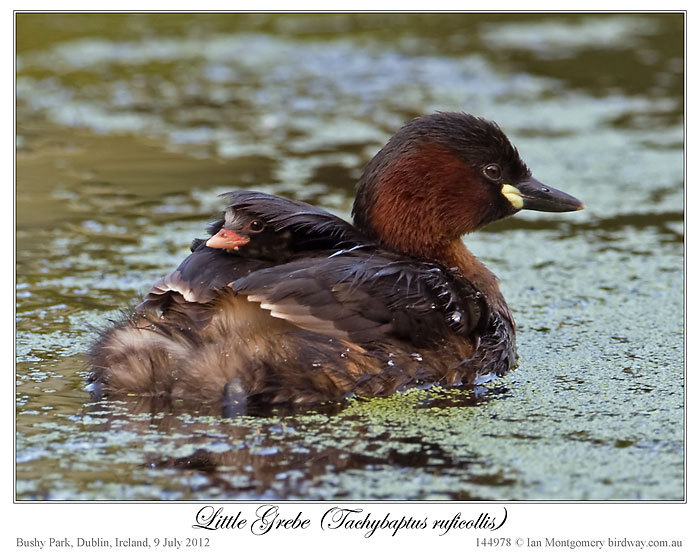
When I was in Dublin – I’m now back home in North Queensland – and we were waiting for the arrival of my niece’s baby, we used to take the dogs for a walk in nearby Bushy Park along the River Dodder. In the park, there is a large artificial pond with an island and I soon found this Little Grebe or ‘Dabchick’ patiently incubating eggs on her nest.

Grebes are usually fairly shy, so a nesting one is a good photo opportunity as they build their floating nests in the open in shallow water. The nest is anchored to submerged vegetation and branches and the fact that it is floating gives it some protection from changing water levels after rain, for example. The second photo was taken on the 26 June, the day when my niece’s daughter finally arrived.

Little Grebe (Tachybaptus ruficollis) by Ian 2

Little Grebe (Tachybaptus ruficollis) by Ian 2

It was a while before I could check the progress of the Little Grebe again and when we returned on the 9th June, third photo, the nest had vanished and, as there had been some bad weather in the meantime, I feared the worst. Both adults were still present but there was no obvious sign of any chicks. However, if you look carefully at this bird, you’ll see that the left wing is slightly raised and not folded flat.

Little Grebe (Tachybaptus ruficollis) by Ian 3

Little Grebe (Tachybaptus ruficollis) by Ian 3

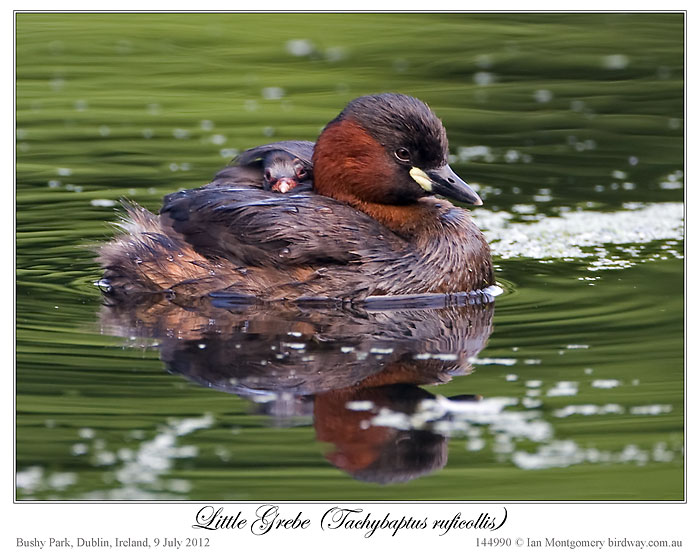
The reason for this became clear when the bird turned around, revealing a chick carefully tucked away under the wing.

Little Grebe (Tachybaptus ruficollis) by Ian 4 with chick

Little Grebe (Tachybaptus ruficollis) by Ian 4

The fourth photo was taken on the same day. We returned again 4 days later and I saw only the one adult and no chick but there is plenty of cover around the island and I may have missed it.

Little Grebe (Tachybaptus ruficollis) by Ian 5 with chick

Little Grebe (Tachybaptus ruficollis) by Ian 5

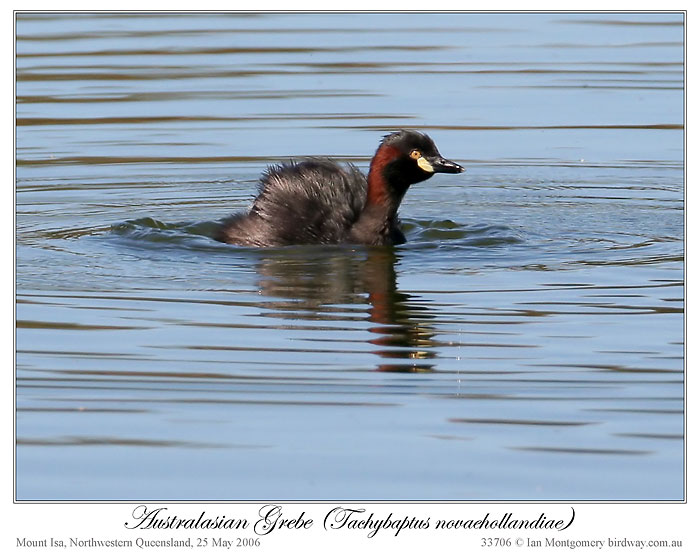
Any Australian birders would immediately notice the similarity between the Eurasian Little Grebe and the Australasian Grebe. They can be distinguished in breeding plumage by the amount of rufous on the neck, throat and breast. These are rufous in the Little Grebe (hence the specific name ruficollis) but the throat and breast of the Australasian Grebe are black as in the fifth photo. Other distinguishing field marks are the yellow, rather than reddish-brown, iris and the greater amount of white under the tail of the Australasian Grebe, though the latter is not evident in this photo.

Australasian Grebe (Tachybaptus novaehollandiae) by Ian

Australasian Grebe (Tachybaptus novaehollandiae) by Ian

These are fairly trivial differences and for a long time the two were treated as conspecific. However, the ranges of the two overlap in New Guinea (are ‘sympatric’) and it is usual to treat them as separate species with the Little Grebe being widespread throughout Eurasia and Africa and the Australasian Grebe occurring in New Guinea, Australia and New Zealand.

Best wishes

Ian
**************************************************
Ian Montgomery, Birdway Pty Ltd,
454 Forestry Road, Bluewater, Qld 4818
Tel 0411 602 737 ian@birdway.com.au
Check the latest website updates:
http://www.birdway.com.au/#updates
**************************************************


Lee’s Addition:

I love the photos of the little one riding under the wing of the parent. Of course that brings to mind several verses.

Keep me as the apple of the eye, hide me under the shadow of thy wings, (Psalms 17:8 KJV)

How excellent is thy lovingkindness, O God! therefore the children of men put their trust under the shadow of thy wings. (Psalms 36:7 KJV)

He shall cover you with His feathers, And under His wings you shall take refuge; His truth shall be your shield and buckler. (Psalms 91:4 NKJV)

We see the Pied-billed Grebe and the Horned Grebe here. It would be neat to see those two that Ian had the privilege of seeing. The Grebes belong to the Podicipedidae family. There are 23 Grebes worldwide.

See more:

Ian’s Bird of the Week articles.

Podicipedidae – Grebes Family

*

Nuggets Plus – Bleeding Mom Pelican..

Brown Pelican (Pelecanus occidentalis) rookery ©USFWS

Brown Pelican (Pelecanus occidentalis) rookery ©USFWS

Bleeding Mom Pelican.. ~ by a j mithra

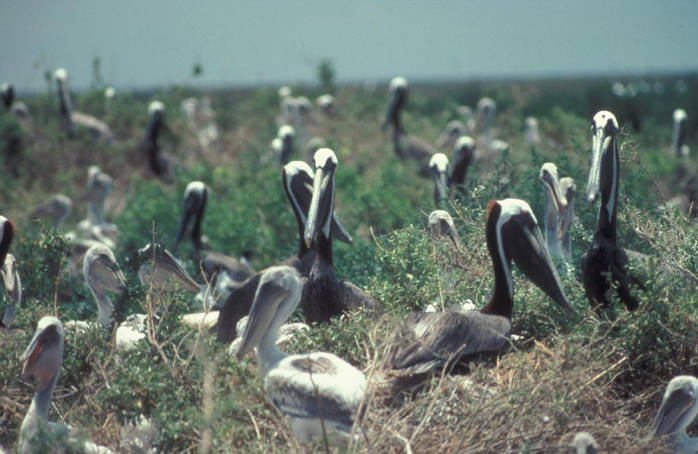
The Mom pelican
regurgitates food for her babies,
and in doing so,

Nuggets Plus

Nuggets Plus

blood from the macerated fish
spots her snowy white breast –
hence giving the impression
of piercing her own chest
to let blood as food for her young…
Do you know that our Lord Jesus
doesn’t give us regurgitated food.
But, let Him to be pierced
on the cross and shed His blood..
to give Himself as the Living bread…

“I am the living bread which came down from heaven: if any man eat of this bread, he shall live for ever: and the bread that I will give is my flesh, which I will give for the life of the world.” John 6:51

Yours in YESHUA,

a j mithra

Please visit us at:

Crosstree

ajmithra21

See More Nuggets Plus

*

Birds of the Bible – Descending Like A Dove

When I have my devotions, I sit in a chair by the window that faces the bird feeders. So while reading, I notice the birds busily getting their daily quota of my seed. I have been reading currently through the Gospels and keep coming upon when Jesus was baptized and the “Spirit of God descended like a dove?” That phrase is in all four Gospels; Matthew 3:16; Mark 1:10, Luke 3:22 and in John 1:32.

I have 3 or 4 Mourning Doves and a group of 9-11 Eurasian Collared Doves that come to eat quite frequently at about the time I am reading. So I have been noticing them more lately. They sort of flutter down to the feeders. The Red-winged Blackbirds and the Boat-tailed Grackles seem to sail in and then put on their brakes to land. The few House Sparrows don’t seem to flutter like the Doves either.

When He had been baptized, Jesus came up immediately from the water; and behold, the heavens were opened to Him, and He saw the Spirit of God descending like a dove and alighting upon Him. (Matthew 3:16 NKJV)

Barnes says – “The Spirit of God – See Mat_3:11. This was the third person of the Trinity, descending upon him in the form of a dove, Luk_3:22. The dove, among the Jews, was the symbol of purity of heart, harmlessness, and gentleness, Mat_10:16; compare Psa_55:6-7. The form chosen here was doubtless an emblem of the innocence, meekness, and tenderness of the Saviour. The gift of the Holy Spirit, in this manner, was the public approbation of Jesus Joh_1:33, and a sign of his being set apart to the office of the Messiah. We are not to suppose that there was any change done in the moral character of Jesus, but only that he was publicly set apart to his work, and solemnly approved by God in the office to which he was appointed.”

Pulpit Commentary – “The dove-Spirit on Christ. “Descending like a dove, and lighting upon him.” Comparing the accounts given by the evangelists, it still remains uncertain whether what was seen by John actually had the form of a dove, or hovered or brooded as a descending bird does. But for our fixed associations, and the familiar comments, we should be more willing to see that the brooding, resting, abiding of the Spirit on Jesus, is the thing intended to be set prominently before us by the figure. It will be safer, perhaps, to fix attention on both the explanations.”

Doves in Israel

Doves in Israel ©©

And immediately, coming up from the water, He saw the heavens parting and the Spirit descending upon Him like a dove. (Mark 1:10 NKJV)

Matthew Henry – “(2.) He saw the Spirit like a dove descending upon him. Note, Then we may see heaven opened to us, when we perceive the Spirit descending and working upon us. God’s good work in us is the surest evidence of his good will towards us, and his preparations for us. Justin Martyr says, that when Christ was baptized, a fire was kindled in Jordan: and it is an ancient tradition, that a great light shone round the place; for the Spirit brings both light and heat.”

Bible Knowledge Comm. – “Second, He saw the Spirit descending on Him like a dove, in a visible dovelike form, not in a dovelike way (cf. Luk_3:22). The dove imagery probably symbolized the Spirit’s creative activity (cf. Gen_1:2). In Old Testament times the Spirit came on certain people to empower them for service (e.g., Exo_31:3; Jdg_3:10; Jdg_11:29; 1Sa_19:20, 1Sa_19:23). The coming of the Spirit on Jesus empowered Him for His messianic mission (cf. Act_10:38) and the task of baptizing others with the Spirit, as John predicted (Mar_1:8).”

J Vernon McGee – “Mark 1:10-11 – Here we see the Trinity brought together in a very definite way. We see the Lord Jesus, the second Person of the Godhead; the Spirit of God who descends like a dove upon Him—the Spirit is the third Person of the Godhead; and the voice from heaven saying, “Thou art my beloved Son” is that of the Father, the first Person of the Godhead. So the Trinity is brought to our attention. And this, by the way, is heaven’s seal upon the Person and dedication of Jesus.   You will notice that things are happening very fast here. He is the Servant. John the Baptist is the one who introduces Him, and then God the Father identifies Him and puts His seal upon Him. Next the temptation will initiate Him.”

Mourning Dove (Zenaida macroura) by Quy Tran

Mourning Dove (Zenaida macroura) by Quy Tran

And the Holy Spirit descended in bodily form like a dove upon Him, and a voice came from heaven which said, “You are My beloved Son; in You I am well pleased.” (Luke 3:22 NKJV)

Life Application Study Bible – “Luke 3:21-22 – Theologians have long been troubled by Jesus’ allowing himself to be baptized by John. After all, this baptism was for sinners. Why, then, did Jesus do it? He did it because he is both God and human—he underwent baptism and even death as only a human could; he lived a sinless life and rose from the dead as only God could. This baptism by John in the Jordan River was another step in his identification with us sinful people; and the arrival of the dove signifies God’s approval. Now Jesus would officially begin his ministry as God’s beloved Son walking the dusty roads of Israel. When you are hurting, depressed, broken, remember: You have a Savior who understands your humanity. When you sin, remember: He has paid the price for your disobedience.

This is one of several places in Scripture where all the members of the Trinity are mentioned—Father, Son, and Holy Spirit. In the traditional words of the church, the one God exists in three persons but one substance, coeternal and coequal. No explanation can adequately portray the power and intricacy of this unique relationship. There are no perfect analogies in nature because there is no other relationship like the Trinity.

Gill – “like a dove upon him; either in the form of a dove, or this corporeal form, whatever it was, descended and hovered on him as a dove does:”

I did not know Him; but that He should be revealed to Israel, therefore I came baptizing with water.” And John bore witness, saying, “I saw the Spirit descending from heaven like a dove, and He remained upon Him. I did not know Him, but He who sent me to baptize with water said to me, ‘Upon whom you see the Spirit descending, and remaining on Him, this is He who baptizes with the Holy Spirit.’ And I have seen and testified that this is the Son of God.” (John 1:31-34 NKJV)

Ironside – “Then John says, “This is he of whom I said, After me cometh a man which is preferred before me: for he was before me. And I knew him not” (vv. 30-31a). Evidently he had been out in company where Jesus was, but he did not understand that this was the Messiah until now. He “knew him not: but that he should be made manifest to Israel, therefore am I come baptizing with water. And John bare record, saying, I saw the Spirit descending from heaven like a dove”-you see this event takes place after the baptism, which is not referred to here, but is mentioned in other Gospels-”I saw the Spirit descending from heaven like a dove, and it abode upon him. And I knew him not: but he that sent me to baptize with water, the same said unto me, Upon whom thou shalt see the Spirit descending, and remaining upon him, the same is he which baptizeth with the Holy Ghost” (vv. 31-33). The great work that John was sent to do was nearing an end. Now here is the climax: “I saw and bare record that this is the Son of God.” Did John really know that? Yes, he did-“I saw, and bare record that this is the Son of God” (v. 34). Do you know that, dear friend? Have you trusted Him for yourself? Oh, if you have never trusted Him before, won’t you come to God, owning your sin? “Behold the Lamb of God, which taketh away the sin of the world.”

*** From the above remarks from the different commentaries and the four verses, it seems that the Dove descending on Christ and resting there is for several reason. John the Baptist had been told to look for that sign so that he would know who the Messiah was. Also, the verse help reveal the work of the Trinity, especially the Holy Spirit (our Dove). And most important of all, those verse point to Our Savior or “the Lamb of God, which taketh away the sin of the world.” I trust you know Him as your personal Savior.

The next time I watch a Dove landing, I am sure what I have just gleaned from these writers and my reading of the Bible will bring to mind Jesus’ baptism and the how the Holy Spirit descended like a Dove and God speaking from heaven, confirming that He is the Son of God.

Quotes are from my e-Sword program.

See ~ Birds of the Bible – Doves

Sharing The Gospel

*

Video by  CherokeePhoenix

*

I know these are not Doves, but Gulls, but they remind me of the Dove’s landings at my feeders.

*

Ms. Theresa’s Thoughts – Eagles’ Wings

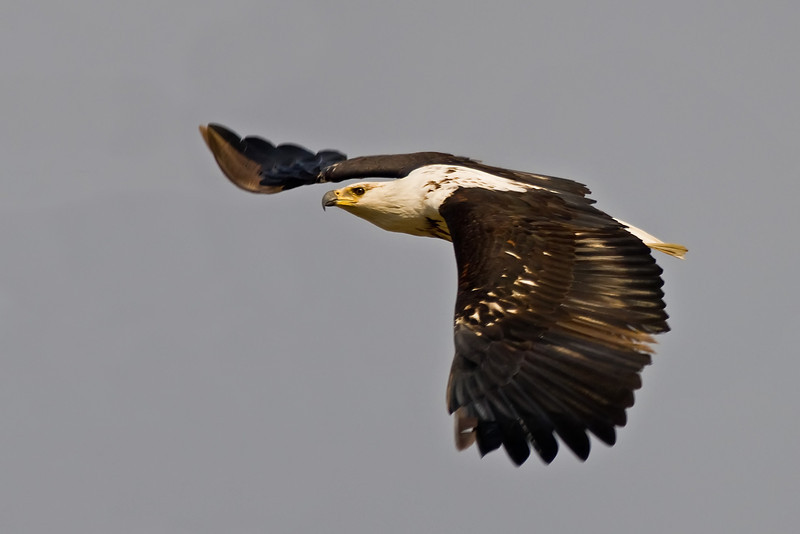
African Fish Eagle (Haliaeetus vocifer) by Africaddict

Ms. Theresa’s Thoughts – Eagles’ Wings

You have seen what I did to the Egyptians, and how I bore you on eagles’ wings and brought you to Myself. (Exodus 19:4 NKJV)

How sweet and loving is God that takes such good care of not only the birds but us as well. But the only way we are brought to God is accepting Him as our Lord and Savior.

*

Wordless Birds

*