The Double Life of the Hummingbird ~ Creation Moments

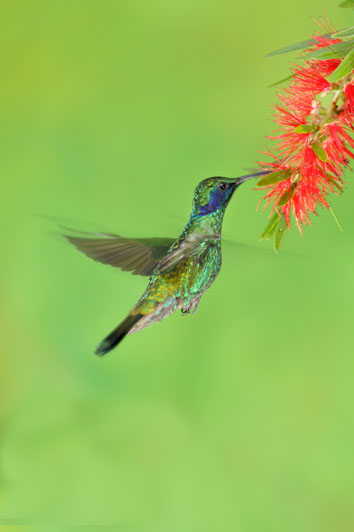
GreenVioletear (Colibri thalassinus) Reinier Munguia

Green Violetear (Colibri thalassinus) Reinier Munguia

The Double Life of the Hummingbird ~ ©Creation Moments 2014

“I will both lay me down in peace, and sleep: for thou, LORD, only makest me dwell in safety.” Psalm 4:8

You might guess that the hummingbird, darting around from flower to flower with wings beating some 60 times a second, must burn a lot of energy to keep going. If a 65-pound boy burned up energy at the same rate, he would eat 100 pounds of chicken every day. The fact is, the hummingbird will die if it goes for more Green Violetear hummingbird than two hours without eating. You might wonder, if the hummingbird cannot go more than two hours without eating, when does it sleep? The fact is, the hummingbird does sleep a good eight hours every night. How does he do it?

God has given the hummingbird a most remarkable metabolism. During the day, the hummingbird’s heart must beat 10 times every second as it keeps its incredibly fast metabolism going. But when it goes to sleep, the hummingbird’s heart slows down to less than one beat per second – about the same as ours. And to further slow his metabolism, the hummingbird’s normal daytime temperature drops from 100 (F) degrees to the same temperature as the night air – 50 or 60 degrees. This drop in temperature would kill most warm-blooded animals. But all of this enables the hummingbird to go without food for a good eight-hour sleep.

The hummingbird provides more than enough evidence that the Creator really does care for His creatures, even when they are asleep.

Prayer:
Dear Father, I thank You that You care for me even when I am asleep and cannot protect myself. Comfort me with this truth, especially when I am fearful of the night. In Jesus’ Name. Amen.

Notes:
Bob Devine, Uncle Bob’s Animal Stories (Moody Press, Chicago, IL, 1986), pp. 38-39. Photo: Green Violetear hummingbird. Courtesy of Mdf. Licensed under the Creative Commons Attribution-Share Alike 3.0 Unported license. Creation Moments ©(Used with permission)
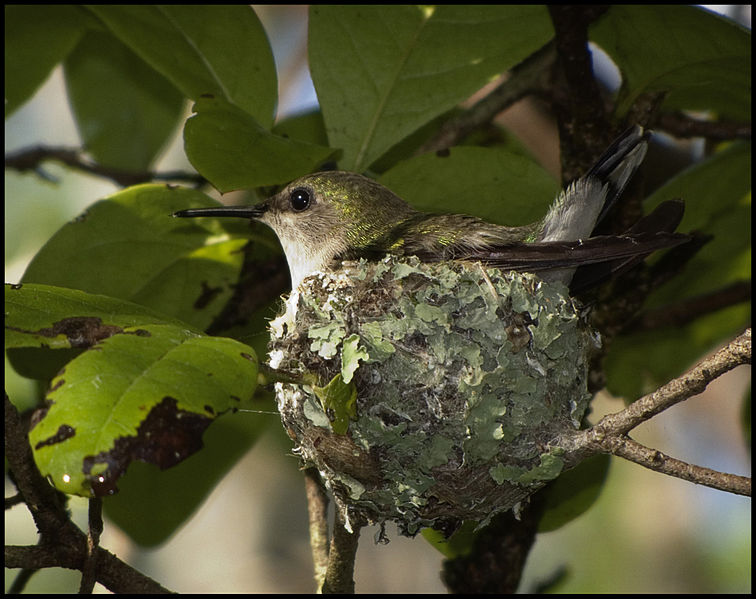
Vervain Hummingbird (Mellisuga minima) WikiC

Vervain Hummingbird (Mellisuga minima) WikiC

I always enjoy the articles from Creation Moments, especially the ones about our avian friends. Our Creator is definitely Omniscient (all-knowing). Such wisdom He used in providing for the various needs of the birds.

The Hummingbirds belong to the Trochilidae – Hummingbird Family.

Creation Moments

More Interesting Things from Creation Moments

*


Interesting Things – A Noisy, Bird Brained Harem

Comb-crested Jacana (Irediparra gallinacea)  ©WikiC

Comb-crested Jacana (Irediparra gallinacea) ©WikiC

A NOISY, BIRD BRAINED HAREM

“Whence then cometh wisdom? and where is the place of understanding? Seeing it is hid from the eyes of all living, and kept close from the fowls of the air.” (Job 28:20-21)

SmileyCentral.comScripture frequently makes reference to the fact that birds are not very smart compared to human beings. The tropical wetland bird called the jacana shows that you don’t have to be very smart to be deceptive. The jacana is noteworthy for several reasons. It is one of only 20 species of birds in the world where the female Comb-crested jacana, sometimes referred to as Jesus birdsleaves the care of the young to the males. One flock in southern India was made up of about 50 birds. The males staked out their territory on floating vegetation, often getting into violent fights with other males. Then the females, which are about 60 percent larger than the males, fought with each other for exclusive rights to up to four male territories. Once territories were established, the females would visit each of the males in her territory, mating with each.
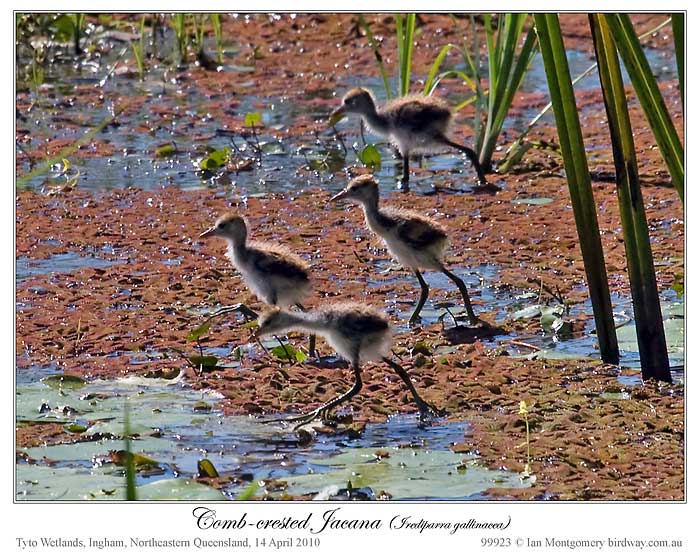
Once the eggs are laid in each male’s nest, the female shows no more interest in her offspring. The male will care for the eggs and youngsters once they hatch, until the time they are ready to leave home. But the smaller males have their own strategy for dealing with their situation. They yell. Researchers say a yelling male is really blackmailing the larger female into giving him some attention. A yelling male attracts the attention of other nearby females who might want to take him into her own harem, so his mate comes running to pay attention to him. Sometimes males will even fake an emergency which brings his mate in a hurry. God is the source of all wisdom, and He gave each of His creatures enough wisdom to conduct their lives.

Prayer:
Father, I thank You for Your wisdom in Holy Scripture. Grant me understanding as I read Your Word. Amen.

Notes:
S. Milius, Science News, March 6, 1999, v. 155, p. 149. Photo: Comb-crested jacana, sometimes referred to as Jesus birds. Courtesy of John Hill. Licensed under the Creative Commons Attribution-Share Alike 3.0 Unported license.

Used with permission: ©Creation Moments 2014


Comb-crested Jacana (Irediparra gallinacea) by Ian

Comb-crested Jacana (Irediparra gallinacea) by Ian

Lee’s Addition:

Now in the fourth watch of the night Jesus went to them, walking on the sea. And when the disciples saw Him walking on the sea, they were troubled, saying, “It is a ghost!” And they cried out for fear. But immediately Jesus spoke to them, saying, “Be of good cheer! It is I; do not be afraid.” (Matthew 14:25-27 NKJV)

What an interesting behavior from these Jacanas. Never cease to be amazed at how the Lord created His critters and their way of doing things. Did you notice how their feet were designed to support their weight? That habit of “walking on water” is why some call them the “Jesus” Bird.

The Comb-crested Jacanas are members of the Jacanidae – Jacanas Family.

Comb-crested Jacana (Irediparra gallinacea) by Ian's Birdway

Comb-crested Jacana (Irediparra gallinacea) by Ian’s Birdway

More Interesting Things

Creation Moments

Jacanidae – Jacanas Family

Ian’s Bird of the Week – Comb-crested Jacana

*


Interesting Things – Meerkat School

SmileyCentral.com

MEERKAT SCHOOL

“… and I will be with thy mouth, and with his mouth, and will teach you what ye shall do.” Exodus 4:15b

Behavioral researchers define teaching very specifically. First, of course, a teacher must have pupils. Then the teacher must be less efficient in doing whatever he is doing than he normally would be if he were alone, as a means of showing the pupils how to do the task. And finally, the pupils must learn the task more quickly than they would on their own.

Meerkats at the Auckland Zoo ©©Auckland_Zoo

Meerkats at the Auckland Zoo ©©Auckland_Zoo

Meerkats at the Auckland Zoo by that definition, humans, of course, are teachers. Among animals, only a species of ant meets this definition of teaching. But now researchers from the University of Cambridge in England say that meerkats also qualify as teachers. They found that experienced hunters will take young, inexperienced pups with them when they hunt. They will let the youngsters watch them as they catch prey. Of course, when they catch some small prey, the youngsters will vocally beg for a handout. However, only 35 percent of those handouts are served to the youngsters dead. The rest of the time they have to learn how to subdue the caught prey themselves. On the other hand, older, more experienced pups received already-killed handouts only 10 percent of the time. Further tests involving live and dead prey show that those given live prey could learn to subdue it in only three days.

Despite the researchers’ presupposition that teaching evolved, God is still the One that teaches the teachers.

Meerkat at LP Zoo by Lee

Meerkat at LP Zoo by Lee

Prayer:
Father, I pray that you would provide Your church with faithful teachers of the forgiveness we have in Jesus Christ. Amen.
Notes:
Science News, 7/15/06, p. 36, S. Milius, “Live Prey for Dummies.” Photo: Meerkats at the Auckland Zoo. Courtesy of Ashleigh Thompson. Licensed under the Creative Commons Attribution 2.0 Generic license.

©Creation Moments – Meerkat School, 2014.


Lee’s Additions:

Meerkat at LP Zoo by Lee

Meerkat at LP Zoo by Lee

I have always enjoy watching Meerkats and thought you might enjoy another Interesting Things blog. Lowry Park Zoo and other zoos keep them.

*

*

Intimidating Duets – ©Creation Moments

Magpie-lark (Grallina cyanoleuca) ©©J.J. Harrison

Magpie-lark (Grallina cyanoleuca) ©©J.J. Harrison

“… and he shall rise up at the voice of the bird, and all the daughters of musick shall be brought low…” Ecclesiastes 12:4b

Precision in communication is highly important. This is especially true of the type of communication called music, whether you are talking about Mozart or magpie-larks.

Only about three percent of bird species are known to sing duets. In a duet, one mate begins singing, and the other mate begins a half second later. Among Australian magpie-larks, pairs that are newly mated usually lack that precision. However, in pairs that have been together for two years, the lag time of the duet usually varies by only a few hundredths of a second.

Researchers also discovered that this precision serves a purpose. Male magpie-larks respond to perceived threats by increasing their singing. When they played the less-precise duets to 12 pairs of other magpie-larks, the males only responded in this way seven times in five minutes. However, the more-precise duets resulted in nine responses in five minutes. In short, other magpie-larks are more intimidated by pairs that sing with precision than by those who do not. This is important in preserving an established couple’s territory from invasion by new couples.

Communication with precision is yet another fingerprint of God on the creation. In Scripture, the ultimate in precise communication, God even points us to the birds as He urges us to recognize His involvement in the creation.

Prayer:

Thank You, Father, for taking care of all Your creation and especially for sending Your Son to save me. Amen.

Notes:
Science News, 6/9/07, p. 357, S. Milius, “Scary Singing.” Photo: Female magpie-lark. Courtesy of J.J. Harrison. Licensed under the Creative Commons Attribution-Share Alike 3.0 Unported license.  ©Creation Moments 2014


Magpie-lark (Grallina cyanoleuca) by W Kwong

Magpie-lark (Grallina cyanoleuca) by W Kwong

Lee’s Addition:

By them the birds of the heavens have their home; They sing among the branches. (Psalms 104:12 NKJV)

Magpie-larks are members of the Monarchs – Monarchidae Family, which has 99 species in it. There are only two larks in this family:

Magpie-lark (Grallina cyanoleuca)
Torrent-lark (Grallina bruijnii) WorldBirds – Photos

Here is a sound recording from xeno-canto of a duet.

*

*


For The Sheer Joy of Variety! – Creation Moments


Greater Painted Snipe (Rostratula benghalensis) by W Kwong

Greater Painted Snipe (Rostratula benghalensis) by W Kwong

FOR THE SHEER JOY OF VARIETY!

“Woe unto him that striveth with his Maker! Let the potsherd strive with the potsherds of the earth. Shall the clay say to him that fashioneth it, What makest thou? or thy work, He hath no hands?” (Isaiah 45:9)

Did you ever try to plan all the details of a simple project? How many plans do you think the Lord had to make when He created living things? A billion? A billion times a billion?

The hierarchy of biological classification’s eight major taxonomic ranks

The hierarchy of biological classification’s eight major taxonomic ranks

We all know that it takes time to plan the most simple project. Did you ever think about the planning God had to do when He created all the different kinds of living things? Our word “species” today includes many creatures that the Bible counts as being the same “kind” – as when God created the kinds. But God did design the genetic information that allowed the kinds to produce these variations.

Yes, God’s act of creating living things was much more than just wishing. Just think that there are more than 20,000 different species of bees – some with very complex societies – and their own languages! The figures and the beauty of it all makes one wonder at God. Why are there 4,500 different species of sponges? Why are some creatures – never seen by humans until this century – so eerily beautiful? For that matter, why have so many different kinds of beautiful flowers?

The variety in the creation reflects some of the joy of creation that God felt, and shows us the incredible unbridled creativity of our wonderful God. The fact that there is only one species of human – all related – confirms the human history related in the Bible.

Prayer:
Dear heavenly Father, I know that I shall never have Your ability to plan and carry out those plans. I confess that too often I waste the time and energy You give me because I don’t even bother to use the abilities You have given me. Forgive me for Jesus’ sake, and for His sake help me to be more like You in this. Amen.
Notes:
Diagram: The hierarchy of biological classification’s eight major taxonomic ranks. The biblical “kind” is roughly the same as the “family” classification.
(Used with permission of Creation Moments©2014)


Lee’s Addition:

We mention the Lord’s fantastic variety in His avian creations often. This article fits right in with those thoughts and thought it should be shared.


This slideshow requires JavaScript.

*

I selected different photos for the same article on my other site:

Creation Moments’ – For The Sheer Joy of Variety!

*

After Their Kinds – Creation Moments

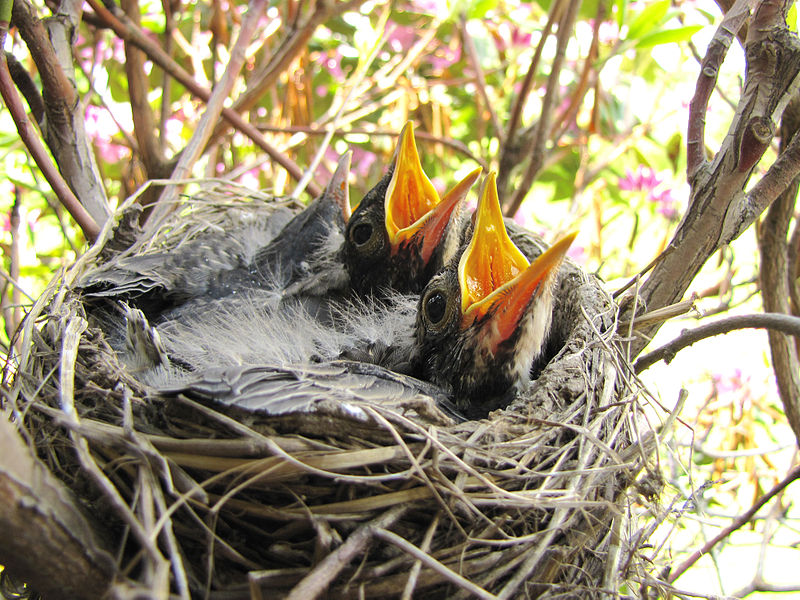
American Robin (Turdus migratorius) in nest ready to eat WikiC

American Robin (Turdus migratorius) in nest ready to eat WikiC

AFTER THEIR KINDS

And the earth brought forth grass, and herb yielding seed after his kind, and the tree yielding fruit, whose seed was in itself, after his kind: and God saw that it was good. (Genesis 1:12)

How wonderful! Your dog has just had puppies! But do you now have to sort through the litter and make sure there are no baby giraffes or kangaroos?

New born Welsh Springer Spaniel puppies ©WikiC

New born Welsh Springer Spaniel puppies ©WikiC

No, not a single giraffe or kangaroo in the litter!In God’s account of creation in Genesis 1, we repeatedly read that both plants and animals were created to reproduce “after their kind.” Genesis 1, in speaking about the creation of plants, repeats three times in just two verses that they are to reproduce “after their kind.” We see the same phrase repeated later in the chapter when animals are created. This is not just empty repetition. God is stressing a fundamental principle that all things reproduce “after their kind.” Mother dogs have puppies and mother cats have kittens. You can count on it.

Why does God stress this principle? Even before creation, God knew that humans would eventually sin and then seek to hide their responsibility by trying to explain things without a Creator. God knew that this idea of evolution would capture the faith of millions over the history of the world.

God stresses what our experience shows so that He might be harder for us to hide from. All things do reproduce after their kind. And despite evolutionists’ strong faith in evolution, they cannot offer one established scientific fact to explain how one kind of creature might eventually make a completely different kind!

Prayer:
I thank You, Lord, that You have made it hard for men to deny You. Yet men still deny You, seeking explanations and excuses outside of Your Word. I know that I, too, can do this, for I am both saint and sinner. I ask that You would correct me when I seek outside of Your Word what is so richly provided to me in Your Word. Amen.

Notes:
Photo: No, not a single giraffe or kangaroo in the litter!
Used with permission of Creation Moments ©2014


See:

Creation Moments – After Their Kind

More Creation Moment and Interesting Things articles here

*


Peru’s Marvellous Hummingbird – Updated

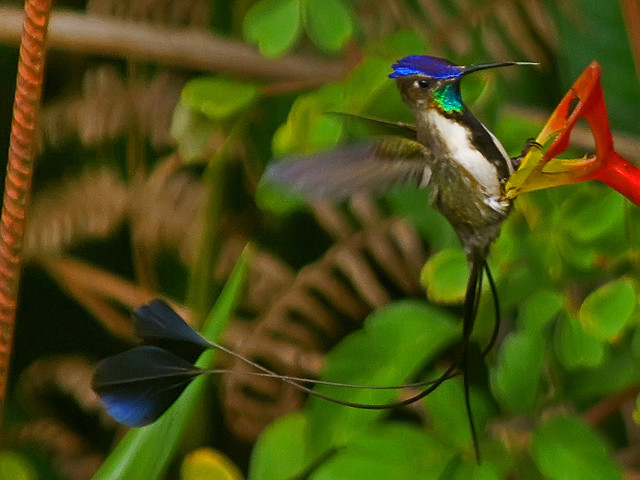
Marvelous Spatuletail (Loddigesia mirabilis)©©

Marvelous Spatuletail (Loddigesia mirabilis)©©

Peru’s Marvellous Hummingbird

(from Creation Moments)

In that day the LORD of hosts will be for a crown of glory and a diadem of beauty to the remnant of His people. (Isaiah 28:5)

In 1835, when scientists first saw Peru’s most unusual hummingbird, they were so overcome with its beauty that they gave it the name “Marvellous.” This little bird treats the eye to iridescent green, yellow, orange, and purple feathers. But its most unusual feature is its tail. While most birds have eight to twelve tail feathers, the Marvellous hummingbird has only four. Two of these are long, pointed, thorn-like feathers that don’t seem to help much in flying or landing. The other two feathers are truly marvellous. They are six inches long, three times the length of the bird’s two-inch body. On the end of these two long narrow feathers are large feather fans that nearly equal the surface area of its wings.

Marvelous Spatuletail (Loddigesia mirabilis) ©©

Marvelous Spatuletail (Loddigesia mirabilis) ©©

Astonishingly, the Marvelous hummingbird has complete control of these feathers. At rest, the bird perches with these two feathers hanging down an inch or so from its body, and then crossing them until they are horizontal. In flight and landing they provide remarkable maneuverability. During mating, the hummingbird moves them as semaphores. Interestingly enough, evolutionists admit that they are stumped as to why these unusual feathers should have evolved.

One look at our creation clearly shows that our Creator appreciates beauty. But even the beautiful Marvelous hummingbird is but a poor and cloudy hint of the beauty of our Creator Himself.

Prayer:
Dear Father, help me treat the beauty You have created as You would have me to do. Let me be filled with thanksgiving to You for it, and let it remind me that You are the source of all that is truly beautiful. In Jesus’ Name. Amen.
Notes:
Crawford H. Greenewalt. The Marvelous Hummingbird Rediscovered. National Geographic, Vol. 130, No. 1. P. 98-101.”

©Creation Moments 2014


*

Lee’s Addition:

This was originally done in 2010, but needs to be re-blogged again. Also, the YouTube above was added. It is astonishing to watch the little bird in action. Thanks to one of our readers who found the video to add to their site. See The Vine Vigil.

The Marvellous Hummingbird is now the Marvelous Spatuletail (Loddigesia mirabilis). It is in the Hummingbird Family (Trochilidae) and is part of the Apodiformes Order.

Marvelous Spatuletail (Loddigesia mirabilis) ©WikiC-Gould_Troch._pl._161

Marvelous Spatuletail (Loddigesia mirabilis) ©WikiC-Gould_Troch._pl._161

The Marvelous (also Marvellous) Spatuletail (hummingbird), Loddigesia mirabilis, is a medium-sized (up to 5.9 in/15 cm long) white, green and bronze hummingbird adorned with blue crest feathers, a brilliant turquoise gorget, and a black line on its white underparts. It is the only member of the monotypic genus Loddigesia.

A Peruvian endemic, this species is found in the forest edge of the Río Utcubamba region. It was first reported in 1835 by the bird collector Andrew Matthews for George Loddiges. The Marvellous Spatuletail is unique among birds, for it has just four feathers in its tail. Its most remarkable feature is the male’s two long racquet-shaped outer tail feathers that cross each other and end in large violet-blue discs or “spatules”. He can move them independently.

Information gathered from Creation Moments, Wikipedia, and YouTube.

Wordless Birds

Peru’s Marvellous Hummmingbird – The Vine Vigil

*

*


Creation Moments’ – Designed For Flight

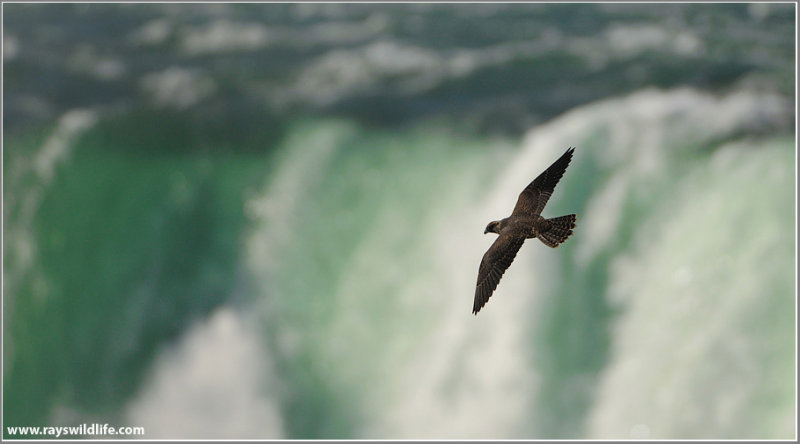
Peregrine Falcon Flying Over Niagara Falls

Doth the hawk fly by thy wisdom, [and] stretch her wings toward the south? Job 39:26

Many textbooks tell young people today that birds are modified reptiles. Suppose, they say, that millions of years ago the scales on some reptiles began to fray along the edges. In time, they say, the frayed scales turned into feathers and birds were born.

Designed for Flight The elegance and beauty of the feather make this story hard to believe. Can sticking a feather on a lizard produce a peacock? The bird’s feather is only a small part of the complete flying system of the bird. Even with very careful planning and redesigning, a reptile doesn’t have what it takes.

A bird needs massive breast muscles for flight. In some birds, 30 percent of the body weight of the bird is breast muscle. By comparison, in humans, breast muscles are only about 1 percent of body weight. A bird also needs an extremely high metabolism and blood pressure to deliver the energy those muscles need for flight. Birds have a higher metabolism than any other creature; they also have the necessary high blood pressure. Finally, as is well known, birds need light skeletons. The man-o’-war has a wingspan of seven feet. But its entire skeleton weighs only a few ounces – less than its feathers!

Even the most clever rebuilding of a reptile cannot produce a bird. In fact, birds have very little in common with reptiles. The entire being of the bird, from body to brain, has been specially designed for flight by a Creator who clearly knows everything there is to know about flight.

Prayer:
Father in heaven, the beauty, grace and huge variety of birds You have created are some of the most beautiful creatures on earth. As I thank You for them, fill me with new wonder over the wonderful work of Your hands. Amen.

Notes:
Vandeman, George. 1991. “The miracle of flight.” Signs of the Times, May. p. 25.

Designed For Flight ©Creation Moments 2014

Interesting Things

*

Interesting Things – The Master Artist

Deep Sea Fish - Watercress darter - Creation Moments

Deep Sea Fish – Watercress darter – Creation Moments

THE MASTER ARTIST
in
God’s Design

And out of the ground made the LORD God to grow every tree that is pleasant to the sight, and good for food; the tree of life also in the midst of the garden, and the tree of knowledge of good and evil. (Genesis 2:9 KJV)

SmileyCentral.com

For example, the Earth could get along with a lot less color. All those beautiful sunsets and sunrises actually serve no purpose, and neither does each one have to be different from every other. Many flowers have Watercress dartercolors that attract their pollinators, but few flowers actually need color for this purpose. But then, flowers in black and white certainly would be dull. There are many beautiful deep-sea fish that don’t need their bright and beautiful colors at all. Some of these fish live so far below the surface of the water that only a small amount of blue light reaches those depths. Where these fish live, everything always looks a very dim blue. Yet, some of these fish have incredibly bright coloration that they and their friends never see.

Here we have to ask the evolutionist what value could it have been for this fish to develop all these bright colors when they can serve no purpose for survival? In Genesis 2:9 we read that when God created the fruit trees for food, He also made them “pleasant to the sight.” They didn’t need to be. Clearly, God does indeed appreciate beauty and has created works that human artists can only try to copy.

Prayer:
Dear Lord, I thank You for all the beauty You have created in the world. I ask that You would help us to gain a better appreciation for it, and find better ways to preserve it. In Jesus Name. Amen.
Notes:
Gary Parker, Ed.D., “Nature’s Challenges to Evolutionary Theory,” Institute of Creation Research, Impact Series, October, 1978, No. 64. Photo: Watercress darter.

(Permission by Creation Moments ©2014)


Magnificent Hummingbird (Eugenes fulgens) by Judd Patterson

Magnificent Hummingbird (Eugenes fulgens) by Judd Patterson

Lee’s Addition:

This article goes along with the many things written here about our beautifully created birds.

I am so thankful that the Lord likes color and beauty. When heaven is described, it usually tells of the various “precious stones, “streets of gold,” and other wonderful sights that we cannot comprehend.

Surely the Creator has given us these brilliantly colored birds, fish, flowers, butterflies, trees in the Fall, and numerous other things, to give us a “glimpse” and “taste” of what heaven will look like, color wise.

*

Creation Moments – Master Artist

Nature’s Challenge to Evolutionary Theory” – Institute of Creation Research

Watercress Darter – Wikipedia

More Interesting Things

*


Birds Helping Birds by Creation Moments

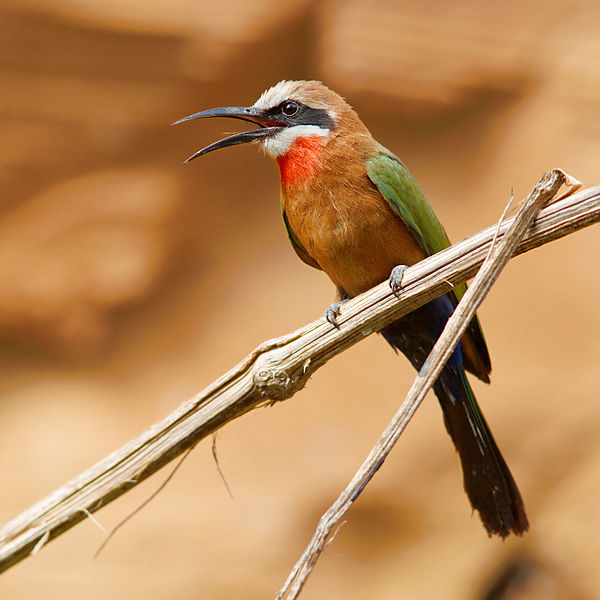
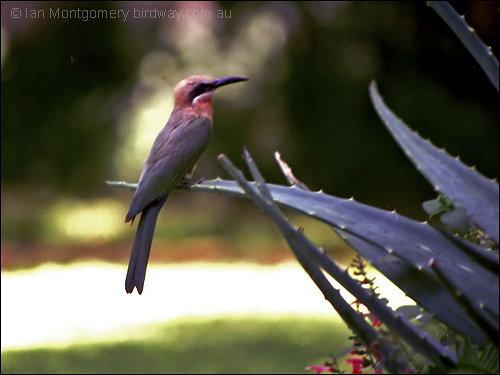
White-fronted Bee-eater (Merops bullockoides) ©WikiC

White-fronted Bee-eater (Merops bullockoides) ©WikiC

Birds Helping Birds ~ by Creation Moments

“But a certain Samaritan, as he journeyed, came where he was: and when he saw him, he had compassion on him, And went to him, and bound up his wounds, pouring in oil and wine, and set him on his own beast, and brought him to an inn, and took care of him.” (Luke 10:33-34)

Altruism – helping one another – is a real puzzle to those who explain the world of living things in terms of materialistic evolution. Evolution is supposed to work on the selfish survival-of-the-fittest principle, so there should be no reason for any creature, including man, to develop a helping attitude. In fact, there is no way to explain how the genetic code could possibly develop and pass on a trait such as altruism.

Birds helping birds Researchers have studied a bird called the white-fronted African bee-eater. Members of this species help each other, sometimes even at the sacrifice of their own life. For example, one bird will face a spitting cobra to defend another, and scientists have been puzzled to know how this altruistic trait can possibly be passed on, when it often results in death. Another common altruistic habit of the African bee-eater is that one female will put off starting her own family to help another bee-eater raise her young. Some argue that such behavior is limited to birds that are related. But they admit that even adopted orphaned bee-eaters will help their adopted parents in this way.

While it is often denied, the theory of evolution has yet to adequately explain altruism. Altruism is a demonstration of that commandment given by our Creator to “love our neighbor.”

Prayer:
Dear God, I ask that You would help me so that I would not adopt the selfish and cold behavior of so many in today’s world. Let my life be an example that draws others to You. In Jesus’ Name. Amen.

©Creation Moments

Notes:
Kathy A. Fackelmann, “Avian Altruism,” Science News, Vol.135, June 10, 1989, pp. 364-365. Photo: Courtesy of Luc Viatour. Licensed under the GNU Free Documentation 1.2 License.


Lee’s Addition:

White-fronted Bee-eater (Merops bullockoides) by Bob-Nan

White-fronted Bee-eater (Merops bullockoides) by Bob-Nan

The Bee-eaters are members of the Meropidae Family. There are 27 different species of bee-eaters. What an amazing display of the Lord’s Creation. They are a lovely family to look at.

Most species are found in Africa and Asia but others occur in southern Europe, Australia, and New Guinea. They are characterised by richly coloured plumage, slender bodies, and usually elongated central tail feathers. All have long downturned bills and pointed wings, which give them a swallow-like appearance when seen from afar. There are 26 different species of bee-eaters.

*

White-fronted Bee-eater (Merops bullockoides) by Ian

White-fronted Bee-eater (Merops bullockoides) by Ian

Meropidae Family

Articles Mentioning Birds From This Family:

*

Interesting Things – Not So Bird-Brained

Great Blue Heron (Ardea herodias) Sleeping by Lee at Circle B

Great Blue Heron (Ardea herodias) Sleeping by Lee

NOT SO BIRD-BRAINED ~ by Creation Moments

So God created . . . every winged bird according to its kind. And God saw that it was good. (Genesis 1:21)

How do you take a much-needed nap or get a good night’s sleep when you must be alert to danger? Human beings designate people to stay awake and watch for danger when they sleep. Then, they set up warning systems.

SmileyCentral.com

Since birds are much more vulnerable to danger, God gave them the ability to do these things on a simple scale, and then He gave them one more amazing gift. Many birds are able to put half of their brain to sleep, while the other half stays awake and alert. The eye that serves the sleeping half even closes, while the eye that serves the waking half of the brain stays alert, searching for danger. After the first sleeping half is nicely rested, it wakes up, and the other half goes to sleep. Of course, these birds can also put both sides of the brain to sleep at the same time, just as we do. Whales, seals and dolphins are among the non-birds that can half-brain sleep as well.

Evidence of the clever design of this half-brain sleep ability can be seen in the fact that where two birds sleep next to each other, each bird will put the half of the brain that faces its partner to sleep. Once that half is rested, they change places, so the other half of their brain can sleep.

When Scripture tells us that God looked at His creation and declared it “good,” God’s standard for good is perfection. His ingenious design, which would allow birds to protect themselves even when sin and death entered the creation, is part of the goodness of God’s creation.

Prayer:
I thank You, Lord, that You made a creation perfect and so beautiful that even in could not completely destroy it. Amen.

Notes:
S. Milius, Half-asleep birds choose which half dozes, Science News, February 6, 1999, v.155, p.86

©Creation Moments

*

Largest Creature on Earth ~ from Creation Moments

Skeleton of a blue whale

And God created great whales, and every living creature that moveth, which the waters brought forth abundantly, after their kind, and every winged fowl after his kind: and God saw that it was good. (Genesis 1:21)

Many people think that the greatest of the dinosaurs were the largest creatures ever to live on Earth. But while a few of the very largest dinosaurs may have been longer than the blue whale, the blue whale has the largest actual body size of any creature that ever lived.

The blue whale can reach a length of 100 feet and weigh up to 170 tons. That’s about as much as a whole town of twenty-seven hundred people! It has to eat a million calories a day, which is equivalent to about 1,000 banana splits. The blue whale’s tongue weighs more than an elephant and its arteries are big enough for a man to swim through. Its heart, which has to pump the whale’s entire supply of eight tons of blood, weighs 1,000 pounds.

In addition to its great size, the whale is intelligent. Besides showing forth God’s great creative power and imagination, the whale also shows us that neither size nor other standards of human measurement give us an indication of how God places value on things. Though we human beings are not the largest, nor the only intelligent creatures on Earth, we are the only ones responsible to God for the way we live. That is why, when sin separated us from our Creator, He sent His only Son to save and restore us to Himself.

Prayer:
Heavenly Father, help me not to measure things in a worldly manner. Instead of focusing on the creation, including myself, let my focus be on You and what You have done for me. In Jesus’ Name. Amen.

Notes:

“So You Think a Dinosaur is Big.” Does God Exist? May-June, 1989. Photo: Skeleton of a blue whale, Canadian Museum of Nature, Ottawa, Ontario. Courtesy of D. Gordon E. Robertson. Licensed under the Creative Commons Attribution-Share Alike 3.0 Unported license.

©Creation Moments 2014

*

More Plus Articles

*