Bible Birds – Swallow-tailed Kites

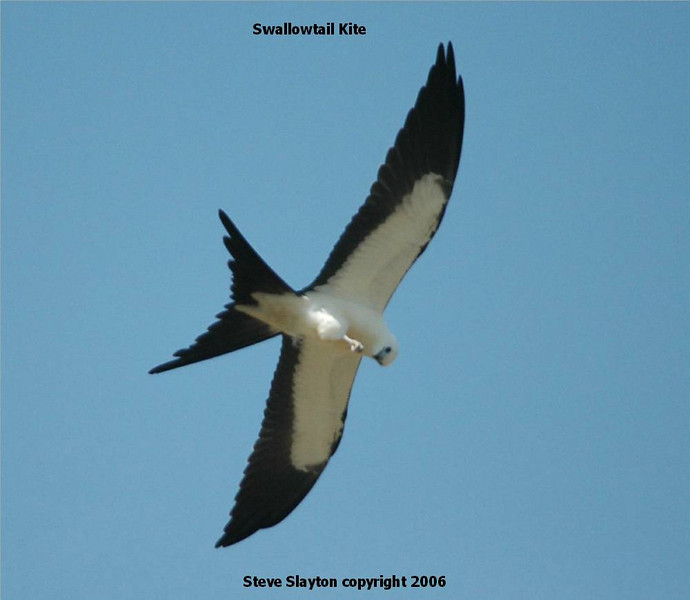
Swallow-tailed Kite by S Slayton

Swallow-tailed Kite by S Slayton

and the red kite, the falcon, and the kite in their kinds, (Deuteronomy 14:13 NASB)

In the Birds of the Bible – Hidden Covenant Part 3, I mistakenly placed this photo of a Swallow-tailed Kite instead of a Swallow. I have since fixed my mistake. A J was talking about the Swallows observing the time of their coming and he used Jeremiah 8:7.

Even the stork in the heavens Knows her appointed times; And the turtledove, the swift, and the swallow Observe the time of their coming. But My people do not know the judgment of the LORD. (Jeremiah 8:7 NKJV)

The reason I mixed them up is because right now, in this area, the Swallow-tailed Kites are being spotted. I have seen a single one three times and just the other day, Dan and I had two of them skim over the top of trees, right in front of us. They have been in the area for a month or so, and soon they will move on again. They “Observe the time of their coming.” Thus the mistake on my part.

They may be one of the Birds of Prey, but they were beautifully created by the Lord. They are so graceful and enjoyable to watch. I am always amazed at the Creator’s use of such variety in the birds and in all the other neat things around us.

God created the great sea monsters and every living creature that moves, which the waters brought forth abundantly, according to their kinds, and every winged bird according to its kind. And God saw that it was good (suitable, admirable) and He approved it. (Genesis 1:21 AMP)

According to the Audubon WatchList, “Two subspecies found in the Americas. Northern subspecies (Elanoides forficatus forficatus) breeds in small sections of seven southeastern U.S. states and in southern Mexico. Members of this group migrate to South America in the late summer. Southern subspecies (Elanoides forficatus yetapa) found through much of South America. The estimated U.S. population of approximately 10,000 birds now breeds in fragmented populations from South Carolina south to Florida and west to Louisiana/Texas border with largest known populations in northern Florida. Formerly bred north to Minnesota and west through Texas to Mexico. Significant populations remain in Florida and along the Pascagoula River in Mississippi.”

I really enjoy seeing these Kites because you just have to be looking in the right direction at the right time. Every time they have been spotted by us, they just sort of “appear” over the tops of the trees. They skim so low, that when they come over you, you either see them or you don’t.

Kites are of course one of our Bible Birds – (Glede and Kites). They are mentioned twice in Scripture in the list of “unclean” birds in Leviticus 11:14 and Deuteronomy 14:13. Each time “after its kind” is given. So, our Swallow-tailed Kite is one of those kinds and would like to introduce you to this amazing bird that is so neat to watch flying. When they spread that tail of theirs, it is just super neat.
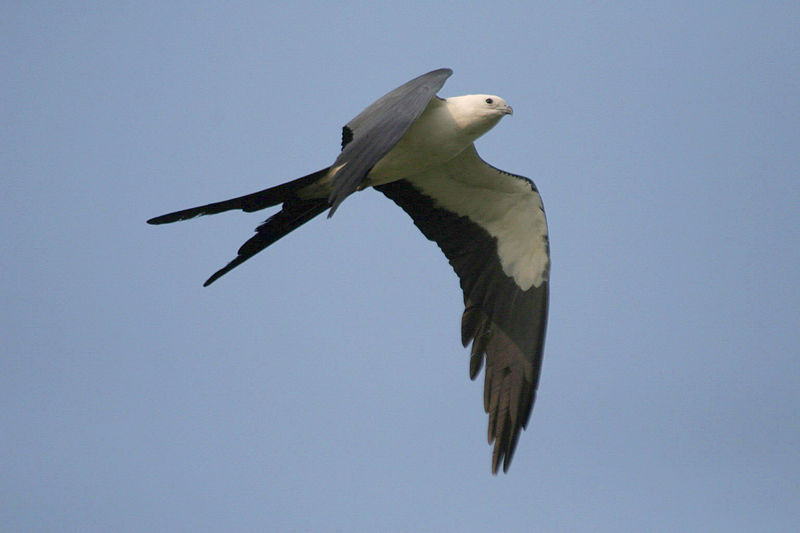
Swallow-tailed Kite (Elanoides forficatus) ©Wikipedia

Swallow-tailed Kite (Elanoides forficatus) ©Wikipedia

(Sounds from xeno-canto)

The Swallow-tailed Kite is a member of the Accipitridae Family (Kites, Hawks & Eagles) Family in the Order Accipitriformes. They are considered Abundance Common according the Thayer Birding software.

They are 24 inches (60 cm) with a very long black forked tail, white head, chest, belly and leading portion of underwing. Their flight feathers are black and their back is also black.

They are a medium-sized, graceful, long-winged, long-tailed hawk with pointed wings, a short, dark, hooked bill. The males and females are similar.

Adults have a long, deeply forked tail. white head, neck, chest, underwing coverts, belly, and undertail coverts, a slate gray back and upperwings, black tail and flight feathers. Whereas the immature is duller than adult with fine streaks on head and breast and has a shorter, less deeply-forked tail than adult.

Thayer also says of their habitat and behavior – ” Wet open woodlands, bottomlands, wooded river swamps, marshes, wetlands, and along rivers, ponds and lakes. Agile and graceful in flight. Eats in flight by bending head and neck under body to eat prey held in talon. Will drink in flight, much like a swallow. Gregarious. Will sweep low over open fields and grasslands to catch food or soar very high for flying insects.”

Swallow-tailed Kite (Elanoides forficatus) by Africaddict

Swallow-tailed Kite (Elanoides forficatus) by Africaddict

The Swallow-tails like to breed in “Lowland forest, especially swampy areas extending into open woodland. 1 brood. Mating system is monogamous. Displays are In flight: easy sailing, curving chase often over water. On perch: mutual approach on horizontal limb, face-off, female quickly turns or backs under limb. They also do courtship feeding.

The nest is usually in treetop concealed by thick foliage and they place it on a foundation of preceding year’s nest. It consist of sticks, twigs, moss, pine needles, leaves, lichen. Lined with fine materials, few feathers. Both sexes help with nest construction.

The eggs are white, marked with browns, occasionally lavender, often concentrated at end. 1.8” (47 mm). Both sexes incubate.  with Incubation taking 28 days. Development is semialtricial (immobile, downy, eyes open, fed). Young are able to fly after 36-42 days. Both sexes tend young.

The spend their winters from Colombia and Venezuela S. Marsh drainage, deforestation, and shooting are responsible for reduction in population and range.

Miscellaneous notes; Occasionally nest in loose colonies of a few pairs. Bathe and drink by skimming water surface like swallow. Occasionally soar at great heights. Up to 200 pieces used in nest, carried individually, may require up to 800 miles of flight. Formerly known as American Swallow-tailed Kite; changed by AOU in 1996.

From Thayer Birding Software, The Birder’s Handbook, Wikipedia, and other internet sources.

See also:

Originally posted in 2018 on Birds of the Bible For Kids Blog)

*

Bible Birds – Storks at Zoo Tampa

Yellow-billed Stork (Mycteria ibis) LPZ

“Where the birds make their nests: as for the stork, the fir trees are her house.” (Psalms 104:17 KJV)

Bible Birds – Storks at Zoo Tampa

Birds mentioned in the Bible include the Storks. The Yellow-billed Stork is closely related to the Wood Stork. [Bible Birds – Wood Storks]

The Yellow-billed Stork has a very yellow beak and like other storks, it is quite long. They live in “Africa South of Sahara, Madagascar; straggles into Palearctic Africa in Morocco, Tunisia and Egypt.”

These storks are 90–105 cm (35–41 in) tall and have a wingspan 150–165 cm (59-65 in). Males average larger. Non breeding adult has plumage and bare parts duller. Immature duller, especially bare.

Here are some photos of the Yellow-billed Stork taken at Zoo Tampa recently:

*

Scripture Alphabet of Animals: The Stork


The Three Sparrows by Emma Foster

The Three Sparrows

By Emma Foster

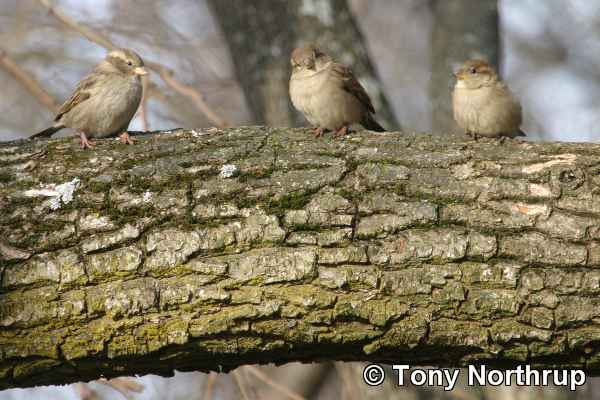
Three Sparrows ©Tony Northrup

Three sparrows, Tip, Tap, and Top, once lived on a college campus, inside a dormitory courtyard. They had built a nest under the metal stair railing leading up to the second floor. They flew out into the courtyard every day to search for food or continue building their nests. Usually however, the three of them preferred to watch the students.Eagle on Pumpkin - Stencil

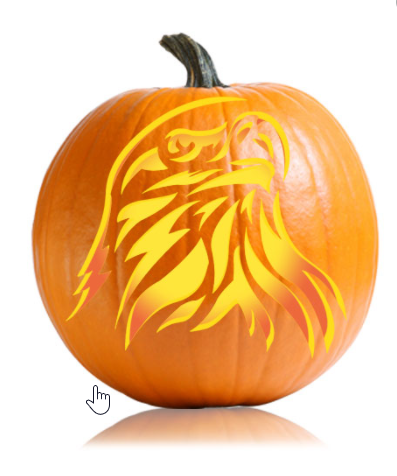
As fall approached, the birds noticed the cooler weather outside. The leaves started to change color and fall, and more students sat outside in their hammocks to study. One evening, Tip, Tap, and Top noticed how many of the students gathered outside, carrying pumpkins into the courtyard. The students sat down in circle and began carving pumpkins. The three sparrows watched as some of the students cut the top off the pumpkins, took the insides out, and drew faces on the pumpkins. Some of the students even brought paint to paint flowers and birds and other designs on the pumpkins. Top’s favorite pumpkin was one with an eagle painted on it, which he believed to be a very majestic sparrow that resembled himself.

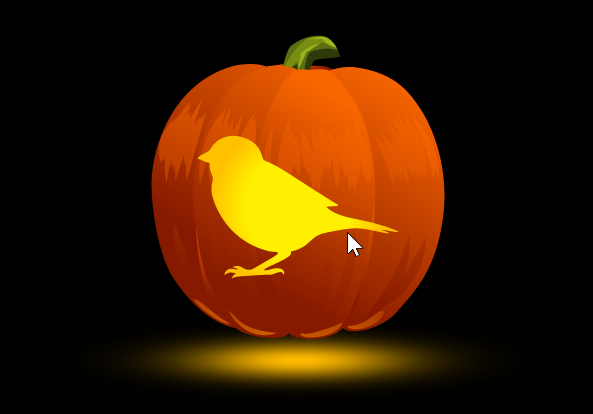
Very Majestic Sparrow Pumpkin

Very Majestic Sparrow Pumpkin

Later that night, after the sun set, Tip hopped off the second-floor railing to examine the pumpkins more closely. Out of all three sparrows, Tip could spot small details the best, which was why it was his job to find food most of the time. While Tip flapped by all the pumpkins, he noticed something pink and something else shiny sitting on the opposite side of the courtyard.

Tip flew to the object and recognized it as something the students carried around with them to identify themselves and to get into their rooms. Tip called for Tap and Top. Tap, the strongest sparrow who was in charge of building the nests, carried it back with him to the nest. But just as they got the wallet back to the nest and looked at the picture on the ID, Tip noticed the same girl come out of one of rooms looking for the wallet in the courtyard, while her friend held the door open so she could get back inside. Tip told Tap to hurry and return it, but when Tap flew back with the wallet, he wasn’t fast enough. The girl returned to her room just as Tip and Top tried to help carry the wallet. Top, however, flew so fast that the lanyard slipped out of his beak and he ran into the door, causing a massive thump.

Tip, Tap, and Top tried to think of a new plan. Top suggested running into the door to get the girl’s attention, while Tap argued that they should just leave the wallet by the door. Tip, on the other hand, had an idea to use the key to get into the room. With Top’s help, he brought the wallet to the door then had Top hold the wallet steady while he inserted the key. Tap flew against the door as best he could, but the door’s weight only let him open it a few inches. Tip yanked the key out with his beak, and he and Top dropped the wallet inside. However, only part of the wallet made it through.

Tip, Tap, and Top all panicked when they heard the girl coming. Tap lifted the top of the pumpkin by the door, and the three of them sneaked inside.

Once the coast seemed clear, and the girl found her wallet (though she had no idea what the commotion was about), Tip, Tap, and Top returned to their nest. From then on, they agreed that was the last time Tip could do any exploring whenever students carved pumpkins. However, they did all agree that pumpkins seemed comfortable to live in. Once winter arrived, they decided, they would each pick their own pumpkin to nestle into before it grew too cold for them in their nest.


Lee’s Addition:

“A friend loves at all times, and a brother is born for a difficult time.” (Proverbs 17:17 HCSB)

These sparrows were definitely trying to be helpful.

I think I like these three adventurous sparrows. Who knows, maybe Tip, Tap, and Top will become another series of stories for Emma. We have all enjoyed the adventures of Reginald the Turkey Commander.

Emma’s Stories

Wordless Birds

Ian’s Bird of the Moment – Isla de la Plata

If you remember that far back, the last Irregular Bird was on the birds of Christmas Island. Here is another tropical island, Isla de la Plata (Silver Island) in the eastern Pacific just off the coast of Ecuador. Unlike Christmas Island, it isn’t remote, just a 40km/25mile boat trip from Puerto Lopez. So it doesn’t have any endemic birds, but it does have nesting colonies of interesting seabirds. I visited it in October 2005 with Jo Wieneke. She was on her way to the Galapagos, while I was on my way back to Australia on a round the world fare.

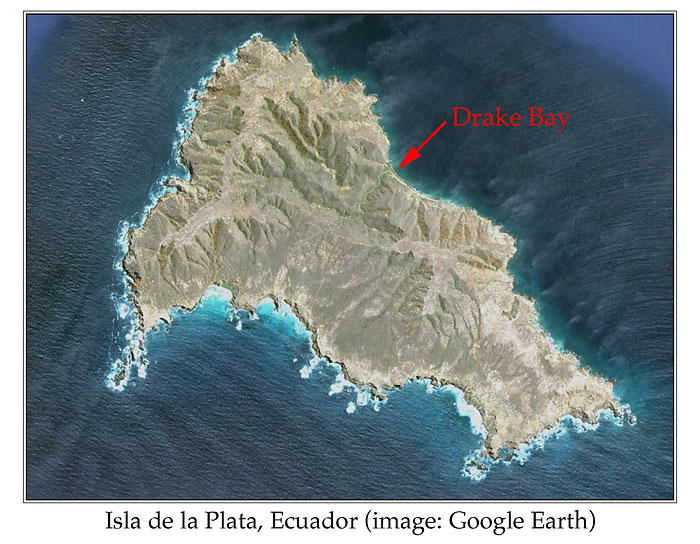
Isla de la Plata, Ecuador

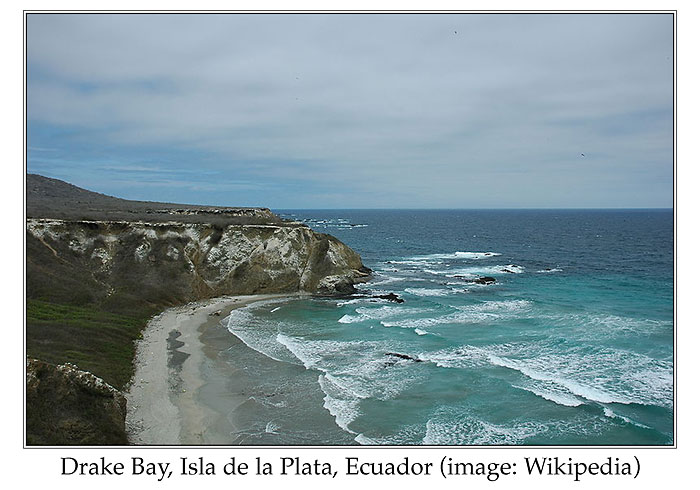
It’s relatively small, about 5km/3miles long from northwest to southeast, uninhabited, with the only building – at Drake Bay, above – being the information centre of the national park (Machalilla) of which it is part. Like Christmas Island, it is surrounded by cliffs and the only beach of note is at Drake Bay, the landing place for visitors and the start of a network of walking tracks around the island.

Isla de la Plata, Ecuador Shore

The Bay is named after Sir Francis Drake who, as captain of the Golden Hind, was here in 1579, plundering Spanish ships carrying plundered native treasure. There is debate over whether the name ‘Plata’ refers to silver in Drake’s possession or the white, guano-covered cliffs and if you are interested you can check up on the history of Drake’s adventures around Isla de la Plata here.
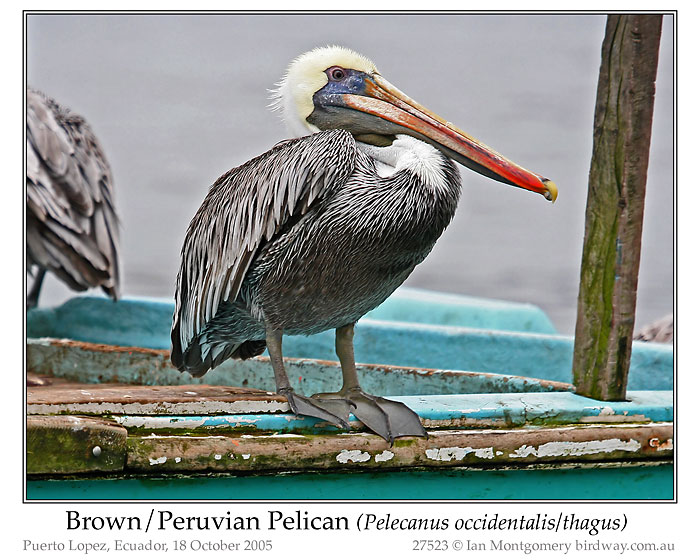
Brown/Peruvian Pelican (Pelecanus occidentalis/thagus) by Ian
Anyway, back to birds. Puerto Lopez, the departure port for day trips to the island is a fishing village and is notable for plenty of Pelicans, lounging around on the colourful fishing boats waiting for a free feed. This part of the coast of Ecuador marks the transition from the northern Brown Pelican (Birdway) to the southern Peruvian Pelican (Birdway). The latter has been treated in the past as a subspecies of the Brown but the two are now regarded as different species. These ones look intermediate to me and I’ve given up trying to pin them down to one species or the other. In any case, it was lovely to get a close-up view of these spectacular birds.
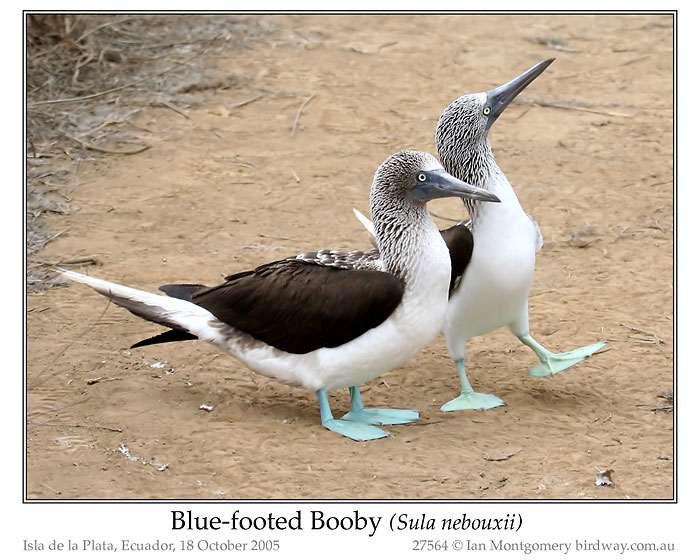
SUL-Suli Blue-footed Booby (Sula nebouxii) by Ian
Isla de la Plata is often referred to as the Poor Man’s Galapagos as it costs only about 40USD to visit it and shares some of the iconic species of the Galapagos such as the Blue-footed Booby. These were to be found nesting on the walking tracks and appeared quite undisturbed by human visitors. The male in the first photo is displaying to the stationary female by walking around her and showing off his blue feet. Foot colour is very important to boobies. She looks completely unimpressed, perhaps because he is too young and his feet aren’t blue enough yet.
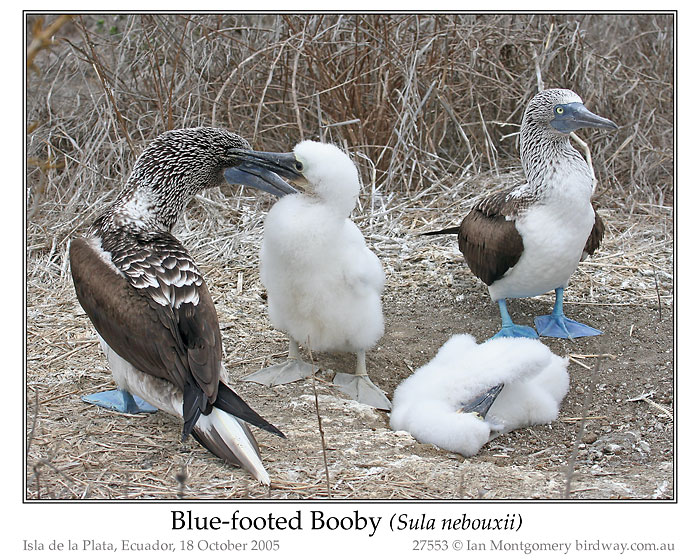
Blue-footed Booby (Sula nebouxii) by Ian4
The next pair clearly have what it takes and the male on the left has blue enough feet to melt the heart of any prospective mate. The sexes look similar but females are generally bigger and the irises of males appear whiter as female irises have a dark inner ring around the pupil. I tend to think of the Blue-footed Booby as mainly a Galapagos specialty but in fact it’s breeding range includes Baja California in Mexico and along the coast from Panama to northern Peru.
SUL-Suli Nazca Booby (Sula granti) Portrait by Ian
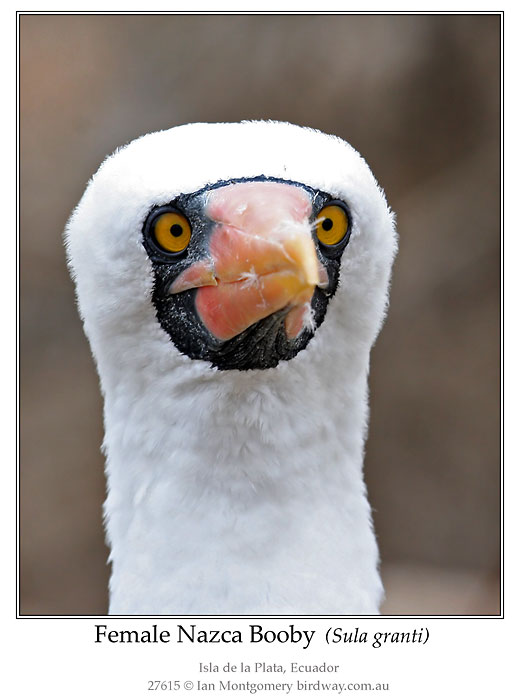
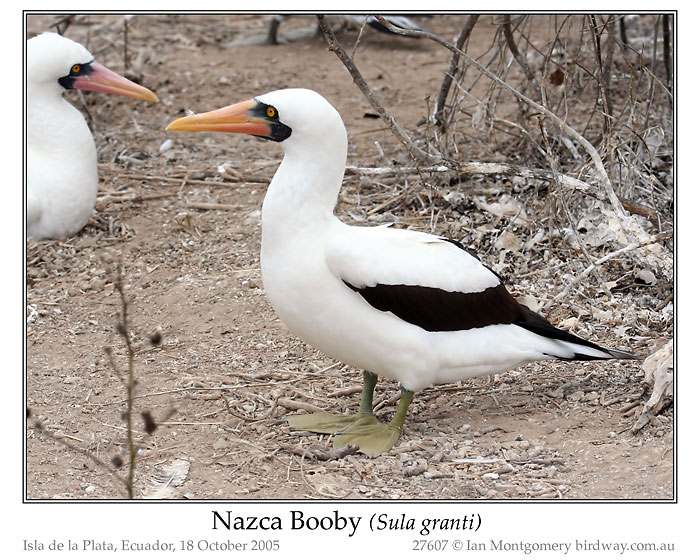
Like Christmas Island, Isla de la Plata has three species of nesting boobies. The second is the Nazca Booby, a black and and white booby with orange bill and eyes. It bears more than a striking resemblance to its close relative the Masked Booby (Birdway), which it replaces in the eastern Pacific where its main population centre is also the Galapagos Archipelago. The Nazca used to be treated as a subspecies of the Masked, which occurs in tropical and subtropical water around the world including offshore islands around Australia. The main field mark distinguishing the Nazca is the coral pink, rather than yellow, bill but there are also morphological differences including smaller size and longer wings and tail.
SUL-Suli Nazca Booby (Sula granti) by Ian
Bill colour differs between the sexes: the bird in the background in the second photo has a pinker bill and is female. Nazca Boobies have khaki feet, hardly something to get excited about, but there’s no accounting for differences in taste.
SUL-Suli Red-footed Booby (Sula sula) by Ian
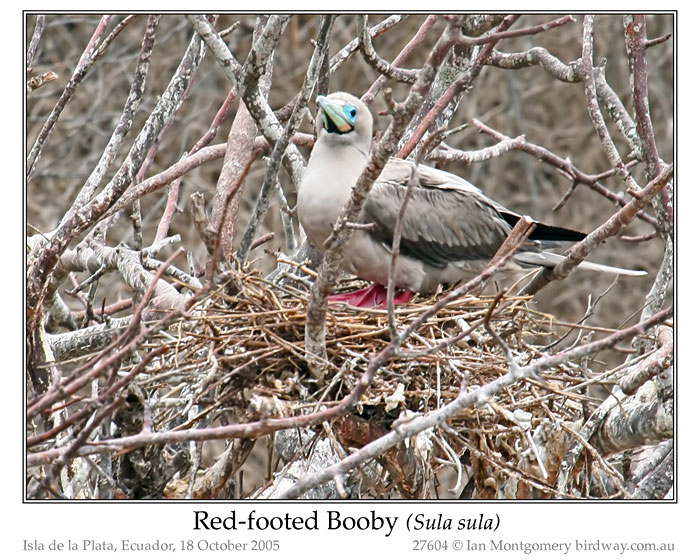
The third species of Booby is the Red-footed, another species with a pantropical distribution and which we encountered on Christmas Island. There, the birds were of the white morph; here they are of the brown morph. The one in the photo is an adult bird (juveniles don’t, of course, have red feet) at its nest.
One might wonder ecologically why various species of booby have such overlapping distributions. It seems that they differ in the feeding habits. Blue-footed Boobies feed mainly on schooling sardines, anchovies and mackerel and feed gregariously, often diving in unison, and also feed on flying-fish. The diet of Nazca Boobies varies by location but includes larger schooling fish and flying-fish. Red-footed Boobies feed mainly on flying-fish and squid and often feed at night when squid come to the surface.
Male Magnificent Frigatebird by Ian
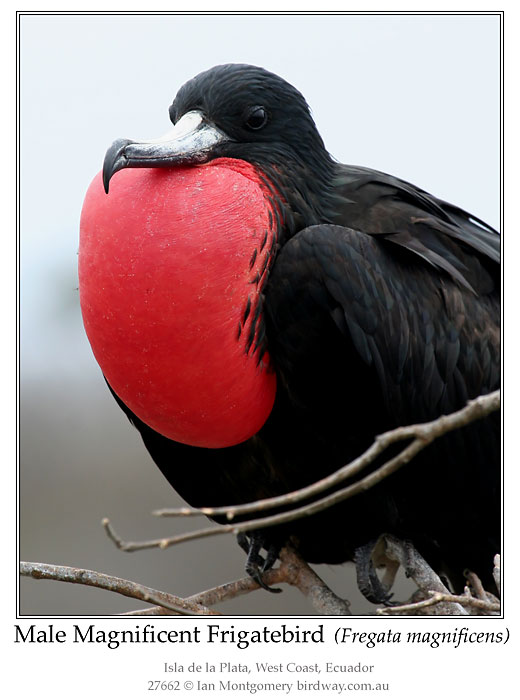
Christmas Island boasts three of the five species of Frigatebird, including the endemic Christmas (Island) Frigatebird, the Lesser and the Great. Isla de la Plata has only one, the Magnificent, but this is the largest of the five species by way of compensation. Adult males have entirely black plumage making them difficult to distinguish in the field from the Great. Males of the latter have a brown wing-bar, but so do a few male Magnificent. Female Magnificent Frigatebirds are similar to female Great but are larger and have a white nucal collar (below).
Magnificent Frigatebird Family by Ian
The Magnificent Frigatebird is closely related to the Great and both it and the fifth species, the Ascencion Island Frigatebird, used to be treated as races of the Great. The Great also occurs in the eastern Pacific but it is mainly an offshore species and does not breed on Isla de la Plata, though both breed in the Galapagos so their ranges are not exclusive. The distribution of the Magnificent is mainly the tropical and subtropical eastern and western coasts of the Americas, with a relict population on Cape Verde Island off the west coast of Africa.
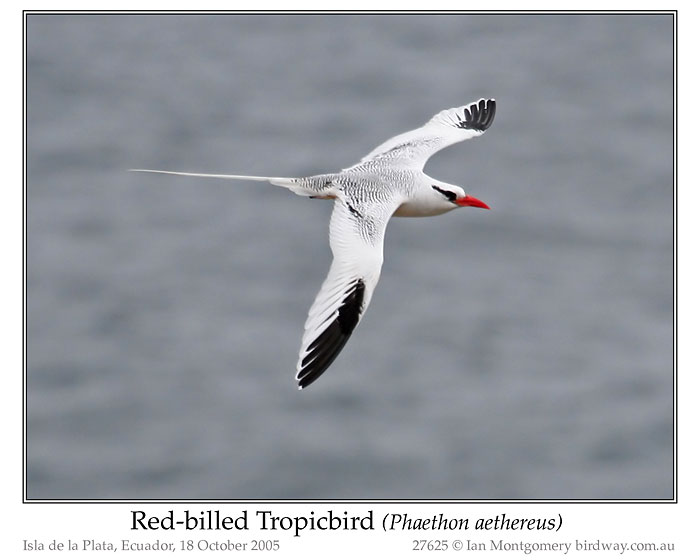
Red-billed Tropicbird by Ian
Christmas Island has two of the three global species of Tropicbird: the Red-tailed and the golden morph of the White-tailed. Isla de la Plata has the third: the Red-billed Tropicbird. This is probably the least numerous of the three species with three subspecies in the northwestern Indian Ocean; the Atlantic south of the equator; and, the most common and widespread subspecies off Cape Verde, in the Caribbean and the eastern Pacific. Adult birds retain the barred plumage on the back and wings that is otherwise characteristic of juvenile birds. With a wingspan to 106cm/42in and length, including tail streamers, to 105cm/41in , this is the largest of the three species. It feeds mainly on flying fish, usually by diving but will also take them in flight.
Isla de la Plata has a very small population, less than 20 pairs, of the only tropical Albatross, the Waved Albatross, but unfortunately we didn’t see any. It breeds mainly on Hood Island in the Galapagos with a population of less than 20,000 pairs. The population has declined in recent decades owing to mortality as bycatch by fishing vessels and is classified as critically endangered.
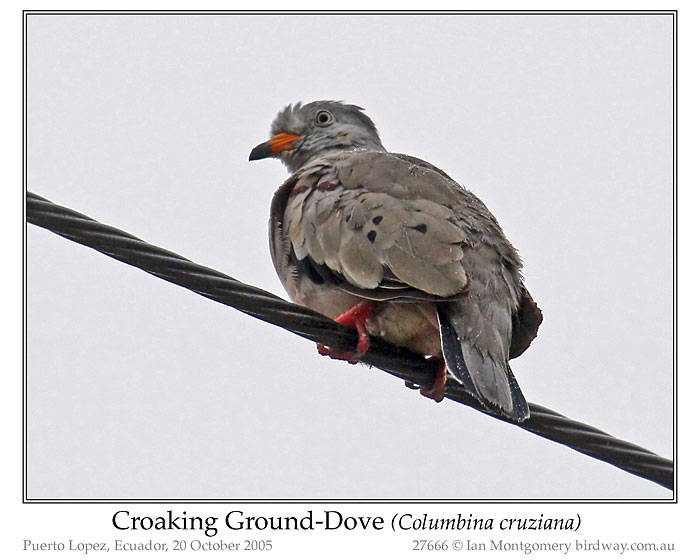
Croaking Ground-dove by Ian
The island is rather arid with scrubby vegetation and didn’t seem to support many species of terrestrial birds. We did however see White-tipped Doves (Birdway) and Croaking Ground-Doves. I photographed the Croaking Ground-Dove above when we were having breakfast in Puerto Lopez a couple of days after our visit to Isla de la Plata.
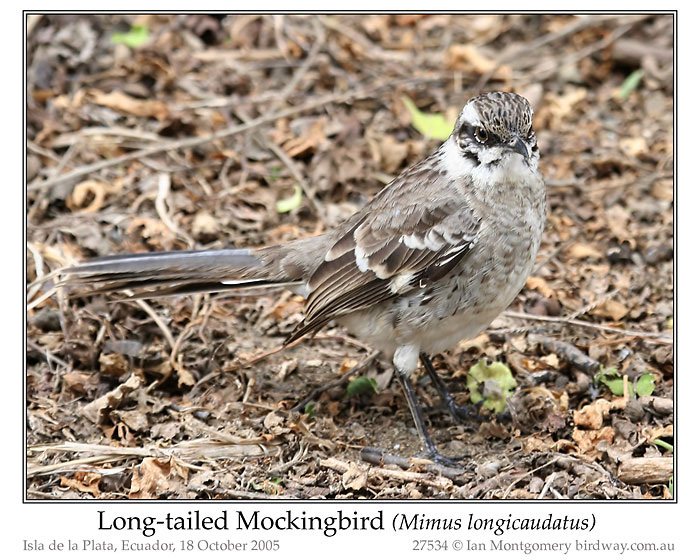
Long-tailed Mockingbird by Ian
The only passerines we saw were Long-tailed Mockingbird and Collared Warbling-Finch. The Long-tailed Mockingbird has a mainly coastal distribution in Ecuador and Peru and is a close relative of the Chilean Mockingbird (Birdway).
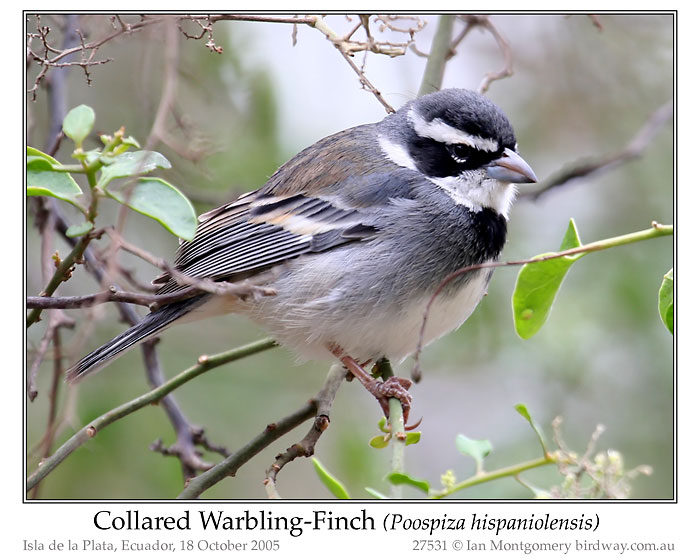
Collard Warbling-Finch by Ian
The Collared Warbling-Finch isn’t a finch but a member of the Thraupidae family (Birdway) which comprises a rather heterogeneous collection of birds including most, but not all, of the Tanagers. It has a similar distribution to the Long-tailed Mockingbird along the coast of Ecuador and Peru. The bird in the photo is a male; females have streaked, brownish plumage without the black breast-band or black markings on the head.
I hope you’ve enjoyed our virtual tours of two tropical islands. I have a couple of very cold islands, one in the northern hemisphere and one in the southern, in mind as candidates for the next two Irregular Birds.
Greetings
Ian


Ian Montgomery,
454 Forestry Road, Bluewater, Qld 4818
Phone: 0411 602 737 +61-411 602 737
Preferred Email: ian@birdway.com.au

Recorder Society http://www.nqrs.org.au

Lee’s Addition:

I am always amazed and tickled by these Blue-footed and Red-footed Boobies. Along with all the many critters and birds the Lord created, it sometimes shows his sense of humor.
“So God created great sea creatures and every living thing that moves, with which the waters abounded, according to their kind, and every winged bird according to its kind. And God saw that it was good. And God blessed them, saying, “Be fruitful and multiply, and fill the waters in the seas, and let birds multiply on the earth.” So the evening and the morning were the fifth day.” (Genesis 1:21-23 NKJV)

Bible Birds – Masked Lapwing

CHA-Char Masked Lapwing (Vanellus miles)

Masked Lapwing (Vanellus miles) at Lowry Park Zoo 3-27-2018

Both times the Lapwing is mentioned in the Bible, it is in the “Do Not Eat” lists in Leviticus and Deuteronomy.

And the stork, the heron after her kind, and the lapwing, and the bat. (Leviticus 11:19 KJV)
And the stork, and the heron after her kind, and the lapwing, and the bat. (Deuteronomy 14:18 KJV)

We were at Zoo Tampa (new name of Lowry Park Zoo) several years ago. We saw the Masked Lapwing again and I always enjoy that look he has. The Yellow mask make him quite attractive, don’t you think?

“The masked lapwing is the largest representative of the family Charadriidae. It measures from 30 to 37 cm (12 to 15 in) in length and has a wingspan of 75–85 cm (30–33 in). The nominate subspecies (V. m. miles) weighs 191–300 g (6.7–10.6 oz), while the southern race (V. m. novaehollandiae) is larger and weighs 296–412 g (10.4–14.5 oz). The subspecies from northern Australia and New Guinea (V. m. miles) has an all-white neck and large yellow wattles with the male having a distinctive mask and larger wattles. The subspecies found in the southern and eastern states of Australia and in New Zealand (V. m. novaehollandiae), and often locally called the spur-winged plover, has a black neck-stripe and smaller wattles. (Note that the northern-hemisphere spur-winged plover is a different bird.)

The birds have a wide range of calls which can be heard at any time of the day or night: the warning call, a loud defending call, courtship calls, calls to its young, and others. Since this bird lives on the ground it is always alert and even though it rests it never sleeps properly.” [Wikipedia – Masked Lapwing]

A masked lapwing blinking the left eye (the nictitating membrane is used rather than the eyelids). Note origin of the membrane from the medial canthus. Masked Lapwing (Vanellus miles) Eye ©WikiC

It is always amazing to see the different ways the Lord created His birds. Even how this Lapwing blinks show design and not something that just happened.

We see them frequently in many Zoos. Next time you are visiting a zoo, see if they have the Lapwings. If you are living in Australia or New Zealand, you can look for them in the Wild.

Bible Birds – Lapwings

Bible Birds

Wordless Birds

Bible Birds – Holding On With My Feet

Tricolored Heron (Egretta tricolor) Viera Wetlands 12-26-17

Holding On With My Feet

“I have refrained my feet from every evil way, that I might keep thy word.” (Psalms 119:101 KJV)

While birdwatching at the Viera Wetlands in Florida, we spotted this Tricolored Heron. He was watching and waiting to find his lunch swim by. The way his feet grabbed the plants was interesting.

Tricolored Heron (Egretta tricolor) Viera Wetlands 12-26-17

“My son, walk not thou in the way with them; refrain thy foot from their path:” (Proverbs 1:15 KJV)

Tricolored Heron (Egretta tricolor) Viera Wetlands 12-26-17

The Tricolored Heron never moved his feet. They were planted solidly on those plants. Our Lord, when he created the birds, gave them quite a variety of feet. The feet this Heron was given works very well for holding steady.

Tricolored Heron Close up of feet – Viera Wetlands

When you first look at the foot, it looks like other bird feet. Yet, when it needs to anchor on those plants. It works very well.

Tricolored Heron’s Foot

Whether you are young or older, friends may try to encourage you to do something that you know you shouldn’t. Either your parents, teachers, and especially the Bible have taught you right and wrong. Hold on and “refrain” [don’t do it] from doing the wrong thing.

“Therefore to him that knoweth to do good, and doeth it not, to him it is sin.” (James 4:17 KJV)

Bible Birds – Herons

Wordless Toucan


Lack of Birds To Watch

Staying in as much as we have lately, the birds were at least coming by for a visit. Now that fall has arrived, we were expecting the birds to return. BUT!

Northern Mockingbird on Hook 2
Northern Mockingbird on Hook, last spring.
The trees beyond those houses are the beginning of the forest.

The feeders are filled, yet the birds are not returning. Could it be because they are destroying a huge area of trees right here by us???

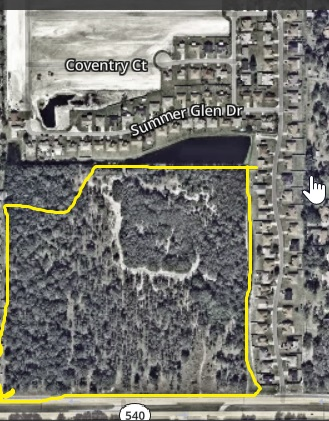
Here is a picture, from the weather radar zoomed in on this area. It is a satellite view. The bare spot at the top is where the new houses were put in last year. (Of course, the view is the newest that they have released.)

Before they started clearing

The dark spot in front is a huge forest. When I have shown photos of the birds, those trees have been visible over the houses. That strip of trees is about all that is left of all of those woods. They are clearing it all out for another housing addition. I am expecting any day for those trees to disappear. When they do, I’ll update and show a photo with the trees gone.

The Trees already gone as of today.

The yellow outlines the area that has already been cleared. When that little section is cleared, who knows if many birds will come back this winter. With our area being new, there are few trees that have been planted, and the ones that have been, are only a few feet tall.

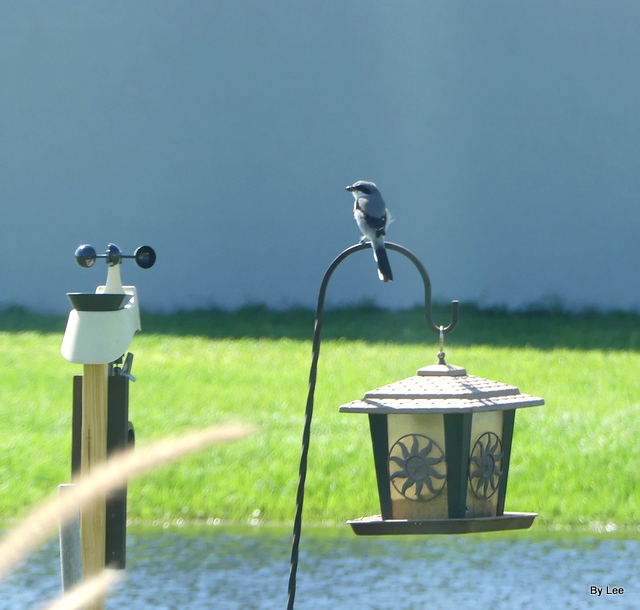
Yet! There is always hope for the strange finds now and then. We were visited by a new bird about a week ago. One we have not seen that often. First time we saw one was in Louisiana years ago.

Loggerhead Shrike on Oct 1, 2020

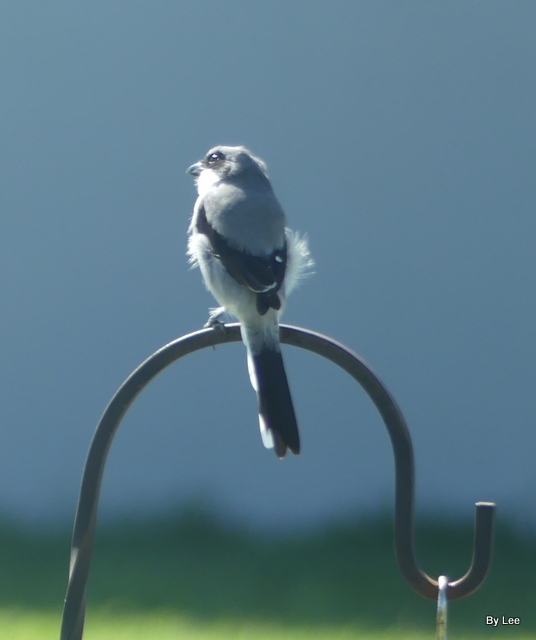
What a surprise!! This Shrike is a first for our yard, and a first in a long time since we spotted the last one.

Loggerhead Shrike 1 Oct 2020-2
Loggerhead Shrike 1 Oct 2020

Stay tuned to see what might show up this winter. I am hoping that we have as many as last winter, but we shall see. Thankfully, we still have the water birds walking by now and then. Oh! Another gator has shown up and ate a Muscovy Duck recently. But that is another post.

Let the field exult, and all that is in it. Then all the trees of the forest will sing for joy Before the LORD, for He is coming; For He is coming to judge the earth. He will judge the world in righteousness, And the peoples in His faithfulness. (Psalms 96:12-13) [Unfortunately, these trees will not be in that chorus

Who Paints The Leaves?

Spectacular Journey to Africa by Honey Buzzard

What an amazing story!! This is from the BirdGuides.Com

…..

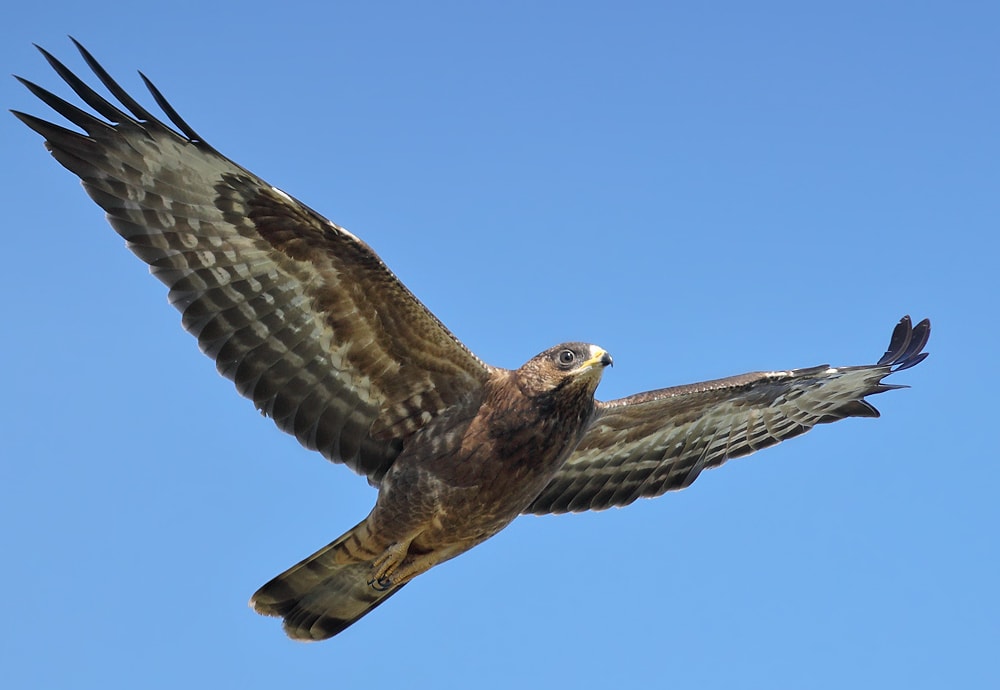
A young European Honey Buzzard, satellite tagged by the Roy Dennis Foundation at a nest near Forres, Scotland, in mid-August, has already reached the African continent – albeit via a remarkably risky route that included two long sea crossings.

The bird, ‘620’, was tagged on 11 August and remained in the vicinity of her natal woodland until early September. Her first significant flight came on 11 September, when she moved 50 km to the east, aided by a stiff breeze.

“Doth the hawk (or buzzard) fly by thy wisdom, and stretch her wings toward the south?” (Job 39:26 KJV)

Young European Honey Buzzards, such as this one, often end up taking more convoluted migrations south in their first autumn than the more experienced adults (Per Schans Christensen).

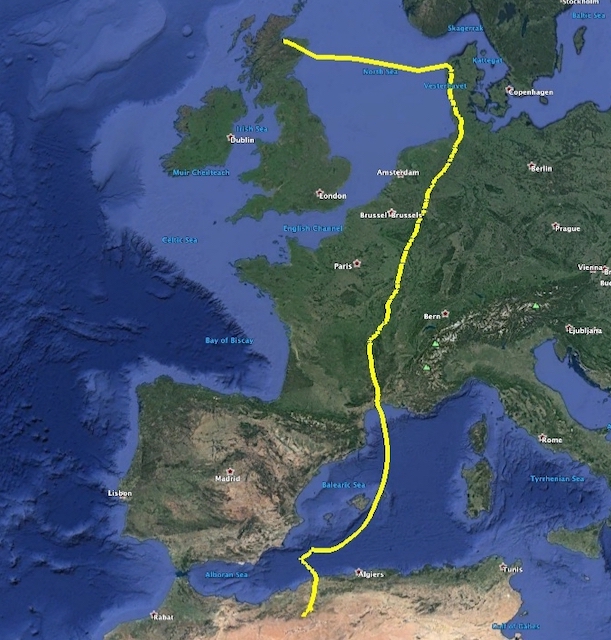
However, this could have given no clues for the extraordinary events that took place on 12-13 September. Clear skies and a brisk westerly wind on the morning of 12th encouraged the young honey buzzard to continue her eastward journey, although the Aberdeenshire coast seemingly provided no deterrant – she continued out to sea just north of Aberdeen at around 11.20 am, with the next GPS position logging her at an altitude of 477 m some 57 km out to sea, south-east of the Scottish city.

She continued on an easterly trajectory and, as darkness fell, she was only half-way across the North Sea. Flying through the night, the next tag fix at 2.34 am placed her a further 282 km east of the previous evening’s reading. By 6.30 am, she reached the Danish coast safely, having made a 640-km sea crossing in a non-stop 19-hour flight, largely during the hours of darkness – hugely impressive given it was the bird’s first long-distance movement since fledging the nest.

After a couple of days’ recuperation, her southward journey recommenced as she gradually made her way through Denmark, reaching Germany by the evening of 17th. She continued on a south-westerly route, skirting the western border of Germany and entering south-east Belgium on 20th, roosting in the country that evening. The south-westerly trajectory continued over the following five days, and ‘620’ had reached Clermont-Ferrand, France, by the evening of 25th.


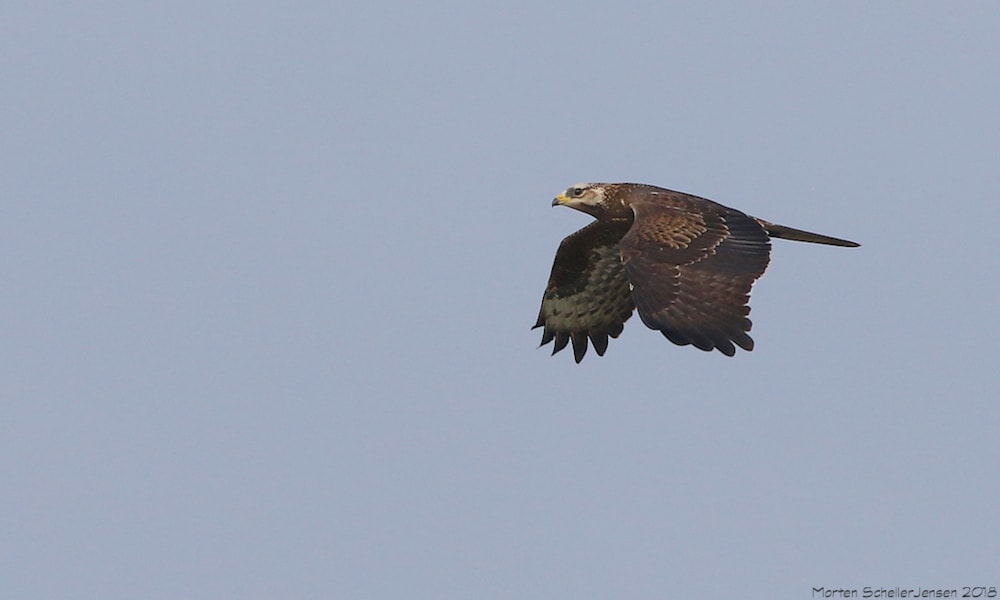
Juvenile European Honey Buzzard photographed on migration in Denmark – a route used by many youngsters of this species, including ‘620’ (Morten Scheller Jensen).

At this point, it seemed as if the south-westerly route would continue, taking the bird into Iberia and, most likely, across the Strait of Gibraltar, which is a well-practised spring and autumn migration route for adult European Honey Buzzards. However, ‘620’ had other ideas.

After two days near Clermont-Ferrand, she flew due south to a wood near Montpellier on the afternoon of 27th. Her migration recommenced the next morning and by 8.40 am she was at the coast. But, instead of following this south-west into Spain, strong north-westerly winds encouraged her to fly directly out to sea.

As she moved south over the Mediterranean Sea the wind veered to a north-easterly and, with a brisk tailwind, her flying speed reached 87 km/h as she flew at altitudes of up to 750 m. By 1 pm she had reached Menorca – but did not land there, instead continuing southwards. By 8.30 pm, the wind had dropped and she was flying due west, having travelled almost 750 km over open sea in 12 hours of continuous flight.

Satellite data suggests she rested on a boat for a couple of hours in the middle of the night, before recommencing her journey south. Finally, by 12.50 pm the following day, she reached the Algerian coast, completing a 1,000-km migration over open sea in just over 28 hours – an astonishing feat for such a young bird tackling its first migration. Not done there though, the young honey buzzard continued inland for a further 160 km, roosting in mountains on the northern edge of the Sahara. It then made a further 60-km movement south and roosted in one of the last patches of woodland on the north side of the Sahara on the evening of 29th.


The movements of young European Honey Buzzard ‘620’ between 11 and 29 September, from Scotland to Algeria via Denmark, Germany and France (Roy Dennis Foundation).

This amazing journey shows just how treacherous life can be for migrant birds, especially youngsters in their first autumn, yet also exhibits the impressive feats that they are capable of. But the journey isn’t done there, with the world’s largest desert still left to negotiate. As the Roy Dennis Foundation wrote on its blog on 30 September: “After two very long sea crossings, the young honey buzzard now faces another daunting challenge – her first flight across the Sahara.”

Following 620’s exploits at www.roydennis.org/category/honey-buzzard-620.

“Was it through your know how that the hawk learned to fly, soaring effortlessly on thermal updrafts? Did you command the eagle’s flight, and teach her to build her nest in the heights,” (Job 39:26-27 MSG) [I don’t use this version normally, but I liked these verses, in respect to this story.]

What A Creator!!

Birds of the Bible – Buzzard

Wordless Birds

Garfield – Early Bird Gets the Worm

American Robin (Turdus migratorius)with youngsters by Raymond Barlow

One of the birds that, I personally have seen, dig worms out the ground is the American Robin. When we lived in Indiana, there were many Robin available to watch. Down here in central Florida, we very seldom see any. Mostly in the winter, a few Robins migrate through here. They do not stay for the winter, but keep heading further down the state.

Eastern Bluebird (Sialia sialis) by S Slayton

Eastern Bluebird (Sialia sialis) by S Slayton

Many other birds like worms also, including Bluebirds.

Yet, it seems that Garfield met a very interesting Bluebird that has a problem feeding her little ones:

” A merry heart does good, like medicine, But a broken spirit dries the bones.”  Proverbs 17:22

Have a Merry Hearted Day!!

I shared this on the Birds of the Bible For Kids blog today. We all need a Merry Hearted Day!!

Wordless Birds

Sparrow Frozen To A Fence – DoDo

Another interesting video from “the dodo” channel.

https://youtu.be/SRm3bpYO-fk&rel=0

“Bird Frozen To Metal Fence Rescued by Kind Man | This little bird landed on a fence that was so cold, his feet froze to it and he couldn’t fly away. But luckily the nicest guy came along and knew exactly what to do.”

Not sure if this bird prayed like this, but it would apply to us if we were in such a predicament as this.

“Be pleased, O LORD, to deliver me: O LORD, make haste to help me.” (Psalms 40:13 KJV)

P.S. This wouldn’t happen here in Central Florida. :)

See more from “the dodo” channel.

Mute Swans – From AviBirds

Mark, from AviBirds, has given us the privledge of viewing the various videos that they produce. Here is the one about the Mute Swan (Cygnus Olor).

We are fortunate to see the Mute on several of the Lakes over in Lakeland, Florida. Plus, other places around here, but we have birded Lake Morton and Lake Hollingsworth many times over the years. Here are a few of those sightings:

Why you looking at my foot – Mute Swan at Lake Morton

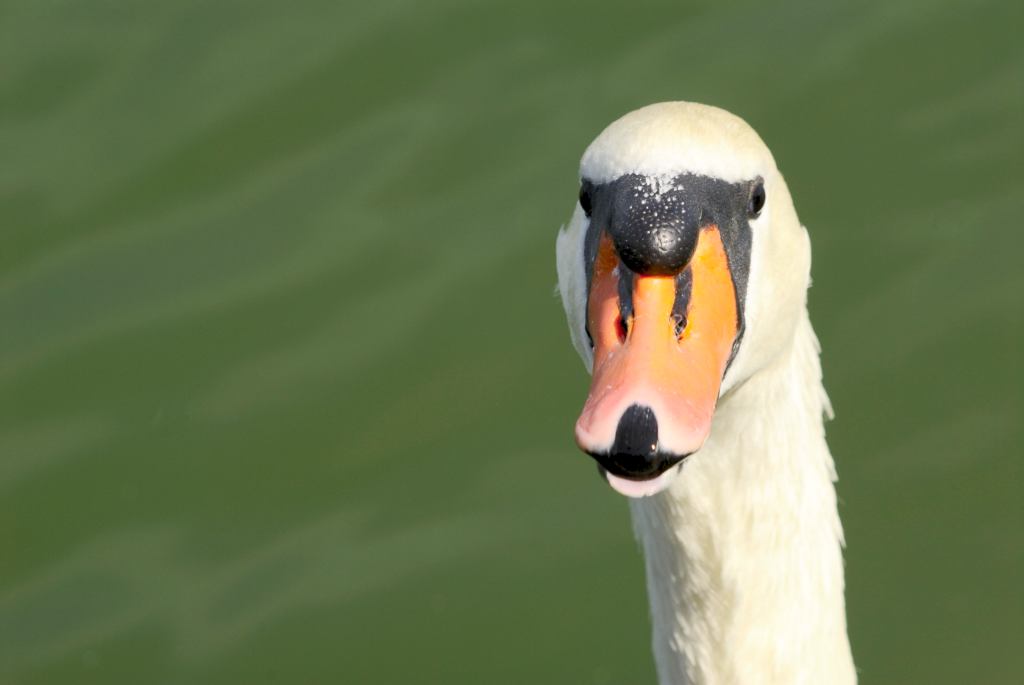
Mute Swan (Cygnus olor) (close up) at Lake Morton, Lakeland, FL By Dan’sPix

Mute Swan on Nest at Lake Morton

Mute Swan on Nest at Lake Morton by Dan

“And the swan, and the pelican, and the gier eagle,” (Leviticus 11:18 KJV) From the “Do Not Eat List”

Stop by AviBirds for all of their videos, or stay tuned for more postings here.

Birds of the Bible – Swans

Good News

Hawk Stuck In Grill Of Car – Dodo Channel

Dan found this on The DoDo channel and I thought we would share it here:

https://youtu.be/LhBqq8kfjVc&rel=0

But you, God, see the trouble of the afflicted; you consider their grief and take it in hand. The victims commit themselves to you; you are the helper of the fatherless. (Hawk in the case) (Psalms 10:14 NIV)