Ian’s Bird of the Week – Common/Black-billed Magpie

Black-billed Magpie (Pica hudsonia) by Ian

Ian’s Bird of the Week – Common/Black-billed Magpie ~ by Ian Montgomery

Newsletter ~ 2/9/2015

The Australian Magpie of last week generated quite some interesting correspondence, about both it being an iconic species and bird names and their derivation. I also got a request for a BotW on Butcherbirds, which I’ll do soon, but in the meantime here is the original Magpie of the the Northern Hemisphere. It is, incidentally, on the Australian list, a record from Port Hedland in May 2007 having been accepted by the rarities committee. This species is quite sedentary, the nearest place it occurs naturally is China and Port Hedland is an iron ore port so you don’t have to be Sherlock Holmes to work out how it got there.

This, unlike the Australian Magpie, is a member of the crow family, Corvidae, and I think you’ll agree that the resemblance between the two species is fairly superficial, not that that ever got in the way of names. The Common or Black-billed Magpie – I’ll get back inevitably to names shortly – has beautifully iridescent wings and tail which can appear blue or green under different lighting conditions, which tells us that the colour is due to the prismatic microscopic structure of the feather rather than coloured pigment. The first photo shows one on a garden wall in suburban Dublin.
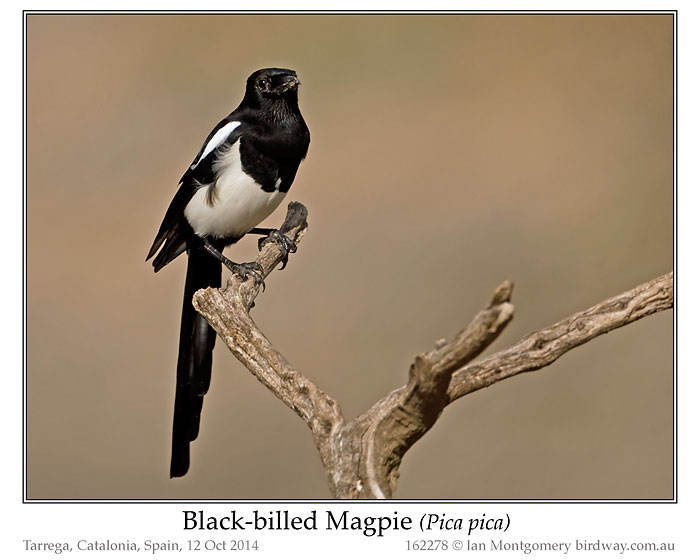
Black-billed Magpie (Pica hudsonia) by IanThe second one was taken in Catalonia at the Northern Goshawk site. Like their cousins the Common Ravens the Magpies were quite brazen and prepared to steal a morsel of food from under the noses of much larger raptors. Also like the Ravens and unlike the raptors, the Magpies noticed the sound of the camera shutter and you can see this one peering warily at the hide. This photo shows the extremely wedged-shaped tail, which is very obvious in flight. The third photo shows a juvenile one in Ireland, very similar to the adult plumage but it still has the slightly swollen gape of a very young bird and, maybe I’m imagining it, an atypically innocent expression.

Black-billed Magpie (Pica hudsonia) by IanCommon Magpies are iconic too, and as kids in Ireland we attached great significance to the number seen together, according to the nursery rhyme ‘One for sorrow, Two for joy …’ http://en.wikipedia.org/wiki/One_for_Sorrow_(nursery_rhyme). Magpies, and other crows, have long been considered birds of ill-omen.
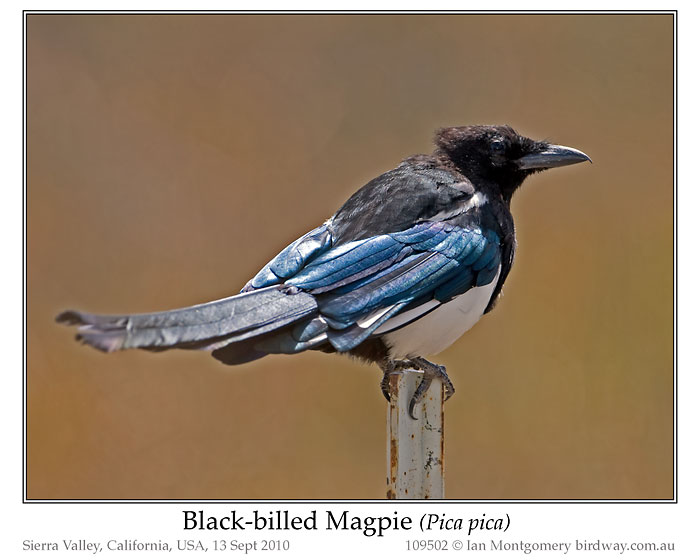
Black-billed Magpie (Pica hudsonia) by IanBack then, we called them just ‘Magpies’. In later decades, I became aware that, like The Kittiwake and for similar reasons, it acquired a coloured qualification ‘Black-billed’. In the case of the Kittiwake this was to distinguish the black-legged Eurasian one from the Red-legged Kittiwake of the eastern Bering Sea; in the case of the Magpie, it was because of the Yellow-billed Magpie of California, fifth photo, having a very restricted range that overlaps with the much more widespread Black-billed Magpie (fourth photo). The fifth photo, incidentally gives a good idea what the very similar Common/Black-billed Magpie looks like in flight and the white patches on the wing are very striking.
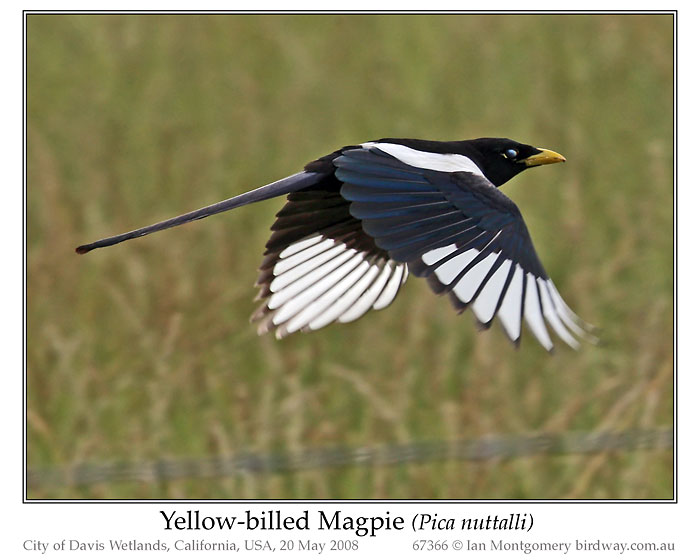
Black-billed Magpie (Pica hudsonia) by Ian

Plus ça change … as they say. I discovered while researching this BotW that Handbook of Birds of the World (HBW) and Birdlife International have accepted the split of the Black-billed/Common into three species: the Common Magpie (Pica pica) of Eurasia, the Black-billed Magpie of North America (Pica hudsonii) – fourth photo – and the Arabian Magpie (Pica asirensis), restricted to a tiny range in SW Saudi Arabia. So the European bird is back to where it started from.

I’m losing patience with avian taxonomists. Molecular studies over the past thirty years have led to countless changes in classification and naming, and not just at the species level. The 2014 HBW Checklist of Birds of the World, volume 1 (non-passerines) has many changes at every level up to order. I’ll repeat what I’ve said before that Linnaeus – he who tried to impose order on chaos – must be turning in his grave. Maybe he is just laughing, and perhaps that’s the right approach.

I used to think what the latest taxonomists said – starting with Sibley and Monroe in 1990 – was the gospel truth and a huge advance in our understanding. I don’t think that anymore! Here is a quote from Birdlife International on the fate of the Rainbow and Red-collared Lorikeets: Trichoglossus haematodus, … T. rubritorquis… (del Hoyo and Collar 2014) were previously lumped as T. haematodus following Christidis and Boles (1994), and before then were split as T. haematodus and T. rubritorquis following Sibley and Monroe (1990, 1993): Lump, split, lump, split!

On a lighter note, I’m giving a talk on ‘Australia: Land of Parrots?’ at the BirdLife Townsville AGM next Saturday 14 February at 2:00pm in the Sound Shell meeting room at Thuringowa. If you’re a local, and even if you’re not, it would be great to see you there. The talk is about parrot diversity and bio-geography – all the Gondwanaland stuff.

Greetings
Ian

**************************************************
Ian Montgomery, Birdway Pty Ltd,
454 Forestry Road, Bluewater, Qld 4818
Tel 0411 602 737 ian@birdway.com.au
Bird Photos http://www.birdway.com.au/


Lee’s Addition:

I know and am acquainted with all the birds of the mountains, and the wild animals of the field are Mine and are with Me, in My mind. (Psalms 50:11 AMP)

Ha! Ha! Ha! Thanks Ian for saying what I have been feeling. Sounds like we both agree on all the renaming, splitting, re-shuffling and “Lump, split, lump, split!” (Birds, People and DNA) 

The Magpies above are neat and I especially like that expression of the juvenile one. He (or she) still has the gape of an immature bird.

The Corvidae Family Crows, Jays, Ravens is where you will find the Magpies placed. (at this time). There are 130 members that make up this family.

*

*

Sunday Inspiration – “Ant” Birds

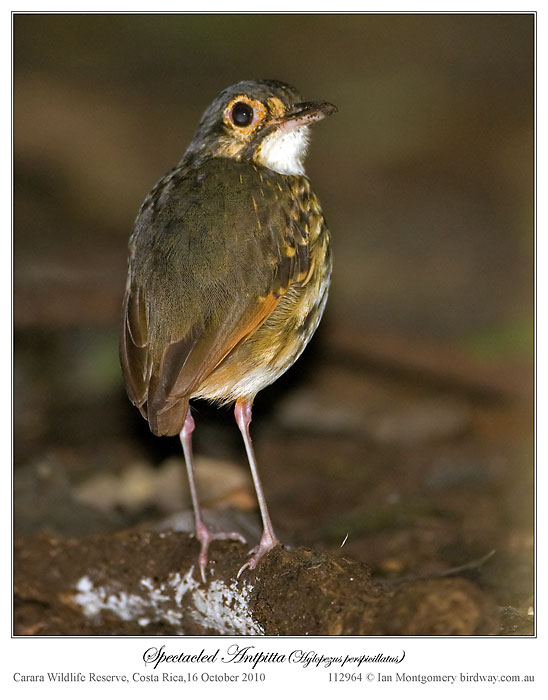
Streak-chested (Spectacled) Antpitta (Hylopezus perspicillatus) by Ian

Streak-chested (Spectacled) Antpitta (Hylopezus perspicillatus) by Ian

The ants are a people not strong, yet they prepare their meat in the summer; (Proverbs 30:25 KJV)

Go to the ant, thou sluggard; consider her ways, and be wise: Which having no guide, overseer, or ruler, Provideth her meat in the summer, and gathereth her food in the harvest. (Proverbs 6:6-8 KJV)

Last week’s Sunday Inspiration featured the “first four bird families, taxonomically, in the Passeriformes Order (Songbirds)” This week we will continue with the next three families. They all have “ant” birds in them; Antshrikes, Antwrens, Antbirds, Antthrushes and Antpittas.. The Thamnophilidae – Antbirds family does have a few Bare-eyes.

This slideshow requires JavaScript.

Click to Listen

“He Looked Beyond My Fault” ~ ©The Hyssongs

*

Sunday Inspirations

Passeriformes Order

Thamnophilidae – Antbirds Family

Formicariidae – Antthrushes Family

Grallariidae – Antpittas Family

Gideon

*

Designed for Flight – Creation Moments TV

An eagle fishing

An eagle fishing

For thus says the LORD: “Behold, one will fly swiftly like an eagle And spread out his wings against Moab. (Jeremiah 48:40 NASB)

Creation Moments articles have been used here many times. Now they have a YouTube Channel called Creation Moments TV.

While checking out their new videos, I found this one about birds and thought you might enjoy seeing it. Watching instead of reading is more enjoyable at times. Though reading is still good for us or else those of us who do blogs would be out of business.

God created the great sea monsters and every living creature that moves, with which the waters swarmed after their kind, and every winged bird after its kind; and God saw that it was good. (Genesis 1:21 NASB)

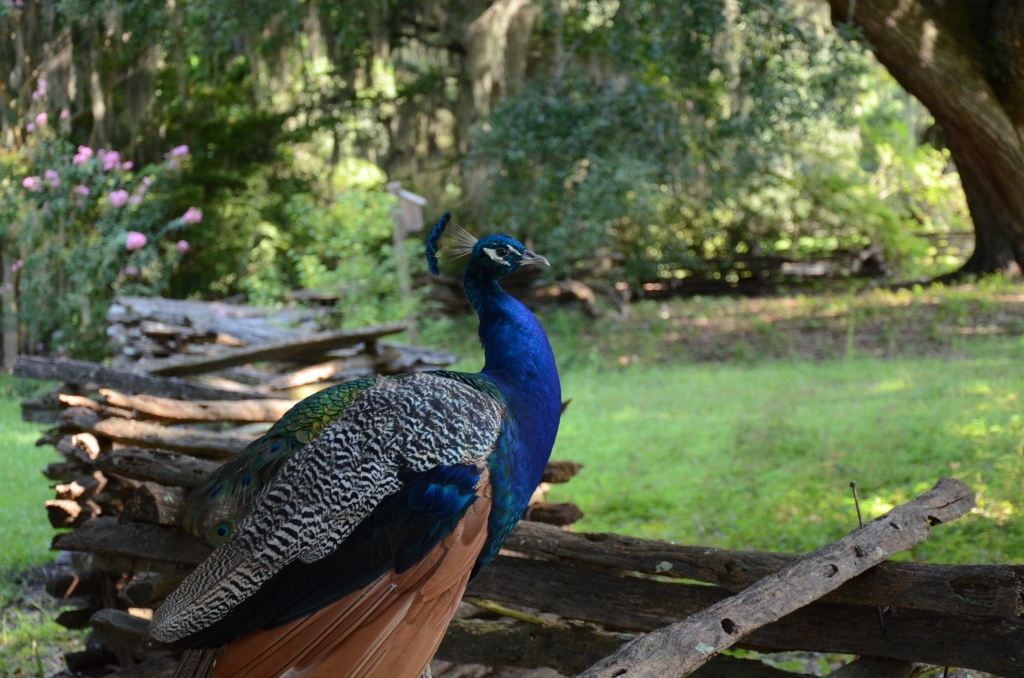
Peacock at Magnolia Plantation by Dan

Peacock at Magnolia Plantation by Dan

Creation Moments TV

Interesting Things from Creation Moments

When I Consider

*

Live Cams from All About Birds

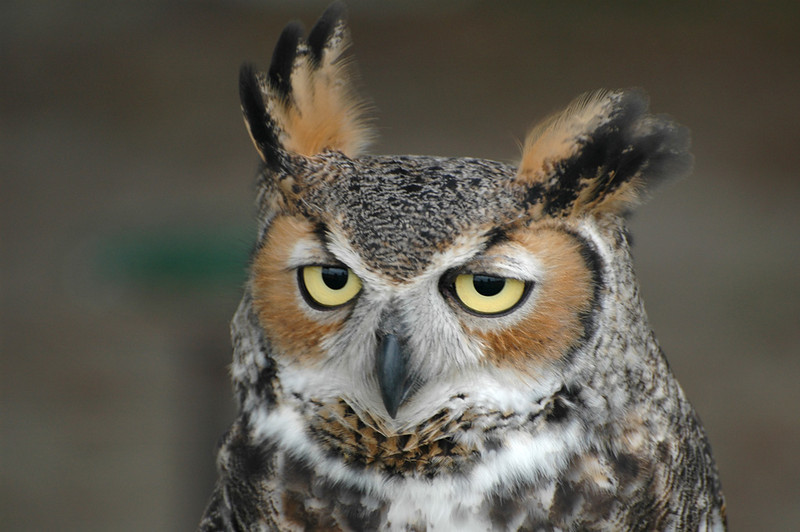
Great Horned Owl (Bubo virginianus) by Bob-Nan

Great Horned Owl (Bubo virginianus) by Bob-Nan

The little owl, and the great owl, and the swan, (Deuteronomy 14:16 KJV)

There shall the great owl make her nest, and lay, and hatch, and gather under her shadow: there shall the vultures also be gathered, every one with her mate. (Isaiah 34:15 KJV)

Are you aware of the Live Cameras that All About Birds are sharing? They are very interesting to watch. The latest that was shared with me is a Great Horned Owl nest Cam in Savannah, GA.

Take a look”

Here is a link that shows more about the Great Horned Owls there.

http://cams.allaboutbirds.org/channel/46/Great_Horned_Owls/

How about some Laysan Albatross nest in Hawaii?

Here is there link for the Albatross.

http://cams.allaboutbirds.org/channel/41/Laysan_Albatross/

Aren’t these amazing? It is alway great to watch the Lord’s amazing creations, but to get to see them at the nest or at feeders is neat with today’s technology.

If you would like to see all the current Cams from All About Birds click this link. Not all the camera are operating all the time, but this page will help you find the live one as the current time.

http://cams.allaboutbirds.org/all-cams/

*

Birds of the Bible – Owls

Strigidae – Owls

Diomedeidae – Albatrosses Family

*


Birds, People and DNA

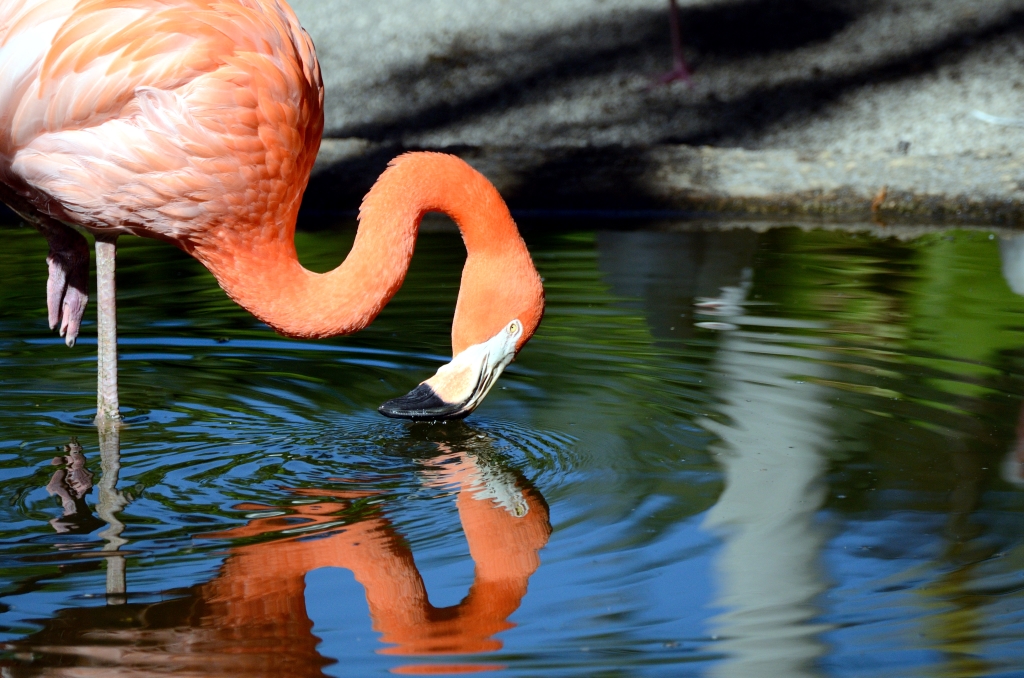
Flamingo by Dan' at Flamingo Gardens

Flamingo by Dan at Flamingo Gardens

So God created great sea creatures and every living thing that moves, with which the waters abounded, according to their kind, and every winged bird according to its kind. And God saw that it was good. And God blessed them, saying, “Be fruitful and multiply, and fill the waters in the seas, and let birds multiply on the earth.” (Genesis 1:21-22 NKJV)

Recently, I have been interested in genealogy. I have been working on our ancestry while staying home since I have been “under the weather.” It is really fun and exciting finding out about my previous generations. It also can be time-consuming and addictive, if you let it.

I can only imagine how those that are working on the DNA of our avian friends feel. If you have been following this blog very long, you know that I keep updating my Birds of the World when a new version comes out. When the Ver. 4.2 came out I.O.C. Version 4.2 Updated, I wrote this:

“They (the birds) are still doing as commanded by the Lord to reproduce and keeping the ornithologist busy naming, renaming, and rearranging them.

This time they renamed one and moved it to a new family just for it. The Spotted Wren-Babbler (Spelaeornis formosus) was in the Timaliidae Family. It has been renamed the Spotted Elachura (Elachura formosa) and placed in its own Elachuridae Family. (I do not have permission yet to post a photo.)

Version 4.2 also took the Lark Family and tossed it up in the air and rearranged it. See the Alaudidae – Larks Family. The DNA researches are keeping them busy keeping up with how the birds bred. Some of the scientific names were changed:”

Tawny-throated Leaftosser (Sclerurus mexicanus) by Michael Woodruff

Tawny-throated Leaftosser (Sclerurus mexicanus) by Michael Woodruff

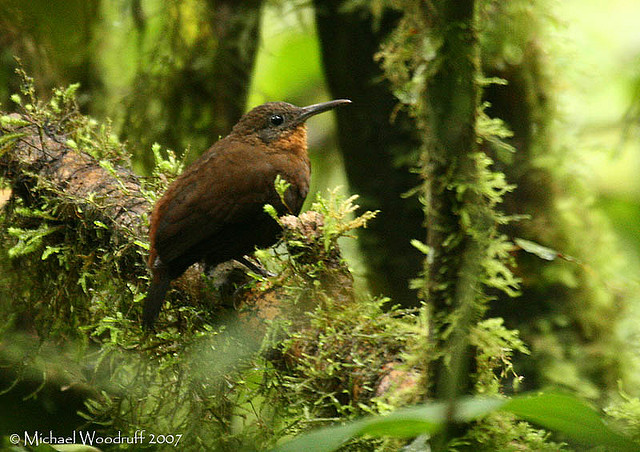
Maybe the DNA Bird Researchers could hire this Leaftosser to help them out. Not sure if the next version coming out soon will toss another family up in the air or not.

Of course, we believe that God created these beautiful, and not so beautiful, birds and not by evolution over millions of years. Yes, they did inter-breed over the years and you have different looks and songs within the families. But they are still birds and the Lord has wonderfully made DNA that helps trace that.

Today, you can trace your own ancestors through DNA. I don’t understand much about it, but what I do know is this:

I will praise You, for I am fearfully and wonderfully made; Marvelous are Your works, And that my soul knows very well. (Psalms 139:14 NKJV)

Here are some interesting articles that do discuss DNA from a Christian Perspective:

(From this article) But nowhere does the Bible say that species cannot change! Instead, it seems that they would have to change—within the limits of their own interbreeding kind—in order to fulfill God’s command in Genesis 1 for His living creatures to fill the earth and its many changing environments.

Darwin insisted that animals slowly change between kinds. In contrast, seedeater birds have shown that they rapidly changed within their kind. Despite Campagna’s touting of Darwin’s “accomplishments,” these birds display programmed variation, not evolution.

Marsh Seedeater (Sporophila palustris) ©WikiC

Marsh Seedeater (Sporophila palustris) ©WikiC

Good News
*

Sunday Inspiration – More Amazing Birds

Rufous-capped Spinetail (Synallaxis ruficapilla) by Dario Sanches

Rufous-capped Spinetail (Synallaxis ruficapilla) by Dario Sanches

For he that is mighty hath done to me great things; and holy is his name. (Luke 1:49 KJV)

Our Creator has given us so many birds to enjoy, that it is hard to pick them. So, today as you listen to another arrangement from Pastor Jerry’s special night a few weeks ago, you can view another slideshow of mixed avian friends. These are from the first four bird families, taxonomically, in the Passeriformes Order (Songbirds).

Ah Lord GOD! behold, thou hast made the heaven and the earth by thy great power and stretched out arm, and there is nothing too hard for thee: Thou shewest lovingkindness unto thousands, and recompensest the iniquity of the fathers into the bosom of their children after them: the Great, the Mighty God, the LORD of hosts, is his name, Great in counsel, and mighty in work: for thine eyes are open upon all the ways of the sons of men: to give every one according to his ways, and according to the fruit of his doings: (Jeremiah 32:17-19 KJV)

This slideshow requires JavaScript.

Click to listen:

“Jesus What A Might Name” – Pastor Jerry Smith w/Choir and Orchestra

For unto us a Child is born, Unto us a Son is given; And the government will be upon His shoulder. And His name will be called Wonderful, Counselor, Mighty God, Everlasting Father, Prince of Peace. (Isaiah 9:6 NKJV)

*

Birds of the World
Passeriformes Order
Acanthisittidae – New Zealand Wrens
Eurylaimidae – Broadbills
Pittidae – Pittas
Furnariidae – Ovenbirds

Good News

*

Photos by Michael Woodruff

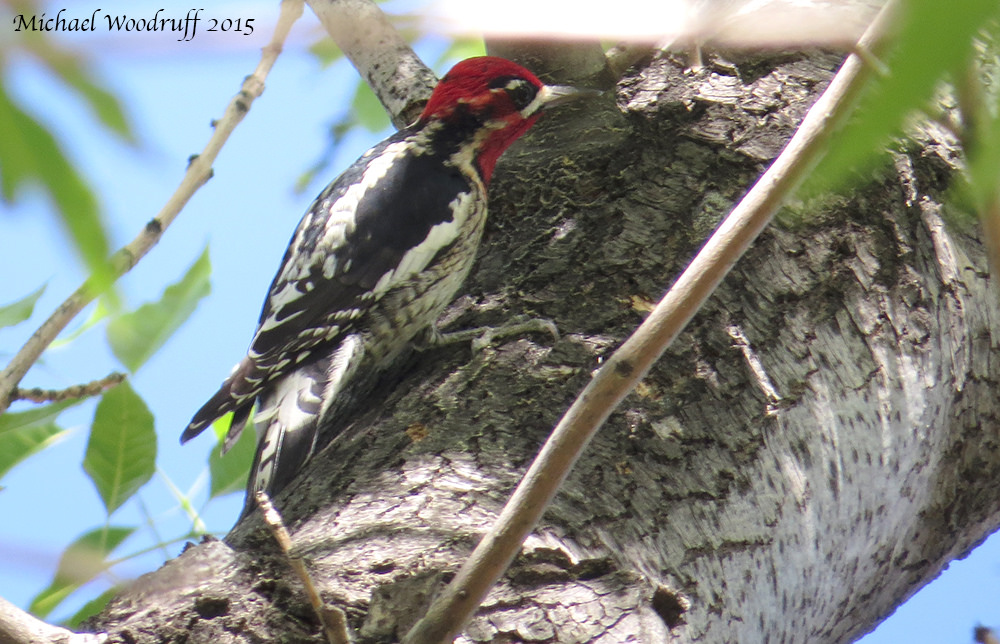
Red-breasted X Red-naped Sapsucker  By Michael Woodruff

Red-breasted X Red-naped Sapsucker By Michael Woodruff

Out of the ground the LORD God formed every beast of the field and every bird of the air, and brought them to Adam to see what he would call them. And whatever Adam called each living creature, that was its name. (Genesis 2:19 NKJV)

Thought I would share some of Michael Woodruff’s latest photos. He has been giving me permission to use his great photos for several years. The Lord created these birds and Michael has a great way of capturing their images for us to enjoy. Thanks, Michael.

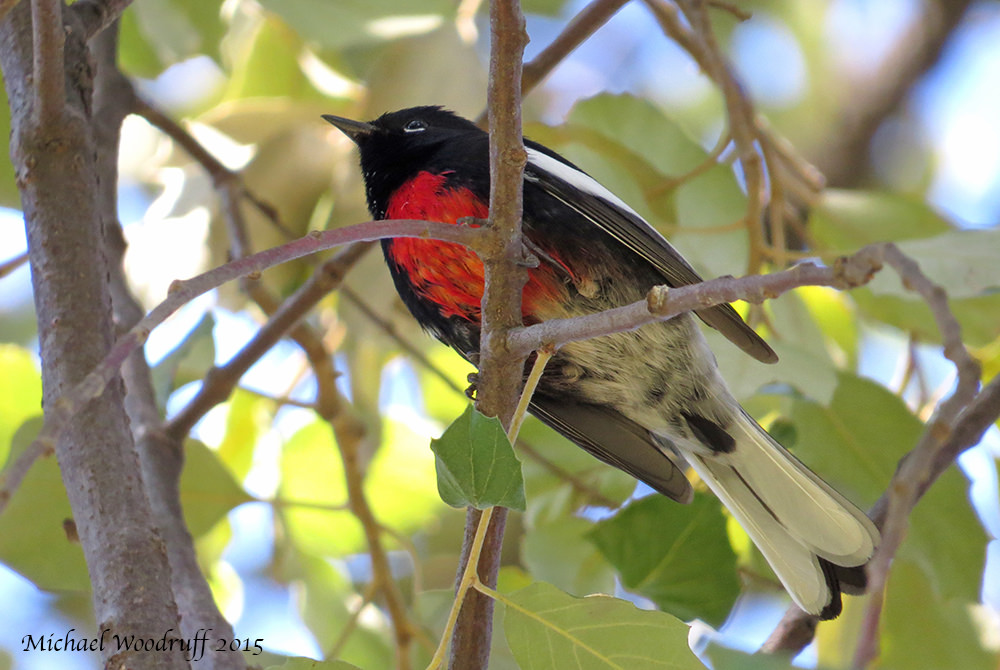
Painted Redstart by Michael Woodruff

Painted Redstart by Michael Woodruff

I know all the birds of the mountains, And the wild beasts of the field are Mine. (Psalms 50:11 NKJV)

And since we haven’t been on any birdwatching trips yet this year, you can enjoy photos from others. His Flickr photos can be see at:

Tropical Kingbird By Michael Woodruff

Tropical Kingbird By Michael Woodruff

Click to see Michael’s Pictures:

Michael Woodruff

Red-masked Parakeet by Michael Woodruff

Red-masked Parakeet by Michael Woodruff

Then God said, “Let the waters abound with an abundance of living creatures, and let birds fly above the earth across the face of the firmament of the heavens.” (Genesis 1:20 NKJV)

*

Here are some articles where Michael’s photos have been used:

*

Quotes from C. S. Lewis

Grey-headed Canary-Flycatcher (Culicicapa ceylonensis) by W Kwong

Grey-headed Canary-Flycatcher (Culicicapa ceylonensis) by W Kwong

In today’s Creation Moments article, A WONDROUS BUT TERRIFYING CREATION, these quotes from C. S. Lewis caught my interest. The article is actually about Louie Zamperini’s experiences, especially with nature.

C.S. Lewis writes about how our experience with the creation awakens within us a sense that there is more – something other, something beyond the natural world. He writes in Mere Christianity, “If I find in myself a desire which no experience in this world can satisfy, the most probable explanation is that I was made for another world.”

Lewis also observes in his book Miracles that we can only savor this world for the wonder that it really is when we appreciate it as the creation of a supernatural God. “Only Super-naturalists really see Nature…. To treat Nature as God, or as Everything, is to lose the whole pith and pleasure of her. Come out, look back and then you will see … this astonishing cataract of bears, babies, and bananas; this immoderate deluge of atoms, orchids, oranges, cancers, canaries, fleas, gases, tornadoes, and toads. How could you have ever thought this was ultimate reality? … The “vanity” (futility) to which she was subjected was her disease not her essence.”

Like all of us, Nature – though wondrous and awesome – is in need of redemption. The “essence” of Nature points us to her Awesome Maker. And the “disease” within her – the futility, corruption, and harsh cruelty – instructs us to anxiously long for our full redemption. As the Bible puts it,

“…the sufferings of this present time are not worthy to be compared with the glory which shall be revealed in us. For the earnest expectation of the creature (the anxious longing of the creation) waits for the manifestation of the sons of God…. For we know that the whole creation groaneth and travaileth in pain together until now.” (Romans 8:18-19, 22)

To see that article …

Like yesterday’s I’m Little but…., the hawk would not be trying to catch and eat the squirrel had it not been for the curse and our fallen world. It will be great when things are made right. The main question is, are you prepared for when that takes place?

The Gospel Message

Yellow Canary (Crithagra flaviventris) Male ©WikiC

Yellow Canary (Crithagra flaviventris) Male ©WikiC

*

I’m Little but…..

Squirrel at a park in Daytona

Squirrel at a park in Daytona

Thought you might enjoy this sent to me by a friend. Not sure how it was done, but National Geographic was involved.

A couple of verses come to mind:

But God hath chosen the foolish things of the world to confound the wise; and God hath chosen the weak things of the world to confound the things which are mighty; (1 Corinthians 1:27 KJV)

Call unto me, and I will answer thee, and shew thee great and mighty things, which thou knowest not. (Jeremiah 33:3 KJV)

If he watches out for these two, how much more does God watch out for us?

*

Wordless Birds

*


Sunday Inspiration – “Star” Birds

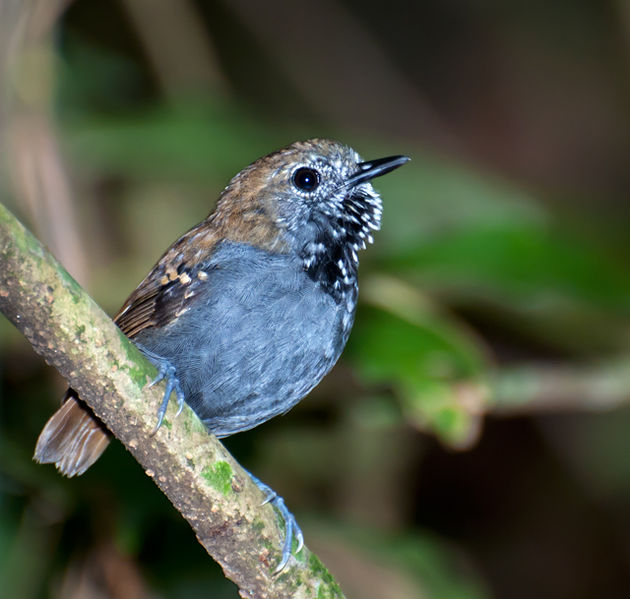
Star-throated Antwren (Rhopias gularis) ©WikiC

Star-throated Antwren (Rhopias gularis) ©WikiC

Today’s Sunday Inspiration is spotlighting the “Star” birds while Pastor Jerry and Reagan Osborne sing “Day Star.” This was sung when Pastor Jerry retired from the Music Ministry.

The “star” birds have “star” in their names. This includes Hillstars, Redstarts, Starlings, Starfrontlets, and a Whitestart.

We have also a more sure word of prophecy; whereunto ye do well that ye take heed, as unto a light that shineth in a dark place, until the day dawn, and the day star arise in your hearts: (2 Peter 1:19 KJV)

Believer’s Bible Commentary: “…The rising of the morning star (day star) pictures Christ’s coming for His saints. Thus the sense of the passage is that we should always keep the prophetic word before us, treasuring it in our hearts, for it will serve as a light in this dark world until the age is ended and Christ appears in the clouds to take His waiting people home to heaven.”

This slideshow requires JavaScript.

Click to Listen

“Day Star” ~ Pastor Jerry Smith and Reagan Osborne at Faith Baptist Church

*

Sunday Inspirations

Big Mighty God

Pastor Jerry Smith – Testimony

Good News

*

Bird’s Egg Evolution – Creation Moments

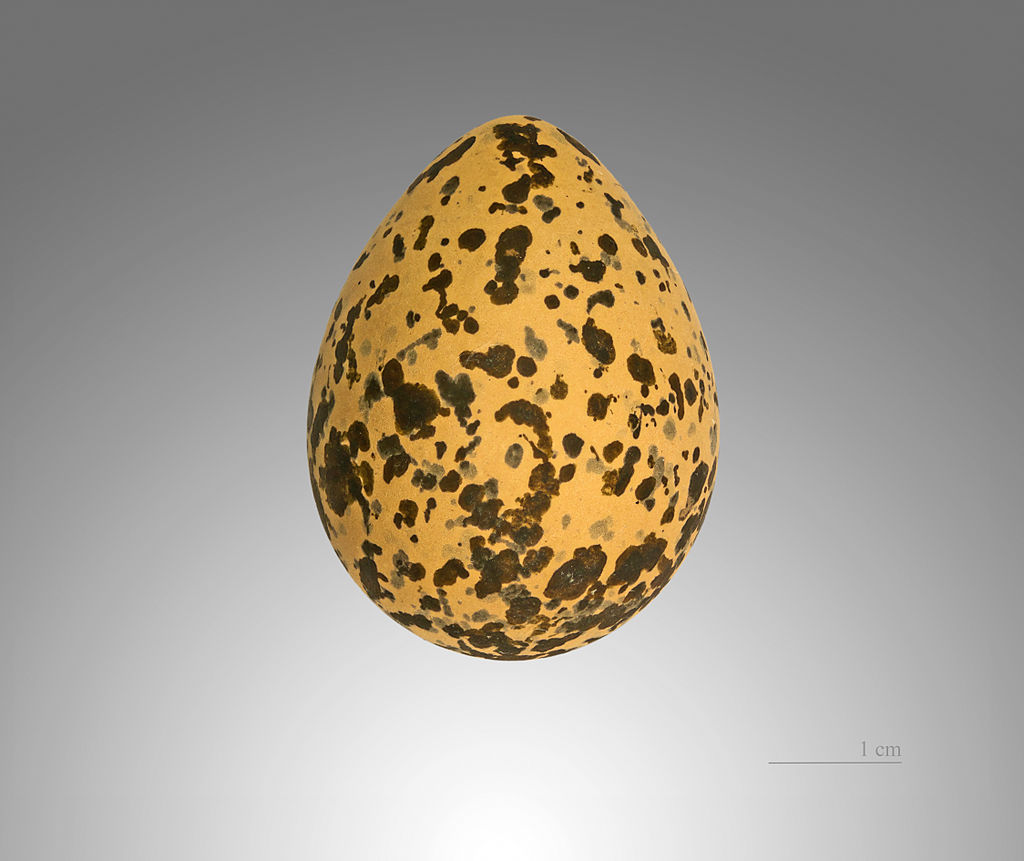
Spur-winged Lapwing (Vanellus spinosus) Egg ©Wiki

Spur-winged Lapwing (Vanellus spinosus) Egg ©Wiki

BIRDS EGG EVOLUTION

“Which leaveth her eggs in the earth, and warmeth them in dust, and forgetteth that the foot may crush them, or that the wild beast may break them.” (Job 39:14-15)

The creation is literally filled with millions of what those who believe in evolution call “happy coincidences.” But when you encounter millions of instances of what appears to be thoughtful design, the obvious conclusion is that there is a Designer. Take the example of bird eggs.

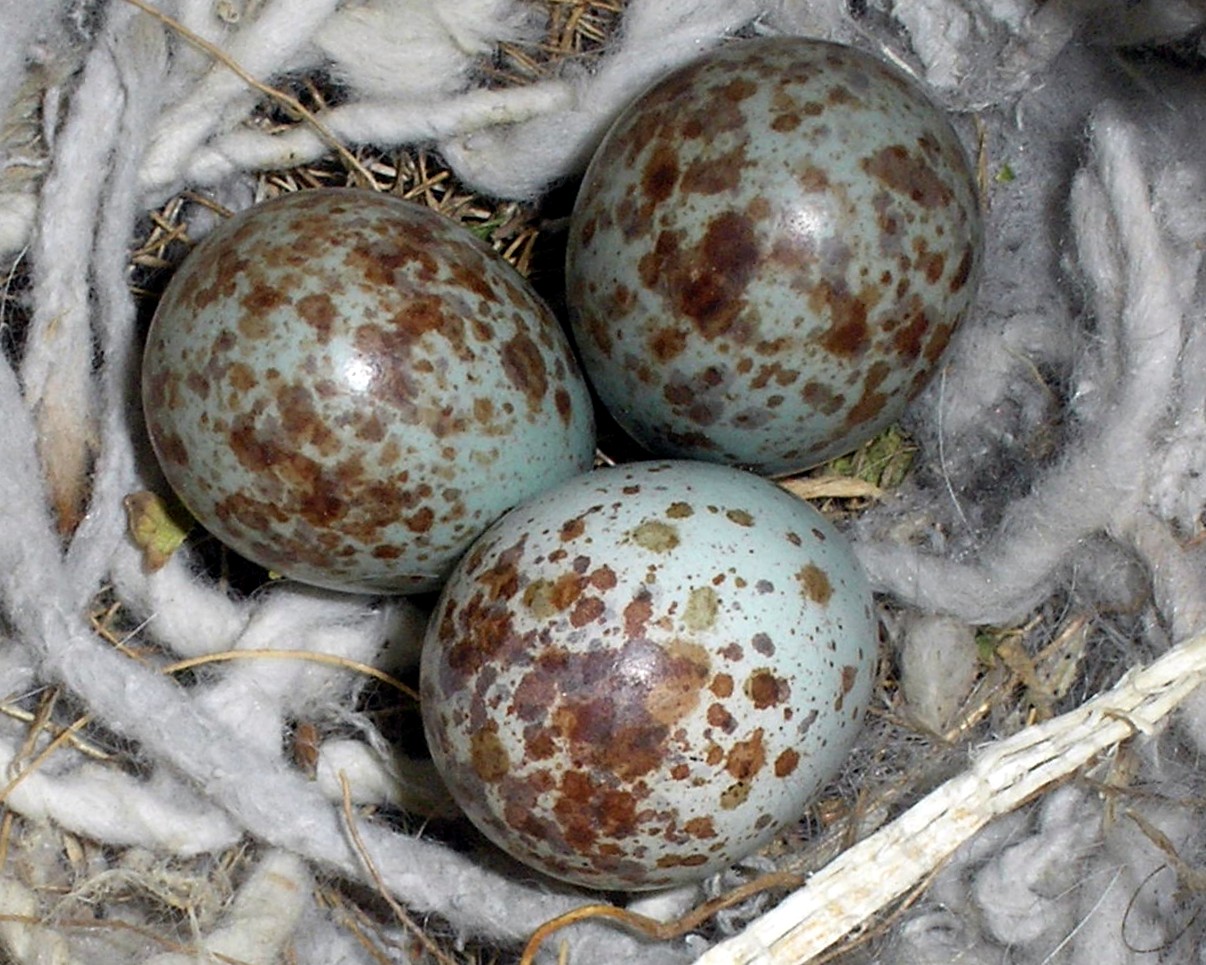
Northern Mockingbird (Mimus polyglottos) eggs ©WikiC

Northern Mockingbird (Mimus polyglottos) eggs ©WikiC

The shape of the egg makes it strong. This strength comes in handy in a busy nest. Mom and dad are coming and going, and they turn the eggs periodically during incubation. But all eggs are not equally egg shaped, and there is a pattern to their shapes. Birds like robins that build a nice, dish shaped nest tend to lay eggs that are more round in shape. Screech owls, which lay their eggs at the bottom of a hole in a tree, also have round shaped eggs. Birds like the killdeer barely build any kind of nest and lay eggs on the ground where almost-round eggs could roll away. For this reason, birds such as a kildeer lay much more sharply pointed eggs which are designed to pivot on their small end. Likewise, eggs that are laid where predators are not likely to see them are usually pale or solid in color, but eggs laid out in the open are camouflaged. Moreover, baby birds that hatch in protected nests, like the bluebird, tend to be naked, blind and helpless. But the unprotected killdeer hatchlings are ready to leave the nest within minutes of hatching.

All coincidences? It seems more scientific to say that here we have a few of the many fingerprints of our wise Creator!

Prayer:
I praise You, Father, for how Your glory is reflected in the creation. Amen.

Notes:
Jim Williams, “Bird basics: egg size, color and shape”, Star Tribune, 7/29/99, p. 8. Illustration: Long elliptical egg of a loon. (PD)

©Creation Moments, 2015 (Used with permission)

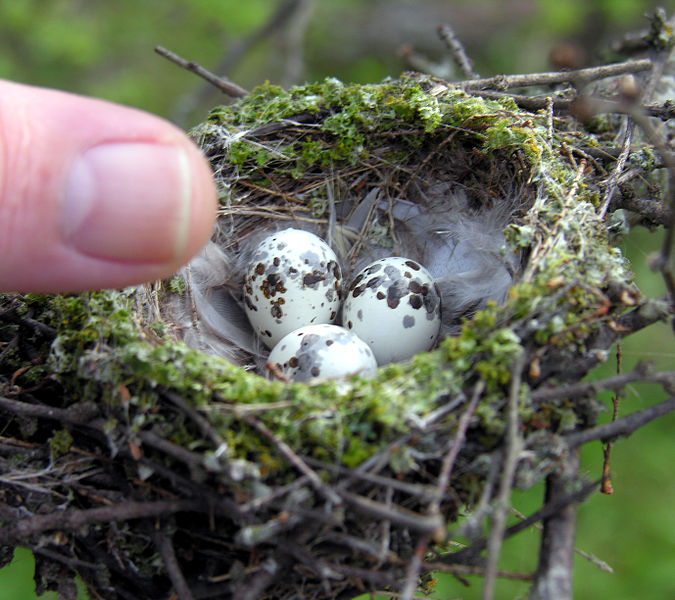
Vermilion Flycatcher (Pyrocephalus rubinus) Eggs ©WikiC

Vermilion Flycatcher (Pyrocephalus rubinus) Eggs ©WikiC


Lee’s Addition:

So teach us to number our days, that we may apply our hearts unto wisdom. (Psalms 90:12 KJV)

O LORD, how manifold are thy works! in wisdom hast thou made them all: the earth is full of thy riches. (Psalms 104:24 KJV)

Another reminder of how great and wise our Creator is.

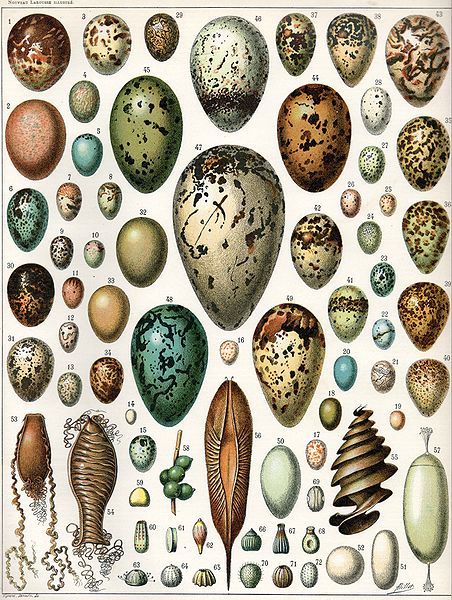
Different Eggs- Birds and Others - from Wikipedia

Different Eggs- Birds and Others – from Wikipedia

Incredible Chicken Egg
Birds of the Bible – Bird Egg Facts
Formed By Him – Bird Eggs

*