I love this statement that they started their answer with in the excerpt they had in their Answers Weekly Newsletter.
Since the Bible is the Word of God, and since God cannot lie, then the Bible is trustworthy. That is our starting point.
That is exactly how I feel about what is written by me here on this blog. I start with knowing that God’s Word is truth and that all these birds that were created for our enjoyment, were Created By God, Not Made in China or Made in the USA, but Made By God.
Anyway, the following article excerpt came from Feedback. It has to do with Dinosaurs living with humans.
Q: Why do we believe dinosaurs lived with people?
A: Since the Bible is the Word of God, and since God cannot lie, then the Bible is trustworthy. That is our starting point. We are told that land animals were created on Day Six, and this would include dinosaurs. Since Day Six is also when man was created, we certainly believe dinosaurs lived at the same time as man.
How do you explain the various petroglyphs of dinosaurs found around the world? How do you explain the fact that so many dragon legends from around the world describe creatures that match what we know about dinosaurs from their fossils? How do you explain the biblical account that seems to describe something like a brachiosaurus, called behemoth in Job 40:15–24?
And I said, Oh that I had wings like a dove! [for then] would I fly away, and be at rest. Lo, [then] would I wander far off, [and] remain in the wilderness. (Psalm 55 6-7)
These days, we don’t have to wait very long before we hear some nonsense about how flight or – more recently – space travel are but stages in human evolutionary development. As Christians, we know that when Adam, the first man, is described as perfect, he is perfect in every way – spiritually, morally and intellectually. This probably explains why Scripture says that within the first few generations of human existence on Earth, the arts and sciences were flourishing.
In 1898, an object that was thought to be a small wooden model of a bird was discovered in Egypt. The “unremarkable” find was tossed into a box marked “wooden bird models” and was rediscovered in more recent times. The Egyptian Ministry of Culture set up a special panel to study the object. As a result of that study, the object is on display at the Cairo Museum today as the centerpiece of a special exhibit. It is now officially labeled as a model airplane.
The plane’s design shows that it is an excellent glider, and with a small engine it could carry huge loads because of the unique design of its wings. This 2,200 year old model airplane had wings that angle slightly downward at the ends—exactly the same improved wing design that was first used in modern times on the supersonic Concorde!
Everyone agrees that humans have always been interested in flight. But now it appears that we creationists were right – we have always been smart enough to do something about our interest in flight as well!
Prayer:
Lord, help people understand that they are not simply glorified animals but are Your creations. Help us all to see that You made each one of us for a purpose, and help me to live for Your purpose.
In Jesus’ Name. Amen.
Notes:
Photo: Courtesy of Dawoudk and licensed under the Creative Commons Attribution-Share Alike 3.0 Unported license.
I almost cracked up when I read the title Stephen gave me for this blog. He gave me the suggested titles and I am suppose to write the articles. Some deal! We would like this series to be informative, but mainly to encourage all of us to “start birdwatching today” no matter our level of experience.
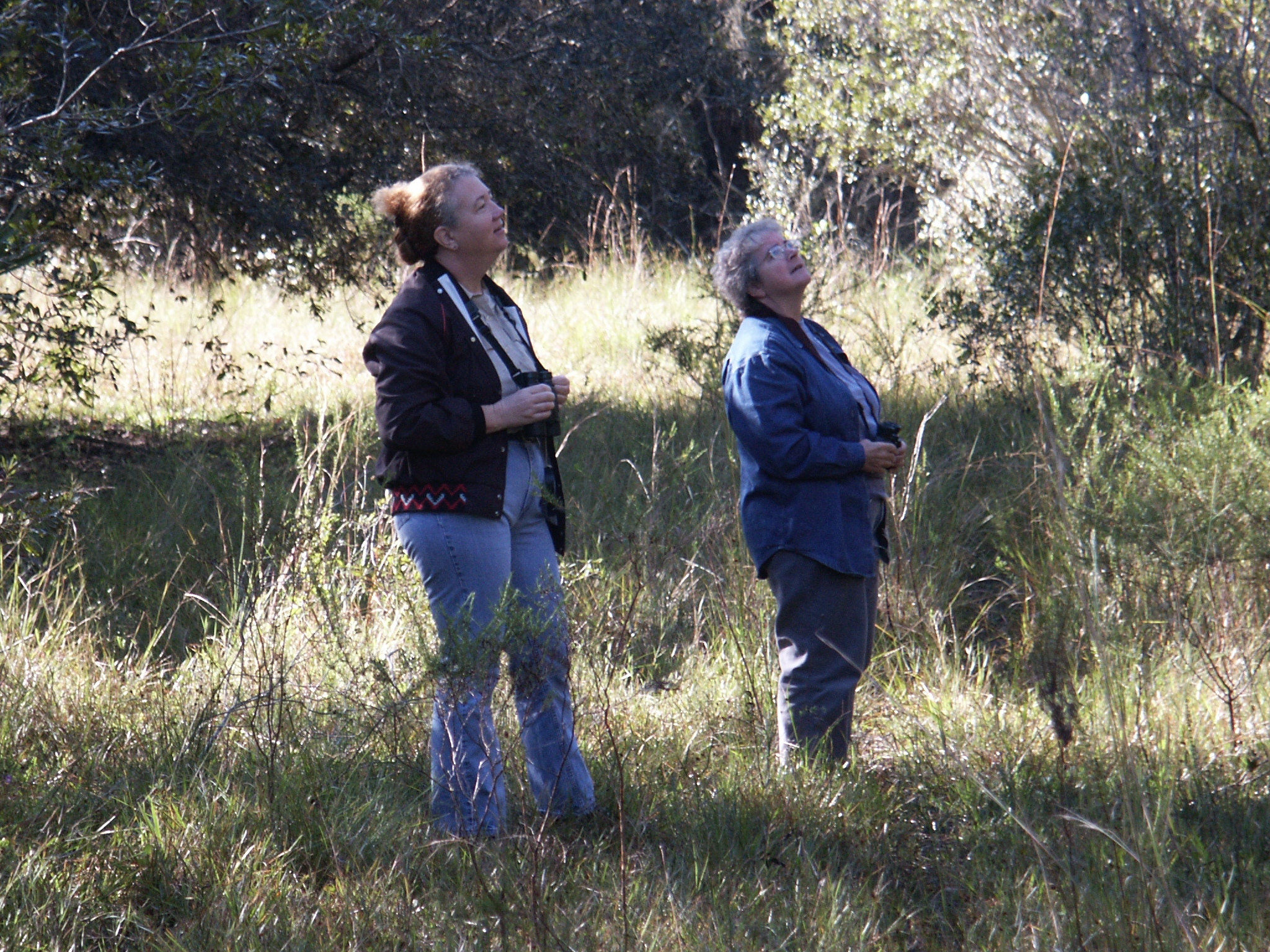
So, why should you go outside? Mainly, because that is where most of the birds are. Yes, there are some in cages in peoples house, but the majority are outside flying freely about waiting for you to come watch them. The birds are busy doing what the Lord designed them to do; singing, building nests, eating, finding food for their young, arguing sometimes (especially those in the Dove-Pigeon family), Why do they argue? They are actually showing dominance or defending their territory, or who knows what else. If you are not outside, you might miss all this. You can watch through your window, so even those who are ill or handicapped, can still get to enjoy the antics of our avian friends.
According to Job, you might even learn something from watching the birds:
But now ask the beasts, and they will teach you; And the birds of the air, and they will tell you; (Job 12:7 NKJV)
Who teaches us more than the beasts of the earth, And makes us wiser than the birds of heaven? (Job 35:11 NKJV)
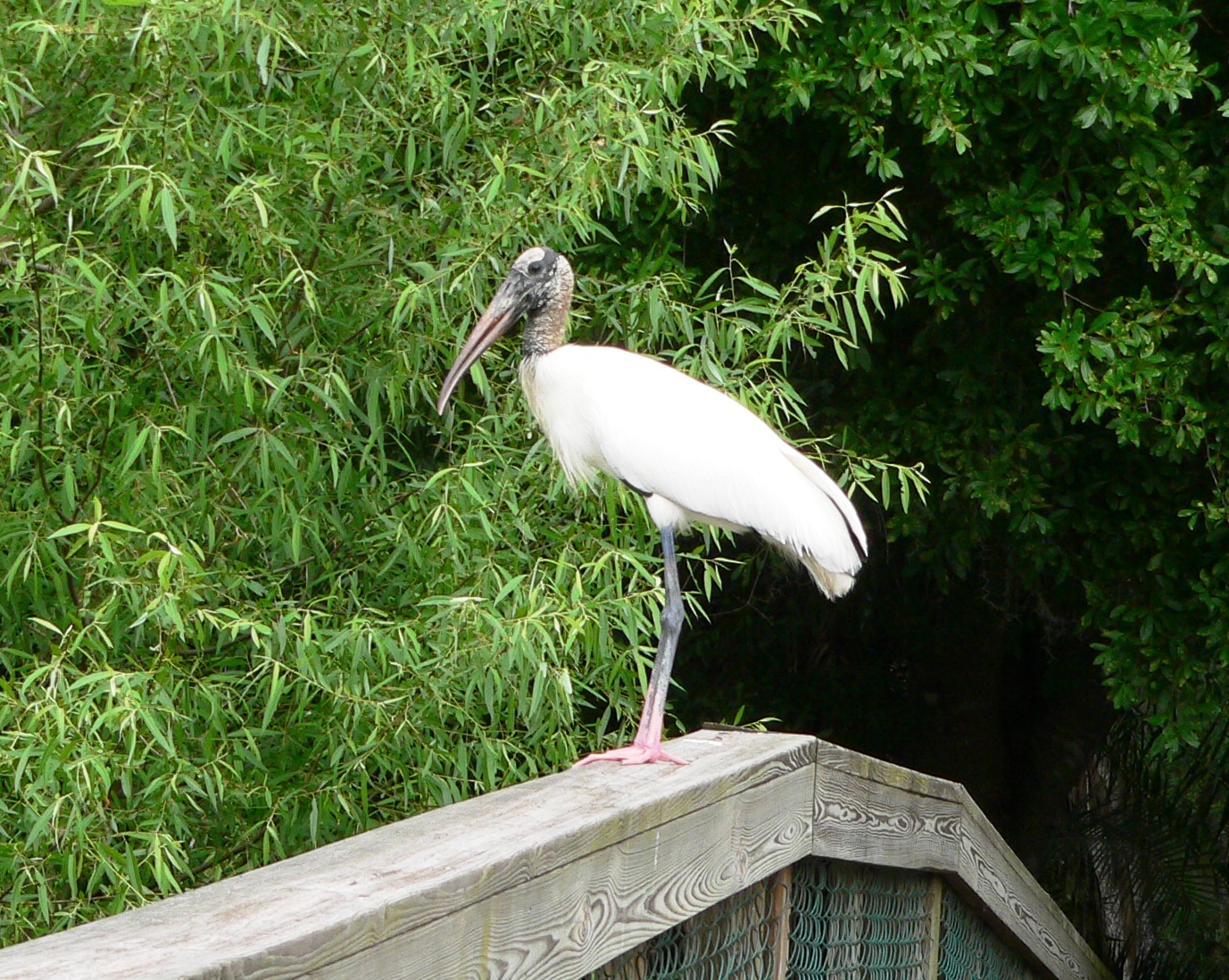
Wood Stork at S. Lake Howard Nature Park
Stare at the birds? If you do that to a person, they get upset, but I am not sure a bird would, but then again they just might. One of the things I was taught when I first became interested in birding or birdwatching was to have “soft eyes.” If you stare at a tree or a certain area, you might see a bird. If you look at a tree, but not stare, then you can catch movement or activity in that tree that you might miss if you are only staring at one spot.
Are there times to stare? When I am really concentrating on a bird that I have already spotted, then, yes, I will stare as I try to observe details about the bird. But we will save those details for another blog.
Enough for this article. So either slide your chair or wheelchair up to the window, or go outside and stare at the birds, after you find one.
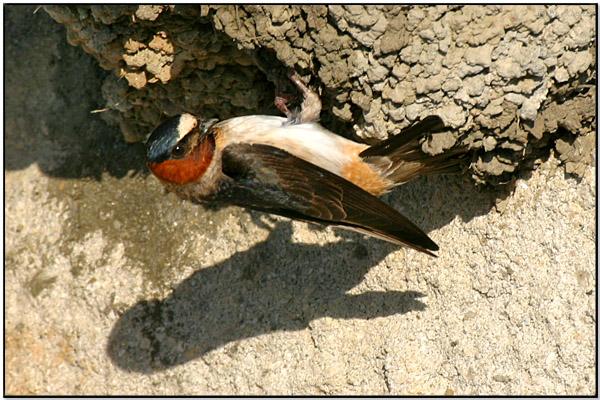
American Cliff Swallow (Petrochelidon pyrrhonota) by Daves BirdingPix
“Did you hear the bells this past Monday? The bells at San Juan Capistrano? Thousands of people did hear them, because they gathered, as they do every year, to rejoice in and celebrate the return of the beloved Swallows. These famous swallows begin their flight every year at dawn on February 18th, from the Argentinian city of Goya, and arrive at the San Juan Capistrano mission, without fail, on the morning of March 19th.
According to Argentinian magazine correspondent Enrique Bermudez, who has made a thorough study of the swallows, they fly a total of 7,500 miles one way on this astounding trip, which they have been making every year for at least 200 years…..”
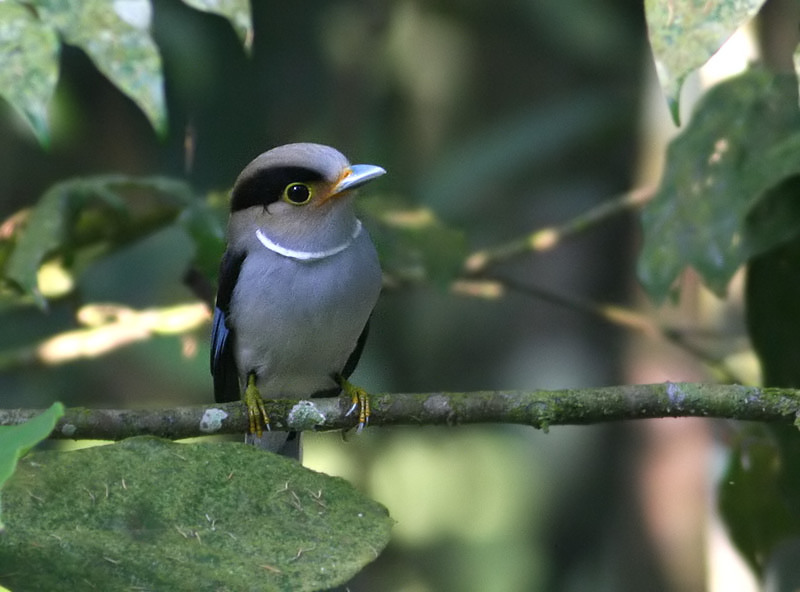
Silver-breasted Broadbill (Serilophus lunatus) by Peter Ericsson
We know from Genesis 1 that the God created the birds, along with everything else. They were created on the fifth day. When Adam became conscience, the birds and critters were already present for him to discover and enjoy.
Then God said, “Let the waters abound with an abundance of living creatures, and let birds fly above the earth across the face of the firmament of the heavens.” So God created great sea creatures and every living thing that moves, with which the waters abounded, according to their kind, and every winged bird according to its kind. And God saw that it was good. And God blessed them, saying, “Be fruitful and multiply, and fill the waters in the seas, and let birds multiply on the earth.” So the evening and the morning were the fifth day. (Genesis 1:20-23 NKJV)
Then the LORD God brought the birds to Adam to let him give them a name.
Out of the ground the LORD God formed every beast of the field and every bird of the air, and brought them to Adam to see what he would call them. And whatever Adam called each living creature, that was its name. (Genesis 2:19 NKJV)
Psalm 111 reminds us that the things that were created are great and are to be “sought out” and enjoyed.
The works of the LORD are great, sought out of all them that have pleasure therein. His work is honourable and glorious: and his righteousness endureth for ever. He hath made his wonderful works to be remembered: the LORD is gracious and full of compassion. (Psalms 111:2-4 KJV)
Fast forward to today. If Adam was to enjoy the birds and put names on them, should we not try to discover them, enjoy them, and try to figure out what their names are?
Galah (Eolophus roseicapilla) and Dan at Brevard Zoo
The birds are all around us, in the sky flying or gliding on the wind (currents), on the power lines, on feeders, on bushes, in trees, or singing or calling in the distant. (Sometimes they are even on cameras.)
Start birdwatching today for pleasure and realize the goodness of the Lord to us.
Our Assistant to the Pastor, Stephen, has asked if I would consider another series for our Church’s Blog, the Fountain. Thanks to Stephen and his assistance in getting the first “Birds of the Bible” series started, those articles and this resulting blog have grown beyond what was ever imagined. Now, we are beginning another new series.
Some of his first suggestions were like, “Birdwatching for Dummies” and I assured him that that book had already been written. The Complete Idiot’s Guide to Birdwatching has also been written. Between the two of us, we just want to encourage you to start birding today.
Okay, so I am suppose to start “birdwatching,” what is it?
“Birding”, “Birdwatching”, “Bird Watching”, “Looking at or for birds”, “Enjoying seeing birds” or whatever you want to call it, are basically the same. It amounts to watching the many wonderful birds that the Lord has created. If you observe only one bird, you are still “birding.”
The flowers appear on the earth; the time of the singing of birds is come, and the voice of the turtle is heard in our land; (Song of Solomon 2:12 KJV)
Cattle Egrets and Juvenile White Ibis at S Lake Howard
So watch for future titles like:
Start Birdwatching Today: Some Background Information
Start Birdwatching Today: Why Should I Go Outside and Stare at Birds?
Start Birdwatching Today: The Few Tools You Need To Be A Birdwatcher
Start Birdwatching Today: Where Do I Go?
Start Birdwatching Today: What Kind of Bird is This?
Ephesians 2:10
For we are his workmanship, created in Christ Jesus unto good works, which God hath before ordained that we should walk in them.
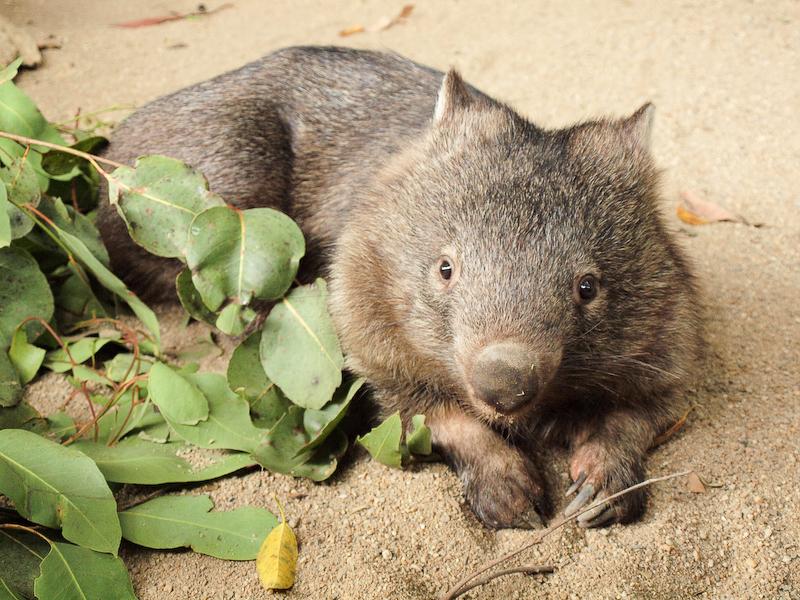
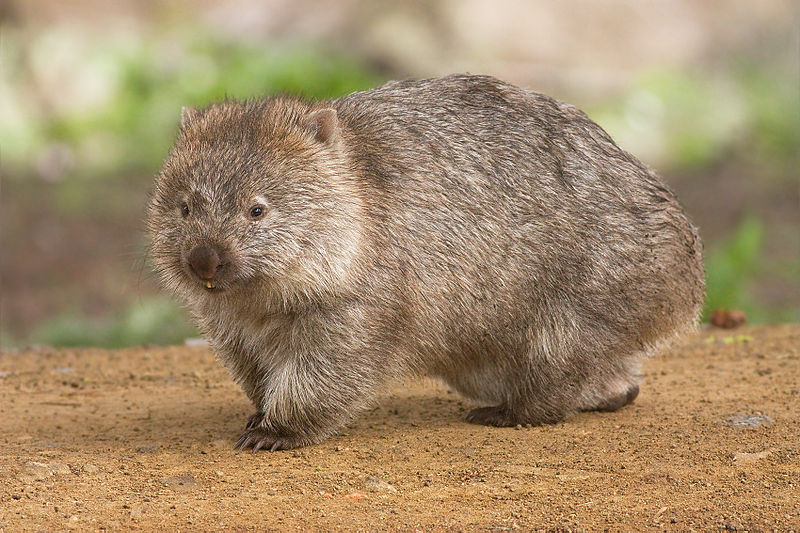
Australia has many animals that are not found anywhere else in the world today. One of the most unique is the wombat, which looks like a small bear with brown fur. The wombat is a burrowing animal.
Like many of Australia’s animals, the wombat is a marsupial, having a pouch in which its prematurely born young complete their development. The pouches owned by most marsupials are open at the top toward the mother’s head. This works fine for the kangaroo and other marsupials – no one ever saw a kangaroo standing on its head.
Common Wombat (Vombatus ursinus)-Maria Island National Park
But the wombat is a burrowing animal. If its pouch opened toward the mother’s head, it would very quickly fill with dirt, which wouldn’t do the young wombat inside the pouch any good. So, unlike any other marsupial, the wombat’s pouch opens toward the animal’s hind legs – it points backward!
The marsupial’s pouch is a wondrous enough invention all by itself. But this pouch is a clear case of a specialized intelligent design for a unique situation. If the wombat’s backward pouch had been produced by mutations, how would baby wombats have gotten by during the millions of years of trial and error needed to redesign the pouch? It’s easy to see the wombat’s backward pouch as a humorous hint from the Creator that human theories simply cannot replace the account of creation that He has revealed to us in the Bible!
Prayer:
Lord, I thank You that You have so carefully planned every detail of the creation for the benefit of every creature. When things don’t seem to be going well in my life, comfort me with the fact that You are still in charge and that You care about the details of my life, too. Amen.
Notes:
Major, Trevor. 1989. “The backward wombat.” Reasoning from Revelation, August. p. 3.
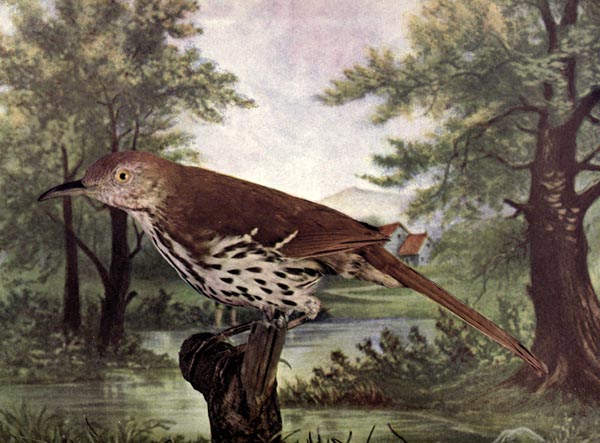
Brown Thrasher (Toxostoma rufum) – Birds Illustrated
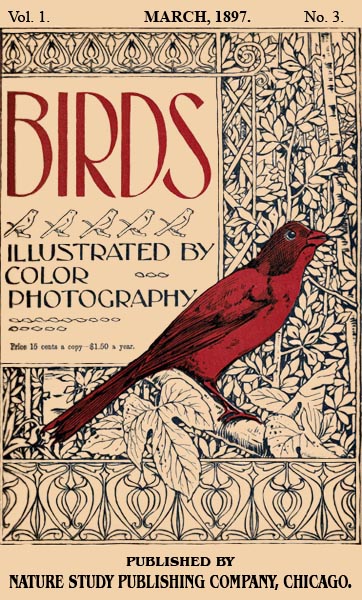
Birds Illustrated by Color Photography – Revisited
Vol 1. March, 1897 No. 3
*
THE BROWN THRUSH.
“However the world goes ill,
The Thrushes still sing in it.”
HE Mocking-bird of the North, as the Brown Thrush (Brown Thrasher today) has been called, arrives in the Eastern and Middle States about the 10th of May, at which season he may be seen, perched on the highest twig of a hedge, or on the topmost branch of a tree, singing his loud and welcome song, that may be heard a distance of half a mile. The favorite haunt of the Brown Thrush, however, is amongst the bright and glossy foliage of the evergreens. “There they delight to hide, although not so shy and retiring as the Blackbird; there they build their nests in greatest numbers, amongst the perennial foliage, and there they draw at nightfall to repose in warmth and safety.” The Brown Thrasher sings chiefly just after sunrise and before sunset, but may be heard singing at intervals during the day. His food consists of wild fruits, such as blackberries and raspberries, snails, worms, slugs and grubs. He also obtains much of his food amongst the withered leaves and marshy places of the woods and shrubberies which he frequents. Few birds possess a more varied melody. His notes are almost endless in variety, each note seemingly uttered at the caprice of the bird, without any perceptible approach to order.
The site of the Thrush’s nest is a varied one, in the hedgerows, under a fallen tree or fence-rail; far up in the branches of stately trees, or amongst the ivy growing up their trunks. The nest is composed of the small dead twigs of trees, lined with the fine fibers of roots. From three to five eggs are deposited, and are hatched in about twelve days. They have a greenish background, thickly spotted with light brown, giving the whole egg a brownish appearance.
The Brown Thrush leaves the Eastern and Middle States, on his migration South, late in September, remaining until the following May.
THE THRUSH’S NEST.
“Within a thick and spreading hawthorn bush
That overhung a molehill, large and round,
I heard from morn to morn a merry thrush
Sing hymns of rapture while I drank the sound
With joy—and oft an unintruding guest,
I watched her secret toils from day to day;
How true she warped the moss to form her nest,
And modeled it within with wood and clay.
And by and by, with heath-bells gilt with dew,
There lay her shining eggs as bright as flowers,
Ink-spotted over, shells of green and blue:
And there I witnessed, in the summer hours,
A brood of nature’s minstrels chirp and fly,
Glad as the sunshine and the laughing sky.”
THE BROWN THRUSH.
Dear Readers:
My cousin Robin Redbreast told me that he wrote you a letter last month and sent it with his picture. How did you like it? He is a pretty bird—Cousin Robin—and everybody likes him. But I must tell you something of myself.
Folks call me by different names—some of them nicknames, too.
The cutest one of all is Brown Thrasher. I wonder if you know why they call me Thrasher. If you don’t, ask some one. It is really funny.
Some people think Cousin Robin is the sweetest singer of our family, but a great many like my song just as well.
Early in the morning I sing among the bushes, but later in the day you will always find me in the very top of a tree and it is then I sing my best.
Do you know what I say in my song? Well, if I am near a farmer while he is planting, I say: “Drop it, drop it—cover it up, cover it up—pull it up, pull it up, pull it up.”
One thing I very seldom do and that is, sing when near my nest. Maybe you can tell why. I’m not very far from my nest now. I just came down to the stream to get a drink and am watching that boy on the other side of the stream. Do you see him?
One dear lady who loves birds has said some very nice things about me in a book called “Bird Ways.” Another lady has written a beautiful poem about my singing. Ask your mamma or teacher the names of these ladies. Here is the poem:
There’s a merry brown thrush sitting up in a tree.
He is singing to me! He is singing to me!
And what does he say—little girl, little boy?
“Oh, the world’s running over with joy!
Hush! Look! In my tree,
I am as happy as happy can be.”
And the brown thrush keeps singing, “A nest, do you see,
And five eggs, hid by me in the big cherry tree?
Don’t meddle, don’t touch—little girl, little boy—
Or the world will lose some of its joy!
Now I am glad! now I am free!
And I always shall be,
If you never bring sorrow to me.”
So the merry brown thrush sings away in the tree
To you and to me—to you and to me;
And he sings all the day—little girl, little boy—
“Oh, the world’s running over with joy!
But long it won’t be,
Don’t you know? don’t you see?
Unless we’re good as good can be.”
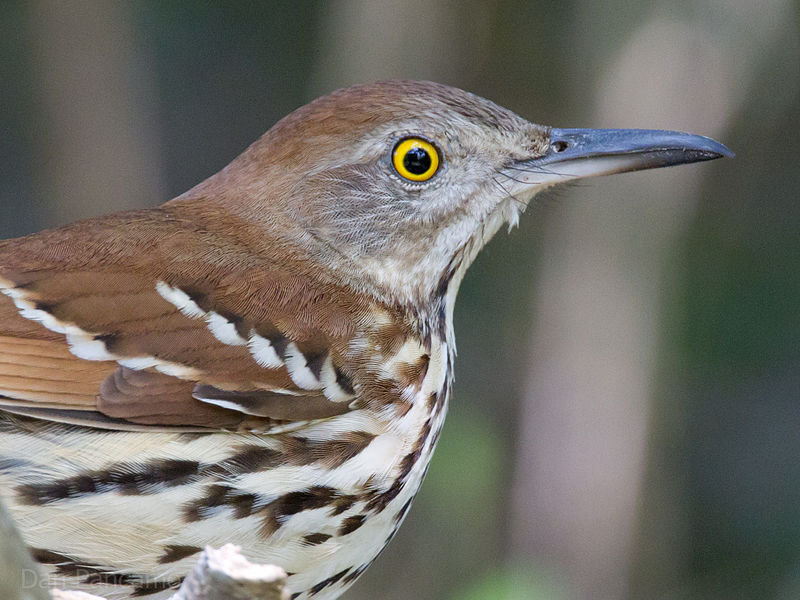
Brown Thrasher (Toxostoma rufum) By Dan’sPix
Lee’s Addition:
The Brown Thrush mentioned in this article is now known as the Brown Thrasher. They are members of the Mimidae – Mockingbirds, ThrashersFamily. The family not only has the Thrashers (14) and Mockingbirds (16), but also Catbirds (2) and Tremblers (2).
The Brown Thrasher is bright reddish-brown above with thin, dark streaks on its buffy underparts. Its long, rufous tail is rounded with paler corners, and eyes are a brilliant gold. Adults average about 11.5 in (29 cm) long with a wingspan of 13 in (33 cm), and weigh 2.4 oz (68 g).
It is found in thickets and dense brush, often searching for food in dry leaves on the ground. It also enjoys the convergence of mowed to unmowed lawns, particularly if there are ample shrubs or shrubby trees, i.e., fruit orchards that the undergrowth is left undisturbed. It also enjoys perennial gardens and can be seen jumping from the ground to catch insects on flowers and foliage. Its breeding range includes the United States and Canada east of the Rocky Mountains. It is a partial migrant, with northern birds wintering in the southern USA, where it occurs throughout the year.
The female lays 3 to 5 eggs in a twiggy nest lined with grass. The nest is built in a dense shrub or low in a tree. Both parents incubate and feed the young. These birds raise two or three broods in a year. They are able to call in up to 3000 distinct songs. The male sings a series of short repeated melodious phrases from an open perch to defend his territory and is also very aggressive in defending the nest.
Brown Thrasher by Chris Parrish
The Brown Thrasher is the official state bird of Georgia, and was the inspiration for the name of Atlanta’s former National Hockey League team, the Atlanta Thrashers.(Wikipedia)
The flowers appear on the earth; the time of the singing of birds is come, and the voice of the turtle is heard in our land; (Song of Solomon 2:12 KJV)
The above article is the first article in the monthly serial for February 1897 “designed to promote Knowledge of Bird-Live.” These include Color Photography, as they call them, today they are drawings. There are at least three Volumes that have been digitized by Project Gutenberg.
Kingfisher – Birds Illustrated by Photography 1897
Birds Illustrated by Color Photography – Revisited
Vol 1. February, 1897 No. 2
*
THE KINGFISHER.
Dear Children:
I shall soon arrive from the south. I hear that all the birds are going to tell stories to the boys and girls.
I have never talked much with children myself for I never really cared for people. They used to say that the dead body of a Kingfisher kept them safe in war and they said also that it protected them in lightning.
Even now in some places in France they call us the moth birds, for they believe that our bodies will keep away moths from woolen cloth.
I wish that people would not believe such things about us. Perhaps you cannot understand me when I talk. You may think that you hear only a child’s rattle.
Listen again! It is I, the Kingfisher. That sound is my way of talking. I live in the deep woods. I own a beautiful stream and a clear, cool lake. Oh, the little fish in that lake are good enough for a king to eat! I know, for I am a king.
You may see me or some of my mates near the lake any pleasant day. People used to say that we always brought pleasant weather. That is a joke. It is the pleasant weather that always brings us from our homes. When it storms or rains we cannot see the fish in the lake. Then we may as well stay in our nests.
My home once belonged to a water rat. He dug the fine hall in the gravel bank in my stream. It is nearly six feet long. The end of it is just the kind of a place for a nest. It is warm, dry and dark. In June my wife and I will settle down in it. By that time we shall have the nest well lined with fish bones. We shall put in some dried grass too. The fish bones make a fine lining for a nest. You know we swallow the fish whole, but we save all the bones for our nest.
I shall help my wife hatch her five white eggs and shall try in every way to make my family safe.
Please tell the people not to believe those strange things about me and you will greatly oblige,
A neighbor,
The Kingfisher.
THE KINGFISHER.
The Lone Fisherman.
HE American species belongs to the true group of Kingfishers. It occupies the whole continent of North America and although migrating in the north, he is a constant resident of our southern states. The belted Kingfisher is the only variety found along the inland streams of the United States. Audubon declares that “belted” should apply only to the female, however.
Like most birds of brilliant plumage, the Kingfisher prefers a quiet and secluded haunt. It loves the little trout streams, with wooded and precipitous banks, the still ponds and small lakes, ornamental waters in parks, where it is not molested, and the sides of sluggish rivers, drains and mill-ponds.
Here in such a haunt the bird often flits past like an indistinct gleam of bluish light. Fortune may sometimes favor the observer and the bird may alight on some twig over the stream, its weight causing it to sway gently to and fro. It eagerly scans the shoal of young trout sporting in the pool below, when suddenly it drops down into the water, and, almost before the observer is aware of the fact, is back again to its perch with a struggling fish in its beak. A few blows on the branch and its prey is ready for the dexterous movement of the bill, which places it in a position for swallowing. Sometimes the captured fish is adroitly jerked into the air and caught as it falls.
Fish is the principal food of the Kingfisher; but it also eats various kinds of insects, shrimps, and even small crabs. It rears its young in a hole, which is made in the banks of the stream it frequents. It is a slatternly bird, fouls its own nest and its peerless eggs. The nesting hole is bored rather slowly, and takes from one to two weeks to complete. Six or eight white glossy eggs are laid, sometimes on the bare soil, but often on the fish bones which, being indigestible, are thrown up by the bird in pellets.
The Kingfisher has a crest of feathers on the top of his head, which he raises and lowers, especially when trying to drive intruders away from his nest.
The plumage is compact and oily, making it almost impervious to water. The flesh is fishy and disagreeable to the taste, but the eggs are said to be good eating. The wings are long and pointed and the bill longer than the head. The voice is harsh and monotonous.
It is said that few birds are connected with more fables than the Kingfisher. The superstition that a dead Kingfisher when suspended by the throat, would turn its beak to that particular point of the compass from which the wind blew, is now dead. It was also supposed to possess many astonishing virtues, as that its dried body would avert thunderbolts, and if kept in a wardrobe would preserve from moths the woolen stuffs and the like contained in it.
Under the name of “halcyon,” it was fabled by the ancients to build its nest on the surface of the sea, and to have the power of calming the troubled waves during its period of incubation; hence the phrase “halcyon days.”
A pair of Kingfishers have had their residence in a bank at the south end of Washington Park, Chicago, for at least three seasons past. We have watched the Kingfisher from secluded spots on Long Island ponds and tidal streams, where his peculiar laughing note is the same as that which greets the ear of the fisherman on far inland streams on still summer days.
Belted Kingfisher (Megaceryle alcyon) by Daves BirdingPix
Lee’s Addition:
Another of my favorite birds. I think most of them are, but the Belted Kingfisher is a real challenge to photograph. They must sense that your camera is on. Dan says that many photographers call it the “Devil Bird” because it is so hard to photo. See http://jimt.zenfolio.com/p703966915 by James Thiel and another photographer at http://www.flickr.com/photos/johnklos/3049270990/.
I think of them as having a short squatty neck and a long beak. Actually the Laughing Kookaburra is in the Kingfisher family, the Kingfishers – Alcedinidae Family. The article mentioned that the Belted Kingfisher is the only one in the U. S., but there are actually two more; the Ringed and the Green Kingfishers that are found in south Texas. We have seen all three of them.
The Kingfisher – Alcedinidae family has a total of 95 members. Many of them are very colorful and again show the Lord’s Creative Hand at work. He has provided them with just the right kind of beak to snatch their meals with and even given them the ability to see their prey in the water. The distortion water gives is compensated for them.
And Jesus, walking by the sea of Galilee, saw two brethren, Simon called Peter, and Andrew his brother, casting a net into the sea: for they were fishers. And he saith unto them, Follow me, and I will make you fishers of men. (Matthew 4:18-19 KJV)
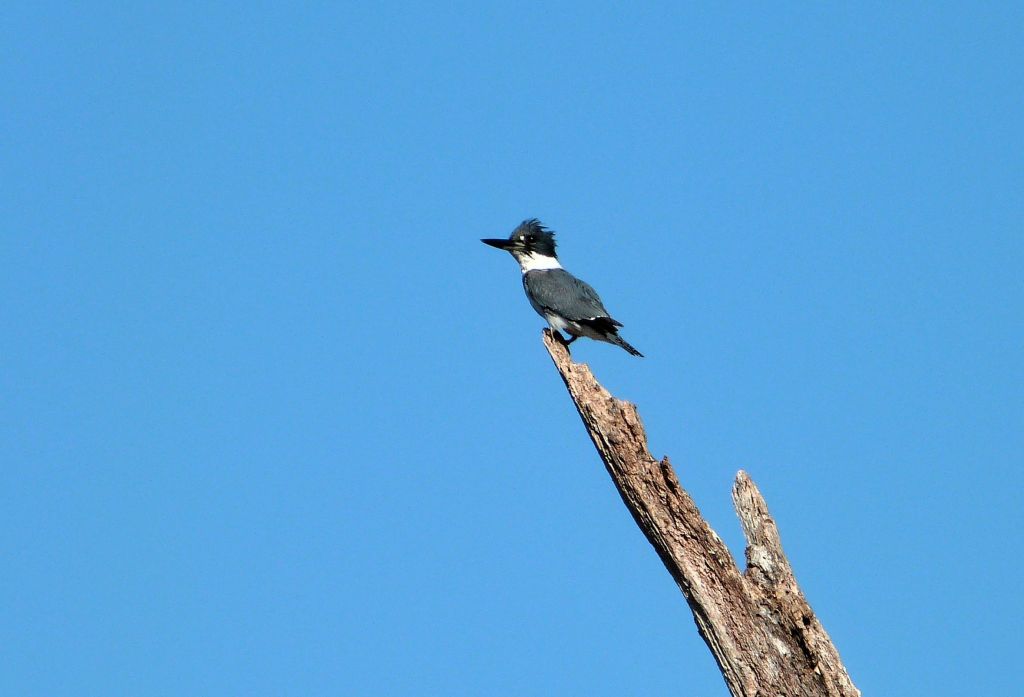
Belted Kingfisher (Megaceryle alcyon) by Lee Circle B
In January, I was able for the first time to get some photos of the Belted Kingfisher. Two of them were showing off and forgot someone was watching. They can hover over the water, keeping their head steady and watch for their prey. It is amazing to watch them do that. (Birdwatching Adventure – Circle B Bar Reserve – 1/16/12)
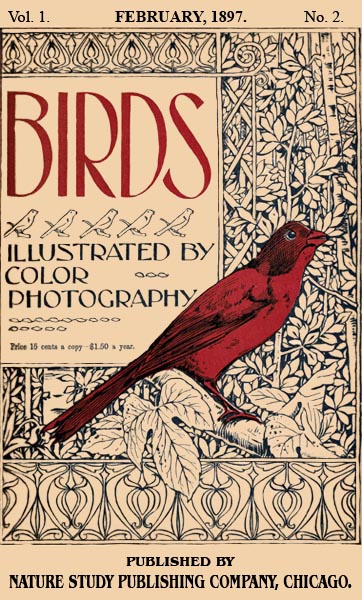
Birds Illustrated by Color Photograhy Vol 1 February 1897 No 2 – Cover
The above article is the first article in the monthly serial for February 1897 “designed to promote Knowledge of Bird-Live.” These include Color Photography, as they call them, today they are drawings. There are at least three Volumes that have been digitized by Project Gutenberg.
Was sent a link to this fantastic video of how birds camouflage their nests by BBC Wildlife. This shows some of the great instinct and capabilities given to the birds by their Creator.
All the birds of the heavens made their nests in its boughs; Under its branches all the beasts of the field brought forth their young; And in its shadow all great nations made their home. (Ezekiel 31:6 NKJV)
Trust will enjoy this as well.
*
*
Another parable He put forth to them, saying: “The kingdom of heaven is like a mustard seed, which a man took and sowed in his field, which indeed is the least of all the seeds; but when it is grown it is greater than the herbs and becomes a tree, so that the birds of the air come and nest in its branches.” (Matthew 13:31-32 NKJV)
P.S. I know this is a short post, but last night I just discovered that the Slide.Com, which I used for many slideshows on various blogs, is closing. That means I have tons of work to do behind the scenes while I fix all of those and use another slideshow program. Watch out for dust!
Updated 2 Hours later: Just finished one with the new style Slideshow. I kind of like the new style. What do you think?
This was taken from TedTalks.com and was received by me in an e-mail. It is FANTASTIC!
I do not know the story behind the video, but I see God’s mighty creation at work in helping plants be pollinated. The photography is phenomenal.
The flowers appear on the earth; the time of the singing of birds is come, and the voice of the turtle is heard in our land; (Song of Solomon 2:12 KJV)
The grass withereth, the flower fadeth: but the word of our God shall stand for ever. (Isaiah 40:8 KJV)