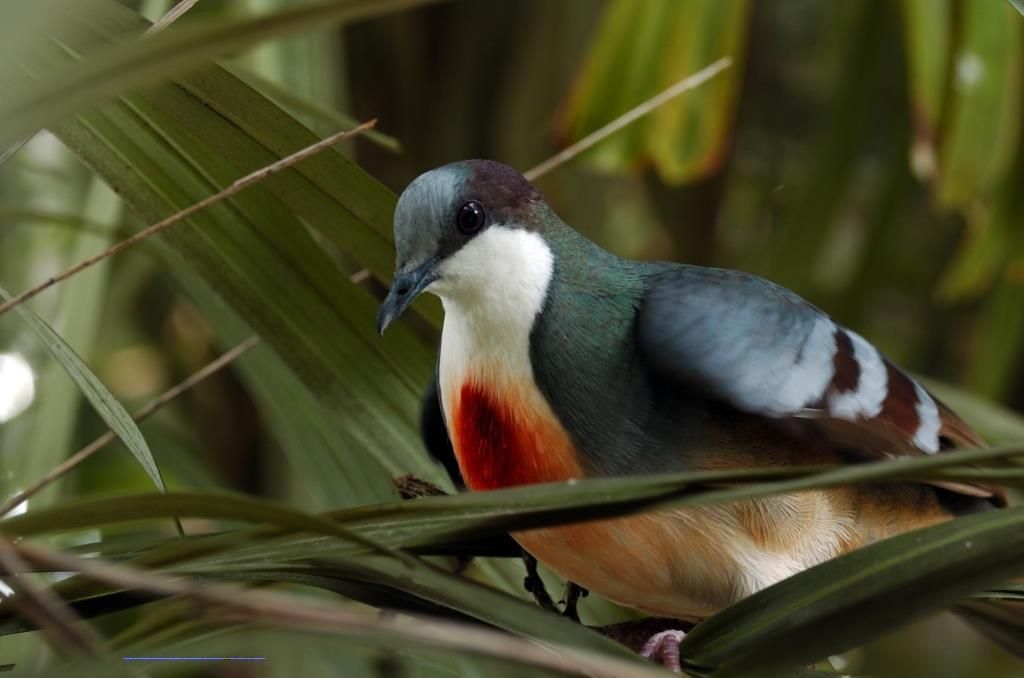
Luzon Bleeding-heart Dove by Dan at Zoo Miami
“Sing praise to the LORD, you saints of His, And give thanks at the remembrance of His holy name.” (Psalms 30:4 NKJV)
Luzon Bleeding-heart Dove by Dan at Zoo Miami
“Sing praise to the LORD, you saints of His, And give thanks at the remembrance of His holy name.” (Psalms 30:4 NKJV)
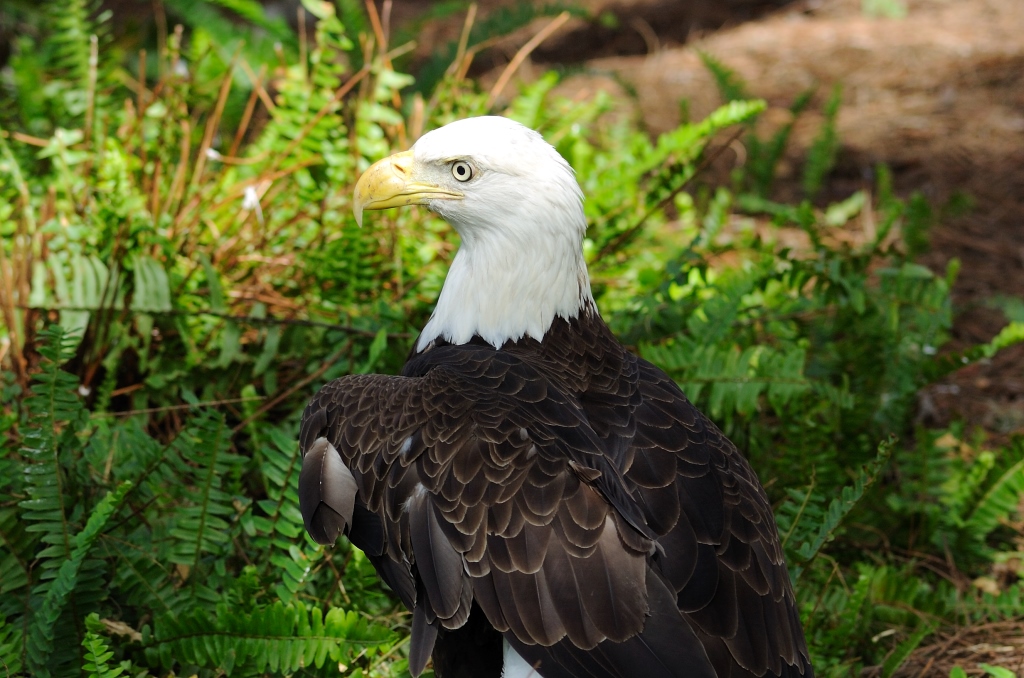
Bald Eagle (close up) Lowry Park Zoo by Dan
“Oh, give thanks to the LORD, for He is good! For His mercy endures forever.” (1 Chronicles 16:34 NKJV)
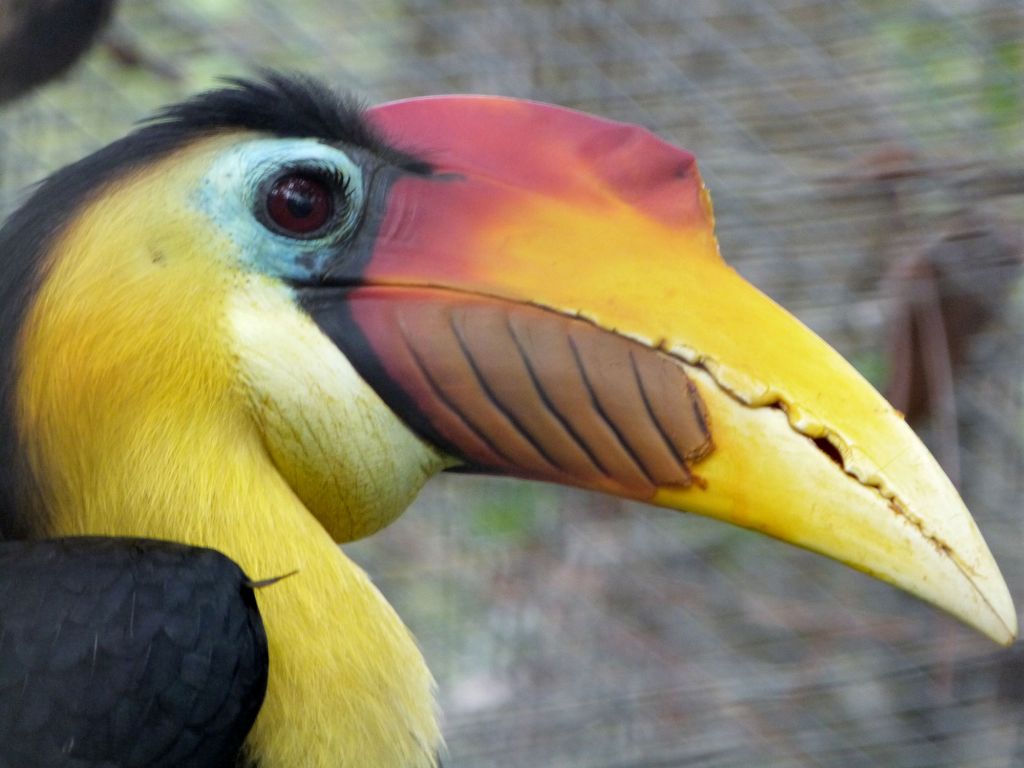
Wrinkled Hornbill (Aceros corrugatus) Brevard Zoo by Lee
“Oh, give thanks to the LORD! Call upon His name; Make known His deeds among the peoples!” (1 Chronicles 16:8 NKJV)
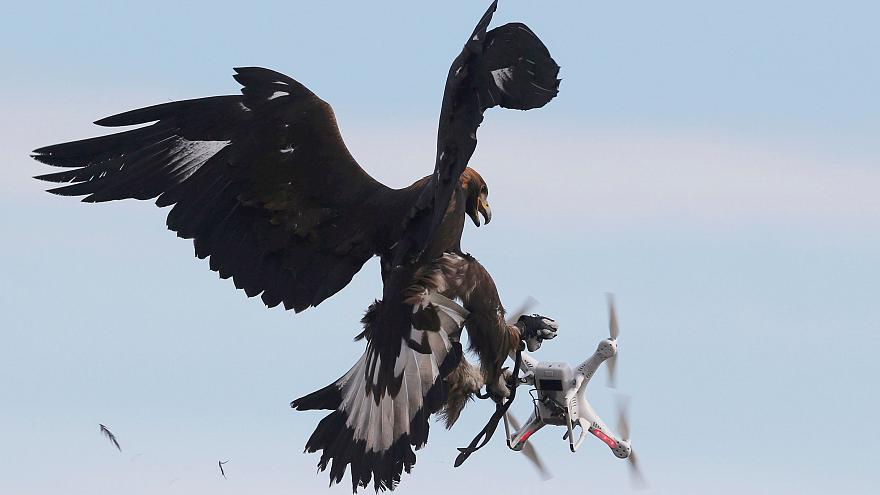
Eagle Taking On a Drone ©Euronews
“Like an eagle swooping on its prey.” (Job 9:26b NKJV)
After receiving an email about the French Military training Golden Eagles to capture Drones, my curiosity kicked in. Below are links to articles and video of this training.
“The French military is literally going where eagles dare in an effort to combat the increasing use of drones by criminals and terrorists.
Following incidents of drones flying over the presidential palace and restricted military sites – along with the deadly 2015 Paris terror attacks – the French air force has trained four golden eagles to intercept and destroy the rogue aircraft.” Where Eagles Dare
“Faced with the specter of a terrorist threat from rogue drones, the French are recruiting an avian ally. At a base in the southwest of the country, a special army unit has for months been training four golden eagles to spot drones and perform mid-air takedowns.” Drones-Eagles-France
NTD has a great video of how they train baby Golden Eagles as babies, and then as adults.
“Though you ascend as high as the eagle, And though you set your nest among the stars, From there I will bring you down,” says the LORD.” (Obadiah 1:4 NKJV) [I took some liberty with this verse.]
Checking YouTube, there are several video of how bird attack drones.
Here is just one example. This drone is downed by a Hawk.

BJU Bird Collection 2018-Display Case 3 – Woodpeckers and Shorebirds
“If a bird’s nest happens to be before you along the way, in any tree or on the ground, with young ones or eggs, with the mother sitting on the young or on the eggs, you shall not take the mother with the young;” (Deuteronomy 22:6 NKJV)
The next Display case of the Waterman Bird Collection contains Woodpeckers from the Picidae family and some shorebirds from the Scolopacidae Family. [Next post]

BJU Bird Collection 2018
– Woodpeckers
This post is about the five Woodpeckers; Pileated Woodpecker (Dryocopus pileatus), Black-backed Three-toed Woodpecker [now the Black-backed Woodpecker (Picoides arcticus)], Downy Woodpecker (Dryobates pubescens), Yellow-bellied Sapsucker (Sphyrapicus varius) and a Common Flicker [now the Northern Flicker (Colaptes auratus).
Pileated Woodpecker (Dryocopus pileatus)

BJU Bird Collection 2018 Pileated Woodpecker (Dryocopus pileatus)
Pileated Woodpecker (Dryocopus pileatus) “The Pileated Woodpecker is one of the biggest, most striking forest birds on the continent. It’s nearly the size of a crow, black with bold white stripes down the neck and a flaming-red crest. Look (and listen) for Pileated Woodpeckers whacking at dead trees and fallen logs in search of their main prey, carpenter ants, leaving unique rectangular holes in the wood. The nest holes these birds make offer crucial shelter to many species including swifts, owls, ducks, bats, and pine martens.”
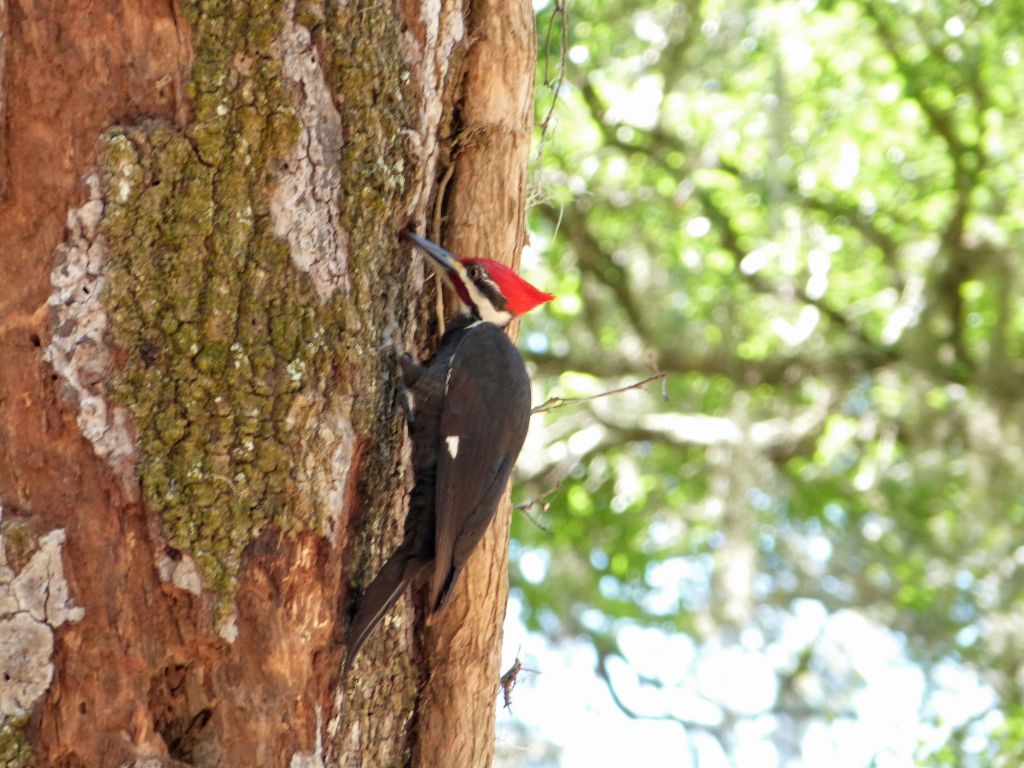
Pileated Woodpecker by Lee at Circle B
Cool Facts – “The Pileated Woodpecker digs characteristically rectangular holes in trees to find ants. These excavations can be so broad and deep that they can cause small trees to break in half.” [Pileated Woodpecker – All About Birds]
American Three-toed Woodpecker (Picoides dorsalis)

BJU Bird Collection 2018 BJU Bird Collection Black-backed Woodpecker (Picoides arcticus)
American Three-toed Woodpecker (Picoides dorsalis) – “Found in boreal forests and montane coniferous forests across North America. Because of its choice of habitat, it is infrequently seen by most people.” “The “Three-toed Woodpecker” was split in 2003 into the American Three-toed and Eurasian Three-toed woodpeckers. The two species are nearly identical in appearance, but differ in mitochondrial DNA sequences and in voice.”
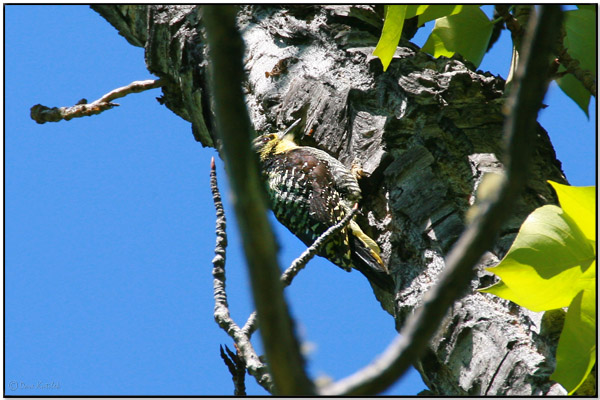
American Three-toed Woodpecker (Picoides dorsalis) by Daves BirdingPix
Cool Fact “Most woodpeckers have four toes on each foot. The three-toed and Black-backed woodpeckers have only three. The loss of the fourth toe may help deliver stronger blows, but at the expense of climbing ability.” [American Three-toed_Woodpecker – All About Birds]
Downy Woodpecker (Dryobates pubescens)

Downy Woodpecker (Picoides pubescens) Male – Waterman Bird Collection BJU
Downy Woodpecker (Dryobates pubescens) – “The active little Downy Woodpecker is a familiar sight at backyard feeders and in parks and woodlots, where it joins flocks of chickadees and nuthatches, barely outsizing them. An often acrobatic forager, this black-and-white woodpecker is at home on tiny branches or balancing on slender plant galls, sycamore seed balls, and suet feeders. Downies and their larger lookalike, the Hairy Woodpecker, are one of the first identification challenges that beginning bird watchers master.”

Downy Woodpecker (Picoides pubescens) Brevard Zoo by Dan
Cool Facts – “In winter Downy Woodpeckers are frequent members of mixed species flocks. Advantages of flocking include having to spend less time watching out for predators and better luck finding food from having other birds around.” [Downy Woodpecker – All About Birds]
Yellow-bellied Sapsucker (Sphyrapicus varius)

BJU Bird Collection 2018 Yellow-bellied Sapsucker (Sphyrapicus varius)
Yellow-bellied Sapsucker (Sphyrapicus varius) – “On a walk through the forest you might spot rows of shallow holes in tree bark. In the East, this is the work of the Yellow-bellied Sapsucker, an enterprising woodpecker that laps up the leaking sap and any trapped insects with its specialized, brush-tipped tongue. Attired sharply in barred black-and-white, with a red cap and (in males) throat, they sit still on tree trunks for long intervals while feeding. To find one, listen for their loud mewing calls or stuttered drumming.”
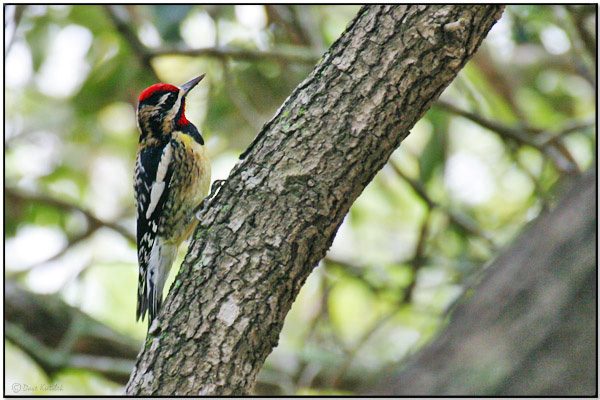
Yellow-bellied Sapsucker (Sphyrapicus varius) by Daves BirdingPix
Cool Facts – “Yellow-bellied Sapsuckers have been found drilling sapwells in more than 1,000 species of trees and woody plants, though they have a strong preference for birches and maples.”[Yellow-bellied Sapsucker – All About Birds]
Northern Flicker (Colaptes auratus)

BJU Bird Collection 2018 Northern Flicker (Colaptes auratus)
Northern Flicker (Colaptes auratus) – “Northern Flickers are large, brown woodpeckers with a gentle expression and handsome black-scalloped plumage. On walks, don’t be surprised if you scare one up from the ground. It’s not where you’d expect to find a woodpecker, but flickers eat mainly ants and beetles, digging for them with their unusual, slightly curved bill. When they fly you’ll see a flash of color in the wings – yellow if you’re in the East, red if you’re in the West – and a bright white flash on the rump.”
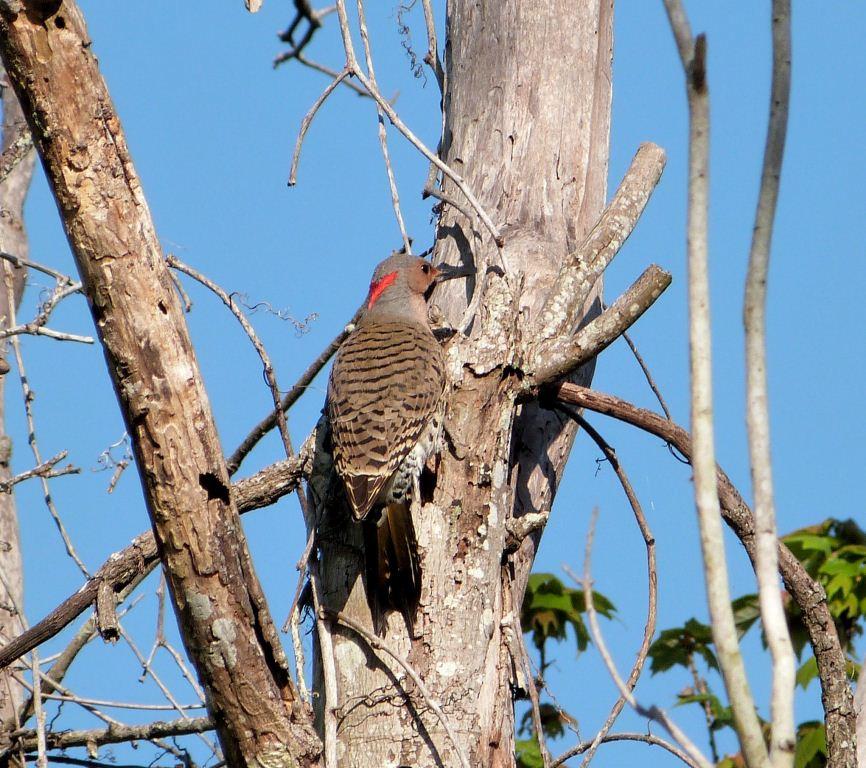
Northern Flicker cropped by Lee at S. Lake Howard Nature Pk
Cool Fact – “Although it can climb up the trunks of trees and hammer on wood like other woodpeckers, the Northern Flicker prefers to find food on the ground. Ants are its main food, and the flicker digs in the dirt to find them. It uses its long barbed tongue to lap up the ants.” [Northern Flicker – All About Birds]
*
Some of the Previous Woodpecker Posts:
Wordless Woodpecker – Yellow-Fronted
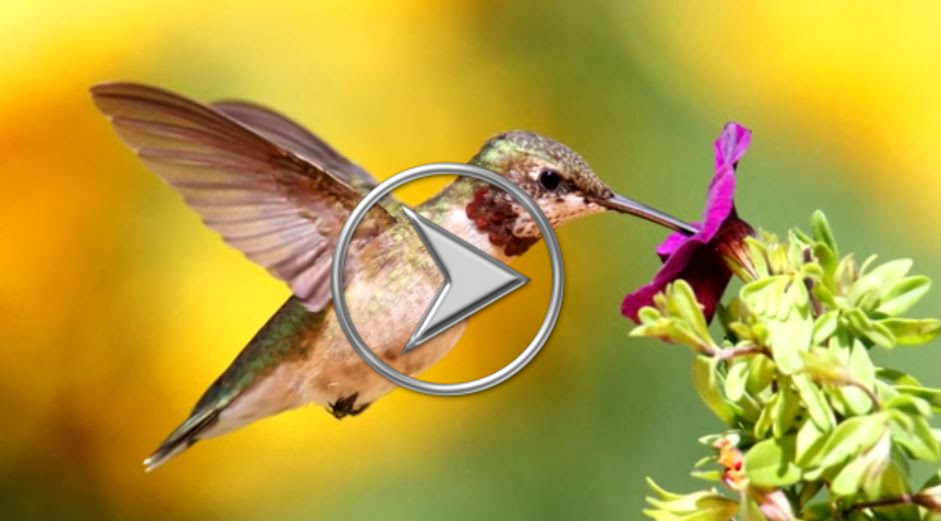
Who doesn’t love the beautiful hummingbird? You’ll love them even more after viewing our “Double Life of the Hummingbird” video! That’s because you’ll learn about the unique abilities their Designer has given them. Truly, hummingbirds bear evidence of God’s creative hand!
This Week’s Creation Action Moment:
1. Watch our “Double Life of the Hummingbird” video by clicking here or on the picture above.
[Used with permission of Creation Moments]

“Does the hawk fly by your wisdom, And spread its wings toward the south? (Job 39:26 NKJV)
According to the King James Version of Scripture, the other two verses with hawk in them are:
“the ostrich, the short-eared owl, the sea gull, and the hawk after its kind;” (Leviticus 11:16 NKJV)
“the ostrich, the short-eared owl, the sea gull, and the hawk after their kinds;” (Deuteronomy 14:15 NKJV)
For more advanced reading, you can check out Birds of the Bible – Clean vs. Unclean, Birds of the Bible – The Law Of The Birds and Deuteronomy 14:11-18 Visualized on Leesbird.com
What is a Hawk? To what Family of birds does it belong?

Hawks are one of God’s Created Avian Wonders. The bird family of Hawks, Accipitridae, not only includes Hawks, but also Eagles, Kites, Harriers, Vultures, plus more. The Lord has given them great eyesight, hearing, and speed.
Hawks have excellent eyesight. They can see up to 8 times more clearly than the sharpest human eye. Eyesight is primarily used for hunting.
Their hearing is acute, but their sense of smell is poor.
Hawk species are known for their speed, particularly when chasing prey. During the hunt, some species of hawks can dive 240 kilometers (150 miles) per hour through the air. [Just Fun Facts]
“All hawks are almost exactly the same structurally as all other birds, and the distinguishing features that set them apart from all of the other hawks are minute. Hawks are distinguished from all other birds, especially falcons, by their broader, more rounded wings. They also have sharp, curved, hooked bills, strong feet with curved talons, and amazing sight capabilities. All hawks have uniform 20/2 vision, exactly 8 times better than a human with good eyesight! Almost all male hawks are smaller than females.” Hawks – CreationWiki [with editing]


Hawks are in the Accipitridae Family of Kites, Hawks & Eagles and you can read more about them in the Birds of the Bible – Hawk section.
Hawks have claws which are used for catching their prey. Beware of these:

Hawks and the other birds in this family did not always prey (catch) other living critters. Because of sin, these avian creations from the Lord, were placed under God’s curse. One day, when that curse is removed, the birds of prey will become birds of play [with others.]
Check out All About Birds – Hawks and Falcons
See also:
Accipitriformes – Order, Accipitridae – Family (Kites, Hawks & Eagles)
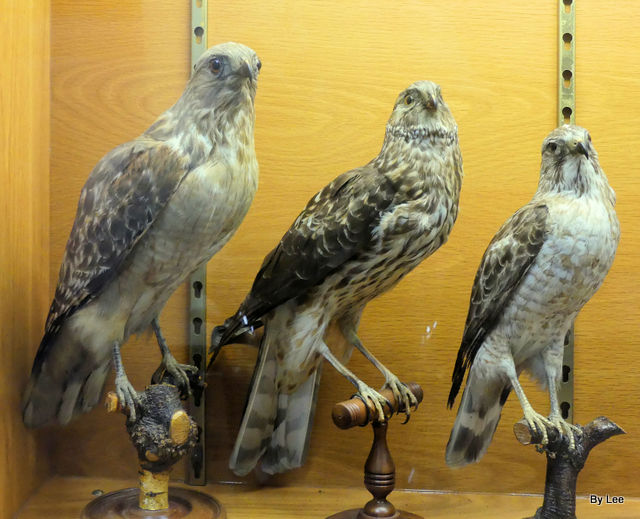
BJU Waterman Bird Collection Hawks Display 2018
“Doth the hawk fly by thy wisdom, and stretch her wings toward the south?” (Job 39:26 KJV)
The next upper display case had Hawks and Owl specimen. The three Hawks give a size perspective of those hawks. The largest is the Red-Shouldered Hawk, then the Northern Harrier (female), and the Broad-Winged Hawk.
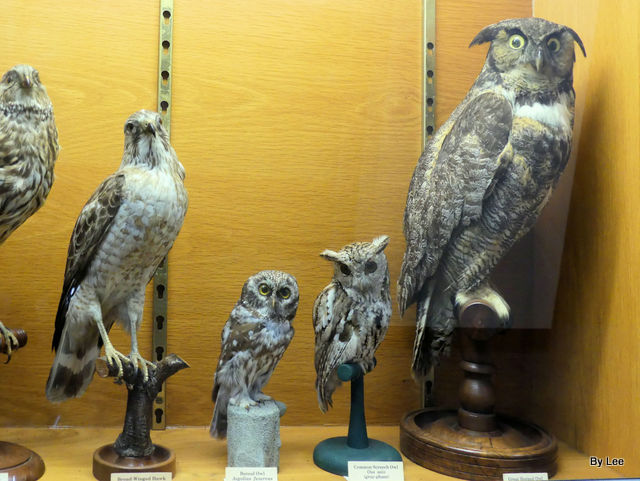
BJU Waterman Bird Collection Hawks and Owls Display 2018
“And the owl, and the night hawk, and the cuckow, and the hawk after his kind, The little owl, and the great owl, and the swan,” (Deuteronomy 14:15-16 KJV)
The Owls went from small to the large Great Horned Owl being the largest. The two small owls are the Boreal Owl, and the Common Screech Owl. Out of the five species, we have only seen the Red-shouldered Hawk, the Harrier and a Great Horned Owl in the wild. Again, I think these birds look pretty good, considering how long they have be preserved. [Before 1910]
Hawks and Owls are both mentioned in Scripture and are therefore – Birds of the Bible. Birds of the Bible – Hawks and Birds of the Bible – Owls. Did you notice their coloration? Most sleep during the day and the Lord, their Creator, has provided them with a camouflage that helps many of them look like bark on trees.
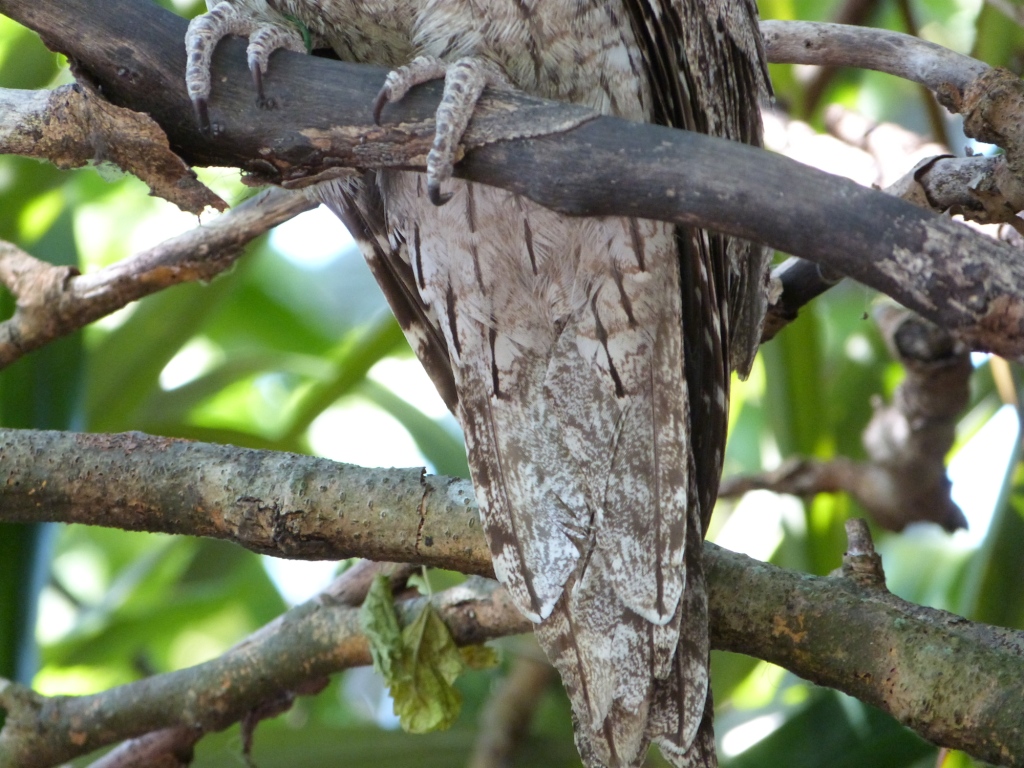
Tawny Frogmouth (Podargus strigoides) Tail by Lee
[My favorite “bark” covered bird is the Tawny Frogmouth. We see them in the zoos.] Back to this article.
Here are some very informative articles with great photos about these birds from WhatBird and All About Birds. The WhatBird links have sounds to which you can listen.
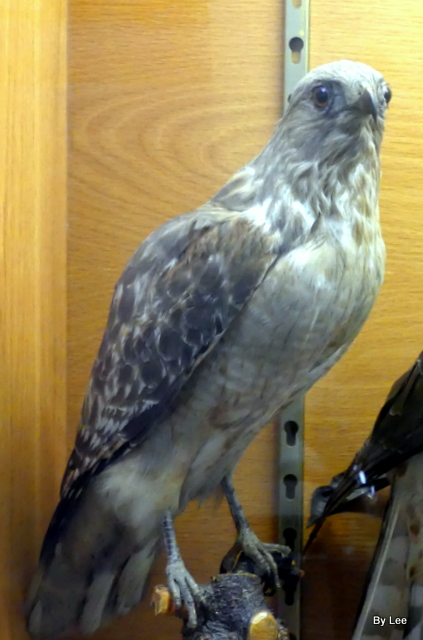
Red-shouldered Hawk BJU Bird Collection 2018
Red-shouldered Hawk All About Birds
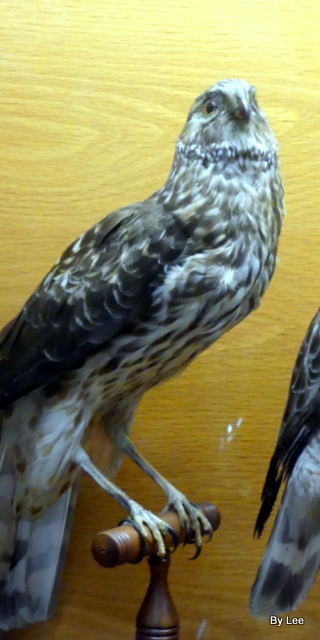
Northern Harrier BJU Bird Collection 2018
Northern Harrier All About Birds
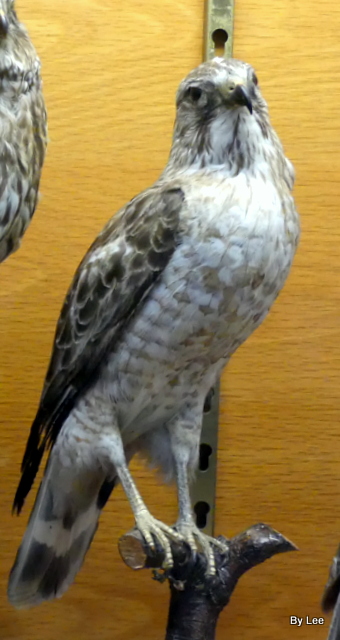
Broad-Winged Hawk BJU Bird Collection
Broad-Winged Hawk All About Birds
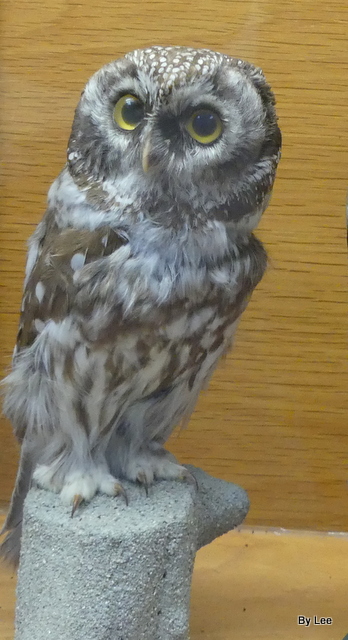
Boreal Owl (Aegolius funereus) BJU Collection
Boreal Owl All About Birds
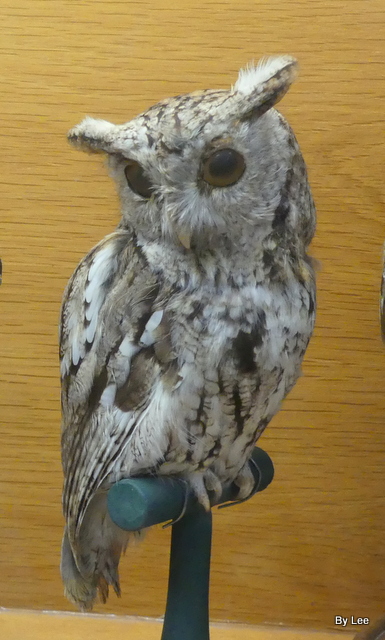
Screech Owl (Megascops asio) BJU Bird Collection 2018
Eastern Screech-Owl All About Birds
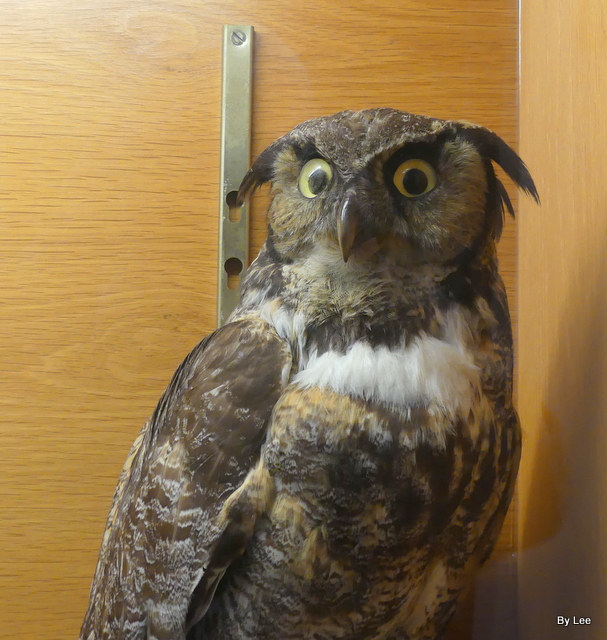
Great-Horned Owl BJU Bird Collection
Great Horned Owl All About Birds
*
Accipitriformes – Order, Accipitridae – Family (Kites, Hawks & Eagles)

Leach’s Storm Petrel (Oceanodroma leucorhoa) BJU Bird Collection 2018
Just realized I didn’t post this. Again, it is a duplicate of a Waterman Bird Collection – Part II – Petrel & Crow article on the Birds of the Bible for Kids blog. [I am behind in blogging] This time it is about the Leach’s Storm Petrel and the Crow.
As promised, in Waterman Bird Collection – Part II, here are the last two birds from that display. The Leach’s Storm Petrel and the Crow will now be introduced. Many of you already have heard of a Crow, but how about a Storm Petrel? Let’s see what we can find out about these avian creations from the Creator.

BJU Bird Collection 2018 Bottom Shelf
The two birds today are the two right hand birds in the Display.
The Leach’s Storm Petrel [at the top] is starting to show a tiny bit of deterioration, but considering it’s over 100 years old, it’s not too much.
“The Leach’s Storm Petrel or Leach’s Petrel (Oceanodroma leucorhoa) is a small seabird of the tubenose order. It is named after the British zoologist William Elford Leach. The scientific name is derived from Ancient Greek. Oceanodroma is from okeanos, “ocean” and dromos, “runner”, and leucorhoa is from leukos, “white” and orrhos, “rump”.

“It breeds on inaccessible islands in the colder northern areas of the Atlantic and Pacific. It nests in colonies close to the sea in well concealed areas such as rock crevices, shallow burrows or even logs. It lays a single white egg which often has a faint ring of spots at the large end. This storm petrel is strictly nocturnal at the breeding sites to avoid predation by gulls and skuas, and will even avoid coming to land on clear moonlit nights. The largest colony of Leach’s storm petrels can be found on Baccalieu Island of eastern Canada, an ecological reserve with more than 3 million pairs of the bird.” [Wikipedia with editing]
Fun Fact: “Flies swiftly, erratically, buoyantly with 1 or 2 fast, powerful flaps followed by glides on wings held well above the horizontal and noticeably kinked; sudden changes of direction impart a bounding quality. Flutters less than other storm-petrels.” [Neotropical Birds]
Drinks salt water – Formed By Him – Sea Birds That Drink Seawater, is an interesting article about Tubenose birds.
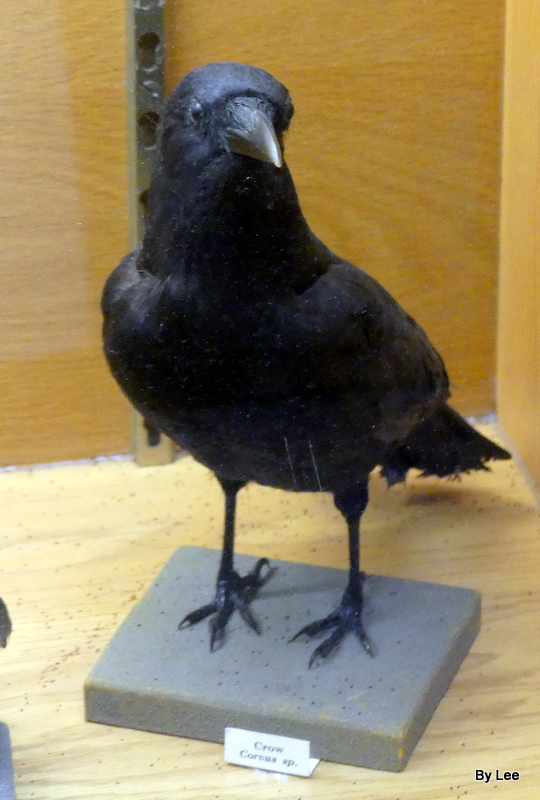
American Crow (Corvus brachyrhynchos) BJU Bird Collection 2018
The last bird in the part of the collection is a Crow. It wasn’t shown which one exactly, so we are using the American Crow.
“The American crow (Corvus brachyrhynchos) is a large passerine bird species of the family Corvidae. It is a common bird found throughout much of North America. American crows are the new world counterpart to the carrion crow and the hooded crow. Although the American crow and the hooded crow are very similar in size, structure and behavior, their calls are different. The American crow nevertheless occupies the same role the hooded crow does in Eurasia.”
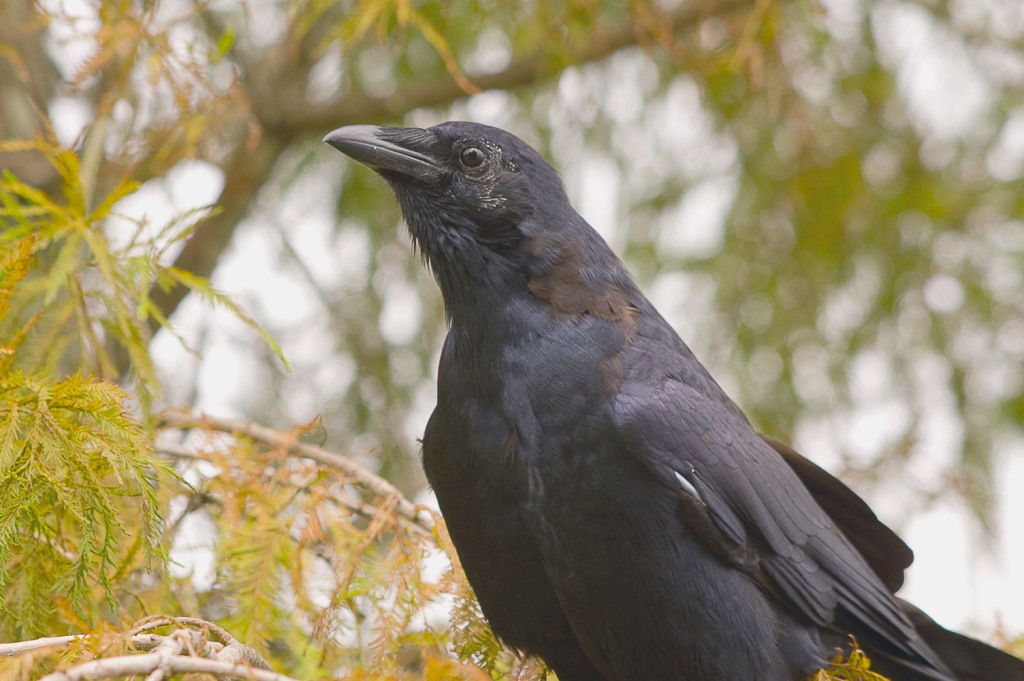
Florida Fish Crow (Corvus ossifragus) at Lake Morton By Dan’sPix
“From beak to tail, an American crow measures 40–50 cm (16–20 in), almost half of which is tail. Mass varies from about 300 to 600 g (11 to 21 oz). Males tend to be larger than females. The most usual call is CaaW!-CaaW!-CaaW!.’
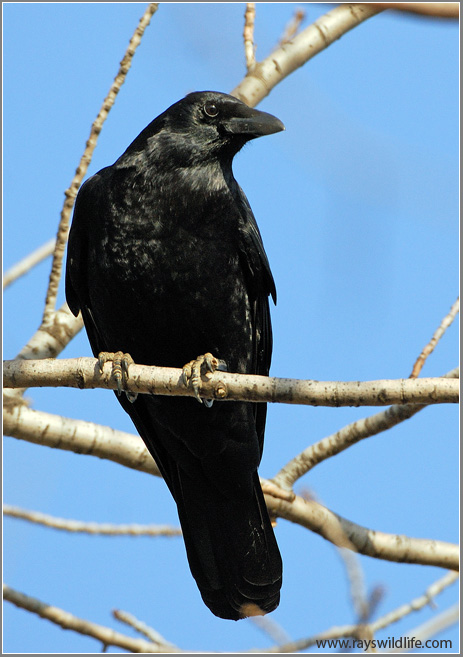
American Crow (Corvus brachyrhynchos) by Ray
“The American crow is all black, with iridescent feathers. It looks much like other all-black corvids. They can be distinguished from the common raven (C. corax) because American crows are smaller and from the fish crow (C. ossifragus) because American crows do not hunch and fluff their throat feathers when they call, and from the carrion crow (C. corone) by the enunciation of their calls.” [American Crow – Wikipedia]
A Cool Fact from American Crows – All About Birds:
*
Here are the links to this Series:
A Pleasant Surprise At The BJU Homecoming
Today’s Peanut’s cartoon reminds me of the birds we saw at the Jacksonville Zoo recently. It had rained before and it rained while we were visiting.
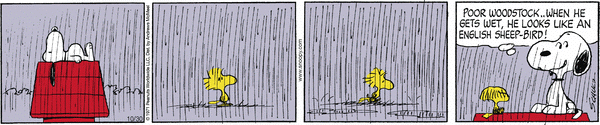
Woodstock and Rain
“Poor Woodstock.. When he gets wet, he looks like an English Sheep-Bird!” [In case you can’t read it]
“Who does great things, and unsearchable, Marvelous things without number. He gives rain on the earth, And sends waters on the fields.” (Job 5:9-10 NKJV)
In Where Am I Found? – Abdim’s Stork, the first photo showed the stork still wet. Dan just showed me his photo of the Stork, which definitely shows a wet bird hairdo.
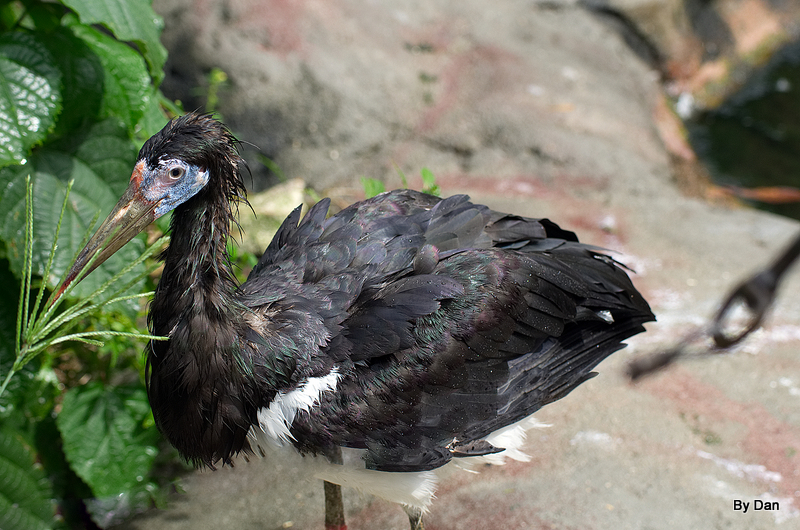
Wet Abdim’s Ibis at Jacksonville Zoo by Dan
My photo of this wet Ibis:

Abdim’s Stork (Ciconia abdimii) -Jacksonville Zoo wet
There were a few others that were not up to their normally sleek appearance.
Another wet avian wonder was the Yellow-billed Stork. He was damp, but not as wet as the Abdim’s Stork.

Yellow-billed Stork (Mycteria ibis) Wet at Jacksonville Zoo
Are you taking a picture of me like this when I am not preened?
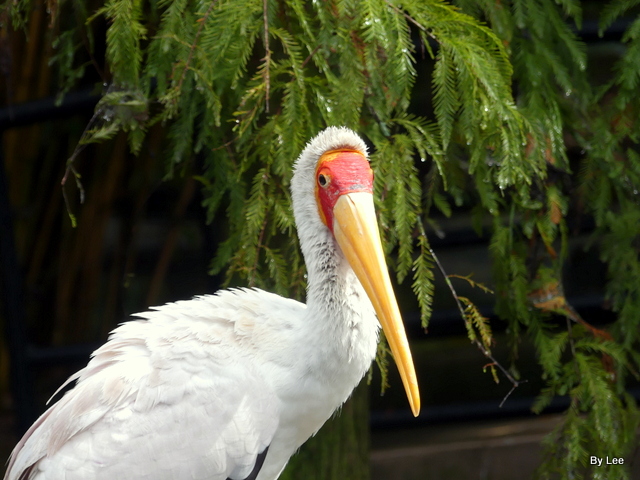
Yellow-billed Stork (Mycteria ibis) – Jacksonville Zoo
This is why you see so many birds preening. The Roseate Spoonbill was busy straightening and drying its feathers.
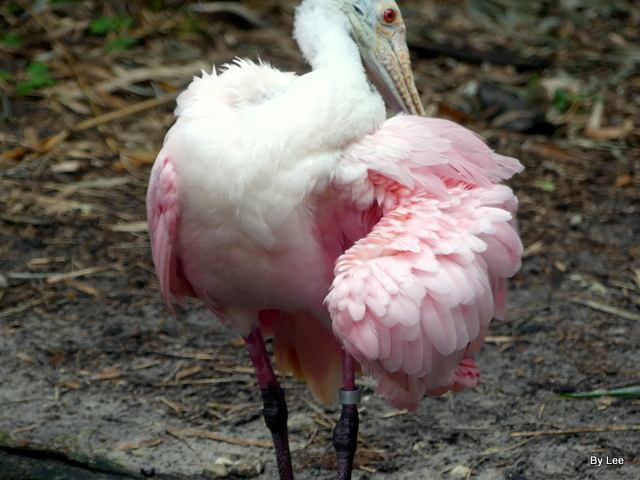
Roseate Spoonbill (Platalea ajaja) Preening – Jax Zoo
“Who covers the heavens with clouds, Who prepares rain for the earth, Who makes grass to grow on the mountains. He gives to the beast its food, And to the young ravens that cry.” (Psalms 147:8-9 NKJV)
There were a few others that were not up to their normally sleek appearance.
*
Where Am I Found? – Abdim’s Stork
Some of the Other Jacksonville Zoo articles:
Jacksonville Zoo’s Noisy Stork Tree
Marabou Stork Chicks and Inca Tern at Jacksonville Zoo
Birdwatching at the Jacksonville Zoo by Dan’s Pix
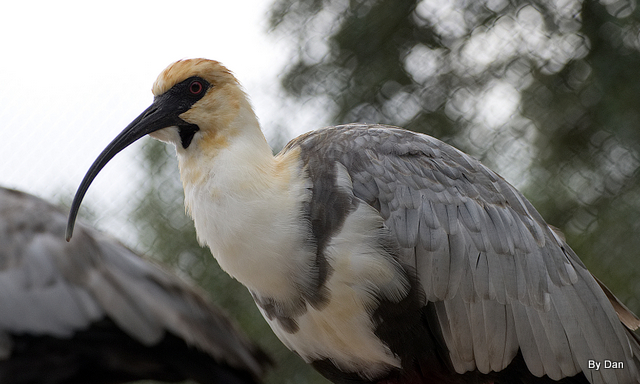
Black-faced Ibis (Theristicus melanopis) Jax Zoo by Dan
On the way to South Carolina we visited the Jacksonville Zoo. The birds were a bit damp as it had just rained. Here is one of the avian wonders that Dan captured with his camera.
and for a long time birds and hedgehogs, and ibises and ravens shall dwell in it: and the measuring line of desolation shall be cast over it, and satyrs shall dwell in it. (Isaiah 34:11 Brenton)
“The Black-faced Ibis (Theristicus melanopis) is a species of bird in the family Threskiornithidae. It is found in grassland and fields in southern and western South America. It has been included as a subspecies of the similar buff-necked ibis, but today all major authorities accept the split. The black-faced ibis also included the Andean ibis (T. branickii) as a subspecies. Some taxonomic authorities (including the American Ornithological Society) still do so.” [Wikipedia with editing]
Links:
BJU Bird Collection 2018 Bottom Shelf
The next set of birds from the Waterman Bird Collection at BJU has five specimens. Four of these birds are found in or near water, but the Crow is not really known as a water bird. [This is a copy of the Waterman Bird Collection – Part II from Birds of the Bible for Kids]
This is the bottom shelf display under the Anatidae Family, just above them. That Family was covered in A Pleasant Surprise – II. I trust you clicked on the links provided to read more about those avian wonders.

Common Loon (Gavia immer) BJU Bird Collection 2018

Common Loon (Gavia immer) BJU Bird Collection 2018
Our big tall bird is a Common Loon. “The common loon or great northern diver (Gavia immer) is a large member of the loon, or diver, family of birds. Breeding adults have a plumage that includes a broad black head and neck with a greenish, purplish, or bluish sheen, blackish or blackish-grey upperparts, and pure white underparts except some black on the undertail coverts and vent. Non-breeding adults are brownish with a dark neck and head marked with dark grey-brown. Their upperparts are dark brownish-grey with an unclear pattern of squares on the shoulders, and the underparts, lower face, chin, and throat are whitish. The sexes look alike, though males are significantly larger and heavier than females. During the breeding season, they live on lakes and other waterways in Canada, the northern United States (including Alaska), as well as in southern parts of Greenland and Iceland. Small numbers breed on Svalbard and sporadically elsewhere in Arctic Eurasia. Common loons winter on both coasts of the US as far south as Mexico, and on the Atlantic coast of Europe.
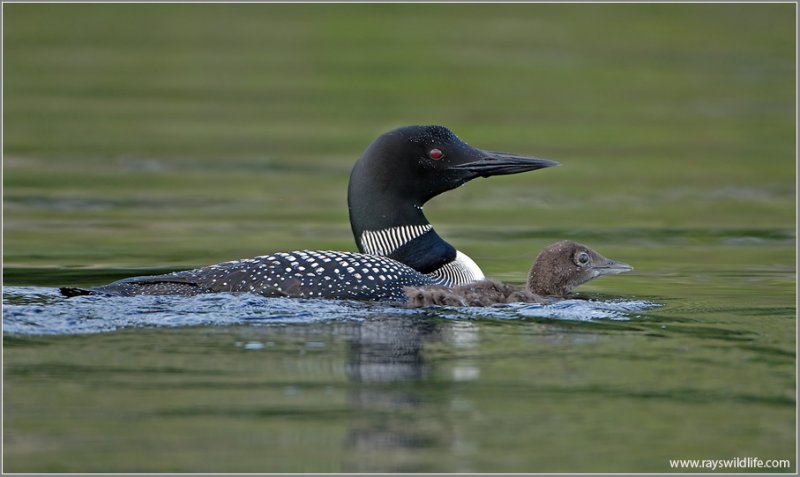
Common Loon by Raymond Barlow
Common loons eat a wide range of animal prey including fish, crustaceans, insect larvae, mollusks, and occasionally aquatic plant life. They swallow most of their prey underwater, where it is caught, but some larger items are first brought to the surface.” Common Loon – Wikipedia
Here is just one of the Cool Facts from Common Loon – All About Birds

Red-necked Grebe (Podiceps grisegena) BJU Bird Collection 2018
Next to the Loon is a Red-necked Grebe (Podiceps grisegena). “Like all grebes, the Red-necked is a good swimmer, a particularly swift diver, and responds to danger by diving rather than flying. The feet are positioned far back on the body, near the tail, which makes the bird ungainly on land. It dives for fish or picks insects off vegetation; it also swallows its own feathers, possibly to protect the digestive system.” Red-necked Grebes – Wikipedia

Red-necked Grebe (Podiceps grisegena) young on her wing©USFWS
Here is a Cool Fact from Red-necked Grebe – All About Birds

Pied-billed Grebe (Podilymbus podiceps) BJU Bird Collection 2018
The smaller Grebe, next to the Red-necked Grebe, is a Pied-billed Grebe (Podilymbus podiceps) . They both belong to the Podicipedidae Family. Now that is a bird we see often here in Florida.

Pied-Billed Grebe at Lake Hollingsworth, Lakeland, FL by Dan
“The Pied-billed Grebes (Podilymbus podiceps) is a species of the grebe family of water birds. Since the Atitlán grebe (Podilymbus gigas) has become extinct, it is the sole extant member of the genus Podilymbus. The pied-billed grebe is primarily found in ponds throughout the Americas. Other names of this grebe include American dabchick, dabchick, Carolina grebe, devil-diver, dive-dapper, dipper, hell-diver, pied-billed dabchick, pied-bill, thick-billed grebe, and water witch.”
Pied-billed Grebes are small, stocky, and short-necked. They are mainly brown, with a darker crown and back. Their brown color serves as camouflage in the marshes they live in. They do not have white under their wings when flying, like other grebes. Their undertail is white and they have a short, blunt chicken-like bill that is a light grey color, which in summer is encircled by a broad black band (hence the name). In the summer, its throat is black.” Pied-billed grebe – Wikipedia [with editing]
A Cool Fact about this from Pied-billed Grebe – All About Birds
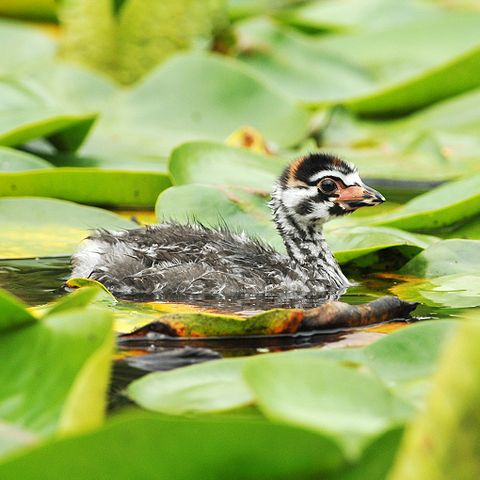
Pied-billed Grebe (Podilymbus podiceps) chick ©WikiC
We will check out the other two birds in the display case next.
I trust you will enjoy meeting the various birds through this series. The links provided give much more information, and photos of these species.
“The works of the LORD are great, Studied by all who have pleasure in them.” (Psalms 111:2 NKJV)
Podicipedidae – Grebes – Family

