***

A Storks on their Nest
THE STORK
***
“Where the birds make their nests: as for the stork, the fir trees are her house.” Psalm 104:17
*
A Storks on their Nest
“Where the birds make their nests: as for the stork, the fir trees are her house.” Psalm 104:17
*

“They give drink to every beast of the field: the wild asses quench their thirst. Psalm 104:11″
*
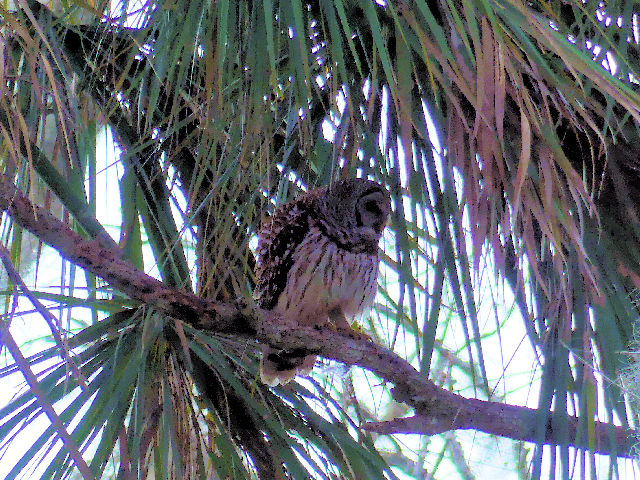
Barred Owl at Circle B by Lee
Our latest trip to Circle B Bar Reserve was rewarded with my first sighting of a wild Barred Owl. We have seen them in Zoos, but never in the wild.

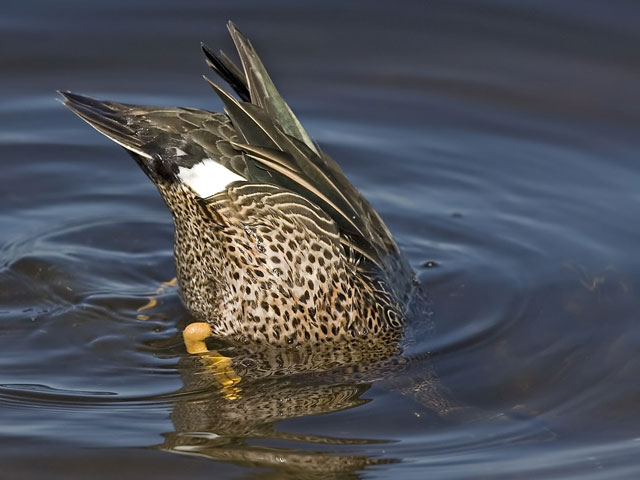
Blue-Winged-Teal-Dabbling ©Flyways USFWS
White-winged Coot (Fulica leucoptera) Cropped ©WikiC
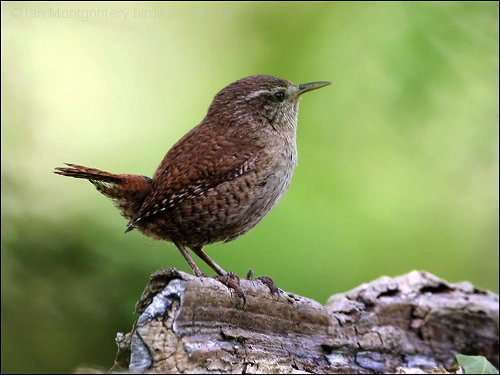
Winter Wren (Troglodytes troglodytes) by Ian
Hope you will check these out and if you like them, consider following that blog also. Lots of interesting things to share with your children and grandchildren.
“And thou shalt love the LORD thy God with all thine heart, and with all thy soul, and with all thy might. And these words, which I command thee this day, shall be in thine heart: And thou shalt teach them diligently unto thy children, and shalt talk of them when thou sittest in thine house, and when thou walkest by the way, and when thou liest down, and when thou risest up.” (Deuteronomy 6:5-7 KJV)
No, the posts aren’t scripture, but there are always principles to grow and learn by. Enjoy!

Barred Owl at Circle B by Lee
Barred Owl at Circle B by Lee
“The beast of the field shall honour me, the dragons and the owls: because I give waters in the wilderness, and rivers in the desert, to give drink to my people, my chosen.” (Isaiah 43:20 KJV)
We were recently out to Circle B Bar Reserve and spotted this Barred Owl. There have been numerous articles here about this Owl, but this is the first time I have seen one in the Wild. I have heard them, but not seen them.
As we were getting our cameras out of the car [and my walker] we spotted a group of birders concentrating on one area. They pointed out a palm tree with a dark figure in it.

Barred Owl in the Palm Tree – Do you see it?
The rest of the photos have been lightened up to see it better. When we first spotted it, it was still, as if asleep. After walking to the marsh and back, I searched for the Owl again. Sure enough, he was still there. This time looking around. [top two photos] It is always enjoyable to spot an owl in the daytime. They are mostly nighttime birds.
“The beast of the field shall honour me, the dragons and the owls” Why do they honor the Lord their Creator? One reason is because He “give waters in the wilderness, and rivers in the desert, to give drink to my people, my chosen.” The water that is provided for people also provides water for the critters and birds to drink.
May this Barred Owl be a reminder of the love and provisions that the Lord provides for us. He cares about us and wants us to ask for and thank Him for all the good provisions (food, water, house, bed, clothes, parents, etc.) He gives.
“But ask now the beasts, and they shall teach thee; and the fowls of the air, and they shall tell thee:” (Job 12:7 KJV)
See:
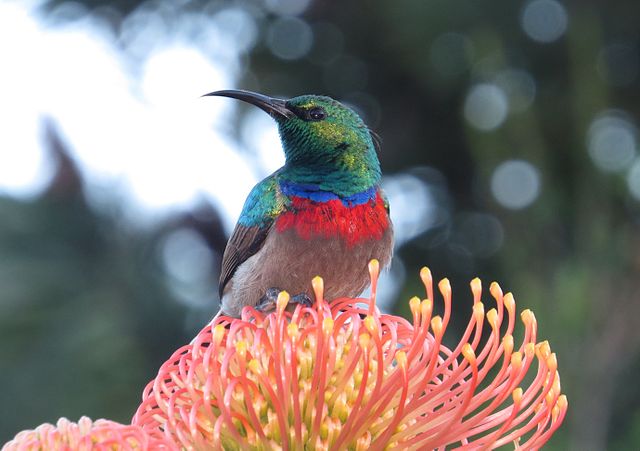
Southern Double-collared Sunbird (Cinnyris chalybeus) ©WikiC
“For if thou altogether holdest thy peace at this time, … and who knoweth whether thou art come to the kingdom for such a time as this?” (Esther 4:14 KJV)
Last weekend we had a great Missions Conference. All the missionaries that spoke were real “heroes of the faith.” Of all the Conferences at Faith Baptist Church, here in Florida, this was the best since we have been here. The Theme was For Such A Time As This! My heart was stirred as we listened to the heartbeat of these Christians who have dedicated their lives to go and reach others for Christ. Sometimes I grumble inwardly about having to fix problems on this blog, yet they have so many issues to deal with. They keep looking to the Lord to help them through. All the stories of problems and blessings from the Lord help us to remember that God is in control. Keep On, Keeping On!
On Sunday night, the final speaker was Mrs. Grace Fabian who was with Wycliffe Bible Translators in Papua New Guinea. She has written a book about all that happened to them while they were there. Her husband was murdered, yet she stayed on to help translate the Bible into the language of that tribe. I found two YouTube videos online that tell much of what she told us.
Check out: Part 1 – https://youtu.be/k5_5UHqwiv4 and Part 2 – https://youtu.be/6wI-FUjtwdg
So, what does all of this have to do with birds? One of the missionaries serves in Togo, West Africa. The Lethers family had on their display table a book of birds from Togo. It was opened to a photo of a Sunbird. Thanks to the Birds of the World blogs that have been here, I was able to immediately put a name on it. [The name was covered]
I was birdwatching at the conference. Most birders, after a while, notice photos or birds no matter where they are. Hopefully, you have become more aware of the birds around you. Whether they are in the wild, a zoo, or even in a book, your eyes will drift that way. Mine do.
Checking the Wikipedia list of birds in Togo, West Africa, there is a huge number of avian wonder in Togo. Here are just a few of them:


Golden Eagle (Aquila chrysaetos) Flying ©WikiC
The link was sent to many of you as https://leesbird.com/2018/02/15/avian-and-attributes-mount/ which was sent accidentally.
This caused a 404 Error.
The correct link is:

Mount Cameroon Speirops (Zosterops melanocephalus) ©WikiC
And I looked, and, lo, a Lamb stood on the mount Sion, and with him an hundred forty and four thousand, having his Father’s name written in their foreheads. And I heard a voice from heaven, as the voice of many waters, and as the voice of a great thunder: and I heard the voice of harpers harping with their harps:
(Revelation 14:1-2 KJV)And he came out, and went, as he was wont, to the mount of Olives; and his disciples also followed him. And when he was at the place, he said unto them, Pray that ye enter not into temptation. And he was withdrawn from them about a stone’s cast, and kneeled down, and prayed, Saying, Father, if thou be willing, remove this cup from me: nevertheless not my will, but thine, be done.
(Luke 22:39-42 KJV)
Avian and Attributes – Mount
MOUNT, n. [L. mons, literally a heap or an elevation.]
1. A mass of earth, or earth and rock, rising considerably above the common surface of the surrounding land. Mount is used for an eminence or elevation of earth, indefinite in highth or size, and may be a hillock, hill or mountain. It is applied in Scripture to the small hillocks on which sacrifice was offered as well as to Mount Sinai. Jacob offered sacrifice on the mount or heap of stones raised for a witness between him and Laban. Gen 31.
2. A mound; a bulwark for offense or defense.
Hew ye down trees and cast a mount against Jerusalem. Jer 6.
3. Formerly, a bank or fund of money.
MOUNT, v.i.
1. To rise on high; to ascend; with or without up.
Doth the eagle mount up at thy command? Job 39.
The fire of trees and houses mounts on high.
2. To rise; to ascend; to tower; to be built to a great altitude.
Though Babylon should mount up to heaven. Jer 51.
3. To get on horseback.
4. To leap upon any animal.
5. To amount; to rise in value.
Bring then these blessings to a strict account,
Make fair deductions, see to what they mount.
MOUNT, v.t. To raise aloft; to lift on high.
What power is it which mounts my love so high?
1. To ascend; to climb; to get upon an elevated place; as, to mount a throne.
2. To place one’s self on horseback; as, to mount a horse.
3. To furnish with horses; as, to mount a troop. The dragoons were well mounted.
4. To put on or cover with something; to embellish with ornaments; as, to mount a sword.
5. To carry; to be furnished with; as, a ship of the line mounts seventy four guns; a fort mounts a hundred cannon.
6. To raise and place on a carriage; as, to mount a cannon.
To mount guard, to take the station and do the duty of a sentinel.

Bald Eagle (Haliaeetus leucocephalus) by Ray Barlow
There are four “Mount” birds, but surprisingly, only one photo available to use. [shown at top]
Mount Cameroon Francolin (Pternistis camerunensis) is a bird species in the family Phasianidae. It is found only in Cameroon.
Mount Cameroon Speirops (Zosterops melanocephalus) is a species of bird in the disputed family Zosteropidae, which might be included in the Timaliidae. It is endemic to Cameroon. Its natural habitats are subtropical or tropical moist montane forests and subtropical or tropical high-altitude shrubland.
Mount Kupe Bushshrike (Telophorus kupeensis) is a species of bird in the family Malaconotidae. It is endemic to Cameroon, where it is found in the Bakossi Forest Reserve and in particular on Mount Kupe.
Mount Victoria Babax (Babax woodi) is a species of passerine bird of the family Leiothrichidae typical of the mountains of the northeast of the Indian subcontinent . Previously it was considered a subspecies of Chinese babax .
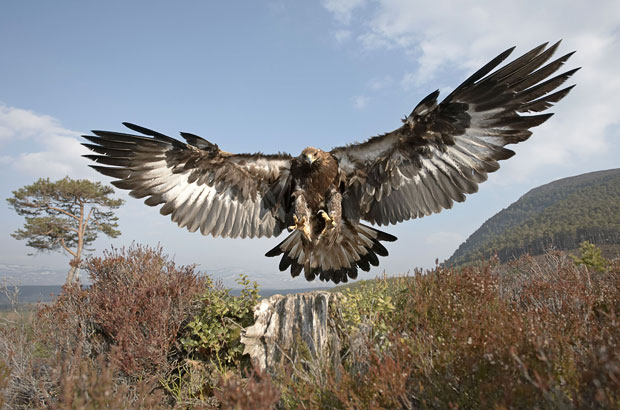
Golden Eagle (Aquila chrysaetos) Swooping Down ©Netns Wildlifezone
“Hast thou not known? hast thou not heard, that the everlasting God, the LORD, the Creator of the ends of the earth, fainteth not, neither is weary? there is no searching of his understanding. He giveth power to the faint; and to them that have no might he increaseth strength. Even the youths shall faint and be weary, and the young men shall utterly fall: But they that wait upon the LORD shall renew their strength; they shall mount up with wings as eagles; they shall run, and not be weary; and they shall walk, and not faint.” (Isaiah 40:28-31 KJV)
“And in the day time he was teaching in the temple; and at night he went out, and abode in the mount that is called the mount of Olives.” (Luke 21:37 KJV)
One of the attributes of Christ, that I think about, is his going up to the Mount to pray. Like us, He became weary in His human body, even though He is 100% God, while on earth, He was also 100% human. Therefore He needed rest and refreshment of body as we do.
Birds whose first name starts with “M”
*
[Definitions from Webster’s Dictionary of American English (1828), unless noted. Bird info from Wikipedia plus.]
In the beginning was the Word, and the Word was with God, and the Word was God. The same was in the beginning with God. All things were made by him; and without him was not any thing made that was made. (John 1:1-3 KJV)
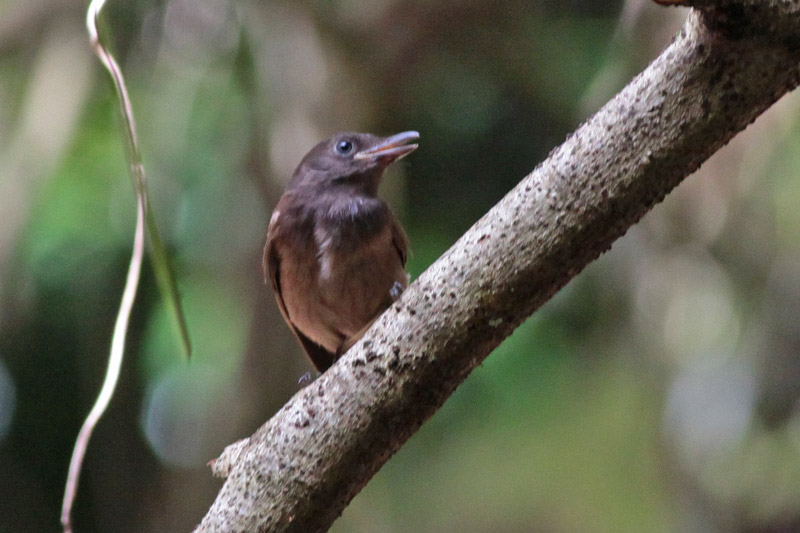
Morningbird (Colluricincla tenebrosa) by Margaret Sloan
“And in the morning, rising up a great while before day, he went out, and departed into a solitary place, and there prayed.” (Mark 1:35 KJV)
“Watch ye therefore: for ye know not when the master of the house cometh, at even, or at midnight, or at the cockcrowing, or in the morning:” (Mark 13:35 KJV)
“And early in the morning he came again into the temple, and all the people came unto him; and he sat down, and taught them.” (John 8:2 KJV)
“I Jesus have sent mine angel to testify unto you these things in the churches. I am the root and the offspring of David, and the bright and morning star.” (Revelation 22:16 KJV)
Avian and Attributes – Morning
MORN’ING, n.
1. The first part of the day, beginning at twelve o’clock at night and extending to twelve at noon. Thus we say, a star rises at one o’clock in the morning. In a more limited sense, morning is the time beginning an hour or two before sunrise, or at break of day, and extending to the hour of breakfast and of beginning the labors of the day. Among men of business in large cities, the morning extends to the hour of dining.
2. The first or early part.
In the morning of life, devote yourself to the service of the Most High.
MORN’ING, a. Pertaining to the first part or early part of the day; being in the early part of the day; as morning dew; morning light; morning service.
She looks as clear
As morning roses newly washed with dew.
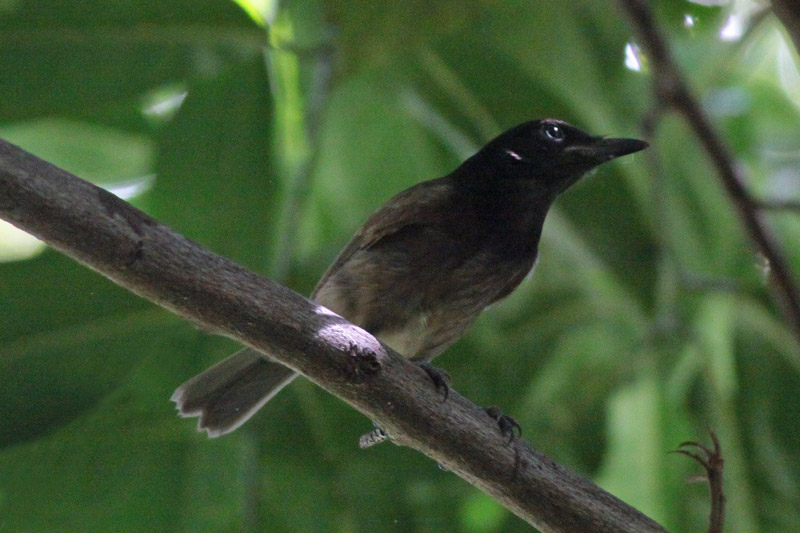
Morningbird (Colluricincla tenebrosa) by Margaret Sloan
Morningbird (Pachycephala tenebrosa)
The Mmorningbird (Pachycephala tenebrosa) is a songbird species in the family Pachycephalidae. It is endemic to the islands of Babelthuap, Koror, Garakayo, Peleliu and Ngabad in Palau. Its natural habitat is deep primary tropical moist lowland forests. The species is non-migratory. It is apparently commoner on the smaller islands in its range.
Morningbirds feed principally on insects, but also take snails, berries, fruit and seeds. They feed on or around the ground.
Birds whose first name starts with “M”
Morningbird – A Voice In The Morning
*
[Definitions from Webster’s Dictionary of American English (1828), unless noted. Bird info from Wikipedia plus.]
“My voice shalt thou hear in the morning, O LORD; in the morning will I direct my prayer unto thee, and will look up.” (Psalms 5:3 KJV)

The dust is thinning out a bit.
Here is the Latest list of pages and articles that have flown over to the Birds of the Bible for Kids site. The ones in blue are the newest arrivals. Wow! I had forgotten about so many of these articles. They are being re-published to current dates.
I trust you will check some of these out. If you have youngsters and/or teenagers, or, grandchildren, you may want to share these with them.
The Bible Bird indexes that are now open are GROWING:
“I will meditate also of all thy work, and talk of thy doings.” (Psalms 77:12 KJV)
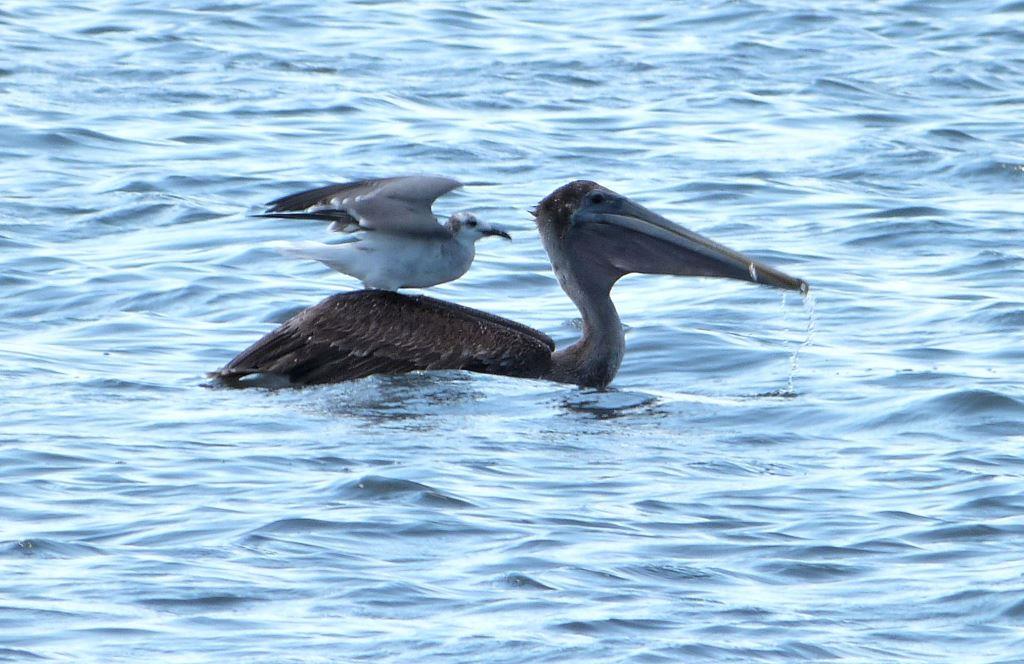
Waiting
Here are some of the articles that are active again: (reverse order as they were released)
Birds of the Bible for Kids is Under Construction
Keep Checking
At times I think I may have bitten off more than I can chew. It was easier moving the Birds of the Bible for Kids material over here than it is trying to move it back to the original location. :)
Things are progressing over there, but it is still quite dusty.
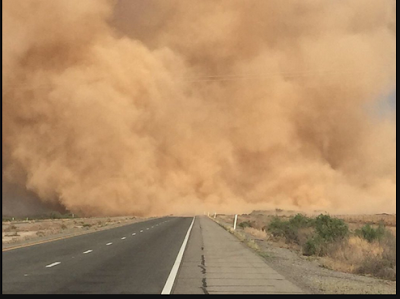
Dust storm over I-10 in Arizona ©AZGeology
In fact, the birds have been taking “Dust Baths”!!

Turkey taking a Dust Bath ©Jim Block
Here’s another one I caught Dust Bathing with some of the dust that is being kicked up:
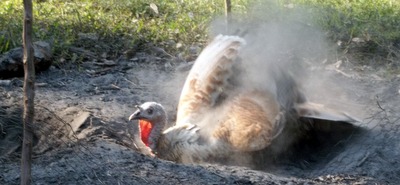
Dust Bathing
There has been some progress though. All of the Scriptural Alphabet of Animals are active.
Here are some of what has been going on over at Birds of the Bible for Kids:
The Bible Bird indexes that are open are:
Here are some of the articles that are active again: (reverse order as they were released)

Mocking Cliff Chat (Thamnolaea cinnamomeiventris) Female ©WikiC
“Likewise also the chief priests mocking him, with the scribes and elders, said, He saved others; himself he cannot save. If he be the King of Israel, let him now come down from the cross, and we will believe him. He trusted in God; let him deliver him now, if he will have him: for he said, I am the Son of God.” (Matthew 27:41-43 KJV) [While the were mocking Christ, He did not say anything.]
Avian and Attributes – Mocking
MOCK’ING, ppr. Imitating in contempt; mimicking; ridiculing by mimicry; treating with sneers and scorn; defeating; deluding.
MOCK’ING, n. Derision; insult.
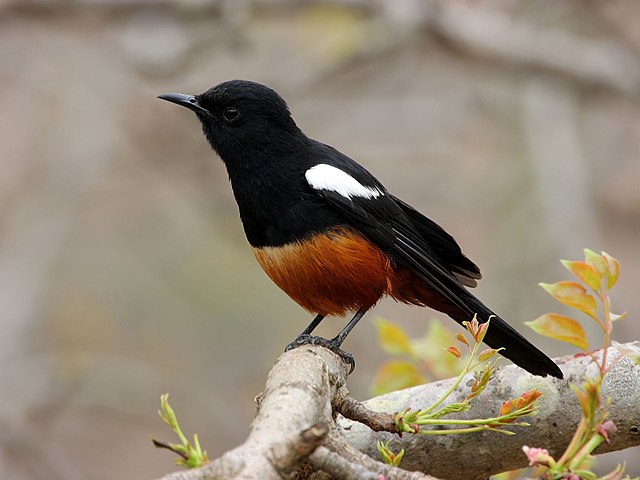
Mocking Cliff Chat (Thamnolaea cinnamomeiventris) Male ©WikiC
The Mocking Cliff Chat, mocking chat or cliff chat, (Thamnolaea cinnamomeiventris) is a species of chat in the family Muscicapidae which occurs in rocky habitats in much of eastern Sub-Saharan Africa.
The mocking cliff chat is a large chat with distinctive colouration. The male has a glossy black with a chestnut belly, vent, and rump and white shoulder patches. The shoulder patches vary in size geographically. The female is dark grey with a chestnut lower breast, belly, and vent. The mocking cliff chat has a length of 19–21 cm and weighs 41–51g.
The mocking cliff chat inhabits rocky and boulder-strewn areas, well-wooded rocky ravines, cliffs, gullies, boulder-strewn hillsides and watercourses in valley bottoms with scattered rocks.
A loud fluty melodious warbling song which often contains many rapid-fire phrases mimicking other species, with some harsher phrases interspersed.
Birds whose first name starts with “M”
*
[Definitions from Webster’s Dictionary of American English (1828), unless noted. Bird info from Wikipedia plus.]
“For the scripture saith, Whosoever believeth on him shall not be ashamed. For there is no difference between the Jew and the Greek: for the same Lord over all is rich unto all that call upon him. For whosoever shall call upon the name of the Lord shall be saved.” (Romans 10:11-13 KJV)
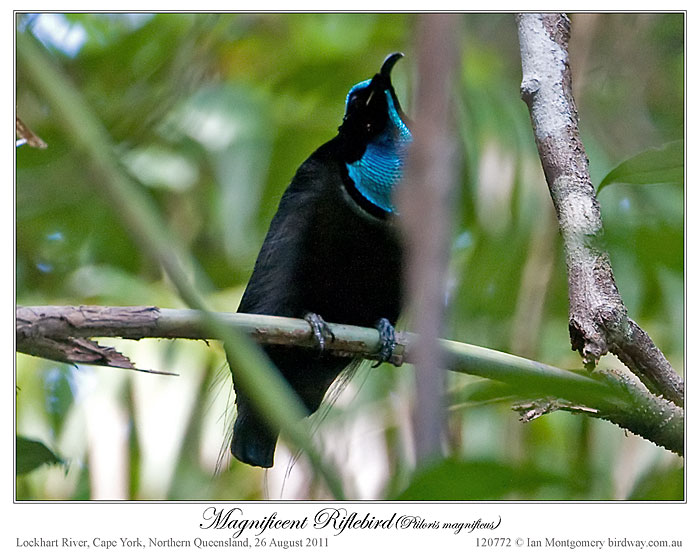
“For by these He has granted to us His precious and magnificent promises, so that by them you may become partakers of the divine nature, having escaped the corruption that is in the world by lust.” (2 Peter 1:4 NASB)
Avian and Attributes – Magnificent
MAGNIF’ICENT, a. Grand in appearance; splendid; pompous.
Man he made, and for him built
Magnificent this world.
1. Exhibiting grandeur.
“Whereby are given unto us exceeding great and precious promises: that by these ye might be partakers of the divine nature, having escaped the corruption that is in the world through lust.” (2 Peter 1:4 KJV)
EXCEE’DING, ppr. Going beyond; surpassing; excelling; outdoing.
1. Great in extent, quantity or duration; very extensive.
2. adv. In a very great degree; unusually; as exceeding rich.
I am thy shield, and thy exceeding great reward. Gen 15.
EXCEE’DING, n. Excess; superfluity.
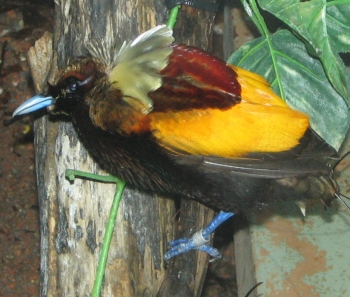
Magnificent Bird-of-paradise (Diphyllodes magnificus) ©WikiC
Magnificent Bird-of-paradise (Diphyllodes magnificus) is distributed amongst the hill and mid-mountain forests of New Guinea and surrounding islands. Their diet consists mainly of fruits. Like most members of the family Paradisaeidae, the male is polygamous and performs an elaborate courtship display.
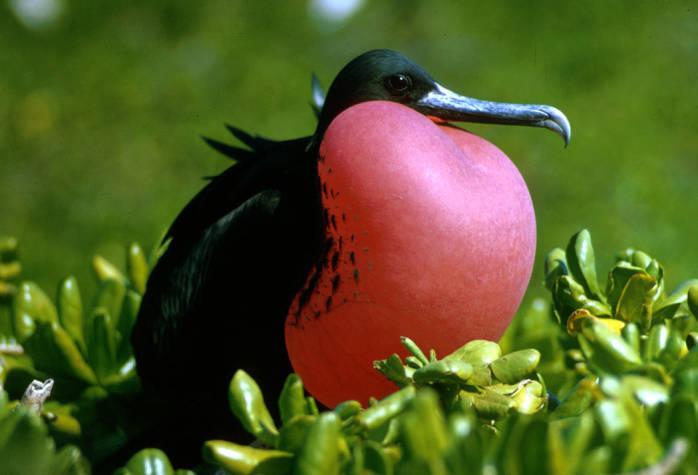
Magnificent Frigatebird (Fregata magnificens) ©USFWS
Magnificent Frigatebird (Fregata magnificens) is a seabird of the frigatebird family Fregatidae. With a length of 89–114 centimetres (35–45 in) it is the largest species of frigatebird. It occurs over tropical and subtropical waters off America, between northern Mexico and Ecuador on the Pacific coast and between Florida and southern Brazil along the Atlantic coast. There are also populations on the Galápagos Islands in the Pacific and the Cape Verde islands in the Atlantic.
The magnificent frigatebird is a large, lightly built seabird with brownish-black plumage, long narrow wings and a deeply forked tail. The male has a striking red gular sac which it inflates to attract a mate. The female is slightly larger than the male and has a white breast and belly. Frigatebirds feed on fish taken in flight from the ocean’s surface (often flying fish), and sometimes indulge in kleptoparasitism, harassing other birds to force them to regurgitate their food.
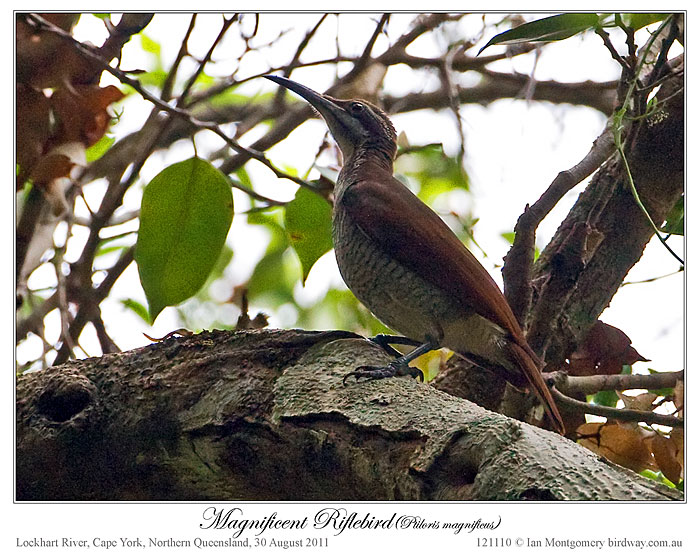
Magnificent Riflebird (Ptiloris magnificus) by Ian
Magnificent Riflebird (Ptiloris magnificus) is a species of passerine bird of the Paradisaeidae family. The magnificent riflebird is widely distributed throughout lowland rainforests of western New Guinea and the northern Cape York Peninsula.
Medium-sized (up to 34 cm long). the male is velvet-black bird-of-paradise with elongated black filamental flank plumes, an iridescent blue-green crown, a wide, triangle-shaped breast shield, and on central tail feathers. It has a black curved bill, yellow mouth, blackish feet and a dark brown iris. The female is brownish with dark spots and buff bars below with a white brow. The immature male resembles the male but with less tail plumes.
Males perform solitary courtship displays on a ‘dancing perch’. During these displays, the male fully extends his wings and raises his tail; he hops upward while swinging his head from side to side, showing off his metallic blue-green breast shield. Multiple females will observe these displays. Mated females subsequently build nests, incubate, brood, and feed young without male assistance.
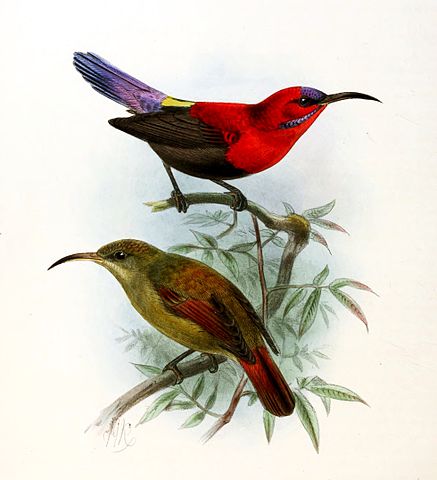
Magnificent Sunbird (Aethopyga magnifica) ©WikiC Drawing
Magnificent Sunbird (Aethopyga magnifica) is a species of bird in the sunbird family which feed largely on nectar, although they will also take insects, especially when feeding young. Flight is fast and direct on their short wings. Most species can take nectar by hovering like a hummingbird, but usually perch to feed most of the time. It is endemic to the western Philippines and was once considered a subspecies of the crimson sunbird.
Birds whose first name starts with “M”
*
[Definitions from Webster’s Dictionary of American English (1828), unless noted. Bird info from Wikipedia plus. Both with editing]
“That if thou shalt confess with thy mouth the Lord Jesus, and shalt believe in thine heart that God hath raised him from the dead, thou shalt be saved. For with the heart man believeth unto righteousness; and with the mouth confession is made unto salvation.” (Romans 10:9-10 KJV)

