For as the rain comes down, and the snow from heaven, and returns not there, but waters the earth, and makes it bring forth and bud, that it may give seed to the sower, and bread to the eater, so shall My Word be, that goes forth out of My mouth; it shall not return unto Me void, but it shall accomplish that which I please, and it shall prosper in the thing to which I sent it. (Isaiah 55:10-11)
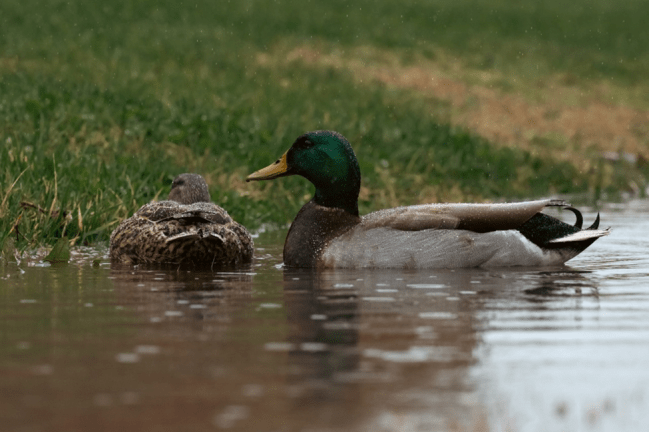
MALLARDS in rain-filled drainage ditch (Ian Sullens / U.S. Air Force photo credit)
Mallards like to float about in rainwater-runoff puddles and pools—in fact, a group of Mallards is sometimes called a “puddle” of Mallards. Mostly unnoticed by humans (even though Mallards are the world’s most ubiquitous duck), these delightful ducks serenely enjoy their own small part of God’s great global water cycle.
At my home, our front yard is bounded by roadside drainage ditches—so, when it rains a lot, those drainage ditches become brook-like pools of flooded rainwater.
Year after year after year, during the colder months (such as December), migratory Mallards (Anas platyrhynchos) seasonally seek out southern ponds and lakes, for over-wintering, yet they also frequent shallow rainwater-filled drainage ditches and rain-pooled puddles.
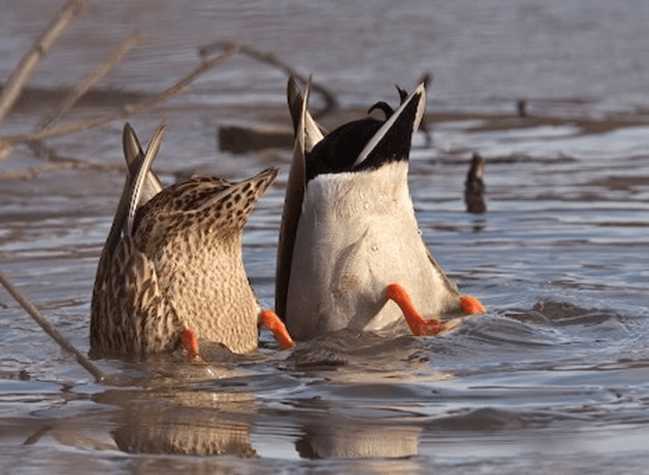
As dabbling ducks (a/k/a “puddle ducks”), they often “upend” in water, thus grazing on water-covered plants that they easily reach by flipping upside-down at the pooled water’s surface.
Dabbling ducks feed by straining food from the water’s surface or by submerging their heads while their tails remain out of the water. Male dabblers are usually brightly colored while females are drab. Plants make up most dabblers’ diets. Their method of taking flight is a sort of leap from the water’s surface. Look for them on rivers and close to shorelines. The most widely known dabbler duck is the mallard. The male has a dark green head while the female is dusky brown. Another dabbler species is the American black duck. Both male and female American black ducks look similar to mallard hens, only darker. Other dabblers include the American wigeon, green-winged teal, northern pintail (the male has long black tail feathers), and northern shoveler (named for its large, spatula-like bill). [Quoting CHESAPEAKE BAY JOURNAL, 33(9):40 (December 2023), posted at www.BayJournal.com ]
Since dabblers don’t dive into deep water, they don’t need large paddle-like feet for underwater propulsion mobility. So, it makes sense that God did not design dabbling ducks to have the larger paddle-shaped feet that diving ducks have. Also, it makes sense that dabbling ducks have legs (and feet) positioned near the middle of their bellies, for balancing themselves as they tread water, upside-down in shallow puddle-water, while the dabblers are grasping water-covered (and water-softened) acorns, nuts, seeds, and underwater plants.
God, in His providential care for the ducks He created, fitted His ducks with appropriate anatomies for the places they “fill” on Earth. Likewise, their behaviors fit their family life roles and territorial needs.
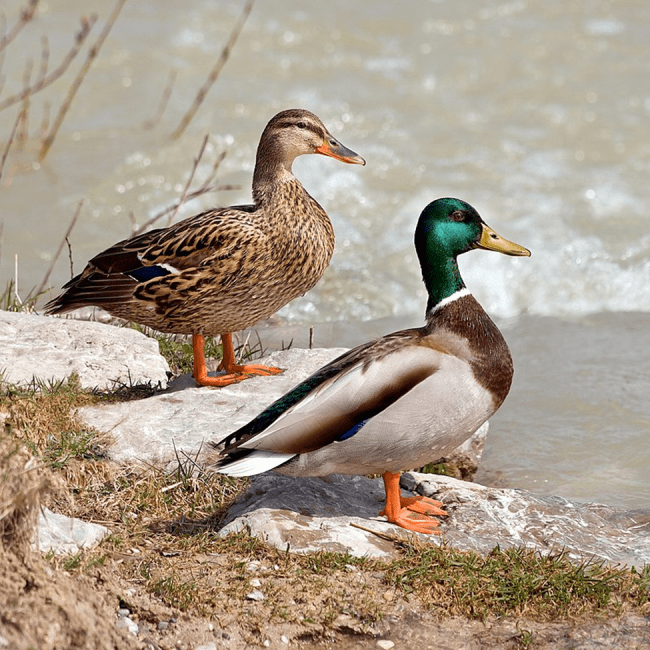
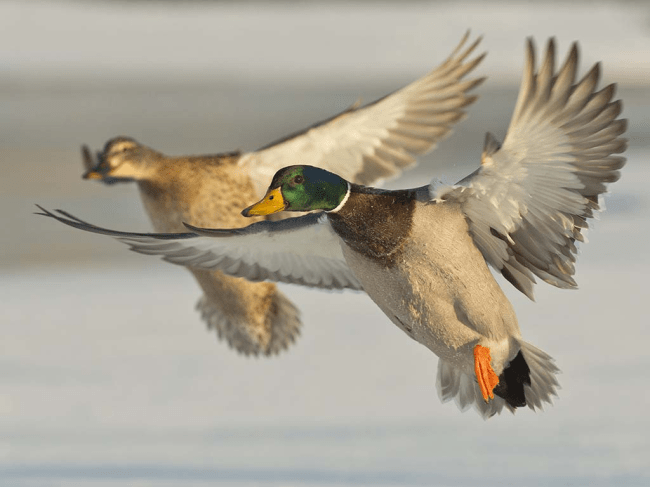
MALLARD male (R) & female (L) (Richard Bartz / Wikipedia photo credit)
Ornithologist Donald Stokes informs us that Mallards not only display sexual dimorphism (i.e., the 2 sexes have very different plumage, with the male being the distinctive “greenhead”), their vocalizations differ based upon sex:
When I first started studying Mallards I was surprised to find that the males and females make entirely different sounds. The quacking sound, which I had assumed all Ducks make, can be made only by the female. The male has two other calls of his own—a nasal rhaeb sound and a short Whistle-call. . . . An added advantage to knowing Mallard displays is that closely related species of Ducks such as Black Ducks, Gadwalls, Pintails, Widgeons and Teals have similar displays. Therefore, once you learn some of the patterns of Mallard behavior you will have a good start on being able to understand the behavior of these other Ducks as well. The Black Duck is particularly close in this respect, having nearly the same display repertoire as the Mallard. [Quoting Donald Stokes, GUIDE TO BIRD BEHAVIOR: VOLUME ONE (Boston, MA: Little, Brown & Company, 1979), pages 31-32]
Of course, hybrid ducks are common, proving that such hybridizing ducks really belong to the same created kind. For example, ornithologist Eugene McCarthy has documented that the Common Pintail (Anas acuata) is known to hybridize with the Mallard, as well as with American Black Duck (Anas rubripes), various pochards, various widgeons, various teals, Gadwall (Anas strepera), Northern Shoveler (Anas clypeata), and more. [See Eugene M. McCarthy, HANDBOOK OF AVIAN HYBRIDS OF THE WORLD (Oxford, UK: Oxford Univ. Press, 2006), pages 71-73.]
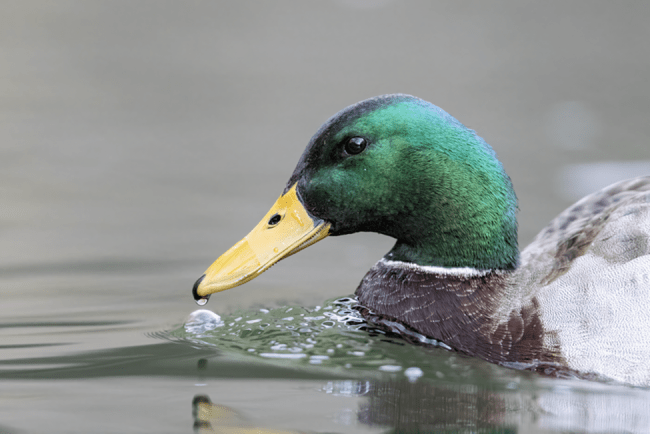
MALLARD MALE close-up (Chuck Homler / Wikipedia photo credit)
Interestingly, Mallards can be permanent (i.e., “year-round”) residents or migrants.
One of the reasons why mallard ducks are so plentiful is because they’re highly adaptable to climate, geography, temperature and diet. Particularly, they love shallow ponds, marshes and wetlands, as those calmer waters tend to produce the most aquatic bugs and plants—more so than fast moving rivers or deeper lakes. Mallards mate in pairs, and while some migrate to warmer temperatures, many are permanent residents in their nested homes throughout the United States. [Quoting Camo Trading, at www.camotrading.com/resources/the-upside-down-life-of-dabbling-ducks/ ]
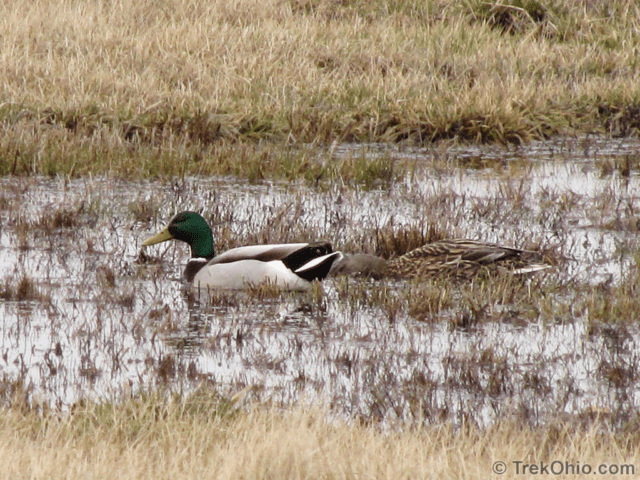
MALLARD male & female, in shallow wetland pool (TrekOhio.com photo credit)
In other words, God gave ducks what they need, anatomically and genetically (and even behaviorally)—for building families where they live—so that God’s ducks can be fruitful, multiply, and “fill” parts of Earth that God providentially prepared for their homes.
“The east wind carrieth him away, and he departeth: and as a storm hurleth him out of his place.” (Job 27:21 KJV)
“But the men marvelled, saying, What manner of man is this, that even the winds and the sea obey him!” (Matthew 8:27 KJV)
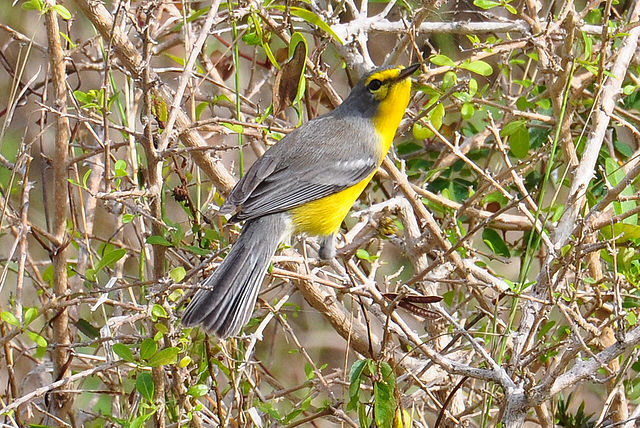
While working on the last Attributes and Avian article, – Bounty/Bountiful, I was using the “B – First Name of Birds” list to find a bird to use. The Barbuda Warbler (Setophaga subita) caught my attention. Also, one of our readers wrote a comment, wondering what happened to the birds during a hurricane.
The tiny island of Barbuda took a direct hit by Hurricane Irma and basically destroyed at least 95% of all structures. They have now evacuated all residents off of the island. [inhabited for the last 300 years] (BoingBoing article Not One Single Human Left on the Island) “With 95% of the island’s structures completely destroyed, all 1,800 residents have evacuated to nearby Antigua, and now live in shelters or with relatives. The only living creatures left on Barbuda are pets and livestock, which the non-profit group World Animal Protection are trying to feed and rescue.” So, what about the birds?
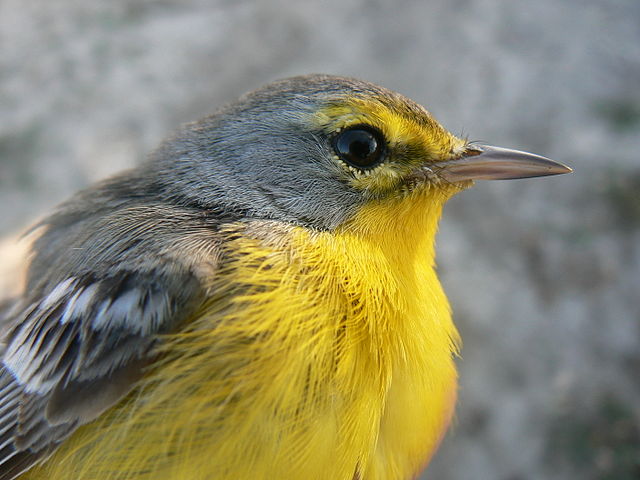
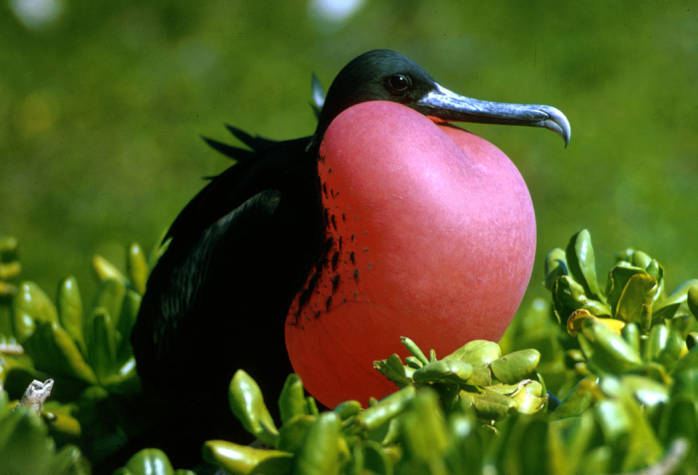
The Barbuda Warbler is endemic to Barbuda. “In addition to the catastrophic impact on Barbuda’s human residents, concern turned to the storm’s effects on the island’s wildlife. The island’s only endemic bird, the near-threatened Barbuda warbler, numbered less than 2,000 individuals prior to the hurricane. It is unknown if the warbler survived the hurricane or its aftermath. Barbuda’s Codrington Lagoon, home to the largest colony of magnificent frigatebirds in the Caribbean, with an estimated 2,500 nesting pairs, was also inundated by the storm surge.” From Hurricane Irma article on Wikipedia. Also, from Wikipedia, “The Barbuda warbler (Setophaga subita) is a species of bird in the Parulidae family. It is endemic to the island of Barbuda in Antigua and Barbuda. Its natural habitat is tropical dry shrubland near wetland areas. It is threatened by habitat loss. It once was considered a subspecies of the Adelaide’s Warbler.”
Searching the internet, I couldn’t find out too much about the Barbuda Warbler, but here are a few articles about other bird species that you will find interesting.
“Irma left the island of Barbuda in ruins; about 95 percent of structures were destroyed or damaged, and nearly all residents were evacuated last week as Hurricane Jose threatened to hit. The fate of Barbuda Warbler, an endemic species that likely numbered less than 2,000 birds before Irma, is unknown.
Jeremy Ross, a scientist with the University of Oklahoma, wonders if Irma was an extinction-level event for the warbler.
Barbuda’s Codrington Lagoon, a RAMSAR-designated wetland and national park, was home to the largest colony of Magnificent Frigatebirds in the region (around 2,500 pairs). According to BirdsCaribbean, the lagoon “was breached during the storm and the sea has flowed in.”
“Thousands of birds must have perished,” said Andrew Dobson, president of BirdsCaribbean, in an article posted on Bernews.com.
Our prayers go out to those who have had to be evacuated from Barbuda, but, also, to all those who have been visited by the Hurricanes this year.
” And I say unto you my friends, Be not afraid of them that kill the body, and after that have no more that they can do. But I will forewarn you whom ye shall fear: Fear him, which after he hath killed hath power to cast into hell; yea, I say unto you, Fear him. Are not five sparrows sold for two farthings, and not one of them is forgotten before God? But even the very hairs of your head are all numbered. Fear not therefore: ye are of more value than many sparrows.” (Luke 12:4-7 KJV)
“Are not two sparrows sold for a farthing? and one of them shall not fall on the ground without your Father.” (Matthew 10:29 KJV)
In whom also we have obtained an inheritance, being predestinated according to the purpose of him who worketh all things after the counsel of his own will:” (Ephesians 1:11 KJV)
For it is God which worketh in you both to will and to do of his good pleasure.” (Philippians 2:13 KJV)
Avian and Attributes – Providence of God
The word “providence” comes from the Latin providentia (Gk. pronoia [provnoia]) and means essentially foresight or making provision beforehand. On the human plane it may be used positively, as when Tertullus praised Felix by saying, “Your foresight has brought about reforms in this nation” ( Acts 24:2 ), or negatively, as when Paul admonishes us to “make no provision for the flesh, to gratify its desires” ( Rom 13:14, ; RSV ). When applied to God the idea takes on a vastly larger dimension because God not only looks ahead and attempts to make provision for his goals, but infallibly accomplishes what he sets out to do. And because it is God’s governance that is in view, it encompasses everything in the universe, from the creation of the world to its consummation, inclusive of every aspect of human existence and destiny. Providence, then, is the sovereign, divine superintendence of all things, guiding them toward their divinely predetermined end in a way that is consistent with their created nature, all to the glory and praise of God. This divine, sovereign, and benevolent control of all things by God is the underlying premise of everything that is taught in the Scriptures. (Baker’s Evangelical Dictionary)
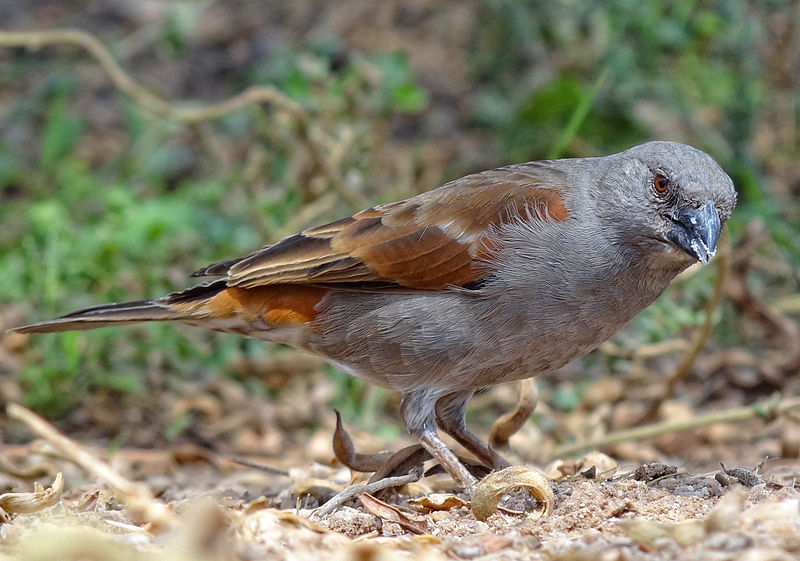
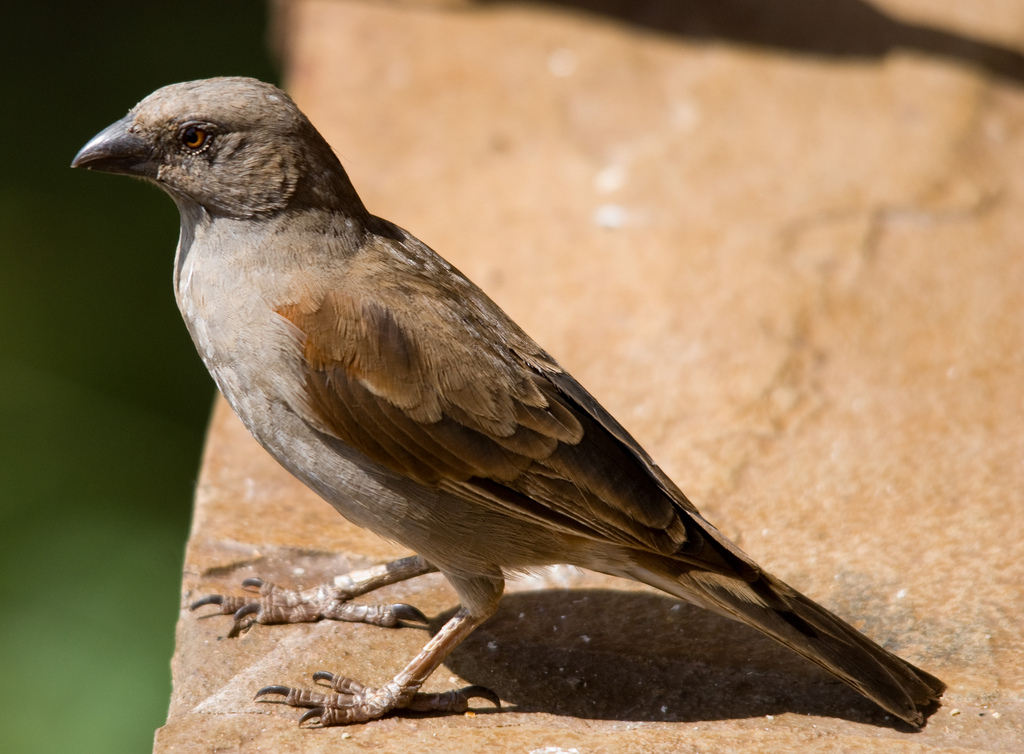
The Parrot-billed Sparrow (Passer gongonensis) is found in the arid lowlands of eastern Africa. At 18 centimeters (7.1 in) and 42 grams (1.5 oz), it is largest of the sparrows of the family Passeridae. It is often considered a subspecies of the grey-headed sparrow. Lives in extreme SE Sudan to S Ethiopia, S Somalia, Kenya and NE Tanzania. Habitats: Deserts and Xeric Shrublands; Tropical and Subtropical Moist Broadleaf Forests:
Tropical and subtropical grasslands, savannas, and shrublands. (Passeridae Family)
“The LORD is slow to anger, and great in power, and will not at all acquit the wicked: the LORD hath his way in the whirlwind and in the storm, and the clouds are the dust of his feet.” (Nahum 1:3 KJV)



 Lee's Birdwatching Adventures Plus