Trumpeter Swans: Trumpeting a Wildlife Conservation Comeback

If a bird’s nest chance to be before you in the way, in any tree, or upon the ground, whether they be young ones [i.e., nestling infant birds], or eggs [i.e., not-yet-hatched baby birds], and the mother [’em is the usual Hebrew noun for “mother”] sitting upon the young, or upon the eggs, you shall not take the mother with the young.  But you shall surely send forth the mother, and take the young [literally “children”] for yourself; that it may be well with you, and that you may prolong days.  Deuteronomy 22:6-7

During mid-August (AD2015) my wife and I visited the Columbus Zoo (in Ohio), while vacationing, and I was surprised to see Trumpeter Swans (Cygnus buccinator) there —  and I realized that the Trumpeter Swan illustrated the importance of Deuteronomy 22:6-7.

Trumpeter Swan (Cygnus buccinator) ©Columbus Zoo

Trumpeter Swan (Cygnus buccinator) ©Columbus Zoo

Seeing the snowy-white Trumpeter Swans, there, occurred during a telephone call, while we were viewing and identifying various animals, with our enthusiasm-exuding Ohio grandsons (who both call us Mimi and Farfar, the latter name being Norwegian for “father’s father”).  The unexpected telephone call came from a caller in crisis, seeking legal advice, on how to interpret and apply a mix of federal statutes.  It appeared that the call could not wait, till I returned to Texas – such is the lot and responsibility of a vacationing lawyer.

But a bird-watcher has his priorities!  So, as we rounded a bend in the walking trail, and I saw a couple of Trumpeter Swans, I interrupted the phone call with “hold on just a minute”, then I half-screamed to the grandsons: “Look, boys  –  Trumpeter Swans!  Look!  Trumpeter Swans!”

Seeing these massive swans, up close, helps you to appreciate how huge they are.  Trumpeter Swans are the heaviest of all birds that are “native” to North America – and one of the heaviest birds, alive today, that is capable of flight!  Unlike other swans, the Trumpeter Swan has a distinctively black bill, a stark contrast to the all-white hue of its adult plumage.
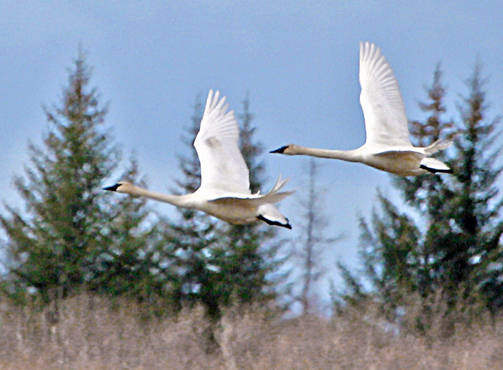
Trumpeter Swan (Cygnus buccinator) ©USFWS

The Trumpeter is a close cousin of Eurasia’s Whooper Swan [Cygnus cygnus], which I previously commented on, in an earlier blogpost about birdwatching in Iceland  (please check out  https://leesbird.com/2014/12/08/birdwatching-in-iceland-part-i/ .)  The Trumpeter Swans did not “trumpet” while we observed them; however, their name is due to their habit of loudly vocalizing with a musical sound like a trumpet, similar to the vocal sounds of their Cygninae cousins, the Whooper Swans and Bewick Swans.  Swans are shaped somewhat like geese, but swans grow larger and have longer (and proportionately thinner) necks.  The poise and posture of swans, accented by their flexible and long necks, appear more elegant than that of geese, some say, although surely mama geese would disagree.  Why are swan necks so lengthy and versatile?  Imagine being nick-named “Edith Swan-neck” — that is the name by which historians remember the wife and widow of England’s last Saxon king, Harold Godwinson, who lost the Battle of Hastings to William the Conqueror, in AD1066.  [ For more on that providentially historic battle, see http://www.norwegiansocietyoftexas.org/wp-content/uploads/2012/04/VikingHistory-GeoWash-ancestry-NST-AD2012.pdf  . ]  Geese have 17 to 23 neck vertebrae, yet swans have 24 or more!  Trumpeters also bob their heads a lot, apparently as a form of visual communication with one another.

Back to the very busy (and very tiring) adventure at the Columbus Zoo in Ohio.

As we all excitedly discussed the Trumpeter Swans, so close to us then, my mind recalled how these quietly graceful and magnificently dignified swans were once very close to the extinction cliff.   According to one study (by Banko, cited below), in AD1957, the United States then hosted only 488 Trumpeter Swans.  It got even worse!  In AD1932, fewer than 70 Trumpeter Swans were known to exist in all of America, with about half of them dwelling at or near Yellowstone National Park’s northwest section.  Would the Trumpeter Swan go extinct like the Passenger Pigeon and the Dodo bird?

What a loss it would have been, if our earthly home had seen a permanent demise of such noble anatids, especially since they once teemed when America was founded!

Trumpeter Swans were once hunted in huge numbers – thousands were killed for their skins and/or feathers.  Sir John Richardson (a Scottish scientist/surgeon who studied the Trumpeter extensively) once wrote that the Trumpeter Swan was “the most common Swan in the interior of the fur-counties.  …  It is to the trumpeter that the bulk of the Swan-skins imported by the Hudson’s Bay Company belong” [as quoted in Winston E. Banko, “The Trumpeter Swan:  Its History, Habits, and Population in the United States”, North American Fauna, 63:1-214 (April 1960), a data-source used for much of this article].  The Trumpeter Swan was well-known of its migratory habits, ranging from Canada to the Gulf of Mexico, according to ornithologist James Audubon:

“The Trumpeter Swans make their appearance on the lower portions of the waters of the Ohio about the end of October. They throw themselves at once into the larger ponds or lakes at no great distance from the river, giving a marked preference to those which are closely surrounded by dense and tall canebrakes, and there remain until the water is closed by ice, when they are forced to proceed southward. During mild winters I have seen Swans of this species in the ponds about Henderson [Kentucky] until the beginning of March, but only a few individuals, which may have stayed there to recover from their wounds. When the cold became intense, most of those which visited the Ohio would remove to the Mississippi, and proceed down that stream as the severity of the weather increased, or return if it diminished. . . . I have traced the winter migrations of this species as far southward as the Texas, where it is abundant at times, . . . At New Orleans . . . the Trumpeters are frequently exposed for sale in the markets, being procured on the ponds of the interior, and on the great lakes leading to the waters of the Gulf of Mexico. . . . The waters of the Arkansas and its tributaries are annually supplied with Trumpeter Swans, and the largest individual which I have examined was shot on a lake near the junction of that river with the Mississippi. It measured nearly ten feet in alar extent, and weighed above thirty-eight pounds.”   [Quotation taken from Banko, on page 15.]

During AD1862 George Barnston, a Scottish-born Hudson’s Bay Company official in Canada, noticed the Trumpeter Swan’s remarkable migration habit, as it is seen in America’s Northwest:
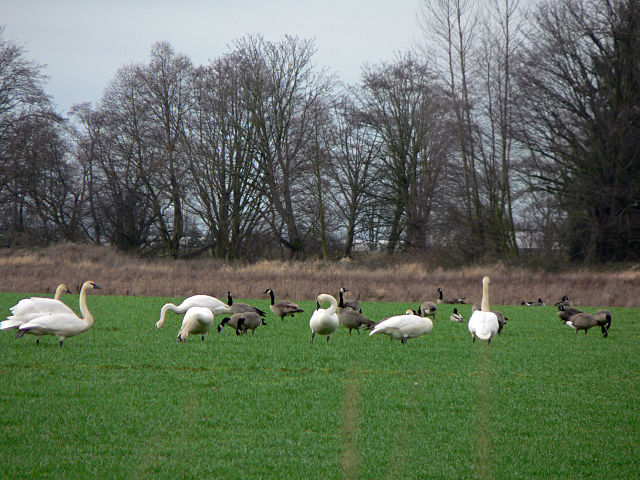
Trumpeter Swan (Cygnus buccinator) and Canadian Geese ©WikiC

Trumpeter Swan (Cygnus buccinator) and Canadian Geese ©WikiC

“In the winter months all the northern regions are deserted by the swans, and from November to April large flocks are to be seen on the expanses of the large rivers of the Oregon territory and California, between the Cascade Range and the Pacific where the climate is particularly mild, and their favourite food abounds in the lakes and placid waters. Collected sometimes in great numbers, their silvery strings embellish the landscape, and form a part of the life and majesty of the scene.”   [Quotation taken from Banko, on page 17.]

Records indicate that Trumpeter Swans were still present in “the states of Washington, Oregon, and California in the Pacific flyway ; Montana, Wyoming, North Dakota, Nebraska, Icansas, and Texas in the Central flyway ; Minnesota, Wisconsin, Iowa, Illinois, Missouri, and Louisiana in the Mississippi flyway ; and Maryland, Virginia, and North Carolina in the Atlantic flyway to demonstrate that the trumpeter still appeared as a migrant or winter resident in those states during the last half of the 19th century”, according to Banko (at page 20).  Banko further reported, in AD1960, that the marketable feathers of swans historically superceded the marketing of their skins (especially by the Hudson’s Bay Company), and soon the population numbers of North American swans were plummeting as swan feathers gained popularity as a glamorous ingredient in fancy hats for ladies, with less flamboyant quills being marketed as ink-pens.   Even the famous Audubon, in AD1828, observed that American Indians engaged in swan hunts, in order to gain the prized plumage of these wondrous waterfowl, many of which feathers would ultimately be exported for resale to ladies of fashion in Europe!  (Banko once served as Refuge Manager, Branch of Wildlife Refuges, for the U.S. Bureau of Sport Fisheries and Wildlife, part of the U.S. Department of the Interior’s Fish & Wildlife Service).
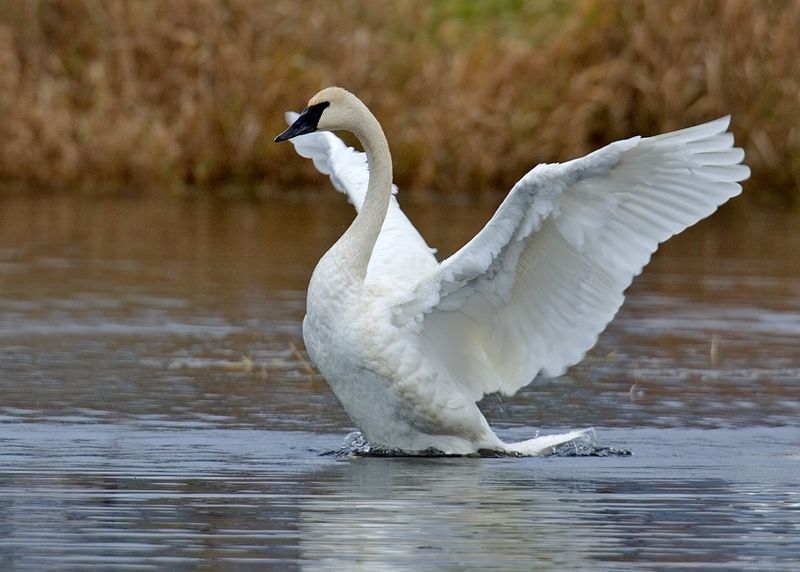
Trumpeter Swan (Cygnus buccinator) ©WikiC naturespicsonline

Trumpeter Swan (Cygnus buccinator) ©WikiC naturespicsonline

As transatlantic trade in fancy feathers burgeoned, the marketing of Trumpeter Swan plumage (as well as plumage of other large birds, such as flamingo, egret, heron, and many others), for fashionable female headgear, was driving the North American population of Trumpeter Swans toward regional extirpations and appeared aimed at a continental extinction, — unless regulatory brakes were somehow applied, with ameliorative conservation efforts to restore the population.

Many conservation efforts combined, to rescue the Trumpeter Swan’s perilous predicament,   four of which were:  (1) the Lacey Act of 1900, that banned trafficking in illegal wildlife; (2) the Migratory Bird Treaty Act of 1918, that implemented the migratory bird protection “convention” treaty, of AD1916, between America and Great Britain (f/b/o Canada); (3) President Franklin D. Roosevelt’s Executive Order 7023 (4-22-AD1935); and (4) the conservation-funding statute called the Federal Aid in Wildlife Restoration [Pittman-Robertson] Act of 1937.  For more on this last federal wildlife conservation-funding law, please review “Crayfish, Caribou, and Scientific Evidence in the Wild”, posted at http://www.icr.org/article/8775 ).

Saving America’s Trumpeter Swan from near-extinction is largely due – humanly speaking – to the establishment of the Red Rock Lakes Migratory Waterfowl Refuge (n/k/a “Red Rock Lakes National Wildlife Refuge”), part of the Greater Yellowstone ecosystem  —  located mostly within a 60-mile radius that includes portions of southwestern Montana, eastern Idaho, and northwestern Wyoming, including Yellowstone National Park, which itself includes a “Trumpeter Lake”.   The Trumpeters have enjoyed dwelling in the Red Rock Lakes neighborhood for generations —  for example, an aerial photograph during January AD1956 shows 80 of them on Culver Pond (east Culver Spring area, where warm spring waters, often found in the Greater Yellowstone Ecosystem, keep the pond from freezing), on a day when the outside air was -20 degrees Fahrenheit!  (See page 59 of Banko’s report, cited above.) This federal wildlife refuge was established by FDR’s presidential executive order (#7023), in AD1935, largely in reaction to the nadir-number of Trumpeter Swan count of less than 70 during AD1932.

Trumpeter Swan (Cygnus buccinator) by Daves BirdingPix

Trumpeter Swan (Cygnus buccinator) by Daves BirdingPix

According to the Red Rock Lakes National Wildlife Refuge’s official website (q.v., at http://www.fws.gov/refuge/Red_Rock_Lakes/about.html), this refuge now includes 51,386 acres, plus conservation easements totaling 23,806 acres, all of which blends into a marvelous mix of snowmelt-watered mountains, montane forests, flowing freshwater, and marshy meadows:

Red Rock Lakes National Wildlife Refuge has often been called the most beautiful national wildlife refuge in the United States. The rugged Centennial Mountains, rising to more than 10,000 feet, provide a dramatic backdrop for this extremely remote Refuge in Southwest Montana’s Centennial Valley. Red Rock Lakes NWR encompasses primarily high mountain, wetland-riparian habitat–the largest in the Greater Yellowstone Area– and is located near the headwaters of the Missouri River. Several creeks flow into the refuge, creating the impressive Upper Red Rock Lake, River Marsh, and Lower Red Rock Lake. The snows of winter replenish the refuge’s lakes and wetlands that provide secluded habitat for many wetland birds, including the trumpeter swan, white-faced ibis, and black-crowned night herons. The Refuge also includes wet meadows, willow riparian, grasslands, and forest habitats. This [ecological] diversity provides habitat for other species such as sandhill cranes, long-billed curlews, peregrine falcons, eagles, hawks, moose, badgers, bears, wolves, pronghorns and native fish such as Arctic grayling and westslope cutthroat trout.”    [Quoting from http://www.fws.gov/refuge/Red_Rock_Lakes/about.html ]

Trumpeter Swans are also seen afloat in lakes of Wyoming’s neighboring park, Grand Teton National Park, a scenic mountain-dominated park accented by the Snake River and Jackson Lake, and historically enjoyed, annually (in the summer), by many bankruptcy barristers (and their families), as they simultaneously attended the Norton Bankruptcy Law Institutes at Jackson Hole, Wyoming.  The Trumpeter pairs are often seen as isolated pairs, each “owning” its own lake, yet these swans also congregate in gregarious flocks, especially in the Red Rock Lakes area.

[Canadians, especially in British Columbia and Alberta, have also been intensively involved in serious efforts to conserve Canada’s population of Trumpeter Swans, for more than 65 years – but this birding report mostly notices and focuses on the Trumpeter conservation efforts in the United States.]

Has FDR’s Executive Order 7023 been followed by conservation and restoration success, for the Trumpeter Swan?   The U.S. Fish & Wildlife Service website reports a happy “yes”:
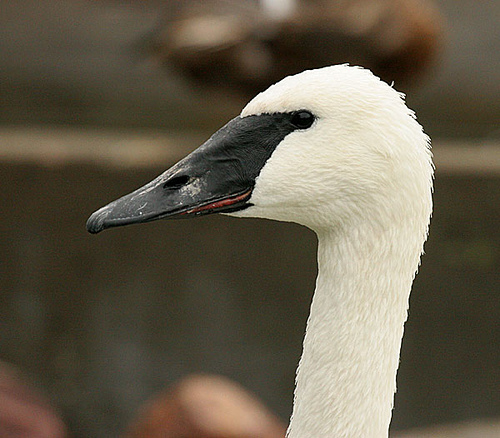
Trumpeter Swan (Cygnus buccinator) by Kent Nickel

Trumpeter Swan (Cygnus buccinator) by Kent Nickel

In 1932, fewer than 70 trumpeters were known to exist worldwide, at a location near Yellowstone National Park.  This led to the establishment of Red Rock Lakes National Wildlife Refuge in 1935.  Red Rock Lakes is located in Montana’s Centennial Valley and is part of the Greater Yellowstone ecosystem.  Nearly half of the known trumpeter swans in 1932 were found in this area.  Warm springs provide year-round open waters where swans find food and cover even in the coldest weather.  Today, estimates show about 46,225 trumpeter swans reside in North America, including some 26,790 in the Pacific Coast population (Alaska, Yukon, and NW British Columbia) which winter on the Pacific Coast; 8,950 in Canada; about 9,809 in the Midwest; and about 487 in the tri-state area of Idaho, Wyoming, and Montana (including the Red Rock Lakes refuge flock).”   [Quoting from http://www.fws.gov/refuge/Red_Rock_Lakes/about.html ]

Sounds like a winner to me  —   from less than 70 to more than 46,000!
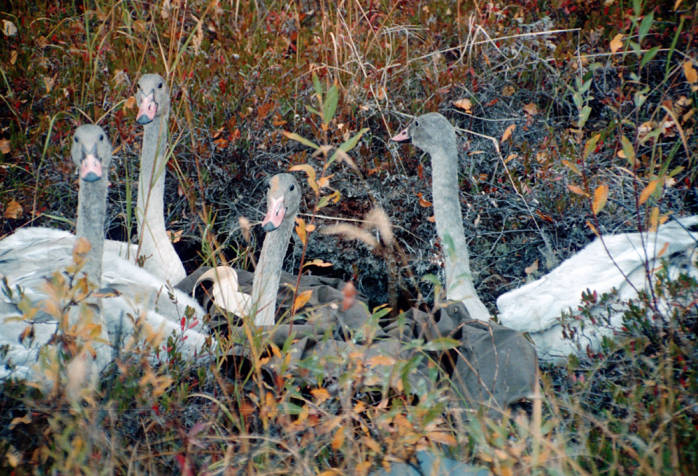
Trumpeter Swan (Cygnus buccinator) cygnets ©USFWS

Trumpeter Swan (Cygnus buccinator) cygnets ©USFWS

However, if only the wildlife conservation principle of Deuteronomy 22:6-7 (i.e., you can take the eggs and nestlings, but not the adult mother birds) had been practiced in North America, during the past 2 or 3 centuries, the continent’s Trumpeter Swan population would never have gotten so close to extinction.  Moses not only mandated restrictions on excessively hunting avian wildlife (Deuteronomy 22:6-7), Moses also banned imprudent deforestation (Deuteronomy 20:19-20).   Of course, creation conservation laws are always balanced to value human life over nonhuman life forms (Matthew 6:26-30; Psalm 8; Jonah 4:8-11).  Yet the promulgated priority of stewardly usage of God’s creation – because all of creation is God’s property, ultimately, not ours! — traces all the way back to Creation Week, because even Adam was put into Eden “to dress it and to keep it” (Genesis 2:15), and Noah managed the greatest biodiversity protection project ever (Genesis chapters 6-9).

Humans have been eating domesticated birds, such as chicken and turkey, ever since Noah’s family disembarked the Ark (Genesis 9:3).  People who raise domesticated fowl (such as chickens) are careful to preserve enough breeders so that they don’t eat up all of their fowl.  [This illustrates the old adage about balancing give and take: if your input exceeds your output, your upkeep is your downfall!]  Accordingly, chicken farmers avoid eating all of their chickens  — it’s important to protect the reproductive success of your chickens if you want poultry eggs and/or chicken meat to eat, on a continuing basis!  But what about wild birds?  The private ownership principle that guides common sense, in raising chickens and other domesticated fowl, doesn’t work so well with wild birds (especially migratory birds), because they are not privately “owned” – so they are a “public” resource vulnerable to irresponsible “tragedy-of-the-commons” depletion.

And most swans are wild, so greedy over-hunting can endanger their population success.

Providentially, the eating of wild birds, such as wild swans, was restricted under Mosaic law, for good reason  —  wild bird populations can be extinguished if one generation of hunters gets too greedy.
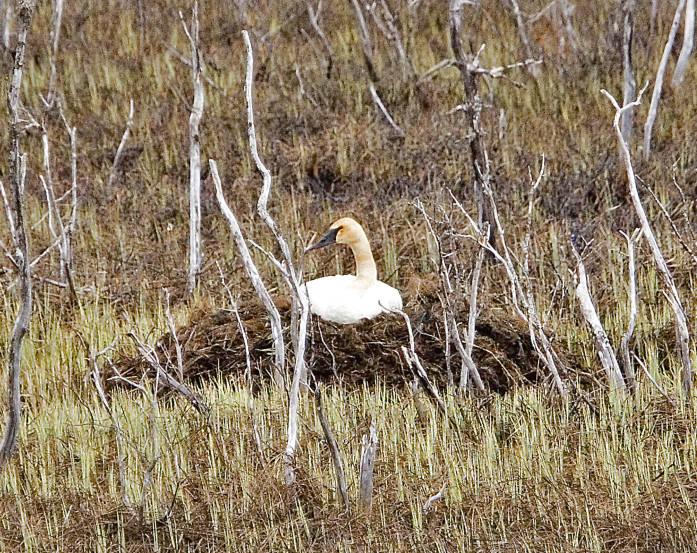
Trumpeter Swan (Cygnus buccinator) on nest ©USFWS

Trumpeter Swan (Cygnus buccinator) on nest ©USFWS

If a bird’s nest chance to be before you in the way, in any tree, or upon the ground, whether they be young one [i.e., nestling infant birds], or eggs [i.e., not-yet-hatched baby birds], and the mother [’em is the usual Hebrew noun for “mother”] sitting upon the young, or upon the eggs, you shall not take the mother with the young.  But you shall surely send forth the mother, and take the young [literally “children”] for yourself; that it may be well with you, and that you may prolong days.  Deuteronomy 22:6-7

This is a simple law of predator-prey dynamics:  if the predator population (i.e., the “eaters”) consume too many of the prey population (i.e., the “eatees”), the result is bad for both populations, because the prey population experiences negative population growth, a trend that can lead to its reproductive failure (and extirpation) if the excessive predation continues unabated.

Each generation of humans, therefore, needs to exercise wise stewardship of Earth’s food resources, so that adequate food resources will be available of posterity (i.e., later generations).  When greed leads to over-hunting, the foreseeable consequence is bad for both the birds (whose population declines, generationally) and the humans (whose food resources decline, generationally).

Sad to say, mankind’s track record for respecting and heeding God’s Word, as it teaches us to be godly stewards of His creation (and to use it in ways that glorify Him, its rightful and only true Owner), all-too-often misses the mark (Romans 3:23).

What slow learners we all-too-often are!   [For Genesis-based ecology perspectives, for this fallen “groaning” world, see http://www.icr.org/article/misreading-earths-groanings-why-evolutionists/ and  http://www.icr.org/article/7486/ and  http://www.icr.org/article/genesis-science-practical-not-just/  and  http://www.icr.org/article/why-we-want-go-home/ .]

Meanwhile, may God have mercy on the people of America, by restoring to us a serious and reverent respect for the whole counsel of God (Acts 20:27), that He has given us in the Holy Bible, His holy Word.  Only then, as we heartily heed His Word, will we properly appreciate and rightly treat His creation, including the Trumpeter Swan.  And, only then, will we properly revere and appreciate Him as our Creator (and Redeemer).  And living life responsibly on His earth, with that kind of reverence, would be far better than the fanciest feather in anyone’s cap!

by James J. S. Johnson

*

More articles by James J. S. Johnson

Orni-Theology

Good News

*

Here’s Seed for Thought

National Aviary - Outside feeder

National Aviary – Outside feeder

Here’s Seed for Thought

By James J. S. Johnson

Now the parable is this: The seed is the word of God. (Luke 8:11)

Being born again, not of corruptible seed, but of incorruptible, by the word of God, which liveth and abideth forever. (1st Peter 1:23)

Luzon Bleeding-heart by Dan

Orni-Theology

God’s Word is like good seed – it transmits God’s very thoughts into new life.

If we have eyes to see it, the whole process of seed germination (in a sunflower, or in a human life) is a providential God-glorifying miracle, every time new life germinates.

Sunflowers for Bird Brains article by Dr James J S Johnson

Sunflowers  [public domain]

When I see sunflowers growing in farm-fields, or elsewhere, I often recall how God sometimes uses “accidental” plantings, caused by birds who occasionally drop sunflower seeds, thereby planting a new generation of bright yellow sunflowers.

To illustrate, consider this poem, written almost 20 years ago.

BACKYARD BIRDS AND SUNFLOWER SEEDS

( © AD1997 James J. S. Johnson, used by permission )

Seeing hungry backyard birds
I filled a tray with seeds;
Sparrows, juncos dined in “herds”,
and jays arrived to feed;
Even cardinals, flashing red:
they came, they saw, they fed.

Bills gulped! seed-hulls popped!
Some seeds spilled! some seeds dropped!
Overhead, as some bird flew,
sunflower seeds did fall;
From green vines, they later grew,
seedlings, green and small.

Then out popped golden faces
Coloring grassy spaces;
Like baby suns of yellow,
Grinning — saying “hello”!
On green stalks they climb,
aiming to greet the sky;
Seed-packed in their prime,
picked by birds, going by.

Thus reaps my yard what jays did sow,
New seeds, from old, sunflowers grow.

Watch I, and think on what God made
How He designed such “mutual aid”…
In my backyard, I must surmise:
The Lord, Who did this, He is wise!

This poem was written when I lived in Carrollton, Texas, where I grew sunflowers by our backyard’s western fence, with the help of blue jay “planters” – but, of course, God gave the increase (1st Corinthians 3:7). (Those were the days, now like a faded dream gone by, when I taught ornithology and avian conservation at Dallas Christian College.)

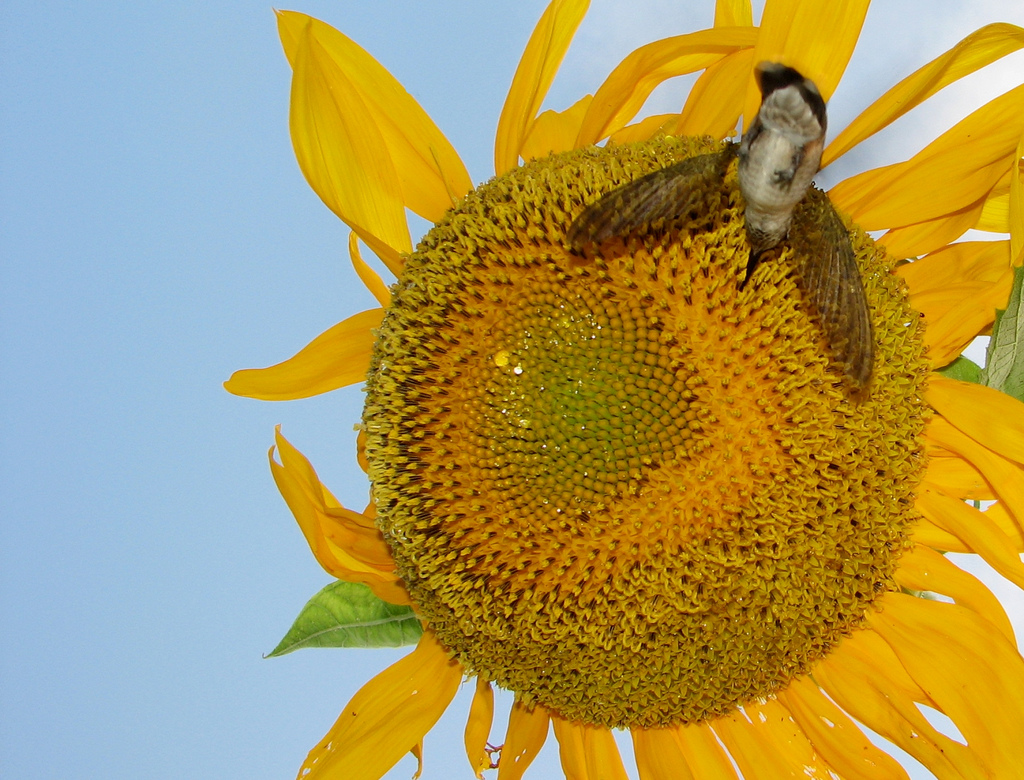
Ruby-throated on Sunflower ©©Frank Boston

Ruby-throated on Sunflower ©©Frank Boston

So, when you see bright-colored sunflowers — and the hungry birds who eat them, just remember this:  those same birds, or their parents, may have “accidently” planted the very seeds that germinated into the full-grown sunflowers that the birds now eat from!

Also, remember this also: God shows His wisdom and goodness, everywhere you look, — if you have the eyes to see it.

Furthermore, even more important, of course, is this: that “incorruptible seed” (to use the apostle Peter’s phrase) — that we call the Holy Bible – is the eternal Word of God, and He uses its truth to give us regenerated life in our Lord Jesus Christ (Who is Himself the Messiah, the promised “Seed of Woman”, prophesied of in Genesis3:15)!

><> JJSJ

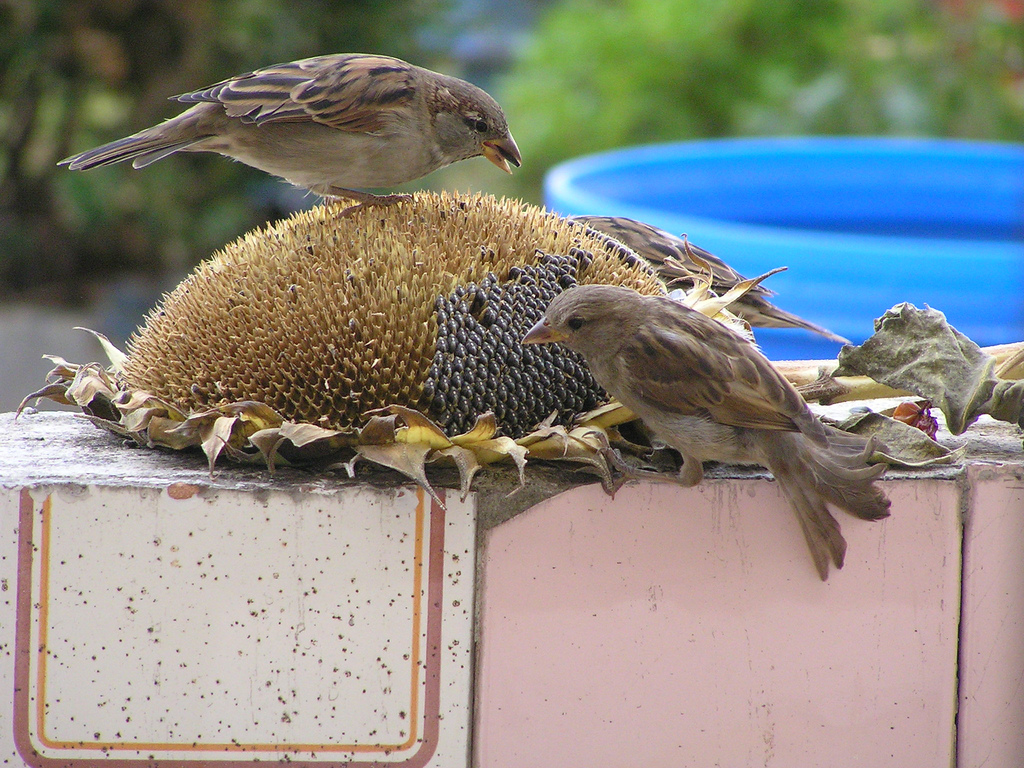
Sparrows Eating From A Sunflower ©©Sagudino Flickr

Sparrows Eating From A Sunflower ©©Sagudino Flickr


Lee’s Addition:

Thanks again, Dr. Jim. Enjoyed your poem and the application. In fact, there is a stalk or two of corn growing under my feeder because of the birds. Had a Sunflower or two last summer growing under the feeders.

Oh, that we all would feast on His Word!

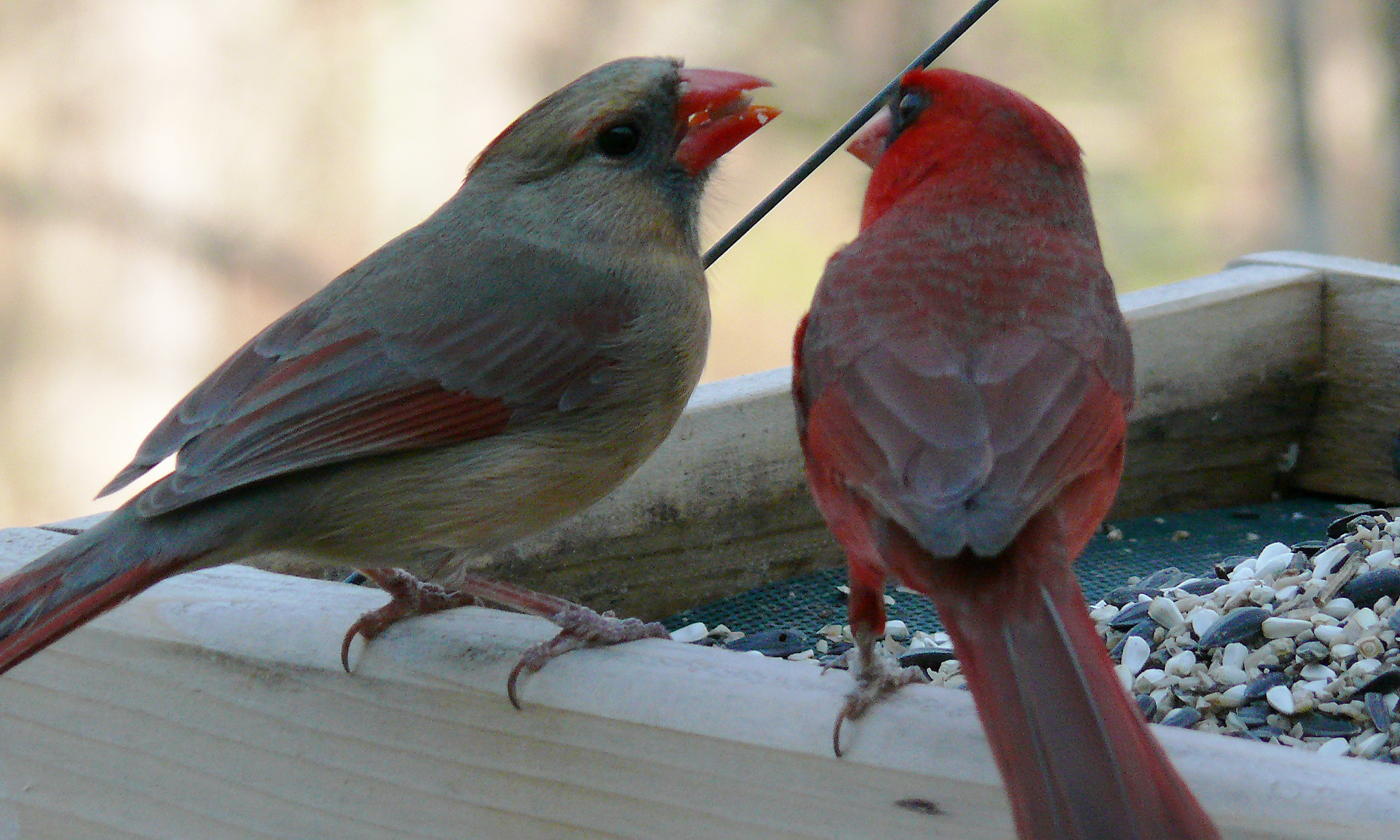
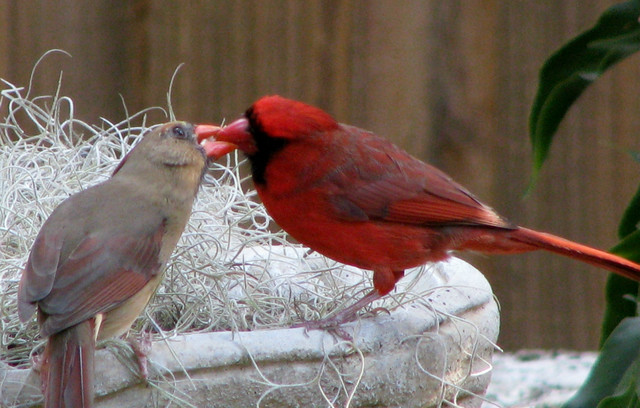
Northern Cardinal (Cardinalis cardinalis) Male and Female ©WikiC

Northern Cardinal (Cardinalis cardinalis) Male and Female ©WikiC

See:

Orni-Theology

James J.S. Johnson

*

Changed From The Inside Out

*

Appreciating Baltimore Orioles and My First Bird Book

“Behold the fowls of the air: for they sow not, neither do they reap, nor gather into barns; yet your heavenly Father feedeth them. Are ye not much better than they?”  Matthew 6:26

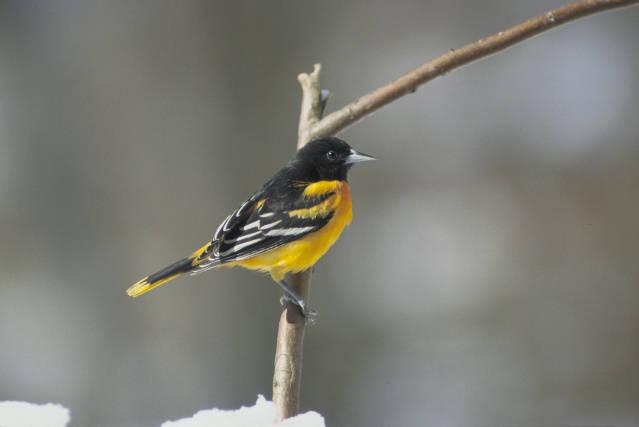
Baltimore Oriole (Icterus galbula) ©USFWS

Baltimore Oriole (Icterus galbula) ©USFWS

As beautiful and valuable as the Baltimore Oriole is—especially to Marylanders—God has made us children of Adam, even in our fallen (and redeemable) condition, “much better than they”. God truly cares for us and for our needs, including our need for truth and our need to belong to Him, through the saving merits of our Redeemer, the Lord Jesus.

Baltimore Oriole (Icterus galbula) Male by Nature's Hues

Baltimore Oriole (Icterus galbula) Male by Nature’s Hues

The Baltimore Oriole (Icterus galbula), a small migratory icterid (i.e., member of the blackbird family) is the state bird of Maryland. Adults grow to about 7 or 8 inches long. Migrating south for the winter, the Baltimore Orioles summer in most of America’s “lower 48” states, except not in the coastal southeast (from Texas’s Gulf coast up to Virginia’s coast). But the only orioles I saw were the pictures on baseball caps (and usually that came from looking at baseball cards)! As a small boy my family often listened to radio broadcasts of Baltimore Oriole baseball games.

597px-Orioles_new Baltimore Orioles Flickr Charlie Lyons-Pardue

Even the coloring of the Baltimore Oriole is appropriate, to represent the state of Maryland, because the state flag of Maryland has a combination of gold (or golden yellow), black, white, and red.

Flag of Maryland

Flag of Maryland

The Baltimore Oriole has three of those four colors—but no red. Although I was physically born outside of Maryland (at a very young age!), all of my boyhood and youth (20 years) were spent somewhere within the “Old Line State”. And, as described below, it was in Maryland where I received my first bird book, as well as where I first believed in the Creator of all birds: the Lord Jesus Christ, Who is both my Creator and my Savior. In the next few paragraphs I will briefly mention my introduction to the “creation controversy”, and how that topic was linked to my first bird book.

Creation can be controversial! Learning to appreciate Genesis, and its foundational truths, has been an ongoing adventure for me. As a pre-school child I was generally taught, by my parents, that the Holy Bible was God’s Word, and that God made everything, including me. Not until kindergarten, however, would I learn that some people disagreed about God being the Creator. There was no public kindergarten (in Waldorf, Maryland) when I was old enough to attend one, so my parents enrolled me in a private kindergarten taught by a Mrs. Wheeler, a local Baptist lady who taught in her home. (Mrs. Wheeler’s faith was “different” from that of my parents, but “not in a bad way … you’ll do fine at her school”.) Mrs. Wheeler always prayed reverently and thankfully when we had snacks. Mrs. Wheeler also taught that the Bible was God’s Word.

Magnet with clips stuck to it

Magnet with clips stuck to it

As a kindergartener I enjoyed learning to match words (specifically, nouns of concrete things) to alphabet letters, finding at least two words for each alphabet letter (when our class was assigned the task of finding one each!), until the letter X stumped me—x-ray was the only words that I know of, that started with an X. One day Mrs. Wheeler taught us to touch a magnet to various physical objects. Some were instantly attracted but others were not. Mrs. Wheeler’s college-attending daughter was there, that day, being home “on break”, so she was helping her mother with us kindergarteners. Probably not noticing that I was listening, the daughter asked (something like), “Why are you trying to teach them about magnets? Science like that is way over their heads. They won’t understand.” Mrs. Wheeler’s reply I will never forget: “Soon these kids will be taught that ‘science’, without God, explains life, and they will wonder if intelligent people should believe in God and the Bible. I want them to have a memory, from kindergarten, that the first person to teach them any ‘science’ was someone who believed in Jesus and the Bible, and who prayed with them.” Wow! That astounded me! When I went to “big school”, like my older brother, I would be taught to learn “science” but no Bible!—nothing about God. Why would “big school” be like that? So Mrs. Wheeler, with her daughter’s help, had just warned me that a godless version of “science” awaited me. In second grade, at Damascus (Maryland), I would learn more about this controversy.

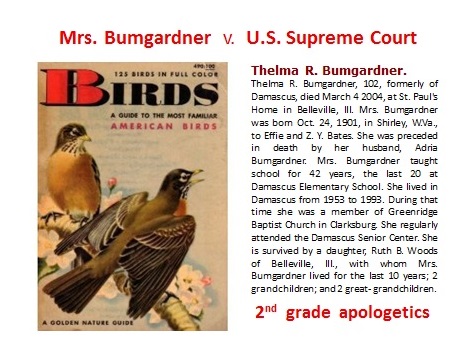
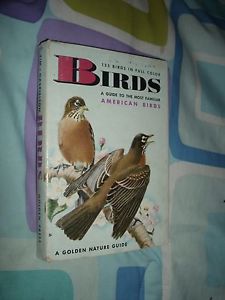
At the end of second grade, while being given my first bird book, I learned more Genesis apologetics, from Mrs. Thelma Bumgardner (see picture of the bird book, BIRDS, A GUIDE TO THE MOST FAMILIAR AMERICAN BIRDS [NY: Golden Press/Golden Nature Guide, 1964; co-authored by Herbert S. Zim & Ira N. Gabrielson; illustrated by James Gordon Irving; 160 pages].

Guide to Most Familiar Birds

Guide to Most Familiar Birds

The bird book I still have, to this day (shown above, next to her obituary notice). How did it happen? Why was it so important that I remember it now, more than a half-century later? It was Mrs. Bumgardner’s custom to give a bird book to one boy and to one girl, at the end of the school year. The privileged girl was Mary Kellogg; the privileged boy was me. When explaining the gift to me Mrs. Bumgardner said that the pictures would help me to learn about many beautiful birds that God made, and that He made them to live in different kinds of places and eat different kinds of foods. Then she turned to pages 12-13, which presented an official-looking Family Tree of Birds”, beginning with this sentence: “Birds developed from reptile ancestors millions of years ago, as internal structures and scaly legs still show.” Mrs. Bumgardner said that the chart was not true, that some people who didn’t like to admit that God made birds (like the Bible said He did) invented the chart to pretend that birds accidentally become what they are by something called “evolution”. “It’s all just a lie, so they won’t have to think about Who God is”, Mrs. Bumgardner warned me, “but don’t worry about the false ideas on those two pages—just enjoy the rest of the book, because the rest of the book teaches a lot of true facts about God’s birds.” Wow! Again I was surprised—who would think that liars would put pictures in a book so they could try to forget Who God is? The bird book is a treasure I never forgot—and I love it to this day.

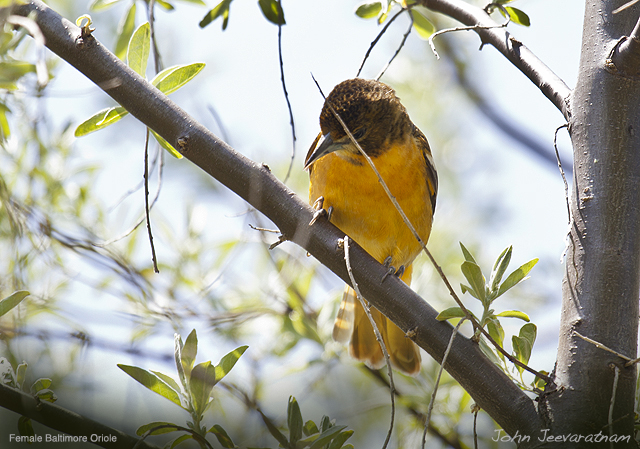
Perhaps you are wondering if my bird book included mention of the Baltimore Oriole. It did! On page 108, with a picture and range map, it says: “The brilliant male is a showy bird . The female is a dull orange-yellow with two pale wing bars. Bullock’s Oriole (8 in.) of the West is like the Baltimore but has orange on sides of head and over eye. The Orchard Oriole (6½ in.), east of the Rockies, is also similar, but with chestnut, not orange. The female Orchard Oriole resembles the female Baltimore but is greenish-yellow instead of orange-yellow.”

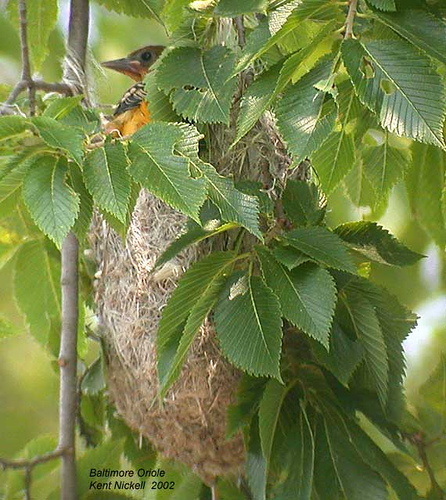
Speaking of orange, providing oranges (i.e., the citrus fruit), halved, is known to attract orioles—they love to eat fruits, such as oranges, berries, or even grape jelly. Leafy deciduous trees or thick shrub foliage might attract them to your backyard, especially if your backyard provides a “total package” of food, water, sheltering foliage, and trees suitable for their deep bag-like hanging nests. They immigrate north during in spring (late March or early April) and emigrate south in autumn.

Baltimore Oriole (Icterus galbula) on nest by Kent Nickell

Baltimore Oriole (Icterus galbula) on nest by Kent Nickell

Mrs. Bumgardner also taught us about John 3:16, which I would rely upon in a very personal away 3½ years later; she also would pray for us, telling us that she knew that the Supreme Court wouldn’t like that, but that the prophet Daniel was told not to pray and he did anyway—and God took care of Daniel, so He would take care of her. Still I remember knowing that Mrs. Bumgardner loved us second-graders, and she cared that we would learn to appreciate God, and it was obvious that she herself loved God and His Word. It was during the first half of my sixth grade year, however, before I would confirm my own personal belief in the Lord Jesus, as my personal Savior and Shepherd, but God foreknew that day was coming—and one day I will thank both Mrs. Wheeler and Mrs. Bumgardner, face-to-face, for caring enough to creatively teach me the truth about my Creator-God.

Meanwhile, ever since the end of second grade I have been enjoying my bird book (and many more that I have acquired since then), knowing how God cares about those beautiful birds—who have such variety. Yet He cares so much more for me (as John 3:16 proves).

What a wonderful start I was given to a happy habit of birdwatching (decades before I would ever teach ornithology at Dallas Christian College), — and Mrs. Bumgardner’s bird book disclaimer, by God’s providence, foreshadowed my later years as a teacher of Genesis-based creation studies!

Baltimore Oriole (Icterus galbula) Female by Nature's Hues

Baltimore Oriole (Icterus galbula) Female by Nature’s Hues

“Flag That Bird!” (Part 4)

“Flag That Bird!”  (Part 4)

He who has an ear, let him hear what the Spirit says unto the churches; unto him who overcomes will I give to eat of the tree of life, which is in the midst of the paradise of God.   (Revelation 2:7)

Luzon Bleeding-heart by Dan

Orni-Theology

The time will eventually come when the words “tree” and “paradise” coincide, in a truly heavenly way.  But until then, we do have a bird of “paradise” that is known for habituating trees, especially the tropical trees of Papua New Guinea.  Various birds, each known as a Bird of paradise, are known for their flamboyant color and beauty, especially long, thin, streamer-like tail feathers that show off the bird’s fancy status as a flying exhibit of heavenly design and construction.

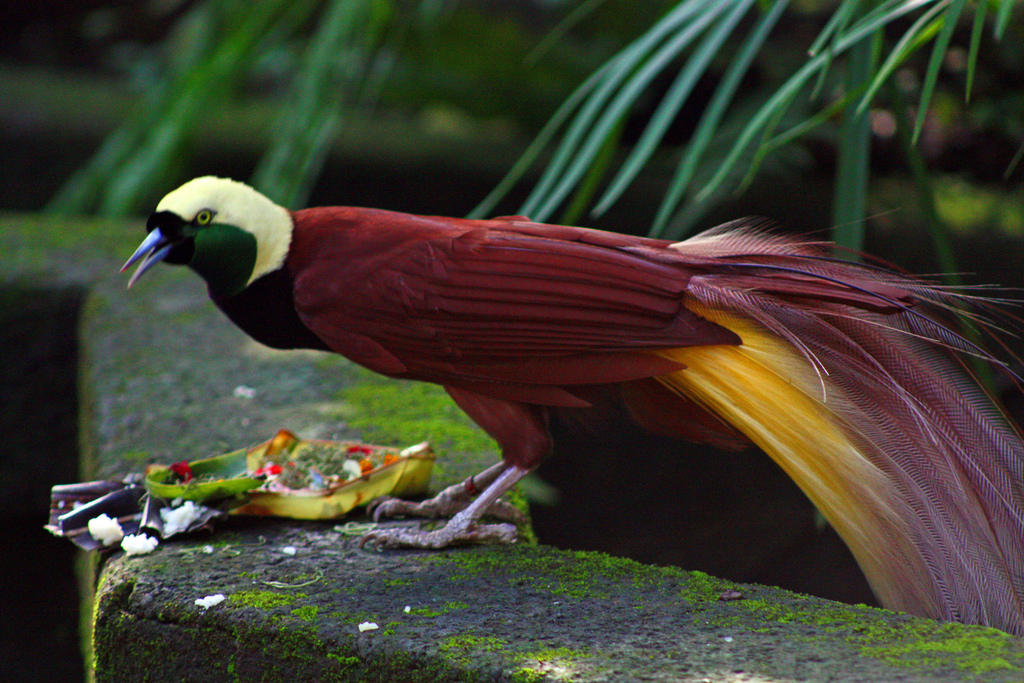
The first of today’s featured creatures, the Raggiana Bird-of-Paradise (Paradisaea raggiana), is a tropical rainforest bird with feathery flamboyance.  Indeed, extravagant feathers are commonplace for birds-of-paradise, and this variety sports scarlet red, bright green, lemon yellow, black, combined to maroonish-mauve/rusty-brown, comprising a challenge for any wildlife painter!

Raggiana Bird-of-paradise (Paradisaea raggiana) ©WikiC

Raggiana Bird-of-paradise (Paradisaea raggiana) ©WikiC

However, as beautiful as Bird-of-Paradise feathers may be, be cautious about buying their feathers from any foreign vendors, because commercial exporting transactions involving these birds are regulated according to Appendix II of a wildlife protection treaty called “Convention on International Trade in Endangered Species of Wild Fauna and Flora” (a/k/a the “Washington Convention”, usually abbreviated as “CITES” – opened for signature AD1973, adopted by USA  in AD1975).  The USA vigorously enforces CITES protections , internationally, by investigating, arresting, and prosecuting poachers who violate the endangered species provisions of the CITES treaty.

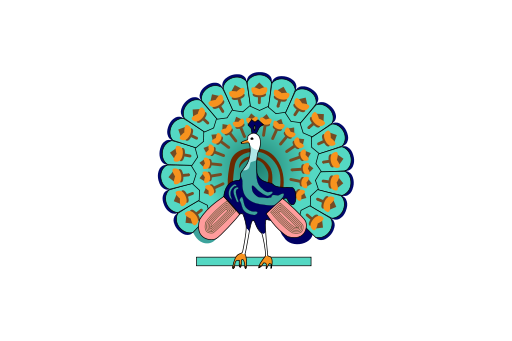
In Flag Those Birds! (Part 1)”,  we considered 4 “banner birds”  –  besides eagles  –  that appear on national flags:  Belgium’s Wallonian Chicken (Gallus gallus domesticus); Portugal’s Northern Goshawk (Accipiter gentilis); Burma’s Green Peafowl (Pavo muticus); and Dominica’s Sisserou Parrot (Amazona imperialis).  In Flag Those Birds! (Part 2)”,  we reviewed 2 more “banner birds”:  the British Antarctic Territory’s Emperor Penguin (Aptenodytes forsteri), and the Saint Helena Plover, a/k/a Saint Helena’s skinny-legged “Wirebird” (Charadrius sanctaehelenae).  In Flag That Bird! (Part 3)”,  we showcased 1 more “banner bird”:  Kiribati’s Great Frigatebird Emperor Penguin (Fregata minor), as well as the importance and popularity of Mother’s Day.

In this posting, we have two more “banner birds”:  Papua New Guinea’s bird of paradise, featured on the flag of Papua New Guinea, and the ubiquitous dove, featured on Fiji’s flag (as well as on the royal standard of Tonga).  God willing, we will subsequently review the black swan of Western Australia, the piping shrike of South Australia, the condor of Bolivia; and Uganda’s crested crane.

So for now, let us resume our series with Papua New Guinea’s Raggiana Bird of Paradise (Paradisaea raggiana).

Raggiana Bird-of-Paradise (Paradisaea raggiana, f/k/a Gerrus paradisaea).

Raggiana Bird-of-paradise (Paradisaea raggiana) ©WikiC

Raggiana Bird-of-paradise (Paradisaea raggiana) ©WikiC

Birds-of-paradise routinely eat a diet of fruits and bugs, which are plentiful in New Guinea jungles, so no one should expect birds-of-paradise to miss a meal, much less to starve in their tropical habitats!  Birds-of-paradise are known to hybridise, in the wild, wreaking havoc on taxonomy charts.  [See David Chandler & Dominic Couzens, 100 Birds to See Before You Die:  The Ultimate Wish List for Birders Everywhere (San Diego, CA: Thunder Bay Press, 2008), page 207.]

Raggiana birds-of-paradise especially appreciate tropical fruit, including nutmeg.  After eating jungle fruits the birds-of-paradise serve fruit-trees by dispersing the seeds, post-digestion, with natural “fertilizer”, and thereby promote the planting of the next generation of fruit trees, which eventually germinate and fruit somewhere within the range of the tree-planting bird-of-paradise.

Raggiana Bird-of-paradise (Paradisaea raggiana) by Dan

Raggiana Bird-of-paradise (Paradisaea raggiana) Lowry Park Zoo by Dan

The Raggiana Bird of Paradise (a/k/a “Count Raggi’s bird-of-paradise”, being named for Marquis Francis Raggi of Genoa, Italy) is the national bird of Papua New Guinea, since AD1971, when it was included on that nation’s national flag and coat-of-arms.

Flag of Papua New Guinea ©PD

Flag of Papua New Guinea ©PD

The next “banner bird” is a dove (which is really a family of similar birds), the most common species of which is the ubiquitous Rock Dove (Columbia livia), a species that includes within it a domesticated subspecies (i.e., breeder’s variety) called the homing pigeon (Columbia livia domestica  –  a/k/a “carrier pigeons” when they carry messages), many of which are completely white.

Of course the world is home to many other common doves and pigeons (e.g., Mourning Dove, Key West Quail-Dove, Inca Dove, White-winged Dove, various Turtle Doves, etc.), but earlier comments about doves and pigeons are now cited, rather than being repeated here,  [See, for examples, Lee’s Birdwatching dove articles at Birds of the Bible – Dove and Turtle Dove,  Birds of the Bible – Descending Like A Dove, and Birds of the Bible – Dove and Pigeon Distribution  —  as well as brief comments on the Mourning Dove (Zenaida macroura), while recalling a wonderful morning of bird-watching (with Chaplain Bob and Marcia Webel) in Pond-side Birdwatching In Florida III.]

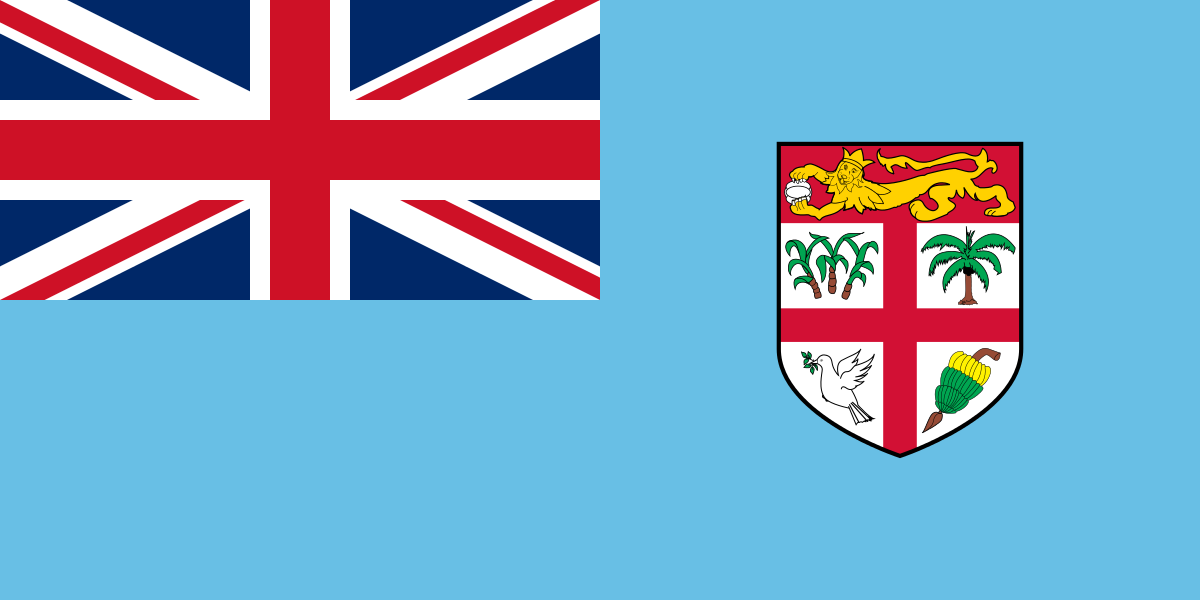
Flag of Fiji ©PD

Flag of Fiji ©PD

A completely white “dove of peace” appears on the flag of Fiji.  But what variety of “dove” is it?  (Well, it looks like it could be a white homing pigeon, but is that what the Fiji flag designers had in mind?)

Fiji is a tropical archipelago (i.e., cluster of islands) in the South Pacific Ocean.  Ironically, the special habitat of the Fiji archipelago is the only “home” for 3 endemic varieties of fruit-eating doves (a/k/a “fruit doves” or “fruit pigeons”): the Orange Fruit Dove (Ptilinopus victor, a/k/a Flame Dove), Golden Fruit Dove (Ptilinopus luteovirens, a/k/a Lemon Dove or Yellow Dove), and Whistling Fruit Dove (Ptilinopus layardi, a/k/a Velvet Dove or Yellow-headed Dove), —  yet none of those doves are completely white.

So the Fiji flag’s white dove, which derives from the coat-of-arms of the Kingdom of Fiji (AD1871-AD1874), does not match any particular variety of dove that is endemic to the Fiji islands.

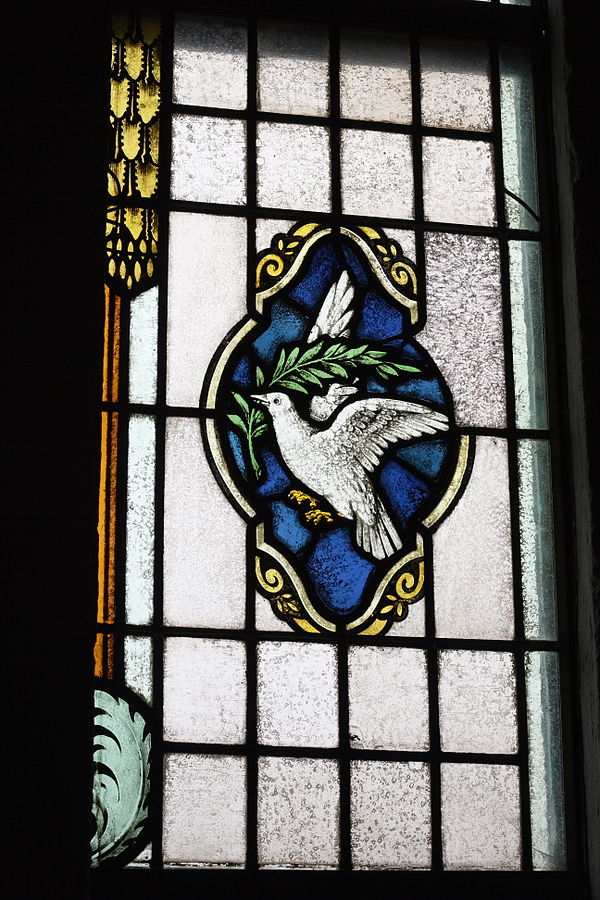
White Dove With Olive Branch - Stained Glass ©WikiC

White Dove With Olive Branch – Stained Glass ©WikiC

[ image taken from http://en.wikipedia.org/wiki/Doves_as_symbols ]

The olive leaf branch in the white dove’s beak suggests that the dove portrayed (in the flag of Fiji) is the olive-bearing dove that Noah released, received, and released again (see Genesis 8:8-12), which Ark-borne dove many have guessed was all white (although the Bible says nothing about that dove’s color).  Likewise, the royal standard of Tonga depicts a similar all-white dove, bearing a green olive leaf.

Royal Standard of Tonga

Royal Standard of Tonga

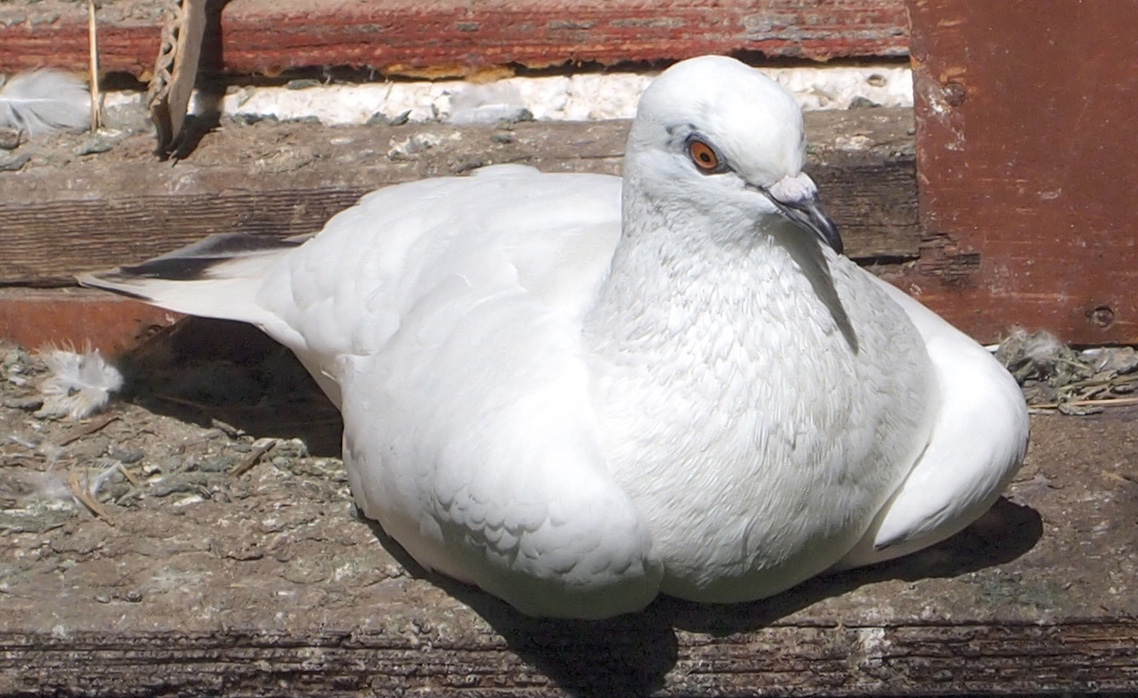
There are, of course, some doves that are completely white.  As noted above, one example of a pure-white dove is the white homing pigeon. That is as good a guess as many.  After all, homing pigeons are famous for returning “home”, and the olive-bearing dove returned home (to its “house-boat”) after the Flood, — so maybe Noah’s famous dove was a homing pigeon!

White Homing Pigeon © WikiC

White Homing Pigeon © WikiC

But we probably need to wait — until we have a chance to speak with Noah, himself, because Noah was the bird-handling one (of only 8 humans) who personally knows which variety of “dove” brought back that famous olive leaf unto him, after the year-long global Flood.  (What a voyage those 8 had!)  And the world’s people-groups, to this day, have multifarious records (usually literary, but not always) of remembering the unique ocean voyage that those 8 survivors took, some 4½ thousand years ago  —  as is briefly illustrated in “Genesis in Chinese Pictographs” (posted at www.icr.org/article/8643 ).  For a thoroughly researched and documented cornucopia of ancient flood accounts, see Dr. Bill Cooper’s THE AUTHENTICITY OF THE BOOK OF GENESIS (Creation Science Movement, 2011 — available through http://www.csm.org.uk ), 424 pages.

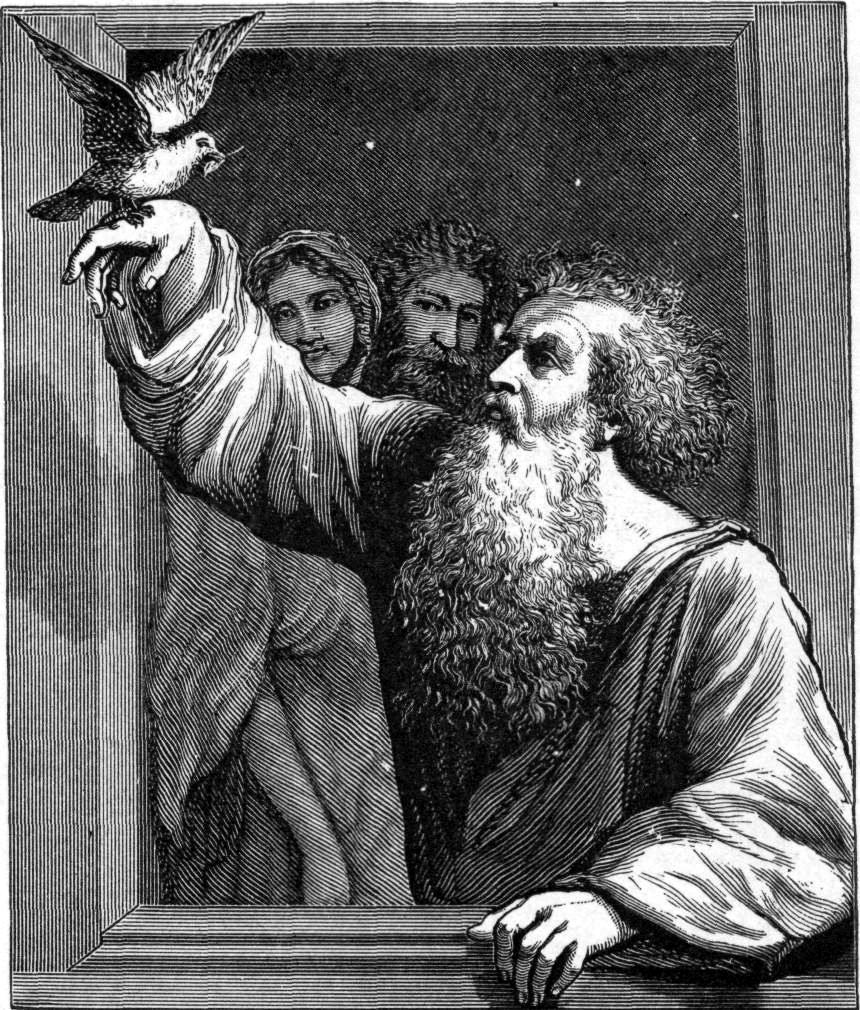
Noah with a Dove ©Drawing WikiC

Noah with a Dove ©Drawing WikiC

And the dove came in to him in the evening; and, lo, in her mouth was an olive leaf plucked off; so Noah knew that the waters were abated from off the earth.  And he [i.e., Noah] stayed yet other 7 days; and sent forth the dove, which returned not again unto him anymore.  (Genesis 8:11-2)

With those short comments, as Noah did centuries ago (Genesis 8:12), we now “release” the dove into the wide wild world, where many of that tribe thrive, faithfully being fruitful, multiplying, and filling the earth (Genesis 1:22 & 9:8-12).

Another day, God willing, we shall consider the black swan of Western Australia,  the piping shrike of South Australia,  the condor of Bolivia,  and Uganda’s crested crane.  So please stay tuned!

*

“Flag That Bird!”  (Part 1)

“Flag That Bird!”  (Part 2)

“Flag That Bird!”  (Part 3)

More Articles by James J. S. Johnson

Orni-Theology

*

“Flag That Bird!” (Part 3)

“Flag that bird!”  (Part 3)

 As birds flying [‘aphôth = “winging” in air], so will the Lord of hosts defend Jerusalem; defending also He will deliver it; and passing over He will preserve it. (Isaiah 31:5)

Luzon Bleeding-heart by Dan

Orni-Theology

Some birds are known for perching – we call them passerines.  Some wade in shoreline tidewaters – we call them waders.  Some birds don’t even fly at all – the flightless penguins only “fly” underwater!  Many other birds, however, we rarely see doing anything but flying — winging in the air (to use the Biblical Hebrew’s word-picture). Today’s featured creature, the Great Frigatebird, is truly a bird of flight – it is conspicuous in the air, and its wings are both acrobatic and enormous. Great Frigatebird (Fregata minor) Female by Ian In Flag those Birds! (Part 1)”,  we considered 4 “banner birds”  –  besides globally popular eagles  –  that appear on national flags:  Belgium’s Wallonian Chicken (Gallus gallus domesticus); Portugal’s Northern Goshawk (Accipiter gentilis); Burma’s Green Peafowl (Pavo muticus); and Dominica’s Sisserou Parrot (Amazona imperialis). In Flag those Birds! (Part 2)”,  we considered 2 more “banner birds”:  the British Antarctic Territory’s Emperor Penguin (Aptenodytes forsteri), and the Saint Helena Plover, a/k/a Saint Helena’s skinny-legged “Wirebird” (Charadrius sanctaehelenae). As promised, this mini-series is continuing with more “flagged birds”, this time, with the Great Frigatebird (Fregata minor), the soaring seabird officially featured on the flag of Kiribati, a Pacific Ocean nation. God willing, we will subsequently review Papua New Guinea’s bird of paradise (on the flag of Papua New Guinea), the ubiquitous dove (on Fiji’s flag, as well as on the royal standard of Tonga), the black swan of Western Australia,  the white piping shrike of South Australia,  the condor of Bolivia;  and Uganda’s crested crane. So for now, let us consider the frigatebird, which appears on the flag of Kiribati. In case you haven’t visited Kiribati yet, the Republic of Kiribati is an archipelago  —  a cluster of islands — located in the middle of the Pacific Ocean.  Specifically it is comprised of 34 islands, one of which (Banaba) is a “raised coral” island, and the rest of which are reef islands or atolls. The term “middle” (in the phrase “middle of the Pacific”) is fitting, because Kiribati straddles the equator and the International Date Line. To avoid confusion about what “day” it is, — because it would be awkward for neighboring islands to be simultaneously experiencing different “days” on the calendar (e.g., some government offices were closed, observing Sunday, while others were open for business, observing Monday!), — the International Date Line is indented, so that now the Kiribati Islands are, technically speaking, Earth’s farthest frontal time zone (called “UTC+14”, meaning “Universal Time Coordinated”, a/k/a Coordinated Universal Time, f/k/a Universal Time [UT] or Greenwich Mean Time [GMT], — so UTC+14 is 14 hours ahead of the time observed in Greenwich, London,  at the Royal Observatory).   Sorry for taking so much time on this digression’s details. 

Great Frigatebird (Fregata minor) pair ©Flickr Len Blumin

Great Frigatebird (Fregata minor) pair ©Flickr Len Blumin

Interestingly, Kiribati’s time-of-day matches that of Hawaii – but it is deemed one “day” ahead on the calendar.  (Hawaii’s time zone is very “late” in the Earth’s rotational “day”,  a fact that I recall because I worked with some lawyers who took advantage of that once — when a contract option deadline appeared to be lost, because locking in a particular contract option required a signature before 5:00pm on a certain day, but no time zone was specified – the solution was to FAX the contract papers to the Hawaii office and have them signed there, before it was 5:00pm Hawaii time!). Previously Kiribati was within (and almost synonymous with) the Gilbert Islands, just west of the old “date line” – when it was a British colony.  (In fact, the name “Kiribati” is how the native language says “Gilberts”.)   And, if you think that is confusing, you should check out how “daylight saving time” (which may locally vary from “UTC” time, during parts of the year) is applied in the central Pacific Ocean and to some of the neighboring island nations, such as Tonga, Samoa, and Tokelau!

Great Frigatebird (Fregata minor) Male ©WikiC

Great Frigatebird (Fregata minor) Male ©WikiC

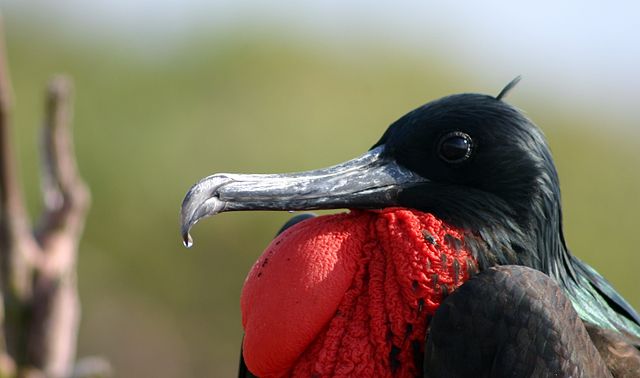
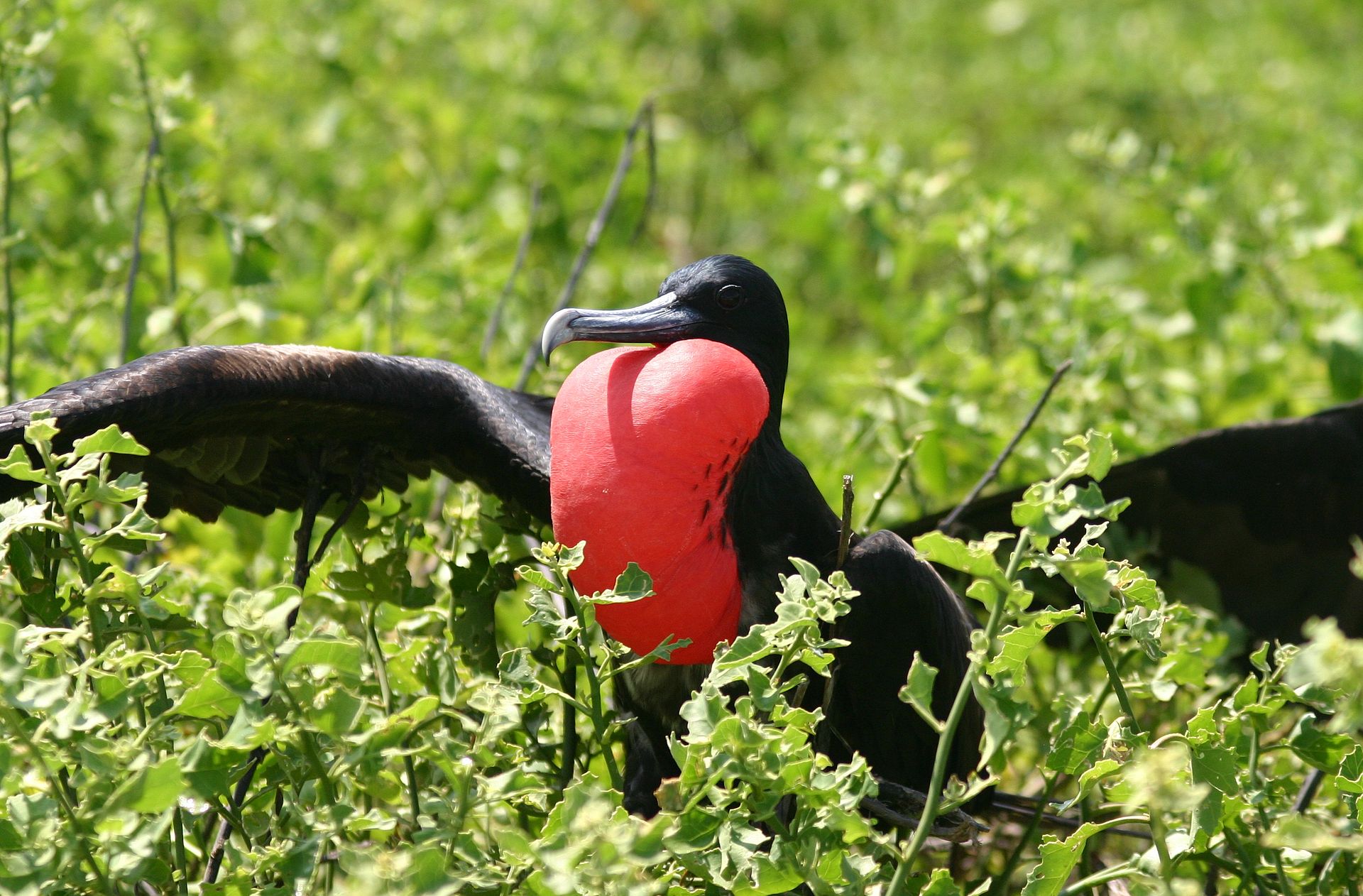
Great Frigatebird (Fregata minor).  The Great Frigatebird is found soaring above tropical oceans all over the world.  Because it is almost always seen at sea, it is not surprising that English sailors (centuries ago) called it the “man-of-war”, a term that indicated a fast-sailing oceanic warship, the same kind of ship that the French called a “frigate” (la frégate). If you ever watch a frigatebird in the air, contextualized by a background (or foreground) that provides distance indexing – as I once did (a Magnificent Frigatebird “cousin”, actually, near the shoreline of Grand Cayman, one of the Cayman Islands), – you too will be impressed with the frigatebird’s speedy flight maneuvers.  In fact, its habit of stealing food (such as fish) from other seabirds is so well-known that the bird might have been better labeled the “pirate-bird”.   Why?  Frigatebirds often harass seagulls carrying fish, in the air, repeatedly, until the seagull drops – abandons – his or her piscatorial food-catch, in order to escape the threatening frigatebird.  As the bullied victim (seagull) flees the scene of the crime, empty-beaked, the buccaneering frigatebird swoops down after the plummeting food, snatching it out of the air before it drops into the water. The physical appearance of a frigatebird is not to be easily forgotten.  Frigatebirds are mostly black, with long angular wings, with a long sharply forked tail that looks pointed when “closed”.  (Males are almost all black, except for the red gular pouch (described below); the females have a white “bib” covering most of the neck-to-chest area (but have no gular pouch).  Frigatebirds “have long, thin, hooked bills and the males [each] possess an inflatable gular pouch which can be blown up to form a huge scarlet ball during courtship”.  [Quoting Marc Dando, Michael Burchett, & Geoffrey Waller, SeaLife, a Complete Guide to the Marine Environment (Smithsonian Institute Press, 1996), page 248.]  The male’s bright red “gular pouch” is a skin-covered (i.e., featherless) inflatable throat sac that connects the lower half of the bird’s beak down to and below the bird’s neck.  This inflatable throat sac, quite conspicuous during breeding season, is showcased during courtship displays, swelling into a balloon-like inflation (like a bullfrog), for a timeframe that may exceed 15 minutes!  The noise produced by this throat sac “sound-box” is the frigatebird’s rattling equivalent to yodeling.

Great Frigatebird (Fregata minor) Male Displaying ©WikiC

Great Frigatebird (Fregata minor) Male Displaying ©WikiC

The Great Frigatebird is usually seen soaring above ocean waters, or swooping through the air near island beaches, looking (“on the fly”) for a meal.  In fact, frigatebirds are rarely seen on land during daylight, though they must use land for sleeping and for nesting activities, such as laying and hatching their eggs.  [See www.icr.org/article/why-we-want-go-home/ — citing Tony Soper, Oceans of Birds (London:  David & Charles Press, 1989), pages 82-83.] Oceanographer Tony Soper describes the winged magnificence of this oceanic flier:  “Frigatebirds live up to their reputation [i.e., “frigate” = seafaring warship] with spectacular manoeuvres in aerial pursuit and piracy, stalling and turning with total control in a way which outclasses any competition.  Supremely aerial seabirds, they can hang seemingly motionless in the sky for hours [gliding], waiting to pounce.  The air is their daytime medium, they alight on the water only at their peril, for they have small oil glands and their plumage is not waterproof. … They are equally at a disadvantage on dry land, for their legs are short and hopelessly inadequate for walking.  They must shuffle and climb to a point from which they can take off [and “land” on a rising thermal air current, as if it was an elevator].  By night they roost on a tree or bush which offers a convenient launch-pad when the sunrise brings a thermal lift.  They have huge wings, up to 7ft. (2.1m) in span….  With their shapely wings they float effortlessly in dynamic soaring flight, plunging only to retrieve food items from the surface or to snatch a flying fish.  Sometimes they chase other seabirds to relieve [i.e., rob] them of their catch. “   [Quoting Tony Soper, Oceans of Birds (London:  David & Charles Press, 1989), pages 82-83.] Frigatebirds congregate in breeding colonies, often near colonies of other seabirds (such as cormorants, pelicans, and boobies), not infrequently mooching food collected by their avian neighbors.

Republic of Kiribati, adopted AD1979 ©PD

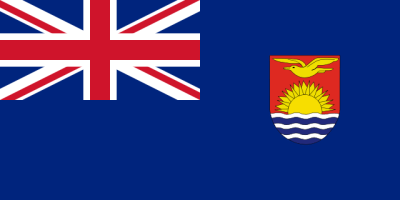
The frigatebird appears to be soaring in sunrise-dominated sky above the ocean waters, in the colorful flag of Kiribati, with the three white stripes representing the three island subsets of Kiribati, the Gilbert Islands, Phoenix Islands, and some of the Line Islands.   (The national coat-of-arms is similar.) Earlier, when Kiribati belonged to the British colony of “Gilbert and Ellice Islands”, the colonial flag included the image of a yellow frigatebird (within a coat-of-arms emblem) soaring in the sunrise above ocean waters.

Gilbert and Ellice Island, as a British colony, AD1937 ©PD

Gilbert and Ellice Island, as a British colony, AD1937 ©PD

Kiribati is a nation that celebrates its past, including its providential heritage as a colony Christianized by the British.  Its official public holidays not only include Easter (celebrating the resurrection of the Lord Jesus Christ) and related days (“Good Friday”, “Holy Saturday”, and “Easter Monday”)), as well as Christmas (celebrating the birth of the Lord Jesus Christ), but also “Gospel Day” (a moveable holiday scheduled on or near July 11th), to celebrate the coming of the Christian faith to these Pacific islands, thanks to God sending Christian missionaries.  Now that’s a day worth celebrating! (See Romans 10:20.) Other national holidays celebrate elderly men (“Unimwane Day”), elderly women (“Unaine Day”),  youth (“Youth Day”), servants (“Boxing Day” – for giving boxed Christmas presents to men and women who serve), and women in general (“International Women’s Day”).   So why not have a holiday to celebrate the value of men in general?  Maybe the omission should be compared to the difference between Mother’s Day and Father’s Day, as they are celebrated in most churches.  On Mother’s Day the typical sermon raves about how wonderful and precious mothers are (and they are applauded, given roses, etc.),  —  but on Father’s Day the typical sermon castigates men for being such sorry fathers, failing, failing, and failing yet again to carry their paternal responsibilities properly — why won’t they do a better job?  (Yet consider this related fact about ingrates:  God the Heavenly Father, Who never fails, knows the ugly ingratitude of billions of humans who fail to appreciate His wonderful, caring providences.  The Lord Jesus was a “man of sorrows”, the Holy Spirit is sometimes “grieved”, and surely God the Father is often disappointed.) The next scheduled bird, on this mini-series list, is the Bird of Paradise, but that bird must wait for another day.  Please stay tuned (and don’t forget Mother’s Day)!

*

“Flag That Bird!”  (Part 1)

“Flag That Bird!”  (Part 2)

More Articles by James J. S. Johnson

Orni-Theology

Fregatidae – Frigatebirds Family

*

“Flag That Bird!” (Part 2)

“Flag those birds!”  (Part 2)

And Moses built an altar and called the name of it Jehovah-nissi [i.e., the LORD is my banner]. (Exodus 17:15)

Luzon Bleeding-heart by Dan

Orni-Theology

In Flag that Bird! (Part 1)”, we considered 4 “banner birds”  –  besides globally popular eagles  –  that appear on national flags:  Belgium’s Wallonian Chicken (Gallus gallus domesticus); Portugal’s Northern Goshawk (Accipiter gentilis); Burma’s Green Peafowl (Pavo muticus); and Dominica’s Sisserou Parrot (Amazona imperialis).

As promised, this mini-series will continue with more “flagged birds”, namely, British Antarctic Territory (penguin);  Saint Helena, British crown colony in the southeastern Atlantic Ocean (Saint Helena Plover, a/k/a “wirebird”);  Kiribati (frigatebird);  Papua New Guinea (bird of paradise);  Fiji, as well as the royal standard of Tonga (dove);  Australian state of Western Australia (black swan);  Australian state of South Australia (iping shrike);  Bolivia (condor);  and Uganda (crested crane).

In this particular installment, 2 more (of those just listed) will be introduced.

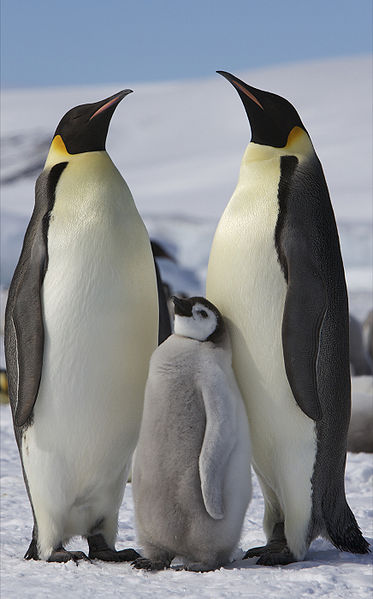
So now, consider the penguin – avian icon of the British Antarctic Territory.

Emperor Penguin (Aptenodytes forsteri) ©WikiC


Emperor Penguin (Aptenodytes forsteri).  There are a variety of penguins that live in the Antarctic regions, yet it is the Emperor Penguin featured on the official coat-of-arms of the British Antarctic Territory, and that coat-of-arms is what appears on the territory’s official flag, next to the Union Jack (on a white background).

British Antarctic Territory - Union Jack with Emperor Penguin ©PD

British Antarctic Territory – Union Jack with Emperor Penguin ©PD

The British explorers of the Antarctic regions include Captain Robert Falcon Scott and Ernest Shackleton, who led an expedition using their research ship RRS Discovery (AD1901-AD1904), a symbol of which ship appears on the heraldic crest of that territory’s coat-of-arms.

Captain Scott’s second expedition (using the Terra Nova, AD1910-AD1913), to explore Antarctica, was disappointing for two reasons: (1) Roald Amundsen’s Norwegian exploration party had just “beat” the Brits to the South Pole, on 14 December of AD1911; and (2) Scott’s expedition party died in the wild weather of Antarctica near the end of March that year, on the Ross Ice Shelf, about 150 miles from their base camp.

Of interest to Biblical creationists, Captain Scott collected about 35 pounds of plant fossils in Antarctica, proving that Antarctica was previously forested (obviously under milder climate conditions!).  Regarding the importance of forests in Antarctica, see Buddy Davis’s article “Forest in Antarctica After the Flood?”, citing National Science Foundation Press Release (8-4-2008), “Antarctic Fossils Paint a Picture of a Much Warmer Continent”.

Ironically, the Discovery and Terra Nova research ventures were both intended to support Darwin’s theory of evolution, but the evidence refused to cooperate!  This surprise (to the evolutionists) is summarized by a BBC reporter, Megan Lane (in BBC News magazine, 2 November, 2011), as follows: “Of the 2,000 specimens of animals collected by Scott and his team – 400 of which were newly discovered – the jewel in the crown was a trio of Emperor penguin eggs.  It was hoped [by Darwinism supporters] that these would provide long-awaited proof of Darwin’s theory of evolution.  At the time, it was thought [by evolutionists that] an embryo passed through all [“phylogenetic”] stages of its species’ evolution as it developed.  And as the [British evolutionists] assumed the flightless Emperor penguin to be the world’s most primitive bird, they hoped the embryos in these eggs would show the link between dinosaurs and birds.  The birds had been seen before, but never with their eggs.  ‘It was the greatest [sic] biological quest of its day,’ says polar historian David Wilson, whose great-uncle, Edward Wilson, was Scott’s naturalist. ‘Then they collected the eggs, and all the theories turned out to be wrong’.”  [Quoting BBC’s Megan Lane.]  Amazingly, the “dinosaur-morphs-into-modern-birds” fairy tale is still being fabricated today, through science fiction movies (like Jurassic Park) and via dinosaur DNA evidence spoliation.  [Regarding how dinosaur DNA evidence is being censored, in academic/research circles, to avoid spoiling evolutionist mythology, see the multi-authored ICR article posted at www.icr.org/article/4947 .]

The next bird on this list is the Saint Helena Plover, locally nicknamed the “wirebird” (due to its wiry-thin legs).

St. Helena Plover (Charadrius sanctaehelenae) ©WikiC

St. Helena Plover (Charadrius sanctaehelenae) ©WikiC

Saint Helena Plover (Charadrius sanctaehelenae).

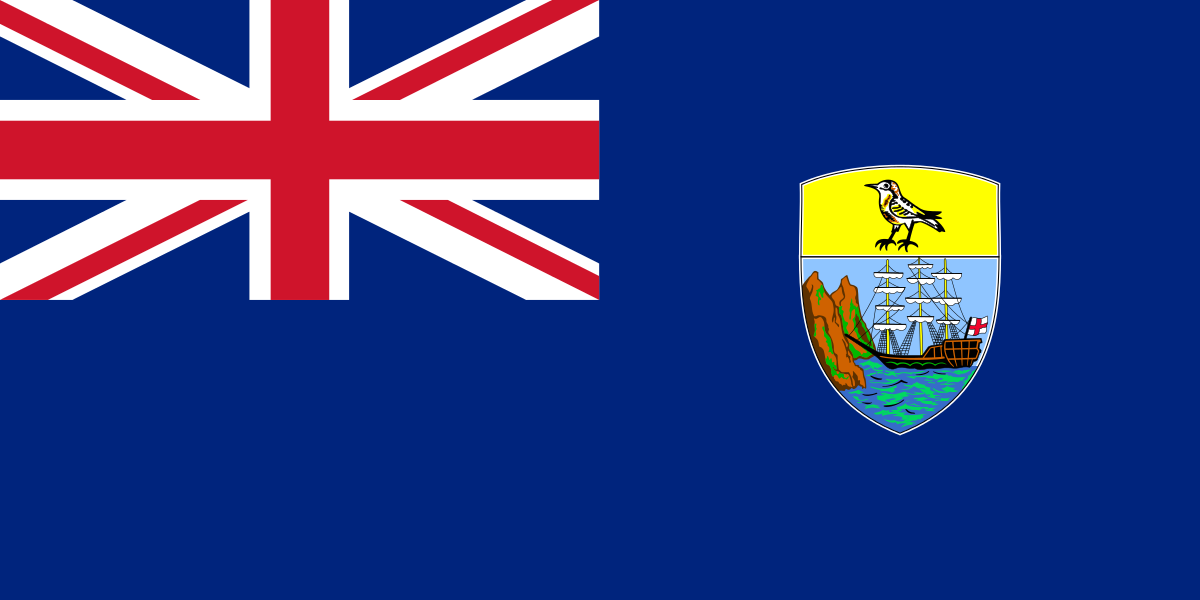
The Saint Helena Plover appears on the flag of Saint Helena, as well as on that small nation’s official coat-of-arms.  The plover is Saint Helena’s national bird as well.  Saint Helena is an island territory  —   in the South Atlantic Ocean (about midway between South America’s Brazil and Africa’s Angola) — administered by the United Kingdom, having been formally claimed by Great Britain when Oliver Cromwell (in AD1657) granted a charter to the East India Company, to settle the South Atlantic island.  Politically speaking, Saint Helena is grouped with Ascension and Tristan da Cunha, as a British overseas territory (formerly known as “Saint Helena and Dependencies”).

Flag of Saint Helena with Saint Henea Plover ©PD

Flag of Saint Helena with Saint Henea Plover ©PD

This little plover is a year-round resident, endemic to this island (although it is similar to other plovers).  This endemic invertebrate-consuming landbird is a small “wader”’, i.e., a shorebird capable of wading in coastal tidewaters, yet it mostly habituates other open areas of the island, such as pasture-like grasslands.  Its eggs are mostly light-brown in color, with dark-speckled mottling.  Its populations are declining, according to monitoring (which includes motion-sensor ultraviolet cameras positioned near nesting grounds), apparently due to predation (by rodents or feral cats) or due to other kinds of nest disturbances (such as sheep that step on plover nests). Conservation efforts are underway, in hopes of restoring the population growth of this island’s humble symbol.

Stay tuned!  God willing, the next installment in this mini-series will cover more of these “banner birds”, now that a penguin and a plover – both of which birds live only in the Southern Hemisphere, are properly “flagged” and accounted for.

*

“Flag That Bird!”  (Part 1)

More Articles by James J. S. Johnson

Orni-Theology

*

“Flag That Bird!” (Part 1)

“Flag That Bird!”  (Part 1)

We will rejoice in thy salvation, and in the name of our God we will set up our banners; may the Lord fulfil all thy petitions.   (Psalms 20:5 — numbered as 20:6 in Hebrew Bible)

Luzon Bleeding-heart by Dan

Orni-Theology

“Flags” and “banners” herald symbolic messages and institutions, such as a nationality, a dynasty, a military force, or some other kind of organization.  In holy Scripture, the term “flag” (in the KJV) refers to riparian or lacustrine wetland plants, which somewhat resemble banners in their physical appearance (see Job 8:11; Exodus 2:3,5; Isaiah 19:6). The term “banner” denotes the word “flag” as it is commonly used today (see Exodus 17:15; Song of Solomon 2:4 & 6:4,10; Psalms 20:5 & 60:4; Isaiah 13:2).

Bald Eagle and a flag

Whenever birds are featured on a national flag (or on its “armorial banner” version, or on a national province or department), the odds heavily favor the banner-bird being an eagle.   Flags affiliated with American showcase the bald eagle; other nations usually present a golden eagle, like Mexico, or sometimes a mythical “double-headed” eagle, like Mount Athos.

ag of Mexico ©WikiC

flag of Mexico ©WikiC

Consider  –  for just a few representative examples  –  the eagles that appear on the flags  –  some present, some past  —  of these national and state/provincial flags:  Albania;  American Samoa;  Austria (armorial flag);  Brandenburg, Germany;  Ecuador (armorial banner);  Egypt;  Geneva, Switzerland;  Germany (armorial flag );  Iowa;  Italian president’s flag (AD1880-AD1946);  Jordan (armorial banner);  Mexico;  North Dakota;  Oregon (front side of state flag);  Pennsylvania;  Poland (armorial flag);  Prussia (armorial banner, AD1819-AD1850); (Moldova;  Mount Athos (autonomous Greek protectorate);  Russian Czar’s banner (18th century A.D.);  Serbia (during AD1882-AD1918); Silesia (until absorption by Prussia in AD1742 – parts of Silesia now lay within Poland, Germany, and the Czech Republic);  United States Coast Guard and Marine Corps;  Utah;  Virgin Islands (of the USA);  Zambia; etc.

So what about the other birds?  Do any other birds get to show off their plumage on a national flag?  Yes, but just a select few.  Although this listing is likely incomplete (and it will be presented as a mini-series, God willing), herebelow are some non-eagle birds that appear on the official flags of some countries of the world.

For starters, consider the common – yet ubiquitously valuable – Chicken.

Gallic Chicken (Gallus gallus domesticus) ©WikiC

Gallic Chicken (Gallus gallus domesticus) ©WikiC

Gallic Chicken (Gallus gallus domesticus).

The Gallic Chicken appears on the flag of Wallonia, Belgium.

Wallonia is a region of Belgium, where French is the language usually spoken.  (In Flanders, however, Flemish is spoken; Brussels is bilingual.)  The “Walloon Cock” (i.e., rooster of Wallonia) marches prominently at the center of the regional flag of Wallonia, Belgium.

Flag of Wallonia

Flag of Wallonia

During New testament times the country of France (and additional lands that border it) was called “Gaul”, and the symbol of Gaul was the “Gallic cock” (Gallus gallus domestic), i.e., a strutting rooster  –  the adult male of the domestic Chicken, deemed a subspecies of the Red Jungle-fowl (Gallus gallus).  “The cock is a traditional Gallic [i.e., Gaelic/Celtic] emblem and [it] recalls Wallonia’s linguistic and cultural ties with France.”  [Quoting Alfred Znamierowski, The World Encyclopedia of Flags (London: Hermes House, 2002), page 146.]  Chickens are bred and eaten all over the world  –  they even roam the streets of Key West, Florida!   Can you imagine life without chicken?  – think of the almost endless variety of culinary uses of chicken meat and chicken eggs!  Vive le poulet!

The next bird on this list is “bird hawk”, i.e., an accipiter hawk.

Among the birds of prey (“raptors”), there are two main categories of “hawks”:  (1) eagle-or-buzzard-like “buteos” (famous for snatching rodents, lizards, fish, and snakes); (2) and smaller forest-frequenting “accipiters” (famous for snatching birds).  Some would “lump” falcons with accipiters; other do not.  Other groups within the greater “hawk family” include eagles, kites, harriers, vultures, and various “buzzards”.

Buteos include such birds as Red-tailed Hawk, Swainson’s Hawk (which also eats insects), Ferruginous Hawk, Eurasian Buzzard, Broad-winged Hawk, and Osprey.

Accipiters are the smaller category of hawk-like birds  —  the “true hawks”  —  which include the likes of Cooper’s Hawk, Northern Goshawk, Eurasian Sparrowhawk, Sharp-shinned Hawk, etc.  “Accipiters are woodland, bird-catching hawks.  They rely on surprise and a blurring burst of speed to overtake prey.  Short, broad wings provide great acceleration, and slim bodies create little drag.”  [Quoting  Jack L. Griggs, All the Birds of North America (HarperCollins, 1997), page 66 .]  The smaller size of accipiters is a more fitting design for darting in between and around tree branches and shrubbery.  “An accipiter, like the Cooper’s hawk, can chase a songbird through a maze of trees without seeming to slow down, using its long tail as a rudder to help maneuver.  If a songbird does escape the initial attack, it is likely to survive the encounter, for accipiters are sprinters … [who] seldom engage in prolonged tail chases.”  [Again quoting Griggs, All the Birds of North America, page 66.]

Northern Goshawk (Accipiter gentilis) ©USFWS

Northern Goshawk (Accipiter gentilis) ©USFWS

Northern Goshawk (Accipiter gentilis).

The Northern Goshawk appears on the flag of the Azores, an Atlantic Ocean-surrounded archipelago.  These volcanic islands, located southwest of the European continent, arose from the Mid-Atlantic Ridge, constitute an autonomous protectorate of Portugal.

Portuguese Flag (PD)

Portuguese Flag (PD)

The word “Azores’ derives from açor, the Portuguese word for “goshawk” (which means “goose-hawk”).  Yet it is ironic that both the name and flag of the Azores feature the Northern Goshawk (an accipiter common in continental Europe), because many historians doubt that the Northern Goshawk was a common resident of there, when the Azores were discovered by Portuguese sailors during the AD1400s.  Many think that a local variety of the Eurasian Common Eurasian (Buteo buteo) was mistaken for the Northern Goshawk (Accipiter gentilis) – yet nonetheless the name “Azores” (meaning “goshawks”) stuck.  Accordingly, the depiction of a goshawk, matching the archipelago’s name, was superimposed onto the Azores’ territorial flag.)

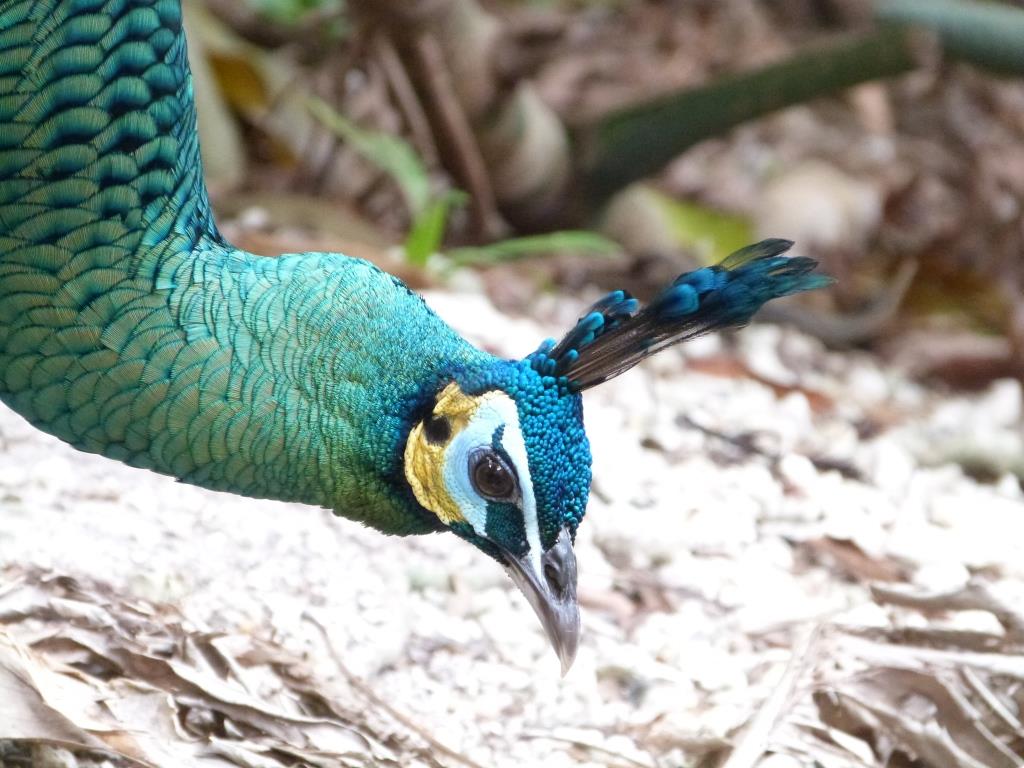
The next flag-featured bird is a spectacularly colored fowl, famous for its fan-like display of extravagant covert plumage, the Peafowl.   Many call this iridescence-decorated fowl the “peacock”, although it is only the male that is appropriately called “peacock”; the female is a “peahen” and the young are “peachicks”.  There are three types of peafowl:  (1) the Blue Peafowl (a/k/a “Indian Peafowl”) of India and Ceylon; (2) the Green Peafowl of southeastern Asia (native to Burma, Indochina, and the Indonesian island of Java); and (3) the Congo Peafowl (native to the Congo River’s drainage basin in Africa).

(Javan) Green Peafowl (Pavo muticus muticus) by Lee at Zoo Miami

(Javan) Green Peafowl (Pavo muticus muticus) by Lee at Zoo Miami

Green Peafowl (Pavo muticus).

The Green Peafowl appeared, briefly (AD1939-AD1941), on the British territorial flag of “British Burma” – then a British Commonwealth colony.  (Burma is now called “Myanmar”.)   That colonial flag contained a Green Peafowl prominently displaying its famous covert feathers.

Flag of the Third Burmese Empire

Flag of the Third Burmese Empire (PD)

The Green Peafowl, historically, had symbolized pre-colonial regimes of Burma.

For example, the flag of the “Third Burmese Empire” (Konbaung Dynasty, AD1752-AD1885 – a/k/a “Alompra Dynasty”, which ultimately lost the Anglo-Burmese Wars  –  after persecuting the Great Commission efforts of Baptist missionary Adoniram Judson, who translated the Holy Bible into Burmese), consisted of a fan-tailed Green Peafowl, superimposed on a white background.

Peafowl on Flag of the Third Burmese Empire (PD)

Peafowl on Flag of the Third Burmese Empire (PD)

One more non-eagle bird, displayed on a national flag, will be included, below.  (The remainder must arrive on this blogsite another day, God willing.)  The next bird we will “flag” is a parrot.

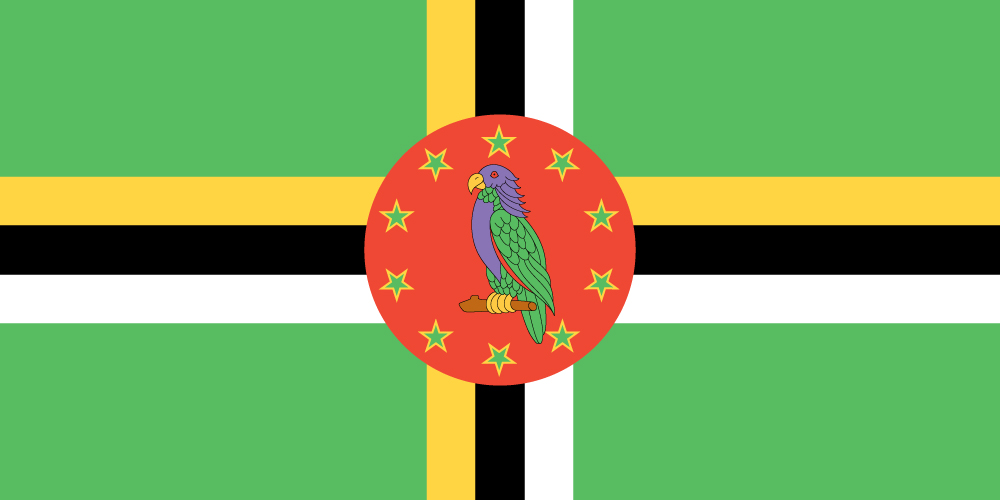
Sisserou Parrot {Imperial Amazon} The national bird of Dominica (PD)

Sisserou Parrot (Amazona imperialis), a/k/a Imperial Amazon Parrot.

The Sisserou Parrot is a montane rainforest-dwelling parrot “endemic” to the Caribbean island nation of Dominica (not to be confused with another Caribbean country, Dominican Republic).  The term “endemic” means limited to that one location, so the Sisserou Parrot is native only to the island nation of Dominica.  And what a beautiful parrot it is!  As the national bird of Dominica, it is showcased “center-stage” on Dominica’s flag.

Dominican-Flag ©WikiC

Dominica’s-Flag ©WikiC

Sisserou Parrot Insert (Amazonaon Dominic )Flag ©Flickr-

Sisserou Parrot Insert (Amazonaon Dominic) Flag ©Flickr-

The flag’s depiction of the parrot is dominated by green and purple, with the beak and talons presented as yellow.  This coloring approximates the real parrot, though the “real thing” is obviously more beautiful!  The Sisserou is known to keep company with other parrots of Dominica, including the also-endemic Dominican Blue-faced Amazon Parrot (Amazona arausiaca, a/k/a “Red-necked Amazon”  –  no jokes about “rednecks”, please!)

There are more official birds to “flag”:   British Antarctic Territory (penguin);  Saint Helena, British crown colony in the southeastern Atlantic Ocean (Saint Helena Plover, a/k/a “wirebird”);  Fiji (dove);  Kiribati (frigatebird);  Papua New Guinea (bird of paradise);  Australian state of Western Australia (black swan);  Australian state of South Australia (piping shrike, n/k/a white-backed Australian magpie);  royal standard flag of Tonga (dove);  Bolivia (condor);  and Uganda (crested crane).

Till this mini-series continues, “flag those Jehovah-nissi birds!”  Yet more importantly, keep in mind that the Creator of all birds, flagged or otherwise, is JEHOVAH-NISSI (“the LORD our banner”), the One to Whom we pledge our ultimate allegiance!

And Moses built an altar and called the name of it Jehovah-nissi. (Exodus 17:15)

*

More Articles by James J. S. Johnson

*
Pacific Golden Plover’s Teamwork

Pacific Golden Plover

Pacific Golden Plover

James J. S. Johnson

“For which of you, intending to build a tower, sitteth not down first, and counteth the cost [psêphizei tôn dapanên], whether he have sufficient to finish it?  Lest haply, after he hath laid the foundation, and is not able to finish it, all that behold it begin to mock him, saying, ‘This man began to build, and was not able to finish’.”  (Luke 14:28-30)

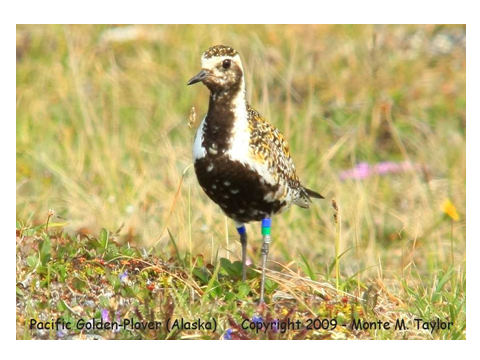
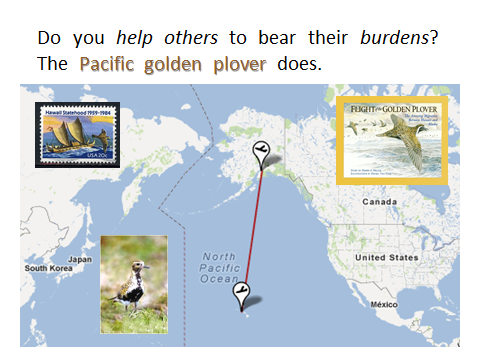
Imagine how inconvenient it would be for a bird to emigrate from Alaska, to Hawaii, only to run out of fuel en route, fall out of the sky from exhaustion, only to drown in the Pacific Ocean, somewhere north of Hawaii.  What a shame that would be!  And yet the Golden Plover’s pre-winter migratory mission, each year, would seem doomed from the start for that very reason – yet the little sandpiper-like migrant survives the journey on less fuel than seems possible.  How do they do it?

Pacific Golden Plover (Pluvialis fulva) by Ian

“The average weight of the golden plover before it leaves Alaska to fly to Hawaii is 200 grams.  It is a small bird about the size of a pigeon.  It is also a bird that does not swim!  Researchers have concluded that 70 grams of its 200 grams is burnable energy. The rate at which the bird burns fuel when flying is about one gram per hour.  This means right at 70 hours of flight is possible. Now we have a potentially disastrous situation.  The flight to Hawaii takes 88 hours of  continuous, non-stop flight!  The little bird must fly for 3 days and 4 nights without food or rest or stopping at all. Impossible! How does it do this?  The birds fly in a formation that breaks the wind, taking [~1/4] less energy to fly.  New leaders are constantly rotating in and out. Formation flight saves energy and when the birds arrive in Hawaii, they have as much as 6 grams of fuel left over.  God must have built the reserve fuel supply into the plover in case of a strong head wind along the way.   Scientists are not certain how the plovers navigate from Alaska to Hawaii and back, since there is no land under their flight path.   Utilization of earth’s magnetic field seems to be the best solution at this point.  Some have suggested that they use the sun and stars.  And how do the young birds find their way to Hawaii without an experienced adult guide, weeks after their parents have already flown back to Hawaii?  A one degree mistake in navigation over the more than 4,000 kilometer flight and the birds miss Hawaii completely!  But they never miss!”

[Quoting Dr. Jobe Martin, The Evolution of a Creationist, rev. ed. (Rockwall, TX: Biblical Discipleship Publishers, 2004), page 203, emphasis added.]

Pacific Golden Plover Map

That’s amazing!  Due to their instinctive behavior to “take turns” as “point man”, the migrating plovers use only ¾ of the food energy they would need to use if flying solo.  Birds display God’s providential programming in their anatomies and physiologies!  Why is that?  Because God carefully planned them before He created their original ancestors on Day 5 of Creation Week (Genesis 1:21).  God planned their genetics, their bio-diversity potentials and limits, their developmental biologies, and all of the bio-engineering needed to accomplish all the contingent details, —  and God has been actively participating in and regulating their lives and world ever since.

As humans we often need to plan out projects before we undertake them; we need to “count the cost” before embarking on an expensive and risky undertaking.  Yet God has already done this for the Pacific Golden Plover, to ensure its successful migrations twice a year.   And notice how God designed teamwork to be part of His plan – and that teamwork involves bearing one another’s burdens.

Bear  ye  one  another’s  burdens,  and  so fulfil  the  law  of  Christ.        (Galatians 6:2)

In sum, collaborating with teammates is usually a good idea, — so long as your colleagues are aimed at the same goal as you (see Amos 3:3.)

Dr. James J. S. Johnson has served as a lecturer (on ecology, geography, and history of Alaska) aboard 4 cruise ships visiting Alaska and the Inside Passage (Norwegian Wind, Norwegian Sky, Radiance of the Seas, and Rhapsody of the Seas).  During those trips he tried valiantly to (and did) eat lots of finfish, such as Pacific salmon and halibut, and shellfish, such as Dungeness crabs – but no Golden Plover.

*

I asked Dr. Jim to post this article because of the devotional emphasis he used. We have used the Plover before, see Incredible Pacific Golden Plover, which is all about the science and creation aspect of this remarkable Plover. Just wanted to review for you an amazing bird our Creator has created for us to learn about and from.

Orni-Theology

Incredible Pacific Golden Plover

Charadriidae – Plovers

Wordless Birds

*

How Can a Mechanical ‘Cardinal’ Make ‘Selections’?

How Can a Mechanical ‘Cardinal’ Make ‘Selections’?

For we are made a spectacle unto the world, and to angels, and to men. (1st Corinthians 4:9b)

But what about birds: can they be spectators?

What about fake birds:  can they “select” when to sing?

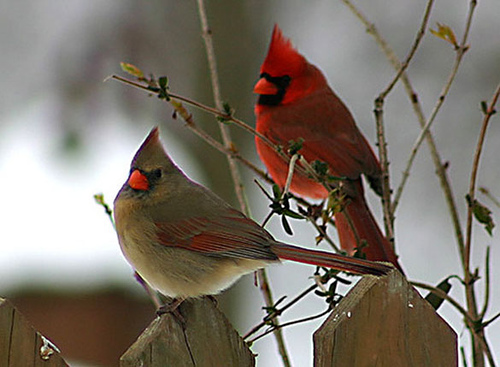
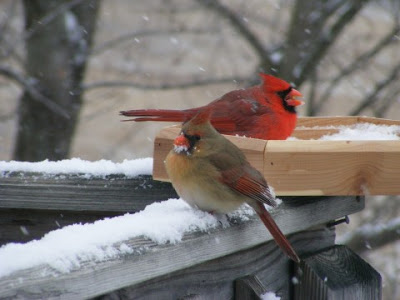
Northern Cardinal (Cardinalis cardinalis) Male and Female ©WikiC

Northern Cardinal (Cardinalis cardinalis) Male and Female ©WikiC

This unusual bird-watching report begins with a “no-brainer” observation that most birders already know well:  we humans like to watch birds!

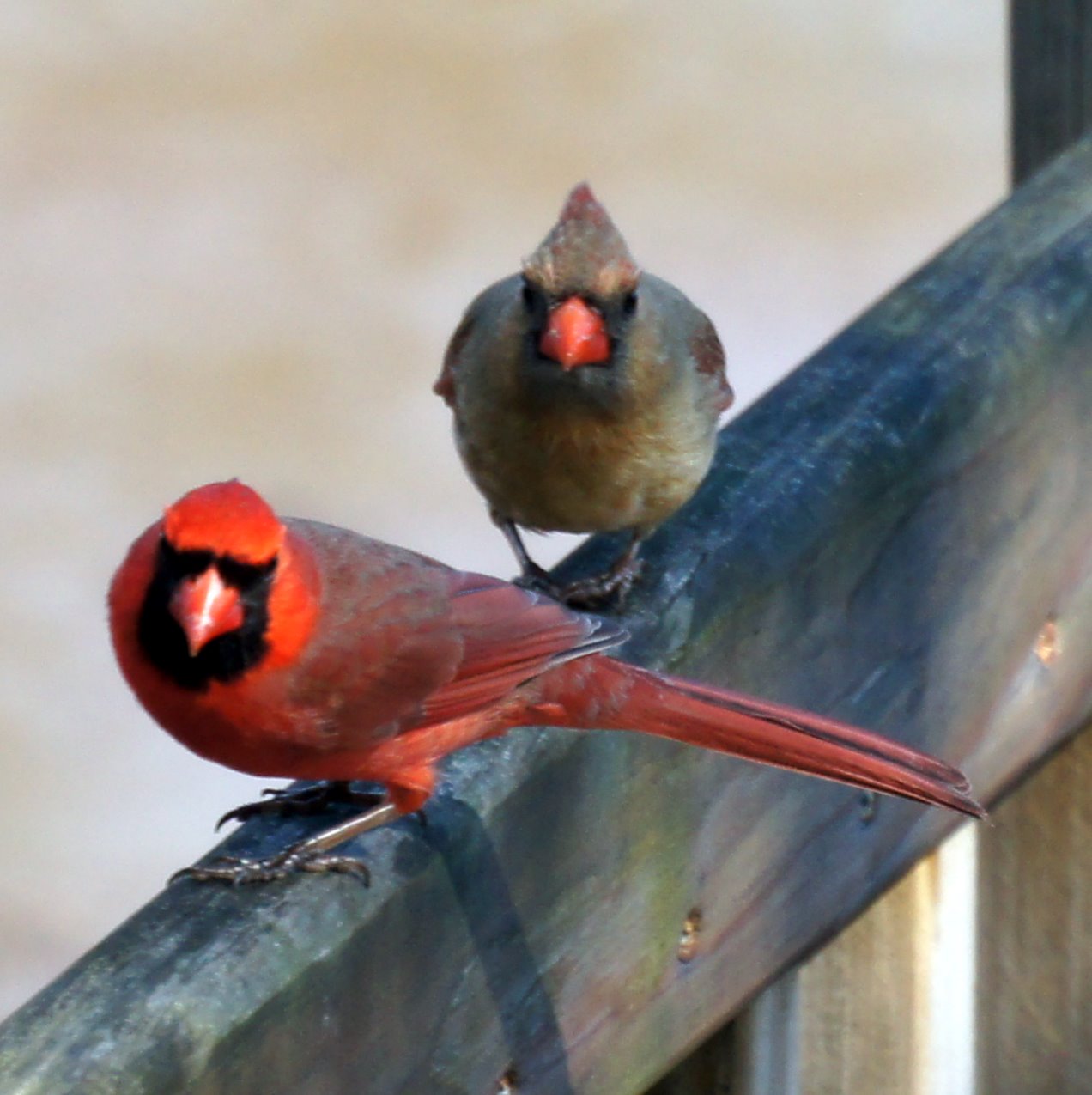
Northern Cardinal (Cardinalis cardinalis) Male and Female ©WikiC

Northern Cardinal (Cardinalis cardinalis) Male and Female ©WikiC

Luzon Bleeding-heart by Dan

Orni-Theology

In fact, it seems (based on a survey done by wildlife ecologists in Maryland) that we humans like to watch birds — moreso than any other kind of wildlife.  People love birds, and well they should!  Specifically, according to a U.S. Fish & Wildlife Service officer, birds are the main attraction when it comes to people viewing wildlife.  “The 2011 National Survey of Fishing, Hunting and Wildlife-Associated Recreation noted that 71.8 million American participated in some kind of wildlife-watching recreation, including observing, feeding or photographing [wildlife].  Birds attract the biggest following of all U.S. wildlife.  Approximately 46.7 million people observed birds around the house and on trips in 2001.  A large majority, 88 percent (41.3 million), observed wild birds around the home, while 38 percent (17.8 million) took trips away from home to observe wild birds.  Home birders averaged 119 days, while away-from-home birders averaged 13 days.”  (Quoting from Kathy Reshetiloff, “Services Provided by Migratory Birds Don’t Come Cheaply”, Chesapeake Bay Journal, 24(3):1 (May 2014).  As noted previously, birds often don’t notice when we are watching them – and that is when we see them acting true to character. [See https://leesbird.com/2014/10/06/busy-hummingbirds-oblivious-to-spectators/  ]

A plastic “toy” cardinal can make you wonder about motion sensitivity.  (More on that below.)

Northern Cardinal (Cardinalis cardinalis) Male and Female ©WikiC

Northern Cardinal (Cardinalis cardinalis) Male and Female ©WikiC

The Northern Cardinal (Cardinalis cardinalis), a/k/a “redbird” is a beauty to behold – and to hear.  Cardinals are so highly appreciated that seven states claim it as their official state bird:  Illinois, Indiana, Kentucky, North Carolina, Ohio, Virginia, and West Virginia!

Cardinals are songbirds that are easily seen (especially the males), due to their colored plumage contrasting with the green foliage of spring and summer, — or with the bright white of winter snow.

Northern Cardinal (Cardinalis cardinalis) Male and Female ©Zanawer

Northern Cardinal (Cardinalis cardinalis) Male and Female ©Zanawer

Surely a view of cardinals, eating safflower and sunflower seeds (or other cracked corn, peanuts, or even raisins!), will make you wonder at God’s creative genius and love of beauty, when He chose to make (see Genesis 1:21) the male and female of that beautiful songbird species!

Northern Cardinal (Cardinalis cardinalis) Male and Female ©WikiC

Northern Cardinal (Cardinalis cardinalis) Male and Female ©WikiC

“The cardinal is a favorite bird of many people and it’s easy to see why.  The brilliant scarlet plumage of the male and the subtle shades of the female, combined with their clear melodic song, make them enjoyable to watch (and to listen to] in any season.”  [Quoting from Donald Stokes & Lillian Stokes, A Guide to Bird Behavior, Volume II (Little, Brown & Co., 1983), page 247.]

But, could it be that birds also like to watch humans?  And could it even be that mechanical “birds” appreciate humans who move around in front of them?

http://www.ebay.com/itm/like/251378388026?lpid=82&chn=ps

Plastic Cardinal from ebay.com

[ plastic cardinal image  from  http://www.ebay.com/itm/like/251378388026?lpid=82&chn=ps ]

Lately my wife have been having fun at my expenses, using a “toy” cardinal.  The cardinal was given to her by Marcia Webel (of Florida, wife of Chaplain Bob Webel).  It is a smaller than life-sized bird shaped and colored like a male cardinal, and it can make “vocal” noises like one, too.  But it is a “motion-activated” machine.  In other words, it is “selective” in when it “chooses” to sound off its recorded chirping sounds (which do sound like a real cardinal).  But it’s not really making decisions about when to chirp; it’s just a programmed machine that is designed with receptor features that sense motion nearby, and the inventor designed the machine to “trigger” its recorded sounds whenever its receptors “recognize” such motions.

So far, so good.

But here is the puzzle:  my wife moves in front of the “cardinal” and he chirps for her, just like the toy’s inventor designed him to do.  Then I dance (not in public, of course, — just in the privacy of our kitchen) in front of the “cardinal” and he is silent.  Silent!  So I dance again.  Silent, silent!  So I try a few Tae Kwon Do maneuvers (kicking, punching, whirling, bowing) – and he is still silent. If proving my body’s mobility was dependent upon the “cardinal” chirping I would be diagnosed as paralyzed or unconscious.

It seems like the “cardinal” is “selective” regarding which human he is “willing” to chirp for.  But that can’t be, you say, and you are right.

A lifeless machine – even one that looks like and sounds like a male cardinal – cannot really “select” anything.

The very idea that anything lifeless can “select” anyone or anything is silly, because the English word “select” necessarily includes the actions of thinking and choosing.  (Of course, the preprogrammed actions of the machine do reveal the thought and choices of the machine’s inventor.)

By now I’m sure you see the parallel to God our Creator, Who programmed all of creation to perform according to how He invented His creatures and the world that He put them in.  (He made the planning and programming choices needed to invent all the birds, and ourselves, and everything else  —   God did it, not “nature”.)

It is both silly and deceptive to use the phrase “natural selection” to imply that nonliving substances (like sunlight, wind, rain, snow, lightning bolts, etc.) are a kind of “natural selection” that orders “nature”.   In fact, the phrase “natural selection” is a science-fiction example of “bait-and-switch” [See “Bait and Switch”, at http://www.icr.org/article/bait-switch-trick-used-by-both-anglerfish ]

Yet that very misleading phrase (“natural selection”) is spun as a secular God-substitute, to explain the origin of species that inhabit our fine-tuned planet.  [See “DNA and RNA:  Providential Coding to ‘Revere’ God”, at http://www.icr.org/article/dna-rna-providential-coding-revere ]  Obviously, the mechanical “cardinal”, with its puzzling actions that “react” to some (but not all) motions, was invented by a clever inventor.  How much moreso is our Creator-God a clever inventor!  It is God Who selected how to make our bodies, to eat food (Acts 14:17) and to grow (Psalm 139) and to do so many other amazing things during our earthly lives.  And He also invented the real cardinals!  (And sometimes real cardinals watch me, so there!)

Maybe I don’t have the kind of “walk” that causes a mechanical cardinal to “sing”.  As we all know, you need to have the “walk”, not just the “talk”.

So who do you watch?  If you only sang a song if and when someone walked in front of you, but not if he (or she) merely talked, who would you sing for?

The best sermons are role-modeled – those who “walk” their “talk” are truly the best communicators!  When we consider the “talk” and “walk” of other Christians, as we do without consciously trying, we are evaluating which Christians we think are moving in step with God’s Word.  Some are.   Others aren’t.  (And some we can’t be too sure about – see 1st Timothy 5:24.)

Meanwhile, as we move through this world, from day to day, are our own lives worth watching?

Let your light so shine before men, that they may see your good works, and glorify your Father which is in heaven.  (Matthew 5:16)

*

Orni-Theology

James J. S. Johnson

Cardinalidae – Cardinals, Grosbeaks and allies

*

Pond-side Birdwatching in Florida III

PondsideBirdwatching-WebelBackyard.2

Pond-side Birdwatching-Webel Backyard

Pond-side Birdwatching in Florida,

from Chaplain Bob’s Backyard: Part 3

 by James J. S. Johnson

Like a crane or a swallow, so did I chatter: I did mourn as a dove: mine eyes fail with looking upward: O Lord, I am oppressed; undertake for me. (Isaiah 38:14)

But they that escape of them shall escape, and shall be on the mountains like doves of the valleys, all of them mourning, every one for his iniquity. (Ezekiel 7:16)

O ye that dwell in Moab, leave the cities, and dwell in the rock, and be like the dove that maketh her nest in the sides of the hole’s mouth.  (Jeremiah 48:28)

Mourning Dove (Zenaida macroura) by Daves BirdingPix

Mourning Dove (Zenaida macroura) by Daves BirdingPix

Doves (a kind of birds that include pigeons) are among the most commonly observed birds in the world.  Doves display great variety (mourning dove, turtle dove, zebra dove, Inca dove, white-winged dove, etc.), the most popular variety being the pigeon (whose more formal name is “rock dove”).   Doves illustrate 2 different nesting habits (both being mentioned in Deuteronomy 22:6-7):  some nest in trees or other high places; others nest on the ground. Pigeons are often seen, due to their conspicuous habit of domesticating urban habitats (such as city buildings and bridges), nesting in high places (as indicated by , feeding, and flying in plain view of human spectators – often learning to accept food from humans, or to scavenge human garbage.  However, other doves (such as mourning doves) nest on the ground, a more vulnerable lifestyle.  Doves that nest on the ground, however, tend to be more reclusive (hiding in bushes and other thick vegetation), so they are more often heard than seen.  For example, in this birding report, brief mention will be made of a cooing mourning dove – that was heard, but not seen.

As reported previously, at Lee’s Birdwatching Adventures, it was a wonderful morning in St. Petersburg, where 3 of us  (my dear friends in Christ, Chaplain Bob and Marcia Webel, and I)  were watching the duck-populated pond and its bird-visited shores, with coffee and feet propped up, in the Webels’ backyard —  under a huge beach umbrella, shielded from occasional droppings (!) from ibises and ospreys (who were perched in branches hanging over where we were) sitting with binoculars, coffee mugs, healthy breakfast foods, and a bird-book.  Mostly we were bird-watching, that morning, but also we were bird-listening!

Muscovy Duck

Muscovy Duck

MUSCOVY   (a/k/a “MUSCOVY DUCK” or “BARBARY DUCK”:  Cairina moschata).

RTP @ 52-53 & 302-303

The Muscovy Duck is a strange looking fowl.  (And its name refers to “musk”, so it must have a characteristic smell, too!)  It is a duck, yet it is large – the size of a goose.  Yet even stranger are the colorful growths of red flesh upon its face:  the Muscovy looks like someone spilled some red bumpy-lumpy oatmeal on the sides of its bill, and on some of them the “red oatmeal” stuck to the face even around the eyes.  This fleshy growth is wattle-like “caruncle”, something like what turkey faces display.  Some people dislike the Muscovy Duck simply because its knobby (i.e., carunculated) face looks grotesque or diseased or “corrupted”!  But Mallards don’t seem to disdain these beauty contest flunkies; often a Muscovy (or two) is seen amidst a group of Mallards, and it seems that maybe they sometimes hybridize.  The coloring of a Muscovy Duck might be mostly white, or mostly black (with iridescent green tinting), or a quilt-patched mixture of black and white, with large white “patches” or “bars” on the wings.   (See Roger Tory Peterson, A Field Guide to the Birds Eastern Birds:  A Completely New Guide to All the Birds of Eastern and Central North America, abbreviated as “Eastern Birds” [Peterson Field Guides, Houghton Mifflin, 1980], at pages 52-53 & 302-303.)   The Muscovy’s awkward gait, when waddling about, sometimes looks a clumsy-looking, but these strange ducks are hearty survivors.  Regardless of where they came from (some say Latin America), these ducks are here to stay.   A domesticated form of the Muscovy is bred as the Pato Criollo (i.e., Creole Duck), though it seems that many of these have figured out how to escape their intended culinary destinies, becoming semi-wild as escapees. Muscovy Ducks have been observed and studied for centuries.  The Muscovy Duck was noted by two of the earliest (and most godly) eco-science geniuses, Konrad Gessner and John Ray, both being Bible-believing creationists.  To appreciate just an introductory sample of their trail-blazing creation research, analysis, and scholarship, see:  http://www.icr.org/article/christianity-cause-modern-science/  (mentioning John Ray),   http://www.icr.org/article/graffiti-judgment/  (mentioning, in Footnote #3, both Konrad Gessner and John Ray),  and  http://www.icr.org/article/fossil-political-correctness-sixteenth-century (mentioning Konrad Gessner as a Bible-believing Christian ecologist).

Feeding White Ibises at Lake Morton

Feeding White Ibises at Lake Morton

WHITE  IBIS   (Eudocimus albus).

The White Ibis is a white-plumed wading bird, with a reddish/orange-scarlet/pinkish/salmon-colored “decurved” (i.e., downward-curved) bill — shown here (with Dan Dusing, Baron Brown, and me  —  in a lakeshore photograph taken by ornithologist Lee Dusing) being fed bread crumbs.  The White Ibis is a gregarious bird, nesting in colonies and often seen foraging as a group.  Its homes are found in coastal mudflats, lakes and lakeshores, ponds and pondshores, and marshy areas.  (Obviously this group of ibises have been fed bread crumbs before – they are quite ready for a tasty snack!)  During the breeding season the White Ibis also has skinny pink legs (about the same color as its prominent bill, but at non-breeding times these legs are duller in color),  —  and this bird knows how to scurry about on those legs! The decurved bill, of course, is an excellent tool for probing around in shoreline mud or sand, for little things to eat, such as small crustaceans (like mudcrabs), frogs, or bugs.  (Obviously God gets the credit, for designing the ibis bill to accomplish what it does for the ibis, as well as for supplying ibis populations with the food sources they need to carry on the business of life.)  If the White Ibis bill snaps your fingers, as you feed him (or her) a bread-crumb, don’t worry!  –  the ibis’s bill is so light and gentle that its peck doesn’t hurt at all.  The White Ibis is found all over Florida, year-round, as well as on the Gulf Coast and America’s East Coast as far north as North Carolina.   (See Peterson’s Eastern Birds” [noted above, in entry for Muscovy Duck], at page M105.)  Why do fishermen especially appreciate the White Ibis?   The ibises eat a lot of shoreline crustaceans (like crabs and crayfish), which in turn eat fish eggs.  So if the crustacean populations grow too much, eating lots of fish eggs, the fish populations decline – bad news for fishermen.  Without consciously realizing it, therefore, the White Ibis is protecting the reproductive success of coastal fish populations — on which human fishermen (and their customers) rely.   (See the National Audubon Society’s Field Guide to North American Birds – Eastern Region [Alfred A, Knopf, 1994 revised edition], co-authored by John Bull & John Farrand, Jr., at page 376.)

Great Egret at Gatorland by Dan

GREAT  WHITE  EGRET   (Ardea alba  or  Casmerodius albus).

The Great White Egret (a/k/a “Great Egret”) is a large long-legged heron-like wading bird, white in plumage, with a yellow bill and black legs.  (See Bull & Farrand’s Eastern Region [noted above, in entry for White Ibis], at page 368.)  This truly “great” egret is often seen standing, like a statute, on the shoreline of a pond, waiting for movement that would betray the availability, in the shallow water or the shoreline weeds, of a quick meal  –  perhaps a fish, a frog, or even a snake.   Donald and Lillian Stokes describe its eating habits as follows:  “Primarily feeds by walking slowly, head erect, then striking prey.  Forages in shallow water for small fish and amphibians [like frogs], but also on land for insects, reptiles [like snakes], and small mammals.  May feed solitarily and defend feeding areas by displaying aggressively and supplanting intruders.  Also feeds in large groups when food is concentrated.  Has been known to steal fish from other birds.” (Quoting Donald W. Stokes & Lillian Q. Stokes, Stokes Field Guide to Birds – Eastern Region [Little, Brown & Co., 1996], page 34.)  During summer this egret also frequents marshy grasslands, tidal mudflats, salt marsh beaches, and other wet habitats – all over America’s lower 48 states.  During winter this fair-weather fowl routinely migrates to America’s East (northward to Delaware), Gulf Coast, and West Coast.  It makes guttural-hoarse croaking noises, as well as loud squawking noises, but it is usually seen before it is heard – due to its large size and strikingly white color.  Its flight is majestic and gracious  —  a marvel to watch, with or without binoculars.

Common Tern (Sterna hirundo) by J Fenton

Common Tern (Sterna hirundo) by J Fenton

COMMON  TERN   (Sterna hirundo).

The Common Tern is one of the many coastline-dwelling birds that get lumped into the term “seagull”.  The Common Tern has been described as “White with black cap and pale gray back and wings.  Bill red with black tip; tail deeply forked.  Similar to Forster’s Tern, but lacks frosty wing tip.  Also similar to Arctic and Roseate Terns.”  (Quoting Bull & Farrand’s Eastern Region [noted above, in entry for White Ibis], at page 519.)  This seagull likes to nest in colonies, often on sandy beaches or on small islands, near lakes, bays, or ocean tidewaters.  Unsurprisingly, the males are the more aggressive sex, although a male intruder may be rebuffed by a male-and-female pair  —  so don’t mess with a Common Tern couple!  (See “Common Tern”, by Donald W. Stokes & Lillian Q. Stokes, in Bird Behavior, Volume III [Little, Brown & Co., 1989], page 71.)

Mourning Dove by Reinier Munguia

Mourning Dove by Reinier Munguia

MOURNING  DOVE   (heard cooing  —   Zenaida macroura).

Many books could be written about the Mourning Dove, and about its many cousins – such as the “pigeon” (Rock Dove) – that inhabit so many rural, suburban, and urban places around the world (as noted above, at the beginning of this birding report).  But a better description and appreciation for this bird must wait another day, because this report is already too long!  So, for now, this report closes with a passing mention that “mourning” was heard that morning – the plaintive cooing of the (well-named) Mourning Dove.  But no need for sadness  –  because it will soon be (God willing) another day for pondside birdwatching in Florida!


On the morning of February 9th, AD2015, from the pond-side backyard of Bob & Marcia Webel (while enjoying breakfast and Christian fellowship with the Webels), I saw 14 birds:  Great Blue Heron, Brown Pelican, Mallard, Double-Crested Cormorant, Black Vulture, Wood Stork, Lesser Scaup, Osprey, Snowy Egret, and Florida Gallinule,  as reported previously,  —  and, as reported hereinabove, Muscovy Duck, Great Egret, White Ibis, and Common Tern, plus the cooing of a nearby Mourning Dove was clearly recognizable.  What a morning!


James J. S. Johnson loves duck ponds, having formerly taught Environmental Limnology and Water Quality Monitoring for Dallas Christian College, as well as other courses on ecology and ornithology.  Limnology terms are not universal:  what some call a “pond” others call a “lake”.  [NOTE:  Some use the temperature of the bottom water as the lentic nomenclature determinant:  if the bottom water is the same temperature, year-round (i.e., regardless of whether it is winter or summer), it’s deep enough to be a “lake” – otherwise limnologists call it a “pond”.]   Regardless of this semantic custom, the “pond” viewed in the foregoing bird-watching report is called “Lake Coronado” in Florida’s Pinellas County.  J


*
Pond-side Birdwatching in Florida I

Pond-side Birdwatching in Florida II

Other Articles by James J. S. Johnson

*

Fantastic Week-end

Purple Gallinule Reaching Circle B

Purple Gallinule Reaching Circle B

We greatly enjoyed this past week-end. Dr. James J. S. Johnson, from Institute For Creation Research, who writes for this blog, came to speak at our church. We had not met him personally and so this was a time of getting to know him.

Dan and I, Dr. Jim (my name for him) and Golden Eagle (Baron) went birdwatching on Saturday. We took him to our favorite birding spot here, Circle B Bar Reserve. We saw 31 species, several “life birds” for him and one “life bird” for me, an Orange-crowned Warbler.

The Birders at Circle B Bar Reserve

The Birders at Circle B Bar Reserve

After we left there, we went to Lake Morton. I wanted two things to happen, but it didn’t. Was hoping to let them feed the Wood Stork over there and see a Wood Duck. Not to be. We saw one Wood Stork, but he must have already been fed. We did get to feed some of our other friends there. All total, we saw at least 19 species there. Also, the Lord prepared a great day for us. (Rained good part of Sunday, but Saturday was beautiful.)

Feeding White Ibises at Lake Morton

Dr Jim Feeding White Ibises at Lake Morton

While describing our trip later, I misused the word “boring” which got mistaken. What I meant was that compared other visits to those two places, the number of species were less than normal. Birdwatching adventures are never “boring.” How can they when you are out enjoying the Lord’s great creation? Amazing! Fabulous! Superb! Those are better words.

“But now ask the beasts, and they will teach you; And the birds of the air, and they will tell you; (Job 12:7 NKJV)

“You are worthy, O Lord, To receive glory and honor and power; For You created all things, And by Your will they exist and were created.” (Revelation 4:11 NKJV)

As Dr. James told us in his presentations, the Lord uses so much variety, provision, and design in each of His created beings, humans included. If we just slow down, God’s hand can clearly be seen. (my paraphrase) Just with the birds, the wing structure, specialized beaks, programmed travels, interconnection between bird and plant, and on and on. Oh, Praise the Lord!

Anhinga Lake Morton by Dan

Anhinga Lake Morton by Dan


I am including the list of birds seen at both places. Also, a short video of a Snowy Egret using his foot to stir up something to eat. Wonder how that habit came about? Could it be that the Lord programmed that in it because of promising to provide for them?

“Consider the ravens, for they neither sow nor reap, which have neither storehouse nor barn; and God feeds them. Of how much more value are you than the birds? (Luke 12:24 NKJV)

Also, Dr. Johnson’s talks showed slides with examples of these points. (From an excerpt)

Witnesses for God’s Truth – “This presentation reviews 5 different kinds of witnesses for God’s truth, each of which takes away excuses from anyone who pretends to have no witness of God and His glory:  (1) the physical creation, including our own physical bodies; (2) the uniqueness of humanity; (3) Scripture; (4) Christ’s incarnation; and (5) one more witness that we all are accountable for, and this one is quite scary!”

Lessons from the Zoo –  “Did you know that the animal kingdom, in all of its diversity, reveals God’s creative genius and glory in uncountable ways?  Why does God like and create variety in creation? How do the various animals living today, as well as other animals (like dinosaurs) which lived in earlier times, confirm the Bible’s account of creation – and refute Darwin’s evolutionary “natural selection” idea? This presentation provides a series of examples of big and little animals that display God’s handiwork in amazing ways. Mammals, reptiles, insects, spiders, fish, shellfish, jellyfish, and more!

Tricolored-Snowy-Great Egret-White Ibis at Circle B

Tricolored-Snowy-Great Egret-White Ibis at Circle B

Circle B Bar Reserve, Polk, US-FL
Nov 8, 2014 8:00 AM – 10:00 AM
Us, Dr J and Baron – 31 species

Pied-billed Grebe
Double-crested Cormorant
Anhinga
Great Blue Heron
Great Egret
Snowy Egret
Little Blue Heron
Tricolored Heron
White Ibis
Glossy Ibis
Roseate Spoonbill  6
Black Vulture  50
Turkey Vulture  50
Osprey
Bald Eagle
Red-shouldered Hawk
Purple Gallinule
Common Gallinule
Stilt Sandpiper
Red-bellied Woodpecker
Pileated Woodpecker
Eastern Phoebe
Carolina Wren
Blue-gray Gnatcatcher
Gray Catbird
Orange-crowned Warbler
Palm Warbler
Yellow-rumped Warbler
Northern Cardinal
Red-winged Blackbird
Boat-tailed Grackle

Lake Morton, Polk, US-FL
Nov 8, 2014 10:30 AM – 11:15 AM
Us, Dr J. and Baron – 18 species (+1 other taxa)

Mute Swan
Black Swan
Black-necked Swan
Muscovy Duck (Established Feral)
Mallard (Domestic type)
Blue-winged Teal
Ring-necked Duck
Anhinga
Great Blue Heron
Great Egret
Snowy Egret
White Ibis
Common Gallinule
American Coot
Laughing Gull
Rock Pigeon (Feral Pigeon)
Blue Jay
Palm Warbler
Boat-tailed Grackle

*
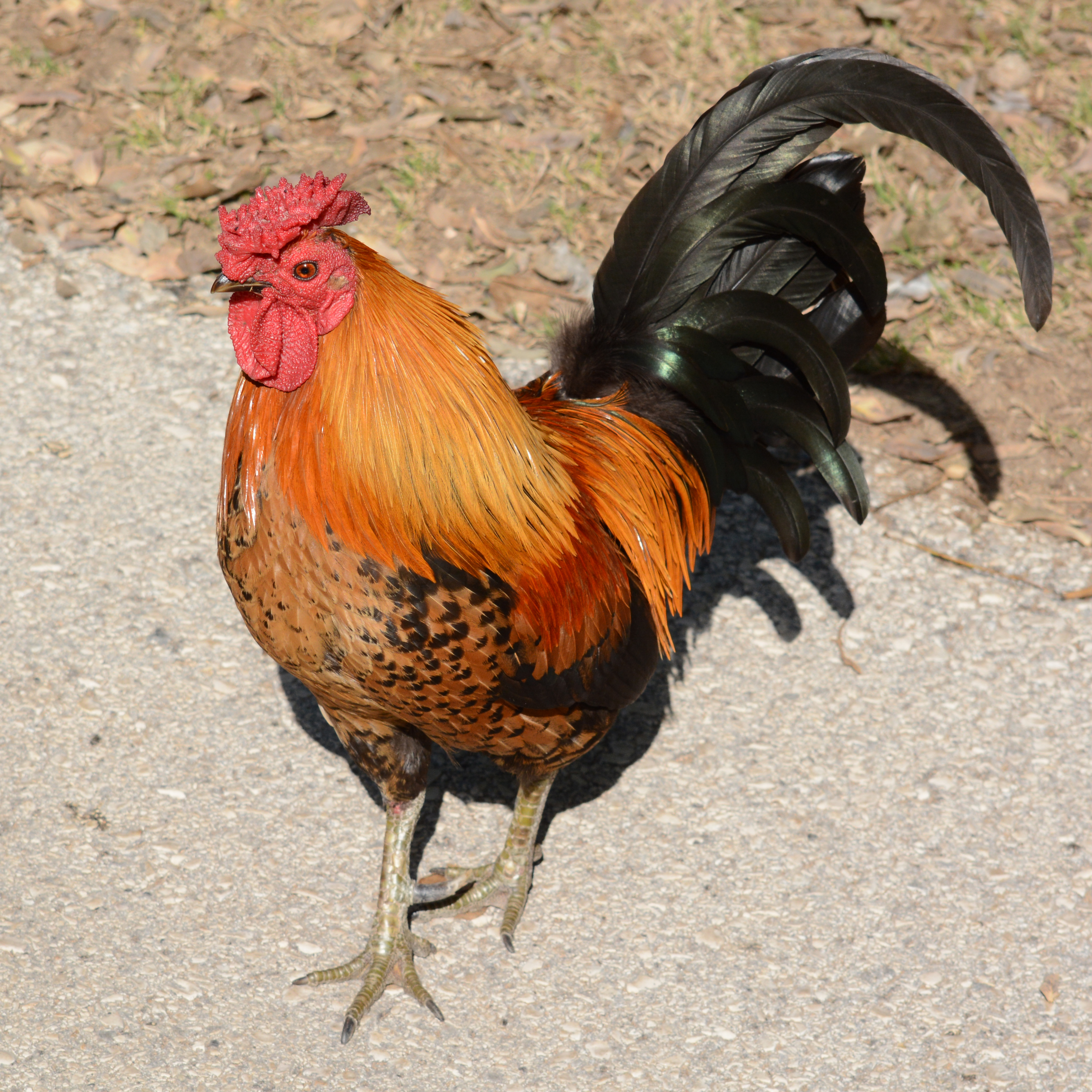
*
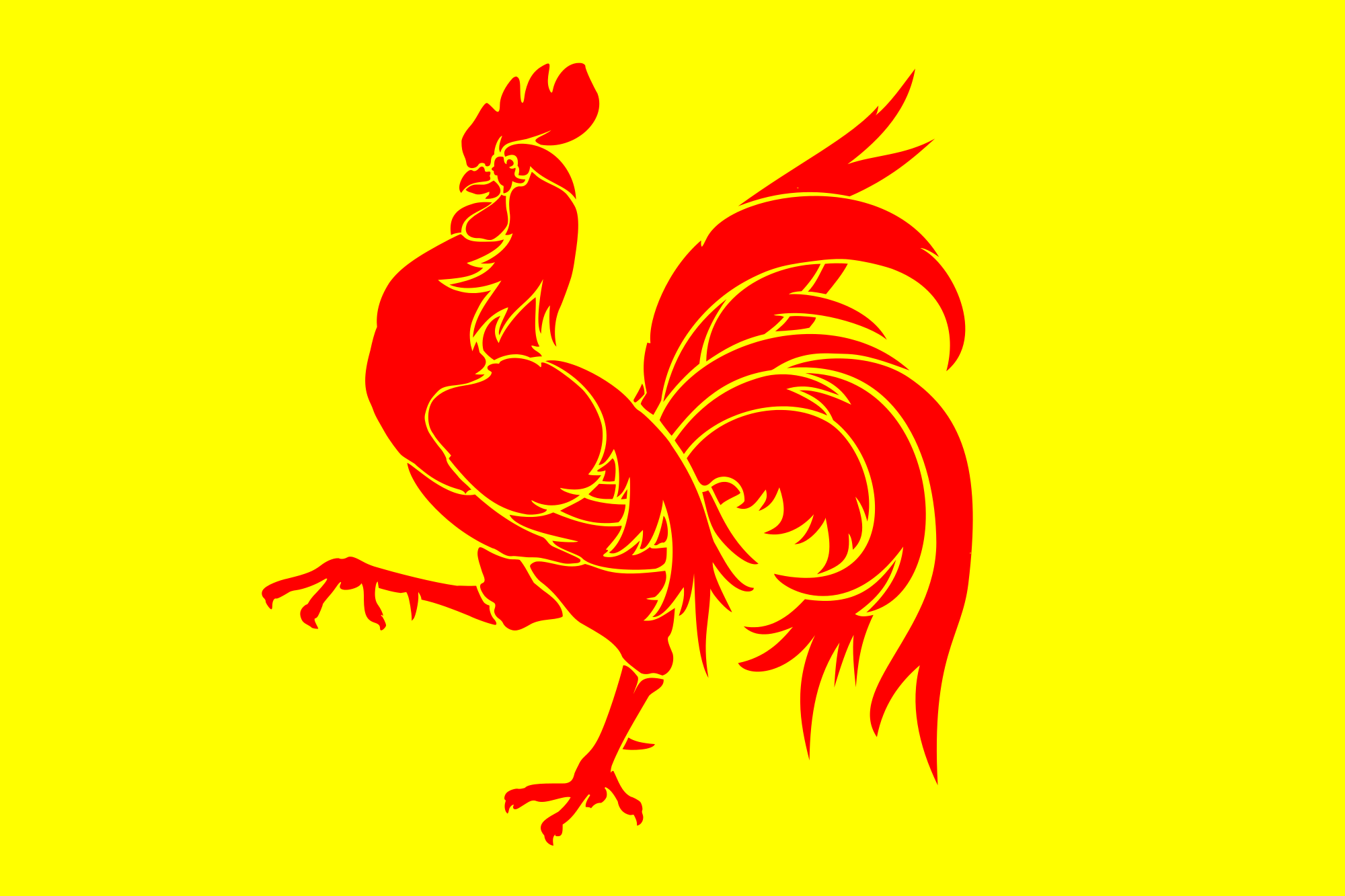
Barn Swallows, a Nostalgic Reminder of Home

Barn Swallow (same)

Barn Swallow (same)

Barn Swallows, a Nostalgic Reminder of Home

by James J. S. Johnson

Whereas ye know not what shall be on the morrow. For what is your life? It is even a vapour, that appeareth for a little time, and then vanisheth away.  For that ye ought to say, If the Lord will, we shall live, and do this, or that.  (James 4:14-15).

Luzon Bleeding-heart by Dan

Orni-Theology

As daylight slid slowly into nighttime darkness, one warm summer evening in Sweden, I thought I recognized the sleek silhouettes of swallows, flitting and zooming here and there, like aerial fighter pilots, catching hapless insects in the air.  It was too dark, and they were too fast, to positively confirm them as Barn Swallows, but surely that’s what they were.  Little hatchlings, waiting hungrily in mud-nests nearby, likewise appreciated the aerial insect-grabbing of their caring parents.  The day would come, in time, when the hungry nestlings would do the same for their progeny.

Barn Swallow (Hirundo rustica) baby by Neal Addy Gallery

Barn Swallow (Hirundo rustica) baby by Neal Addy Gallery

In Europe one of the common summer migrants is the Swallow (Hirunda rustica), known in America as the Barn Swallow, due to their habit of nesting colonies near the roofs of barns, stables, and other wooden buildings.  Barn swallows are easily recognized by their long tail streamers, narrow and pointed wings, iridescent blue-black upper feather coat, contrasting with a white underside sporting a rusty orange forehead and chin-throat bib.  (The sexes are similar except that the female has shorter tail streamers.)   Like other swallows, the barn swallow is mostly insectivorous, catching bugs on the fly, as it darts and arcs with graceful flight patterns, powered by deep wing-beats.  [See Jürgen Nicolai, Detlef  Singer, & Konrad Wothe, Birds of Britain and Europe (Harper Collins, AD1994; translated by Ian Dawson), page 170.]

One of the most nostalgic folk songs of Scandinavia (especially Sweden) is Hälsa dem därhemma  (“Greet those at Home” – audio and bilingual lyrics at http://treasures2.weebly.com/haumllsa-dem-daumlrhemma.html ), a song about a young sailor aboard a ship, as night falls, homesick for his family and homeland, who sees a flight of migratory swallows.  In song the homesick sailor asks the little swallows (“lilla svala”) to give greetings to “those at home”, including his father, mother, and little brother – and even the green fields that the sailor left behind.  To those of us who have heard it sung, many times and in many places, the emotional recall of days (and homes) gone by pull at our hearts and memories, as we too can think of loved ones we have left behind, one way or another, as we have traveled our life journeys in this busy world.

If swallows could transmit greetings, from us to loved ones now out of reach, what greetings would that be?  The New Testament epistle of James reminds us that we have no control on the day that unfolds us, much less on the many tomorrows that approach our horizons.  But the future is not “up for grabs” – it belongs to God.  It is good to know that our great God sovereignly rules the world — and us therein.

Whereas ye know not what shall be on the morrow. For what is your life? It is even a vapour, that appeareth for a little time, and then vanisheth away.  For that ye ought to say, If the Lord will, we shall live, and do this, or that.  (James 4:14-15).

Barn Swallow (Hirundo rustica) baby by Neal Addy Gallery

Barn Swallow (Hirundo rustica) baby by Neal Addy Gallery

Life has many changes.  Homes come and go.  People come and go  —  even loved ones.

But God is always there and He changes not (Malachi 3:6).  And He prepares a place for us, as a permanent and perfect Home, for that day appointed for our Earth-leaving, which is the day of our true Home-going/Home-coming.  And yet, we are already Home, now, if we belong to the Lord Jesus Christ, because God Himself is our permanent home.  What a wonderful privilege it is to be created by Him, redeemed by Him, and to belong to Him (and to His loved ones) now and forever.

It’s okay to be homesick,  —  and to appreciate the migratory swallows that go “home” each year,  — but our true home awaits us, in Christ, and there are many mansions there (John 14:2-3).  Heaven is a prepared place for a prepared people.  ><> JJSJ

*

Orni-Theology

Hirundinidae – Swallows, Martins

Birds of the Bible – Swallows

Gospel Message

*