Birds Vol 2 #1 – The Bald-headed Eagle

The Bald-headed Eagle (Bald Eagle) - Birds Illustrated by Color Photography, 1897

The Bald-headed Eagle (Bald Eagle) – Birds Illustrated by Color Photography, 1897

Birds Illustrated by Color Photography – Revisited

Vol 2. July, 1897 No. 1

THE BALD-HEADED EAGLE.

Dear Boys and Girls:

I had hoped to show you the picture of the eagle that went through the war with the soldiers. They called him “Old Abe.” You will find on page 35 a long story written about him. Ask some one to read it to you.

I could not get “Old Abe,” or you should now be looking at his picture. He is at present in Wisconsin, and his owner would not allow him to be taken from home.

I did the next best thing, and found one that was very much like him. They are as near alike as two children of a family. Old Abe’s feathers are not quite so smooth, though. Do you wonder, after having been through the war? He is a veteran, isn’t he?

The picture is that of a Bald-headed Eagle. He is known, also, by other names, such as White-headed Eagle, Bird of Washington, Sea Eagle.

You can easily see by the picture that he is not bald-headed. The name White-headed would seem a better name. It is because at a distance his head and neck appear as though they were covered with a white skin.

He is called “Sea Eagle” because his food is mostly fish. He takes the fish that are thrown upon the shores by the waves, and sometimes he robs the Fish Hawk of his food. (Not today – there is a Sea Eagle which is a different Eagle.)

This mighty bird usually places his large nest in some tall tree. He uses sticks three to five feet long, large pieces of sod, weeds, moss, and whatever he can find.

The nest is sometimes five or six feet through. Eagles use the same nest for years, adding to it each year.

Young eagles are queer looking birds. When hatched, they are covered with a soft down that looks like cotton.

Their parents feed them, and do not allow them to leave the nest until they are old enough to fly. When they are old enough, the mother bird pushes them out of the nest. She must be sure that they can fly, or she would not dare do this. Don’t you think so?

Eagle in nest feeding eaglets by Dan

Eagle in nest feeding eaglets-zoomed in by Dan

THE BALD-HEADED EAGLE.

THIS mighty bird of lofty flight is a native of the whole of North America, and may be seen haunting the greater portions of the sea coasts, as well as the mouths of large rivers. He is sometimes called the White-headed Eagle, the American Sea Eagle, the Bird of Washington, the Washington Eagle, and the Sea Eagle. On account of the snowy white of his head and neck, the name Bald Eagle has been applied to him more generally than any other.

Sea-faring men are partial to young Eagles as pets, there being a well established superstition among them that the ship that carries the “King of Birds” can never go down. The old Romans, in selecting the Eagle as an emblem for their imperial standard, showed this superstitious belief, regarding him as the favorite messenger of Jupiter, holding communion with heaven. The Orientals, too, believed that the feathers of the Eagle’s tail rendered their arrows invincible. The Indian mountain tribes east of Tennessee venerated the Eagle as their bird of war, and placed a high value on his feathers, which they used for headdresses and to decorate their pipes of peace.

The United States seems to have an abiding faith in the great bird, as our minted dollars show.

The nest of the Bald Eagle is usually placed upon the top of a giant tree, standing far up on the side of a mountain, among myriads of twining vines, or on the summit of a high inaccessible rock. The nest in the course of years, becomes of great size as the Eagle lays her eggs year after year in the same nest, and at each nesting season adds new material to the old nest. It is strongly and comfortably built with large sticks and branches, nearly flat, and bound together with twining vines. The spacious interior is lined with hair and moss, so minutely woven together as to exclude the wind. The female lays two eggs of a brownish red color, with many dots and spots, the long end of the egg tapering to a point. The parents are affectionate, attend to their young as long as they are helpless and unfledged, and will not forsake them even though the tree on which they rest be enveloped in flames. When the Eaglets are ready to fly, however, the parents push them from the perch and trust them to the high atmospheric currents. They turn them out, so to speak, to shift for themselves.

The Bald Eagle has an accommodating appetite, eating almost anything that has ever had life. He is fond of fish, without being a great fisher, preferring to rob the Fish-hawk of the fruits of his skillful labor. Sitting upon the side of a mountain his keen vision surveys the plain or valley, and detects a sheep, a young goat, a fat turkey or rooster, a pig, a rabbit or a large bird, and almost within an eye-twinkle he descends upon his victim. A mighty grasp, a twist of his talons, and the quarry is dead long before the Eagle lays it down for a repast. The impetuosity and skill with which he pursues, overtakes and robs the Fish-hawk, and the swiftness with which the Bald Eagle darts down upon and seizes the booty, which the Hawk has been compelled to let go, is not the least wonderful part of this striking performance.

The longevity of the Eagle is very great, from 80 to 160 years.

Summary

BALD EAGLE.Haliæetus leucocephalus. Other names: “White-headed Eagle,” “Bird of Washington,” “Gray Eagle,” “Sea Eagle.” Dark brown. Head, tail, and tail coverts white. Tarsus, naked. Young with little or no white.

Range—North America, breeding throughout its range.

Nest—Generally in tall trees.

Eggs—Two or three, dull white.

*


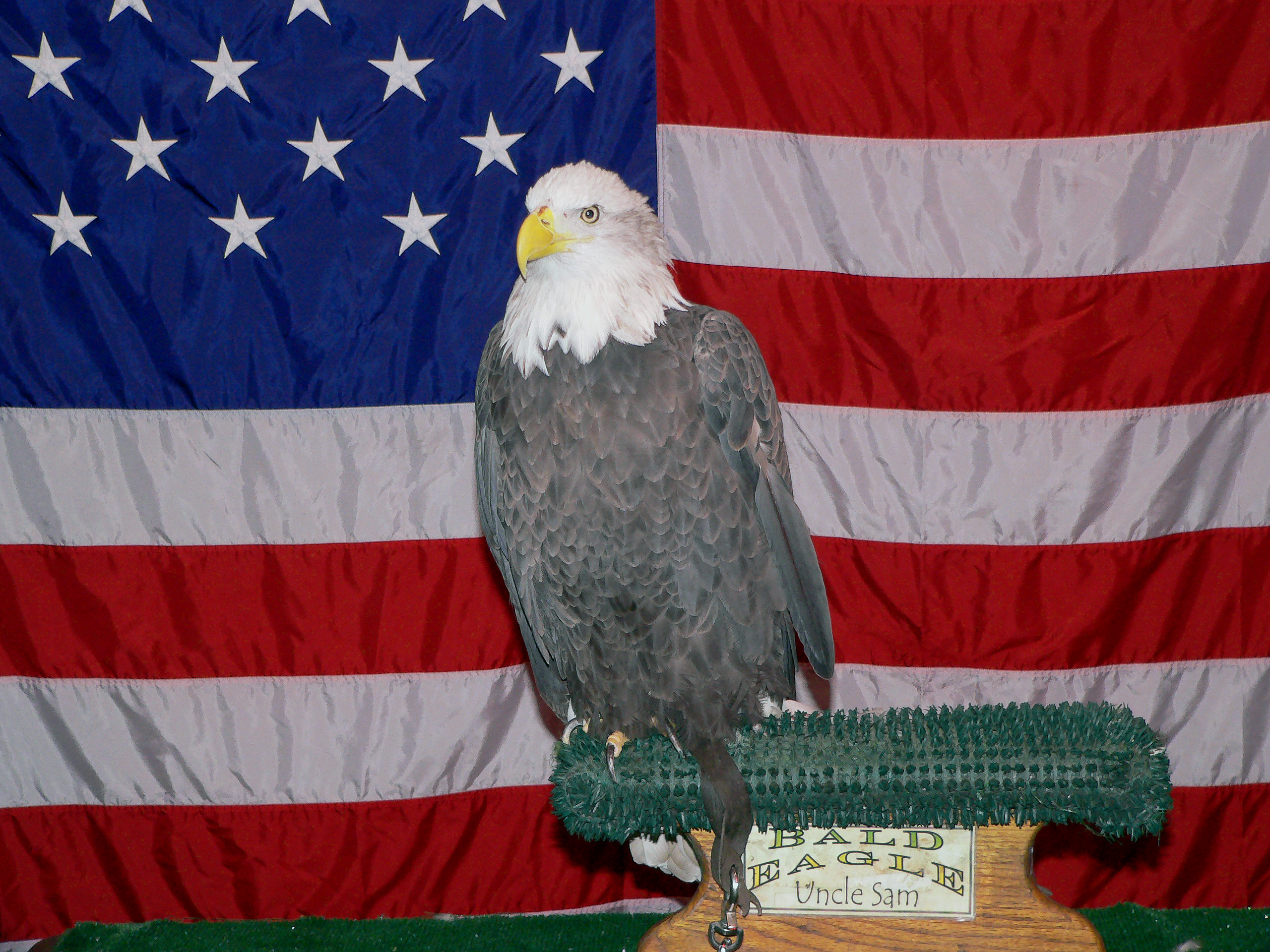
Uncle Sam – Bald Eagle taken at Titusville Birding Festival

Lee’s Addition:

Today the Bald-headed Eagle is just the Bald Eagle. The Sea Eagle is a different Eagle, much larger than the Bald. Also, not so sure about 160 year life span. Will have to check that out.

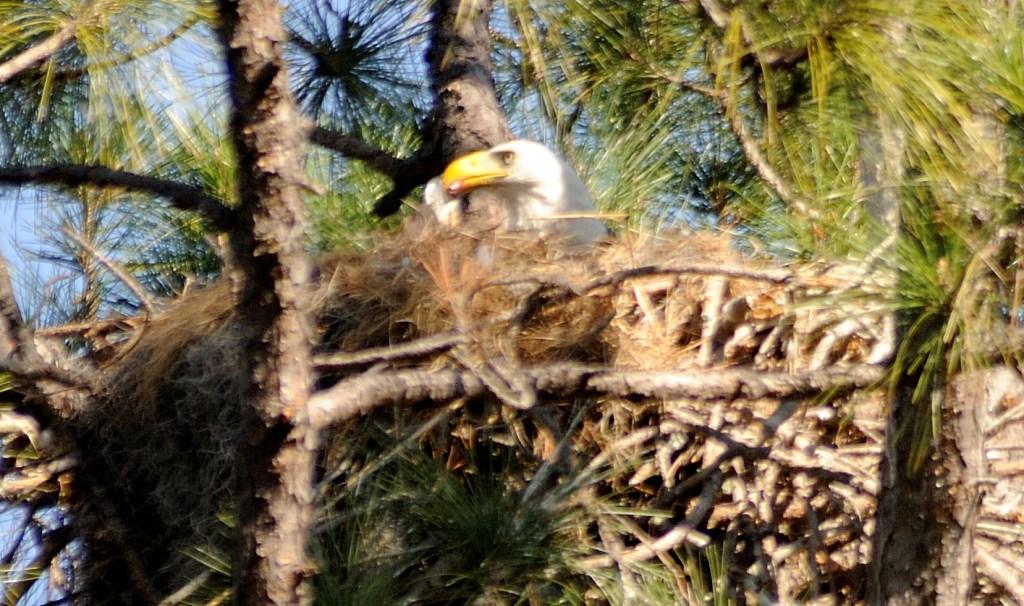
We are fortunate here in Polk County and in Central Florida. We get to see Bald Eagles quite often in the winter. That picture of the nest was taken at South Lake Howard Nature Park where the Eagles return to have young each year. At Circle B Bar Reserve, which we write about, they have several active Bald Eagle nests. Right by our Publix supermarket, the eagles sit on the high electrical posts and scan the area for dinner. I used to have to travel far to see them, but now, we live right where they hang out.

I have to admit that when I see a Bald Eagle fly by or just sitting, I stop in my tracks. There is something about the Bald Eagle’s appearance that appeals to me. Also, the Eagle is a Bible Birds and is mentioned in 34 times in the King James Version, 32 in NKJV, 31 in NASB and 29 times in ESV. It varies in the other versions also. Still it is mentioned about 30 times or so. Most are great verses that tell of their strenght and mighty wings. What a magnificent creation.

Ye have seen what I did unto the Egyptians, and how I bare you on eagles’ wings, and brought you unto myself. (Exodus 19:4 KJV)

Doth the eagle mount up at thy command, and make her nest on high? (Job 39:27 KJV)

But they that wait upon the LORD shall renew their strength; they shall mount up with wings as eagles; they shall run, and not be weary; and they shall walk, and not faint. (Isaiah 40:31 KJV)

Make thee bald, and poll thee for thy delicate children; enlarge thy baldness as the eagle; for they are gone into captivity from thee. (Micah 1:16 KJV)


Birds Illustrated by Color Photography – Revisited – Introduction

The above article is the first article in the monthly serial that was started in January 1897 “designed to promote Knowledge of Bird-Live.” These include Color Photography, as they call them, today they are drawings. There are at least three Volumes that have been digitized by Project Gutenberg.

To see the whole series of – Birds Illustrated by Color Photography – Revisited

*

(Information from Wikipedia and other internet sources)

Next Article – The Semi-Palmated Ring Plover

Previous Article – Birds Vol 1 #6 – The Volume 1. – Index

Sharing The Gospel

Links:

Bible Birds – Eagles

Birds of the Bible – Eagles

Accipitridae – Family (Kites, Hawks & Eagles)

Amazing Free-Flying Bald Eagle “Challenger”

Bald Eagle – WhatBird

*

Birds Illustrated By Color Photography – Volume II Indroduction

BIRDS

A MONTHLY SERIAL

ILLUSTRATED BY COLOR PHOTOGRAPHY

DESIGNED TO PROMOTE

KNOWLEDGE OF BIRD-LIFE


VOLUME II.


CHICAGO  Nature Study Publishing Company


copyright, 1897 by

Nature Study Publishing Co.

chicago.


INTRODUCTION.

This is the second volume of a series intended to present, in accurate colored portraiture, and in popular and juvenile biographical text, a very considerable portion of the common birds of North America, and many of the more interesting and attractive specimens of other countries, in many respects superior to all other publications which have attempted the representation of birds, and at infinitely less expense. The appreciative reception by the public of Vol. I deserves our grateful acknowledgement. Appearing in monthly parts, it has been read and admired by thousands of people, who, through the life-like pictures presented, have made the acquaintance of many birds, and have since become enthusiastic observers of them. It has been introduced into the public schools, and is now in use as a text book by hundreds of teachers, who have expressed enthusiastic approval of the work and of its general extension. The faithfulness to nature of the pictures, in color and pose, have been commended by such ornithologists and authors as Dr. Elliott Coues, Mr. John Burroughs, Mr. J. W. Allen, editor of The Auk, Mr. Frank M. Chapman, Mr. J. W. Baskett, and others.

The general text of Birds—the biographies—has been conscientiously prepared from the best authorities by a careful observer of the feather-growing denizens of the field, the forest, and the shore, while the juvenile autobiographies have received the approval of the highest ornithological authority.

The publishers take pleasure in the announcement that the general excellence of Birds will be maintained in subsequent volumes. The subjects selected for the third and fourth volumes—many of them—will be of the rare beauty in which the great Audubon, the limner par excellence of birds, would have found “the joy of imitation.”

Nature Study Publishing Company.


BIRDS.

Illustrated by COLOR PHOTOGRAPHY.

Vol. II.   No. 1.   JULY, 1897.


Bald Eagle (Haliaeetus leucocephalus) by Lee

Bald Eagle (Haliaeetus leucocephalus) by Lee

Lee’s Addition:

This second volume does not have a cover photo for each month like Volume I did. They apparently changed their format. Also, there are no old time advertisements. These were reproduced through Gutenberg Project.

Will be posting the different birds soon. See Birds Illustrated by Color Photography – Revisted.

*

Birds of the Bible – Water-hen or Water hen

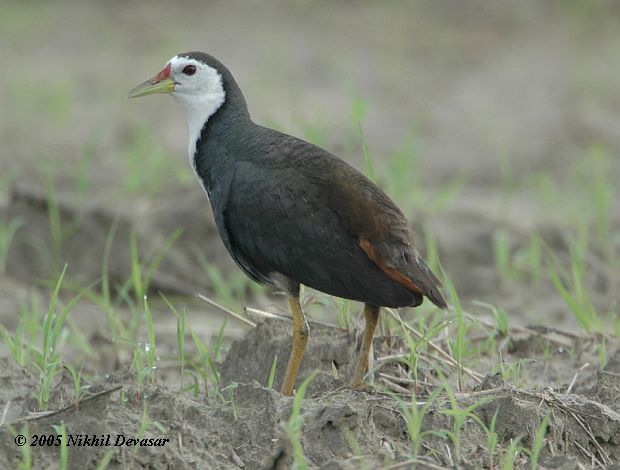
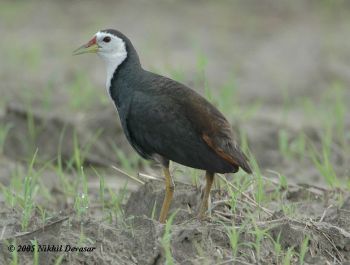
White-breasted Waterhen (Amaurornis phoenicurus) by Nikhil Devasar

White-breasted Waterhen (Amaurornis phoenicurus) by Nikhil Devasar

Leviticus 11:18
(BBE) And the water-hen and the pelican and the vulture;
(ERV) water hens, pelicans, carrion vultures,
(ISV) water-hen, pelican, carrion,
(MSG)  water hen, pelican, Egyptian vulture,
(NRSV) the water hen, the desert owl, the carrion vulture,

(ABP+) and the purple-legged stork, and pelican, and swan
CAB(i) 18 and the red-bill, and the pelican, and swan,
(Brenton) and the red-bill, and the pelican, and swan,
(Bishops) The Backe, the Pellicane, the Pye,

(Geneva) Also the redshanke and the pelicane, and the swanne:
(Vulgate) si ambulans per viam in arbore vel in terra nidum avis inveneris et matrem pullis vel ovis desuper incubantem non tenebis eam cum filiis
(KJV) And the swan, and the pelican, and the gier eagle,
Deuteronomy 14:16
(BBE) The little owl and the great owl and the water-hen;

(Bishops) The litle Owle, the great Owle, nor the Redshanke.
(Geneva) Neither the litle owle, nor the great owle, nor the redshanke,
(KJV)  The little owl, and the great owl,  and the swan,
(Vulgate) herodium et cycnum et ibin

Adam Clarke’s Commentary: “The swan – תנשמת tinshemeth. The Septuagint translate the word by πορφυριωνα, the porphyrion, purple or scarlet bird. Could we depend on this translation, we might suppose the flamingo or some such bird to be intended. Some suppose the goose to be meant, but this is by no means likely, as it cannot be classed either among ravenous or unclean fowls. Bochart thinks the owl is meant.”

Companion Bible Notes: “swan, not our swan: it is variously rendered “ibis”, “heron”, and “pelican”.

Gill: “Leviticus 11:18
And the swan,…. This is a bird well known to us, but it is a question whether it is intended by the word here used; for though it is so rendered in the Vulgate Latin, it is differently rendered by many others: the Targums of Jonathan and Jerusalem call it “otia”, which seems to be the same with the “otus” of Aristotle (n), who says it is like an owl, having a tuft of feathers about its ears (from whence it has its name); and some call it “nycticorax”, or the owl; and here, by Bochart (o), and others, the owl called “noctua” is thought to be meant; and with which agrees the account some Jewish writers give of it, as Aben Ezra and Baal Hatturim, who say it is a bird, which every one that sees is astonished at it, as other birds are at the owl, are frightened at the sight of it, and stupefied. But as the same word is used Lev_11:30 among the creeping things, for a mole, what Jarchi observes is worthy of consideration, that this is “calve (chauve) souris” (the French word for a bat), and is like unto a mouse, and flies in the night; and that which is spoken of among the creeping things is like unto it, which hath no eyes, and they call it “talpa”, a mole. The Septuagint version renders it by “porphyrion”, the redshank; and so Ainsworth; and is thought to be called by the Hebrew name in the text, from the blowing of its breath in drinking; for it drinks biting, as Aristotle says (p):”

Jamieson Fausset Brown: the swan — found in great numbers in all the countries of the Levant. It frequents marshy places – the vicinity of rivers and lakes. It was held sacred by the Egyptians, and kept tame within the precincts of heathen temples. It was probably on this account chiefly that its use as food was prohibited. Michaelis considers it the goose.
McGee:
Leviticus 11:13-19

CLEAN AND UNCLEAN FLYING CREATURES (IN THE AIR)
On the birds there are no visible markers like there are on the fish and the animals. But they seem to have in common that they are all unclean feeders. For the most part, they feed on dead carcasses of animals, fish, and other fowl.

A list of unclean birds of Palestine is given. This is another point that reveals that the Mosaic system was intended for the nation Israel and also for the particular land of Palestine. Some of these birds sound strange to us. They fall into the family of the eagles and the hawks, the vultures and the ravens, the owls and cormorants, and the swans and pelicans. They don’t even sound appetizing. They are the “dirty birdies” because of their feeding habits. Now remember, some people eat some of these birds today. I can’t say I would like any of them, but whether we eat them or don’t eat them makes no difference—meat will not commend us to God. The point is that it was teaching Israel to make a distinction. They had to make a decision about what was clean and unclean.

The lesson for us today is that we must make decisions about our conduct and our profession. We have to make the decision about whether to accept Christ or not, whether to study the Word of God or not, whether to walk in a way pleasing to God or not. That is the application for us today.

This section throws some light on the experience of Elijah. He was fed by the ravens—dirty birds. Elijah did not eat the ravens, but they fed him. This was a humbling experience for this man of God who obeyed God in every detail.

MHCC:
Leviticus 11:1-47

These laws seem to have been intended, 1. As a test of the people’s obedience, as Adam was forbidden to eat of the tree of knowledge; and to teach them self-denial, and the government of their appetites. 2. To keep the Israelites distinct from other nations. Many also of these forbidden animals were objects of superstition and idolatry to the heathen. 3. The people were taught to make distinctions between the holy and unholy in their companions and intimate connexions. 4. The law forbad, not only the eating of the unclean beasts, but the touching of them. Those who would be kept from any sin, must be careful to avoid all temptations to it, or coming near it. The exceptions are very minute, and all were designed to call forth constant care and exactness in their obedience; and to teach us to obey. Whilst we enjoy our Christian liberty, and are free from such burdensome observances, we must be careful not to abuse our liberty. For the Lord hath redeemed and called his people, that they may be holy, even as he is holy. We must come out, and be separate from the world; we must leave the company of the ungodly, and all needless connexions with those who are dead in sin; we must be zealous of good works devoted followers of God, and companions of his people.

***

Well, those are some of the remarks by the different commentaries. It seems there is no real set answer as to whether the Waterhen or Water-hen was the intended bird. The list of Unclean and Clean birds was for the Israelites and not us today. It is not even for them today. Why write about them, because it is interesting. To me, it comes down to a decision on their part and ours today whether we want to obey the Word of God.

….for the LORD your God is testing you to know whether you love the LORD your God with all your heart and with all your soul. You shall walk after the LORD your God and fear Him, and keep His commandments and obey His voice; you shall serve Him and hold fast to Him. (Deuteronomy 13:3-4 NKJV)

Most of the birds seem to have a diet that would cause eating that bird to make people sick or to die. Not all of them are in that category. It could be that they were not to eat a specific bird because they were few in number at that time and it could have caused them to go extinct. (That happens today.) It comes to obedience. That said, let’s see what a Water Hen really is.

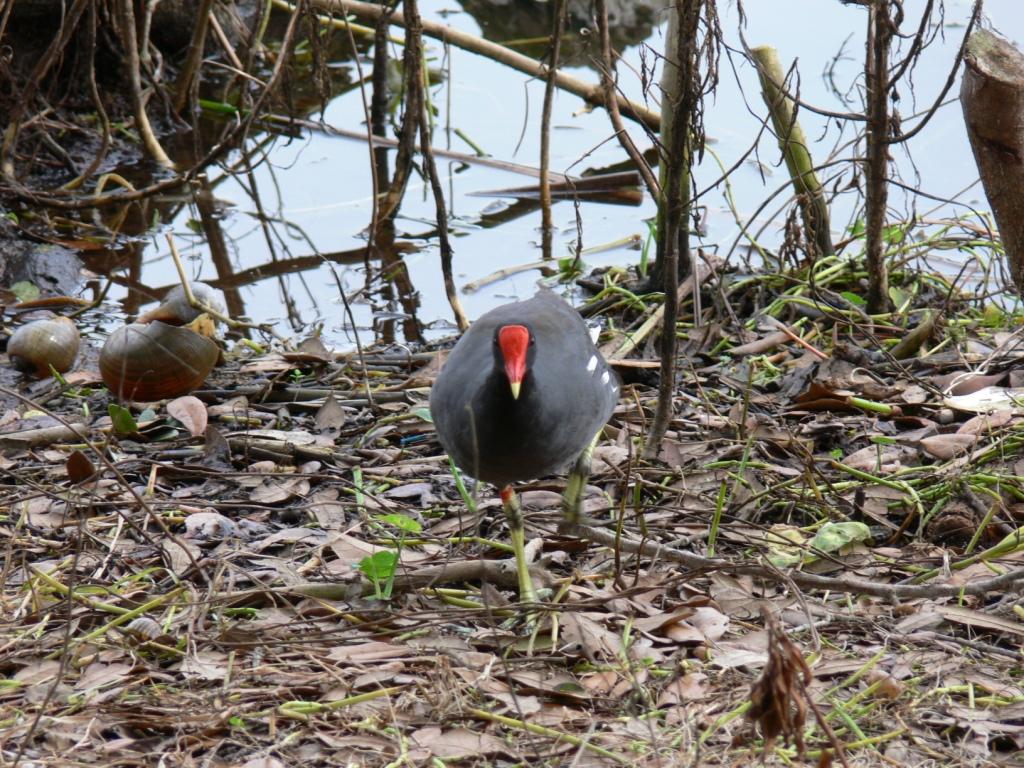
Common Moorhen (Gallinula chloropus) by Lee

Common Moorhen (Gallinula chloropus) by Lee

Water-hen or Waterhens are in the Rallidae – Rails, Crakes & Coots Family. According to Wikipedia’s article on the Waterhen:

Waterhen may refer to any of the following:

Black Crake (Amaurornis flavirostra) ©WikiC

Black Crake (Amaurornis flavirostra) ©WikiC

The adult Black Crake is 19–23 cm long with a short tail and long toes. As its name implies, the adult has mainly black plumage, with a brown olive tone on the wings and upperparts which is rarely detectable in the field. The eye is red, the bill is yellow, and the legs and feet are red, duller when not breeding.

The sexes are similar, but the male is slightly larger. Most males, but only 10% of females, have a hooked upper mandible. The immature bird has brown upperparts and a dark grey head and underparts. Its bill is greenish yellow, and its feet and legs are dull red. The downy chicks are black, as with all rails.

The Black Crake is extremely aggressive when breeding and will attack birds of many species, but especially other rails. It will attack and kill rails of species as large as itself.

The nest is a deep neat bowl made from wetland plants and built by both sexes in marsh vegetation or on the ground in a dry location. The nest is also sometimes constructed up to 3 m high in a bush.

If it was a Redshank(e), then we have a completely different bird in a different family, the Scolopacidae – Sandpipers, Snipes. If so, that would mean I would have to make yet another “Bird of the Bible” category. Humm!
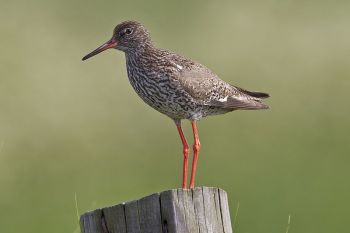
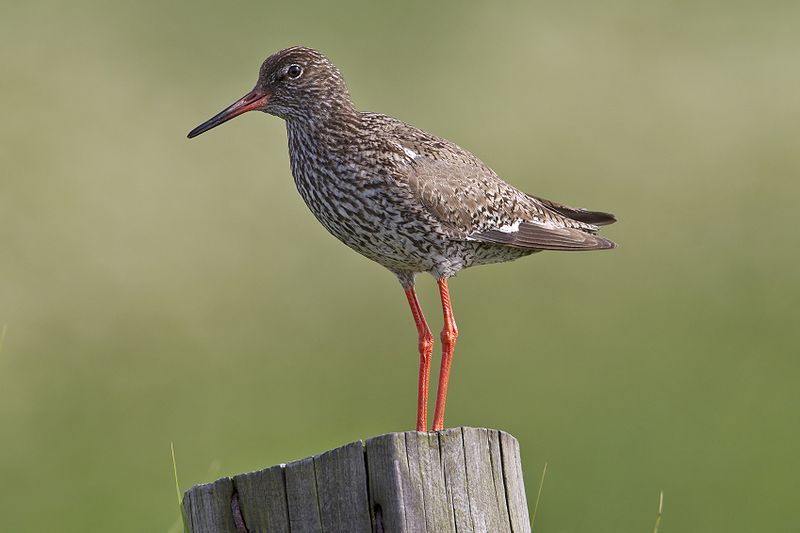
Common Redshank (Tringa totanus) ©WikiC

Common Redshank (Tringa totanus) ©WikiC

Of the three last bird pictures here, they do all have something red. The Moorhen has a red beak and the other two have red legs. You realize that these names are today’s name. They do change over the years. What ever bird this verse applies to, it has been enjoyable for me to investigate it. It has caused me to be in God’s Word, search the Commentaries, and check out the many birds the Lord created. And I trust you have benefited from it also and you might even dig around and find more about these verses.

And I get to add another Bird of the Bible page.

Birds of the Bible – Waterhen

All Birds of the Bible articles.

*

Ian’s Bird of the Week – Bohemian Waxwing

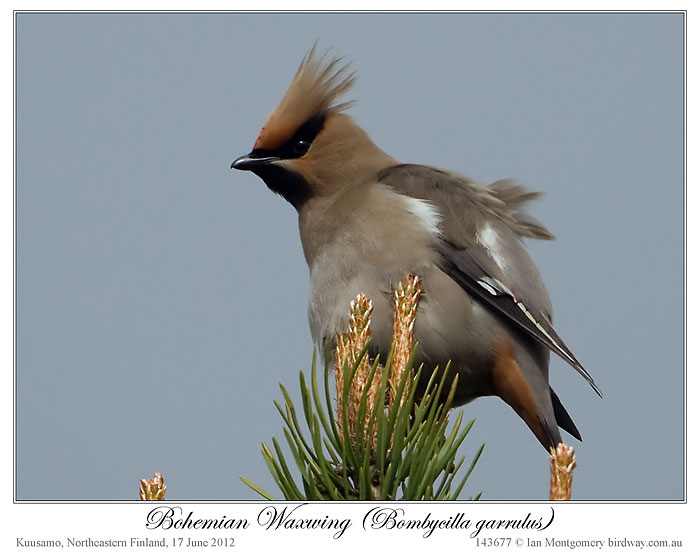
Bohemian Waxwing (Bombycilla garrulus) by Ian 1

Bohemian Waxwing by Ian 1

Bird of the Week – Bohemian Waxwing ~ by Ian Montgomery

Newsletter – 7/5/12

Following on from the Black Woodpecker, here is the (Bohemian) Waxwing another unusual northern European species that has a 50 year connection for me.

The Bohemian Waxwing breeds across northern Eurasian and North America and moves southwards in winter in search of its staple winter food, berries. In Western Europe, it usually goes only as far as Germany and northern France, but in some years, driven by food shortages, it makes its way as far west as Britain and, more rarely, Ireland. That happened in the early 1960s when I was a schoolboy in Ireland, and I once saw several feeding on berries in a suburban street in Dublin (Eglington Road). I hadn’t seen them again since until my trip to Finland two weeks ago and I drove down that street a few days ago.

Bohemian Waxwing (Bombycilla garrulus) by Ian 2

Bohemian Waxwing by Ian 2

These starling-sized birds are exotic by European standards and beautiful by any, so you can imagine my excitement all those years ago. It was good to catch up with them again in Finland, and this female, perched on top of a conifer, allowed me to approach fairly closely. They get their name from the red waxy-looking tips to some of the wing feathers, which you can see if you look carefully at the photos. These are more obvious in males, and the whitish stripes below the red spot are much yellower in males.

Bohemian Waxwing (Bombycilla garrulus) by Ian 3

Bohemian Waxwing by Ian 3

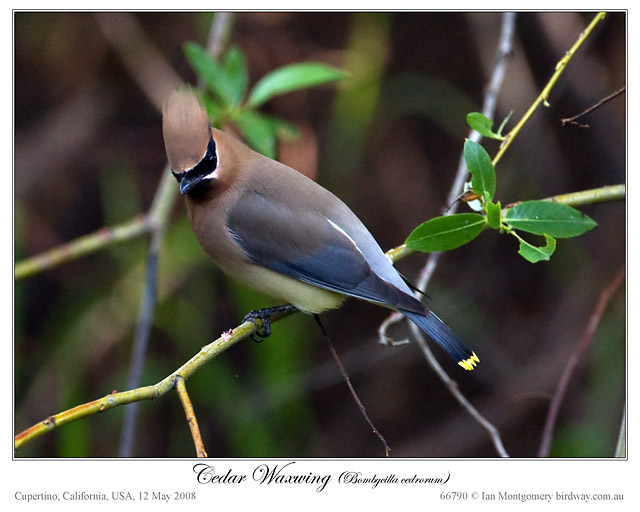
In Europe, these birds are just called Waxwings, but in North America there are two species and this one is qualified with the Bohemian tag to separate it from the slightly smaller but otherwise rather similar Cedar Waxwing. This featured as Bird of the Week three years ago and here it is again:

Bohemian Waxwing (Bombycilla garrulus) by Ian 4

Bohemian Waxwing by Ian 4

Waxwings have silky feathers, and the generic name Bombycilla means, in pigeon Latin, ‘silky tail’. There are only 3 species – the third being the Japanese Waxwing – and they were originally the only members of the family Bombycillidae. Recent genetic studies have shown that several other species are related to them and have been moved into the family. Interestingly, these include the three species of aptly-named Silky-Flycatchers (the ‘silky’ being apt, not the greatly overused ‘flycatcher’), such as the Long-tailed Silky-Flycatcher and you’ll see the family resemblance if you follow the link.

Meanwhile in Dublin, my niece has given birth to a delightful baby girl, Aoibhinn, and both mother and child are doing well. Ancient Irish names are very fashionable here and ‘bh’ in Irish has a ‘v’ sound (strictly speaking it’s an aspirated ‘b’, traditionally represented by a dot over the ‘b’) so the name is pronounced something like ‘eaveen’. Aiobhinn timed her arrival well and waited until all the immediate members of the family were in Dublin, including my other niece who came over from Strasbourg with her husband.

Best wishes
Ian

**************************************************
Ian Montgomery, Birdway Pty Ltd, to a
454 Forestry Road, Bluewater, Qld 4818
Tel 0411 602 737 ian@birdway.com.au
Check the latest website updates:
http://www.birdway.com.au/#updates


Lee’s Addition:

She maketh herself coverings of tapestry; her clothing is silk and purple. (Proverbs 31:22 KJV)

What a gorgeous bird and I am thankful that Ian met up with an old friend from years ago. Seeing her must have brought back memories. Thanks again for sharing your birding adventures with us, Ian.

See these other articles about the Waxwings:

Ian’s Bird of the Week – Cedar Waxwing

See all of Ian’s Bird of the Week articles

Birds Vol 1 #4 – The Bohemian Wax-Wing

Waxwings – Bombycillidae family

Cedar Waxwing – Fruit Passer…

*

Ian’s Bird of the Week – Black Woodpecker

Black Woodpecker (Dryocopus martius) by Ian 1

Black Woodpecker (Dryocopus martius) by Ian 1

Ian’s Bird of the Week – Black Woodpecker ~ by Ian Montgomery

Newsletter – 6/26/12

I said last week that my main target in Finland the Black Woodpecker was another story. It’s a story that started 50 years ago when I started bird watching in Ireland as a teenager and received, as a Christmas present in 1962, the classic Guy Mountfort Field Guide to the Birds of Britain and Europe. It had, for its time, superb colour plates of all the European bird species by Roger Peterson. Some of these birds were to this Irish teenager unbelievably exotic and, living on a woodpecker-free island, I was struck by the woodpecker page in general and the huge Black Woodpecker in particular (I still have the field guide):

The concept of a bucket list (things to do before you ‘kick the bucket’) hadn’t been articulated then, but the Black Woodpecker went straight onto mine. So, when the only route that Qantas could offer me a few months ago for a frequent-flyer ticket in the general direction of Ireland was on Finnair via Helsinki, I immediately thought ‘Black Woodpecker’ (and ‘owls’, another great page in the field guide).

In fact finding birds such as woodpeckers and owls in the endless forests of Finland proved very difficult, so eventually I went out with an excellent Finnature guide, Antti (Finnish for Andrew) and a delightful English birding couple in the Kuusamo region. It was a very bad year for owls (owl years are very dependent on cycles in the vole population) but Antti did eventually find us a distant Pygmy Owl and, last bird of all, showed us the nesting site of a pair of Black Woodpeckers.

Black Woodpecker (Dryocopus martius) by Ian 2

Black Woodpecker (Dryocopus martius) by Ian 2

We were treated to a view of the male – the female lacks the red crown, having on a small red patch on the back of the head – arriving to feed the young, but there then followed a long period without any activity and, as it was time to return to the hotel for breakfast, I returned later on my own so that I could photograph them at my leisure. Again, the male arrived (second photo) and three hungry chicks appeared at the nest entrance. The male then fed them, presumably by regurgitation – third photo – as he didn’t appear to be carrying any food when he arrived.

Black Woodpecker (Dryocopus martius) by Ian 3

Black Woodpecker (Dryocopus martius) by Ian 3

At 45-50cm/18-20in in length, these are crow-sized birds are the largest Eurasian Woodpecker and comparable in size to the related Pileated Woodpecker of North America. Their white bill is 5cm/2in in length and an impressive implement. They usually dig a new nest hollow each year, but Antti told us that this pair had used the same one for two years running. The Black Woodpecker is quite widespread in mature forest in Eurasia and is expanding its range.

Black Woodpecker (Dryocopus martius) by Ian 4

Black Woodpecker (Dryocopus martius) by Ian 4

After feeding the young, the male left the nest for several minutes and then returned and entered the hollow. Nothing further happened for over half an hour until the female, who had been in the nest all along, emerged and flew off (fourth photo). The nest was in a tree on a quiet road outside a house, so I was able to watch it in comfort from my rental car (fifth photo), the red arrow indicating the location of the nest.

Black Woodpecker (Dryocopus martius) by Ian 5

Black Woodpecker (Dryocopus martius) by Ian 5

So, my visit to Finland reached a satisfactory conclusion and the Black Woodpecker lived up to expectations. Three days later I flew to Dublin, where I am now to join the rest of the family and await the arrival of the first member of the next generation. My niece went into hospital yesterday and the arrival of the baby, ten days overdue, is anticipated either tonight or tomorrow.

Best wishes,

Ian
**************************************************
Ian Montgomery, Birdway Pty Ltd,
454 Forestry Road, Bluewater, Qld 4818
Tel 0411 602 737 ian@birdway.com.au
Check the latest website updates:
http://www.birdway.com.au/#updates
**************************************************


Lee’s Addition:

The trees of the LORD are full of sap; the cedars of Lebanon, which he hath planted; Where the birds make their nests: as for the stork, the fir trees are her house. (Psalms 104:16-17 KJV)

Congratulations on a new generation beginning. Also obtaining another of your bucket list birds. What a neat bird. That camera lens is something else!

Thanks again, Ian, for sharing your birdwatching photography with us. We await your next adventure in to the domain of the birds.

The Woodpeckers are in the Picidae – Woodpeckers Family of the Piciformes Order. Check out Ian’s many Woodpecker photos.

*

Birds Vol 1 #6 – The Scarlet Tanager

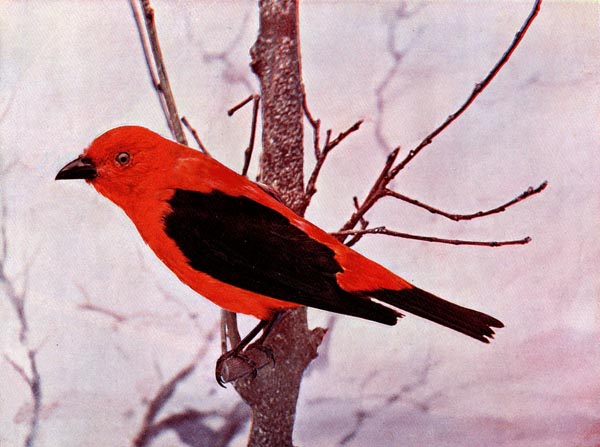
Scarlet Tanager for Birds Illustrated by Color Photography, 1897

Scarlet Tanager for Birds Illustrated by Color Photography, 1897, From col. F. M. Woodruff

Birds Illustrated by Color Photography – Revisited

Vol 1. June, 1897 No. 6

*

THE SCARLET TANAGER.

imgo

NE of the most brilliant and striking of all American birds is the Scarlet Tanager. From its black wings resembling pockets, it is frequently called the “Pocket Bird.” The French call it the “Cardinal.” The female is plain olive-green, and when seen together the pair present a curious example of the prodigality with which mother nature pours out her favors of beauty in the adornment of some of her creatures and seems niggardly in her treatment of others. Still it is only by contrast that we are enabled to appreciate the quality of beauty, which in this case is of the rarest sort. In the January number of Birds we presented the Red Rumped Tanager, a Costa Rica bird, which, however, is inferior in brilliancy to the Scarlet, whose range extends from eastern United States, north to southern Canada, west to the great plains, and south in winter to northern South America. It inhabits woodlands and swampy places. The nesting season begins in the latter part of May, the nest being built in low thick woods or on the skirting of tangled thickets; very often also, in an orchard, on the horizontal limb of a low tree or sapling. It is very flat and loosely made of twigs and fine bark strips and lined with rootlets and fibers of inner bark.

The eggs are from three to five in number, and of a greenish blue, speckled and blotted with brown, chiefly at the larger end.

The disposition of the Scarlet Tanager is retiring, in which respect he differs greatly from the Summer Tanager, which frequents open groves, and often visits towns and cities. A few may be seen in our parks, and now and then children have picked up the bright dead form from the green grass, and wondered what might be its name. Compare it with the Redbird, with which it is often confounded, and the contrast will be striking.

His call is a warble, broken by a pensive call note, sounding like the syllables chip-churr, and he is regarded as a superior musician.

From xeno-canto.org – Scarlet Tanager song:

“Passing through an orchard, and seeing one of these young birds that had but lately left the nest, I carried it with me for about half a mile to show it to a friend, and having procured a cage,” says Wilson, “hung it upon one of the large pine trees in the Botanic Garden, within a few feet of the nest of an Orchard Oriole, which also contained young, hoping that the charity and kindness of the Orioles would induce them to supply the cravings of the stranger. But charity with them as with too many of the human race, began and ended at home. The poor orphan was altogether neglected, and as it refused to be fed by me, I was about to return it to the place where I had found it, when, toward the afternoon, a Scarlet Tanager, no doubt its own parent, was seen fluttering around the cage, endeavoring to get in. Finding he could not, he flew off, and soon returned with food in his bill, and continued to feed it until after sunset, taking up his lodgings on the higher branches of the same tree. In the morning, as soon as day broke, he was again seen most actively engaged in the same manner, and, notwithstanding the insolence of the Orioles, he continued his benevolent offices the whole day, roosting at night as before. On the third or fourth day he seemed extremely solicitous for the liberation of his charge, using every expression of distressful anxiety, and every call and invitation that nature had put in his power, for him to come out. This was too much for the feelings of my friend. He procured a ladder, and mounting to the spot where the bird was suspended, opened the cage, took out his prisoner, and restored him to liberty and to his parent, who, with notes of great exultation, accompanied his flight to the woods.”


THE SCARLET TANAGER.

What could be more beautiful to see than this bird among the green leaves of a tree? It almost seems as though he would kindle the dry limb upon which he perches. This is his holiday dress. He wears it during the nesting season. After the young are reared and the summer months gone, he changes his coat. We then find him dressed in a dull yellowish green—the color of his mate the whole year.

Do you remember another bird family in which the father bird changes his dress each spring and autumn?

The Scarlet Tanager is a solitary bird. He likes the deep woods, and seeks the topmost branches. He likes, too, the thick evergreens. Here he sings through the summer days. We often pass him by for he is hidden by the green leaves above us.

He is sometimes called our “Bird of Paradise.”

Tanagers feed upon winged insects, caterpillars, seeds, and berries. To get these they do not need to be on the ground. For this reason it is seldom we see them there.

Both birds work in building the nest, and both share in caring for the little ones. The nest is not a very pretty one—not pretty enough for so beautiful a bird, I think. It is woven so loosely that if you were standing under it, you could see light through it.

Notice his strong, short beak. Now turn to the picture of the Rose-Breasted Grosbeaks in April Birds. Do you see how much alike they are? They are near relatives.

I hope that you may all have a chance to see a Scarlet Tanager dressed in his richest scarlet and most jetty black.


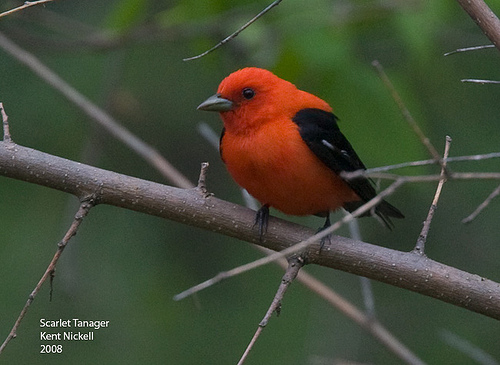
Scarlet Tanager (Piranga olivacea) by Kent Nickell

Scarlet Tanager (Piranga olivacea) by Kent Nickell

Lee’s Addition:

‘Come now, and let us reason together,” Says the LORD, “Though your sins are like scarlet, They shall be as white as snow; Though they are red like crimson, They shall be as wool. (Isaiah 1:18 NKJV)

Scarlet Tanagers (Piranga olivacea) find themselves assigned to the Cardinalidae – Grosbeaks, Saltators & Allies Family and not in the Thraupidae – Tanagers and Allies where I would have thought they might be.

The tanagers comprise the bird family Thraupidae, in the order Passeriformes. The family has an American distribution (Cardinalidae). Tanagers are small to medium-sized birds.

There were traditionally about 240 species of tanagers, but the taxonomic treatment of this family’s members is currently in a state of flux. As more of these birds are studied using modern molecular techniques it is expected that some genera may be relocated elsewhere. Already species in the genera Euphonia and Chlorophonia, which were once considered part of the tanager family, are now treated as members of Fringillidae, in their own subfamily (Euphoniinae). Likewise the genera Piranga (which includes the Scarlet Tanager, Summer Tanager, and Western Tanager), Chlorothraupis, and Habia appear to be members of the Cardinal family, and have been reassigned to that family by the AOU.

The Scarlet Tanager (Piranga olivacea) is a medium-sized American songbird. It and other members of its genus are now classified in the cardinal family (Cardinalidae). The specie’s plumage and vocalizations are similar to other members of the cardinal family.

Adults have pale stout smooth bills. Adult males are bright red with black wings and tail; females are yellowish on the underparts and olive on top, with olive-brown wings and tail. The adult male’s winter plumage is similar to the female’s, but the wings and tail remain darker. Young males briefly show a more complex variegated plumage intermediate between adult males and females. It apparently was such a specimen that was first scientifically described. Hence the older though somewhat confusing specific epithet olivacea (“the olive-colored one”) is used rather than erythromelas (“the red-and-black one”), as had been common throughout the 19th century.

Their breeding habitat is large forested areas, especially with oaks, across eastern North America. Scarlet Tanagers migrate to northwestern South America, passing through Central America around April, and again around October.

They begin arriving on the breeding grounds in numbers by about May and already start to move south again in mid-summer; by early October they are all on their way south.[3] The bird is an extremely rare vagrant to western Europe.
Scarlet Tanagers are often out of sight, foraging high in trees, sometimes flying out to catch insects in flight. They eat mainly insects and fruit.

These birds do best in the forest interior, where they are less exposed to predators and brood parasitism by the Brown-headed Cowbird. Their nests are typically built on horizontal tree branches. Specifically their numbers are declining in some areas due to habitat fragmentation, but on a global scale tanagers are a plentiful species.

*

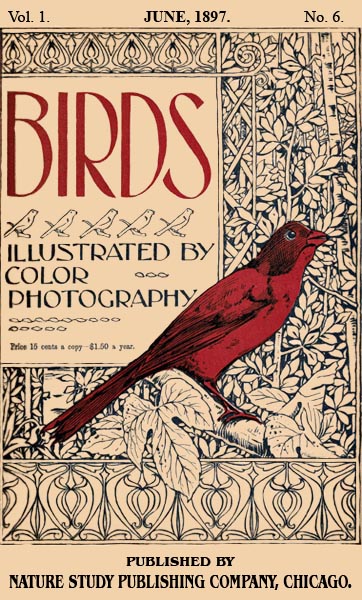
Birds Illustrated by Color Photograhy Vol 1 June, 1897 No 6 - Cover

Birds Illustrated by Color Photograhy Vol 1 June, 1897 No 6 – Cover

Birds Illustrated by Color Photography – Revisited – Introduction

The above article is the first article in the monthly serial that was started in January 1897 “designed to promote Knowledge of Bird-Live.” These include Color Photography, as they call them, today they are drawings. There are at least three Volumes that have been digitized by Project Gutenberg.

To see the whole series of – Birds Illustrated by Color Photography – Revisited

*

(Information from Wikipedia and other internet sources)

Next Article – The Ruffed Grouse

Previous Article – June and the Birds and Farmers

Wordless Birds – With Hummingbirds

Links:

Scarlet Tanager – Wikipedia

Tanager – Wikipedia

Learning From The Birds – Overwhelmed

*

Ian’s Bird of the Week – Ruff

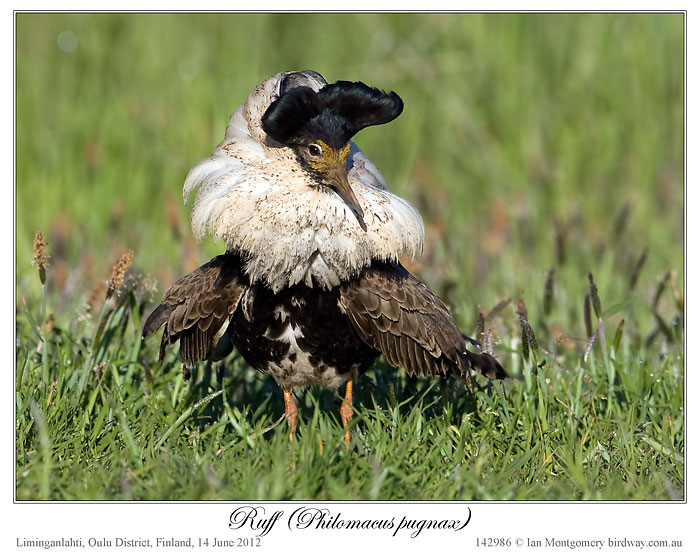
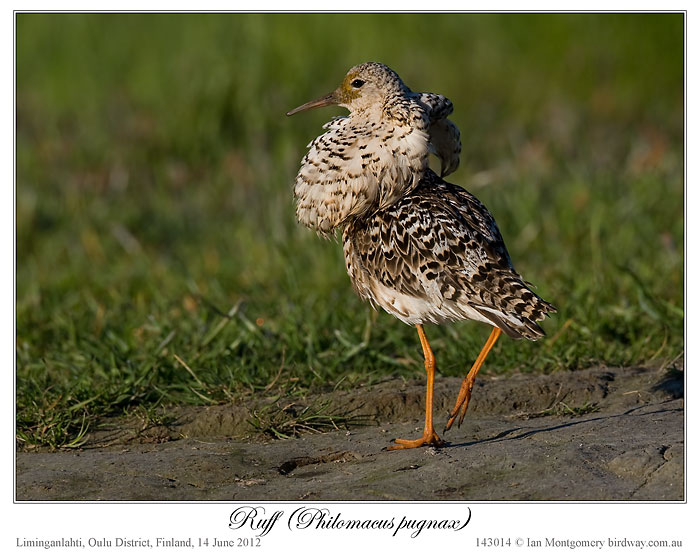
Ruff (Philomachus pugnax) by Ian 1

Ruff (Philomachus pugnax) by Ian 1

Ian’s Bird of the Week – Ruff ~ by Ian Montgomery

Newsletter ~ 6/19/12

This week we have nothing short of a fashion parade, male Ruffs at a communal display ground or lek in eastern Finland. Finland is my second stop-over on the way to Ireland to visit my family and I am spending a week in the northern part of the country in search of some unusual northern European birds. I spent a couple of nights in Oulo on the west coast, a 1 hour flight north of Helsinki and then drove north west to Kuusamo near the Russian border where I am now.

In Oulu, the birding and wildlife tour company Finnature put me very early in the morning in a hide that they had set up near the lek. I settled down to watch a rather unpromising-looking piece of raised ground in a meadow, having been assured that, though it was late in the season, a couple of birds had been seen at the lek on the previous morning.

Ruff (Philomachus pugnax) by Ian 2

Ruff (Philomachus pugnax) by Ian 2

After about half an hour and shortly before 4:00am the black-ruffed bird in the second photo arrived but flew off when I moved the camera. Happily, it soon returned and this time the second white-ruffed bird arrived too and the pair started their extraordinary display, spreading their ruffs and wings apparently to make themselves appear as intimidating as possible. Sometimes, they jumped vertically in the air and at other times they crouched low on the ground in submissive looking postures.

Ruff (Philomachus pugnax) by Ian 3

Ruff (Philomachus pugnax) by Ian 3

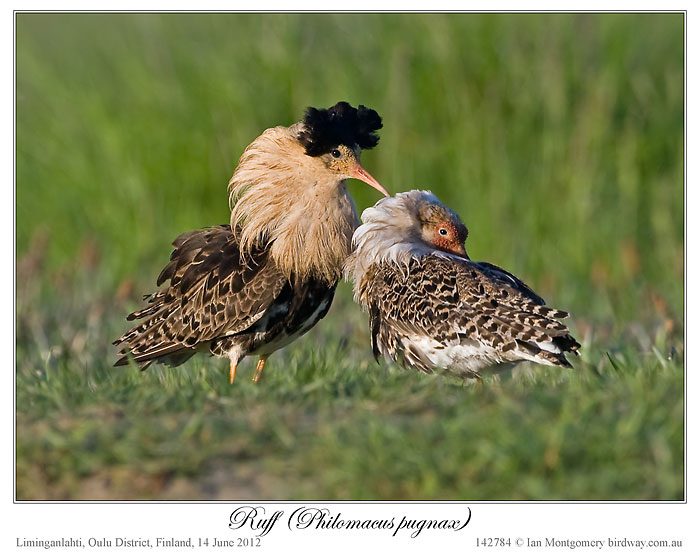
Although the birds often came into close physical contact, there was no actual fighting and no physical damage. These black- and white-ruffed birds were the main performers during the 4 hours that I remained in the hide, but other birds joined in and at one stage there were about 10 birds on the lek. The colours of the ruffs and the erectile feathers on the head were varied. Here is a buff and black one with the white bird.

Ruff (Philomachus pugnax) by Ian 4

Ruff (Philomachus pugnax) by Ian 4

The colour of the bare wattled skin on the face varied too, being sometimes yellow and sometimes red, though it was my impression that this colour wan’t permanent and the red flush was associated with more intense display. This non-displaying one with a chestnut cap, piebald ruff has yellow facial skin.

Ruff (Philomachus pugnax) by Ian 5

Ruff (Philomachus pugnax) by Ian 5

This one is mainly chestnut.

Ruff (Philomachus pugnax) by Ian 6

Ruff (Philomachus pugnax) by Ian 6

While this one with an ermine ruff look suitably regal.

Ruff (Philomachus pugnax) by Ian 7

Ruff (Philomachus pugnax) by Ian 7

Ruffs are unusual among lekking birds in that the display is aimed mainly at other males to establish dominance, rather than at attracting females. Females may mate with multiple males producing young with different fathers and homosexual mating also occurs. The different ruff colours are apparently significant and white-ruffed males are smaller and less dominant and called satellite males.

Ruff (Philomachus pugnax) by Ian 8

Ruff (Philomachus pugnax) by Ian 8

The females, called Reeves, are quite plain and look rather like other sandpipers such as Sharp-tailed and Pectoral. In non-breeding plumage, the males resemble the females but are larger and longer-necked. Ruffs breed across northern Eurasia from Scandinavia to Siberia and winter in Africa, Asia and, in small numbers, Australia. You can see a female and ruff-less male, photographed in India, here: http://www.birdway.com.au/scolopacidae/ruff/index.htm.

Who said waders are plain and boring? I had a wonderful time at this lek. The Ruffs wasn’t one of my target species in Finland but an unexpected bonus, thank you Finnature. My main target was the largest Woodpecker in Europe, the Black Woodpecker, but that’s another story.

Best wishes
Ian

**************************************************
Ian Montgomery, Birdway Pty Ltd,
454 Forestry Road, Bluewater, Qld 4818
Tel 0411 602 737 ian@birdway.com.au
Check the latest website updates:
http://www.birdway.com.au/#updates
**************************************************


Lee’s Addition:

What a group of “show offs.” I find these birds amazing. Never thought of this family as having leks like the pheasants and those in that order. Just goes to show you that the birds are doing what they are suppose to and that is reproducing. What a show for the females to get to watch.

Bring out with you every living thing of all flesh that is with you: birds and cattle and every creeping thing that creeps on the earth, so that they may abound on the earth, and be fruitful and multiply on the earth.”
(Genesis 8:17 NKJV)

The Ruff is in the Scolopacidae – Sandpipers, Snipes Family in the Charadriiformes Order.

*

Birds Vol 1 #6 – The Loggerhead Shrike

Loggerhead Shrike for Birds Illustrated by Color Photography, 1897

Loggerhead Shrike for Birds Illustrated by Color Photography, 1897

Birds Illustrated by Color Photography – Revisited

Vol 1. June, 1897 No. 6

*

THE LOGGERHEAD SHRIKE.

imga1

RAMBLER in the fields and woodlands during early spring or the latter part of autumn is often surprised at finding insects, grasshoppers, dragon flies, beetles of all kinds, and even larger game, mice, and small birds, impaled on twigs and thorns. This is apparently cruel sport, he observes, if he is unacquainted with the Butcher Bird and his habits, and he at once attributes it to the wanton sport of idle children who have not been led to say,


With hearts to love, with eyes to see,
With ears to hear their minstrelsy;
Through us no harm, by deed or word,
Shall ever come to any bird.

If he will look about him, however, the real author of this mischief will soon be detected as he appears with other unfortunate little creatures, which he requires to sustain his own life and that of his nestlings. The offender he finds to be the Shrike of the northern United States, most properly named the Butcher Bird. Like all tyrants he is fierce and brave only in the presence of creatures weaker than himself, and cowers and screams with terror if he sees a falcon. And yet, despite this cruel proceeding, which is an implanted instinct like that of the dog which buries bones he never seeks again, there are few more useful birds than the Shrike. In the summer he lives on insects, ninety-eight per cent. of his food for July and August consisting of insects, mainly grasshoppers; and in winter, when insects are scarce, mice form a very large proportion of his food.

The Butcher Bird has a very agreeable song, which is soft and musical, and he often shows cleverness as a mocker of other birds. He has been taught to whistle parts of tunes, and is as readily tamed as any of our domestic songsters.

The nest is usually found on the outer limbs of trees, often from fifteen to thirty feet from the ground. It is made of long strips of the inner bark of bass-wood, strengthened on the sides with a few dry twigs, stems, and roots, and lined with fine grasses. The eggs are often six in number, of a yellowish or clayey-white, blotched and marbled with dashes of purple, light brown, and purplish gray. Pretty eggs to study.

Readers of Birds who are interested in eggs do not need to disturb the mothers on their nests in order to see and study them. In all the great museums specimens of the eggs of nearly all birds are displayed in cases, and accurately colored plates have been made and published by the Smithsonian Institution and others. The Chicago Academy of Sciences has a fine collection of eggs. Many persons imagine that these institutions engage in cruel slaughter of birds in order to collect eggs and nests. This, of course, is not true, only the fewest number being taken, and with the exclusive object of placing before the people, not for their amusement but rather for their instruction, specimens of birds and animals which shall serve for their identification in forest and field.

The Loggerhead Shrike and nest shown in this number were taken under the direction of Mr. F. M. Woodruff, at Worth, Ill., about fourteen miles from Chicago. The nest was in a corner of an old hedge of Osage Orange, and about eight feet from the ground. He says in the Osprey that it took considerable time and patience to build up a platform of fence boards and old boxes to enable the photographer to do his work. The half-eaten body of a young garter snake was found about midway between the upper surface of the nest and the limb above, where it had been hung up for future use.


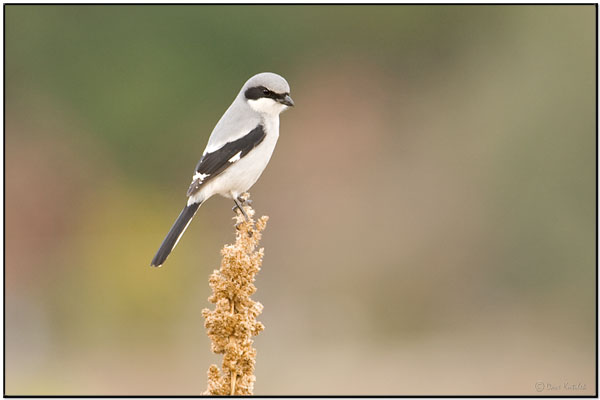
Loggerhead Shrike (Lanius ludovicianus) by Daves BirdingPix

Loggerhead Shrike (Lanius ludovicianus) by Daves BirdingPix

Lee’s Addition:

“That path no bird of prey knows, and the falcon’s eye has not seen it. (Job 28:7 ESV)

What a surprise about a week or so ago when I looked out at my feeders/fountain area. There were 4 Loggerhead Shrikes around the fountain and chasing each other around the tree. That is the first time they have visited our yard. Saw my first Loggerhead out in Louisiana years ago. They can confuse you at first look with a Northern Mockingbird, which is what I thought I was looking at at the fountain.

Loggerhead Shrikes are in the Laniidae – Shrikes Family which at the time has 33 members. The family name, and that of the largest genus, Lanius, is derived from the Latin word for “butcher”, and some shrikes were also known as “butcher birds” because of their feeding habits. Note that the Australasian butcherbirds (Artamidae family) are not shrikes.

Most shrike species have a Eurasian and African distribution, with just two breeding in North America (the Loggerhead and Great Grey shrikes). There are no members of this family in South America or Australia, although one species reaches New Guinea. The shrikes vary in the extent of their ranges, with some species like the Great Grey Shrike ranging across the northern hemisphere to the Newton’s Fiscal which is restricted to the island of São Tomé.

They inhabit open habitats, especially steppe and savannah. A few species of shrike are forest dwellers, seldom occurring in open habitats. Some species breed in northern latitudes during the summer, then migrate to warmer climes for the winter.

The Loggerhead Shrike (Lanius ludovicianus) is a passerine bird. It is the only member of the shrike family endemic to North America; the related Northern Shrike (L. excubitor) occurs north of its range but also in the Palearctic.

The bird has a large hooked bill; the head and back are grey and the underparts white. The wings and tail are black, with white patches on the wings and white on the outer tail feather. The black face mask extends over the bill, unlike that of the similar but slightly larger Northern Shrike.

The bird breeds in semi-open areas in southern Ontario, Quebec and the Canadian prairie provinces, south to Mexico. It nests in dense trees and shrubs. The female lays 4 to 8 eggs in a bulky cup made of twigs and grass. There is an increase in average clutch size as latitude increases.

Loggerhead Shrike (Lanius ludovicianus) by ©Wiki

Loggerhead Shrike (Lanius ludovicianus) by ©Wiki

The shrike is a permanent resident in the southern part of the range; northern birds migrate further south. They are considered a bird of prey even though they have weak legs and feet. The bird waits on a perch with open lines of sight and swoops down to capture prey. Its food is large insects and lizards . Known in many parts as the “Butcher Bird,” it impales its prey on thorns or barbed wire before eating it, because it does not have the talons of the larger birds of prey.

The population of this species has declined in the northeastern parts of its range, possibly due to loss of suitable habitat and pesticide use.

“Loggerhead” refers to the relatively large head as compared to the rest of the body.

*

Birds Illustrated by Color Photograhy Vol 1 June, 1897 No 6 - Cover

Birds Illustrated by Color Photograhy Vol 1 June, 1897 No 6 – Cover

Birds Illustrated by Color Photography – Revisited – Introduction

The above article is the first article in the monthly serial that was started in January 1897 “designed to promote Knowledge of Bird-Live.” These include Color Photography, as they call them, today they are drawings. There are at least three Volumes that have been digitized by Project Gutenberg.

To see the whole series of – Birds Illustrated by Color Photography – Revisited

*

(Information from Wikipedia and other internet sources)

Next Article – The Baltimore Oriole

Previous Article – The Ring-Billed Gull

ABC’s Of The Gospel

Links:

Loggerhead Shrike – Wikipedia

Loggerhead Shrike – All About Birds

Lanidae – Shrike Family

*

Ian’s Bird of the Week – Chinese Pond Heron

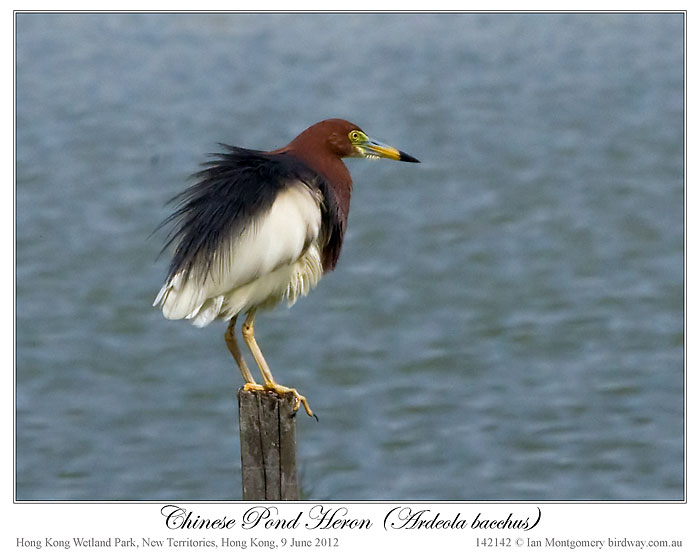
Chinese Pond Heron (Ardeola bacchus) by Ian 1

Chinese Pond Heron (Ardeola bacchus) by Ian 1

Ian’s Bird of the Week – Chinese Pond Heron ~ by Ian Montgomery

Newsletter ~ 6-11-12

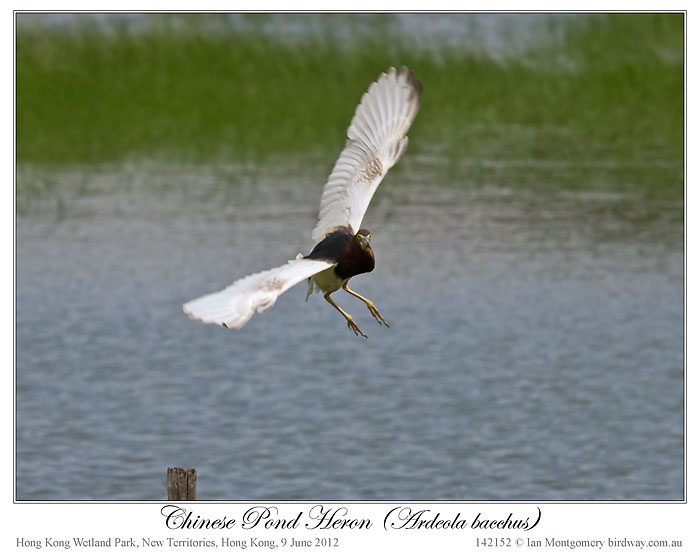
I’m stopping over for a few days in Hong Kong. It’s not the best time of the year for birding here – the northern spring and autumn/fall are good for migrants and the northern winter is good for waders and waterbirds – but we did go out to the Hong Kong Wetland Park near Mai Po reserve in the New Territories on Saturday. One of the species I was keen to see was the Chinese Pond Heron and this one in breeding plumage landed on a post near the hide/blind we were in.

This was of interest to me as it’s on the Australian list as a rare vagrant and I’d seen only non-breeding birds before (in Malaysia). The non-breeding plumage is streaky brown and white and not very distinguished, but when breeding the birds acquire striking black, white and chestnut plumage with a multi-coloured bill. This bird fluffed out its feathers, preened itself a bit and settled down for a few seconds, second photo.

Chinese Pond Heron (Ardeola bacchus) by Ian 2

Chinese Pond Heron (Ardeola bacchus) by Ian 2

These are stocky, mid-sized (47cm/19in in length) herons that feed on fish and invertebrates. Their breeding range includes China and northern Japan. In the northern winter some migrate south to Malaysia and Indonesia, including Java, and sometimes they overshoot and end up in the Australian territories of Christmas and Cocos (Keeling) Islands and on the Australian mainland. This particular one hung around for thirty seconds and then took off, third photo, showing how high they can jump when taking off – they need to be able to do this to take off from reed beds.

Chinese Pond Heron (Ardeola bacchus) by Ian 3

Chinese Pond Heron (Ardeola bacchus) by Ian 3

In flight, fourth photo, the bird displays the striking white wing characteristic of all six species of Pond Herons (genus Ardeola). These are mainly Asian and African species, though the Squacco Heron occurs in southern Europe. The Chinese Pond Heron is closely related to the rather similar Indian Pond Heron (this one was photographed behind the Taj Mahal.

Chinese Pond Heron (Ardeola bacchus) by Ian 4

Chinese Pond Heron (Ardeola bacchus) by Ian 4

Only 30 seconds elapsed between the first and last photos, so we were lucky to have this encounter and it was the only one we saw. The Hong Kong Government is making admirable efforts, through Mai Po Reserved and the restored Hong Kong Wetland Park, to conserve wildlife, but the area is very close to the densely populated and heavily industrialised areas of southern China and the local population of Chinese Pond Herons is suffering from the effects of water pollution on their prey (mud skippers and crustaceans).

Best wishes
Ian

**************************************************
Ian Montgomery, Birdway Pty Ltd,
454 Forestry Road, Bluewater, Qld 4818
Tel 0411 602 737 ian@birdway.com.au
Check the latest website updates:
http://www.birdway.com.au/#updates
**************************************************


Lee’s Addition:

Ian, you sure get around. What a beautiful bird all decked out to “woo” its mate.

Ian has a photo of Chinese Pond Herons on his Birdway website that are in normal plumage. Not as impressive as the one above, but more normal. These herons belong to the Ardeidae – Herons and Allies Family. See a list and photos of the whole 72 species of  Herons, Bitterns and Egrets.

The stork, the heron of any variety, the hoopoe, … (Deuteronomy 14:18 AMP)

See all of Ian’s Birds of the Week articles.

*

Birds Vol 1 #6 – The Black-crowned Night Heron

Birds Illustrated by Color Photography – Revisited

Vol 1. June, 1897 No. 6

*

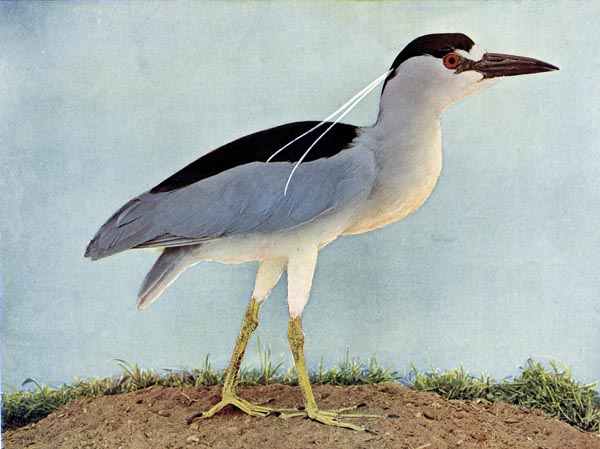
black-crowned night heronblack-crowned night heron.
From col. Chi. Acad. Sciences.

THE BLACK-CROWNED NIGHT HERON.

imgt

HAT a beautiful creature this is! A mounted specimen requires, like the Snowy Owl, the greatest care and a dust tight glass case to preserve its beauty. Dr. Coues’ account of it should be read by those who are interested in the science of ornithology. It is a common bird in the United States and British Provinces, being migratory and resident in the south. Heronries, sometimes of vast extent, to which they return year after year, are their breeding places. Each nest contains three or four eggs of a pale, sea-green color. Observe the peculiar plumes, sometimes two, in this case three, which spring from the back of the head. These usually lie close together in one bundle, but are often blown apart by the wind in the form of streamers. This Heron derives its name from its habits, as it is usually seen flying at night, or in the early evening, when it utters a sonorous cry of quaw or quawk. It is often called Quawk or Qua-Bird.

On the return of the Black-Crowned Night Heron in April, he promptly takes possession of his former home, which is likely to be the most solitary and deeply shaded part of a cedar swamp. Groves of swamp oak in retired and water covered places, are also sometimes chosen, and the males often select tall trees on the bank of the river to roost upon during the day. About the beginning of twilight they direct their flight toward the marshes, uttering in a hoarse and hollow tone, the sound qua. At this hour all the nurseries in the swamps are emptied of their occupants, who disperse about the marshes along the ditches and river shore in search of food. Some of these nesting places have been occupied every spring and summer for many years by nearly a hundred pair of Herons. In places where the cedars have been cut down and removed the Herons merely move to another part of the swamp, not seeming greatly disturbed thereby; but when attacked and plundered they have been known to remove from an ancient home in a body to some unknown place.

The Heron’s nest is plain enough, being built of sticks. On entering the swamp in the neighborhood of one of the heronries the noise of the old and young birds equals that made by a band of Indians in conflict. The instant an intruder is discovered, the entire flock silently rises in the air and removes to the tops of the trees in another part of the woods, while sentries of eight or ten birds make occasional circuits of inspection.

The young Herons climb to the tops of the highest trees, but do not attempt to fly. While it is probable these birds do not see well by day, they possess an exquisite facility of hearing, which renders it almost impossible to approach their nesting places without discovery. Hawks hover over the nests, making an occasional sweep among the young, and the Bald Eagle has been seen to cast a hungry eye upon them.

The male and female can hardly be distinguished. Both have the plumes, but there is a slight difference in size.

The food of the Night Heron, or Qua-Bird, is chiefly fish, and his two interesting traits are tireless watchfulness and great appetite. He digests his food with such rapidity that however much he may eat, he is always ready to eat again; hence he is little benefited by what he does eat, and is ever in appearance in the same half-starved state, whether food is abundant or scarce.


Black-crowned Night Heron at Lake Hollingsworth By Dan

Black-crowned Night Heron at Lake Hollingsworth By Dan

Lee’s Addition:

Black-crowned Night Heron (Nycticorax nycticorax nævius) Crown and back greenish black lower back, wings and tail ashy; head with two or three rounded white plumes, except just after breeding season. Young. Grayish brown streaked with white; below white streaked with blackish; outer webs of primaries, pale rufous. Notes. An explosive qûawk.

Range.—Western hemisphere; breeds in North America north to New Brunswick, Quebec, Manitoba, and Oregon; winters from California and Gulf States southward.

Frequently several nests will be found in the same tree, and I have counted as many as fifty nests in view at the same time. In large swamps in the south they generally nest at a low elevation, while in the marshes of Wisconsin and Minnesota, large colonies of them nest on the ground, making their nest of rushes. Like all Heronries, those of this species have a nauseating odor, from the remains of decayed fish, etc., which are strewn around the bases of the trees. Their eggs number from three to five and are of a pale bluish green color. Size 2.00 × 1.40. 4 eggs. Nest of sticks, about thirty feet up in a pine tree. Many other nests (From the Bird Book)

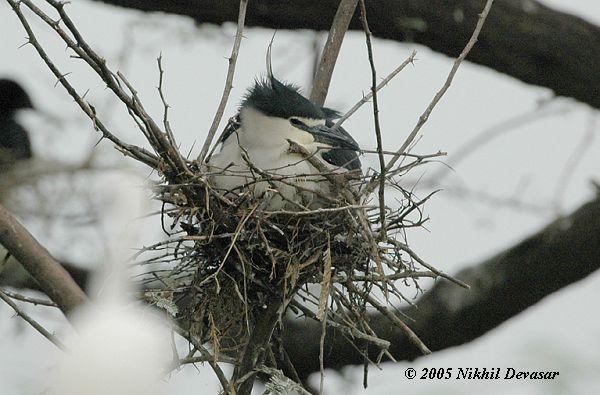
Adults are approximately 64 cm (25 in) long and weigh 800 g (28 oz). They have a black crown and back with the remainder of the body white or grey, red eyes, and short yellow legs. They have pale grey wings and white under parts. Two or three long white plumes, erected in greeting and courtship displays, extend from the back of the head. The sexes are similar in appearance although the males are slightly larger. Black-crowned Night Herons do not fit the typical body form of the heron family. They are relatively stocky and about 25 in tall (63 cm) with shorter bills, legs, and necks than their more familiar cousins the egrets and “day” herons. Their resting posture is normally somewhat hunched but when hunting they extend their necks and look more like other wading birds.

Black-crowned Night Heron (Nycticorax nycticorax) on nest by Nikhil Devasar

These birds stand still at the water’s edge and wait to ambush prey, mainly at night or early morning. They primarily eat small fish, crustaceans, frogs, aquatic insects, small mammals and small birds. During the day they rest in trees or bushes. N. n. hoactli is more gregarious outside the breeding season than the nominate race. (Wikipedia)

Black-crowned Night Heron (Nycticorax nycticorax) ©WikiC

Black-crowned Night Heron (Nycticorax nycticorax) ©WikiC

Now there is a case of almost biting off more than you can chew.

The Night Herons are in the Ardeidae – Herons, Bitterns Family of the Pelicaniformes Order. There are 72 species in the family.

*
Birds Illustrated by Color Photograhy Vol 1 June, 1897 No 6 - Cover

Birds Illustrated by Color Photograhy Vol 1 June, 1897 No 6 – Cover

Birds Illustrated by Color Photography – Revisited – Introduction

The above article is the first article in the monthly serial that was started in January 1897 “designed to promote Knowledge of Bird-Live.” These include Color Photography, as they call them, today they are drawings. There are at least three Volumes that have been digitized by Project Gutenberg.

To see the whole series of – Birds Illustrated by Color Photography – Revisited

*
(Information from Wikipedia and other internet sources)

Next Article – The Ring-Billed Gull

Previous Article – The Mocking Bird


Wordless Birds – Toucan

Links:

Black-crowned Night Heron – Wikipedia

Black-crowned Night Heron All About Birds

Bible Birds – Herons

Birds of the Bible – Herons

Herons and Egrets  – by Dan

*

Ian’s Bird of the Week – Royal Albatross

Southern Royal Albatross (Diomedea epomophora) by Ian 1

Southern Royal Albatross (Diomedea epomophora) by Ian 1

Ian’s Bird of the Week – Royal Albatross ~ by Ian Montgomery

Newsletter ~ 6-3-12

It seems only fitting to celebrate the Diamond Jubilee of Queen Elizabeth with something appropriate, so here is the Royal Albatross, or Royal Albatrosses if you accept, as most now do, the split into Northern and Southern species. Apart from just the Royal title, these birds are also very long lived (up to 60 years) and travel huge distances, routinely circumnavigating Antarctica. It has been estimated that a 50 year old Albatross has travelled 2.8 million miles which compares quite well with the Queen’s 261 official overseas visits and 96 state visits to 116 countries.

On the Sub-Antarctic trip last November, Royal Albatrosses, mainly Southern like the one in the first photo, were regular and very welcome companions in the Southern Ocean. It was always a thrill to see these huge birds completely at home in the wildest weather that the Ocean could throw at them and soaring apparently effortlessly in gale-force winds. If you look carefully at the first photo, you can see the dark (bluish) line along the upper mandible which distinguishes it from the similar Wandering Albatrosses. The other feature of note is the white leading edge to the dorsal surface of the wing. As Southern Royal Albatrosses age, the amount of leading white increases and this distinguishes it from both the Wandering Albatrosses, where the amount of white increases along the centre of the wing, and the Northern Royal Albatross where the wings remain black, as shown in the second photo.

Northern Royal Albatross (Diomedea sanfordi) by Ian2

Northern Royal Albatross (Diomedea sanfordi) by Ian 2

With a little practice, it wasn’t too difficult to distinguish between Northern and Southern birds. What helped was the fact that Royal Albatrosses do not have a confusing array of juvenile plumages, unlike their cousins the Wandering Albatrosses. The juveniles have black tips to the tale and blackish scalloping on the back (the mantle) between the wings but are otherwise similar to the adults.

Southern Royal Albatross (Diomedea epomophora) by Ian 3

Southern Royal Albatross (Diomedea epomophora) by Ian 3

On Campbell Island, we had the opportunity to hike up path to a Southern Royal Albatross colony on a bleak, tussocky moorland. As you can see in the the third photo, things were fairly quiet when we got up there in the morning. They got busier in the afternoon when more birds arrived and some people saw greeting ceremonies, but by then, rather wet and cold, I had returned to the ship for a comforting coffee. There were strict rules about where we could leave the designated path and how close we could approach wildlife, but the albatross in the fourth photo stretching its wings flouted the rules and wandered, or blundered – they’re ungainly on land – right past me.

Southern Royal Albatross (Diomedea epomophora) by Ian 4

Southern Royal Albatross (Diomedea epomophora) by Ian 4

Albatrosses have deceptively gull-like proportions so it is a shock to realise, up-close, just how huge they are. The size record goes to the exulans race/species of the Wandering Albatross, but the Royals are not far behind and an apt comparison is with swans rather than other seabirds, ignoring length where swans have an unfair neck advantage. Southern Royal Albatrosses weight between 6.5 and 10.3kg/14.3 and 22.7lb while the heaviest flying bird, the Mute Swan, ranges between 9kg and 12kg/20 and 33lb. However Royal Albatrosses have a maximum wingspan of up to 3.5m/138in while Mute Swans range up to a mere 2.4m/94in. Just enormous in other words. The contrasting delicacy of the lacy pattern on the back is striking, and the fifth photo shows the tubular nostrils and the dark line along the mandible.

Southern Royal Albatross (Diomedea epomophora) by Ian 5

Southern Royal Albatross (Diomedea epomophora) by Ian 5

Happily, you don’t have to go Campbell Island to see these wonderful birds. Taiaroa Head, a mere 30km from the centre of Dunedin on the South Island of New Zealand, has the only mainland colony of albatrosses in the world. These are Northern Royal Albatrosses and, although I got there too late in the day to gain entry to the Royal Albatross Centre – I gave the local Yellow-eyed Penguins a higher priority – the one in the last photo flew right over me as I stood in the car park.

Northern Royal Albatross (Diomedea sanfordi) by Ian 6

Northern Royal Albatross (Diomedea sanfordi) by Ian 6

Enjoy the Jubilee!

Ian

**************************************************
Ian Montgomery, Birdway Pty Ltd,
454 Forestry Road, Bluewater, Qld 4818
Tel 0411 602 737 ian@birdway.com.au
Check the latest website updates:
http://www.birdway.com.au/#updates
**************************************************


Lee’s Addition:

Wow! Did you read the wingspan on those Albatrosses? 138 inches is 11 1/2 feet. That is amazing! I still just sit back in awe when I hear about these wonderfully created birds.

Check out Ian’s Albatrosses on his site and then check the whole family – Diomedeidae – Albatrosses

Keep me as the apple of Your eye; Hide me under the shadow of Your wings, (Psalms 17:8 NKJV)

Because You have been my help, Therefore in the shadow of Your wings I will rejoice. (Psalms 63:7 NKJV)

*

Oops! Forgot a Few!

Rainbow Lorikeet at Lowry Pk Zoo by Dan

Rainbow Lorikeet at Lowry Pk Zoo by Dan

Oops! Forgot a Few! (follow-up to Updated Birds of the World to I.O.C. 3.1 – Subspecies Definitions)

Guess I was too big a hurry to say I was finished. Realized that I forgot all 40 Order pages and the main Introductory Index pages. After updating almost 50 more pages, “I think” I am finished with the I.O.C. 3.1 Version update.

There was more that needed to be said, so, will do that now.

Now that the names are up to date for now, I am going to go back through each Family page and try to work on them more slowly. Hope to find more photographs for the species that are missing. Now that the “subspecies” are listed, photos for those need to be found. If you are a photographer of birds or know of any that would be willing to let their photos be used here, please contact me at: Lee@Leesbird.com. A link will be provided to your photo site or theirs in the sidebar under Photography and at the bottom of each Family page that uses a photo of yours. Or other arrangements could be made. Photography sites that list the bird’s names are the most useful. (Otherwise I have no clue as to what the bird is, especially ones from around the world.)

Also, there will other items added to the Family pages. Some general facts about the overall family will be added. Our Life List of All Birds Seen (*LLABS*) will be indicated by individual birds that we have seen. Will try to find a photo we took, besides the good ones from photographers that we use (see above).

I remember the days of old; I meditate on all Your works; I muse on the work of Your hands. (Psalms 143:5 NKJV)

Aren’t we thankful that when the LORD created the world and all that is in them, that he didn’t say, “Oops! I forgot…..?” We may make mistakes and miss a few items, but God is Perfect and nothing He does is ever a MISTAKE.

*