“Wings of Life” from YouTube

This was taken from TedTalks.com and was received by me in an e-mail. It is FANTASTIC!

I do not know the story behind the video, but I see God’s mighty creation at work in helping plants be pollinated. The photography is phenomenal.

The flowers appear on the earth; the time of the singing of birds is come, and the voice of the turtle is heard in our land; (Song of Solomon 2:12 KJV)

The grass withereth, the flower fadeth: but the word of our God shall stand for ever. (Isaiah 40:8 KJV)

Today is also National Bird Day.

http://nationalbirdday.com/

*

2011 in review

The WordPress.com stats helper monkeys prepared a 2011 annual report for this blog.

Here’s an excerpt:

The Louvre Museum has 8.5 million visitors per year. This blog was viewed about 210,000 times in 2011. If it were an exhibit at the Louvre Museum, it would take about 9 days for that many people to see it.

Click here to see the complete report.

That report was produced by WordPress and is a great reminder for us to keep up the good work on our blog.

Most of all, thank you for taking the time to view Lee’s Birdwatching Adventures. Without you, these numbers would not be possible.

Thank You and Happy New Year!

And God said, Let there be lights in the firmament of the heaven to divide the day from the night; and let them be for signs, and for seasons, and for days, and years: (Genesis 1:14 KJV)

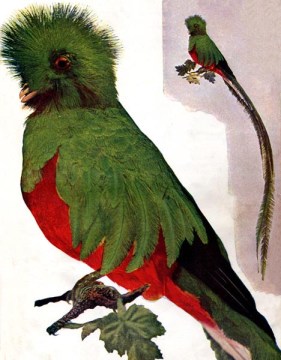
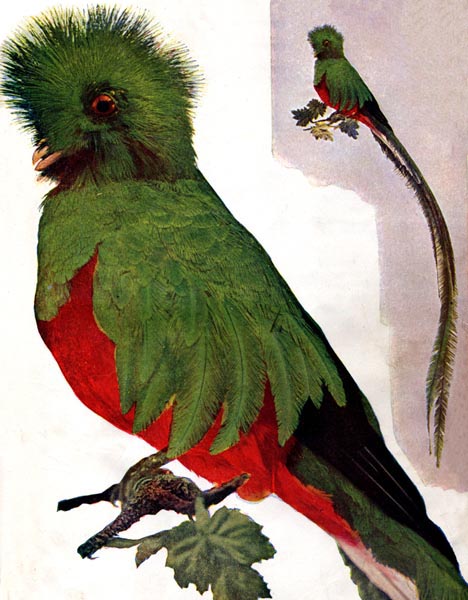
Birds Vol 1 #1 – The Resplendent Trogon (Quetzal)

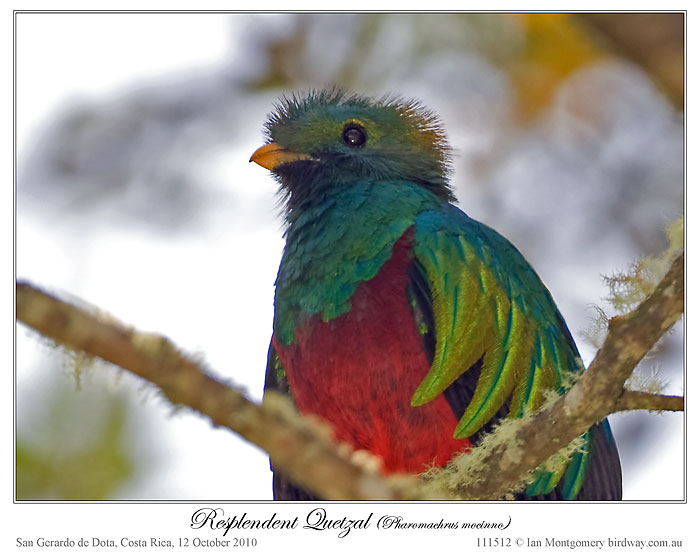
Resplendent (Trogon) Quetzal (Pharomachrus mocinno)

Resplendent (Trogon) Quetzal (Pharomachrus mocinno)

Birds Illustrated by Color Photography – Revisited

Vol 1. January, 1897 No. 1

*

THE RESPLENDENT TROGON

A Letter to Little Boys and Girls of the United States.

Is it cold where you live, little boys and girls? It is not where I live. Don’t you think my feathers grew in the bright sunshine?

My home is way down where the big oceans almost meet. The sun is almost straight overhead every noon.

I live in the woods, way back where the trees are tall and thick. I don’t fly around much, but sit on a limb of a tree way up high.

Don’t you think my red breast looks pretty among the green leaves?

When I see a fly or a berry I dart down after it. My long tail streams out behind like four ribbons. I wish you could see me. My tail never gets in the way.

Wouldn’t you like to have me sit on your shoulder, little boy? You see my tail would reach almost to the ground.

If you went out into the street with me on your shoulder, I would call whe-oowhe-oo, the way I do in the woods.

All the little boys and girls playing near would look around and say, “What is that noise?” Then they would see you and me and run up fast and say, “Where did you get that bird?”

The little girls would want to pull out my tail feathers to put around their hats. You would not let them, would you?

I have a mate. I think she is very nice. Her tail is not so long as mine. Would you like to see her too? She lays eggs every year, and sits on them till little birds hatch out. They are just like us, but they have to grow and get dressed in the pretty feathers like ours. They look like little dumplings when they come out of the eggs.

But they are all right. They get very hungry and we carry them lots of things to eat, so they can grow fast.

Your friend,
R. T.

Resplendent Quetzal (Pharomachrus mocinno) Reinier Munguia

Resplendent Quetzal (Pharomachrus mocinno) Reinier Munguia

THE RESPLENDENT TROGON

imgrESPLENDENT Trogons (Quetzals) are natives of Central America. There are fifty kinds, and this is the largest. A systematic account of the superb tribe has been given by Mr. Gould, the only naturalist who has made himself fully acquainted with them.

Of all birds there are few which excite so much admiration as the Resplendent Trogon.

The skin is so singularly thin that it has been not inaptly compared to wet blotting paper, and the plumage has so light a hold upon the skin that when the bird is shot the feathers are plentifully struck from their sockets by its fall and the blows which it receives from the branches as it comes to the ground.

Its eggs, of a pale bluish-green, were first procured by Mr. Robert Owen. Its chief home is in the mountains near Coban in Vera Paz, but it also inhabits forests in other parts of Guatemala at an elevation of from 6,000 to 9,000 feet.

From Mr. Salvin’s account of his shooting in Vera Paz we extract the following hunting story:

“My companions are ahead and Filipe comes back to say that they have heard a quesal (Resplendent Trogon). Of course, being anxious to watch as well as to shoot one of these birds myself, I immediately hurry to the spot. I have not to wait long. A distant clattering noise indicates that the bird is on the wing. He settles—a splendid male—on the bough of a tree not seventy yards from where we are hidden. It sits almost motionless on its perch, the body remaining in the same position, the head only moving from side to side. The tail does not hang quite perpendicularly, the angle between the true tail and the vertical being perhaps as much as fifteen or twenty degrees. The tail is occasionally jerked open and closed again, and now and then slightly raised, causing the long tail coverts to vibrate gracefully. I have not seen all. A ripe fruit catches the quesal’s eye and he darts from his perch, plucks the berry, and returns to his former position. This is done with a degree of elegance that defies description. A low whistle from Capriano calls the bird near, and a moment afterward it is in my hand—the first quesal I have seen (…).”

The above anecdote is very beautiful and graphic, but we read the last sentence with pain. We wish to go on record with this our first number as being unreconciled to the ruthless killing of the birds. He who said, not a sparrow “shall fall on the ground without your Father,” did not intend such birds to be killed, but to beautify the earth.

The cries of the quesal are various. They consist principally of a low note, whe-oowhe-oo, which the bird repeats, whistling it softly at first, then gradually swelling it into a loud and not unmelodious cry. This is often succeeded by a long note, which begins low and after swelling dies away as it began. Other cries are harsh and discordant. The flight of the Trogon is rapid and straight. The long tail feathers, which never seem to be in the way, stream after him. The bird is never found except in forests of the loftiest trees, the lower branches of which, being high above the ground, seem to be its favorite resort. Its food consists principally of fruit, but occasionally a caterpillar is found in its stomach.
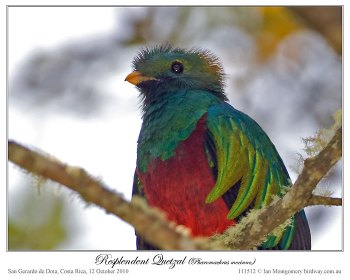
Resplendent Quetzal (Pharomachrus mocinno) by Ian

Resplendent Quetzal (Pharomachrus mocinno) by Ian


Lee’s Addition:

The Resplendent is in the Trogan Family, but today it is called the Resplendent Quetzal (Pharomachrus mocinno). Along with the writer, needless killing of birds is uncalled for, but back in 1897 the ladies liked feathers in their hats. Thankfully, that practice has been stopped for the most part, but how many birds have become extinct or near extinct because of it? What a fantastic bird the Lord created with these long tails.

For man also does not know his time: Like fish taken in a cruel net, Like birds caught in a snare, So the sons of men are snared in an evil time, When it falls suddenly upon them. (Ecclesiastes 9:12 NKJV)
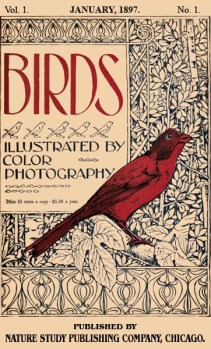
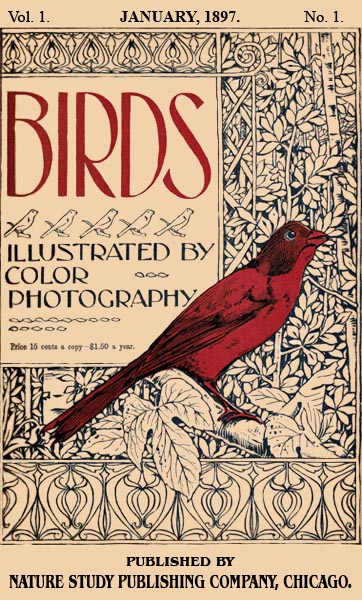
Birds Illustrated by Color Photograhy Vol 1 January 1897 No 1 - Cover

Birds Illustrated by Color Photograhy Vol 1 January 1897 No 1 – Cover

Birds Illustrated by Color Photography – Revisited – Introduction

The above article is the second article in the monthly serial that was started in January 1897 “designed to promote Knowledge of Bird-Live.” These include Color Photography, as they call them, today they are drawings. There are at least three Volumes that have been digitized by Project Gutenberg.

To see the whole series of – Birds Illustrated by Color Photography – Revisited

*

The Resplendent Quetzal is one of 43 species in the Trogonidae – Trogons Family in the Trogoniformes Order. Of the 7 Genus, only two have Quetzals and the other five have Trogons.

The word “trogon” is Greek for “nibbling” and refers to the fact that these birds gnaw holes in trees to make their nests.

The Resplendent Quetzal, Pharomachrus mocinno, is a bird in the trogon family. It is found from southern Mexico to western Panama (unlike the other quetzals of the genus Pharomachrus, which are found in South America and eastern Panama). It is well known for its colorful plumage. There are two subspecies, P. m. mocinno and P. m. costaricensis.

This species is 36–40 cm (14–16 in) long, plus up to 65 cm (26 in) of tail streamer for the male, and weighs about 210 g (7 oz). It is the largest representative of the trogon order. The subspecies costaricensis is slightly smaller than the nominate race and has shorter narrower tail plumes.

This quetzal plays an important role in Mesoamerican mythologies. The Resplendent Quetzal is Guatemala’s national bird, and an image of it is on the flag and coat of arms of Guatemala. It is also the name of the local currency (abbreviation GTQ).

1989 Half Quetzal

1989 Half Quetzal

Trogons are residents of tropical forests worldwide, with the greatest diversity in the Neotropics. The genus Apaloderma contains the three African species, Harpactes and Apalharpactes are Asian, and the remaining four genera are found in Central and South America.

They feed on insects and fruit, and their broad bills and weak legs reflect their diet and arboreal habits. Although their flight is fast, they are reluctant to fly any distance. Trogons are generally not migratory, although some species undertake partial local movements.

Trogons have soft, often colourful, feathers with distinctive male and female plumage. They are the only type of animal with a heterodactyl toe arrangement.

The trogons are insectivorous, usually hunting from a perch. They nest in holes dug into trees or termite nests, laying 2-4 white or pastel-coloured eggs.

The majority of trogons are birds of tropical and subtropical forests. They have a cosmopolitan distribution in the worlds wet tropics, being found in the Americas, Africa and Asia. A few species are distributed into the temperate zone, with one species, the Elegant Trogon, reaching the south of the United States specifically southern Arizona and the surrounding area. Some species, particularly the quetzals, are adapted to cooler montane forest.

The trogons as a family are fairly uniform in appearance, they have compact bodies with long tails (very long in the case of the quetzals), and short necks. Trogons range in size from the 23 cm, 40 gram Scarlet-rumped Trogon to the 40 cm, 210 gram Resplendent Quetzal (not including the male quetzal’s 3-foot-long (0.91 m) tail streamers). Their legs and feet are weak and short, and trogons are essentially unable to walk beyond a very occasional shuffle along a branch. They are even incapable of turning around on a branch without using their wings. The ratio of leg muscle to body weight in trogons is only 3 percent, the lowest known ratio of any bird.

(Information from Wikipedia and other internet sources)

Next Article – The Mandarin Duck

Previous Article – The Nonpareil – Painted Bunting

Wordless Birds

Links:

Ian’s Bird of the Week – Resplendent Quetzal
Ian’s Bird of the Week – Violaceous Trogon
Trogons & Quetzel Photos – Ian’s Birdway
Resplendent Quetzal Photos on Aves – Wikipedia
Resplendent Quetzal Wikipedia
Trogon Family – Wikipedia
Birds of the World – Trogonidae

*
Ian’s Bird of the Week – King Penguin

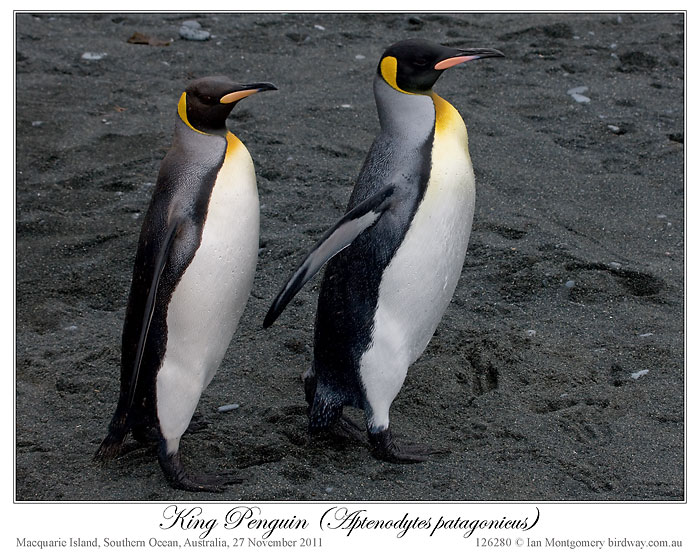
King Penguin (Aptenodytes patagonicus) 1 by Ian

King Penguin (Aptenodytes patagonicus) 1 by Ian

Ian’s Bird of the Week – King Penguin ~ by Ian Montgomery

The Royal Penguins may have won the bird of the trip award on the basis of character, but the sartorial crown went to the King Penguin also very common on the beach at Macquarie Island. We’ll see later that they also won the Worst Dressed Award. The adult King Penguins were magnificently turned out, and strode importantly around, very erect with chests puffed out as in the first photo. (If their suits hadn’t been pure silk, they might, however, be considered slight spivvy.)

They alway seemed to have some consequential to do, such as this one calling at intervals trumpet-like and being listened to deferentially by its followers and being answered in a similar vein by another leader at some distance.
King Penguin (Aptenodytes patagonicus) 2 by Ian

King Penguin (Aptenodytes patagonicus) 2 by Ian

If you sat quietly on the beach, they would, like the Royals come over to inspect you, but they didn’t seem to approve of what they found.
King Penguin (Aptenodytes patagonicus) 3 by Ian

King Penguin (Aptenodytes patagonicus) 3 by Ian

When called upon to do something undignified like feeding an unrelenting chick, they did so with an expression that suggested that this should really be done by a wet nurse, and the neighbours would turn avert their gaze disdainfully.
King Penguin (Aptenodytes patagonicus) 4 by Ian

King Penguin (Aptenodytes patagonicus) 4 by Ian

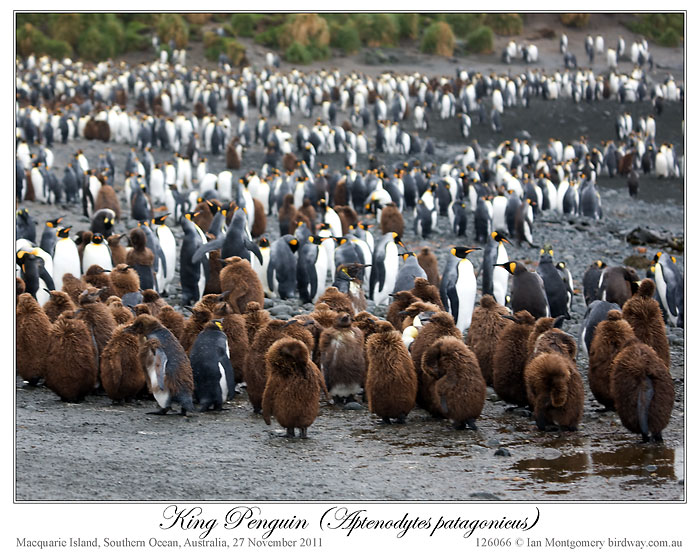
The chicks, of course, won the Worst Dressed Award and the adults, whenever possible, disowned them so that were forced to huddle in a creche at the unfashionable end of the beach.
King Penguin (Aptenodytes patagonicus) 5 by Ian

King Penguin (Aptenodytes patagonicus) 5 by Ian

The chicks look as if they’re preening, but they are really trying to rip off their awful yeti outfits. You can see that some of them have nearly succeeded. This is a transformation to rival any emerging butterfly, and if Hans Christian Andersen had known about King Penguin chicks he would have chosen them rather than cygnets for his Ugly Duckling fairy tale.
King Penguin (Aptenodytes patagonicus) 6 by Ian

King Penguin (Aptenodytes patagonicus) 6 by Ian

Meanwhile, at the other end of the beach, the King Penguins stride officiously towards an Elephant Seal lumbering out of the water. I couldn’t resist converting this into a comic-strip cartoon using an iPhone app called Halftone http://www.juicybitssoftware.com/halftone/ .
King Penguin (Aptenodytes patagonicus) 7 by Ian

King Penguin (Aptenodytes patagonicus) 7 by Ian

As you can imagine, it was a special day on Macquarie Island.
I’m continuing to put photos from the trip on the website and there are now 650 Australian bird species there. You can check the latest updates here: http://www.birdway.com.au/#updates .
Best wishes
Ian


Ian Montgomery, Birdway Pty Ltd,
454 Forestry Road, Bluewater, Qld 4818
Phone: 0411 602 737 +61-411 602 737
Preferred Email: ian@birdway.com.au
Website: http://birdway.com.au


Lee’s Addition:

Now Ian has gone to making cartoons. Ian, that must have been an exciting special day. From your writing, your pleasure shines through. Thanks for sharing your great photos with us again. Stay tuned for Ian’s next adventure. Can’t wait to see some more of his photos from that trip.

Penguines are in the Spheniscidae – Penguin Family of the Sphenisciformes Order. Penguins are the only family in the Order. Check out Ian’s Penguin photos at his Birdway.com site. He has photos for 9 of the 18 species of Penguins.

The king’s heart is in the hand of the LORD, as the rivers of water: he turneth it whithersoever he will. (Proverbs 21:1 KJV)

*

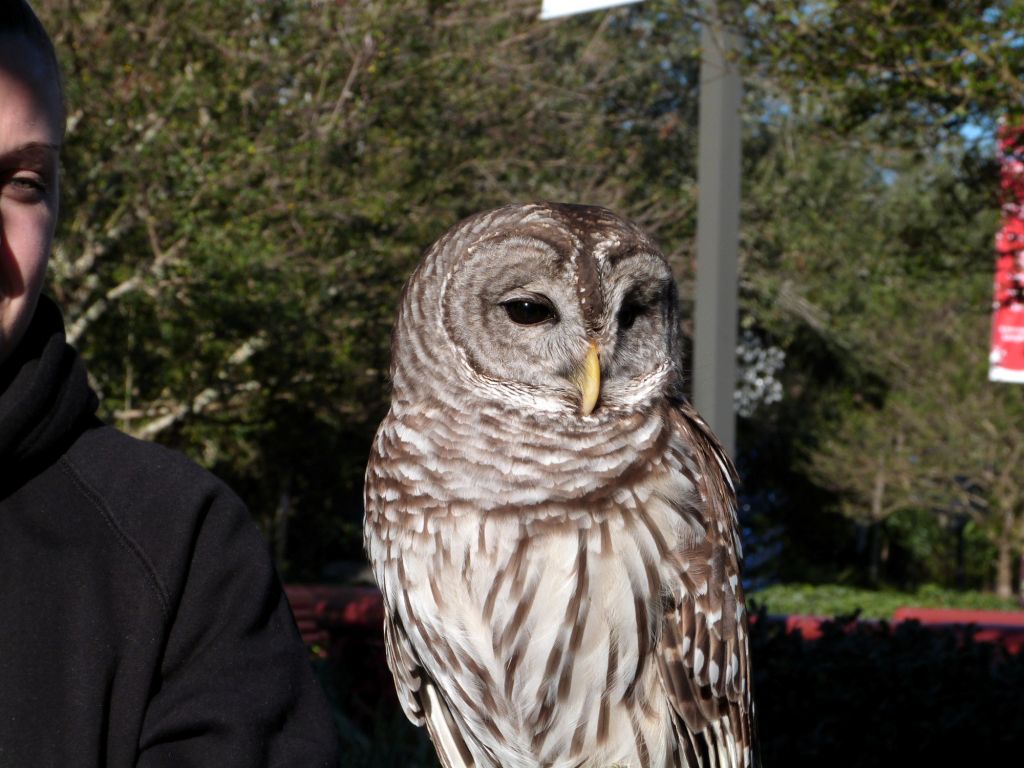
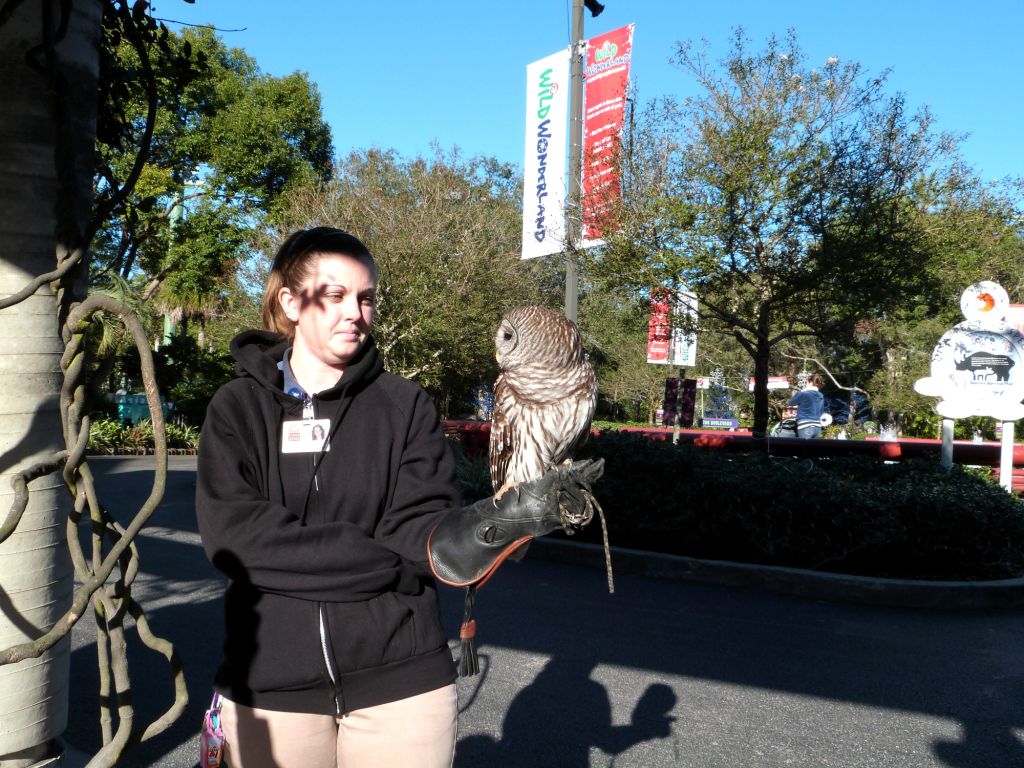
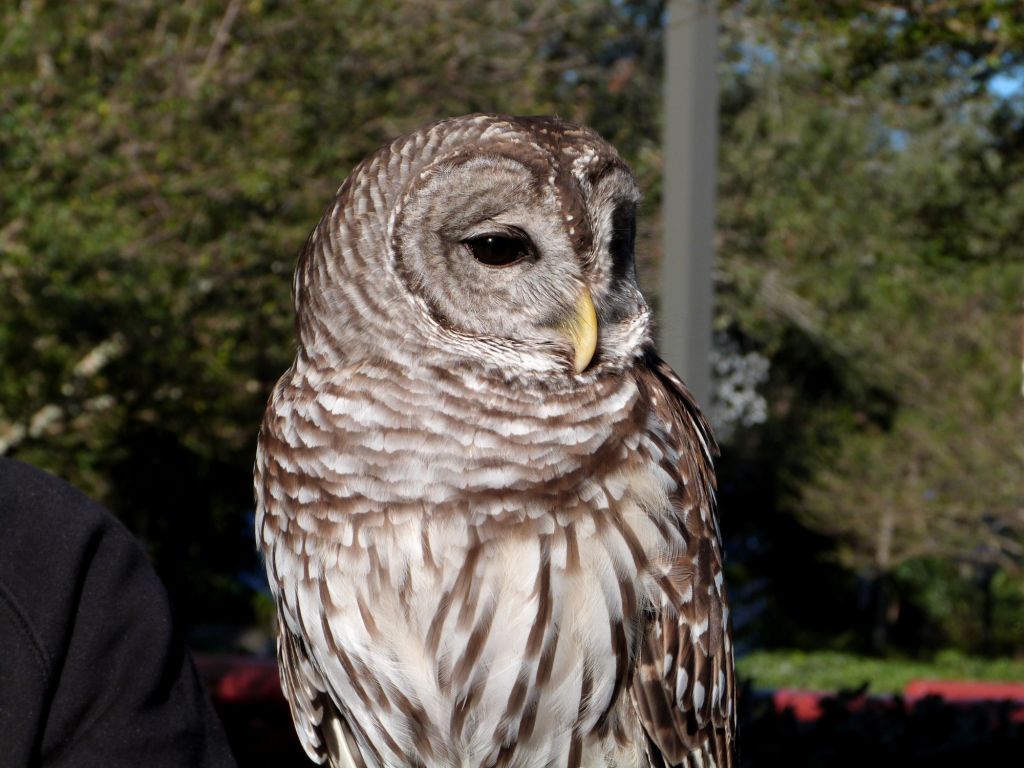
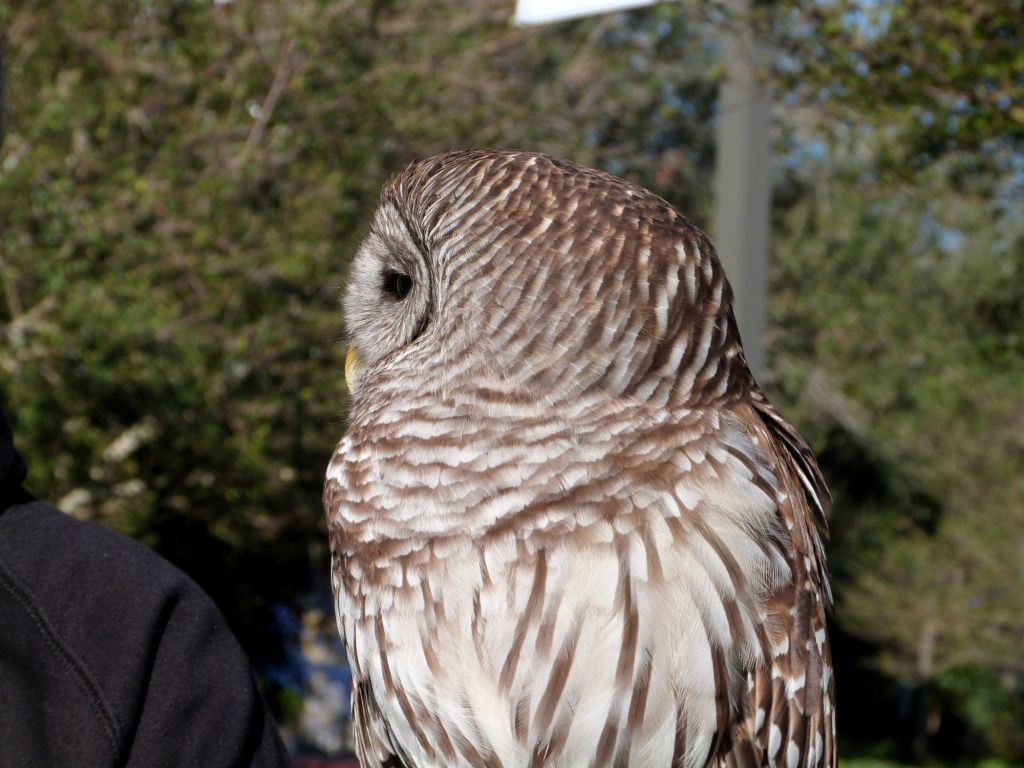
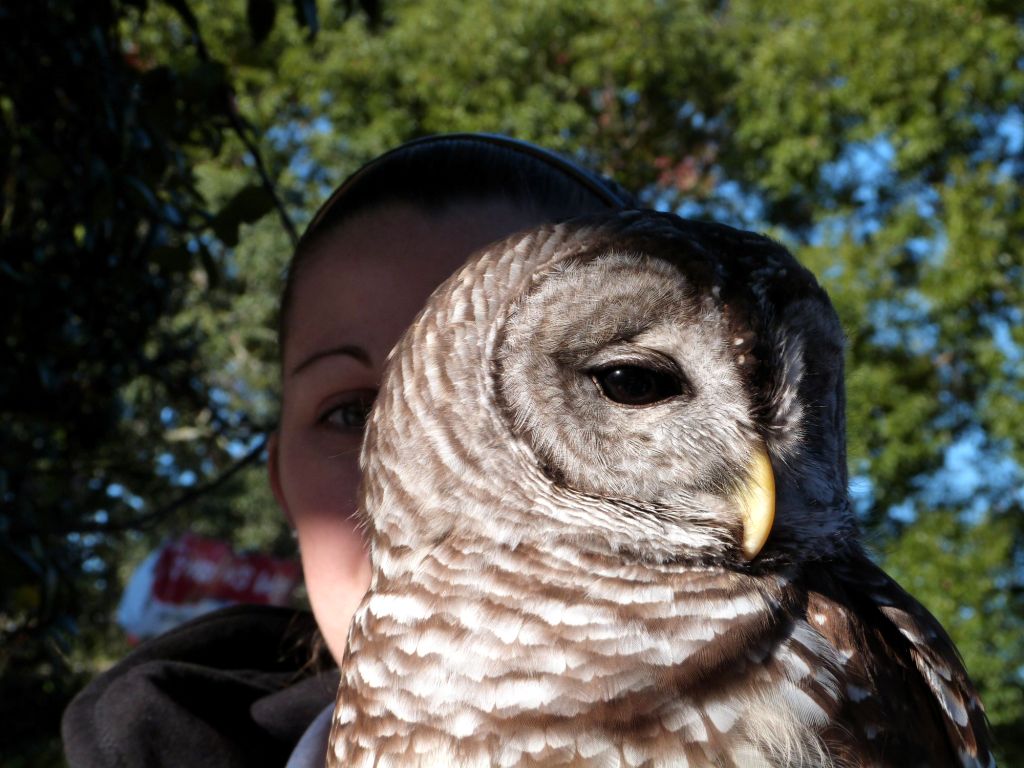
Barred Owl at Lowry Park Zoo Today

Northern Barred Owl (Strix varia) LPZ by Dan 2014

Northern Barred Owl (Strix varia) LPZ by Dan 2014

Northern Barred Owl (Strix varia) LPZ by Lee

Northern Barred Owl (Strix varia) LPZ by Lee

And thorns shall come up in her palaces, nettles and brambles in the fortresses thereof: and it shall be an habitation of dragons, and a court for owls. (Isaiah 34:13 KJV)

Dan and I went over to the Lowry Park Zoo/Zoo Tampa in Tampa again today. I was wanting to check out my Christmas present of a new camera. Enjoying learning to use it and retaking a lot of photos of birds to compare the old ones with the new ones on this camera. (It is still a point-and-shoot, but it has an improved “program mode.” Dan is our good photographer.)

But when we entered the zoo, we were met by one of the zookeepers holding a beautiful Barred Owl. We had not encountered this Owl in our previous trips. While sharing some of the photos, I thought you might like to learn a little about them.

Northern Barred Owl (Strix varia) LPZ by Lee

Northern Barred Owl (Strix varia) LPZ by Lee

Facts from the U.S. Geological Service

Identification Tips:

  • Length: 17 inches Wingspan: 44 inches
  • Sexes similar
  • Rather large owl
  • Dark eyes and yellow bill
  • Back brown, mottled with pale spots and dark bars
  • Underparts pale with long, brown streaks
  • Chest pale with brown barring
  • Face pale with dark concentric rings surrounding eye

Similar species:

The Spotted Owl is most similar, but can be separated with attention to its barred, not streaked, underpart coloration. Short-eared Owl is similar in size, but is not barred on the chest nor is as heavily streaked below, does not share the concentric rings in the facial disks, has yellow eyes and a dark bill, and is found in quite different habitat. Great Gray Owl is superficially similar, but much larger, gray rather than brown below, and has differently patterned underparts.”

Northern Barred Owl (Strix varia) LPZ by Lee

Northern Barred Owl (Strix varia) LPZ by Lee

“The Barred Owl (Strix varia) is a large typical owl native to North America. It goes by many other names, including Eight HooterRain OwlWood Owl, and Striped Owl, but is probably best known as the Hoot Owl based on its call.

The usual call is a series of eight accented hoots ending in oo-aw, with a downward pitch at the end. The most common mnemonic device for remembering the call is “Who cooks for you, who cooks for you all.” It is noisy in most seasons. When agitated, this species will make a buzzy, rasping hiss. While calls are most common at night, the birds do call during the day as well.” (Wikipedia)

(From xeno-canto.org)

Northern Barred Owl (Strix varia) LPZ by Lee

Northern Barred Owl (Strix varia) LPZoo by Lee

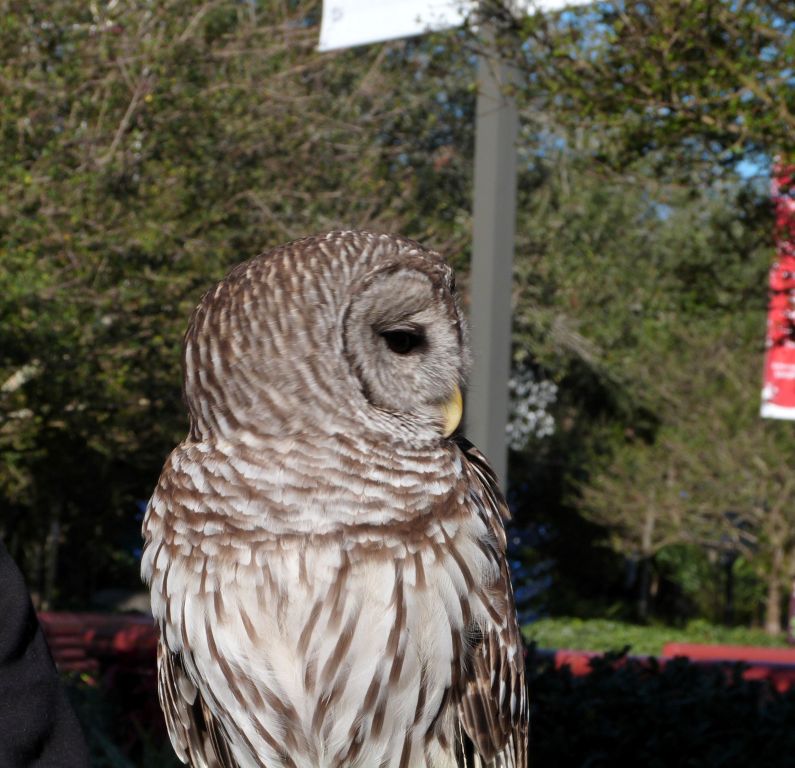
Looking the other way. No, they cannot turn their heads all the way around. Notice also that this owl does not have ear tufts like some owls.

Northern Barred Owl (Strix varia) LPZ by Lee - Side of head

Northern Barred Owl (Strix varia) LPZ by Lee – Side of head

“Breeding habitats are dense woods across Canada, the eastern United States, and south to Mexico; in recent years it has spread to the western United States. Recent studies show suburban neighborhoods can be ideal habitat for barred owls. Using transmitters, scientists found that populations increased faster in the suburban settings than in old growth forest. The main danger to owls in suburban settings is from cars. The increased offspring offset the death rate due to impacts from cars and disease.”

The Barred Owl’s nest is often in a tree cavity, often ones created by pileated woodpeckers; it may also take over an old nesting site made previously by a red-shouldered hawk, cooper’s hawk, crow, or squirrel. It is a permanent resident, but may wander after the nesting season. If a nest site has proved suitable in the past they will often reuse it as the birds are non-migratory. In the United States, eggs are laid from early-January in southern Florida to mid-April in northern Maine, and consist of 2 to 4 eggs per clutch. Eggs are brooded by the female with hatching taking place approximately 4 weeks later. Young owls fledge four to five weeks after hatching. These owls have few predators, but young, unwary owls may be taken by cats. The most significant predator of Barred Owls is the Great Horned Owl. The Barred Owl has been known to live up to 10 years in the wild and 23 years in captivity.” (Wikipedia)

Northern Barred Owl (Strix varia) LPZ by Lee

Northern Barred Owl (Strix varia) LPZ by Lee

“Owl” is mentioned 8 times in the King James Bible and “Owls” is mentioned 6 times. So that makes our friend here a “Bird of the Bible” and of course a “Bird of the World.” Owls are another of the Lord’s great creations.

It was a great birdwatching day at the Zoo. Cool, but the sun was bright and no clouds. I had some other great finds today, but will save them for later.

References to check out:

*

Birds of the World – Icteridae Family – Oropendolas, Orioles & Blackbirds

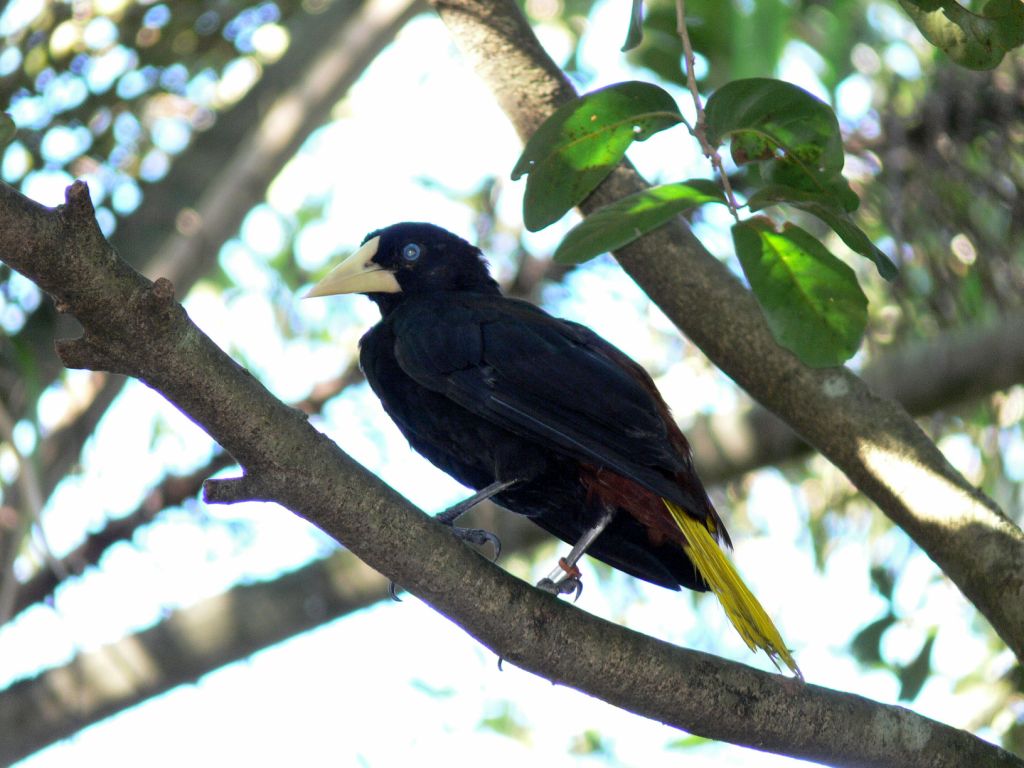
Crested Oropendola (Psarocolius decumanus) at LPZ

Crested Oropendola (Psarocolius decumanus) at LPZ by Lee

Then God said, “Let the waters abound with an abundance of living creatures, and let birds fly above the earth across the face of the firmament of the heavens.” (Genesis 1:20 NKJV)

I have been working on finding photos for the Icteridae Family – Oropendolas, Orioles & Blackbirds. I have managed to get all by three of the species. Tried to find as many of the subspecies while working on the page.

There are 108 members in 27 Genera. They start off, taxonomic order, with the Oropendolas. We have enjoyed seeing the Crested Oropendola at the Lowry Park Zoo and the National Aviary. They make their hanging nest even there. Of the 11, I cannot find any photo of the Band-tailed Oropendola (Ocyalus latirostris). They have 3 Genus.

The Caciques are next with 12 members in two Genus; Cacicus and Amblycercus.

Then there are 3 Troupials in the Icterus Genus with Orioles; the Venezuelan, Orange-backed and Campo Troupials.

Then the Orioles appear next in the list. Those are some very pretty birds. There are 30 members in the Genus Icterus. Here in North America (US) we get to enjoy the Orchard, Hooded, Streak-backed, Spot-breasted, Altamira, Bullock’s, Baltimore, Scott’s and Audubon Orioles. (order by Stokes Guide). There is a Oriole Blackbird, but is not quite considered an Oriole. The Bahama Oriole (Icterus northropi) is Critically Endangered and again I couldn’t find a photo, but did find a Bahamian Stamp with a picture of it.

Brown-and-yellow Marshbird (Pseudoleistes virescens) ©©CDTimm

Brown-and-yellow Marshbird (Pseudoleistes virescens) ©©CDTimm

Next the list alternates back and forth with Blackbirds and Grackles. Most are black with some colors. After 11 Genus of those, then 2 Marshbird are in the Pseudoleistes Genus.

A bird species that lands in my yard, the Brown–headed Cowbird is one of six Cowbirds. I have had as many as 50 Brown-headeds land in my yard and empty my feeders in no time flat. They are the Molothrus Genus. The Bronze-brown Cowbird (Molothrus armenti) escapes most photographers because no photos were found to use.

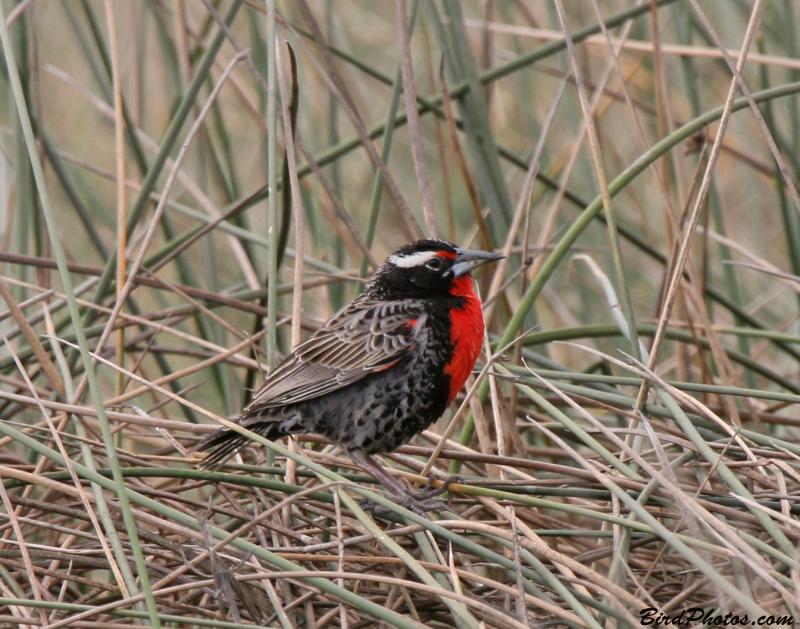
Peruvian Meadowlark (Sturnella bellicosa) By BirdPhotos.Com

Peruvian Meadowlark (Sturnella bellicosa) By BirdPhotos.Com

Going on down the list through more Blackbirds and Grackles, almost to the bottom, you find the Sturnella Genus which has the five Meadowlarks; Peruvian, Pampas, Long-tailed, Eastern and Western Meadowlarks.

After a Yellow-headed Blackbird, you end up with the Bobolink, which we just had an article about a few days ago. (That is why I worked on the page.) See The Christmas Bird? and an earlier one, Bobolink – Extraordinary Migrant.. Both are by ajmithra.

Photos missing for this family are listed below. If you have one you would allow us permission to use or let us link to your photo, please leave a comment. Thanks.

  • Band-tailed Oropendola (Ocyalus latirostris)
  • Bahama Oriole (Icterus northropi) Critically Endangered
  • Bronze-brown Cowbird (Molothrus armenti)
  • Need subspecies

*

God & Natural Law – Answers in Genesis

Here is an interesting article from Answers in Genesis about how the universe obeys certain rules — “laws to which all things must adhere. These laws are precise, and many of them are mathematical in nature. Natural laws are hierarchical in nature; secondary laws of nature are based on primary laws of nature, which have to be just right in order for our universe to be possible. But, where did these laws come from, and why do they exist? If the universe were merely the accidental by-product of a big bang, then why should it obey orderly principles—or any principles at all for that matter? Such laws are consistent with biblical creation. Natural laws exist because the universe has a Creator God who is logical and has imposed order on His universe

In the beginning God created the heaven and the earth. (Genesis 1:1 KJV)

To see the whole article:

God & Natural Law – Answers in Genesis.

Ian’s Bird of the Week – Red-crowned Parakeet

Red-crowned Parakeet (Cyanoramphus novaezelandiae) by Ian 1

Red-crowned Parakeet (Cyanoramphus novaezelandiae) by Ian 1

Ian’s Bird of the Week – Red-crowned Parakeet ~ by Ian Montgomery

Newsletter ~ 12/20/11

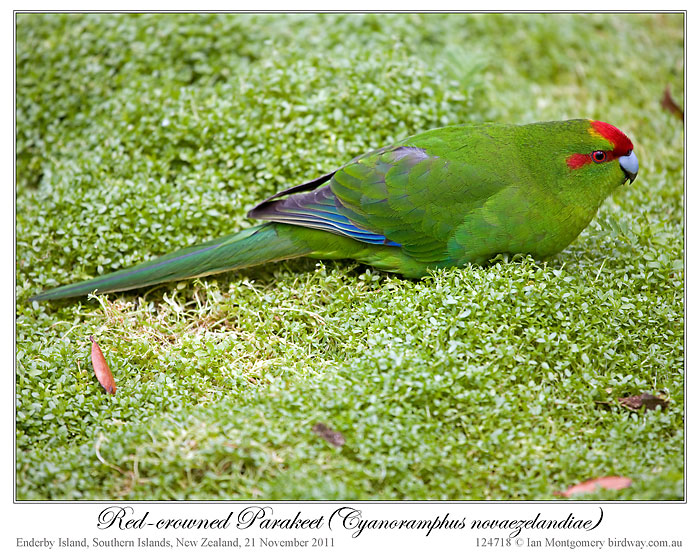
Christmas is nearly on us, so a bird in the Christmas colours of red and green seems appropriate. Here is the Red-crowned Parakeet, one of the relatively few non-seabirds encountered on the trip to the Sub-Antarctic Islands.

We found these birds at several locations on Enderby Island, one of the smaller of the Auckland Islands and the first site at which we actually landed after leaving Dunedin. Enderby Island is mainly basalt with rocky cliffs, as in the second photo, and it reminded me very much of St Paul Island in the Bering Sea that I visited three years ago. On both the vegetation is mainly tundra, though unlike the treeless St Paul Enderby has patches of very gnarled dwarf rata forest.
Red-crowned Parakeet (Cyanoramphus novaezelandiae) by Ian 2

Enderby Island by Ian 2

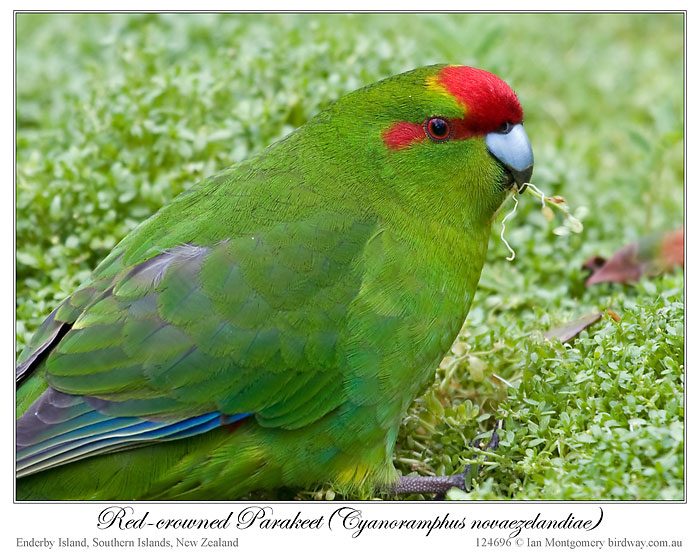
The Parakeets feed mainly on the ground and we found them both on the tundra and in the forest. They are herbivorous, and the bird in the first photo is feeding on the dense understory of the forest – the third photo shows the same bird in close-up eating very fine shoots and leaves.
Red-crowned Parakeet (Cyanoramphus novaezelandiae) by Ian 3

Red-crowned Parakeet (Cyanoramphus novaezelandiae) by Ian 3

The fourth photo shows a different bird feeding on the flower-heads of small herbs growing on the tundra near the beach where we landed.
Red-crowned Parakeet (Cyanoramphus novaezelandiae) by Ian 4

Red-crowned Parakeet (Cyanoramphus novaezelandiae) by Ian 4

I’m used to seeing parrots in more tropical locations, so it was a startling to see these small (25-28cm/10-11in long) elegant parrots in such a cold and rugged environment. They are obvious tough little birds, though their confiding habits, ground-feeding life-style and choice of low nesting sites makes them very vulnerable to introduced predators such as feral cats,rats and, in New Zealand, stoats. The Red-crowned Parakeet used to widespread throughout New Zealand but is now rare or extinct on the two main islands, though it survives well on Stewart and other offshore islands. As you can judge from the photos, the birds are very approachable and took little notice of us.
On the website, there are now nine species of penguins http://www.birdway.com.au/spheniscidae/index.htm and thirteen species of albatrosses http://www.birdway.com.au/diomedeidae/index.htm . The additional species of albatrosses include ones that were treated as sub-species by Christidis and Boles, 2008, but are now recognised as full species by Birdlife International and the IOC.
I wish you a safe and happy Christmas and best wishes
Ian


Ian Montgomery, Birdway Pty Ltd,
454 Forestry Road, Bluewater, Qld 4818
Phone: 0411 602 737 +61-411 602 737
Preferred Email: ian@birdway.com.au
Website: http://birdway.com.au


Lee’s Addition:

Thanks again, Ian, for sharing your great adventures. This parakeet, indeed, looks decked out for the colors of Christmas. Would be pretty to have a flock of them perching on a Christmas Tree. Merry Christmas to you, Ian, and our readers.

Then the angel said to them, “Do not be afraid, for behold, I bring you good tidings of great joy which will be to all people. For there is born to you this day in the city of David a Savior, who is Christ the Lord. (Luke 2:10-11 NKJV)

Check out Ian’s other Parrots and Parakeets at his Parrots & Allies Psittacidae Family page. Our Birds of the World Psittacidae Family page has more Parrot and Parakeet photos.

Ian’s Other Birds of the Week

*

Birds In Christmas Hymns – Carol of the Birds

American Yellow Warbler (Dendroica aestiva) singing by J Fenton

American Yellow Warbler (Dendroica aestiva) singing by J Fenton

And the angel said unto them, Fear not: for, behold, I bring you good tidings of great joy, which shall be to all people. For unto you is born this day in the city of David a Saviour, which is Christ the Lord. (Luke 2:10-11)

Written as – El Cant Dels Ocells – Traditional Catalonian Carol

Translator Unknown

Birds in Christmas Hymns

Carol of the Birds

1. Upon this holy night,

When God’s great star appears,
And floods the earth with brightness
Birds’ voices rise in song
And warbling all night long
Express their glad heart’s lightness
Birds’ voices rise in song
And warbling all night long
Express their glad heart’s lightness

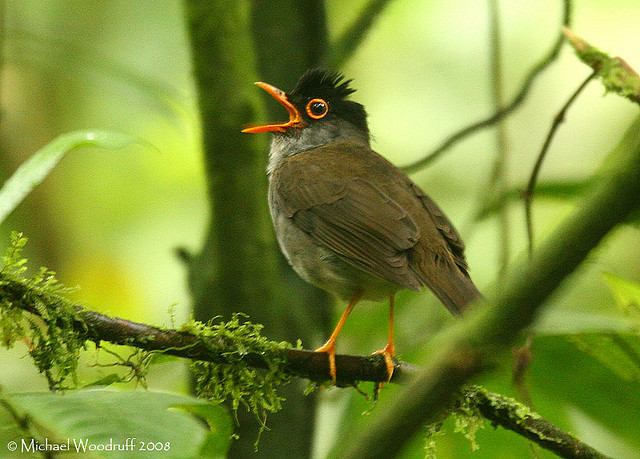
Black-headed Nightingale-Thrush (Catharus mexicanus) by Michael Woodruff

Black-headed Nightingale-Thrush (Catharus mexicanus) by Michael Woodruff

2. The Nightingale is first
To bring his song of cheer,
And tell us of His glad – ness:
Jesus, our Lord, is born
To free us from all sin
And banish ev’ry sadness!
Jesus, our Lord is born
To free us from all sin
And banish ev’ry sadness!

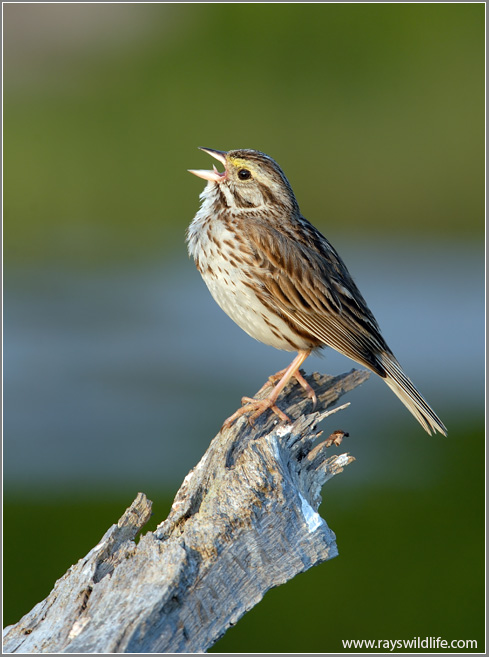
Savannah Sparrow singing by Ray

Savannah Sparrow singing by Ray

3. The answ’ring Sparrow cries:
“God comes to earth this day
Amid the angels flying.”
Trilling in sweetest tones,
The Finch his Lord now owns:
“To Him be all thanksgiving.”
Trilling in sweetest tones,
The Finch his Lord now owns:
“To Him be all thanksgiving.”

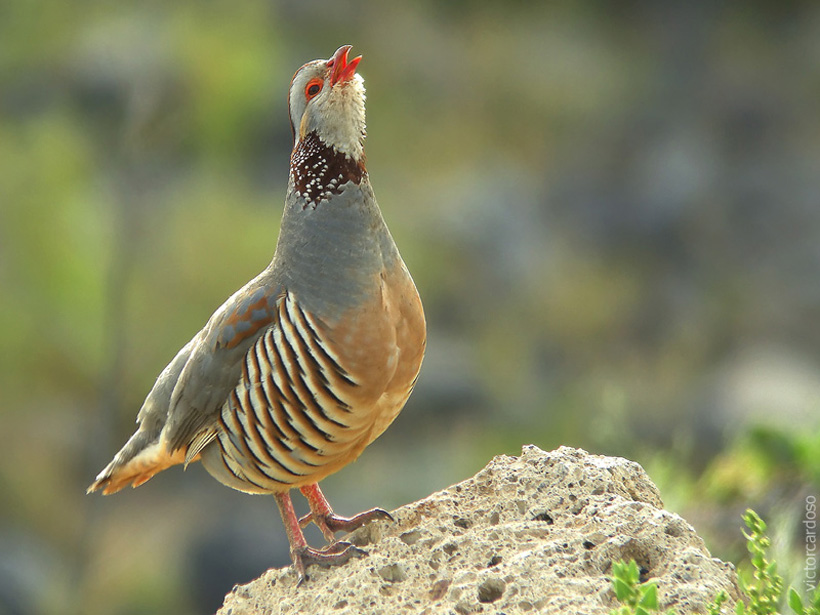
Barbary Partridge (Alectoris barbara koenigi) Pixdaus

Barbary Partridge (Alectoris barbara koenigi) Pixdaus

4. The Partridge adds his note:
“To Bethlehem I’ll fly,
Where in the stall He’s lying.
There, near the manger blest,
I’ll build myself a nest,
And sing my love undying.
There, near the manger blest,
I’ll build myself a nest,
And sing my love undying.

Photo

*

Found another version of the Carol of the Birds and it appears to be Australian Birds.

The Carol of the Birds
(Wheeler/James)

Brolga (Grus rubicunda) by Ian

Brolga (Grus rubicunda) by Ian

Out on the plains the brolgas are dancing
Lifting their feet like warhorses prancing
Up to the sun the woodlarks go winging
Faint in the dawn light echoes their singing
Crana! Orana! Orana to Christmas Day.

Crested Bellbird (Oreoica gutturalis) by Ian

Crested Bellbird (Oreoica gutturalis) by Ian

Down where the tree ferns grow by the river
There where the waters sparkle and quiver
Deep in the gullies bell-birds are chiming
Softly and sweetly their lyric notes rhyming
Orana! Orana! Orana to Christmas Day.

Silver-crowned Friarbird (Philemon argenticeps) by Ian

Silver-crowned Friarbird (Philemon argenticeps) by Ian

Friar birds sip the nectar of flowers
Currawongs chant in wattle tree bowers
In the blue ranges lorikeets calling
Carols of bush birds rising and falling
Orana! Orana! Orana to Christmas Day.
*

More Birds in Hymns

See ~ Share The Gospel

Most information from The Hymns and Carols of Christmas – Name of Hymn with Link to it

*

Ian’s Bird of the Week – Royal Penguin

Royal Penguin (Eudyptes schlegeli) by Ian 1

Royal Penguin (Eudyptes schlegeli) by Ian 1

Ian’s Bird of the Week – Royal Penguin ~ by Ian Montgomery

Newsletter – 12/10/11

I think that this should really be the Bird of the Trip, if not the Year. The birders’ table at dinner on the last night on board had a vote for Bird of the Trip, and it was a close contest between the Light-mantled Sooty Albatross, featured last week, and my choice, the Royal Penguin. As I mentioned last week, Macquarie Island was for most of us the highlight of the trip, and the day spent on familiar terms with the penguins was memorably enchanting.

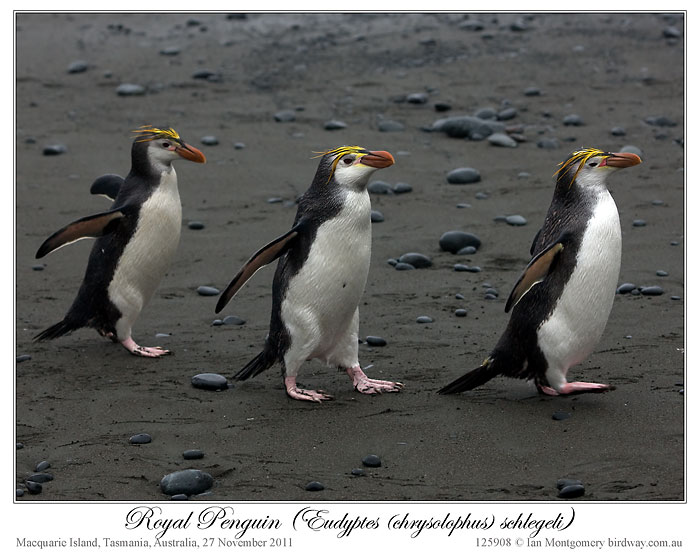
Four species breed there, the commonest being the Royal and King Penguins. The King Penguins are beautiful, very smart, elegant and colourful, but the smaller Royals (up to 75cm/30in in length) won hands down in terms of personality.
Royal Penguin (Eudyptes schlegeli) by Ian 2

Royal Penguin (Eudyptes schlegeli) by Ian 2

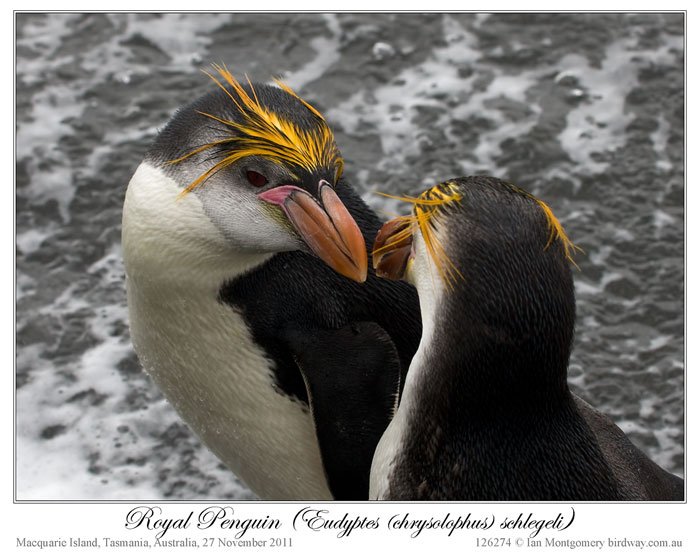
Who could fail to be endeared by the curious attention of the bird in the first photo or by the ones promenading along the beach as in the second photo or by the pair having a deep and meaningful exchange, as in the the third photo?
Royal Penguin (Eudyptes schlegeli) by Ian 3

Royal Penguin (Eudyptes schlegeli) by Ian 3

Apart from curiosity, the penguins appeared little affected by our presence. They would move out of the way if you walked towards them, but if you sat on the beach, they’d come over to check you out and nibble in an exploratory manner on clothing and cameras. The Labrador-eyed baby elephant seals would come over for a cuddle, but that’s another story.
Royal Penguin (Eudyptes schlegeli) by Ian 4

Royal Penguin (Eudyptes schlegeli) by Ian 4

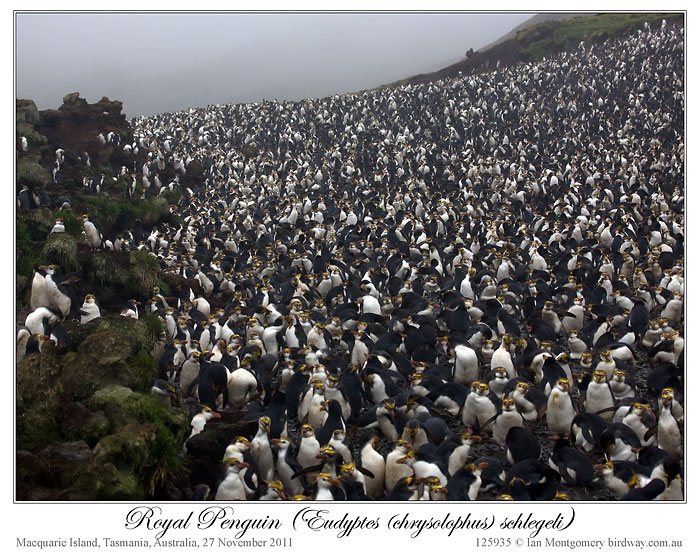
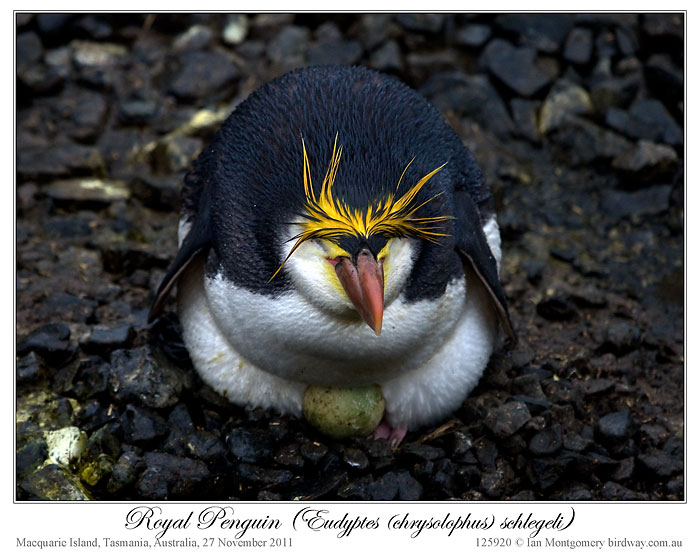
The beach was the promenade area but the real action was taking place at a huge rookery behind the beach, fourth photo. Here, many thousands of Royal Penguins were huddled on uncomfortable-looking stony nests incubating eggs like the long-suffering one having a bad-hair day in the fifth photo.
Royal Penguin (Eudyptes schlegeli) by Ian 5

Royal Penguin (Eudyptes schlegeli) by Ian 5

Woe betide a penguin getting too close to another one’s nest, and an individual moving through the colony was subject to a cacophony of abuse like the one in the sixth photo. The abusers didn’t appeared seriously aggressive, more just letting off steam and complaining about the crowded conditions. They did get serious, however, when the brown skuas attempted to steal their eggs and the area around the rookery was littered with empty egg shells.
Royal Penguin (Eudyptes schlegeli) by Ian 6

Royal Penguin (Eudyptes schlegeli) by Ian 6

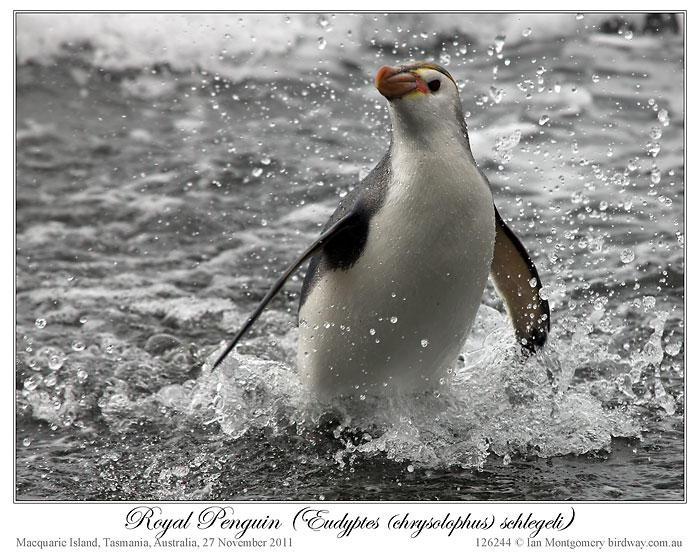
Now generally recognised as a separate species from the closely related Macaroni Penguin, the Royal breeds only on Macquarie Island and the population is estimated at 850,000 pairs. (Macaronis have black chins, Royal have white ones.) ‘Royal’ struck me as a quite inappropriate name: ‘court jester’ would be closer. Maybe that would be underestimating them: the one in the last photo looks like a real champion emerging from the surf, up there with any cross-channel swimmer.
Royal Penguin (Eudyptes schlegeli) by Ian 7

Royal Penguin (Eudyptes schlegeli) by Ian 7

I’m in Sydney now on my way home. The week spent in Tasmania in search of the local endemics was largely successful, despite sometimes miserable weather and I’m looking forward to making many additions to the website.
Best wishes
Ian

Ian Montgomery, Birdway Pty Ltd,
454 Forestry Road, Bluewater, Qld 4818
Phone: 0411 602 737 +61-411 602 737
Preferred Email: ian@birdway.com.au
Website: http://birdway.com.au


Lee’s Addition:

Wow! How do they ever know where their nest is located? That must have been some experience. That second photo looks like they are strutting their stuff.

The Penguins are in the Sphenisciformes Order and they make up the only family, the Spheniscidae Family. See Ian’s photos of the Penguins and then check out our Birds of the WorldSpheniscidae – Penguin family.

He sends out His command to the earth; His word runs very swiftly. He gives snow like wool; He scatters the frost like ashes; He casts out His hail like morsels; Who can stand before His cold? (Psalms 147:15-17 NKJV)

Apparently Penguins were designed to “stand before His cold.”

*

Working Behind the Scene – Tanagers

Grass-green Tanager (Chlorornis riefferii) by Michael Woodruff

Grass-green Tanager (Chlorornis riefferii) by Michael Woodruff

But now ask the beasts, and they will teach you; And the birds of the air, and they will tell you; (Job 12:7 NKJV)

I have been busy trying to find photos for the Thraupidae – Tanagers and Allies Family page. The Tanagers are one of Passeriformes (Song Bird) Order. Working on this page and an upcoming series has kept me from writing as many articles.

But, Wow! Tanagers are some very neat birds that are found throughout the Americas; North, Central, and South (60% of them). Some are plain, but many are very colorful. At the present time with the IOC’s Version 2.10 of the Birds of the World list, there are 388 species in the Traupidae family. Needless to say, that is taking me some time to find the photos and then to load them to the site or provide links for the ones that I do not have permission for. I have gotten down to the Diglossa genus of Flowerpiercers. (which is a little past half way)  I am trying to find as many of the supspecies also and that is where a lot of time is getting spent.

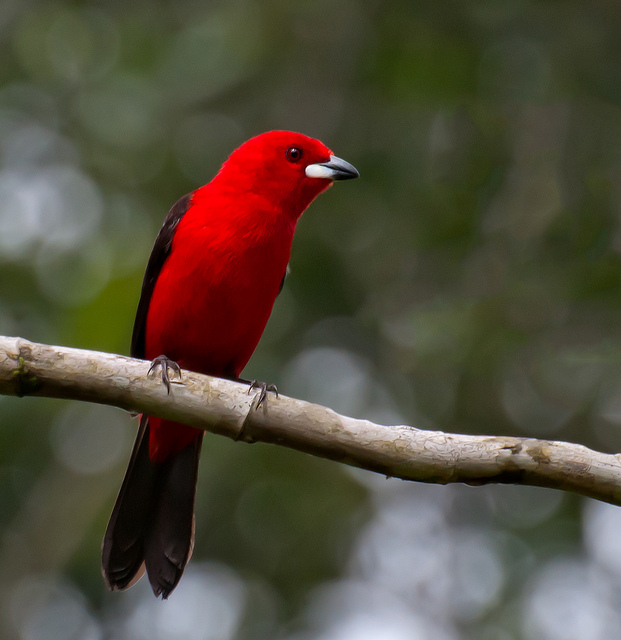
Brazilian Tanager (Ramphocelus bresilius) by Dario Sanches

Brazilian Tanager (Ramphocelus bresilius) by Dario Sanches

The Internet Bird Collection has one of the best collections that list the supspecies. It is a tremendous site that I use quite frequently. As of today, 12/6/2011, they have 56,387 videos, 51,697 photos and 6859 sounds of birds. That represents about 88.67% of all species. When I have problems finding a photo, this place will have it most likely.

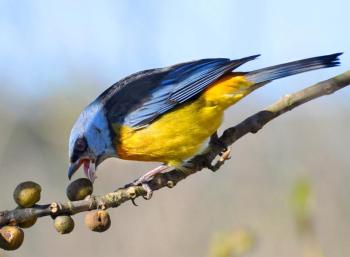
Blue-and-yellow Tanager (Thraupis bonariensis bonariensis) ©BirdPhotos.com

Blue-and-yellow Tanager (Thraupis bonariensis bonariensis) ©BirdPhotos.com

Known to God from eternity are all His works. (Acts 15:18 NKJV)

Back to the tanagers. The family is in flux and some members have been moved to other families, but most are still in the Thraupidae family which has not only Tanagers, but also Hemispingus, Shrike-Tanagers, Mountain Tanagers, Dacnis, Honeycreepers, Conebills, Flowerpiercers, Bush Tanagers, Finches, Reed Finch, Island Finch, Diuca Finch, Inca Finch, Warbling Finch, Grassquit and Orangequits, Seedeaters, Seed Finch, Bullfinch, Ground Finch, Ant Tanagers, Chat-Tanagers, Spindalis and a Plushcap.

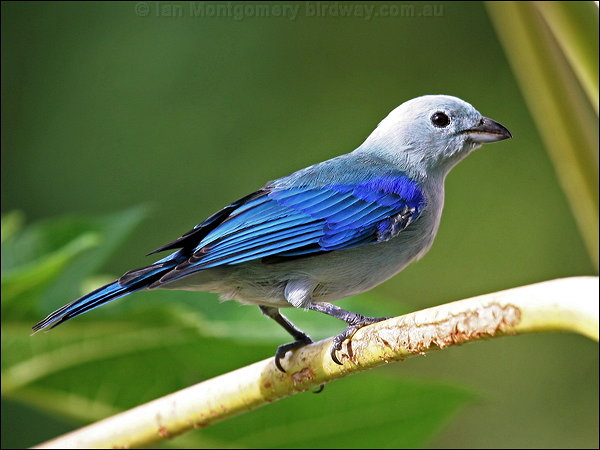
Blue-grey Tanager (Thraupis episcopus) by Ian

Blue-grey Tanager (Thraupis episcopus) by Ian

Tanagers are small to medium-sized birds. The shortest-bodied species, the White-eared Conebill, is 9 cm (3.8 in) long and weighs 7 grams, barely smaller than the Short-billed Honeycreeper. The longest, the Magpie Tanager is 28 cm (11 in) and weighs 76 grams (2.7 oz). The heaviest is the White-capped Tanager which weighs 114 grams (4 oz) and measures about 24 cm (9.5 in). Both sexes are usually the same size and weight. Tanagers are often brightly colored, but some species are black and white. Birds in their first year are often duller or a different color altogether. Males are typically more brightly coloured than females.

Most tanagers have short, rounded wings. The shape of the bill seems to be linked to the species’ foraging habits, which shows forethought and design by their Creator.

Golden-hooded Tanager (Tangara larvata centralis) ©BirdPhotos.com

Golden-hooded Tanager (Tangara larvata centralis) ©BirdPhotos.com

Most tanagers live in pairs or in small groups of 3-5 individuals. These groups may consist simply of parents and their offspring. Birds may also be seen in single species or mixed flocks. Many tanagers are thought to have dull songs, though some are elaborate.

Tanagers are omnivorous, and their diet varies from genus to genus. They have been seen eating fruits, seeds, nectar, flower parts and insects. Many pick insects off branches. Other species look for insects on the underside of leaves. Yet others wait on branches until they see a flying insect and catch it in the air. Many of these particular species inhabit the same areas, but these specializations alleviate competition.

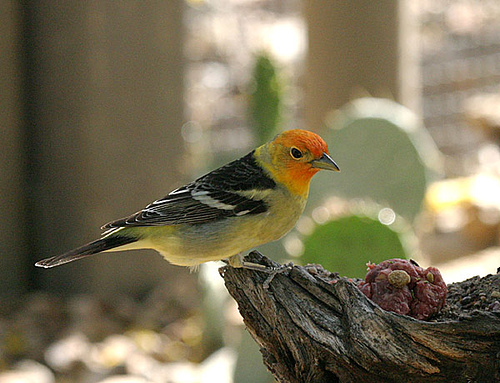
Western Tanager (Piranga ludoviciana) by Kent Nickell

Western Tanager (Piranga ludoviciana) by Kent Nickell

The breeding season begin in March through until June in temperate areas and in September through October in South America. Some species are territorial while others build their nests closer together. There is little information on tanager breeding behavior or whether they are monogamous or polygamous. Males show off their brightest feathers to potential mates and rival males. Some species’ courtship rituals involve bowing and tail lifting.

Most tanagers build cup nests on branches in trees. Some nests are almost globular. Entrances are usually built on the side of the nest. The nests can be shallow or deep. The species of the tree they choose to build their nest in and the nest’s position varies among genera. Most species nest in an area hidden by very dense vegetation. There is still no information on the nests of some species.

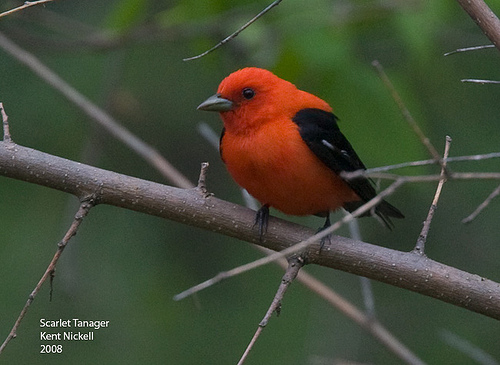
Scarlet Tanager (Piranga olivacea) by Kent Nickell

Scarlet Tanager (Piranga olivacea) by Kent Nickell

The clutch size is 3–5 eggs. The female incubates the eggs and builds the nest, but the male may feed the female while she incubates. Both sexes feed the young. Five species have helpers assist in feeding the young. These helpers are thought to be the previous year’s nestlings.

The Genus I am working on right now is the Diglossa. The Flowerpiercers, The common name refers to their habit of piercing the base of flowers to access nectar that otherwise would be out of reach. This is done with their highly designed bills, although this is greatly reduced in the Bluish Flowerpiercer, which has an almost “normal” bill. Most flowerpiercers are restricted to highlands, especially the Andes, in South America, but two species occur in Central America. See the article – Formed By Him – “Sword and Piercer” Birds

O the depth of the riches both of the wisdom and knowledge of God! how unsearchable are his judgments, and his ways past finding out! (Romans 11:33 KJV)

Well, guess I better get back to work behind the scenes again. Keep checking the page as I work to the bottom. Not sure how many more beautiful birds I’ll find, but it is fun to birdwatch through the cameras of others who go places I’ll never get to. I stay amazed at the paint brush and designs from our Creator.

The Gospel Message

*

(Above mostly from Wikipedia)

*

Formed By Him – Dippers

White-throated Dipper (Cinclus cinclus) by Ian

White-throated Dipper (Cinclus cinclus) by Ian

Dippers are small, stout, short-tailed, short-winged, strong-legged birds. The different species are generally dark brown (sometimes nearly black), or brown and white in colour, apart from the Rufous-throated Dipper which is brown with a reddish-brown throat patch. Sizes range from 14–22 cm in length and 40-90 g in weight, with males larger than females. Their short wings give them a distinctive whirring flight. They have a characteristic bobbing motion when perched beside the water, giving them their name.

White-capped Dipper (Cinclus leucocephalus leuconotus) ©BirdPhotos.com

White-capped Dipper (Cinclus leucocephalus leuconotus) ©BirdPhotos.com

Dippers are found in suitable freshwater habitats in the highlands of the Americas, Europe and Asia. In Africa they are only found in the Atlas Mountains of Morocco. They inhabit the banks of fast-moving upland rivers with cold, clear waters, though, outside the breeding season, they may visit lake shores and sea coasts.

The Lord created them unlike many water birds, dippers are generally similar in form to many terrestrial birds (for example they do not have webbed feet), but they were designed with some morphological and physiological adaptations to their aquatic habits. Their wings are relatively short but strongly muscled, enabling them to be used as flippers underwater. They have dense plumage with a large preen gland for waterproofing their feathers. Relatively long legs and sharp claws enable them to hold onto rocks in swift water. Their eyes have well-developed focus muscles that can change the curvature of the lens to enhance underwater vision. They have nasal flaps to prevent water entering their nostrils. Their blood has a high haemoglobin concentration, allowing a greater capacity to store oxygen than terrestrial birds, and allowing them to remain underwater for up to at least 30 seconds.

Let them praise the name of the LORD: for he commanded, and they were created. (Psalms 148:5 KJV)

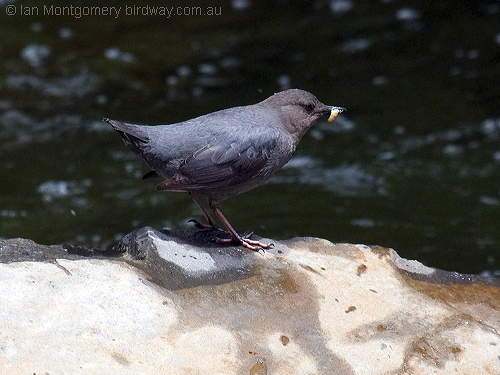
American Dipper (Cinclus mexicanus) by Ian

American Dipper (Cinclus mexicanus) by Ian

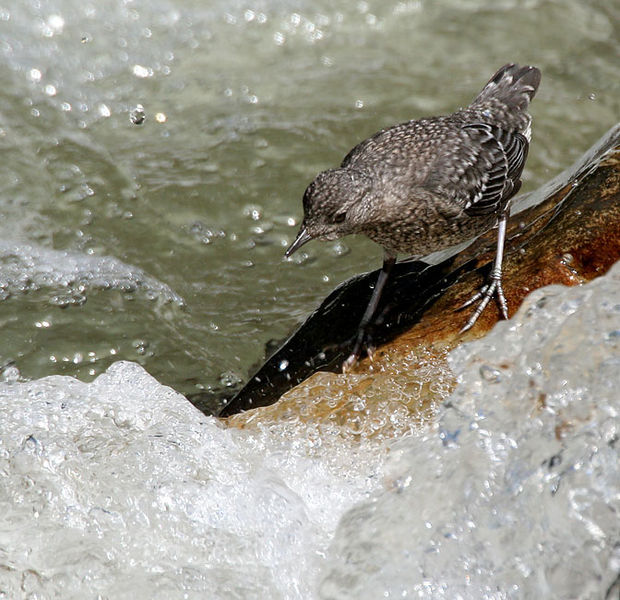
Dippers forage for small animal prey in and along the margins of fast-flowing freshwater streams and rivers. They perch on rocks and feed at the edge of the water, but they often also grip the rocks firmly and walk down them beneath the water until partly or wholly submerged. They then search underwater for prey between and beneath stones and debris; they can also swim with their wings. The two South American species swim and dive less often than the three northern ones. Their prey consists primarily of invertebrates such as the nymphs or larvae of mayflies, blackflies, stoneflies and caddisflies, as well as small fish and fish eggs. Molluscs and crustaceans are also consumed, especially in winter when insect larvae are less available.

White-throated Dipper

Recording Sound of White-throated Dipper by BBC

Video by National Geographic

*
There are five members of the Dipper – Cinclidae Family in the Passeriformes Order. They all are of the Cinclus genus. The Dippers are:

White-throated Dipper (Cinclus cinclus) – Widespread, also nw Africa
Brown Dipper (Cinclus pallasii) – Europe
American Dipper (Cinclus mexicanus) – w Canada to Panama
White-capped Dipper (Cinclus leucocephalus) – Colombia to Bolivia
Rufous-throated Dipper (Cinclus schulzii) – nw Argentina, se Bolivia

What an amazing Creator we have!

Brown Dipper (Cinclus pallasii) ©WikiC

Brown Dipper (Cinclus pallasii) ©WikiC

Several things have been dipped in blood in Scripture:

And they took Joseph’s coat, and killed a kid of the goats, and dipped the coat in the blood; (Genesis 37:31 KJV)

Hyssop was dipped in blood in Exodus 12:22 and put on doorposts; Lev. 4:6,16 and  9:9, 14:16 dipped finger in blood and sprinkled it while at the altar; dipped a bird in blood in Lev. 14:6 (See Birds of the Bible – Purifying Bird); then when Christ is seen in heaven, His vesture is dipped in blood.

And he was clothed with a vesture dipped in blood: and his name is called The Word of God. (Revelation 19:13 KJV)

The one time someone dipped himself in a river, was when Naaman, who had leprosy, finally believed enough to go dip seven times in the Jordan and was healed.

Then went he down, and dipped himself seven times in Jordan, according to the saying of the man of God: and his flesh came again like unto the flesh of a little child, and he was clean. (2 Kings 5:14 KJV)

Gospel Message

See Also:

Formed By Him

The American Dipper – The Intercessor by a j mithra

Birds of the World

(Information from Wikipedia and other internet sources)

*