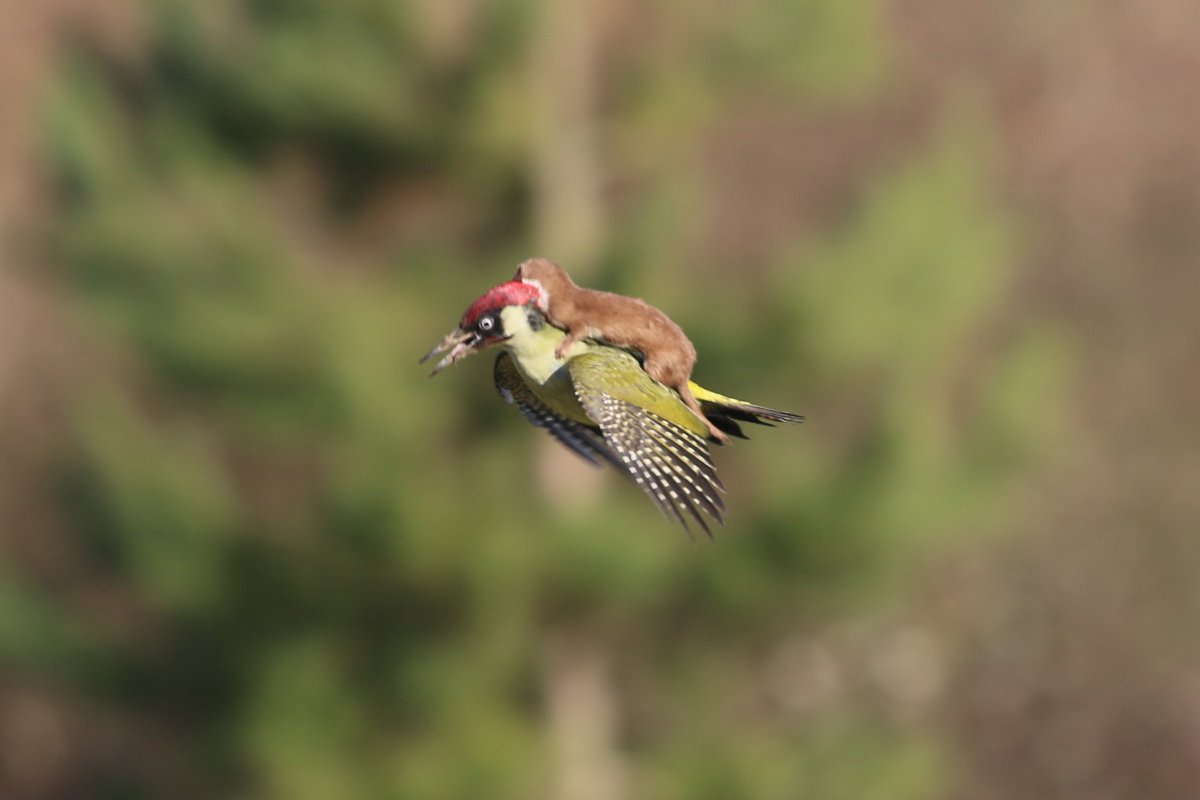
Woodpecker With A Weasel On It’s Back

Green Woodpecker with Weasel On It's Back ©Martin Le-May

Green Woodpecker with Weasel On It’s Back ©Martin Le-May

You have to see this:

Amateur photographer Martin Le-May, from Essex, has recorded the extraordinary image of a weasel riding on the back of a green woodpecker as it flies through the air.

http://focusingonwildlife.com/news/weasel-photographed-riding-on-a-woodpeckers-back/

*

Now behold, there was a man named Zacchaeus who was a chief tax collector, and he was rich. And he sought to see who Jesus was, but could not because of the crowd, for he was of short stature. So he ran ahead and climbed up into a sycamore tree to see Him, for He was going to pass that way. And when Jesus came to the place, He looked up and saw him, and said to him, “Zacchaeus, make haste and come down, for today I must stay at your house.” (Luke 19:2-5 NKJV)

Maybe the Weasel, like Zacchaeus, thought Jesus was going to come by and he wanted to get a better look.
*
Picadae – Woodpeckers

Wordless Birds

*

Pond-side Birdwatching in Florida III

PondsideBirdwatching-WebelBackyard.2

Pond-side Birdwatching-Webel Backyard

Pond-side Birdwatching in Florida,

from Chaplain Bob’s Backyard: Part 3

 by James J. S. Johnson

Like a crane or a swallow, so did I chatter: I did mourn as a dove: mine eyes fail with looking upward: O Lord, I am oppressed; undertake for me. (Isaiah 38:14)

But they that escape of them shall escape, and shall be on the mountains like doves of the valleys, all of them mourning, every one for his iniquity. (Ezekiel 7:16)

O ye that dwell in Moab, leave the cities, and dwell in the rock, and be like the dove that maketh her nest in the sides of the hole’s mouth.  (Jeremiah 48:28)

Mourning Dove (Zenaida macroura) by Daves BirdingPix

Mourning Dove (Zenaida macroura) by Daves BirdingPix

Doves (a kind of birds that include pigeons) are among the most commonly observed birds in the world.  Doves display great variety (mourning dove, turtle dove, zebra dove, Inca dove, white-winged dove, etc.), the most popular variety being the pigeon (whose more formal name is “rock dove”).   Doves illustrate 2 different nesting habits (both being mentioned in Deuteronomy 22:6-7):  some nest in trees or other high places; others nest on the ground. Pigeons are often seen, due to their conspicuous habit of domesticating urban habitats (such as city buildings and bridges), nesting in high places (as indicated by , feeding, and flying in plain view of human spectators – often learning to accept food from humans, or to scavenge human garbage.  However, other doves (such as mourning doves) nest on the ground, a more vulnerable lifestyle.  Doves that nest on the ground, however, tend to be more reclusive (hiding in bushes and other thick vegetation), so they are more often heard than seen.  For example, in this birding report, brief mention will be made of a cooing mourning dove – that was heard, but not seen.

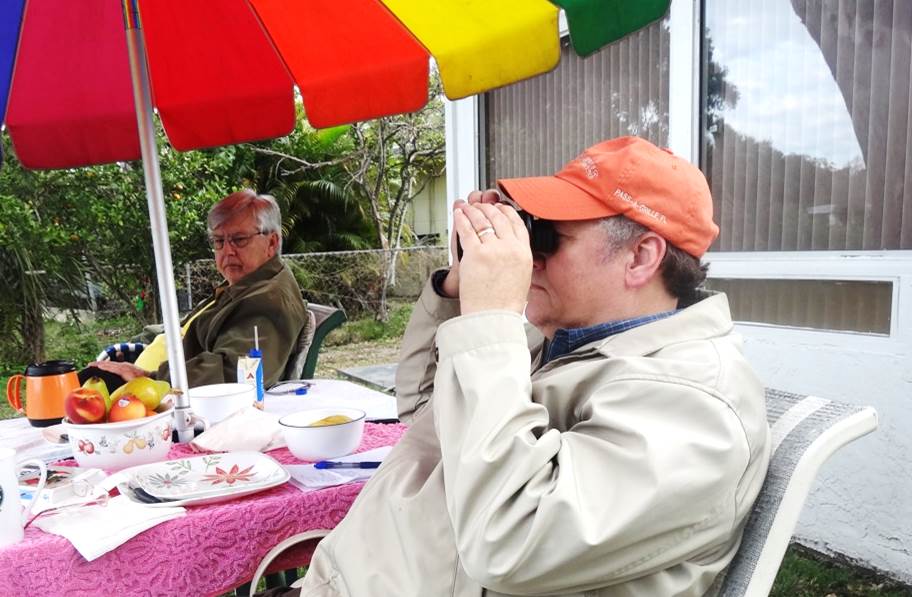
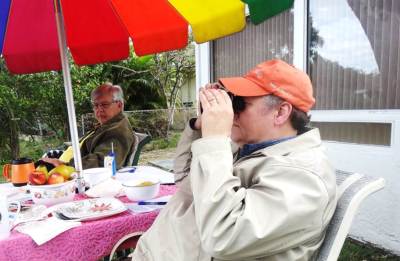
As reported previously, at Lee’s Birdwatching Adventures, it was a wonderful morning in St. Petersburg, where 3 of us  (my dear friends in Christ, Chaplain Bob and Marcia Webel, and I)  were watching the duck-populated pond and its bird-visited shores, with coffee and feet propped up, in the Webels’ backyard —  under a huge beach umbrella, shielded from occasional droppings (!) from ibises and ospreys (who were perched in branches hanging over where we were) sitting with binoculars, coffee mugs, healthy breakfast foods, and a bird-book.  Mostly we were bird-watching, that morning, but also we were bird-listening!
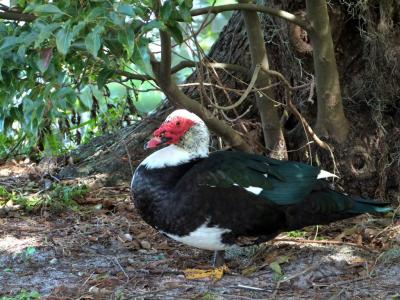
Muscovy Duck

Muscovy Duck

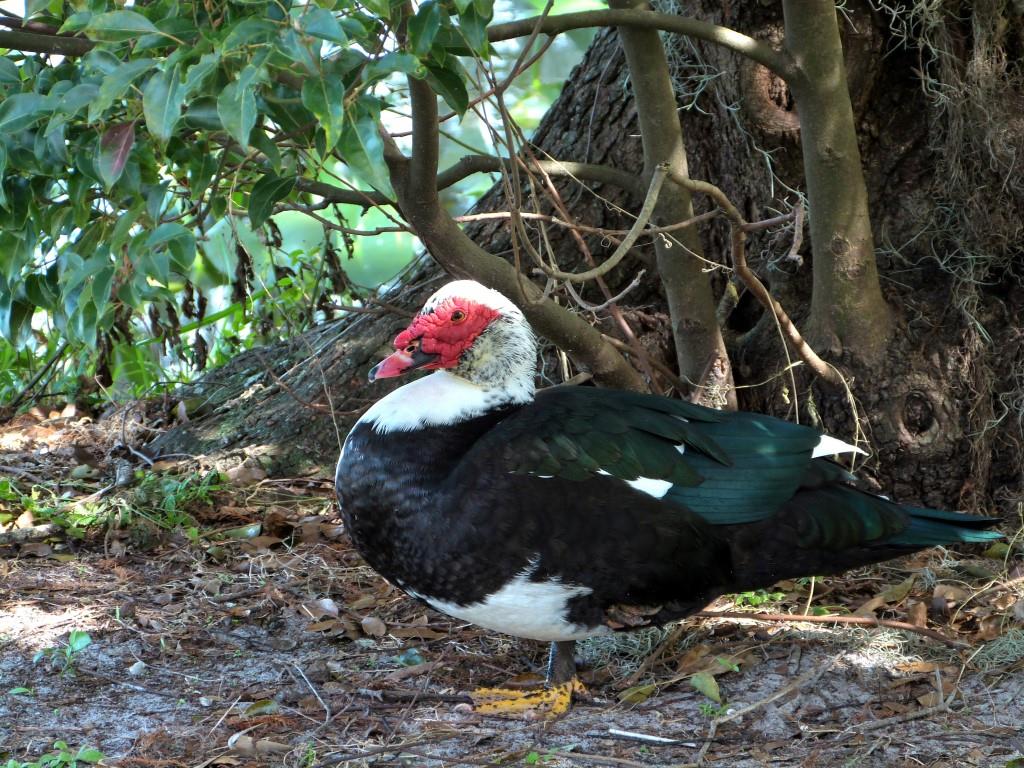
MUSCOVY   (a/k/a “MUSCOVY DUCK” or “BARBARY DUCK”:  Cairina moschata).

RTP @ 52-53 & 302-303

The Muscovy Duck is a strange looking fowl.  (And its name refers to “musk”, so it must have a characteristic smell, too!)  It is a duck, yet it is large – the size of a goose.  Yet even stranger are the colorful growths of red flesh upon its face:  the Muscovy looks like someone spilled some red bumpy-lumpy oatmeal on the sides of its bill, and on some of them the “red oatmeal” stuck to the face even around the eyes.  This fleshy growth is wattle-like “caruncle”, something like what turkey faces display.  Some people dislike the Muscovy Duck simply because its knobby (i.e., carunculated) face looks grotesque or diseased or “corrupted”!  But Mallards don’t seem to disdain these beauty contest flunkies; often a Muscovy (or two) is seen amidst a group of Mallards, and it seems that maybe they sometimes hybridize.  The coloring of a Muscovy Duck might be mostly white, or mostly black (with iridescent green tinting), or a quilt-patched mixture of black and white, with large white “patches” or “bars” on the wings.   (See Roger Tory Peterson, A Field Guide to the Birds Eastern Birds:  A Completely New Guide to All the Birds of Eastern and Central North America, abbreviated as “Eastern Birds” [Peterson Field Guides, Houghton Mifflin, 1980], at pages 52-53 & 302-303.)   The Muscovy’s awkward gait, when waddling about, sometimes looks a clumsy-looking, but these strange ducks are hearty survivors.  Regardless of where they came from (some say Latin America), these ducks are here to stay.   A domesticated form of the Muscovy is bred as the Pato Criollo (i.e., Creole Duck), though it seems that many of these have figured out how to escape their intended culinary destinies, becoming semi-wild as escapees. Muscovy Ducks have been observed and studied for centuries.  The Muscovy Duck was noted by two of the earliest (and most godly) eco-science geniuses, Konrad Gessner and John Ray, both being Bible-believing creationists.  To appreciate just an introductory sample of their trail-blazing creation research, analysis, and scholarship, see:  http://www.icr.org/article/christianity-cause-modern-science/  (mentioning John Ray),   http://www.icr.org/article/graffiti-judgment/  (mentioning, in Footnote #3, both Konrad Gessner and John Ray),  and  http://www.icr.org/article/fossil-political-correctness-sixteenth-century (mentioning Konrad Gessner as a Bible-believing Christian ecologist).
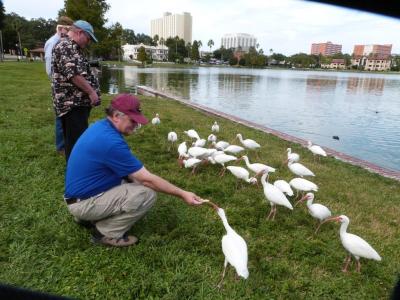
Feeding White Ibises at Lake Morton

Feeding White Ibises at Lake Morton

WHITE  IBIS   (Eudocimus albus).

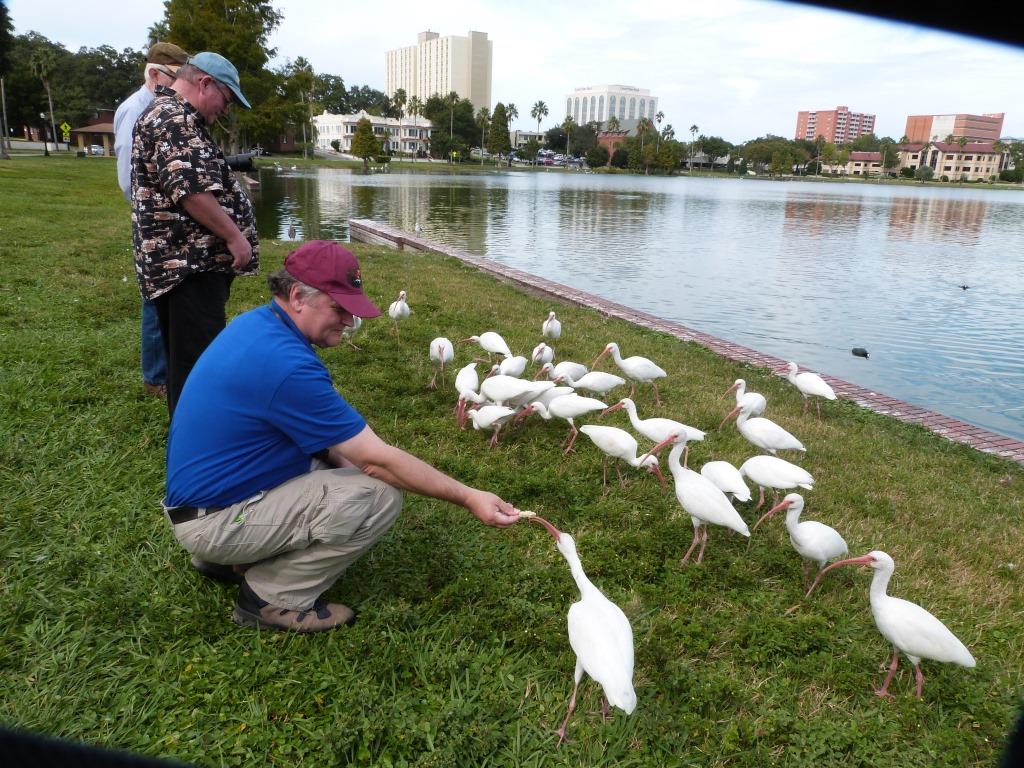
The White Ibis is a white-plumed wading bird, with a reddish/orange-scarlet/pinkish/salmon-colored “decurved” (i.e., downward-curved) bill — shown here (with Dan Dusing, Baron Brown, and me  —  in a lakeshore photograph taken by ornithologist Lee Dusing) being fed bread crumbs.  The White Ibis is a gregarious bird, nesting in colonies and often seen foraging as a group.  Its homes are found in coastal mudflats, lakes and lakeshores, ponds and pondshores, and marshy areas.  (Obviously this group of ibises have been fed bread crumbs before – they are quite ready for a tasty snack!)  During the breeding season the White Ibis also has skinny pink legs (about the same color as its prominent bill, but at non-breeding times these legs are duller in color),  —  and this bird knows how to scurry about on those legs! The decurved bill, of course, is an excellent tool for probing around in shoreline mud or sand, for little things to eat, such as small crustaceans (like mudcrabs), frogs, or bugs.  (Obviously God gets the credit, for designing the ibis bill to accomplish what it does for the ibis, as well as for supplying ibis populations with the food sources they need to carry on the business of life.)  If the White Ibis bill snaps your fingers, as you feed him (or her) a bread-crumb, don’t worry!  –  the ibis’s bill is so light and gentle that its peck doesn’t hurt at all.  The White Ibis is found all over Florida, year-round, as well as on the Gulf Coast and America’s East Coast as far north as North Carolina.   (See Peterson’s Eastern Birds” [noted above, in entry for Muscovy Duck], at page M105.)  Why do fishermen especially appreciate the White Ibis?   The ibises eat a lot of shoreline crustaceans (like crabs and crayfish), which in turn eat fish eggs.  So if the crustacean populations grow too much, eating lots of fish eggs, the fish populations decline – bad news for fishermen.  Without consciously realizing it, therefore, the White Ibis is protecting the reproductive success of coastal fish populations — on which human fishermen (and their customers) rely.   (See the National Audubon Society’s Field Guide to North American Birds – Eastern Region [Alfred A, Knopf, 1994 revised edition], co-authored by John Bull & John Farrand, Jr., at page 376.)

Great Egret at Gatorland by Dan

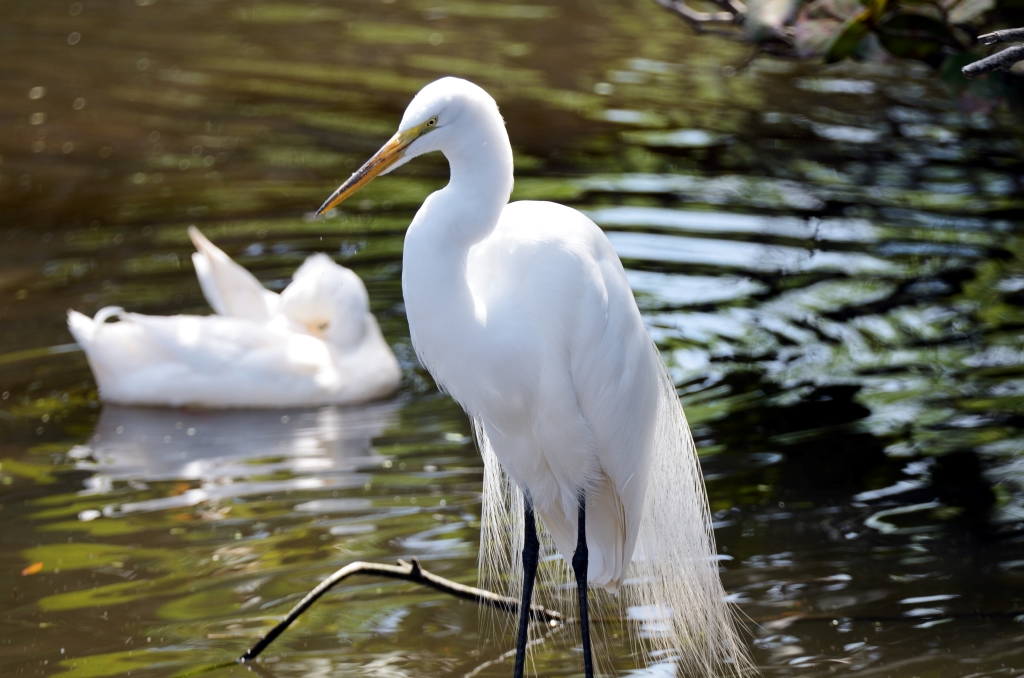
GREAT  WHITE  EGRET   (Ardea alba  or  Casmerodius albus).

The Great White Egret (a/k/a “Great Egret”) is a large long-legged heron-like wading bird, white in plumage, with a yellow bill and black legs.  (See Bull & Farrand’s Eastern Region [noted above, in entry for White Ibis], at page 368.)  This truly “great” egret is often seen standing, like a statute, on the shoreline of a pond, waiting for movement that would betray the availability, in the shallow water or the shoreline weeds, of a quick meal  –  perhaps a fish, a frog, or even a snake.   Donald and Lillian Stokes describe its eating habits as follows:  “Primarily feeds by walking slowly, head erect, then striking prey.  Forages in shallow water for small fish and amphibians [like frogs], but also on land for insects, reptiles [like snakes], and small mammals.  May feed solitarily and defend feeding areas by displaying aggressively and supplanting intruders.  Also feeds in large groups when food is concentrated.  Has been known to steal fish from other birds.” (Quoting Donald W. Stokes & Lillian Q. Stokes, Stokes Field Guide to Birds – Eastern Region [Little, Brown & Co., 1996], page 34.)  During summer this egret also frequents marshy grasslands, tidal mudflats, salt marsh beaches, and other wet habitats – all over America’s lower 48 states.  During winter this fair-weather fowl routinely migrates to America’s East (northward to Delaware), Gulf Coast, and West Coast.  It makes guttural-hoarse croaking noises, as well as loud squawking noises, but it is usually seen before it is heard – due to its large size and strikingly white color.  Its flight is majestic and gracious  —  a marvel to watch, with or without binoculars.
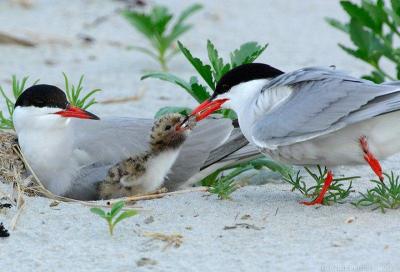
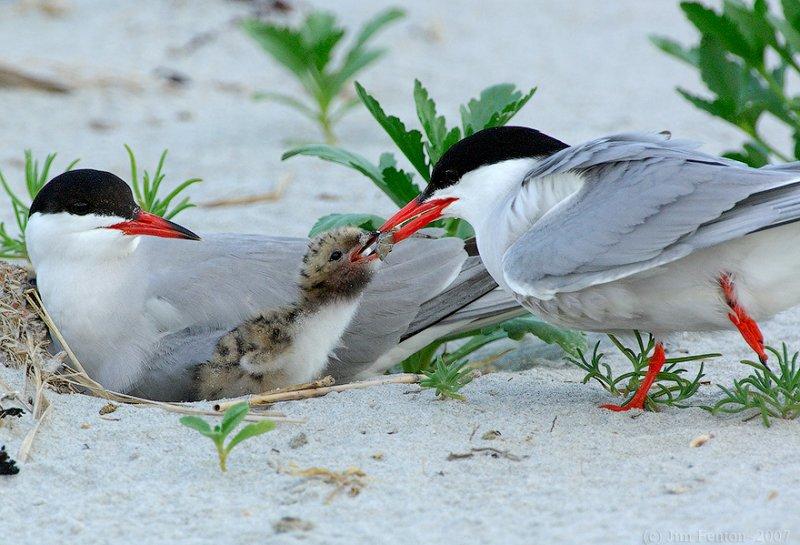
Common Tern (Sterna hirundo) by J Fenton

Common Tern (Sterna hirundo) by J Fenton

COMMON  TERN   (Sterna hirundo).

The Common Tern is one of the many coastline-dwelling birds that get lumped into the term “seagull”.  The Common Tern has been described as “White with black cap and pale gray back and wings.  Bill red with black tip; tail deeply forked.  Similar to Forster’s Tern, but lacks frosty wing tip.  Also similar to Arctic and Roseate Terns.”  (Quoting Bull & Farrand’s Eastern Region [noted above, in entry for White Ibis], at page 519.)  This seagull likes to nest in colonies, often on sandy beaches or on small islands, near lakes, bays, or ocean tidewaters.  Unsurprisingly, the males are the more aggressive sex, although a male intruder may be rebuffed by a male-and-female pair  —  so don’t mess with a Common Tern couple!  (See “Common Tern”, by Donald W. Stokes & Lillian Q. Stokes, in Bird Behavior, Volume III [Little, Brown & Co., 1989], page 71.)

Mourning Dove by Reinier Munguia

Mourning Dove by Reinier Munguia

MOURNING  DOVE   (heard cooing  —   Zenaida macroura).

Many books could be written about the Mourning Dove, and about its many cousins – such as the “pigeon” (Rock Dove) – that inhabit so many rural, suburban, and urban places around the world (as noted above, at the beginning of this birding report).  But a better description and appreciation for this bird must wait another day, because this report is already too long!  So, for now, this report closes with a passing mention that “mourning” was heard that morning – the plaintive cooing of the (well-named) Mourning Dove.  But no need for sadness  –  because it will soon be (God willing) another day for pondside birdwatching in Florida!


On the morning of February 9th, AD2015, from the pond-side backyard of Bob & Marcia Webel (while enjoying breakfast and Christian fellowship with the Webels), I saw 14 birds:  Great Blue Heron, Brown Pelican, Mallard, Double-Crested Cormorant, Black Vulture, Wood Stork, Lesser Scaup, Osprey, Snowy Egret, and Florida Gallinule,  as reported previously,  —  and, as reported hereinabove, Muscovy Duck, Great Egret, White Ibis, and Common Tern, plus the cooing of a nearby Mourning Dove was clearly recognizable.  What a morning!


James J. S. Johnson loves duck ponds, having formerly taught Environmental Limnology and Water Quality Monitoring for Dallas Christian College, as well as other courses on ecology and ornithology.  Limnology terms are not universal:  what some call a “pond” others call a “lake”.  [NOTE:  Some use the temperature of the bottom water as the lentic nomenclature determinant:  if the bottom water is the same temperature, year-round (i.e., regardless of whether it is winter or summer), it’s deep enough to be a “lake” – otherwise limnologists call it a “pond”.]   Regardless of this semantic custom, the “pond” viewed in the foregoing bird-watching report is called “Lake Coronado” in Florida’s Pinellas County.  J


*
Pond-side Birdwatching in Florida I

Pond-side Birdwatching in Florida II

Other Articles by James J. S. Johnson

*
Ian’s Bird of the Week – Budgerigar

PSI-Psit Budgerigar (Melopsittacus undulatus) by Ian
Ian’s Bird of the Week – Budgerigar ~ by Ian Montgomery

Newsletter ~ 3/3/15

Judging by the number of emails that I received about Pied Butcherbirds, iconic species are popular and there were many interesting stories about experiences with them. So here is another, perhaps globally the most familiar Australian bird. Although it’s quite common and sometimes very abundant after good rains in the drier parts of Australia, you have to go out of your way to find it. So it it’s much less well-known as a wild bird than say other iconic species like Australian Magpie and Laughing Kookaburras that turn up in backyards.

It wasn’t until after I moved to North Queensland in 2002 that I first saw them in the wild, and that was on a trip to Moorrinya National Park between Torrens Creek and Aramac, 370km southwest of Townsville. In places like that you usually see them in small flocks of maybe 10-20 in rapid undulating flight. These make sudden turns in the sunlight showing alternately green and yellow in a characteristic and delightful display of vivid, fluorescent colour.

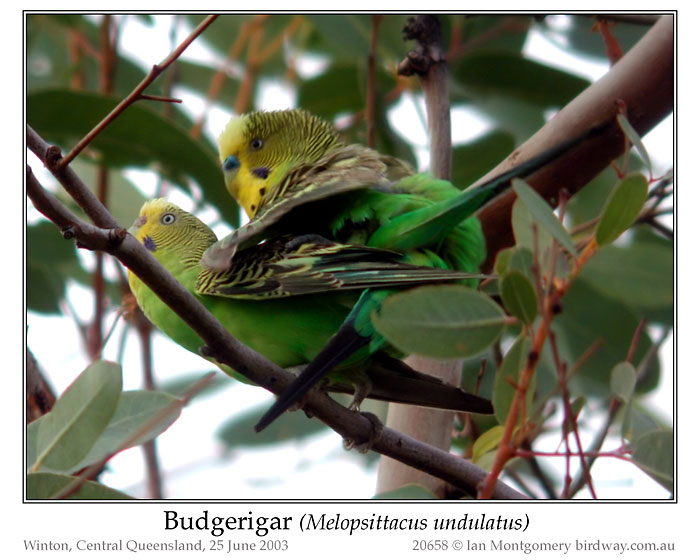
PSI-Psit Budgerigar (Melopsittacus undulatus) by Ian

The sexes can be distinguished either by differences in behaviour, sometimes subtle as in the first photo with an attentive male and a bored or playing hard to get female, or less subtly as in the second photo. Her the male is concentrating seriously, and the female is rather inscrutably either in a state of bliss or thinking of the motherland. An easier way though is by the colour of the cere – the tissue surrounding the nostrils – blue in adult males, and brown in females. Juveniles have duller plumages, barred foreheads and lack the black spots on the neck.

PSI-Psit Budgerigar (Melopsittacus undulatus) by IanAfter good inland rains, the population can explode and Budgerigars may be seen in flocks of thousands. When dry conditions return and seeds become scare, flocks wander far and wide in search of food. They move into areas beyond their normal range and can turn up in coastal areas such as near Townsville. The birds in the third photo were near Woodstock just south of Townsville on the way to Charters Towers and I have seen them near Bluewater.

Sometimes escaped cage birds turn up in odd places in strange colours, such as this almost completely white one near the Strand in Townsville. I don’t know about you, but I prefer the natural colours. I was in Ireland once for a family funeral in February and was birding on Dun Laoghaire pier in Dublin Bay on a very cold, dull winter’s day, when I spotted a bright yellow budgie looking very out-of-place among some roosting waders. It was a moment of great empathy and I thought ‘you and I should be back in sunny Australia’.

PSI-Psit Budgerigar (Melopsittacus undulatus) by IanI’m in Melbourne at the moment to visit East Gippsland next weekend with my Victorian birding pals who know of a good site for both Greater Sooty Owls and Masked Owls (both cousins of Barn Owls) near Orbost. I haven’t seen or photographed either of these, so may I request your customary friendly support and spiritual goodwill to help us find them? It would be lovely to be able to bring at least one of them to you as the next bird of the week.

Greetings
Ian

**************************************************
Ian Montgomery, Birdway Pty Ltd,
454 Forestry Road, Bluewater, Qld 4818
Tel 0411 602 737 ian@birdway.com.au
Check the latest website updates:
http://www.birdway.com.au/#updates


Lee’s Addition:

Declare His glory among the nations, His wonders among all peoples. (Psalms 96:3 NKJV)

Ian is correct, at least for me. The Budgerigar or “Budgie” as I was taught, was one of the first bird names I ever knew. Almost everyone I have ever seen was in a cage or aviary. Few have been pets and one was sitting on someone glasses look down into their lens. But, to see them in the wild where they live would be a great experience.

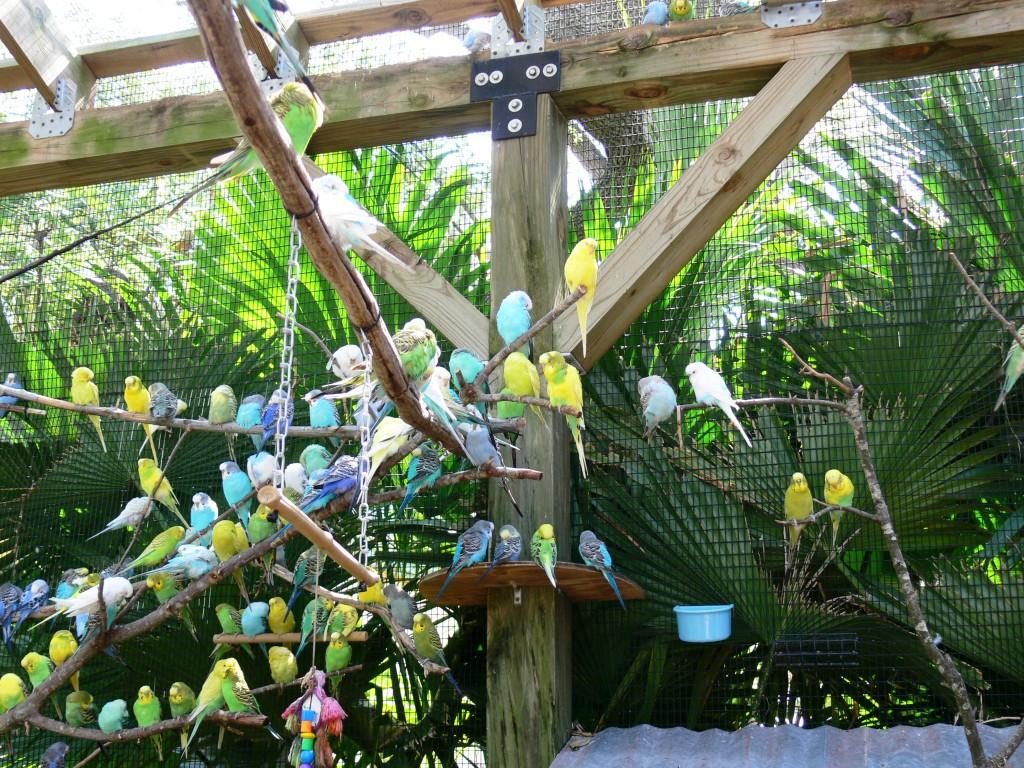
Thanks, Ian, for again sharing your adventures with us. The most I have ever seen at one time has been at Lowry Park Zoo. I’ll also be praying that Ian finds those Greater Sooty Owls and Masked Owls so that he will share them with us on another Bird of the Week.

Budgerigar (Melopsittacus undulatus) by Lee LPZ

Budgerigar (Melopsittacus undulatus) by Lee LPZ

Ian’s Birds of the Week

Ian’s Budgerigar Photos

Ian’s Psittacidae Family

Psittacidae – Parrots Family

*


Sunday Inspiration – Give Thanks

Spangled Cotinga (Cotinga cayana) ©WikiC CinZoo Photo by Greg Hume

Spangled Cotinga (Cotinga cayana) ©WikiC CinZoo Photo by Greg Hume

To the end that my glory may sing praise to thee, and not be silent. O LORD my God, I will give thanks unto thee for ever. (Psalms 30:12 KJV)

As we continue through the Passerine Families, today we arrive at Cotingidae – Cotingas Family which has 66 members and the Pipridae – Manakins Family has 52 species.

As you watch the birds you can listen to Mark Quijano sing “Give Thanks.” Mark is a newer follower of this blog and I am following his, now that we have been made aware of the each other’s blog. Our mutual draw is Our Lord Jesus Christ. I find the Lord’s Family enjoyable, wherever they may be. Mark lives in Saga City, Japan. Please check out his site “Travel Diary.”

If you have a large screen, you can do both at the same time, else, watch the birds as you listen to Mark. Or you can watch Mark sing and then start it again and listen as you watch the birds. Oh, the options I have given you today to enjoy Our Lord’s Creation and “Give Thanks” through music and birds.

This slideshow requires JavaScript.

“Give Thanks” ~ sung by Mark Quijano, his YouTube Channel

*

Sunday Inspirations

Cotingidae – Cotingas Family

Pipridae – Manakins Family

Travel Diary

Good News

*

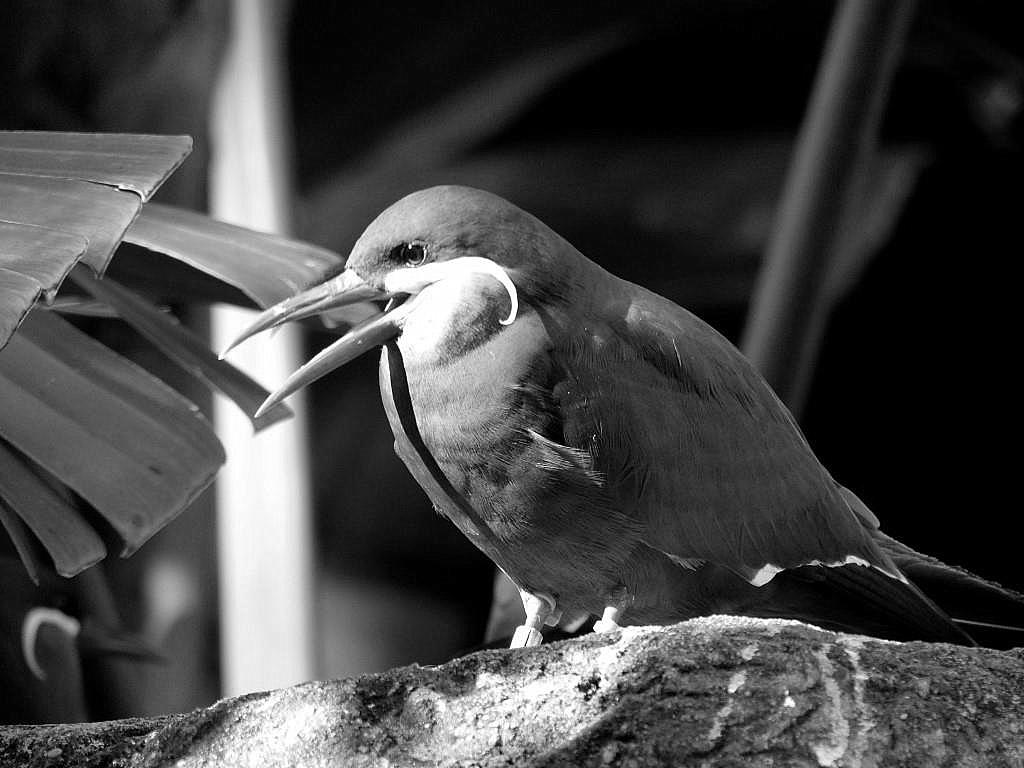
5 Day Black and White Photo Challenge #5 – Happy Bird

Inca Tern at Lowry Park Zoo by Lee

Inca Tern at Lowry Park Zoo by Lee

 Happy is the man that findeth wisdom, and the man that getteth understanding. (Proverbs 3:13 KJV)

There are only two rules for this challenge:

1. On 5 consecutive days, create a post using either a past or recent photo in B&W.
2. Each day invite another blog friend to join in the fun.

My fifth nomination is Talainsphotographybecause he has a variety of photos, most of them from nature. He “likes birds, bees, trees and flowers with sunsets, rainbows, and with rocky towers thrown in. But don’t be surprised if I throw in something else that is not nature oriented occasionally. If it catches my eye, I’ll put it in and try to give you some background on the photo’s subject matter!”

Again, I was nominated by Our Rumbling Ocean, and I nominated AussieBirderSukanya RamanujanThrough Open Lens, B is for Blessed and now Talainsphotography. Please check out all of these fine sites.

This is the fifth and final one in the 5-day challenge. I trust you have enjoyed them and checking out the sites of the ones nominated. There are many more of you that I could have nominated, but I could only choose five. Maybe another challenge will come along that interests me and I will pick you.

*

My photos so far for this challenge:

*

Good News

*

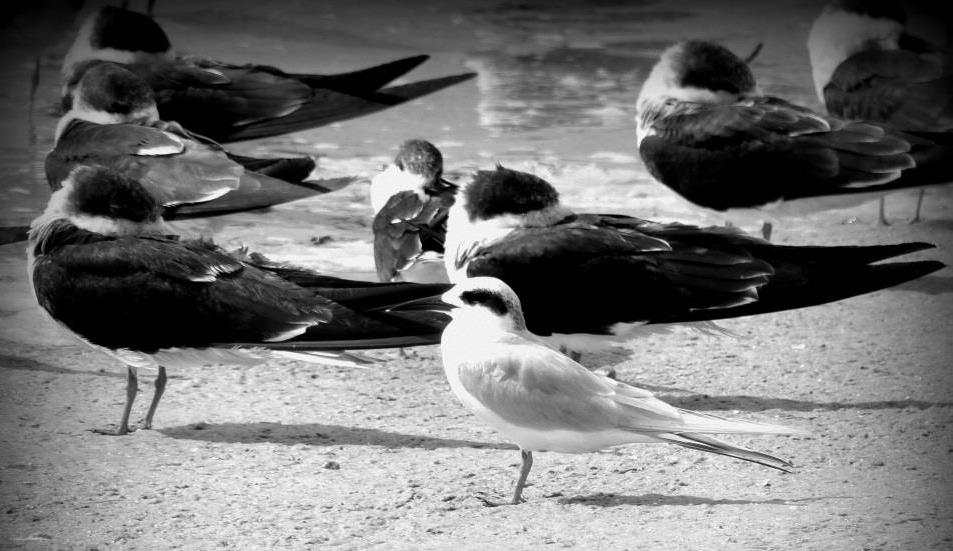
5 Day Black and White Photo Challenge #4 – Shore Friends

Tern with Skimmer Friends at MacDill AFB Shore 2015 by Lee

And great multitudes were gathered together unto him, so that he went into a ship, and sat; and the whole multitude stood on the shore. (Matthew 13:2 KJV)

But when the morning was now come, Jesus stood on the shore: but the disciples knew not that it was Jesus. (John 21:4 KJV)

There are only two rules for this challenge:

1. On 5 consecutive days, create a post using either a past or recent photo in B&W.
2. Each day invite another blog friend to join in the fun.

My fourth nomination is B is for Blessed, “Receive God’s Grace Every Day,” because Lilkah is a Christian who likes to encourage others with her photos, verses and enjoyable stories.

Again, I was nominated by Our Rumbling Ocean, and I nominated AussieBirder and Sukanya RamanujanThrough Open Lens and now B is for Blessed. Please check out all of these fine sites.

*

My photos so far for this challenge:

*

Good News

*

Ian’s Bird of the Week – Pied Butcherbird

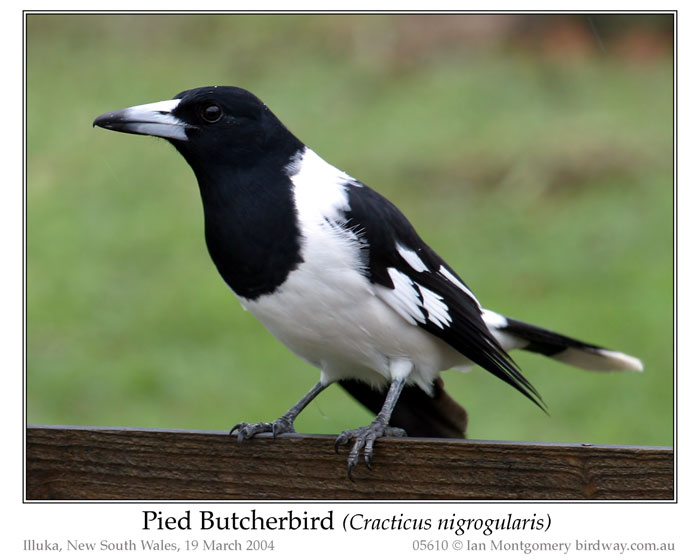
Pied Butcherbird (Cracticus nigrogularis) by Ian
Ian’s Bird of the Week – Pied Butcherbird ~ by Ian Montgomery

Newsletter ~ 2/22/14

Birds of the week are usually chosen on the basis of appearance, photo quality or species interest, but here for a change is one whose real claim to fame is auditory. Not that Pied Butcherbirds don’t look quite dapper, even if the hooked bill suggests a predatory existence and the black hood has the connotation of the executioner, at least for the Spanish : Verdugo Gorjinegro, where verdugo means executioner or hangman, and gorjinegro you can guess. However, their real claim to fame is their beautiful singing which has a clarity and sense of purpose that I think is unequalled. When I first heard a Pied Butcherbird singing in Australia in western New South Wales in 1971, I was fascinated. To me it seemed like it was practising the theme from an oboe concerto, as it would keep carefully repeating the phrases, each time slightly differently.

The first edition of Graham Pizzey’s Field Guide to the Birds of Australia (1980-2000) has wonderful descriptions – I bought it after reading his description of Musk Duck, which starts “A decidedly strange duck.” – so I’ll quote him on the Pied Butcherbird: “Superb: slow flute-like piping, of clear high-pitched and low mellow notes, throughout day and moonlit nights, best in early morning; often given by two or more birds alternatively, higher-pitched notes of one contrasting with more mellow notes of others. … Also accomplished mimicry, as part of quieter sub-song.”

I can’t just leave you hanging after a description like that. Here is a YouTube link to a lovely video of a duet

and here is another to a Pied Butcherbird mimicking a variety of species

Listen to these and I’m sure you’ll agree that this is one of the most beautiful song birds in the world.

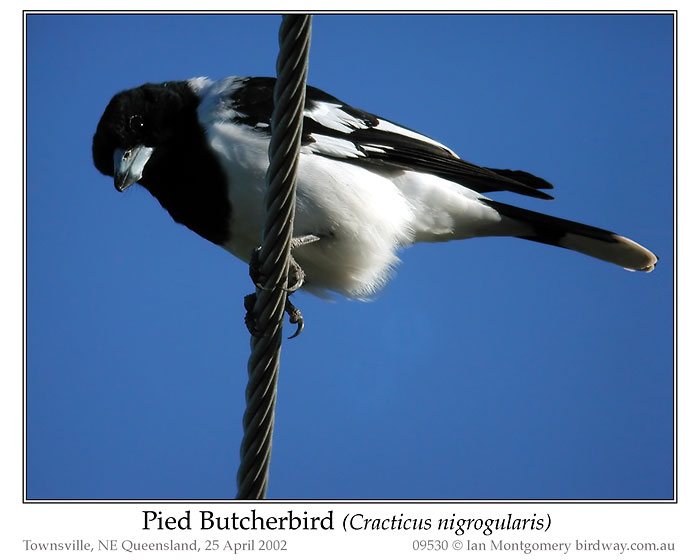
Pied Butcherbird (Cracticus nigrogularis) by Ian

On the subject of mimicry, I had an email from Rose Bay in Sydney recounting a conversation that took place between a Grey Butcherbird and the correspondent, thank you Jeremy, who whistled in response, over several months. The bird remained hidden and unidentified in foliage until a couple of weeks ago when, during such a talk, he spotted the bird and the mystery was solved. I’ve accompanied a Pied Butcherbird here in Bluewater on the treble recorder. I checked their vocal range using a pitch analyser on sound recordings and found that the mellow notes were close to middle C (C4), while the top notes were around D6, two octaves above middle C; an impressive range.

Pied Butcherbird (Cracticus nigrogularis) by Ian

And, yes, they do prey on small birds, mammals, reptiles and invertebrates and will even hunt in unison with Australian Hobbies. They get their name from their habit of wedging larger prey items in a fork in a tree (or clothes line) so that they can dismember it. If you think that sounds macabre, go and listen to Berlioz’s Symphonie Fantastique again, imagining the idée fixé played by a Pied Butcherbird, particular the rendering of it in the third movement on the oboe and by the clarinet in the fourth Marche au supplice. The latter appears briefly before the fall of the guillotine. I tried playing the first of the YouTube videos simulaneously with the third movement a short while ago and the result is, well, fantastic.

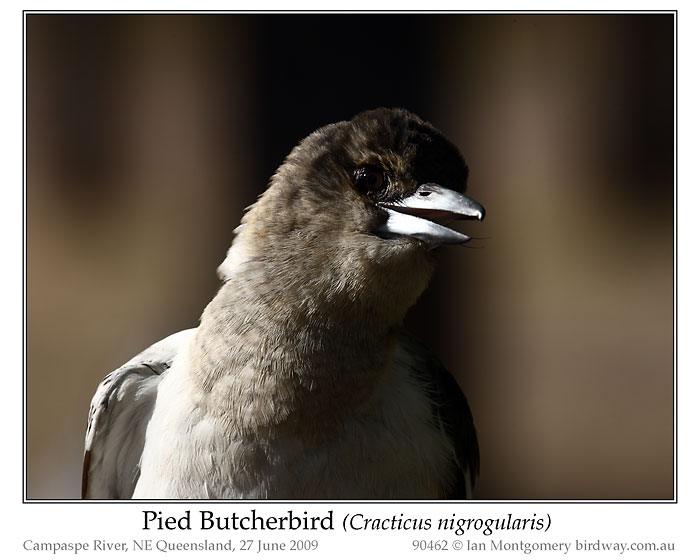
Pied Butcherbird (Cracticus nigrogularis) by Ian

Anyway, back to family matters. Pied Butcherbirds have group territories similar to those of their cousins the Australian Magpies with usually one breeding pair. The female does all the hard work of building the nest and incubating the eggs while, the male, presumably, sings. The other members of the group, usually offspring from earlier broods, do help to feed the young.

I should, I suppose, mention the photos. The first three are of adult birds, the last two of brownish immature birds. At 32-36cm/12.5-14in in length the Pied Butcherbird is intermediate between the smaller Grey and Black-backed Butcherbirds and the larger Black Butcherbird. The Pied Butcherbird occurs through most of mainland Australia, but is absent from very arid regions, most of South Australia and Victoria, and southeastern New South Wales. Here in the northeast Queensland, they show a preference for watercourses.

PAS-Arta Pied Butcherbird (Cracticus nigrogularis) by Ian 5

The bird of the week has been going out regularly, if not weekly, since late 2002. I have copies of almost all of them and I’ve decided to publish them as an electronic book under the umbrella “A Bird Photographer’s Diary”. At the moment, I’m progressing steadily through the second quarter of 2006, and I’m having great fun reliving all the experiences and places involved. The intention is to add photos of the various locations and habitats. I’ll keep you posted.

Greetings and sweet sounds,
Ian

**************************************************
Ian Montgomery, Birdway Pty Ltd,
454 Forestry Road, Bluewater, Qld 4818
Tel 0411 602 737 ian@birdway.com.au
Bird Photos http://www.birdway.com.au/
Where to Find Birds in Northern Queensland: iTunesGoogle Play Kobo Books
Recorder Society http://www.nqrs.org.au


Lee’s Addition:

The flowers appear on the earth; the time of the singing [of birds] has come, and the voice of the turtledove is heard in our land. (Song of Solomon 2:12 AMP)

Wow! What an amazing article about these birds and the videos only enhance it more. I especially like the them singing duet. Ian finds us the most interesting birds to see and hear. Thanks, Ian.

Check out Ian’s Butcherbirds in his Artamidae Family

Ian’s Bird of the Week

Artamidae – Woodswallows, butcherbirds and allies Family

Wordless Birds

*


5 Day Black and White Photo Challenge #3 – Galah

Galah (Eolophus roseicapilla) and Dan at Brevard Zoo BW

Beloved, do not be surprised at the fiery ordeal among you, which comes upon you for your testing, as though some strange thing were happening to you; (1 Peter 4:12 NASB)

There are only two rules for this challenge:

1. On 5 consecutive days, create a post using either a past or recent photo in B&W.
2. Each day invite another blog friend to join in the fun.

My third nomination is Through Open Lensbecause he is a great photographer and has some stunning photos. The articles are short, but informative. An all around variety of nature.

Again, I was nominated by Our Rumbling Ocean, and I nominated AussieBirder, Sukanya Ramanujan and now Through Open Lens. Please check out all of these fine sites.

(Couldn’t resist turning my favorite photo of Dan into Black and White)

*

My photos so far for this challenge:

*

Good News

*

Sunday Inspiration – Flycatchers

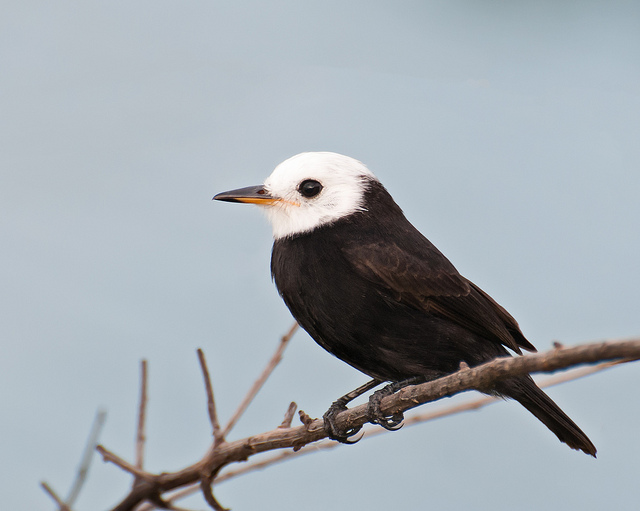
White-headed Marsh Tyrant (Arundinicola leucocephala) Male ©©Dario Sanches

White-headed Marsh Tyrant (Arundinicola leucocephala) Male ©©Dario Sanches

Where the birds build their nests, And the stork, whose home is the fir trees. (Psalms 104:17 NASB)

Last week we saw some of the Tyrant Flycatcher family. This time, with over 400 species, just this family of birds will be featured.

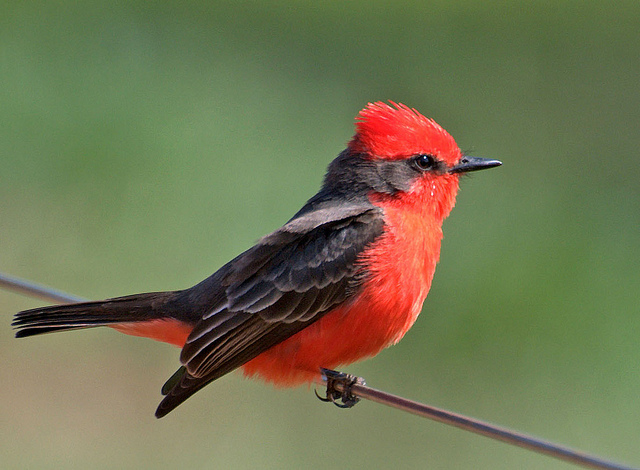
The tyrant flycatchers are birds which occur throughout North and South America. They are considered the largest family of birds, with more than 400 species. They are the most diverse avian family in every country in the Americas, except for the United States and Canada. As could be expected from a family this large, the members vary greatly in shape, patterns, size and colors. Most, but not all, species are rather plain, with various hues of brown, gray and white commonplace. Obvious exceptions include the bright red vermilion flycatcher, blue, black, white and yellow many-colored rush-tyrant and some species of tody-flycatchers or tyrants, which are often yellow, black, white and/or rufous.

Vermilion Flycatcher (Pyrocephalus rubinus) by Dario Sanches

Vermilion Flycatcher (Pyrocephalus rubinus) by Dario Sanches

The smallest family members are the closely related short-tailed pygmy tyrant and black-capped pygmy tyrant. These species reach a total length of 6.5–7 cm (2.5–2.8 in) and a weight of 4–5 grams. By length, they are the smallest passerines on earth, although some species of Old World warblers apparently rival them in their minuscule mean body masses if not in total length. The minuscule size and very short tail of the Myiornis pygmy tyrants often lend them a resemblance to a tiny ball or insect. The largest tyrant flycatcher is the great shrike-tyrant at 29 cm (11.5 in) and 99.2 grams (3.5 oz).

Please enjoy watching a slideshow of some more of the Lord’s neatly created birds as you listen our orchestra and then the choir sing.

This slideshow requires JavaScript.

*

Click to listen:

“Amazing Grace” – Orchestra and “I Love You, Written in Red” – Choir (Faith Baptist Church)

(Because there are so many birds there are two inspirations. More of this bird family were shown in Sunday Inspiration – Everlasting God)

*

Sunday Inspirations
Tyrannidae – Tyrant Flycatchers Family
Good News

*

5 Day Black and White Photo Challenge #2 – Woody

Wood Duck Brevard Zoo 120913 by Lee BW

Wood Duck Brevard Zoo 120913 by Lee BW

Neither shalt thou swear by thy head, because thou canst not make one hair white or black. (Matthew 5:36 KJV)

There are only two rules for this challenge:

1. On 5 consecutive days, create a post using either a past or recent photo in B&W.
2. Each day invite another blog friend to join in the fun.

My second nomination is Sukanya Ramanujanbecause she accepted the challenge and she has great photos. She is from Chennai, India (Same town a j mithra was from) She is a “multi-lingual professional with varied interests such as reading, travelling, music and photography.” Also check out her photos.

Again, I was nominated by Our Rumbling Ocean, and I nominated AussieBirder and now Sukanya Rananujan. Please check out both of these fine sites.

*

My photos so far for this challenge:

*

Good News

*


5 Day Black and White Photo Challenge #1 – Drying Out

Anhinga (Anhinga anhinga) Female at Vierra Wetlands By Dan'sPix B-W

Anhinga (Anhinga anhinga) Female at Vierra Wetlands By Dan’sPix B-W

There are only two rules for this challenge:

1. On 5 consecutive days, create a post using either a past or recent photo in B&W.
2. Each day invite another blog friend to join in the fun.

My first nomination is AussieBirderbecause their purpose is for “the appreciation of Australian birds and the love of birdwatching, sharing bird sightings, photographs, personal experiences and helpful information.” That pretty well sums up their purpose and feel they are up to the challenge.

I am thankful to Our Rumbling Ocean for nominating me. They live on the East Coast of South Africa and have lots of nature photos, plus an adorable son, Boeta. I enjoy following their adventures.

Like the heat of summer in a dry land, the angry shouts of those foreigners brought us to our knees. But like a thick cloud that blocks the summer heat, you answered their challenge. (Isaiah 25:5 ERV)

(I converted one of Dan’s great Anhinga photos)

AussieBirder

Our Rumbling Ocean

Dan’s Pix

*

Good News

*

Winter Willow Ptarmigan

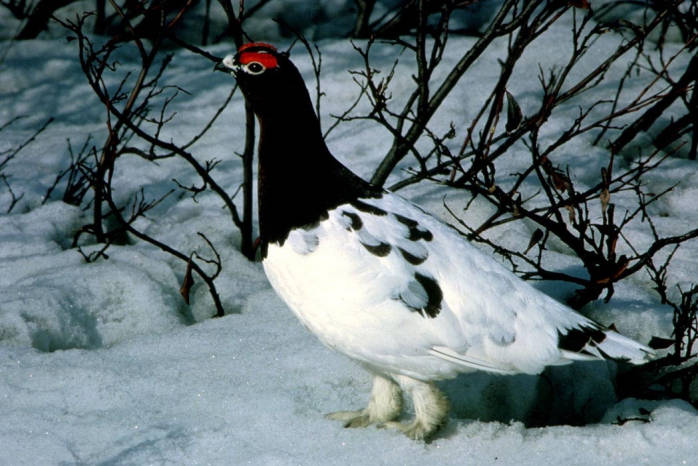
Willow Ptarmigan (Lagopus lagopus) ©USFWS

Willow Ptarmigan (Lagopus lagopus) ©USFWS

He gives snow like wool; He scatters the frost like ashes; (Psalms 147:16 NKJV)

Let them praise the name of the LORD, For He commanded and they were created. He also established them forever and ever; He made a decree which shall not pass away. Praise the LORD from the earth, You great sea creatures and all the depths; Fire and hail, snow and clouds; Stormy wind, fulfilling His word; (Psalms 148:5-8 NKJV)

Since so much of North America is having such a cold and snowy winter, thought that you might like watching a Willow Ptarmigan in its winter outfit.

Lesley the Bird Nerd produced this YouTube and thought you might enjoy watching how the Lord has prepared this bird to survive in winter.

We are going to drop down to freezing the for a few nights here in Central Florida, but nothing like what many of you are experiencing. Stay warm and enjoy the Lord’s Creations.

God thunders marvelously with His voice; He does great things which we cannot comprehend. For He says to the snow, ‘Fall on the earth’; Likewise to the gentle rain and the heavy rain of His strength. He seals the hand of every man, That all men may know His work. (Job 37:5-7 NKJV)

The willow ptarmigan (Lagopus lagopus) is a bird in the grouse subfamily Tetraoninae of the pheasant family Phasianidae. It is also known as the willow grouse and in the British Isles, where it was previously believed to be a separate species, as the red grouse. It is a sedentary species, breeding in birch and other forests and moorlands in northern Europe, the tundra of Scandinavia, Siberia, Alaska and northern Canada, in particular in the provinces of Newfoundland and Labrador. It is the state bird of Alaska. In the summer the birds are largely brown, with dappled plumage, but in the winter they are white with some black feathers in their tails (British populations do not adopt a winter plumage). Nesting takes place in the spring when clutches of four to ten eggs are laid in a scrape on the ground. The chicks are precocial and soon leave the nest and while they are young, both parents play a part in caring for them. The chicks eat insects and young plant growth while the adults are completely herbivorous, eating leaves, flowers, buds, seeds and berries during the summer and largely subsisting on the buds and twigs of willow and other dwarf shrubs and trees during the winter. (Wikipedia)

*

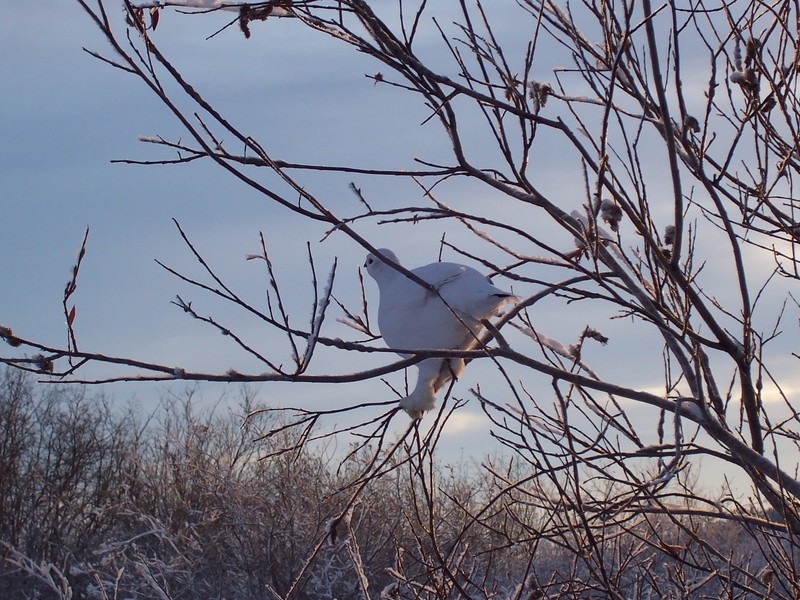
Willow Ptarmigan (Lagopus lagopus)  Winter ©WikiC

Willow Ptarmigan (Lagopus lagopus) Winter ©WikiC

Willow Ptarmigan – State of Alaska with videos

Willow Ptarmigan – All About Birds

Willow Ptarmigan – Wikipedia

Willow Ptarmigan – Kidzone

Phasianidae – Pheasants, Fowl & Allies Family

Wordless Birds

*