Double-crested Cormorant (Phalacrocorax auritus) by Lee at Honeymoon Is SP
The birds of the air, And the fish of the sea That pass through the paths of the seas. O LORD, our Lord, How excellent is Your name in all the earth! (Psalms 8:8-9 NKJV)
We just got back from another birdwatching trip. This time we birded the Honeymoon Island State Park and MacDill AFB beach. Was gone overnight and have many photos to prep. Here are just a few photos for now.
These Double-crested Cormorants were just sitting along the Gulf shore and one was sleeping. They seem to be tired and may have decided to stay on shore because of Hurricane Arthur’s bands of rain that kept sweeping the area the last two days. A man walked between the two and they didn’t even move.
Grey Kingbird (Tyrannus dominicensis) by Lee at Honeymoon Is SP
This photo of a Kingbird, which is the best shot I have ever had of one, was also at the state park. (Actually, just checked, these are the only ones I have taken of Grey Kingbirds. This was a LIFE BIRD for me. Yeah!)
Today, July 4th, we checked out the shore on Tampa Bay at the base. The birds were few, but enough to give us a chance to get some photos. Without so many species, maybe I’ll be able to ID them. My ID’s of shorebirds is still weak. I will pouring be over my bird books again. Praise the Lord for bird books. (I still think the Lord should have hung tags on them.)
Trust those of us celebrating the Fourth have had a good day. We have!
I know all the birds of the mountains (and Lake Morton) , And the wild beasts of the field are Mine. (Psalms 50:11 NKJV)
We finally had a chance to take a short birdwatching adventure to Lake Morton over in Lakeland. I have been battling a cold and cough for the last three weeks. Our trips to Lake Morton don’t require much walking and it is one of the few places that people feed the birds.
When someone parks their car, before they can get across the street, the birds start walking towards them. Needless to say, the birds are expecting something.
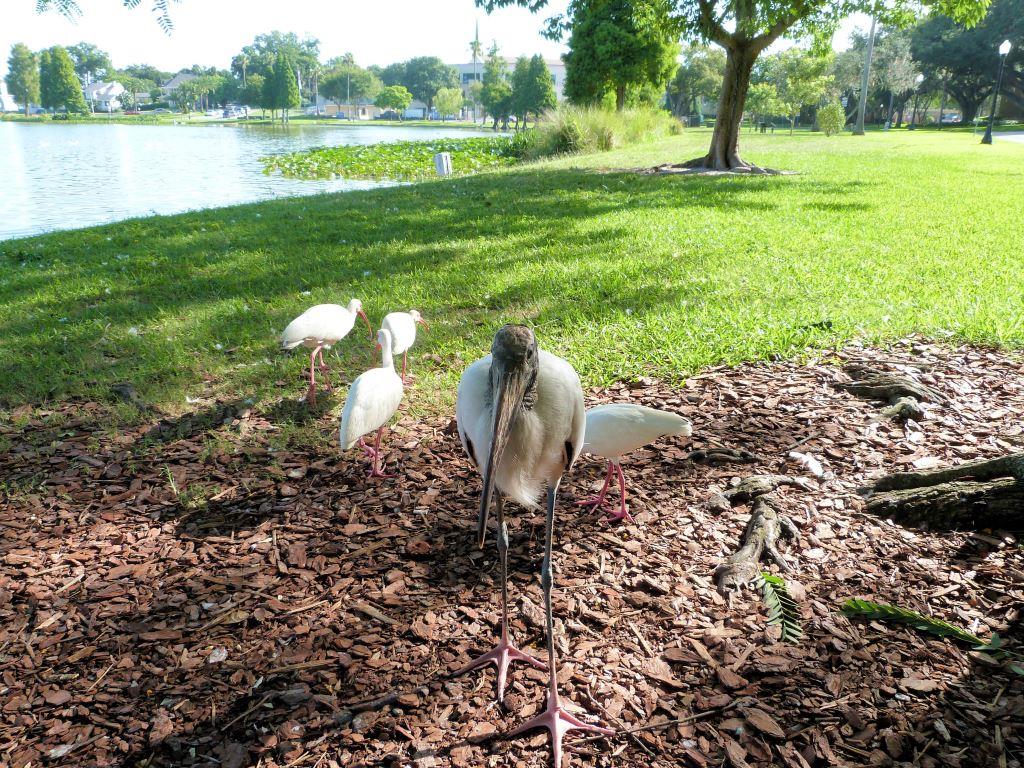
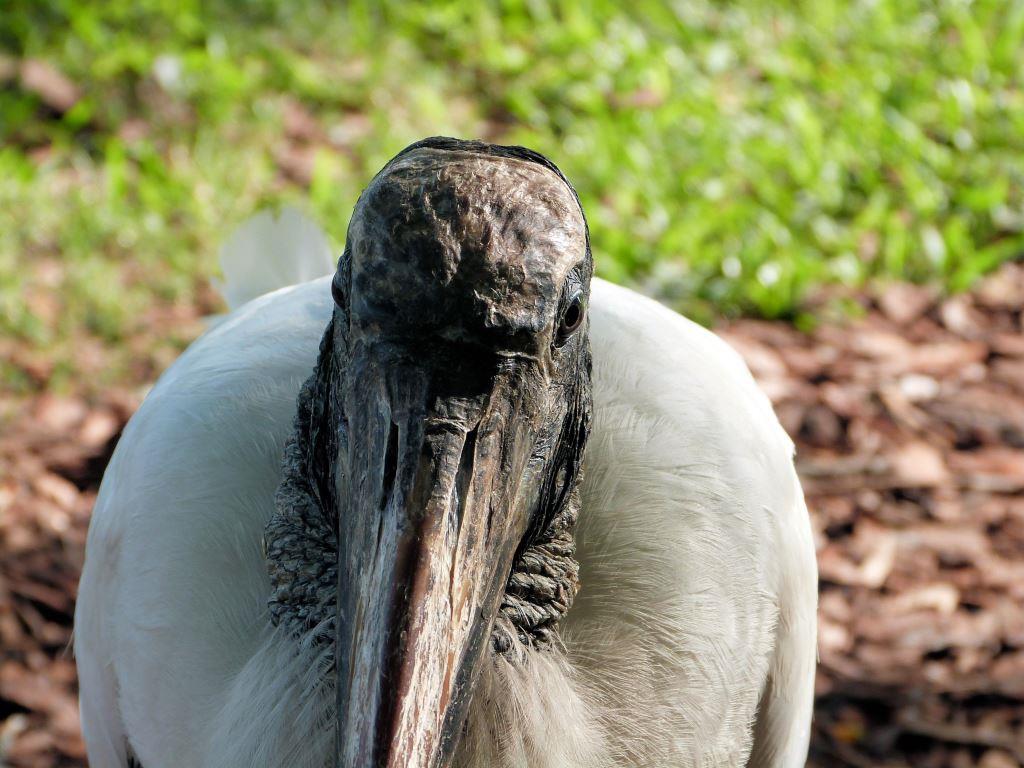
Wood Stork up close by Lee at Lake Morton
As I was walking across the street, here they came; Wood Stork in the lead because of its long legs, White Ibises next, followed by the waddling shorter legged birds – Mute Swans, Mallards, Muscovy Duck and then the fly-ins – Boat-tailed Grackles and the Gulls. The Wood Stork met me at the curb.
Of course when you have a treat for them, you become the “Pied Piper.” Apparently, someone must have recently fed them, because they were gathered loosely together. Once I got to the table and sat down, the group gathered around. I was enjoying them so much, I didn’t take many photos then.
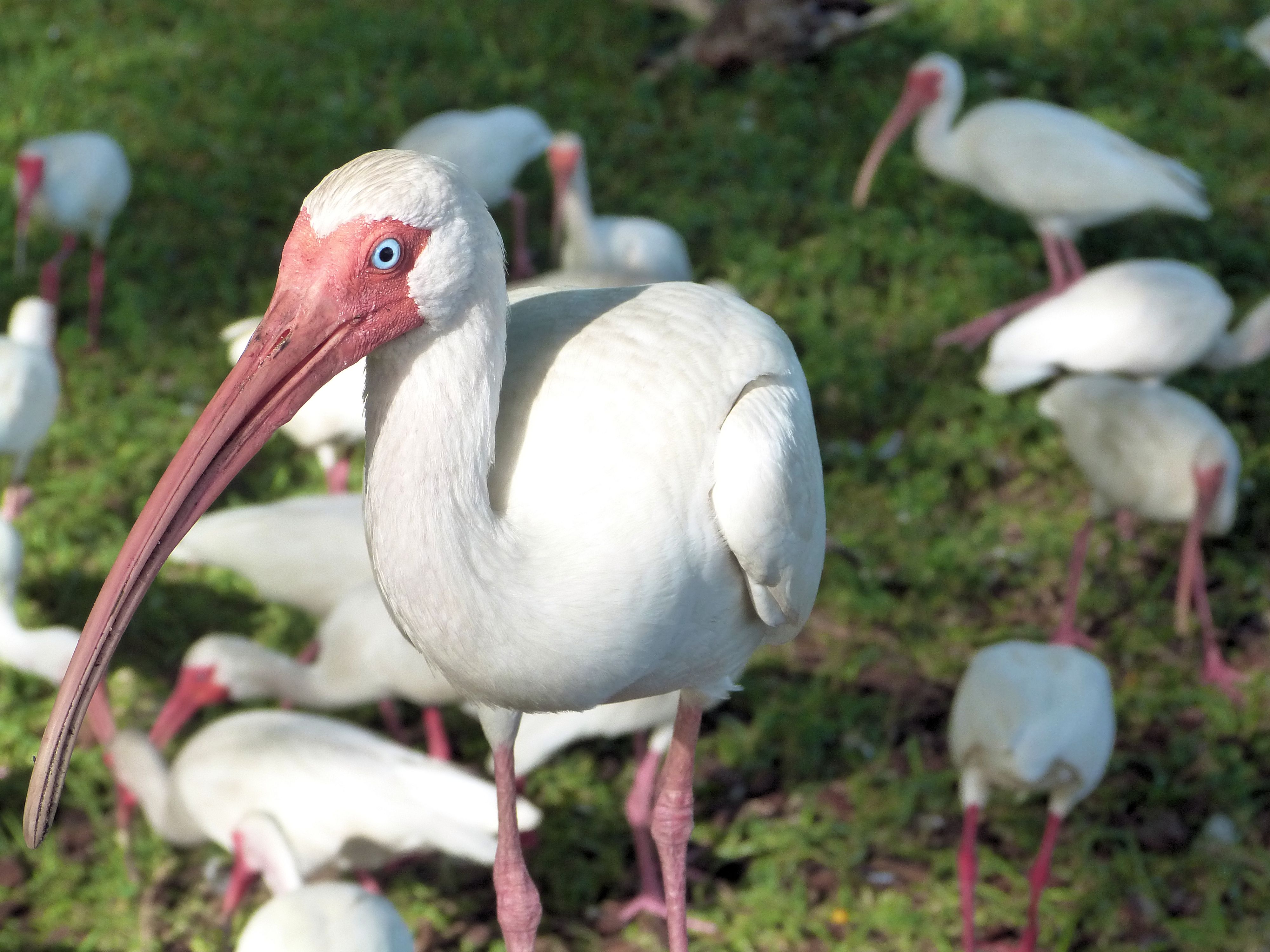
American White Ibis on Table by Lee
Once the food gave out, of which I didn’t have much to begin with, they moseyed off to rest in the shade until the next visitor with a bag of goodies came. One White Ibis hopped upon the table behind me, but too late because the bag was empty. Took its photo, but it was almost too close.
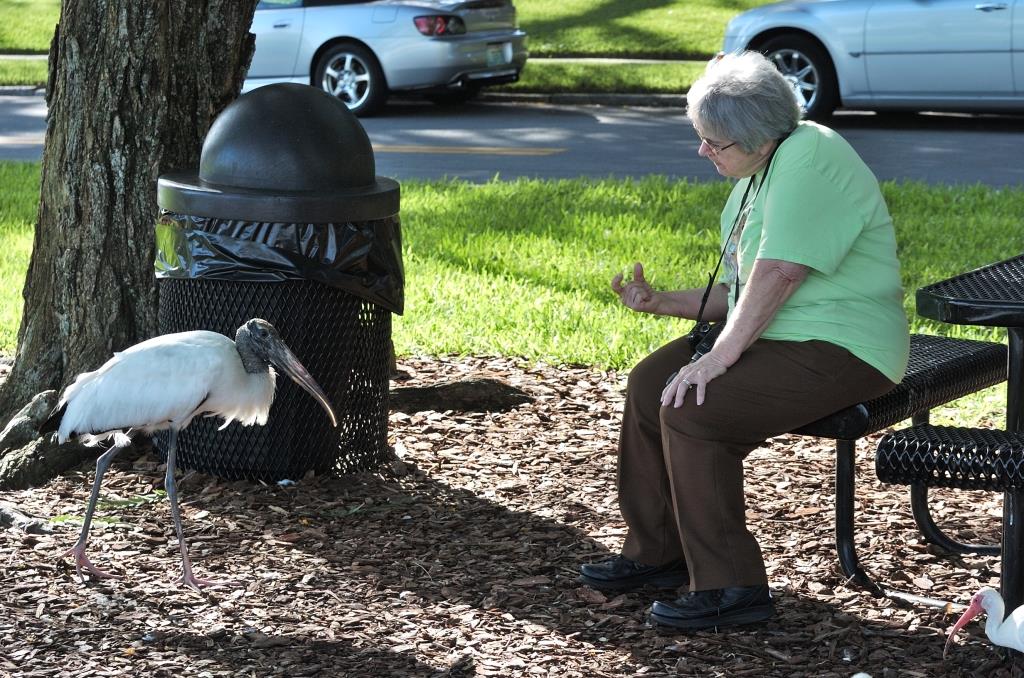
Woodstork & Lee by Dan at Lake Morton
One of the resident Wood Storks walked up in front of me and stood there. I reassured him that I had nothing else, but he (or she) just stayed there. I started talking to it, motioned to come closer, and it did. I could have reached out and touched the Wood Stork, but chose not to with that long beak. Have you ever heard a Wood Stork’s beak “snap” when it grabs food? It is loud. No, I like my fingers!
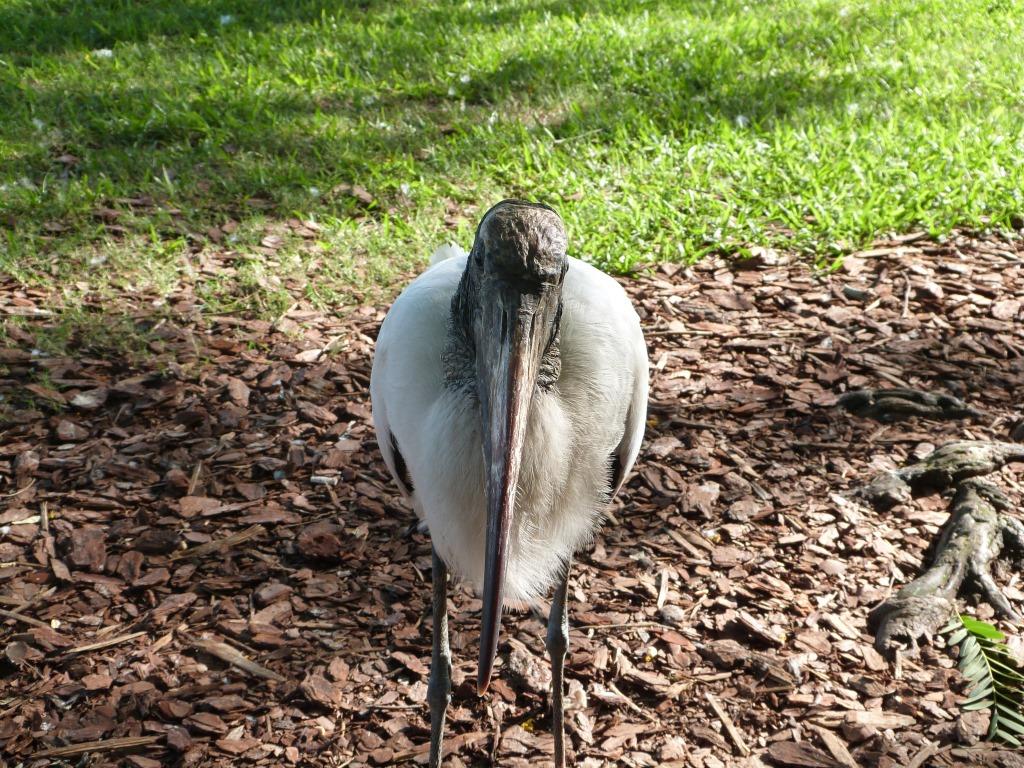
Wood Stork close-up by Lee at Lake Morton
We sat face to face for about 4 minutes of so; me talking and him just standing there looking at me.
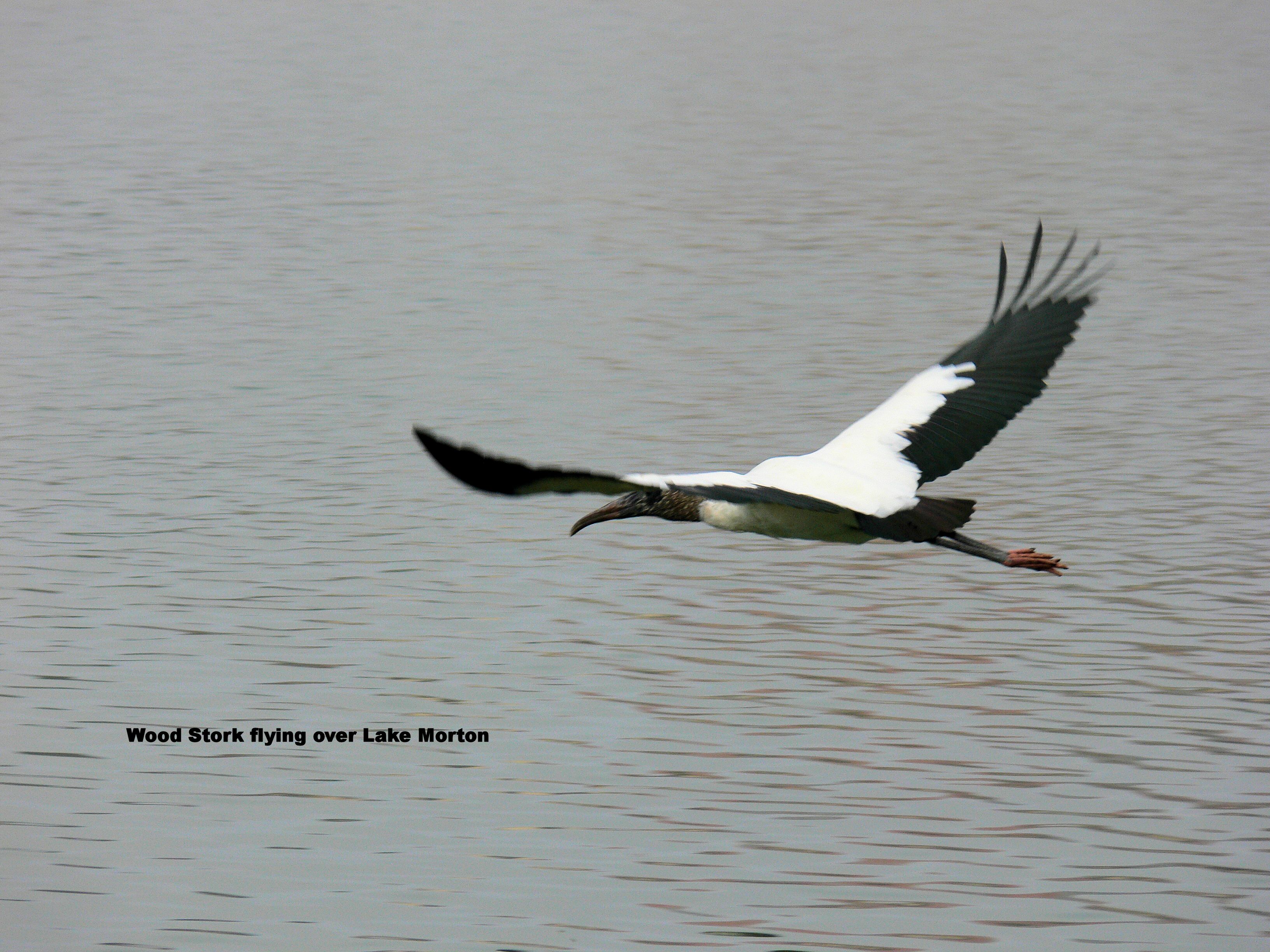
Even though they are “ugly,” they are really neat. Have you ever seen a Wood Stork in the air? They are so beautiful and graceful, but up this close? I assured him that the Lord had created him and that He makes no mistakes.
Great is our Lord, and mighty in power; His understanding is infinite. (Psalms 147:5 NKJV)
Wood Stork flying over Lake Morton by Lee 2009
The wings of the ostrich wave proudly, But are her wings and pinions like the kindly stork’s? (Job 39:13 NKJV)
Even the sparrow finds a home, and the swallow a nest for herself, where she may lay her young, at your altars, O LORD of hosts, my King and my God. Blessed are those who dwell in your house, ever singing your praise! Selah. (Psalms 84:3-4 ESV)
I know we used the Sparrows before with an orchestra playing “His Eye Is On The Sparrow, but this special by Kathy Lisby from Faith, is so good, I just have to share it.
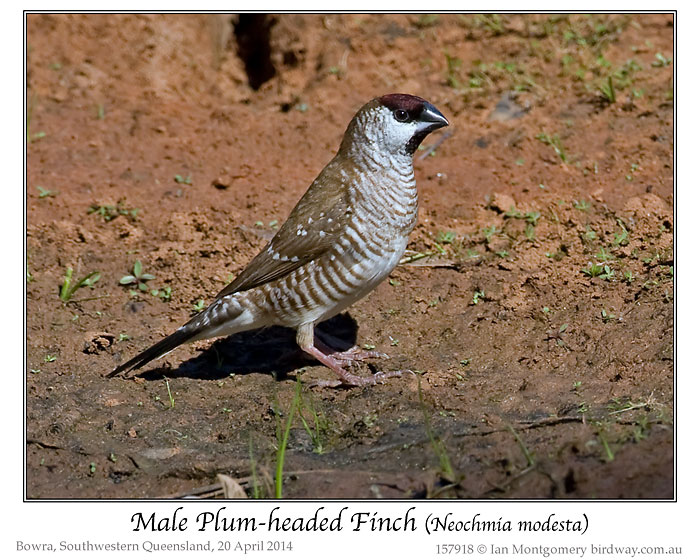
Ian’s Bird of the Week – Plum-headed Finches ~ by Ian Montgomery
Newsletter – 6-28-14
Bird of the week numbering has been a bit wonky lately, two #502s, no #503 to compensate, and two #504s and the one previous to this, Halls Babbler was #506 and should have been #507. Hopefully, we are back on track now with #508, the Plum-headed Finch. One of my favourite methods of bird photography is to relax by a water-hole in a comfortable camping chair and see what comes along. I did this at Bowra in April, and was treated to several pairs of Plum-headed Finches, presumably breeding as a result of rain several weeks earlier.
The ‘plum’ bit refers to the gorgeous cap, dark and extensive in the male, above, or paler and less extensive in the female, which has consequently space for a white eye-stripe. Males have black chins, females white ones. The specific modesta presumably refers to the understated colours, but I think the barred breast and flanks make them look very smart, and it’s always a pleasure to see them.
The genus Neochmia contains only three other species, all of them Australian: Star, Red-browed and Crimson Finches, and none barred, so the Plum-headed looks quite distinctive. In the past it has been placed in its own genus, but mitochondrial studies show that it’s quite closely related to both the Star and Red-browed Finches.
They have quite a widespread distribution in Queensland and New South Wales, but mainly inland and rather patchy. With an average length of 11cm/4.3in, they’re quite small. They’re popular as cage birds and used to be trapped a lot, but have been protected since 1972.
The bird in the fourth photo was photographed in the light of the setting sun, hence the lovely glow. I’ve been on the road for a few days taking (almost) the last location photos for Where to Find Birds in Northeastern Queensland so I’ll keep this short. One more day trip along the inland route to Paluma, and that’s it.
Also, to every beast of the earth, to every bird of the air, and to everything that creeps on the earth, in which there is life, I have given every green herb for food”; and it was so. (Genesis 1:30 NKJV)
What a neat looking Finch, Ian. Thanks again for sharing with us. Plum-headed Finches belong to the Estrildidae – Waxbills, Munias & Allies Family which has 141 species.
Then God said, “Let the waters abound with an abundance of living creatures, and let birds fly above the earth across the face of the firmament of the heavens.” (Genesis 1:20 NKJV
What a fantastic video – WOW! It is a bit long, but worth every minute of it. This is the 2nd one. See Part I How can anyone watch these birds flying and not realize they have a fantastic Creator? This was produced by Wittydud on YouTube *
I know all the birds of the mountains, And the wild beasts of the field are Mine. (Psalms 50:11 NKJV)
Then God said, “Let the waters abound with an abundance of living creatures, and let birds fly above the earth across the face of the firmament of the heavens.” (Genesis 1:20 NKJV
What a fantastic video – WOW! It is a bit long, but worth every minute of it.
How can anyone watch these birds flying and not realize they have a fantastic Creator?
who teaches us more than the beasts of the earth and makes us wiser than the birds of the heavens?’ (Job 35:11 ESV)
Orni-Theology
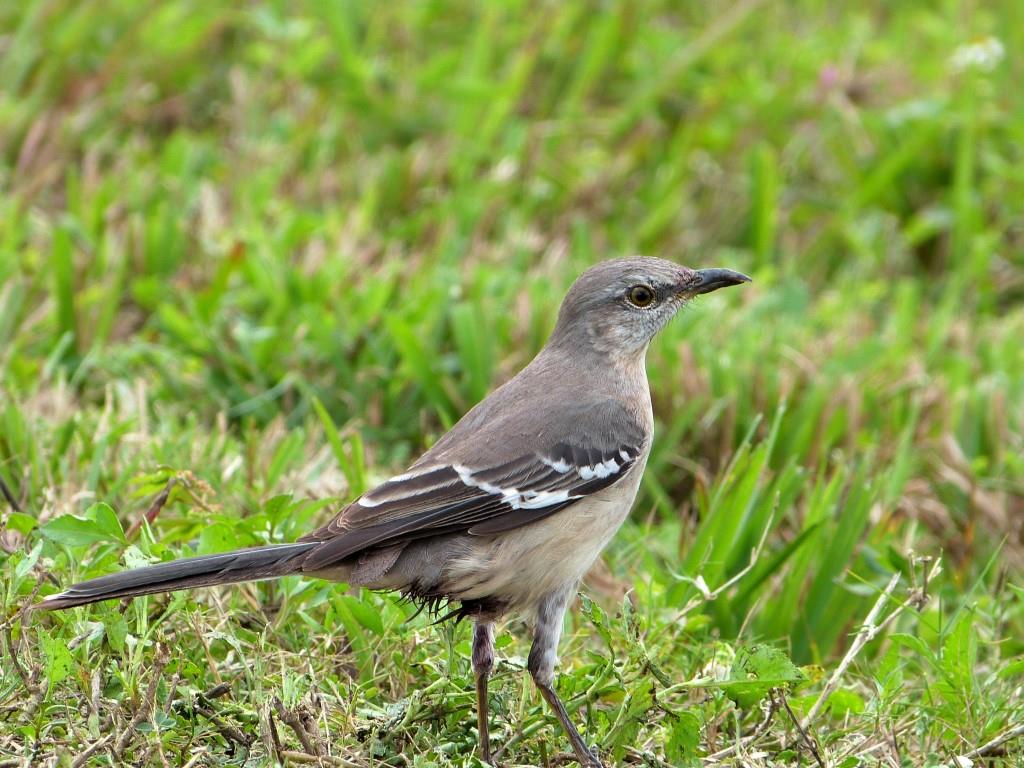
Recently.a friend was telling me about a bird that has been singing every night. He said that it begins around 3 AM and continues for hours. He was frustrated by the bird’s behavior. After discussing it, we came to the conclusion that it is a Northern Mockingbird. They have one with a nest in their yard.
We used to have one that had a nest in the bush outside our bedroom window when we lived in south Florida. Whenever the babies were born, our Mockingbird started its “songs in the night.” The songs are pleasant, but in the middle of the night, the urge to throw a pillow out the window sounds tempting.
Northern Mockingbirds are members of the Mimidae – Mockingbirds, Thrashers Family. They are the only Mockingbird in North America and are the state bird in Arkansas, Florida, Mississippi, Tennessee and Texas, and formerly the state bird of South Carolina. They are omnivore, meaning it eats fruits and insects.
The Northern Mockingbird is a medium-sized mimid that has long legs and tail. Both males and females look alike. Its upper parts are colored gray, while its underparts have a white or whitish-gray color. It has parallel wing bars on the half of the wings connected near the white patch giving it a distinctive appearance in flight. The iris is usually a light green-yellow or a yellow, but there have been instances of an orange color. The bill is black with a brownish black appearance at the base. The juvenile appearance is marked by its streaks on its back, distinguished spots and streaks on its chest, and a gray or grayish-green iris. Northern Mockingbirds measure from 8.1 to 11.0 in (20.5 to 28 cm) including a tail almost as long as its body.
Although many species of bird imitate the vocalizations of other birds, the Northern Mockingbird is the best known in North America for doing so. It imitates not only birds, but also other animals and mechanical sounds such as car alarms. As convincing as these imitations may be to humans, they often fail to fool other birds. (Wikipedia with editing)
Northern Mockingbird Viera Wetlands by Lee
What is interesting about the Bible verse above is that the verse has been used many times before, but I have not used the previous verse. Here are the two verses together.
But no one says, ‘Where is God my Maker, Who gives songs in the night, Who teaches us more than the beasts of the earth, And makes us wiser than the birds of heaven?’ (Job 35:10-11 NKJV)
God our Maker and the Lord our Savior gives us songs in the night when all is well. Apparently, the Mockingbird is happy or joyful as he sings his songs in the night. We can learn from the songster of the night.
Looking at other verses, what can cause us to not have songs in the night?
The LORD will command His lovingkindness in the daytime, And in the night His song shall be with me— A prayer to the God of my life. (Psalms 42:8 NKJV)
Are we praying and staying in communication with the Lord? When sin creeps in, the songs stop ringing out.
You shall have a song as in the night when a holy feast is kept, and gladness of heart, as when one sets out to the sound of the flute to go to the mountain of the LORD, to the Rock of Israel. (Isaiah 30:29 ESV)
When we have Communion, our pastor always asks us to make sure our fellowship with the Lord and others is clear. When all is straightened out, then we can have our “feast” (communion) with a clear forgiven spirit.
About midnight Paul and Silas were praying and singing hymns to God, and the prisoners were listening to them, (Acts 16:25 ESV)
Even when circumstances are not what we would like are we still “praying and singing hymns to God”?
Why we should sing night or day:
speaking to one another in psalms and hymns and spiritual songs, singing and making melody in your heart to the Lord, (Ephesians 5:19 NKJV)
Let the word of Christ dwell in you richly in all wisdom, teaching and admonishing one another in psalms and hymns and spiritual songs, singing with grace in your hearts to the Lord. And whatever you do in word or deed, do all in the name of the Lord Jesus, giving thanks to God the Father through Him. (Colossians 3:16-17 NKJV)
In the last blog, the term “Orni-Theology” was introduced. (Orni-theology ~ The Master Carpenter) Since then, an Orni-Theology page has been established. There will be links there to the various articles that will feature some bird or bird characteristics with an application and challenge to principles from the Bible, with verses, that we should be applying to our lives.
Orni-Theology
Also, each article that is of an Orni-Theology category will have this thumbnail attached. (Clicking the thumbnail will take you to the Orni-Theology page)
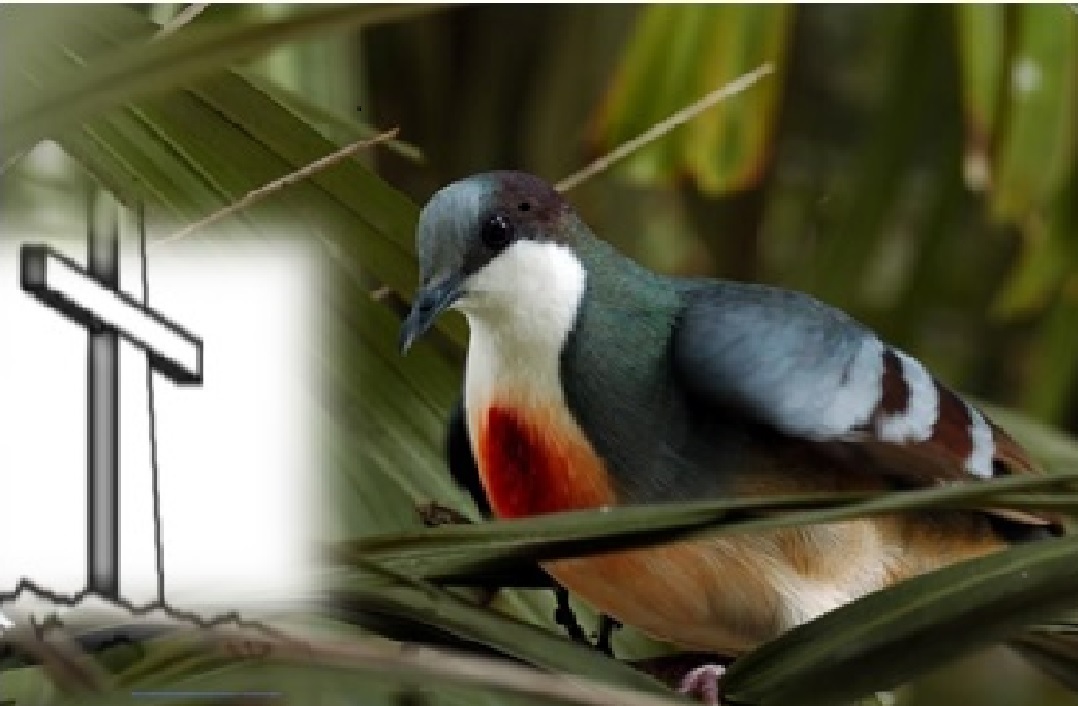
The Luzan Bleeding-heart above was chosen as our theme bird and I blended a cross with the photo. I can think of many illustrations just using that bird.
Wikipedia says, the Luzon Bleeding-heart (Gallicolumba luzonica) is one of a number of species of ground dove in the genus Gallicolumba that are called “bleeding-hearts”. They get this name from a splash of vivid red colour at the centre of their white breasts. The Luzon Bleeding-heart is the species in which this feature is most pronounced, and on first sight it is hard to believe that the bird has not recently been wounded. A reddish hue that extends down the belly furthers the illusion of blood having run down the bird’s front.
The species is endemic to the island of Luzon, Philippines. They eat seeds, berries and grubs. They are shy and secretive, and very quiet, and rarely leave the ground except when nesting. Unlike the other bleeding-hearts, they usually lay two eggs in each clutch.
The article below by Landry mentions that when the birds display, that the male rushes toward the female, stops, lowers his tail and then “throws his breast upwards so that the vivid blood mark is fully presented frontally.” He then bows and coos.
The application this time has to do with its appearance and behavior. Oh, my, where should I begin?
when your heart is lifted up, and you forget the LORD your God who brought you out of the land of Egypt, from the house of bondage; (Deuteronomy 8:14 NKJV)
That verse could indicate that pride was in control and not the Lord. We know that is not good.
These verses could indicate subjection to the Lord. We look to the Lord with our hearts lifted up, but bow in honor to Him.
My defense is of God, Who saves the upright in heart. (Psalms 7:10 NKJV)
The sacrifices of God are a broken spirit, A broken and a contrite heart— These, O God, You will not despise. (Psalms 51:17 NKJV)
I am sure you could come up with many applications also and Luzan Bleeding-heart will most likely be revisited again.
(This is an idea of how these articles will try to honor our Lord’s Fantastically Created birds and challenge us with our own relationship to Him.)
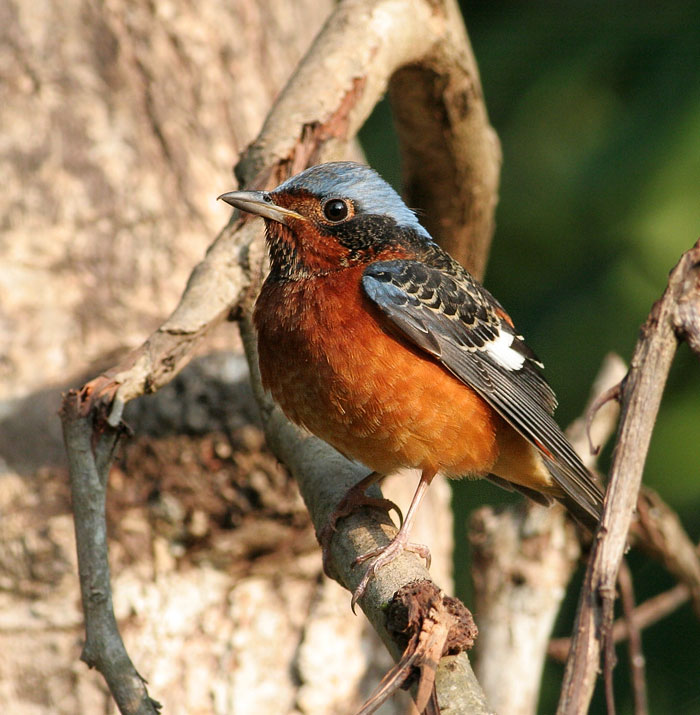
White-throated Rock Thrush (Monticola gularis) by Peter Ericsson
He is the Rock, his work is perfect: for all his ways are judgment: a God of truth and without iniquity, just and right is he. (Deuteronomy 32:4 KJV)
This week we will look at the different “Rock” birds. Many articles have been written about them, but today we get to see their photos.
Of the Rock that begat thee thou art unmindful, and hast forgotten God that formed thee. (Deuteronomy 32:18 KJV)
Our Savior is Our Rock and sure foundation. Scripture mentions numerous purposes of rocks: safety, foundations, hiding places, shadow and other references.
Therefore thus saith the Lord GOD, Behold, I lay in Zion for a foundation a stone, a tried stone, a precious corner stone, a sure foundation: he that believeth shall not make haste. (Isaiah 28:16 KJV)
Nevertheless the foundation of God standeth sure, having this seal, The Lord knoweth them that are his. And, Let every one that nameth the name of Christ depart from iniquity. (2 Timothy 2:19 KJV)
And did all drink the same spiritual drink: for they drank of that spiritual Rock that followed them: and that Rock was Christ. (1 Corinthians 10:4 KJV)
This slideshow requires JavaScript.
*
*
“Hiding in the Shadow of the Rock” ~ Sung by Dr. Richard Gregory (Used with permission)
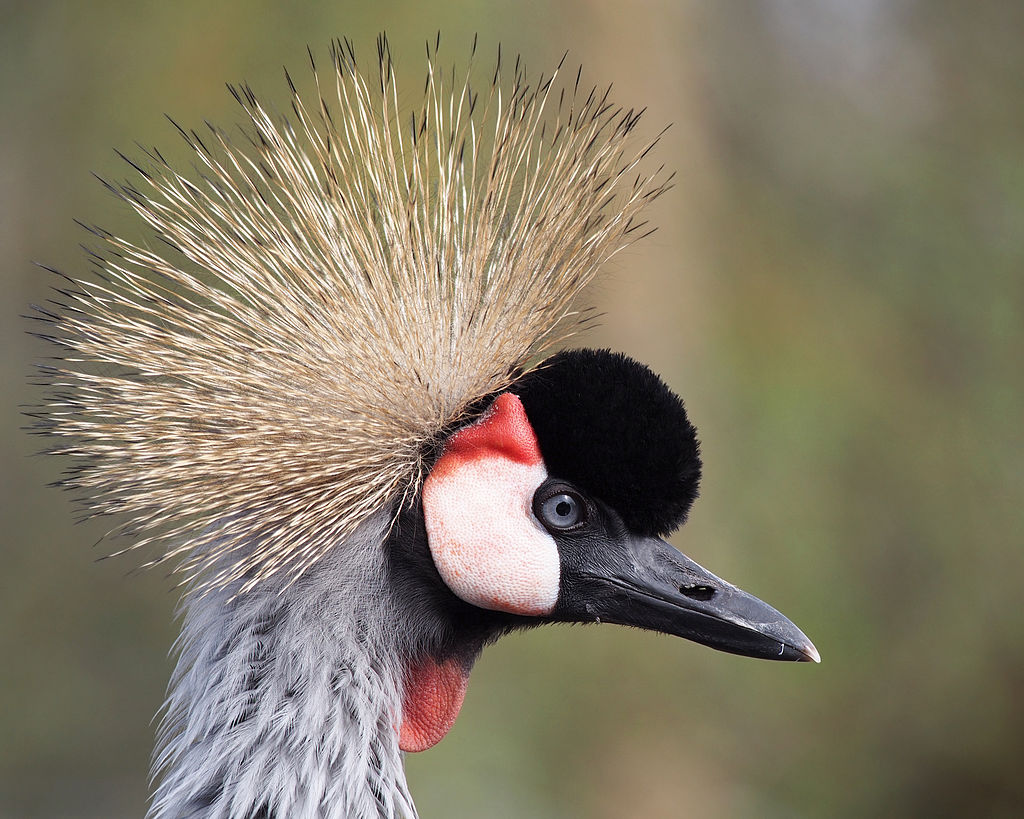
Grey Crowned Crane (Balearica regulorum gibbericeps) Jax Zoo by Lee
Like a crane or a swallow, so did I chatter: I did mourn as a dove: mine eyes fail with looking upward: O LORD, I am oppressed; undertake for me. (Isaiah 38:14 KJV)
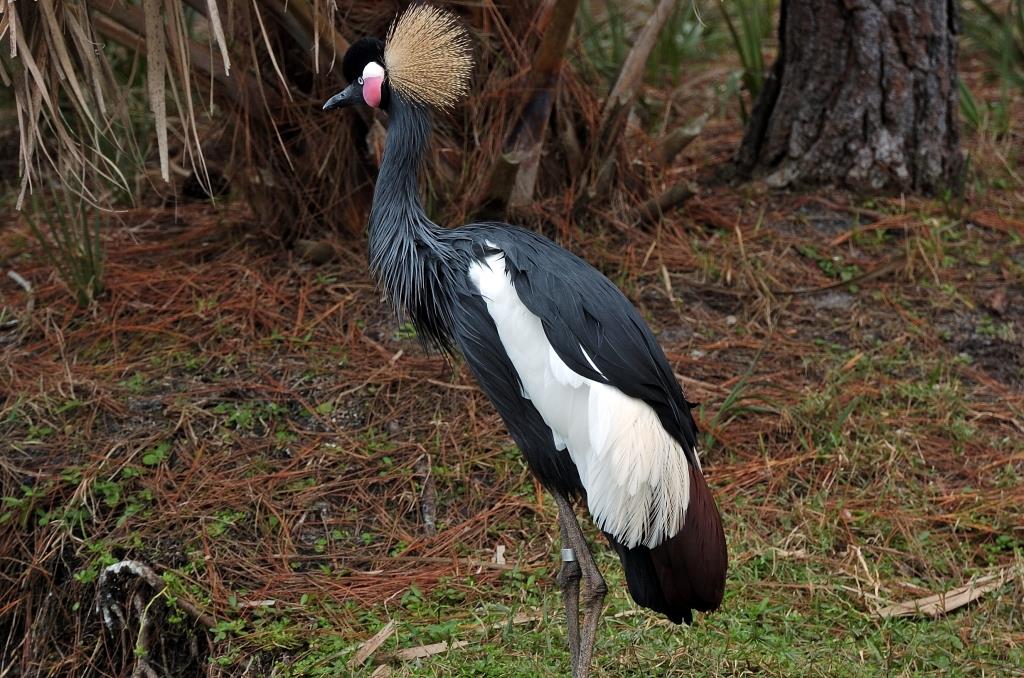
Originally this was going to be about the Grey Crowned Crane at Jacksonville Zoo and other zoos, but the bird genus Balearica (also called the crowned cranes) consists of two living species in the crane family Gruidae: the Black Crowned Crane (B. pavonina) and the Grey Crowned Crane (B. regulorum). The species today occur only in Africa, south of the Sahara Desert, and are the only cranes that can nest in trees. This habitat is one reason why the relatively small Balearica cranes are believed to closely resemble the ancestral members of the Gruidae. Like all cranes, they eat insects, reptiles, and small mammals.
While looking for information, I realized my first impression was incorrect. The Grey Crowned has a grey crown, so while searching our photos the Black Crowned also had the same color crown. At first, I thought I had mislabeled them. Searching Wikipedia, I found these two super photos and decided to share them. You can see that the face is unique in each.
The Black has the red or pink at the bottom of that cheek.
Also, one has a grey neck and the other a black neck. Ahah! That’s where the name comes from. Man names the birds, but God created them and I think it is neat that He helps us identify them. My opinion is that the Lord should have hung name tags on the birds, so that when we have them in our binoculars or scoped we could just read the sign. But God:
Which doeth great things past finding out; yea, and wonders without number. (Job 9:10 KJV)
O the depth of the riches both of the wisdom and knowledge of God! how unsearchable are his judgments, and his ways past finding out! (Romans 11:33 KJV)
There are other things about them, but this was interesting for me. For me, I will have to keep observing and learning. May none of us every get “bored” watching the Lord’s Creations.
Black Crowned Crane (Balearica pavonina pavonina) (West African) by Dan at Brevard Zoo
*
Yea, the stork in the heaven knoweth her appointed times; and the turtle and the crane and the swallow observe the time of their coming; but my people know not the judgment of the LORD. (Jeremiah 8:7 KJV)
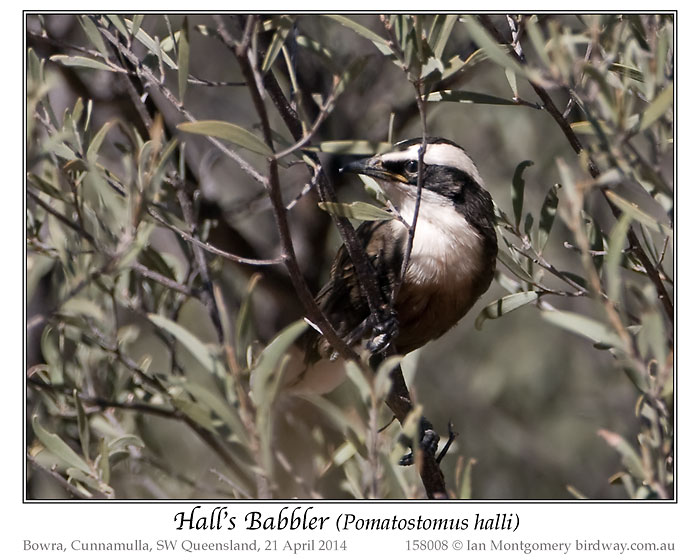
Here is another of the Bowra specialties, Hall’s Babbler, which has a restricted range in dry scrubland in western Queensland north to about Winton and northwestern New South Wales south to about Brewarrina.
If you think it looks just like a White-browed Babbler, you won’t be surprised to hear that it was overlooked as a separate species until 1963 and was first described in 1964. It was named after Harold Hall who funded five controversial bird collecting Australian expeditions in the 1960s and the species was detected, and presumably ‘collected’, on the first of these. It’s larger than the White-browed, 23-25cm/9-10 in length versus 18-22cm/7-9in, is darker overall, has a shorter white bib abruptly shading into the dark belly and a much wider eyebrow. DNA studies suggest that it’s actually more closely related to the Grey-crowned Babbler. It’s voice is described pithily by Pizzey and Knight as ‘squeaky chatterings … lacks “yahoo” of Grey-crowned and madder staccato outbursts of White-browed’. Babblers are clearly birds of great character.
It’s quite common at Bowra in suitable habitat, mainly mulga scrub, and on this occasion we found a party of about 20. Like all Australasian babblers, they’re very social and move erratically through the scrub bouncing along the ground and up into bushes like tennis balls. They’re delightful to watch, and infuriating to photograph as the tangled, twiggy mulga plays havoc with automatic focus – no time for manual – and they keep ducking out of sight. You can be lucky and get ones, like the bird in the second photo, that hesitate briefly, between bounces, in the open to look for food. There had been some good rain a couple of months before our visit, and the birds had been breeding – the one in the third photo with the yellow gape is a juvenile.
Bowra is unusual in that it’s in a relatively small area where the ranges of all four Australian babblers overlap. The other restricted range species, the Chestnut-crowned is at the northern end of its range and also fairly easy to find, while the widespread more northern species, the Grey-crowned, meets the mainly southern White-browed.
I’ve had several emails recently from prominent birders commenting on the excellence of the digital version of Pizzey and Knight. Things they like particularly are the combination of both illustrations and photos (including over 1200 of mine), the great library of bird calls by Fred Van Gessel, portability (phone, tablet and PC), comprehensiveness – all of the more than 900 species recorded in Australia and its territories and ease of generating bird lists by location. The good news is that the price has been reduced to $49.95 and it comes in iPhone/iPad, Android and Windows versions. Go here http://www.gibbonmm.com.au for more information, product tours and links to the appropriate stores, and here http://www.birdway.com.au/meropidae/rainbowbeeeater/source/rainbow_bee_eater_15231.htm to see the photo of the Rainbow Bee-eater below.
My apologies for the delay since the last bird of the week. I’m having a major drive to finish Where to Find Birds in Northeastern Queensland and other things are getting pushed temporarily into the background.
Greetings
Ian
**************************************************
Ian Montgomery, Birdway Pty Ltd,
454 Forestry Road, Bluewater, Qld 4818
Tel 0411 602 737 ian@birdway.com.au
Bird Photos http://www.birdway.com.au/
Recorder Society http://www.nqrs.org.au
Lee’s Addition:
But shun profane and idle babblings, for they will increase to more ungodliness. (2 Timothy 2:16 NKJV)
Here is what a Hall’s Babbler sounds like:
Thanks again Ian for sharing another interesting bird from your part of the world.
I am the LORD, and there is no other; There is no God besides Me…, (Isaiah 45:5 NKJV)
We are in the middle of Vacation Bible School this week and it is difficult to keep up the blog also. We take photos in the morning and then spend time cleaning them up later. (Over 200 photos Monday, plus what Dan took.)
We have been posting 25 or so each day to the Faith Baptist Church Facebook photos – Vacation Bible School 2014.
Monday, a really funny video was posted and want to share it here. This is our own Missions Pastor Pete playing the part of Dr. Grunkenkleiner.
Dr. Grunkenkleiner was demonstrating scientific evidence of things we cannot see at the International Spy Academy VBS.
We can’t see wind, but we can certainly see its effect. Similarly, we cannot see God, but we know He is there.
Look unto me, and be ye saved, all the ends of the earth: for I am God, and there is none else. (Isaiah 45:22 KJV)
VBS 2014
Who is a liar but he who denies that Jesus is the Christ? He is antichrist who denies the Father and the Son. Whoever denies the Son does not have the Father either; he who acknowledges the Son has the Father also. (1 John 2:22-23 NKJV)












 Lee's Birdwatching Adventures Plus